Article

Vulnerability Assessment of Guarani Aquifer Using PESTICIDE-DRASTIC-LU Model: Insights from Brotas Municipality, Brazil


by
João Vitor Guerrero
1,
Alberto Gomes
2,*,
Reinaldo Lorandi
1,
José Augusto Di Lollo
3,
Guilherme Mataveli
4 and
Luiz Eduardo Moschini
1
1
Environmental Sciences Department, Federal University of São Carlos, São Carlos 13565-905, Brazil
2
Geography Department, University of Porto, 4099-002 Porto, Portugal
3
Civil Engineering Department, São Paulo State University, Ilha Solteira 01049-010, Brazil
4
Earth Observation and Geoinformatics Division, National Institute for Space Research, São José Dos Campos 12227-010, Brazil
*
Author to whom correspondence should be addressed.
Water 2024, 16(12), 1748; https://doi.org/10.3390/w16121748
Submission received: 17 May 2024 / Revised: 14 June 2024 / Accepted: 16 June 2024 / Published: 20 June 2024

Abstract

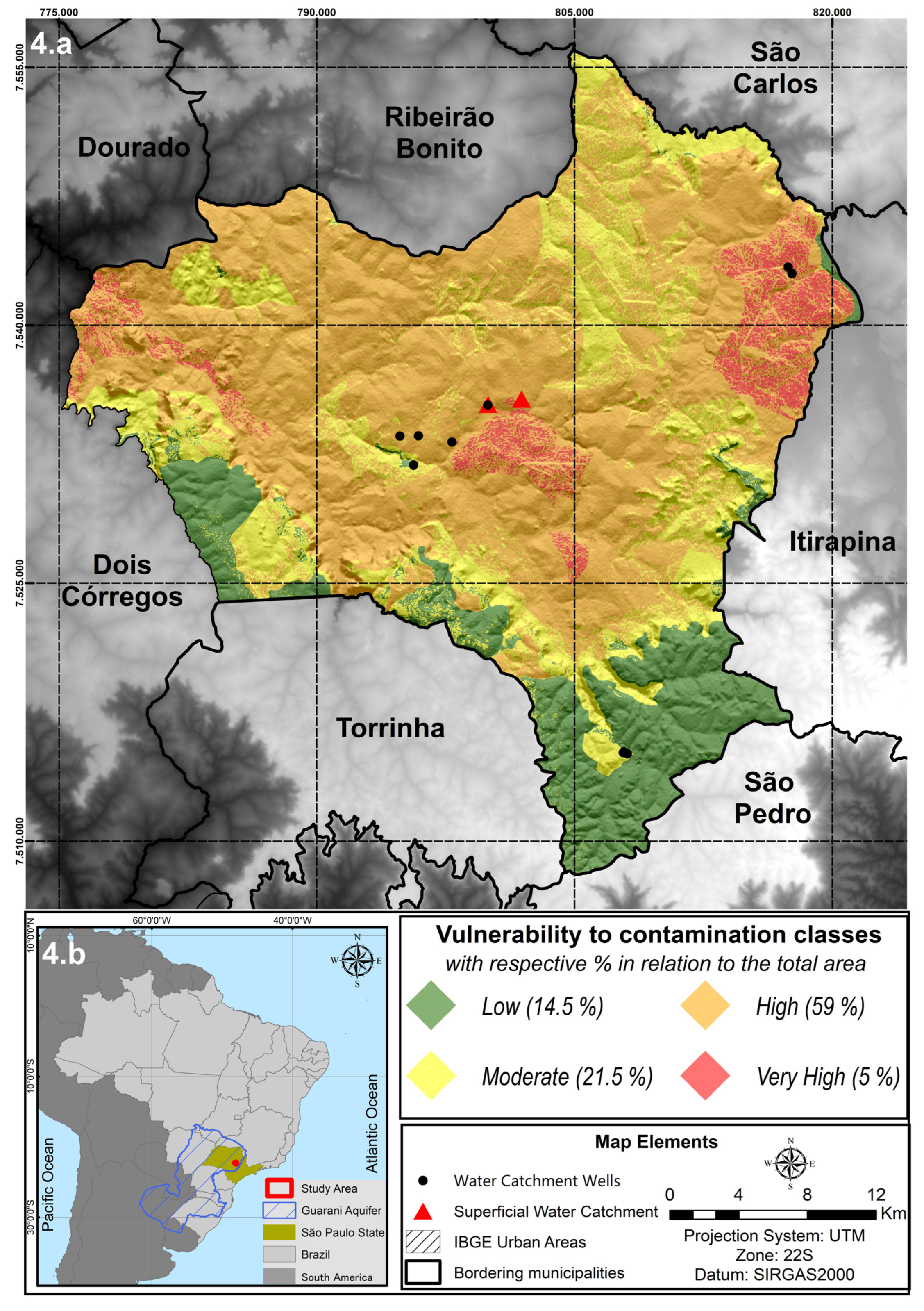
Free aquifers have become an important water supply option for underdeveloped and developing countries, due to the resource quality and relatively low extraction prices. However, overexploitation and the lack of territorial planning guidelines in these areas endanger groundwater availability and quality. In this context, this study aimed to analyze the vulnerability to groundwater contamination and contribute to the conservation of the ecosystem services, provided by the Guarani aquifer in Brotas, Brazil, by applying the PESTICIDE-DRASTIC-LU model. The application of this model allowed the identification of priority conservation areas within the context of ecosystem services that groundwater provides to local inhabitants. To this end, we collected, treated, and analyzed seven different hydrogeological data to understand the environmental dynamics of the system and to identify which areas are most vulnerable to aquifer contamination. The results pointed out that 64% of the study area presents zones of high and very high vulnerability to contamination, due to the local hydrogeological characteristics (sandy soils and rocks) and the various anthropogenic activities, mainly with large plantations of sugar cane and eucalyptus. In addition, the mapping allowed the spatial demonstration of the places that should be considered a priority for the conservation of ecosystem services provided by local groundwater. Thus, our results can serve as a baseline to define public action strategies for the preservation and sustainable management of the Guarani aquifer areas.
Keywords: groundwater; guarani aquifer; environmental dynamics; GIS; sustainable management groundwater; guarani aquifer; environmental dynamics; GIS; sustainable management