Article

Brazilian Annual Precipitation Analysis Simulated by the Brazilian Atmospheric Global Model

by
Caroline Bresciani
1,*,†,
Nathalie Tissot Boiaski
2,†,
Simone Erotildes Teleginski Ferraz
2,†,
Flávia Venturini Rosso
2,
Diego Portalanza
2,
Dayana Castilho de Souza
1,
Paulo Yoshio Kubota
1 and
Dirceu Luis Herdies
1,*
1
Center for Weather Forecasting and Climate Studies (CPTEC), National Institute for Space Research (INPE), Cachoeira Paulista 12630-000, Brazil
2
Department of Physics, Federal University of Santa Maria (UFSM), Santa Maria 97105-900, Brazil
*
Authors to whom correspondence should be addressed.
These authors contributed equally to this work.
Water 2023, 15(2), 256; https://doi.org/10.3390/w15020256
Submission received: 20 November 2022 / Revised: 27 December 2022 / Accepted: 3 January 2023 / Published: 7 January 2023
(This article belongs to the Section Hydrology)

Abstract

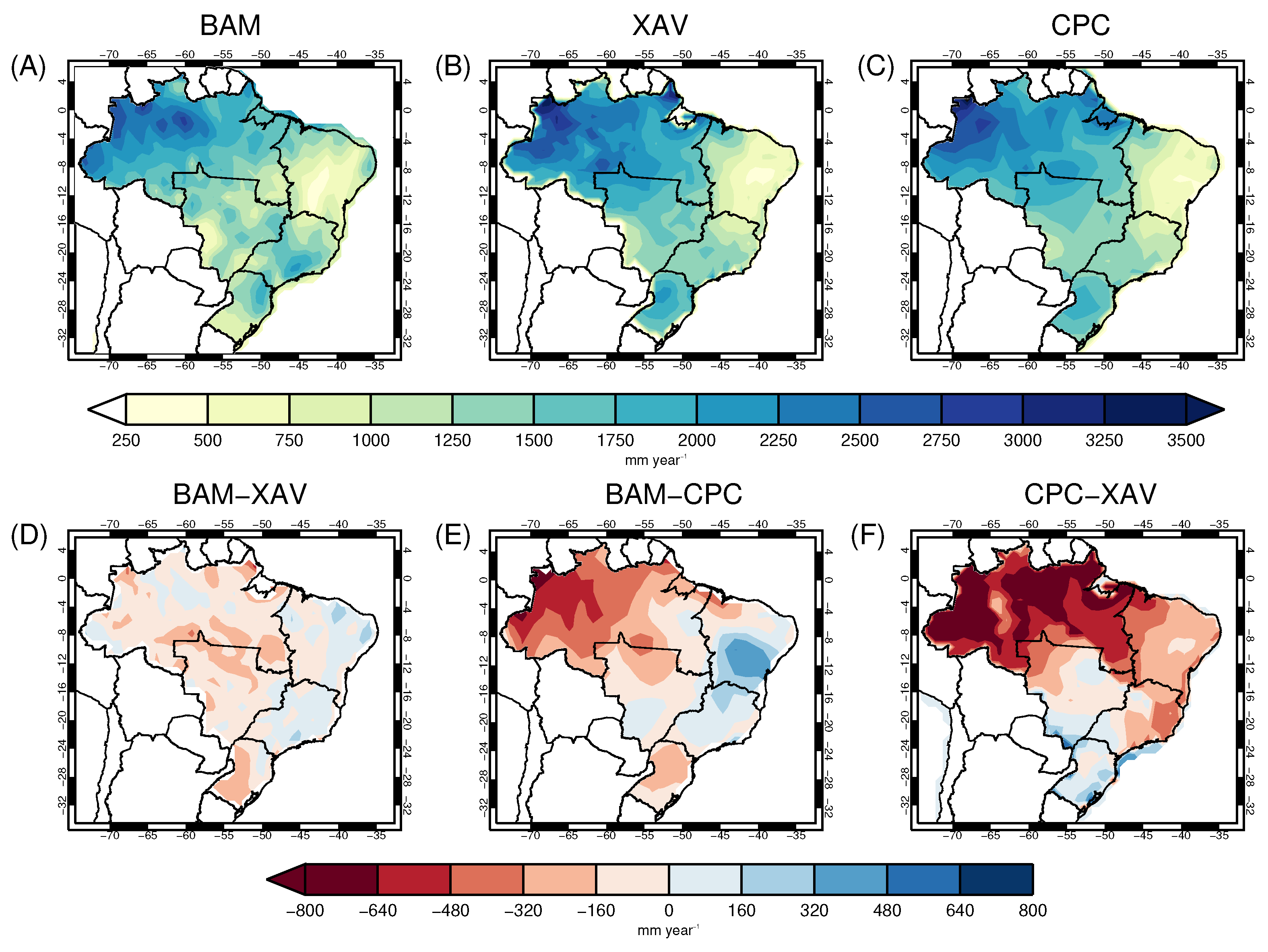
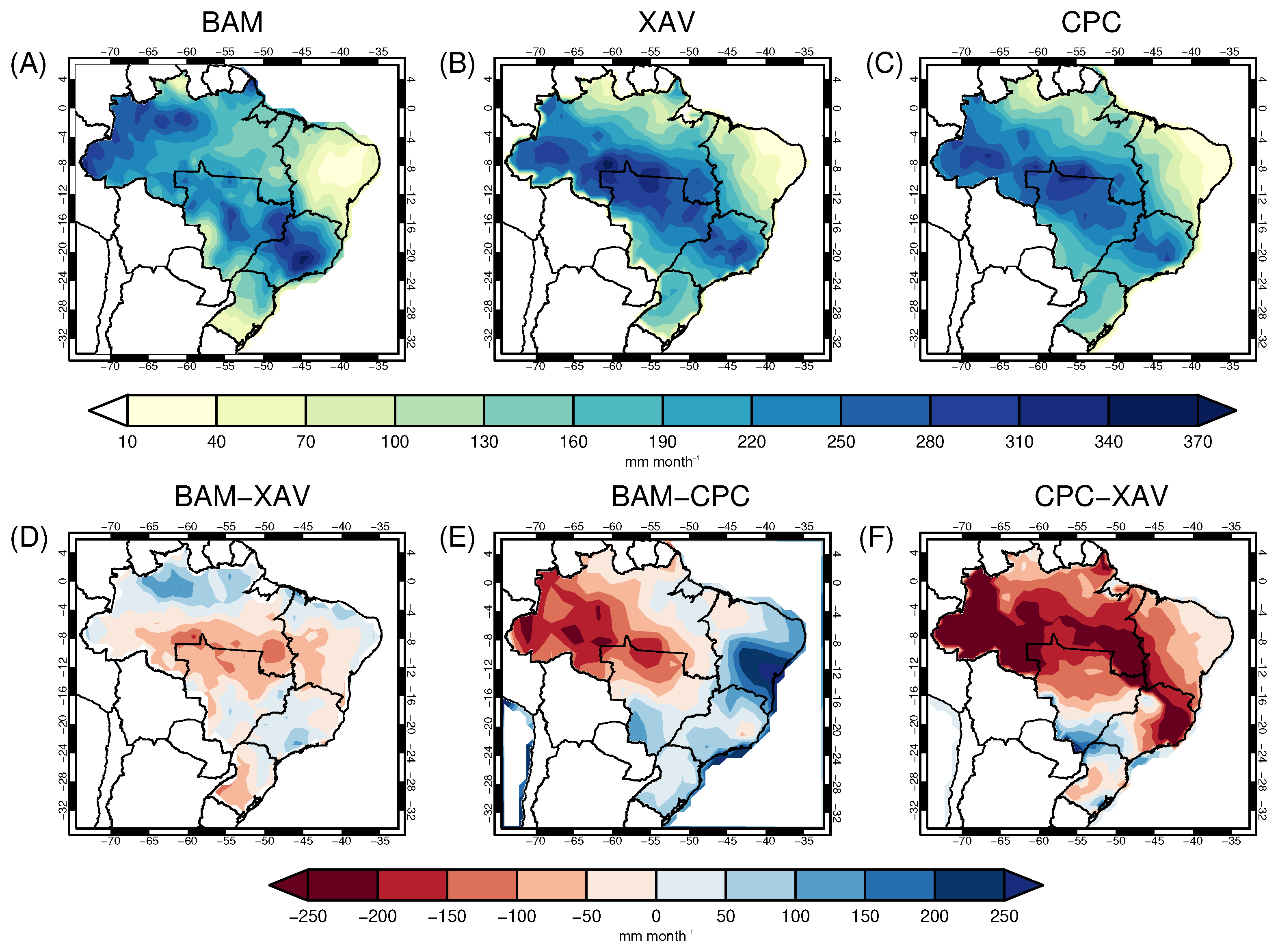
The strategy for assessing simulations produced by climate models established as part of the Atmospheric Model Intercomparison Project (AMIP) delivers an outline for model analysis, verification/validation, and intercomparison. Numerical models are continuously being developed to find the best representation for the amount and distribution of precipitation in Brazil to improve the country’s precipitation forecast. This article describes the key features of the Brazilian Global Atmospheric Model (BAM) (developed by the Center for Weather Forecasting and Climate Studies of the National Institute for Space Research (CPTEC/INPE)) and analyses of its performance for annual rainfall climate simulations. This study considered the representation of the annual precipitation in Brazil mainly during the rainy season in the central part of Brazil by the BAM. The model was run over the 1990 to 2015 period using spectral Eulerian model dynamics with a 70-horizontal resolution of approximately 1.0× 1.0 and 42 vertical sigma levels. The analysis was divided into two stages: the annual precipitation and the rainy season precipitation. Model precipitation analyses were performed using statistical methods, such as the mean and standard deviation, comparing modeled data with observed data from two datasets, data from the XAV (observed data from INMET, ANA, and DAEE), and the Climate Prediction Center (CPC). In general, the BAM model simulations reasonably replicated the configuration of the spatial distribution of precipitation in the Brazilian territory almost entirely, especially compared with the XAV. The accumulated precipitation in the southern region presented great variation, accumulating from 750 mm year1 in the extreme south to 1750 mm year1 in the north of this region. Average values of the BAM accumulated precipitation ranged from 1000 to 2000 mm year1, within the expected average, compared to observed values of 750–1500 mm year1 (CPC and XAV, correspondingly). Although there was an underestimation of the accumulated precipitation by the model, the model reasonably reproduced the precipitation during the rainy season. The performed assessment identified model aspects that need to be improved.
Keywords: precipitation; BAM model; rainy period precipitation; BAM model; rainy period