Abstract
In this study, the theory of equilibrium water prices is constructed and practiced based on previous research on cooperative game technology and the water price system. The equilibrium water price utilized in this study emphasized solving the unbalanced and unsustainable water supply system, including the reclaimed water resources and the current water price used in numerous Chinese cities. Safety, affordability, and sustainability become the key factors of the equilibrium water price system, which is operated and analyzed in a typical city in southeastern China. The cooperative game model of equilibrium water price is solved by game technology, considering various factors such as the price strategy, the water supply quantity, and the local water demand. The practical application shows that the theoretical system can effectively solve the problem of water price formation mechanisms after the unified allocation of different types of water resources. It not only enhances the enthusiasm and initiative of the public in the utilization of reclaimed water, but also plays an important role in the rational utilization of multiple water resources for different purposes by introducing a reasonable water price ratio and local water resource allocation.
1. Introduction
Currently, it is widely accepted that reclaimed water is an effective resource to solve the imbalance between water supply and demand. Additionally, the severe local water ecological and environmental problems can also be alleviated by integrating reclaimed water into the optimal allocation system of water resources [1,2,3,4,5,6]. With the development of human society, water resources provide valuable and fundamental support for humans. Water resources are widely accepted as vital natural resource endowments all around the world [3,4]. Nowadays, multi-source water supply is preferred in a number of cities in different countries; as a result, the water price system is also considered one of the most important aspects that concern all governments and citizens, especially in those areas where water shortage problems are severe. Safety, affordability, and sustainability become the key factors of the water price in those water shortage areas; however, most of the previous studies did not combine these factors simultaneously. In this study, an equilibrium water price system is operated and analyzed considering various factors based on cooperative game technology; therefore, the benefits and advantages of the equilibrium water price system are calculated and analyzed in practice [2,3,4,5]. However, it is also noticed that the establishment of an equilibrium water price system is still difficult, since a comprehensive investigation of the government as well as the water suppliers and users is essential. Additionally, several well-acknowledged aspects, such as direct cost, environmental cost, and resource cost, are also included in the cooperative game model. Indeed, it is necessary to establish an equilibrium water price system considering different types of water resources to improve the local water guarantee rate [4,5,6,7].
During the last decades, a number of water price-determining methods have been developed for the management of the water supply system [5,6,7]. Indeed, the water price-determining methods can be generally divided into two types: firstly, the water price is calculated based on the cost of water suppliers without considering the reclaimed water utilization [8,9,10]; and secondly, both the suppliers and users are included in determining the water price, and the reclaimed water is also included as one of the water resources [11,12,13,14]. However, the traditional water price-determining methods have three problems in the case of differentiated water supply modes. Firstly, the cost coverage problem, which is important to the water security guarantee and water environment [15,16,17]. Indeed, it is not appropriate to consider the cost of water supply in the formulation of the water price when reclaimed water is included in the water supply system [18,19]. Secondly, the problem of unequilibrium water prices, which is critical and sensitive to the scale and operation of the water intake facilities. Indeed, the earlier the construction of the water intake facility, the lower the water price will be determined, and it is also easier to be accepted by the public [20,21,22,23]. The third problem is sustainability. Due to the small scale and poor water quality of reclaimed water utilization, the cost of water production is high, and the public’s willingness to accept it is relatively low [22,23,24,25,26].
Indeed, the water price system is still missing in many Chinese cities. As a country with a water shortage, it is urgent for the local government to establish an efficient water price system, considering the benefits to all participants. It is highly recommended that three key factors—safety, affordability, and sustainability—should be included in the water price system, and the benefits of the government as well as the water suppliers and users are considered together to improve the water supply system and the water price system in this study [27,28,29,30,31,32].
Based on labor value theory, land rent theory, and utility value theory, previous researchers focused on the economic characteristics of water, such as property value and usage value. In this study, the value of water resources is mainly analyzed based on economic attributes. Moreover, the theoretical system is then further studied and improved for the water price formulation of multi-source and dual water supply systems, considering both social and economic principles [29,30,31,32,33]. In this study, the methodology of the equilibrium water price system is discussed in Section 2, the basic equations and parameters used in the cooperative game model are shown in Section 3, and a typical Chinese city is selected as a case study in Section 4. Further, the advantages of the equilibrium water price used in dual water supply systems are calculated and analyzed in detail [31,32,33,34].
2. Methodology
The equilibrium water price refers to a water price system combining a reasonable price relationship formed by scientific methods based on relevant policies for multi-source and dual water supply systems, which confirmed its capacity to promote the usage of reclaimed water in the dual water supply system, and is also helpful to ensure the regulation of the water price mechanism in multi-source water resource allocation [25,26,27]. Multi-source water resource allocation has proven effective in promoting water conservation and reclaimed water utilization based on a high-quality local water resource allocation method. Because of the differences between multiple water sources and their scarcity, both the allocation method and the corresponding price system will be affected. A reasonable water price relationship among different water sources is critical to ensuring the best allocation of multiple water resources [28,29,30,31,32,33,34,35,36]. In order to promote the implementation of the multiple water source allocation method, a number of factors are included in this study, such as the users’ willingness to pay and the demand for the total water amount.
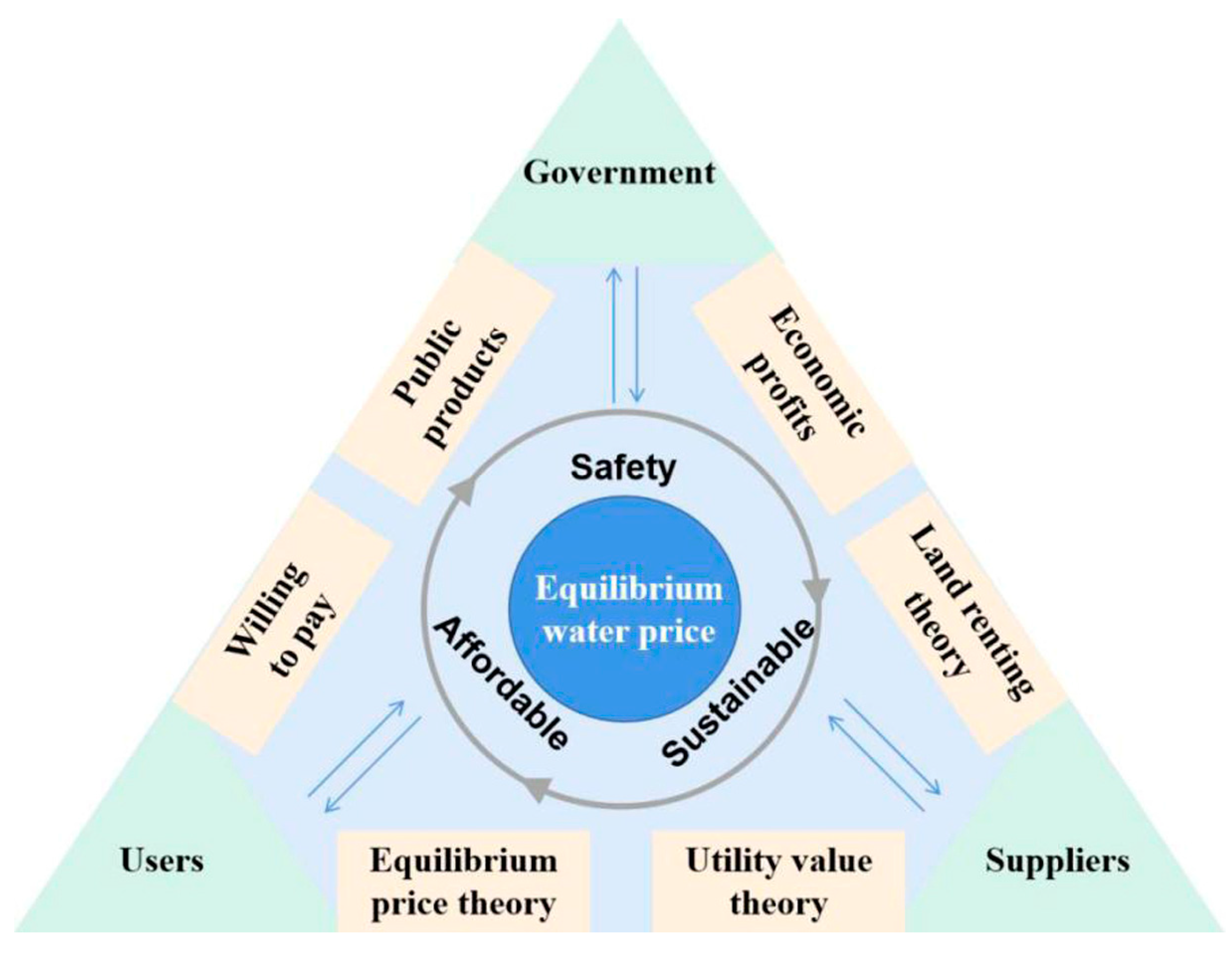
In order to solve the problem of the water price formation mechanism, which includes the reclaimed water in the local multi-source water allocation, a multi-attribute multi-source water price equilibrium theoretical framework is constructed for three specific stakeholders, namely, the government, enterprises, and water users, on the basis of relevant economic theory and water resources theory. The relationship of the three stakeholders and the basis of the equilibrium water price theory are shown in Figure 1. Indeed, a convergent cob-web economic model is adopted in this study, which is the fundamental economic hypothesis of the water price system. Additionally, an Arrow–Debreu model with a strong anchoring in Say’s law and Keynes’ principle is also introduced in this study, which argues that output cannot run ahead of income or expenditure. Both of them became the basic and fundamental theory of cooperative game technology in most of the previous research [34,35,36,37].
Figure 1.
Framework of the equilibrium water price system.
In the framework of the theoretical system shown in Figure 1, the stakeholders include local governments, water supply enterprises (one or more), and water users (multiple categories). Additionally, their objectives are quite different. The local government paid most of its attention to the rational allocation of multiple water sources to ensure water safety and the reasonable allocation of public product responsibilities because of the public product attributes and externalities of the water usage [31,32,33,34,35]. The water suppliers focus on clear water resource allocation objectives, especially for government departments, to ensure water supply capacity. Based on labor value theory, land rent theory, total cost theory, and other theories, the suppliers prefer a high price for high-quality water resources and a low price for low-quality water resources. However, based on the utility value theory, the willingness to pay theory, and other theories, water users prefer a reasonable water demand and a minimum water price determined by the government. Moreover, in order to overcome the limitations of the current water price determination and verification, the systematic and synergistic nature of the water price formulation is considered based on the unified allocation of multiple water sources, and the supply use-consumption-discharge systems of various water sources in a specific region are considered in their entirety [33,34,35,36,37]. The regional comprehensive water price is determined based on specific water resource allocation objectives and schemes. Additionally, the principles of compensation cost and reasonable profit are also taken into account according to the scarcity of water resources and the public’s willingness to pay. Eventually, the price relationship strategy will be reasonably determined. The analysis of equilibrium water price strategy is mainly based on labor value theory, land rent theory, public payment willingness, and other principles to determine the reasonable price relationship between different types of suppliers and users. Meanwhile, the externality and publicity of reclaimed water utilization require a reasonable cost apportionment and price ratio among the government, suppliers, and users [35,36,37,38,39].
3. Basic Equations
According to the equilibrium water price theory, reclaimed water is considered in the water price formation mechanism for the multi-source water resource allocation in this study. From the analysis of stakeholders, variable subjects and objectives are observed for different suppliers and users. However, it is also difficult to accurately quantify the water users’ willingness to pay using the existing tools and methods [20,21,22,23,38,39,40,41,42]. Therefore, this study introduces cooperative game technology to try to obtain the equilibrium water price [42,43,44,45,46]. Cooperative game technology is a form of work in which players work with others in order to achieve a common objective. The goal of cooperative game technology is to reduce the emphasis on competition and increase the emphasis on the social aspects of work. In this study, the equilibrium water price strategy for the specific users is given as [34,35,36,37]
where Xij is the apportioning water price for governments, while the residents’ willing water price in this model is constrained by disposable income.
3.1. Payoff Function
The expected payoff function also includes three stakeholders, namely, the local government, water suppliers, and users. The apportioned water price should not be greater than the water price, which excludes the reclaimed water. Indeed, it becomes the acceptable balanced water price for the three stakeholders [39,40,41,42,43]. The payoff function is given as
The water suppliers emphasized the water price strategy, which is able to determine the whole process water price for each water supply enterprise according to the principle of compensation cost and reasonable profit, which is given as
where Wij is the water consumption of water users and is the whole process water price of a specific water resource. Additionally, water users want to minimize the total amount of payment, while water demand is also considered a key factor.
3.2. Utility Function
Similarly, the utility function also includes the local government, water suppliers, and users. Among them, the local government wants to include the reclaimed water in the multi-source unified allocation of the intended target, in which all kinds of water consumption are approximately equal to the configuration of the water allocation method [9,10,11,12,13]. The model is given as
During the simulation, the water price strategy, water supply quantity, and local water demand were the three key factors that attracted water suppliers. Additionally, water quantity and quality were the two factors that attracted water users [41,42,43,44,45,46].
3.3. Model Iteration
After each round of the game model simulation, the water price adjustment strategy is executed for all the stakeholders, as shown in Table 1.
Table 1.
Strategies for equilibrium water prices for each partner.
After multiple rounds of the game model simulation, the equilibrium water price strategy of this study becomes the combination of the water price strategy with the best results simulated by the utility function and payment function.
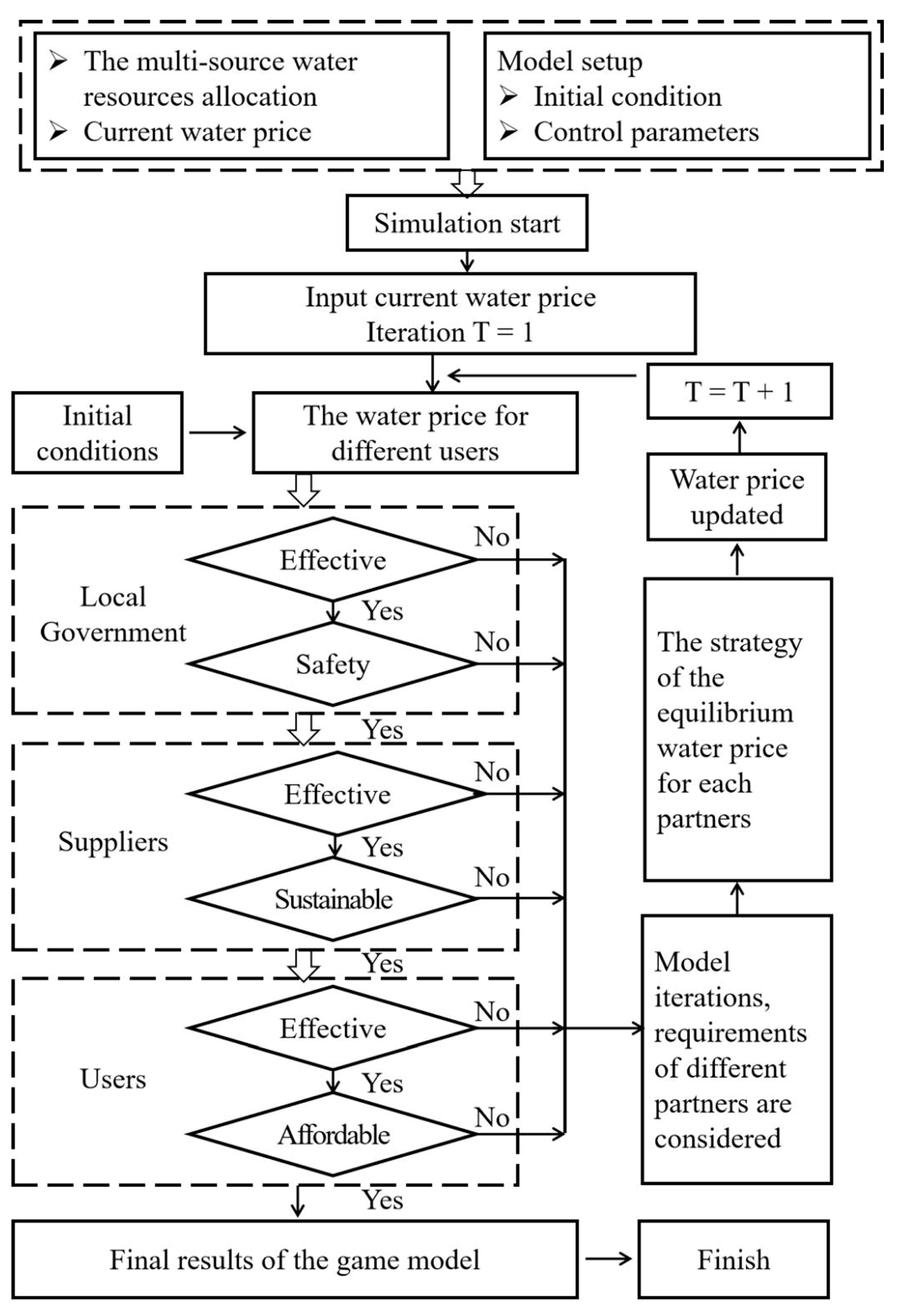
The model simulation process is also a key consideration in this study. First of all, the water price strategy for the water supply enterprises is given as the initial condition of the model setup, assuming that the current water price relationship for the same source of water is unchanged. Then, the water price strategy referring to the whole process cost can be obtained.
Secondly, the water selection schemes of various water users are analyzed and calculated. According to the criteria, various options are available to the water users to calculate their water consumption. As a result, the total demand for water can be determined.
Thirdly, according to the water price strategy and water consumption plan, the utility functions of the local government, water suppliers, and users are calculated. Finally, through multiple rounds of the game model simulation, the equilibrium water price is achieved, and the simulation will be terminated. The cooperative game model simulation flow chart is shown in Figure 2.
Figure 2.
Model iteration flowchart.
4. Case Study
4.1. Basic Parameters
Yiwu City is located in the southeastern region of China. Due to the high concentration of population and economic factors, the imbalance of water supply and demand and the problem of the water’s ecological environment have become serious embarrassments for Yiwu City. In order to solve these problems, Yiwu City has constructed a dual water supply system with high-quality water from reservoirs, general water from rivers, and tail water from sewage treatment plants. However, the water price in Yiwu City becomes unbalanced due to the impact of construction time, water supply scale, and water quality. Therefore, it is urgent to establish an equilibrium water price system. Table 2, Table 3 and Table 4 show the equilibrium water price system of Yiwu City, which is affected by the multi-source water allocation method, the current water supply price, and the cost of the whole process of the social water cycle.
Table 2.
Current water resource allocation method (104 m3).
Table 3.
Current water price in Yiwu City (Yuan/m3).
Table 4.
Current water price in Yiwu City.
4.2. Local Public’s Willingness to Pay
Based on the investigation in Yiwu City, the average price of river water is 30% lower than the price of reservoir water, and the average price of reclaimed water is 50% lower than the price of reservoir water. Hence, in this study, the equilibrium water price is calculated following the criteria of the local public’s willingness to pay.
When the river water price is 70% of the reservoir water price, water users are willing to choose either of the two types of water sources. When the river water price is higher than 70% of the reservoir water price, water users prefer to choose reservoir water. When the price of river water is less than 70% of the price of reservoir water, water users prefer to choose river water.
When the reclaimed water price is 50% of the reservoir water price, water users are willing to choose either of the two types of water sources. When the reclaimed water price is higher than 50% of the reservoir water price, water users prefer to choose reservoir water. When the price of reclaimed water is less than 50% of the price of reservoir water, water users prefer to choose reclaimed water.
When the price of river water is 1.4 times the price of reclaimed water, water users are willing to choose either of the two types of water sources. When the river water price is 1.4 times higher than the reclaimed water price, water users prefer to choose reclaimed water. When the price of river water is lower than 1.4 times the price of reclaimed water, water users prefer to choose river water.
4.3. Effectiveness and Payment Method of the Game Model
Two factors are expected for the model utility and payment objectives, namely, the utility goal and the payment goal.
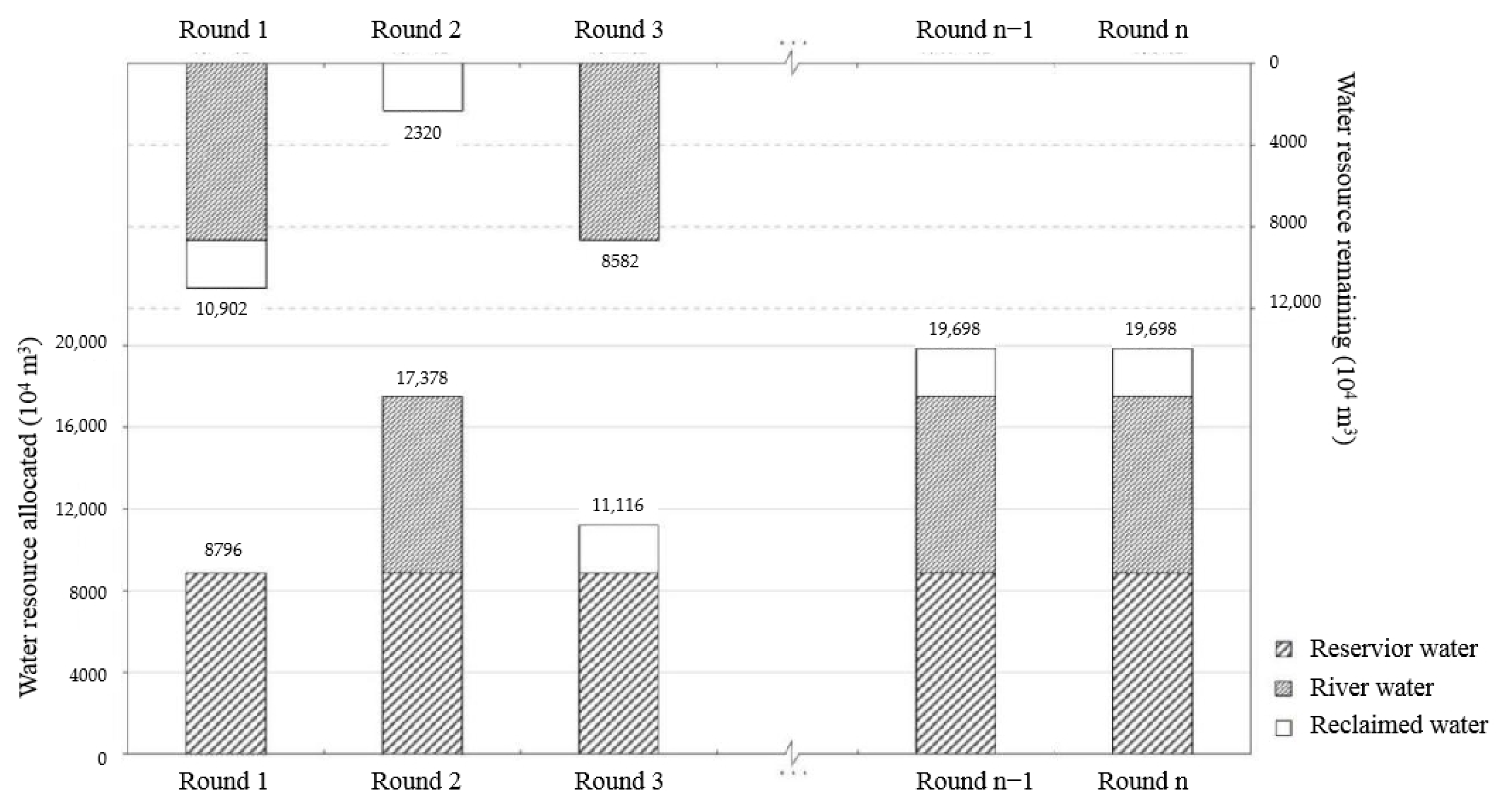
Indeed, the multiple water source allocation method used in Yiwu is highly efficient nowadays. When the annual total water consumption reaches 196.98 million m3, the water consumption of reservoir water, river water, and reclaimed water reaches 87.96, 85.82, and 23.2 million m3, respectively.
If the reclaimed water is excluded from the water allocation method in Yiwu City, the proportion of the government’s shared water price to the whole process cost water price can be calculated as
Secondly, by comparing the game water price strategy and the social willingness to pay for different water sources, the utility function of water suppliers can be calculated.
The quantity of water supplied is guaranteed and the quality of water supplied meets the demand. The water supply capacity of reservoir water, river water and reclaimed water should be more than 8796, 8582, 2320 million m3, respectively. The function is given as [33,34,35]
While for the users, the water user utility function is calculated by comparing the game of water price strategy and the social willingness to pay for different water sources.
Eventually, different water sources for various water users will meet the configuration requirements. Namely, the water supply capacity of reservoir water, river water, and reclaimed water should be less than 8796, 8582, and 2320 million m3, respectively.
During the simulation, each round of the iteration is formulated as follows. Firstly, a set of water price strategies at the water supply end is given. Assuming that the price ratio of different types of water use in the same water source remains unchanged, such as the current water price ratio, namely, for domestic water, non-domestic water, and special water, the price ratio equals 1:1.64:2.64. Secondly, the water selection method of various water users is analyzed and calculated according to the above-mentioned public’s willingness criterion, the water consumption selection scheme for water users is determined, and their water consumption is calculated. Thirdly, both the utility function and payment function of local government, water suppliers, and water users are calculated according to the water price strategy and water consumption plan.
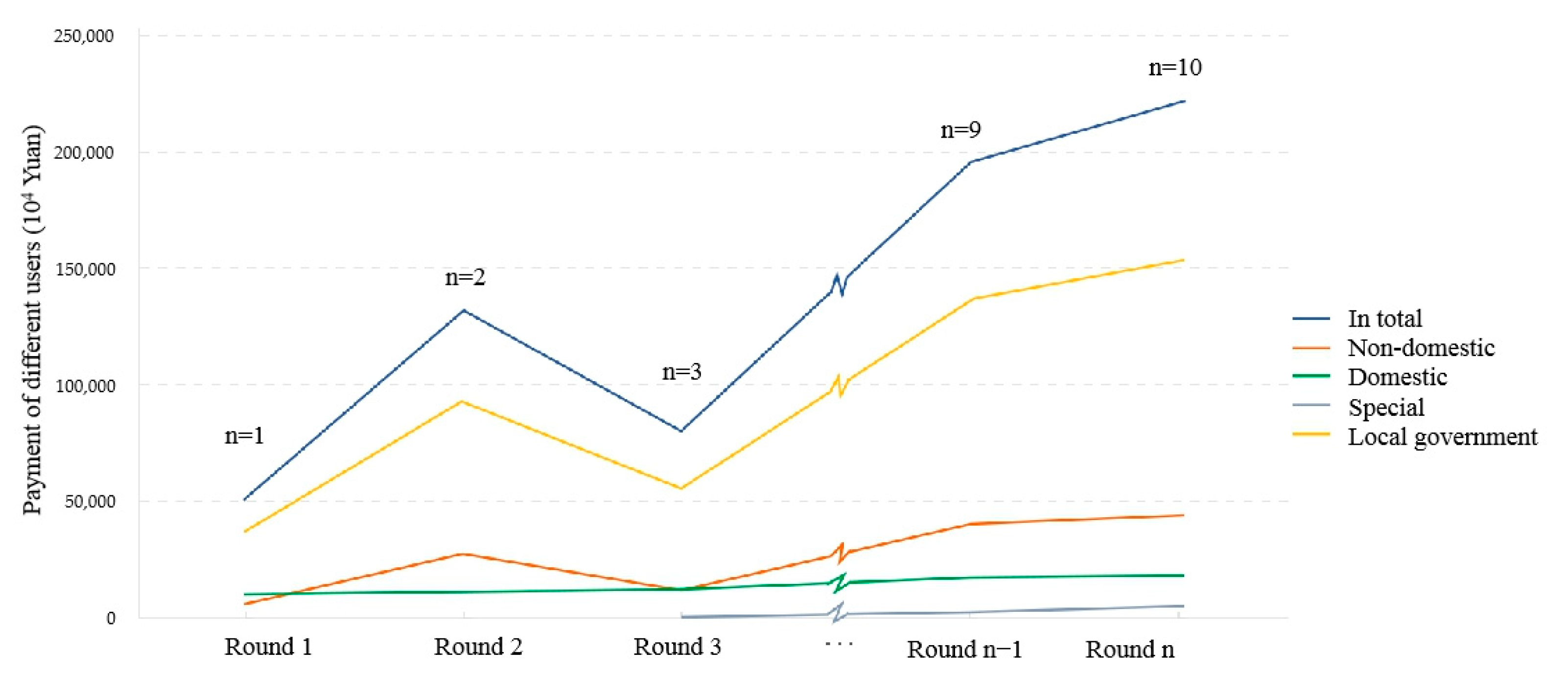
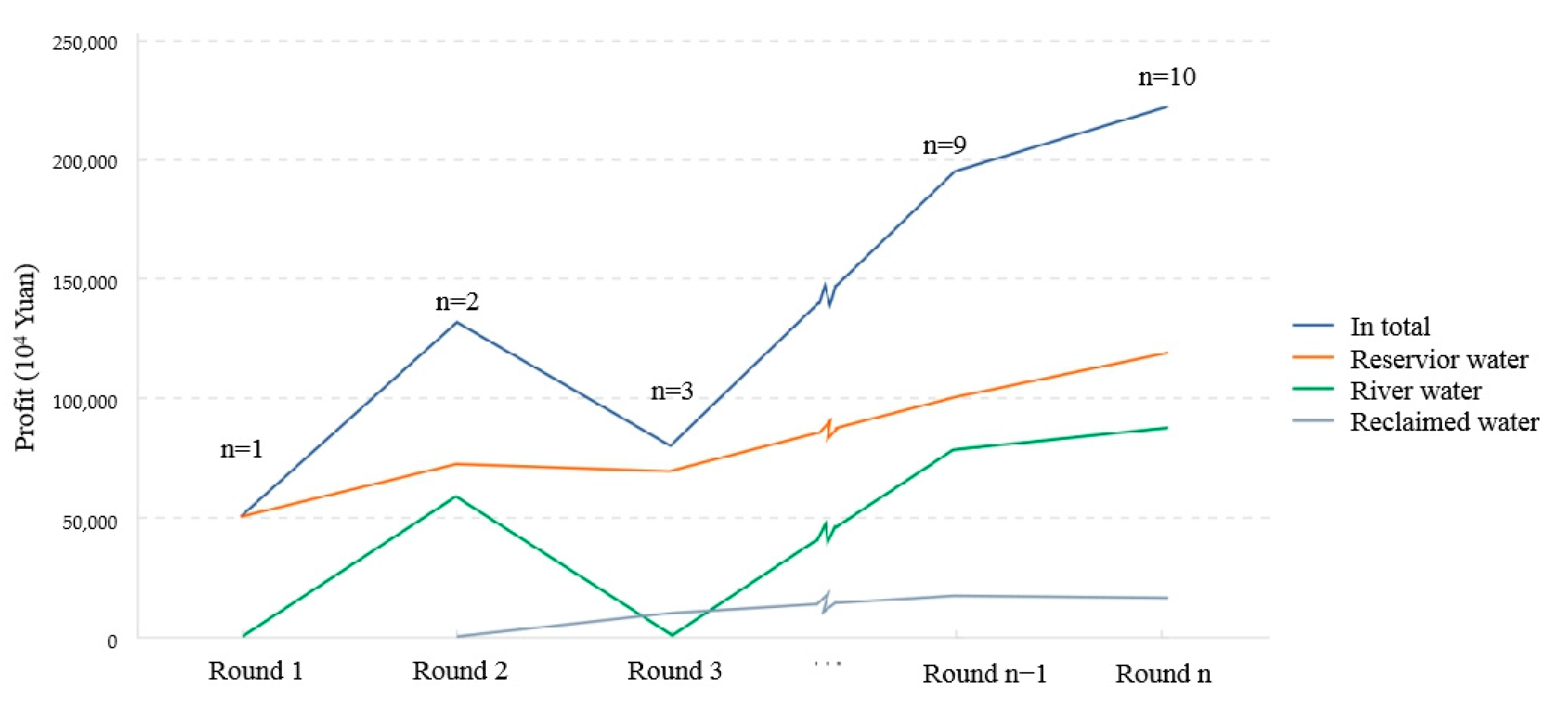
After several rounds of the game model simulation, an equilibrium price relationship can be achieved. According to the water price strategy of each simulation iteration, the water users’ selection strategy, the corresponding multi-source water allocation, the residual water quantity, and the total water payment are shown in Table 5, Table 6 and Table 7. The utility function and payment function simulation curves of different game rounds of government are drawn, which are shown in Figure 3, Figure 4 and Figure 5.
Table 5.
Equilibrium water price in every iteration step.
Table 6.
Water resource allocation and the profit of the water suppliers.
Table 7.
Payment of different water users in every iteration step.
Figure 3.
Multi-source water resource allocation and water price during model iteration.
Figure 4.
Profit from the multi-source water resource allocation.
Figure 5.
Payments of different water users.
According to the present game model simulation, the equilibrium water price system of Yiwu City is obtained after several iterations, as shown in Table 8.
Table 8.
Payments of different water users in every iteration step.
As shown in Table 8, a multi-attribute and multi-source water price ratio relationship is formed on the basis of the whole process cost water price verification by taking the supply use-consumption-drainage system. The local government is paying almost 64.3% of the reclaimed water price. It is also proven that the equilibrium water price system can effectively promote the rational allocation and efficient utilization of multiple water sources, which is also important to magnify the market mechanism [41,42,43,44,45,46].
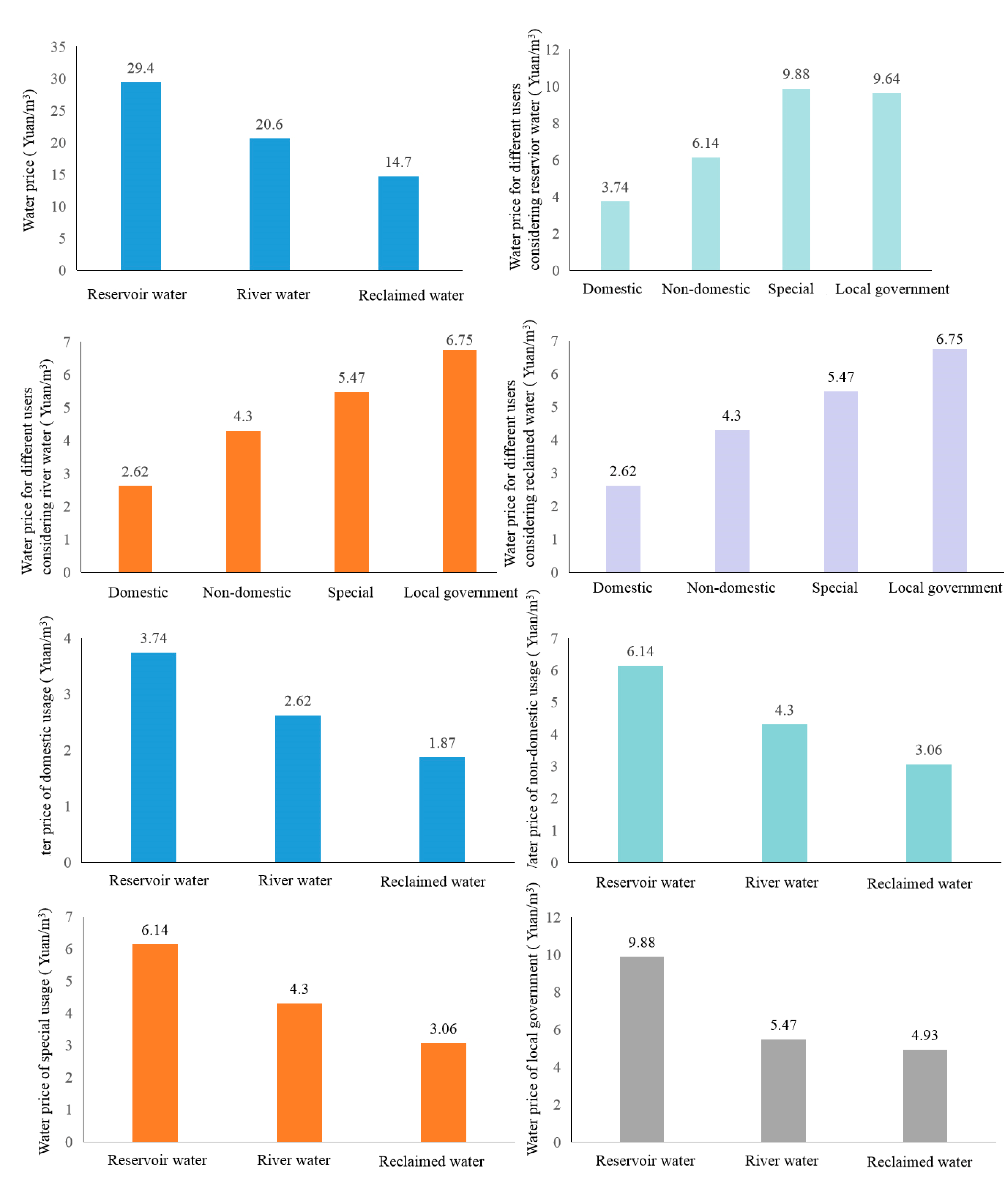
As shown in Figure 6, based on the equilibrium water price theory and calculation method, a reasonable water price relationship between the water suppliers and users is achieved by coordinating fairness and efficiency for both the suppliers and users.
Figure 6.
Equilibrium water price system in Yiwu City.
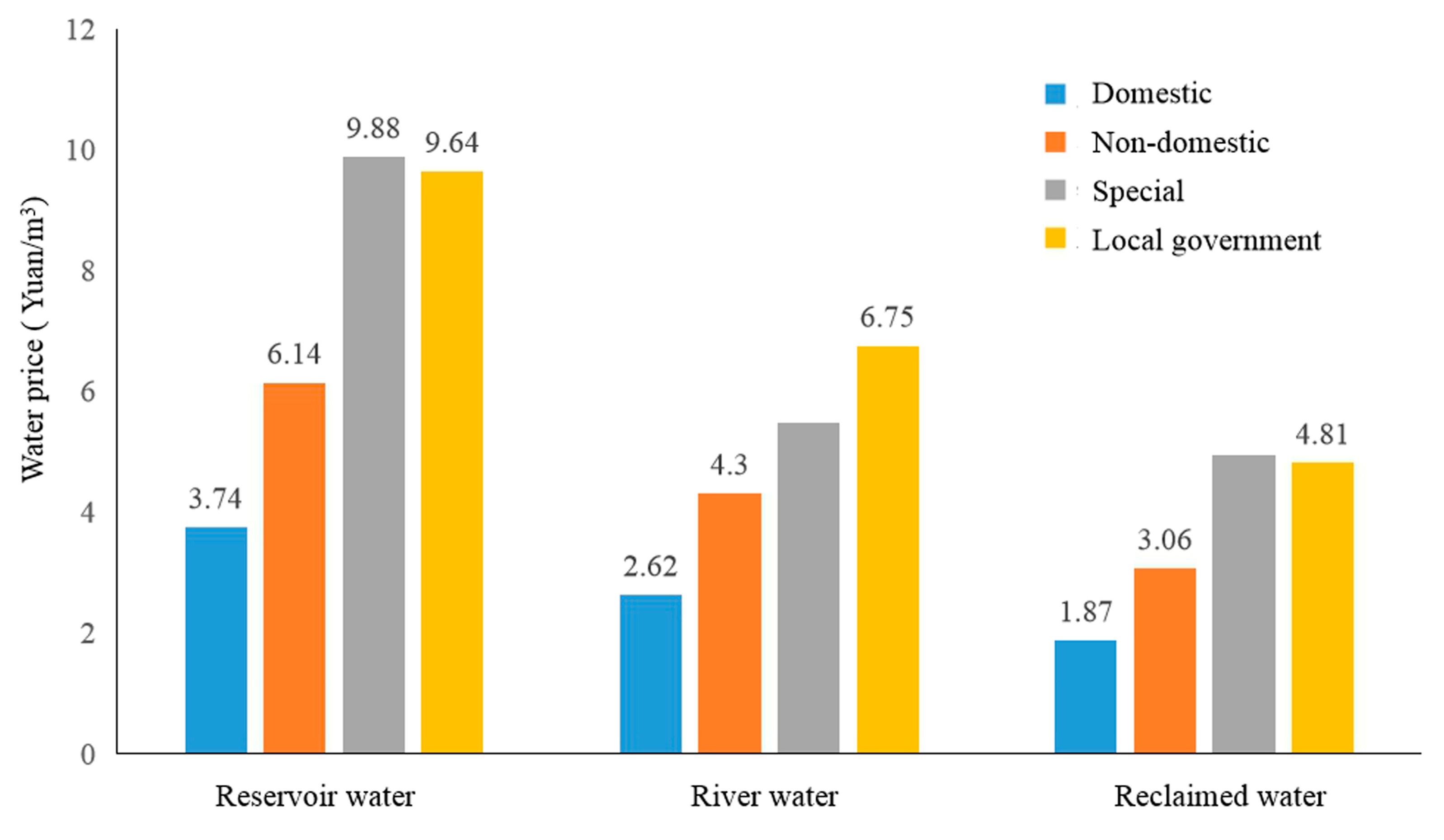
The equilibrium water price system, which includes reclaimed water, can reduce the total amount of water price payment in the whole process of the social water cycle with a decrease rate of 2.83%, as shown in Figure 7 and Table 9.
Figure 7.
Equilibrium water prices for different water users in Yiwu City.
Table 9.
Total payment of multi-source water resources in different simulation cases.
The comparison of the multi-source water price relationship based on the whole process water usage cost in Yiwu City shows that the simulated equilibrium water price is more reasonable than the current water price system established by the local government.
The domestic water price for residents is 0.59 yuan/t higher than the current first-level water price and 0.51 yuan/t lower than the second-level water price. The water price for non-resident water is 0.84 yuan/t higher than the current first-level water price and is 1.81 yuan/t lower than the second-level water price. The special industry water price is 9.88 yuan/t, which is higher than the current status of 7.5 yuan/t. These water prices are affordable for most water users.
The water price of river water and reclaimed water is significantly lower than the current water price for various types of water users, which shows economic comparative advantages and is conducive to enhancing the enthusiasm of various types of water users.
5. Conclusions and Policy Recommendation
In this study, both the theoretical and practical applications of equilibrium water prices are derived and analyzed. The equilibrium water price theory provides a theoretical basis for solving the problem of water price imbalance when reclaimed water is included in the unified allocation of multiple water sources. The equilibrium water price theory can also solve the external problem of reclaimed water utilization and accelerate the utilization of reclaimed water. However, insufficient data will lead to a distortion of the water price simulation, which is recognized as a limitation of the equilibrium water price theory [12,20,21,22,23,24,25].
Cooperative game technology is also an effective tool to solve the equilibrium water price iteration problem. This method can effectively coordinate the obligations, rights, and objectives of the local government, water suppliers, water users, and other stakeholders in the process of balancing the formation of water prices. The costs and benefits are both considered in a complex domestic dual water supply system in this study [25,26,27,28,29]. It is anticipated in the future that cooperative game technology and the equilibrium water price system will become more popular in areas where the water shortage problem exists.
From the analysis of the application results of Yiwu City, the equilibrium water price system is affordable and sustainable for all types of water users compared with the current water price system without increasing the budget of the local government. Additionally, due to the lower price of river water and reclaimed water, the enthusiasm of various water users has obviously improved, which is also beneficial for water security and ecological environment protection in the future.
Author Contributions
Conceptualization, L.F. and S.W.; methodology, S.W. and J.W.; investigation, S.W. and Y.H.; resources, H.P. and Z.G.; writing—original draft, S.W. All authors have read and agreed to the published version of the manuscript.
Funding
This research was jointly supported by the Applied Basic Public Research Program and the Natural Science Foundation of Zhejiang Province (No. LGF22E090007), the Key Research and Development Program of Zhejiang Province (No. 2023C03134), the Technology Demonstration Project of Chinese Ministry of Water Resources (No. SF202212), the Soft Science and Technology Plan Project of Zhejiang Province (No. 2022C35022), the Zhejiang Provincial Natural Science Foundation (No. LZJWY23E090009), and the Research Program of the Department of Water Resources of Zhejiang Province (No. RB2107, RC2139, RA2102, ZIHE21Q003, ZIHE21Z002).
Data Availability Statement
The data that support the findings of this study are openly available at URL: http://www.yw.gov.cn, available on 11 May 2023.
Conflicts of Interest
The authors declare no conflict of interest.
References
- Hanemann, W.M. The economic conception of water. Water Crisis Myth Real. 2006, 61, 74–76. [Google Scholar]
- Brelsford, C.; Abbott, J.K. Growing into Water Conservation? Decomposing the Drivers of Reduced Water Consumption in Las Vegas, NV. Ecol. Econ. 2017, 133, 99–110. [Google Scholar] [CrossRef]
- Brent, D.A.; Ward, M.B. Price perceptions in water demand. J. Environ. Econ. Manag. 2019, 98, 102266. [Google Scholar] [CrossRef]
- Momeni, M.; Zakeri, Z.; Esfandiari, M.; Behzadian, K.; Zahedi, S.; Razavi, V. Comparative analysis of agricultural water pricing between Azarbaijan Provinces in Iran and the state of California in the US: A hydro-economic approach. Agric. Water Manag. 2019, 223, 11. [Google Scholar] [CrossRef]
- Griffin, R.C.; Mjelde, J.W. Distributing water’s bounty. Ecol. Econ. 2011, 72, 116–128. [Google Scholar] [CrossRef]
- Charness, G.; Gneezy, U.; Kuhn, M.A. Experimental methods: Between-subject and within-subject design. J. Econ. Behav. Organ. 2012, 81, 1–8. [Google Scholar] [CrossRef]
- Grafton, R.Q. Policy review of water reform in the Murray-Darling Basin, Australia: The “do’s” and “do’nots”. Aust. J. Agric. Resour. Econ. 2019, 63, 116–141. [Google Scholar] [CrossRef]
- Aubin, C.; Fougere, D.; Husson, E.; Ivaldi, M. Real-time pricing of electricity for residential customers: Econometric analysis of an experiment. J. Appl. Econom. 1995, 10, S171–S191. [Google Scholar] [CrossRef]
- Hearne, R.R.; Donoso, G. Water institutional reforms in Chile. Water Policy 2005, 7, 53–69. [Google Scholar] [CrossRef]
- Marshall, G.R.; Alexandra, J. Institutional Path Dependence and Environmental Water Recovery in Australia’s Murray-Darling Basin. Water Altern. 2016, 9, 679–703. [Google Scholar]
- Andreoni, J. Warm-glow versus cold-prickle: The effects of positive and negative framing on cooperation in experiments. Q. J. Econ. 1995, 110, 1–21. [Google Scholar] [CrossRef]
- Sapino, F.; Pérez-Blanco, C.D.; Gutiérrez-Martín, C.; García-Prats, A.; Pulido-Velazquez, M. Influence of crop-water production functions on the expected performance of water pricing policies in irrigated agriculture. Agric. Water Manag. 2022, 259, 107248. [Google Scholar] [CrossRef]
- Chebil, A.; Soula, R.; Souissi, A.; Bennouna, B. Efficiency, valuation, and pricing of irrigation water in northeastern Tunisia. Agric. Water Manag. 2022, 266, 107577. [Google Scholar] [CrossRef]
- EPA. Case Studies of Sustainable Water and Wastewater Pricing; Case studies EPA 816-R-05-007; USEPA: Washington, DC, USA, 2005. [Google Scholar]
- Beal, C.; Stewart, R.A. South East Queensland residential end use study: Final report. Urban Water Secur. Res. Alliance Tech. Rep. 2011, 47, 174. [Google Scholar]
- Fagan, B.E. A History of Water and Humankind; Bloomsbury Press: London, UK, 2011. [Google Scholar]
- Pahl-Wostl, C. Transitions towards adaptive management of water facing climate and global change. Water Resour. Manag. 2007, 21, 49–62. [Google Scholar] [CrossRef]
- Fuente, D.; Gatua, J.G.; Ikiara, M.; Kabubo-Mariara, J.; Mwaura, M.; Whittington, D. Water and sanitation service delivery, pricing, and the poor: An empirical estimate of subsidy incidence in Nairobi, Kenya. Water Resour. Res. 2016, 52, 4845–4862. [Google Scholar] [CrossRef]
- Goldsmith, H.; Carter, D. 150 The Finance of Local Public Goods at the Onset of Industrialization: Water in London 1582 to 1904. In Infrastructure Finance in Europe: Insights into the History of Water, Transport, and Telecommunications; Cassis, Y., De Luca, G., Florio, M., Eds.; Oxford University Press: Oxford, UK, 2016. [Google Scholar]
- Hellwig, M.; Polk, A. Do political links influence water prices? determinants of water prices in Germany. Util Policy 2021, 70, 101184. [Google Scholar] [CrossRef]
- Biggar, D.R.; Hesamzadeh, M.R. Welfare-maximising dispatch and pricing of water in a gravity-fed river network. Energy Econ. 2022, 108, 105710. [Google Scholar] [CrossRef]
- Kenney, D.S.; Goemans, C.; Klein, R.; Lowrey, J.; Reidy, K. Residential water demand management: Lessons from Aurora, Colorado. J. Am. Water Resour. Assoc. 2008, 44, 192–207. [Google Scholar] [CrossRef]
- Pluchinotta, I.; Kazakci, A.O.; Giordano, R.; Tsoukias, A. Design Theory for Generating Alternatives in Public Decision Making Processes. Group Decis. Negot. 2019, 28, 341–375. [Google Scholar] [CrossRef]
- Loaiciga, H.A.; Renehan, S. Municipal water use and water rates driven by severe drought: A case study. J. Am. Water Resour. Assoc. 1997, 33, 1313–1326. [Google Scholar] [CrossRef]
- Muller, M. Lessons from Cape Town’s drought. Nature 2018, 559, 174–176. [Google Scholar] [CrossRef]
- Agthe, D.E.; Billings, R.B. Equity, price elasticity, and household income under increasing block rates for water. Am. J. Econ. Sociol. 1987, 46, 273–286. [Google Scholar] [CrossRef]
- Leiva, B.; Van Houtven, G.; Vásquez, W.F.; Nájera, A. Valuing water service reliability and in-home water storage: A hedonic price model from Guatemala. Util. Policy 2023, 82, 101526. [Google Scholar] [CrossRef]
- Pronti, A.; Berbel, J. The impact of volumetric water tariffs in irrigated agriculture in Northern Italy. Environ. Impact Assess. Rev. 2023, 98, 106922. [Google Scholar] [CrossRef]
- Lamaddalena, N.; D’Arcangelo, G.; Billi, A.; Todorovic, M.; Hamdy, A.; Bogliotti, C.; Quarto, A. Participatory water management in Italy: Case study of the Consortium “Bonifica della Capitanata”. Options M’Ed. 2004, 48, 159–169. [Google Scholar]
- Passarella, G.; Barca, E.; Sollitto, D.; Masciale, R.; Bruno, D.E. Cross-Calibration of Two Independent Groundwater Balance Models and Evaluation of Unknown Terms: The Case of the Shallow Aquifer of “Tavoliere di Puglia” (South Italy). Water Resour. Manag. 2017, 31, 327–340. [Google Scholar] [CrossRef]
- Arbués, F.; Garcıa-Valiñas, M.Á.; Martınez-Espiñeira, R. Estimation of residential water demand: A state-of-the-art review. J. Socio-Econ. 2003, 32, 81–102. [Google Scholar] [CrossRef]
- Dalhuisen, J.M.; Florax, R.J.; De Groot, H.L.; Nijkamp, P. 2003. Price and income elasticities of residential water demand: A meta-analysis. Land Econ. 2003, 79, 292–308. [Google Scholar] [CrossRef]
- Brons, M.; Nijkamp, P.; Pels, E.; Rietveld, P. A meta-analysis of the price elasticity of gasoline demand. A SUR approach. Energy Econ. 2008, 30, 2105–2122. [Google Scholar] [CrossRef]
- Grafton, R.Q.; Horne, J. Water markets in the Murray-Darling Basin. Agric. Water Manag. 2014, 145, 61–71. [Google Scholar] [CrossRef]
- Dutta, G.; Mitra, K. A literature review on dynamic pricing of electricity. J. Oper. Res. Soc. 2017, 68, 1131–1145. [Google Scholar] [CrossRef]
- Briesch, R.A.; Krishnamurthi, L.; Mazumdar, T.; Raj, S.P. A comparative analysis of reference price models. J. Consum. Res. 1997, 24, 202–214. [Google Scholar] [CrossRef]
- Castledine, A.; Moeltner, K.; Price, M.K.; Stoddard, S. Free to choose: Promoting conservation by relaxing outdoor watering restriction. J. Econ. Behav. Organ. 2014, 107, 324–343. [Google Scholar] [CrossRef]
- Li, L.; Jeuland, M. Household water savings and response to dynamic incentives under nonlinear pricing. J. Environ. Econ. Manag. 2023, 119, 102811. [Google Scholar] [CrossRef]
- Marshall, A. Principles of Economics, 8th ed.; MacMillan and Company, Ltd.: London, UK, 1952. [Google Scholar]
- Molle, F.; Berkoff, J. Irrigation Water Pricing: The Gap Between Theory and Practice; CABI Publishing: Oxfordshire, UK, 2007. [Google Scholar]
- Katic, P.G.; Grafton, R.Q. Economic and spatial modelling of groundwater extraction. Hydrogeol. J. 2012, 20, 831–834. [Google Scholar] [CrossRef]
- Levidow, L.; Zaccaria, D.; Maia, R.; Vivas, E.; Todorovic, M.; Scardigno, A. Improving water-efficient irrigation: Prospects and difficulties of innovative practices. Agric. Water Manag. 2014, 146, 84–94. [Google Scholar] [CrossRef]
- Nauges, C.; Whittington, D. Evaluating the Performance of Alternative Municipal Water Tariff Designs: Quantifying the Tradeoffs between Equity, Economic Efficiency, and Cost Recovery. World Dev. 2017, 91, 125–143. [Google Scholar] [CrossRef]
- Cominola, A.; Giuliani, M.; Piga, D.; Castelletti, A.; Rizzoli, A.E. Benefits and challenges of using smart meters for advancing residential water demand modeling and management: A review. Environ. Modell. Softw. 2015, 72, 198–214. [Google Scholar] [CrossRef]
- Geudens, P. Dutch Drinking Water Statistics 2017; Association of Dutch Water Companies: Hague, The Netherlands, 2017. [Google Scholar]
- Iwafune, Y.; Kazuhiko, O.; Kobayashi, Y.; Suzuki, K.; Shimoda, Y. Aggregation model of various demand-side energy resources in the day-ahead electricity market and imbalance pricing system. Int. J. Elec. Power 2023, 147, 108875. [Google Scholar] [CrossRef]
Disclaimer/Publisher’s Note: The statements, opinions and data contained in all publications are solely those of the individual author(s) and contributor(s) and not of MDPI and/or the editor(s). MDPI and/or the editor(s) disclaim responsibility for any injury to people or property resulting from any ideas, methods, instructions or products referred to in the content. |
© 2023 by the authors. Licensee MDPI, Basel, Switzerland. This article is an open access article distributed under the terms and conditions of the Creative Commons Attribution (CC BY) license (https://creativecommons.org/licenses/by/4.0/).