Wastewater Quality Screening Using Affinity Propagation Clustering and Entropic Methods for Small Saturated Nonlinear Orthogonal Datasets

Abstract
1. Introduction
2. Materials and Methods
2.1. The OA Sampler Structure

2.2. The Unsupervised Analyzer
2.3. The Water Quality Case Study
2.4. The Methodological Steps
- (1)
- Define the wastewater quality characteristics that monitor the direction of the ED progress and quantify the recycling efficiency improvement.
- (2)
- Select the proper group of the ED process controlling factors that are deemed relevant to regulating the influent wastewater condition, and directly screen the multivariate effluent tendencies.
- (3)
- Determine a practical operating range for each of the controlling factors, such as to induce adequate variability, that could potentially detect a presence of curvature effects.
- (4)
- (5)
- Execute the prescribed OA runs (step 4) and compile the multiresponse dataset.
- (6)
- (7)
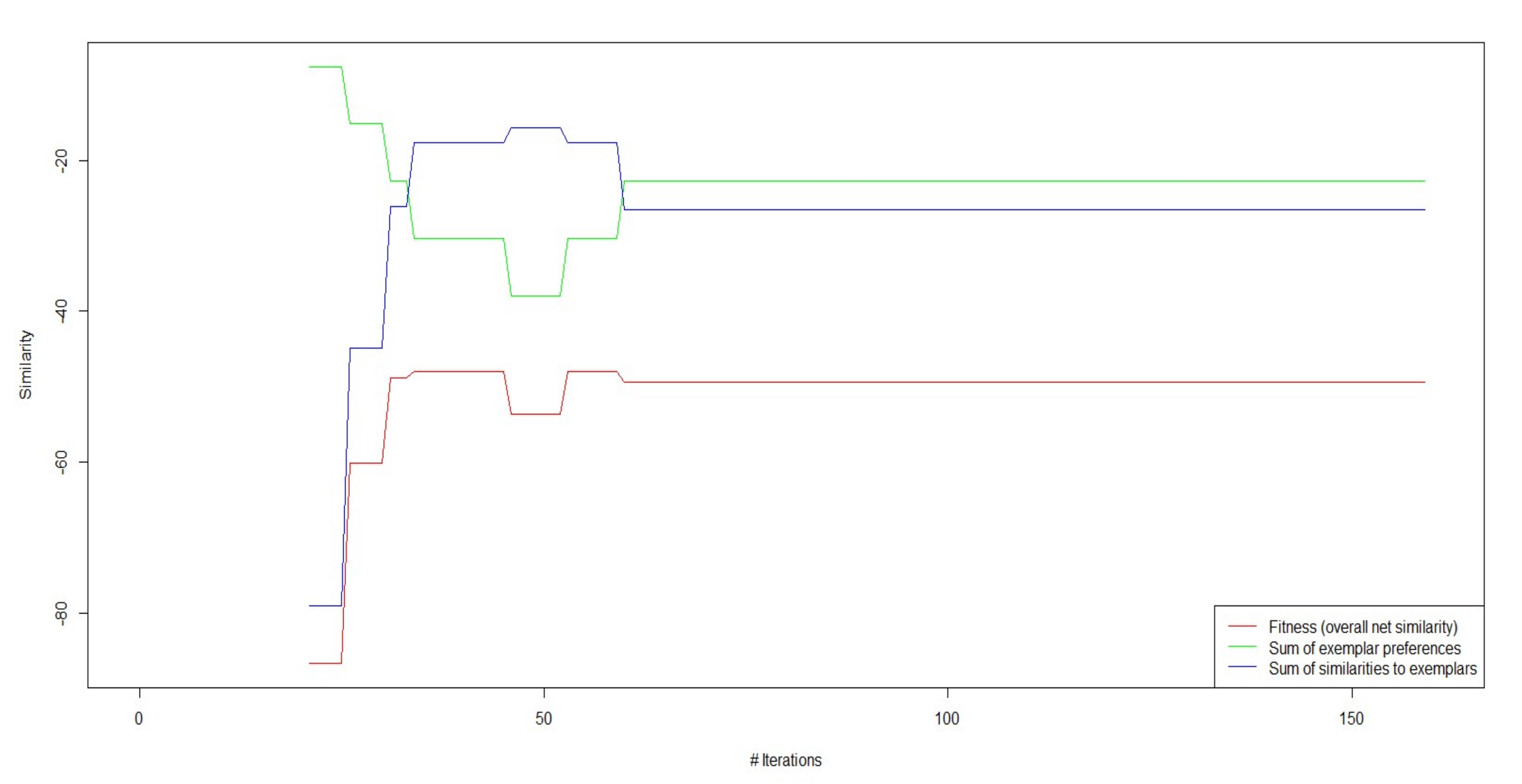
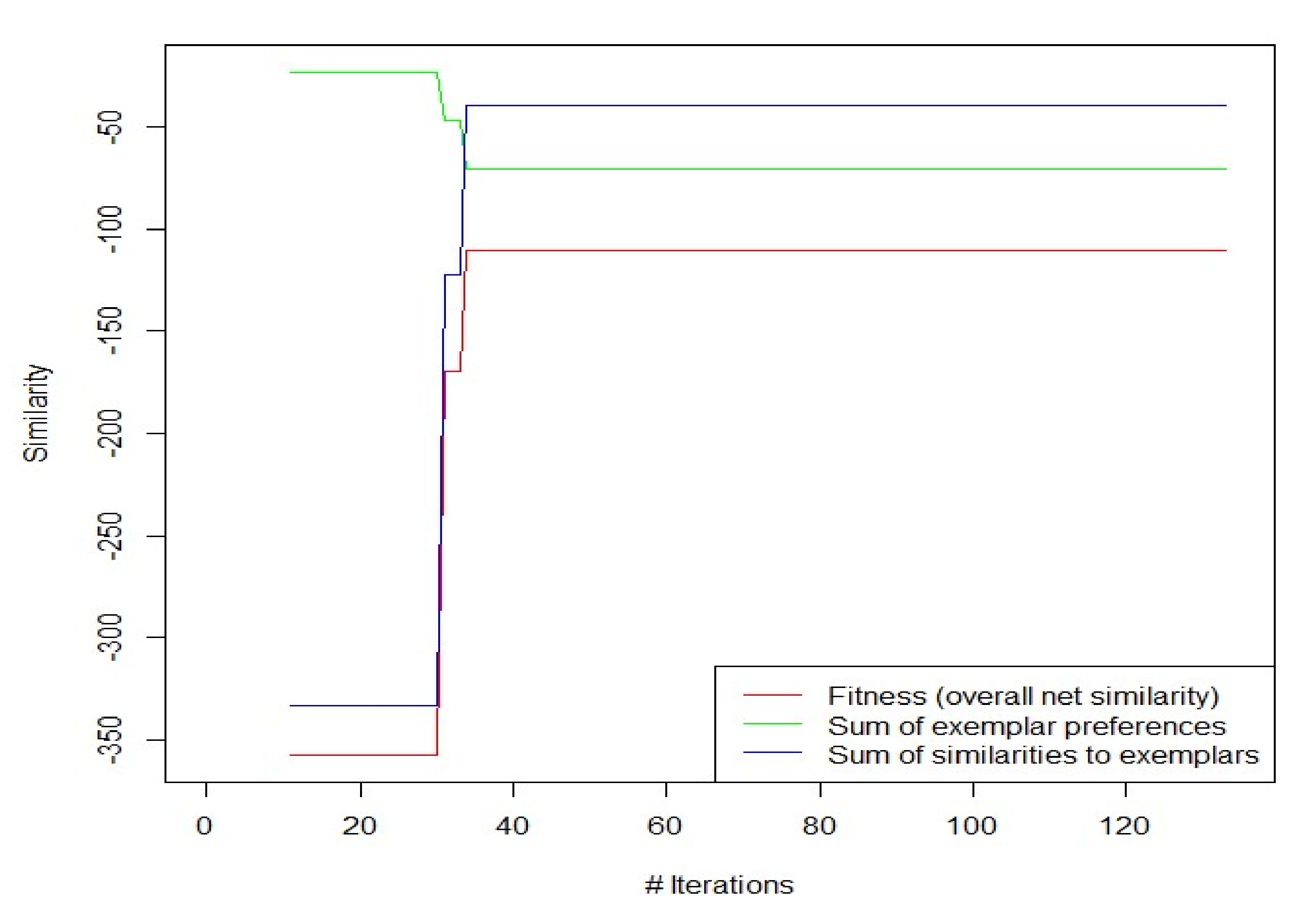
- Ensure convergence of the estimations of the predicted exemplar preferences and fitness (maximizing overall net similarity) to proceed in determining the cluster hierarchy.
- (8)
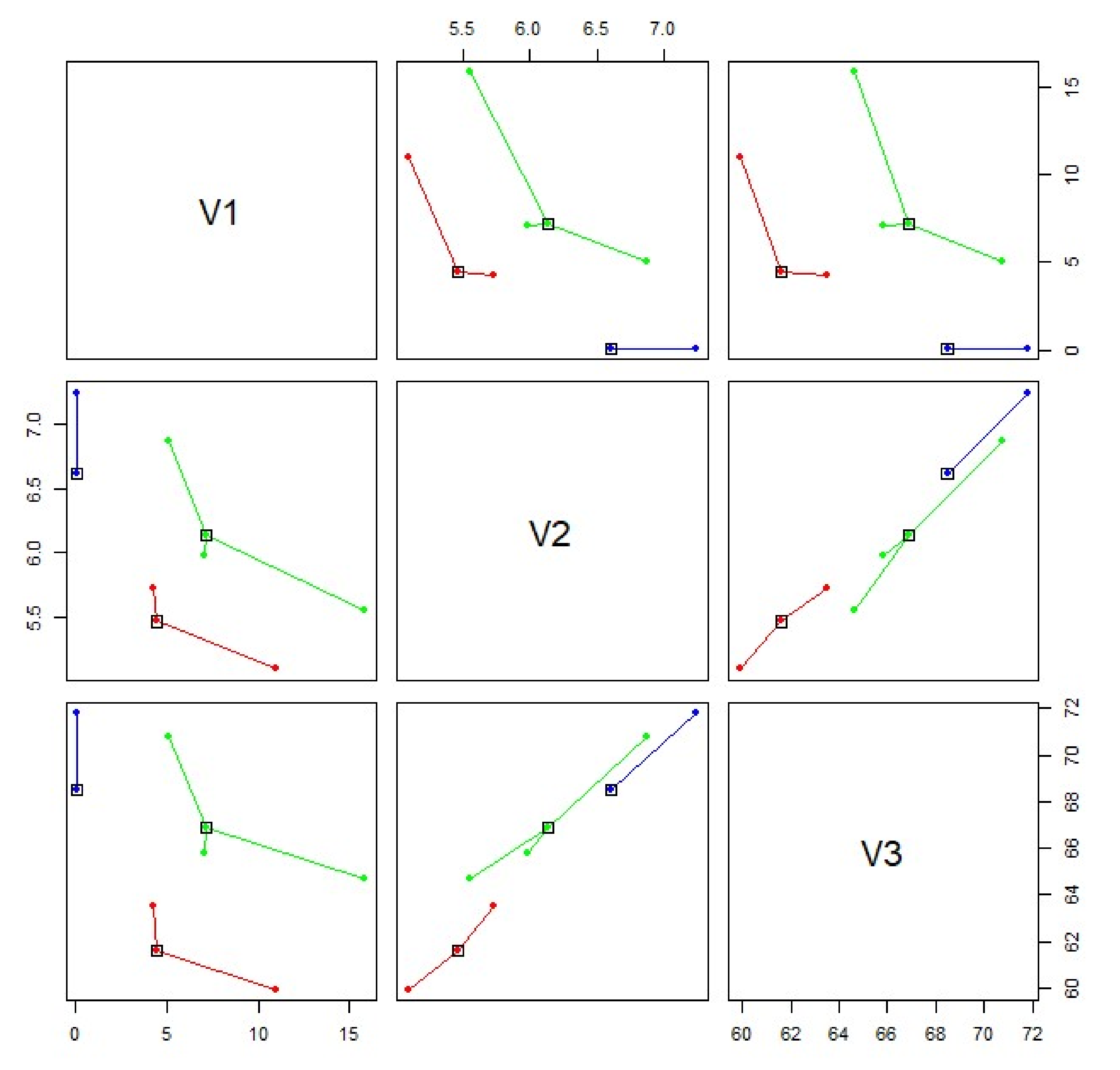
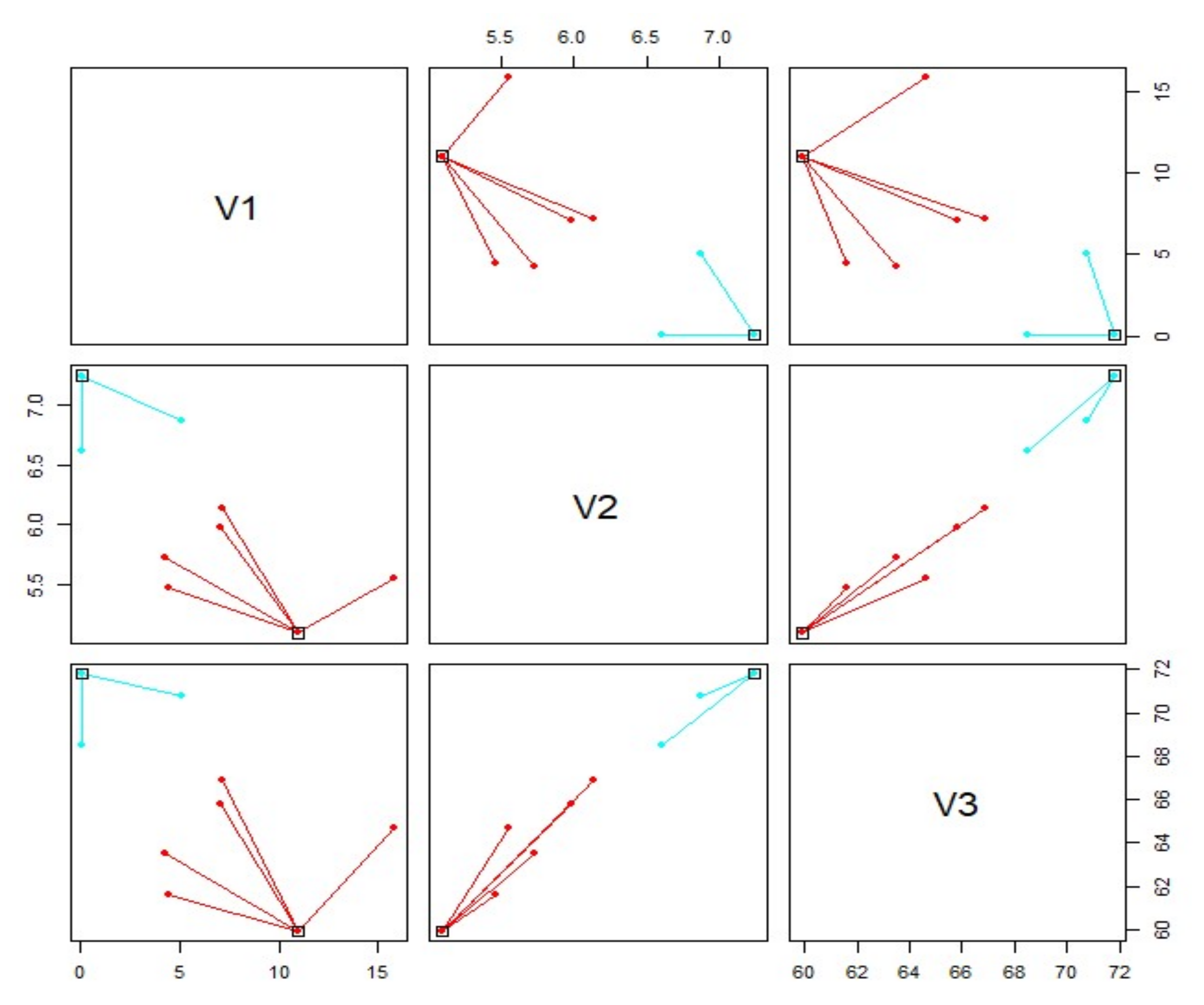
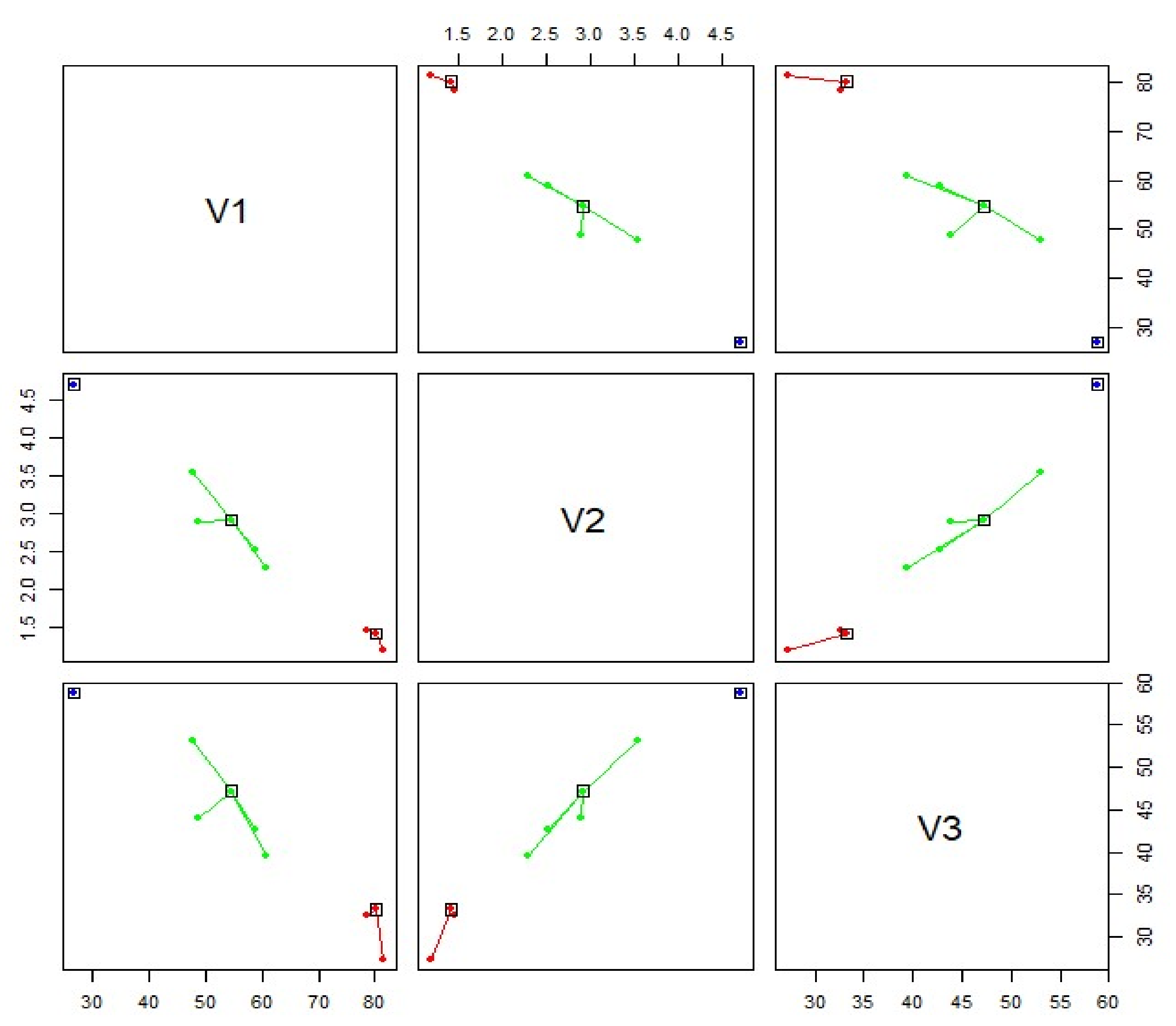
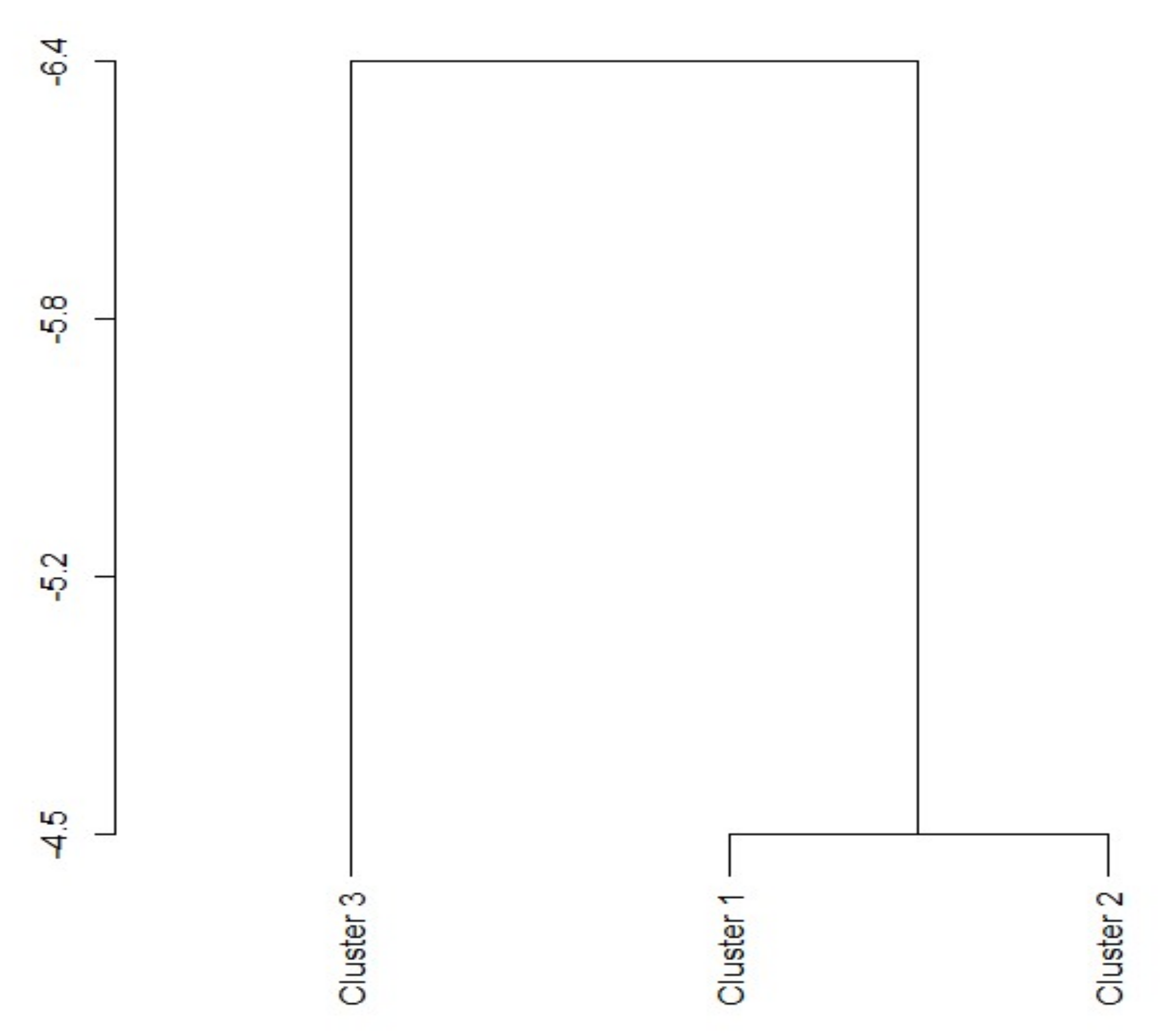
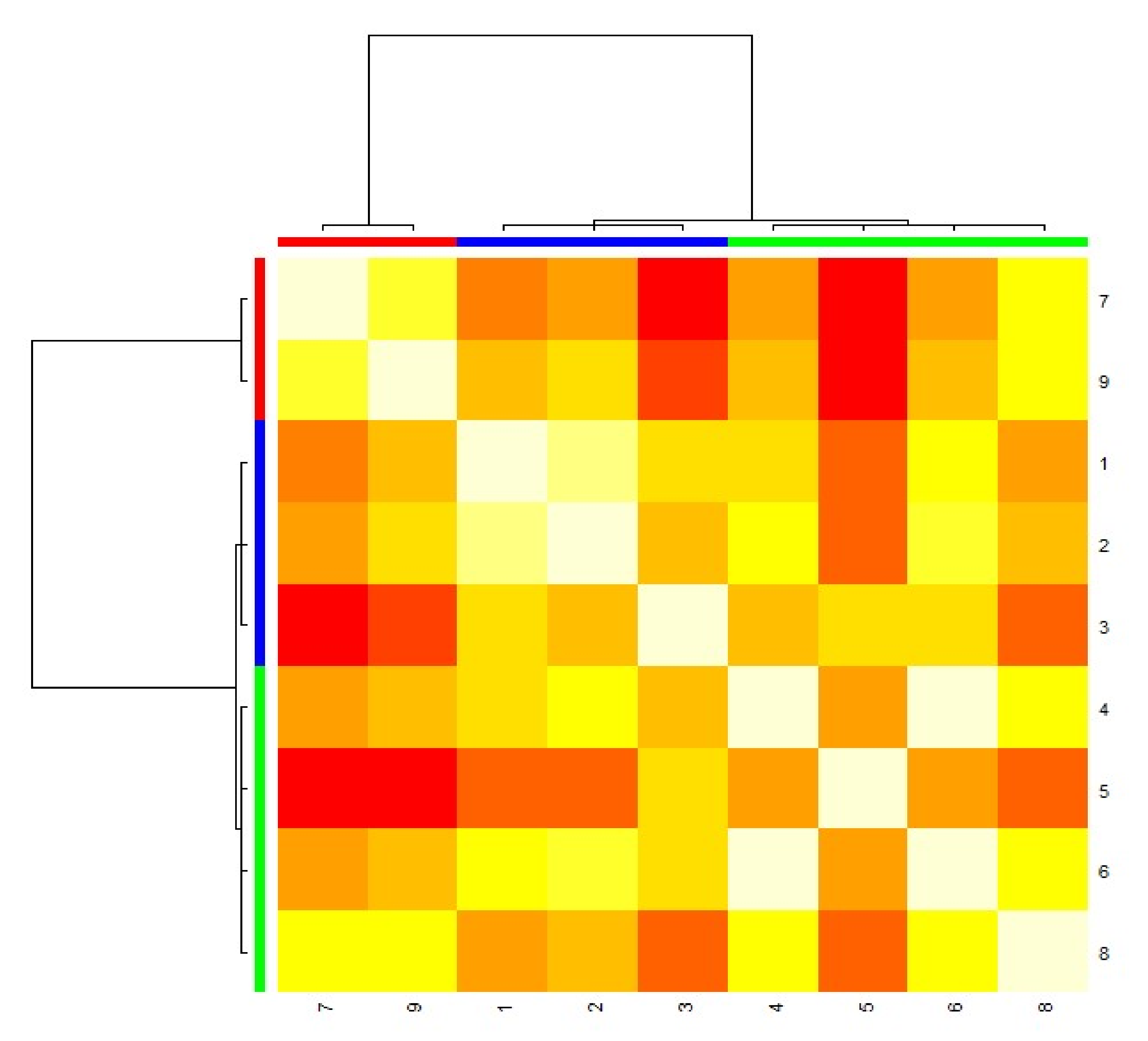
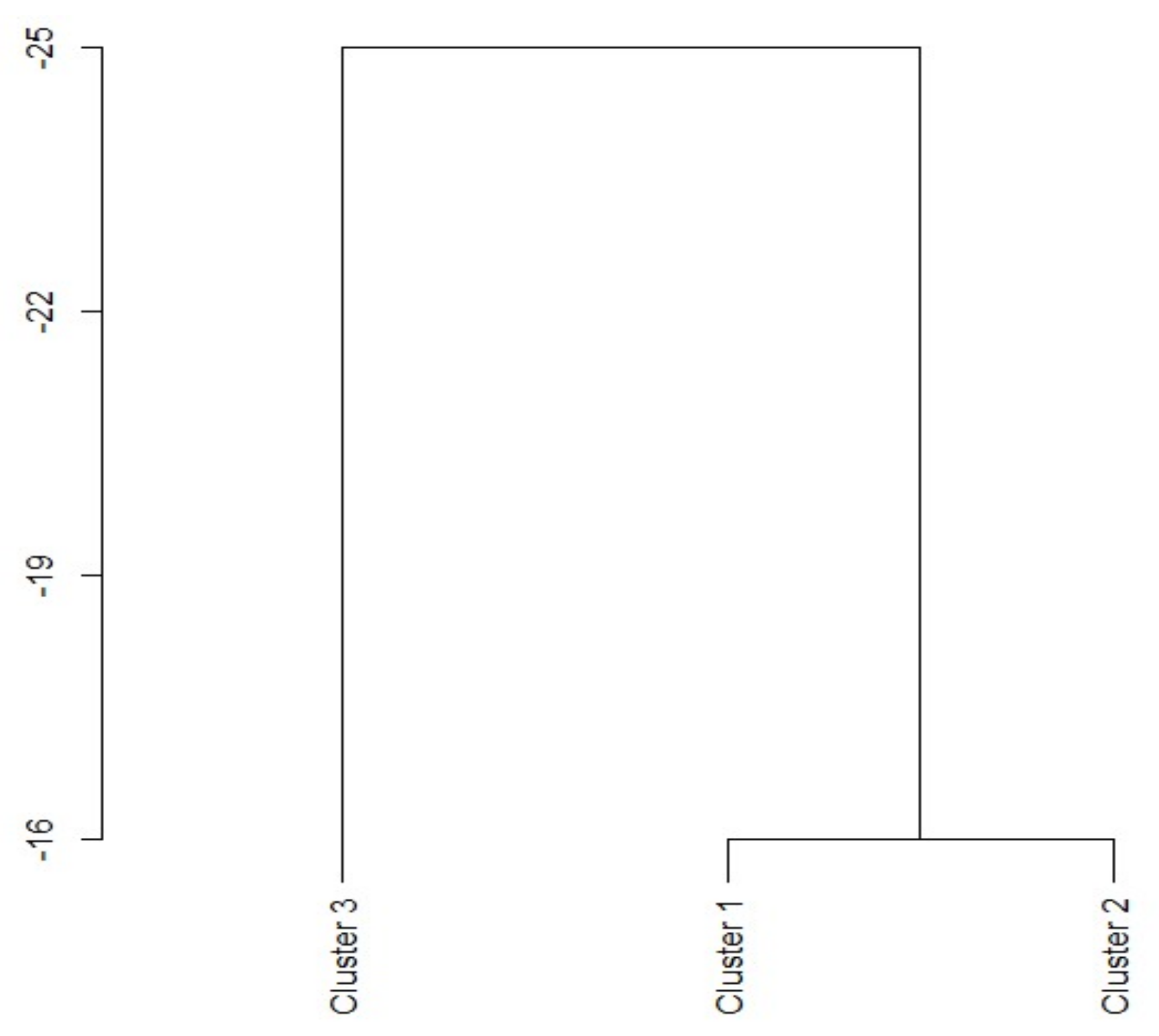
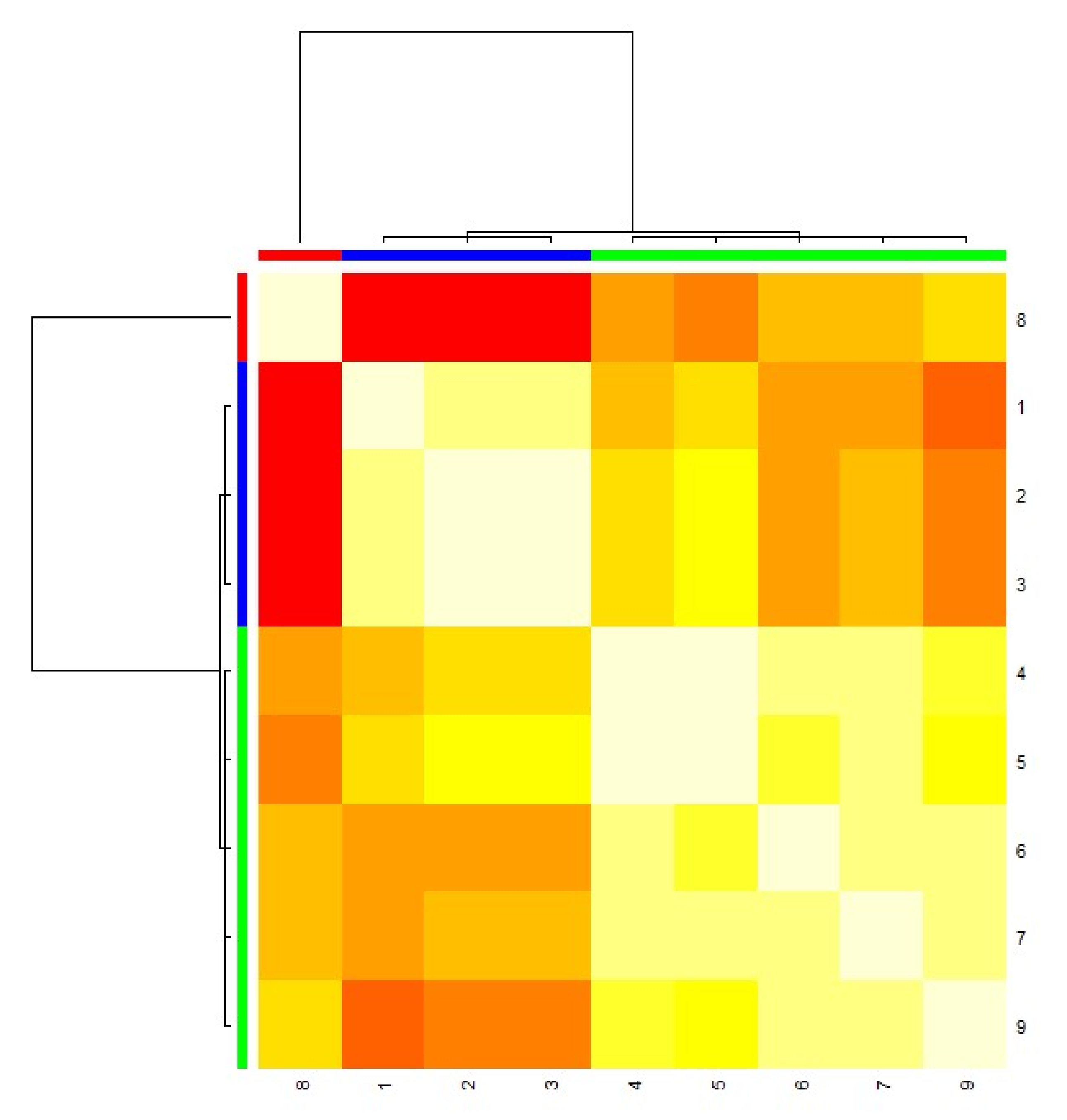
- Prepare the cluster dendrogram and the visualized clustering result, including the designated exemplar points. Pinpoint on a similarity–matrix heatmap the contoured clustering performance to assess the correlation between potential operational limits.
- (9)
- Provide a double verification of the strong effect predictions (from step 8) by reassessing the clustering outcomes by their estimated relative surprise measure, leading to a relative entropy measure for each labelled cluster [62].
- (10)
- Confirm the results with additional independent datasets.
2.5. The Computational Aids
3. Results
4. Discussion
5. Conclusions
Funding
Data Availability Statement
Conflicts of Interest
References
- Finney, J. Waterꓽ A Very Short Introduction; Oxford University Press: Oxford, UK, 2015. [Google Scholar]
- Ball, P. H2O: The Biography of Water; Orion Publishing Co.: London, UK, 2000. [Google Scholar]
- SDG Compass. Ensure Availability and Sustainable Management of Water and Sanitation for All; United Nations: New York, NY, USA, 2015. Available online: https://sdgcompass.org/sdgs/sdg-6/ (accessed on 7 August 2021).
- WWAP (United Nations World Water Assessment Programme). The United Nations World Water Development Report 2017: Wastewater: The Untapped Resource; UNESCO: Paris, France, 2017. [Google Scholar]
- Younas, F.; Mustafa, A.; Rahman Farooqi, Z.U.; Wang, X.; Younas, S.; Mohy-Ud-Din, W.; Hameed, M.A.; Abrar, M.M.; Maitlo, A.A.; Noreen, S.; et al. Current and emerging adsorbent technologies for wastewater treatment: Trends, limitations, and environmental implications. Water 2021, 13, 215. [Google Scholar] [CrossRef] [Scilit]
- Zito, R. Electrochemical Water Processing; Wiley-Scrivener: Hoboken, NJ, USA, 2011. [Google Scholar]
- Tanaka, Y. Ion Exchange Membrane Electrodialysis: Fundamentals, Desalination, Separation; Nova Science: New York, NY, USA, 2013. [Google Scholar]
- Zhang, Y.; Shen, Y. Wastewater irrigation: Past, present, and future. WIRE’s Water 2019, 6, 1234. [Google Scholar] [CrossRef] [Scilit]
- Jaramillo, M.F.; Restrepo, I. Wastewater reuse in agriculture: A review about its limitations and benefits. Sustainability 2017, 9, 1734. [Google Scholar] [CrossRef] [Scilit]
- Lopez-Serrano, M.J.; Velasco-Munoz, J.F.; Arnar-Sanchez, J.A.; Roman-Sanchez, I.M. Sustainable use of wastewater in agriculture: A bibliometric analysis of worldwide research. Sustainability 2020, 12, 8948. [Google Scholar] [CrossRef] [Scilit]
- Elgallal, M.; Fletcher, L.; Evans, B. Assessment of potential risks associated with chemicals in wastewater used for irrigation in arid and semiarid zones: A review. Agric. Water Manag. 2016, 177, 419–431. [Google Scholar] [CrossRef] [Scilit]
- Ungureanu, N.; Vladut, V.; Voicu, G. Water scarcity and wastewater reuse in crop irrigation. Sustainability 2020, 12, 9055. [Google Scholar] [CrossRef] [Scilit]
- Saliu, T.D.; Oladoja, N.A. Nutrient recovery from wastewater and reuse in agriculture: A review. Environ. Chem. Lett. 2021, 19, 2299–2316. [Google Scholar] [CrossRef] [Scilit]
- Richa, A.; Touil, S.; Fizir, M.; Martinez, V. Recent advances and perspectives in the treatment of hydroponic wastewater: A review. Rev. Environ. Sci. Biotechnol. 2020, 19, 945–966. [Google Scholar] [CrossRef] [Scilit]
- El Batouti, M.; Al-Harby, N.E.; Elewa, M.M. A review on promising membrane technology approaches for heavy metal removal from water and wastewater to solve water crisis. Water 2021, 13, 3241. [Google Scholar] [CrossRef] [Scilit]
- Saleh, T.A.; Mustaqeem, M.; Khaled, M. Water treatment technologies in removing heavy metal ions from wastewater: A review. Environ. Nanotechnol. Monit. Manag. 2022, 17, 100617. [Google Scholar] [CrossRef] [Scilit]
- Mora, A.; Torres-Martinez, J.A.; Capparelli, M.V.; Zabala, A.; Mahlknecht, J. Effects of wastewater irrigation on groundwater quality: An overview. Curr. Opin. Environ. Sci. Health 2022, 25, 100322. [Google Scholar] [CrossRef] [Scilit]
- Lahlou, F.-Z.; Mackey, H.R.; Al-Ansari, T. Role of wastewater in achieving carbon and water neutral agricultural production. J. Clean. Prod. 2022, 339, 130706. [Google Scholar] [CrossRef] [Scilit]
- Burn, D.H.; McBean, E.A. Optimization modelling of water quality in an uncertain environment. Water Resour. Res. 1985, 21, 934–940. [Google Scholar] [CrossRef] [Scilit]
- Rehana, S.; Rajulapati, C.R.; Ghosh, S.; Karmakar, S.; Mujumdar, P. Uncertainty Quantification in Water Resource Systems Modeling: Case Studies from India. Water 2020, 12, 1793. [Google Scholar] [CrossRef] [Scilit]
- Singha, S.; Pasupuleti, S.; Singha, S.S.; Singh, R. Prediction of groundwater quality using efficient machine learning technique. Chemosphere 2021, 276, 130265. [Google Scholar] [CrossRef] [Scilit]
- Malviya, A.; Jaspal, D. Artificial intelligence as an upcoming technology in wastewater treatment: A comprehensive review. Environ. Technol. Rev. 2021, 10, 177–187. [Google Scholar] [CrossRef] [Scilit]
- Hanoon, M.S.; Ahmed, A.N.; Fai, C.M.; Birima, A.H.; Razzaq, A.; Sherif, M.; Sefelnasr, A.; El-Shafie, A. Application of artificial intelligence models for modeling water quality in groundwater: Comprehensive review, evaluation and future trends. Water Air Soil Pollut. 2021, 232, 411. [Google Scholar] [CrossRef] [Scilit]
- Sunayana; Kalawapudi, K.; Dube, O.; Sharma, R. Use of neural networks and spatial interpolation to predict groundwater quality. Environ. Dev. Sustain. 2020, 22, 2801–2816. [Google Scholar] [CrossRef] [Scilit]
- Pilar Callao, M. Multivariate experimental design in environmental analysis. Trends Anal. Chem. 2014, 62, 86–92. [Google Scholar] [CrossRef] [Scilit]
- Box, G.E.P.; Hunter, W.G.; Hunter, J.S. Statistics for Experimenters—Design, Innovation, and Discovery; Wiley: New York, NY, USA, 2005. [Google Scholar]
- Abou-Shady, A. Recycling of polluted wastewater for agriculture purpose using electrodialysis: Perspective for large scale application. Chem. Eng. J. 2017, 323, 1–18. [Google Scholar] [CrossRef] [Scilit]
- Taguchi, G.; Chowdhury, S.; Wu, Y. Quality Engineering Handbook; Wiley-Interscience: Hoboken, NJ, USA, 2004. [Google Scholar]
- Taguchi, G.; Chowdhury, S.; Taguchi, S. Robust Engineering: Learn How to Boost Quality while Reducing Costs and Time to Market; McGraw-Hill: New York, NY, USA, 2000. [Google Scholar]
- Dhingra, R.; Kress, R.; Upreti, G. Does lean mean green? J. Clean. Prod. 2014, 85, 1–7. [Google Scholar] [CrossRef] [Scilit]
- Johansson, G.; Sundin, E. Lean and green product development: Two sides of the same coin? J. Clean. Prod. 2014, 85, 104–121. [Google Scholar] [CrossRef] [Scilit]
- Garza-Reyes, J.A. Lean and green—A systematic review of the state of the art literature. J. Clean. Prod. 2015, 102, 18–29. [Google Scholar] [CrossRef] [Scilit]
- Fercoq, A.; Lamouri, S.; Carbone, V. Lean/Green integration focused on waste reduction techniques. J. Clean. Prod. 2016, 137, 567–578. [Google Scholar] [CrossRef] [Scilit]
- Dieste, M.; Panizzolo, R.; Garza-Reyes, J.A.; Anosike, A. The relationship between lean and environmental performance: Practices and measures. J. Clean. Prod. 2019, 224, 120–131. [Google Scholar] [CrossRef] [Scilit]
- Bhattacharya, A.; Nand, A.; Castka, P. Lean-green integration and its impact on sustainability performance: A critical review. J. Clean. Prod. 2019, 236, 117697. [Google Scholar] [CrossRef] [Scilit]
- Teixeira, P.; Sa, J.C.; Silva, F.J.G.; Ferreira, L.P.; Santos, G.; Fontoura, P. Connecting lean and green with sustainability towards a conceptual model. J. Clean. Prod. 2021, 322, 129047. [Google Scholar] [CrossRef] [Scilit]
- Anastas, P.T.; Zimmerman, J.B. Design through the 12 principles of green engineering. Environ. Sci. Technol. 2003, 37, 94–101. [Google Scholar] [CrossRef] [Scilit]
- Constable, D.J.C. Green and sustainable chemistry: The case for a systems-based, interdisciplinary approach. iScience 2021, 24, 103489. [Google Scholar] [CrossRef] [Scilit]
- Lopez-Lorente, A.I.; Pena-Pereira, F.; Pedersen-Bjergaard, S.; Zuin, V.G.; Ozkan, S.A.; Psillakis, E. The ten principles of green sample preparation. Trends Anal. Chem. 2022, 148, 116530. [Google Scholar] [CrossRef] [Scilit]
- Sajid, M.; Plotka-Wasylka, J. Green analytical chemistry metrics: A review. Talanta 2022, 228, 123046. [Google Scholar] [CrossRef] [Scilit] [PubMed]
- Sheldon, R.A.; Bode, M.L.; Akakios, S.G. Metrics of green chemistry: Waste minimization. Curr. Opin. Green Sustain. Chem. 2022, 33, 100569. [Google Scholar] [CrossRef] [Scilit]
- Besseris, G.J. A Distribution-Free Multi-Factorial Profiler for Harvesting Information from High-Density Screenings. PLoS ONE 2013, 8, e73275. [Google Scholar] [CrossRef] [Scilit] [PubMed]
- Hamada, M.; Balakrishnan, N. Analyzing unreplicated factorial experiments: A review with some new proposals. Stat. Sin. 1998, 8, 1–41. [Google Scholar]
- Daniel, C. Use of the half-normal plots in interpreting factorial two-level experiments. Technometrics 1959, 1, 311–341. [Google Scholar] [CrossRef]
- Lenth, R.V. Quick and easy analysis of unreplicated factorials. Technometrics 1989, 31, 469–473. [Google Scholar] [CrossRef]
- Box, G.E.P.; Meyer, R.D. An analysis for unreplicated fractional factorials. Technometrics 1986, 28, 11–18. [Google Scholar] [CrossRef]
- Derringer, G.; Suich, R. Simultaneous optimization of several response variables. J. Qual. Technol. 1980, 12, 214–219. [Google Scholar] [CrossRef] [Scilit]
- Besseris, G.J. Concurrent multiresponse multifactorial screening of an electrodialysis process of polluted wastewater using robust non-linear Taguchi profiling. Chemom. Intell. Lab. Syst. 2020, 200, 103997. [Google Scholar] [CrossRef] [Scilit]
- Ilzarbe, L.; Alvarez, M.J.; Viles, E.; Tanco, M. Practical applications of design of experiments in the field of engineering: A bibliographical review. Qual. Reliab. Eng. Int. 2008, 24, 417–428. [Google Scholar] [CrossRef] [Scilit]
- Tanco, M.; Viles, E.; Ilzarbe, L.; Alvarez, M.J. Implementation of Design of Experiments projects in industry. Qual. Reliab. Eng. Int. 2009, 25, 478–505. [Google Scholar] [CrossRef] [Scilit]
- Breiman, L. Statistical modeling: The two cultures. Stat. Sci. 2001, 16, 199–231. [Google Scholar] [CrossRef] [Scilit]
- Besseris, G. Micro-Clustering and Rank-Learning Profiling of a Small Water-Quality Multi-Index Dataset to Improve a Recycling Process. Water 2021, 13, 2469. [Google Scholar] [CrossRef] [Scilit]
- Fontdecaba, S.; Grima, P.; Tort-Martorell, X. Analyzing DOE with Statistical Software Packages: Controversies and proposals. Am. Stat. 2014, 68, 205–211. [Google Scholar] [CrossRef] [Scilit]
- Fisher, R.A. Statistical Methods, Experimental Design, and Scientific Inference; Oxford University Press: Oxford, UK, 1990. [Google Scholar]
- Besseris, G.J. Order Statistics for a Two-Level, Eight-Run Saturated-Unreplicated Fractional-Factorial Screening. Qual. Eng. 2009, 21, 416–431. [Google Scholar] [CrossRef] [Scilit]
- Mee, R.W.; Lu, X. Don’t use rank sum tests to analyze factorial designs. Qual. Eng. 2010, 23, 26–29. [Google Scholar] [CrossRef] [Scilit]
- Carlson, R.; Nordahl, A.; Barth, T.; Myklebust, R. An approach to evaluating screening experiments when several responses are measured. Chemom. Intell. Lab. Syst. 1991, 12, 237–255. [Google Scholar] [CrossRef] [Scilit]
- Lepeniotis, S.S.; Vigezzi, M.J. Lowering manufacturing cost of material by formulating it through statistical modeling and design. Chemom. Intell. Lab. Syst. 1995, 29, 133–139. [Google Scholar] [CrossRef]
- Lim, M.K.; Lai, M.; Wang, C.; Lee, Y. Circular economy to ensure production operational sustainability: A green-lean approach. Sustain. Prod. Consum. 2022, 30, 130–144. [Google Scholar] [CrossRef] [Scilit]
- Touriki, F.E.; Benkhati, I.; Kamble, S.S.; Belhadi, A.; El Fezazi, S. An integrated smart, green, resilient, and lean manufacturing framework: A literature review and future research directions. J. Clean. Prod. 2021, 319, 128691. [Google Scholar] [CrossRef] [Scilit]
- Frey, B.J.; Dueck, D. Clustering by passing messages between data points. Science 2007, 315, 972–976. [Google Scholar] [CrossRef] [Scilit] [PubMed]
- Shannon, C.E. A mathematical theory of communication. Bell Syst. Tech. J. 1948, 27, 379–423, 623–656. [Google Scholar] [CrossRef] [Scilit]
- Bodenhofer, U.; Kothmeier, A.; Hochreiter, S. APCluster: An R package for affinity propagation clustering. Bioinformatics 2011, 27, 2463–2464. [Google Scholar] [CrossRef] [Scilit] [PubMed]
- R Core Team. R (Version 4.1.2): A Language and Environment for Statistical Computing; R Foundation for Statistical Computing: Vienna, Austria, 2021; Available online: https://www.R-project.org/ (accessed on 16 February 2022).
- Lawson, J. Design and Analysis of Experiments with R; CRC Press: Boca Raton, FL, USA, 2014. [Google Scholar]
- Stone, R.A.; Veevers, A. The Taguchi influence on designed experiments. J. Chemom. 1994, 8, 103–110. [Google Scholar] [CrossRef] [Scilit]




| Controlling Factors |
|---|
| Factor/Setting | P(X) | Relative Entropy |
|---|---|---|
| A1 | 1 | 0.00 |
| A2 | 0.75/0.25 | 0.41 |
| A3 | 1 | 0.00 |
| B1 | 0.33/0.33/0.33 | 1.00 |
| B2 | 0.25/0.25/0.5 | 0.75 |
| B3 | 0.5/0.5 | 1.00 |
| C1 | 0.33/0.33/0.33 | 1.00 |
| C2 | 0.25/0.25/0.5 | 0.75 |
| C3 | 0.5/0.5 | 1.00 |
| D1 | 0.33/0.33/0.33 | 1.00 |
| D2 | 0.25/0.25/0.5 | 0.75 |
| D3 | 0.5/0.5 | 1.00 |
| Factor/Setting | P(X) | Relative Entropy |
|---|---|---|
| A1 | 1 | 0.00 |
| A2 | 0.6/0.4 | 0.42 |
| A3 | 1 | 0.00 |
| B1 | 0.33/0.33/0.33 | 1.00 |
| B2 | 0.4/0.4/0.2 | 0.65 |
| B3 | 1 | 0.00 |
| C1 | 0.33/0.33/0.33 | 1.00 |
| C2 | 0.4/0.4/0.2 | 0.65 |
| C3 | 1 | 0.00 |
Publisher’s Note: MDPI stays neutral with regard to jurisdictional claims in published maps and institutional affiliations. |
© 2022 by the author. Licensee MDPI, Basel, Switzerland. This article is an open access article distributed under the terms and conditions of the Creative Commons Attribution (CC BY) license (https://creativecommons.org/licenses/by/4.0/).
Share and Cite
Besseris, G. Wastewater Quality Screening Using Affinity Propagation Clustering and Entropic Methods for Small Saturated Nonlinear Orthogonal Datasets. Water 2022, 14, 1238. https://doi.org/10.3390/w14081238
Besseris G. Wastewater Quality Screening Using Affinity Propagation Clustering and Entropic Methods for Small Saturated Nonlinear Orthogonal Datasets. Water. 2022; 14(8):1238. https://doi.org/10.3390/w14081238
Chicago/Turabian StyleBesseris, George. 2022. "Wastewater Quality Screening Using Affinity Propagation Clustering and Entropic Methods for Small Saturated Nonlinear Orthogonal Datasets" Water 14, no. 8: 1238. https://doi.org/10.3390/w14081238
APA StyleBesseris, G. (2022). Wastewater Quality Screening Using Affinity Propagation Clustering and Entropic Methods for Small Saturated Nonlinear Orthogonal Datasets. Water, 14(8), 1238. https://doi.org/10.3390/w14081238