Article

Optimization of China Sponge City Design: The Case of Lincang Technology Innovation Park

State Key Joint Laboratory of Environment Simulation and Pollution Control, School of Environment, Tsinghua University, Beijing 100084, China
*
Author to whom correspondence should be addressed.
Water 2018, 10(9), 1189; https://doi.org/10.3390/w10091189
Submission received: 24 July 2018 / Revised: 25 August 2018 / Accepted: 31 August 2018 / Published: 4 September 2018

Abstract

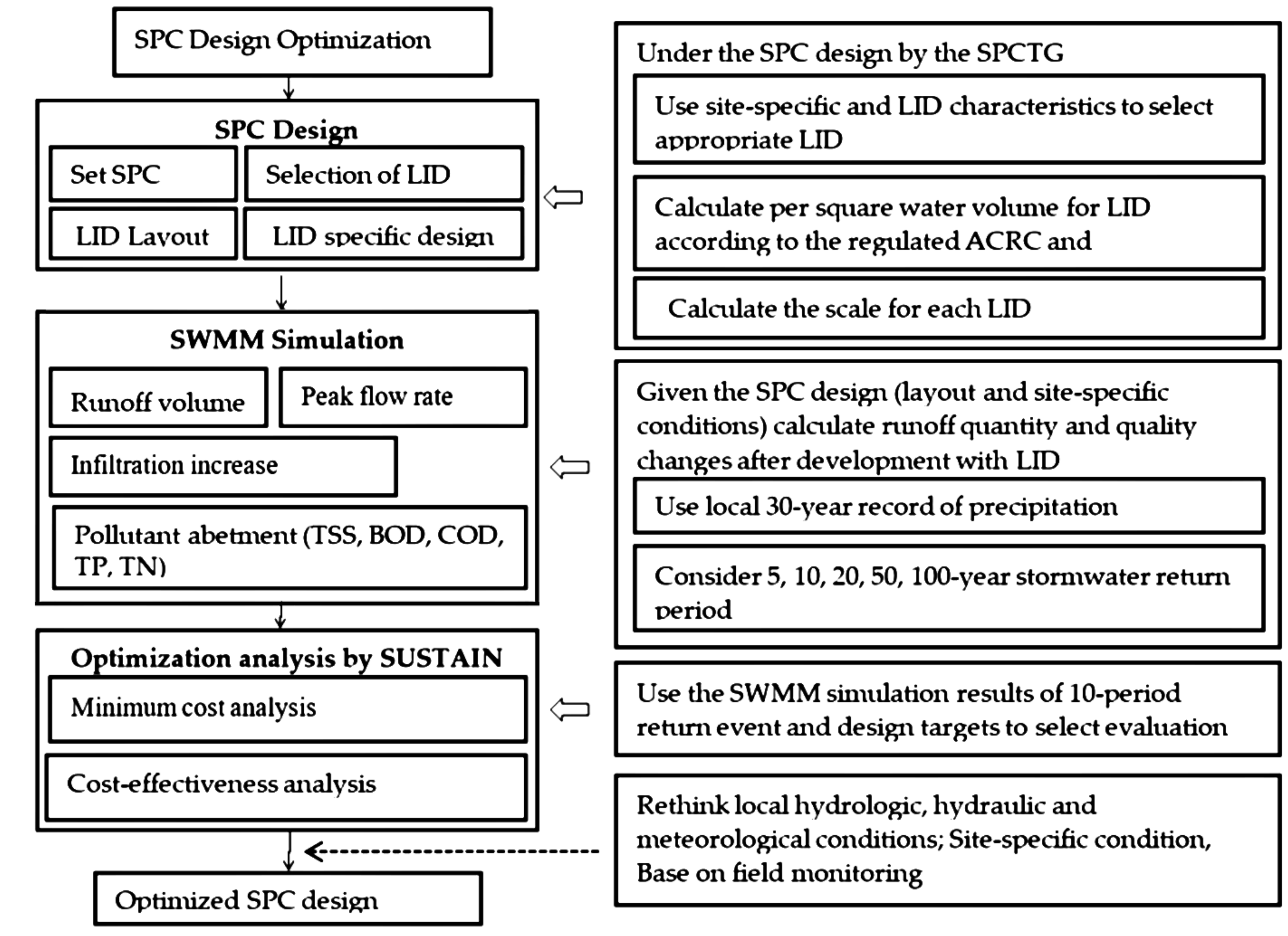
China launched the sponge city (SPC) initiative in 2013 to reduce municipal stormwater runoff. The design criteria are mainly the annual comprehensive runoff coefficient (ACRC) regulated in a design guideline. Numerous SPC alternatives with varied low-impact development (LID) measures can be designed to meet the ACRC. Obviously, the optimization of SPC design is significant. This study provides an approach to SPC design optimization that applies an optimized module of SUSTAIN to simulate SPC performance over a 10-year period. The targeted volume reduction was derived from the SWMM model and corresponded to the ACRC criteria. Based on the reduction, the minimal cost and cost-effectiveness analyses were conducted. The proposed approach was applied to the Lincang Technology Innovation Park (LCTIP) as a test case. Three scenarios were analyzed: The original design implemented on the site, the landscape improved design, and the most economical design. The results indicated that the optimized alternative may save up to 12.3% of the cost while meeting that ACRC value. The approach improves upon SPC design, particularly with regards to flood control. The present research will help decision makers to develop and select the most appropriate SPC design that is most cost-effective.
Keywords: sponge city; design optimization; Stormwater Management Model (SWMM); System for Stormwater Analysis and Integration (SUSTAIN); Lincang Technology Innovation Park (LCTIP) sponge city; design optimization; Stormwater Management Model (SWMM); System for Stormwater Analysis and Integration (SUSTAIN); Lincang Technology Innovation Park (LCTIP)