A Study on the Electric Field Degradation of Common Pollutant Gases in Archive Rooms Based on Density Functional Theory

Abstract
1. Introduction
2. Theory
3. Calculation Results and Discussion
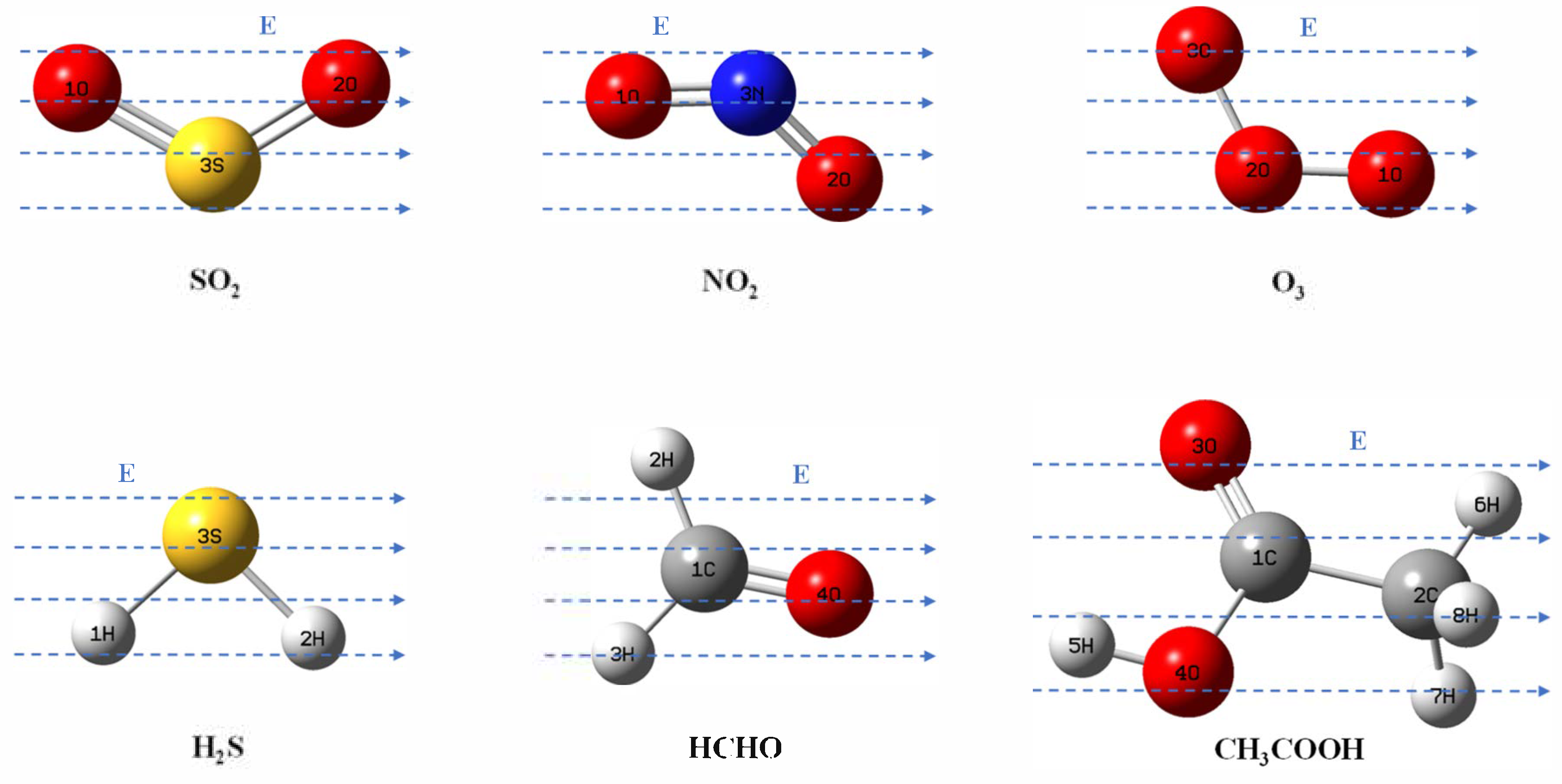
3.1. Optimization of Molecular Configurations
3.2. Spectroscopic Study of Six Pollutant Molecules
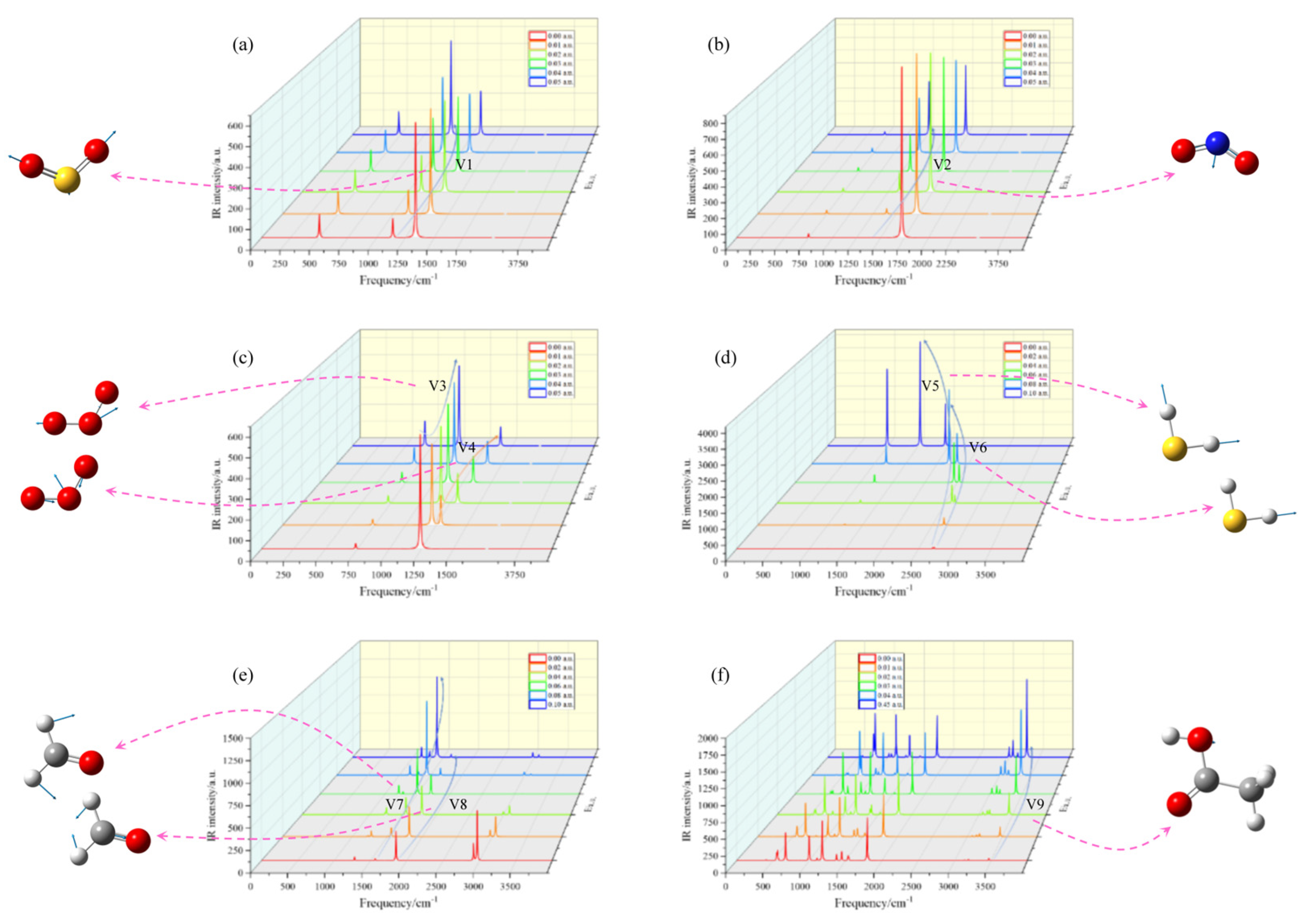
3.2.1. Infrared Spectroscopy
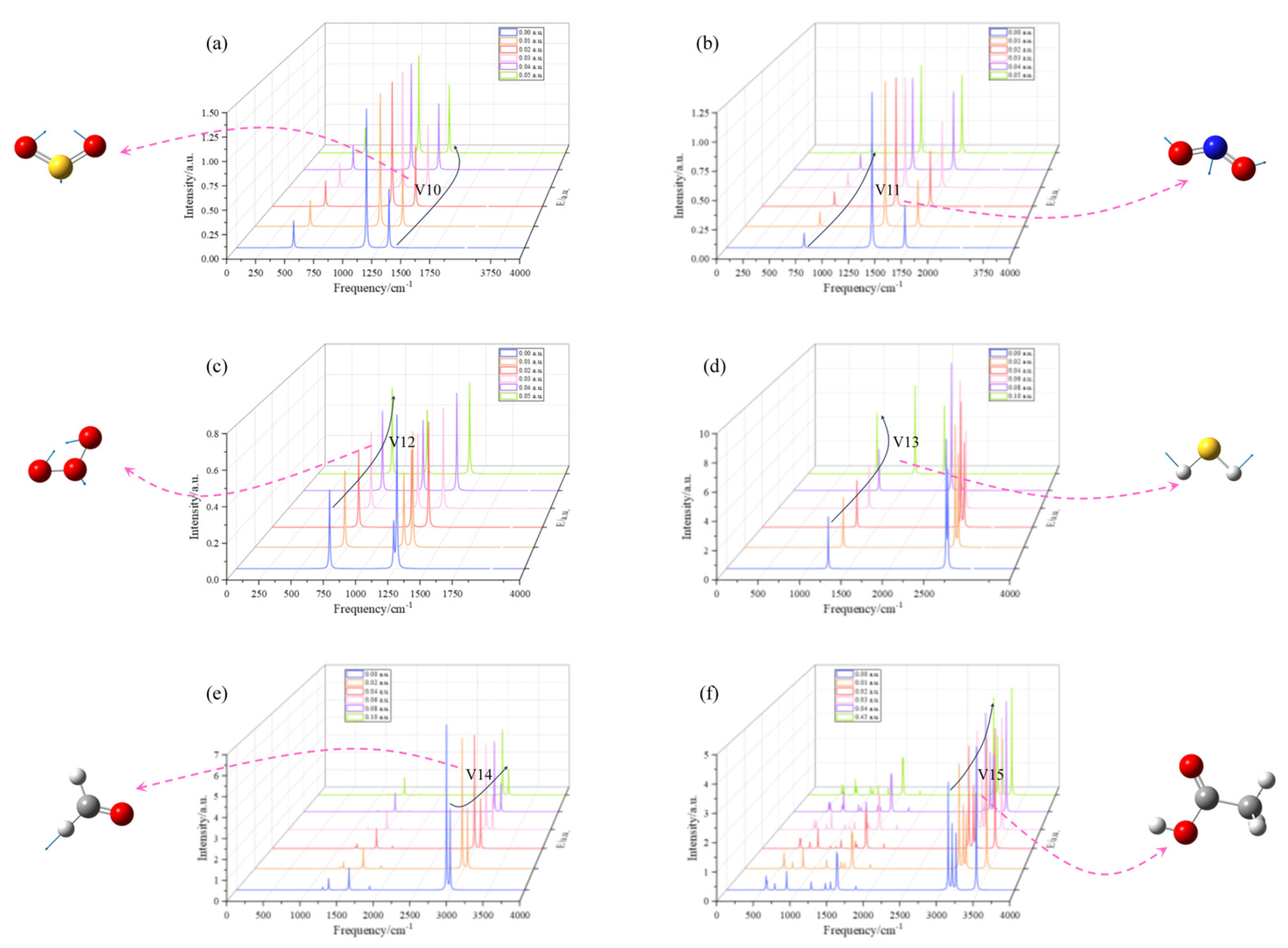
3.2.2. Raman Spectroscopy
3.3. Study on the Potential Energy Surfaces of Six Pollutant Molecules
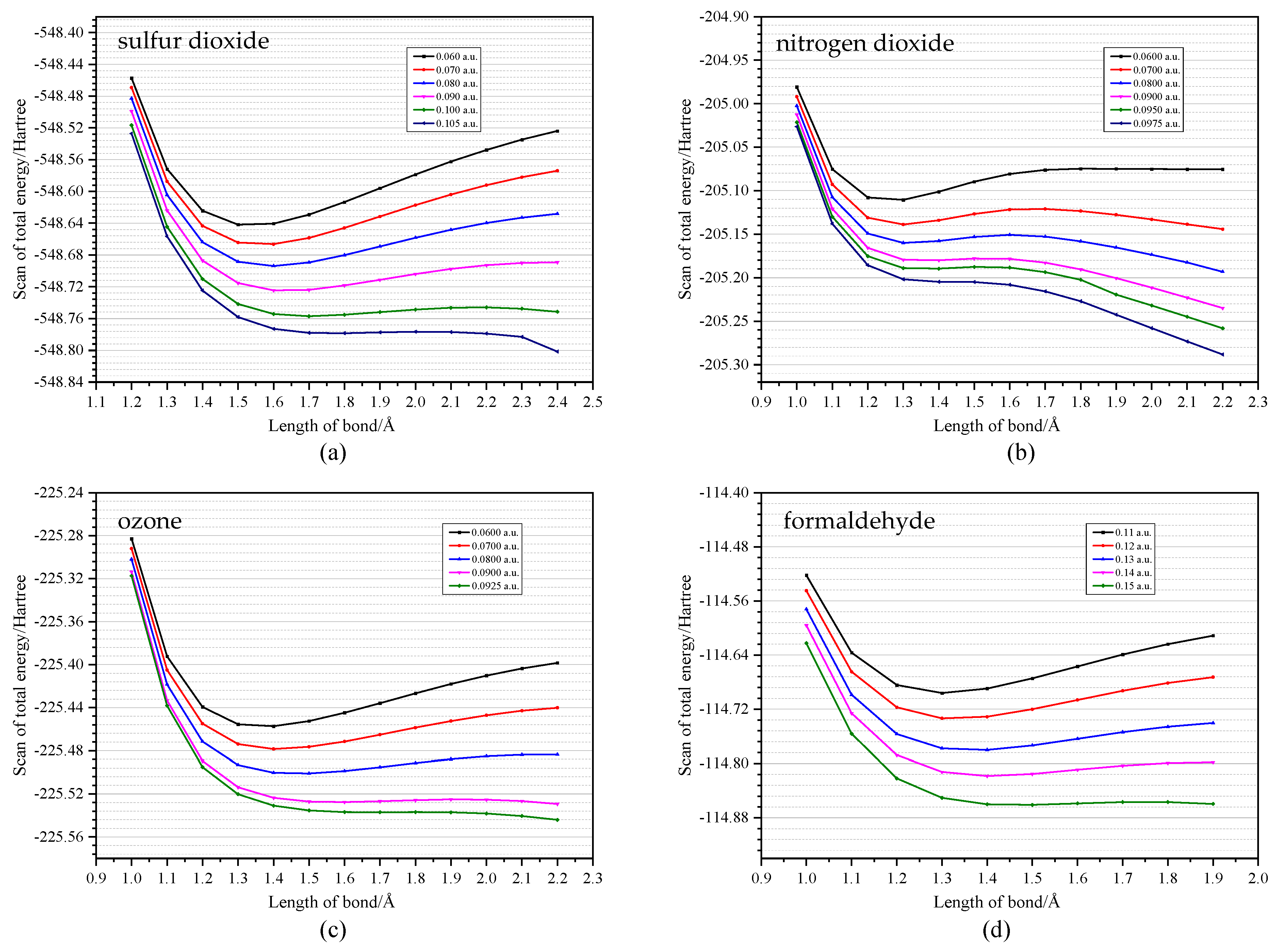
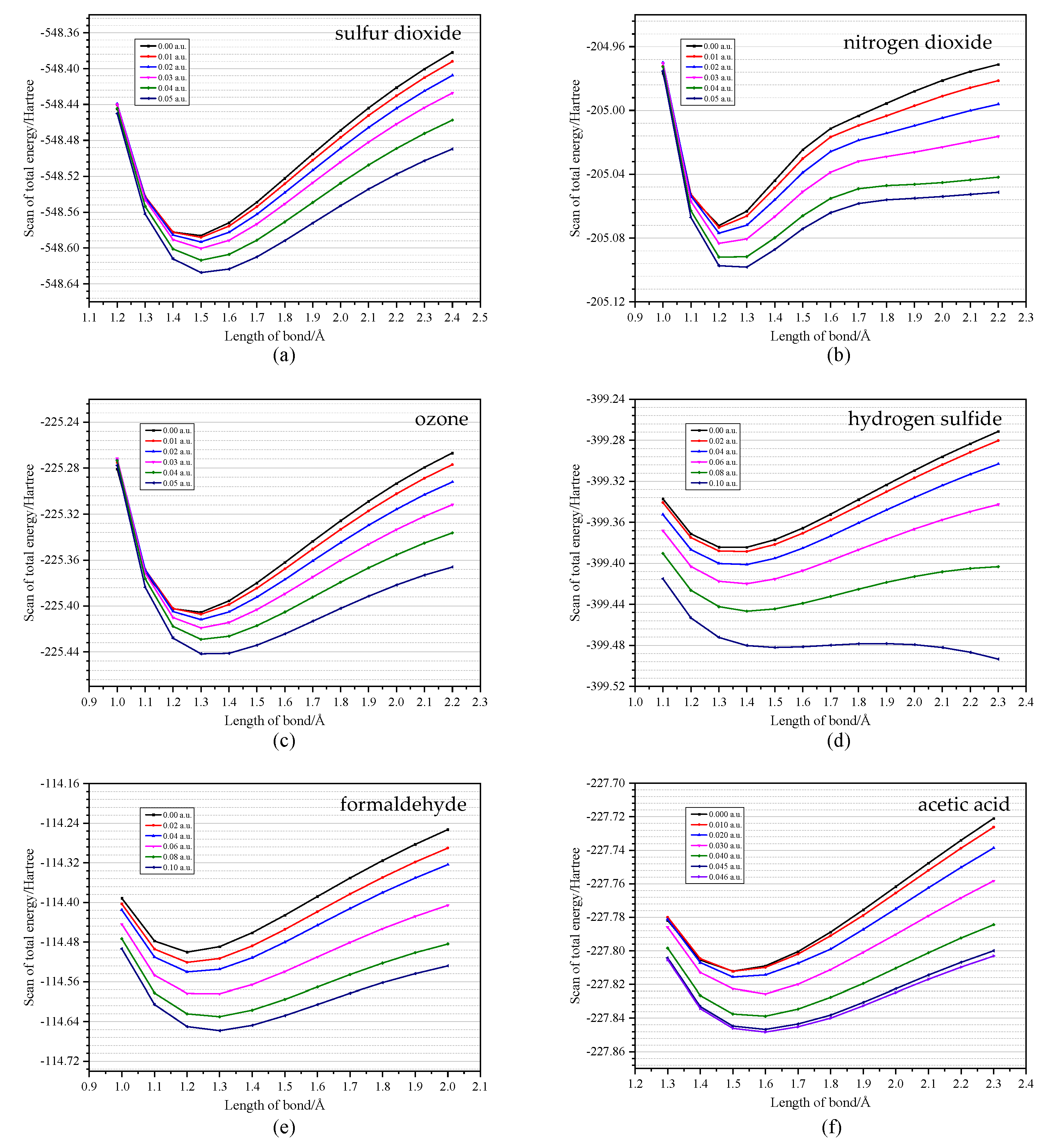
3.3.1. Molecular Potential Energy Surface Under External Electric Field
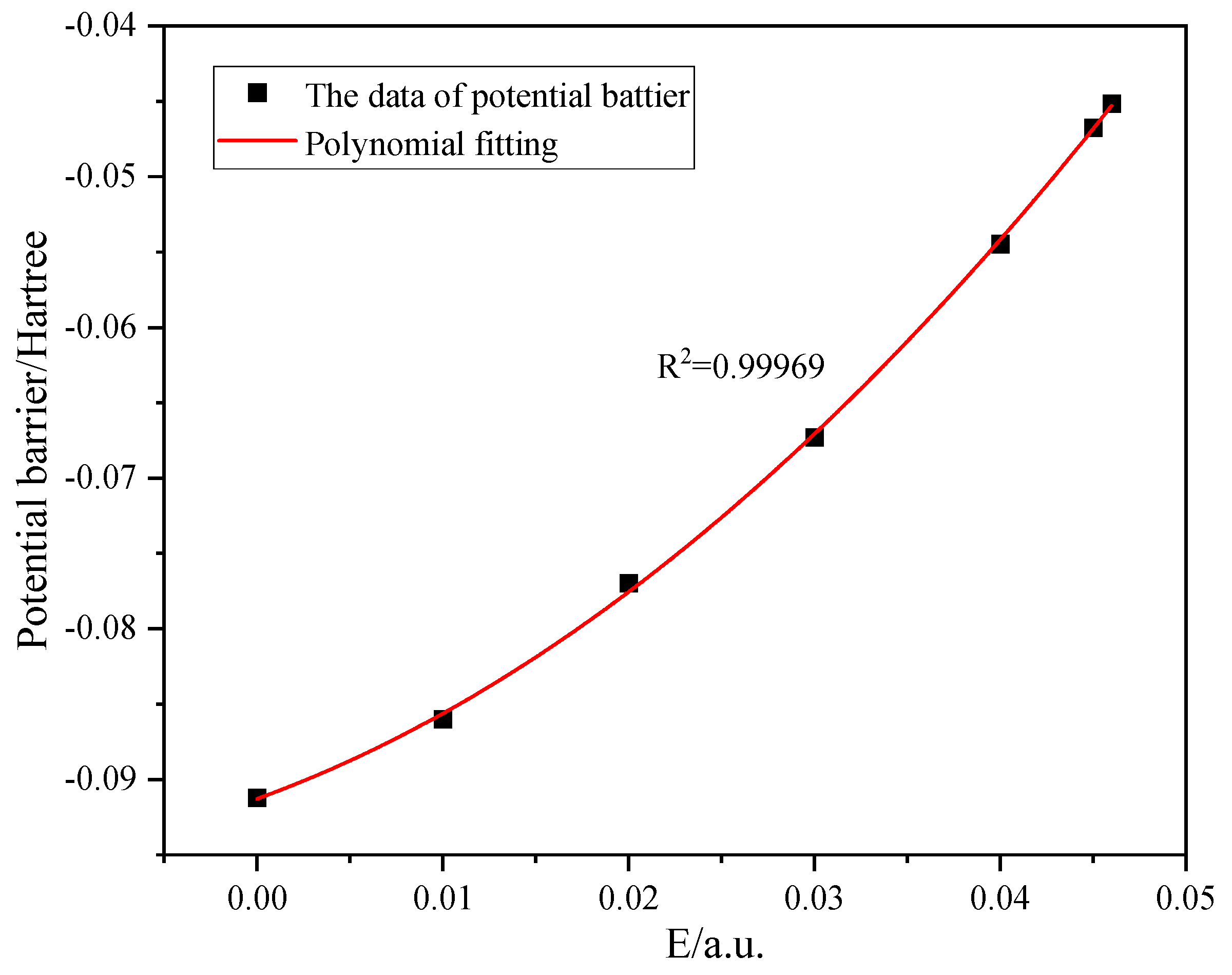
3.3.2. Field-Dependent Potential Barrier Evolution and Dissociation Tendency
4. Summary
Author Contributions
Funding
Institutional Review Board Statement
Informed Consent Statement
Data Availability Statement
Acknowledgments
Conflicts of Interest
References
- Fang, Z. Technical Specification for Air Quality Detection in Archive Repositories; Archives Science and Technology Institute of the National Archives Administration: Beijing, China, 2019. [Google Scholar]
- Licastro, F. Exogenous and Endogenous Virus Infection and Pollutants Drive Neuronal Cell Senescence and Alzheimer’s Disease. Biocell 2025, 49, 981–989. [Google Scholar] [CrossRef] [Scilit]
- Ligterink, F.; Di Pietro, G. The limited impact of acetic acid in archives and libraries. Herit. Sci. 2018, 6, 59. [Google Scholar] [CrossRef] [Scilit]
- Lee, H.W.; Jeon, J.I.; Lim, H.B.; Lee, K.B.; Park, S.Y.; Lee, C.M. A Preliminary Research Study for Distribution Characteristics and Sources of Indoor Air Pollutants in the Valuable Archive of the National Library of Korea. Int. J. Environ. Res. Public Health 2021, 18, 1715. [Google Scholar] [CrossRef] [Scilit] [PubMed]
- Di Pietro, G.; Ligterink, F.; Porck, H.; de Bruin, G. Chemical air filtration in archives and libraries reconsidered. Stud. Conserv. 2016, 61, 245–254. [Google Scholar] [CrossRef] [Scilit]
- Grontoft, T.; Thickett, D.; Lankester, P.; Hackney, S.; Townsend, J.H.; Ramsholt, K.; Garrido, M. Assessment of indoor air quality and the risk of damage to cultural heritage objects using MEMORI® dosimetry. Stud. Conserv. 2016, 61, S70–S82. [Google Scholar] [CrossRef] [Scilit]
- Le Cloirec, P. Treatments of polluted emissions from incinerator gases: A succinct review. Rev. Environ. Sci. Bio-Technol. 2012, 11, 381–392. [Google Scholar] [CrossRef] [Scilit]
- Jaison, A.; Mohan, A.; Lee, Y.C. Recent developments in photocatalytic nanotechnology for purifying air polluted with volatile organic compounds: Effect of operating parameters and catalyst deactivation. Catalysts 2023, 13, 407. [Google Scholar] [CrossRef] [Scilit]
- Liu, L.Y.; Yung, K.F.; Yang, H.B.; Liu, B. Emerging single-atom catalysts in the detection and purification of contaminated gases. Chem. Sci. 2024, 15, 6285–6313. [Google Scholar] [CrossRef] [Scilit] [PubMed]
- Asili, V.; De Visscher, A. Mechanistic model for ultraviolet degradation of H2S and NOx in waste gas. Chem. Eng. J. 2014, 244, 597–603. [Google Scholar]
- Cui, S.C.; Xie, B.W.; Li, R.; Pei, J.; Tian, Y.; Zhang, J.; Xing, X. g-C3N4/CeO2 binary composite prepared and its application in automobile exhaust degradation. Materials 2020, 13, 1274. [Google Scholar] [PubMed]
- Omran, A.; Nesterenko, N.; Valtchev, V. Zeolitic ice: A route toward net zero emissions. Renew. Sustain. Energy Rev. 2022, 168, 112768. [Google Scholar] [CrossRef] [Scilit]
- Rong-Rong, K.; Hong-Mei, L.; Yuan-Feng, Y.; Peng, L.; Xing, Y.; Jian-Wei, Z. Properties of oligo-polyphenylene molecular wires under external electric field. Acta Phys.-Chim. Sin. 2007, 23, 671–675. [Google Scholar] [CrossRef] [Scilit]
- Ren, J.X.; Tao, Y.C.; Li, X.N.; Ma, T.; Liu, B.; Lu, D. Effect of external electric field on the ordered structure of molecular chains and hole mobility in regioregular poly(3-hexylthiophene) with different molecular weights. Langmuir 2018, 34, 13871–13881. [Google Scholar] [CrossRef] [Scilit] [PubMed]
- Han, B.Y.; Feng, J.; Aizezi, N.; Liu, Y. Study on the physical and chemical properties of dimethyl sulfoxide under the external electric field. Phys. Scr. 2023, 98, 115011. [Google Scholar] [CrossRef] [Scilit]
- Li, L.; Shi, B.; Lu, L.M.; Zhao, X.-H.; Hu, D.-Y.; Tang, T.-Y.; Tang, Y.-L. Study on the structure, UV spectrum, dissociation and active sites of trichlorotrifluoroethane (CFC-113A) molecule under external electric field. Russ. J. Phys. Chem. A 2022, 96, 2002–2009. [Google Scholar] [CrossRef] [Scilit]
- Frish, M.J.; Trucks, G.W.; Schlegel, J.; Scuseria, G.E.; Robb, M.A.; Cheeseman, J.R.; Schlegel, H.B.; Scalmani, G.; Barone, V.; Mennucci, B.; et al. Gaussian 09, Revision C.01 [Z]; Gaussian Inc: Wallingford, CT, USA, 2010. [Google Scholar]
- Cooper, G.; Olney, T.N.; Brion, C.E. Absolute UV and soft x-ray photoabsorption of ethylene by high resolution dipole (e, e) spectroscopy. Chem. Phys. 1995, 194, 175–184. [Google Scholar] [CrossRef] [Scilit]
- Zhang, F.; Wei, Z.; Cao, Z.; Zhang, C.; Zhang, B. Photodissociation/photoionization processes of chlorobromomethane induced by femtosecond laser pulses with pump-probe scheme. Chin. Sci. Bull. 2008, 53, 681–686. [Google Scholar]
- Li, J.; Yang, J.; Mo, Y.; Lau, K.C.; Qian, X.M.; Song, Y.; Liu, J.; Ng, C.Y. Combined vacuum ultraviolet laser and synchrotron pulsed field ionization study of CH2BrCl. J. Chem. Phys. 2007, 126, 184304. [Google Scholar] [CrossRef] [Scilit] [PubMed]
- Sowlati-Hashjin, S.; Matta, C.F. The chemical bond in external electric fields: Energies, geometries, and vibrational Stark shifts of diatomic molecules. J. Chem. Phys. 2013, 139, 144101. [Google Scholar]
- Suydam, I.T. Electric fields at the active site of an enzyme: Direct comparison of experiment with theory. Science 2006, 313, 200–204. [Google Scholar] [CrossRef] [Scilit] [PubMed]





| Molecule | Molecular Bond | Calculated (Å) | Experimental (Å) | Percentage Error/% |
|---|---|---|---|---|
| SO2 | 3S=2O | 1.46366 | 1.46364 | 0.00137 |
| NO2 | 3N=2O | 1.20314 | 1.20313 | 0.00083 |
| O3 | 1O=2O | 1.26445 | 1.28081 | 1.27737 |
| H2S | 1H-3S | 1.34968 | 1.34962 | 0.00445 |
| HCHO | 1C=4O | 1.20660 | 1.20670 | 0.00829 |
| CH3COOH | 4O-5H | 0.97571 | 0.97568 | 0.00307 |
| Characteristic Peak | Frequency (cm−1) | Characteristic Peak | Frequency (cm−1) | Characteristic Peak | Frequency (cm−1) |
|---|---|---|---|---|---|
| V1 | 1140 | V2 | 1404 | V3 | 1241 |
| V4 | 1266 | V5 | 2697 | V6 | 2717 |
| V7 | 1563 | V8 | 1849 | V9 | 3470 |
| Characteristic Peak | Frequency (cm−1) | Characteristic Peak | Frequency (cm−1) |
|---|---|---|---|
| V10 | 502 | V11 | 749 |
| V12 | 735 | V13 | 1250 |
| V14 | 2967 | V15 | 3079 |
Disclaimer/Publisher’s Note: The statements, opinions and data contained in all publications are solely those of the individual author(s) and contributor(s) and not of MDPI and/or the editor(s). MDPI and/or the editor(s) disclaim responsibility for any injury to people or property resulting from any ideas, methods, instructions or products referred to in the content. |
© 2026 by the authors. Licensee MDPI, Basel, Switzerland. This article is an open access article distributed under the terms and conditions of the Creative Commons Attribution (CC BY) license.
Share and Cite
Ao, K.; Liu, Y. A Study on the Electric Field Degradation of Common Pollutant Gases in Archive Rooms Based on Density Functional Theory. Atmosphere 2026, 17, 626. https://doi.org/10.3390/atmos17070626
Ao K, Liu Y. A Study on the Electric Field Degradation of Common Pollutant Gases in Archive Rooms Based on Density Functional Theory. Atmosphere. 2026; 17(7):626. https://doi.org/10.3390/atmos17070626
Chicago/Turabian StyleAo, Kuang, and Yuzhu Liu. 2026. "A Study on the Electric Field Degradation of Common Pollutant Gases in Archive Rooms Based on Density Functional Theory" Atmosphere 17, no. 7: 626. https://doi.org/10.3390/atmos17070626
APA StyleAo, K., & Liu, Y. (2026). A Study on the Electric Field Degradation of Common Pollutant Gases in Archive Rooms Based on Density Functional Theory. Atmosphere, 17(7), 626. https://doi.org/10.3390/atmos17070626