
Article

Evaluating Future Global Wetland Methane Response to Extreme Heat and Precipitation Using a Wetland Methane Model LPJ-wsl

1
College of Geography and Remote Sensing, Hohai University, Nanjing 210098, China
2
National Tibetan Plateau Data Center (TPDC), State Key Laboratory of Tibetan Plateau Earth System, Environment and Resource (TPESER), Institute of Tibetan Plateau Research, Chinese Academy of Sciences, Beijing 100101, China
*
Author to whom correspondence should be addressed.
Atmosphere 2026, 17(4), 409; https://doi.org/10.3390/atmos17040409
Submission received: 9 February 2026 / Revised: 28 March 2026 / Accepted: 8 April 2026 / Published: 17 April 2026
(This article belongs to the Section Air Quality)

Abstract

Wetlands are the largest natural source of atmospheric methane (CH4), and their emissions are projected to increase during the 21st century in response to climate change. However, how extreme climate events such as extreme heat, extreme precipitation, and their compound occurrences modulate future wetland methane emissions, remains poorly constrained. Here, we quantify the impacts of extreme temperature, precipitation, and compound hot–wet events on global wetland methane emissions (eCH4) using simulations from the dynamic global vegetation model LPJ-wsl driven by four CMIP5 climate models under a high-emission scenario (RCP8.5) for the period 2006–2099. Our results show that extreme heat events intensify and become substantially more frequent, with global occurrence increasing by more than 303% by the end of the century. Correspondingly, their contribution to global wetland methane emissions rises from ~26–28% in 2006 to ~73–83% by 2099, making extreme heat the dominant driver of future eCH4 increases. Extreme precipitation events exhibit relatively modest changes in frequency and mixed intensity. In contrast, compound hot–wet events, despite their low baseline frequency, increase by more than 600% and are associated with disproportionately strong methane responses, driven by the combined effects of elevated temperatures and enhanced anaerobic conditions. Across all event types, tropical wetlands account for 75–90% of global methane emissions, while contributions from mid-latitudes increase modestly and high-latitude contributions remain comparatively small. These findings highlight the emerging importance of climate extremes—particularly extreme heat and compound hot–wet events—in shaping future wetland methane emissions. Explicit consideration of extreme-event dynamics is therefore essential for improving projections of methane–climate feedback under continued global warming.

1. Introduction

Methane (CH4) is a potent greenhouse gas, with a global warming potential 28 to 34 times that of carbon dioxide (CO2) over a 100-year timeframe [1]. Natural CH4 emissions from wetlands contributes approximately 30% of the global total CH4 emissions, and play a critical role in regulating the strength of climate-carbon feedback [2,3,4,5,6,7]. Wetland CH4 emissions (eCH4) respond rapidly and nonlinearly to changes in climate through strong controls by temperature, hydrology, and substrate availability [8]. Saunois et al. (2020) [6] reported that natural wetland CH4 ranged between 101–179 Tg CH4 year−1 during 2000–2017, showing an increasing trend over time. Similarly, Zhang et al. (2023) [9] documented a 5–6% rise in global annual eCH4 during 2007–2021 relative to the 2000–2006 baseline, collectively indicating a persistent upward trajectory in future wetlands eCH4. Together, these findings indicate a persistent upward trajectory of wetland methane emissions under ongoing global warming, raising concern that wetland CH4 may increasingly amplify future climate change.
Extreme climate events are increasingly recognized as important drivers of wetland methane emissions, yet their impacts remain poorly understood. Extreme heat events can substantially accelerate microbial methane production by shifting methanogenic activity toward optimal thermal conditions, while extreme precipitation can rapidly alter water table depth, soil redox status, and methane transport pathways [10]. compound events—such as the simultaneous occurrence of extreme heat and extreme precipitation—may trigger nonlinear methane responses by combining enhanced methanogenesis with expanded anaerobic conditions [11]. These studies consistently suggest that warming enhances methanogenesis and that changes in hydrological conditions modulate methane production and transport, leading to an overall increase in global wetland CH4 emissions [12]. However, extreme climate events operate on short temporal scales, typically lasting from days to weeks, during which ecosystem processes can deviate strongly from responses derived from monthly or annual averages but most of the existing studies are on monthly or event coarse scales.
Recent observational and modeling studies have begun to highlight the role of extreme and compound climate events in regulating wetland methane fluxes but an evaluation for methane under future climate scenarios remains lacking [13,14]. Site-level analyses and syntheses have shown that extreme temperature and precipitation can significantly elevate methane emissions, and that compound events often produce disproportionately strong responses compared to single-variable extremes [10]. Previous multi-site syntheses evaluating the impact of extreme climate events on ecosystem greenhouse gas emissions have primarily focused on CO2 fluxes [15,16,17]. Consequently, it remains unclear to what extent extreme and compound climate events will contribute to future increases in global wetland methane emissions.
Here, we address these gaps by quantifying the impacts of extreme temperature, precipitation, and compound extreme events on global wetland methane emissions using daily climate forcing and daily methane fluxes simulated by the LPJ dynamic global vegetation model. The model is driven by four CMIP5 climate models under a high-emission scenario (RCP8.5) for the period 2006–2099. Specifically, we aim to (1) characterize future changes in the frequency and intensity of extreme heat and precipitation events, (2) quantify the immediate response of wetland methane emissions during these extreme events, and (3) assess the contribution of extreme and compound events to total global wetland methane emissions. By explicitly resolving methane responses at the daily scale, this study provides new insights into the role of climate extremes in shaping methane–climate feedbacks under continued global warming.

2. Methods

2.1. Climate Datasets

This study utilizes temperature and precipitation data from four Global Climate Models (GCMs) within the Coupled Model Intercomparison Project Phase 5 (CMIP5)—GFDL-ESM2M, HadGEM2-ES, IPSL-CM5A-LR, and MIROC5—as the forcing data for calculating extreme climate events. The spatial resolution is 0.5° × 0.5°. All four models include data for the historical period (1861–2005) and the future period (2006–2099). The future scenario employed is RCP8.5, one of the Representative Concentration Pathways (RCP) proposed by the Intergovernmental Panel on Climate Change (IPCC). GCMs are complex computer simulation tools built upon physical laws, designed to describe the interactions among the components of the Earth’s climate system (atmosphere, ocean, land, sea ice, etc.) and their evolution over time. By solving equations governing fluid dynamics, thermodynamics, and radiative transfer, and calibrated with observational data, these models can simulate historical climate states and project future climate change trends. The primary objective of GCMs is to quantify the climate system’s response to natural and anthropogenic forcings (e.g., greenhouse gas emissions, aerosols, land-use change), providing a quantitative basis for climate change research. The RCP8.5 scenario represents a high-emission, high-temperature-increase scenario. It assumes continued growth in greenhouse gas emissions over the coming decades due to economic activity and technological development, with no effective mitigation measures. Under this scenario, the global mean temperature is projected to rise by 4.3 °C to 5.4 °C by 2100, with radiative forcing reaching 8.5 W/m2 relative to pre-industrial levels.

2.2. Simulated CH4 Emissions from LPJ-wsl

The LPJ Dynamic Global Vegetation Model (LPJ-DGVM) [18] is a process-based model that couples vegetation dynamics with carbon and water cycle processes and has been widely applied in global ecosystem studies. The model is driven by daily climate variables (temperature, precipitation, and cloud cover), soil texture, and atmospheric CO2 concentration, and produces outputs including Net Primary Productivity (NPP), Leaf Area Index (LAI), soil carbon storage, biomass, evapotranspiration, and runoff [19]. For wetland simulations, LPJ-wsl incorporates a TOPMODEL-based hydrological scheme driven by the HydroSHEDS digital elevation model, with the compound topographic index (CTI) used to capture sub-grid inundation heterogeneity [20]. Wetland extent is simulated dynamically based on topographic and hydrological conditions, consistent with the Global Lakes and Wetlands Database (GLWD) baseline [20]. LPJ incorporates a dedicated wetland methane module to simulate dynamic methane fluxes by representing key physical and biogeochemical processes [2,7,20]. Model performance has been evaluated against in-situ measurements from the FLUXNET network and satellite observations, demonstrating reasonable agreement with observed seasonal variability and spatial patterns [21]. Previous studies demonstrate that LPJ-wsl successfully reproduces observed seasonal methane variability in the Northern Hemisphere and have relatively good performance in evaluating against in-site measurements and satellite observations [22,23].
In this study, methane fluxes were simulated using the LPJ-wsl model driven by four general circulation models (GFDL-ESM2M, HadGEM2-ES, IPSL-CM5A-LR, and MIROC5) for the period 2006–2099. Two scenarios were considered for each GCM: S1, which accounts for climate change while holding atmospheric CO2 constant at the 2005 level (378.81 ppm), and S2, which follows the RCP8.5 scenario with both climate and CO2 concentrations varying over time. These simulations provide the basis for assessing future wetland methane responses to changing climate conditions and extremes.

2.3. Extreme Events Definition and Identification

This study adopts the extreme event indices defined by Lippmann et al. (2024) [24]. To distinguish the impacts of discrete (univariate) extreme events from compound (concurrent) temperature and wet/dry extremes, a total of 12 extreme event indices are considered (Table S1 in Supporting Information). These include: (1) base events, which characterize each extreme independently of other co-occurring extremes (All-Hot, All-Cold, All-Wet, All-Dry); (2) discrete extreme events, in which a single extreme occurs in isolation (Hot-Only, Cold-Only, Wet-Only, Dry-Only); and (3) compound extreme events, representing concurrent temperature and moisture extremes (Hot + Dry, Hot + Wet, Cold + Wet, Cold + Dry).
Microbial methane production is strongly regulated by temperature and anaerobic conditions. Low temperatures and drought generally suppress methane emissions, whereas high temperatures and waterlogged conditions act as the most important—and often synergistic—climatic drivers of enhanced methane release. Preliminary statistical analyses indicate that, in terms of the immediate methane response to extreme events, extreme heat events (All-Hot and Hot-Only) contribute the largest share of global annual methane emissions simulated by the LPJ model. These are followed by All-Wet, Hot + Wet, and Wet-Only events. In contrast, the combined contribution of extreme cold and drought events—including their base, discrete, and compound forms—accounts for less than 10% of the total methane emissions. Based on these results, this study focuses on five extreme event types related to extreme heat and precipitation for detailed analysis: All-Hot, All-Wet, Hot-Only, Wet-Only, and Hot + Wet. The definitions of these five extreme events are provided in Table 1.
To quantify future changes relative to the historical climate, this study uses 40 years of historical data (1960–1999) to calculate the 95th percentile thresholds for temperature and precipitation as historical baselines (1). These thresholds are then applied to identify extreme events from 2006 to 2099 (2).
T lon , lat , d   = quantile ( { H lon , lat , y 1 , d   |   y 1 [ 1960 , 1999 ] , d [ 1 , 365 ] } ,   0.95 ,   na   = TRUE
E lon , lat , y 2 , d = { F lon , lat , y 2 , d i f   F lon , lat , y 2 , d > T lon , lat , d   and   F lon , lat , y 2 , d N A N A o t h e r w i s e
Here, T lon , lat , d   denotes the historical 95th-percentile threshold for day d ( 1 d d 365 ) at grid cell ( lon , lat ) , derived from historical daily mean temperature or precipitation H lon , lat , y 1 , d . Thresholds are computed using the quantile function, with missing values ignored. In the future period, an extreme event indicator E lon , lat , y 2 , d is defined by comparing the future daily value F lon , lat , y 2 , d against the corresponding historical threshold. Discrete (Hot-Only, Wet-Only) and compound (Hot + Wet) extreme events are identified based on the base classifications (All-Hot, All-Wet, All-Cold, All-Dry). A discrete event occurs when only one variable exceeds its threshold on a given day, whereas a compound event occurs when multiple variables do so simultaneously. The five extreme event types analyzed here involve six extreme variables: three temperature-related (All-Hot, Hot-Only, Hot-Wet-hot) and three precipitation-related (All-Wet, Wet-Only, Hot-Wet-wet). Wetland methane responses were assessed using daily methane fluxes and then aggregated to annual scale to characterize the impacts of extreme temperature and precipitation events.

2.4. Statistical Methods

In this study, we statistically analyzed the frequency of five extreme events, the intensity of six extreme event variables, and methane emissions under five extreme events over wetlands during 2006–2099. Each statistical result includes simulations from four climate models as well as the multi-model mean of these four models. To assess the statistical significance of the observed trends, the non-parametric Mann-Kendall test was employed. For visual representation, linear fitting was applied to the multi-model mean time series to highlight the long-term direction of change, and the coefficient of determination (R2) was calculated. The trend magnitudes obtained from Sen’s slope estimator and linear fitting were comparable, confirming the robustness of the observed trends. Statistical analyses were performed using R v4.3.2 (R Core Team, Vienna, Austria).

3. Results

3.1. Changes in Extreme Event Frequency

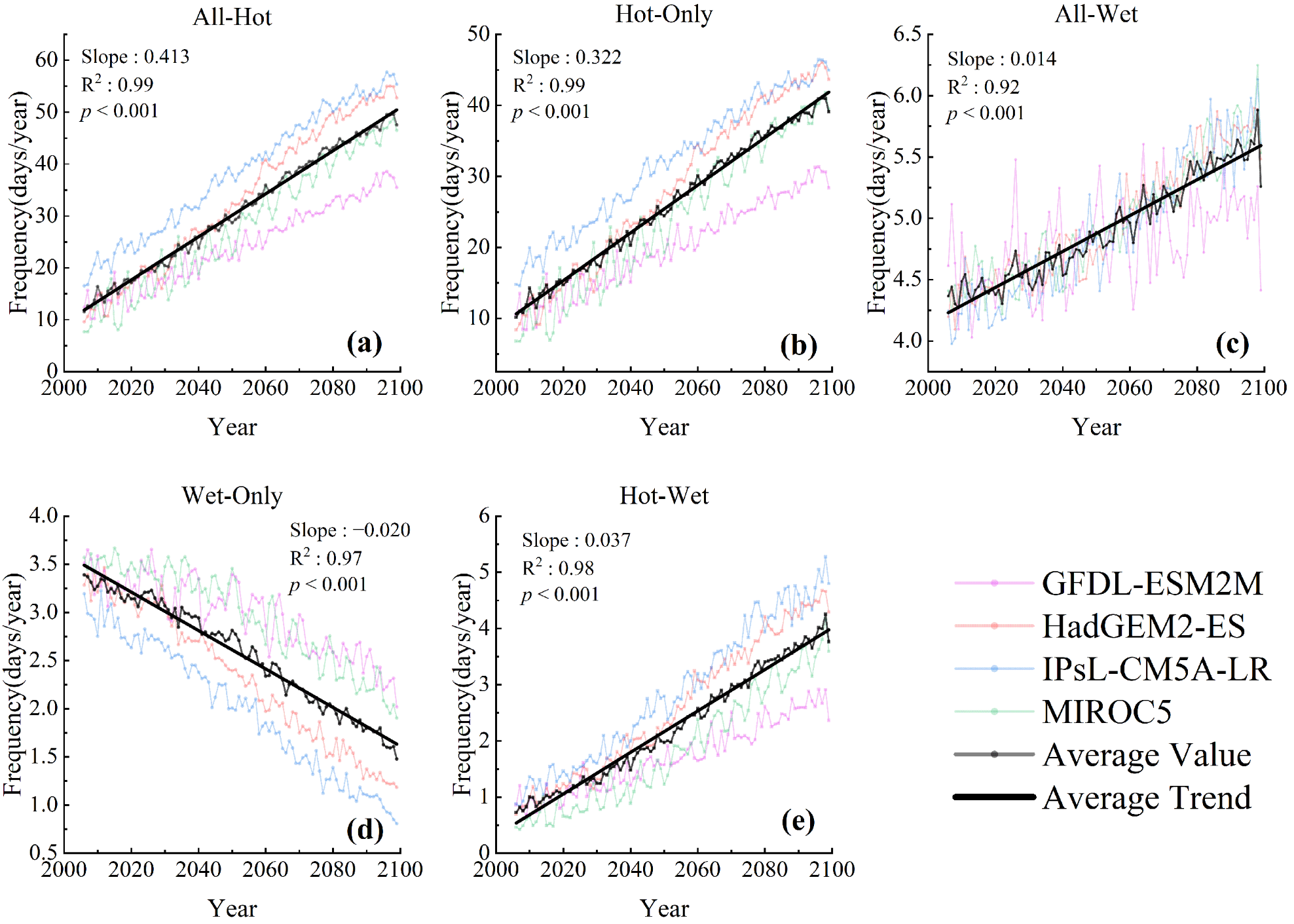
From 2006 to 2099, the frequency of extreme heat and precipitation events shows pronounced and divergent trends (Figure 1). The frequencies of All-Hot, Hot-Only, All-Wet, and Hot-Wet events all increase over time, whereas Wet-Only events exhibit a persistent decline. Extreme heat events dominate both in absolute frequency and in trend magnitude. The multi-model mean frequency of All-Hot events increases from 11.92 days yr−1 in 2006 to 50.36 days yr−1 in 2099, while Hot-Only events rise from 9.86 to 39.80 days yr−1, corresponding to increases of approximately 304–346%. In contrast, precipitation-related extremes occur less frequently and evolve more slowly. The multi-model mean frequency of All-Wet events increases modestly from 4.24 to 5.55 days yr−1 (+30.9%). Hot-Wet events, although rare, show the largest relative increase, rising from 0.55 to 3.94 days yr−1 (+616%). Wet-Only events decline steadily, with their frequency decreasing from 3.49 to 1.62 days yr−1 (−53.6%). Overall, these results indicate a future climate characterized by a strong amplification of extreme heat events, an increasing co-occurrence of heat and wet extremes, and a reduced prevalence of isolated wet extremes.

3.2. Changes in Extreme Event Intensity

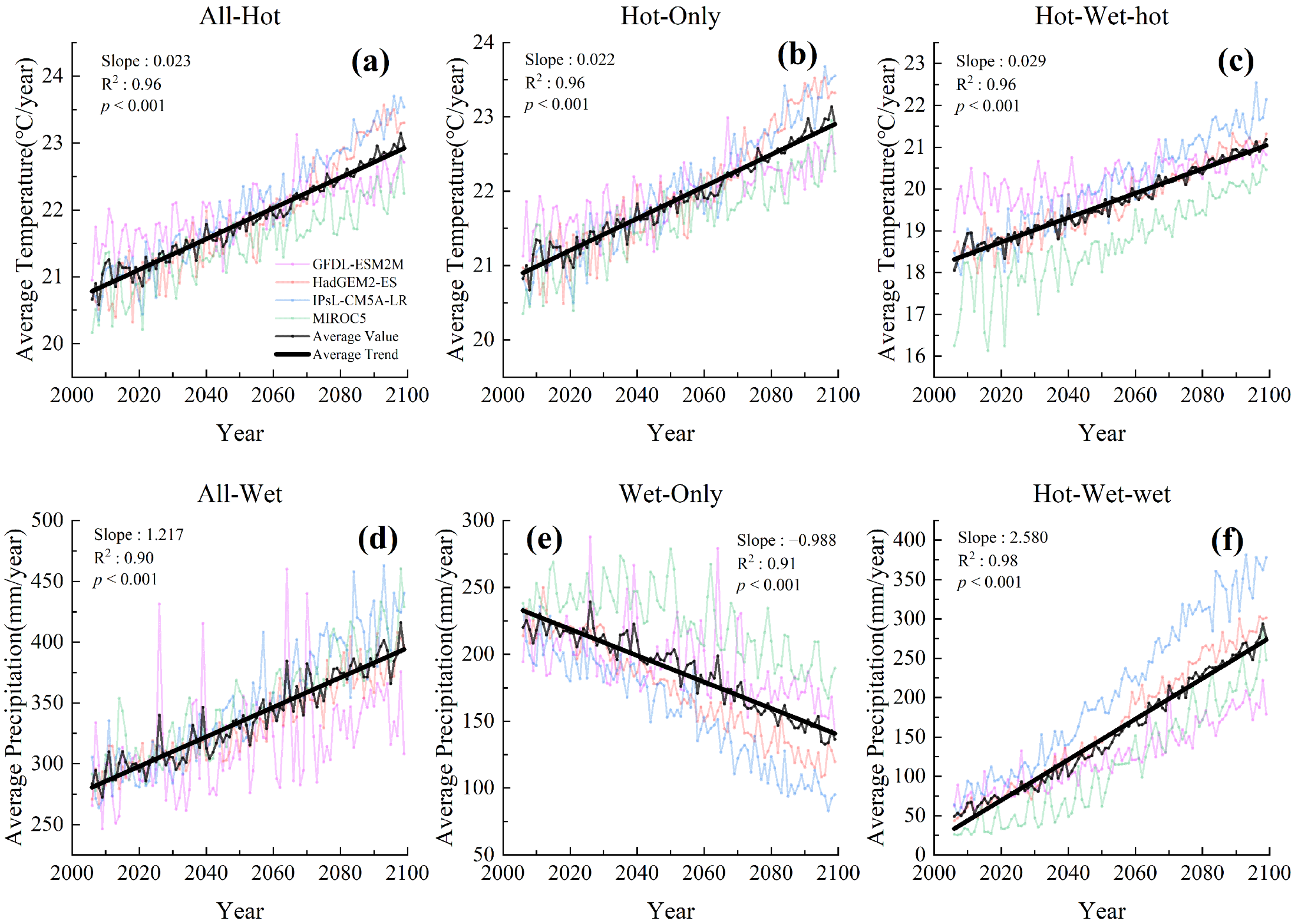
In addition to changes in frequency, the intensity of extreme heat and precipitation events exhibits pronounced long-term trends during 2006–2099 (Figure 2). All three extreme heat variables show consistent increases in intensity. The multi-model mean temperature during All-Hot events rises from 20.76 °C in 2006 to 23.01 °C in 2099, corresponding to an increase of 2.25 °C. Similarly, Hot-Only events warm from 20.68 °C to 22.94 °C (+2.26 °C). The temperature component of Hot-Wet events (Hot-Wet-hot) shows the strongest warming, increasing from 18.30 °C to 21.16 °C (+2.86 °C). Despite this larger warming, temperatures during Hot-Wet events remain approximately 1–2 °C lower than those associated with All-Hot and Hot-Only events throughout the period. Extreme precipitation intensities display more divergent behavior. The multi-model mean annual precipitation associated with All-Wet events increases from 281.16 to 392.55 mm yr−1 (+39.6%), while the precipitation component of Hot-Wet events (Hot-Wet-wet) shows a particularly strong increase, rising from 33.72 to 272.41 mm yr−1 (+707.9%). In contrast, Wet-Only events exhibit a persistent decline in intensity, with global mean precipitation decreasing from 232.80 to 140.30 mm yr−1 (−39.7%). Together, these results indicate a future intensification of extreme heat events and wet extremes associated with high temperatures, alongside a weakening of isolated wet extremes.

3.3. Changes in Methane Emissions During Extreme Events

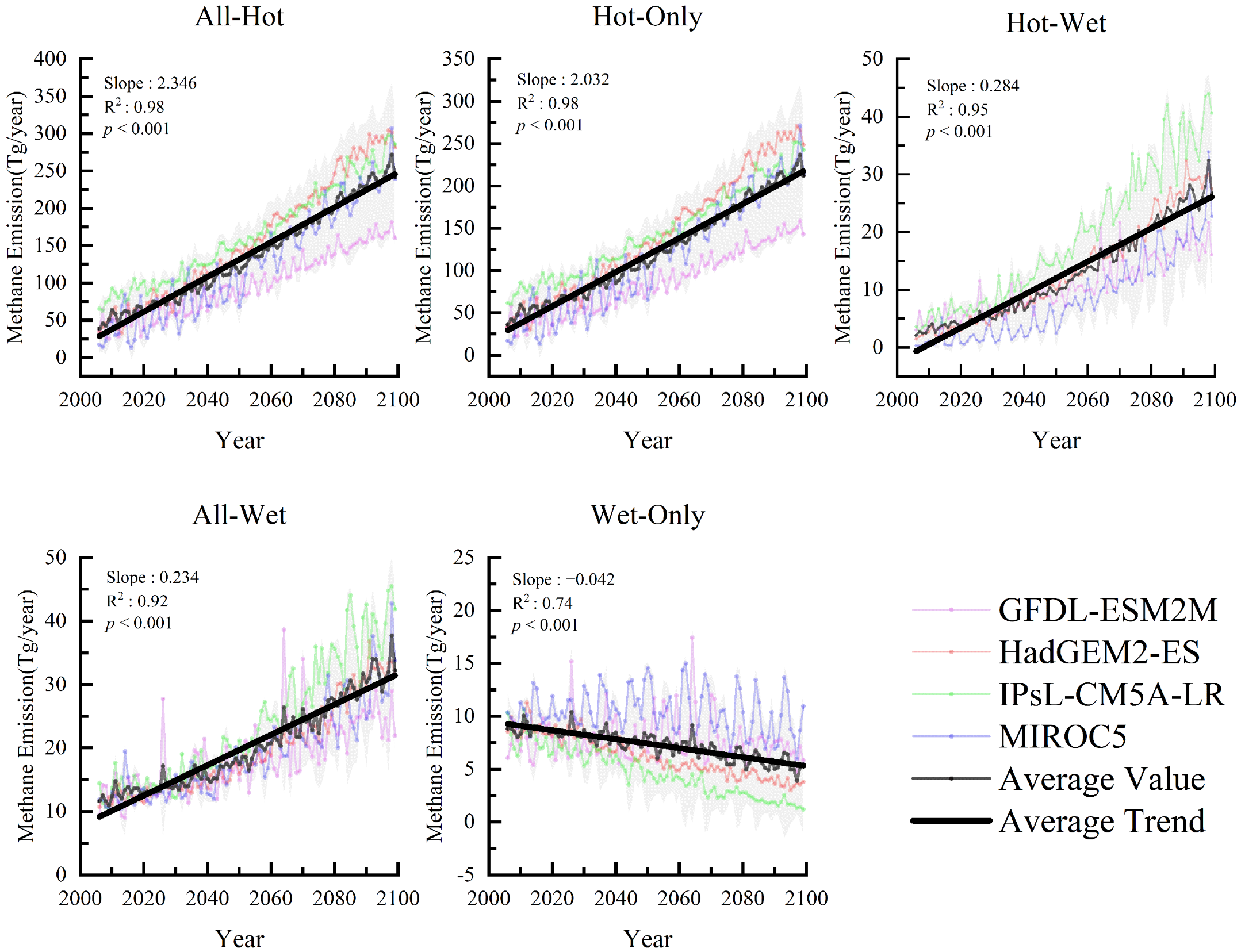
The results demonstrate that global wetland methane emissions are increasing rapidly (Figure S1 in Supporting Information). The multi-model ensemble mean shows that global wetland methane emissions increased from 138.62 Tg yr−1 in 2006 to 156.61 Tg yr−1 in 2026, which is highly consistent with the 2021–2025 global natural wetland methane emissions (157.83 ± 2.38 Tg yr−1) reported by Li et al. (2026) using a model emulator developed based on 35 global methane budget models (22 process-based models and 13 atmospheric inversions) [25]. By 2099, methane emissions reached 289.45 Tg yr−1. Future increases in global wetland methane emissions are overwhelmingly driven by the intensification and increasing frequency of extreme heat events, while the role of isolated wet extremes diminishes under continued warming. Extreme heat events dominate the contribution of methane emissions associated with climate extremes (Figure 3). Methane emissions during All-Hot events increase markedly from 38.69 Tg yr−1 in 2006 to 241.71 Tg yr−1 in 2099, with their contribution to total annual methane emissions rising from 27.9% to 83.5%. Hot-Only events show a similarly strong increase, with emissions rising from 36.30 to 212.12 Tg yr−1 and their contribution increasing from 26.2% to 73.3%. Although Hot-Only events are a subset of All-Hot events, their rapid growth highlights the dominant role of isolated extreme heat in driving future methane emissions. In contrast, methane emissions associated with precipitation-related extremes are smaller in magnitude but still show notable changes (Figure 3). Emissions during All-Wet events increase from 11.64 to 32.21 Tg yr−1, with their contribution rising modestly from 8.4% to 11.1%. Hot-Wet events, while rare, exhibit a pronounced relative increase, with methane emissions rising from 2.12 to 26.73 Tg yr−1 and their contribution increasing from 1.5% to 9.2%. Wet-Only events are the only category showing a declining trend, with methane emissions decreasing from 8.84 to 5.45 Tg yr−1 and their contribution dropping from 6.4% to 1.9%.
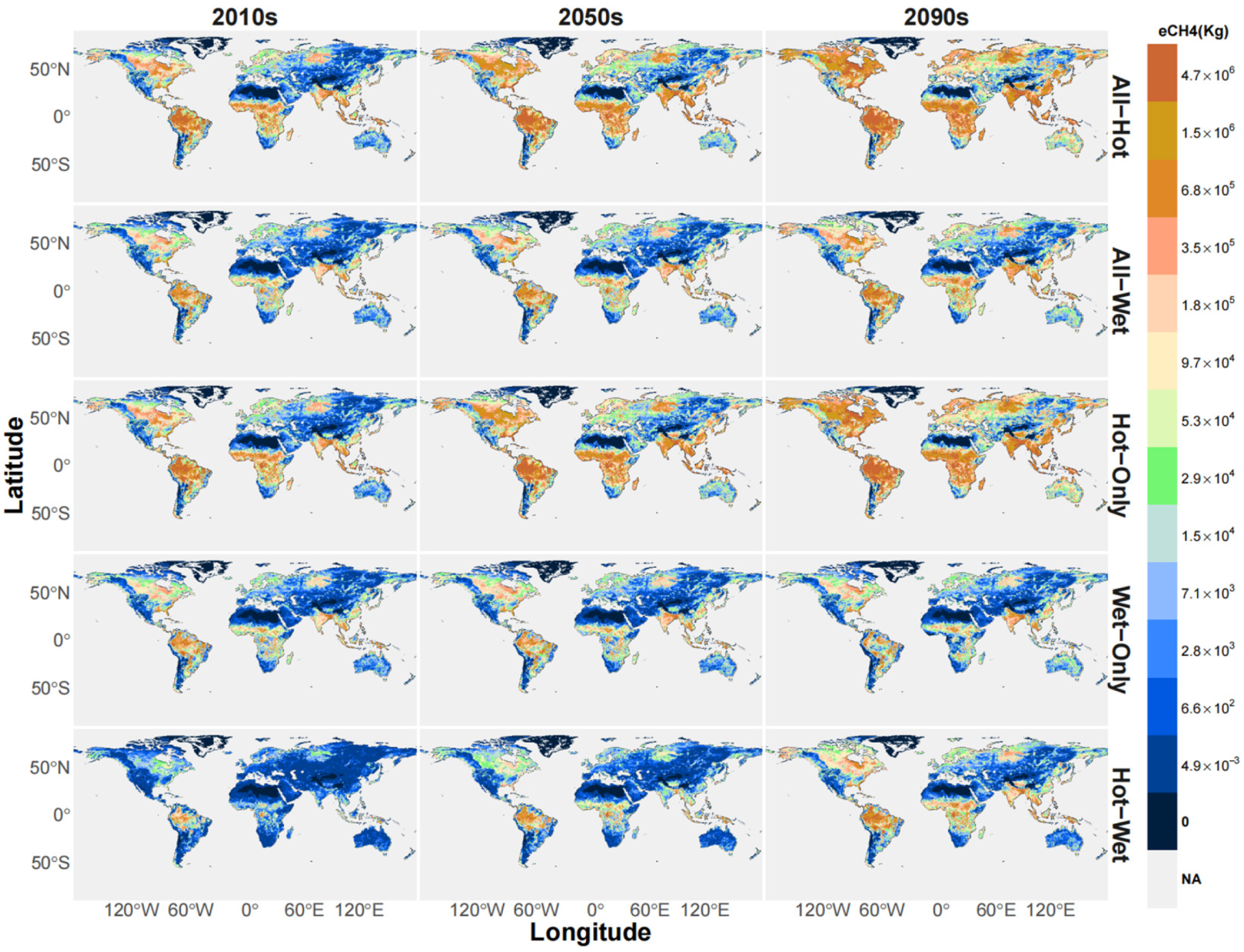
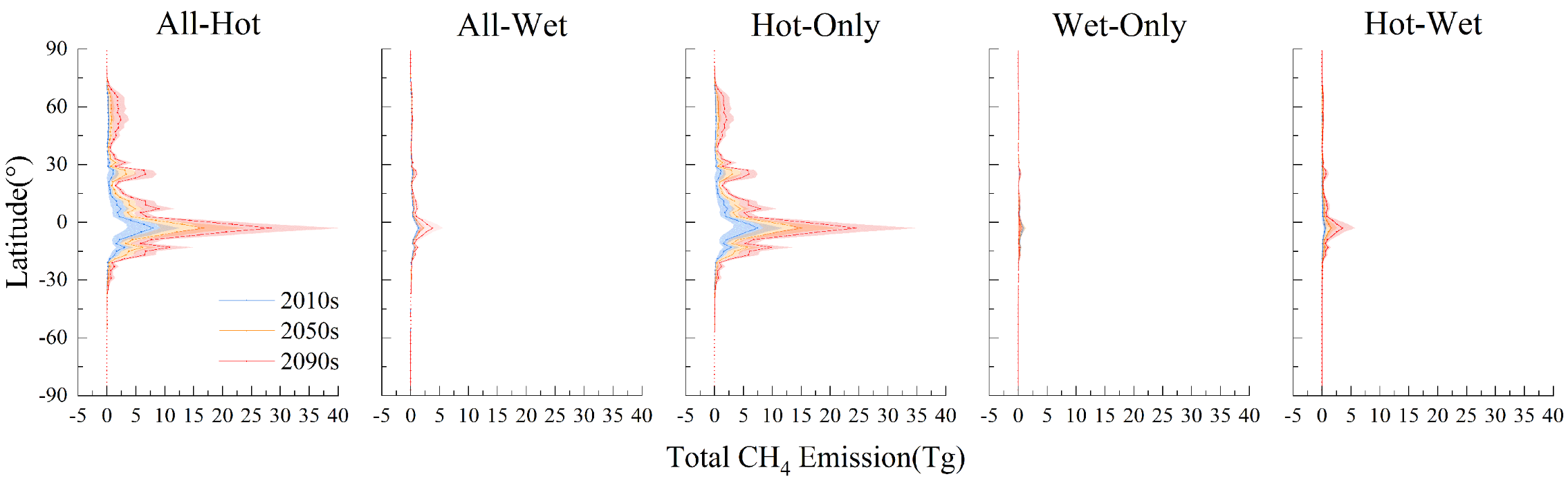
To examine the spatial evolution of methane emissions under future climate extremes, methane emission patterns associated with each extreme event were analyzed for three representative periods: the 2010s, 2050s, and 2090s (Figure 4 and Figure 5). Across all five extreme event types, methane emissions are strongly dominated by tropical regions, which account for approximately 75–90% of the global total. In the Northern Hemisphere, methane emissions generally decrease from low to high latitudes, with pronounced contributions in tropical and subtropical regions. In contrast, Southern Hemisphere emissions are almost entirely confined to low latitudes, with negligible contributions from mid- and high-latitude regions. At the global scale, the spatial patterns of the two dominant contributors—All-Hot and Hot-Only events—are highly similar, differing mainly in the magnitude of total emissions. Major emission hotspots under extreme heat events are consistently located in central and northwestern South America, central Africa and the Middle East, and coastal regions of southern Asia. Secondary contributions arise from mid-latitude regions of North America, Europe, and Asia, where emission intensities are lower but exhibit clear spatial expansion from the 2010s to the 2090s. Methane emissions associated with All-Wet and Hot-Wet events display comparable global totals and latitudinal structures, but their spatial distributions differ substantially in the 2010s. During this period, Hot-Wet events exhibit more spatially confined high-emission areas than All-Wet events, particularly in central and western North America, central Africa, and southern Asia. These differences gradually diminish over time, and by the 2090s the spatial patterns of the two event types converge. For both events, major methane emission regions include the Amazon Basin, Hudson Bay Lowlands, Nile and Congo River basins, and the Ganges Delta. Wet-Only events contribute the least to global methane emissions and show a persistent decline over time. Their spatial distribution becomes increasingly concentrated after the 2050s, with a marked reduction in high-emission areas across tropical South America. In contrast, localized increases are observed in the upper Indus River basin and parts of Australia, although these remain minor contributors at the global scale.

4. Discussion

4.1. Assessment of Extreme Event Frequency and Intensity

Extreme heat events (All-Hot and Hot-Only) exhibit the most pronounced increases in frequency among all event types. Between 2006 and 2099, All-Hot events increase from 11.92 to 50.36 days yr−1 (+322%), while Hot-Only events rise from 9.86 to 39.80 days yr−1 (+303%). These changes are consistent with IPCC AR6 projections [26], which indicate a three- to fivefold increase in extreme heat frequency under RCP8.5 by the end of the century. The strong increase results from the upward shift of temperature distributions under continued warming, as fixed historical thresholds are increasingly exceeded. The close correspondence between All-Hot and Hot-Only frequency trends suggests a stable proportion of purely heat-driven extremes, consistent with previous multi-model findings [27]. In contrast, extreme precipitation frequencies diverge: All-Wet events increase modestly (~30%), and this increase is consistent with Tabari (2020), who reported a 20–40% increase in extreme precipitation frequency under RCP8.5 based on a multi-model ensemble study [28]. In contrast, Wet-Only events decline by more than 50%, a decrease that aligns with the projections of Bevacqua et al. (2021), who indicated a 50–70% reduction in the frequency of non-compound extreme precipitation events under RCP8.5 [29].This reflects strong spatial heterogeneity in precipitation responses under warming, as intensification in humid regions is offset by weakening in semi-arid regions [13]. Enhanced thermodynamic coupling between temperature and precipitation further reduces isolated wet extremes, favoring the formation of compound Hot-Wet events, which show the largest relative frequency increase (+418%) despite a low baseline occurrence. This increase is highly consistent with the findings of Wu et al. (2021), who projected a 473% increase in the frequency of compound heat–wet extremes under high-emission scenarios based on CMIP5/6 multi-model intercomparisons [30].
Changes in event intensity broadly mirror these frequency patterns. The intensities of All-Hot and Hot-Only events increase at similar rates, indicating that extreme heat intensity is primarily controlled by background warming. The multi-model mean temperature increase of 2.25–2.26 °C for All-Hot and Hot-Only events is consistent with Gaitan et al. (2019), who projected that under RCP8.5, heat wave mean intensity would increase by approximately 2 °C by the end of the century based on CMIP5 multi-model ensemble [31]. In contrast, the temperature component of Hot-Wet events remains approximately 1–2 °C lower, reflecting the moderating effects of enhanced evaporation, increased cloud cover, and higher soil heat capacity during wet conditions [32,33,34]. Notably, the temperature component of Hot-Wet events shows a stronger warming of 2.86 °C, which aligns with findings that compound heat–wet events are projected to intensify more rapidly than individual heat extremes due to enhanced atmospheric moisture capacity under warming [35]. The extreme precipitation intensity of All-Wet events increases modestly (~38%), which falls within the 10–50% range for high-end extreme precipitation events under RCP8.5 reported by Lopez-Cantu et al. (2020) based on five downscaled climate projection datasets [36]. In contrast, the sharp increase in precipitation intensity for Hot-Wet events (~461%) is consistent with the finding that precipitation intensity in compound heatwave–extreme precipitation events exceeds that of individual extreme precipitation events [37], driven by warming-enhanced moisture availability and convective intensification. Meanwhile, Wet-Only precipitation intensity declines in parallel with its decreasing frequency. Together, these results indicate a future climate increasingly characterized by intensifying extreme heat and a growing dominance of compound heat–precipitation extremes.

4.2. Assessment of Methane Emission Under Extreme Event

This study shows that under the RCP8.5 scenario (2006–2099), global wetland methane emissions reach 289.45 Tg yr−1 by 2099, a value highly consistent with the 2090s emission range (e.g., 308 ± 102 Tg yr−1) projected by multi-model ensemble studies under RCP8.5 [38]. Extreme heat events (All-Hot and Hot-Only) become the dominant drivers of future wetland methane emissions, with their combined contribution increasing from ~26–28% in 2006 to ~73–83% in 2099. This increase exceeds the temperature-driven methane emission increment reported by Zhang et al. (2017) under the RCP8.5 scenario [39]. The reason lies in our use of the 1960–1999 historical temperature as the threshold for defining extreme events; continued future warming leads to a substantial increase in the number of days exceeding this historical threshold, thereby driving rapid growth in methane emissions associated with extreme heat events. This historical-threshold-based definition better captures the severity of future extreme heat events. This temperature-dominated response is consistent with global syntheses demonstrating a strong, nonlinear dependence of methane emissions on temperature [40], whereby warming sharply enhances methanogenic activity. In addition to directly stimulating microbial methane production, sustained warming may also increase carbon substrate availability by enhancing wetland vegetation productivity, as suggested by long-term warming experiments showing strengthened ecosystem carbon cycling under adaptation [41]. This vegetation-mediated effect operates partly through increased root exudation, with a recent global meta-analysis showing that warming significantly enhances root carbon secretion and labile carbon supply to methanogens [42]. The similar magnitude and growth rates of methane emissions from All-Hot and Hot-Only events indicate that extreme heat alone—independent of concurrent precipitation extremes—is sufficient to drive large emission increases through its direct control on microbial activity and carbon turnover. This suggests that temperature plays a more dominant role than moisture in regulating methanogenesis under future climate scenarios, consistent with meta-analyses showing that warming effects on CH4 emissions are stronger and more consistent than precipitation effects [43].
In contrast, methane emissions associated with extreme precipitation events are substantially smaller and more divergent. All-Wet events show only a modest increase in contribution (from 8.4% to 11.1%), while Wet-Only events decline sharply (from 6.4% to 1.9%). This finding aligns with Lippmann et al. (2024), who analyzed 45 FLUXNET-CH4 sites and found that precipitation-only extreme events have a relatively small impact on wetland methane emissions, with their contribution to total emissions continuing to decline under warming [24]. This reflects the limited ability of precipitation alone to enhance methane production in the absence of sufficient substrate availability [44], even under favorable anaerobic conditions, substrate limitation constrains methanogenesis, as substrate hydrolysis has been identified as the rate-limiting step for methane formation in wetland soils [45]. Moreover, the lagged response of methane emissions to wetting events [46] arises because microbial communities require time to re-establish and fermentation products to accumulate. Field studies have documented lag periods ranging from 5 to 30 days in seasonally saturated wetlands, with the delay being longer in ephemeral than in permanently wet soils [47]. Compound Hot-Wet events, although rare initially, exhibit the largest relative increase in methane contribution (from 1.5% to 9.2%), highlighting strong synergistic effects between heat and precipitation. Lippmann et al. (2024) also demonstrated that compound hot + wet extreme-events lead to daily methane emission increases exceeding those of individual extremes, and that as the frequency of hot extremes and compound extremes increases, the impact of wetland methane emissions on climate warming is expected to intensify [24]. Furthermore, Shu et al. (2020) simulated wetland methane emissions using the ISAM land surface model under RCP8.5 and found that total wetland emissions in the 2090s are 64% higher than in the 2000s, with the synergistic effects of temperature and precipitation contributing substantially to this increase [48]. High temperatures maximize methanogenic activity by accelerating microbial metabolic rates and enhancing substrate availability [49]. Laboratory studies have shown that temperature increases directly stimulate methanogen metabolism, with methane production rates responding exponentially to warming across a range of wetland sediments [49]. Concurrently, heavy precipitation maintains or expands anaerobic conditions by sustaining higher water tables that restrict oxygen penetration into surface soils, thereby creating favorable redox conditions for methanogenesis [50]. Furthermore, precipitation events promote methane transport via ebullition [51,52]. Methane produced in anaerobic layers accumulates as gas bubbles in the soil pore space [53]. Subsequent heavy precipitation can trigger ebullition by reducing hydrostatic pressure as water levels rise, which decreases confining pressure on trapped gas bubbles and facilitates their release [54].
Spatially, methane emissions from all extreme events are concentrated in tropical wetlands, particularly the Amazon, Congo, and Ganges basins, with tropical regions accounting for approximately 75–90% of global methane emissions from extreme events—a range highly consistent with the 70–85% contribution of tropical wetlands reported by multi-model ensemble studies [6,9]. However, under continued warming, emission hotspots associated with extreme heat and compound events expand into mid- and high-latitude regions, driven by permafrost thaw and increased carbon release [39,55], indicating a growing role of high-latitude wetlands in future methane emissions. This is because in permafrost-affected regions, extreme heat triggers thermokarst development—the formation of new water-saturated depressions as ice-rich permafrost thaws—creating expansive anaerobic environments that become hotspots for methane production [56]. This is associated with the high carbon lability of recently thawed permafrost sediments [57] and the enhanced microbial activity following permafrost thaw [58]. Furthermore, deep permafrost thaw beneath thermokarst lakes can mobilize carbon from depths exceeding 20 m, releasing ancient Pleistocene-aged organic matter that sustains methanogenesis for decades to centuries [59]. These high-latitude-specific mechanisms suggest that the contribution of northern wetlands to extreme-event methane emissions may be underestimated in models that do not fully resolve permafrost-carbon feedbacks and deep carbon mobilization.

4.3. Limitations and Future Implications

This study is subject to several limitations related to climate forcing and model structure. The simulations are driven by CMIP5 climate data, whereas CMIP6 provides improved representations of extreme events and more advanced coupling of permafrost processes (e.g., MPI-ESM1-2-LR), which may better capture methane responses in mid- and high-latitude regions [60]. Recent studies using CMIP6 simulations suggest higher frequencies and faster increases of compound Hot-Wet events under RCP8.5 than projected by CMIP5 [30], implying that the contribution of compound extremes to future methane emissions may be underestimated here. In addition, uncertainties in the LPJ model arise from structural assumptions, spatially heterogeneous parameters, and uncertainties in gridded forcing data derived from observational interpolation, all of which can influence regional-scale methane simulations.
Another limitation is that this study focuses on the immediate methane response to extreme events, while wetland methane emissions often exhibit delayed responses. Observations indicate that elevated methane emissions can persist for 7–10 days following extreme precipitation events [44]. Future work could explicitly account for these lag effects by adopting a tri-temporal framework that distinguishes immediate, sustained, and lagged responses to basic, discrete, and compound extreme events. Such an approach would provide a more comprehensive understanding of the temporal dynamics of methane emissions under climate extremes and improve the robustness of future projections.

5. Conclusions

Based on CMIP5 climate data and the LPJ Dynamic Global Vegetation Model, this study analyzes the impacts of five extreme event types related to extreme heat and precipitation on global wetland methane emissions under the high-emission RCP8.5 scenario from 2006 to 2099. The results demonstrate that extreme heat events are the primary drivers of change, exhibiting frequency increases of 304–346% and steady intensity growth of ~2.25 °C. Although compound events have a low baseline frequency, they show the highest increase rate (616%), with their heat intensity being 1–2 °C lower than base and discrete events. Extreme precipitation events show significant divergence, with Wet-Only being the only type displaying decreases in both frequency and intensity. Methane emissions under extreme events are concentrated in tropical wetlands, accounting for 75–90% of the global total. Extreme heat events dominate the increase in global wetland methane emissions, contributing 73–83% of the total by 2099. Compound heat-precipitation extreme events, characterized by the highest increases in both frequency and associated methane emissions, are playing an increasingly prominent role. These findings clarify the dominant influence of extreme heat events on wetland methane emissions under the RCP8.5 scenario, providing a scientific basis for formulating climate policies and methane mitigation strategies.

Supplementary Materials

The following supporting information can be downloaded at: https://www.mdpi.com/article/10.3390/atmos17040409/s1, Figure S1: Annual sum of global methane emissions from wetland based on LPJ-wsl model in scenario S2 during 2006–2099; Table S1: Types and Definitions of Extreme Events.

Author Contributions

Conceptualization, W.D., Z.Z. and Q.Z.; methodology, W.D., Z.Z. and Q.Z.; software, Z.Z.; validation, W.D. and Z.Z.; formal analysis, W.D. and Z.Z.; investigation, W.D. and Z.Z.; resources, Z.Z. and Q.Z.; data curation, Z.Z. and Q.Z.; writing—original draft preparation, W.D.; writing—review and editing, Z.Z. and Q.Z.; visualization, W.D.; supervision, Z.Z. and Q.Z.; project administration, W.D., Z.Z. and Q.Z.; funding acquisition, Z.Z. and Q.Z. All authors have read and agreed to the published version of the manuscript.

Funding

Z.Z. is supported by Excellent Research Group for Tibetan Plateau Earth System (No. 42588201) and the National Natural Science Foundation of China under Grant 42530211.

Data Availability Statement

The author has no right to disclose data.

Conflicts of Interest

The authors declare no conflicts of interest.

References

  1. Bergamaschi, P.; Houweling, S.; Segers, A.; Krol, M.; Frankenberg, C.; Scheepmaker, R.A.; Dlugokencky, E.; Wofsy, S.C.; Kort, E.A.; Sweeney, C.; et al. Atmospheric CH4 in the First Decade of the 21st Century: Inverse Modeling Analysis Using SCIAMACHY Satellite Retrievals and NOAA Surface Measurements. J. Geophys. Res. Atmos. 2013, 118, 7350–7369. [Google Scholar] [CrossRef]
  2. Melton, J.R.; Wania, R.; Hodson, E.L.; Poulter, B.; Ringeval, B.; Spahni, R.; Bohn, T.; Avis, C.A.; Beerling, D.J.; Chen, G.; et al. Present State of Global Wetland Extent and Wetland Methane Modelling: Conclusions from a Model Inter-Comparison Project (WETCHIMP). Biogeosciences 2013, 10, 753–788. [Google Scholar] [CrossRef]
  3. Poulter, B.; Bousquet, P.; Canadell, J.G.; Ciais, P.; Peregon, A.; Saunois, M.; Arora, V.K.; Beerling, D.J.; Brovkin, V.; Jones, C.D.; et al. Global Wetland Contribution to 2000–2012 Atmospheric Methane Growth Rate Dynamics. Environ. Res. Lett. 2017, 12, 094013. [Google Scholar] [CrossRef]
  4. Riley, W.J.; Subin, Z.M.; Lawrence, D.M.; Swenson, S.C.; Torn, M.S.; Meng, L.; Mahowald, N.M.; Hess, P. Barriers to Predicting Changes in Global Terrestrial Methane Fluxes: Analyses Using CLM4Me, a Methane Biogeochemistry Model Integrated in CESM. Biogeosciences 2011, 8, 1925–1953. [Google Scholar] [CrossRef]
  5. Saunois, M.; Bousquet, P.; Poulter, B.; Peregon, A.; Ciais, P.; Canadell, J.G.; Dlugokencky, E.J.; Etiope, G.; Bastviken, D.; Houweling, S.; et al. The Global Methane Budget 2000–2012. Earth Syst. Sci. Data 2016, 8, 697–751. [Google Scholar] [CrossRef]
  6. Saunois, M.; Stavert, A.R.; Poulter, B.; Bousquet, P.; Canadell, J.G.; Jackson, R.B.; Raymond, P.A.; Dlugokencky, E.J.; Houweling, S.; Patra, P.K.; et al. The Global Methane Budget 2000–2017. Earth Syst. Sci. Data 2020, 12, 1561–1623. [Google Scholar] [CrossRef]
  7. Wania, R.; Ross, I.; Prentice, I.C. Implementation and Evaluation of a New Methane Model within a Dynamic Global Vegetation Model: LPJ-WHyMe v1.3.1. Geosci. Model Dev. 2010, 3, 565–584. [Google Scholar] [CrossRef]
  8. Ding, W.; Cai, Z. Effect of Temperature on Methane Production and Oxidation in Soils. J. Appl. Ecol. 2003, 14, 604–608. [Google Scholar]
  9. Zhang, Z.; Poulter, B.; Feldman, A.F.; Ying, Q.; Ciais, P.; Peng, S.; Li, X. Recent Intensification of Wetland Methane Feedback. Nat. Clim. Chang. 2023, 13, 430–433. [Google Scholar] [CrossRef]
  10. Xu, M.; Zhang, J.; Zhang, Z.; Wang, M.; Chen, H.; Peng, C.; Yu, D.; Zhan, H.; Zhu, Q. Global Responses of Wetland Methane Emissions to Extreme Temperature and Precipitation. Environ. Res. 2024, 252, 118907. [Google Scholar] [CrossRef]
  11. Zhuang, Q.; Zhu, X.; He, Y.; Prigent, C.; Melillo, J.M.; David McGuire, A.; Prinn, R.G.; Kicklighter, D.W. Influence of Changes in Wetland Inundation Extent on Net Fluxes of Carbon Dioxide and Methane in Northern High Latitudes from 1993 to 2004. Environ. Res. Lett. 2015, 10, 095009. [Google Scholar] [CrossRef]
  12. Koffi, E.N.; Bergamaschi, P.; Alkama, R.; Cescatti, A. An Observation-Constrained Assessment of the Climate Sensitivity and Future Trajectories of Wetland Methane Emissions. Sci. Adv. 2020, 6, eaay4444. [Google Scholar] [CrossRef] [PubMed]
  13. Calvin, K.; Dasgupta, D.; Krinner, G.; Mukherji, A.; Thorne, P.W.; Trisos, C.; Romero, J.; Aldunce, P.; Barrett, K.; Blanco, G.; et al. Climate Change 2023: Synthesis Report. Contribution of Working Groups I, II and III to the Sixth Assessment Report of the Intergovernmental Panel on Climate Change, 1st ed.; Core Writing Team, Lee, H., Romero, J., Eds.; Intergovernmental Panel on Climate Change (IPCC): Geneva, Switzerland, 2023. [Google Scholar]
  14. Du, H.; Alexander, L.V.; Donat, M.G.; Lippmann, T.; Srivastava, A.; Salinger, J.; Kruger, A.; Choi, G.; He, H.S.; Fujibe, F.; et al. Precipitation From Persistent Extremes Is Increasing in Most Regions and Globally. Geophys. Res. Lett. 2019, 46, 6041–6049. [Google Scholar] [CrossRef]
  15. Bastos, A.; O’Sullivan, M.; Ciais, P.; Makowski, D.; Sitch, S.; Friedlingstein, P.; Chevallier, F.; Rödenbeck, C.; Pongratz, J.; Luijkx, I.T.; et al. Sources of Uncertainty in Regional and Global Terrestrial CO2 Exchange Estimates. Glob. Biogeochem. Cycles 2020, 34, e2019GB006393. [Google Scholar] [CrossRef]
  16. Zscheischler, J.; Mahecha, M.D.; Harmeling, S.; Rammig, A.; Tomelleri, E.; Reichstein, M. Extreme Events in Gross Primary Production: A Characterization across Continents. Biogeosciences 2014, 11, 2909–2924. [Google Scholar] [CrossRef]
  17. Zscheischler, J.; Mahecha, M.D.; Harmeling, S.; Reichstein, M. Detection and Attribution of Large Spatiotemporal Extreme Events in Earth Observation Data. Ecol. Inform. 2013, 15, 66–73. [Google Scholar] [CrossRef]
  18. Sitch, S.; Smith, B.; Prentice, I.C.; Arneth, A.; Bondeau, A.; Cramer, W.; Kaplan, J.O.; Levis, S.; Lucht, W.; Sykes, M.T.; et al. Evaluation of Ecosystem Dynamics, Plant Geography and Terrestrial Carbon Cycling in the LPJ Dynamic Global Vegetation Model. Glob. Change Biol. 2003, 9, 161–185. [Google Scholar] [CrossRef]
  19. Sun, G.D. Simulation of Potential Vegetation Distribution and Estimation of Carbon Flux in China from 1981 to 1998 with LPJ Dynamic Global Vegetation Model. Clim. Environ. Res. 2009, 14, 341–351. [Google Scholar]
  20. Zhang, Z.; Zimmermann, N.E.; Kaplan, J.O.; Poulter, B. Modeling Spatiotemporal Dynamics of Global Wetlands: Comprehensive Evaluation of a New Sub-Grid TOPMODEL Parameterization and Uncertainties. Biogeosciences 2016, 13, 1387–1408. [Google Scholar] [CrossRef]
  21. Zhang, Z.; Chatterjee, A.; Ott, L.; Reichle, R.; Feldman, A.F.; Poulter, B. Effect of Assimilating SMAP Soil Moisture on CO2 and CH4 Fluxes through Direct Insertion in a Land Surface Model. Remote Sens. 2022, 14, 2405. [Google Scholar] [CrossRef]
  22. East, J.D.; Jacob, D.J.; Balasus, N.; Bloom, A.A.; Bruhwiler, L.; Chen, Z.; Kaplan, J.O.; Mickley, L.J.; Mooring, T.A.; Penn, E.; et al. Interpreting the Seasonality of Atmospheric Methane. Geophys. Res. Lett. 2024, 51, e2024GL108494. [Google Scholar] [CrossRef]
  23. Zhang, Z.; Poulter, B.; Melton, J.R.; Riley, W.J.; Allen, G.H.; Beerling, D.J.; Bousquet, P.; Canadell, J.G.; Fluet-Chouinard, E.; Ciais, P.; et al. Ensemble Estimates of Global Wetland Methane Emissions over 2000–2020. Biogeosciences 2025, 22, 305–321. [Google Scholar] [CrossRef]
  24. Lippmann, T.J.R.; Van Der Velde, Y.; Naudts, K.; Hensgens, G.; Vonk, J.E.; Dolman, H. Simultaneous Hot and Dry Extreme-Events Increase Wetland Methane Emissions: An Assessment of Compound Extreme-Event Impacts Using Ameriflux and FLUXNET-CH4 Site Data Sets. Glob. Biogeochem. Cycles 2024, 38, e2024GB008201. [Google Scholar] [CrossRef]
  25. Li, M.; Jackson, R.B.; Saunois, M.; Ciais, P.; Poulter, B.; Canadell, J.G.; Patra, P.K.; Tian, H.; Zhang, Z.; Fluet-Chouinard, E.; et al. Global Natural Wetland Methane Emissions (2000–2025). Earth Syst. Sci. Data Discuss. 2026, 2026, 1–25. [Google Scholar]
  26. Arias, P.; Bellouin, N.; Coppola, E.; Jones, C.; Krinner, G.; Marotzke, J.; Naik, V.; Plattner, G.-K.; Rojas, M.; Sillmann, J.; et al. Climate Change 2021: The Physical Science Basis. Contribution of Working Group I to the Sixth Assessment Report of the Intergovernmental Panel on Climate Change; Technical Summary; Intergovernmental Panel on Climate Change (IPCC): Geneva, Switzerland, 2021. [Google Scholar]
  27. Beobide-Arsuaga, G.; Suarez-Gutierrez, L.; Barkhordarian, A.; Olonscheck, D.; Baehr, J. Increasing Central and Northern European Summer Heatwave Intensity Due to Forced Changes in Internal Variability. Nat Commun 2025, 16, 9485. [Google Scholar] [CrossRef]
  28. Tabari, H. Climate Change Impact on Flood and Extreme Precipitation Increases with Water Availability. Sci. Rep. 2020, 10, 13768. [Google Scholar] [CrossRef]
  29. Bevacqua, E.; De Michele, C.; Manning, C.; Couasnon, A.; Ribeiro, A.F.S.; Ramos, A.M.; Vignotto, E.; Bastos, A.; Blesić, S.; Durante, F.; et al. Guidelines for Studying Diverse Types of Compound Weather and Climate Events. Earth’s Future 2021, 9, e2021EF002340. [Google Scholar] [CrossRef]
  30. Wu, Y.; Miao, C.; Sun, Y.; AghaKouchak, A.; Shen, C.; Fan, X. Global Observations and CMIP6 Simulations of Compound Extremes of Monthly Temperature and Precipitation. GeoHealth 2021, 5, e2021GH000390. [Google Scholar] [CrossRef]
  31. Gaitán, E.; Monjo, R.; Pórtoles, J.; Pino-Otín, M.R. Projection of Temperatures and Heat and Cold Waves for Aragón (Spain) Using a Two-Step Statistical Downscaling of CMIP5 Model Outputs. Sci. Total Environ. 2019, 650, 2778–2795. [Google Scholar] [CrossRef]
  32. Frederick, J.E.; Khosla, R. The Energy Balance of an Urban Rooftop: A Case Study Addressing Cloudiness and Evaporative Cooling. Adv. Build. Energy Res. 2014, 8, 97–115. [Google Scholar] [CrossRef]
  33. Ghausi, S.A.; Ghosh, S.; Kleidon, A. Breakdown in Precipitation–Temperature Scaling over India Predominantly Explained by Cloud-Driven Cooling. Hydrol. Earth Syst. Sci. 2022, 26, 4431–4446. [Google Scholar] [CrossRef]
  34. Zhang, S.; Meurey, C.; Calvet, J.-C. Identification of Soil-Cooling Rains in Southern France from Soil Temperature and Soil Moisture Observations. Atmos. Chem. Phys. 2019, 19, 5005–5020. [Google Scholar] [CrossRef]
  35. Zhou, Z.; Zhang, L.; Zhang, Q.; Hu, C.; Wang, G.; She, D.; Chen, J. Global Increase in Future Compound Heat Stress-Heavy Precipitation Hazards and Associated Socio-Ecosystem Risks. npj Clim. Atmos. Sci. 2024, 7, 33. [Google Scholar] [CrossRef]
  36. Lopez-Cantu, T.; Prein, A.F.; Samaras, C. Uncertainties in Future U.S. Extreme Precipitation From Downscaled Climate Projections. Geophys. Res. Lett. 2020, 47, e2019GL086797. [Google Scholar] [CrossRef]
  37. Jin, H.; Zhang, K.; Liu, M.; Yu, X.; Yang, X.; Chao, L.; Zhang, P.; Liu, G. Global Escalation of More Frequent and Intense Compound Heatwave-Extreme Precipitation Events. EGUsphere 2025, 1–30. [Google Scholar] [CrossRef]
  38. Zhang, Z.; Poulter, B.; Gedney, N.; Ito, A.; Melton, J.R.; Riley, W.J.; Wiltshire, A.; Zhu, Q. Emergent Constraints of Temperature Sensitivity on Projected Wetland Methane Emissions. In Proceedings of the AGU Fall Meeting 2024, Washington, DC, USA, 9–13 December 2024; Volume 2024, p. B51D-08. [Google Scholar]
  39. Zhang, Z.; Zimmermann, N.E.; Stenke, A.; Li, X.; Hodson, E.L.; Zhu, G.; Huang, C.; Poulter, B. Emerging Role of Wetland Methane Emissions in Driving 21st Century Climate Change. Proc. Natl. Acad. Sci. USA 2017, 114, 9647–9652. [Google Scholar] [CrossRef]
  40. Yvon-Durocher, G.; Allen, A.P.; Bastviken, D.; Conrad, R.; Gudasz, C.; St-Pierre, A.; Thanh-Duc, N.; Del Giorgio, P.A. Methane Fluxes Show Consistent Temperature Dependence across Microbial to Ecosystem Scales. Nature 2014, 507, 488–491. [Google Scholar] [CrossRef]
  41. Liu, X.; Lie, Z.; Reich, P.B.; Zhou, G.; Yan, J.; Huang, W.; Wang, Y.; Peñuelas, J.; Tissue, D.T.; Zhao, M.; et al. Long-term Warming Increased Carbon Sequestration Capacity in a Humid Subtropical Forest. Glob. Change Biol. 2024, 30, e17072. [Google Scholar] [CrossRef]
  42. Zeng, J.; Li, X.; Xing, L.; Chen, L.; Li, Y.; Wang, X.; Zhang, Q.; Yang, G.; Ren, C.; Yang, G.; et al. Soil Nitrogen Regulates Root Carbon Secretion in the Context of Global Change: A Global Meta-analysis. Funct. Ecol. 2024, 38, 2067–2080. [Google Scholar] [CrossRef]
  43. Yang, J.; Jia, X.; Ma, H.; Chen, X.; Liu, J.; Shangguan, Z.; Yan, W. Effects of Warming and Precipitation Changes on Soil GHG Fluxes: A Meta-Analysis. Sci. Total Environ. 2022, 827, 154351. [Google Scholar] [CrossRef]
  44. Bridgham, S.D.; Cadillo-Quiroz, H.; Keller, J.K.; Zhuang, Q. Methane Emissions from Wetlands: Biogeochemical, Microbial, and Modeling Perspectives from Local to Global Scales. Glob. Change Biol. 2013, 19, 1325–1346. [Google Scholar] [CrossRef] [PubMed]
  45. Glissmann, K.; Conrad, R. Saccharolytic Activity and Its Role as a Limiting Step in Methane Formation during the Anaerobic Degradation of Rice Straw in Rice Paddy Soil. Biol. Fertil. Soils 2002, 35, 62–67. [Google Scholar] [CrossRef]
  46. Wang, T.; Deng, Z.; Xie, Y.; Wang, B.; Wu, S.; Li, F.; Wang, W.; Zou, Y.; Li, X.; Hou, Z.; et al. Time-Lag Effects of Flood Stimulation on Methane Emissions in the Dongting Lake Floodplain, China. Agric. For. Meteorol. 2023, 341, 109677. [Google Scholar] [CrossRef]
  47. Kannenberg, S.A.; Dunn, S.T.; Ludwig, S.M.; Spawn, S.A.; Schade, J.D. Patterns of Potential Methanogenesis Along Soil Moisture Gradients Following Drying and Rewetting in Midwestern Prairie Pothole Wetlands. Wetlands 2015, 35, 633–640. [Google Scholar] [CrossRef]
  48. Shu, S.; Jain, A.K.; Kheshgi, H.S. Investigating Wetland and Nonwetland Soil Methane Emissions and Sinks Across the Contiguous United States Using a Land Surface Model. Glob. Biogeochem. Cycles 2020, 34, e2019GB006251. [Google Scholar] [CrossRef]
  49. Blake, L.I.; Tveit, A.; Øvreås, L.; Head, I.M.; Gray, N.D. Response of Methanogens in Arctic Sediments to Temperature and Methanogenic Substrate Availability. PLoS ONE 2015, 10, e0129733. [Google Scholar] [CrossRef]
  50. Cui, S.; Liu, P.; Guo, H.; Nielsen, C.K.; Pullens, J.W.M.; Chen, Q.; Pugliese, L.; Wu, S. Wetland Hydrological Dynamics and Methane Emissions. Commun. Earth Environ. 2024, 5, 470. [Google Scholar] [CrossRef]
  51. Barel, J.M.; Moulia, V.; Hamard, S.; Sytiuk, A.; Jassey, V.E.J. Come Rain, Come Shine: Peatland Carbon Dynamics Shift Under Extreme Precipitation. Front. Environ. Sci. 2021, 9, 659953. [Google Scholar] [CrossRef]
  52. Li, J.; Hao, T.; Yang, M.; Chen, Z.; Yu, G. Analysis of Methane Emission Characteristics and Environmental Response in Natural Wetlands. Atmos. Environ. 2024, 334, 120696. [Google Scholar] [CrossRef]
  53. Katsman, R. Mechanics of Methane Bubbles in Consolidated Aquatic Muds. Earth-Sci. Rev. 2024, 257, 104908. [Google Scholar] [CrossRef]
  54. Lohrberg, A.; Schmale, O.; Ostrovsky, I.; Niemann, H.; Held, P.; Schneider Von Deimling, J. Discovery and Quantification of a Widespread Methane Ebullition Event in a Coastal Inlet (Baltic Sea) Using a Novel Sonar Strategy. Sci. Rep. 2020, 10, 4393. [Google Scholar] [CrossRef]
  55. Schuur, E.A.G.; McGuire, A.D.; Schädel, C.; Grosse, G.; Harden, J.W.; Hayes, D.J.; Hugelius, G.; Koven, C.D.; Kuhry, P.; Lawrence, D.M.; et al. Climate Change and the Permafrost Carbon Feedback. Nature 2015, 520, 171–179. [Google Scholar] [CrossRef]
  56. Walter Anthony, K.M.; Lindgren, P.; Hanke, P.; Engram, M.; Anthony, P.; Daanen, R.P.; Bondurant, A.; Liljedahl, A.K.; Lenz, J.; Grosse, G.; et al. Decadal-Scale Hotspot Methane Ebullition within Lakes Following Abrupt Permafrost Thaw. Environ. Res. Lett. 2021, 16, 035010. [Google Scholar] [CrossRef]
  57. Gerera, Y.; Pellerin, A.; Eliani Russak, E.; Hasson, N.; Rosenberg, Y.; Walter Anthony, K.; Sivan, O. The Evolution of Methane Production Rates from Young to Mature Thermokarst 1 Lakes. Biogeosciences 2025, 22, 7901–7914. [Google Scholar] [CrossRef]
  58. Qin, S.; Kou, D.; Mao, C.; Chen, Y.; Chen, L.; Yang, Y. Temperature Sensitivity of Permafrost Carbon Release Mediated by Mineral and Microbial Properties. Sci. Adv. 2021, 7, eabe3596. [Google Scholar] [CrossRef]
  59. Freitas, N.L.; Walter Anthony, K.; Lenz, J.; Porras, R.C.; Torn, M.S. Substantial and Overlooked Greenhouse Gas Emissions from Deep Arctic Lake Sediment. Nat. Geosci. 2025, 18, 65–71. [Google Scholar] [CrossRef]
  60. Gutjahr, O.; Putrasahan, D.; Lohmann, K.; Jungclaus, J.H.; Von Storch, J.-S.; Brüggemann, N.; Haak, H.; Stössel, A. Max Planck Institute Earth System Model (MPI-ESM1.2) for the High-Resolution Model Intercomparison Project (HighResMIP). Geosci. Model Dev. 2019, 12, 3241–3281. [Google Scholar] [CrossRef]
Figure 1. Projected changes in the global frequency of extreme heat and precipitation events during 2006–2099. Shown are annual frequencies of (a) All-Hot, (b) Hot-Only, (c) All-Wet, (d) Wet-Only, and (e) Hot-Wet events simulated by the LPJ model driven by four GCMs (colored lines). The black line denotes the multi-model mean. Event frequency is expressed as the global mean number of event days per year. Linear trends are indicated to highlight long-term changes under future climate conditions.
Atmosphere 17 00409 g001
Figure 2. Projected changes in the intensity of extreme heat and precipitation events during 2006–2099.The top row shows the multi-model mean intensity of extreme heat events, including (a) All-Hot, (b) Hot-Only, and (c) the temperature component of Hot-Wet events (Hot-Wet-hot), expressed as global, area-weighted mean temperature (°C). The bottom row shows the corresponding intensity of extreme precipitation events, including (d) All-Wet, (e) Wet-Only, and (f) the precipitation component of Hot-Wet events (Hot-Wet-wet), expressed as global, area-weighted annual precipitation totals (mm yr−1). Colored lines represent simulations driven by individual GCMs, while black lines denote the multi-model mean and its linear trend. Slopes indicate the rate of intensity change over the study period.
Atmosphere 17 00409 g002
Figure 3. Projected changes in global wetland methane emissions associated with extreme events under the transient scenario under RCP8.5 during 2006–2099. Colored lines represent methane emissions simulated by the LPJ model driven by individual GCMs (GFDL-ESM2M, HadGEM2-ES, IPSL-CM5A-LR, and MIROC5). The black line denotes the multi-model mean, and the shaded envelope indicates the inter-model range. Linear trends highlight the long-term increase in methane emissions under future climate and CO2 forcing.
Atmosphere 17 00409 g003
Figure 4. Spatial distribution of wetland methane emissions associated with extreme events under the S2 scenario. Shown are the global spatial patterns of wetland methane emissions (eCH4) during five extreme event types (All-Hot, All-Wet, Hot-Only, Wet-Only, and Hot-Wet) for three future periods: the 2010s, 2050s, and 2090s. Emissions are expressed as grid-cell totals (kg) averaged over each period.
Atmosphere 17 00409 g004
Figure 5. Latitudinal distribution of global wetland methane emissions under extreme events. Zonal sums of methane emissions associated with five extreme event types are shown for the 2010s, 2050s, and 2090s. Curves represent total methane emissions aggregated by latitude, highlighting the relative contributions of tropical, mid-latitude, and high-latitude regions.
Atmosphere 17 00409 g005
Table 1. Types and Definitions of Extreme Events.
TypeDefinition
All-Hotupper 5th temperature percentile, irrespective of possible simultaneous extremes
All-Wetupper 5th precipitation percentile, irrespective of possible simultaneous extremes
Hot-OnlyAll-Hot extreme-events, omitting extreme-events with simultaneous precipitation extremes
Wet-OnlyAll-Wet extreme-events, omitting extreme-events with simultaneous precipitation extremes
Hot-Wetsimultaneous occurrences of All-wet and All-hot ex-treme-events
Disclaimer/Publisher’s Note: The statements, opinions and data contained in all publications are solely those of the individual author(s) and contributor(s) and not of MDPI and/or the editor(s). MDPI and/or the editor(s) disclaim responsibility for any injury to people or property resulting from any ideas, methods, instructions or products referred to in the content.