
Article

Integrated Assessment of Traffic-Related PM2.5 Exposure, Metal Composition, and Health Risk in a Roadside Urban Microenvironment of Jaipur, India

by
Ruchi Sharma
Department of Civil Engineering, Malaviya National Institute of Technology (MNIT), Jaipur 302017, India
Atmosphere 2026, 17(4), 362; https://doi.org/10.3390/atmos17040362
Submission received: 8 February 2026 / Revised: 27 March 2026 / Accepted: 30 March 2026 / Published: 31 March 2026
(This article belongs to the Section Air Quality and Health)

Abstract

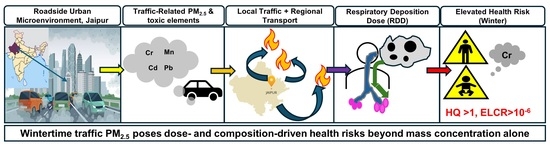
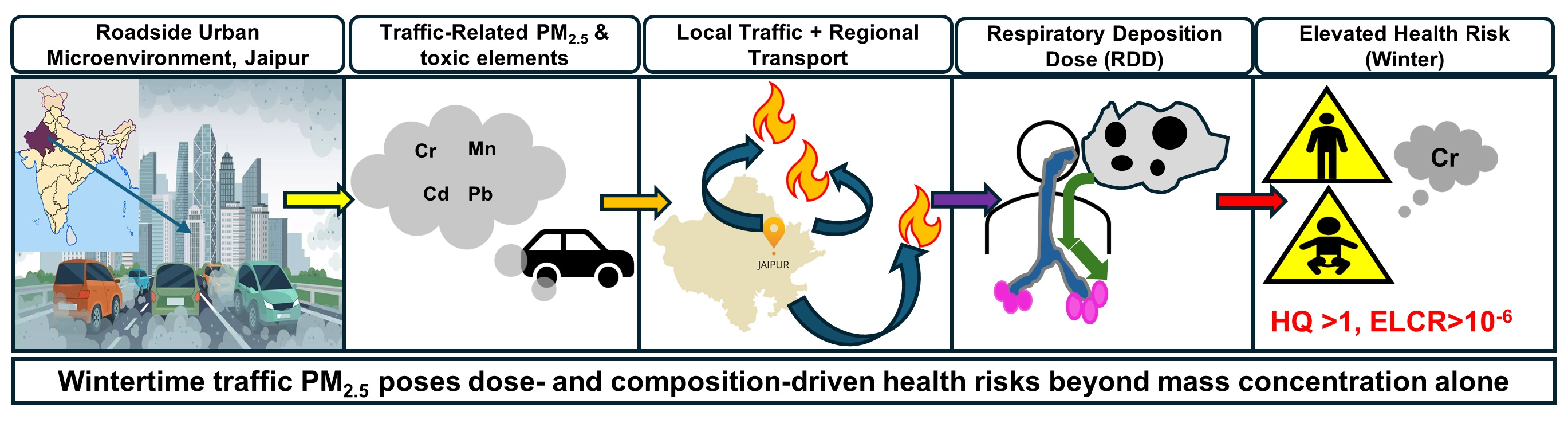
Traffic-related emissions significantly contribute to fine particulate matter (PM2.5) in urban roadside environments, where limited dispersion elevates human exposure and health risks. This study provides an integrated assessment of PM2.5 exposure in a traffic-dominated roadside microenvironment in Jaipur, India, and evaluates seasonal variability, respiratory deposition dose (RDD), elemental composition, source characteristics, and inhalation health risk. Ambient PM2.5 sampling was performed from October to February, and gravimetric and elemental analyses were conducted. RDD was quantified, and non-carcinogenic and carcinogenic risks were estimated using USEPA guidelines. PM2.5 concentrations showed strong seasonal variability, peaking at 97 ± 5.85 µg/m3 during low-temperature winter weekdays, exceeding national and World Health Organization guidelines by 1.6 and 6.5 times, respectively. Winter conditions also led to higher RDD (~80% deposition in the head region) and the enrichment of traffic-related metals, particularly chromium, cadmium, and lead. Backward trajectory analysis indicated dominant local traffic influence with episodic regional transport. Non-carcinogenic risk surpassed unity for children during winters, while carcinogenic risk, primarily driven by chromium, exceeded acceptable thresholds (1 × 10⁻⁶), reaching 610 times higher during low-temperature winter weekdays. This first integrated PM2.5 health risk assessment for Jaipur underscores the need of dose- and composition-based assessment in traffic-influenced urban environments.

Graphical Abstract

1. Introduction

Rapid urbanization and increasing motorization have emerged as major drivers of air quality deterioration in cities worldwide, with traffic-related emissions now recognized as a dominant source of urban particulate matter (PM) pollution [1,2,3,4]. Recent studies have highlighted the growing contribution of vehicular emissions and non-exhaust sources to PM2.5 levels in rapidly developing urban environments [3,4]. Among various air pollutants, fine particulate matter (PM2.5; aerodynamic diameter ≤ 2.5 µm) is of particular concern due to its ability to penetrate deep into the respiratory system and its strong association with adverse health outcomes [5,6]. Epidemiological evidence has consistently linked PM2.5 exposure to respiratory and cardiovascular diseases, lung cancer, metabolic disorders, neurological effects, and premature mortality, underscoring its significance as a critical public health issue [7,8,9,10].
Traffic-related urban PM2.5 contributes through both exhaust and non-exhaust emissions including brake wear, tire abrasion, road surface wear, and resuspension of road dust [11,12,13,14]. Although advances in fuel quality and engine technology have decreased tailpipe emissions in many regions, non-exhaust emissions still remain largely unregulated and are a major contributor to roadside PM2.5, especially in high-traffic areas [12,13,14,15]. Several studies have concluded that traffic-generated fine and ultrafine particles dominate roadside atmospheric microenvironments, particularly under high traffic conditions with limited atmospheric dispersion [15,16].
The health effects of PM2.5 are controlled not only by its mass concentration but also by the size of particle and its chemical composition, particularly the presence of particle-bound toxic trace elements (TEs) and organic compounds capable of inducing oxidative stress, inflammation, and genotoxic effects [17,18,19,20]. PM comprises organic and inorganic components including carcinogenic polycyclic aromatic hydrocarbons (PAHs), inorganic ions, trace elements and endotoxins [20]. Among all these, trace elements are major contributors to toxic and carcinogenic health effects of PM, and are commonly used in health risk assessments studies. Traffic-related PM2.5 is often enriched with metals such as chromium (Cr), arsenic (As), cadmium (Cd), lead (Pb), nickel (Ni), and manganese (Mn), many of which are associated with non-carcinogenic and carcinogenic health risks [21,22,23,24,25]. Seasonal and meteorological conditions may further affect PM2.5 concentrations and toxicity; winter periods reported elevated levels attributed to temperature inversions, reduced wind speeds, and limited vertical mixing [26,27,28].
India experiences one of the highest PM2.5 pollutions globally, with vehicular emissions playing a major role in the deterioration of urban air quality [28,29,30]. Previous studies have evaluated PM2.5 concentrations and temporal variations in Indian cities; however, most of them rely on mass-based measurements and urban background monitoring [29,30,31]. Comprehensive investigations combining roadside measurements, respiratory deposition dose (RDD), elemental composition, source identification, and inhalation human health risk assessment remain scarce, particularly for medium-sized Indian cities like Jaipur [29,32,33]. Since mass-based PM2.5 standards alone may not be adequate for human health protection, considering evidence suggesting that dose- and composition-based methods can offer more realistic health-relevant insights [17,18]. Thus, there is a strong need for in-depth studies which incorporate dose-based exposure metrics or composition-driven human health risk assessment in cities like Jaipur.
In view of the above research gaps, the present study aims to give a comprehensive assessment of traffic-related PM2.5 exposure in a roadside urban atmospheric microenvironment in Jaipur, India. The specific objectives include: (i) determination of PM2.5 concentrations under varying traffic and meteorological conditions, (ii) estimation of RDD for males and females, (iii) characterization of PM2.5-bound TEs and their potential sources, and (iv) evaluation of associated non-carcinogenic and carcinogenic inhalation health risks for adults and children. The findings indicate that wintertime roadside environments experience significantly higher PM2.5 concentrations, enhanced metal enrichment, and excess lifetime cancer risks exceeding acceptable thresholds several-fold, primarily driven by chromium. These results demonstrate the limitations of relying only on mass-based PM2.5 metrics and highlight the importance of using dose- and composition-based indicators into urban air quality management and public health protection strategies. To the best of our knowledge, this is the first study from Jaipur, India, to provide a detailed, integrated assessment of traffic-related PM2.5 in a roadside urban microenvironment by jointly examining seasonal variability, RDD, elemental composition, source indication, and associated potential non-carcinogenic and carcinogenic health risks.

2. Materials and Methods

2.1. Study Area and Sampling Location

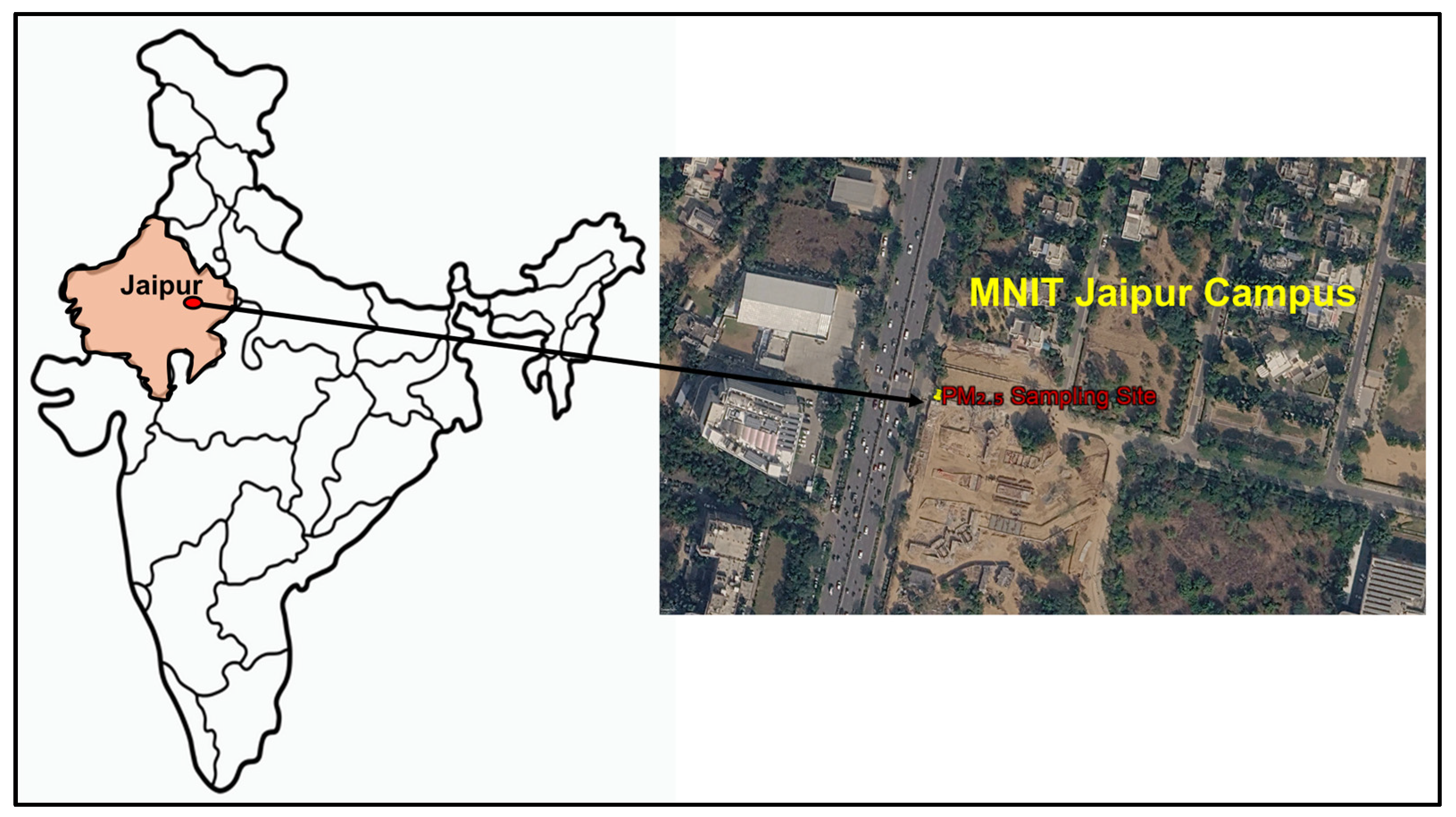
The study was conducted at the main gate of Malaviya National Institute of Technology (MNIT), Jaipur (26.862° N, 75.817° E), adjacent to Jawaharlal Nehru (JLN) Marg. In terms of transportation patterns, Jaipur exhibits a high dependence on road-based mobility. Moreover, JLN Marg is one of the city’s major arterial roads connecting residential, institutional, and commercial zones and is characterized by continuous high vehicular movement with about 7920 vehicles/hour. It includes about 73 two-wheelers, 11 three-wheelers (auto-rickshaws) and 48 four-wheelers (passenger cars, buses, and heavy-duty vehicles) passing per minute in front of the sampling point. The study area experiences continuous traffic flow throughout the day, with pronounced peak-hour congestion and frequent stop-and-go conditions, which are known to increase vehicular emissions and are highly relevant for exposure assessment of traffic-related PM2.5. In addition to exhaust emissions, non-exhaust sources such as resuspension of road dust, brake wear, and tire abrasion further contribute to elevated PM2.5 levels. These characteristics make the study location highly representative of a traffic-dominated urban microenvironment in a rapidly growing Indian city. Jaipur experiences a semi-arid climate characterized by hot summers, mild to cold winters, low to moderate wind speeds, and limited precipitation. During winter months, reduced wind speed, a shallow atmospheric boundary layer, and frequent temperature inversions significantly limit pollutant dispersion and cause pollutant accumulation near ground level. In contrast, occasional rainfall contributes to the washing out of particles, temporarily reducing PM2.5 concentrations. Foggy conditions during winter further enhance pollution levels by increasing atmospheric stability and secondary particle formation. The location of the PM2.5 sampling site along the traffic corridor in Jaipur, India has been shown in Figure 1.

2.2. PM2.5 Sampling and Gravimetric Analysis

Ambient PM2.5 sampling was performed using a GFPS-375 fine particulate sampler operated at a flow rate of approximately 1 m3 h−1. Sampling was conducted over five months (October–February), covering weekdays and weekends as well as special conditions such as pre- and post-Diwali periods, foggy and non-foggy days, rainy and non-rainy days, and low- and high-temperature winter conditions. The sampling period of October to February was intentionally selected to capture seasonal variability, including pre-winter, post-Diwali, and winter conditions. These intervals are associated with significant variations in PM2.5 concentrations due to meteorological factors and emission patterns, allowing for a comprehensive evaluation of seasonal variability in PM2.5 concentrations and associated health risks. A total of 45 valid 24 h PM2.5 samples were collected during the study period. Each sampling event was conducted for a continuous 24 h period. The instrument was operated four to five times per week, yielding a representative dataset for different traffic and meteorological conditions. The gravimetric sampling method was chosen for its high accuracy and suitability for chemical and elemental analysis, ensuring reliable estimation of PM2.5 concentrations and associated trace elements.
It should be noted that low- and high-temperature winter condition classification was based on daily ambient temperature observations during the sampling period. A median temperature threshold of 17.2 °C for various sampling datasets was set and days with temperatures above the median were categorized as high-temperature (during November to early December), while those below the median (during January to early February) were categorized as low-temperature conditions. In total, nine low-temperature winter weekdays, six low-temperature winter weekends, nine high-temperature winter weekday and six low-temperature winter weekends were monitored. Moreover, the classification for rainy, non-rainy, foggy, non-foggy, pre-Diwali, and post-Diwali sampling days was based on meteorological observations and event-based conditions for the 24 h PM2.5 sampling period. A rainy day included measurable precipitation during the 24 h sampling duration, whereas days without precipitation were categorized as non-rainy. Similarly, foggy days were based on the occurrence of prolonged fog events during the sampling period, associated with reduced visibility, while days without such conditions were classified as non-foggy. Total of two rainy, three non-rainy, two foggy and two non-foggy days were included in this study. The Diwali period was defined relative to the festival date of 24 October 2022. Pre-Diwali conditions correspond to the 3 days immediately before the festival, which caused increased vehicular movement, market activity, and firework usage. Post-Diwali conditions represent the 3 days following the festival, during which emission levels and traffic patterns gradually normalize. The classification of all conditions was aligned with the 24 h sampling duration to ensure consistency between environmental conditions and measured PM2.5 concentrations. Meteorological data used for classification were obtained from local weather records corresponding to the sampling dates [34].
Polytetrafluoroethylene (PTFE) filters (47 mm diameter, 2 µm pore size with ring support) were conditioned in a desiccator for 24 h prior to and after sampling. Pre- and post-sampling weights were recorded using a microbalance with a least count of 0.001 mg. PM2.5 concentrations were calculated following Central Pollution Control Board (CPCB) guidelines. After post weighing, all the filter samples were kept inside a refrigerator maintained at −20 °C to prevent the particles captured from reacting or escaping until further chemical analysis. The 24 h PM2.5 mass concentration (μg/m3) was determined using the gravimetric mass of particulates collected on the filter paper (μg) and the total volume of air passed through a filter (m3) during sampling using the following Equation (1):
P M ( μ g m 3 ) = M e a s u r e d   g r a v i m e t r i c   m a s s   o f   P M ( μ g ) T o t a l   v o l u m e   o f   a i r   s a m p l e d   ( m 3 )

2.3. Chemical Extraction and Elemental Analysis

Collected PM2.5 filters were subjected to detailed chemical analysis following established protocols reported in previous studies [35,36]. Prior to analysis, filters were handled under controlled conditions, and no pre-combustion step was required due to the use of PTFE filters, which are suitable for trace metal analysis without thermal treatment. Microwave-assisted acid digestion was conducted using a mixture of nitric acid (HNO3), hydrogen peroxide (H2O2), and hydrofluoric acid (HF) in a closed-vessel system. The digested samples were subsequently filtered and diluted with ultra-pure water prior to analysis. Elemental concentrations were quantified using an inductively coupled plasma mass spectrometry (ICP-MS) system (Thermo Scientific iCAP series, Thermo Fisher Scientific, Waltham, MA, USA), operated under standard analytical conditions. Field blanks were processed alongside samples to correct for background contamination. Further details regarding sample preparation, digestion procedure, instrumentation settings, and quality assurance/quality control (QA/QC) protocols are provided in Supplementary Materials.
In total, concentrations of nine TEs such as aluminum (Al), As, beryllium (Be), Cd, cobalt (Co), Cr, Mn, Ni, and Pb were quantified using ICP-MS technique. These elements were selected since they are commonly reported in the literature as key components of traffic-related PM2.5 emissions and health risk assessment in urban roadside environments, ensuring comparability of results with existing literature. Moreover, these elements are included in United States Environmental Protection Agency (USEPA) and Agency for Toxic Substances and Disease Registry (ATSDR) databases, with well-established toxicity parameters such as reference concentration (RfC) and inhalation unit risk (IUR), which are essential for quantitative non-carcinogenic and carcinogenic risk assessment.

2.4. Backward Air Trajectory Analysis

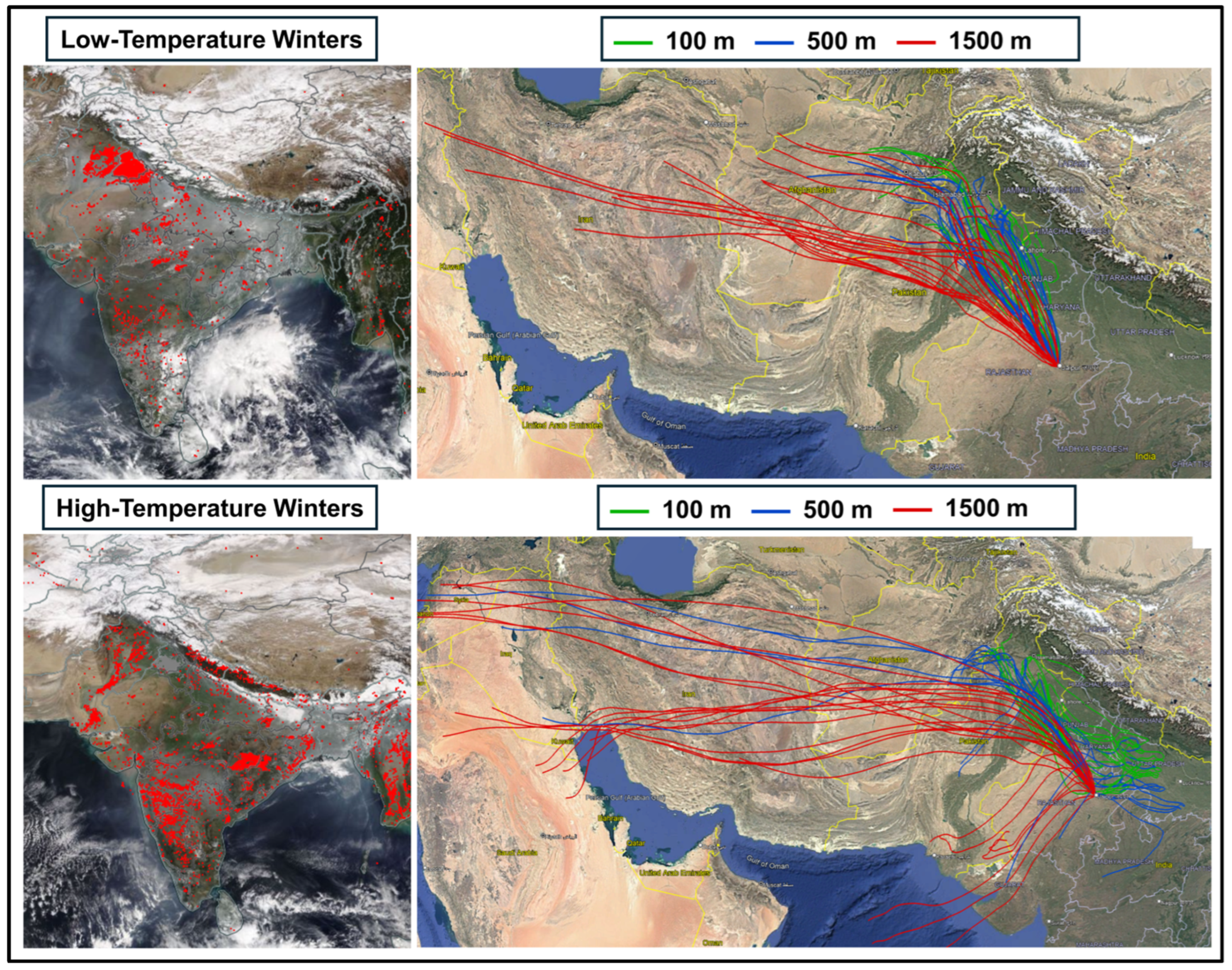
The Hybrid Single-Particle Lagrangian Integrated Trajectory (HYSPLIT) model was used [37,38] in developing backward trajectory profiles of air masses in all possible paths to the sampling site. For this purpose, Global Data Assimilation System (GDAS) meteorological archived data (daily 1°, global) of the National Oceanic and Atmospheric Administration (NOAA) were retrieved using NOAA [38] for the estimation of mixing height. The similar use of GDAS data has been reported in previous studies [39,40]. The trajectories were calculated for 72 h back in time at an interval of 3 h for the respective day. The time of termination at the sampling site in the simulation process was considered as 14:00 h (UTC) with path heights at 100 m (surface level), 500 m (below boundary layer) and 1500 m (above boundary level). The heights are taken above ground level (AGL) for various seasonal conditions. The uncertainties in a produced trajectory have been reported to be within 15–30% of the travel distance [37]. Moreover, fire count data was retrieved from the MODIS (Moderate Resolution Imaging Spectroradiometer) database [41], superimposed with a true color image to provide the location of geographical regions which played a crucial role in increasing particulate concentrations at the sampling site of this study domain.

2.5. Source Identification of Trace Elements

Sources for various TEs were identified using enrichment factor (EF) analysis which divides the sources of elements as crustal (natural) and non-crustal (anthropogenic) origin. The following Equation (2) was used for calculating EF value [42]:
E F x = ( C x , a e r o s o l C A l , a e r o s o l ) / ( C x , c r u s t C A l , c r u s t )
where EFx is the enrichment factor of an element x; Cx,aerosol, and CAl,aerosol are concentrations of an element x and Al, respectively, in PM2.5 (aerosol); Cx,crust, and CAl,crust are their concentrations in average crustal materials [43]. EF > 10 indicates a non-crustal source for the element, while an element of crustal origin has EF < 10.

2.6. Estimation of Respiratory Deposition Dose

Ambient RDD of PM2.5 were estimated using a semi-empirical human respiratory tract (HRT) model based on International Commission on Radiological Protection (ICRP) Publication 66 [44,45,46]. Deposition fractions were estimated for three regions of the respiratory system: head airways (HA), tracheobronchial (TB), and alveolar (AL) regions, using established mathematical formulations in the literature [44,45,46,47] and the details are provided in Supplementary Materials (Equations (S1)–(S4)). RDD (µg/min) was calculated as in Equation (3) [44,45,46]:
R D D s ( μ g / m i n ) = D F i × V T ( m 3 b r e a t h ) × f ( b r e a t h m i n ) × P M i ( μ g m 3 )
where DFi is deposition fraction for PM2.5, VT is tidal volume (m3/breath), f is breathing frequency (breaths/minute), and PMi is the mass concentration of PM2.5 (µg/m3). Separate calculations were performed for adult males and females under light physical activity conditions, using VT and f values as 9.9 × 10⁻⁴ m3/breath (female) and 12.5 × 10⁻⁴ m3/breath (male), with breathing frequencies of 21 and 20 breaths/min, respectively [47].

2.7. Potential Human Health Risk Assessment

Non-carcinogenic and carcinogenic health risks associated with inhalation exposure to PM2.5-bound TEs were assessed for various seasonal conditions using USEPA methodology [21,22,23,24]. Risk assessment was conducted for both adults and children and results give quantitative estimates for health hazards associated with inhalation exposure to traffic-related PM2.5 under different seasonal conditions. Hazard quotient (HQ) values associated with non-carcinogenic health risk (for Al, As, Be, Cd, Co, Cr, Mn Ni and Pb), and excess lifetime cancer risk (ELCR) values associated with carcinogenic health risk (for As, Be, Cd, Co, Cr, Ni and Pb) were quantified, details of which are shown in Supplementary Materials (Equations (S5)–(S9), Tables S1–S3). HQ values greater than 1 and ELCR values exceeding 1 × 10⁻⁶ were considered indicative of potential health concern. An overall flowchart of the methodology adopted in this study has also been presented in Supplementary Materials (Figure S1).

3. Results

3.1. Variability of PM2.5 Concentrations

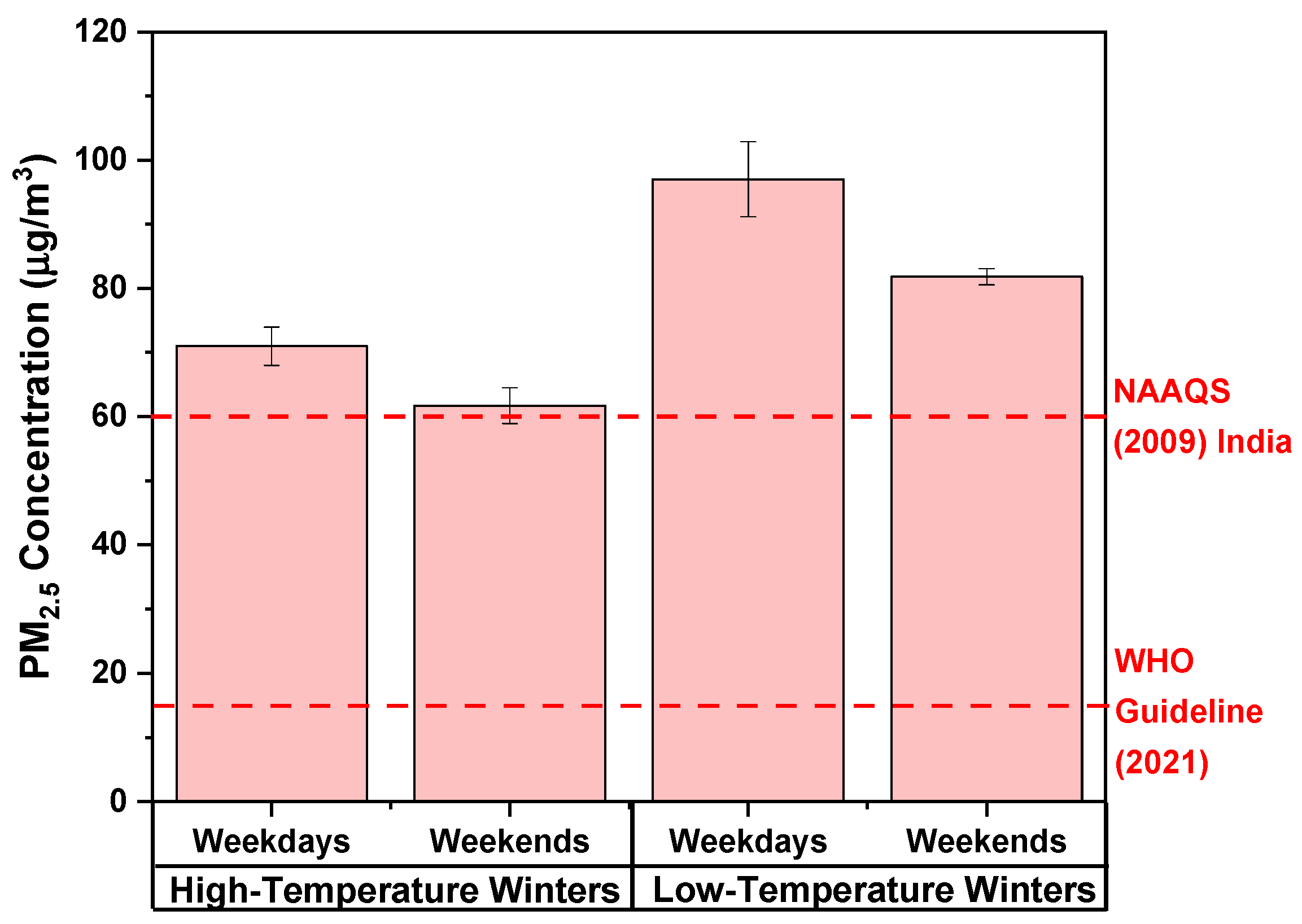
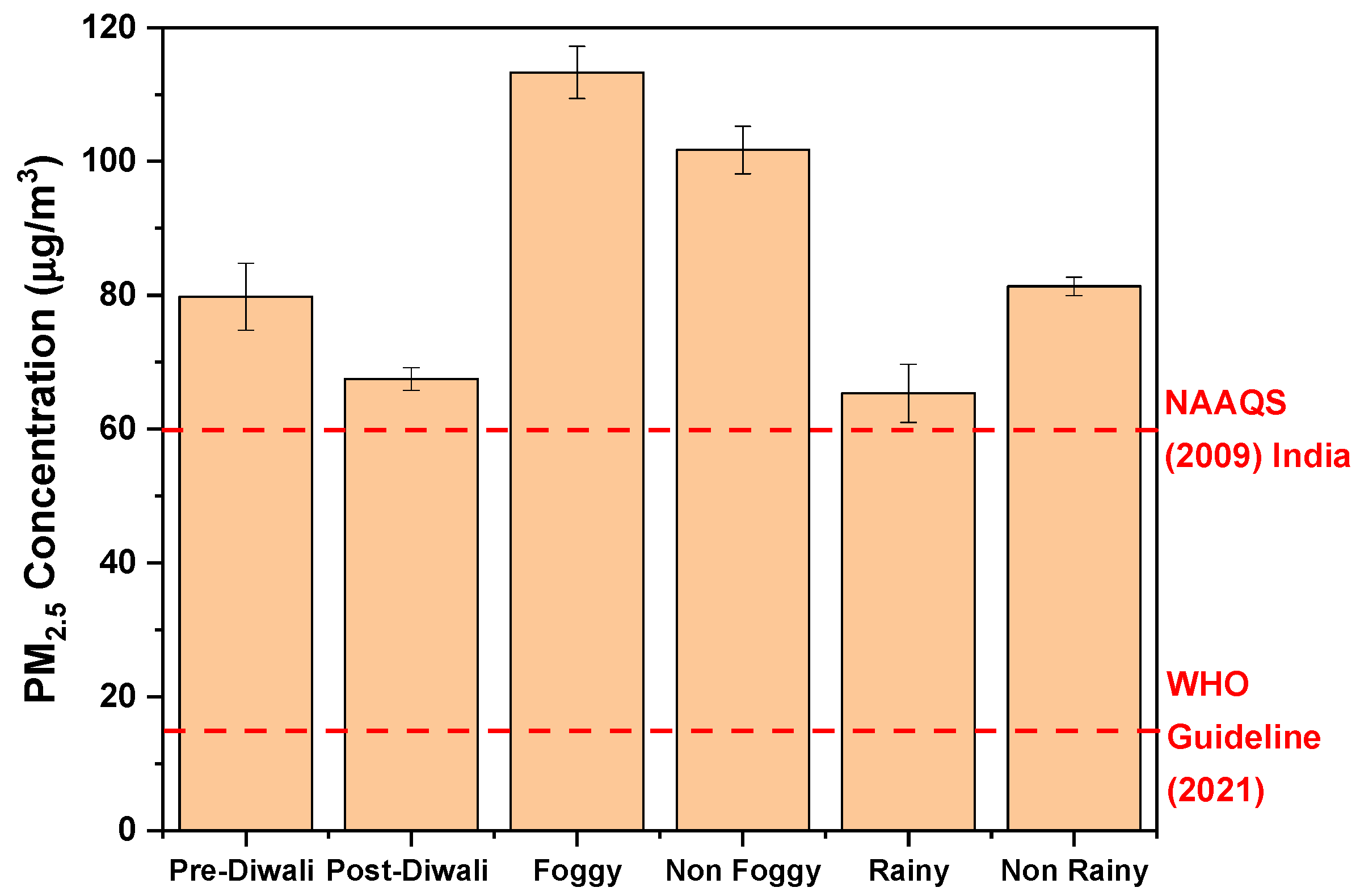
Figure 2 and Figure 3 illustrate the variability of ambient PM2.5 concentrations at the roadside site under different traffic and meteorological conditions. PM2.5 concentrations exhibited pronounced temporal and seasonal variability, with consistently higher levels observed on weekdays compared to weekends, reflecting increased traffic intensity during working days. The observed PM2.5 concentrations in the present study ranged from approximately 61.7 to 97 µg/m3, with peak values recorded during low-temperature winter weekdays. Concentrations increased progressively from October and peaked during the winter months of December and January.
As shown in Figure 2, low-temperature winter conditions were associated with significantly higher PM2.5 concentrations than high-temperature winter periods. The classification of temperature groups has already been described in Section 2.2. The highest concentrations occurred during low-temperature winter weekdays as 97 ± 5.85 µg/m3, exceeding the Indian National Ambient Air Quality Standards (NAAQS) of 60 µg/m3 by about 1.6 times and the World Health Organization (WHO) guideline of 15 µg/m3 values by about 6.5 times. Weekend concentrations during both high- and low-temperature winters were comparatively lower but frequently remained above guideline levels.
Figure 3 further demonstrates the influence of short-term meteorological conditions on PM2.5 levels. Elevated concentrations were observed during pre-Diwali periods (79.8 ± 5.03 µg/m3), foggy days (113.3 ± 3.89 µg/m3), and non-rainy conditions (81.3 ± 1.38 µg/m3), whereas post-Diwali, non-foggy, and rainy days showed comparatively reduced concentrations, indicating the role of wet scavenging and improved dispersion. Overall, the results demonstrate that traffic activity combined with unfavorable winter meteorology strongly governs roadside PM2.5 accumulation, leading to frequent exceedance of air quality standards and highlighting wintertime roadside environments as periods of heightened exposure.

3.2. Respiratory Deposition Dose of PM2.5

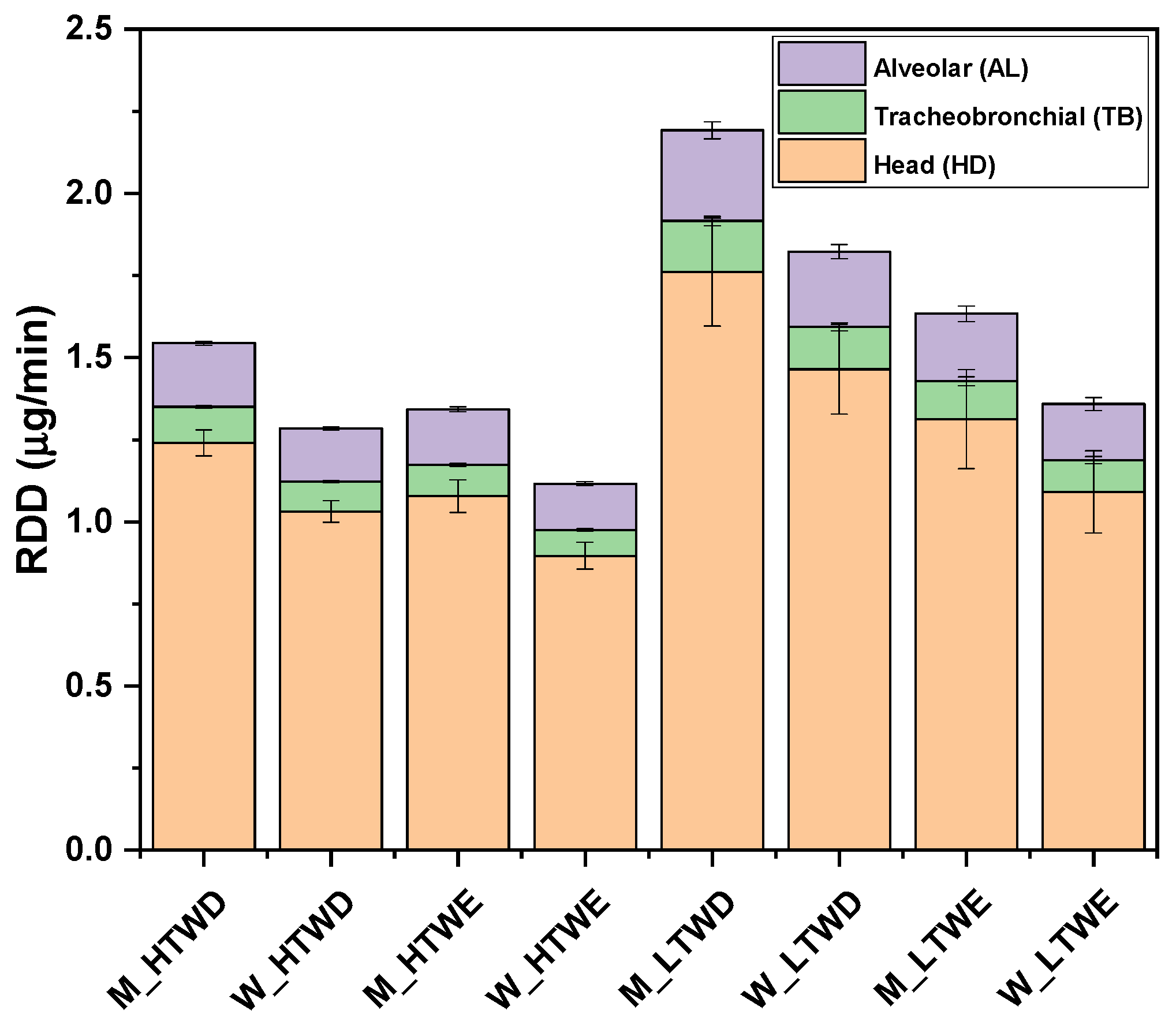
Figure 4 presents the estimated RDD of PM2.5 for adult males and females during high- and low-temperature winter periods. Moreover, Figure S2 in Supplementary Materials shows the respective doses across different traffic and meteorological conditions. RDD values exhibited substantial temporal variability and were strongly influenced by ambient PM2.5 concentrations and physiological differences between sexes. Across all scenarios, males consistently showed higher total RDD than females, attributable to higher tidal volume and inhalation rates under light physical activity conditions.
RDD values were lowest during post-Diwali, rainy, and high-temperature winter weekend conditions and increased markedly during foggy days and low-temperature winter periods. The highest RDD values were observed during low-temperature winter weekdays for men as 1.76 ± 0.16 µg/min, coinciding with elevated PM2.5 concentrations and increased traffic activity under stagnant atmospheric conditions. Among the three regions of the respiratory tract, deposition was greatest in the head airways (~80%), followed by the alveolar (~13%) and tracheobronchial (~7%) regions, for both males and females. Although head deposition dominated total RDD, alveolar deposition remained substantial, indicating enhanced potential for deep lung penetration during high-exposure periods.
Overall, these results demonstrate that respiratory deposition of PM2.5 is highly sensitive to seasonal meteorology and traffic intensity, with wintertime roadside conditions leading to significantly increased inhaled doses. The pronounced increase in alveolar deposition during low-temperature winter conditions highlights an elevated potential for adverse health effects, supporting the need for dose-based exposure assessment in traffic-dominated urban microenvironments.

3.3. Elemental Composition and Source Identification of PM2.5

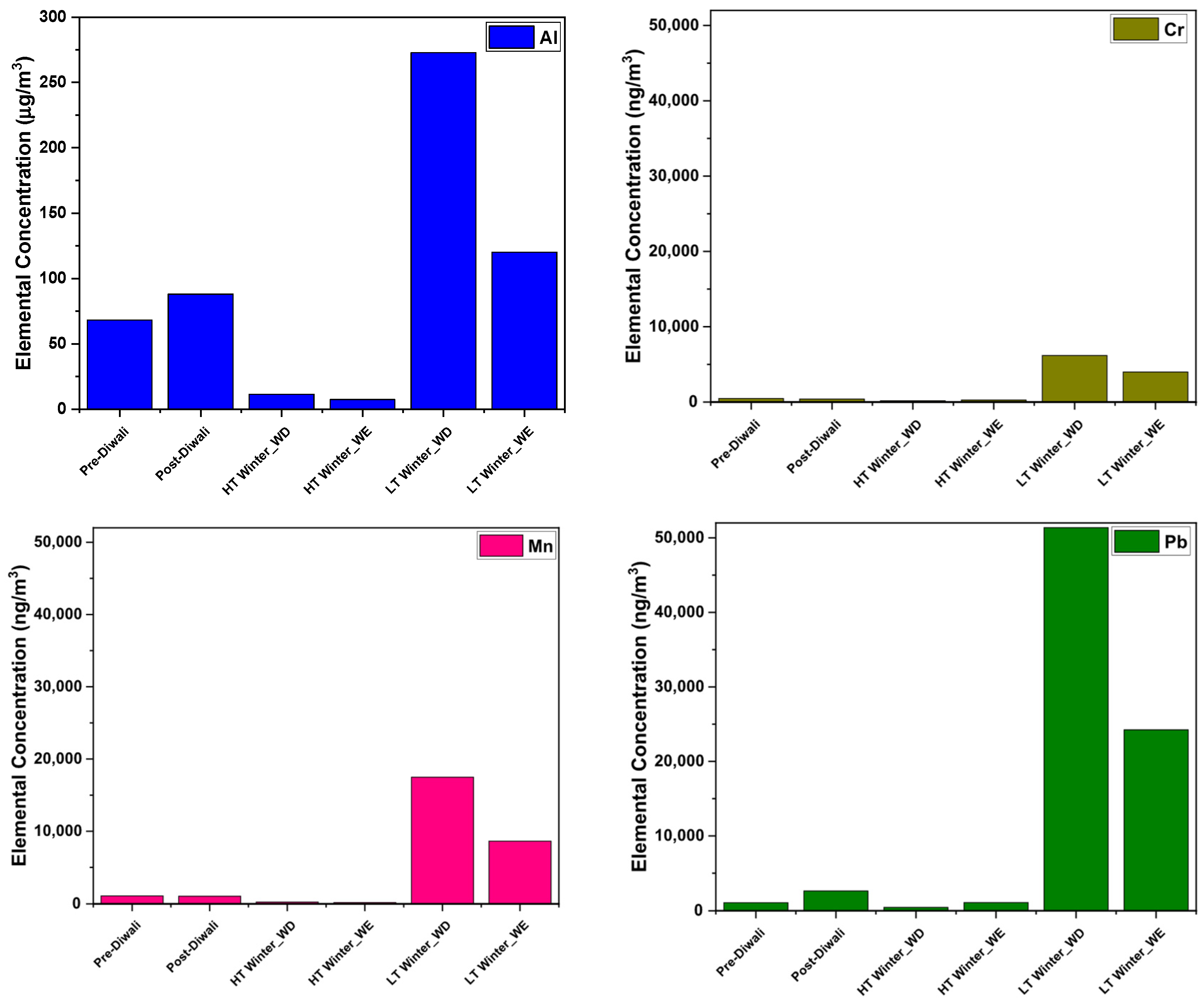
The elements were divided as major, sub-major and minor categories based on their concentrations during low-temperature winter conditions in the range of 0–500 ng/m3, 500–5000 ng/m3 and >5000 ng/m3, respectively. Results for major elements are demonstrated in Figure 5 while sub-major and minor elements are shown in Supplementary Materials in Figures S3 and S4, respectively. Figure 5 indicates that Al was observed as the most abundant element across all sampling periods, reflecting strong contributions from crustal material and resuspended road dust. Further, it can be observed that concentrations of traffic-related metals, including Cr, Mn, Cd, Ni and Pb, increased markedly (p < 0.05) during low-temperature winter conditions, with the highest levels observed on winter weekdays when traffic intensity and atmospheric stagnation were greatest. Sub-major elements (As, Cd, Ni) and minor elements (Be, Co) in Figures S3 and S4 also followed similar seasonal trends, with elevated levels during winter, indicating combined effects of vehicular emissions and limited dispersion. The relatively higher enhancement of these metals compared to Al suggests a strong influence of non-crustal sources linked to vehicular emissions and component wear. Overall, the results indicate that roadside PM2.5 is influenced by both resuspended dust and traffic-related emissions, with the latter becoming more dominant during winter conditions.
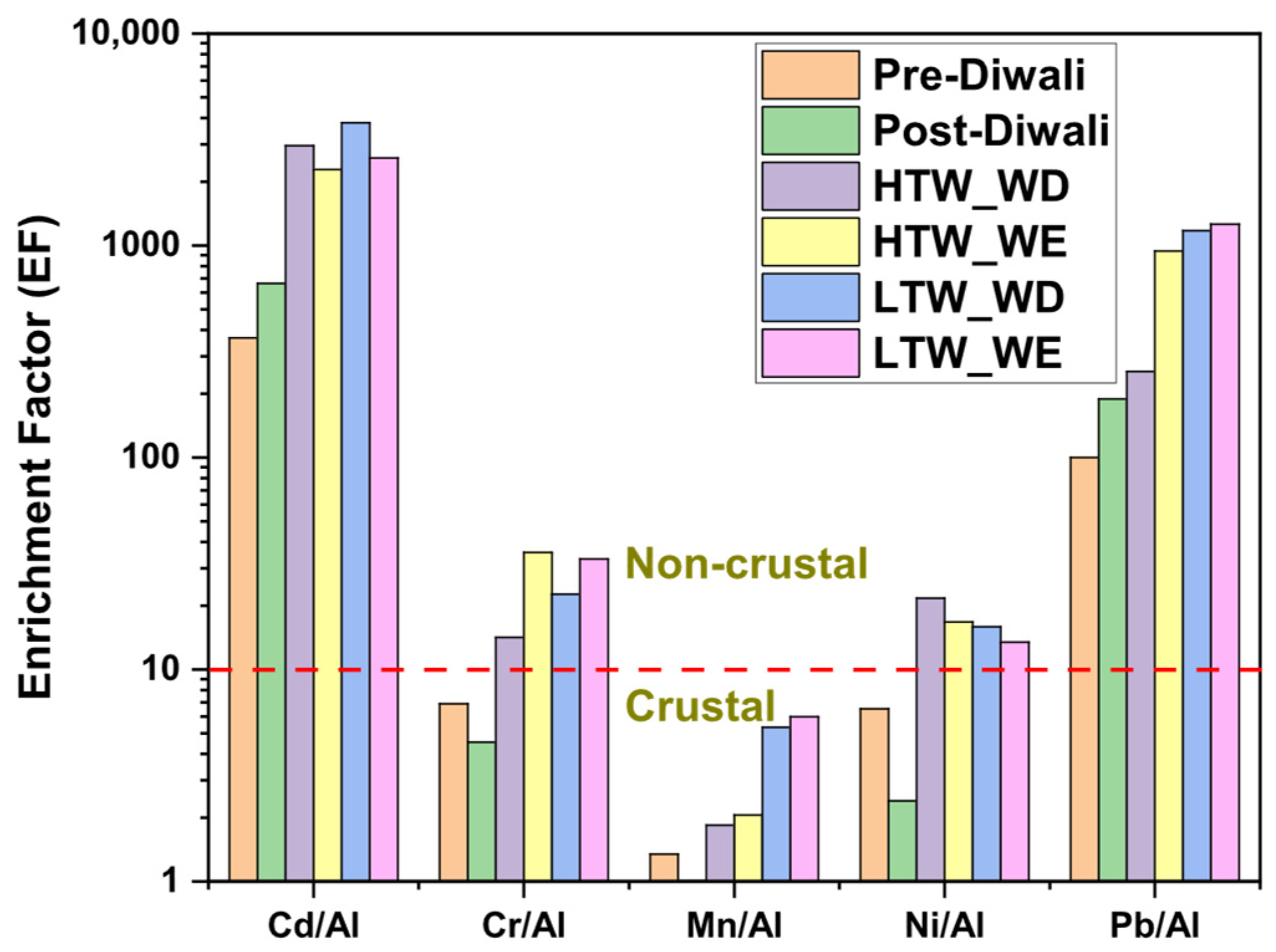
EF analysis, as shown in Figure 6, provides insight into potential sources of PM2.5-bound metals. Cr, Cd, and Pb exhibited EF values substantially exceeding 10 during winter periods, indicating dominant non-crustal contributions from traffic-related sources such as fuel combustion, brake wear, tire abrasion, and lubricating oil additives. Ni showed moderate enrichment, consistent with mixed contributions from both traffic emissions and resuspended dust, while Mn displayed relatively lower EF values of smaller than 10, suggesting a weaker anthropogenic influence. It should be noted that source identification in this study was performed using EF analysis, traffic proximity, and backward trajectory analysis (as discussed in Section 3.4). This approach allows differentiation between crustal vs non-crustal sources. Non-crustal sources may include anthropogenic emissions related to industries and vehicular traffic.
Overall, the combined elemental concentration patterns and enrichment factor results demonstrate that wintertime roadside PM2.5 in Jaipur is strongly influenced by traffic-related non-exhaust and exhaust sources, superimposed on a substantial crustal background. The enhanced enrichment of toxic metals during low-temperature winter conditions indicates increased potential for adverse health impacts, supporting the subsequent non-carcinogenic and carcinogenic risk assessments.

3.4. Profiles of Backward Air-Mass Trajectories

Figure 7 presents the spatial distribution of MODIS-detected fire counts and 72 h backward air-mass trajectories at 100, 500, and 1500 m AGL during high- and low-temperature winters.
In high-temperature winters, extensive fire activity is observed across central and northwestern India, with high fire densities indicating widespread biomass-burning events. The corresponding backward trajectories show that air masses reaching the sampling site predominantly originate from northwestern India and adjacent regions, intersecting areas with intense fire activity at all three altitudes. Trajectories at 100 and 500 m AGL are largely confined within the Indian subcontinent, whereas 1500 m AGL trajectories extend further westward. During low-temperature winters, fire counts are more concentrated over the Indo-Gangetic Plain and eastern India, reflecting seasonal crop-residue burning patterns. Backward trajectories during this period indicate dominant westerly to north-westerly transport pathways. Higher-altitude trajectories (1500 m AGL) extend across Pakistan and parts of Afghanistan, while lower-altitude trajectories (100–500 m AGL) remain comparatively localized over northern India.

3.5. Potential Non-Carcinogenic Human Health Risk Assessment

Tables S4 and S5 in Supplementary Materials present the non-carcinogenic health risk associated with inhalation exposure to PM2.5-bound TEs for adults and children, expressed as HQ. An HQ value greater than unity indicates a potential non-carcinogenic health concern. For adults, HQ values for most elements remained below 1 under pre-Diwali, post-Diwali, and high-temperature winter conditions. However, during low-temperature winter weekdays, Mn with HQ = 2.40, exceeded the acceptable threshold of unity, while Cd, Cr, and Al showed elevated but sub-threshold values. The cumulative hazard index (ΣHQ) for adults exceeded unity only during low-temperature winter weekdays with ΣHQ as 4.24, indicating that exposure to related particulate elements is a matter of concern, as it can cause relevant non-cancer risks in humans. Moreover, children exhibited substantially higher HQ values across all elements and seasons compared to adults. During low-temperature winter weekdays, HQ values exceeded unity for Mn, Cd, Cr, and Al and the cumulative hazard index for children was markedly elevated to 17.14, indicating a significant potential non-carcinogenic health risk. Moreover, cumulative HQ values exceeded unity during low-temperature winter weekends (2.87), and high-temperature winter weekdays (1.08) for children. These results demonstrate that non-carcinogenic risks linked with PM2.5-bound metals are strongly season-dependent and are most pronounced during low-temperature winter conditions, with children being considerably more vulnerable than adults.

3.6. Potential Carcinogenic Human Health Risk Assessment

Table 1 and Table 2 summarize ELCR estimates for adults and children associated with inhalation exposure to PM2.5-bound TEs under different seasonal conditions. ELCR values exceeding threshold of 1 × 10⁻⁶ indicate a potential carcinogenic health concern. For both age groups, ELCR values for Cr consistently exceeded the acceptable threshold across all sampling conditions, with pronounced seasonal amplification during low-temperature winter periods. The highest cumulative carcinogenic risk occurred during low-temperature winter weekdays, reaching 6.10 × 10⁻⁴ for adults and 4.92 × 10⁻⁴ for children, corresponding to exceedances of the acceptable risk level by approximately 610 and 492 times, respectively. It also reflects that 610 adults in 1 million population and 492 children in 1 million population have the chance of getting cancer in their lifetime through exposure to these toxic particulate elements during low winter conditions. Cr was the dominant contributor to carcinogenic risk as compared to other elements with (p < 0.05), accounting for the majority of total ELCR, followed by As, Cd, and Co during winter conditions. In addition, the carcinogenic elements showed a greater cancer risk for adults than children. Overall, these results demonstrate that traffic-related PM2.5 in roadside environments poses a significant potential carcinogenic health risk, dominated by Cr and intensified under wintertime stagnation conditions, with adults facing substantially greater long-term cancer risk than children.

4. Discussion

The present study demonstrates that traffic-dominated roadside environments in Jaipur experience pronounced seasonal variability in PM2.5 concentrations, RDD, and associated inhalation health risks, governed by the combined influence of traffic activity and meteorological conditions. Elevated PM2.5 concentrations during winter, particularly under low-temperature conditions (97 ± 5.85 µg/m3), are consistent with previous studies from other urban environments that report enhanced particulate accumulation under reduced wind speed, shallow boundary layer height, and frequent temperature inversions [26,27,28,39,40,48,49]. This is further worsened by increased vehicular emissions under congested traffic conditions, particularly during peak hours. Conversely, lower PM2.5 concentrations during rainy and high-temperature conditions may be attributed to increased atmospheric mixing and wet deposition processes. These findings validate the hypothesis that unfavorable wintertime dispersion conditions together with dense traffic activity enhance exposure risks in roadside microenvironments, highlighting the importance of considering both climatic factors and transportation dynamics in urban air quality assessment. Compared to previous studies, the PM2.5 levels observed in this study are lower than those reported in the Delhi study by Kumer et al. [40] but comparable to heavily trafficked urban locations reported by Sah [49], suggesting the significant influence of traffic emissions and unfavorable meteorological conditions in Jaipur.
Moreover, RDD was found higher during winter, and showed consistently higher magnitude in males compared to females which reflects the combined effects of elevated ambient concentrations and physiological differences in breathing patterns. Similar sex-dependent differences in inhaled dose have been reported in earlier exposure studies [44,47], underscoring the limitation of relying only on mass-based PM2.5 concentrations for human exposure assessment. The substantial alveolar deposition (~13%) observed during winter conditions is especially relevant, since particles deposited in this region can remain for extended periods and potentially translocate into the systemic circulation, thereby increasing health impacts [40].
Elemental analysis divided metals into major (>5000 ng/m3), sub-major (500–5000 ng/m3), and minor (0–500 ng/m3) categories based on their concentrations during worst case for low-temperature winter conditions. Results indicated strong seasonal enrichment of traffic-related elements, particularly Cr, Mn, Cd, and Pb, during low-temperature winter periods which are consistent with the findings of other studies [39,49]. Moreover, the concentrations of toxic trace elements also showed considerable variations. For example, As concentrations reached up to 1130 ng/m3, which is higher than values reported in similar roadside studies in India [39,49]. Although regulatory limits for elemental concentrations in airborne PM2.5 are limited, these values indicate elevated exposure to toxic metals associated with vehicular emissions. EF analysis reveals dominant non-crustal contributions for Cr, Cd, and Pb, implicating vehicular exhaust, brake and tire wear, and lubricating oil additives as key sources. These findings are in agreement with previous roadside studies which also identify non-exhaust traffic emissions as major sources to metal-rich PM2.5 in urban settings [12,13,14,39,40,49]. The elevated Al concentrations further support significant resuspension of road dust, which can act as a carrier for toxic TEs.
The integration of backward air-mass trajectory analysis with fire count data reflects the additional influence of regional and long-range transport on PM2.5 composition [28,37,38,41]. Seasonal contrasts in transport pathways and biomass-burning activity highlight that while local traffic emissions dominate roadside exposure, regional sources can further modulate particulate loading, particularly during winter when atmospheric conditions limit vertical mixing. This interaction between local emissions and regional transport reinforces the complexity of PM2.5 exposure in urban areas.
Health risk assessment results indicate that non-carcinogenic risks for individual elements were generally within the acceptable limit of unity for adults but increased considerably during winters, particularly for children. The marked exceedance of cumulative HQ values for children reflects their higher vulnerability due to physiological and exposure-related factors, as also reported in previous studies [21,39,40,48,49,50]. More critically, carcinogenic risk estimates exceeded the acceptable threshold of 1 × 10⁻⁶ across most sampling conditions, with Cr identified as the dominant contributor. The magnitude of ELCR during low-temperature winter periods is comparable to or higher than values reported for other Indian urban roadside environments [39,40,49,50], suggesting that long-term exposure to traffic-related PM2.5-bound metals may pose serious health concerns even when mass-based standards are met.
Overall, these findings have important implications for urban air quality management. They conclude that compliance with PM2.5 concentration limits alone may not enough to protect public health in traffic-influenced microenvironments. Incorporating dose-based exposure indices, chemical composition, and seasonal atmospheric dynamics into air quality assessments is crucial for more effective risk evaluation and mitigation. Therefore, targeted strategies addressing non-exhaust traffic emissions, improved road dust management, and season-specific traffic control measures may yield substantial health benefits.
However, this study was limited to a single roadside location which may not fully represent spatial variability. Future research should extend this approach to multiple roadside and urban background sites to capture spatial variability and integrate personal exposure monitoring. Source-specific apportionment and long-term epidemiological linkage studies would further enhance understanding of the health impacts of metal-enriched PM2.5 and support evidence-based urban air quality policy development.

5. Conclusions

The findings of this study revealed strong seasonal variability in PM2.5 concentrations, with elevated wintertime levels of 97 ± 5.85 µg/m3 during low-temperature weekdays which exceeded NAAQS (60 µg/m3) and WHO guideline (15 µg/m3) values by 1.6 and 6.5 times, respectively. Correspondingly, RDD values also increased substantially during winters, with dominant deposition in the head airways (~80%) and noticeable penetration into the alveolar region (~13%). Elemental and EF analyses further indicated significant wintertime enrichment of traffic-related elements, particularly Cr, Cd, and Pb, which indicate dominant contributions from vehicular exhaust, non-exhaust emissions, and resuspended road dust, with additional regulation by regional transport. Findings of backward air mass trajectory analysis showed that local traffic emissions were the primary sources to roadside PM2.5, while episodic regional transport may increase particulate loading during winter conditions.
Human health risk assessment showed that non-carcinogenic risks were generally within the acceptable limit of unity for adults but increased significantly during winter, especially for children with cumulative HQ as 17.14, causing serious health concerns. Carcinogenic risk exceeded the recommended threshold of 1 × 10⁻⁶ for most of the sampling conditions, with Cr identified as the primary factor of cancer risk. It is noteworthy that cancer risk exceeded the acceptable risk level by approximately 610 and 492 times for adults and children, respectively, during low-temperature winter weekdays, emphasizing the severe health implications due to PM2.5 exposure. Overall, the results indicated that roadside urban environments may pose substantial seasonal inhalation-based potential human health risks that are not adequately represented by PM2.5 mass concentrations alone. To the best of our knowledge, this is the first dose- and composition-based health risk assessment of traffic-related PM2.5 in Jaipur which incorporates chemical composition, exposure dose, and population vulnerability in traffic-dominated urban settings and highlights the need for air quality management strategies. From a policy perspective, these outcomes support the use of targeted traffic emission control, non-exhaust source mitigation, and season-specific exposure management measures in order to gain public health benefits in rapidly growing urban cities like Jaipur.

Supplementary Materials

The following supporting information can be downloaded at: https://www.mdpi.com/article/10.3390/atmos17040362/s1, Figure S1: Schematic illustrating the overall methodological framework adopted in this study for assessing traffic-related PM2.5 in a roadside urban environment of Jaipur, India; Figure S2: Estimated respiratory deposition doses (RDDs) of PM2.5 in different regions of the human respiratory tract for adult males (M) and females (W) under light activity across varying traffic and meteorological conditions; Figure S3: Concentrations of sub-major trace elements (TEs) associated with PM2.5 under different traffic and meteorological conditions, highlighting enhanced metal enrichment during low-temperature winter periods where HT, LT, WD, and WE denote to high-temperature, low-temperature, weekdays, and weekends, respectively; Figure S4: Concentrations of minor trace elements (TEs) associated with PM2.5 under different traffic and meteorological conditions, highlighting enhanced metal enrichment during low-temperature winter periods where HT, LT, WD, and WE denote to high-temperature, low-temperature, weekdays, and weekends, respectively; Table S1: Assumed values of exposure parameters for USEPA-based human health risk calculations; Table S2: Reference concentration (RfC) for elements for non-carcinogenic risk assessment; Table S3: Inhalation unit risk (IUR) for elements for carcinogenic risk assessment; Table S4: Potential non-carcinogenic health risk estimates for adults expressed as HQ associated with inhalation exposure to PM2.5-bound trace elements under different seasonal conditions; Table S5: Potential non-carcinogenic health risk estimates for children expressed as HQ associated with inhalation exposure to PM2.5-bound trace elements under different seasonal conditions.

Funding

This research received no external funding.

Institutional Review Board Statement

Not applicable.

Informed Consent Statement

Not applicable.

Data Availability Statement

The data presented in this study are available from the corresponding author upon reasonable request.

Acknowledgments

The authors gratefully acknowledge IRCLASS Systems and Solutions Pvt. Ltd. (ISSPL), Jaipur, for providing laboratory facilities and technical support for chemical extraction and inductively coupled plasma mass spectrometry (ICP-MS) analysis of PM2.5 filter samples.

Conflicts of Interest

The author declares no conflicts of interest.

Abbreviations

The following abbreviations are used in this manuscript:
AGLAbove Ground Level
AlAluminum
ALAlveolar
AsArsenic
ATSDRAgency for Toxic Substances and Disease Registry
BeBeryllium
CdCadmium
CoCobalt
CPCBCentral Pollution Control Board
CrChromium
EFEnrichment Factor
ELCRExcess Lifetime Cancer Risk
GDASGlobal Data Assimilation System
HAHead Airways
HQHazard Quotient
HRTHuman Respiratory Tract
HTHigh-Temperature
HYSPLITHybrid Single-Particle Lagrangian Integrated Trajectory
ICP-MSInductively Coupled Plasma Mass Spectrometry
ICRPInternational Commission on Radiological Protection
IURInhalation Unit Risk
JLNJawahar Lal Nehru
LTLow-Temperature
MnManganese
MNITMalaviya National Institute of Technology
MODISModerate Resolution Imaging Spectroradiometer
NAAQSNational Ambient Air Quality Standards
NiNickel
NOAANational Oceanic and Atmospheric Administration
PAHsPolycyclic Aromatic Hydrocarbons
PbLead
PMParticulate Matter
PM2.5Fine Particulate Matter with aerodynamic diameter ≤ 2.5 µm
PTFEPolytetrafluoroethylene
RDDRespiratory Deposition Dose
RfCReference Concentration
SISupplementary Information
TBTracheobronchial
TEsTrace Elements
USEPAUnited States Environmental Protection Agency
WDWeekdays
WEWeekends
WHOWorld Health Organization

References

  1. Herath Bandara, S.J.; Thilakarathne, N. Economic and Public Health Impacts of Transportation-Driven Air Pollution in South Asia. Sustainability 2025, 17, 2306. [Google Scholar] [CrossRef]
  2. Manisalidis, I.; Stavropoulou, E.; Stavropoulos, A.; Bezirtzoglou, E. Environmental and health impacts of air pollution: A review. Front. Public Health 2020, 8, 14. [Google Scholar] [CrossRef]
  3. Dheekwal, A.; Singh, K.; Sharma, A. GIS-based modeling of traffic-related air pollution and public health risks: A systematic review with an emphasis on developing urban contexts. Comput. Urban Sci. 2025, 5, 65. [Google Scholar] [CrossRef]
  4. Wang, P.; Zhang, R.; Sun, S.; Gao, M.; Zheng, B.; Zhang, D.; Zhang, Y.; Carmichael, G.R.; Zhang, H. Aggravated air pollution and health burden due to traffic congestion in urban China. Atmos. Chem. Phys. 2023, 23, 2983–2996. [Google Scholar] [CrossRef]
  5. Li, T.; Zhang, Y.; Jiang, N.; Du, H.; Chen, C.; Wang, J.; Li, Q.; Feng, D.; Shi, X. Ambient fine particulate matter and cardiopulmonary health risks in China. Chin. Med. J. 2023, 136, 287–294. [Google Scholar] [CrossRef]
  6. Lelieveld, J.; Klingmüller, K.; Pozzer, A.; Pöschl, U.; Fnais, M.; Daiber, A.; Münzel, T. Cardiovascular disease burden from ambient air pollution in Europe reassessed using novel hazard ratio functions. Eur. Heart J. 2019, 40, 1590–1596. [Google Scholar] [CrossRef]
  7. Cohen, A.J.; Brauer, M.; Burnett, R.; Anderson, H.R.; Frostad, J.; Estep, K.; Balakrishnan, K.; Brunekreef, B.; Dandona, L.; Dandona, R.; et al. Estimates and 25-year trends of the global burden of disease attributable to ambient air pollution: An analysis of data from the Global Burden of Diseases Study 2015. Lancet 2017, 389, 1907–1918. [Google Scholar] [CrossRef] [PubMed]
  8. Xia, T.; Nitschke, M.; Zhang, Y.; Shah, P.; Crabb, S.; Hansen, A. Traffic-related air pollution and health co-benefits of alternative transport in Adelaide, South Australia. Environ. Int. 2015, 74, 281–290. [Google Scholar] [CrossRef]
  9. Lim, E.Y.; Kim, G.D. Particulate Matter-Induced Emerging Health Effects Associated with Oxidative Stress and Inflammation. Antioxidants 2024, 13, 1256. [Google Scholar] [CrossRef]
  10. Dai, L.; Zanobetti, A.; Koutrakis, P.; Schwartz, J.D. Associations of fine particulate matter species with mortality in the United States: A multicity time-series analysis. Environ. Health Perspect. 2014, 122, 837–842. [Google Scholar] [CrossRef]
  11. Jandacka, D.; Drliciak, M.; Cingel, M.; Brna, M. Modeling and Measurements of Traffic-Related PM10, PM2.5, and NO2 Emissions Around the Roundabout and Three-Arm Intersection in the Urban Environment. Environments 2025, 12, 378. [Google Scholar] [CrossRef]
  12. Piscitello, A.; Bianco, C.; Casasso, A.; Sethi, R. Non-exhaust traffic emissions: Sources, characterization, and mitigation measures. Sci. Total Environ. 2021, 766, 144440. [Google Scholar] [CrossRef]
  13. Costagliola, M.A.; Marchitto, L.; Giuzio, R.; Casadei, S.; Rossi, T.; Lixi, S.; Faedo, D. Non-Exhaust Particulate Emissions from Road Transport Vehicles. Energies 2024, 17, 4079. [Google Scholar] [CrossRef]
  14. Pant, P.; Shi, Z.; Pope, F.D.; Harrison, R.M. Characterization of Traffic-Related Particulate Matter Emissions in a Road Tunnel in Birmingham, UK: Trace Metals and Organic Molecular Markers. Aerosol Air Qual. Res. 2017, 17, 117–130. [Google Scholar] [CrossRef]
  15. Li, Q.-Q.; Guo, Y.-T.; Yang, J.-Y.; Liang, C.-S. Review on main sources and impacts of urban ultrafine particles: Traffic emissions, nucleation, and climate modulation. Atmos. Environ. X 2023, 19, 100221. [Google Scholar] [CrossRef]
  16. Chang, L.T.-C.; Scorgie, Y.; Duc, H.N.; Monk, K.; Fuchs, D.; Trieu, T. Major Source Contributions to Ambient PM2.5 and Exposures within the New South Wales Greater Metropolitan Region. Atmosphere 2019, 10, 138. [Google Scholar] [CrossRef]
  17. Sharma, R.; Balasubramanian, R. Size-fractionated Particulate Matter in Indoor and Outdoor Environments during the 2015 Haze in Singapore: Potential Human Health Risk Assessment. Aerosol Air Qual. Res. 2018, 18, 904–917. [Google Scholar] [CrossRef]
  18. Liu, Z.; Zhan, C.; Liu, H.; Liu, S.; Quan, J.; Liu, X.; Zhang, J.; Qu, C. Source-Specific Health Risk of PM2.5-Bound Metals in a Typical Industrial City, Central China, 2021–2022. Atmosphere 2023, 14, 1406. [Google Scholar] [CrossRef]
  19. Zhai, X.; Wang, J.; Sun, J.; Xin, L. PM2.5 induces inflammatory responses via oxidative stress-mediated mitophagy in human bronchial epithelial cells. Toxicol. Res. 2022, 11, 195–205. [Google Scholar] [CrossRef]
  20. See, S.W.; Balasubramanian, R.; Rianawati, E.; Karthikeyan, S.; Streets, D.G. Characterization and source apportionment of particulate matter ≤2.5 μm in Sumatra, Indonesia, during a recent peat fire episode. Environ. Sci. Technol. 2007, 41, 3488–3494. [Google Scholar] [CrossRef]
  21. Lu, X.; Wu, X.; Wang, Y.; Chen, H.; Gao, P.; Fu, Y. Risk assessment of toxic metals in street dust from a medium-sized industrial city of China. Ecotoxicol. Environ. Saf. 2014, 106, 154–163. [Google Scholar] [CrossRef]
  22. United States Environmental Protection Agency (USEPA). Risk Assessment Guidance for Superfund, Volume I: Human Health Evaluation Manual (Part A); EPA/540/1-89/002; USEPA: Washington, DC, USA, 1989. Available online: https://www.epa.gov/sites/default/files/2015-09/documents/rags_a.pdf (accessed on 6 January 2026).
  23. United States Environmental Protection Agency (USEPA). Integrated Risk Information System (IRIS). Available online: https://www.epa.gov/iris (accessed on 15 January 2026).
  24. Agency for Toxic Substances and Disease Registry (ATSDR). Toxicological Profiles. Available online: https://www.atsdr.cdc.gov/toxicological-profiles/about/index.html (accessed on 13 January 2026).
  25. Guo, F.; Tang, M.; Wang, X.; Yu, Z.; Wei, F.; Zhang, X.; Jin, M.; Wang, J.; Xu, D.; Chen, Z.; et al. Characteristics, sources, and health risks of trace metals in PM2.5. Atmos. Environ. 2022, 289, 119314. [Google Scholar] [CrossRef]
  26. Wang, Y.; Hou, Z.; Ma, J.; Zhang, X.; Liu, X.; Wang, Q.; Chen, C.; Yang, K.; Meng, J. Seasonal Variations and Health Risk Evaluation of Trace Elements in Atmospheric PM2.5 in Liaocheng, the North China Plain. Atmosphere 2025, 16, 72. [Google Scholar] [CrossRef]
  27. Liu, Y.; Guo, X.; Zhang, Y.; Cao, Y.; Jiang, Y.; Qi, W.; Shen, M.; Li, L.; Wang, Q.; Dai, W.; et al. Chemical characteristics of wintertime PM2.5 in background region of northwest China during urban emission reduction. iScience 2025, 28, 113528. [Google Scholar] [CrossRef]
  28. Venkataraman, C.; Brauer, M.; Tibrewal, K.; Sadavarte, P.; Ma, Q.; Cohen, A.; Chaliyakunnel, S.; Frostad, J.; Klimont, Z.; Martin, R.V.; et al. Source influence on emission pathways and ambient PM2.5 pollution over India (2015–2050). Atmos. Chem. Phys. 2018, 18, 8017–8039. [Google Scholar] [CrossRef]
  29. Dadhich, A.P.; Goyal, R.; Dadhich, P.N. Assessment of spatio-temporal variations in air quality of Jaipur city, Rajasthan, India. Egypt. J. Remote Sens. Space Sci. 2018, 21, 173–181. [Google Scholar] [CrossRef]
  30. Central Pollution Control Board (CPCB). Source Profiling for Vehicular Emissions; CPCB: New Delhi, India, 2007; Available online: https://cpcb.nic.in/displaypdf.php?id=U291cmNlX1Byb2ZpbGVfVmVoaWNsZXMucGRm (accessed on 16 January 2026).
  31. Central Pollution Control Board (CPCB). Guidelines for Measurement of Ambient Air Pollutants, Volume I; CPCB: New Delhi, India, 2013; Available online: https://web.iitd.ac.in/~arunku/files/CVL313_Y20/Guideline%20for%20measurements%20for%20ambient%20air%20pollutants_report_epm_NAAQMS.pdf (accessed on 14 January 2026).
  32. Bhati, V.S.; Saxena, A. Comparative study of the PM2.5 during 2017-2021 over Jaipur, Rajasthan. J. Sci. Technol. Res. 2022, 4, 13–17. [Google Scholar] [CrossRef]
  33. Ruhela, M.; Maheshwari, V.; Ahamad, F.; Kamboj, V. Air quality assessment of Jaipur city Rajasthan after the COVID-19 lockdown. Spat. Inf. Res. 2022, 30, 597–605. [Google Scholar] [CrossRef]
  34. Open-Meteo. Free Weather API, 2026. Available online: https://open-meteo.com/ (accessed on 20 January 2026).
  35. Karthikeyan, S.; Joshi, U.M.; Balasubramanian, R. Microwave assisted sample preparation for determining water-soluble fraction of trace elements in urban airborne particulate matter: Evaluation of bioavailability. Anal. Chim. Acta 2006, 576, 23–30. [Google Scholar] [CrossRef]
  36. Behera, S.N.; Cheng, J.; Huang, X.; Zhu, Q.; Liu, P.; Balasubramanian, R. Chemical composition and acidity of size-fractionated inorganic aerosols of 2013-14 winter haze in Shanghai and associated health risk of toxic elements. Atmos. Environ. 2015, 122, 259–271. [Google Scholar] [CrossRef]
  37. Draxler, R.R.; Hess, G.D. An overview of the HYSPLIT_4 modeling system of trajectories, dispersion, and deposition. Aust. Meteorol. Mag. 1998, 47, 295–308. Available online: https://www.arl.noaa.gov/documents/reports/MetMag.pdf (accessed on 20 January 2026). [CrossRef]
  38. NOAA. HYSPLIT (Hybrid Single-Particle Lagrangian Integrated Trajectory) Model. Available online: https://www.ready.noaa.gov/HYSPLIT.php (accessed on 15 January 2026).
  39. Sah, D. Concentration, source apportionment and human health risk assessment of elements in PM2.5 at Agra, India. Urban Clim. 2023, 49, 101477. [Google Scholar] [CrossRef]
  40. Kumar, V.; Yadav, M.; Behera, S.N. Characterization of PM2.5-bound trace elements, source apportionment, and assessment of associated human health risks during summer and winter in Greater Noida, the National Capital Region of India. Front. Environ. Sci. 2022, 10, 949913. [Google Scholar] [CrossRef]
  41. MODIS. Fire Information for Resource Management System (FIRMS). Available online: https://firms.modaps.eosdis.nasa.gov (accessed on 22 January 2026).
  42. Boreddy, S.K.; Hegde, P.; Aswini, A.R. Geochemical characteristics of trace elements in size-resolved coastal urban aerosols associated with distinct air masses over tropical peninsular India: Size distributions and source apportionment. Sci. Total Environ. 2021, 763, 142967. [Google Scholar] [CrossRef]
  43. Balasubramanian, R.; Qian, W.-B. Characterization and source identification of airborne trace metals in Singapore. J. Environ. Monit. 2004, 6, 813–818. [Google Scholar] [CrossRef]
  44. Aleksandropoulou, V.; Lazaridis, M. Development and application of a model (ExDoM) for calculating the respiratory tract dose and retention of particles under variable exposure conditions. Air Qual. Atmos. Health 2013, 6, 13–26. [Google Scholar] [CrossRef]
  45. International Commission on Radiological Protection (ICRP). Human Respiratory Tract Model for Radiological Protection; ICRP Publication 66; Pergamon Press: Oxford, UK, 1994; Available online: https://icrp.org/publication.asp?id=ICRP%20Publication%2066 (accessed on 25 January 2026).
  46. Megido, L.; Suarez-Peña, B.; Negral, L.; Castrillon, L.; Suarez, S.; Fernandez-Nava, Y.; Maranon, E. Relationship between physico-chemical characteristics and potential toxicity of PM10. Chemosphere 2016, 162, 73–79. [Google Scholar] [CrossRef]
  47. Hinds, W.C. Aerosol Technology: Properties, Behavior, and Measurement of Airborne Particles, 2nd ed.; John Wiley & Sons: New York, NY, USA, 1999; pp. 233–259. Available online: https://ftp.cdc.gov/pub/Documents/OEL/02.%20Kuempel/References/Hinds_1999-Aerosol%20technology.pdf (accessed on 12 January 2026).
  48. Adly, H.M.; Saleh, S.A.K. Long-Term Trends in PM10, PM2.5, and Trace Elements in Ambient Air: Environmental and Health Risks from 2020 to 2024. Atmosphere 2025, 16, 415. [Google Scholar] [CrossRef]
  49. Sah, D. Chemical Characteristics and Public Health Risk Assessment of PM2.5-Bound Elements in Sheohar, India. Aerosol Sci. Eng. 2024, 8, 275–287. [Google Scholar] [CrossRef]
  50. Yadav, N.; Bajar, S.; Gupta, S.; Vijayan, N.; Sharma, S.K. Evaluating health risks of PM2.5-bound heavy elements in Faridabad, Haryana (India): An industrial perspective. Environ. Monit. Assess. 2024, 196, 1185. [Google Scholar] [CrossRef]
Figure 1. Location of Rajasthan state in India showing Jaipur and the roadside PM2.5 sampling site along the study corridor.
Atmosphere 17 00362 g001
Figure 2. Seasonal variations in PM2.5 concentrations during high- and low-temperature winter periods for weekdays and weekends, compared with Indian NAAQS and WHO guideline values.
Atmosphere 17 00362 g002
Figure 3. Variations in ambient PM2.5 concentrations under different traffic and meteorological conditions, including pre- and post-Diwali periods, foggy and non-foggy days, and rainy and non-rainy days.
Atmosphere 17 00362 g003
Figure 4. Estimated respiratory deposition doses (RDD) of PM2.5 in different regions of the human respiratory tract for adult males (M) and females (W) under light activity during high-temperature (HT) and low-temperature (LT) winter weekdays (WD) and weekends (WE).
Atmosphere 17 00362 g004
Figure 5. Concentrations of major trace elements (TEs) associated with PM2.5 under different traffic and meteorological conditions, highlighting enhanced metal enrichment during low-temperature winter periods where HT, LT, WD, and WE denote to high-temperature, low-temperature, weekdays, and weekends, respectively.
Atmosphere 17 00362 g005
Figure 6. Enrichment factors (EFs) of the selected elements associated with traffic-related PM2.5 under different seasonal and traffic conditions; the red dashed-line (EF = 10) separates crustal and non-crustal sources.
Atmosphere 17 00362 g006
Figure 7. MODIS fire counts and 72 h HYSPLIT backward air-mass trajectories at 100, 500, and 1500 m AGL for high-temperature (top) and low-temperature (bottom) winters, illustrating seasonal variability in biomass-burning activity and air-mass transport to the study site.
Atmosphere 17 00362 g007
Table 1. Potential carcinogenic health risk estimates for adults expressed as ELCR associated with inhalation exposure to PM2.5-bound trace elements under different seasonal conditions.
ElementSF (kg day mg−1)ELCR for Adults for PM2.5
Pre-DiwaliPost-DiwaliHigh-Temp Winter_WeekdaysHigh-Temp Winter_WeekendsLow-Temp Winter_WeekdaysLow-Temp Winter_Weekends
As15.051.81 × 10−61.21 × 10−62.66 × 10−60.97 × 10−633.36 × 10−63.23 × 10−6
Be8.40.00 × 10−60.00 × 10−60.00 × 10−60.00 × 10−60.49 × 10−60.06 × 10⁻⁶
Cd6.30.51 × 10−61.18 × 10−62.97 × 10−60.54 × 10−630.71 × 10−63.35 × 10−6
Co31.50.00 × 10−60.00 × 10−60.00 × 10−60.00 × 10−625.74 × 10−63.57 × 10−6
Cr4226.40 × 10−622.47 × 10−639.55 × 10−623.37 × 10−6508.73 × 10−6119.38 × 10−6
Ni0.840.45 × 10−60.21 × 10−61.09 × 10−60.20 × 10−66.43 × 10−60.87 × 10⁻⁶
Pb0.0420.06 × 10−60.15 × 10−60.11 × 10−60.10 × 10−64.23 × 10−60.73 × 10⁻⁶
Σ = 29.23 × 10625.22 × 10646.37 × 10625.17 × 106609.69 × 106131.19 × 106
Table 2. Potential carcinogenic health risk estimates for children expressed as ELCR associated with inhalation exposure to PM2.5-bound trace elements under different seasonal conditions.
ElementSF (kg day mg−1)ELCR for Children for PM2.5
Pre-DiwaliPost-DiwaliHigh-Temp Winter_WeekdaysHigh-Temp Winter_WeekendsLow-Temp Winter_WeekdaysLow-Temp Winter_Weekends
As6.451.46 × 10−60.98 × 10−62.15 × 10−60.78 × 10−626.94 × 10−62.61 × 10−6
Be3.60.00 × 10−60.00 × 10−60.00 × 10−60.00 × 10−60.40 × 10−60.05 × 10⁻⁶
Cd2.70.41 × 10−60.95 × 10−62.40 × 10−60.44 × 10−624.80 × 10−62.70 × 10−6
Co13.50.00 × 10−60.00 × 10−60.00 × 10−60.00 × 10−620.79 × 10−62.89 × 10−6
Cr1821.32 × 10−618.15 × 10−631.94 × 10−618.87 × 10−6410.9 × 10−696.43 × 10⁻⁶
Ni0.360.36 × 10−60.17 × 10−60.88 × 10−60.16 × 10−65.20 × 10−60.70 × 10⁻⁶
Pb0.0180.05 × 10−60.12 × 10−60.09 × 10−60.08 × 10−63.42 × 10−60.59 × 10⁻⁶
Σ = 23.61 × 10620.37 × 10637.45 × 10620.33 × 106492.45 × 106105.96 × 106
Disclaimer/Publisher’s Note: The statements, opinions and data contained in all publications are solely those of the individual author(s) and contributor(s) and not of MDPI and/or the editor(s). MDPI and/or the editor(s) disclaim responsibility for any injury to people or property resulting from any ideas, methods, instructions or products referred to in the content.