Article

Impact of 2015 El Niño and Monsoonal Variability on Aerosol Optical Properties over Penang, Malaysia


by
Hussaini Yusuf
1,2,
Norhaslinda Mohamed Tahrin
1,* and
Hwee San Lim
1
1
School of Physics, Universiti Sains Malaysia, Gelugor 11800, Penang, Malaysia
2
Department of Physics, Aliko Dangote University of Science and Technology Wudil, Kano 713101, Nigeria
*
Author to whom correspondence should be addressed.
Atmosphere 2026, 17(3), 255; https://doi.org/10.3390/atmos17030255
Submission received: 18 December 2025 / Revised: 22 January 2026 / Accepted: 26 January 2026 / Published: 28 February 2026

Abstract

Atmospheric aerosols in Southeast Asia, influenced by climate and seasonal circulation, are examined here. This study analyzes the impact of the 2015 El Niño and monsoonal variability on aerosol properties over Penang, Malaysia, from 2015–2019. Aerosol Optical Depth (AOD), Ångström Exponent (AE), Fine Mode Fraction (FMF), and Single Scattering Albedo (SSA) were analyzed using AERONET observations, complemented by satellite-derived fire data and NOAA HYSPLIT back-trajectory analysis. Pronounced seasonal variability was observed, with elevated AOD during the Southwest Monsoon (0.72 ± 0.15) associated with biomass burning and mixed urban aerosols, and lower AOD during the Northeast Monsoon (0.47 ± 0.12) due to cleaner maritime air masses. The inter-monsoon period exhibited the lowest AOD (0.28 ± 0.10), reflecting enhanced wet scavenging and mixed aerosol sources. Interannually, the 2015 El Niño recorded substantially higher aerosol loading, including extreme AOD events (>1.75), driven by intensified regional fire activity under dry conditions. A statistically significant but weak correlation (R2 = 0.12, p = 0.047) indicates biomass burning contributed to AOD, though transport processes were the dominant driver. Trajectory analysis confirmed that aerosols originated from fire-affected Sumatra during the Southwest Monsoon and from the South China Sea during the Northeast Monsoon. These results show that climate and winds drive aerosol changes, so regional monitoring and cross-border air management in Southeast Asia are needed.

1. Introduction

Aerosols play a crucial role in atmospheric processes, influencing climate, air quality, and human health. Their impact on radiative forcing depends on their optical properties, which vary with composition, size, and sources [1]. Key parameters used to characterize this impact include Aerosol Optical Depth (AOD), Ångström Exponent (AE), Fine Mode Fraction (FMF), and Single Scattering Albedo (SSA). AOD quantifies the total aerosol load and its light-extinguishing effect in the atmospheric column. AE serves as a proxy for the dominant particle size, with higher values indicating a prevalence of fine-mode aerosols (e.g., from combustion) and lower values signaling coarse-mode particles (e.g., dust or sea salt). FMF refines this size characterization by directly quantifying the proportion of AOD attributable to fine-mode aerosols. Finally, SSA is critical for determining the aerosol’s radiative effect, defining the ratio of scattering to total extinction; values near 1 indicate purely scattering aerosols that cool the atmosphere, while lower values signify absorbing aerosols that contribute to atmospheric warming [2,3]. The ability of aerosols to absorb or scatter solar radiation directly affects the Earth’s radiative balance, contributing to either warming or cooling effects depending on their chemical composition [4].
The Southeast Asian region, particularly Malaysia, experiences significant aerosol variability due to seasonal monsoon dynamics and transboundary pollution. Biomass burning from Sumatra and Kalimantan during the Southwest Monsoon (SWM) leads to increased fine-mode aerosols, elevating AOD levels and reducing air quality [5,6]. In contrast, the Northeast Monsoon (NEM) brings clean maritime air masses, resulting in lower AOD values. The inter-monsoon periods exhibit moderate aerosol loading influenced by a combination of local emissions and regional transport [7]. The impact of these aerosols extends beyond air quality degradation, affecting cloud formation, regional hydrological cycles, and visibility conditions, particularly during extreme haze [8]. Understanding these seasonal variations is essential for assessing regional air quality and climate impacts.
Previous studies have highlighted the effects of El Niño on aerosol trends, showing that intense dry conditions exacerbate biomass burning, thereby increasing atmospheric aerosol loading [9]. During El Niño years, reduced precipitation and higher temperatures create favorable conditions for large-scale forest fires, further intensifying haze episodes across the region [10]. Additionally, the interaction between aerosols and meteorological factors such as wind circulation, atmospheric stability, and relative humidity plays a crucial role in the transport and dispersion of pollutants, which can influence long-range aerosol distribution [11]. However, there is limited research on the long-term variability of aerosol properties in Penang, a coastal region affected by both local and transported emissions.
Despite extensive documentation of El Niño-driven biomass burning and haze events across Southeast Asia, most previous studies rely primarily on satellite observations or short-term episodic analyses, which provide limited insight into aerosol microphysical and optical characteristics at receptor locations [12,13]. In particular, long-term ground-based assessments of aerosol size distribution, absorption–scattering behavior, and mixing state under combined El Niño and monsoonal influences remain scarce, especially in coastal urban–marine environments.
Recent studies have also increasingly highlighted the role of large-scale climate variability, particularly El Niño–Southern Oscillation (ENSO), in modulating aerosol emissions, transport pathways, and radiative effects across Southeast Asia. Post-2020 research has demonstrated that El Niño conditions intensify biomass-burning activity, alter monsoonal circulation, and amplify transboundary aerosol transport toward downwind coastal regions, with measurable impacts on air quality and regional climate feedbacks [14,15]. Advances in aerosol monitoring and trajectory analysis have further improved the ability to diagnose source–receptor relationships under extreme climate anomalies. However, despite these developments, observational constraints remain for tropical coastal receptor sites, where the interaction between maritime air masses, continental pollution, and climate forcing is particularly complex [16].
Penang, Malaysia, represents a unique receptor site influenced by local urban emissions, maritime air masses, and long-range transport from biomass-burning regions in Sumatra. However, its aerosol response to extreme climatic perturbations such as El Niño has not been comprehensively quantified using continuous ground-based observations.
This study addresses this gap by investigating the seasonal and interannual variability of aerosol optical properties over Penang from 2015 to 2019 using AERONET observations, satellite fire data, and HYSPLIT back-trajectory analysis. The specific objectives are to (i) quantify aerosol variability under contrasting monsoonal regimes, (ii) assess the impact of the 2015 El Niño on aerosol loading and particle size characteristics, and (iii) identify dominant aerosol types and transport pathways influencing Penang during extreme and normal climatic conditions.

2. Materials and Methods

2.1. Study Area

Penang, an island state located on the northwest coast of Peninsular Malaysia (5.35° N, 100.30° E), experiences a tropical monsoon climate influenced by seasonal wind patterns. The region is characterized by high humidity, frequent rainfall, and temperature variations that range between 24 °C and 32 °C throughout the year. The two dominant monsoon seasons, the NEM from November to March and the SWM from May to September, play a significant role in determining the atmospheric aerosol composition [17].
During the SWM, Penang experiences transboundary haze events caused by seasonal biomass burning. These episodes lead to elevated AOD levels and fine-mode aerosol dominance, degrading air quality and reducing visibility. Conversely, the NEM season brings cleaner maritime air masses, resulting in lower AOD levels with coarse-mode aerosol dominance. The inter-monsoon periods (April and October) represent transitional phases where both local and transported aerosols influence atmospheric composition [18].
The Universiti Sains Malaysia (USM) Aerosols Robotic Network (AERONET) station in Penang provides long-term aerosol measurements, making it an ideal location for studying seasonal and interannual variations in aerosol properties. The data from this site, combined with satellite observations and trajectory modeling, offer valuable insights into the influence of regional and climatic factors on aerosol trends [19].

2.1.1. AERONET Data

The AERONET operates as a globally distributed ground-based monitoring system for atmospheric aerosols, comprising over 500 standardized sun photometer stations across all continents. The network’s USM Penang station, located at 5.35° N, 100.30° E, has contributed to this long-term monitoring effort since its establishment in 2015, providing essential aerosol data for Southeast Asia. AERONET delivers comprehensive aerosol characterization through direct sun measurements including spectral aerosol optical depth from 340 to 1640 nm, AE calculations between 440–870 nm, and total precipitable water measurements [6]. These fundamental measurements are complemented by advanced inversion products such as SSA, FMF, and detailed particle size distributions covering radii from 0.05 to 15 μm. The system also derives complex optical properties including the real and imaginary components of refractive index, asymmetry parameters, and full phase functions for complete aerosol characterization.
The period 2015–2019 was selected in this research to capture one of the strongest El Niño events on record (2015–2016), which produced anomalously dry conditions and widespread biomass burning across Maritime Southeast Asia, followed by subsequent climatologically normal years. This temporal framework allows robust comparison between El Niño–perturbed aerosol conditions and post-event baseline variability. Additionally, continuous Level 2.0 AERONET observations were available throughout this period, ensuring high-quality, consistent aerosol retrievals and minimizing uncertainties associated with data gaps or instrument changes.
The AERONET Level 2.0 dataset used in this study provides AOD at specific wavelengths, including 440 nm and 675 nm, but does not directly report AOD at 500 nm [20]. To enable intercomparison with standard satellite and radiative transfer references (which often use 500 nm as a benchmark), AOD at 500 nm was extrapolated using the Ångström power law [1]:
τ λ = β λ α ,
τ λ is the AOD at wavelength λ, β is the turbidity coefficient, and α is the Ångström exponent (AE), indicating particle size distribution.
Rearranging for extrapolation and using two measured AOD values (e.g., 440 nm and 675 nm) and their corresponding wavelengths, we computed the Ångström exponent (α) and used it to estimate AOD at 500 nm:
α = ln τ 440 τ 675 ln 440 675 ,
τ 500 = τ 440 500 440 α ,
Previous validation studies indicate that uncertainties associated with spectral extrapolation are typically within ±0.01–0.02 for Level 2.0 AERONET data, depending on aerosol type and wavelength separation. Given the magnitude of observed seasonal and interannual AOD variability, the uncertainty introduced by this conversion is small and does not affect the robustness of the reported trends [5,17].
AERONET implements rigorous quality assurance protocols across three data processing levels [6]. The near-real-time Level 1.5 data undergo automatic cloud screening, while the research-grade Level 2.0 data receive additional manual quality checks and calibration validation. This tiered approach ensures data reliability while accommodating different user requirements from operational monitoring to climate research. The network’s standardized calibration procedures and uniform processing algorithms enable direct comparison of measurements across diverse geographic regions and atmospheric conditions. All data products, including specialized retrievals like absorption aerosol optical depth and non-spherical particle analyses, are publicly accessible through the AERONET web portal in standardized file formats designed for scientific analysis.

2.1.2. MODIS Fire Hotspot Data

The Moderate Resolution Imaging Spectroradiometer (MODIS) aboard NASA’s Terra and Aqua satellites provides global fire hotspot detection through its advanced thermal anomaly algorithms. These sensors identify active fires by measuring infrared radiation at 1 km resolution, generating comprehensive datasets that include fire locations, fire radiative power (FRP), and detection confidence levels [21]. The MODIS fire products offer near-real-time monitoring capabilities, capturing both small-scale agricultural burns and large wildfire events across diverse ecosystems.
The fire detection algorithms utilize multiple spectral bands to distinguish thermal anomalies from background surfaces, with confidence levels assigned to each fire pixel. FRP measurements provide quantitative estimates of fire intensity, serving as a valuable proxy for biomass burning emissions and their potential atmospheric impacts [22]. These global fire observations have become essential for studying fire regimes, land management, and air quality applications.

2.1.3. HYSPLIT Data

The Hybrid Single-Particle Lagrangian Integrated Trajectory (HYSPLIT) model, developed by the National Oceanic and Atmospheric Administration (NOAA), is a widely used atmospheric transport and dispersion modeling system [23]. HYSPLIT calculates air parcel trajectories by incorporating meteorological data from the Global Data Assimilation System (GDAS), which provides global coverage with 0.5° × 0.5° spatial resolution [24]. The model’s capabilities include identifying potential aerosol source regions and characterizing long-range transport pathways under different meteorological conditions.
HYSPLIT has been extensively applied in atmospheric studies to trace the movement of air masses and pollutants across regional and continental scales. The model’s trajectory calculations help distinguish between locally generated aerosols and those transported from distant sources particularly during monsoon seasons when wind patterns significantly influence air mass origins. These analyses provide valuable insights into the transboundary nature of aerosol pollution and its seasonal variations.

2.1.4. Aerosol Parameter Classifiation

The selection of aerosol parameters in this study was based on their relevance to understanding aerosol variability over Penang. AERONET Level 2.0 data were used to ensure high-quality, cloud-screened, and quality-assured measurements [6]. The key parameters considered include AOD at 500 nm, AE at 440–870 nm, SSA at 440, 675, and 870 nm, and FMF at 500 nm.
AOD was selected as a primary parameter to quantify aerosol loading in the atmosphere, while AE was used to infer particle size distribution [23]. Aerosol classification thresholds for AOD, Ångström Exponent (AE), Single Scattering Albedo (SSA), and Fine Mode Fraction (FMF) were selected following established AERONET-based frameworks. High AE (>1.2) and FMF (>0.7) values indicate dominance of fine-mode combustion aerosols, while low AE (<0.8) and FMF (<0.4) characterize coarse-mode marine aerosols. SSA values below 0.90 represent absorbing aerosol types typical of biomass burning, whereas SSA values exceeding 0.95 reflect predominantly scattering maritime particles. These thresholds are consistent with regional aerosol classification studies across Southeast Asia [25]. FMF was used to differentiate between fine and coarse aerosol modes, with values above 0.7 indicating fine-mode dominance and values below 0.3, suggesting coarse-mode prevalence [2].
The classification approach utilized in this study aligns with previous methodologies that have successfully differentiated aerosol types based on optical properties [5]. By applying this method, we identified seasonal trends in aerosol types over Penang, using the criteria followed [26] in Table 1.

2.1.5. Fire-AOD Correlation

The correlation between fire intensity and AOD was analyzed using statistical methods to assess the influence of biomass burning on atmospheric aerosol loading. Fire radiative power (FRP) data from MODIS Active Fire Data were utilized to quantify the intensity of biomass burning events within a 500 km radius of Penang. The study employed a linear regression model to determine the relationship between FRP and AOD, with FRP serving as the independent variable and AOD as the dependent variable.
Fire intensity was quantified based on FRP, calculated using the Stefan–Boltzmann law:
F R P = σ ε T 4 A ,
where σ is the Stefan–Boltzmann constant, ε represents emissivity, T denotes fire temperature, and A, is the fire pixel area. To ensure data reliability, only fire pixels with a confidence level above 80% were included in the analysis [27].
The statistical significance of the correlation between FRP and AOD was assessed using the Pearson correlation coefficient and the t-statistic. The Pearson correlation coefficient measures the strength and direction of the linear relationship between the two variables and is given by:
r = X i X ¯ Y i Y ¯ X i X ¯ 2 Y i Y ¯ 2 ,
where X i and X ¯ are the individual FRP and AOD values, respectively, and Y i and Y ¯ represent their mean values. The statistical significance of the correlation was determined using the t-statistic, which is calculated as:
t = r n 2 1 r 2 ,
where n is the number of data points. The resulting t-value was compared against the critical values of the t-distribution to derive the corresponding p-value, which indicates whether the observed correlation is statistically significant. This approach ensures a rigorous evaluation of the relationship between biomass burning intensity and aerosol loading in the atmosphere.
Seasonal and interannual differences in aerosol properties were evaluated using one-way analysis of variance (ANOVA), with seasonal sample sizes ranging from approximately 250 to 420 daily observations. Pearson correlation analysis was employed to examine the relationship between Fire Radiative Power (FRP) and AOD during the 2015 El Niño event. All statistical tests were conducted at a 95% confidence level. Prior to analysis, assumptions of normality and homoscedasticity were assessed to ensure the validity of parametric testing.

2.1.6. Trajectory Analysis

The Hybrid Single-Particle Lagrangian Integrated Trajectory (HYSPLIT) model was used to analyze the origin and transport pathways of air masses influencing AOD levels in Penang. This model, developed by the National Oceanic and Atmospheric Administration (NOAA), calculates air parcel trajectories based on meteorological data, providing insights into potential source regions of aerosols [7].
For this study, 72 h backward trajectories were computed using Global Data Assimilation System (GDAS) meteorological data. The trajectories were generated at multiple altitudes (500 m, 1000 m, and 1500 m above ground level) to capture vertical variations in air mass transport. These altitudes were chosen to represent boundary layer and lower free tropospheric transport mechanisms affecting aerosol dispersion [28].
Trajectory clustering was performed to categorize distinct transport pathways, identifying regions with frequent air mass transport toward Penang. Additionally, the potential source contribution function (PSCF) was applied to determine the probability of significant aerosol contributions from specific geographic areas. The PSCF analysis was conducted by linking trajectory endpoints with observed high AOD levels, thereby pinpointing major aerosol source regions [24].
The trajectory of an air parcel is determined by the advection equation:
d X d t = V X , t ,
where X represents the position vector of the air parcel, t is time, and V = (X, t) denotes wind velocity interpolated from GDAS data. Numerical integration techniques were applied to solve this equation, allowing the estimation of back-trajectories.
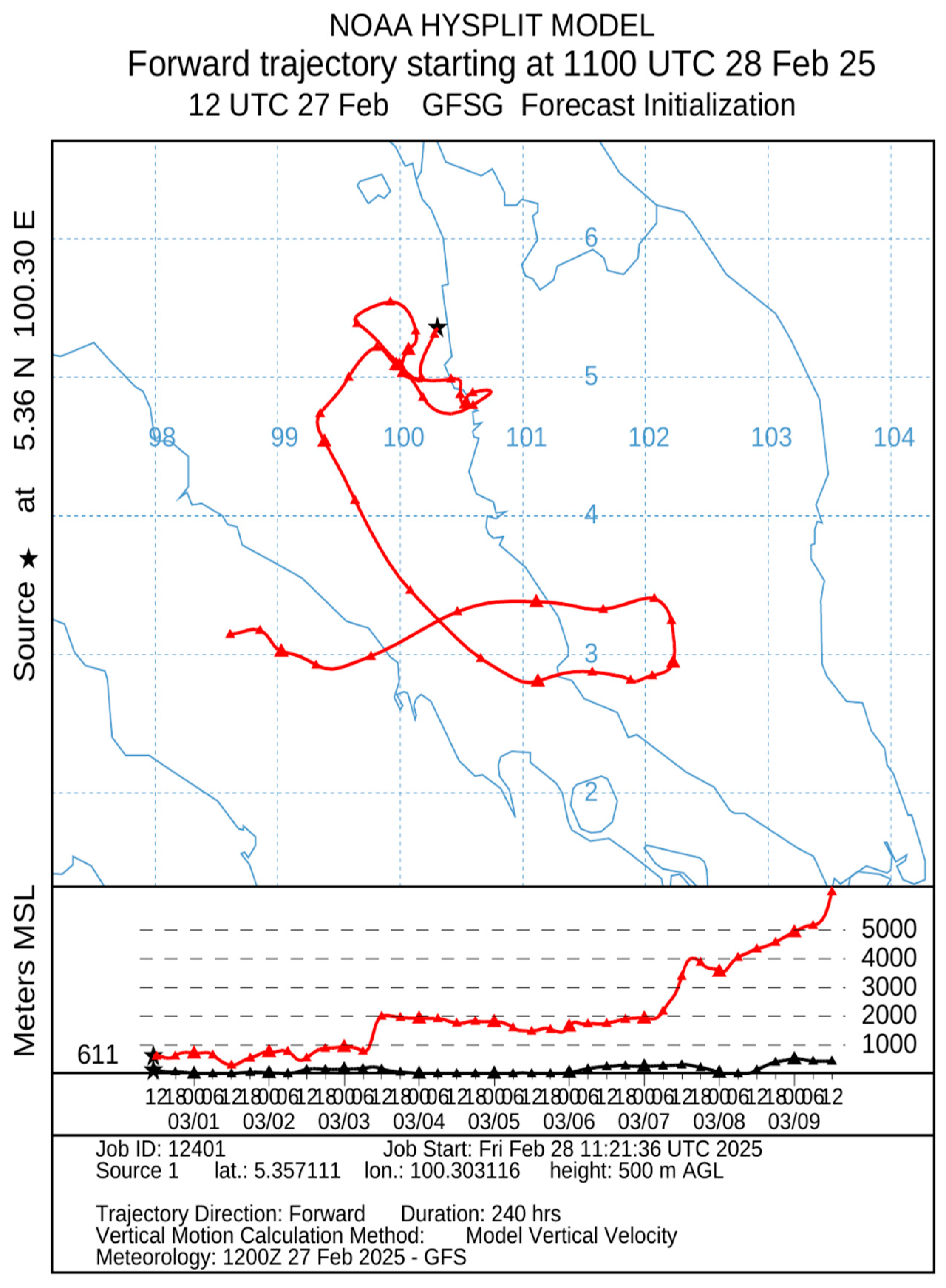
Figure 1 presents the HYSPLIT trajectories for selected periods with elevated AOD values, highlighting dominant air mass origins and transport patterns. This methodology enables a detailed examination of long-range aerosol transport and its influence on local atmospheric conditions in Penang.
Trajectory outputs were exported in Portable Document Format (PDF) for visualization and interpretation. Quantitative trajectory information, including latitude–longitude coordinates and altitude along each trajectory path, was systematically extracted by converting the trajectory files to tabulated coordinate formats using the HYSPLIT endpoint files. These extracted trajectory points were subsequently overlaid with satellite-derived fire hotspot data to assess the spatial coincidence between air-mass pathways and biomass burning regions. This approach enabled identification of dominant transport corridors and supported the attribution of elevated aerosol loading over Penang to long-range transboundary transport from fire-affected regions in Sumatra.

3. Results and Discussion

3.1. Seasonal and Monthly Variability of Aerosols

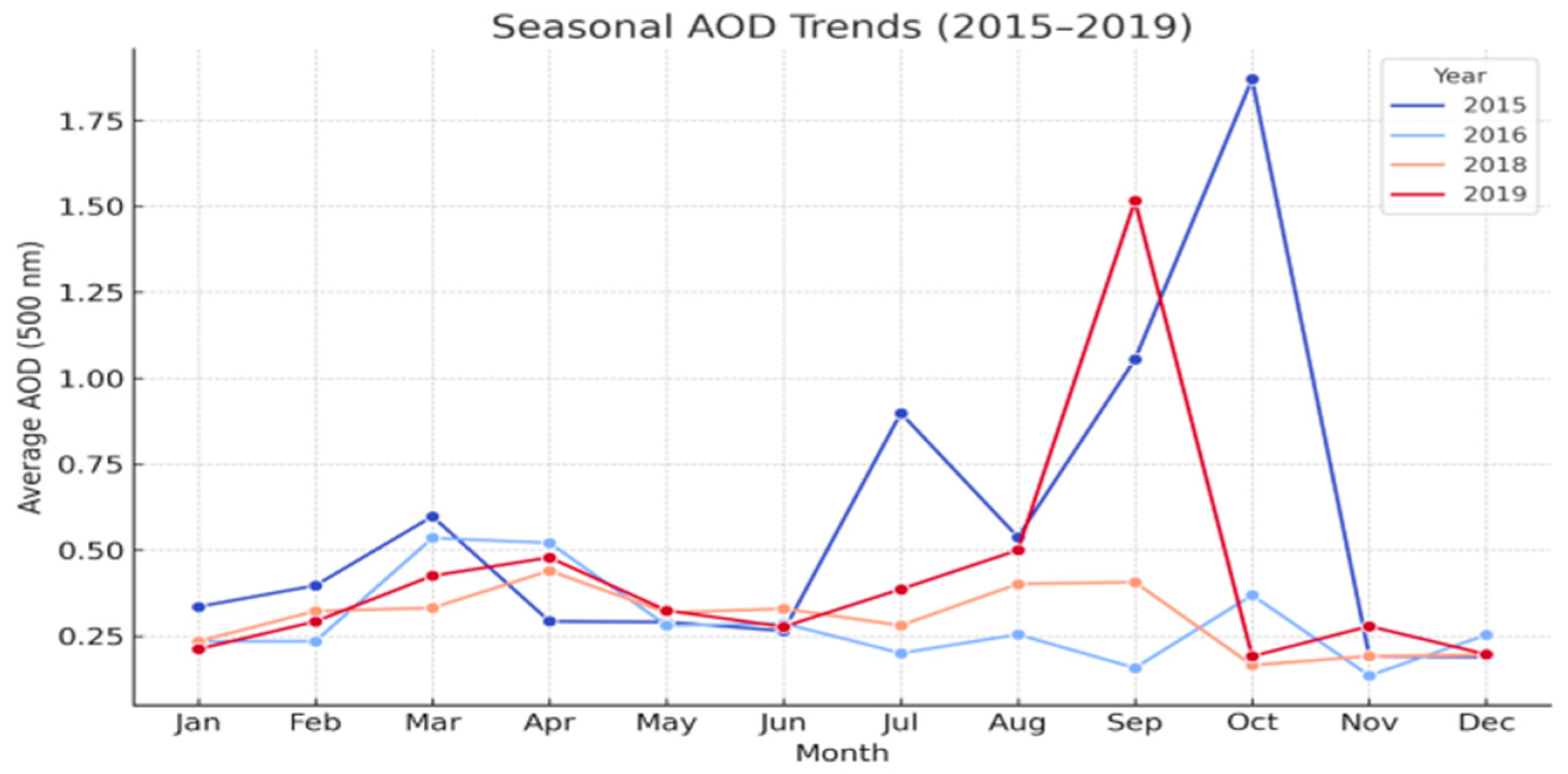
The seasonal and monthly variations in aerosol AOD and AE were analyzed for the period 2015–2019 to understand aerosol characteristics in Penang. Figure 2 illustrates the monthly AOD trends, highlighting seasonal variability.
The seasonal AOD trends (Figure 2) reveal distinct peaks, particularly during the biomass burning season, indicating significant aerosol loading from regional fire emissions. The highest AOD values are observed in October 2019 and October 2015, coinciding with increased fire activities in neighboring regions. Conversely, lower AOD values are recorded during the monsoon seasons, reflecting reduced emissions and enhanced wet deposition [29].
The peak AOD values observed in 2015 and 2019 correspond to intense fire seasons. In contrast, 2016 and 2018 exhibit lower AOD levels, suggesting differences in fire activity and meteorological influences. The influence of the Southwest Monsoon, which typically brings cleaner maritime air, is evident in the lower AOD values recorded from June to August [30].
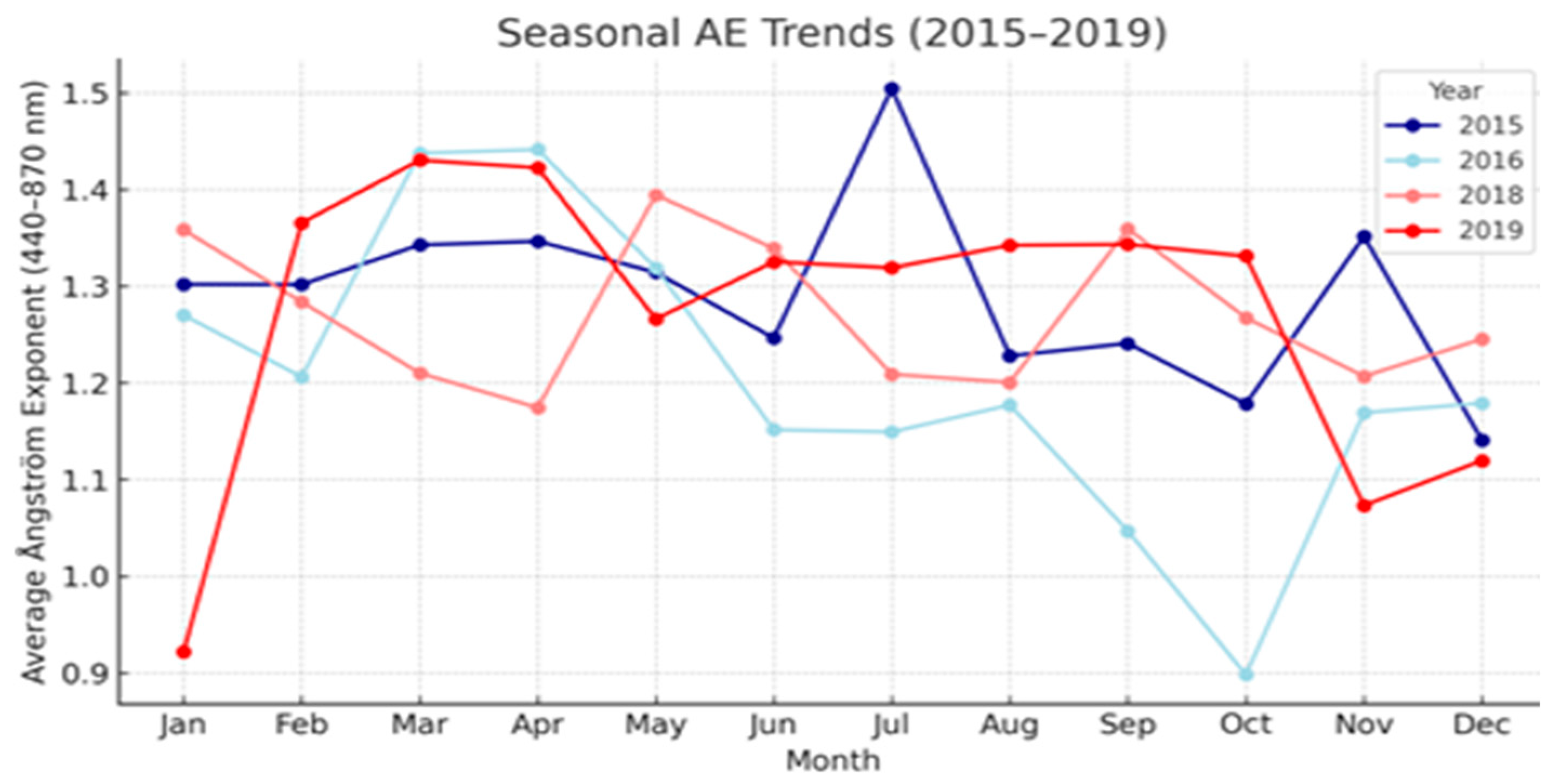
The Ångström exponent (Figure 3) provides insights into aerosol size distribution. Higher AE values suggest dominance of fine-mode particles, often associated with urban and biomass burning aerosols, while lower values indicate coarse-mode particles from dust and sea salt. The trends show seasonal variations, with pronounced increases during fire seasons, confirming the influence of fine aerosols from biomass burning. The highest AE values are observed in February–April and June–August, aligning with increased biomass burning emissions and anthropogenic influences [5].
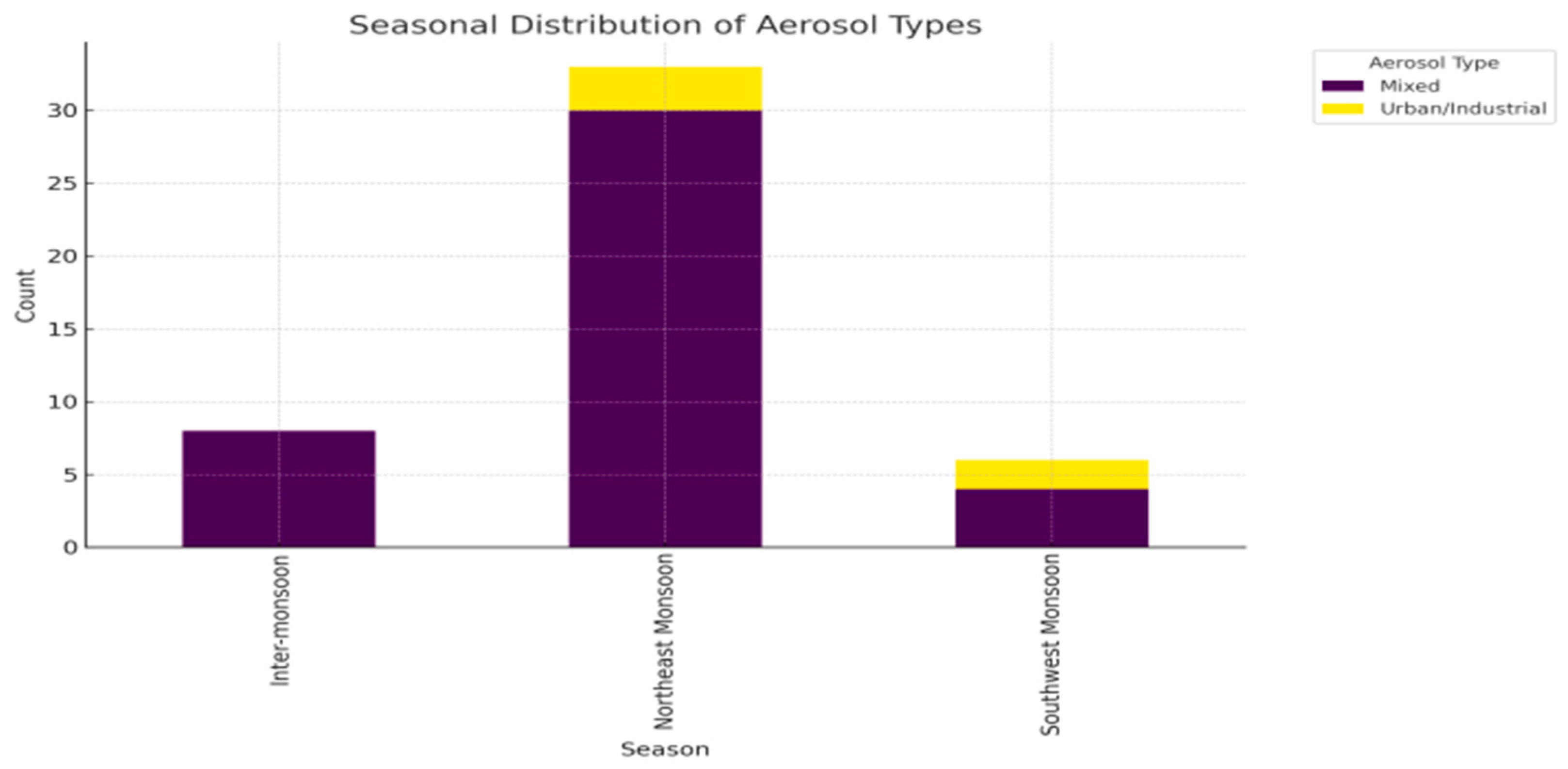
To further analyze the seasonal distribution of aerosol types, Figure 4 categorizes aerosols into mixed and urban/industrial types based on AOD and AE characteristics. The NEM exhibits the highest aerosol counts, largely attributed to long-range transport from continental sources.
The stacked bar chart shows the frequency of aerosol classification by season: Inter-monsoon, NEM, and SWM. Aerosol types are classified based on combined thresholds of AOD500, AE440–870, SSA440, and FMF, following established AERONET-based criteria. Mixed aerosols (purple) represent combined influences of marine, urban/industrial, and biomass-burning sources, while Urban/Industrial aerosols (yellow) indicate fine-mode, absorbing particles typically associated with anthropogenic emissions. Higher mixed-aerosol occurrence during the Northeast Monsoon reflects enhanced aerosol heterogeneity under humid, low-wind conditions, whereas the shows minimal aerosol contributions, reflecting cleaner atmospheric conditions. The Inter-monsoon periods exhibit moderate aerosol levels containing mixed type, influenced by localized sources and atmospheric dynamics [8].
For each season, the arithmetic mean and standard deviation of AOD500 and AE were calculated to characterize central tendency and variability. Aerosol type occurrence frequencies (biomass burning and marine types) were determined using combined thresholds of AOD, AE, FMF, and SSA, following established aerosol classification schemes for Southeast Asia. Statistical significance of seasonal differences was evaluated using one-way analysis of variance (ANOVA), with p-values < 0.05 indicating statistically significant contrasts among seasons. This integrated statistical framework reported in Table 2, ensured robust quantification of seasonal aerosol variability and source dominance over Penang.
Table 2 reveals clear and statistically significant seasonal differences in aerosol characteristics over Penang. AOD500nm is highest during the SWM; (0.72 ± 0.15), reflecting intense biomass burning in Sumatra and drier regional conditions that limit wet deposition. In contrast, the NEM records much lower AOD (0.47 ± 0.12) due to strong maritime inflow and frequent rainfall, which efficiently removes aerosols. The Inter-monsoon period shows the lowest AOD values (0.28 ± 0.10), consistent with weaker long-range transport.
The AE supports these findings: elevated AE during the SWM (1.42 ± 0.22) indicates dominance of fine-mode particles from biomass burning and urban emissions, while reduced AE in the NEM (0.98 ± 0.15) reflects the influence of coarse marine aerosols. Aerosol type counts further confirm these patterns, with biomass-burning aerosols most common during the SWM and marine aerosols most frequent during the NEM. All parameters show statistically significant seasonal differences (p < 0.001), emphasizing the strong impact of monsoonal circulation on aerosol composition.
These observations align with previous Southeast Asian studies [9], which highlight the central role of biomass burning and monsoon-driven atmospheric processes in shaping regional aerosol variability.

3.2. Annual Variability of Aerosols and Long-Term Trends

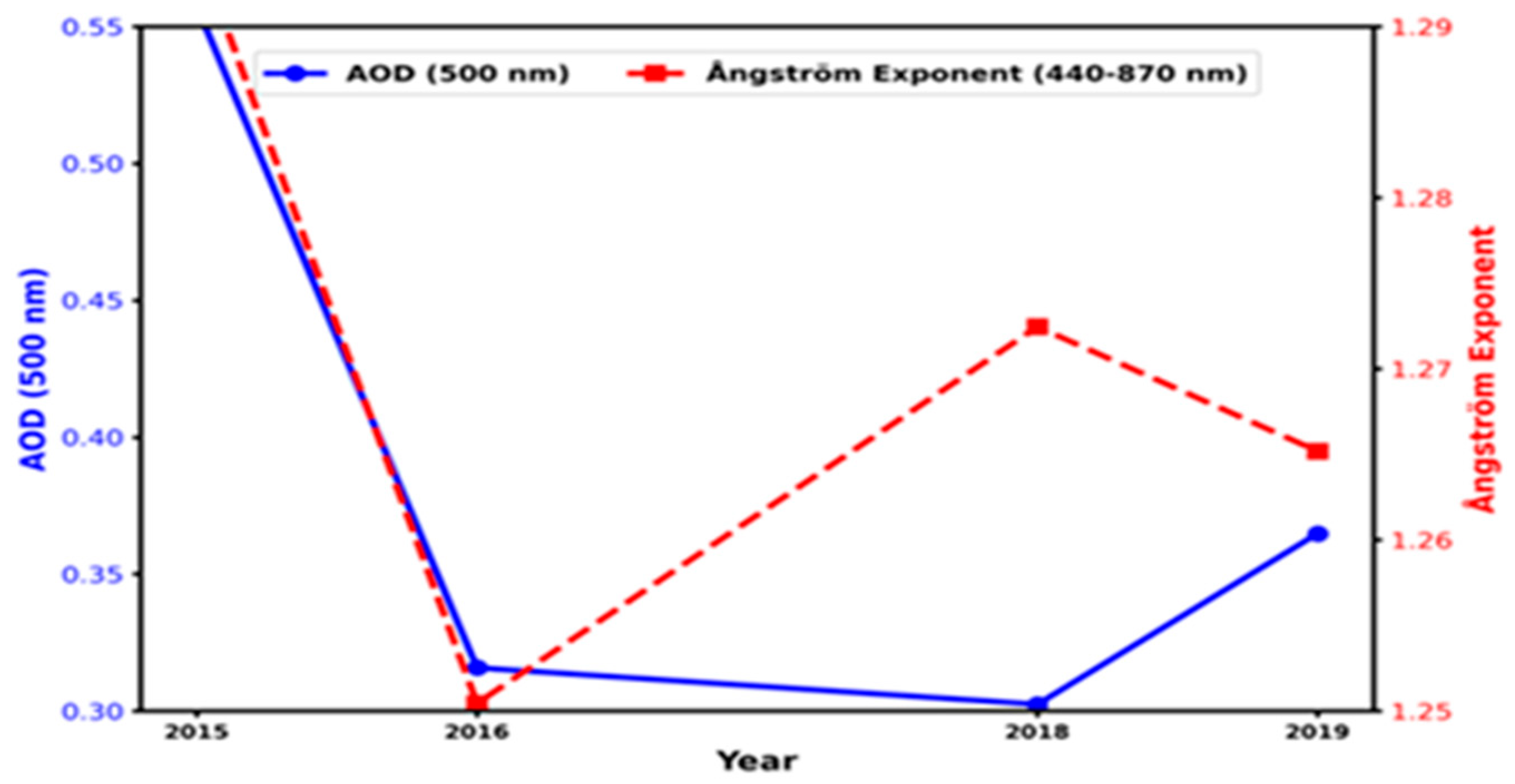
The annual variability of aerosols over Penang from 2015 to 2019 reveals distinct patterns in both AOD500nm and AE440–870 measurements (Figure 5).
The 2015 El Niño event produced peak values in both parameters, with AOD exceeding 0.55 and AE reaching 1.29, indicating a dominance of fine-mode aerosols from intensified biomass burning under drought conditions [31]. This coupled elevation of AOD and AE demonstrates how climate anomalies simultaneously increase aerosol loading and alter particle size characteristics. The subsequent decline in 2016 to AOD levels of approximately 0.35 with AE stabilization reflects a transition to mixed aerosol regimes, while maintaining a persistent background of fine particles. The moderate resurgence of both AOD (0.40) and AE (1.25) in 2019 suggests renewed fine aerosol emissions, potentially linked to regional fire activity [32].
The concurrent increase in AOD and AE, particularly during 2015, indicates a substantial rise in fine-mode aerosol loading, consistent with biomass burning events intensified by El Niño-driven drought conditions. This parallel behavior strengthens the attribution of aerosol enhancements to regional combustion sources rather than natural or coarse-mode particles [32]. The combined use of AOD and AE provides a more robust framework for aerosol characterization, with AE serving as a sensitive indicator of particle size distribution shifts linked to climate-induced emission changes. Such dual-parameter analysis offers superior diagnostic capability compared to AOD alone, particularly in regions like Penang, where aerosol sources are both diverse and seasonally variable [33].
The observed seasonal and interannual variability in aerosol optical properties over Penang is strongly governed by boundary layer dynamics and wet deposition efficiency, in addition to emission strength and transport pathways. During the SWM and the 2015 El Niño event, persistently dry conditions and enhanced solar heating promote a deeper and more unstable planetary boundary layer, which facilitates long-range transport of fine-mode aerosols from biomass-burning regions in Sumatra while limiting precipitation-driven removal. Under these conditions, aerosols can remain suspended for longer durations, leading to elevated AOD and higher AE values indicative of fine particle dominance. Similar boundary layer–aerosol coupling during El Niño events has been reported across maritime Southeast Asia, where suppressed convection and reduced cloud formation enhance aerosol residence time and optical thickness [31].
In contrast, the NEM is characterized by frequent rainfall, high relative humidity, and a shallower boundary layer, which collectively enhance wet scavenging through in-cloud and below-cloud processes. Wet deposition efficiently removes both coarse marine aerosols and transported fine particles, resulting in lower AOD despite persistent aerosol sources. This mechanism explains the reduced aerosol loading observed during NEM despite active maritime air-mass inflow. Previous studies have demonstrated that precipitation efficiency is often the dominant aerosol sink in tropical coastal environments, outweighing emission variability [32,34].
Inter-monsoon periods exhibit transitional boundary layer behavior, with episodic convection and variable mixing depths leading to mixed aerosol signatures. During these periods, rapid shifts between stagnant and ventilated conditions result in heterogeneous aerosol composition, reflected by moderate AOD and intermediate AE values. The integration of HYSPLIT trajectories with aerosol optical properties further confirms that aerosol impacts in Penang are not solely emission-driven but are strongly modulated by meteorological controls on dispersion and removal. This physically based interpretation advances the discussion beyond descriptive seasonality and highlights the coupled role of climate variability, boundary layer processes, and wet deposition in regulating aerosol burdens in tropical coastal regions [35].

3.3. Impact of El Niño on Aerosol Composition

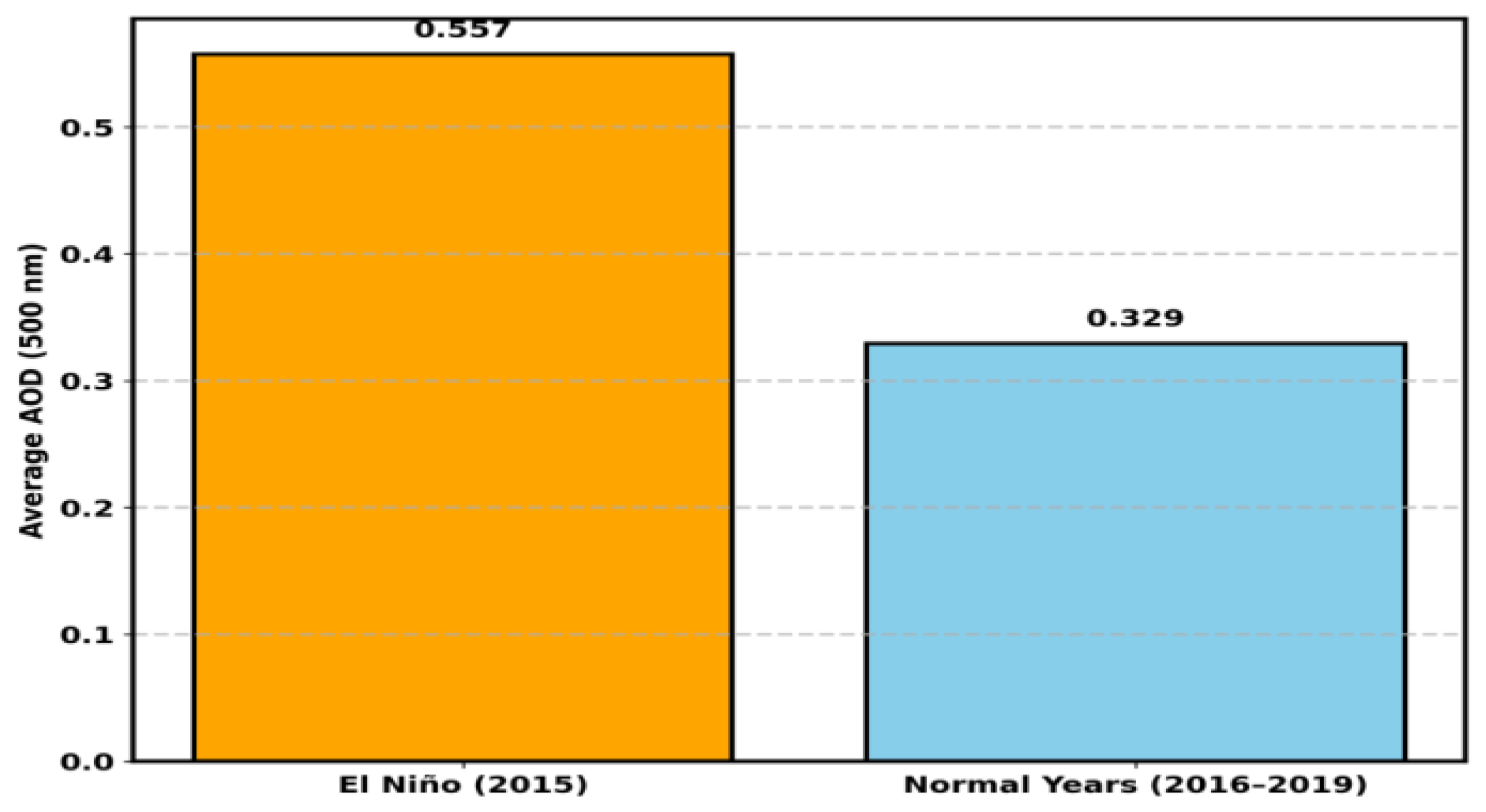
The influence of El Niño on aerosol composition was examined by comparing aerosol properties during El Niño (2015) and normal years (2016–2019). Figure 6 illustrates the differences in average AOD (500 nm) between these periods. The results indicate significantly higher AOD values during the El Niño year, suggesting increased aerosol loading associated with intensified biomass burning and drier atmospheric conditions.
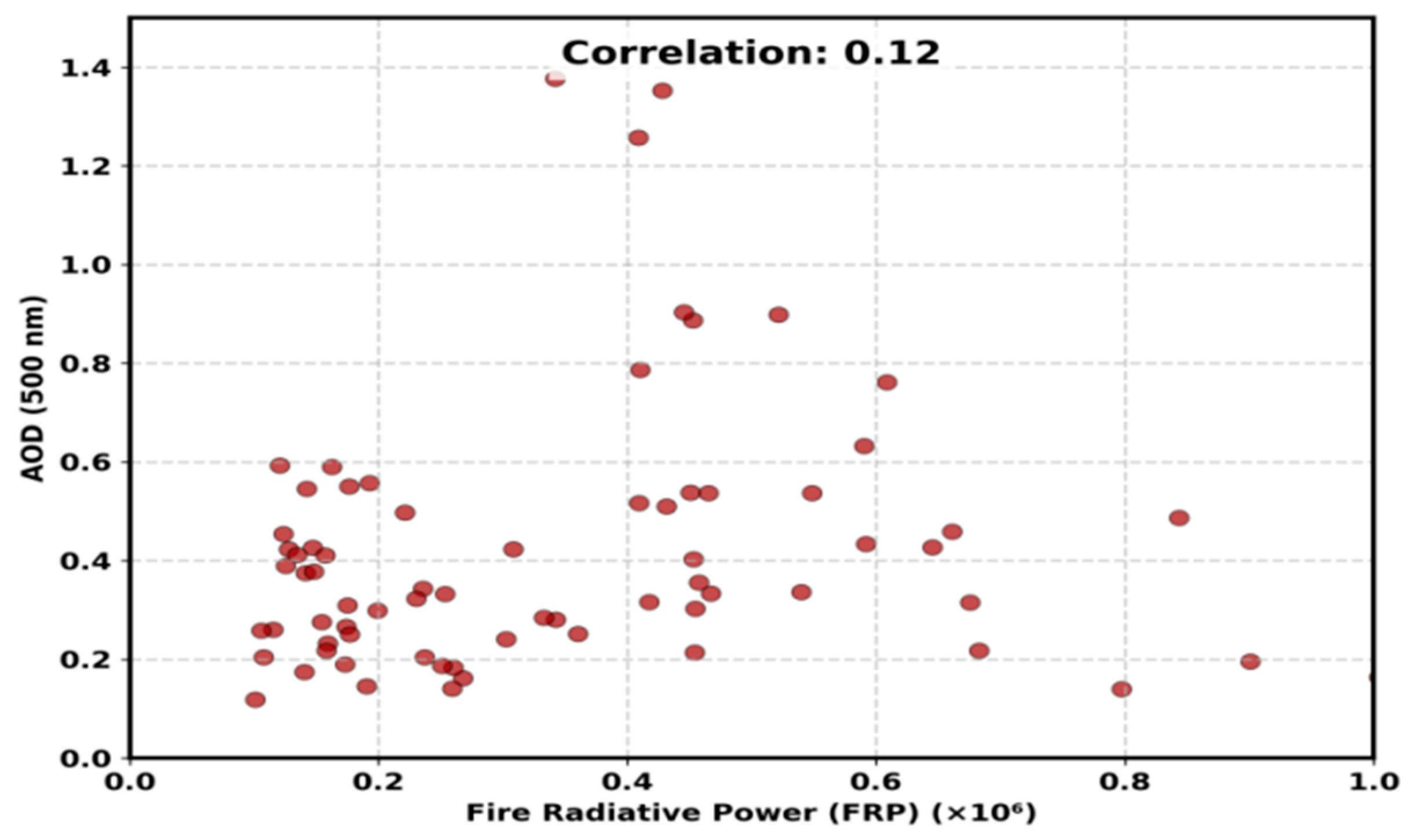
The observed increase in AOD aligns with previous findings linking El Niño events to elevated fire activity and enhanced atmospheric aerosol concentrations [8]. In addition to AOD variations, Figure 7 presents a scatterplot of fire radiative power (FRP) versus AOD, highlighting the correlation between fire intensity and aerosol loading during El Niño.
Each scatter point represents a temporally matched observation between daily mean MODIS-derived Fire Radiative Power (FRP, ×106 MW) and ground-based AERONET AOD500. The red circular markers denote individual fire–aerosol data pairs, while the reported Pearson correlation coefficient (r = 0.12) indicates a weak but statistically significant positive association (p = 0.0468). The wide dispersion of points, highlights substantial variability introduced by meteorological dilution, transport pathways, and secondary aerosol formation processes. Despite the low coefficient of determination, the statistically significant relationship supports the role of biomass burning as a contributing though not exclusive source of aerosol loading during the 2015 El Niño, emphasizing the influence of transboundary transport and atmospheric mixing rather than local fire intensity alone [36].
The chemical composition of aerosols during El Niño also exhibited distinct characteristics. Studies have shown an increase in black carbon and organic aerosols, attributed to enhanced biomass burning. The dominance of fine-mode particles during El Niño, as inferred from AE trends, further supports the hypothesis that regional fire emissions significantly impact aerosol composition [37].
The broad dispersion of AOD values across a wide range of FRP highlights the nonlinear and multiscale nature of aerosol transport and transformation processes. High FRP events do not consistently correspond to elevated AOD values, reflecting the influence of meteorological modulation, including wind direction, atmospheric stability, boundary layer dynamics, and removal processes such as wet and dry deposition. Conversely, elevated AOD values observed under moderate FRP conditions suggest that transport efficiency and aerosol accumulation, rather than emission strength alone, play a dominant role in determining aerosol loading over Penang.
The statistical significance of the fire–aerosol relationship is further supported by the associated p-value (p = 0.0468), obtained from a two-tailed Student’s t-test applied to the Pearson correlation coefficient between daily Fire FRP and AOD at 500 nm during 2015. This p-value indicates that the observed correlation is unlikely to have occurred by random chance and is statistically significant at the 95% confidence level (p < 0.05). Although the correlation strength is relatively weak (R2 = 0.12), the statistical significance confirms that biomass burning activity contributed measurably to aerosol loading over Penang during the El Niño period. This highlights the dominant role of atmospheric transport, boundary layer dynamics, and wet scavenging processes in controlling aerosol concentrations at the receptor site, consistent with previous transboundary aerosol studies [34].

3.4. Aerosol Transport Pathways and Source Attribution

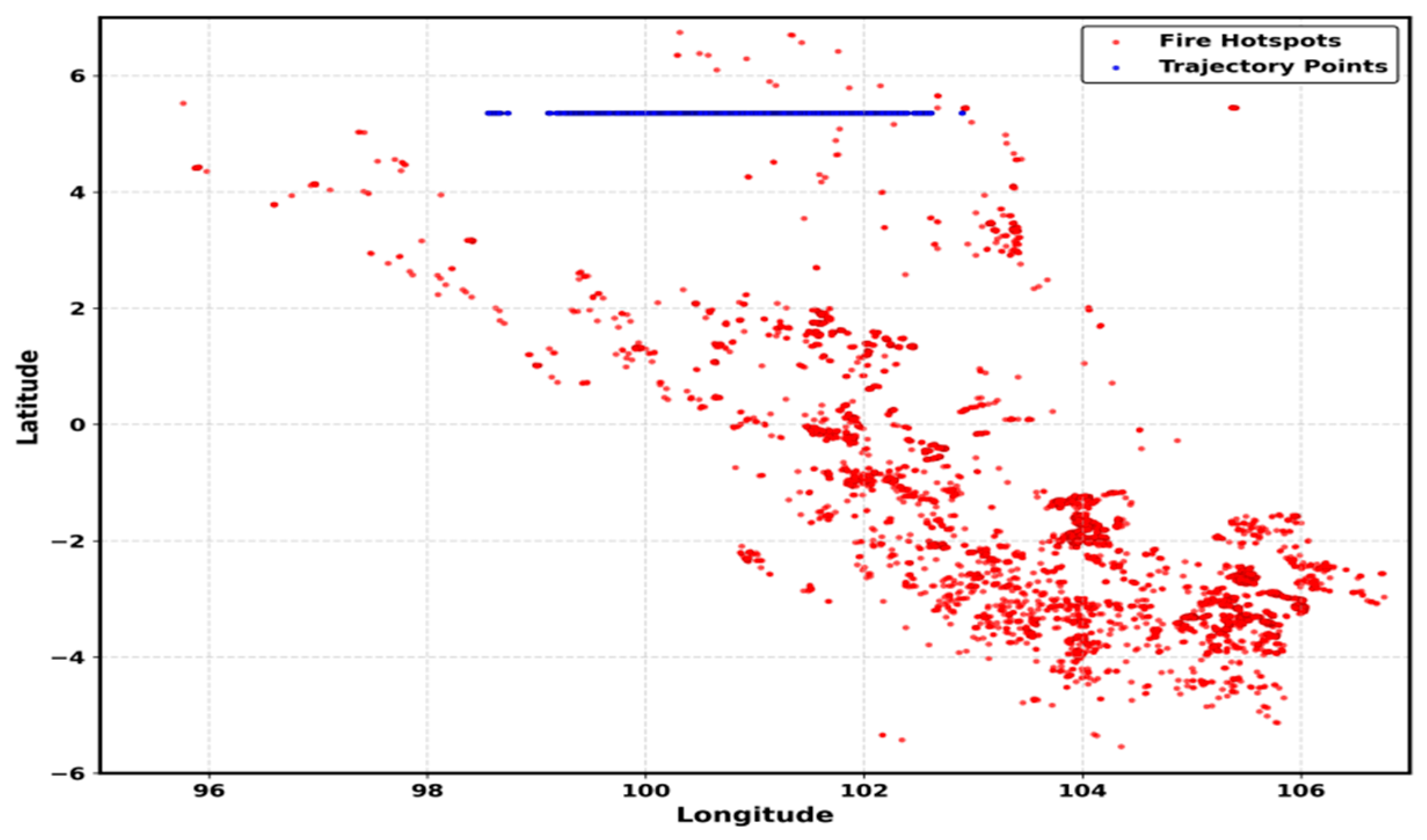
The transport pathways of aerosols in Penang are significantly influenced by regional meteorology, fire emissions, and large-scale atmospheric circulation patterns. Figure 8 illustrates the NOAA HYSPLIT model output for air parcel movement and fire hotspots during 2015, a strong El Niño year. The trajectory analysis provides critical insights into the origin and dispersion of aerosols affecting the region.
During El Niño periods, prolonged drought conditions in Southeast Asia lead to intensified biomass burning, as indicated by the dense clustering of fire hotspots in Figure 8. The backward trajectory analysis suggests that air masses arriving in Penang predominantly originate from fire-prone regions in Sumatra and Borneo, confirming transboundary transport of biomass burning aerosols. These findings align with previous studies that highlight the role of El Niño in exacerbating haze events due to enhanced fire activity and reduced precipitation [38].
The impact of synoptic meteorological patterns on aerosol transport is also evident. The trajectory analysis highlights distinct seasonal variations in aerosol pathways. During the Southwest Monsoon (June–September), air masses primarily originate from the Indian Ocean, carrying minimal pollution. However, during the Northeast Monsoon (December–March), air masses transport pollutants from continental Southeast Asia, including industrial emissions from Thailand and Vietnam. The Inter-monsoon periods (April–May, October–November) exhibit mixed influences, with contributions from both regional fires and urban–industrial emissions [39].
The strong spatial coincidence between dense fire hotspot clusters and the trajectory pathways supports the hypothesis that long-range transport of biomass-burning aerosols played a critical role in the observed AOD enhancements. The sustained residence of air parcels over fire-prone regions suggests prolonged exposure to combustion emissions, increasing the likelihood of aerosol accumulation and aging prior to arrival at the receptor site. This transport pattern is consistent with the dominance of fine-mode, absorbing aerosols inferred from elevated AE and reduced Single SSA during the same period.
In contrast, trajectories associated with lower AOD conditions are observed to originate predominantly over the South China Sea, particularly during the NEM, reflecting the influence of clean maritime air masses. This seasonal shift in air-mass origin explains the pronounced reduction in aerosol loading and the transition toward scattering-dominated marine aerosols, highlighting the strong control exerted by monsoonal circulation on aerosol regimes over Penang.
The trajectory clustering further indicates that during peak burning months, multiple air-mass pathways converge from Sumatra toward Penang, reinforcing the persistence and regional coherence of transboundary aerosol transport under El Niño–enhanced circulation. Importantly, these findings demonstrate that aerosol impacts in Penang are not solely governed by local emissions, but are strongly modulated by synoptic-scale transport mechanisms, which can amplify or suppress the influence of biomass burning depending on prevailing meteorological conditions.
The combined visualization of fire hotspot density and HYSPLIT back trajectories provides a spatially explicit framework for linking aerosol loading over Penang to upwind emission regions. The superposition of clustered air-mass pathways with satellite-detected fire locations enables direct identification of dominant transport corridors during the 2015 El Niño event. High-AOD periods coincide with air parcels traversing fire-prone regions of central and southern Sumatra, confirming that enhanced aerosol concentrations over Penang are driven by long-range transport rather than local emissions alone [40]. This integrative visualization approach strengthens causal attribution by explicitly connecting emission sources, transport pathways, and receptor-site aerosol observations, thereby improving the diagnostic power of trajectory-based analyses.

3.5. Physical Mechanisms and Societal Implications of Aerosol Variability

The pronounced enhancement of aerosol optical depth (AOD) during the 2015 El Niño and Southwest Monsoon period is not only a manifestation of increased biomass-burning emissions but also reflects fundamental atmospheric processes governing aerosol accumulation and persistence. El Niño–induced drought conditions suppress wet scavenging processes, significantly reducing precipitation-driven aerosol removal, while concurrently promoting enhanced fire activity across Sumatra and surrounding regions [41]. These conditions are further exacerbated by increased lower-tropospheric stability and a reduced planetary boundary layer height during dry periods, which collectively prolong aerosol residence time and intensify near-surface aerosol loading over downwind receptor sites such as Penang.
The dominance of fine-mode aerosols during high-AOD episodes has important implications beyond optical characteristics. Fine particulate matter is strongly associated with adverse public health outcomes, including respiratory and cardiovascular morbidity, particularly during transboundary haze events in Southeast Asia. Previous epidemiological studies have demonstrated a marked increase in hospital admissions and premature mortality during El Niño-related haze episodes, underscoring the public health relevance of the aerosol enhancements observed in this study [42].
From a regional climate perspective, the prevalence of absorbing aerosols during biomass-burning periods, as indicated by reduced single scattering albedo (SSA), implies enhanced atmospheric heating and surface solar dimming. Such radiative perturbations can influence boundary-layer development, cloud formation, and local hydrological feedbacks, thereby reinforcing climate–aerosol coupling in tropical coastal environments. In addition, elevated aerosol concentrations during haze events have been shown to negatively affect economic sectors such as tourism, aviation, and port operations, which are critical to Penang’s coastal economy [43].
These findings demonstrate that aerosol variability over Penang represents not merely an atmospheric signal but a coupled environmental–health–economic phenomenon, emphasizing the need to interpret aerosol observations within a broader Earth system and societal context.

3.6. Comparative Analysis with Regional Studies

To contextualize the findings from Penang, a comparative analysis was conducted using regional and global aerosol studies. Previous research in Southeast Asia has consistently highlighted the strong correlation between El Niño events and elevated aerosol levels due to intensified biomass burning [28]. The analysis in this study aligns with regional findings, demonstrating a significant increase in AOD during El Niño years. Similar patterns were observed in Indonesia and Thailand, where prolonged drought conditions exacerbated fire emissions, leading to extensive haze episodes (Crippa et al., 2016) [44].
A comparative study with South Asia shows that aerosol variability in Penang is influenced by similar seasonal meteorological patterns. Studies by Kumar et al. (2018) [45] indicate that fire emissions in India and Southeast Asia are similarly modulated by climate anomalies such as El Niño. However, long-range transport mechanisms differ, with monsoonal winds playing a dominant role in redistributing aerosols across South and Southeast Asia [39].
Additionally, the role of transboundary pollution has been extensively documented in East Asia. Studies by Lee et al. (2020) [46] show that aerosols originating from biomass burning in Indonesia and Malaysia contribute significantly to air pollution in East Asia, particularly during strong El Niño episodes. The findings of this study provide further evidence that Penang experiences similar cross-boundary pollution dynamics, emphasizing the need for regional air quality management strategies.
Moreover, global studies on fire emissions and air quality (Giglio et al., 2018) [36], highlight that Southeast Asia remains one of the most affected regions during El Niño-induced fire events. These studies reinforce the importance of integrating ground-based and satellite data to better understand aerosol–climate interactions and their broader environmental impacts.
The aerosol responses observed over Penang during the 2015 El Niño are broadly consistent with findings from other coastal and downwind regions of Southeast Asia, including Singapore, southern Thailand, and western Indonesia, where El Niño-induced droughts have been shown to intensify biomass-burning emissions and enhance long-range aerosol transport [47]. However, Penang exhibits distinct receptor characteristics due to its exposure to both continental outflow and maritime inflow, resulting in a unique seasonal transition between absorbing, fine-mode aerosols and cleaner marine-dominated conditions.
Compared with urban continental sites, the Penang case underscores the sensitivity of coastal environments to climate-modulated transport rather than local emissions alone. This distinction is critical for regional air-quality forecasting, as it highlights the importance of incorporating climate indicators, such as ENSO phase and monsoonal circulation strength, into predictive frameworks. The observational relationships established in this study between fire activity, transport pathways, and aerosol optical properties can inform the development of hybrid forecasting systems that integrate satellite fire detection, trajectory modeling, and near-real-time aerosol monitoring. Such approaches are increasingly recognized as essential for improving early-warning capabilities during extreme climate events and for supporting evidence-based air-quality management across Southeast Asia [48].

4. Conclusions

This study demonstrates that aerosol optical properties over Penang, Malaysia, are strongly modulated by the combined effects of the 2015 El Niño event and seasonal monsoonal circulation. Pronounced seasonal variability was observed, with elevated AOD during the Southwest Monsoon driven primarily by biomass burning and mixed urban aerosols, and reduced AOD during the Northeast Monsoon associated with cleaner maritime air masses and enhanced wet deposition. The inter-monsoon period exhibited the lowest aerosol loading, reflecting increased rainfall and mixed local sources. Interannually, the 2015 El Niño produced markedly higher AOD levels, including extreme events exceeding 1.75, linked to intensified regional fire activity under prolonged dry conditions and a higher contribution of fine-mode absorbing aerosols. Although the relationship between fire intensity and AOD was weak, it was statistically significant (R2 = 0.12, p = 0.0468), indicating that biomass burning contributed measurably to aerosol enhancement, while atmospheric transport and meteorological conditions exerted a dominant control. HYSPLIT back-trajectory analysis confirmed long-range transport of aerosols from fire-prone regions in Sumatra during the SWM and maritime influence from the South China Sea during the NEM. Based on the findings, the study emphasizes the need to integrate climate indicators, like El Niño, into regional haze early-warning systems to provide advance alerts of pollution episodes. The results reinforce the necessity for stronger transboundary cooperation in Southeast Asia, especially during El Niño years when fire activity and transport synergistically elevate pollution. Furthermore, continuous monitoring at receptor sites such as Penang is essential not only for air-quality management but also for improving climate resilience strategies by accounting for aerosol–radiation interactions under future climate variability.

Author Contributions

Conceptualization, N.M.T. and H.S.L.; Investigation, N.M.T. and H.S.L.; Data curation, H.S.L.; Writing–original draft, H.Y.; Writing–review & editing, N.M.T.; Visualization, H.S.L.; Supervision, N.M.T. and H.S.L. All authors have read and agreed to the published version of the manuscript.

Funding

This research received no external funding.

Institutional Review Board Statement

Not applicable.

Informed Consent Statement

Not applicable.

Data Availability Statement

The original contributions presented in this study are included in the article. Further inquiries can be directed to the corresponding author.

Acknowledgments

We acknowledge the AERONET program with financial support from FRGS grant, Investigation of the direct and semi-direct radiative effect of burning aerosols From AERONET and MPLNET data over Southeast Asian Maritime Continent, 203.PFIZIK.6711608 and Nigerian TetFund for sponsoring and Paying the APC charges. We also extend our appreciation to the NASA Fire Information for Resource Management System (FIRMS) for access to global fire data, and the NOAA Air Resources Laboratory for the HYSPLIT model and meteorological data support.

Conflicts of Interest

The authors declare no conflicts of interest.

References

  1. Holben, B.N.; Eck, T.F.; Slutsker, I.; Tanré, D.; Buis, J.P.; Setzer, A.; Vermote, E.; Reagan, J.A.; Kaufman, Y.J.; Nakajima, T.; et al. AERONET A Federated Instrument Network and Data Archive for Aerosol Characterization. Remote Sens. Environ. 1998, 66, 1–16. [Google Scholar] [CrossRef]
  2. Kaufman, Y.J.; Koren, I.; Remer, L.A.; Rosenfeld, D.; Rudich, Y. The Effect of Smoke, Dust, and Pollution Aerosols on Shallow Cloud Development Over the Atlantic Ocean. Proc. Natl. Acad. Sci. USA 2005, 102, 11207–11212. [Google Scholar] [CrossRef]
  3. Khamala, G.W.; Makokha, J.W.; Boiyo, R. The Spatiotemporal and Dependency Analysis of Selected Meteorological Parameters and Normalized Difference Vegetation Index with Aerosol Optical Depth over East Africa. Heliyon 2024, 10, e39961. [Google Scholar] [CrossRef] [PubMed]
  4. Haywood, J.M.; Boucher, O. Estimates of the Direct and Indirect Radiative Forcing Due to Tropospheric Aerosols. Rev. Geophys. 2000, 38, 513–543. [Google Scholar] [CrossRef]
  5. Eck, T.F.; Holben, B.N.; Reid, J.S.; Dubovik, O.; Smirnov, A.; O’Neill, N.T.; Slutsker, I.; Kinne, S. Wavelength Dependence of the Optical Depth of Biomass Burning, Urban, and Desert Dust Aerosols. J. Geophys. Res. Atmos. 1999, 104, 31321–31339. [Google Scholar] [CrossRef]
  6. Dubovik, O.; King, M.D. A Flexible Inversion Algorithm for Retrieval of Aerosol Optical Properties from Sun and Sky Radiance Measurements. J. Geophys. Res. Atmos. 2000, 105, 20673–20696. [Google Scholar] [CrossRef]
  7. Giles, D.M.; Sinyuk, A.; Sorokin, M.G.; Schafer, J.S.; Smirnov, A.; Slutsker, I.; Eck, T.F.; Holben, B.N.; Lewis, J.R.; Campbell, J.R.; et al. Advancements in the Aerosol Robotic Network (AERONET) Version 3 Database. Atmos. Meas. Tech. 2019, 12, 169–209. [Google Scholar] [CrossRef]
  8. Ramanathan, V.; Crutzen, P.J.; Kiehl, J.T.; Rosenfeld, D. Aerosols, Climate, and the Hydrological Cycle. Science 2001, 294, 2119–2124. [Google Scholar] [CrossRef]
  9. Reid, J.S.; Hyer, E.J.; Johnson, R.S.; Holben, B.N.; Yokelson, R.J.; Zhang, J.; Campbell, J.R.; Christopher, S.A.; Girolamo, L.D.; Giglio, L.; et al. Observing and Understanding the Southeast Asian Aerosol System by Remote Sensing. Atmos. Res. 2013, 122, 403–468. [Google Scholar] [CrossRef]
  10. Liang, Y.; Che, H.; Gui, K.; Zheng, Y.; Yang, X.; Li, X.; Liu, C.; Sheng, Z.; Sun, T.; Zhang, X. Impact of Biomass Burning in South and Southeast Asia on Background Aerosol in Southwest China. Aerosol Air Qual. Res. 2019, 19, 1188–1204. [Google Scholar]
  11. Lin, J.C.; Matsui, T.; Pielke, R.A.; Kummerow, C. Effects of biomass-burning-derived aerosols on precipitation and clouds in the Amazon Basin: A satellite-based empirical study. J. Geophys. Res. Atmos. 2006, 111, D19204. [Google Scholar] [CrossRef]
  12. Xian, P.; Zhang, J.; O’Neill, N.T.; Toth, T.D.; Sayer, A.M.; Reid, J.S.; Hyer, E.J.; Campbell, J.R.; Colarco, P.R. Arctic Spring and Summertime Aerosol Optical Depth Baseline from Long-Term Observations and Model Reanalyses, with Implications for the Impact of Regional Biomass Burning Processes. Atmos. Chem. Phys. 2022, 22, 14825–14853. [Google Scholar] [CrossRef]
  13. Yorks, J.E.; Wang, J.; McGill, M.J.; Follette-Cook, M.; Nowottnick, E.P.; Reid, J.S.; Colarco, P.R.; Zhang, J.; Kalashnikova, O.; Yu, H.; et al. A SmallSat Concept to Resolve Diurnal and Vertical Variations of Aerosols, Clouds, and Boundary Layer Height. Bull. Am. Meteorol. Soc. 2023, 104, E889–E910. [Google Scholar] [CrossRef]
  14. Field, R.D.; van der Werf, G.R.; Shen, S.S.P. Human Amplification of Drought-Induced Biomass Burning in Indonesia since 1960. Nat. Clim. Chang. 2021, 12, 40–46. [Google Scholar] [CrossRef]
  15. Pan, X.; Chin, M.; Ichoku, C.M.; Field, R.D. Connecting Indonesian Fires and Drought with the Type of El Niño and Phase of the Indian Ocean Dipole during 1979–2022. J. Geophys. Res. Atmos. 2018, 123, 7974–7988. [Google Scholar] [CrossRef]
  16. Reid, J.S.; Maring, H.B.; Narisma, G.T.; Van Den Heever, S.; Di Girolamo, L.; Ferrare, R.; Lawson, P.; Mace, G.G.; Simpas, J.B.; Tanelli, S.; et al. The Coupling Between Tropical Meteorology, Aerosol Lifecycle, Convection, and Radiation During the Cloud, Aerosol and Monsoon Processes Philippines Experiment (CAMP2Ex). Bull. Amer. Meteorol. Soc. 2023, 104, E1179–E1205. [Google Scholar] [CrossRef]
  17. Giglio, L.; Schroeder, W.; Justice, C.O. MODIS Collection 6 Active Fire Detection Algorithm and Fire Products. Remote Sens. Environ. 2016, 178, 31–41. [Google Scholar] [CrossRef]
  18. Juneng, L.; Latif, M.T.; Tangang, F.T.; Mansor, H. Spatio-temporal characteristics of PM10 concentration across Malaysia. Atmos. Environ. 2009, 43, 4584–4594. [Google Scholar] [CrossRef]
  19. Gaveau, D.L.; Salim, M.A.; Hergoualc’h, K.; Locatelli, B.; Sloan, S.; Wooster, M.; Marlier, M.E.; Molidena, E.; Yaen, H.; DeFries, R.; et al. Major Atmospheric Emissions from Peat Fires in Southeast Asia During Non-Drought Years: Evidence from the 2013 Sumatran Fires. Sci. Rep. 2014, 4, 6112. [Google Scholar] [CrossRef]
  20. Schmid, B.; Ferrare, R.; Flynn, C.; Elleman, R.; Covert, D.; Strawa, A.; Welton, E.; Turner, D.; Jonsson, H.; Redemann, J. How Well Do State-of-the-Art Techniques Measuring the Vertical Profile of Tropospheric Aerosol Extinction Compare? J. Geophys. Res. 2006, 111, D05S07. [Google Scholar] [CrossRef]
  21. Freeborn, P.H.; Wooster, M.J.; Roy, D.P.; Cochrane, M.A. Quantification of MODIS Fire Radiative Power (FRP) Measurement Uncertainty for Use in Satellite-Based Active Fire Characterization. Geophys. Res. Lett. 2014, 41, 1988–1994. [Google Scholar] [CrossRef]
  22. Ichoku, C.; Kaufman, Y.J. A Method to Derive Smoke Emission Rates from MODIS Fire Radiative Energy Measurements. IEEE Trans. Geosci. Remote Sens. 2005, 43, 2636–2649. [Google Scholar] [CrossRef]
  23. Draxler, R.R.; Hess, G.D. An Overview of the HYSPLIT_4 Modeling System for Trajectories, Dispersion, and Deposition. Aust. Meteorol. Mag. 1998, 47, 295–308. [Google Scholar] [CrossRef]
  24. Stein, A.F.; Draxler, R.R.; Rolph, G.D.; Stunder, B.J.B.; Cohen, M.D.; Ngan, F. NOAA’s HYSPLIT Atmospheric Transport and Dispersion Modeling System. Bull. Am. Meteorol. Soc. 2015, 97, 2059–2077. [Google Scholar] [CrossRef]
  25. Lee, H.-H.; Bar-Or, R.Z.; Wang, C. Impact of Aerosols on Convective Systems and Its Dependence on Convective Organization. Atmos. Chem. Phys. 2017, 17, 965–980. [Google Scholar] [CrossRef]
  26. Dubovik, O.; Holben, B.; Eck, T.F.; Smirnov, A.; Kaufman, Y.J.; King, M.D.; Tanré, D.; Slutsker, I. Variability of Absorption and Optical Properties of Key Aerosol Types Observed in Worldwide Locations. J. Atmos. Sci. 2002, 59, 590–608. [Google Scholar] [CrossRef]
  27. Ichoku, C.; Kaufman, Y.J.; Feingold, G. Smoke Invigoration of Clouds over the Amazon. Science 2005, 303, 1337–1342. [Google Scholar] [CrossRef]
  28. Kaufman, Y.J.; Tanré, D.; Boucher, O. A Satellite View of Aerosols in the Climate System. Nature 1998, 419, 215–223. [Google Scholar] [CrossRef]
  29. Polissar, A.V.; Hopke, P.K.; Harris, J.M. Source Regions for Atmospheric Aerosol Measured at Barrow, Alaska. Environ. Sci. Technol. 2001, 35, 4214–4226. [Google Scholar] [CrossRef]
  30. Reid, J.S.; Koppmann, R.; Eck, T.F.; Eleuterio, D.P. A Review of Biomass Burning Emissions, Their Atmospheric Effects, and Climate Implications. Atmos. Chem. Phys. 2005, 5, 799–825. [Google Scholar] [CrossRef]
  31. Lin, N.-H.; Tsay, S.-C.; Maring, H.B.; Yen, M.-C.; Sheu, G.-R.; Wang, S.-H.; Chi, K.H.; Chuang, M.-T.; Ou-Yang, C.-F.; Fu, J.S.; et al. An Overview of Regional Experiments on Biomass Burning Aerosols and Related Pollutants in Southeast Asia: From BASE-ASIA and the Dongsha Experiment to 7-SEAS. Atmos. Environ. 2013, 78, 1–19. [Google Scholar] [CrossRef]
  32. van der Werf, G.R.; Randerson, J.T.; Giglio, L.; van Leeuwen, T.T.; Chen, Y.; Rogers, B.M.; Mu, M.; van Marle, M.J.E.; Morton, D.C.; Collatz, G.J.; et al. Global Fire Emissions Estimates During 1997–2016. Earth Syst. Sci. 2017, 9, 697–720. [Google Scholar] [CrossRef]
  33. Chen, Y.; Morton, D.C.; Andela, N.; van der Werf, G.R.; Giglio, L.; Randerson, J.T. Impact of El Niño on Global Biomass Burning Emissions. Geophys. Res. Lett. 2017, 44, 4029–4037. [Google Scholar] [CrossRef]
  34. Seinfeld, J.H.; Pandis, S.N. Atmospheric Chemistry and Physics: From Air Pollution to Climate Change, 3rd ed.; John Wiley & Sons: Hoboken, NJ, USA, 2016; ISBN 978-1-118-94740-1. [Google Scholar]
  35. Kanniah, K.D.; Kaskaoutis, D.G.; Lim, H.Q.; Latif, M.T.; Zaman, N.A.F.K. Overview of Atmospheric Aerosol Studies in Malaysia: Known and Unknown. Atmos. Res. 2016, 182, 302–318. [Google Scholar] [CrossRef]
  36. Giglio, L.; Boschetti, L.; Roy, D.P.; Humber, M.L.; Justice, C.O. The Global Distribution and Intensity of Large Wildfires, 2003–2016. Remote Sens. Environ. 2018, 210, 96–112. [Google Scholar] [CrossRef]
  37. Eck, T.F.; Holben, B.N.; Sinyuk, A.; Pinker, R.T.; Goloub, P.; Chen, H.; Chatenet, B.; Li, Z.; Singh, R.P.; Tripathi, S.N.; et al. Climatological Aspects of the Optical Properties of Fine/Coarse Mode Aerosol Mixtures. J. Geophys. Res. Atmos. 2010, 115, D19205. [Google Scholar] [CrossRef]
  38. Lin, C.-C.; Chen, W.-N.; Loftus, A.M.; Lin, C.-Y.; Fu, Y.T.; Peng, C.-M.; Yen, M.-C. Influences of the Long-Range Transport of Biomass-Burning Pollutants on Surface Air Quality during 7-SEAS Field Campaigns. Aerosol Air Qual. Res. 2017, 17, 2595–2607. [Google Scholar] [CrossRef]
  39. Oshima, N.; Kondo, Y.; Moteki, N.; Takegawa, N.; Koike, M.; Kita, K.; Matsui, H.; Kajino, M.; Nakamura, H.; Jung, J.S.; et al. Wet Removal of Black Carbon in Asian Outflow: Aerosol Radiative Forcing in East Asia (A-FORCE) Aircraft Campaign. J. Geophys. Res. Atmos. 2012, 117, D03204. [Google Scholar] [CrossRef]
  40. Betha, R.; Pradani, M.; Lestari, P.; Joshi, U.M.; Reid, J.S.; Balasubramanian, R. Chemical Speciation of Trace Metals Emitted from Indonesian Peat Fires for Health Risk Assessment. Atmos. Res. 2013, 122, 571–578. [Google Scholar] [CrossRef]
  41. Koplitz, S.N.; Mickley, L.J.; Marlier, M.E.; Buonocore, J.J.; Kim, P.S.; Liu, T.; Sulprizio, M.P.; DeFries, R.S.; Jacob, D.J.; Schwartz, J. Public Health Impacts of the Severe Haze in Equatorial Asia in September–October 2015: Demonstration of a New Framework for Informing Fire Management Strategies to Reduce Downwind Smoke Exposure. Environ. Res. Lett. 2016, 11, 094023. [Google Scholar] [CrossRef]
  42. Cheong, K.H.; Ngiam, N.J.; Morgan, G.G.; Pek, P.P.; Tan, B.Y.-Q.; Lai, J.W.; Koh, J.M.; Ong, M.E.H.; Ho, A.F.W. Acute Health Impacts of the Southeast Asian Transboundary Haze Problem—A Review. Int. J. Environ. Res. Public Health. 2019, 16, 3286. [Google Scholar] [CrossRef]
  43. Shamsul, A.B.; Pengiran, M.S. Economic Impact of Haze-Related Air Pollution on the Tourism Industry in Brunei Darussalam. Econ. Anal. Policy 2000, 30, 133–143. [Google Scholar] [CrossRef]
  44. Crippa, P.; Guizzardi, D.; Muntean, M.; Schaaf, E.; Dentener, F.; van Aardenne, J.A.; Monni, S.; Doering, U.; Olivier, J.G.J.; Pagliari, V.; et al. Gridded Emissions of Air Pollutants for the Period 1970–2012 within EDGAR v4.3.2. Earth Syst. Sci. Data. 2018, 10, 1987–2013. [Google Scholar] [CrossRef]
  45. Kumar, R.; Naja, M.; Pfister, G.G.; Barth, M.C.; Wiedinmyer, C.; Brasseur, G.P. Simulations over South Asia using the Weather Research and Forecasting model with Chemistry (WRF-Chem): Chemistry Evaluation and Initial Results. Geosci. Model Dev. 2012, 5, 619–648. [Google Scholar] [CrossRef]
  46. Lee, H.J.; Jo, Y.J.; Kim, S.; Kim, D.; Kim, J.M.; Choi, D.; Jo, H.Y.; Bak, J.; Park, S.Y.; Jeon, W.; et al. Transboundary Aerosol Transport Process and Its Impact on Aerosol-Radiation-Cloud Feedbacks in Springtime over Northeast Asia. Sci. Rep. 2022, 12, 4870. [Google Scholar] [CrossRef]
  47. Reid, J.S.; Hyer, E.J.; Prins, E.M.; Westphal, D.L.; Zhang, J.; Wang, J.; Christopher, S.A.; Curtis, C.A.; Schmidt, C.C.; Eleuterio, D.P.; et al. Global Monitoring and Forecasting of Biomass Burning Smoke: Description and Lessons from the Fire Locating and Modeling of Burning Emissions (FLAMBE) Program. IEEE J. Sel. Top. Appl. Earth Obs. Remote Sens. 2009, 2, 144–162. [Google Scholar] [CrossRef]
  48. Zheng, Y.; Ooi, M.C.G.; Juneng, L.; Wee, H.B.; Latif, M.T.; Nadzir, M.S.M.; Hanif, N.M.; Chan, A.; Li, L.; Ahmad, N.; et al. Assessing the Impacts of Climate Variables on Long-Term Air Quality Trends in Peninsular Malaysia. Sci. Total Environ. 2023, 901, 166430. [Google Scholar] [CrossRef]
Figure 1. Trajectory of Air Parcels Originating from 5.36° N, 100.30° E at 500 m AGL.
Atmosphere 17 00255 g001
Figure 2. Seasonal Variability of Aerosol Optical Depth (AOD at 500 nm) Over Penang, Malaysia (2015–2019).
Atmosphere 17 00255 g002
Figure 3. Seasonal Variability of Ångström Exponent (440–870 nm) Over Penang, Malaysia (2015–2019).
Atmosphere 17 00255 g003
Figure 4. Seasonal Distribution of Mixed Urban/Industrial Aerosol Types Over Penang, Malaysia (2015–2019).
Atmosphere 17 00255 g004
Figure 5. Interannual Variability of AOD (500 nm) and AE (440–870 nm) Over Penang, Malaysia (2015–2019).
Atmosphere 17 00255 g005
Figure 6. Comparison of Aerosol Optical Depth (500 nm) During El Niño (2015) Versus Normal Years (2016–2019).
Atmosphere 17 00255 g006
Figure 7. Correlation Between Fire Radiative Power (FRP) and Aerosol Optical Depth at 500 nm (r = 0.12) in Penang, Malaysia.
Atmosphere 17 00255 g007
Figure 8. HYSPLIT Back-Trajectory Analysis and Fire Hotspot Distribution During the 2015 El Niño Event in Penang, Malaysia.
Atmosphere 17 00255 g008
Table 1. Classification criteria and distribution of aerosol types observed in this research.
ParameterInterpretation
(AOD, 500 nm)Higher AOD → (pollution, smoke, or dust events).
(AE, 440–870 nm)High AE (>1.5) → Fine-mode aerosols.
Low AE (<1.0) → Coarse-mode aerosols.
(SSA, 440–1020 nm)High SSA (>0.95) → Scattering aerosols, Low SSA (<0.90) → Absorbing aerosols.
(FMF, 500 nm)FMF > 0.7→ Fine-mode dominance, FMF < 0.3 → Coarse-mode dominance.
Table 2. Integrated seasonal aerosol characteristics.
ParameterSWMNEMInter-MonsoonTitle 3
AOD500nm0.72 ± 0.150.47 ± 0.120.28 ± 0.10<0.001
AE1.42 ± 0.220.98 ± 0.151.21 ± 0.19<0.001
Biomass types25–305–1015–20<0.001
Marine types5–1015–2010–15<0.001
Disclaimer/Publisher’s Note: The statements, opinions and data contained in all publications are solely those of the individual author(s) and contributor(s) and not of MDPI and/or the editor(s). MDPI and/or the editor(s) disclaim responsibility for any injury to people or property resulting from any ideas, methods, instructions or products referred to in the content.