
Technical Note

The Challenge of Matrix Interference in Quantitative Analysis of PM2.5 Microplastics Using Pyrolysis–Gas Chromatography-Mass Spectrometry

1
Department of Chemistry and Industrial Chemistry, University of Pisa, Via Giuseppe Moruzzi 13, 56124 Pisa, Italy
2
Center for Instrument Sharing of the University of Pisa, Lungarno Pacinotti 43/44, 56126 Pisa, Italy
3
ATRq, Orem, UT 84097, USA
4
Frontier Laboratories Ltd., Koriyama 963-8862, Fukushima, Japan
*
Author to whom correspondence should be addressed.
Atmosphere 2026, 17(3), 247; https://doi.org/10.3390/atmos17030247
Submission received: 28 January 2026 / Revised: 20 February 2026 / Accepted: 25 February 2026 / Published: 27 February 2026
(This article belongs to the Special Issue Micro- and Nanoplastics in the Atmosphere)

Abstract

We evaluated the effect of ammonium sulfate, a major component of airborne particulate matter, in the quantification of airborne micro- and nanoplastics (AMNPs) by analytical pyrolysis–gas chromatography-mass spectrometry (Py-GC/MS). Analytical pyrolysis has shown promising potential in providing mass-based information on AMNPs, which are compatible with established standard protocols to monitor airborne particulate matter. Py-GC/MS can be performed with little to no sample preparation, minimizing the risk of polymer loss or sample contamination. However, reactive components of particulate matter, such as inorganic salts, can interfere with the Py-GC/MS measurement of polymers, leading to over/underestimation of the polymer content and instrument contamination. In this study, we have shown that ammonium sulfate can generate matrix interference in the quantification of AMNPs in PM2.5. We have provided a solution to this issue based on water rinsing of the particulate matter directly inside the pyrolysis crucible, avoiding sample loss and preventing instrument contamination.

1. Introduction

Humans have long been exposed to airborne particles such as soot, smoke, tire wear particles, dust, dander, pollen, NOx and SOx condensation droplets, carbon black, and other aerosols visible to the naked eye or perceived through the refraction of sunlight. References to particles in the air and the inconveniences of poor air quality in densely populated areas can be found throughout human history, from Seneca’s Letters in the 1st century AD to the 17th century’s pamphlet Fumifugium on the quality of London’s air [1,2,3,4]. The legislation and regulation of particulate matter air pollution came into greater effect in the mid-1900s. Health concerns about 10 µm and 2.5 µm particulates have catalyzed implementation of >50,000 monitoring stations worldwide [5,6]. Fowler and co-workers provide a good chronology of the global air quality [7].
The recent worldwide media impact of microplastic pollution brought an interest to particulate matter (PM) that has been in the air since the advent of synthetic polymers—airborne micro- and nanoplastics (AMNPs). AMNPs are estimated to constitute between 0.1% and 10% of the total suspended PM [8,9,10], with higher concentrations in indoor environments compared to outdoor environments [11,12]. The main sources of AMNPs are the degradation of textiles and packaging, the wear of vehicle tires, and emissions from industrial activity [8,11,13,14]. AMNPs in PM10 and PM2.5 particulate size fractions are of great interest because of their ability to be ingested into the body. While in vitro and animal studies have demonstrated oxidative stress, inflammation, and metabolic disturbances, the health impacts on humans remain under investigation. It is yet to be determined whether these effects result from microplastics themselves or from chemicals associated with the microplastics [15,16,17,18,19,20,21,22,23,24,25,26,27,28].
A search of journals using Mendeley and Scopus has shown an exponential increase in articles about micro- and nanoplastics in the air. Most of the available studies used spectroscopic methods, such as Raman or Fourier transform infrared (FT-IR), to provide particle numbers and size distribution. Only recently has pyrolysis–gas chromatography-mass spectrometry (Py-GC/MS) been used to quantify AMNPs [29,30,31,32,33,34,35,36,37,38,39]. Although complementary to other spectroscopic methods, Py-GC/MS can provide mass information, making it more compatible with already established methods to monitor air PM [40,41]; size fractionation during sampling can be used to obtain mass information for dimensional ranges of high interest, such as PM10 and PM2.5 [37,42]. In addition, newly released forced splitless pyrolysis technology has enabled Py-GC/MS measurement of trace microplastics in PM filters without the extraction and concentration steps [43].
Minimizing sample pretreatment is generally advisable to reduce the risk of polymer loss or sample contamination. However, this can increase the risk of matrix interference. Such risk is especially relevant in environmental monitoring campaigns, as the sequential analysis of numerous samples can lead to severe instrumental issues with a loss in the reliability of the results [44]. Inorganic species have been known to act as catalyzers, altering the pyrolysis mechanism of polymers and, therefore, the instrumental response provided by Py-GC/MS [45]. The pyrolysis mechanism can also be altered by intentionally added species that are not components of the matrix, such as internal standards [46].
In this study, we have addressed matrix interference in the quantitative analysis of AMNPs using Py-GC/MS. We focused on the effect of ammonium sulfate on instrumental performances, and we developed a method to remove such interfering species.

2. Materials and Methods

Materials and reagentsAmmonium sulfate (NH4)2SO4 (AS, Hayashi Pure Chemicals Co., Ltd., Osaka, Japan) was used to prepare spiked samples. Water (industrial grade, Monotaro, Hyogo, Japan) was used for rinsing samples. Hexamethyldisilazane (HMDS, Tokyo Chemical Industry Co., Ltd., Tokyo, Japan) was used as a derivatizing agent. Deuterated chrysene (Chrysene-d12, FUJIFILM Wako Pure Chemical Corporation, Osaka, Japan) was used as an internal standard. Dichloromethane (FUJIFILM Wako Pure Chemical Corporation, Osaka, Japan) was used as a solvent for the internal standard. The Microplastics Calibration Standard with SiO2 as a diluent (MPs-SiO2-L, Frontier Laboratories, Koriyama, Japan) was used for the polymer recovery tests. This standard contained 11 polymers ranging from 4.63 µg/mg (polyethylene) to 0.13 µg/mg (nylon-6), depending on the number of pyrolyzate peaks in their respective fragmentation patterns [47]. Quartz filters (QMA Ø47 mm × 475 µm, Cytiva/Whatman, Buckinghamshire, UK) were used to collect atmospheric samples and to prepare simulated AS-spiked samples. Before use, all quartz filters were conditioned at 650 °C overnight in a KBF794N Koyo muffle furnace (Koyo Thermo Systems, Nara, Japan). After conditioning, the filters were stored in metal containers wrapped in folded aluminum foil and stored in a refrigerator until use. Refrigeration was not necessary but it can minimize background contamination caused by thermal cycling of the storage containers. Conditioned quartz fiber filters have often been used by researchers for collecting microplastics, especially during Py-GC/MS analysis [36,37,48,49]. The US-EPA recommends PM sampling with a polytetrafluoroethylene (PTFE) filter [50]. However, PTFE filters can provide a disruptive background signal when analyzed by Py-GC/MS. Sullivan et al. described the complications that arise when using PTFE filters for microplastic analysis via Py-GC/MS [51].
Airborne particulate samplesSampling followed the standard procedure for collection of particulate matter as specified by the United States Environmental Protection Agency (US-EPA) [50]. PM sampling was performed using a multiple cascade impact (MCI) sampler (Tokyo Dylec Corp., Tokyo, Japan) or with a Virtual Dichotomous Impact (VDI) sampler (Kimoto Electric, Osaka, Japan). The MCI sampled at 20 mL/min for 168 h, providing PM10, PM10-2.5, and PM2.5 fractions. The VDI sampled at 16.7 mL/min for 168 h providing PM10 and PM2.5 fractions. Although the total volume of the air samples was different between these samplers, the PM2.5 results, expressed in µg/m3, were comparable. The samplers, collocated in Osaka, Japan, were operated simultaneously.
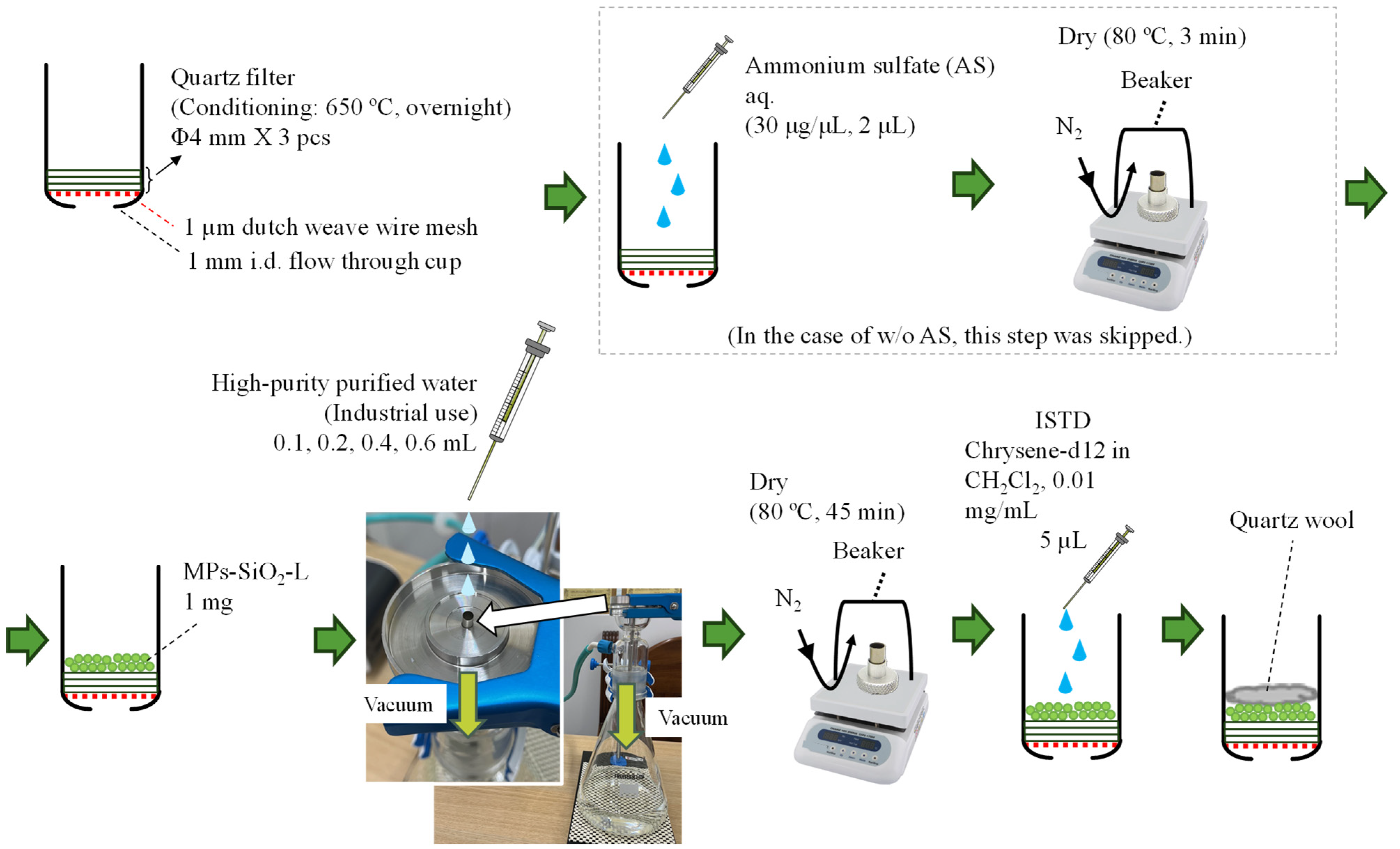
Simulated samplesSamples were prepared to optimize the water rinsing process. The preparation of these simulated samples is shown in Figure 1. A 4 mm punch of 1 µm Dutch weave wire mesh (Frontier Laboratories, Koriyama, Japan) was first inserted at the bottom of an 80 µL flow-through pyrolysis cup (PY1-EC80HF, Frontier Laboratories, Koriyama, Japan). Three 4 mm punches were then cut from a blank quartz filter using a Harris Uni-Core punch (QIAGEN, Venlo, the Netherlands) and placed on top of the wire mesh. Spiking was then performed by adding 2 µL of a 30 g/L AS solution in water and evaporating the solvent by heating at 80 °C under a nitrogen atmosphere. The spiked µg amounts of AS (MAS, Py-GC/MS) for this study were based on the work of Ma and co-workers [52], who found that this salt can exceed 40% by weight (fAS) of the particulate matter captured in urban air PM2.5 filters.
Calculations were performed as follows: the average PM concentration (Cpm2.5) for the PM2.5 filters sampled in this study was 8 µg/m3; 200 m3 of air was sampled (Vair) through a filter area of 1735 mm2 (Afilter); and 3 × 4 mm punches represented 2.2% (Apunches) of the filter area.
Total PM (TPM) = Cpm2.5 × Vair = 8 µg/m3 × 200 m3 = 1600 µg
MAS, filter = TPM × fAS = 1600 µg × 0.40 = 640 µg
Apunches = (3 × (2 mm)2 × π) ÷ (23.5 mm)2 × π = 37.7 mm2 ÷ 1735 mm2 = 0.022
MAS, Py-GC/MS = MAS, filter × (Apunches) = 640 µg × 0.022 = ~14 µg
The World Health Organization has estimated that many low- and middle-income countries have urban PM2.5 averages above 30 µg/m3 [5]. Using these higher PM loading amounts from the WHO suggests >52 µg AS should be added to the pyrolysis vessels to accommodate PM2.5 measurements in areas of higher pollution.
Total PM (TPM) = Cpm2.5 × Vair = 30 µg/m3 × 200 m3 = 6000 µg
MAS, filter = TPM × fAS = 6000 µg × 0.40 = 2400 µg
Apunches = (3 × (2 mm)2 × π) ÷ (23.5 mm)2 × π = 37.7 mm2 ÷ 1735 mm2 = 0.022
MAS, Py-GC/MS = MAS, filter × (Apunches) =2400 µg × 0.022 = ~53 µg
After the AS spiking, 1 mg of MPs-SiO2-L was put into the pyrolysis cups. Water rinsing to remove the AS was then performed by placing the cup on a custom-made steel funnel connected to a vacuum, and known volumes of water were added. After rinsing, the cups were dried again. Finally, 5 μL of a 0.01 mg/mL chrysene-d12 solution in dichloromethane was added as an internal standard, and the solvent was removed by drying at room temperature. Before Py-GC/MS analysis, the cups were plugged with quartz wool to prevent spilling.
Instrumental setupData were generated using a Py-GC/MS system equipped with a Multi-Shot Pyrolyzer (EGA/PY-3030D), an Auto-Shot Sampler (AS-2020E), a MicroJet Cryo-Trap (MJT-2030E), a Multi-Functional Splitless Sampler (MFS-2015E), and a Vent-free GC/MS Adapter (Frontier Laboratories, Koriyama, Japan). The MFS enabled splitless pyrolysis as well as backflushing of higher molecular weight pyrolyzates that were not used for identification or quantitation, thus shortening the GC runtime and facilitating a cleaner GC/MS system. Table 1 shows the Py-GC/MS experimental conditions. The GC was equipped with an SMC (smart precolumn) to improve PE pyrolyzate peak shape, and a UAMP Column Kit specifically designed for microplastics analysis (Frontier Laboratories). The initial oven temperature was 40 °C with a hold time of 2 min, after which the oven was first ramped at 20 °C/min to 280 °C and held for 10 min, before being ramped again at 20 °C to reach a final temperature of 300 °C and held for 5 min. F-Search MPs 2.1 software (Frontier Laboratories) was used for the identification and quantification of microplastics.

3. Results and Discussion

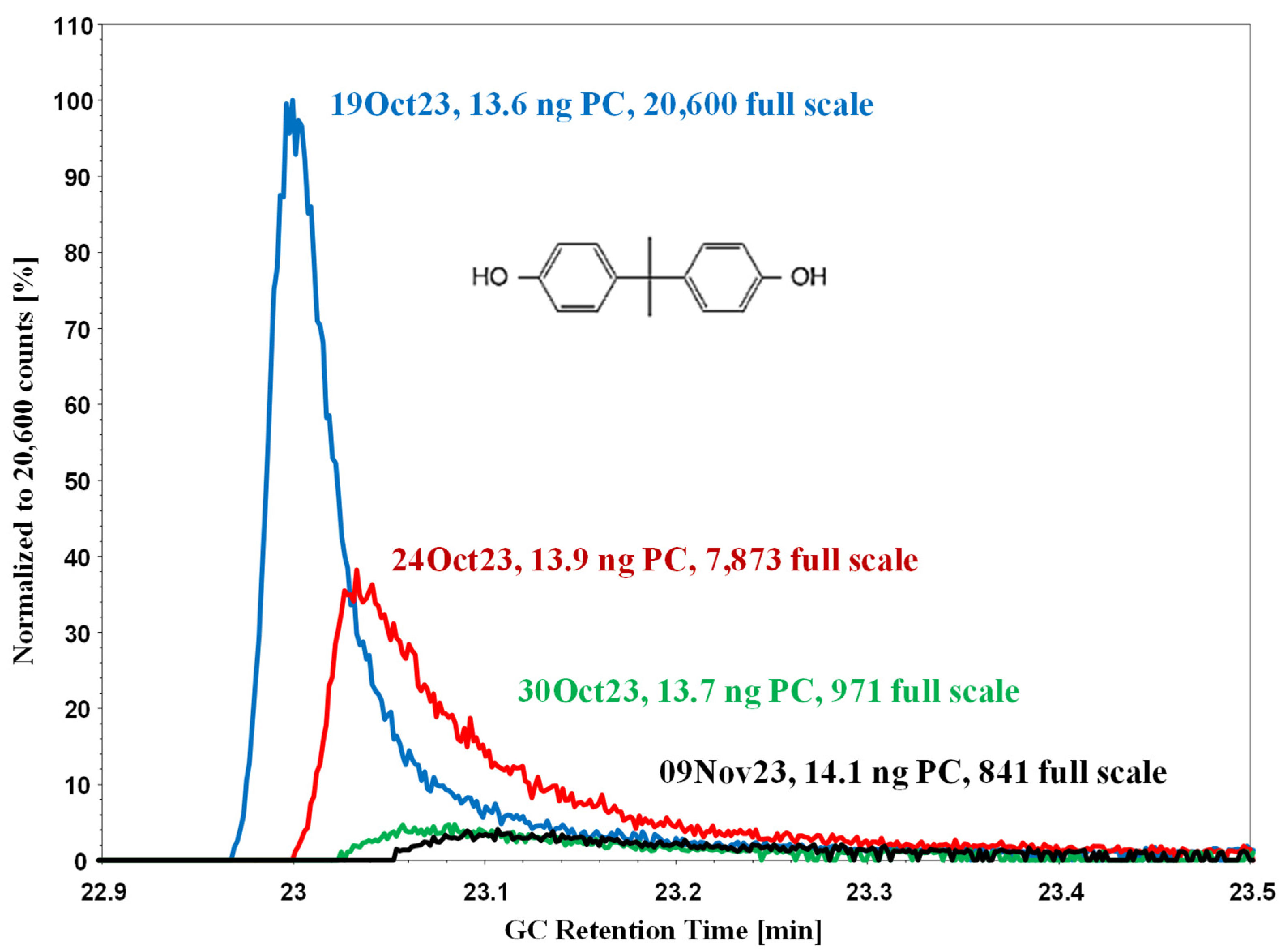
Challenges in airborne microplastics analysisInconsistencies in the responses provided by the control samples of MPs-SiO2-L reference were detected during a continuous 3-week long Py-GC/MS analysis sequence of over 60 real PM2.5 filters. These inconsistencies were ascribed to a significant loss of instrumental sensitivity and to poor analyte transfer from the pyrolysis furnace to the GC/MS system. The compromised performances of the Py-GC/MS can be clearly seen in Figure 2, showing a decrease in the signal of bisphenol A (BPA), the pyrolysis marker for polycarbonate (PC), at four different points during the 3-week long analysis sequence. This decrease in instrumental response was ascribed to the presence of condensed matter evolved from the PM2.5 filters and deposited in the pyrolysis furnace or the injector, as well as partial degradation of the GC stationary phase functional groups. These deposits constituted active sites that could interact with pyrolysis products of polymers and hinder their GC elution and MS detection. This interaction was especially strong for moderately polar pyrolyzates quantitation targets such as BPA, benzoic acid from polyethylene terephthalate (PET), and Ɛ-caprolactam from nylon-6 (N-6). The hypothesis of active site formation was supported by injecting HMDS into the Py-GC/MS system. HMDS derivatized the active sites, making them inert towards eluting pyrolysis products. After HMDS treatment, the BPA’s response was restored to 83% of its original value (ion count 17,000 vs. original 20,600), thus illustrating active sites as the cause of a BPA response loss.
While conditioning of the Py-GC/MS system could be used to restore instrumental sensitivity, it can be time-consuming and requires either the use of reagents such as HMDS or, in the worst cases, turning off the instrument to replace consumable parts. In addition, AS amounts may vary significantly between the PM samples collected in different environments. This could make instrumental contamination unpredictable and indicates the need for constant performance checks, further increasing the time-intensiveness of the workflow. Therefore, although a simple filter-punch-pyrolysis analysis schema would be preferred, the detrimental effects of PM inorganics require the development of an additional sample pretreatment step.
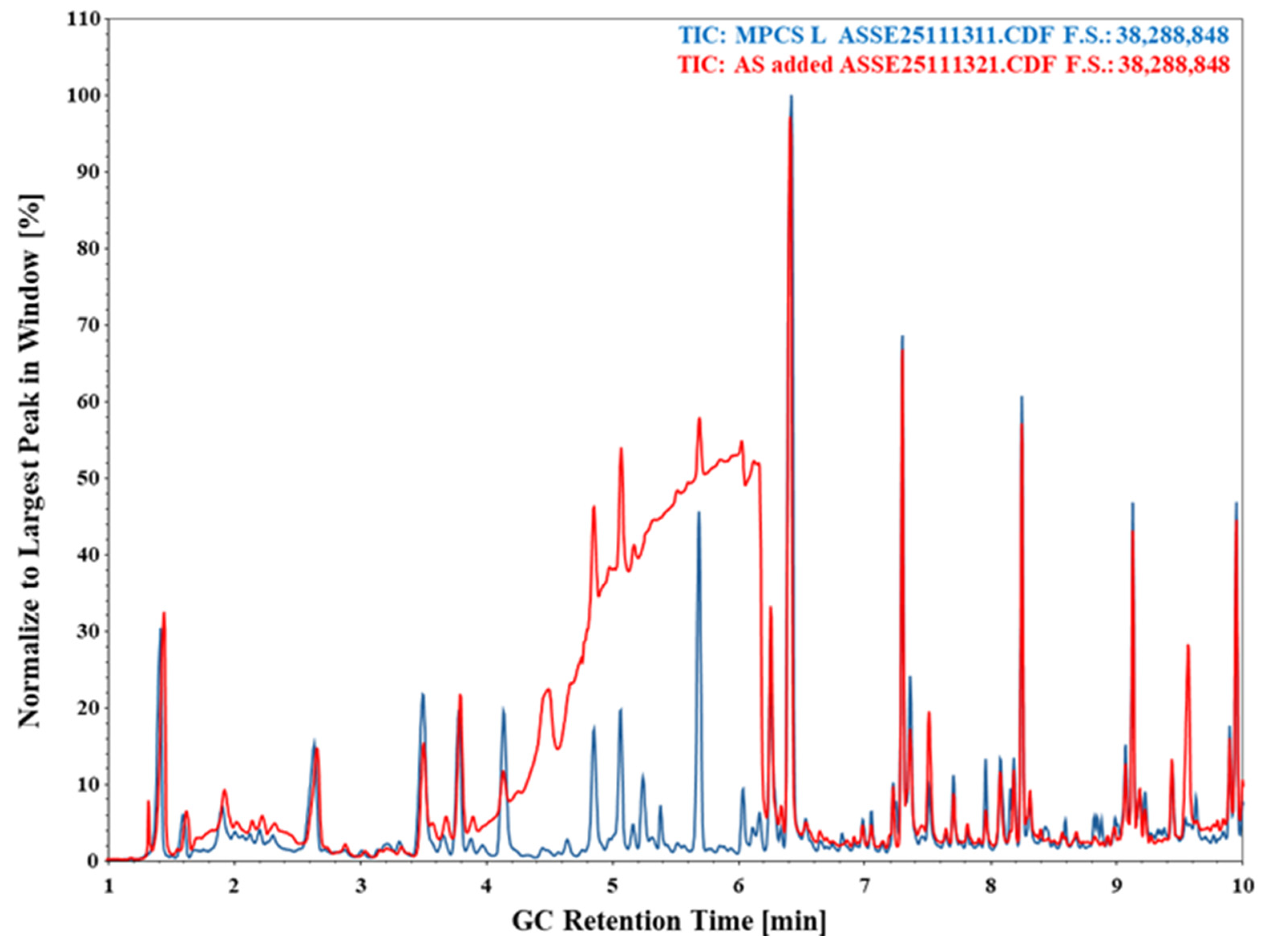
Developing pretreatmentThe first step in developing this pretreatment was pinpointing which species in PM could be the source of instrumental contamination. AS, which displays acid-base properties, is a major component of PM. It was therefore investigated as most likely to be the cause for the loss of instrumental performance. Hodan and Barnard elucidated the creation of AS from SOx and NOx precursors facilitated by ozone [53]. Figure 3 shows the TIC pyrogram of an MPs-SiO2-L reference with AS added and without AS added. It is easy to see the baseline interference of the AS early in the pyrogram.
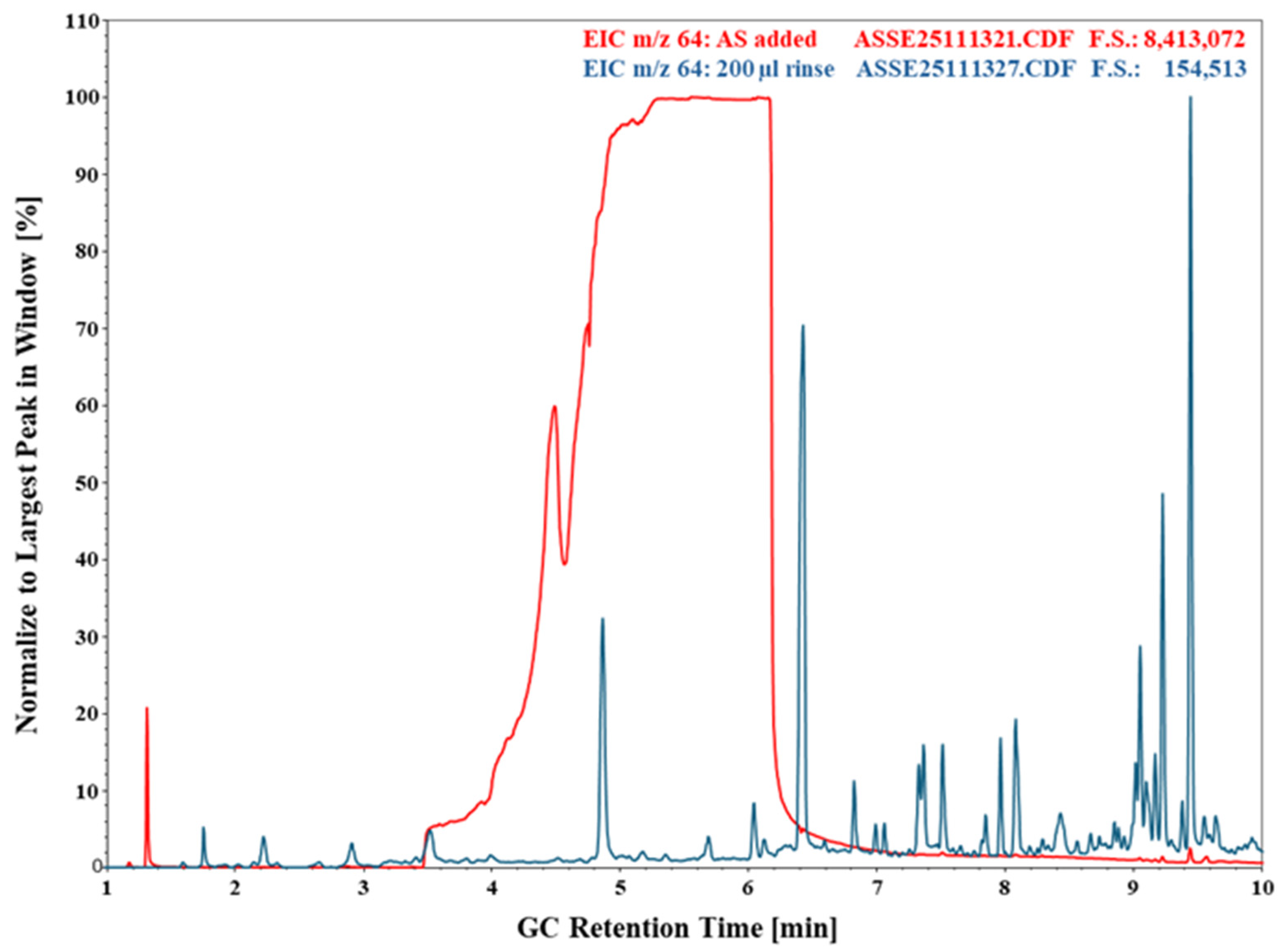
AS and other water-soluble inorganics can be easily removed by rinsing the filter punches with water while in the pyrolysis cup. The first rinsing test was carried out using an AS-spiked MPs-SiO2-L sample with 200 µL of water. This volume was sufficient to return the m/z 64 signal to normal abundance in the pyrogram, as shown in Figure 4. Comparing the total area under the curve for AS before rinsing (red line) and after rinsing (blue line) yielded a 99.9% removal of AS. Note that calculating the % removal of AS with m/z 64 may be underestimated due to the saturation of the detector response.
Validation of water rinsingAfter assessing its efficacy, the water rinsing step was validated for the polymer loss. MPs-SiO2-L samples spiked with AS were prepared, and four rinsing volumes (100–600 μL) were tested. The polymer recoveries after rinsing were assessed by Py-GC/MS, and the results are shown in Table 2. The amount of MPs-SiO2-L added was 1.01 mg (±0.03 mg) for each analysis. Values for each polymer were normalized to their MPs-SiO2-L value of 1 to visualize the effects on the target pyrolyzates more clearly. The addition of AS suppressed the response of the pyrolyzates, with significant suppression of PP, PET, N66, PS, N6, and PMMA. This effect was relevant for polyethylene terephthalate (PET) and nylon-6 (N6), which are susceptible to the presence of inorganic species with acid/base properties such as AS during pyrolysis [45]. Some polyaddition polymers, such as polypropylene (PP), polystyrene (PS), and polymethyl methacrylate (PMMA), were also significantly affected. These results were likely due to a catalytic effect of AS upon pyrolysis, acting on the most reactive sites of these polymers such as the ester bond in PMMA and the tertiary carbon atom in PP. The removal of AS by water rinsing returned most pyrolyzates’ response and reproducibility to nominal values.
To assess the statistical relevance of these findings, a parallel set of experiments was performed where the same amounts of MPs-SiO2-L were rinsed with the same water volumes, but no AS was added. Then, one-way repeated measures ANOVA tests were run individually on both the datasets. The tests were run considering each polymer as a separate subject, and the columns in Table 2 show the levels of treatment. Within-polymer tests in the dataset with AS spiking provided an F-value of 4.75 (p = 0.001) and an η2 value of 0.53. On the contrary, within-polymer tests in the dataset without AS spiking provided F = 0.15 (p = 0.961) and η2 = 0.02. These results indicated that the different levels of water rinsing have a significant effect on polymer recoveries when AS is present, but not when AS is absent.
Two anomalies were observed: N6 increased with increasing rinse volume and PMMA did not return to nominal values with the removal of AS. The experimental results excluded the most intuitive explanations for these trends. The hydrolysis of N6 bonds could lead to leaching of monomers/oligomers during water rinsing, chich would lower their recovery instead of increasing them. The hydrolysis of the methyl carboxylate moieties in PMMA could lead to methacrylic acid being generated upon pyrolysis, but no peak of this compound was detected in the chromatograms. Oligomers of PMMA could be present in the MPs-SiO2-L which was then lost during rinsing. However, such a loss was not observed when the samples were rinsed in the absence of AS. Further study into this result is merited.

4. Conclusions

We showed that ammonium sulfate, a major inorganic component of PM2.5, can provide significant signal loss when analyzing airborne micro- and nanoplastics by analytical pyrolysis–gas chromatography-mass spectrometry. Water rinsing of the samples in dedicated pyrolysis crucibles can prevent this signal loss, with satisfactory recoveries for most of the polymers that are commonly found in airborne particulate samples.
This study shows that identifying specific, problematic matrix components and removing them by developing targeted pretreatment strategies is a more promising approach in microplastic analysis by analytical pyrolysis, as compared with untargeted, multi-step pretreatment processes, these might lead to polymer loss or sample contamination.
Future studies should be aimed at improving our knowledge on the nature of the interactions between ammonium sulfate and single polymers, and how these interactions depend on the relative amounts of the two. Exploring other potential components of the particulate matter that could constitute a source of matrix interference, as well as their removal through water rinsing, are also critical aspects that should be further investigated.

Author Contributions

M.M.: Conceptualization, project administration, supervision, writing—original draft, and writing—review and editing. W.P.: Conceptualization, data curation, formal analysis, investigation, validation, visualization, writing—original draft, and writing—review and editing. A.S.: Data curation, investigation, validation, and writing—original draft. M.N.: Data curation, formal analysis, investigation, supervision, writing—original draft, and writing—review and editing. A.W.: Project administration, resources, and supervision. All authors have read and agreed to the published version of the manuscript.

Funding

This research received no external funding.

Institutional Review Board Statement

Not applicable.

Informed Consent Statement

Not applicable.

Data Availability Statement

The original contributions presented in this study are included in the article. Further inquiries can be directed to the corresponding author.

Acknowledgments

The authors would like to acknowledge Kimoto Electrick, Osaka, Japan for their tireless efforts in collecting particulate matter samples for these experiments and Frontier Laboratories, Koriyama, Japan for the use of their laboratories to carry out the experiments and sample analysis. The Frontier Laboratories Research Fund 2025 (recipient: Marco Mattonai) is also acknowledged for financial support.

Conflicts of Interest

Author William Pipkin was employed by the company ATRq. Authors Ai Shiono, Makoto Niwa and Atsushi Watanabe were employed by the company Frontier Laboratories Ltd. The remaining authors declare that the research was conducted in the absence of any commercial or financial relationships that could be construed as a potential conflict of interest.

Abbreviations

The following abbreviations are used in this manuscript:
AMNPAirborne Micro- and Nanoplastics
PMParticulate Matter
Py-GC/MSPyrolysis–gas chromatography-mass spectrometry
WHOWorld Health Organization
US-EPAUnited States Environmental Protection Agency
CFRCode of Federal Regulations
MCIMulti-stage Cascade Impact Sampler
VDIVirtual Dichotomous Impact Sampler
PTFEPolytetrafluoroethylene
MPs-SiO2-LMicroplastics Calibration Standard with Silica Diluent, Low Concentration
ASAmmonium Sulfate
SMCSmart Precolumn
UAMPUltra-Alloy Microplastics Capillary Column
HMDSHexamethyldisilazane
TICTotal Ion Chromatogram
EICExtracted Ion Chromatogram
PEPolyethylene
PPPolypropylene
PSPolystyrene
ABSAcrylonitrile–Butadiene–Styrene Copolymer
SBRStyrene–Butadiene Rubber
PMMAPolymethyl Methacrylate
PCPolycarbonate
PVCPolyvinyl Chloride
PETPolyethylene Terephthalate
N-6Nylon–6 (polycaprolactam)
N-66Nylon–6,6 (poly(hexamethylene adipamide))

References

  1. Hippocrates. On Air, Water, and Places. Open Access 400BC. Available online: https://archive.org/details/b23983139 (accessed on 25 November 2025).
  2. Seneca. Moral Letters to Lucilius-Letter 104. On Care of Health and Peace of Mind Seneca Exported from Wikisource on November 12, 2025; Mott Gummere, R., Translator; Nomentum: Mentana, Italy, 64AD; Available online: https://en.wikisource.org/wiki/Moral_letters_to_Lucilius/Letter_104 (accessed on 11 November 2025).
  3. Kuo, S. Mengxi Bi Tan (Dream Pool Essays), 1088; Gutenberg.org; Paths International: Reading, UK, 2011. [Google Scholar]
  4. Evelyn, J. Fumifugium or the Inconvience of the Aer and Smoak of London, 1661; The Rota at the University of Exeter: Exeter, UK, 1967. [Google Scholar]
  5. WHO. WHO Ambient Air Quality Database. Available online: https://www.who.int/data/gho/data/themes/air-pollution/who-air-quality-database (accessed on 11 November 2025).
  6. AQI. Air Quality Report 2024. 2025. Available online: https://www.aqi.in/assets/files/world-air-quality-report-2024-by-aqi.in.pdf (accessed on 24 November 2025).
  7. Fowler, D.; Brimblecombe, P.; Burrows, J.; Heal, M.R.; Grennfelt, P.; Stevenson, D.S.; Jowett, A.; Nemitz, E.; Coyle, M.; Liu, X.; et al. A Chronology of Global Air Quality. Philos. Trans. R. Soc. A Math. Phys. Eng. Sci. 2020, 378, 20190314. [Google Scholar] [CrossRef]
  8. Vianello, A.; Jensen, R.L.; Liu, L.; Vollertsen, J. Simulating Human Exposure to Indoor Airborne Microplastics Using a Breathing Thermal Manikin. Sci. Rep. 2019, 9, 8670. [Google Scholar] [CrossRef]
  9. Yang, S.; Brasseur, G.; Walters, S.; Lichtig, P.; Li, C.W.Y. Global Atmospheric Distribution of Microplastics with Evidence of Low Oceanic Emissions. NPJ Clim. Atmos. Sci. 2025, 8, 81. [Google Scholar] [CrossRef]
  10. Rindelaub, J.D.; Salmond, J.A.; Fan, W.; Miskelly, G.M.; Dirks, K.N.; Henning, S.; Conrath, T.; Stratmann, F.; Coulson, G. Aerosol Mass Concentrations and Dry/Wet Deposition of Atmospheric Microplastics at a Remote Coastal Location in New Zealand. Environ. Pollut. 2025, 372, 126034. [Google Scholar] [CrossRef] [PubMed]
  11. Zhang, Y.; Kang, S.; Allen, S.; Allen, D.; Gao, T.; Sillanpää, M. Atmospheric Microplastics: A Review on Current Status and Perspectives. Earth Sci. Rev. 2020, 203, 103118. [Google Scholar] [CrossRef]
  12. Dris, R.; Gasperi, J.; Mirande, C.; Mandin, C.; Guerrouache, M.; Langlois, V.; Tassin, B. A First Overview of Textile Fibers, Including Microplastics, in Indoor and Outdoor Environments. Environ. Pollut. 2017, 221, 453–458. [Google Scholar] [CrossRef]
  13. Baensch-Baltruschat, B.; Kocher, B.; Kochleus, C.; Stock, F.; Reifferscheid, G. Tyre and Road Wear Particles—A Calculation of Generation, Transport and Release to Water and Soil with Special Regard to German Roads. Sci. Total Environ. 2021, 752, 141939. [Google Scholar] [CrossRef] [PubMed]
  14. Abbasi, S.; Keshavarzi, B.; Moore, F.; Turner, A.; Kelly, F.J.; Dominguez, A.O.; Jaafarzadeh, N. Distribution and Potential Health Impacts of Microplastics and Microrubbers in Air and Street Dusts from Asaluyeh County, Iran. Environ. Pollut. 2019, 244, 153–164. [Google Scholar] [CrossRef]
  15. Amato-Lourenço, L.F.; dos Santos Galvão, L.; de Weger, L.A.; Hiemstra, P.S.; Vijver, M.G.; Mauad, T. An Emerging Class of Air Pollutants: Potential Effects of Microplastics to Respiratory Human Health? Sci. Total Environ. 2020, 749, 141676. [Google Scholar] [CrossRef]
  16. Blackburn, K.; Green, D. The Potential Effects of Microplastics on Human Health: What Is Known and What Is Unknown. Ambio 2022, 51, 518–530. [Google Scholar] [CrossRef]
  17. Chartres, N.; Cooper, C.B.; Bland, G.; Pelch, K.E.; Gandhi, S.A.; BakenRa, A.; Woodruff, T.J. Effects of Microplastic Exposure on Human Digestive, Reproductive, and Respiratory Health: A Rapid Systematic Review. Environ. Sci. Technol. 2024, 58, 22843–22864. [Google Scholar] [CrossRef]
  18. Ebrahimi, P.; Abbasi, S.; Pashaei, R.; Bogusz, A.; Oleszczuk, P. Investigating Impact of Physicochemical Properties of Microplastics on Human Health: A Short Bibliometric Analysis and Review. Chemosphere 2022, 289, 133146. [Google Scholar] [CrossRef] [PubMed]
  19. Sun, A.; Wang, W.-X. Human Exposure to Microplastics and Its Associated Health Risks. Environ. Health 2023, 1, 139–149. [Google Scholar] [CrossRef]
  20. Lamoree, M.H.; van Boxel, J.; Nardella, F.; Houthuijs, K.J.; Brandsma, S.H.; Béen, F.; van Duursen, M.B.M. Health Impacts of Microplastic and Nanoplastic Exposure. Nat. Med. 2025, 31, 2873–2887. [Google Scholar] [CrossRef] [PubMed]
  21. Yee, M.S.-L.; Hii, L.-W.; Looi, C.K.; Lim, W.-M.; Wong, S.-F.; Kok, Y.-Y.; Tan, B.-K.; Wong, C.-Y.; Leong, C.-O. Impact of Microplastics and Nanoplastics on Human Health. Nanomaterials 2021, 11, 496. [Google Scholar] [CrossRef] [PubMed]
  22. Abad López, A.P.; Trilleras, J.; Arana, V.A.; Garcia-Alzate, L.S.; Grande-Tovar, C.D. Atmospheric Microplastics: Exposure, Toxicity, and Detrimental Health Effects. RSC Adv. 2023, 13, 7468–7489. [Google Scholar] [CrossRef]
  23. Ahmad, M.; Chen, J.; Khan, M.T.; Yu, Q.; Phairuang, W.; Furuuchi, M.; Ali, S.W.; Nawab, A.; Panyametheekul, S. Sources, Analysis, and Health Implications of Atmospheric Microplastics. Emerg. Contam. 2023, 9, 100233. [Google Scholar] [CrossRef]
  24. Yao, X.; Luo, X.-S.; Fan, J.; Zhang, T.; Li, H.; Wei, Y. Ecological and Human Health Risks of Atmospheric Microplastics (MPs): A Review. Environ. Sci. Atmos. 2022, 2, 921–942. [Google Scholar] [CrossRef]
  25. Dewika, M.; Markandan, K.; Irfan, N.A.; Mohd Abdah, M.A.A.; Ruwaida, J.N.; Sara, Y.Y.; Khalid, M. Review of Microplastics in the Indoor Environment: Distribution, Human Exposure and Potential Health Impacts. Chemosphere 2023, 324, 138270. [Google Scholar] [CrossRef]
  26. Kung, H.-C.; Wu, C.-H.; Cheruiyot, N.K.; Mutuku, J.K.; Huang, B.-W.; Chang-Chien, G.-P. The Current Status of Atmospheric Micro/Nanoplastics Research: Characterization, Analytical Methods, Fate, and Human Health Risk. Aerosol Air Qual. Res. 2023, 23, 220362. [Google Scholar] [CrossRef]
  27. Zhang, Y.; Song, Y.; Chen, Y.-J.; Chen, Y.; Lu, Y.; Li, R.; Dong, C.; Hu, D.; Cai, Z. Discovery of Emerging Sulfur-Containing PAHs in PM2.5: Contamination Profiles and Potential Health Risks. J. Hazard. Mater. 2021, 416, 125795. [Google Scholar] [CrossRef] [PubMed]
  28. Facciolà, A.; Visalli, G.; Pruiti Ciarello, M.; Di Pietro, A. Newly Emerging Airborne Pollutants: Current Knowledge of Health Impact of Micro and Nanoplastics. Int. J. Environ. Res. Public Health 2021, 18, 2997. [Google Scholar] [CrossRef]
  29. Sheng, X.; Lai, Y.; Yu, S.; Li, Q.; Zhou, Q.; Liu, J. Quantitation of Atmospheric Suspended Polystyrene Nanoplastics by Active Sampling Prior to Pyrolysis–Gas Chromatography–Mass Spectrometry. Environ. Sci. Technol. 2023, 57, 10754–10762. [Google Scholar] [CrossRef] [PubMed]
  30. Jarosz, K.; Janus, R.; Wądrzyk, M.; Wilczyńska-Michalik, W.; Natkański, P.; Michalik, M. Airborne Microplastic in the Atmospheric Deposition and How to Identify and Quantify the Threat: Semi-Quantitative Approach Based on Kraków Case Study. Int. J. Environ. Res. Public Health 2022, 19, 12252. [Google Scholar] [CrossRef] [PubMed]
  31. Morioka, T.; Tanaka, S.; Kohama-Inoue, A.; Watanabe, A. The Quantification of the Airborne Plastic Particles of 0.43–11 Μm: Procedure Development and Application to Atmospheric Environment. Chemosphere 2024, 351, 141131. [Google Scholar] [CrossRef]
  32. Fan, W.; Salmond, J.A.; Dirks, K.N.; Cabedo Sanz, P.; Miskelly, G.M.; Rindelaub, J.D. Evidence and Mass Quantification of Atmospheric Microplastics in a Coastal New Zealand City. Environ. Sci. Technol. 2022, 56, 17556–17568. [Google Scholar] [CrossRef]
  33. Torres-Agullo, A.; Zuri, G.; Lacorte, S. Pyr-GC-Orbitrap-MS Method for the Target/Untargeted Analysis of Microplastics in Air. J. Hazard. Mater. 2024, 469, 133981. [Google Scholar] [CrossRef]
  34. Hernández-Fernández, J.; Puello-Polo, E.; Castro-Suarez, J.R. Characterization of the Morphological and Chemical Profile of Different Families of Microplastics in Samples of Breathable Air. Molecules 2023, 28, 1042. [Google Scholar] [CrossRef]
  35. O’Brien, S.; Rauert, C.; Ribeiro, F.; Okoffo, E.D.; Burrows, S.D.; O’Brien, J.W.; Wang, X.; Wright, S.L.; Thomas, K.V. There’s Something in the Air: A Review of Sources, Prevalence and Behaviour of Microplastics in the Atmosphere. Sci. Total Environ. 2023, 874, 162193. [Google Scholar] [CrossRef]
  36. O’Brien, S.; Okoffo, E.D.; O’Brien, J.W.; Ribeiro, F.; Wang, X.; Wright, S.L.; Samanipour, S.; Rauert, C.; Toapanta, T.Y.A.; Albarracin, R.; et al. Airborne Emissions of Microplastic Fibres from Domestic Laundry Dryers. Sci. Total Environ. 2020, 747, 141175. [Google Scholar] [CrossRef]
  37. Mizuguchi, H.; Takeda, H.; Kinoshita, K.; Takeuchi, M.; Takayanagi, T.; Teramae, N.; Pipkin, W.; Matsui, K.; Watanabe, A.; Watanabe, C. Direct Analysis of Airborne Microplastics Collected on Quartz Filters by Pyrolysis-Gas Chromatography/Mass Spectrometry. J. Anal. Appl. Pyrolysis 2023, 171, 105946. [Google Scholar] [CrossRef]
  38. Kaushik, A.; Peter, A.E.; van Pinxteren, M.; Scholz-Böttcher, B.; Herrmann, H. Composition, interactions and resulting inhalation risk of micro- and nano-plastics in urban air. Commun. Earth Environ. 2025, 6, 985. [Google Scholar] [CrossRef]
  39. Ma, J.; Zhao, S.; He, K.; Tian, L.; Zhong, G.; Jones, K.C.; Sweetman, A.J.; Li, J.; Zhou, Q.; Chen, D.; et al. Quantification of Micro- and Nano-Plastics in Atmospheric Fine Particles by Pyrolysis-Gas Chromatography-Mass Spectrometry with Chromatographic Peak Reconstruction. J. Hazard. Mater. 2025, 488, 137292. [Google Scholar] [CrossRef]
  40. United States Code of Federal Regulations. CFR, Title 40, Chapter I, Subchapter C: Air Programs. National Archives and Records Administration. Available online: https://www.ecfr.gov/current/title-40/chapter-I/subchapter-C (accessed on 25 July 2024).
  41. US EPA. Title 40-Protection of Environment Chapter I-Environmental Protection Agency Subchapter C-Air Programs Part 50-National Primary and Secondary Ambient Air Quality Standards Appendix L to Part 50-Reference Method for the Determination of Fine Particulate Matter as PM 2.5 in the Atmosphere. 2024. Available online: https://www.ecfr.gov/current/title-40/chapter-I/subchapter-C/part-50/appendix-Appendix%20L%20to%20Part%2050 (accessed on 25 July 2024).
  42. Pipkin, W.; Sato, M.; Kumagai, S.; Watanabe, C.; Watanabe, A.; Teramae, N.; Yoshioka, T. Into the Nanograms—Sensitive Detection of Microplastics in Passively Sampled Indoor Air Using F-Splitless Pyrolysis Gas Chromatography Mass Spectrometry. ACS ES&T Air 2024, 1, 234–246. [Google Scholar] [CrossRef]
  43. Tei, K.; Matsueda, M.; Matsui, K.; Ishimura, T.; Watanabe, A.; Pipkin, W.; Teramae, N.; Ohtani, H.; Watanabe, C. Highly Sensitive Detection of Polystyrene by On-Line Splitless Pyrolysis-Gas Chromatography/Mass Spectrometry with Cryo-Trapping of Pyrolyzates and Forced Venting of Carrier Gas. J. Anal. Appl. Pyrolysis 2022, 168, 105707. [Google Scholar] [CrossRef]
  44. Lykkemark, J.; Mattonai, M.; Vianello, A.; Gomiero, A.; Modugno, F.; Vollertsen, J. Py–GC–MS analysis for microplastics: Unlocking matrix challenges and sample recovery when analyzing wastewater for polypropylene and polystyrene. Water Res. 2024, 261, 122055. [Google Scholar] [CrossRef]
  45. Ishimura, T.; Iwai, I.; Matsui, K.; Mattonai, M.; Watanabe, A.; Robberson, W.; Cook, A.-M.; Allen, H.L.; Pipkin, W.; Teramae, N.; et al. Qualitative and quantitative analysis of mixtures of microplastics in the presence of calcium carbonate by pyrolysis-GC/MS. J. Anal. Appl. Pyrolysis 2021, 157, 105188. [Google Scholar] [CrossRef]
  46. Lauschke, T.; Dierkes, G.; Schweyen, P.; Ternes, T.A. Evaluation of poly(styrene-d5) and poly(4-fluorostyrene) as internal standards for microplastics quantification by thermoanalytical methods. J. Anal. Appl. Pyrolysis 2021, 159, 105310. [Google Scholar] [CrossRef]
  47. Matsueda, M.; Mattonai, M.; Iwai, I.; Watanabe, A.; Teramae, N.; Robberson, W.; Ohtani, H.; Kim, Y.-M.; Watanabe, C. Preparation and Test of a Reference Mixture of Eleven Polymers with Deactivated Inorganic Diluent for Microplastics Analysis by Pyrolysis-GC-MS. J. Anal. Appl. Pyrolysis 2021, 154, 104993. [Google Scholar] [CrossRef]
  48. Nespor, B.; Cochran, R.; Jeong, H.; Bowman, F.; Delene, D.; Kozliak, E.; Kubátová, A. Occurrence of Both Nonvolatile and Semivolatile Carbonaceous Air Particulate Markers Using Thermal Desorption-Pyrolysis-Gas Chromatography-Mass Spectrometry. Atmos. Environ. 2021, 246, 118058. [Google Scholar] [CrossRef]
  49. Chandrakanthan, K.; Fraser, M.P.; Herckes, P. Airborne Microplastics in a Suburban Location in the Desert Southwest: Occurrence and Identification Challenges. Atmos. Environ. 2023, 298, 119617. [Google Scholar] [CrossRef]
  50. Environmental Protection Agency (EPA). Pt. 50, App. L. Available online: https://www.govinfo.gov/content/pkg/CFR-2022-title40-vol2/pdf/CFR-2022-title40-vol2-part50-appL.pdf (accessed on 30 November 2023).
  51. Sullivan, G.L.; Gallardo, J.D.; Jones, E.W.; Hollliman, P.J.; Watson, T.M.; Sarp, S. Detection of Trace Sub-Micron (Nano) Plastics in Water Samples Using Pyrolysis-Gas Chromatography Time of Flight Mass Spectrometry (PY-GCToF). Chemosphere 2020, 249, 126179. [Google Scholar] [CrossRef] [PubMed]
  52. Ma, C.J.; Kang, G.U.; Kim, K.H. High Time-Resolution Characterization of PM2.5 Sulfate Measured in a Japanese Urban Site. Asian J. Atmos. Environ. 2015, 9, 280–287. [Google Scholar] [CrossRef]
  53. Hodan, W.M.; Barnard, W.R. Evaluating the Contribution of PM2.5 Precursor Gases and Re-Entrained Road Emissions to Mobile Source PM2.5 Particulate Matter Emissions. 2004. Available online: https://api.semanticscholar.org/CorpusID:28139041 (accessed on 2 December 2025).
Figure 1. Sample handling steps to test removal of ammonium sulfate and recovery of MPs-SiO2-L.
Atmosphere 17 00247 g001
Figure 2. Bisphenol A Py-GC/MS response decay over the analysis of 66 PM2.5 filters, as measured by ~300 µg MPs-SiO2-L interspersed throughout the sequence. Full-scale ion abundance is 20,600 counts.
Atmosphere 17 00247 g002
Figure 3. TIC MPs-SiO2-L pyrograms with AS (red) and without (blue).
Atmosphere 17 00247 g003
Figure 4. EIC m/z 64 from MPs-SiO2-L with ammonium sulfate added (red) and after 200 µL water rinse (blue).
Atmosphere 17 00247 g004
Table 1. Py-GC/MS conditions.
Furnace temperature600 °C
Pyrolyzer interface temperature300 °C
Pyrolysis modeF-Splitless
Pyrolysis time0.5 min
Backflush start time10 min
GC injector temperature300 °C
Carrier gasHe, constant pressure, 150 kPa
Smart precolumn UASMC-M20, 2 m × 0.25 mm, deactivated
PrecolumnUA+-50, 1 m × 0.25 mm, film thickness 1.0 µm
ColumnUA+-5, 30 m × 0.25 mm, film thickness 0.5 µm
GC/MS transfer line temperature300 °C
MS scan range and ratem/z 29–350, 4 scans/s
Table 2. Effect of AS addition and removal on target microplastic pyrolyzates. Values are averaged over two replicates and normalized to 1.
MPs-SiO2-L60 µg AS Added100 µL Rinse200 µL Rinse400 µL Rinse600 µL Rinse
PE10.901.001.011.051.03
PP10.520.950.981.010.97
SBR10.910.850.740.710.87
PVC10.991.080.990.961.03
ABS10.870.950.991.030.98
PET10.580.910.960.980.95
N6610.600.911.111.101.02
PS10.620.831.021.021.01
N610.750.981.201.211.16
PMMA10.210.640.670.750.70
Disclaimer/Publisher’s Note: The statements, opinions and data contained in all publications are solely those of the individual author(s) and contributor(s) and not of MDPI and/or the editor(s). MDPI and/or the editor(s) disclaim responsibility for any injury to people or property resulting from any ideas, methods, instructions or products referred to in the content.