
Article

PM2.5 and Lung Cancer: An Ecological Study (2014–2023) Using Data from Brazilian Capitals
by
Albery Batista de Almeida Neto
1,
Fernando Rafael de Moura
2,*,
Alicia da Silva Bonifácio
2,
Vitória Machado da Silva
2,
Rodrigo de Lima Brum
2,
Ronan Adler Tavella
3,
Ronabson Cardoso Fernandes
2,
Glauber Lopes Mariano
1 and
Flavio Manoel Rodrigues da Silva Júnior
1,2
1
Institute of Biological and Health Sciences, Federal University of Alagoas—UFAL, Maceió 57072-970, AL, Brazil
2
Faculty of Medicine, Federal University of Rio Grande—FURG, Rio Grande 96203-900, RS, Brazil
3
Institute of Environmental, Chemical and Pharmaceutical Sciences, Federal University of São Paulo—UNIFESP, Diadema 09913-030, SP, Brazil
*
Author to whom correspondence should be addressed.
Atmosphere 2026, 17(2), 175; https://doi.org/10.3390/atmos17020175
Submission received: 31 December 2025 / Revised: 3 February 2026 / Accepted: 6 February 2026 / Published: 8 February 2026
(This article belongs to the Section Air Quality and Health)

Abstract

Air pollution remains a major global public health concern, with fine particulate matter (PM2.5) recognized as an important environmental risk factor for lung cancer. This ecological study assessed lung cancer mortality attributable to long-term PM2.5 exposure in the 26 Brazilian state capitals and the Federal District (Brasília) from 2014 to 2023. Annual mean PM2.5 concentrations were estimated using reanalysis-based PM2.5 concentration estimates and atmospheric reanalysis data, ensuring consistent spatial and temporal coverage. Mortality data were obtained from the Brazilian Mortality Information System (SIM/DATASUS). Health impacts attributable to PM2.5 exposure were estimated using the World Health Organization’s AirQ+ model, based on exposure–response functions from the Global Burden of Disease framework. During the study period, 97.41% of annual PM2.5 means exceeded the WHO Air Quality Guideline of 5 µg/m3, and 28.52% surpassed the current Brazilian regulatory limit. Higher concentrations were observed mainly in capitals from the North and Southeast regions, reflecting the influence of biomass burning, urbanization, and regional atmospheric processes. Approximately 13.56% of lung cancer deaths in Brazilian capitals were attributable to PM2.5 exposure, with the highest absolute numbers concentrated in the Southeast region. These findings demonstrate a substantial and spatially heterogeneous lung cancer burden associated with urban air pollution in Brazil and highlight the need for strengthened air quality management and targeted urban public health policies.

1. Introduction

Lung cancer remains one of the most lethal malignancies worldwide, and its persistence as a major public health threat can no longer be explained solely by tobacco exposure. While approximately 87% of cases are still attributable to smoking [1], high-quality epidemiological and burden-of-disease studies now demonstrate that ambient fine particulate matter (PM2.5) is a significant contributor to both incidence and mortality [2]. A recent spatiotemporal assessment estimated that PM2.5 exposure accounted for roughly 374,000 lung cancer deaths globally in 2021, with the steepest increases occurring in low- and middle-SDI (socio-demographic index) countries [3]. Complementary analyses of Global Burden of Disease (GBD) data show that, although household air pollution has declined, mortality linked to ambient PM2.5 continues to rise and is projected to grow further through 2045 if current trends persist [4].
These global patterns increasingly manifest in Latin America, where declining smoking prevalence has not translated into proportional reductions in lung cancer—especially among never-smokers. Evidence suggests that environmental exposures such as biomass burning, traffic-related emissions, tuberculosis incidence, occupational carcinogens, and particulate pollution contribute to a growing share of cases unrelated to tobacco use [5]. This shift underscores the need to integrate environmental determinants into regional cancer-prevention strategies.
Brazil exemplifies this changing epidemiologic landscape. National studies indicate that ambient air pollution is now a leading contributor to noncommunicable disease mortality and plays a measurable role in cancer outcomes. Short-term increases in PM2.5 have been associated with higher cancer mortality, including lung cancer [6], while long-term exposure reduces life expectancy and could yield substantial gains in life years if concentrations were minimized [7]. Environmental inequalities further amplify these risks: populations living near major roadways, industrial districts, or fire-prone regions face disproportionately high exposures, and emerging evidence suggests that air pollution contributes to cancer mortality independent of classical risk factors [8].
At the subnational level, Brazil’s 26 state capitals and the national capital offer suitable conditions for rigorous, long-term assessments. These metropolitan areas combine higher population density, major emission sources, and comparatively stronger environmental and health surveillance systems. Recent national-scale advances, notably the BRAIN database [9], have mapped PM2.5 hotspots and temporal trends with unprecedented spatial resolution, enabling reconstruction of historical exposure trajectories using satellite products, chemical transport models, and ground-based monitoring. This analytical infrastructure allows for the integration of long-term exposure estimates with cancer incidence and mortality registries to evaluate the contribution of ambient PM2.5 to lung cancer in urban settings.
Mechanistic research further strengthens the rationale for such analyses. Long-term PM2.5 exposure promotes oxidative stress, chronic inflammation, impaired DNA repair, and oncogenic signaling, including EGFR-mediated tumorigenesis among never-smokers [10,11]. Yet Brazil’s regulatory framework remains misaligned with WHO recommendations [12], and enforcement varies widely across municipalities, resulting in persistent spatial disparities in exposure and monitoring [13,14]. This combination of heterogeneous emissions—from vehicular fleets to industrial hubs and recurrent burning—and uneven regulatory capacity creates a quasi-natural experiment ideal for investigating how long-term exposure patterns shape lung cancer outcomes across diverse urban contexts.
Within this framework, the present study aims to quantify the long-term contribution of ambient PM2.5 to lung cancer mortality across Brazilian capitals by reconstructing historical exposure series over a 10-year period and evaluating spatial and temporal heterogeneity in risk. This approach is designed to generate policy-relevant evidence capable of informing air quality regulation, urban planning, and targeted cancer-prevention strategies in Brazil.

2. Materials and Methods

2.1. Study Area

This study includes the 26 state capitals of Brazil and the Federal District (Brasília), covering all 27 federative units and spanning the country’s five macro-regions: North (Rio Branco, Manaus, Macapá, Belém, Porto Velho, Boa Vista, and Palmas), Northeast (Maceió, Salvador, Fortaleza, São Luís, João Pessoa, Recife, Teresina, Natal, and Aracaju), Midwest (Goiânia, Cuiabá, Campo Grande, and Brasília), Southeast (Vitória, Belo Horizonte, Rio de Janeiro, and São Paulo), and South (Curitiba, Porto Alegre, and Florianópolis).
Brazil exhibits marked regional heterogeneity in population density, urbanization, industrial activity, and air pollution profiles across these regions. The Southeast region has the largest share of the urban population and industrial output, accounting for approximately 43% of the population of the capitals in this study, with São Paulo and Rio de Janeiro as the most populous cities. This region also has the highest average levels of ambient air pollution, hospitalizations and cardiovascular diseases [15].
In contrast, the North region, despite having a substantially smaller urban population, shows air pollution levels comparable to those in the Southeast. This pattern is largely driven by biomass burning, deforestation, and land-use change, which increase particulate matter concentrations even in less densely populated urban centers [16]. Capitals such as Manaus, Belém, Porto Velho, and Rio Branco exemplify this exposure profile.
The Northeast region, the second most populous macro-region, has the lowest average air pollution levels among Brazilian capitals. This pattern is influenced by lower industrial density and favorable meteorological conditions, particularly the action of trade winds that enhance pollutant dispersion [9]. The Midwest region includes rapidly growing urban centers affected by agricultural expansion and seasonal biomass burning [17]. Brasília, the national capital in the Federal District, has the largest population in the region, while other capitals, such as Cuiabá and Goiânia, also reflect the combined effects of urban growth and environmental pressures.
Finally, the South region, although it represents a smaller share of the total urban population, is home to the country’s second-largest industrial hub [18]. Capitals such as Porto Alegre and Curitiba suffer from the impact of industrial activity and urban atmospheric conditions on health outcomes.
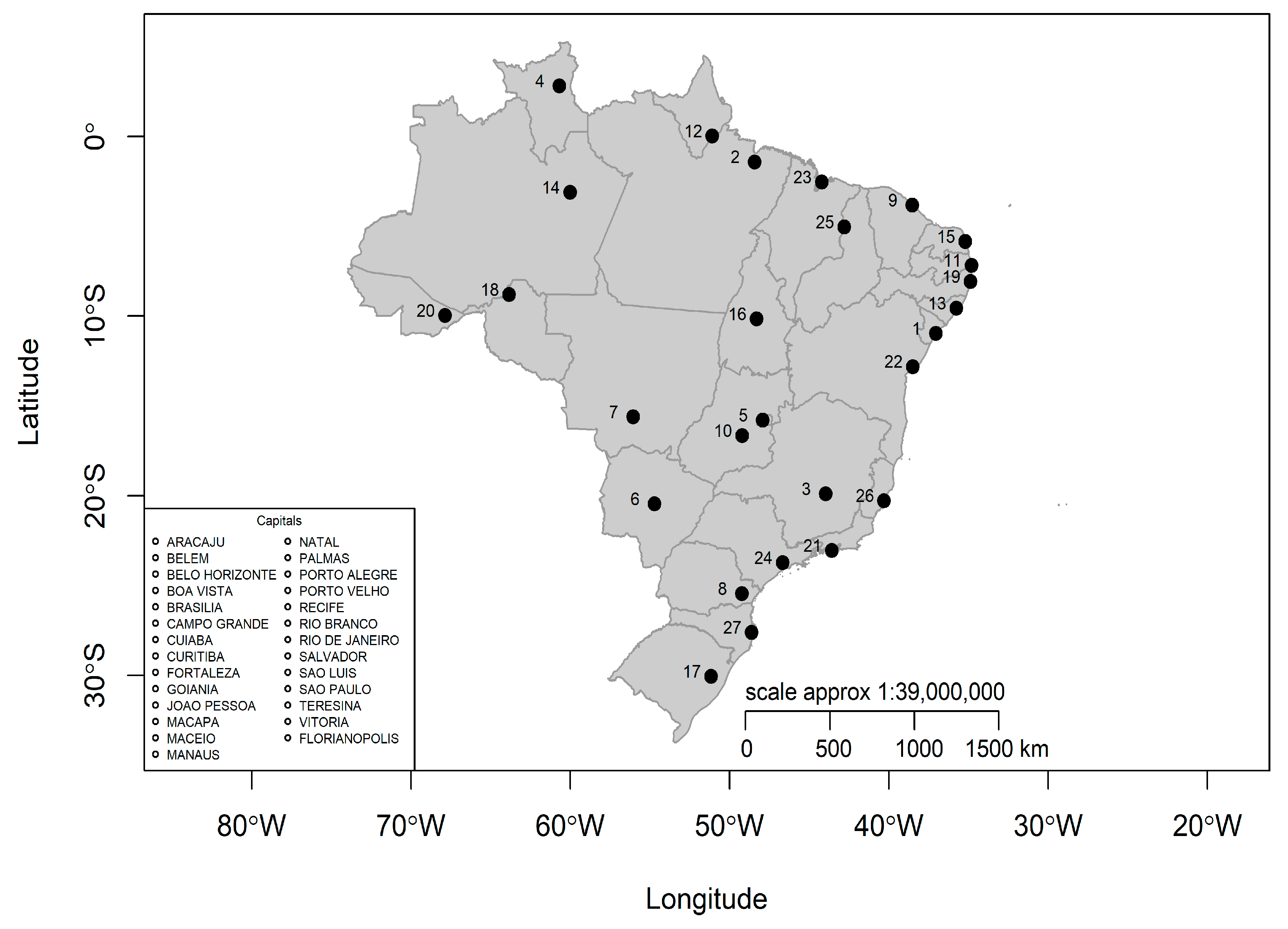
Together, these capitals (Figure 1) offer a comprehensive and nationally representative setting for evaluating long-term associations between ambient PM2.5 exposure and lung cancer mortality across diverse climatic, socioeconomic, and environmental contexts in Brazil.

2.2. Data Sample

Daily concentrations of fine particulate matter PM2.5 (µg/m3) were obtained from the Copernicus Atmosphere Monitoring Service (CAMS) database. Although CAMS has known limitations in validating and retrieving ground-level pollution data outside Europe, it has been widely adopted and validated in air pollution studies in Brazil, especially in regions without long-term ground-based monitoring networks, where consistent observational PM2.5 data are unavailable at the national scale [19,20,21,22]. This database provides reanalysis data based on an ensemble of atmospheric transport and chemistry models, operating at a horizontal spatial resolution of 0.1° [23].
The meteorological variables were obtained from the Copernicus global monitoring systems using secondary data extraction techniques. Temperature, wind components, and atmospheric pressure were retrieved from the CAMS Global Reanalysis (EAC4) dataset available through the Atmosphere Data Store (ADS). The EAC4 model integrates satellite observations with chemical transport modeling to provide consistent estimates of atmospheric composition and associated meteorological parameters. Data were extracted at a temporal resolution of 3 h (eight observations per day) throughout the study period, with a spatial resolution of approximately 0.75° × 0.75° (~80 km). The selection of this dataset was based on the documented performance and reliability of the EAC4 global reanalysis framework, as described by Inness et al. [24].
All computational processing was conducted in the R environment (v4.4.1), using specialized packages to handle large NetCDF datasets [25]. Temperature values were converted from Kelvin to degrees Celsius. From the eight sub-daily measurements, daily maximum, minimum, and mean temperatures were calculated for each day in the time series. Surface atmospheric pressure values were averaged at the daily level. Wind speed was derived from the zonal (u) and meridional (v) components by calculating the vector magnitude (√u2 + v2), followed by computation of daily and annual averages.
Health and population data were extracted from secondary databases available on official Brazilian platforms. Lung cancer mortality data were obtained from the Department of Informatics of the Brazilian Unified Health System (DATASUS), using the Mortality Information System (SIM), managed by the Ministry of Health. Deaths from lung cancer in individuals over 25 years of age were identified based on the 10th Revision of the International Statistical Classification of Diseases and Related Health Problems (ICD-10), using code C34 (malignant neoplasm of the bronchi and lungs). Demographic information was extracted from DATASUS estimates. The research period covered 2014 to 2023, during which all environmental, epidemiological, and population data were collected and standardized.

2.3. Attributable Deaths

After data collection, AirQ+ (version 2.2.4), a tool developed by the World Health Organization (WHO) to estimate the impact of air pollution on the health of exposed populations, as described by De Moura et al. [19], was used. With this tool, the number of lung cancer deaths attributed to air pollution in each capital city of Brazil was measured. Additionally, lung cancer deaths attributable to PM2.5 were calculated as rates per 100,000 inhabitants, considering the age group above 25 years (population at risk).

2.4. Data Analysis

Temporal trends in PM2.5-attributable lung cancer mortality rates for the total population at the city level were evaluated using ordinary least squares (OLS) linear regression. Only cities with at least three years of non-missing data were included in these regressions. For each regression, we extracted the estimated slope (m), the corresponding p-value, and the coefficient of determination (R2) as a descriptive measure of model fit. To obtain an overall estimate of the national temporal trend in PM2.5-attributable lung cancer total mortality rates while accounting for clustering by city, we additionally fitted a linear mixed-effects model. For this case, we included a random intercept for city to allow for heterogeneous baseline levels across capitals. This model was estimated using restricted maximum likelihood (REML), and we report the fixed effect for year with its 95% confidence interval and p-value.
Subsequently, we modeled the annual number of PM2.5-attributable lung cancer deaths using generalized linear models (GLMs) with Poisson distribution and log link, incorporating annual meteorological variables as potential confounders. Meteorological variables considered as covariates were annual averages of temperature (°C), wind speed (m/s), relative humidity (%), and atmospheric pressure (hPa). For each city separately, we fitted a Poisson regression with year and all meteorological variables as predictors and the natural logarithm of the annual population as an offset, to estimate time trends in mortality rates on the relative scale. For each model, we computed the Pearson chi-square (χ2) statistic divided by the residual degrees of freedom as an empirical dispersion index. Values appreciably greater than 1.5 were interpreted as indicative of overdispersion. Cities presenting evidence of overdispersion in these multivariable Poisson models were analyzed using negative binomial regression. In these negative binomial GLMs, we retained the same log link, offset term, and set of predictors, but allowed for an additional dispersion parameter to explicitly model extra-Poisson variability.
Finally, we fitted population-averaged models using generalized estimating equations (GEE) to estimate national effects by year and meteorological variables on PM2.5-attributable deaths. For these cases, we used a Poisson variance function and specified an exchangeable working correlation structure to account for within-city correlation over time, treating each capital as a cluster. Robust covariance estimators were used to obtain standard errors and 95% confidence intervals that are valid under potential misspecification of the correlation structure. All hypothesis tests were two-sided, and p values below 0.05 were considered statistically significant.
The data were tabulated and organized in spreadsheets, and Poisson regression analyses were performed using SPSS Statistics 23 software (SPSS Software, Chicago, IL, USA). Graphical representations were created using GraphPad Prism software, version 8.2.1 (GraphPad Software, San Diego, CA, USA).

3. Results

The results show data on lung cancer mortality attributed to PM2.5 exposures in different cities across Brazilian regions between 2014 and 2023. Consistently, it was observed that the rates and percentages of deaths attributed to pollution were higher in capitals with greater urban density and intense industrial activity, although smaller cities also showed significant percentages when exposed to high levels of PM2.5.
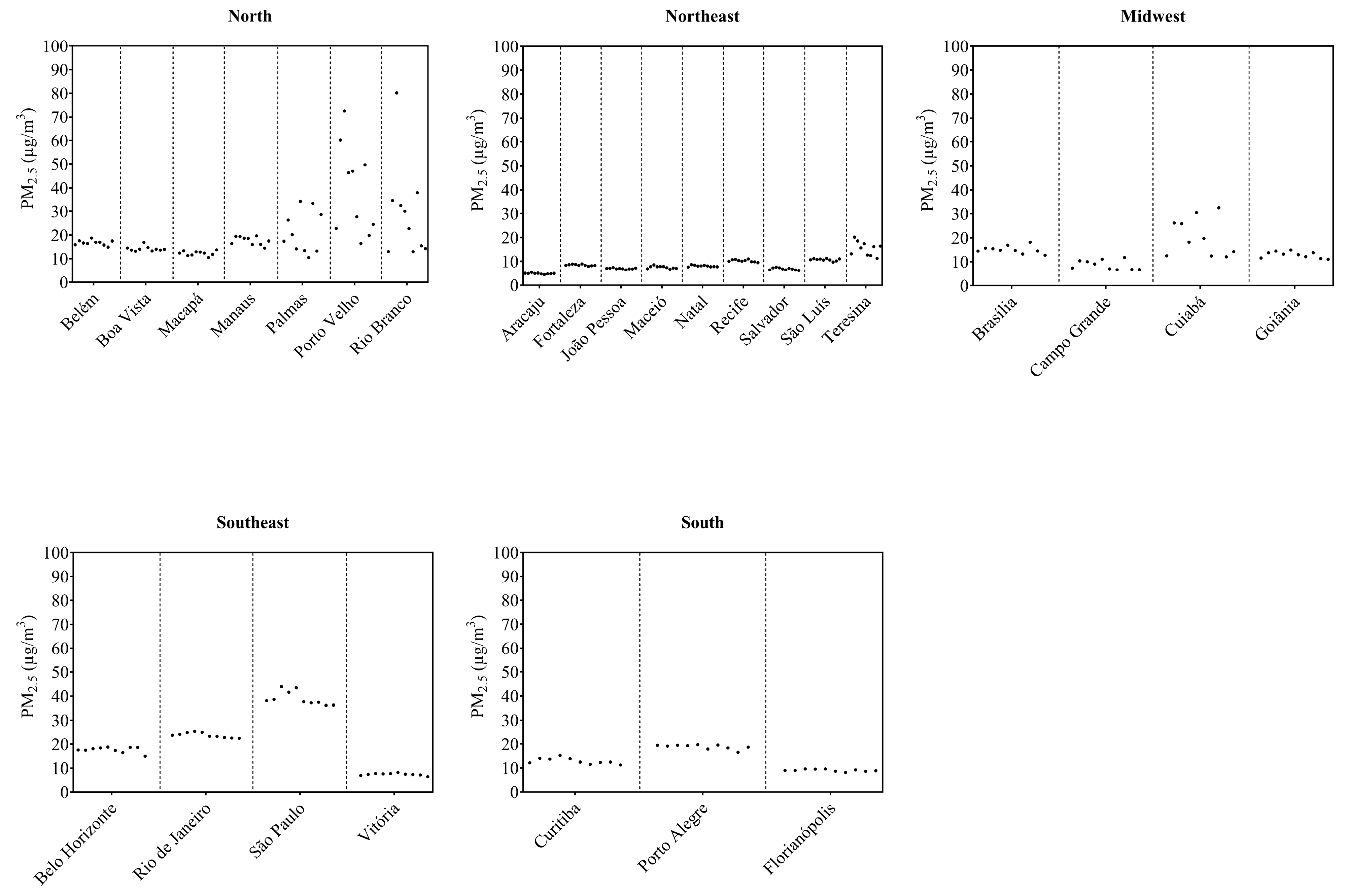
The average annual concentration of PM2.5 (µg/m3) is shown in Figure 2. Each graph represents a region of the country, and the points represent the years from 2014 to 2023. For most cities, the average annual concentrations of PM2.5 remained stable, except in the North region (Palmas, Porto Velho, and Rio Branco), the Northeast region (Teresina), and the Midwest region (Cuiabá). In terms of PM2.5 concentration magnitude, all these cities had at least one year in which the concentration exceeded 20 µg/m3, reaching up to 80.2 µg/m3 in Rio Branco. Additionally, Rio de Janeiro and São Paulo in the Southeast region showed high PM2.5 concentrations, despite low annual variation. The average annual values of PM2.5 concentration and meteorological variables for each year and city can be seen in Table S1 (Supplementary Material).
The absolute numbers of lung cancer deaths attributed to PM2.5 by city and year are presented in Table S2 (Supplementary Material). When aggregated over the study period, pronounced regional disparities become evident. Capitals in the Southeast region accounted for a total of 6770 deaths, corresponding to a mortality burden more than sixfold higher than that observed in the region with the second highest number of cases, the South, which registered 907 deaths. In contrast, the North, Northeast, and Midwest regions exhibited broadly comparable absolute numbers, with 692, 633, and 631 deaths, respectively. Notably, when considering the total number of lung cancer deaths across all Brazilian capitals during the analyzed period, approximately 13.56% (9631/71,043) were attributable to exposure to PM2.5.
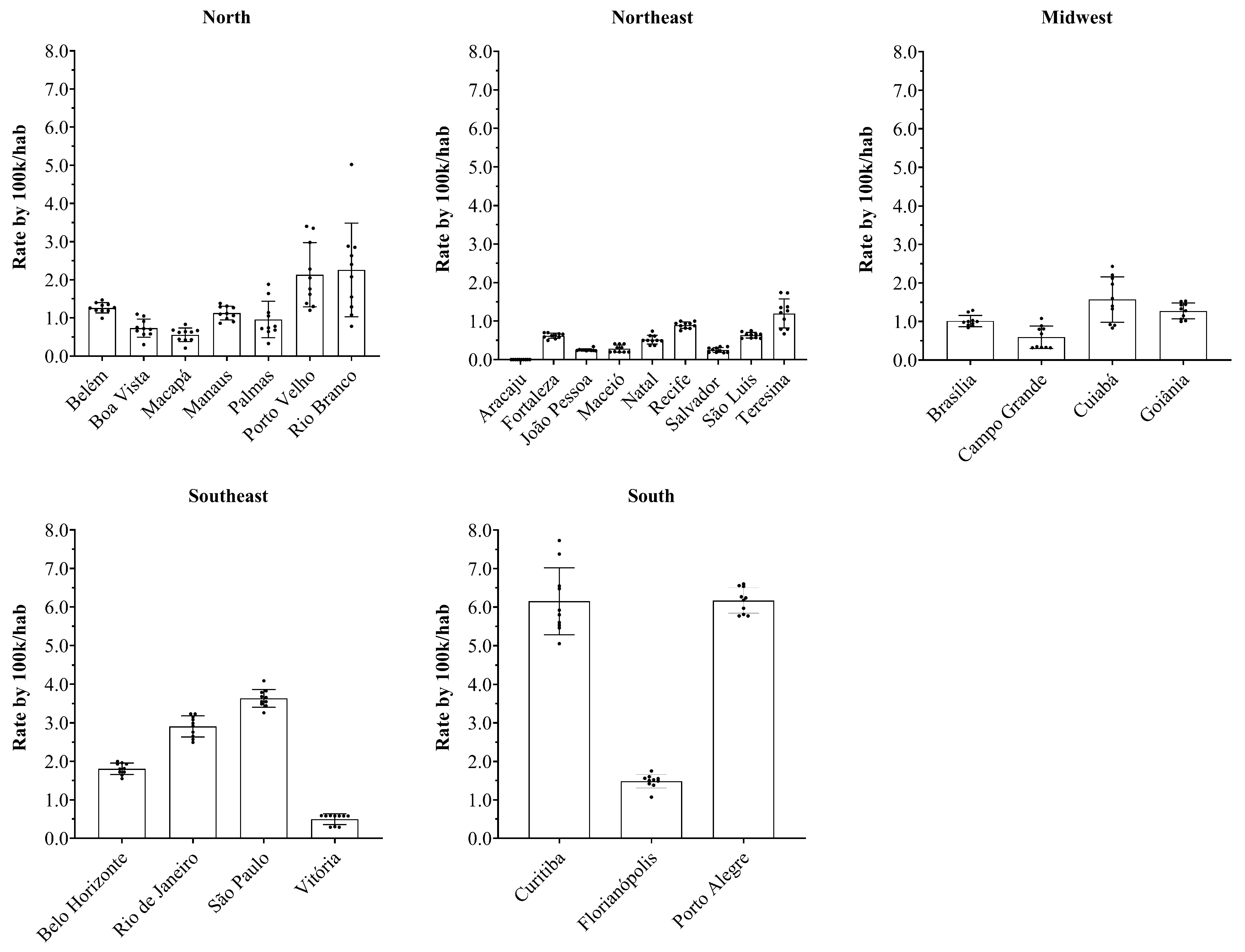
In addition, Figure 3 shows the lung cancer death rates attributed to PM2.5 for the five regions studied. The rates are expressed as the mean ± standard deviation of the annual rates in each city. The highest death rates per 100,000 inhabitants were observed in the Southeast and South regions, with particular emphasis on the cities of Porto Alegre (6.171 ± 0.3297), Curitiba (6.150 ± 0.8709), São Paulo (3.634 ± 0.2323), and Rio de Janeiro (2.907 ± 0.2748). In contrast, the Northeast region had the lowest rates per 100,000 inhabitants, with the lowest rates being observed in Salvador (0.2520 ± 0.06443) and Aracaju, where no cases of lung cancer deaths attributed to PM2.5 were reported.
Temporal trends in PM2.5-attributable lung cancer mortality rates varied substantially across Brazilian state capitals. City-specific OLS linear regressions, presented in Table 1, showed predominantly negative slopes, indicating a general pattern of declining attributable mortality rates over the study period. However, for most capitals, these trends were not statistically significant, reflecting substantial interannual variability. Only two capitals, Manaus and Rio de Janeiro, showed statistically significant trends, and in both cases the direction was downward. Manaus displayed a moderate decline (slope = −0.043; p value = 0.020; R2 = 0.510), whereas Rio de Janeiro exhibited the strongest reduction over time (slope = −0.075; p value = 0.003; R2 = 0.688).
Consistent with these findings, the linear mixed-effects model that pooled all cities while accounting for clustering showed an overall national decline in PM2.5-attributable lung cancer mortality rates, with a fixed year effect of −0.018 (95% CI: −0.033, −0.003; p value = 0.017). This population-level estimate indicates a modest but statistically significant downward temporal trend when considering the national context rather than individual city trajectories.
When modeling the annual number of PM2.5-attributable lung cancer deaths using Poisson regression with meteorological covariates (Table 2), no city demonstrated significant temporal changes. The estimated coefficients for year remained close to zero across capitals, suggesting that temporal trends in attributable mortality were minimal. Most cities exhibited dispersion indices below 1.5, indicating adequate fit under the Poisson assumption. However, Campo Grande and Cuiabá presented evidence of overdispersion (dispersion > 1.5), warranting re-analysis using negative binomial regression. In these models, annual effects remained small and non-significant: in Campo Grande, β = −0.026 (95% CI: −0.365, 0.313; p = 0.880), and in Cuiabá, β = −0.005 (95% CI: −0.329, 0.318; p = 0.974). The wide confidence intervals and lack of statistical significance in both cities further reinforce the absence of meaningful temporal changes after full adjustment for meteorological covariates.
In contrast to the mostly null city-specific results, the population-averaged GEE model revealed a statistically significant national trend. After adjustment for meteorological covariates and using a Poisson variance structure with exchangeable within-city correlation, year remained negatively associated with PM2.5-attributable lung cancer deaths, with β = −0.012 (95% CI: −0.022, −0.002; p = 0.002). Interpreted on the relative scale, this coefficient corresponds to an average 1.2% reduction per year in PM2.5-attributable lung cancer mortality nationwide. Despite the absence of statistically significant trends in the individual cities, this nationwide estimate indicates a small but systematic downward temporal pattern when considering all capital cities jointly. None of the meteorological covariates displayed statistically significant associations in the GEE model, indicating that short-term national variability in those variables did not substantially modify the temporal pattern of attributable mortality at the national level.

4. Discussion

This study aimed to estimate the number of lung cancer deaths attributable to PM2.5 exposure over a ten-year period and to assess the temporal patterns of ambient PM2.5 concentrations across the capitals of all 27 Brazilian federative units. Our findings reveal widespread air pollution in Brazilian capitals, with 97.41% of annual PM2.5 means exceeding the World Health Organization (WHO) Air Quality Guideline of 5 µg/m3, as established in the 2021 update [26]. Although recent Brazilian air quality legislation formally aligns with WHO recommendations, the current regulatory framework is still based on Intermediate Targets. As of January 2025, the Intermediate Target II adopted by the National Environmental Council [27] sets a reference limit of 17 µg/m3, which remains substantially higher than the WHO guideline.
Even under this more permissive national standard, 28.52% of annual PM2.5 means exceeded the CONAMA limit, indicating that a significant proportion of the urban population remains exposed to pollutant concentrations associated with adverse health effects. When evaluated against WHO guidelines, this situation becomes even more critical, suggesting that nearly the entire population of Brazilian capitals—including vulnerable groups—is exposed to PM2.5 levels that pose a recognized risk to human health.
Pronounced temporal variability in PM2.5 concentrations was observed, particularly in capitals located in the North region. This pattern aligns with previous studies demonstrating the strong influence of biomass burning on particulate matter concentrations in northern Brazil, where deforestation and agricultural expansion intensify fire activity [17,28]. Additionally, 2020 was marked by unprecedented wildfire events in the Pantanal biome, located in the Midwest, during which approximately 30% of the biome was affected. The resulting large-scale smoke plumes dispersed over thousands of kilometers, degrading air quality both locally and across distant regions [29]. These events illustrate how extreme biomass-burning episodes can elevate PM2.5 concentrations directly in affected areas and indirectly through delayed and long-range atmospheric transport.
The behavior of particulate matter in the atmosphere is governed by complex physical processes, including transport, dispersion, transformation, and deposition, which vary across regions. Key determinants of ambient PM2.5 concentrations include particle size and atmospheric residence time. Unlike secondary pollutants such as ground-level ozone (O3), whose formation is strongly driven by photochemical reactions, particulate matter concentrations depend largely on physical characteristics and meteorological conditions. Variables such as wind speed and relative humidity can either promote dispersion or favor particle sedimentation, shaping regional and temporal concentration patterns [30]. This regional and temporal heterogeneity in PM2.5 concentrations has direct implications for population-level long-term exposures and associated health outcomes.
Fine particulate matter varies not only with meteorological conditions and emission sources but also with seasonal patterns and geographical characteristics, resulting in persistent exposure gradients across urban environments. Long-term exposure to elevated PM2.5 has been associated with increased risks of cardiopulmonary mortality, including lung cancer, with exposure–response relationships remaining significant even at concentrations below previously accepted regulatory thresholds [31,32]. Such chronic exposures disproportionately burden populations subjected to sustained higher concentrations, particularly in metropolitan regions with dense traffic and industrial activity [33]. Conversely, areas with consistently lower ambient PM2.5 tend to exhibit lower attributable mortality. These patterns underscore that the spatial variability documented here is not merely a physical phenomenon but a key determinant of disparities in long-term exposure and consequent adverse health effects.
At the city level, Aracaju, located in the Northeast region, stands out for reporting no lung cancer deaths attributable to PM2.5 during the study period. Although the city has lung cancer mortality rates proportional to its population and comparable to those of other capitals, it consistently recorded the lowest PM2.5 concentrations among all cities analyzed. Aracaju ranked among the ten lowest annual PM2.5 means throughout the study period and was the only capital to report annual averages below the WHO guideline of 5 µg/m3 in seven of the ten years evaluated. This finding highlights the potential public health benefits associated with sustained low-level exposure to particulate matter in urban environments.
A substantial body of epidemiological evidence has linked prolonged exposure to fine particulate matter with increased risks of lung cancer [34,35,36,37,38]. According to estimates from the GBD study, the crude mortality rate attributable to PM2.5 exposure is 12.55 per 100,000 inhabitants for lung cancer, lower than that observed for other PM2.5-related outcomes such as chronic obstructive pulmonary disease (COPD), estimated at 27.28 per 100,000 inhabitants [39]. In the present study, we identified annual lung cancer mortality rates attributable to PM2.5 of up to 6.171 (± 0.3297), reinforcing the contribution of ambient particulate matter to cancer-related mortality in Brazilian urban centers. These findings help contextualize the differences observed between national and city-level statistical models.
The discrepancy between statistically significant associations in pooled national models and the non-significant results in city-specific analyses is consistent with patterns widely reported in multicity environmental epidemiology [40]. Pooled models benefit from greater statistical power, wider exposure contrasts, and reduced random variability through aggregation, whereas city-level models are inherently constrained by smaller sample sizes, limited within-city exposure variability, and greater uncertainty. Large multi-location analyses have demonstrated that combining data across diverse settings improves precision and stabilizes effect estimates, even when individual-site estimates are imprecise yet directionally consistent [41]. Importantly, the absence of statistical significance in individual city models does not indicate the absence of effect, particularly when effect estimates remain directionally consistent across locations. Substantively, these results suggest that PM2.5-related lung cancer risk becomes more statistically discernible at broader spatial scales, supporting the robustness of national-level inference for public health decision-making.
A comparative regional perspective further demonstrates that population size alone does not fully account for the distribution of PM2.5-attributable lung cancer mortality across Brazilian capitals. Although the Midwest region is significantly less populous than the Northeast, it recorded a nearly equivalent number of attributable deaths during the study period. This apparent discrepancy highlights the impact of region-specific exposure factors that go beyond traditional urban and industrial emission sources. Previous studies have shown that large-scale biomass burning, agricultural expansion, and land-use change play a central role in determining PM2.5 concentrations in the Midwest, particularly through intense fire activity and long-range transport of smoke plumes [42,43]. Additionally, as atmospheric circulation patterns can redistribute particulate matter over hundreds to thousands of kilometers, sustained exposure even in areas with lower population density or limited local emissions may occur [44]. These mechanisms help explain why regions outside Brazil’s most populous and industrialized centers may experience health burdens similar to those in larger urban agglomerations.
When considered in a broader context, the magnitude of PM2.5-attributable lung cancer mortality observed in this study becomes even more significant. We estimated that approximately 13.56% of lung cancer deaths in Brazilian capitals during the study period were attributable to PM2.5 exposure. Although this estimate is not directly comparable to global metrics based on life expectancy loss, it aligns conceptually with findings from large-scale modeling studies. Lelieveld et al. [45] estimated that lung cancer accounts for about 4.8% of the total global loss in life expectancy attributable to air pollution, highlighting its substantial contribution within the broader range of pollution-related health outcomes. At the national level, Yu et al. [6] showed that PM2.5 exposure has led to measurable reductions in life expectancy across Brazil, with more pronounced effects in densely populated and urbanized areas. The higher proportional impact observed in this study likely reflects the deliberate focus on state capitals, where population density, traffic intensity, industrial activity, and sustained exposure to fine particulate matter are concentrated. By restricting the analysis to large urban centers, this study does not aim to represent national averages, but rather to capture environments where the health burden of air pollution is usually most severe.
Temporal analyses are particularly valuable for assessing whether the health impacts of PM2.5 exposure are intensifying or stabilizing over time. International evidence shows increasing lung cancer mortality rates attributable to PM2.5 in several Asian countries over recent decades, including China, the Republic of Korea, and Mongolia, while Japan has experienced a decline [46]. Between 1990 and 2019, mortality rates among men increased substantially in China, the Republic of Korea, and Mongolia, whereas a modest decrease was observed in Japan, with similar patterns reported among women. In contrast, our findings indicate that lung cancer mortality rates attributable to PM2.5 remained relatively stable across most Brazilian capitals during the ten-year study period, suggesting a distinct temporal dynamic in the Brazilian context.
Although our study quantified PM2.5-attributable lung cancer deaths across all Brazilian capitals, stratification by age and sex was not possible due to limitations of the AirQ+ software. Evidence from Asian countries also indicates that increases in PM2.5-attributable lung cancer mortality have been more pronounced among women than men, highlighting the importance of sex-stratified analyses to identify differential vulnerabilities and inform targeted public health interventions [39].
Moreover, lung cancer mortality attributable to PM2.5 can be estimated only for individuals aged 25 years and older, without further stratification by age group or sex, which may obscure risks among specific subpopulations. The lack of individual-level smoking history data also prevented comparisons between smokers and never-smokers. In contrast, for other outcomes such as ischemic heart disease (IHD), AirQ+ allows age-stratified analyses, though still without sex differentiation. Also, the use of annual average meteorological data may not reflect seasonal fluctuations or episodic pollution events; nevertheless, for chronic outcomes such as lung cancer, long-term average exposure is epidemiologically more relevant than short-term variability. Finally, as this is an ecological study based on aggregated exposure and mortality data, the findings should be interpreted with caution, as individual-level risk factors and potential within-city exposure variability could not be directly accounted for. Addressing these limitations is an important direction for future research, particularly to better characterize vulnerabilities and guide more precise policy responses.

5. Conclusions

This study evaluated the distribution of lung cancer deaths attributable to PM2.5 exposure across the capitals of the 27 Brazilian federative units and examined the temporal behavior of ambient PM2.5 concentrations over a ten-year period. Overall, PM2.5 concentrations remained relatively stable in most cities, with greater temporal variability observed in selected capitals in the North and Midwest regions. Nearly one-third of the annual PM2.5 means exceeded the limits established by current Brazilian air quality legislation, while almost all cities presented annual averages above the WHO guidelines.
Regarding health outcomes, the Southeast and South regions exhibited the highest rates of lung cancer mortality attributable to PM2.5, reflecting the combined effects of sustained exposure and urban–industrial characteristics in these regions. At the same time, the occurrence of comparable attributable mortality in less populous regions highlights that elevated health risks are not confined to the most densely populated areas but are also shaped by region-specific emission sources and atmospheric processes.
Taken together, these findings emphasize the central role of urban environments in shaping population exposure to PM2.5 and its associated cancer burden. Since the analysis focused on state capitals, the results underscore the importance of urban-scale air quality management as a component of cancer prevention strategies. Policies aimed at reducing emissions from transportation, controlling industrial sources, improving urban planning, and mitigating the impacts of biomass burning are likely to yield substantial public health benefits in highly exposed urban populations by reducing the burden of air pollution–related cancer in Brazilian cities.

Supplementary Materials

The following supporting information can be downloaded at https://www.mdpi.com/article/10.3390/atmos17020175/s1, Table S1: Annual means of meteorological variables and PM2.5 concentrations by city and year. Table S2: Data regarding total population and population at risk (aged > years) for all analyzed cities, number of deaths in each population group, lung cancer rates attributed to air pollution for the total and at-risk populations, and the percentage of death.

Author Contributions

Conceptualization, A.B.d.A.N., A.d.S.B. and F.M.R.d.S.J.; methodology, A.d.S.B., R.d.L.B. and R.A.T.; software, R.d.L.B., R.A.T. and F.M.R.d.S.J.; validation, R.d.L.B., R.A.T. and F.M.R.d.S.J.; formal analysis, F.R.d.M., A.d.S.B., V.M.d.S., R.d.L.B., R.A.T. and F.M.R.d.S.J.; resources, F.M.R.d.S.J.; writing—original draft preparation, A.B.d.A.N., F.R.d.M., A.d.S.B., V.M.d.S., R.d.L.B., R.A.T., R.C.F. and G.L.M.; writing—review and editing, F.R.d.M., R.C.F. and G.L.M.; visualization, F.M.R.d.S.J.; supervision, F.M.R.d.S.J. All authors have read and agreed to the published version of the manuscript.

Funding

This study was financed in part by the Coordenação de Aperfeiçoamento de Pessoal de Nível Superior—Brasil (CAPES)—Finance Code 001, Conselho Nacional de Desenvolvimento Científico e Tecnológico (CNPq), Grants 307791/2023-8, 444528/2023-7 and 407484/2025-6 (F.M.R.S.J.), Fundação de Amparo à Pesquisa do Estado de São Paulo (FAPESP) Grant 2024/02579-0 (R.A.T.), Fundação de Amparo à Pesquisa do Estado do Rio Grande do Sul (FAPERGS), Grant 24/2551-0002130-2 (F.M.R.S.J.).

Institutional Review Board Statement

Not applicable.

Informed Consent Statement

Not applicable.

Data Availability Statement

The raw data supporting the conclusions of this article will be made available by the authors on reasonable request.

Acknowledgments

The authors thank the Conselho Nacional de Desenvolvimento Científico e Tecnológico (CNPq), Fundação de Amparo à Pesquisa do Estado do Rio Grande do Sul (FAPERGS), Fundação de Amparo à Pesquisa do Estado de São Paulo (FAPESP), Coordenaçãoo de Aperfeiçoamento de Pessoal de Nível Superior (CAPES), Universidade Federal de Alagoas and Universidade Federal do Rio Grande—FURG.

Conflicts of Interest

The authors declare no conflicts of interest.

References

  1. Bittoni, M.A.; Carbone, D.P.; Harris, R.E. Vaping, Smoking and Lung Cancer Risk. J. Oncol. Res. Ther. 2024, 9, 10229. [Google Scholar] [CrossRef] [PubMed]
  2. Chen, C.Y.; Huang, K.Y.; Chen, C.C.; Chang, Y.H.; Li, H.J.; Wang, T.H.; Yang, P.C. The role of PM2.5 exposure in lung cancer: Mechanisms, genetic factors, and clinical implications. EMBO Mol. Med. 2025, 17, 31–40. [Google Scholar] [CrossRef] [PubMed]
  3. Zhang, Y.; Wang, W.; Dai, K.; Huang, Y.; Wang, R.; He, D.; He, J.; Liang, H. Global lung cancer burden attributable to air fine particulate matter and tobacco smoke exposure: Spatiotemporal patterns, sociodemographic characteristics, and transnational inequalities from 1990 to 2021. BMC Public Health 2025, 25, 1260. [Google Scholar] [CrossRef]
  4. Deng, Y.; Li, Z.; Zhang, P.; Yang, Y.; Xie, Y.; Cheng, Y.; Yu, S.; Zhu, G.; Han, L.; Jia, L.; et al. Global, regional and national burden of lung cancer attributable to PM2.5 air pollution: Trends from 1990 to 2021 with projections to 2045. J. Environ. Manag. 2025, 390, 126216. [Google Scholar] [CrossRef]
  5. Corrales, L.; Rosell, R.; Cardona, A.F.; Martin, C.; Zatarain-Barrón, Z.L.; Arrieta, O. Lung cancer in never smokers: The role of different risk factors other than tobacco smoking. Crit. Rev. Oncol. Hematol. 2020, 148, 102895. [Google Scholar] [CrossRef]
  6. Yu, P.; Xu, R.; Li, S.; Coelho, M.S.Z.S.; Saldiva, P.H.N.; Sim, M.R.; Abramson, M.J.; Guo, Y. Loss of life expectancy from PM2.5 in Brazil: A national study from 2010 to 2018. Environ. Int. 2022, 166, 107350. [Google Scholar] [CrossRef]
  7. Yu, P.; Xu, R.; Huang, W.; Coelho, M.S.Z.S.; Saldiva, P.H.N.; Ye, T.; Wen, B.; Liu, Y.; Yang, Z.; Li, S.; et al. Cancer mortality risk from short-term PM2.5 exposure and temporal variations in Brazil. J. Hazard. Mater. 2024, 473, 134606. [Google Scholar] [CrossRef]
  8. Wikuats, C.F.H.; Nogueira, T.; Squizzato, R.; de Freitas, E.D.; Andrade, M.d.F. Health Risk Assessment of Exposure to Air Pollutants Exceeding the New WHO Air Quality Guidelines (AQGs) in São Paulo, Brazil. Int. J. Environ. Res. Public Health 2023, 20, 5707. [Google Scholar] [CrossRef] [PubMed]
  9. Hoinaski, L.; Will, R.; Ribeiro, C.B. Brazilian Atmospheric Inventories—BRAIN: A comprehensive database of air quality in Brazil. Earth Syst. Sci. Data 2024, 16, 2385–2405. [Google Scholar] [CrossRef]
  10. Liang, H.; Zhou, X.; Zhu, Y.; Li, D.; Jing, D.; Su, X.; Pan, P.; Liu, H.; Zhang, Y. Association of outdoor air pollution, lifestyle, genetic factors with the risk of lung cancer: A prospective cohort study. Environ. Res. 2023, 218, 114996. [Google Scholar] [CrossRef]
  11. Wang, T.H.; Huang, K.Y.; Chen, C.C.; Chang, Y.H.; Chen, H.Y.; Hsueh, C.; Liu, Y.T.; Yang, S.C.; Yang, P.C.; Chen, C.Y. PM2.5 promotes lung cancer progression through activation of the AhR-TMPRSS2-IL18 pathway. EMBO Mol. Med. 2023, 15, e17014. [Google Scholar] [CrossRef]
  12. Tavella, R.A.; De Moura, F.R.; Miraglia, S.G.E.K.; Da Silva Júnior, F.M.R. A New Dawn for Air Quality in Brazil. Lancet Planet. Health 2024, 8, e717–e718. [Google Scholar] [CrossRef]
  13. De Moura, F.R.; De Moura, D.F.F.; Tavella, R.A.; Da Silva Júnior, F.M.R. Letter to the Editor Regarding the Article “Open Air Quality Data Platforms for Environmental Health Research and Action”. Curr. Environ. Health Rep. 2025, 12, 42. [Google Scholar] [CrossRef] [PubMed]
  14. Buralli, R.J.; Connerton, P. Poluição do ar, saúde e regulação no Brasil: Estamos avançando? Cad. Saúde Pública 2025, 41, e00172924. [Google Scholar] [CrossRef]
  15. Moore, J.P.; Will, R.; Bastos, C.R.; Réquia, W.J.; Hoinaski, L. Spatial analysis of cardiopulmonary disease risks linked to air pollution in Brazil. Air Qual. Atmos. Health 2025. Epub ahead of printing. [Google Scholar] [CrossRef]
  16. Cancio, A.K.C.; Guerrero-Moreno, M.A.; Silva, E.C.; Oliveira, F.A.; Dias-Silva, K.; Moura, J.F., Jr.; Vieira, T.A.; Calvão, L.B.; Juen, L.; Oliveira-Júnior, J.M.B. The impacts off ire use in the Brazilian Amazon: A bibliometric analysis. Int. J. Wildland Fire 2025, 34, WF24182. [Google Scholar] [CrossRef]
  17. De Moura, F.R.; Machado, P.D.W.; Ramires, P.F.; Tavella, R.A.; Carvalho, H.; Silva Júnior, F.M.R. In the line of fire: Analyzing burning impacts on air pollution and air quality in an Amazonian city, Brazil. Atmos. Pollut. Res. 2024, 14, 102033. [Google Scholar] [CrossRef]
  18. Ellwanger, J.H.; Ziliotto, M.; Kulmann-Leal, B.; Chies, J.A.B. Environmental Challenges in Southern Brazil: Impacts of Pollution and Extreme Weather Events on Biodiversity and Human Health. Int. J. Environ. Res. Public Health 2025, 22, 305. [Google Scholar] [CrossRef] [PubMed]
  19. De Moura, F.R.; Buffarini, R.; Barlem, E.L.D.; Nadaleti, W.C.; Carvalho, H.; Silva Júnior, F.M.R. Amazon’s climate crossroads: Analyzing air pollution and health impacts under machine learning-based temperature increase scenarios in Northern Mato Grosso, Brazil. Environ. Geochem. Health 2025, 47, 206. [Google Scholar] [CrossRef]
  20. Gueymard, C.A.; Yang, D. Worldwide validation of CAMS and MERRA-2 reanalysis aerosol optical depth products using 15 years of AERONET observations. Atmos. Environ. 2020, 225, 117216. [Google Scholar] [CrossRef]
  21. Requia, W.J.; Amini, H.; Mukherjee, R.; Gold, D.R.; Schwartz, J.D. Health impacts of wildfire-related air pollution in Brazil: A nationwide study of more than 2 million hospital admissions between 2008 and 2018. Nat. Commun. 2021, 12, 6555. [Google Scholar] [CrossRef]
  22. Brum, A.N.; Brum, R.L.; Bonifácio, A.S.; Da Silva Júnior, F.M.R.; Zhang, L. Impact of temperature increase on air pollutants—A case study in a small city in southern Brazil. Case Stud. Chem. Environ. Eng. 2024, 9, 100624. [Google Scholar] [CrossRef]
  23. Casciaro, G.; Cavaiola, M.; Mazzino, A. Calibrating the CAMS European multi-model air quality forecasts for regional air pollution monitoring. Atmos. Environ. 2022, 287, 119259. [Google Scholar] [CrossRef]
  24. Inness, A.; Ades, M.; Agustí-Panareda, A.; Barré, J.; Benedictow, A.; Blechschmidt, A.M.; Dominguez, J.J.; Engelen, R.; Eskes, H.; Flemming, J.; et al. The CAMS reanalysis of atmospheric composition. Atmos. Chem. Phys. 2019, 19, 3515–3556. [Google Scholar] [CrossRef]
  25. Hijmans, R.J.; Van Etten, J.; Sumner, M.; Cheng, J.; Baston, D.; Bevan, A.; Bivand, R.; Busetto, L.; Canty, M.; Fasoli, B.; et al. Package ‘raster’. 2021. Available online: https://cran.r-project.org/web/packages/raster/raster.pdf (accessed on 17 May 2025).
  26. Hoffmann, B.; Boogaard, H.; de Nazelle, A.; Andersen, Z.J.; Abramson, M.; Brauer, M.; Brunekreef, B.; Forastiere, F.; Huang, W.; Kan, H.; et al. WHO Air Quality Guidelines 2021-Aiming for Healthier Air for all: A Joint Statement by Medical, Public Health, Scientific Societies and Patient Representative Organisations. Int. J. Public Health 2021, 66, 1604465. [Google Scholar] [CrossRef] [PubMed]
  27. National Environment Council (CONAMA), Ministry of Environment and Climate Change, Brazil. CONAMA Resolution No 506, of 5 July 2024. Establishes National Air Quality Standards and Provides Guidelines for Their Application. 2024. Available online: https://conama.mma.gov.br/?option=com_sisconama&task=arquivo.download&id=827 (accessed on 1 October 2025).
  28. Cobelo, I.; Castelhano, F.J.; Borge, R.; Roig, H.L.; Adams, M.; Amini, H.; Koutrais, P.; Réquia, W.J. The impact of wildfires on air pollution and health across land use categories in Brazil over a 16-year period. Environ. Res. 2023, 224, 115522. [Google Scholar] [CrossRef] [PubMed]
  29. Palmeiro-Silva, Y.; Llerena-Cayo, C.; Blanco-Villafuerte, L.; Rojas-Rueda, D.; Borchers Arriagada, N.; Vela-Clavo, Z.; de Camargo, T.; Rusticucci, M.; Valdes-Velasquez, A.; Hartinger, S.M. The 2024 South America ablaze: Health impacts and policy imperatives for protecting population health in an era of wildfires. Lancet Reg. Health Am. 2025, 48, 101160. [Google Scholar] [CrossRef]
  30. Yuan, F.; Yao, R.; Yu, W.; Sadrizadeh, S.; Awbi, H.; Kumar, P. Dynamic characteristics of particulate matter resuspension due to human activities in indoor environments: A comprehensive review. J. Build. Eng. 2023, 79, 107914. [Google Scholar] [CrossRef]
  31. Hoek, G.; Krishnan, R.M.; Beelen, R.; Peters, A.; Ostro, B.; Brunekreef, B.; Kaufman, J.D. Long-term air pollution exposure and cardio- respiratory mortality: A review. Environ. Health 2013, 12, 43. [Google Scholar] [CrossRef] [PubMed]
  32. Liu, C.; Chen, R.; Sera, F.; Vicedo-Cabrera, A.M.; Guo, Y.; Tong, S.; Coelho, M.S.Z.S.; Saldiva, P.H.N.; Lavigne, E.; Matus, P.; et al. Ambient Particulate Air Pollution and Daily Mortality in 652 Cities. N. Engl. J. Med. 2019, 381, 705–715. [Google Scholar] [CrossRef]
  33. Cohen, A.J.; Brauer, M.; Burnett, R.; Anderson, H.R.; Frostad, J.; Estep, K.; Balakrishnan, K.; Brunekreef, B.; Dandona, L.; Dandona, R.; et al. Estimates and 25-year trends of the global burden of disease attributable to ambient air pollution: An analysis of data from the Global Burden of Diseases Study 2015. Lancet 2017, 389, 1907–1918. [Google Scholar] [CrossRef]
  34. Kinzunga, M.N.; Westervelt, D.M.; Masisa, D.M.; Bangelesa, F.; Isevulambire, P.K.; Tabou, T.T.; Obel, B.K.; Mbela, G.K.; Ntumba, J.M.K. Assessment of Respiratory Health Impacts of PM2.5 by AirQ+ Software in a Sub-Saharan African Urban Setting. Atmosphere 2024, 15, 1518. [Google Scholar] [CrossRef]
  35. Zhou, R.X.; Liao, H.J.; Hu, J.J.; Xiong, H.; Cai, X.Y.; Ye, D.W. Global Burden of Lung Cancer Attributable to Household Fine Particulate Matter Pollution in 204 Countries and Territories, 1990 to 2019. J. Thorac. Oncol. 2024, 19, 883–897. [Google Scholar] [CrossRef]
  36. Feng, Y.; Jin, T.; Wei, Y.; Steenland, K.; Schwartz, J. Long-term exposure to PM2.5 constituents and incident cancer among Medicare beneficiaries in the USA: A national cohort study. Lancet Planet. Health 2025, 9, 101334. [Google Scholar] [CrossRef]
  37. Yu, P.; Xu, R.; Li, S.; Coelho, M.S.Z.S.; Saldiva, P.H.N.; Sim, M.R.; Abramson, M.J.; Guo, Y. Associations between long-term exposure to PM2.5 and site-specific cancer mortality: A nationwide study in Brazil between 2010 and 2018. Environ. Pollut. 2022, 302, 119070. [Google Scholar] [CrossRef] [PubMed]
  38. Wang, M.; Kim, R.Y.; Kohonen-Corish, M.R.J.; Chen, H.; Donovan, C.; Oliver, B.G. Particulate matter air pollution as a cause of lung cancer: Epidemiological and experimental evidence. Br. J. Cancer 2025, 132, 986–996. [Google Scholar] [CrossRef] [PubMed]
  39. GBD 2021 Diseases and Injuries Collaborators. Global incidence, prevalence, years lived with disability (YLDs), disability-adjusted life-years (DALYs), and healthy life expectancy (HALE) for 371 diseases and injuries in 204 countries and territories and 811 subnational locations, 1990–2021: A systematic analysis for the Global Burden of Disease Study 2021. Lancet 2024, 403, 2133–2161. [Google Scholar] [CrossRef]
  40. Yazdi, M.D.; Wang, Y.; Di, Q.; Requia, W.J.; Wei, Y.; Shi, L.; Sabath, M.B.; Dominici, F.; Coull, B.; Evans, J.S.; et al. Long-term effect of exposure to lower concentrations of air pollution on mortality among US Medicare participants and vulnerable subgroups: A doubly-robust approach. Lancet Planet. Health 2021, 10, e689–e697. [Google Scholar] [CrossRef]
  41. Stafoggia, M.; Oftedal, B.; Chen, J.; Rodopoulou, S.; Renzi, M.; Atkinson, R.W.; Bauwelinck, M.; Klompmaker, J.O.; Mehta, A.; Vienneau, D.; et al. Long-term exposure to low ambient air pollution concentrations and mortality among 28 million people: Results from seven large European cohorts within the ELAPSE project. Lancet Planet. Health 2022, 6, e9–e18. [Google Scholar] [CrossRef]
  42. Oliveira, I.N.; Oliveira, B.F.A.; Silveira, I.H.; Machado, L.M.G.; Villardi, J.W.R.; Ignotti, E. Air pollution from forest burning as environmental risk for millions of inhabitants of the Brazilian Amazon: An exposure indicator for human health. Cad. Saúde Pública 2023, 39, e00131422. [Google Scholar] [CrossRef]
  43. Velásquez-García, M.P.; Hernández, K.S.; Vergara-Correa, J.A.; Pope, R.J.; Gómez-Marín, M.; Rendón, A.M. Long-range transport of air pollutants increases the concentration of hazardous components of PM2.5 in northern South America. Atmos. Chem. Phys. 2024, 24, 11497–11520. [Google Scholar] [CrossRef]
  44. Rosas Santana, J.; Lima da Silva, G.; Akemi Yamasoe, M.; Èvora do Rosario, N. Biomass burning smoke transport and radiative impact over the city of São Paulo: An extreme event case study. Atmos. Chem. Phys. 2025, 25, 15935–15951. [Google Scholar] [CrossRef]
  45. Lelieveld, J.; Pozzer, A.; Pöschl, U.; Fnais, M.; Haines, A.; Münzel, T. Loss of life expectancy from air pollution compared to other risk factors: A worldwide perspective. Cardiovasc. Res. 2020, 116, 1910–1917. [Google Scholar] [CrossRef] [PubMed]
  46. Liu, X.; Mubarik, S.; Wang, F.; Yu, Y.; Wang, Y.; Shi, F.; Wen, H.; Yu, C. Lung Cancer Death Attributable to Long-Term Ambient Particulate Matter (PM2.5) Exposure in East Asian Countries During 1990–2019. Front. Med. 2021, 8, 742076. [Google Scholar] [CrossRef] [PubMed]
Figure 1. Geographic location of the 26 Brazilian state capitals and the Federal District (Brasília) included in the study.
Atmosphere 17 00175 g001
Figure 2. Average annual concentration of PM2.5 for each federative unit of the country, separated by region and capital city. The points represent the years between 2014 and 2023.
Atmosphere 17 00175 g002
Figure 3. Mean (±standard deviation) of the lung cancer death rate per 100,000 inhabitants attributed to PM2.5 between the years 2014 and 2023.
Atmosphere 17 00175 g003
Table 1. Linear regression coefficients (m), p-values, and coefficients of determination (R2) estimating temporal trends in the annual rate of total pollution-attributable cancer mortality across Brazilian state capitals (2014–2023). Negative slopes indicate decreasing trends over time, whereas positive slopes indicate increasing trends.
Capital CitySlope (m)p ValueR2
Aracaju---
Belém−0.0050.7490.014
Belo Horizonte0.0220.1910.203
Boa Vista0.0290.2940.136
Brasília−0.0060.7550.013
Campo Grande−0.0240.4850.063
Cuiabá−0.0450.5170.054
Curitiba−0.0090.6200.032
Florianópolis−0.0050.7430.014
Fortaleza−0.0080.2980.134
Goiânia−0.0280.2400.167
Joao Pessoa0.0030.4690.067
Macapá0.0110.5890.038
Maceió−0.0130.2190.182
Manaus−0.0430.0200.510
Natal0.0030.8090.008
Palmas0.0570.3030.131
Porto Alegre−0.0150.5200.053
Porto Velho−0.0940.3400.114
Recife−0.0080.3970.091
Rio Branco−0.1290.3720.101
Rio de Janeiro−0.0750.0030.688
Salvador−0.0080.2490.162
São Luís−0.0030.7810.010
São Paulo−0.0220.4170.084
Teresina−0.0610.1540.237
Vitória−0.0130.4360.077
Table 2. Results of city-specific Poisson regression models evaluating temporal trends in PM2.5-attributable mortality after adjustment for meteorological covariates. The table presents the estimated regression coefficient (β), p-value, and the dispersion statistic.
Capital CityBeta Coefficient (β)p ValueDispersion
Aracaju---
Belém−0.0420.7530.189
Belo Horizonte0.0160.4010.344
Boa Vista0.0440.6810.417
Brasília−0.0120.5980.294
Campo Grande−0.0360.6291.501
Cuiabá−0.0130.8141.805
Curitiba−0.0120.6440.517
Florianópolis−0.0150.8130.121
Fortaleza−0.0110.8290.170
Goiânia−0.0020.9440.303
Joao Pessoa0.0490.8310.033
Macapá0.1250.6380.321
Maceió−0.0240.7270.331
Manaus−0.0060.9170.542
Natal0.0010.9800.456
Palmas0.0280.8920.380
Porto Alegre−0.0070.8610.498
Porto Velho−0.0620.7060.463
Recife−0.0040.9240.328
Rio Branco−0.0630.8110.504
Rio de Janeiro−0.0430.5890.414
Salvador−0.0260.5870.358
São Luís−0.0120.7100.414
São Paulo−0.0120.7000.419
Teresina−0.0250.7220.506
Vitória−0.0110.8470.379
Disclaimer/Publisher’s Note: The statements, opinions and data contained in all publications are solely those of the individual author(s) and contributor(s) and not of MDPI and/or the editor(s). MDPI and/or the editor(s) disclaim responsibility for any injury to people or property resulting from any ideas, methods, instructions or products referred to in the content.