Article

Optimizing WRF Spectral Nudging to Improve Heatwave Forecasts: A Case Study of the Sichuan Electricity Grid

1
State Key Laboratory of Renewable Energy Grid-Integration, China Electric Power Research Institute, Beijing 100192, China
2
Key Laboratory of Physical Oceanography, College of Oceanic and Atmospheric Sciences, Ocean University of China, Qingdao 266100, China
*
Authors to whom correspondence should be addressed.
Atmosphere 2026, 17(2), 144; https://doi.org/10.3390/atmos17020144
Submission received: 17 December 2025 / Revised: 20 January 2026 / Accepted: 26 January 2026 / Published: 28 January 2026

Abstract

Accurate forecasting of heatwaves is critical for ensuring the safe operation of electricity grids. Focusing on the complex terrain of Sichuan, China, this study investigates the optimization of spectral nudging parameters within the Weather Research and Forecasting (WRF) model to improve predictions of heatwave events. To overcome the subjectivity inherent in the traditional selection of the spectral nudging cutoff wavenumber, we propose an objective method based on power-spectrum energy diagnostics of the background field. This method determines an optimal domain-specific cutoff wavenumber. A series of sensitivity experiments were designed for a significant heatwave event that affected the Sichuan electricity grid in August 2019. These experiments evaluated the impact of different spectral nudging configurations, which considered varying domain sizes and forecast lead times, on correcting large-scale circulation drift and enhancing near-surface air temperature forecasts. The results demonstrate the following: (1) For a smaller domain or a longer forecast lead time, spectral nudging effectively compensates for circulation drift induced by weakening lateral boundary constraints, significantly improving the forecast of heatwave intensity and spatial extent, representing a compensatory effect. (2) For a larger domain that already adequately resolves large-scale circulation evolution, spectral nudging can over-constrain the model’s internal dynamical processes, thereby degrading forecast performance, an outcome termed the over-constraint effect. (3) The proposed energy-threshold method provides an objective, physics-based strategy for identifying dominant large-scale waves and optimizing the spectral nudging cutoff wavenumber. This work offers practical insights for the operational application of spectral nudging over complex terrain to advance extreme temperature forecasting.

1. Introduction

The precise forecasting of severe weather is crucial for protecting vital infrastructure and developing contingency strategies for catastrophe prevention and mitigation. Heatwaves, a typical manifestation of extreme weather, present substantial hazards to energy and power systems by challenging electricity grid load management and dispatch operations. An illustrative instance occurred in the summer of 2019 in Sichuan Province, a significant hydroelectric base in China, where enduring heatwaves induced a marked increase in electricity demand while concurrently diminishing hydropower production due to falling reservoir levels, ultimately resulting in regional power shortages [1]. This incident highlights the critical necessity of accurate heatwave forecasts for safe grid dispatch and power supply management.
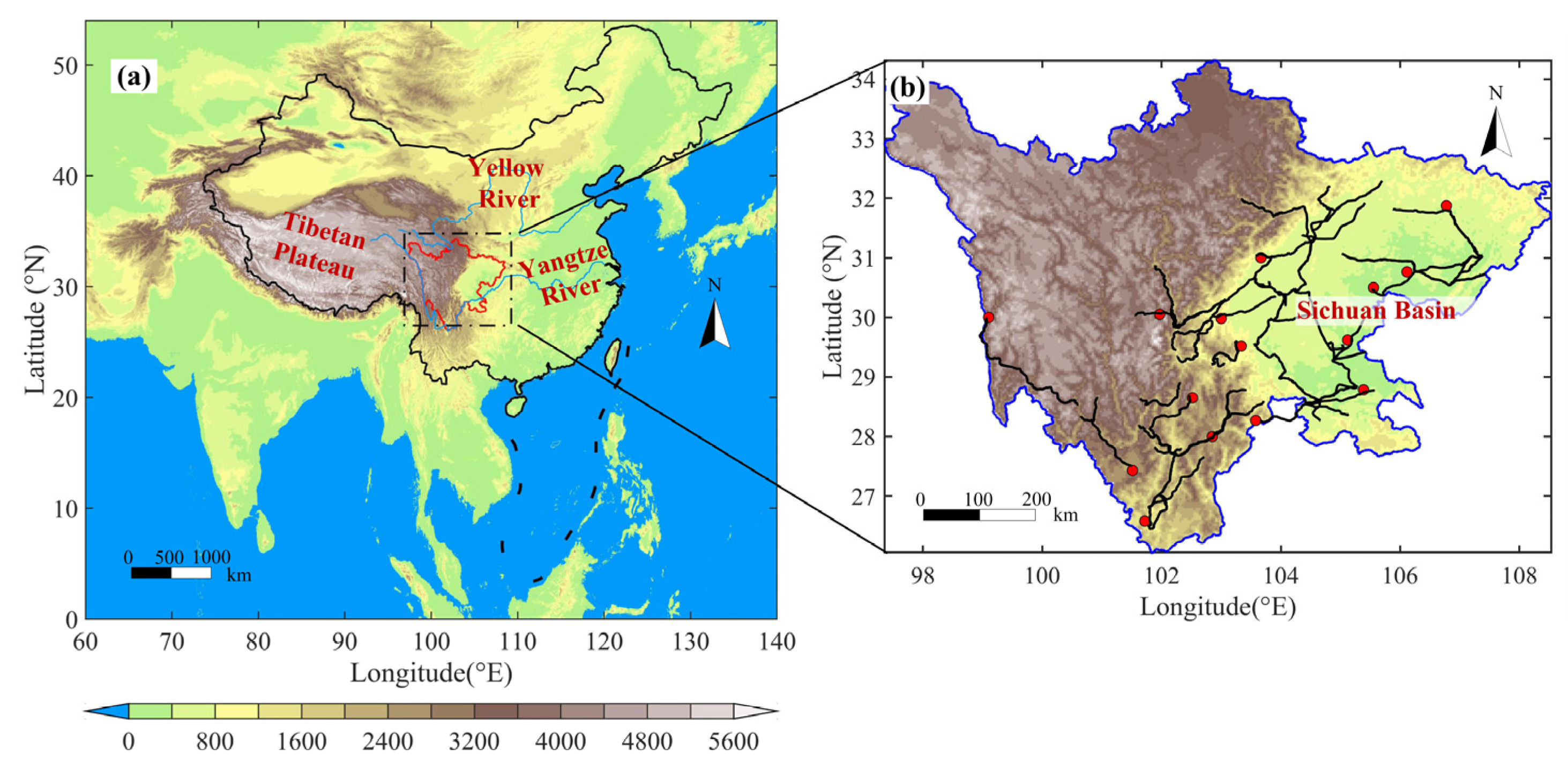
The Sichuan region features a complex topography of alternating basins and plateaus (Figure 1). The formation and persistence of surface meteorological elements, especially extreme high temperatures characteristic of heatwaves, are governed by intricate multi-scale atmospheric interactions. Such prolonged heat events are generally governed by quasi-stationary synoptic-scale systems, such as the subtropical high, which establish a favorable background through large-scale subsidence and enhanced solar radiation [2,3]. Under such a synoptic-scale forcing background, local complex terrain further modulates the surface energy budget and boundary-layer structure through thermal and dynamic processes, thereby altering the intensity and spatial distribution of high temperatures [4]. Therefore, the skill of a numerical weather prediction (NWP) model in accurately simulating the coupling between synoptic-scale forcing and terrain-induced local processes is key to achieving precise forecasts of such extreme heat events in this region.
Operationally, regional NWP systems based on the Weather Research and Forecasting (WRF) model [5] play an important role in such forecasting tasks. However, in extended-range forecasts spanning a week or longer, regional models exhibit a tendency for systematic large-scale circulation drift, causing simulated weather systems to progressively diverge from their actual evolution in terms of both position and intensity [6]. This systematic error arises in part from the declining constraining effect of lateral boundary conditions over time, which undermines the coherence between the interior model solution and the global driving field, ultimately degrading forecasts of weather occurrence location and magnitude [7].
A conventional remedy for such large-scale drift is to enlarge the simulation domain, though this incurs substantially higher computational cost. Research demonstrates that lateral boundary effects often persist for about three days of integration, with this duration potentially being shorter for smaller domains, indicating that merely expanding the domain is not a fundamental remedy [8]. An alternative and widely adopted strategy employs relaxation nudging techniques, which dynamically adjust the large-scale circulation of the regional model to align more closely with a dependable global analysis or forecast field. The WRF model offers two principal nudging methods: grid (analysis) nudging and spectral nudging [5]. Unlike grid nudging, which uniformly adjusts all scales in physical space, spectral nudging applies scale separation in wavenumber space, imposing dynamic constraints only on components larger than a predefined cutoff wavenumber [9,10,11]. Theoretically, this approach better balances the guidance from the global background field with the regional model’s inherent capacity to develop locally consistent, physically realistic features, thus utilizing the advantages of both global and regional models [12,13]. This is especially beneficial for maintaining terrain-induced mesoscale circulations in areas of complex topography.
The effectiveness of spectral nudging, however, is highly affected by the cutoff wavenumber, a key parameter whose represented physical scale is intrinsically dependent on the dimensions of the simulation domain. Because the technique relies on a two-dimensional Fourier transform, the physical wavelength corresponding to a given wavenumber is determined by the domain’s dimensions. Consequently, an identical cutoff wavenumber imposes constraints on different physical scales over domains of differing sizes. Suboptimal parameter configuration, such as an excessively small domain or an inappropriate wavenumber selection, may therefore fail to effectively constrain key synoptic systems or, conversely, may over-suppress the model’s simulation of local processes [14]. Traditional parameter selection often relies on subjective experience, lacking an objective, weather-type-specific methodology. Thus, for forecasting heatwave events over Sichuan’s complex terrain, establishing the optimal spectral nudging configuration, which involves identifying the appropriate physical scale to constrain for a specific domain, remains a major issue for enhancing forecast accuracy using this method.
To address this gap, this study investigates a significant heatwave event that impacted the Sichuan electricity grid. We formulate and evaluate an objective methodology for spectral-nudging parameterization, primarily aimed at identifying the best cutoff wavenumber through power-spectrum energy diagnostics of the background field. This method seeks to objectively identify and constrain the dominant large-scale waves, thus alleviating the systematic drift in large-scale circulation that typically undermines extended-range regional forecasts as lateral boundary constraints weaken. Such drift manifests as progressive deviations in the position and intensity of steering circulation features, such as the subtropical high, directly leading to errors in forecasting the spatial extent and intensity of heatwave episodes. We comprehensively assess the impact of various spectral nudging configurations on correcting drift and enhancing surface temperature forecasts using a series of sensitivity tests, focusing on the essential relationship between domain size and cutoff wavenumber. A central innovation of this work is the development of an objective “energy-threshold” method to determine the spectral nudging cutoff wavenumber. This method moves beyond the subjective selection common in prior studies by quantitatively identifying the dominant large-scale waves from the background field’s energy spectrum. To rigorously evaluate this approach, our experimental design incorporates configurations that represent a spectrum of constraint strengths—from no nudging, to optimally selective nudging (using our objective method), to nudging that imposes broader, less selective constraints on the circulation. This framework allows us to explicitly assess whether and when scale-selective spectral nudging provides forecast benefits over both unconstrained simulations and simulations with more pervasive dynamic constraints.
The remainder of this paper is structured as follows. Section 2 describes the data and details the proposed objective method for determining the spectral nudging cutoff wavenumber, focusing on a heatwave event in 2019. Section 3 presents the design of a suite of WRF sensitivity experiments, which contrast spectral nudging forecasts with various combinations of domain size and cutoff wavenumber. Section 4 examines the outcomes of these comparative experiments. Finally, Section 5 summarizes the main conclusions.

2. Data and Methodology

2.1. Data

This study employs the following data sources: the fifth-generation global reanalysis from the European Centre for Medium-Range Weather Forecasts (ECMWF ERA5) [15] surface meteorological observations from stations across Sichuan Province; geographic coordinates defining the spatial distribution of the electricity grid; operational weather analysis charts (850 hPa, 500 hPa, and 200 hPa) from the China Meteorological Administration (CMA); and the China Daily Meteorological (CDMet) dataset [16], a 4 km resolution gridded product for China (2000–2020) that includes daily maximum 2 m temperature.
The ERA5 reanalysis, with a high spatiotemporal resolution (0.25° × 0.25°, up to hourly), serves two primary purposes: it supplies the initial and lateral boundary conditions for all WRF simulations in the chosen heatwave case, and its 500 hPa geopotential height field is utilized for the objective determination of spectral-nudging wavenumber parameters. The CDMet dataset is derived from multivariate sources, including surface observations, digital elevation, and ERA5 data, using an adaptive interpolation method that combines thin plate splines with random forest. To identify events with direct impacts on electricity grid operations, 15 meteorological stations closest to the Sichuan electricity grid were selected based on the nearest-neighbor principle (see Figure 1b for locations). The 15 meteorological stations used are part of the operational network and adhere to standards compatible with WMO guidelines, enabling the acquisition of reliable hourly 2 m air temperature observations. Their temperature records help assist in identifying extreme heat events. Finally, the CMA’s operational 500 hPa analysis charts, illustrating the observed large-scale circulation, provide a benchmark for assessing the accuracy of the ERA5 reanalysis and WRF simulations in representing the synoptic background of this case study.

2.2. Heatwave Events

A heatwave is: “Marked warming of the air, or the invasion of very warm air, over a large area; it usually lasts from a few days to a few weeks” [17,18] Although all heatwaves are a type of extreme heat event, the converse does not hold; formal classification demands strict satisfaction of predefined duration and intensity criteria.
Considering the operational focus of this study on power load impacts, we adopt a more targeted definition. Firstly, an extreme heat event is defined as occurring when the daily maximum temperature reaches or exceeds 35 °C at three or more of the 15 designated monitoring stations within the service area of the electricity grid. A single day meeting this criterion is recorded as one extreme heat event. If such extreme heat events persist for at least three consecutive days, it constitutes a heatwave event. This definition aligns with the Sichuan electricity grid’s indicators for extreme heat disaster warnings, aiming to capture sustained, regional extreme heat episodes that pose a prolonged and immediate threat to electricity grid operations.

2.3. Spectral Nudging

2.3.1. Brief Overview of Spectral Nudging

Spectral nudging applies a Fourier transform to decompose model and background fields spectrally, applying dynamic constraints only to long-wave (large-scale) components below a prescribed cutoff wavenumber [9,10,11]. The adjusted spectral coefficients are then inverted back to physical space and introduced as a tendency term into the model equations. This approach corrects large-scale drift while preserving meso- and small-scale features internally generated by the model.
The specific implementation of spectral nudging involves selecting the model output variable Ψ to be nudged and decomposing it together with the corresponding background field Ψ a [5]:
Ψ ( λ , ϕ , t ) = j = J m ,     k = K m J m ,   K m α j , k m ( t )   e x p ( i j λ / L λ )   e x p ( i k ϕ / L ϕ )
Ψ a ( λ , ϕ , t ) = j = J a ,     k = K a J a ,     K a α j , k a ( t )   e x p ( i j λ / L λ )   e x p ( i k ϕ / L ϕ )
Here, λ and ϕ represent the zonal and meridional coordinates, respectively; t is time; L λ and L ϕ denote the zonal and meridional widths of the simulation domain; J m and   K m   are the zonal and meridional wavenumbers for the decomposition of the forecast field; J a and K a are the zonal and meridional wavenumbers for the decomposition of the background field; and α j , k m ( t ) and α j , k a ( t ) are the Fourier decomposition coefficients.
Subsequently, the deviation between the model forecast field and the background field, multiplied by a weighting coefficient, is introduced as a relaxation term for spectral nudging into the forecast equation:
𝜕 Ψ 𝜕 t = L ( Ψ ) + j = J a ,     k = K a J a ,   K a η j ,   k [ α j , k m ( t ) α j , k a ( t ) ]   e x p ( i j λ / L λ )   e x p ( i k ϕ / L ϕ )
where η j , k is the spectral nudging weighting coefficient, which can vary with height, and L represents the model operator. The size of the simulation domain (i.e., L λ and L ϕ ) is the prerequisite and foundation for implementing spectral nudging. Its selection directly affects the range of resolvable wave scales and the strength of lateral boundary constraints. The zonal and meridional widths of the domain mathematically define the fundamental wavelength of the Fourier transform, fundamentally determining the correspondence between wavenumber and actual physical scale.
On this basis, the cutoff wavenumbers for spectral nudging (i.e., J m and K m ) are crucial parameters influencing its effectiveness [19]. They directly determine the scale of weather systems retained in the nudging. In regional models, setting the cutoff wavenumber too low weakens the constraint on large-scale features, failing to prevent large-scale circulation drift; conversely, setting it too high may suppress the development of meso- and small-scale systems [12,20,21].

2.3.2. Energy-Threshold Method for Cutoff Wavenumber Selection

(1)
Methodological Basis
WRF spectral nudging is applied not directly toward the regional background field derived from the global model, but toward its low-pass filtered counterpart. This filtered field retains only wave components with wavelengths longer than the threshold defined by the cutoff wavenumber within the simulation domain, representing a physically consistent large-scale steering flow for regional weather. Thus, nudging toward an appropriately filtered field ensures the regional simulation remains anchored to a dynamically consistent synoptic-scale environment.
Given that the filtered field depends on both the domain size and the cutoff wavenumber, and considering that the latter is often determined subjectively in many studies, we aim to develop a more objective method for selecting wavenumbers relevant to heatwave events affecting the Sichuan electricity grid. The core idea of our approach is to objectively define the “large-scale circulation” within a given domain as the wave components that dominate the energy in the background field. Through quantitative spectral energy analysis, key wavenumber ranges are identified automatically and used as the cutoff criterion for spectral nudging. The procedure involves three main steps: (i) defining the simulation domain, (ii) computing the power spectrum (i.e., energy distribution across wavenumbers) of the background circulation over that domain, and (iii) selecting the wavenumbers that contribute the dominant energy to serve as the spectral nudging parameters for that domain.
(2)
Procedure
The 500 hPa geopotential height field is used for spectral analysis because it effectively represents the steering level for mid-latitude weather systems. From a spectral perspective, this variable shows strong coherence at synoptic and larger scales. This means its dominant wave energy is concentrated and distinct from the more chaotic, smaller-scale noise associated with boundary layer and convective processes. This spectral separation is essential for our method, enabling the objective identification and selective constraint of physically meaningful “dominant large-scale waves.” Since heatwave evolution is largely governed by quasi-stationary circulation patterns at this level, it serves as an ideal basis for our analysis.
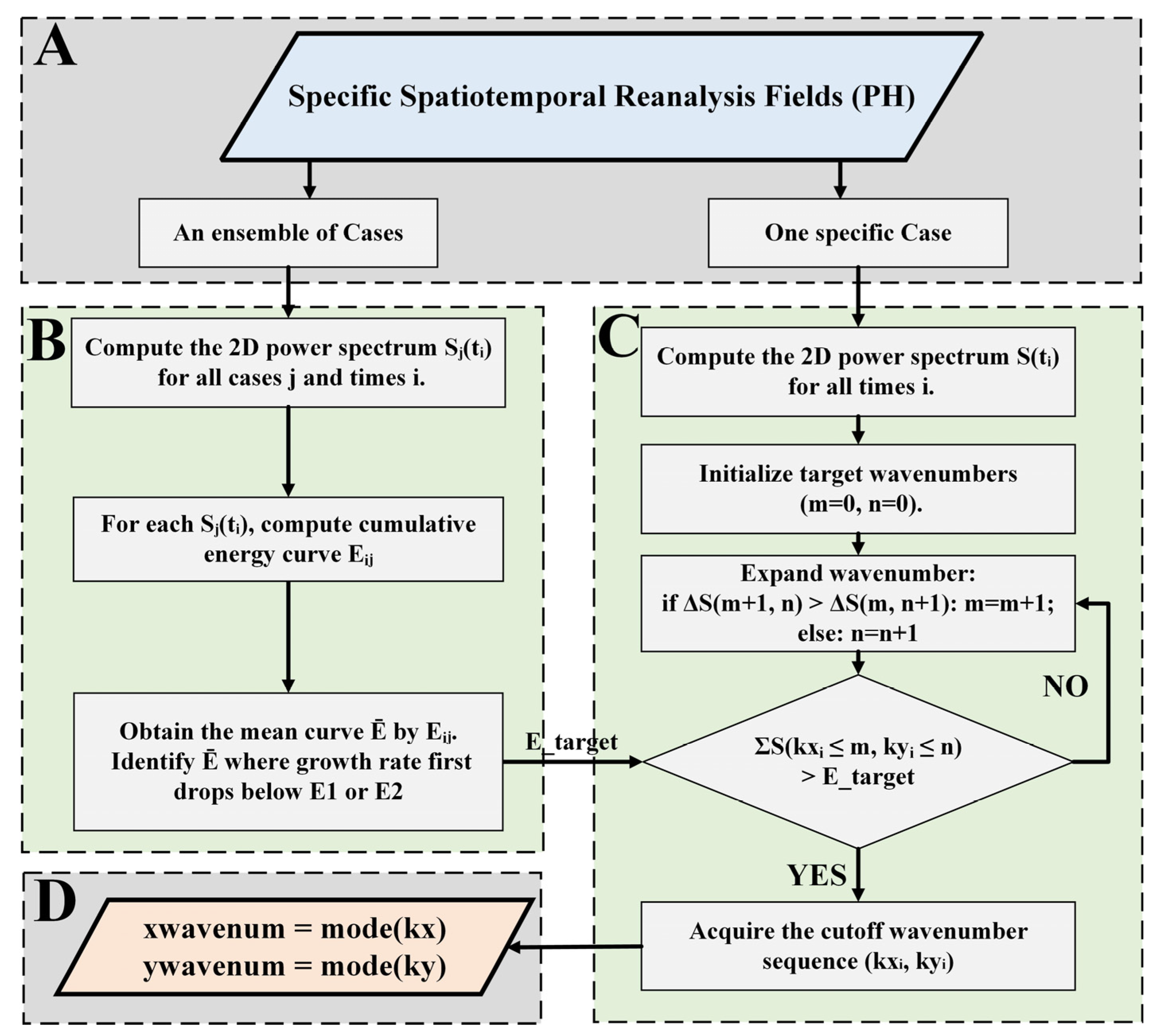
The energy-threshold method for selecting the cutoff wavenumber is illustrated in Figure 2. For a given forecast time, the 500 hPa geopotential height field from ERA5 within the WRF domain is extracted, detrended, and transformed via a two-dimensional Fourier transform (Module A). Its two-dimensional power spectrum is then computed, thereby mapping the field’s energy into wavenumber space.
An energy-threshold window algorithm is applied to this spectrum to objectively identify the key wavenumber range associated with the dominant large-scale circulation (Module C). Starting from the lowest wavenumbers, the algorithm iteratively expands the selected wavenumber window by incorporating the zonal or meridional wavenumber that yields the greatest energy increase. The iteration stops once the cumulative normalized energy exceeds a predefined threshold, denoted E_target. The determination of E_target is detailed in Module B. The algorithm thus yields an objective pair of zonal and meridional cutoff wavenumbers (xwavenum, ywavenum) for that time step. Using these parameters, WRF nudges toward a low-pass filtered field that retains the essential large-scale circulation while filtering out small-scale perturbations.
E_target is determined through a statistical analysis of ensemble cases, focusing on the cumulative energy increase in wavenumber space associated with large-scale and synoptic-scale systems (Module B). Two key thresholds are defined: 10% (E1) and 1% (E2). The algorithm identifies the point where the energy growth rate first falls below E1 to indicate that the dominant fluctuating features of the large-scale circulation have been captured. Subsequently, when the growth rate declines further below E2, the incorporation of synoptic-scale system features is considered complete. Using E1 as the target primarily constrains the WRF background field to the large-scale circulation. In contrast, applying E2 allows the background field to approximate both the large-scale circulation and the embedded synoptic-scale systems.
To ensure the temporal stability of the parameters throughout the integration, a statistical optimization is performed (Module D). Background fields at multiple forecast times within the target period are analyzed independently, yielding a sample sequence of cutoff wavenumber pairs. The modal values of the zonal and meridional wavenumbers from this sample are then adopted as the final, time-invariant parameters for WRF spectral nudging. This ensures that the spectral constraint is applied to the most persistent and representative large-scale circulation components throughout the simulation.

3. Forecasting Experiments

3.1. Study Case

Following the heatwave definition in Section 2.2, 160 extreme heat events and 24 heatwave events were identified from 2015 to 2024. This study selects a significant heatwave event occurring from 15 to 17 August 2019 for case study.
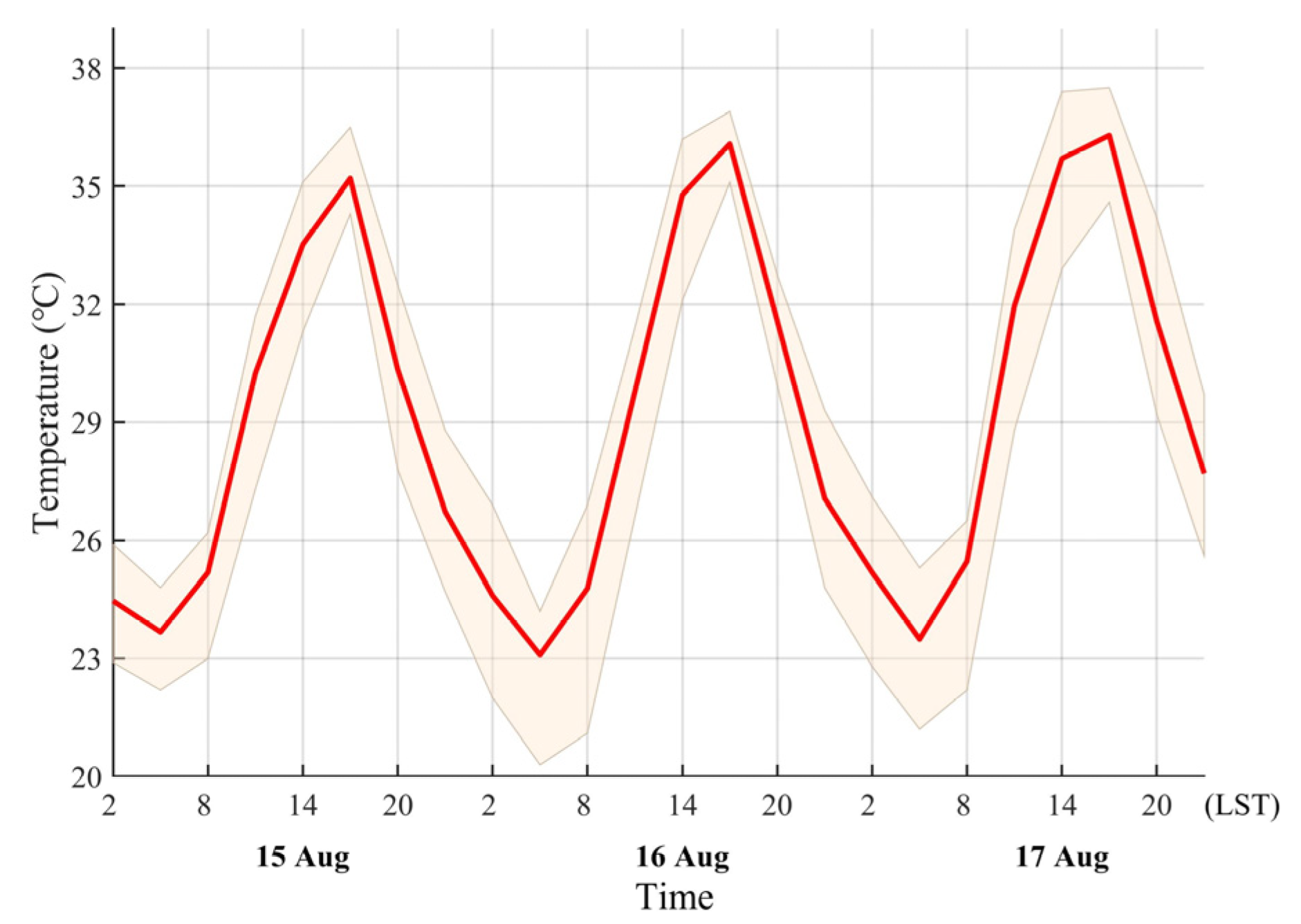
This case study focuses on a heatwave event distinguished by its pronounced regional persistence and sustained high temperatures. Figure 3 presents the three-hourly evolution of 2 m air temperature from 15–17 August at selected stations within the Sichuan electricity grid (locations provided in Figure 1b). The temporal progression shows a consistent daily warming trend, with the regional mean 2 m temperature (average of the 15 stations) approaching 37 °C by 17 August.
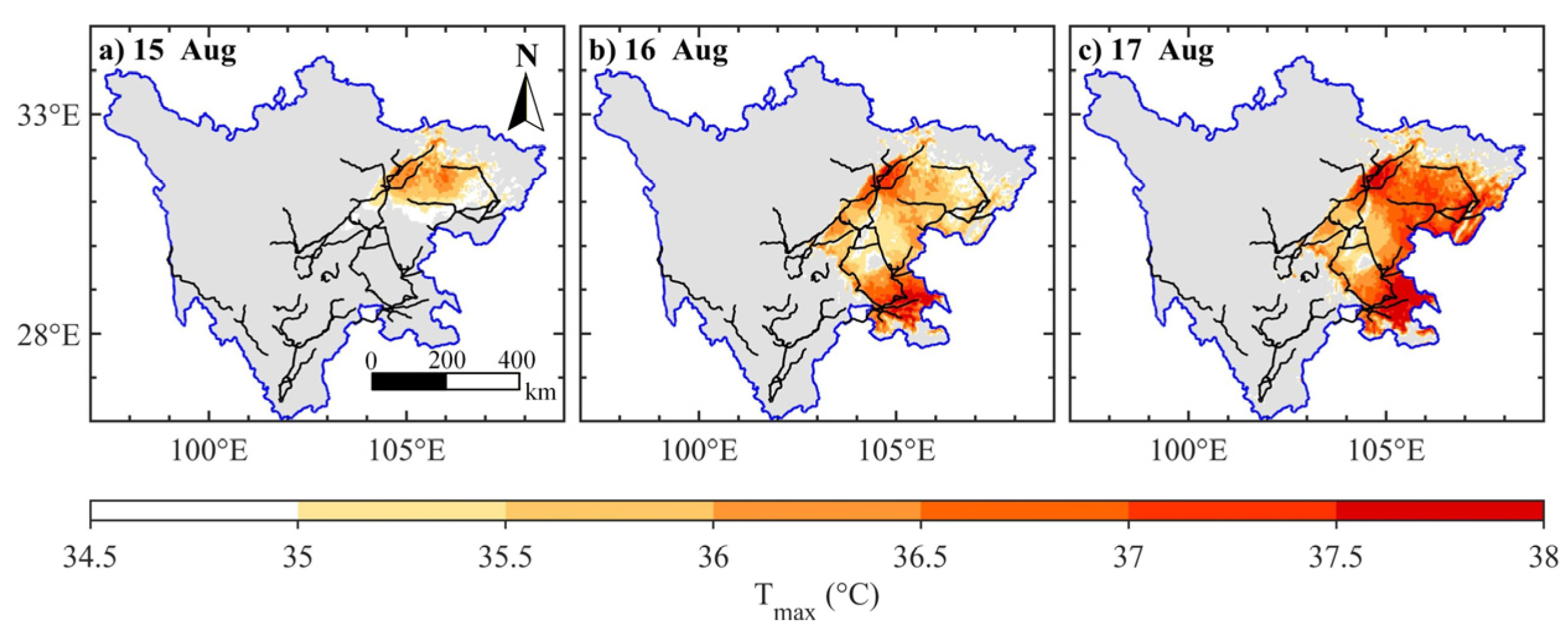
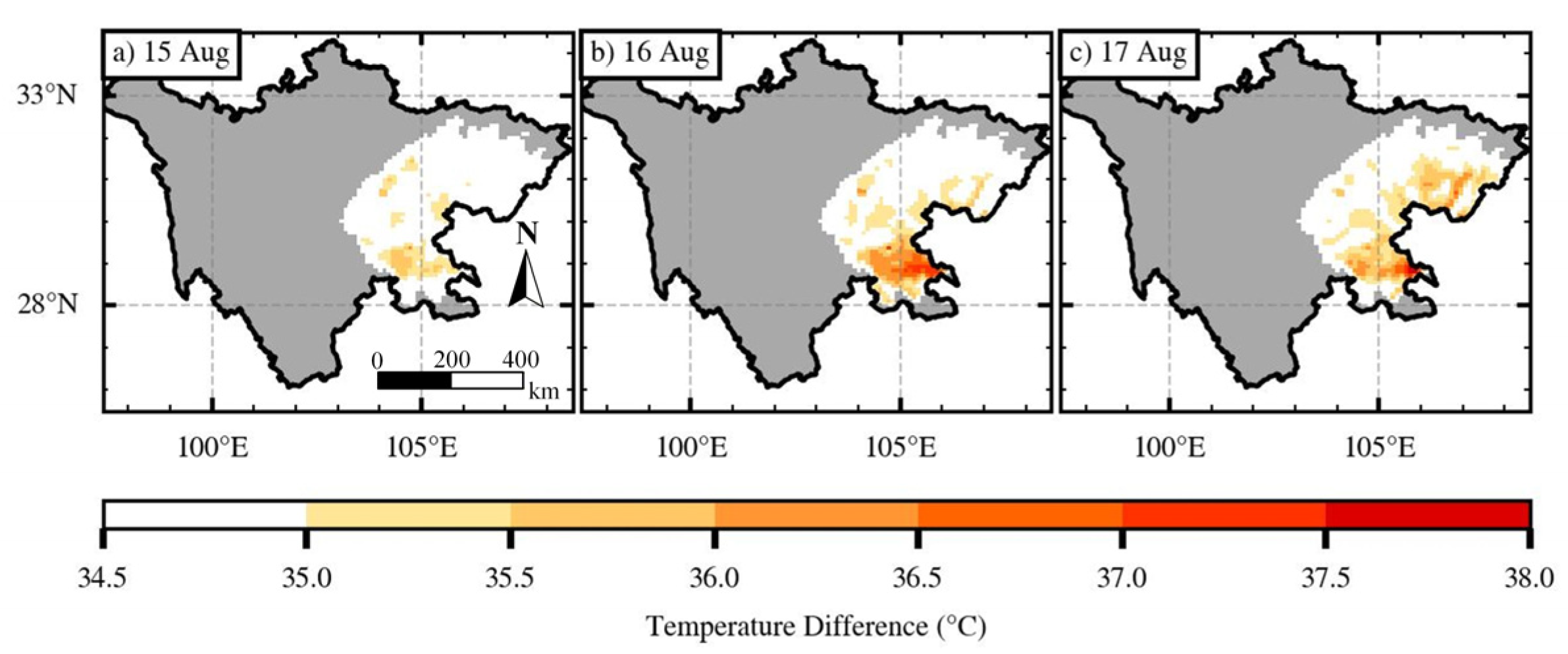
To map the spatial extent of the heatwave, we used daily maximum 2 m temperature (Tmax) data from CDMet to identify regions where temperatures reached or exceeded 35 °C between 15 and 17 August (Figure 4). The high-temperature zone was largely confined to the plains of the Sichuan Basin, with elevated areas remaining comparatively unaffected. From the 15th to the 17th, the zone expanded progressively from northeastern Sichuan across the entire eastern part of the province, with both its coverage and intensity increasing each day.
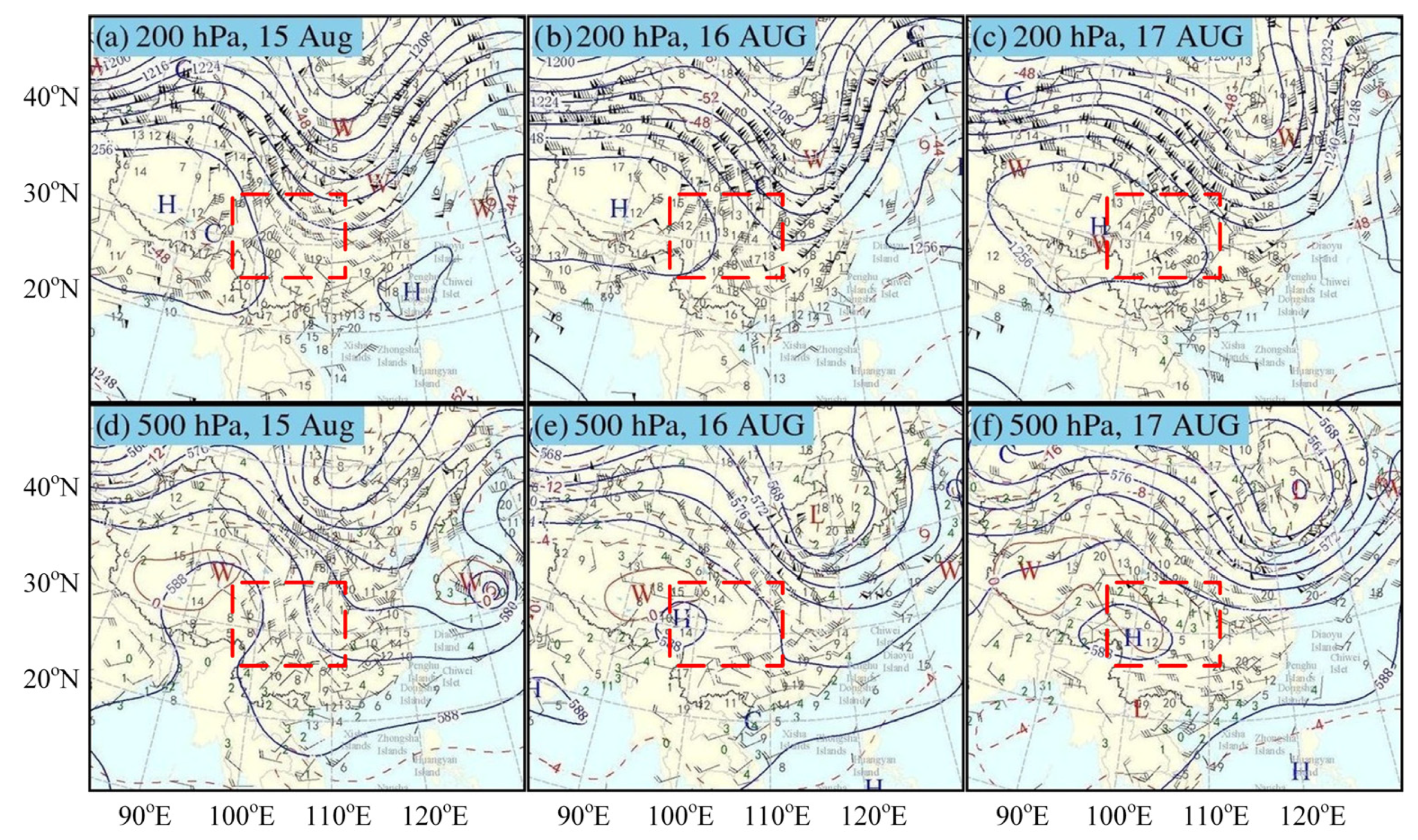
While earlier research attributes persistent high temperatures in Sichuan mainly to the western Pacific subtropical high [22], the present event exhibits a distinct circulation pattern. Weather charts at 200 hPa and 500 hPa (Figure 5) show that a continental thermal high-pressure system (Figure 5a–c) dominated the Tibetan Plateau and the Sichuan Basin, whereas an upper-level trough at 500 hPa was situated east of Sichuan (Figure 5d–f). At 0800 LST (UTC+8) on 15 August, the 5880 gpm geopotential height contour advanced northward to approximately 30 °N (Figure 5d), reflecting a notable northward displacement of the high. With its eastern flank extending near 100 °E, the high established control over Sichuan, promoting large-scale subsidence and creating a background favorable for surface warming. By 0800 LST on 16 August, although the core of the high had shifted slightly eastward and southward, the 5880 gpm contour remained over Sichuan, enabling the persistence and further amplification of high temperatures (cf. Figure 4a,b). By 0800 LST on 17 August, the high had extended eastward from 100 °E to around 105 °E, reinforcing a persistent and stable subsidence zone over the eastern Sichuan Basin. This evolution supported the continued expansion and intensification of surface high-temperature areas (cf. Figure 4b,c).

3.2. Model Configuration

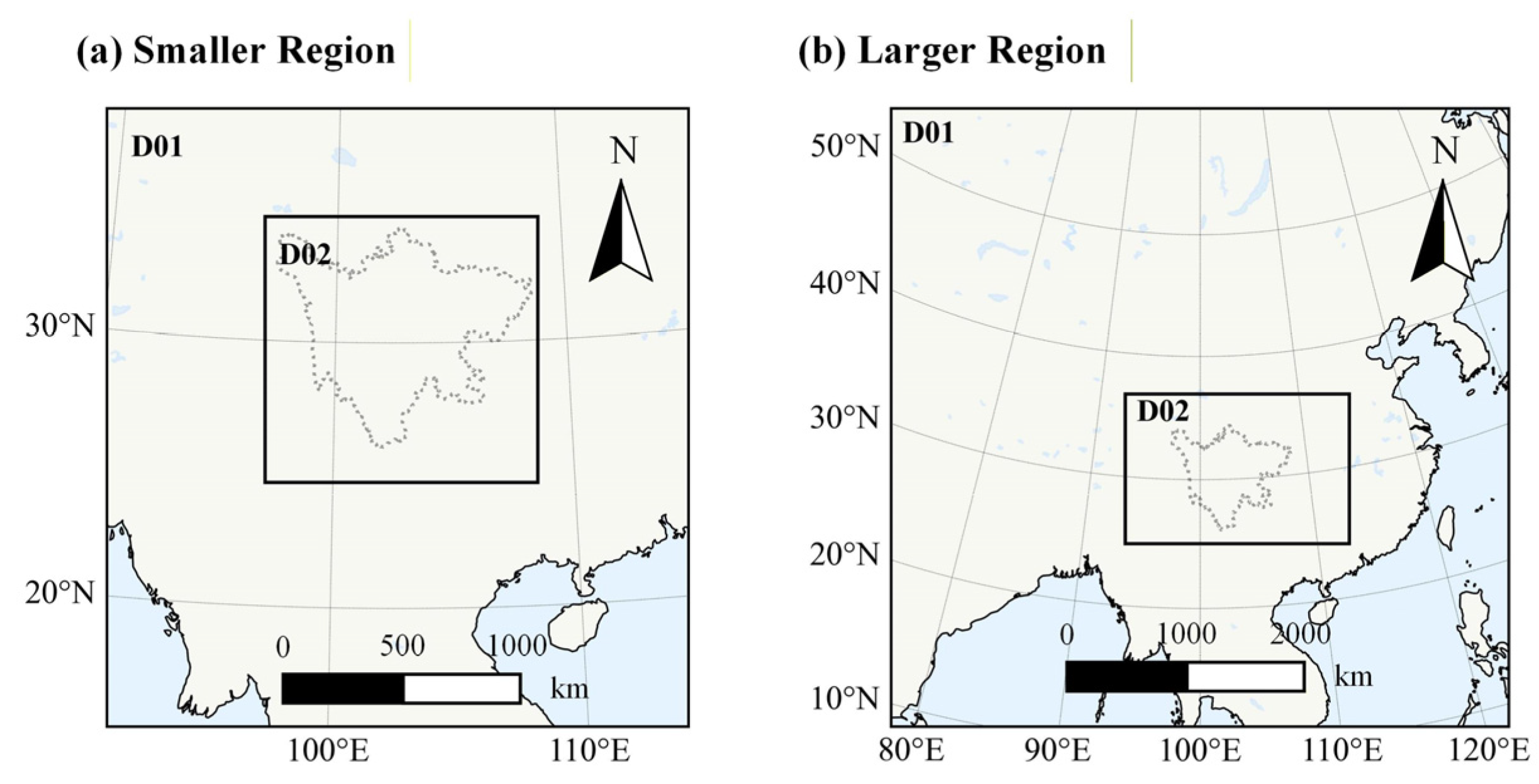
We employ the WRF model, version 4.3, to simulate the heatwave event affecting the electricity grid described in Section 2.1. Two sets of WRF simulation domains are designed for the comparative experiments in Section 3.3.2. The WRF simulation uses a two-way nested configuration with two domains under a Lambert projection centered at (123 °E, 30.5 °N). The outer domain (D01) has a horizontal resolution of 30 km, while the inner domain (D02) is run at 10 km resolution (Figure 6). The vertical grid consists of 57 layers. The following physical parameterization schemes are selected: the YSU scheme for the planetary boundary layer [23], the Purdue-Lin scheme for microphysics [24], the Kain-Fritsch scheme for cumulus convection [25], the RRTMG scheme for both longwave and shortwave radiation [26], and the Noah land surface model for land surface processes [27]. The initial and lateral boundary conditions for the WRF model were provided by the ERA5 reanalysis. The lateral boundary conditions were updated every 6 h. The provided fields include essential pressure-level variables (e.g., geopotential height, temperature, U and V wind components, moisture information).
Spectral nudging is applied exclusively to the outer domain (D01). It acts on four variables simultaneously: geopotential height, horizontal wind components, temperature, and water vapor mixing ratio. The nudging coefficient is set to the typical WRF-recommended value of 0.0003 s−1, and nudging is performed throughout the entire integration. To prevent excessive interference with near-surface processes dominated by local topography and land-surface interactions, spectral nudging is intentionally deactivated below the boundary layer top. This configuration aims to correct the large-scale circulation while retaining the model’s ability to develop fine-scale structures within the boundary layer.

3.3. Experimental Design

3.3.1. Cutoff Wavenumber Selection

For the outer domains (D01) in the two model configurations shown in Figure 6, we employed the energy-threshold method outlined in Section 2.3.2 to derive the key spectral nudging parameters xwavenum and ywavenum. The spatial extent of the PH(ti) field in Figure 2 approximately matches the D01 domain. To determine the energy threshold, we used Sj(ti) data from 160 extreme heat events between 2015 and 2024. For the specific case study, however, the PH(ti) field covering only the event period (15–17 August 2019) was utilized to compute the spectral nudging parameters.
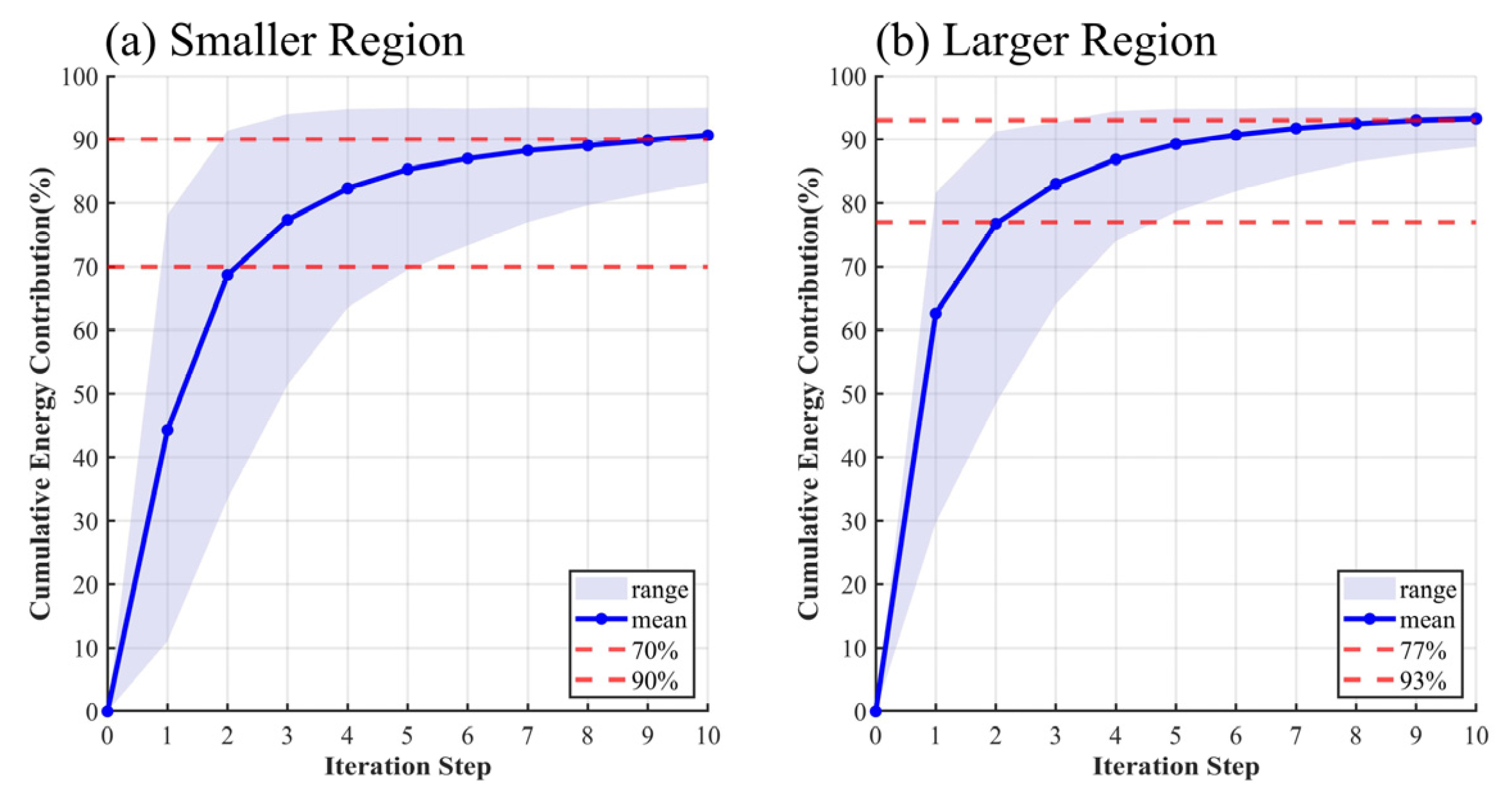
Figure 7 presents the average cumulative energy contribution of the low-pass-filtered field derived from these 160 events. In the smaller region (Figure 7a), energy accumulation increases steadily until approximately 70% (as E1 for the smaller region), beyond which the growth rate slows substantially and approaches saturation after 90% (as E2 for the smaller region). A similar pattern is evident in the larger region (Figure 7b), where the accumulation rate declines noticeably after about 77% (as E1 for the larger region) and effectively plateaus above 93% (as E2 for the larger region). These inflection points are interpreted as energy thresholds that separate dominant from secondary circulation scales. Consequently, the energy-contribution values at these points were adopted as the thresholds for the wave-tracking algorithm.
The selected energy thresholds are 70% and 90% for the smaller region, and 77% and 93% for the larger region. Following the procedure in Figure 2, these thresholds yielded the final spectral nudging parameters: (xwavenum, ywavenum) = (2, 2) and (8, 6) for the smaller region, and (2, 1) and (5, 2) for the larger region.

3.3.2. Comparative Experiment Design

In regional modeling, the influence of lateral boundary conditions on simulation outcomes depends primarily on the size of the simulation domain and the forecast length. When the domain is relatively small and the forecast period is short (e.g., 3–4 days), information from the boundaries can exert a dominant influence on the evolution of weather systems within the domain. This strong boundary constraint may fail to accurately represent the actual large-scale circulation that governs weather system development, thereby introducing forecast errors. Under such circumstances, applying the spectral nudging technique, which nudges the model’s large-scale circulation toward reanalysis data or global forecasts, can effectively correct weather system drift arising from the lateral boundary conditions.
Based on this reasoning, it is hypothesized that the improvement from spectral nudging should become more pronounced with increasing forecast length, as forecast errors from large-scale circulation drift accumulate over time. However, for a given forecast length (e.g., 5–7 days), if the simulation domain is sufficiently large, the model possesses adequate space to develop internal dynamical processes and realistically evolve the large-scale circulation. In this case, the additional improvement contributed by spectral nudging may be relatively limited.
Therefore, for the two domain sizes shown in Figure 6 (the smaller region, SR and larger region, LR), we designed two forecast lengths: 96 h (shorter-term, ST) and 144 h (longer-term, LT). Since the forecast target is the heatwave event of 15–17 August, the forecast length essentially corresponds to varying lead times. This combination defines four experimental groups (G1–G4; see Table 1). Each group consists of a control experiment without spectral nudging and two spectral nudging experiments using the wavenumber pairs (xwavenum, ywavenum) corresponding to the E1 and E2 inflection points derived in Section 3.3.1. Groups G1 and G2 are the longer-term forecasts for the smaller and larger regions, respectively, whereas G3 and G4 are their shorter-term counterparts.

4. Results

4.1. Evaluation of Simulation Performance Under Different Configurations

4.1.1. Compensatory Effect of Spectral Nudging in a Smaller Domain

The control experiment in Group G1 (LT-SR-no) used a relatively small simulation domain, which limited the captured large-scale circulation and allowed error accumulation (i.e., large-scale drift) over long integration times. Theoretically, this could lead to poor forecasting of the heatwave. Figure 3 shows that the daily maximum 2 m temperature during this heatwave event occurred around 1700 LST; therefore, the 2 m temperature at 1700 LST was used to characterize the spatial extent and intensity of the heatwave. The spatiotemporal evolution of the heatwave simulated by experiment LT-SR-no is presented in Figure 8. Compared with observations (Figure 4), the simulated heatwave extent is notably smaller and its intensity is weaker. In particular, the experiment failed to reproduce the high temperatures over the eastern Sichuan Basin (east of 105 °E) on 17 August (cf. Figure 4c and Figure 8c).
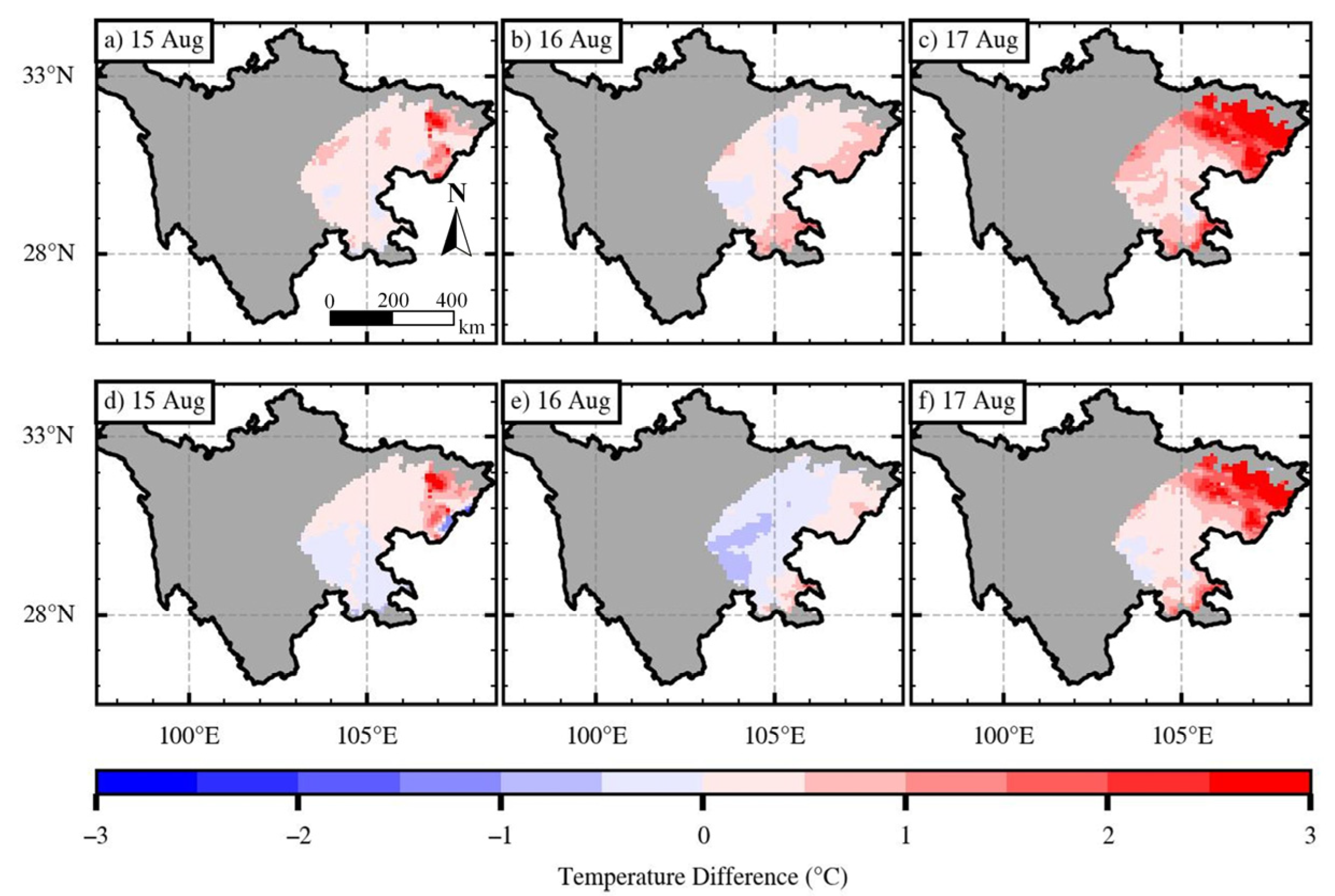
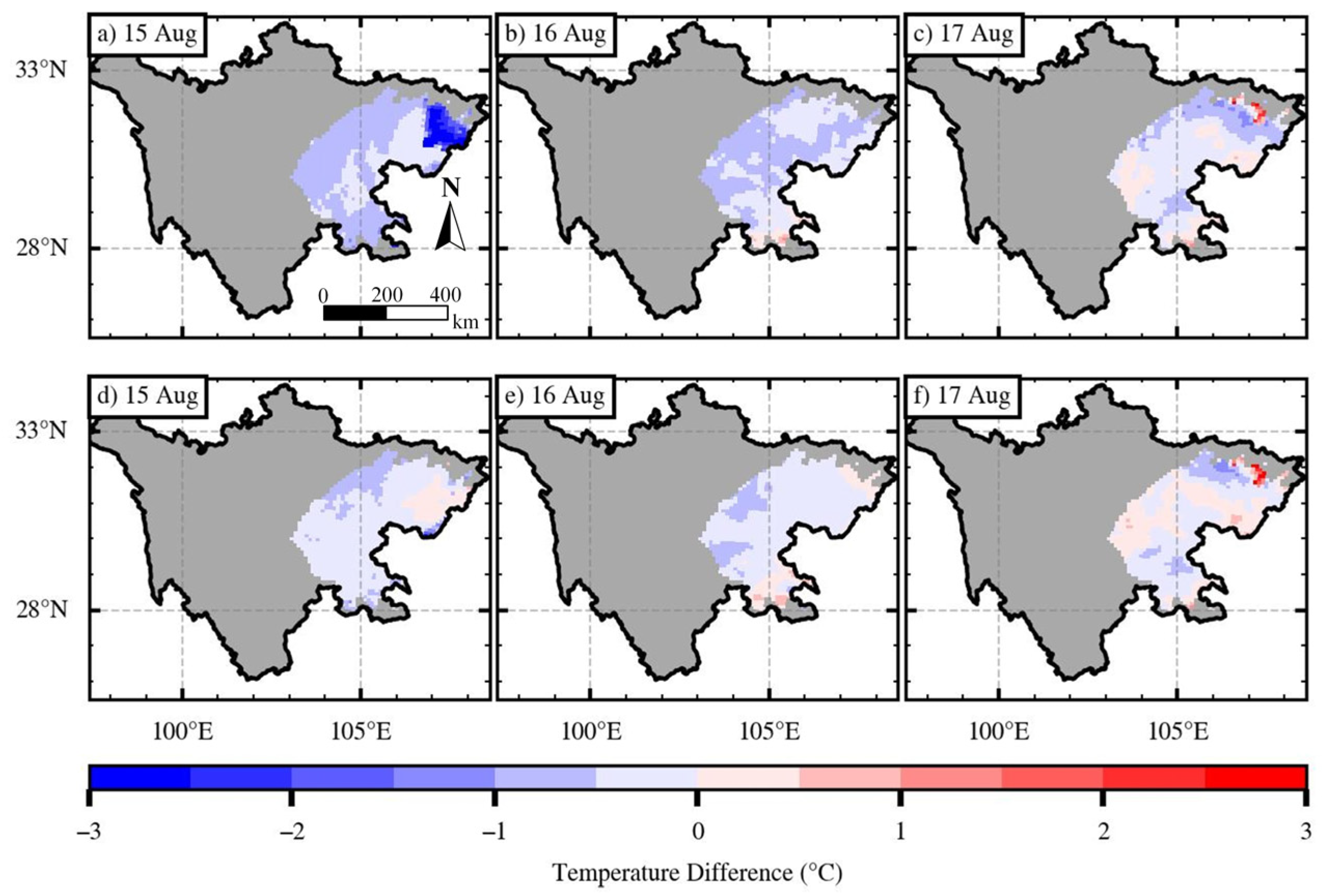
The other two sensitivity experiments in Group G1 (LT-SR-E1 and LT-SR-E2) employed spectral nudging, yielding simulated heatwave evolutions that differed markedly from the control run (LT-SR-no). These differences are illustrated in Figure 9, which shows how spectral nudging modifies the simulated heatwave pattern. Crucially, the spatial changes reflect a correction of the underlying dynamical bias, not just a quantitative adjustment.
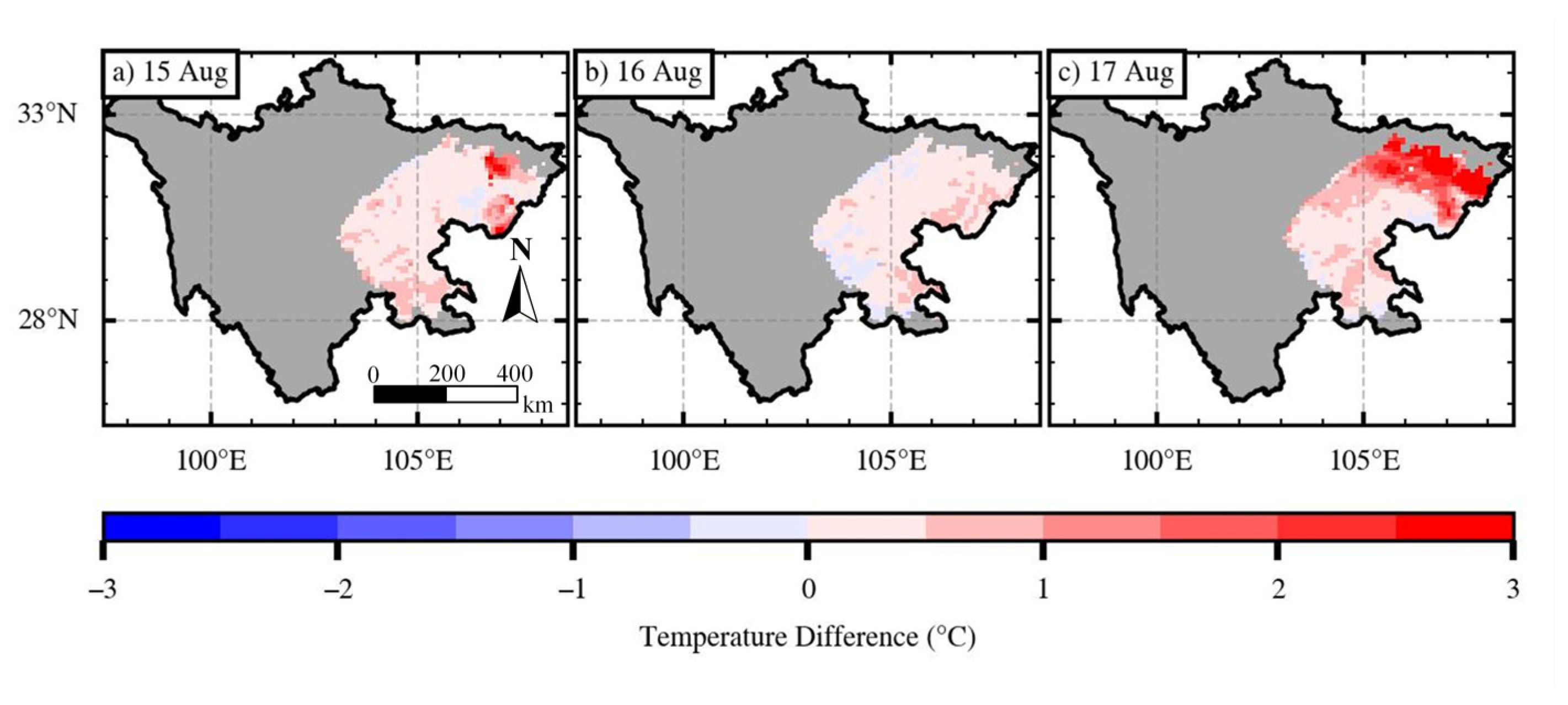
For LT-SR-E1 (Figure 9a–c), the heatwave intensity was significantly stronger than in LT-SR-no, with temperatures 2–3 °C higher over the eastern Sichuan Basin (east of 105 °E) on 17 August. This spatially concentrated warming is the direct surface manifestation of the compensatory effect: by constraining the dominant large-scale waves, spectral nudging systematically intensified the synoptic-scale high-pressure system aloft. The enhanced subsidence associated with a stronger high suppresses cloud formation and promotes adiabatic warming, leading to the more accurate and intense heatwave forecast shown here. The confinement of the strongest warming to the basin’s eastern sector underscores that the improvement stems from a better-represented circulation pattern.
In contrast, LT-SR-E2 (Figure 9d–f), which applied a broader spectral constraint (higher cutoff wavenumbers), produced a more mixed result. While it also showed warming over the eastern basin on 17 August (Figure 9f), its simulated heatwave intensity was generally weaker than that of the control run (LT-SR-no) on 15–16 August (Figure 9d–e). This suggests that the less selective constraint of LT-SR-E2 was less effective in compensating for the large-scale drift during the earlier phase of the forecast, and may have begun to suppress beneficial mesoscale development, a precursor to the over-constraint effect discussed later for larger domains.
To quantitatively evaluate the heatwave forecast performance of Group G1 experiments, the simulated 2 m temperature at 1700 LST was bilinearly interpolated to CDMet stations (with daily maximum temperature ≥ 35 °C) near the electricity grid. The mean error (ME) and root mean square error (RMSE) were then calculated; the results are listed in Table 2. All experiments in Group G1 showed a negative ME, indicating a systematic underestimation of heatwave intensity. The underestimation was most pronounced in the control experiment LT-SR-no (ME and RMSE of −2.41 °C and 2.78 °C, respectively). The application of spectral nudging reduced these errors. For example, compared with LT-SR-no, experiment LT-SR-E2 improved the ME and RMSE by 15% and 15%, respectively, while LT-SR-E1 showed even greater improvements of 25% and 21%.
The cutoff wavenumber pair for experiment LT-SR-E2 was (8, 6), whereas for LT-SR-E1 it was (2, 2). This indicates that the former nudged not only large-scale circulation but also relatively smaller-scale systems. The comparative results from the three experiments in Group G1 (see Figure 9 and Table 2) demonstrate that within a relatively small domain, better simulation is achieved by nudging only the dominant large-scale circulation (as in LT-SR-E1). Forecast errors arising from system drift due to the limited domain can be partially corrected by spectral nudging, an effect we term the compensatory effect of spectral nudging. Importantly, the performance of LT-SR-E2, which nudges a broader spectrum of waves (including synoptic scales) and thus approximates the effect of a strong-constraint grid nudging, lies between that of the control run and the optimal spectral nudging (LT-SR-E1). This quantitative comparison underscores a key advantage of properly configured spectral nudging: by selectively constraining only the most critical large-scale waves, it achieves superior forecast skill compared to both no nudging and a nudging strategy that imposes broader, less selective constraints.

4.1.2. Over-Constraint Effect of Spectral Nudging in a Larger Domain

Theoretically, a larger simulation domain can better resolve the spatiotemporal evolution of large-scale circulation, alleviate system drift caused by boundary conditions, and thus improve forecast performance. This theoretical expectation is supported by the results of the control experiment LT-LR-no in Group G2 (Figure 10). The heatwave intensity simulated by LT-LR-no was stronger than that in LT-SR-no and was nearly comparable to that of experiment LT-SR-E1, which used spectral nudging (cf. Figure 9a–c and Figure 10a–c).
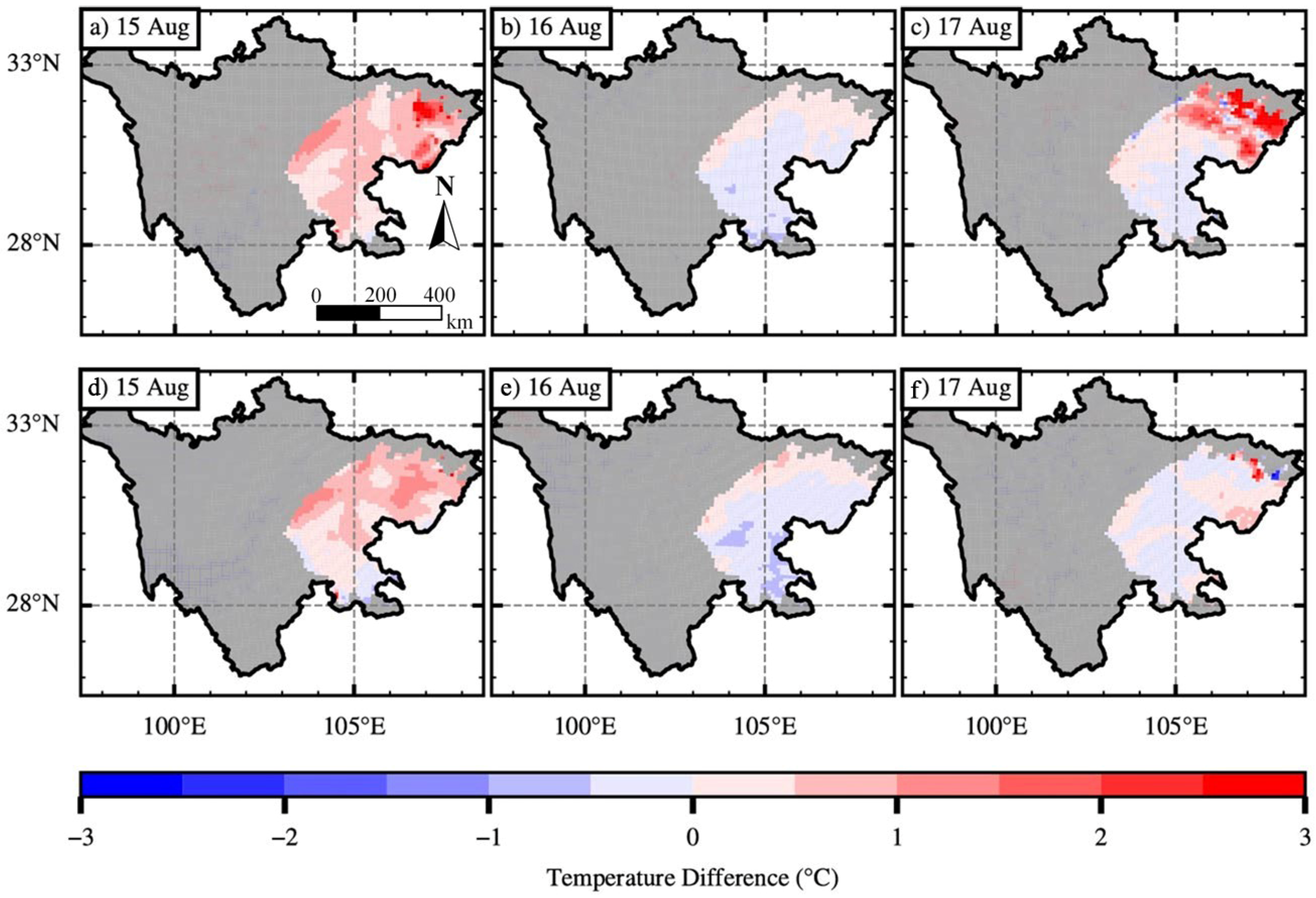
However, the two sensitivity experiments in Group G2 that employed spectral nudging (LT-LR-E1 and LT-LR-E2) performed worse than the control experiment LT-LR-no (Figure 11). Contrary to the performance ranking in Group G1 (where LT-SR-E1 outperformed LT-SR-E2), LT-LR-E1 performed worse than LT-LR-E2. Quantitative statistics (table omitted) also confirmed this finding. This indicates that when the simulation domain is sufficiently large to adequately resolve the evolution of large-scale circulation, imposing spectral nudging to constrain either the large-scale circulation (LT-LR-E1) or relatively smaller-scale systems (LT-LR-E2) degrades the heatwave forecast. We term this the over-constraint effect of spectral nudging.

4.1.3. Sensitivity of the Nudging Effect to the Length of Lead Time

The forecast lead time for Groups G1 and G2 was 144 h. If the lead time is shortened, the drift of large-scale circulation systems would be relatively smaller, potentially leading to better forecast performance than in the longer-lead experiments. Groups G3 and G4 correspond to G1 and G2, respectively, but with a shortened lead time of 96 h. The forecast performance of their control experiments (ST-SR-no and ST-LR-no) for the heatwave showed clear improvement compared to the control experiments in Groups G1 and G2 (LT-SR-no and LT-LR-no). Figure 12 illustrates these improvements in the spatiotemporal evolution of the heatwave. The improvement was more pronounced for the smaller domain (Figure 12a–c) than for the larger domain (Figure 12d–f), particularly for the forecast on 17 August (cf. Figure 12c,f).
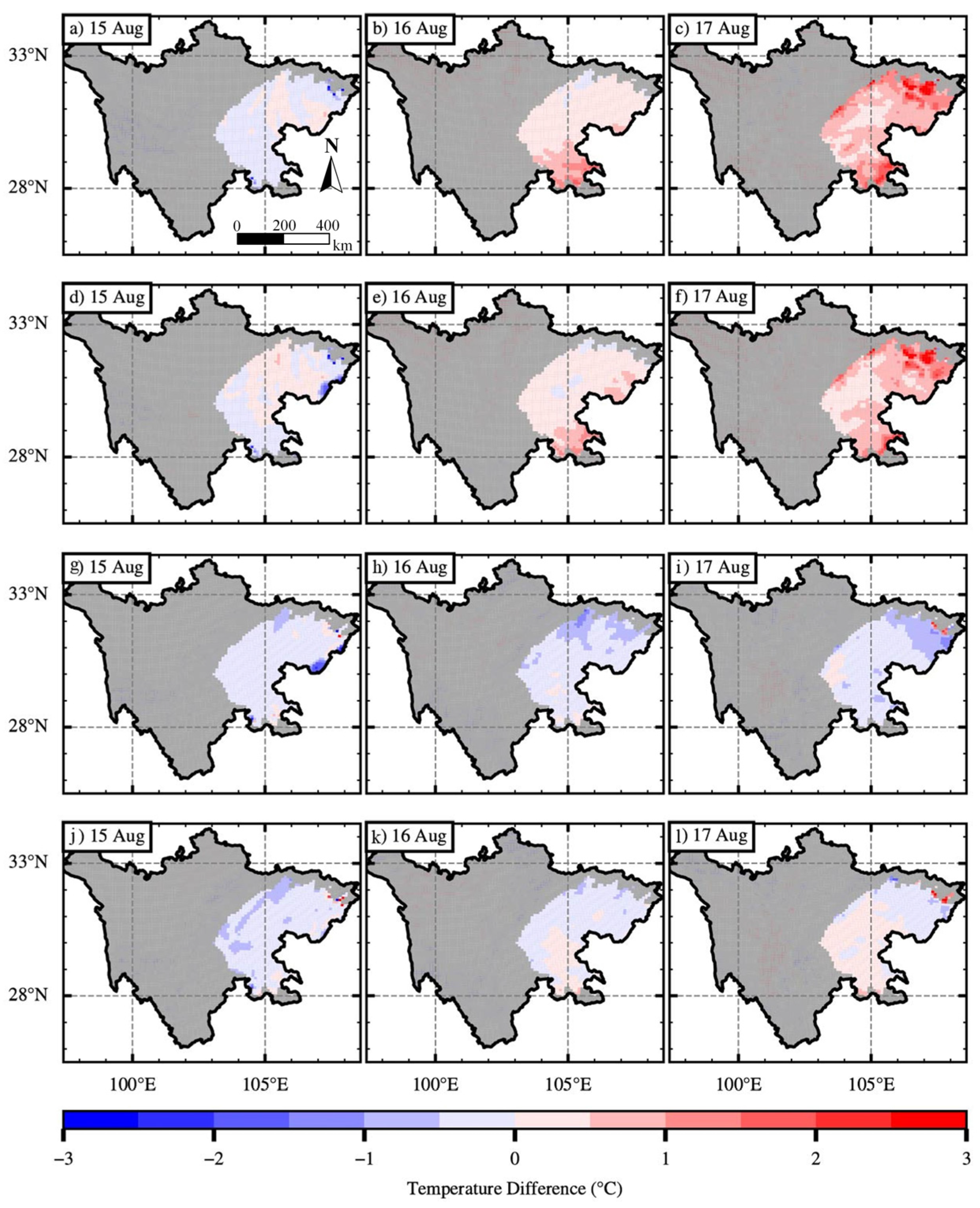
Figure 13 shows the impact of the sensitivity experiments in Groups G3 and G4 on heatwave forecasts relative to their respective control experiments. It reveals the differential effects of spectral nudging on forecast performance for smaller and larger domains under a shorter lead time. For the smaller domain, both ST-SR-E1 (top row of Figure 13) and ST-SR-E2 (second row) significantly improved the heatwave forecast on 16 and 17 August. In contrast, for the larger domain, ST-LR-E1 (third row) and ST-LR-E2 (bottom row) did not yield clear improvements. This indicates that with a shorter lead time, applying spectral nudging in a smaller domain can effectively improve heatwave forecasts, whereas its benefit is minimal for a larger domain.
A quantitative assessment of the heatwave forecast performance for Groups G3 and G4 is summarized in Table 3, supporting the qualitative analysis from Figure 12 and Figure 13. Control experiments with shorter lead times consistently showed better ME and RMSE than their longer-lead counterparts (e.g., compare ST-SR-no in Table 3 with LT-SR-no in Table 2). Notably, ST-LR-no achieved the best performance among all experiments without spectral nudging, with a three-day average RMSE of 2.03 °C and a ME of −1.65 °C.
Among experiments using spectral nudging, the impact of a shorter lead time depended on the domain size. For the smaller domain, experiments ST-SR-E1 and ST-SR-E2 further improved the forecasts relative to the control (ST-SR-no), with average ME improvement rates of 20% and 18%, and RMSE improvement rates of 15% and 14%, respectively. However, for the larger domain, applying spectral nudging led to a slight degradation in performance. For instance, ST-LR-E1 and ST-LR-E2 showed increased ME by 18% and 10%, and increased RMSE by 14% and 9%, respectively. This reaffirms that even with a shorter lead time, spectral nudging applied to a large domain that already resolves large-scale circulation well may suppress the free development of weather systems within the domain, consequently degrading the heatwave forecast. Across all experiments, the configurations using our objectively determined optimal cutoff wavenumber (E1) consistently outperformed or matched their E2 counterparts, which acted as proxies for less scale-selective nudging. This reinforces the conceptual superiority of an objective, scale-selective approach over a one-size-fits-all constraint strategy.
The analysis in Section 4.1 demonstrates that the impact of spectral nudging on the forecast of persistent high temperatures over the Sichuan Basin is highly conditional. For long-term (LT) simulations in a smaller domain (SR), spectral nudging effectively improves the simulation by elevating temperatures and reducing errors. In contrast, for a larger domain (LR), its over-constraining effect degrades performance. Shortening the forecast lead time (ST) offers an alternative pathway to slightly improve accuracy. Within the short-term forecast situation, the magnitude of improvement from spectral nudging is comparable to that from shortening the lead time. However, its effectiveness remains strictly modulated by the domain size: it is beneficial only for small domains and still produces negative effects in large domains.

4.2. Underlying Mechanism: Modulation of Background Circulation by Spectral Nudging

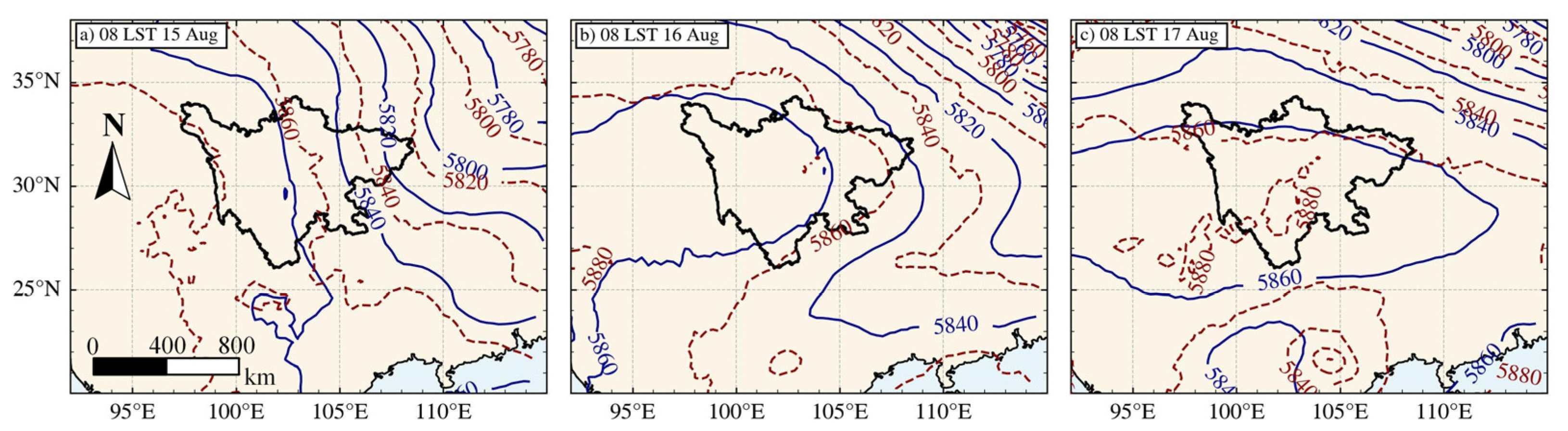
To investigate the mechanism behind the impact of spectral nudging on forecast performance, we examined the difference in the 500 hPa geopotential height field between experiments LT-SR-no and LT-SR-E1 as an example. The choice of this level is based on the fact that the cutoff wavenumber pair (xwavenum, ywavenum) controlling the spectral nudging was derived from the 500 hPa height field (see Section 2.3.2). Figure 14 compares the 500 hPa geopotential height fields from ERA5 and experiment LT-SR-no at 0800 LST on 15–17 August 2019. The 5880 gpm contour present in the CMA weather analysis charts (Figure 5d–f) is not seen in the ERA5 reanalysis (blue solid lines in Figure 14) and was also not captured by experiment LT-SR-no (red dashed lines in Figure 14). This indicates that ERA5, which provided the background fields for the WRF simulation, systematically underestimated the high-pressure system, leading to a persistently weaker simulated circulation in LT-SR-no compared to the observations.
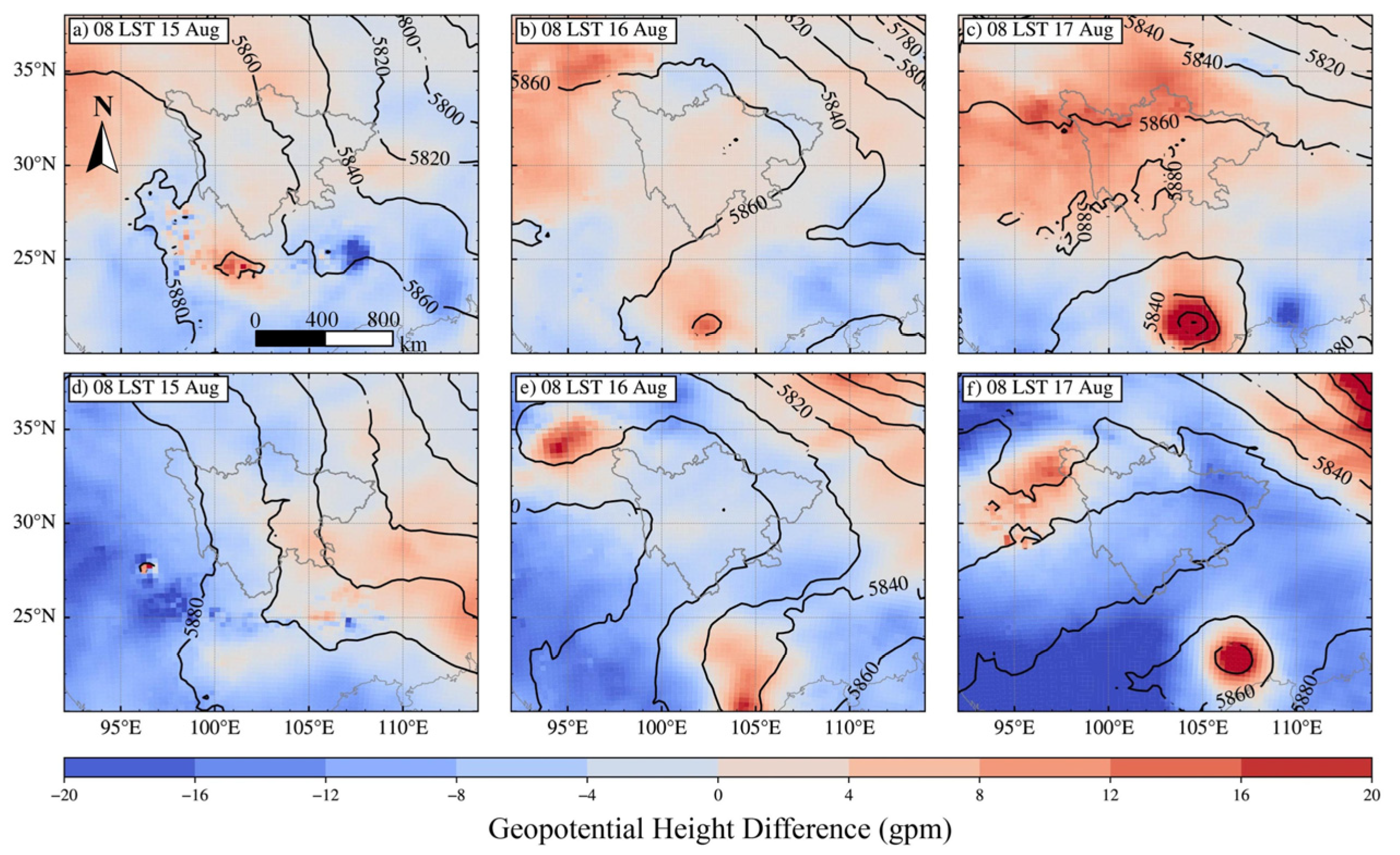
The forecast performance of experiment LT-SR-E1 improved significantly with the application of spectral nudging (Table 2). Comparing the 500 hPa height fields of LT-SR-E1 and LT-SR-no (Figure 15a–c) reveals a notable increase in geopotential height over the Sichuan region in LT-SR-E1, bringing it closer to the observations in Figure 5. This suggests that spectral nudging, by constraining the large-scale circulation over Sichuan while allowing meso- and small-scale systems to develop freely, compensated for the underestimation of the high-pressure system inherent in the background field. Consequently, it more accurately reproduced the high-pressure system dominating the Sichuan extreme heat weather, leading to a significant improvement in the heatwave forecast.
For the larger domain, experiment LT-LR-E1 performed worse than LT-LR-no (Figure 11). The 500 hPa geopotential height differences in Figure 15 directly link the spectral nudging constraint to the forecast skill documented in Section 4.1. In Figure 15a–c (LT-SR-E1 minus LT-SR-no), the broad area of positive height anomalies over Sichuan signifies a strengthening of the upper-level ridge. This correction towards a more realistic high-pressure system (cf. Figure 5) is the key dynamical driver behind the compensatory effect: it enhances large-scale subsidence, stabilizes the atmospheric column, and thereby amplifies the surface heating captured in Figure 9a–c. Conversely, Figure 15d–f (LT-LR-E1 minus LT-LR-no) show negative height anomalies, indicating that nudging weakened the ridge in the large-domain experiment. This dynamical degradation explains the corresponding deterioration in surface heatwave forecasts (Figure 11a–c), exemplifying the over-constraint effect where nudging disrupts an already well-evolving circulation. Thus, these height difference maps are not just auxiliary diagnostics; they provide the causal physical explanation for the performance changes shown in the temperature maps. Further analysis of the 850 hPa temperature field (figure omitted) revealed that when the 500 hPa height field was stronger, the 850 hPa level over Sichuan was noticeably warmer. This suggests that a stronger 500 hPa height field intensifies subsidence, favoring the enhancement of heatwave intensity.

4.3. A Fourier-Based Interpretation of Spectral Nudging Effects

Based on the diagnostic results from the specific case study presented above, we can formulate a more general physical interpretation of the compensatory and over-constraint effects, which carries implications for the broader application of spectral nudging.
The contrasting effects of spectral nudging—beneficial compensation in small domains and detrimental over-constraint in large ones—originate from fundamental principles of wave interaction in limited domains, suggesting a potentially generalizable framework for its application.
From a spectral perspective, when a domain is dominated by a single coherent system (e.g., a subtropical high), its structure is captured by specific low-wavenumber components. Spectral nudging “anchors” these key components, but more importantly, it fixes the phase reference for the entire wave packet representing that system. This phase-locking enables constructive superposition between the constrained large-scale waves and the model’s internally generated smaller-scale features, systematically reinforcing the system’s core intensity—manifesting as the compensatory effect. This mechanism is not specific to heatwaves or the Sichuan region; it should apply wherever a well-defined, dominant large-scale circulation (e.g., a blocking high, persistent trough, or monsoon system) controls the weather phenomenon of interest, provided the domain scale appropriately captures that system.
Conversely, in domains containing multiple interacting systems, the Fourier spectrum becomes populated by competing wavenumber sets representing different systems. Constraining this broader spectrum does not reinforce a single coherent entity. Instead, it rigidly prescribes phase relationships between multiple wave packets, which can destructively interfere with the regional model’s internal multi-scale dynamics. This suppresses physically meaningful mesoscale development—the over-constraint effect. This risk is likewise general: it will emerge whenever the domain is sufficiently large that the nudging must constrain a complex background flow rather than a single coherent wave packet, such as in continental-scale simulations or climate downscaling.
Thus, the method’s efficacy depends crucially on whether the spectral constraint is applied to a coherent wave packet (enhancing it through phase-locking) or to a complex wave background (disrupting scale interactions). This principle suggests compensatory effects should be most pronounced when a single dominant system exists within the domain, while over-constraint risks increase with domain size and circulation complexity. The proposed energy-threshold method operationalizes this principle by objectively identifying the coherent wave packet(s) to constrain. While the specific energy thresholds (E1, E2) may require calibration for different regions or flow regimes, the underlying concept of aligning the nudging scale with the dominant spectral signature of the governing circulation is universally applicable.
In summary, the conceptual framework developed here—linking domain size, circulation complexity, and wave interaction outcomes—provides a guiding principle for configuring spectral nudging. Future work should test this framework across diverse weather types and geographical settings to fully establish its generality and refine its operational implementation.

5. Conclusions

Aimed at supporting reliable electricity grid operations through better heatwave prediction over Sichuan’s complex topography, this study specifically targets the optimization of the key spectral nudging parameter, the cutoff wavenumber. Traditional selection methods, which are often subjective, lack objective criteria tailored to specific weather events and simulation domains. We developed an objective energy-threshold method, grounded in spectral energy analysis of the background 500 hPa geopotential height field, to determine a physically consistent cutoff wavenumber. Using the August 2019 Sichuan heatwave event as a case, comprehensive sensitivity experiments were conducted to assess the effects of domain size, forecast lead time, and spectral nudging configuration on forecast performance. The underlying mechanisms were further explored through circulation diagnostics.
The efficacy of spectral nudging is strongly modulated by the simulation domain scale. Over smaller domains and longer lead times, spectral nudging successfully compensates for large-scale circulation drift arising from insufficient lateral boundary constraints, yielding a marked improvement in heatwave forecasts—a compensatory effect. Conversely, in larger domains that inherently support more realistic large-scale evolution, applying spectral nudging suppresses beneficial mesoscale development and degrades forecast skill, revealing an over-constraint effect.
Forecast lead time offers an alternative pathway to enhance accuracy. Although shortening the lead time itself improves forecasts, the benefit of spectral nudging within short-term situations remains strictly scale-dependent. It provides significant gains only in smaller domains, whereas in larger domains, it offers no improvement and may even degrade performance.
The energy threshold method introduced here effectively isolates the dominant large-scale circulation patterns associated with the heatwave event from the background field, enabling an objective and physics-based determination of the spectral nudging cutoff wavenumber. This approach provides a viable alternative to subjective parameter selection for operational implementation. Crucially, the experimental results demonstrate that spectral nudging configured with our objective method (E1) can yield better forecasts than both no nudging and a strong-constraint approach resembling traditional analysis nudging (E2), highlighting the value of scale-selective guidance.
These conclusions are derived from an in-depth analysis of a single, albeit significant, case study. Their generality, particularly the applicability and boundaries of the proposed “compensatory” and “over-constraint” conceptual framework, should be tested across a broader range of heatwave events with varying synoptic backgrounds and seasonal timing. Furthermore, while this study primarily evaluated forecast skill for near-surface temperature, future work should extend the assessment to other critical variables such as circulation patterns, boundary-layer structure, and humidity. Although the energy thresholds (E1, E2) were derived from a historical event sample, their optimal values may exhibit regional and seasonal dependencies, warranting further sensitivity investigations.
Future efforts should aim to implement this objective parameterization approach within operational regional forecasting systems, enabling dynamic optimization. Furthermore, this study confirms that the application of energy-threshold-selected spectral nudging can effectively enhance heatwave forecast skill over a smaller inner domain. This finding carries significant practical implications, as it suggests the potential for operational forecasting systems to significantly reduce computational costs by employing smaller domains while maintaining, or even improving, forecast quality. It is acknowledged that this conclusion is drawn from an in-depth analysis of a single representative case; its generality and the precise computational cost benefits need to be further verified and quantitatively assessed across a wider variety of weather events and different geographical regions. Furthermore, testing the applicability of this conceptual framework across diverse geographical regions could substantially advance extreme weather prediction.


Author Contributions

Conceptualization, S.J., B.W. and S.G.; methodology, S.L. and S.G.; validation, S.J. and S.L.; formal analysis, S.J., S.L. and H.S.; data curation, S.J., S.L. and S.G.; writing—original draft preparation, S.J. and S.L.; writing—review and editing, S.J., H.S. and S.G.; visualization, S.L. and H.S.; supervision, S.G.; project administration, S.G., S.J. and B.W.; funding acquisition, S.G., S.J. and B.W. All authors have read and agreed to the published version of the manuscript.

Funding

This work was funded by the Science and Technology Foundation of the State Grid Corporation of China (4000-202355453A-3-2-ZN).

Data Availability Statement

The CDMet are available at https://zenodo.org/records/1096393 (accessed on 3 March 2025). The site https://cds.climate.copernicus.eu/cdsapp#!/dataset/reanalysis-era5-pressure-levels (accessed on 23 June 2025) provides for ERA5 downloading. Other data and codes for this study are available from the corresponding author upon reasonable request.

Acknowledgments

The authors acknowledge MathWorks for providing the MATLAB software (version R2021a) and the Python 3.10.1 community for the open-source scientific computing libraries (including NumPy 1.26.4, SciPy 1.16.0, and Matplotlib 3.10.1), which were used for data analysis and visualization in this study.

Conflicts of Interest

The authors declare no conflicts of interest. The funders had no role in the design of the study; in the collection, analyses, or interpretation of data; in the writing of the manuscript; or in the decision to publish the results.

Abbreviations

The following abbreviations are used in this manuscript:
NWPNumerical Weather Prediction
WRFWeather Research and Forecasting
ECMWFThe European Centre for Medium-Range Weather Forecasts
ERA5The ECMWF fifth-generation global reanalysis
CMAChina Meteorological Administration
CDMetChina Daily Meteorological Dataset
MEMean Error
RMSERoot Mean Square Error
LTLong-term
STShorter-term
LRLarger-region
SRSmaller-region

References

  1. State Council of the People’s Republic of China. Statistics on the Reduction of Power Curtailment for Hydropower in Sichuan Province in 2019. Available online: https://www.sc.gov.cn/10462/10464/10797/2020/1/6/ba3c1f40623b4f40b30582ab89b3faa6.shtml (accessed on 6 January 2020).
  2. Li, Y.; Luo, X.; Wang, M.; Di, B.; Li, Y.; Tan, C.; Pan, Y. Spatiotemporal Variations and Influencing Factors of Heatwaves in Chengdu, China. Ecol. Inform. 2022, 84, 102924. [Google Scholar] [CrossRef]
  3. Huang, Y.; Yuan, M.; Guo, J.; Song, W.; Liu, X. Synoptic Circulation Patterns Clustering Analysis and Physical Diagnosis of High Temperature Weather in the Lower Reaches of the Jinsha River. J. Arid Meteorol. 2024, 42, 217–227. [Google Scholar] [CrossRef]
  4. Wu, Z.; Liu, H.; Chan, K.T.F.; Wu, K.; Zhang, W.; Wang, D. Effects of Topography and Latent Heat on the Evolution of a Mesoscale Dual-Core Southwest Vortex over Sichuan Basin, China. Front. Earth Sci. 2022, 10, 827601. [Google Scholar] [CrossRef]
  5. Skamarock, W.C.; Klemp, J.B.; Dudhia, J.; Gill, D.O.; Liu, Z.; Berner, J.; Wang, W.; Powers, J.G.; Duda, M.G.; Barker, D.; et al. A Description of the Advanced Research WRF Model Version 4; NCAR Technical Notes, NCAR/TN-556+STR; National Center for Atmospheric Research: Boulder, Colorado, 2021; p. 145. [Google Scholar] [CrossRef]
  6. Feser, F.; Rockel, B.; von Storch, H.; Winterfeldt, J.; Zahn, M. Regional Climate Models Add Value to Global Model Data: A Review and Selected Examples. Bull. Am. Meteorol. Soc. 2011, 92, 1181–1192. [Google Scholar] [CrossRef]
  7. Warner, T.T.; Peterson, R.A.; Treadon, R.E. A Tutorial on Lateral Boundary Conditions as a Basic and Potentially Serious Limitation to Regional Numerical Weather Prediction. Bull. Am. Meteorol. Soc. 1997, 78, 2599–2618. [Google Scholar] [CrossRef]
  8. Suga, R.; Megyeri-Korotaj, O.A.; Allaga-Zsebeházi, G. Sensitivity Study of the REMO Regional Climate Model to Domain Size. Adv. Sci. Res. 2021, 18, 157–167. [Google Scholar] [CrossRef]
  9. Waldron, K.M.; Paegle, J.; Horel, J.D. Sensitivity of a Spectrally Filtered and Nudged Limited-Area Model to Outer Model Options. Mon. Weather Rev. 1996, 124, 529–547. [Google Scholar] [CrossRef]
  10. von Storch, H.; Langenberg, H.; Feser, F. A Spectral Nudging Technique for Dynamical Downscaling Purposes. Mon. Weather Rev. 2000, 128, 3664–3673. [Google Scholar] [CrossRef]
  11. Kida, H.; Koide, T.; Sasaki, H.; Chiba, M. A new approach to coupling a limited area model with a GCM for regional climate simulation. J. Meteorol. Soc. Jpn. 1991, 69, 723–728. [Google Scholar] [CrossRef]
  12. Liu, P.; Tsimpidi, A.P.; Hu, Y.; Stone, B.; Russell, A.G.; Nenes, A. Differences between Downscaling with Spectral and Grid Nudging Using WRF. Atmos. Chem. Phys. 2012, 12, 3601–3610. [Google Scholar] [CrossRef]
  13. Bowden, J.H.; Otte, T.L.; Nolte, C.G.; Otte, M.J. Examining Interior Grid Nudging Techniques Using Two-Way Nesting in the WRF Model for Regional Climate Modeling. J. Clim. 2012, 25, 2805–2823. [Google Scholar] [CrossRef]
  14. Zhang, Q. Application of Spectral Nudging Method and Hyperspectral Satellite Data in Regional Atmospheric Reanalysis. Ph.D. Thesis, Nanjing University, Nanjing, China, 2019. (In Chinese) [Google Scholar]
  15. Soci, C.; Hersbach, H.; Simmons, A.; Poli, P.; Bell, B.; Berrisford, P.; Horányi, A.; Muñoz-Sabater, J.; Nicolas, J.; Radu, R.; et al. The ERA5 global reanalysis from 1940 to 2022. Q. J. R. Meteorol. Soc. 2024, 150, 4014–4048. [Google Scholar] [CrossRef]
  16. Zhang, J.; Liu, B.; Ren, S.; Han, W.; Ding, Y.; Peng, S. A 4 km Daily Gridded Meteorological Dataset for China from 2000 to 2020. Sci. Data 2024, 11, 1230. [Google Scholar] [CrossRef] [PubMed]
  17. Met Office. What Is a Heatwave? Understand the Impact of Extreme Heat and Who It May Affect. Available online: https://www.redcross.org.uk/stories/disasters-and-emergencies/uk/what-is-a-heatwave (accessed on 11 November 2025).
  18. Clima, T.H.E.R.; Te, W. Guidelines on the Definition and Characterization of Extreme Weather and Climate Events; World Meteorological Organization: Geneva, Switzerland, 2023; p. 5. [Google Scholar]
  19. Gómez, B.; Miguez-Macho, G. The Impact of Wave Number Selection and Spin-Up Time in Spectral Nudging. Q. J. R. Meteorol. Soc. 2017, 143, 1772–1786. [Google Scholar] [CrossRef]
  20. Qu, H.; Li, X.; Ling, T.; Zhang, Y. Impact of Spectral Relaxation Assimilation Technique on Typhoon Track and Intensity Simulation. Mar. Forecast. 2018, 35, 17–29. [Google Scholar] [CrossRef]
  21. Mai, X. Application of Climate Dynamic Downscaling Using Nudging Assimilation Method in China. Master’s Thesis, Lanzhou University, Lanzhou, China, 2018. Available online: https://kns.cnki.net/KCMS/detail/detail.aspx?dbname=CMFD202201&filename=1018979625.nh (accessed on 20 January 2026). (In Chinese)
  22. Zhou, C.; Wang, L.; Guo, S.; Song, Y.; Yang, Y. Spatiotemporal characteristics and prediction model of heat waves in Sichuan Basin. Plateau Mt. Meteorol. Res. 2014, 34, 51–57. [Google Scholar] [CrossRef]
  23. Hong, S.-Y.; Noh, Y.; Dudhia, J. A New Vertical Diffusion Package with an Explicit Treatment of Entrainment Processes. Mon. Weather Rev. 2006, 134, 2318–2341. [Google Scholar] [CrossRef]
  24. Chen, S.-H.; Sun, W.-Y. A One-Dimensional Time Dependent Cloud Model. J. Meteorol. Soc. Jpn. 2002, 80, 99–118. [Google Scholar] [CrossRef]
  25. Kain, J.S. The Kain–Fritsch Convective Parameterization: An Update. J. Appl. Meteorol. 2004, 43, 170–181. [Google Scholar] [CrossRef]
  26. Iacono, M.J.; Delamere, J.S.; Mlawer, E.J.; Shephard, M.W.; Clough, S.A.; Collins, W.D. Radiative Forcing by Long-Lived Greenhouse Gases: Calculations with the AER Radiative Transfer Models. J. Geophys. Res. Atmos. 2008, 113, D13103. [Google Scholar] [CrossRef]
  27. Tewari, M.; Chen, F.; Wang, W.; Dudhia, J.; LeMone, M.A.; Mitchell, K.; Ek, M.; Gayno, G.; Wegiel, J.; Cuenca, R.H. Implementation and Verification of the Unified NOAH Land Surface Model in the WRF Model. In Proceedings of the 20th Conference on Weather Analysis and Forecasting/16th Conference on Numerical Weather Prediction, Seattle, WA, USA, 12–16 January 2004; pp. 11–15. [Google Scholar]
Figure 1. (a) Location of Sichuan Province within China and (b) its topographic map, with shading indicating terrain height. The solid red dots in (b) mark the locations of the 15 monitoring stations of the Sichuan electricity grid.
Atmosphere 17 00144 g001
Figure 2. Schematic of the energy-threshold method for selecting cutoff wavenumbers, comprising four modules: (A) Data input and preprocessing; (B) Calculation of the target energy threshold (E_target); (C) Determination of the cutoff wavenumber sequence using the energy-threshold window algorithm; (D) Derivation of the final cutoff wavenumber pair (xwavenum, ywavenum).
Atmosphere 17 00144 g002
Figure 3. Temporal evolution of 2 m air temperature across the Sichuan electricity grid during 15–17 August 2019. The shaded area indicates the temperature range observed across the stations, while the solid red line represents the regional mean 2 m temperature (average of the 15 stations).
Atmosphere 17 00144 g003
Figure 4. Spatiotemporal evolution of the heatwave from 15–17 August, based on daily maximum 2 m temperature from the CDMet dataset. The branched solid line represents the main transmission network of the Sichuan electricity grid. (a) 15 August, (b) 16 August, (c) 17 August.
Atmosphere 17 00144 g004
Figure 5. Circulation patterns at 200 hPa (top) and 500 hPa (bottom) at 0800 LST during 15–17 August 2019. (ac) 200 hPa geopotential height field on 15, 16, and 17 August, respectively; (df) same as (ac) but for 500 hPa.
Atmosphere 17 00144 g005
Figure 6. Two sets of WRF simulation domains, corresponding to (a) the smaller simulation region and (b) the larger simulation region, as described in Section 3.3.2. The gray dashed line indicates the boundary of Sichuan Province.
Atmosphere 17 00144 g006
Figure 7. Determination of energy thresholds from inflection points in cumulative energy contribution curves: (a) smaller region and (b) larger region. The shaded area indicates the distribution of cumulative energy contributions from 160 extreme heat events, while the blue solid line represents their mean.
Atmosphere 17 00144 g007
Figure 8. Spatiotemporal evolution of the heatwave simulated by experiment LT-SR-no. (a) 15 August, (b) 16 August, (c) 17 August.
Atmosphere 17 00144 g008
Figure 9. Differences in the simulated spatiotemporal heatwave patterns between the two sensitivity experiments and the control run in Group G1: (ac) LT-SR-E1 minus LT-SR-no; (df) LT-SR-E2 minus LT-SR-no.
Atmosphere 17 00144 g009
Figure 10. Difference in simulated heatwave intensity between experiments LT-LR-no and LT-SR-no (LT-LR-no minus LT-SR-no). (a) 15 August, (b) 16 August, (c) 17 August.
Atmosphere 17 00144 g010
Figure 11. Differences in the simulated spatiotemporal heatwave patterns between the two sensitivity experiments and the control run in Group G2: (ac) LT-LR-E1 minus LT-LR-no; (df) LT-LR-E2 minus LT-LR-no.
Atmosphere 17 00144 g011
Figure 12. Differences in the simulated spatiotemporal heatwave evolution between the control experiments of Groups G3/G4 and those of Groups G1/G2: (ac) ST-SR-no minus LT-SR-no; (df) ST-LR-no minus LT-LR-no.
Atmosphere 17 00144 g012
Figure 13. Differences in the simulated spatiotemporal heatwave evolution between the sensitivity experiments and their respective control runs in Groups G3 and G4: (ac) ST-SR-E1 minus ST-SR-no; (df) ST-SR-E2 minus ST-SR-no; (gi) ST-LR-E1 minus ST-LR-no; (jl) ST-LR-E2 minus LT-LR-no.
Atmosphere 17 00144 g013
Figure 14. Comparison of the 500 hPa geopotential height (gpm) between the ERA5 background field (blue solid lines) and the model simulation of experiment LT-SR-no (red dashed lines).
Atmosphere 17 00144 g014
Figure 15. Differences in the 500 hPa geopotential height field between the sensitivity and control experiments: (ac) LT-SR-E1 minus LT-SR-no, and (df) LT-LR-E1 minus LT-LR-no. The contours represent the geopotential height field of the control experiments (LT-SR-no and LT-LR-no, respectively).
Atmosphere 17 00144 g015
Table 1. Configuration of comparative spectral nudging experiments.
ExperimentInflection
Points
Energy Contribution
(xwavenum, ywavenum)
Specification
G1LT-SR-no//longer-term, smaller region
LT-SR-E1E170% (2, 2)
LT-SR-E2E290% (8, 6)
G2LT-LR-no//longer-term, larger region
LT-LR-E1E177% (2, 1)
LT-LR-E2E293% (5, 2)
G3ST-SR-no//shorter-term, smaller region
ST-SR-E1E170% (2, 2)
ST-SR-E2E290% (8, 6)
G4ST-LR-no//shorter-term, larger region
ST-LR-E1E177% (2, 1)
ST-LR-E2E293% (5, 2)
Table 2. Statistical evaluation of heatwave forecast performance for the three experiments in Group G1 (units for ME and RMSE are °C; improvement rates of sensitivity experiments using spectral nudging relative to the control experiment without nudging are shown in bold within parentheses).
Exp15 August16 August17 August3-Day Mean
MERMSEMERMSEMERMSEMERMSE
LT-SR-no−2.262.55−1.752.13−3.213.66−2.412.78
LT-SR-E1−1.792.11−1.481.91−2.142.56−1.80
(25%)
2.19
(21%)
LT-SR-E2−1.732.01−1.942.28−2.452.83−2.04
(15%)
2.37
(15%)
Table 3. Statistical evaluation of heatwave forecast performance for experiments in Groups G3 and G4 (units for ME and RMSE are °C; improvement rates of sensitivity experiments using spectral nudging relative to their control experiment without nudging are shown in bold within parentheses).
Exp15 August16 August17 August3-Day Mean
MERMSEMERMSEMERMSEMERMSE
ST-SR-no−1.351.74−1.812.12−2.913.31−2.032.39
ST-SR-E1−1.401.80−1.441.85−2.042.44−1.63
(20%)
2.03
(15%)
ST-SR-E2−1.231.64−1.551.91−2.202.60−1.66
(18%)
2.05
(14%)
ST-LR-no−0.961.43−1.641.96−2.352.69−1.652.03
ST-LR-E1−1.231.63−1.992.32−2.642.97−1.95
(−18%)
2.31
(−14%)
ST-LR-E2−1.381.75−1.812.15−2.342.75−1.84
(−10%)
2.22
(−9%)
Disclaimer/Publisher’s Note: The statements, opinions and data contained in all publications are solely those of the individual author(s) and contributor(s) and not of MDPI and/or the editor(s). MDPI and/or the editor(s) disclaim responsibility for any injury to people or property resulting from any ideas, methods, instructions or products referred to in the content.