


Abstract
Long-term wind speed changes over the Yangtze River waterway have critical implications for inland shipping efficiency, emission dispersion, and renewable energy potential. This study utilizes a high-resolution 5 km gridded reanalysis dataset spanning 1979–2018 to conduct a comprehensive spatiotemporal analysis of surface wind climatology, variability, and trends along China’s primary inland waterway. A pivotal regime shift was identified around 2000, marking a transition from terrestrial stilling to a recovery phase characterized by wind speed intensification. Multiple change-point detection algorithms consistently identify 2000 as a pivotal turning point, marking a transition from the late 20th century “terrestrial stilling” to a recovery phase characterized by wind speed intensification. Post-2000 trends reveal pronounced spatial heterogeneity: the upstream section exhibits sustained strengthening (+0.02 m/s per decade, p = 0.03), the midstream shows weak or non-significant trends with localized afternoon stilling in complex terrain (−0.08 m/s per decade), while the downstream coastal zone demonstrates robust intensification exceeding +0.10 m/s per decade during spring–autumn daytime hours. Three distinct wind regimes emerge along the 3000 km corridor: a high-energy maritime-influenced downstream sector (annual means > 3.9 m/s, diurnal peaks > 6.0 m/s) dominated by sea breeze circulation, a transitional midstream zone (2.3–2.7 m/s) exhibiting bimodal spatial structure and unique summer-afternoon thermal enhancement, and a topographically suppressed upstream region (<2.0 m/s) punctuated by pronounced channeling effects through the Three Gorges constriction. Critically, the observed recovery contradicts widespread basin greening (97.9% of points showing significant positive NDVI trends), which theoretically should enhance surface roughness and suppress wind speeds. Correlation analysis reveals that wind variability is systematically controlled by large-scale atmospheric circulation patterns, including the Northern Hemisphere Polar Vortex (r ≈ 0.35), Western Pacific Subtropical High (r ≈ 0.38), and East Asian monsoon systems (r > 0.60), with distinct seasonal phase-locking between baroclinic spring dynamics and monsoon-thermal summer forcing. These findings establish a comprehensive, fine-scale climatological baseline essential for optimizing pollutant dispersion modeling, and evaluating wind-assisted propulsion feasibility to support shipping decarbonization goals along the Yangtze Waterway.
1. Introduction
The Yangtze River Economic Belt (YREB), contributing over 46% of China’s economic output, stands as a central pillar in the nation’s development paradigm [1,2]. At its core is the Yangtze River—the “Golden Waterway”—which functions as a critical transport artery that has unlocked unprecedented logistical capabilities. It directly connects inland megacities like Wuhan and Chongqing to the global maritime system, reinforcing the YREB’s function within the Belt and Road Initiative [3,4,5,6]. In this context, recent national strategies have placed a dual emphasis on ensuring supply chain resilience and promoting green, low-carbon shipping. This policy pivot introduces a critical challenge that near-surface wind, a dominant meteorological variable, is both a significant environmental factor influencing navigational efficiency and a largely untapped resource for meeting new decarbonization targets [7,8]. Wind conditions frequently contribute to shipping operations and transit delays, making their study essential for improving operational reliability [9]. Therefore, a precise understanding of the wind resource along this 3000 km artery is no longer just an academic exercise but a strategic necessity for the YREB’s sustainable development.
For decades, a broad consensus in the climate literature, based on analyses of hundreds of observation stations, documented a long-term decline in near-surface wind speeds across China [10,11,12]. This phenomenon, known as “terrestrial stilling,” was observed consistently in various regions, including South, North, and Northeast China [13,14,15]. This historical narrative, however, is becoming increasingly outdated. Emerging global evidence points to a significant “stilling reversal” or “wind recovery” post-2010, a trend with profound implications for wind energy and climate resilience. The critical question is no longer if stilling occurred, but how the recent recovery is spatially and temporally manifesting along a feature as geographically complex as the Yangtze River. The legacy station network, often compromised by dramatic land-use changes (e.g., Wuhan station in Appendix B, Figure A3) and with each station representing vast areas, is fundamentally incapable of resolving this new, nuanced trend. This creates a significant data gap, which can now be bridged by high-resolution atmospheric datasets that provide a more accurate and spatially complete picture of the wind environment.
Previous large-scale climate studies, with their focus on broad regional averages [16,17,18], fail to meet the specific demands of dynamic industries like inland waterway transport. A ship’s journey from Chongqing to Shanghai is a multi-day transit through constantly changing meteorological conditions across mountains, plains, and hills. This complex terrain directly modulates local wind fields through mechanisms such as channeling within narrow gorges and varying surface friction over open plains, creating the extreme spatial heterogeneity that this study aims to resolve. Annual or even seasonal climate assessments are insufficient for operational planning, as vessel masters require route-specific wind information to optimize navigation through spatially heterogeneous wind conditions, as meteorological conditions change constantly across mountains, plains, and hills, particularly in topographically complex sections of the river [19]. Optimizing multi-modal transport networks [5] and implementing wind-assisted propulsion strategies requires a granular understanding that coarse regional studies cannot offer. By leveraging a state-of-the-art, high-resolution dataset, we can, for the first time, treat the Yangtze waterway not as a series of isolated points, but as a continuous, dynamic waterway, analyzing wind characteristics as they evolve along the entire shipping route.
Based on this critical need for updated, high-resolution wind information, this study aims to conduct an analysis of the wind speed climatology, variability, and trends along the Yangtze River mainline waterway for the period 1979–2018. Using a gridded meteorological dataset as a proxy for spatial observation, our objectives are threefold: (1) to characterize the multi-scale (diurnal to decadal) spatiotemporal patterns of wind speed; (2) to precisely identify the timing and magnitude of the “stilling reversal” phenomenon along the navigation route; and (3) to establish a robust, fine-scale climatological baseline. This baseline will directly support the dual national goals of enhancing navigational efficiency and promoting green shipping, providing an essential scientific foundation for the climate-resilient development of the Yangtze Waterway.
2. Materials and Methods
2.1. Study Area and Sampling Strategy
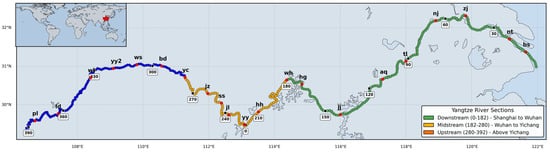
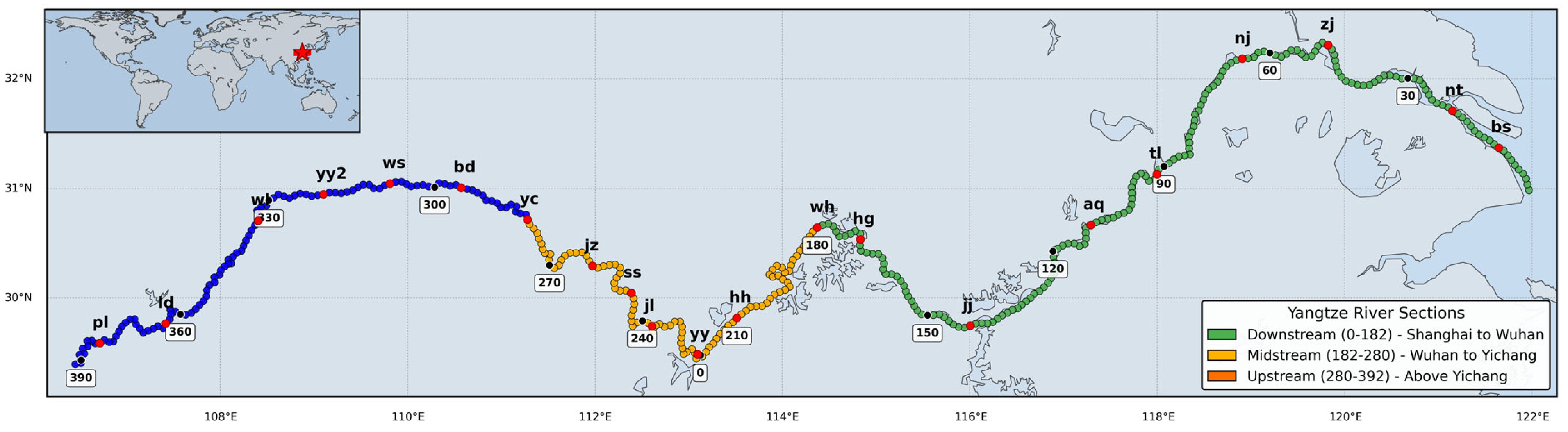
The Yangtze River, China’s longest river, originates from the Qinghai–Tibet Plateau and serves as a vital economic artery connecting inland regions with coastal ports (Figure 1). Given the significant variations in topography and channel morphology along its course, which directly impact both wind regimes and shipping conditions, the primary waterway is segmented into three functionally distinct sections for this study.
Figure 1.
Map of the Yangtze River waterway study area.
- Upstream Section (Chongqing to Yichang): This segment is characterized by complex gorge topography, where wind fields are strongly channeled and localized. It represents a unique navigational environment demanding specific meteorological insights.
- Midstream Section (Yichang to Wuhan): Emerging from the gorges, this section flows through open plains and extensive river-lake systems. The broader landscape allows for more synoptic-scale weather influence, altering wind patterns significantly.
- Downstream Section (Wuhan to Baoshan Estuary): This section features a wide, estuary-like channel increasingly susceptible to maritime weather influences, including sea breezes and typhoons, posing distinct challenges to navigation.
To facilitate high-resolution analysis, a linear sampling grid of 393 points was established at 5 km intervals along the river’s central navigation channel, corresponding to the spatial resolution of our primary meteorological dataset. Following the official regulations of the Yangtze River Maritime Safety Administration, the waterway is divided into three functional sections: the upstream section (Yichang to Chongqing), the midstream section (Wuhan to Yichang), and the downstream section (Shanghai to Wuhan). According to official waterway mileage conventions, each section has its own zero-point reference at Shanghai, Wuhan, and Yichang, respectively. However, for analytical consistency and simplification, this study adopts a unified indexing system where Sample Point 0 is located at the Shanghai estuary (Wusongkou), with the index increasing sequentially upstream toward Chongqing (Sample Point 393). For validation purposes, 27 China Meteorological Administration (CMA) weather stations located within approximately 5 km (0.05°) of these sample points were selected for model performance evaluation (see Appendix A, Table A1).
The map shows the division into upstream, midstream, and downstream sections. The analysis utilized 393 gridded meteorological samples (black dots) indexed spatially from the coast inland (bottom axis). This indexing follows the unified regulations for Yangtze River waterway mileage, where the main channel’s mileage starts at zero at Shanghai’s Wusongkou (near ‘bs’ Baoshan) and increases upstream (towards ‘cq’ Chongqing). The Key locations are abbreviated: Baoshan (bs), Nantong (nt), Zhenjiang (zj), Nanjing (nj), Tongling (tl), Anqing (aq), Jiujiang (jj), Huanggang (hg), Wuhan (wh), Honghu (hh), Yueyang (yy), Jianli (jl), Shishou (ss), Jingzhou (jz), Yichang (yc), Badong (bd), Wushan (ws), Yunyang (yy2), Wuling (wl), Fengdu (ld), and Fuling (pl).
2.2. Data Sources
2.2.1. High-Resolution Regional Reanalysis Dataset (EAR40)
A critical challenge for climatological analysis along the Yangtze River waterway is the lack of a dense, long-term meteorological observation network capable of fully resolving the spatiotemporal variability of the wind field. To overcome this key data limitation, this study employs a validated, high-resolution regional reanalysis dataset (EAR40, distinct from the coarse-resolution ERA-40 global reanalysis) as a spatial proxy for observation, enabling a comprehensive analysis. The primary dataset for this study is a high-resolution (5 km, 1-hourly) regional atmospheric reanalysis-East Asian Reanalysis 40-year, hereinafter referred to as EAR40, covering East Asia from 1979 to 2018. This dataset was dynamically downscaled using the Weather Research and Forecasting (WRF) model (v3.7.1) driven by the global ERA-Interim reanalysis. The system employed a Four-Dimensional Data Assimilation (FDDA) scheme, which further enhanced accuracy by assimilating surface observations from over 2400 CMA stations. Key physical parameterizations in the WRF configuration included the Thompson microphysics scheme, the Unified Noah land surface model, the Dudhia shortwave radiation scheme, and the Rapid Radiative Transfer Model (RRTM) for longwave radiation. The Unified Noah model incorporated high-resolution static geographical data to explicitly represent the thermodynamic properties of diverse land surfaces, including the riverine environment. Simulations were conducted in 36 h cycles, with the initial 12 h of each run discarded as a model spin-up period. The resulting EAR40 dataset provides a spatially and temporally consistent representation of the wind field, overcoming the inhomogeneities and sparse distribution of station-based observations [20] (see Appendix A for a comprehensive evaluation).
2.2.2. In Situ Observations for Validation
Wind speed data from the 27 selected CMA stations were used exclusively for evaluating the performance of the EAR40 reanalysis. These observations, measured at a 10 m height, were obtained from the National Meteorological Information Center of CMA. The dataset exhibits temporal inhomogeneity, with 4-times daily manual observations before 2004 and higher-frequency automatic recordings thereafter. All data used in this study passed the official quality control (QC) procedures, and only records flagged as “normal” were retained for analysis.
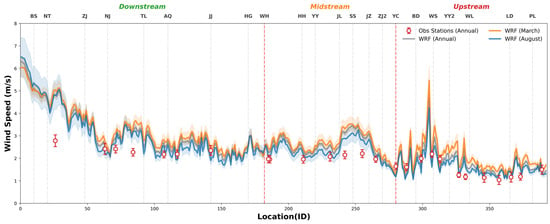
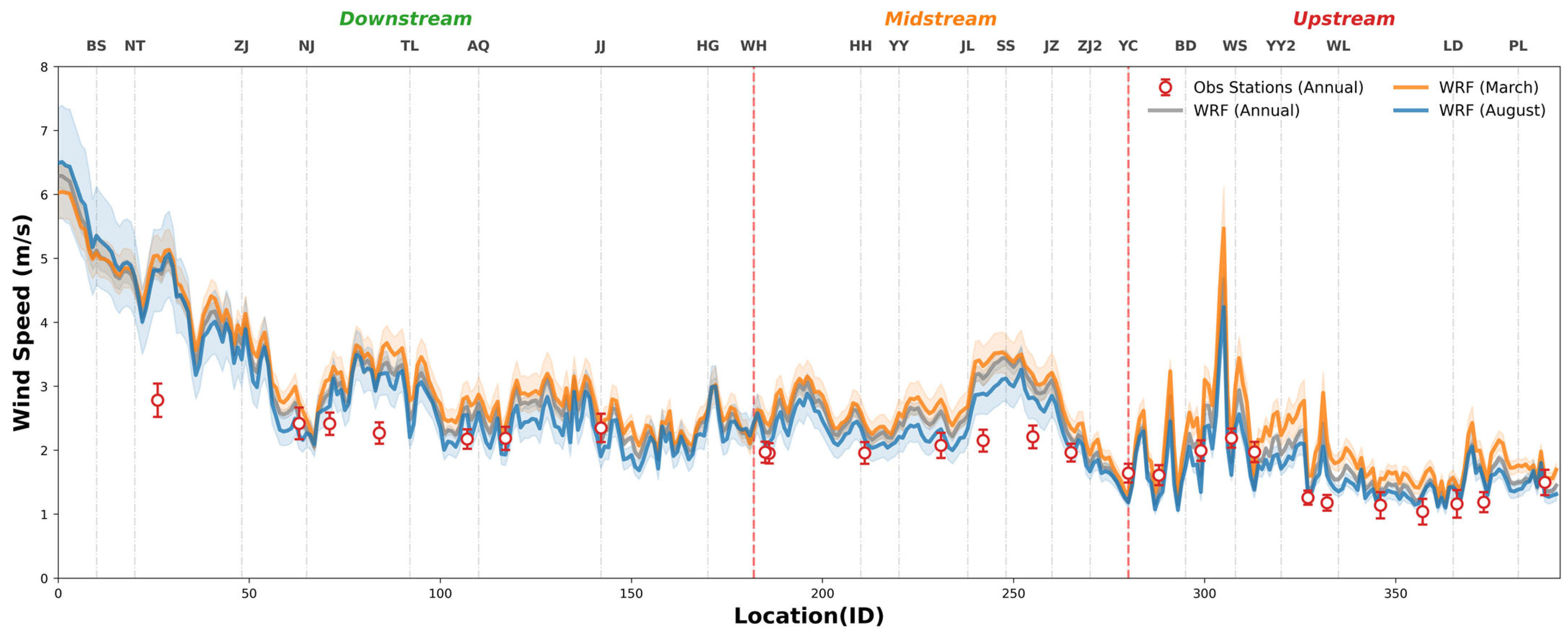
The WRF model generally captures the spatial variability of wind speeds along the transect (Figure 2), showing a decreasing trend from downstream (~6 m/s) to upstream (~1.5 m/s). However, a significant positive bias exists. In the downstream region, simulated annual means (gray line) consistently exceed observations (red circles) by approximately 1.0–2.0 m/s. This overestimation persists in the midstream region, though the gap narrows slightly to ~0.5–1.0 m/s. The model performs best in the upstream region, where the simulated values align closely with observations, often falling within the observational standard deviation. Seasonally, March winds (orange) are consistently stronger than August winds (blue), with the model reproducing this seasonal amplitude well across all regions. For detailed spatial distributions and error metrics, please refer to Appendix A, Figure A1 and Figure A2.
Figure 2.
Spatial distribution of wind speed showing model-observation comparisons. Red open circles indicate the annual mean observed wind speeds. Solid lines represent WRF simulations for the annual mean (gray), March (orange), and August (blue). Error bars and shaded regions denote ±1 standard deviation of interannual variability. Vertical dashed lines demarcate the Downstream, Midstream, and Upstream regions. Abbreviations along the top axis correspond to major cities along the transect.
2.2.3. Auxiliary Datasets for Attribution Analysis
To investigate potential drivers of wind speed changes, we used the Global Inventory Modeling and Mapping Studies (GIMMS) NDVI3g dataset (8 km resolution, 1982–2015) as a proxy for local land cover change [21]. Additionally, to explore the relationship with large-scale atmospheric dynamics, we utilized a comprehensive dataset of 88 monthly circulation indices from the CMA’s National Climate Center. This dataset includes a wide range of global and regional patterns, such as the East Asian Monsoon, NAO, AO, and indices related to major topographic features like the Tibetan Plateau (see Appendix C for a complete list).
2.3. Analysis Methods
All data processing, statistical analysis, and visualization for this study were conducted using the Python programming language (v3.8) with its core scientific libraries, including SciPy (1.9.1) for statistical tests, Pandas (1.4.4) for data manipulation, and Matplotlib (3.5.2) for plotting. Time series of annual mean wind speed (u) were smoothed using a 5-point moving average filter. Long-term trends were quantified using linear regression. To identify abrupt shifts in the time series, a multi-algorithm approach was adopted, employing four widely used change-point detection methods: the Pettitt’s test, Buishand U test, Standard Normal Homogeneity Test (SNHT), and the Mann–Kendall (MK) test. For these change-point tests, the null hypothesis (H0) is that the time series is homogeneous (i.e., no change-point exists), while the alternative hypothesis (H1) is that a change-point is present. A year was confirmed as a change-point if identified by a majority of the algorithms; otherwise, the result from the robust MK test was adopted. The Theil–Sen regression and MK test were also used for trend analysis of NDVI and wind speed. Finally, to investigate the linkage between wind speed and large-scale atmospheric dynamics, the Spearman rank correlation coefficient was calculated between the wind speed time series and 88 different climate indices. This non-parametric correlation method was chosen for its ability to assess monotonic relationships without assuming a linear relationship between variables.
3. Results
3.1. Long-Term Trend and Decadal Turning Point of Wind Speed
To robustly identify the timing of abrupt regime shifts in Yangtze River wind speed and minimize uncertainties from individual statistical tests, we employed a multi-model ensemble approach using four independent change-point detection algorithms: the Standard Normal Homogeneity Test (SNHT), Buishand U test, Pettitt test, and Mann–Kendall test (Table 1). In the upstream region, three methods (SNHT, Pettitt, and Mann–Kendall) consistently identified 2003 as the change-point, while Buishand U detected 2002, suggesting a slightly delayed response compared to downstream areas. For the midstream and downstream regions, results converged tightly around the turn of the century, with SNHT, Pettitt, and Mann–Kendall uniformly detecting 2000, and Buishand U indicating 1999. Basin-wide analysis revealed a definitive systemic shift, with the majority of algorithms—including the robust Mann–Kendall test—identifying 2000 as the representative change-point despite minor inter-method variations (1999–2000). Based on this cross-validated evidence, we adopt 2000 as the dividing line for analyzing multi-decadal wind speed climatology throughout this study.
Table 1.
Diagnosis of the year of abrupt change in wind speed along the Yangtze River main waterway.
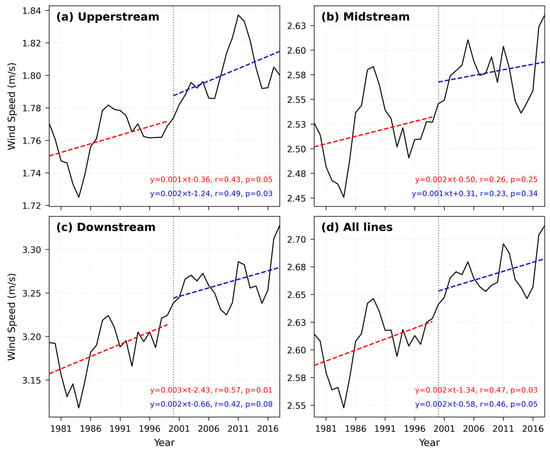
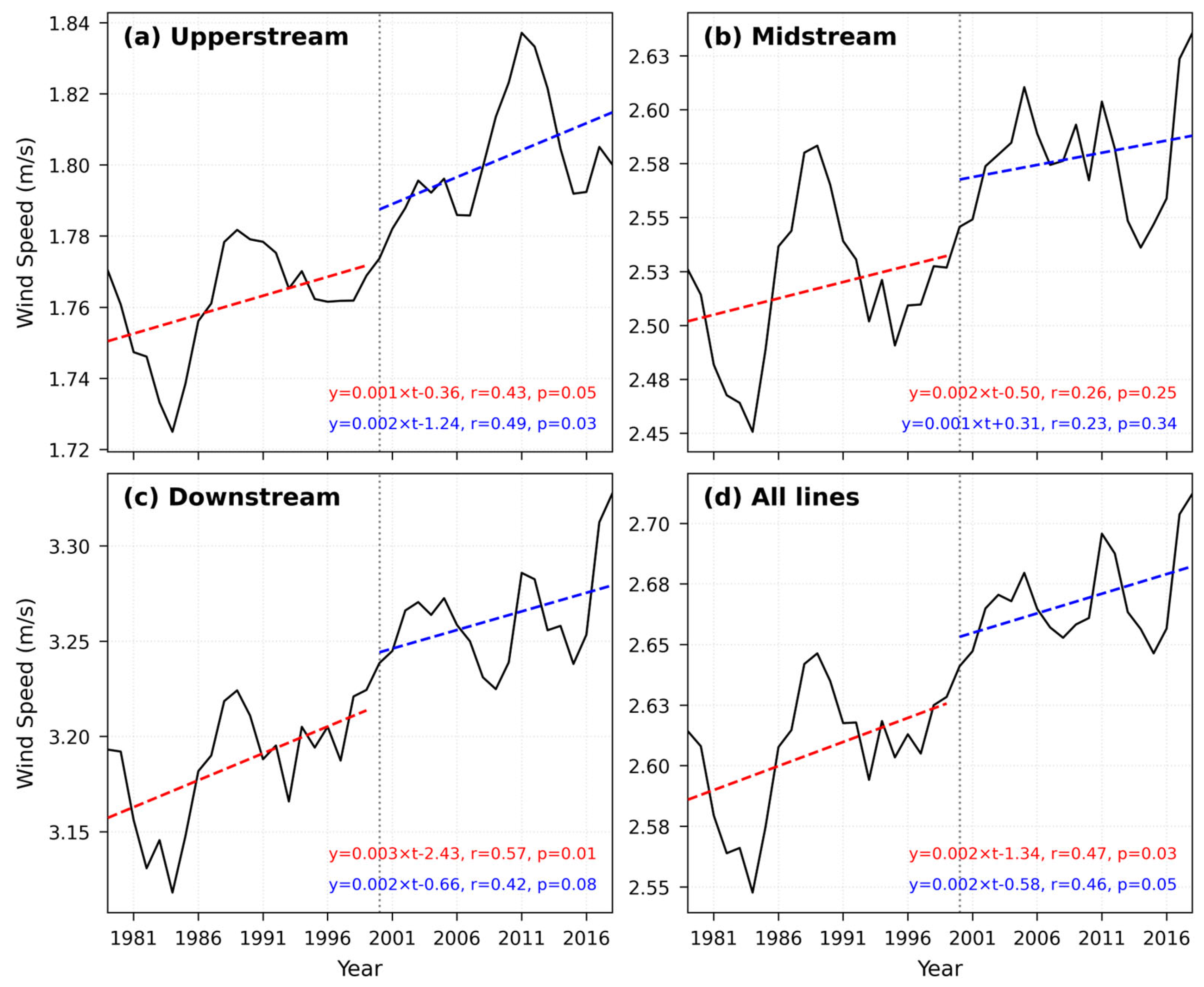
Analysis of annual mean wind speed from 1979 to 2018 reveals a consistent upward trajectory across the Yangtze River basin, with 2000 marking a critical inflection point in trend magnitude. The upstream region (Figure 3a) exhibits an accelerating trend, increasing from 0.01 m/s per decade before 2000 (r = 0.43, p = 0.05) to 0.02 m/s per decade afterward (r = 0.49, p = 0.03). In contrast, the midstream section (Figure 3b) shows the highest interannual variability but weaker linear trends, with rates of 0.02 m/s per decade (p = 0.25) and 0.01 m/s per decade (p = 0.34) before and after 2000, respectively, suggesting dominance by interannual oscillations rather than robust long-term forcing. The downstream region (Figure 3c), recording the highest absolute wind speeds, demonstrates a decelerating yet persistent positive trend: 0.03 m/s per decade pre-2000 (r = 0.57, p = 0.01) declining to 0.02 m/s per decade post-2000 (r = 0.42, p = 0.08). Basin-wide integration (Figure 3d) reveals a remarkably stable strengthening at 0.02 m/s per decade during both 1979–2000 (r = 0.47, p = 0.03) and 2000–2018 (r = 0.46, p = 0.05), contrasting sharply with the terrestrial “stilling” phenomenon observed elsewhere and indicating sustained recovery of surface wind speeds over the Yangtze River waterway throughout the 40-year period.
Figure 3.
Changes in average wind speed along the Yangtze River Mainstream (1979–2018). The time series, smoothed with a 5-point filter, shows the annual average wind speed. The vertical dashed line marks the identified change-point year, with red and blue dashed lines representing the linear trends before and after this point, respectively.
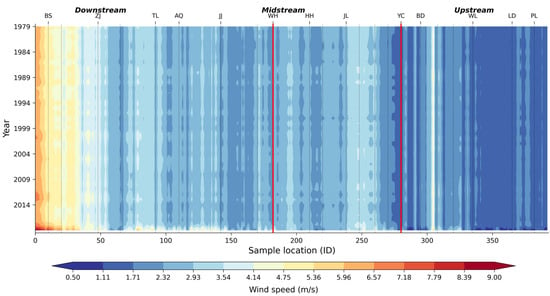
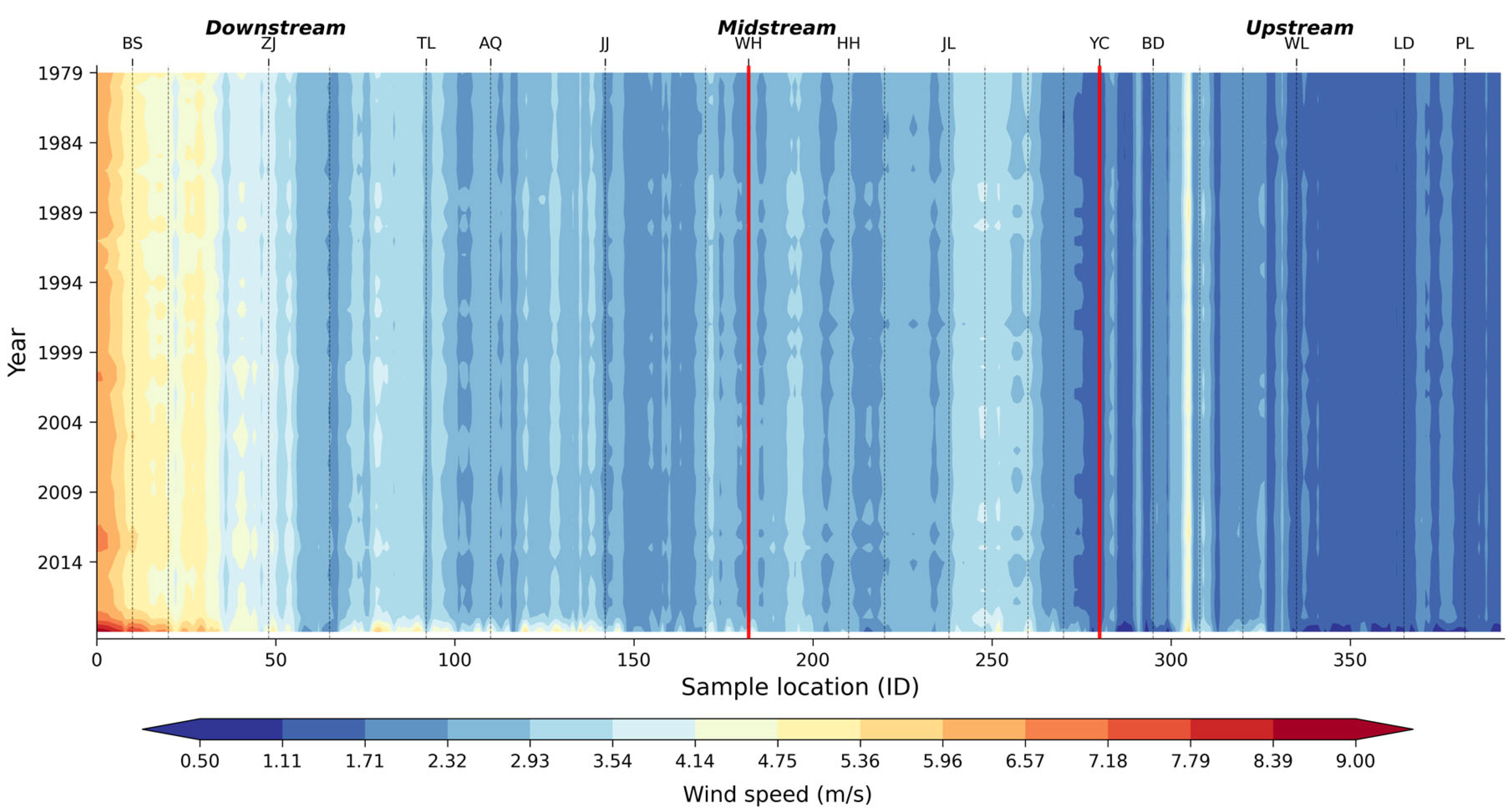
Figure 4 presents a depicting the spatiotemporal evolution of near-surface wind speeds along the Yangtze River waterway from 1979 to 2018. The analysis reveals a dominant west-to-east gradient with wind energy decaying from the coastal estuary inland, modulated by localized topographic effects. Three distinct spatial regimes emerge: (1) the downstream estuarine sector (Sample IDs 0–50) exhibits persistently high wind speeds exceeding 5.0 m/s (orange-red shading), driven by open marine exposure and strong land–sea thermal contrasts; (2) the midstream transition zone (Nanjing to Wuhan, IDs 50–180) shows gradual attenuation to 3.0–4.0 m/s (yellow-blue shading) as surface roughness increases and maritime influence weakens; and (3) the upstream sector (west of Yichang, IDs > 280) displays generally suppressed wind speeds (<2.0 m/s, deep blue) due to terrain shielding, interrupted by a prominent high-wind waterway near Badong (BD, ID ~300) where speeds frequently exceed 4.0 m/s (yellow vertical band), indicating topographic acceleration through the Three Gorges constriction. Temporal variability shows synchronized interannual fluctuations across downstream and midstream regions, with pronounced intensification during 2014–2018 (warm color deepening) consistent with Figure 2 trends. The spatial confinement of upstream variability suggests that while lower reaches respond to large-scale atmospheric teleconnections, upper reaches are primarily governed by local orographic forcing that filters synoptic-scale climate signals.
Figure 4.
Spatiotemporal evolution of annual mean wind speed along the Yangtze River mainstream (1979–2018). The x-axis denotes the longitudinal sampling index from the estuary (Sample 0, Wusongkou, Shanghai) upstream to the inland basin (Sample 393, Chongqing), following the official waterway mileage. Vertical dashed lines mark key cities (e.g., nt: Nantong, wh: Wuhan, bd: Badong).
3.2. Seasonal Cycle and Spatiotemporal Heterogeneity of Trends
3.2.1. Climatological Monthly Wind Speed
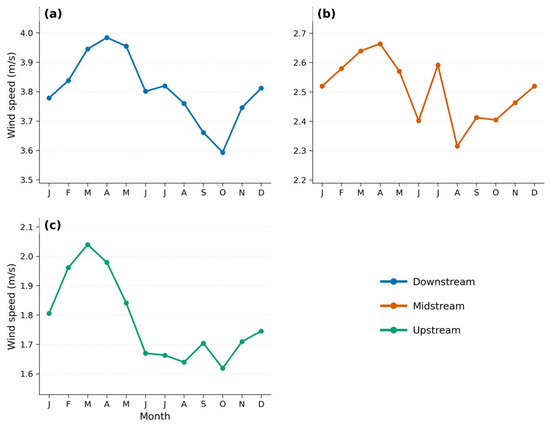
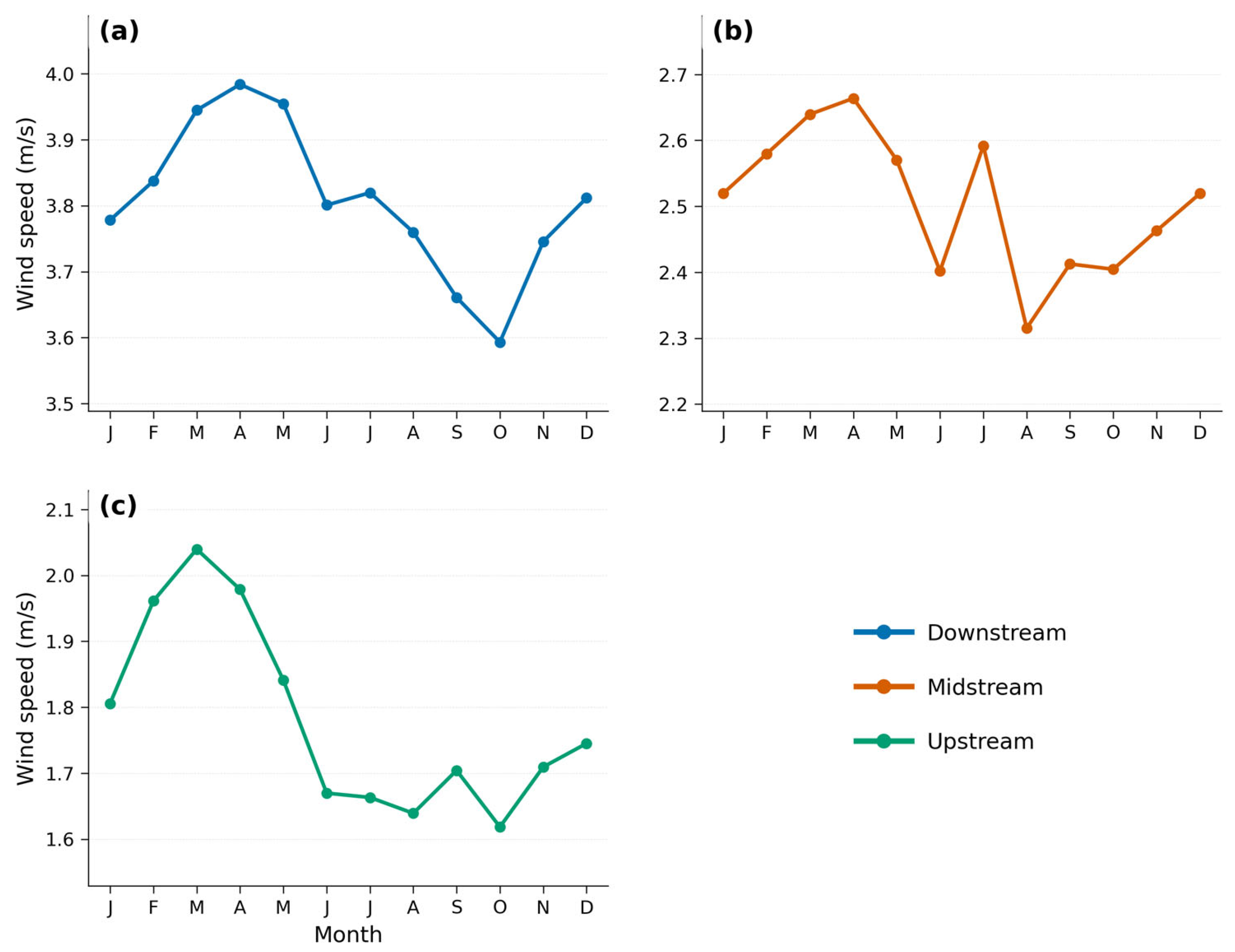
Figure 5 quantifies the seasonal cycle of wind speeds along the Yangtze River waterway, revealing pronounced zonal gradients and phase-lagged maxima. Monthly mean wind speeds decrease systematically from downstream (3.60–4.00 m/s, Figure 5a) through midstream (2.30–2.70 m/s, Figure 5b) to upstream (1.60–2.05 m/s, Figure 5c), reflecting progressive momentum attenuation by surface roughness and topographic friction as airflow penetrates inland from the frictionally smooth coastal delta. A prominent “spring maximum” characterizes all three sectors, with peaks occurring in spring rather than winter despite stronger cold-season meridional pressure gradients. This maximum exhibits eastward temporal propagation: upstream peaks earliest in March (~2.05 m/s), while midstream and downstream maxima delay until April (2.68 m/s and 3.98 m/s, respectively). This counterintuitive spring intensification results from seasonal boundary layer evolution—winter thermal inversions decouple surface winds from upper-level momentum, whereas spring surface heating destabilizes the boundary layer, enhancing vertical mixing and downward momentum transfer coincident with active extratropical cyclogenesis in the Yangtze-Huaihe valley.
Figure 5.
Climatological monthly mean wind speed for the Yangtze River waterway. The panels show the seasonal cycle for the upstream (a), midstream (b), and downstream (c) sections. Each point on the x-axis represents a calendar month, and the y-axis shows the long-term average wind speed in meters per second (m/s) for that month.
Wind speeds decline following the spring peak, reaching annual minima in late summer through autumn with longitudinally varying timing. The midstream minimum occurs in August (~2.30 m/s), while upstream and downstream sectors reach their lowest values in October (1.62 m/s and 3.60 m/s, respectively). The summer lull reflects westward extension of the Western Pacific Subtropical High, imposing large-scale subsidence and weak pressure gradients. The October minima in upstream and downstream regions correspond to transitional weakening of the synoptic pressure gradient field between summer monsoon retreat and winter monsoon establishment.
3.2.2. Spatial Distribution of Wind Speed in Typical Months
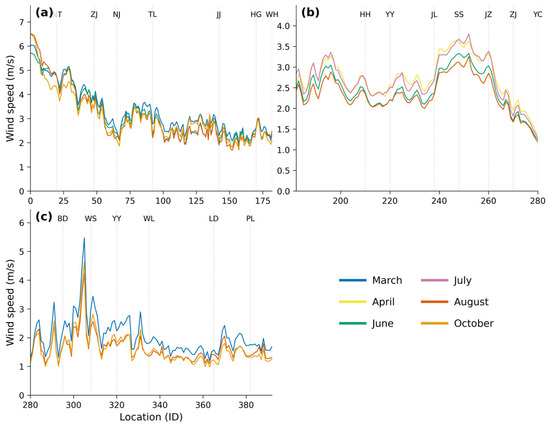
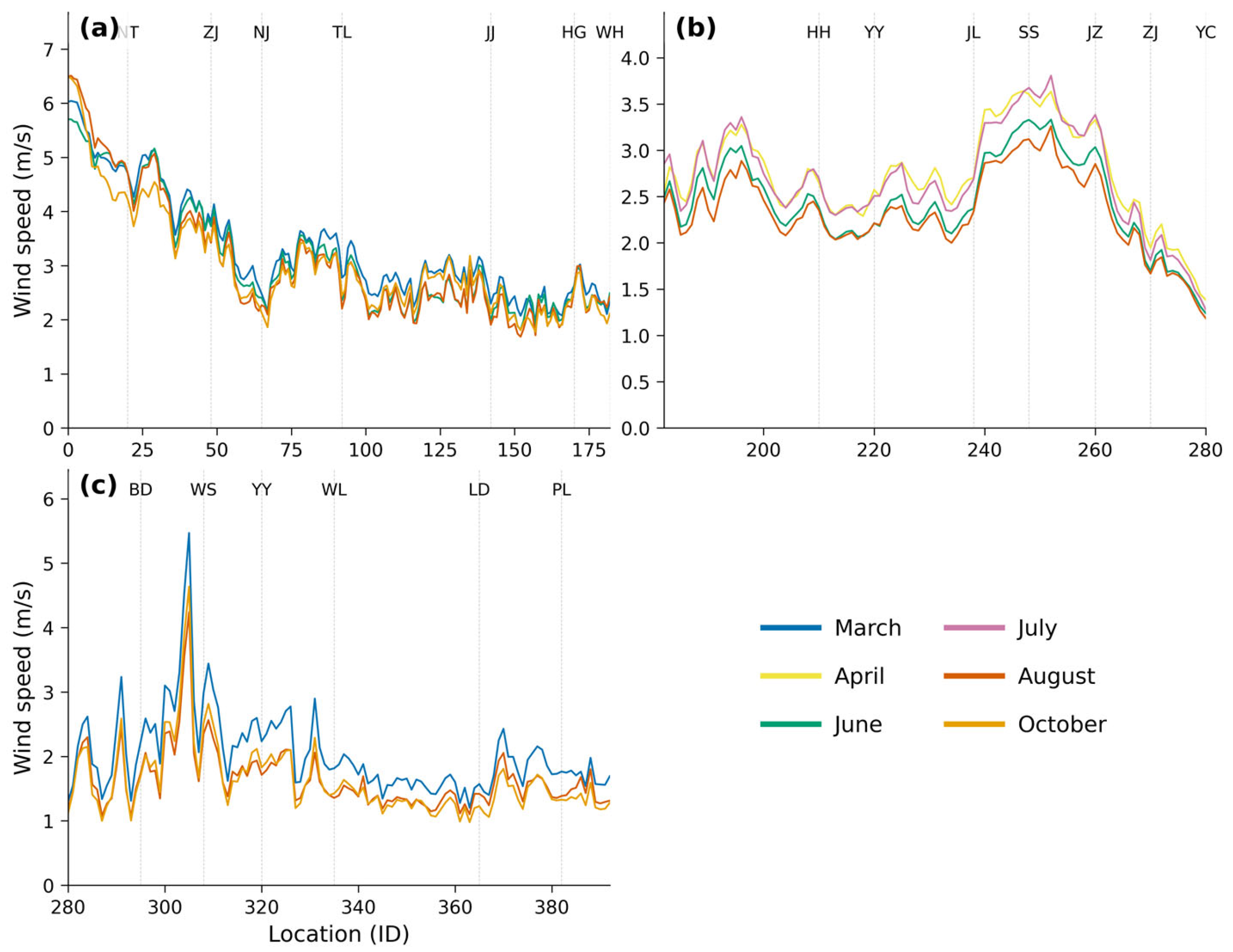
The downstream section (Figure 6a) exhibits a pronounced coastal-to-inland gradient where spatial variability exceeds seasonal amplitude. Wind speeds decay dramatically from the estuarine zone (east of Nantong, exceeding 6.0 m/s in March/April due to direct maritime exposure) to a minimum of 2.0–2.5 m/s near Nanjing as surface roughness increases. A secondary localized acceleration occurs between Nanjing and Tongling, with spring months consistently maintaining highest wind energy and August representing the seasonal minimum throughout this section. The midstream region (Figure 6b) displays complex bimodal spatial structure controlled by local terrain rather than maritime distance. Two high-wind zones emerge: a primary maximum near Shishou where channel orientation aligns with prevailing winds (>3.5 m/s), and a secondary peak in the Wuhan-Honghu reach (IDs 180–200). A notable seasonal anomaly occurs where July wind speeds rival or exceed April values within these high-wind zones, likely reflecting deepening of the summer thermal low and active monsoon convection preceding August’s subtropical high-induced subsidence and calm conditions. The upstream section (Figure 6c) demonstrates extreme topographic control, dominated by a localized spike in the Three Gorges region peaking at Wushan (ID ~305). The Venturi effect through the narrowing channel accelerates March wind speeds to ~5.5 m/s—comparable to coastal values—but this enhancement remains spatially confined. Upstream of Wuling toward Chongqing, the wind regime collapses into a stable low-energy state (<2.0 m/s) with minimal spatial variance, maintaining March as the distinct maximum and late summer–autumn (August/October) as a uniform quiescent phase.
Figure 6.
Spatial distribution of wind speed during typical months. The panels show profiles for the Upstream (a), Midstream (b), and Downstream (c) sections. The X-axis for each panel represents a local index for that specific river section, starting at 0 at the section’s downstream end and increasing as one moves upstream. Each colored line represents the average wind speed profile for a specific month, as indicated in the legend.
3.3. Diurnal Characteristics and Trends
3.3.1. Climatological Diurnal Wind Speed Cycle
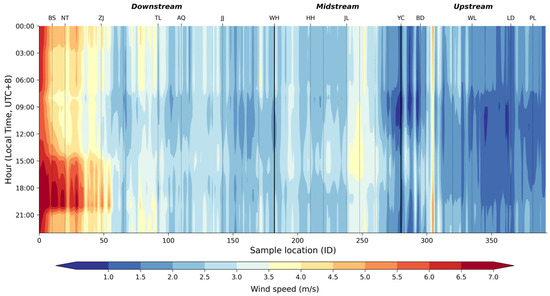
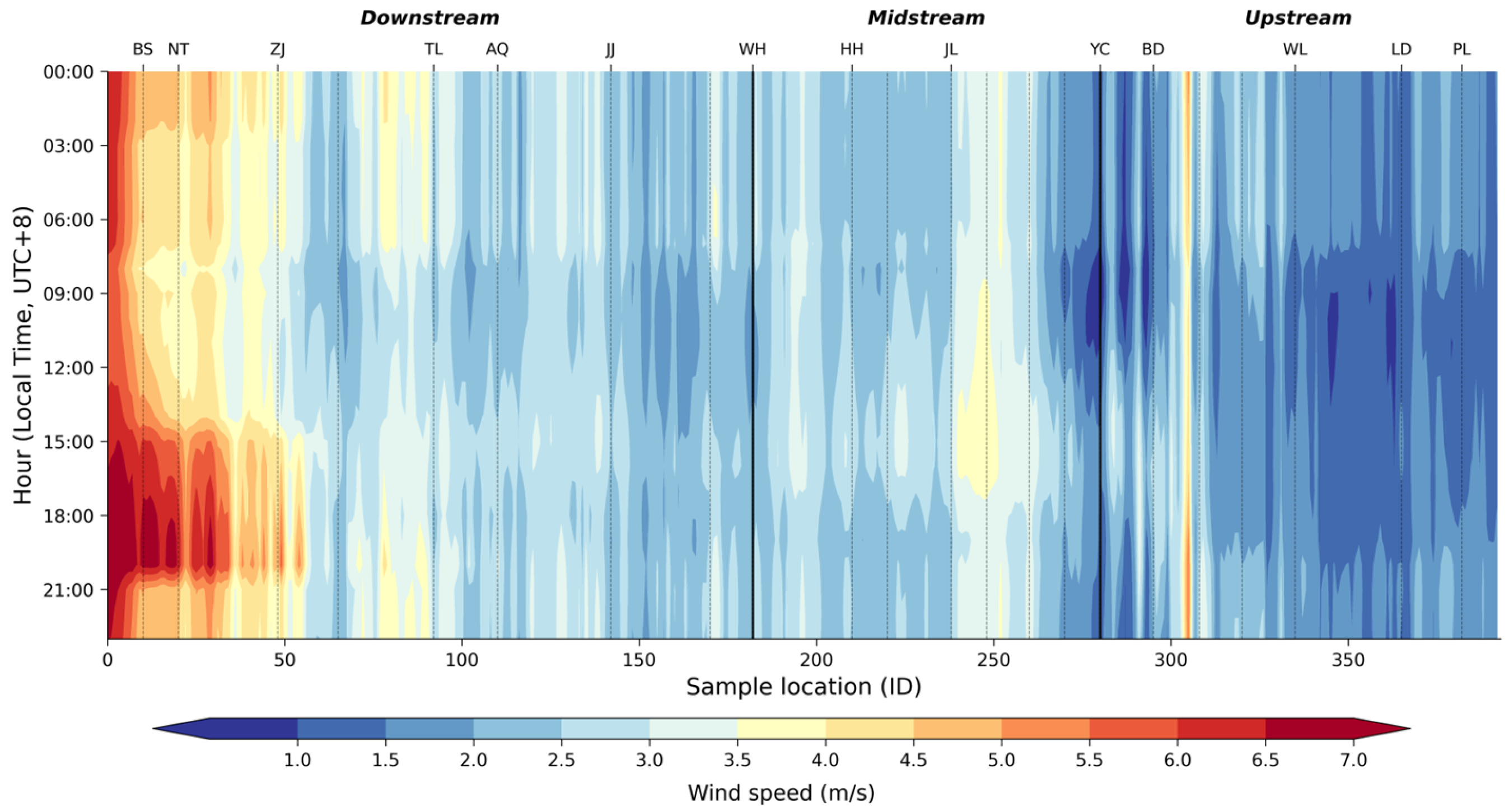
Figure 7 characterizes the climatological diurnal cycle of hourly mean wind speeds along the Yangtze River waterway, revealing a pronounced zonal gradient in diurnal amplitude reflecting the transition from marine-influenced eastern regimes to continentally dominated western conditions. The downstream estuarine sector (Samples 0–60, BS–ZJ) exhibits the most vigorous diurnal rhythm driven by sea breeze circulation and strong boundary layer mixing. A high-energy window persists from late morning through early evening (10:00–19:00 LST) with wind speeds consistently exceeding 6.0 m/s (deep red shading), while nocturnal speeds remain elevated (>3.5 m/s, yellow tones), indicating sustained coastal pressure gradient forcing independent of solar heating. The midstream sector (Samples 100–250, JJ–JZ) transitions to a classic continental diurnal cycle characterized by quiescent nocturnal-morning conditions (<2.5 m/s, blue shading) and pronounced afternoon acceleration driven by surface solar heating. A notable localized maximum near Jianli (JL, ID ~240) intensifies afternoon winds (13:00–17:00 LST) to 4.5–5.0 m/s. The upstream sector (Samples > 280, west of Yichang) shows heavily suppressed diurnal variability due to complex topography, with persistent low wind speeds (<2.0 m/s, deep blue) throughout the 24 h cycle. While faint afternoon enhancement appears in gorge sections (e.g., Badong), far upstream reaches (Sample > 350) exhibit virtually no diurnal variation, indicating that deep valley topography shields surface flow from synoptic forcing and inhibits thermally driven local circulations. The river waterway thus transitions from a broad-peak, high-energy coastal regime through a sharp-peak, moderate-energy continental regime to a damped, low-energy topographic regime, illustrating the shift from land–sea thermal contrast forcing to local orographic control.
Figure 7.
Climatological diurnal cycle of wind speed along the Yangtze River waterway. The x-axis represents the spatial sampling index (0–393) following official waterway mileage from Shanghai estuary (Sample 0, left) upstream to Chongqing (Sample 393, right). The y-axis represents the hour of the day in UTC (00:00–23:00 UTC; add 8 h for Beijing Time). Vertical white dashed lines delineate the three sections: Downstream (BS–WH, Samples 0–180), Midstream (WH–YC, Samples 180–250), and Upstream (YC–CQ, Samples 280–393). Key location abbreviations are marked along the top axis.
3.3.2. Diurnal and Seasonal Wind Speed Cycles
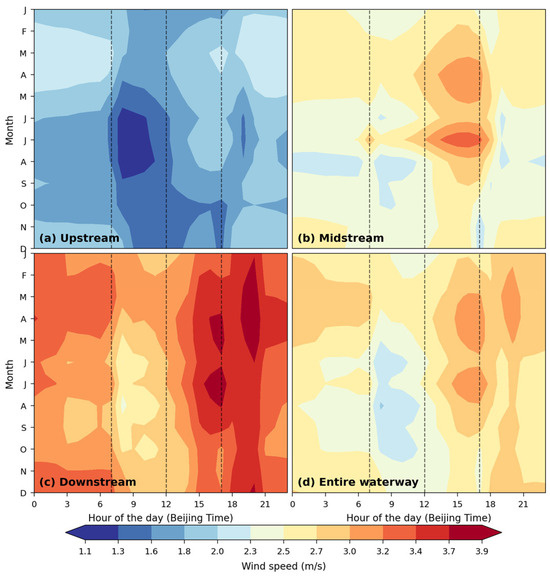
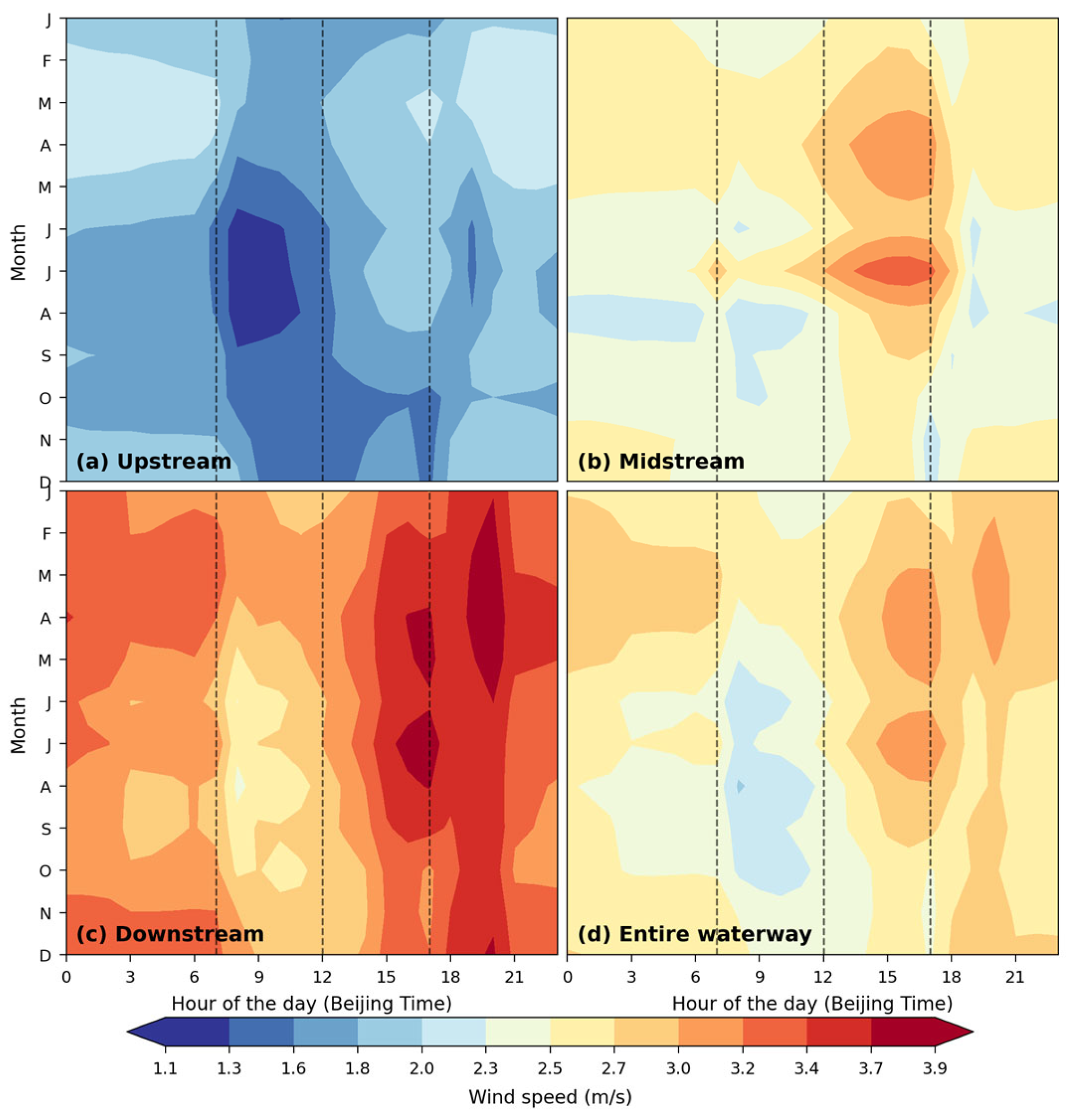
Figure 8 integrates diurnal and seasonal dimensions into a comprehensive climatological analysis, revealing pronounced spatial decoupling in the timing of maximum wind energy along the Yangtze River waterway. The downstream section (Figure 8c) exhibits a coherent “spring-daytime” coupled regime with annual maximum intensity strictly confined to spring afternoons (February–May, 13:00–18:00 BJT) exceeding 3.9 m/s (deep red shading). Summer months (July–August) display suppressed wind energy even during daytime, confirming large-scale subsidence from the Western Pacific Subtropical High dampens coastal ventilation.
Figure 8.
Climatological mean wind speed by hour and month. The panels show data for the (a) upstream, (b) midstream, (c) downstream, and (d) entire waterway. The y-axis represents the month (J = January through D = December) and the x-axis represents the hour of the day in Beijing Time (BJT, 0–23 h). Vertical dashed lines at approximately 07:00, 12:00, and 17:00 BJT mark key diurnal transitions framing typical daylight hours.
In contrast, upstream (Figure 8a) and midstream (Figure 8b) sections demonstrate a fundamental regime shift toward a “summer-afternoon” maximum. A distinct high-wind core emerges during July afternoons (14:00–17:00 BJT), particularly evident in the midstream section (>3.0 m/s, orange-red shading). This contradicts monthly mean spring maxima, indicating that while synoptic background winds weaken in summer, local thermal forcing intensifies. Vigorous solar heating during mid-summer drives enhanced turbulent mixing and valley breeze circulations that overcome stable background atmospheric conditions, creating a “summer afternoon wind pulse” critical for inland wind energy applications but obscured in daily averages.
Nocturnal boundary layer behavior shows remarkable basin-wide consistency, with a persistent “zone of quiescence” (<1.6 m/s, blue shading) dominating early morning hours (00:00–07:00 BJT) year-round. However, the onset timing varies spatially: downstream winds remain elevated until ~22:00 BJT due to coastal thermal inertia, while upstream winds decouple rapidly after sunset (~19:00 BJT) reflecting faster radiative cooling in mountain-basin terrain. This spatiotemporal structure demonstrates a transition from synoptically driven coastal regimes (spring maximum) to thermally driven inland regimes (summer afternoon maximum), implying that inland wind energy assessments must account for summer-afternoon resource availability offering seasonal complementarity to coastal wind patterns. The basin-wide climatology (Figure 8d) is not uniform but a complex superposition. It exhibits a ‘Spring-Dominant’ magnitude driven by the estuary, but with a ‘Summer-Afternoon’ persistence sustained by the inland valley breezes.
3.3.3. Diurnal and Spatial Patterns of Long-Term Wind Speed Trends
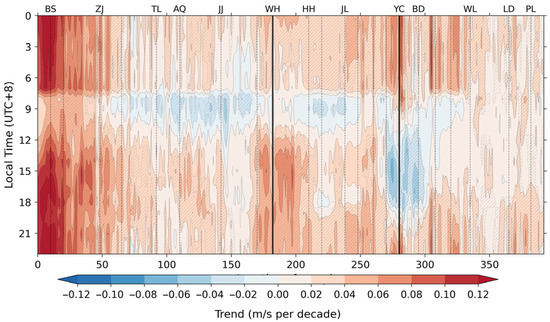
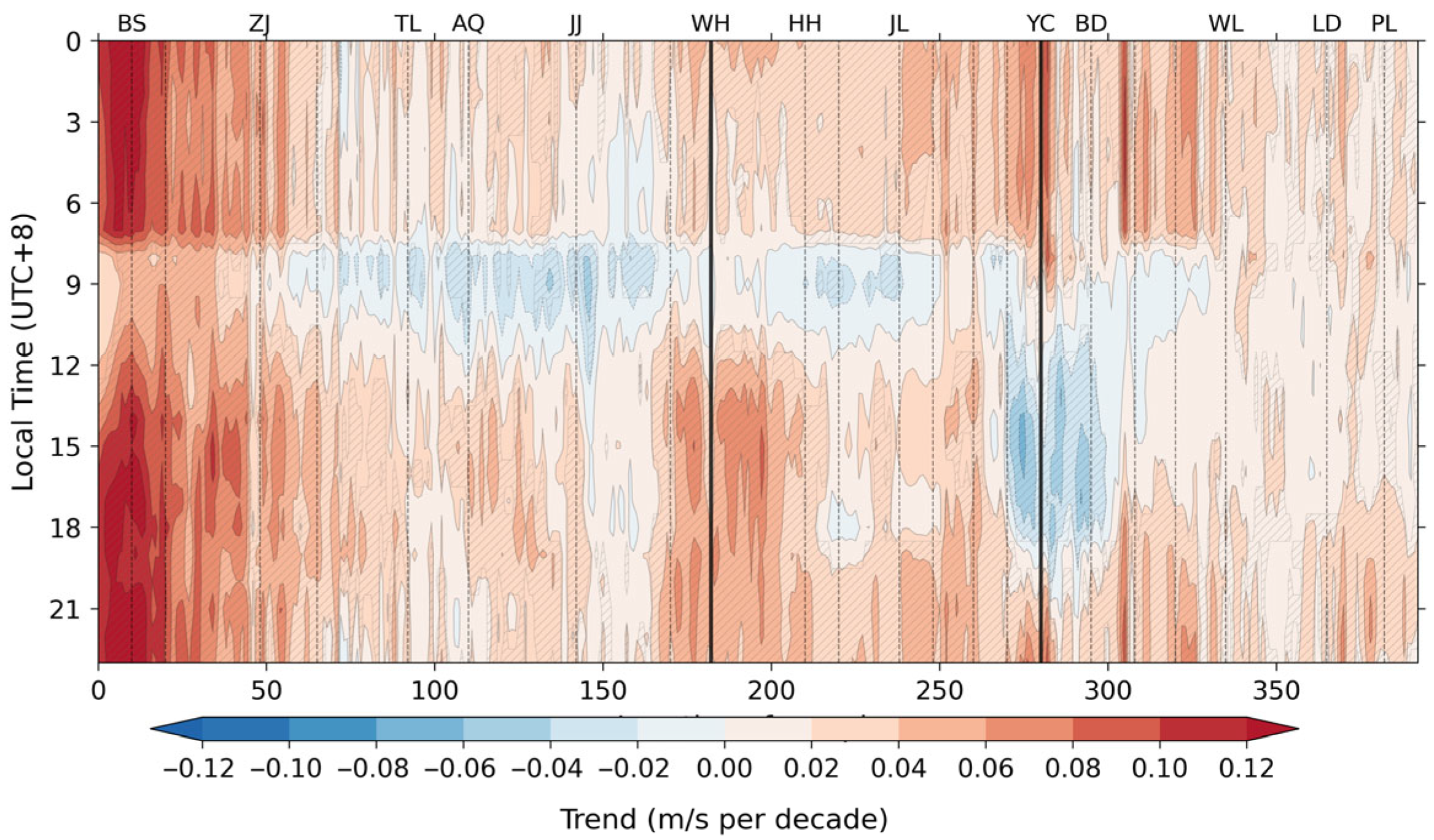
Figure 9 presents long-term linear trends (1979–2018) in hourly mean wind speeds, revealing complex spatiotemporal heterogeneity where climate-driven changes depend strongly on both location and time of day. The downstream section (Baoshan to Zhenjiang, IDs 0–60) exhibits the most robust basin-wide intensification with uniform positive trends (red shading) throughout the diurnal cycle but pronounced diurnal asymmetry. Strengthening peaks during daylight hours (09:00–18:00 LST) with trend magnitudes frequently exceeding +0.10 m/s per decade, suggesting that delta wind recovery is driven by enhanced daytime boundary layer mixing and potentially strengthened land–sea thermal contrasts amplifying sea breeze circulation. The midstream section (Wuhan to Yichang, IDs 180–280) acts as a transition zone with generally positive but weak trends (<0.04 m/s per decade, light orange) or negligible changes (white), indicating gradual decoupling from coastal forcing mechanisms.
Figure 9.
Long-term linear trend of hourly mean wind speed (1979–2018). The x-axis represents the spatial sampling index (0–393) following official waterway mileage from Shanghai estuary (Sample 0, left) upstream to Chongqing (Sample 393, right). The y-axis shows local time in UTC-8 (approximately equivalent to Beijing Time minus 8 h; 0 = 00:00, 21 = 21:00). Key location abbreviations are marked along the top axis (BS = Baoshan, ZJ = Zhenjiang, TL = Tongling, AQ = Anqing, JJ = Jiujiang, WH = Wuhan, HH = Honghu, JL = Jianli, YC = Yichang, BD = Badong, WL = Wuling, LD = Fuling, PL = Chongqing). Hatched areas denote trends that do not pass the p < 0.01 significance test; non-hatched colored areas represent statistically significant trends.
An anomaly emerges in the lower upstream gorge region between Yichang and Badong (YC–BD, IDs 280–300), where coherent negative trends (blue shading, −0.06 to −0.08 m/s per decade) appear during afternoon hours (12:00–18:00 LST). This localized “afternoon stilling” implies weakening thermally driven valley breezes during peak heating in the Three Gorges region, possibly linked to altered surface heat fluxes or reservoir-induced microclimate adjustments. Further west in the upper upstream section (Badong to Chongqing, IDs > 300), trends revert to a moderate positive regime (+0.04 m/s per decade) with relative uniformity across the diurnal cycle.
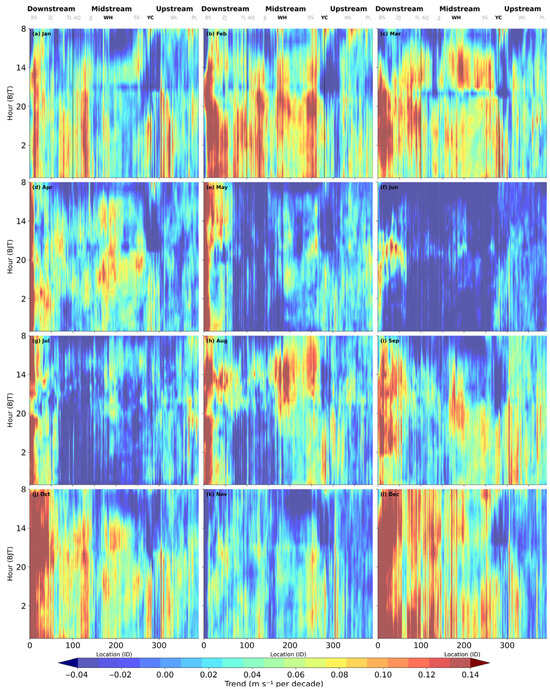
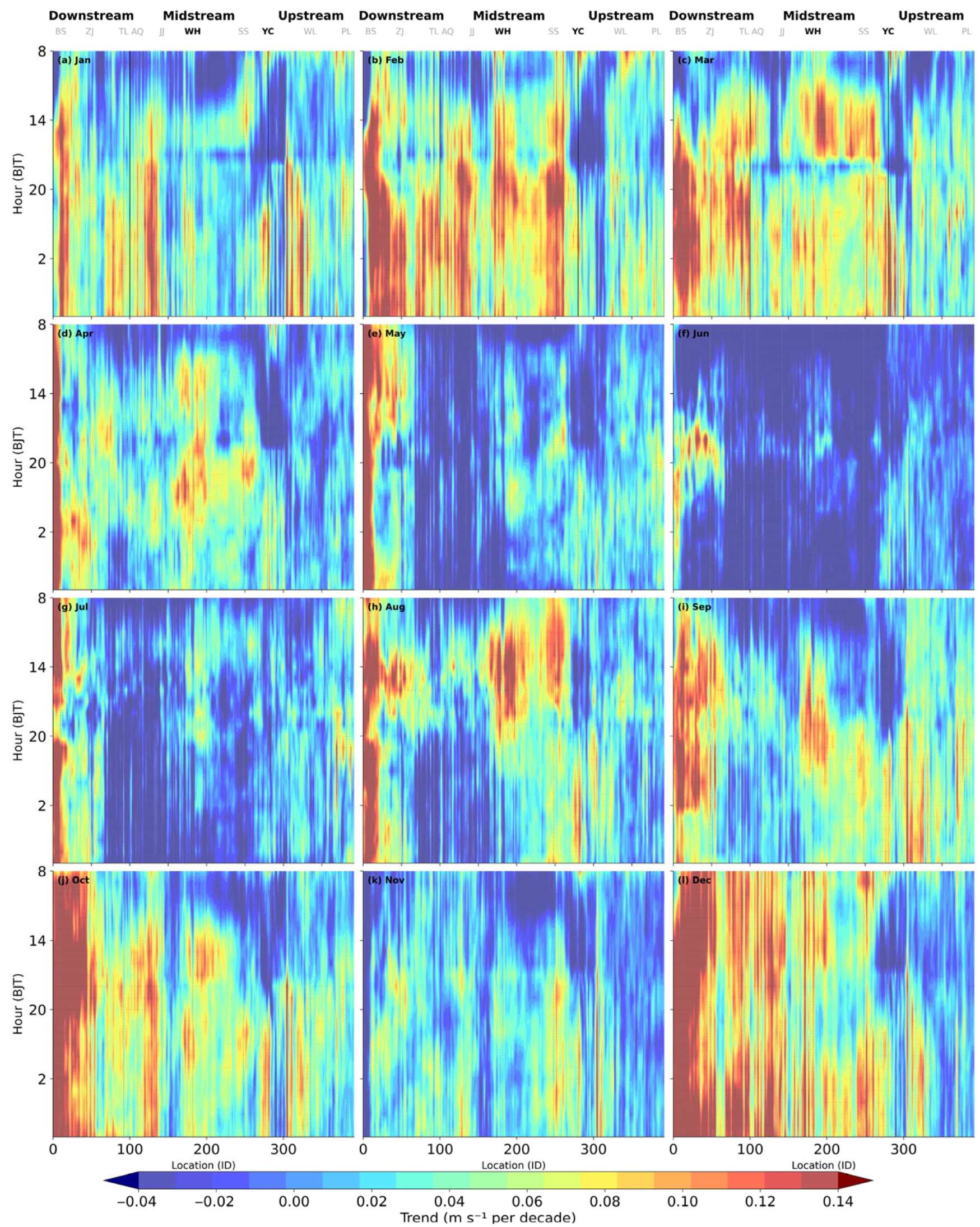
3.3.4. Spatiotemporal Patterns of Monthly and Diurnal Wind Speed Trends
Figure 10 presents a comprehensive month-by-hour decomposition of long-term wind speed trends, revealing that annual trends emerge from specific seasonal-diurnal windows rather than uniform changes across all timescales. The downstream coastal sector (BS–ZJ) exhibits pronounced “spring-autumn daytime recovery” with robust positive trends (>0.10 m/s per decade, deep red) dominating daylight hours (08:00–18:00 BJT) during February–May and October–November. This pattern indicates intensification of thermally driven sea breeze circulation during transition seasons, likely enhanced by increasing land–sea thermal contrasts. Summer months (June–August) show substantially weaker or negligible trends, suggesting monsoon-season suppression of this recovery mechanism. The upstream inland sector (west of Yichang) displays distinct “autumn-winter nocturnal intensification” with widespread positive trends concentrated during afternoon through nighttime hours (14:00–02:00 BJT) in January–March and October–December, particularly west of Badong. Unlike downstream daytime signals, the persistence of positive trends into nocturnal hours suggests strengthening background synoptic flow or localized mountain-valley winds less constrained by nocturnal stable boundary layers during cold seasons. The midstream transition zone (WH–YC) reveals complex “summer stilling” patterns, with extensive negative trends (blue shading) across midstream and lower upstream sections during peak summer months (July–August), particularly during morning hours (06:00–12:00 BJT). This weakening of morning boundary layer winds potentially reflects increased atmospheric stability or aerosol–radiation interactions delaying nocturnal inversion breakup.
Figure 10.
Monthly and diurnal patterns of the linear wind speed trend (m/s per decade). Each panel (a–l) represents one month (January–December). X-axis: spatial sampling index (0–393) from Shanghai estuary to Chongqing; Y-axis: hour of day (Beijing Time, 0–23). Each panel shows three sections: Downstream, Midstream, and Upstream, with key locations marked (WH, YC).
3.4. Statistical Linkages with Surface and Circulation Factors
3.4.1. Relationship with Land Cover Change
To investigate potential terrestrial drivers of observed wind speed trends, we analyzed spatiotemporal land cover evolution using the Normalized Difference Vegetation Index (NDVI) as a proxy for surface roughness. Theoretically, enhanced vegetation density increases aerodynamic roughness length (z0), enhancing frictional drag and suppressing near-surface wind speeds.
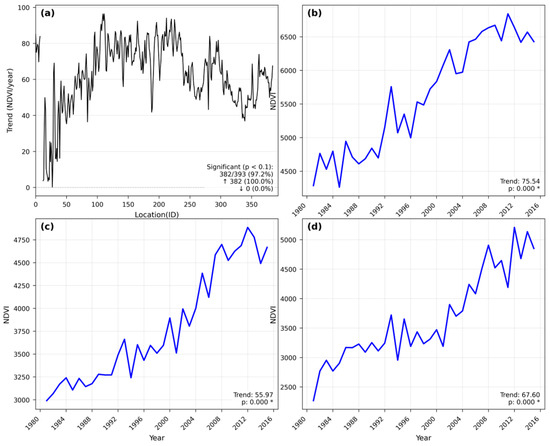
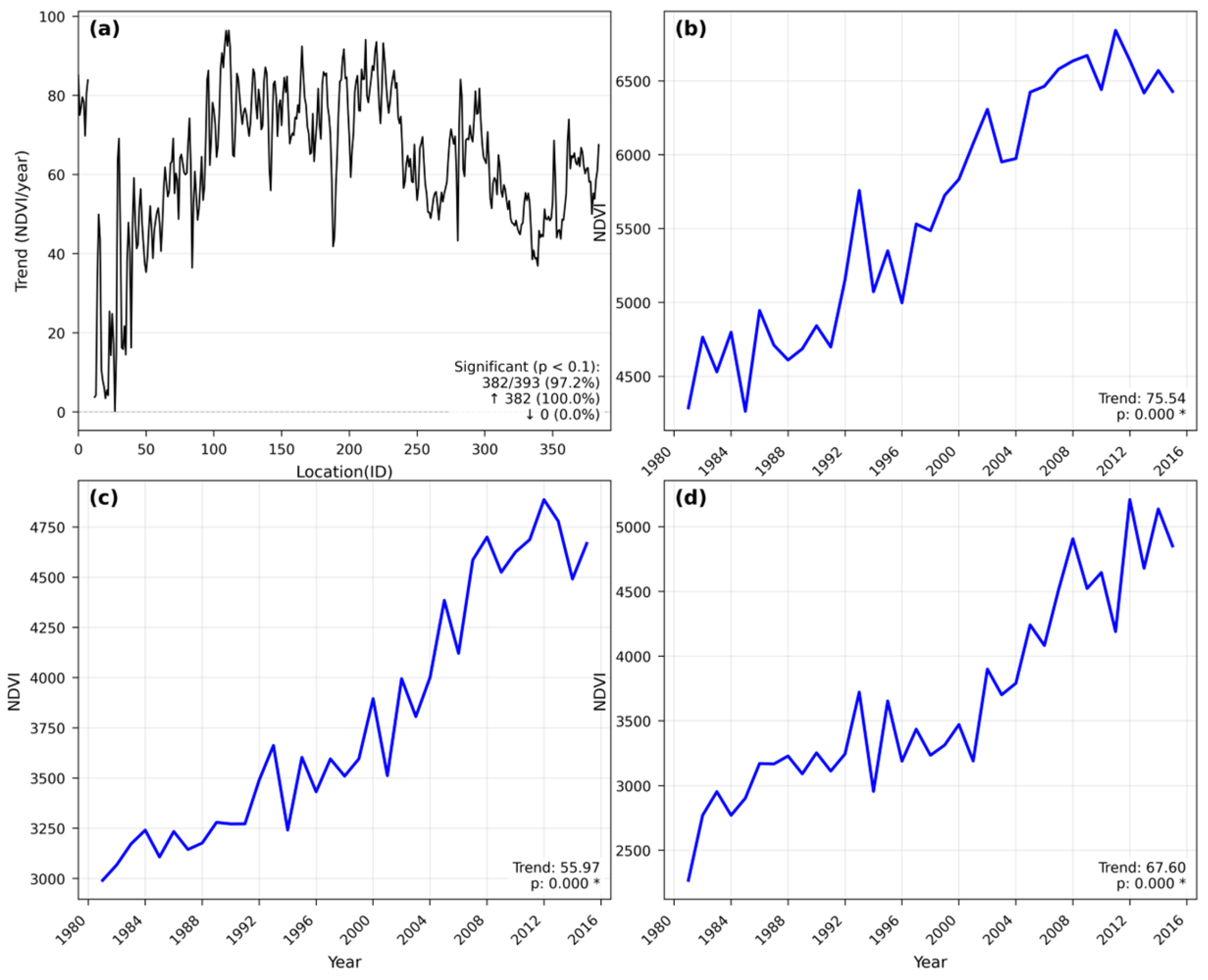
Figure 11a presents long-term annual mean NDVI trends along the Yangtze River waterway (1982–2015), revealing ubiquitous and robust greening across the basin. Statistically significant positive trends dominate nearly the entire 393-point transect, with particularly pronounced greening in the upstream sector (Points > 280) likely reflecting ecological restoration projects such as “Grain for Green.” The only notable exception occurs in the downstream estuarine zone (Points 0–40, near Shanghai-Nanjing), where trends fluctuate near zero or turn slightly negative, consistent with rapid urbanization and impervious surface expansion in the Yangtze River Delta.
Figure 11.
NDVI trends along the Yangtze River waterway (1982–2015). (a) The spatial trend of annual mean NDVI along the waterway, with the black line showing the trend magnitude (scaled by 104 per year). Note that the initial 11 sample points near the downstream estuary (Wusongkou, Shanghai) are water bodies and thus excluded from the analysis (shown as data gaps). (b–d) Time series of annual mean NDVI (scaled by 104) for three representative terrestrial sites: (b) Badong (upstream), (c) Shishou (midstream), and (d) Jiujiang (downstream). All three sites show statistically significant greening trends (p < 0.01), with trend magnitudes of 75.54, 55.97, and 67.60 (×10−4 per year), respectively. The asterisk (*) indicates that the trend is statistically significant at p < 0.01.
Temporal evolution at representative sites corroborates basin-wide greening: Badong (upstream, Figure 11b) exhibits dramatic NDVI increase from ~0.45 in the early 1980s to >0.65 in the 2010s (Trend = 0.0076, p < 0.001), reflecting substantial Three Gorges afforestation; Shishou (midstream, Figure 11c) shows steady rise (Trend = 0.0056, p < 0.001) indicating agricultural intensification or vegetation growth in middle plains; and Jiujiang (downstream–midstream transition, Figure 11d) displays clear upward trajectory despite higher interannual variability (Trend = 0.0068, p < 0.001).
The widespread greening presents a clear paradox, increased vegetation and inferred surface roughness should have decreased wind speeds, yet our analysis demonstrated significant wind speed increases in these regions. This contradiction strongly suggests the observed multi-decadal wind speed increase is not driven by local land cover changes but likely governed by larger-scale atmospheric circulation patterns.
Figure 12 presents a spatial comparison of Mann–Kendall trend test results for vegetation greenness (NDVI) and annual mean wind speed, revealing fundamental decoupling between land surface boundary conditions and aerodynamic response.
Figure 12.
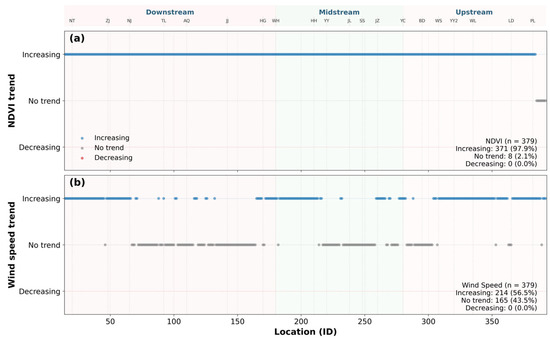
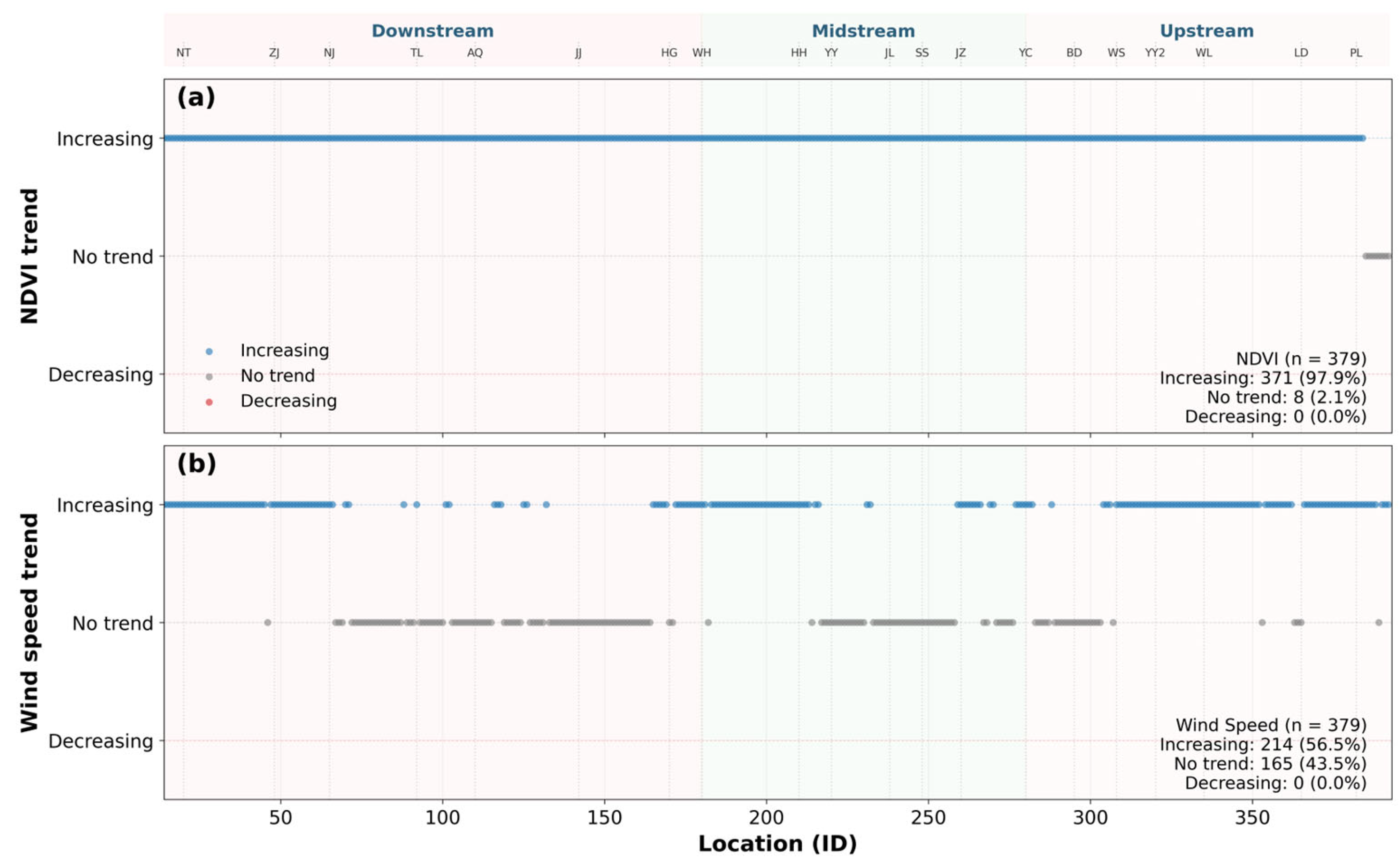
Mann–Kendall trend test results for (a) NDVI (1982–2015) and (b) annual mean wind speed (1979–2018) along the Yangtze River waterway. The plots categorize the trend at each spatial point along the Yangtze River waterway as statistically significant “Increasing,” “Decreasing,” or “No trend.” X-axis: Location ID (0–393) from Shanghai estuary to Chongqing. Vertical dashed lines mark section boundaries (Downstream, Midstream, Upstream).
Standard boundary layer theory predicts that increased vegetation density (NDVI↑) enhances aerodynamic roughness length (z0), increasing frictional drag and suppressing near-surface wind speeds. However, Figure 12a demonstrates near-universal greening of the Yangtze River corridor, with 97.9% of 379 analyzed points exhibiting statistically significant increasing NDVI trends (solid blue line) and zero stations showing significant vegetation decrease.
Despite this widespread greening, wind speed trends (Figure 12b) fail to show the anticipated concomitant decrease. In the estuarine (Points 0–50) and upper reaches (Points > 300), where NDVI increases significantly, wind speeds consistently increase (blue dots, 56.5% of sites), directly contradicting physical expectations of roughness-induced deceleration. The midstream region (Points 150–250) shows continued NDVI increase yet predominantly exhibits no wind speed trend (gray dots, 43.5%), with expected negative trends notably absent. Wind speed recovery or stabilization across the basin despite significant opposing forces from enhanced vegetation roughness indicates sufficiently energetic large-scale processes to override friction induced by widespread ecological restoration. This spatial decoupling points decisively to large-scale atmospheric circulation dynamics.
3.4.2. Linkage to Large-Scale Atmospheric Circulation
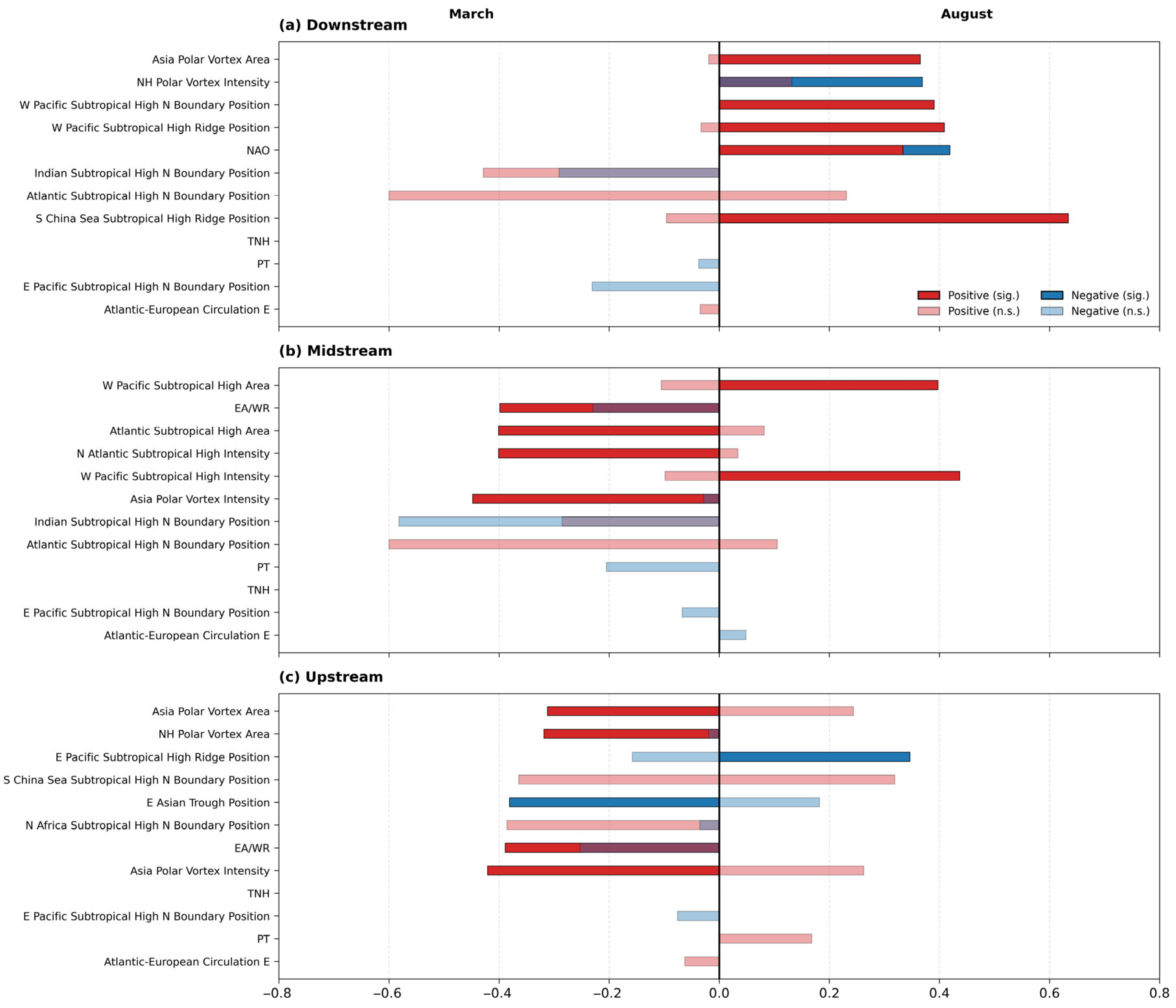
The relationship between wind speed and atmospheric circulation indices along the Yangtze River exhibits pronounced seasonal phase-locking and regime shift characteristics (Figure 13), with wind–climate couplings undergoing dramatic oscillations that mirror the fundamental reorganization from baroclinic-driven winter–spring dynamics to monsoon-thermal summer forcing.
Figure 13.
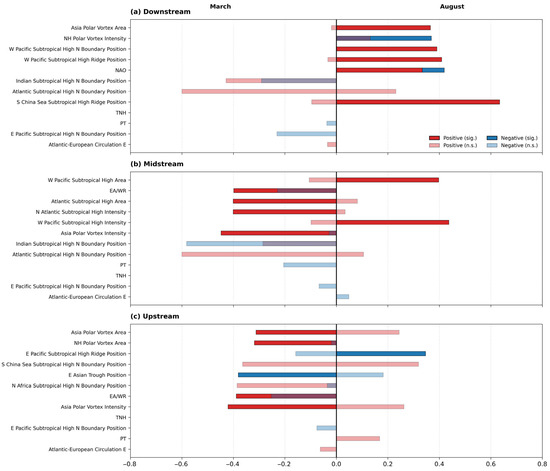
Seasonal reversal of large-scale atmospheric circulation drivers controlling wind speed variability along the Yangtze River waterway. Spearman rank correlation coefficients between monthly mean wind speeds and 88 atmospheric circulation indices for March (left columns) and August (right columns) across three sections: (a) Downstream, (b) Midstream, and (c) Upstream. Only statistically significant correlations are shown. Key circulation indices include: Asia Polar Vortex Area, NH (Northern Hemisphere) Polar Vortex Intensity, W Pacific Subtropical High (various position/intensity metrics), NAO (North Atlantic Oscillation), Indian/Atlantic/S China Sea Subtropical High positions, PT (Polar/Tropical indices), EAWM (East Asian Winter Monsoon), and Atlantic-European Circulation E.
During March, when wind energy resources peak, wind speeds are primarily governed by interactions between the Northern Hemisphere polar vortex system and meridional westerly circulation. In the upstream Chongqing-Badong Three Gorges section (Figure 13c, left panel), wind speeds exhibit statistically significant positive correlations with both the Northern Hemisphere Polar Vortex Area Index (r ≈ 0.35, p < 0.05) and Asia Polar Vortex Area Index (r ≈ 0.30), indicating that polar vortex expansion, particularly over the Asian sector, enhances southward cold air outbreak frequency. Coupled with topographic channeling through the gorge region, this synoptic forcing substantially accelerates valley winds. The downstream Shanghai-Nanjing estuary (Figure 13a, left panel) displays a dual-driver mechanism with wind speeds correlating positively with the Western Pacific Subtropical High northern boundary position (r ≈ 0.38) and North Atlantic Oscillation (NAO, r ≈ 0.33). This spring intensification operates through a “north-cold, south-warm” configuration where northward subtropical high displacement compresses meridional pressure gradients against cold continental air masses, while positive NAO phase reinforces mid-latitude westerly wave trains, collectively amplifying extratropical cyclone activity and marine-origin inflow.
August witnesses fundamental physical reversal, with spring’s consistent positive forcing replaced by a spatially bifurcated regime controlled by subtropical high morphology and teleconnection wave trains. The downstream estuary (Figure 13a, right panel) shows the strongest signal in the entire analysis, with the South China Sea Subtropical High ridge position demonstrating exceptionally robust positive correlation with wind speeds (r > 0.60, p < 0.001), indicating that summertime navigational zone wind speeds east of Nanjing are directly modulated by monsoon surge intensity. In striking contrast, the upstream gorge region (Figure 13c, right panel) exhibits complete disappearance of March’s positive correlations, replaced by significant negative correlations with the Eastern Pacific Subtropical High ridge position (r ≈ −0.30) and East Asian Trough position (r ≈ −0.38). This inverse relationship suggests summer upstream wind variability is governed by remote teleconnections, with anomalies in these indices likely inducing large-scale atmospheric blocking or Meiyu front shifts that stabilize the boundary layer through moist convection feedback, thereby suppressing surface wind speeds in inland channels.
4. Discussion
This study identifies a major turning point in the Yangtze River wind regime around 2000. Unlike the global “terrestrial stilling” observed in the late 20th century, our analysis shows that the Yangtze waterway has entered a phase of wind speed recovery and strengthening, particularly in the upstream and downstream areas. This shift creates a “new normal” with higher average wind speeds and greater variability, requiring updated operational standards and safety protocols. Using a high-resolution 5 km grid, our analysis places this regional recovery within the broader context of global wind speed reversals [22], while revealing detailed spatial patterns that were hidden in studies using sparse station data [23]. The observed increase in wind speeds suggests a related shift in wind event frequency. Higher mean wind speeds often lead to larger increases in extreme gusts. As a result, the return periods for extreme wind events—the 50-year or 100-year standards used in engineering design—are likely becoming shorter [24]. This changing risk pattern is important for preventing disasters like inland waterway accidents. Our data supports dividing the river into distinct “wind-risk zones,” with the Three Gorges canyon (affected by terrain channeling) and the downstream coastal area (affected by monsoon flows) as high-risk sections needing extra attention.
These climate changes raise important questions about infrastructure and operations. The continued increase in wind loads in busy upstream sections suggests that current design standards for vessel stability, especially for tall cruise ships and container vessels, may need updating. Similarly, port infrastructure standards, including crane wind protection and mooring capacity, might require review. The clear diurnal and seasonal patterns found in this study call for moving toward dynamic maritime management, where “safe wind conditions” must be treated as time-dependent; a crosswind manageable in the morning may become dangerous during windier afternoons (especially in summer upstream), requiring time-specific guidance for vessel operators [25]. While upstream and downstream areas show recovery, the heavily trafficked midstream section showed weak trends (non-significant) after 2000. This lack of ventilation improvement is concerning for pollutant dispersion, as calm conditions reduce mixing of exhaust emissions (SOx, NOx, PM2.5), potentially worsening local air quality. However, the confirmed wind speed recovery offers an economic opportunity for wind-assisted ship propulsion technologies like Flettner rotors, with our detailed wind atlas serving as the foundation for assessing decarbonization potential [26].
A key finding of this work is the clear separation of wind trends from local land surface roughness, solving an important “Greening-Recovery Paradox.” In theory, the widespread vegetation increase observed along the basin [27] should increase surface friction and reduce wind speeds [28]; yet, we observe strong wind speed increases. Although the NDVI analysis period (1982–2015) differs slightly from the wind speed period (1979–2018), this small time difference does not change the conclusion of widespread greening. This contradiction suggests that the frictional effect of surface roughness is overridden by local roughness changes are less important than shifts in large-scale atmospheric circulation. Our findings agree with studies linking surface winds to upper-level dynamics [12,29,30,31], identifying clear correlations with the Polar Vortex and large-scale climate patterns. Specifically, the seasonal shift—where March winds are driven by temperature contrasts and August winds by monsoon-blocking patterns—confirms that the “recovery” is controlled by strengthening of synoptic pressure gradients that overcome the friction from ecological restoration. The identification of 2000 as a pivotal turning point aligns with the broader decadal variability of the global climate system. Specifically, this timing coincides with the phase transition of the Pacific Decadal Oscillation (PDO), which shifted from a positive to a negative phase around 1998–2000 [32]. This large-scale ocean-atmosphere reorganization is known to enhance the temperature gradient and intensify atmospheric circulation over East Asia, thereby driving the recovery of surface wind speeds observed in the 21st century [22]. This further supports our finding that large-scale circulation forcing overrides local surface roughness effects.
While this study uses high-resolution reanalysis data to address station scarcity, it is important to note some limitations. Reanalysis products like ERA5 [33] and CLDAS [34] effectively fill data gaps [35], but they face: (1) limited observational data over complex terrain like the Three Gorges, (2) smoothing of small-scale topographic effects at 5 km resolution, and (3) possible inconsistencies in the data processing system over multi-decade periods. Additionally, the influence of river flow velocity was not explicitly calculated; given the river’s narrow width relative to the 5 km grid, the channel acts as a sub-grid feature, limiting the model’s ability to resolve specific air–water dynamic interactions. While these factors might affect the exact magnitude of trends, the direction and spatial patterns remain reliable. Future work should focus on improved downscaling and bias-correction methods to refine these estimates, ultimately creating a new generation of “smart waterway” tools that provide practical, location-specific information.
5. Conclusions
This study investigated spatiotemporal changes in surface wind speed along the Yangtze River waterway from 1979 to 2018 using high-resolution gridded data. Analysis identified a critical turning point around 2000, transitioning from basin-wide uniform trends to pronounced spatial heterogeneity. Post-2000, the upstream section maintained strengthening trends of +0.02 m/s per decade (p = 0.03), the midstream showed weak or non-significant trends with localized afternoon stilling reaching −0.08 m/s per decade in the Three Gorges region, while the downstream coastal zone demonstrated the strongest intensification exceeding +0.10 m/s per decade during spring–autumn daytime hours.
Three distinct wind regimes emerged: the downstream estuarine sector exhibits highest wind speeds (spring averages > 3.9 m/s, afternoon peaks > 6.0 m/s) with a “spring-daytime” maximum driven by maritime exposure; the midstream displays moderate speeds (2.3–2.7 m/s) with terrain-controlled bimodal structure and a unique “summer-afternoon” thermal pulse; the upstream shows generally suppressed speeds (<2.0 m/s) except for pronounced topographic acceleration through the Three Gorges constriction.
A key finding resolves the “Greening-Recovery Paradox”: despite widespread vegetation increases (97.9% of points showing positive NDVI trends) that should reduce wind speeds through enhanced surface roughness, sustained wind recovery occurred basin-wide. Statistical analysis reveals significant correlations with large-scale circulation patterns—Northern Hemisphere Polar Vortex (r ≈ 0.35), Western Pacific Subtropical High (r ≈ 0.38) in spring, and monsoon indices (r > 0.60) in summer—confirming that synoptic-scale pressure gradient intensification overrides local friction effects. This comprehensive baseline supports re-evaluating long-term navigational planning and climate resilience strategies, implementing dynamic maritime management, and assessing wind-assisted propulsion for shipping decarbonization. Future research should further integrate high-resolution numerical simulations with multi-source observations to explore the micro-scale wind field structure in complex terrains like the Three Gorges. Additionally, the analytical framework presented in this study regarding the “stilling reversal” could provide a reference for wind resource assessments in other inland waterways globally.
Author Contributions
Conceptualization, L.B., M.S. and J.Z.; methodology, L.B. and M.S.; software, C.S. and Y.B.; validation, L.L. and Q.L.; formal analysis, L.B. and C.S.; investigation, M.S. and Y.B.; resources, J.Z. and Q.L.; data curation, C.S. and L.L.; writing—original draft preparation, L.B. and M.S.; writing—review and editing, all authors; visualization, Y.B. and L.L.; supervision, J.Z.; project administration, L.B. and Q.L.; funding acquisition, L.B. and Q.L. All authors have read and agreed to the published version of the manuscript.
Funding
This research was funded by the Xinjiang Key Laboratory of Water Cycle and Utilization in Arid Zone, Xinjiang Institute of Ecology and Geography, Chinese Academy of Sciences, grant number XJYS0907-2023-11; the National Natural Science Foundation of China, grant number 32260294; the Scientific Research Foundation of Hainan University, grant number KYQD(ZR)-22083; the Natural Science Foundation of Hainan Province, grant numbers 423QN317 and 425RC692.
Institutional Review Board Statement
Not applicable.
Informed Consent Statement
Not applicable.
Data Availability Statement
The data are not publicly available due to the exceptional volume of the raw data.
Acknowledgments
Thanks to Xiaolong Huang, in Sichuan Information Centre, CMA, who provided many constructive suggestions for this study.
Conflicts of Interest
The authors declare no conflicts of interest.
Abbreviations
| Acronym | Full Name |
| AAO | Antarctic Oscillation |
| AO | Arctic Oscillation |
| CC | Correlation Coefficient |
| CMA | China Meteorological Administration |
| EA | East Atlantic Pattern |
| EAR40 | East Asian Reanalysis 40-year |
| EA/WR | East Atlantic-West Russia Pattern |
| FDDA | Four-Dimensional Data Assimilation |
| GIMMS | Global Inventory Modeling and Mapping Studies |
| ME | Mean Error |
| MK | Mann-Kendall |
| NAO | North Atlantic Oscillation |
| NDVI | Normalized Difference Vegetation Index |
| NP | North Pacific Pattern |
| PNA | Pacific/North American Pattern |
| POL | Polar-Eurasia Pattern |
| PT | Pacific Transition Pattern |
| QC | Quality Control |
| RMSE | Root Mean Square Error |
| RRTM | Rapid Radiative Transfer Model |
| SCA | Scandinavia Pattern |
| SNHT | Standard Normal Homogeneity Test |
| TNH | Tropical-Northern Hemisphere Pattern |
| WP | West Pacific Pattern |
| WRF | Weather Research and Forecasting |
| YREB | Yangtze River Economic Belt |
Appendix A. Evaluation of EAR40 Along the Yangtze River Waterway
Table A1.
Meteorological stations used for model validation along the Yangtze River waterway.
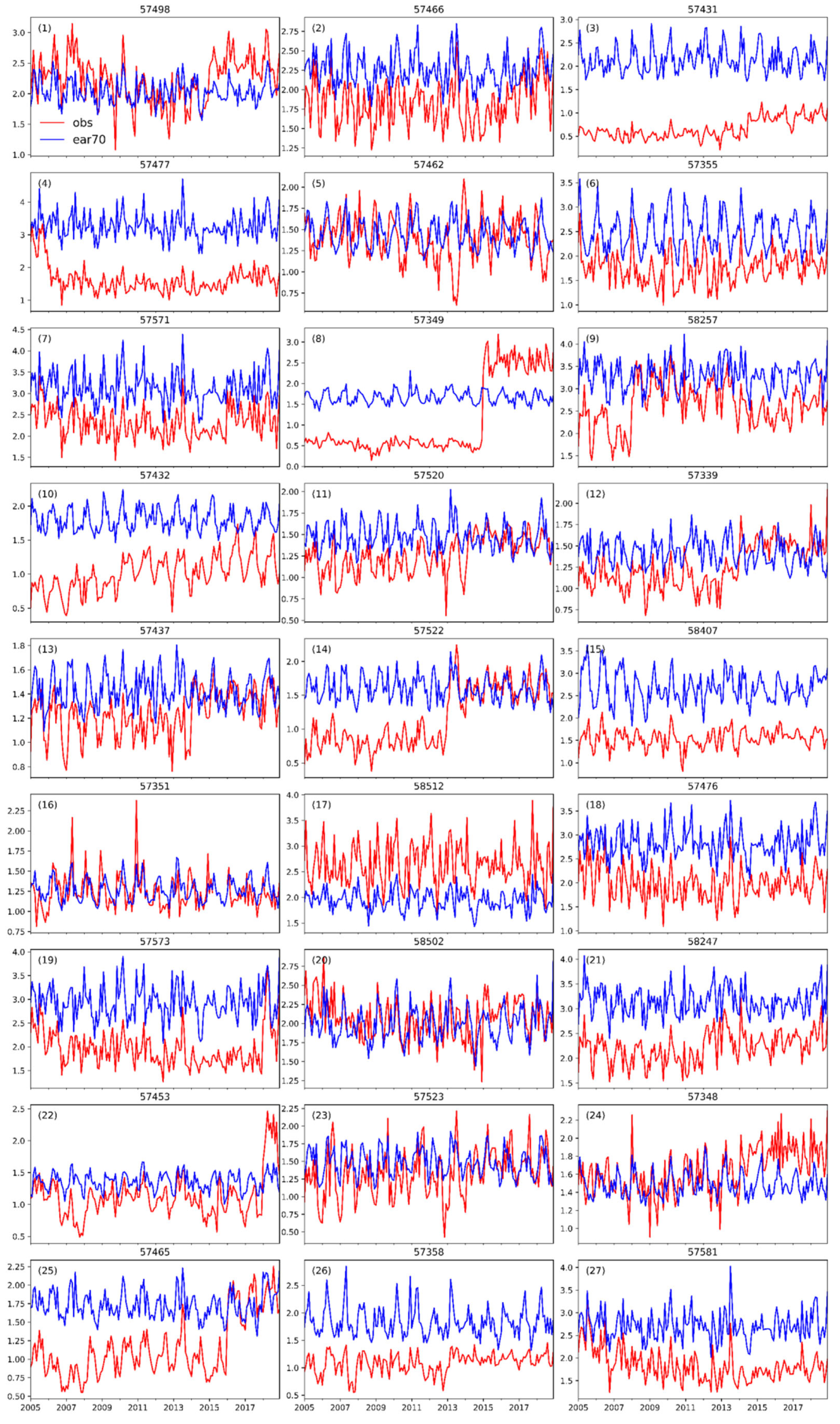
This appendix evaluates the EAR40 reanalysis dataset against observations from 27 meteorological stations along the Yangtze River to assess its suitability for climatological analysis. Overall, the EAR40 reanalysis data successfully captures the primary monthly fluctuations in wind speed observed at most stations (Figure A1). However, the reanalysis data is generally more stable and shows less extreme variability than the station records, even after the station data has undergone quality control by the CMA. Notably, several station records show significant discontinuities or changes in behavior not present in the reanalysis, particularly after 2013 (e.g., Figure A1(8,14,24,25)), which may point to uncorrected issues in the observational record.
Figure A1.
Comparison of monthly mean wind speed (u) between EAR40 reanalysis and station observations for 27 locations along the Yangtze River Waterway.
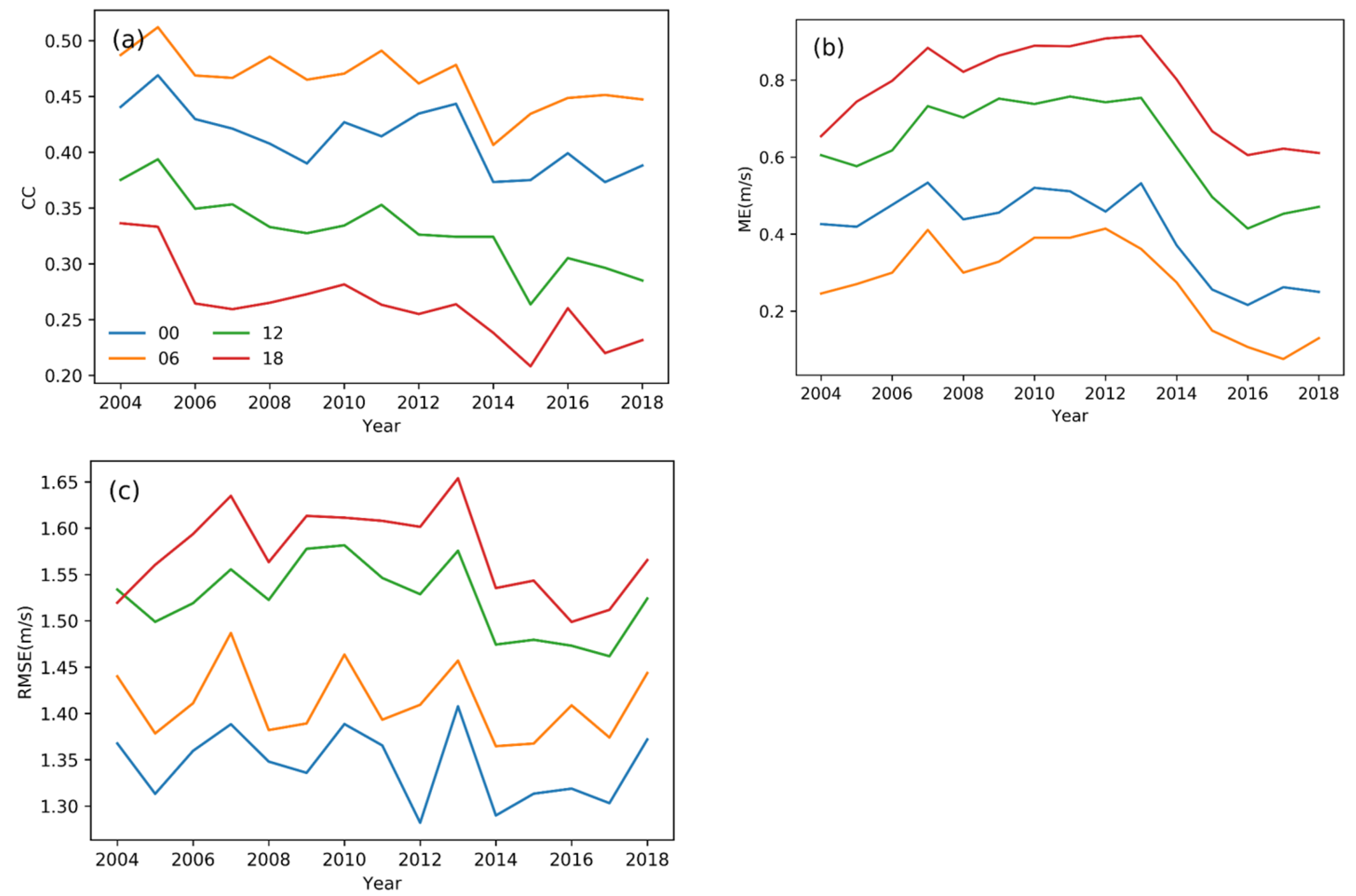
A statistical evaluation of the reanalysis performance at fixed times reveals a clear diurnal pattern in its accuracy (Figure A2). The Correlation Coefficient (CC) is highest at 06UTC (local afternoon), exceeding 0.6, and lowest at 18UTC (local late night), dropping below 0.21. Conversely, the Mean Error (ME) and Root Mean Square Error (RMSE) are lowest at 06UTC and highest at 18UTC, indicating the reanalysis performs best during the daytime when the atmospheric boundary layer is well-mixed. The errors show a decreasing trend over time, particularly after 2008 when automated weather stations were implemented across China, improving data consistency.
Figure A2.
Statistical evaluation of EAR40 against station data from 2004 to 2018, showing the (a) Correlation Coefficient (CC), (b) Mean Error (ME), and (c) Root Mean Square Error (RMSE) at four fixed times daily.
Appendix B. Example of Changing Observation Environment at Wuhan Station
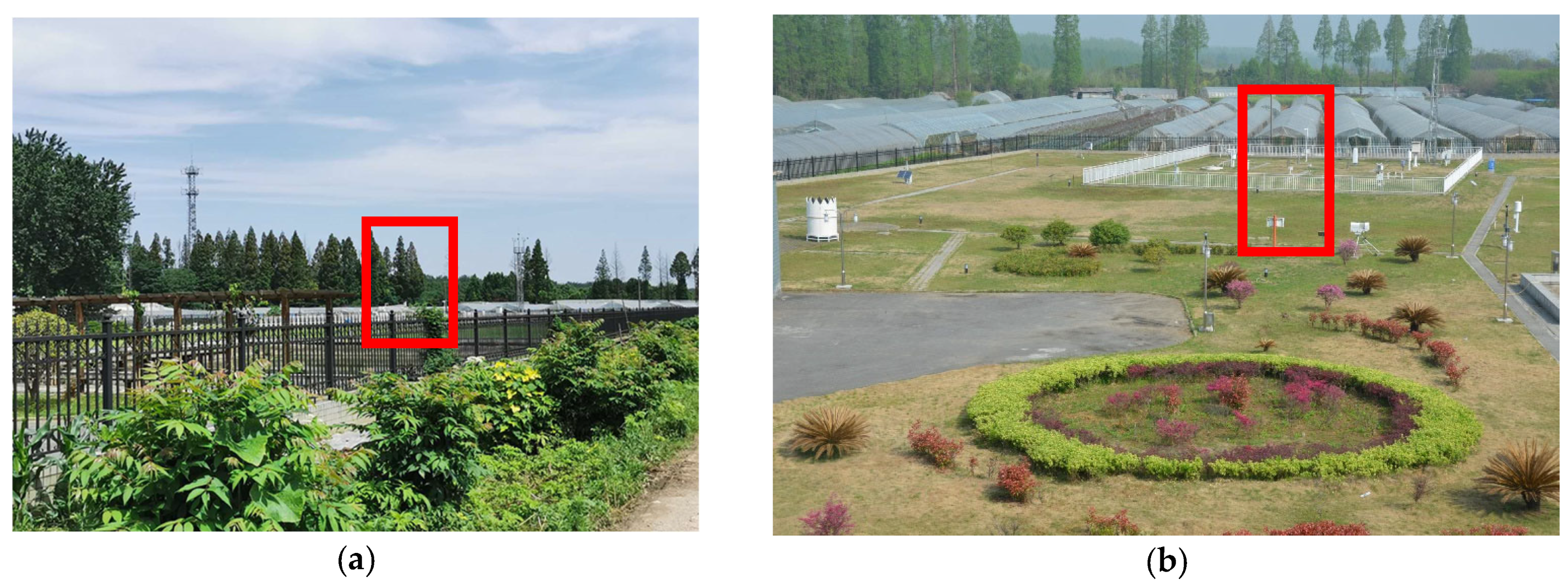
The following images illustrate the significant changes in the surrounding environment of a key national reference station (Wuhan), a critical issue discussed in the main paper regarding data quality and the scale effect. Urban encroachment and vegetation growth can alter local airflow, potentially introducing biases into long-term wind speed records.
Figure A3.
The observation field at the Wuhan meteorological station. This station was established in 1869 and has been relocated five times, most recently in 2009. (a) A view of the site in June 2021. (b) A view from 2018, showing the proximity of surrounding buildings. The red rectangles highlight the location of the 10 m anemometer, demonstrating how local obstructions can influence measurements.
Appendix C. Climate Indices and Correlation Analysis
The following 88 climate indices, provided by the China Meteorological Administration (CMA), were used in the correlation analysis to investigate the linkage between large-scale atmospheric circulation and local wind speed along the Yangtze River.
Table A2.
List of the 88 climate indices used in the correlation analysis.
References
- The World Bank. GDP. Available online: https://data.worldbank.org/indicator/NY.GDP.MKTP.CD?end=2020&most_recent_value_desc=true&start=2020&view=bar (accessed on 3 August 2021).
- Li, L.; Liu, Y. Industrial green spatial pattern evolution of Yangtze River Economic Belt in China. Chin. Geogr. Sci. 2017, 27, 660–672. [Google Scholar] [CrossRef] [Scilit]
- Upper Reaches of Yangtze River Welcome First 10,000-Tonne-Class Ship. Xinhua. 2025. Volume 2025. Available online: https://english.news.cn/20240509/fb14033f6559429aabbe68d3da0d615f/c.html (accessed on 11 January 2026).
- Jiangsu Nanjing: Efficiency of Yangtze River Deepwater Channel Improved, 90,000-ton Ocean-Going Vessels Can Directly Reach Nanjing. Available online: http://news.cctv.com/ (accessed on 3 August 2021).
- Dai, Q.; Yang, J.; Li, D. Modeling a three-mode hybrid port-hinterland freight intermodal distribution network with environmental consideration: The case of the Yangtze river economic belt in China. Sustainability 2018, 10, 3081. [Google Scholar] [CrossRef] [Scilit]
- Peng, W.; Shuai, C.F.; Xin, X. Yangtze River: China’s golden waterway. In Proceedings of the Institution of Civil Engineers-Civil Engineering; Thomas Telford Ltd.: London, UK, 2010; Volume 163, pp. 3–47. [Google Scholar]
- Sun, T.; Che, H.; Wu, J.; Wang, H.; Wang, Y.; Zhang, X. The variation in visibility and its relationship with surface wind speed in China from 1960 to 2009. Theor. Appl. Climatol. 2018, 131, 335–347. [Google Scholar] [CrossRef] [Scilit]
- Tillig, F.; Ringsberg, J.W. Design, operation and analysis of wind-assisted cargo ships. Ocean Eng. 2020, 211, 107603. [Google Scholar] [CrossRef] [Scilit]
- Sui, Z.; Wen, Y.; Huang, Y.; Song, R.; Piera, M.A. Maritime accidents in the Yangtze River: A time series analysis for 2011–2020. Accid. Anal. Prev. 2023, 180, 106901. [Google Scholar] [CrossRef] [Scilit]
- Chen, L.; Li, D.; Pryor, S.C. Wind speed trends over China: Quantifying the magnitude and assessing causality. Int. J. Climatol. 2013, 33, 2579–2590. [Google Scholar] [CrossRef] [Scilit]
- Fu, G.; Yu, J.; Zhang, Y.; Hu, S.; Ouyang, R.; Liu, W. Temporal variation of wind speed in China for 1961–2007. Theor. Appl. Climatol. 2011, 104, 313–324. [Google Scholar] [CrossRef] [Scilit]
- Zhang, R.; Zhang, S.; Luo, J.; Han, Y.; Zhang, J. Analysis of near-surface wind speed change in China during 1958–2015. Theor. Appl. Climatol. 2019, 137, 2785–2801. [Google Scholar] [CrossRef] [Scilit]
- Dragoni, D.; Schmid, H.P.; Wayson, C.A.; Potter, H.; Grimmond, C.S.B.; Randolph, J.C. Evidence of increased net ecosystem productivity associated with a longer vegetated season in a deciduous forest in south-central Indiana, USA. Glob. Change Biol. 2011, 17, 886–897. [Google Scholar] [CrossRef] [Scilit]
- Jin, W.; Ren, G.; Qu, Y.; Liu, X.L. Change in surface mean wind speed of northeast China during 1971–2010. Arid Zone Res. 2012, 29, 648–653. [Google Scholar]
- Zhang, F.; Wang, J.A.; Zou, X.; Mao, R.; Gong, D.; Feng, X. Wind Erosion Climate Change in Northern China During 1981–2016. Int. J. Disaster Risk Sci. 2020, 11, 484–496. [Google Scholar] [CrossRef] [Scilit]
- Dadaser-Celik, F.; Cengiz, E. Wind speed trends over Turkey from 1975 to 2006. Int. J. Climatol. 2014, 34, 1913–1927. [Google Scholar] [CrossRef] [Scilit]
- McVicar, T.R.; Van Niel, T.G.; Li, L.T.; Roderick, M.L.; Rayner, D.P.; Ricciardulli, L.; Donohue, R.J. Wind speed climatology and trends for Australia, 1975–2006: Capturing the stilling phenomenon and comparison with near-surface reanalysis output. Geophys. Res. Lett. 2008, 35. [Google Scholar] [CrossRef] [Scilit]
- Wan, H.; Wang, X.L.; Swail, V.R. Homogenization and Trend Analysis of Canadian Near-Surface Wind Speeds. J. Clim. 2010, 23, 1209–1225. [Google Scholar] [CrossRef] [Scilit]
- Jiang, D.; Wu, B. Hierarchical Control for Ship Navigation under Winds: A Case in the Three Gorges Reservoir Area. In Proceedings of the 18th COTA International Conference of Transportation Professionals, Beijing, China, 5–8 July 2018; American Society of Civil Engineers: Reston, VA, USA, 2018; pp. 1693–1700. [Google Scholar]
- Xu, J.; Wu, J.; Xing, Y.; Yang, D.; Jiao, Y.; Shang, M.; Bai, L. Error Analysis of Wind Speed of High Spatiotemporal Resolution Surface Variable Reanalysis Products in China. Clim. Change Res. Lett. 2025, 14, 831–841. (In Chinese) [Google Scholar] [CrossRef]
- Pinzon, J.E.; Tucker, C.J. A non-stationary 1981–2012 AVHRR NDVI3g time series. Remote Sens. 2014, 6, 6929–6960. [Google Scholar] [CrossRef] [Scilit]
- Zeng, Z.; Ziegler, A.D.; Searchinger, T.; Yang, L.; Chen, A.; Ju, K.; Piao, S.; Li, L.Z.; Ciais, P.; Chen, D. A reversal in global terrestrial stilling and its implications for wind energy production. Nat. Clim. Change 2019, 9, 979–985. [Google Scholar] [CrossRef] [Scilit]
- Li, Z.; Xiao, Z.; Zheng, C. Observation analysis of wind climate in China for 1971–2017 under the demand of wind energy evaluation and utilization. Energy Rep. 2021, 7, 3535–3546. [Google Scholar] [CrossRef] [Scilit]
- Seneviratne, S.I.; Zhang, X.; Adnan, M.; Badi, W.; Dereczynski, C.; Luca, A.D.; Ghosh, S.; Iskandar, I.; Kossin, J.; Lewis, S. Weather and climate extreme events in a changing climate. In Climate Change 2021—The Physical Science Basis 2021; IPCC: Geneva, Switzerland, 2021. [Google Scholar]
- Liu, L.; Wen, Y.; Liang, Y.; Zhang, F.; Yang, T. Extreme weather impacts on inland waterways transport of Yangtze River. Atmosphere 2019, 10, 133. [Google Scholar] [CrossRef] [Scilit]
- Khan, L.; Macklin, J.; Peck, B.; Morton, O.; Souppez, J.R. A review of wind-assisted ship propulsion for sustainable commercial shipping: Latest developments and future stakes. In Proceedings of the Wind Propulsion Conference, London, UK, 15–16 September 2021; Royal Institution of Naval Architects: London, UK, 2021. [Google Scholar]
- Rayner, D.P. Wind Run Changes: The Dominant Factor Affecting Pan Evaporation Trends in Australia. J. Clim. 2007, 20, 3379–3394. [Google Scholar] [CrossRef] [Scilit]
- Yang, P.; Ren, G.; Yan, P.; Deng, J. Tempospatial pattern of surface wind speed and the “Urban Stilling Island” in Beijing City. J. Meteorol. Res. 2020, 34, 986–996. [Google Scholar] [CrossRef] [Scilit]
- Ding, J.; Cuo, L.; Zhang, Y.; Zhang, C. Varied spatiotemporal changes in wind speed over the Tibetan Plateau and its surroundings in the past decades. Int. J. Climatol. 2021, 41, 5956–5976. [Google Scholar] [CrossRef] [Scilit]
- You, Q.; Fraedrich, K.; Min, J.; Kang, S.; Zhu, X.; Pepin, N.; Zhang, L. Observed surface wind speed in the Tibetan Plateau since 1980 and its physical causes. Int. J. Climatol. 2014, 34, 1873–1882. [Google Scholar] [CrossRef] [Scilit]
- Zheng, J.; Li, B.; Chen, Y.; Chen, Z.; Lian, L. Spatiotemporal variation of upper-air and surface wind speed and its influencing factors in northwestern China during 1980–2012. Theor. Appl. Climatol. 2018, 133, 1303–1314. [Google Scholar] [CrossRef] [Scilit]
- Peterson, W.T.; Schwing, F.B. A new climate regime in Northeast Pacific ecosystems. Geophys. Res. Lett. 2003, 30, 1896. [Google Scholar] [CrossRef] [Scilit]
- Hersbach, H.; Bell, B.; Berrisford, P.; Hirahara, S.; Horányi, A.; Muñoz-Sabater, J.; Nicolas, J.; Peubey, C.; Radu, R.; Schepers, D.; et al. The ERA5 global reanalysis. Q. J. R. Meteorol. Soc. 2020, 146, 1999–2049. [Google Scholar] [CrossRef] [Scilit]
- Shi, C.; Jiang, L.; Zhang, T.; Xu, B.; Han, S. Status and Plans of CMA Land Data Assimilation System (CLDAS) Project; EGUGA: Munich, Germany, 2014. [Google Scholar]
- Jarraud, M. Guide to Meteorological Instruments and Methods of Observation (WMO-No. 8); World Meteorological Organization: Geneva, Switzerland, 2008; Volume 29. [Google Scholar]

Disclaimer/Publisher’s Note: The statements, opinions and data contained in all publications are solely those of the individual author(s) and contributor(s) and not of MDPI and/or the editor(s). MDPI and/or the editor(s) disclaim responsibility for any injury to people or property resulting from any ideas, methods, instructions or products referred to in the content. |
© 2026 by the authors. Licensee MDPI, Basel, Switzerland. This article is an open access article distributed under the terms and conditions of the Creative Commons Attribution (CC BY) license.