1. Introduction
Understanding the physical mechanisms underlying extreme weather events is essential, given their profound societal and ecological impacts at both global and regional scales, as highlighted in the Special Report on Extreme Events and Climate Change 2023 [
1,
2,
3]. The recent escalation in the frequency and severity of such events has intensified efforts to link changes in large-scale atmospheric circulation with the occurrence of extremes. Among various data-driven approaches, the Self-Organizing Map (SOM) has gained popularity as a powerful unsupervised learning method for identifying representative circulation patterns.
In climate science, SOMs have been widely applied for objective synoptic weather classification, linking circulation patterns to surface extremes [
4,
5,
6,
7]. By clustering fields such as mean sea-level pressure (MSLP) or geopotential height into a limited number of representative circulation regimes, SOM facilitates the analysis of relationships between large-scale flow anomalies and local weather extremes. For example, Horton et al. [
8] found that long-term changes in the frequency of SOM-based geopotential height patterns have contributed to changes in extreme temperature trends in some regions of the Northern Hemisphere since the 1980s. SOM has also been used to link regional changes in precipitation to shifts in large-scale circulation patterns [
8,
9,
10,
11,
12]. In addition, SOM has been used as a statistical downscaling method for future climate prediction by relating the changes in the frequency of synoptic events to surface variables [
5,
13].
Despite its extensive use, the interpretability and physical robustness of SOM-derived clusters remain contentious across applications. Gibson et al. [
6] demonstrated that the generalized patterns represented by SOMs may fail to capture atypical or compound synoptic configurations associated with extreme events, thereby risking misinterpretation of the underlying circulation mechanisms. Similarly, Huva et al. [
14] showed that SOM nodes often fail to represent key synoptic features responsible for rainfall in major Australian cities, while Lennard and Hegerl [
15] reported that SOM-derived patterns did not properly depict closed low-pressure systems linked to heavy precipitation. Nicholls et al. [
16] also noted that transient and small-scale features are often obscured by the over-smoothed SOM representations. These studies collectively indicate that although SOM is effective for summarizing typical circulation regimes, it may misrepresent the atypical synoptic structures most relevant to extreme weather events. Beyond these generalization issues, another often-overlooked limitation of the SOM approach is that the individual members assigned to a given node may bear little resemblance to the node’s representative composite pattern. In other words, even when a node is interpreted as depicting a typical circulation regime, some of its member cases can exhibit markedly different spatial structures or dynamical characteristics. This within-node heterogeneity can mislead subsequent analyses that assume strong similarity among node members, particularly when extreme events are involved–a key motivation for this study.
This study aims to highlight the interpretational risks inherent in SOM clustering when identifying large-scale atmospheric patterns associated with regional extreme weather events. Using a case study of extreme cold events in South Korea, we demonstrate how such misinterpretations can arise and propose a spatial pattern correlation analysis as a post-processing step to mitigate these issues and enhance the physical interpretability of SOM-derived patterns.
2. Data and Methods
2.1. Identifying Severe Cold Cases
Daily mean surface temperature and sea level pressure with a spatial resolution of 2.5° × 2.5° from 1949 to 2021, provided by the NCEP-NCAR reanalysis [
17], are used. Although the 2.5° resolution dataset may not fully capture local-scale temperature extremes over the Korean Peninsula, which is characterized by complex terrain, it is suitable for the present study, which focuses on large-scale circulation patterns associated with extreme cold events defined by area-averaged temperature over the Korean Peninsula. Following Yoon et al. [
18], K-tas was defined as the area-averaged daily mean surface air temperature over 34–43° N and 124–131° E, encompassing the Korean Peninsula (green box in
Figure 1 and
Figure S1). The standardized anomaly of K-tas was calculated by removing the climatological mean and dividing by the corresponding standard deviation. Severe cold events were then defined as days when the standardized K-tas anomaly fell below −0.7, a threshold chosen to represent pronounced cold conditions at the peninsula-wide scale while retaining a sufficient sample size for the SOM analysis. To classify and compare large-scale background circulation patterns associated with the selected severe cold events over Korea, we performed a SOM-based cluster analysis over 20–80° N and 40–240° E.
2.2. Self-Organizing Map (SOM) Classification
SOM was initially developed by Kohonen [
19] as an unsupervised data mining method. This map was used to identify inherent patterns in the input data by projecting them onto it. The nodes on the map represented the most important features of the input space. A major strength of SOM is that the underlying patterns in a dataset can be visualized in the same form as the original data. SOM was widely used as a statistical tool for multivariate analysis because they are (1) a projection method that maps high-dimensional data to a low-dimensional space and (2) a clustering and classification method that orders similar data patterns onto neighboring SOM units. SOM is used for diverse purposes such as understanding a link between synoptic circulation and climatic variability, statistical downscaling of dynamics, climate prediction, and weather forecasting.
SOMs are trained by iteratively comparing each input pattern with the weight vectors of all neurons on the map. Each neuron
is associated with a weight vector
that has the same dimension as the input vector
, and all weights are randomly initialized at the beginning of training. For a given input
, the Euclidean distance
is computed between the input vector and each neuron’s weight vector, and the neuron with the smallest distance is identified as the best-matching unit (BMU). Once the BMU is found, the weight vectors of the BMU and its neighboring neurons are updated so that they move closer to the input pattern. During training, both the learning rate and the neighborhood radius decrease over time, allowing the SOM to evolve from a coarse global ordering of patterns to a finer local adjustment and gradually converge [
14,
19].
Some parameters, such as node array, type of initialization method, algorithm types, radius, and neighboring function, are necessarily selected to apply the SOM. Therefore, we selected the parameters as the same as Jun and Choi. [
20], including “Repeated 1,” “Number of nodes × 500 in the basic training stage,” and “Number of nodes × 1000 in the fine-tuning stage” (
Table S1). In this study, to eliminate the possibility of atypical cases arising from arbitrarily chosen clusters in SOM, we identified the optimal number of clusters that best fit the data. To determine the optimal cluster number, we evaluated topographic error (TE), slope of the pattern correlation coefficient (PCC), as well as the explained cluster variance (ECV) and its slope.
2.3. SOM Combined with Pattern Correlation
To minimize the issue of ensuring objectivity in identifying atypical cases, one of the interpretation pitfalls in SOM-based clustering, we applied a methodology using pattern correlation analysis as a post-processing step. For SOM assessment, we first performed the SOM classification using 2 × 2 node configuration and then computed pattern correlation coefficients (PCCs) to identify atypical cases. Specifically, PCCs were calculated between the SOM-derived cluster pattern and the patterns of individual event members within each cluster using the standard Pearson correlation [
21]. Events with low PCCs were treated as atypical and filtered out. The resulting SOM classification was retained as SOM-PC.
For example, if you set the number of clusters to four, the SOM-based will necessarily assign all cases to one of the four clusters without an exception. In this study, a PCCs threshold of 0.4 is not intended to provide an objectively correct separation between typical and atypical cases, but rather to diagnose how many events assigned to each SOM node exhibit only weak resemblance to its centroid pattern. The PCC was performed between cluster 1 and the cases assigned to cluster 1. In this process, cases with PCCs threshold below 0.4 were defined as atypical cases and were eliminated. This process allowed us to clarify the importance of appropriately excluding atypical cases that “don’t deserve to be members” of any cluster when performing SOM-based cluster analysis. Finally, 154 cases of severe cold on Korea were analyzed using the SOM-PC cluster analysis excluding atypical cases. Here, we used the same SOM map size as in the original setting (2 × 2).
3. Results
3.1. Classified Large-Scale Patterns and a Potential Drawback
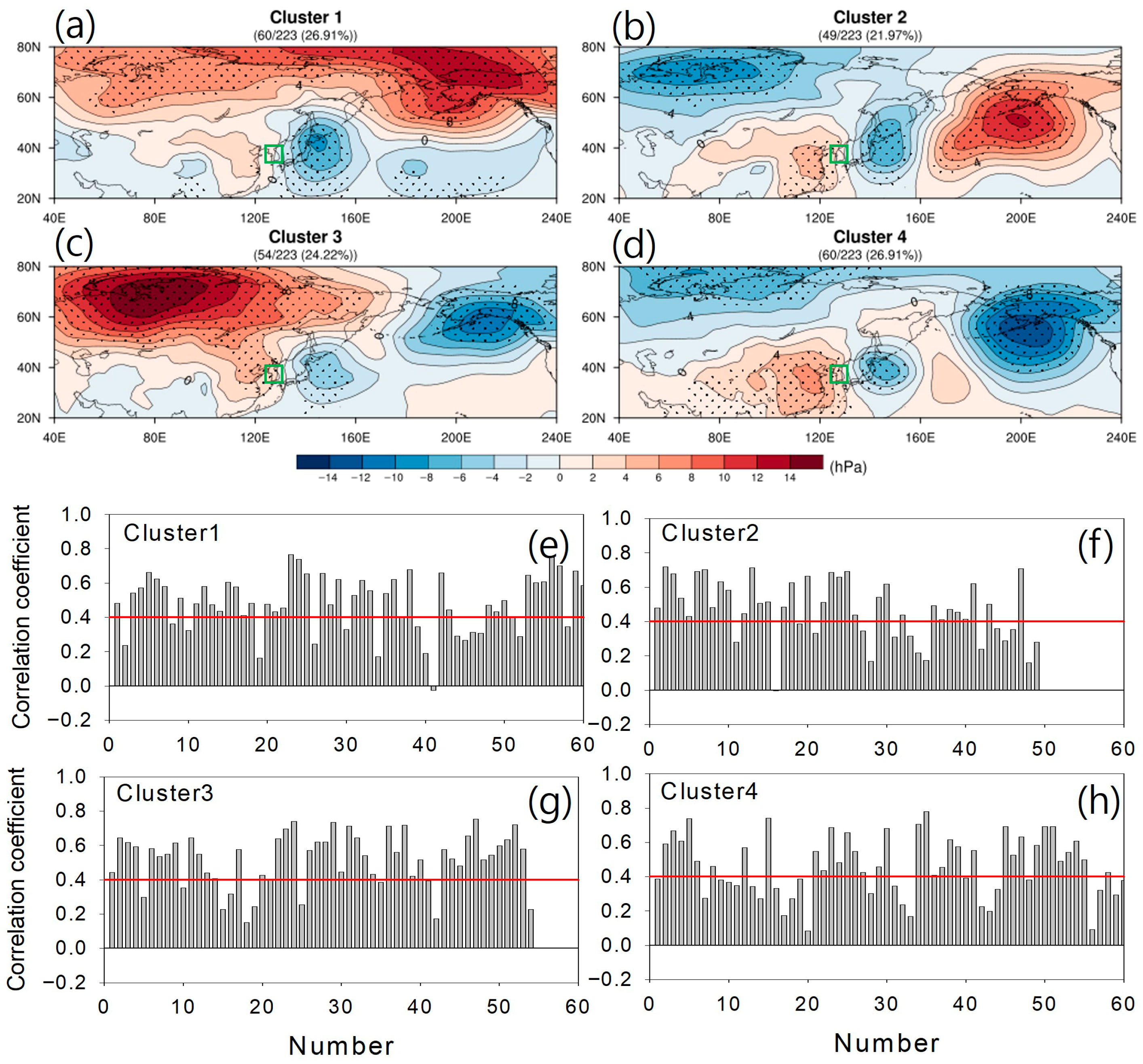
Figure 1a–d shows the SOM-classified MSLP anomaly patterns for the selected 223 severe cold cases over Korea, using a 2 × 2 SOM configuration. The cluster 1 (
Figure 1a) and 4 (
Figure 1d) showed the largest number of severe cold cases, while cluster 2 (
Figure 1b) indicated the least.
A positive MSLP anomaly pattern was shown in the west and a negative pattern in the east of Korea in all clusters (area of green boxes in
Figure 1a–d). This pattern explains the cold air from the North due to intensified Siberian High and Aleutian Low strengthened the atmospheric pressure gradient and moved to Korea, resulting in severe cold events, despite pressure patterns being derived by different large-scale patterns; positive anomalies MSLP over Eurasia (North Pacific) showed in cluster 1 (
Figure 1a) and 3 (
Figure 1c) (cluster 1 and 2), negative anomalies in cluster 2 (
Figure 1b) and 4 (
Figure 1d) (cluster 3 and 4). These patterns were likely consistent with various natural variabilities, such as Arctic Oscillation, Warm Arctic, Cold Eurasian, and the El Niño-Southern Oscillation [
18,
22,
23,
24,
25,
26].
The PCCs of the SOM-based clusters were calculated to identify atypical cases (
Figure 1e–h). Out of the total 223 cases, 154 (PCC > 0.4) were typical cases, accounting for 69.06%, while 69 cases (PCC < 0.4) were considered atypical, making up 30.94%. Across the clusters, atypical cases represented 26.67% (16/60), 32.65% (16/49), 22.22% (12/54), and 41.67% (25/60) of the cases from clusters 1 to 4, respectively. Cluster 3 (
Figure 1g) had the lowest ratio of typical to atypical cases, and cluster 4 (
Figure 1h) had the highest ratio. The clusters with the most severe cases, indicated by negative PCC values representing completely conflicting patterns, were clusters 1 (PCC = −0.02) and 2 (PCC = −0.003). These results highlight a fundamental methodological limitation of the SOM-based approach used in this study: a single node can simultaneously host events that closely resemble its centroid and events that are only weakly or even oppositely related to it. Rather than being treated as a few misclassified outliers, these low- and negative-PCC members therefore indicate a structural limitation of the method, whereby cluster membership does not guarantee physical homogeneity of the assigned circulation patterns. These results highlight a structural limitation of the SOM-based approach, whereby all cases—including atypical ones—are necessarily assigned to a limited number of representative clusters. To examine whether this structural limitation is sensitive to the choice of analysis domain, we repeated an identical SOM analysis using a reduced domain. We find that atypical cases persist even with the smaller domain (
Figure S2), indicating that this issue cannot be fully resolved by domain reduction alone.
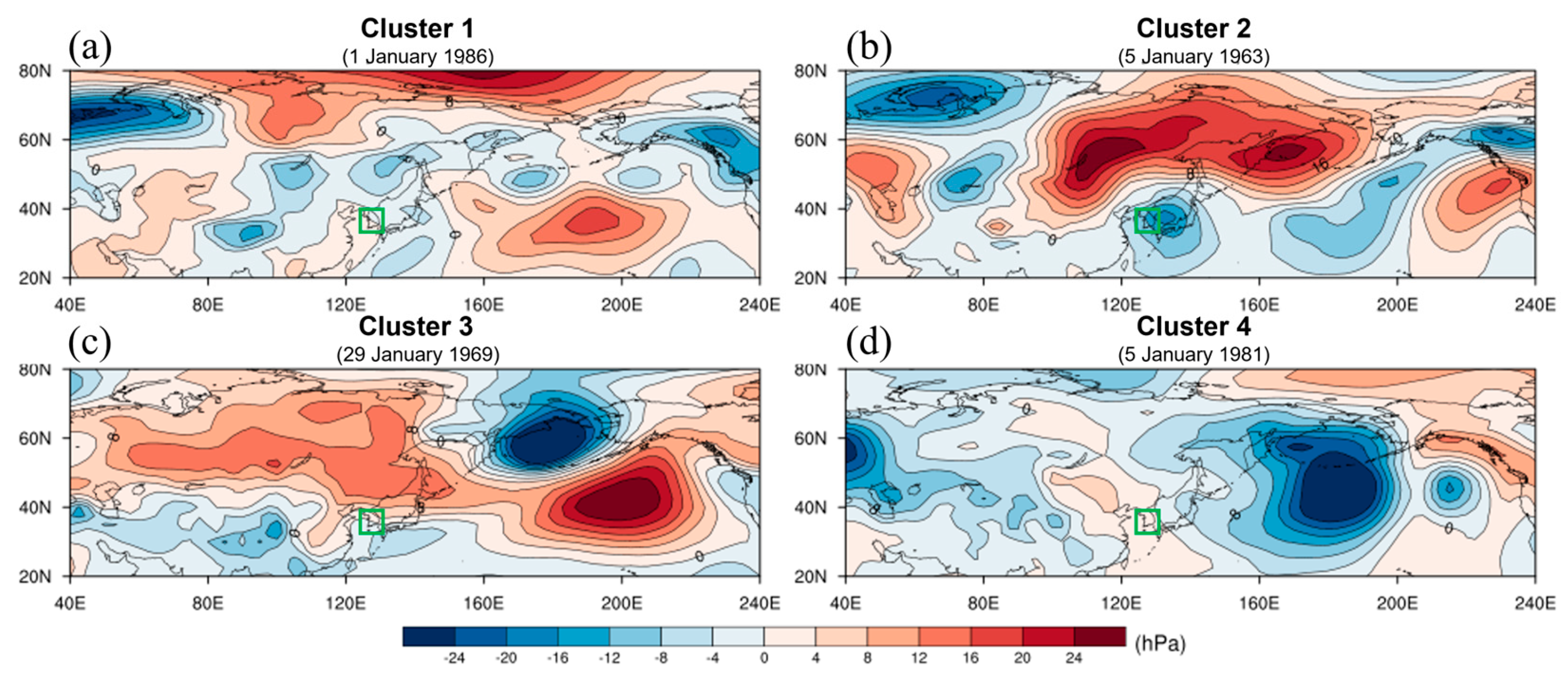
To examine the characteristics of SOM-classified atypical cases, we selected cases with the lowest PCC for each cluster to illustrate the distribution of MSLP anomalies (
Figure 2). The selected cases from clusters 1 to 4 represent 1 January 1986 (PCC −0.02), 5 January 1963 (PCC −0.003), 29 January 1969 (PCC 0.15), and 5 January 1981 (PCC 0.08). Moreover, their normalized K-tas were −1.5σ, −0.82σ, −0.73σ, and −1.6σ (threshold −0.7 σ). Clusters 1 (
Figure 2a) and 4 (
Figure 2d) exhibited a significant pressure gradient arising from a positive MSLP anomaly on the western side of Korea and a concurrent negative MSLP anomaly on the eastern Korea. In contrast, clusters 2 (
Figure 2b) and 3 (
Figure 2c) showed a negative MSLP anomaly on the northwestern side of Korea, showing a relatively weaker pressure gradient. Comparison of clusters over the study area also displayed different patterns from the SOM-classified results.
Figure 2a showed a negative MSLP anomaly Eurasia and a positive MSLP anomaly over the northern Pacific, while
Figure 2d indicated a distinct pattern; negative MSLP anomaly over the northern Pacific, and a positive anomaly in south China. Similarly, MSLP anomaly pattern differences also appear with
Figure 2c. It is evident that the original SOM lacks the capacity to effectively filter out atypical cases that inherently belong within a cluster. Furthermore, it raises the question: ‘Can we trust the SOM-classified clustering process?’.
3.2. Optimization of Node Configuration and Cluster Numbers
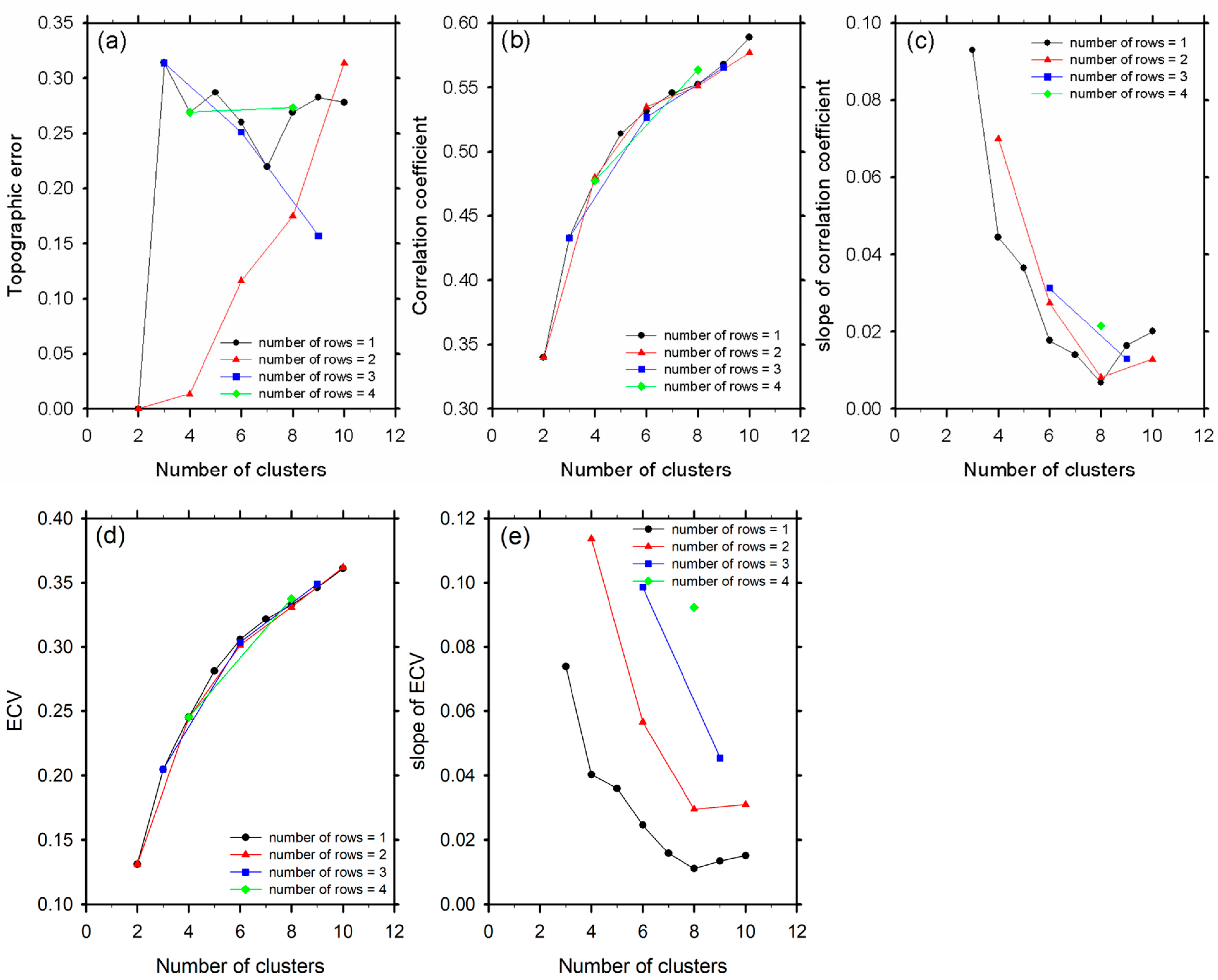
In order to enhance the SOM-classified results, we conducted two analyses. Firstly, we investigated the extent to which the interpretational pitfalls in SOM-based clustering be mitigated by optimizing the node configuration and selecting an appropriate number of clusters. This evaluation considered TE, PCC, slope of PCC, ECV, and slop of ECV (
Figure 3). The TE is defined as the percentage of input vectors for which the most similar node and the second most similar node are not neighboring nodes [
9,
11,
19]. The PCC was defined as the mean pattern-correlation coefficient between the SOM-derived cluster pattern and the pattern of each case assigned to that cluster. A higher PCC is considered indicative of the optimal number of clusters. The ECV ranges from 0 to 1 and reaches its maximum value when the centroids completely account for the data within each cluster. As a result, the ECV evaluates how effectively the centroids of clusters describe and capture the characteristics of the data in those clusters.
In rows 1 (1 × 1, 1 × 2, 1 × 3, …, 1 × 10), 3 (3 × 1, 3 × 2, …, 3 × 3), and 4 (4 × 1, 4 × 2), the TE (
Figure 3a) decreased as the number of clusters increased whereas, row number 2 (2 × 2, 2 × 3, …, 2 × 5) exhibited a contrasting outcome compared to the other rows. The smallest TE was observed in row 2, with a total cluster count of 4 (2 × 2). Following closely, the next lowest TE was in row 2, with a total cluster count of 6 (2 × 3). The PCC and ECV showed a rapid increase as the number of clusters increased, with the gradual rate of increase diminishing (
Figure 3b,d). This was also evident in the slope of the PCC and ECV (
Figure 3c,e). These results confirmed that the optimal number of clusters is between 6 and 8, with rows 1–2. Therefore, considering both TE and PCC, the optimal cluster configuration was determined to be a total of 6 clusters in a 2 × 3 array. In this study, however, the 2 × 3 configuration is interpreted not as a uniquely optimal solution but as a local compromise, where TE is relatively low and the gains in PCC and ECV begin to saturate.
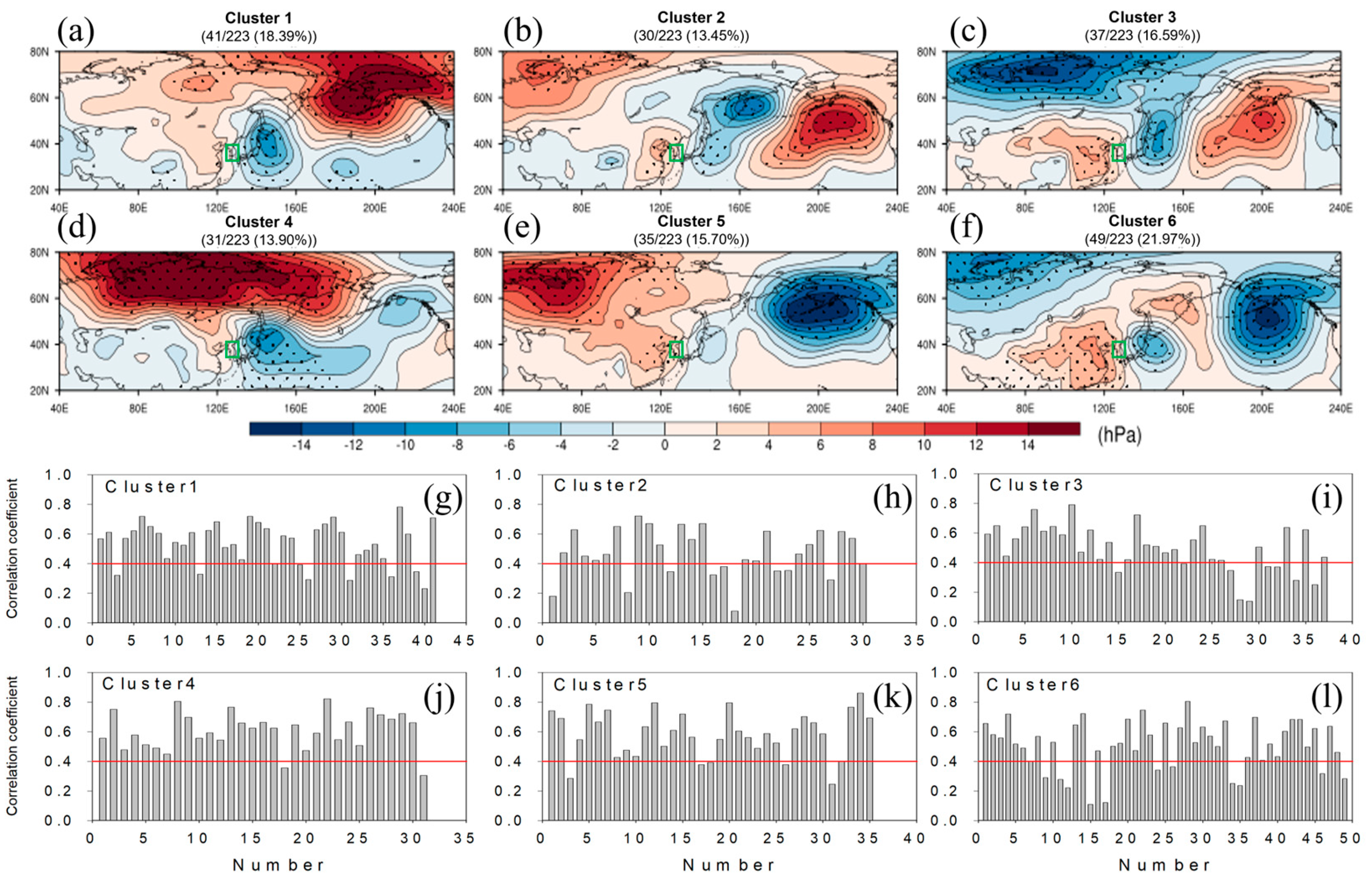
Figure 4a–f presents the clustering results of MSLP anomaly using the SOM configured with the optimal cluster count of 6 (2 × 3). Clusters 1 through 6 have occurrences of cold wave patterns in the order of 41 cases (18.39%), 30 cases (13.45%), 37 cases (16.59%), 31 cases (13.90%), 35 cases (15.70%), and 49 cases (21.97%), respectively. Cluster 6 exhibited the highest occurrence with a total of 49 cases, representing the most frequent pattern of severe cold wave events, while Cluster 2 showed the least occurrences with 30 cases.
Similar to the SOM results with a 2 × 2 configuration (
Figure 1a–d), all clusters in
Figure 4a–f exhibited an MSLP pattern of a positive anomaly on the west side and a negative anomaly on the east side of Korea. Clusters 2 (
Figure 4b) and 5 (
Figure 4e) displayed newly classified patterns, exhibiting strong positive anomalies in the high-latitude region of Eurasia whereas, they displayed different patterns over the North Pacific. However, even in the newly classified clusters, a positive MSLP anomaly was observed on the west side of Korea, while negative a MSLP anomaly was observed on the east side. Previously, through the results of the SOM classification with a 2 × 2 configuration, the atypical representative case on 1 January 1986 (
Figure 2a), was reclassified into Cluster 2 (
Figure 3b) under 2 × 3 SOM configuration. This low PCC (0.08) in the optimal 2 × 3 configuration illustrates that even after node optimization, strongly dissimilar events can still be forced into the same SOM node. In other words, the structural limitation of SOM—compulsory assignment of all events to a small number of centroids—cannot be fully remedied by tuning the node configuration alone.
Figure 4g–l shows the PCCs of members within each SOM classification cluster corresponding to
Figure 4a–f. The red line represents a PCC of 0.4. Even with the optimal 6 (2 × 3) SOM classification, atypical cases are still present. There was a total of 175 typical cases, accounting for 78.48% of the total, while atypical cases numbered 48, making up 21.52% of the total. Additionally, atypical cases within clusters were observed in the following proportions for clusters 1 to 6: 9 cases (21.95%), 10 cases (33.33%), 9 cases (24.32%), 2 cases (6.45%), 6 cases (17.14%), and 12 cases (24.92%), respectively. Cluster 4 (
Figure 4j) exhibited the lowest proportion, while Cluster 6 (
Figure 4l) showed the highest. The percentage of atypical cases in the SOM results with the optimal 2 × 3 configuration (
Figure 4g–l) decreased by approximately 9.42% compared to the results with the 2 × 2 configuration (
Figure 1e–h).
3.3. SOM-PC
To address interpretational pitfalls in SOM-based clustering, we verified that atypical cases could persist even when using an optimal node configuration and cluster count. We therefore conducted an additional post-processing analysis (SOM-PC) to mitigate these drawbacks. The SOM-PC procedure consists of: (1) performing SOM-based clustering; (2) calculating PCCs between the SOM-derived cluster pattern and individual cases within each cluster; (3) removing cases with PCCs below a threshold of 0.4 (red line in
Figure 1e–h); and (4) re-running the SOM-based clustering on the filtered dataset.
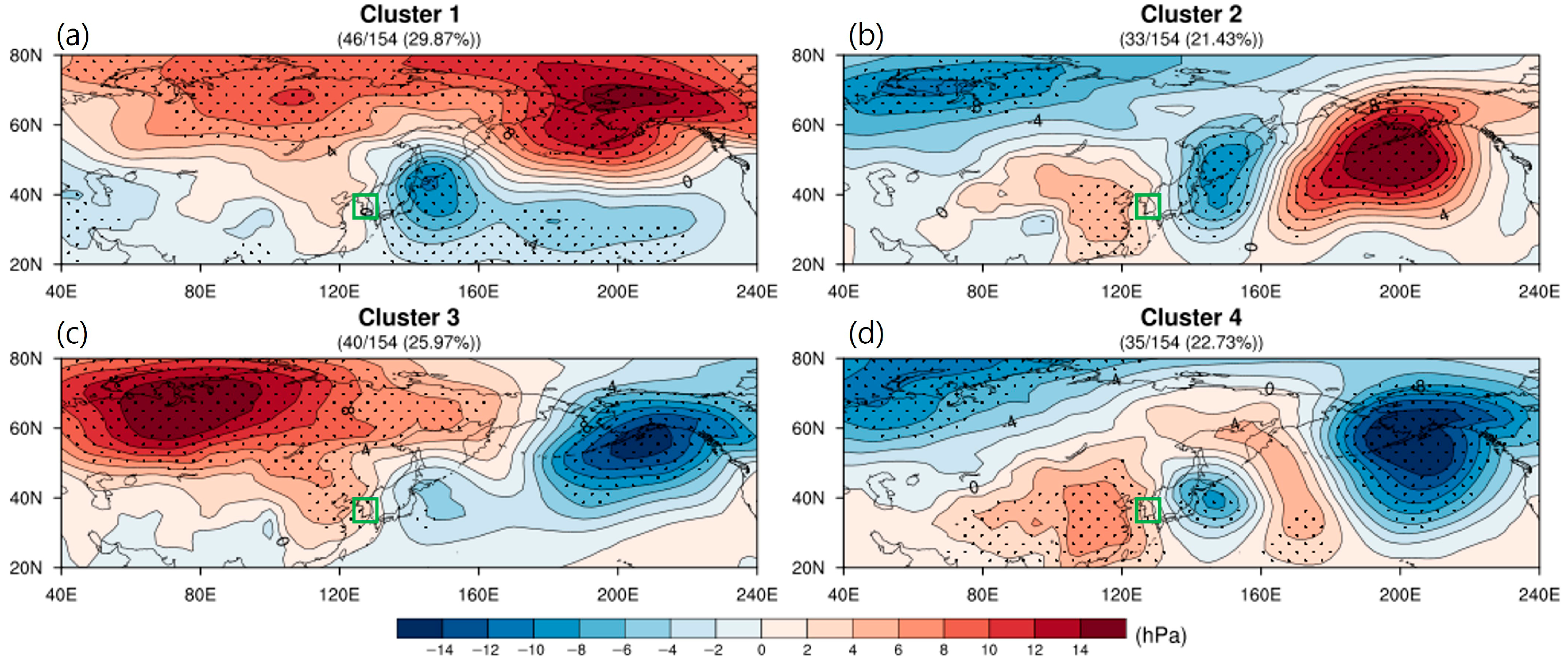
Figure 5 depicts the results of the 2 × 2 SOM-PC configuration for January cold wave cases (154 cases) after removing atypical cases. Clusters 1 to 4 accounted for 46 cases (28.87%;
Figure 5a), 33 cases (21.43%;
Figure 5b), 40 cases (25.97%;
Figure 5c), and 35 cases (22.73%;
Figure 5d), respectively. Regarding the patterns of January cold wave cases, Cluster 1 exhibited the highest frequency with 46 cases, while Cluster 2 had the lowest with 33 cases. Additionally, the proportion of atypical cases significantly decreased from 30.94% (69/223; SOM classification) to 3.9% (6/154; SOM-PC), indicating a larger reduction compared to the results obtained with the optimal node from 10.72% (25/233; SOM classification, 2 × 3).
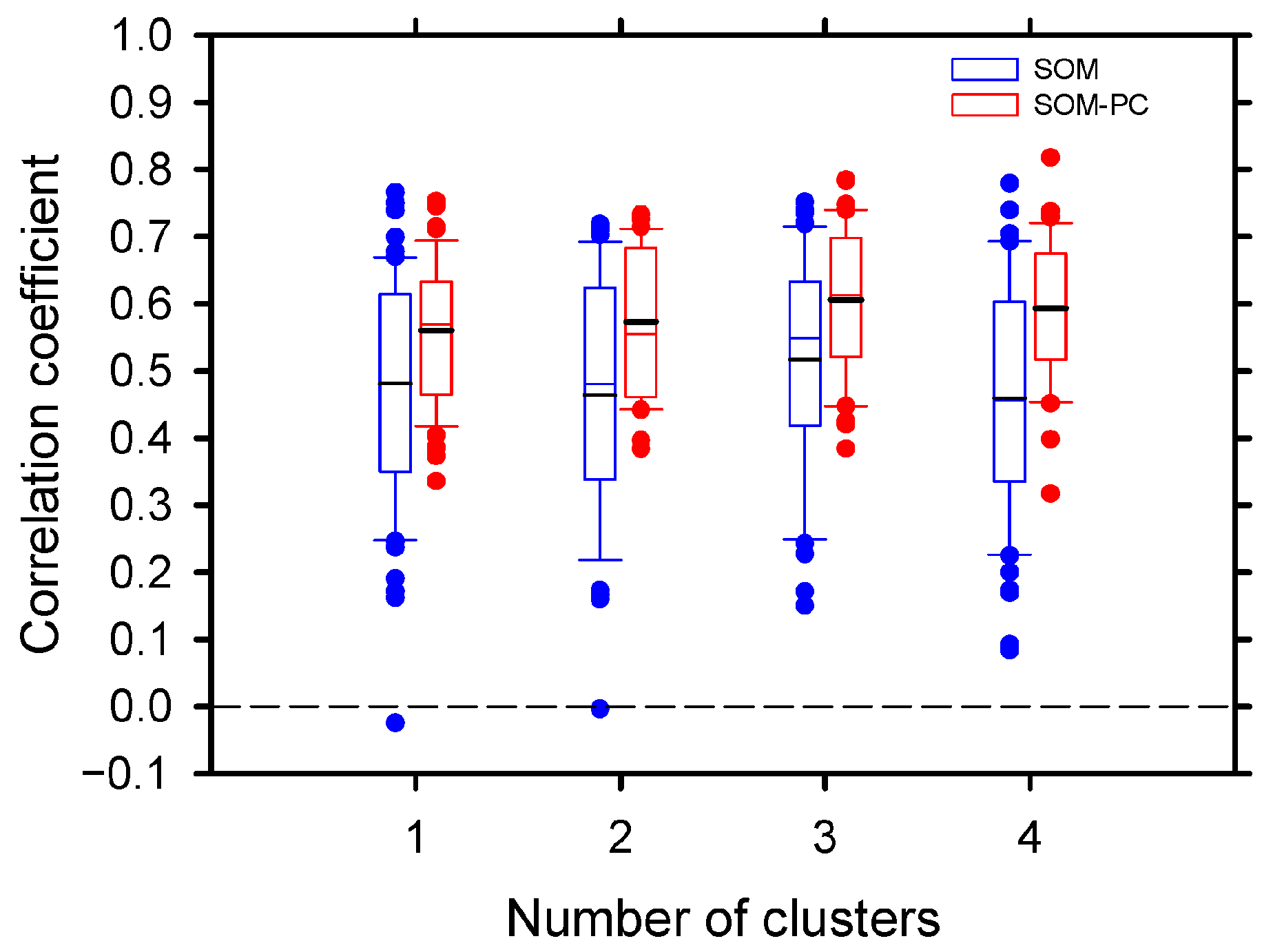
Figure 6 presents the PCCs among SOM patterns and case members within the clusters, comparing the SOM classification and SOM-PC. The blue color represents the SOM classification, while the red color represents SOM-PC. The dots represent the upper and lower 95% confidence intervals, and the color line within the boxes represents the median, while the black line represents the mean. The average PCCs for SOM-PC (SOM classification) from clusters 1 to 4 are 0.56 (0.48), 0.57 (0.46), 0.61 (0.52), and 0.59 (0.46), respectively, showing a slight increase compared to the SOM-based clustering. The application of SOM-PC for eliminating atypical cases results in slightly improved PCCs. However, when conducting a long-term trend analysis, the results appear ambiguous.
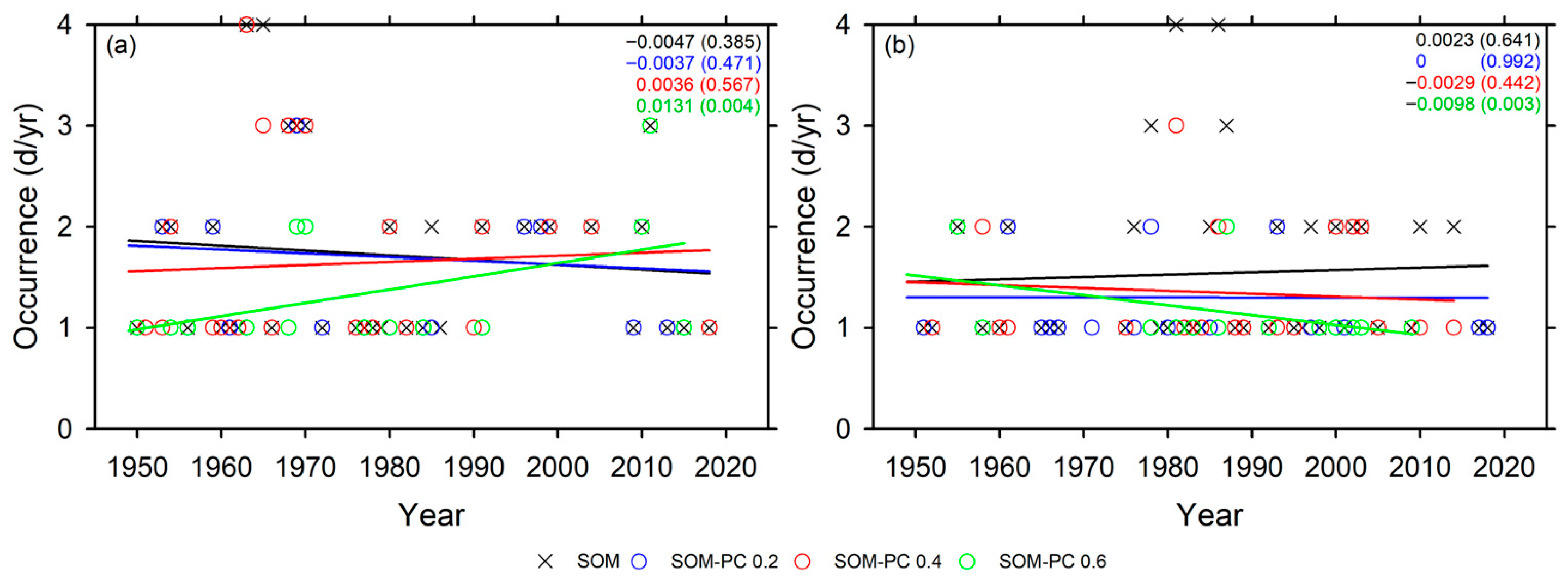
Figure 7 illustrates the trends in the occurrence of severe cold in January for four patterns each year from 1949 to 2021, using various thresholds (0.2, 0.4, 0.6). Note that the zero occurrence cases were removed in trend analysis, as we focused on examining the extreme cases of severe cold. Among the 4 clusters, cluster 1 (
Figure 7a) and cluster 4 (
Figure 7b) showed a notable contrasting result. Cluster 1 (cluster 4) displayed the largest decrease (increase) trend with −0.0047 (0.0023) per year using SOM while SOM-PC 0.6 indicated the largest increase (decrease) trend with a significant 0.0131 (−0.0098) per year. In particular, SOM-PC with 0.6 showed a significant level of
p-value less than 0.05. Thus, we do not claim that any particular trend line in
Figure 7 represents a robust physical signal. Instead, the strong dependence of the trend sign on the PCC threshold is interpreted as further evidence that SOM-based circulation trend analyses can be heavily influenced by classification choices and should be treated with great caution, especially in the context of extreme events.
4. Discussion
In this study, we examined how SOM-based circulation pattern clustering represents severe January cold events over Korea, with particular attention to the occurrence of atypical circulation patterns within SOM-derived clusters. Using a total of 223 cases of severe January cold events over Korea, we first applied an SOM-based classification with a 2 × 2 node configuration to classify the associated mean sea-level pressure patterns. All four clusters exhibited a dipole structure, characterized by positive MSLP anomalies to the east of Korea and negative anomalies to the west. This pattern is consistent with the physical mechanism in which an enhanced meridional pressure gradient facilitates the southward intrusion of cold air, leading to severe cold conditions over the Korean Peninsula. However, despite the similarity of these regional pressure patterns, the corresponding large-scale circulation structures over Eurasia and the North Pacific differed substantially among clusters, likely reflecting the influence of multiple modes of large-scale variability [
18,
22,
23,
24,
25,
26]. These results indicate that SOM-based clustering can group dynamically distinct circulation regimes into the same cluster, as all severe cold events are necessarily assigned to one of the predefined nodes.
To quantify the presence of atypical circulation patterns within each cluster, pattern correlation coefficients were calculated between the SOM node patterns and the circulation fields of individual event members. Among the 223 severe cold events, 154 cases were classified as typical, while 69 cases (30.94%) were identified as atypical. This result demonstrates that severe cold events associated with atypical large-scale circulation patterns are nevertheless allocated to specific SOM clusters. To assess whether this issue could be mitigated, we optimized the SOM node configuration based on TE, PCC, and ECV metrics. The optimal configuration was found to be 2 × 3, yielding six clusters. Compared to the original 2 × 2 configuration, this arrangement provided a more detailed classification and reduced the proportion of atypical cases to 21.52% (48 out of 223 cases), corresponding to a reduction of approximately 9.42%. While this optimization improved cluster representativeness, a substantial fraction of atypical cases persisted, indicating that node optimization alone cannot fully resolve the issue.
We further applied a SOM–PC approach, in which atypical cases identified based on PCC thresholds were excluded from the analysis. For the remaining 154 January cold wave cases, the SOM–PC configuration reduced the proportion of atypical cases by approximately 27.04% relative to the SOM-based clustering results. In addition, PCC values between SOM node patterns and their member cases showed a modest increase compared to those obtained from the SOM-based clustering. These results suggest that post-processing strategies based on pattern similarity can improve internal consistency within SOM clusters, although their effectiveness depends on the choice of PCC threshold.
Several alternative strategies may be considered to address interpretational challenges associated with representing extreme-event circulation patterns using SOM-based clustering. For example, a preprocessing approach—such as applying composite analysis to exclude atypical cases prior to SOM training—could be used as an alternative to post-processing. However, such preprocessing methods often make it more difficult to ensure that the criteria for defining atypical events are objective and reproducible. In contrast, the post-processing approach adopted in this study allows atypical cases to be identified and evaluated explicitly after clustering, while preserving transparency in the classification procedure.
Overall, these results indicate that although post-processing strategies such as SOM–PC can enhance internal cluster consistency, atypical circulation patterns remain an inherent challenge in SOM-based representations of extreme weather and climate events.
5. Conclusions
This study critically evaluates the interpretability of SOM-based circulation pattern clustering in relation to severe January cold events over South Korea. By analyzing 223 cold-event cases, we demonstrated that circulation patterns represented by SOM nodes can differ markedly from the large-scale circulation structures of individual member events. A substantial fraction of cold events exhibited weak or even conflicting similarity with their assigned SOM node, indicating pronounced within-node heterogeneity. Although optimizing the SOM node configuration and applying a pattern-correlation–based post-processing approach reduced the proportion of atypical cases, such heterogeneity issue could not be fully resolved.
Rather than pointing to methodological limitations of SOM itself, this study highlights interpretational pitfalls that can arise when SOM-based clustering results are interpreted without explicitly recognizing within-node heterogeneity. In particular, assuming that cluster-representative patterns are physically meaningful for all member events—without assessing their individual representativeness—can lead to misleading inferences about the dynamics of localized extremes. For studies aiming to characterize typical circulation features associated with regional extremes, additional diagnostics to assess representativeness and atypicality within each SOM-derived cluster are essential. More broadly, as the use of advanced tools such as artificial neural networks and machine-learning–based methods continues to expand rapidly in weather and climate studies, the caution emphasized in this study remains directly applicable to researchers employing these tools as end users.
In light of these interpretational challenges, our findings underscore the importance of supplementing SOM-based classification with explicit robustness assessments, particularly in applications such as climate-change attribution, seasonal prediction, and risk assessment of temperature extremes. Future research should build upon this work by developing and routinely applying systematic diagnostics to evaluate within-cluster coherence. Doing so will enable more reliable interpretation of SOM-identified circulation patterns, ultimately contributing to more robust understanding and forecasting of extreme weather and climate events.
Supplementary Materials
The following supporting information can be downloaded at:
https://www.mdpi.com/article/10.3390/atmos17010044/s1, Figure S1. Zoomed-in map of the Korean Peninsula highlighting the analysis domain (the green box in
Figure 1), over which the area-averaged surface air temperature (K-tas) is defined; Table S1: Topographic error, Average quantization error, and Explained cluster variance according to training length; Figure S2: The spatial distribution (a–f) of mean sea-level pressure (MSLP) anomalies of severe cold on Korea in January for six clusters classified by the self-organizing map classified patterns (2 × 3 nodes) for cluster 1 to cluster 6. The dots indicate the significant values, at a 99% confidence level. The pattern correlation coefficient (g–l) between the self-organizing map (SOM) clusters and the cases within the SOM clusters. The optimal classification patterns for clusters 1 to 6 were obtained using 2 × 3 nodes. The red line is the selected threshold pattern correlation coefficient (PCC) of 0.4.
Author Contributions
Conceptualization, J.-S.Y. and I.-U.C.; methodology, J.-S.Y. and S.P.; Data Curation, J.-S.Y. and S.P.; Visualization, J.-S.Y. and S.P.; Writing—Original Draft Preparation, J.-S.Y.; Writing—Review and Editing, S.P. and I.-U.C.; Supervision, I.-U.C. All authors have read and agreed to the published version of the manuscript.
Funding
This research was funded by the Korea Meteorological Administration Research and Development Program “Development and Assessment of Climate Change Scenario” under Grant (KMA2018-00321), and also supported in part by the Research Institute of Natural Science, Gangneung-Wonju National University.
Institutional Review Board Statement
Not applicable.
Informed Consent Statement
Not applicable.
Data Availability Statement
Conflicts of Interest
The authors declare no conflicts of interest.
References
- Murray, V.; Ebi, K.L. IPCC special report on managing the risks of extreme events and disasters to advance climate change adaptation (SREX). J. Epidemiol. Community Health 2012, 66, 759–760. [Google Scholar] [CrossRef]
- Field, C.B.; Barros, V.; Stocker, T.F.; Qin, D.; Dokken, D.J.; Ebi, K.L.; Mastrandrea, M.D.; Mach, K.J.; Plattner, G.-K.; Allen, S.K.; et al. IPCC Managing the Risks of Extreme Events and Disasters to Advance Climate Change Adaptation. A Special Report of Working Groups I and II of the Intergovernmental Panel on Climate Change; Cambridge University Press: Cambridge, UK; New York, NY, USA, 2012; 582p. [Google Scholar]
- Lee, H.; Calvin, K.; Dasgupta, D.; Krinner, G.; Mukherji, A.; Thorne, P.; Trisos, C.; Romero, J.; Aldunce, P.; Ruane, A.C. CLIMATE CHANGE 2023 Synthesis Report Summary for Policymakers. 2024. Available online: https://ntrs.nasa.gov/citations/20230009518 (accessed on 26 June 2023).
- Sheridan, S.C.; Lee, C.C. The self-organizing map in synoptic climatological research. Prog. Phys. Geogr. 2011, 35, 109–119. [Google Scholar] [CrossRef]
- Jiang, N.; Luo, K.; Beggs, P.J.; Cheung, K.; Scorgie, Y. Insights into the implementation of synoptic weather-type classification using self-organizing Maps: An Australian case study. Int. J. Climatol. 2015, 35, 3471–3485. [Google Scholar] [CrossRef]
- Gibson, P.B.; Perkins-Kirkpatrick, S.E.; Uotila, P.; Pepler, A.S.; Alexander, L.V. On the use of self-organizing maps for studying climate extremes. J. Geophys. Res. 2017, 122, 3891–3903. [Google Scholar] [CrossRef]
- Doan, Q.V.; Kusaka, H.; Sato, T.; Chen, F. S-SOM v1.0: A structural self-organizing map algorithm for weather typing. Geosci. Model Dev. 2021, 14, 2097–2111. [Google Scholar] [CrossRef]
- Horton, D.E.; Johnson, N.C.; Singh, D.; Swain, D.L.; Rajaratnam, B.; Diffenbaugh, N.S. Contribution of changes in atmospheric circulation patterns to extreme temperature trends. Nature 2015, 522, 465–469. [Google Scholar] [CrossRef] [PubMed]
- Hewitson, B.C.; Crane, R.G. Self-organizing maps: Applications to synoptic climatology. Clim. Res. 2022, 22, 13–26. [Google Scholar] [CrossRef]
- Liu, Y.; Weisberg, R.H.; Mooers, C.N.K. Performance evaluation of the self-organizing map for feature extraction. J. Geophys. Res. 2006, 111. [Google Scholar] [CrossRef]
- Cassano, E.N.; Cassano, J.J.; Nolan, M. Synoptic weather pattern controls on temperature in Alaska. J. Geophys. Res. 2011, 116. [Google Scholar] [CrossRef]
- Shin, Y.; Kim, J.H.; Chun, H.Y.; Jang, W.; Son, S.W. Classification of synoptic patterns with mesoscale mechanisms for downslope windstorms in Korea using a self-organizing map. J. Geophys. Res. Atmos. 2022, 127, e2021JD035867. [Google Scholar] [CrossRef]
- Ohba, M.; Sugimoto, S. Differences in climate change impacts between weather patterns: Possible effects on spatial heterogeneous changes in future extreme rainfall. Clim. Dyn. 2019, 52, 4177–4191. [Google Scholar] [CrossRef]
- Huva, R.; Dargaville, R.; Rayner, P. The impact of filtering self-organizing Maps: A case study with Australian pressure and rainfall. Int. J. Climatol. 2015, 35, 624–633. [Google Scholar] [CrossRef]
- Lennard, C.; Hegerl, G. Relating changes in synoptic circulation to the surface rainfall response using self-organising Maps. Clim. Dyn. 2015, 44, 861–879. [Google Scholar] [CrossRef]
- Nicholls, N.; Uotila, P.; Alexander, L. Synoptic influences on seasonal, interannual and decadal temperature variations in Melbourne, Australia. Int. J. Climatol. 2010, 30, 1372–1381. [Google Scholar] [CrossRef]
- Kalnay, E.; Kanamitsu, M.; Kistler, R.; Collins, W.; Deaven, D.; Gandin, L.; Iredell, M.; Saha, S.; White, G.; Woollen, J.; et al. The NCEP/NCEP 40-year reanalysis project. Bull. Amer. Meteor. Soc. 1996, 77, 437–471. [Google Scholar] [CrossRef]
- Yoon, J.S.; Chung, I.U.; Shin, H.J.; Jang, K.Y.; Kim, M.K.; Park, J.S.; Park, D.S.; Boo, K.O.; Byun, Y.H.; Sung, H.M. Non-Stationary Effects of the Arctic Oscillation and El Niño–Southern Oscillation on January Temperatures in Korea. Atmosphere 2021, 12, 538. [Google Scholar] [CrossRef]
- Kohonen, T. Self-organized formation of topologically correct feature maps. Biol. Cybern. 1982, 43, 59–69. [Google Scholar] [CrossRef]
- Jun, S.; Choi, Y. The applicability of the self-organizing map method for synoptic climatology studies over the Republic of Korea. J. Clim. Res. 2013, 8, 1–11. (In Korean) [Google Scholar]
- Wilks, D.S. Statistical Methods in the Atmospheric Sciences; Academic Press: Cambridge, MA, USA, 2011; Volume 100. [Google Scholar]
- Gong, D.Y.; Ho, C.H. The Siberian high and climate change over middle to high latitude Asia. Theor. Appl. Climatol. 2002, 72, 1–9. [Google Scholar] [CrossRef]
- Jhun, J.G.; Lee, E.J. A new East Asian winter monsoon index and associated characteristics of the winter monsoon. J. Clim. 2004, 17, 711–726. [Google Scholar] [CrossRef]
- Park, T.W.; Ho, C.H.; Jeong, J.H.; Heo, J.W.; Deng, Y. A new dynamical index for classification of cold surge types over East Asia. Clim. Dyn. 2015, 45, 2469–2484. [Google Scholar] [CrossRef]
- Sung, M.K.; Kim, S.H.; Kim, B.M.; Choi, Y.S. Interdecadal variability of the warm arctic and cold Eurasia pattern and its North Atlantic origin. J. Clim. 2018, 31, 5793–5810. [Google Scholar] [CrossRef]
- Yun, J.; Ha, K.J.; Jo, Y.H. Interdecadal changes in winter surface air temperature over East Asia and their possible causes. Clim. Dyn. 2018, 51, 1375–1390. [Google Scholar] [CrossRef]
Figure 1.
The spatial distribution (a–d) of mean sea-level pressure (MSLP) anomalies of severe cold on Korea in January for four clusters classified by the self-organizing map classified patterns (2 × 2 nodes) for cluster 1 to cluster 4. The dots indicate the significant values, at a 99% confidence level. The green box represents focus on Korea. The pattern correlation coefficient (e–h) between the self-organizing map (SOM) clusters and the cases within the SOM clusters. The red line is the selected threshold pattern correlation coefficient (PCC) of 0.4.
Figure 1.
The spatial distribution (a–d) of mean sea-level pressure (MSLP) anomalies of severe cold on Korea in January for four clusters classified by the self-organizing map classified patterns (2 × 2 nodes) for cluster 1 to cluster 4. The dots indicate the significant values, at a 99% confidence level. The green box represents focus on Korea. The pattern correlation coefficient (e–h) between the self-organizing map (SOM) clusters and the cases within the SOM clusters. The red line is the selected threshold pattern correlation coefficient (PCC) of 0.4.
Figure 2.
The spatial distribution of mean sea-level pressure anomalies (hPa) associated with atypical cases: (a) cluster 1 (1 January 1986), (b) cluster 2 (5 January 1963), (c) cluster 3 (29 January 1969), and (d) cluster 4 (6 January 1981). The green box represents focus on Korea.
Figure 2.
The spatial distribution of mean sea-level pressure anomalies (hPa) associated with atypical cases: (a) cluster 1 (1 January 1986), (b) cluster 2 (5 January 1963), (c) cluster 3 (29 January 1969), and (d) cluster 4 (6 January 1981). The green box represents focus on Korea.
Figure 3.
Graphs showing (a) topographic error (TE), (b) average of pattern correlation coefficient (PCC), (c) slope of the average PCC, (d) Explained cluster variance (ECV), and (e) the slope of ECV with an increasing number of clusters for the number of rows.
Figure 3.
Graphs showing (a) topographic error (TE), (b) average of pattern correlation coefficient (PCC), (c) slope of the average PCC, (d) Explained cluster variance (ECV), and (e) the slope of ECV with an increasing number of clusters for the number of rows.
Figure 4.
The spatial distribution (a–f) of mean sea-level pressure (MSLP) anomalies of severe cold on Korea in January for six clusters classified by the self-organizing map classified patterns (2 × 3 nodes) for cluster 1 to cluster 6. The dots indicate the significant values, at a 99% confidence level. The green box represents focus on Korea. The pattern correlation coefficient (g–l) between the self-organizing map (SOM) clusters and the cases within the SOM clusters. The optimal classification patterns for clusters 1 to 6 were obtained using 2 × 3 nodes. The red line is the selected threshold pattern correlation coefficient (PCC) of 0.4.
Figure 4.
The spatial distribution (a–f) of mean sea-level pressure (MSLP) anomalies of severe cold on Korea in January for six clusters classified by the self-organizing map classified patterns (2 × 3 nodes) for cluster 1 to cluster 6. The dots indicate the significant values, at a 99% confidence level. The green box represents focus on Korea. The pattern correlation coefficient (g–l) between the self-organizing map (SOM) clusters and the cases within the SOM clusters. The optimal classification patterns for clusters 1 to 6 were obtained using 2 × 3 nodes. The red line is the selected threshold pattern correlation coefficient (PCC) of 0.4.
Figure 5.
The spatial distribution of mean sea-level pressure (MSLP) anomalies of severe cold on Korea in January for four clusters classified by the SOM-PC patterns (2 × 2 nodes) for (a) cluster 1, (b) cluster 2, (c) cluster 3, and (d) cluster 4. The dots indicate the significant values, at a 95% confidence level. The green box represents focus on Korea.
Figure 5.
The spatial distribution of mean sea-level pressure (MSLP) anomalies of severe cold on Korea in January for four clusters classified by the SOM-PC patterns (2 × 2 nodes) for (a) cluster 1, (b) cluster 2, (c) cluster 3, and (d) cluster 4. The dots indicate the significant values, at a 95% confidence level. The green box represents focus on Korea.
Figure 6.
Box plot of the pattern correlation between the self-organizing map (SOM) and within the SOM cases. The blue and red results represent the SOM classification and SOM-PC, respectively. Lines in each box represent the median and average values of the correlation coefficient. The colored circles represent outliers. The dashed line indicates zero correlation coefficient.
Figure 6.
Box plot of the pattern correlation between the self-organizing map (SOM) and within the SOM cases. The blue and red results represent the SOM classification and SOM-PC, respectively. Lines in each box represent the median and average values of the correlation coefficient. The colored circles represent outliers. The dashed line indicates zero correlation coefficient.
Figure 7.
Trend in circulation patterns and cold severe cold on Korea in January for (a) cluster 1 and (b) cluster 4 classified by the SOM and SOM-PC classified patterns (2 × 2 nodes). Time series of SOM (black) and SOM-PC that is the selected threshold pattern correlation coefficient of 0.3 (blue), 0.4 (red), 0.5 (green) circulation pattern occurrence (d/yr). The slopes are the trend line and p values (in parentheses).
Figure 7.
Trend in circulation patterns and cold severe cold on Korea in January for (a) cluster 1 and (b) cluster 4 classified by the SOM and SOM-PC classified patterns (2 × 2 nodes). Time series of SOM (black) and SOM-PC that is the selected threshold pattern correlation coefficient of 0.3 (blue), 0.4 (red), 0.5 (green) circulation pattern occurrence (d/yr). The slopes are the trend line and p values (in parentheses).
| Disclaimer/Publisher’s Note: The statements, opinions and data contained in all publications are solely those of the individual author(s) and contributor(s) and not of MDPI and/or the editor(s). MDPI and/or the editor(s) disclaim responsibility for any injury to people or property resulting from any ideas, methods, instructions or products referred to in the content. |