
Article

Accuracy Assessment of Remote Sensing-Derived Evapotranspiration Products Against Eddy Covariance Measurements in Tensift Al-Haouz Semi-Arid Region, Morocco

1
International Water Research Institute (IWRI), Mohammed VI Polytechnic University, Ben Guerir BP 43150, Morocco
2
Center for Spatial Studies of the Biosphere (CESBIO), Université de Toulouse, CNES, CNRS, IRD, UPS, 31400 Toulouse, France
3
LMFE, Department of Physics, Faculty of Sciences Semlalia, Cadi Ayyad University, Marrakech 40000, Morocco
4
Center for Remote Sensing Applications (CRSA), Mohammed VI Polytechnic University, Ben Guerir 43150, Morocco
5
MISCOM, National School of Applied Sciences, Cadi Ayyad University, Safi 46000, Morocco
6
AgroBiotech Center, Department of Physics, Faculty of Sciences and Technology (FST), Cadi Ayyad University (UCA), Marrakesh 40000, Morocco
*
Author to whom correspondence should be addressed.
Atmosphere 2025, 16(12), 1407; https://doi.org/10.3390/atmos16121407
Submission received: 17 October 2025 / Revised: 7 December 2025 / Accepted: 15 December 2025 / Published: 17 December 2025

Abstract

Evapotranspiration (ET) is challenging to measure directly, motivating the use of remote sensing products as alternatives. We evaluated five high-resolution (≤1 km) global ET products (SSEBop, MOD16, ETMonitor, PMLv2, and FAO’s WaPOR) against five eddy covariance (EC) measurements in Morocco’s semi-arid Tensift Al-Haouz region, with observations spanning from 2006 to 2019. These five products were selected because they offer the finest spatial resolution (around 1 km or less) among freely downloadable global ET datasets, making them well-suited for comparison with local EC flux tower data. The study area was chosen for its reliable ground-truth EC stations, extensive knowledge of local irrigation practices, and a semi-arid climate that provides a rigorous testbed for ET model evaluation in water-limited conditions. Precipitation observations were included to assess each product’s sensitivity to soil moisture and precipitation-driven ET variations, particularly to identify which models respond to rainfall and irrigation inputs (i.e., differences between rainfed and irrigated fields). Results indicate that PMLv2 achieved the best agreement with EC (R2 up to 0.65, RMSE as low as 0.4 mm/day, and PBIAS under 10% at most sites), followed by WaPOR and SSEBop which captured seasonal ET patterns (R2 ~0.3–0.5) with moderate bias (~20–30%). In contrast, ETMonitor and MOD16 underperformed, showing larger errors (RMSE ~1–2.5 mm/day) and substantial underestimation biases (e.g., MOD16 PBIAS ~50–80% in irrigated sites). These findings underscore the impact of algorithmic differences and highlight PMLv2, SSEBop, and WaPOR as more reliable options for estimating ET in semi-arid agricultural regions lacking in situ measurements.

1. Introduction

Evapotranspiration (ET), a key component of the Earth’s hydrological cycle, governs the exchange of water, energy, and carbon between the land surface and atmosphere, directly influencing regional and global climate systems [1,2]. Climate variability, shifting vegetation dynamics, and intensified human activities—particularly irrigation and agriculture—have driven significant changes in global ET patterns over recent decades [3,4]. Accurate quantification of ET is thus critical for sustainable water resource management, agricultural productivity, and drought resilience, especially in water-scarce semi-arid regions where precipitation is erratic and ecosystems are vulnerable to climatic shifts [5,6].
While direct ET measurement methods, such as eddy covariance (EC) systems, provide reliable field-scale data, their high costs, maintenance demands, and limited spatial representativeness hinder widespread application, particularly in heterogeneous agricultural landscapes [7,8,9,10,11]. Remote sensing has emerged as a vital alternative, offering spatially continuous ET estimates through satellite-based products derived from physical, empirical, and hybrid models [12,13,14,15,16]. However, these products exhibit substantial uncertainties (up to 30%) due to algorithmic assumptions, input data quality, and resolution mismatches, underscoring the need for rigorous validation against ground-based measurements to enhance their reliability [17,18,19].
Despite advances in global ET product development [20,21] their performance in semi-arid agricultural regions—where irrigation practices and soil moisture variability complicate ET dynamics—remains understudied [17,22]. North Africa, in particular, lacks robust evaluations, creating uncertainties in product applicability for local water management [22]. Morocco’s Tensift Plain, characterized by a semi-arid Mediterranean climate, frequent droughts, and diverse irrigated crops, presents an ideal case study. The region benefits from an EC station network (LMI-TREMA), providing high-resolution ET measurements across varying crop types (e.g., wheat, olive orchards) and irrigation regimes [23,24]. This dataset, combined with local agricultural insights, enables an opportunity to validate ET products in a data-scarce, water-stressed environment.
Previous studies have evaluated remote sensing-based ET products in semi-arid regions worldwide, including African savannas, Australian arid zones, and Mediterranean irrigated systems. For example, MOD16 has been validated against flux tower data in savanna ecosystems, showing moderate performance under sparse vegetation conditions [25]. WaPOR has been applied in Iran’s Lake Urmia Basin, revealing systematic overestimation during dry periods [26]. ETMonitor captured precipitation-driven ET variability in semi-arid inland basins in China [27]. Studies in Mediterranean semi-arid croplands highlighted variable accuracy across ET products depending on irrigation type and spatial resolution [28]. Despite these efforts, rigorous evaluations against local eddy covariance measurements in North African semi-arid agricultural landscapes remain scarce, and, to the authors’ knowledge, no prior study has validated high-resolution global ET products in Morocco’s Tensift Al-Haouz region. This gap underscores the importance of the present study for assessing ET products under water-limited and heterogeneous irrigation conditions.
This study evaluates five high-resolution (≤1 km) global ET products—the operational Simplified Surface Energy Balance model (SSEBop; an energy balance-based model), MOD16 (a MODIS-driven Penman–Monteith algorithm), ETMonitor (a surface energy balance model integrating multi-source remote sensing data), the portal from the Food and Agricultural Organisation of the United Nations (FAO) for monitoring “Water Productivity through Open access of Remotely sensed derived data” (WaPOR; an NDVI–LST trapezoid-based approach), and the Penman–Monteith–Leuning version 2 (PML v2; a process-based model incorporating biophysical constraints)—selected for their spatial granularity (critical in fragmented farmlands) and diverse algorithms, against EC measurements in Morocco’s Tensift Plain. The study aims to (1) assess their accuracy in capturing ET seasonality and interannual variability across crops and irrigation conditions, (2) analyze their sensitivity to precipitation and soil moisture dynamics, and (3) quantify biases to inform their suitability for agricultural water management and drought monitoring. By addressing these objectives, we provide actionable insights for improving ET algorithms and enhancing the operational use of remote sensing in semi-arid regions facing escalating climate pressures.

2. Materials and Methods

2.1. Study Area

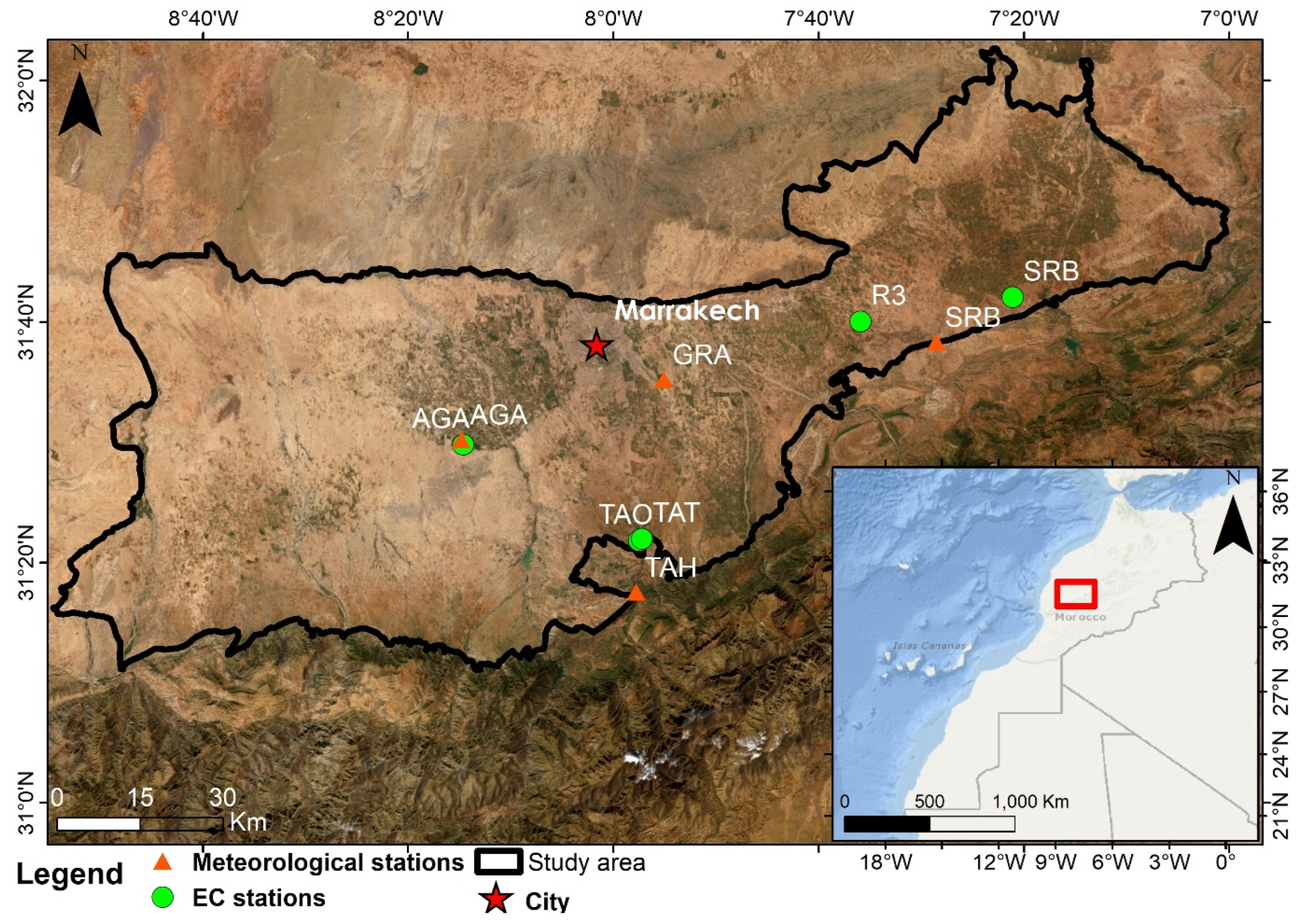
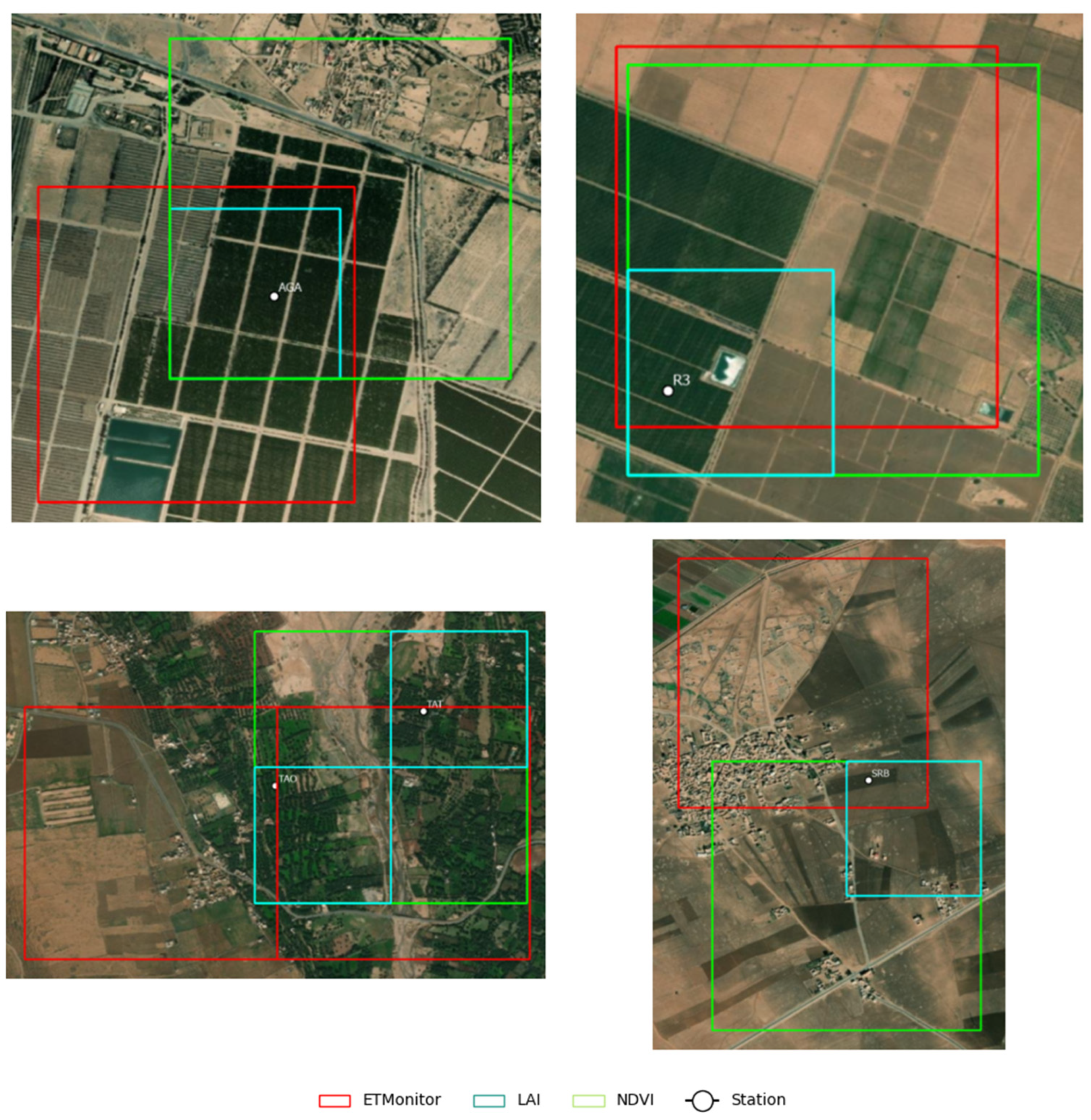
The Tensift Al Haouz region is situated in the central region of Morocco (Figure 1) and covers a territory of approximately 20,500 square kilometers, spanning across latitudes 31° and 32°30′ N and longitudes 7° and 10° W. The Haouz region, situated in the Tensift Watershed of Morocco, is a semi-arid agricultural plain with significant water conservation potential. Approximately 85% of the water mobilized in this region is allocated for irrigation [23]. The irrigation methods employed encompass conventional and modern techniques, such as flood and drip irrigation. The irrigation water may be derived from dams, river diversion, or groundwater extraction. The crops cultivated in the area consist primarily of arboreal cultivations, including olive and orange trees, as well as seasonal crops such as cereals and other annual crops [29]. Additionally, intercropping is a common agricultural practice conducted in the region, with alfalfa and cereals often grown in the understory of olive trees. For the rainfed wheat field (SRB), there was no recorded crop rotation during the time span of the study. Additionally, intercropping is a common agricultural practice conducted in the region, with alfalfa and cereals often grown in the understory of olive trees. Flood-irrigated olive orchards (i.e., TAO) rely on infrequent (every 2–3 weeks), high-volume water applications driven by shared canal rotations or fixed routines, not crop needs [30]. Applied water exceeds olive evapotranspiration demands by 20–30%, causing percolation and evaporation losses [31]. Despite semi-arid conditions and water scarcity, flood irrigation lacks adaptive timing or soil moisture monitoring, perpetuating inefficiency.

2.2. In Situ Data

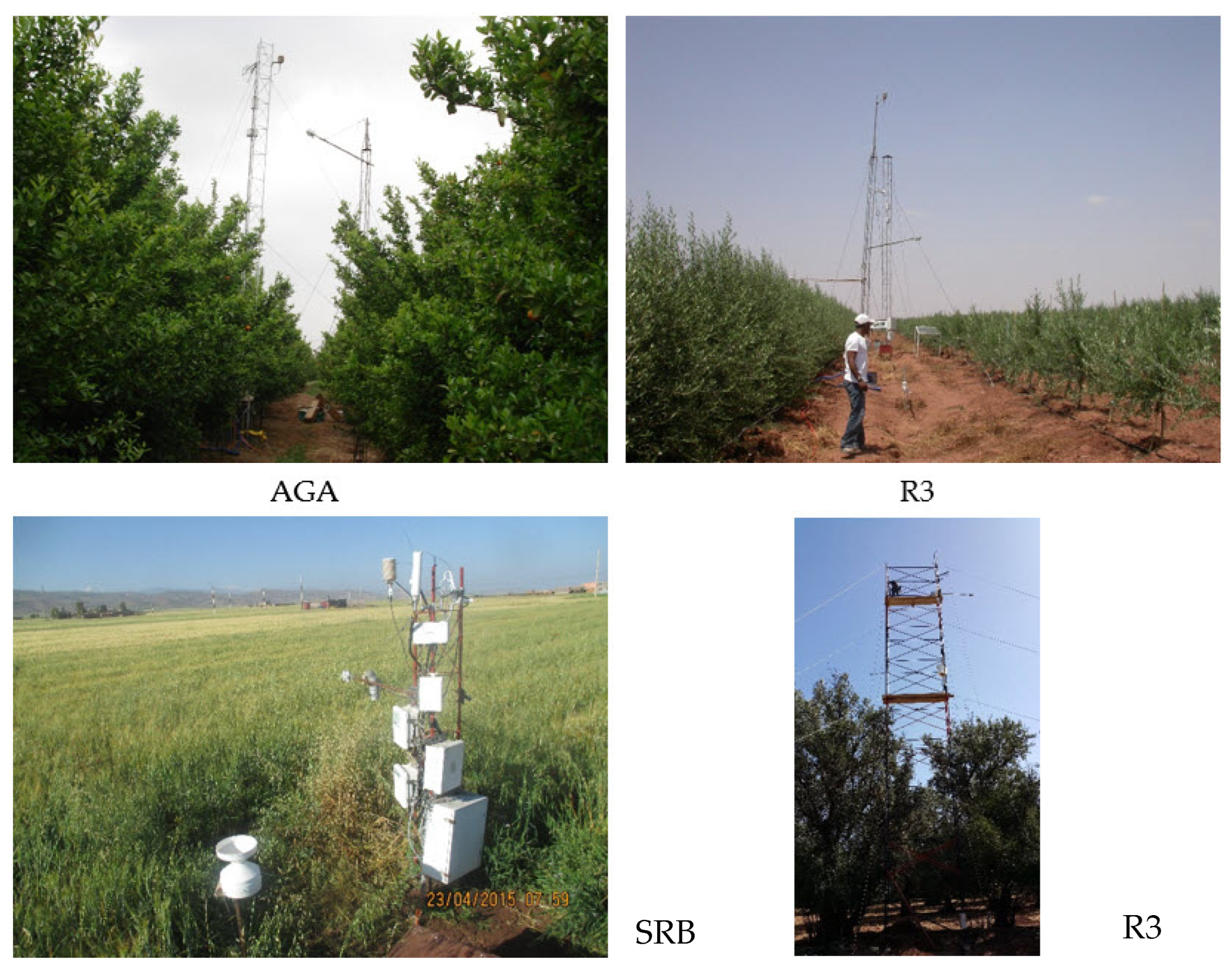
The study utilized five eddy covariance (EC) stations (Figure 1) across diverse agricultural contexts in the Tensift Plain, each positioned approximately two meters above the canopy to capture local fluxes in drip-irrigated orchards, flood-irrigated olive fields, or rainfed wheat (Table 1). Specifically, the AGA station (height of 8.5 m) is located in a drip-irrigated orange orchard (Agafay), co-located with a primary meteorological station of the same name for precipitation monitoring. The R3 site measures latent heat flux (LE) over drip-irrigated olive trees (7.45 m above the ground) and is accompanied by the GRA meteorological station. Two flood-irrigated olive fields with intercropping—TAO and TAT (17.82 m)—share the TAH weather station, while the SRB station (2 m), paired with its own weather station, represents a rainfed wheat field.
High-frequency (20 Hz) EC data at each site were recorded via a CR1000 datalogger (Campbell Scientific, Logan, UT, USA) and a CompactFlash Module for offline retrieval. Post-processing with the ECpack version 2.5.21 [32], included corrections for time-lag synchronization, flow distortion and planar fit coordinate rotation [33], sensor drift, linear detrending of variances and covariances, oxygen-sensitivity calibration for the krypton hygrometer [34], adjustments to sonic temperature for humidity effects [35], frequency response compensation [36], and density fluctuation corrections via Webb–Pearman–Leuning [37]. Energy balance closure was assessed by comparing the sum of latent (LE) and sensible heat fluxes (H) to net radiation minus soil heat flux (Rn − G). Previous studies [22,38,39,40] reported closure ratios of 75–90% at these stations. To further ensure data reliability and maintain high-quality flux estimates, residual energy imbalance was corrected using the Bowen ratio method.
Table 1. In situ data information.
SiteCrop TypePercentage of Valid Daily DataPeriodCoordinatesClosure Ratio (Average over the Period of Measurements)Paper
AGAOrange trees72.22%2006–201031°29′50″ N, 8°14′38″ W80%[41,42]
R3Olive trees79.86%2006–200931°40′03″ N, 7°35′56″ W78%[43]
SRBWheat68.06%2016–201931°42′03″ N, 7°21′07″ W77%[44]
TAOOlive trees + vegetation54.86%2016–201931°21′51″ N, 7°57′30″ W78%[22]
TATOlive trees + vegetation79.17%2016–201931°22′00″ N, 7°57′13″ W75%[22]

2.3. Satellite ET Products Description

The ET products evaluated in this study were selected based on two key criteria: spatial resolution and temporal coverage. To sufficiently resolve field-scale measurements, products were required to have a spatial resolution of 1 km or finer. Additionally, products with longer and continuous temporal coverage were prioritized to allow for multi-year comparisons. Based on these criteria, the following ET products were selected: MOD16, SSEBop, WaPOR, ETMonitor and PMLv2 (Table 2).

2.3.1. SSEBop

The Operational Simplified Surface Energy Balance (SSEBop) model [45] is a globally implemented satellite-based method for estimating actual evapotranspiration (ETa) at a 1 km spatial resolution and 10-day (dekadal) temporal resolution. Developed by the U.S. Geological Survey, SSEBop is designed to support applications in water resources, drought monitoring, and agricultural assessments.
The model is grounded in a contextual energy balance framework that estimates ETa by scaling a reference evapotranspiration (ETo) using a satellite-derived evaporative fraction (ETf). The ETf is calculated from MODIS land surface temperature (Ts), relative to a dynamically defined cold/wet reference temperature (Tc), which represents the surface under maximum evapotranspiration conditions. Tc is determined from maximum air temperature (Ta) using a c-factor calibrated from well-vegetated pixels (NDVI ≥ 0.7), and refined within MODIS sub-tiles to improve local accuracy.
The key model inputs include MODIS land surface temperature and vegetation indices (NDVI), daily maximum air temperature from gridded datasets (Daymet/WorldClim), and reference evapotranspiration from global weather reanalysis (GDAS). To ensure compatibility across vegetation types and seasons, ETo is scaled to represent an alfalfa reference surface. SSEBop incorporates quality control procedures to address cloud contamination using temporal gap-filling algorithms, and it applies constraints in specific land cover types. For example, ETa is capped in arid zones (low NDVI) and adjusted over permanent water bodies. The model outputs include dekadal, monthly, and annual ETa values, as well as ETa anomalies based on a historical median baseline, which are especially useful for drought early warning.

2.3.2. MOD16

The MOD16 global ET dataset [16] developed by the National Aeronautics and Space Administration (NASA) provides ET estimates at 500 m spatial resolution and 8-day intervals for vegetated land areas. The algorithm utilizes the Penman–Monteith equation (PM) [46] driven by a combination of meteorological reanalysis data and satellite remote sensing inputs. Key meteorological inputs—net radiation, air temperature, vapor pressure deficit (VPD), and air pressure—are derived from NASA’s Global Modeling and Assimilation Office (GMAO) reanalysis datasets at 1° × 1.25° resolution and are interpolated to match the MODIS grid.
MODIS remote sensing inputs include land cover classification (MCD12Q1), used to assign biome-specific parameters annually at 500 m; leaf area index (LAI) and the fraction of photosynthetically active radiation (FPAR) from MOD15A2, used to estimate canopy conductance; and surface albedo from MOD43, used in net radiation calculations. The model partitions ET into four components: wet canopy evaporation (Ewet), dry canopy transpiration (T), saturated soil evaporation (Esat), and moist soil evaporation (Esoil).
Transpiration (T) is estimated using stomatal conductance, which is biome-dependent and varies between daytime and nighttime. During the day, stomatal conductance is modulated by minimum air temperature (Tmin), which controls stomatal opening, and VPD, which restricts stomatal conductance at high atmospheric dryness. At night, stomatal conductance is assumed to be zero, reflecting full stomatal closure. Soil evaporation is partitioned between saturated and moist fractions based on relative humidity (RH), with saturated soil evaporation treated as potential evaporation and evaporation from moist soil reduced using a moisture limitation function.
Aerodynamic resistance is estimated based on a combination of radiative and convective resistances, including leaf boundary layer resistance, which is sensitive to VPD and varies by biome. Canopy resistance is calculated by scaling leaf-level stomatal conductance to the canopy level using LAI. Finally, net radiation (Rn) is partitioned between the canopy and soil according to vegetation cover fraction derived from FPAR.
The MOD16 algorithm applies biome-level parameterization for global generalization and includes several simplifying assumptions, such as no nighttime transpiration and static vegetation classification over the year. These assumptions enable efficient global-scale ET estimation while maintaining reasonable accuracy when validated against eddy covariance tower data.

2.3.3. WaPOR

The Actual EvapoTranspiration and Interception (ETIa) product of WaPOR (https://data.apps.fao.org/wapor/; accessed on 20 April 2023), is accessible via the WaPOR FAO portal. This portal allows for monitoring Water Productivity using data derived from remote sensing. The ETIa data is produced at three different levels on a decadal basis. Level 1 has a spatial resolution of 250 m and covers continental Africa. Level 2 has a spatial resolution of 100 m and is available for some countries and river basins. Level 3 has a spatial resolution of 30 m and is available for some specific irrigation areas. For level 2, ET is generated using the ETLook model, based on the PM equations applied to soil and canopy. WaPOR version 2 estimates soil moisture content (SMC) using the trapezoid method, relating LST and vegetation cover (fc). LST is obtained from MODIS at 1 km resolution. NDVI is obtained from MODIS at 250 m resolution, resampled to 100 m up to 2014, then at 100 m resolution from Proba-V after 2014. Considering environmental factors, canopy resistance (rc) is calculated using the Jarvis-type model that relates stomatal conductance with environmental variables for estimating transpiration. Aerodynamic resistance (ra) is calculated for neutral and non-neutral atmospheric conditions. Interception refers to vegetation leaves catching and evaporating rainfall, influenced by vegetation cover, LAI, and precipitation. The ETLook model used in WaPOR separates evaporation and transpiration using modified PM equations applied to the soil and vegetation components, respectively. The SMC acts as a constraint on ET in water-limited conditions.

2.3.4. ETMonitor

ETMonitor [47] is a global evapotranspiration (ET) product that provides daily estimates at 1 km spatial resolution for the period 2000–2019. It partitions total ET into soil evaporation (Es), plant transpiration (Ec), canopy rainfall interception loss (Ei), open water evaporation (Ew), and snow/ice sublimation (Ess), using a modular approach based on surface energy balance and plant physiological processes.
Over vegetated surfaces, ETMonitor uses the dual-source Shuttleworth–Wallace (S–W) model [46] to separately estimate Es and Ec. Canopy transpiration (Ec) is calculated using a Jarvis–Stewart stomatal conductance scheme, with environmental constraint functions based on incoming radiation, vapor pressure deficit (VPD), air temperature, and root-zone soil moisture stress. Soil evaporation (Es) is driven by surface soil moisture retrieved from passive microwave satellite observations (ESA CCI) that have been downscaled from 25 km to 1 km resolution using a machine learning approach (Random Forest), improving sensitivity to moisture heterogeneity at fine spatial scales.
The model explicitly partitions net radiation (Rn) into components for wet canopy evaporation (Rni), canopy transpiration (Rnc), and soil evaporation (Rns). The ground heat flux (G), previously neglected, is now estimated using a Random Forest model trained on global FLUXNET data (https://fluxnet.org/; accessed on 10 October 2024), significantly reducing errors in surface energy closure.
Rainfall interception loss (Ei) is estimated using a revised Gash model, accounting for canopy structure, rainfall regime, and storage capacity derived from LAI. Pixels classified as open water or snow/ice are handled separately: open water evaporation (Ew) is computed using the Penman combination equation, and snow/ice sublimation (Ess) is estimated similarly when snow cover is present, following empirical formulations. High temporal resolution water body and snow cover maps are used to update land surface classification dynamically, improving accuracy in floodplains and seasonally variable regions.
Model parameters are calibrated against 236 global flux tower sites, stratified by plant functional types (PFTs) and Köppen–Geiger climate zones, using sensitivity analysis and optimization procedures (e.g., Latin Hypercube Sampling and Kling–Gupta Efficiency). This allows extrapolation of calibrated parameters globally with climate-specific adjustments.

2.3.5. PML v2

The PML v2 (Penman–Monteith–Leuning Version 2) product [48,49] is a global dataset providing estimates of evapotranspiration (ET) and gross primary production (GPP) at 500 m spatial resolution and 8-day temporal frequency. The algorithm builds upon the original Penman–Monteith–Leuning (PML) framework by introducing a coupled water–carbon diagnostic model that directly links canopy conductance to both stomatal physiology and carbon assimilation.
The PML v2 model partitions ET into three components: vegetation transpiration, soil evaporation, and evaporation of rainfall intercepted by the canopy. Soil evaporation is calculated by scaling Priestley–Taylor equilibrium evaporation using a soil evaporation coefficient (f), which reflects water limitations and is derived from cumulative precipitation and evaporative demand over a 32-day window.
Canopy resistance is modeled through a novel biophysically based formulation of canopy conductance (Gc) that integrates leaf-level stomatal behavior and carbon assimilation, allowing simultaneous estimation of ET and GPP. This Gc model is derived from a Ball–Berry-type stomatal conductance equation, with GPP estimated using a hyperbolic assimilation function. The model uses MODIS inputs, including MOD15A2 LAI/FPAR at 500 m and 8-day intervals, and MCD12Q1 land cover to assign biome-specific physiological parameters.
Aerodynamic conductance is calculated following the Leuning et al. (2008) formulation [50], accounting for wind speed, surface roughness, and canopy structure. Rainfall interception and canopy water loss are simulated using the Gash analytical model [51], which estimates the partitioning of precipitation into interception, throughfall, and evaporation based on canopy and rainfall characteristics.
Table 2. Main Characteristics of different satellite ET Products used in this study.
ProductSpatial CoverageSpatial ResolutionTemporal CoverageTemporal ResolutionEstimation ApproachInputs
SSEBopGlobal1 km2003—NowDecadalSimplified energy balance to calculate Evaporative fractionMODIS, GDAS/IWMI
Access: https://earlywarning.usgs.gov/fews/product/465 (accessed on 15 February 2023)
Reference: [45]
MOD16Global500 m2002—Now8 daysPM equation with meteorological data onlyMODIS, GMAO
Access: https://modis.gsfc.nasa.gov/data/dataprod/mod16.php (accessed on 15 February 2023)
Reference: [16]
WaPORAfrica and Middle east30 m/ 100 m/250 m2009—NowDecadalPM equation with soil moisture estimates from LSTMODIS, GEOS-5/MERRA
Access: https://WaPOR.apps.fao.org/home/WAPOR_2/1 (accessed on 20 April 2023)
Reference: [52]
PML v2Global500 m2002–20238 daysPM equation and Leuning equationMODIS / GLDAS
Access: https://developers.google.com/earth-engine/datasets/catalog/CAS_IGSNRR_PML_V2_v018
(accessed on May 2023)
Reference: [48]
ETMonitorGlobal1 km2000–2022DailyShuttleworth–Wallace equation, with soil moisture from passive microwave dataMODIS, FLUXNET15, ERA5
Access: https://data.tpdc.ac.cn/zh-hans/data/c284bd88-7694-4577-9cbb-02684bd940ff (accessed on 25 January 2023)
Reference: [47]

2.4. Methodology

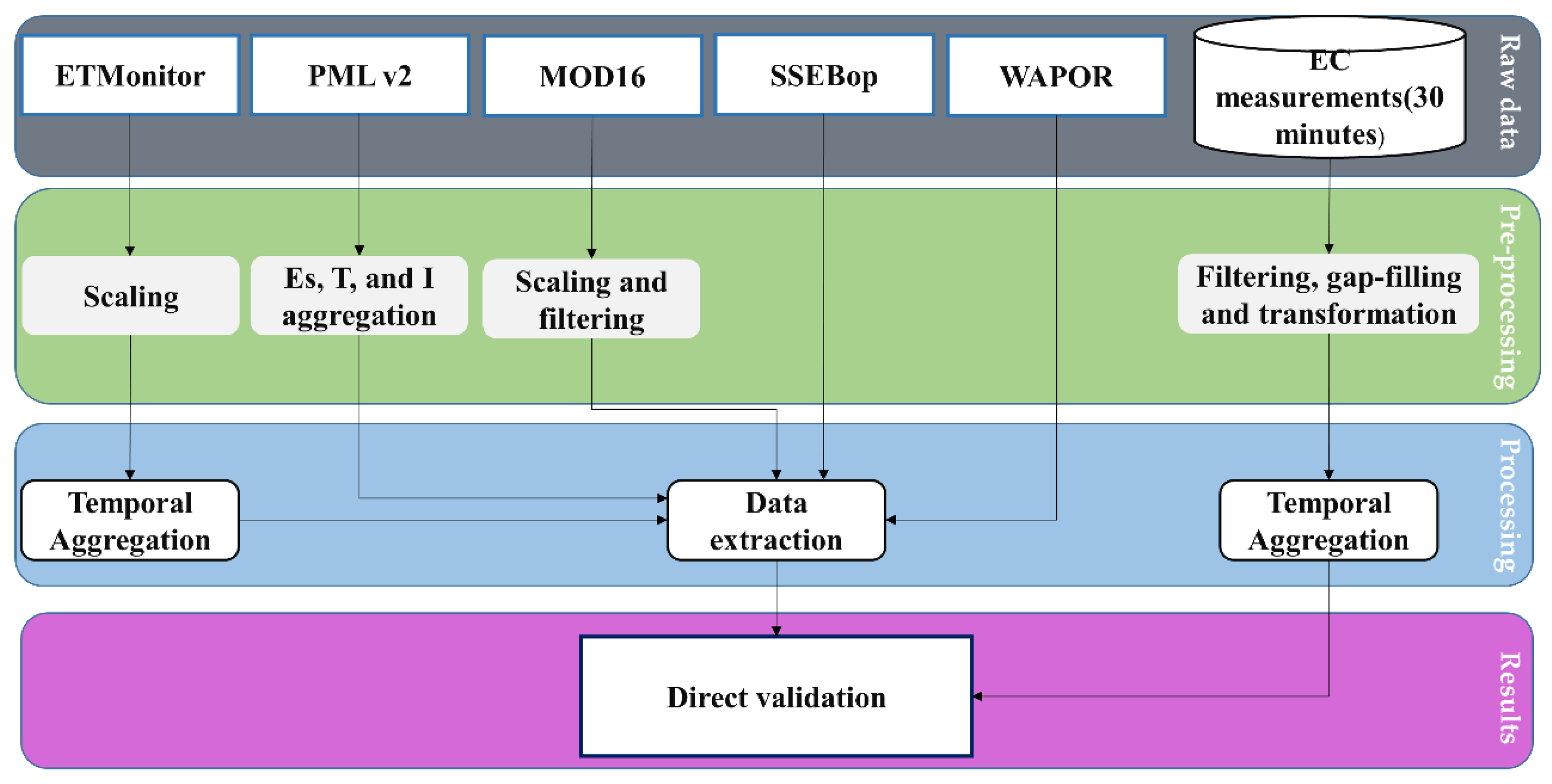
The methodology used in this study is summarized in Figure 2. LE data were filtered to include only the period from 8:00 AM to 8:00 PM, when net radiation was assumed positive. Short gaps of up to one and a half hours were linearly interpolated [53], while days containing longer gaps were excluded to avoid undue uncertainties. Although this approach can introduce minor bias, it ensures sufficient continuity for reliable product comparisons. The half-hourly LE values were integrated to daily evapotranspiration (ET, mm day−1) using the latent heat of vaporization (λ = 2.45 MJ kg−1). To match the temporal scales of satellite ET products, daily ET was aggregated to eight-day intervals for MOD16 and PML v2, and to ten-day (dekadal) intervals for SSEBop, WaPOR, and ETMonitor. Any interval with more than two missing daily values was considered invalid and excluded from analyses. This combined procedure yielded continuous, quality-controlled ET estimates from both rainfed and irrigated systems, providing a robust basis for validating and intercomparing satellite-derived ET products.
Footprint modeling was not applied in this study. While EC footprints vary dynamically with wind speed and direction over 30 min intervals, satellite products provide static pixels aggregated over 8–10 days. Calculating a representative footprint for these extended periods would conflate conflicting spatial contributions, as the footprint’s location and extent shift continuously [54]. Thus, we extracted ET values from the satellite pixel overlapping each EC station (nearest-neighbor approach). This method aligns with validation protocols for regional-scale ET products, where pixel-scale comparisons are prioritized over footprint-weighted averages when temporal resolutions exceed daily scales [55].
To align with satellite product resolutions, EC-based ET was aggregated into 8-day intervals (for MOD16 and PML v2) and 10-day intervals (for SSEBop, WaPOR, and ETMonitor). For satellite product processing, the raw data from SSEBop and WaPOR were introduced directly into the extraction using station points without any preprocessing. MOD16 was filtered based on the data quality layer. PML v2 provides the interception (I), soil evaporation (Es), and crop transpiration (T) independently, which were aggregated to obtain total ET. ETMonitor data were aggregated into 10-day intervals to enable direct comparison with other products and in situ measurements.

2.5. Statistical Metrics

Three statistical parameters were used in this study to evaluate the performance of the ET-satellite products, described below:
RMSE stands for Root Mean Square Error. It is a frequently used measure of the differences between values predicted by a model or an estimator and observed values. This study used RMSE to calculate the error between estimated and measured evapotranspiration daily. The average distance was calculated between each product’s ET values and those obtained from Eddy covariance measurements.
R M S E = i = 1 n ( y i x i ) 2 n
where
xi: The observed (actual) value of ET obtained by EC stations
yi: The predicted (estimated) value of ET estimated by each product
n: The total number of observations.
PBIAS, or Percent Bias, measures the average tendency of simulated values to be larger or smaller than their observed counterparts. An optimal value of PBIAS is 0.0, indicating accurate model simulation. Positive values indicate an overestimation bias, while negative values indicate an underestimation bias. In the case of daily evapotranspiration estimation, PBIAS was used to calculate the average tendency of estimated values to be larger or smaller than measured ones. A PBIAS value closer to 0.0 indicates a better fit of the model to the dataset.
P B I A S = i = 1 n ( y i x i ) i = 1 n y i × 100
R-squared, or the coefficient of determination, is a statistical measure used in regression models to determine the proportion of variance in the dependent variable that the independent variable can explain. In other words, it shows how well the data fit the regression model. In the case of evapotranspiration estimation daily, R-squared can be used to determine how well the model fits the dataset. A value of R-squared closer to 1 indicates a better fit of the model to the dataset.
R 2 = 1 i = 1 n ( y i x i ) 2 i = 1 n ( y i y ˉ ) 2

3. Results and Discussion

This section represents the key findings and discussions from the comparisons between the different ET products and the Eddy Covariance station data for the various agricultural experiments. Additionally, the results are analyzed to determine the agreement and discrepancies between the in situ measurements and satellite estimates over the different land cover types.

3.1. SSEBop ET Product’s Evaluation

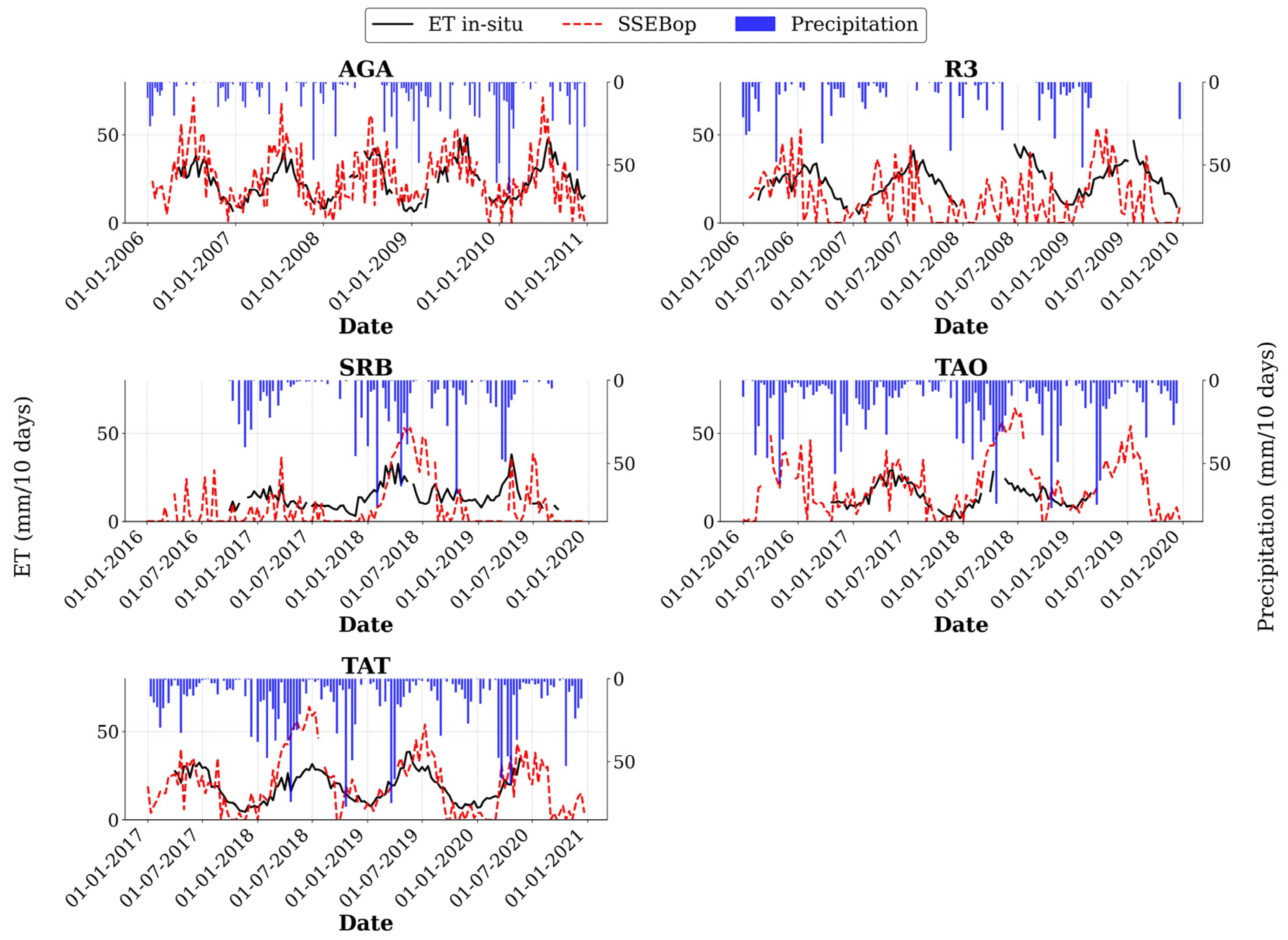
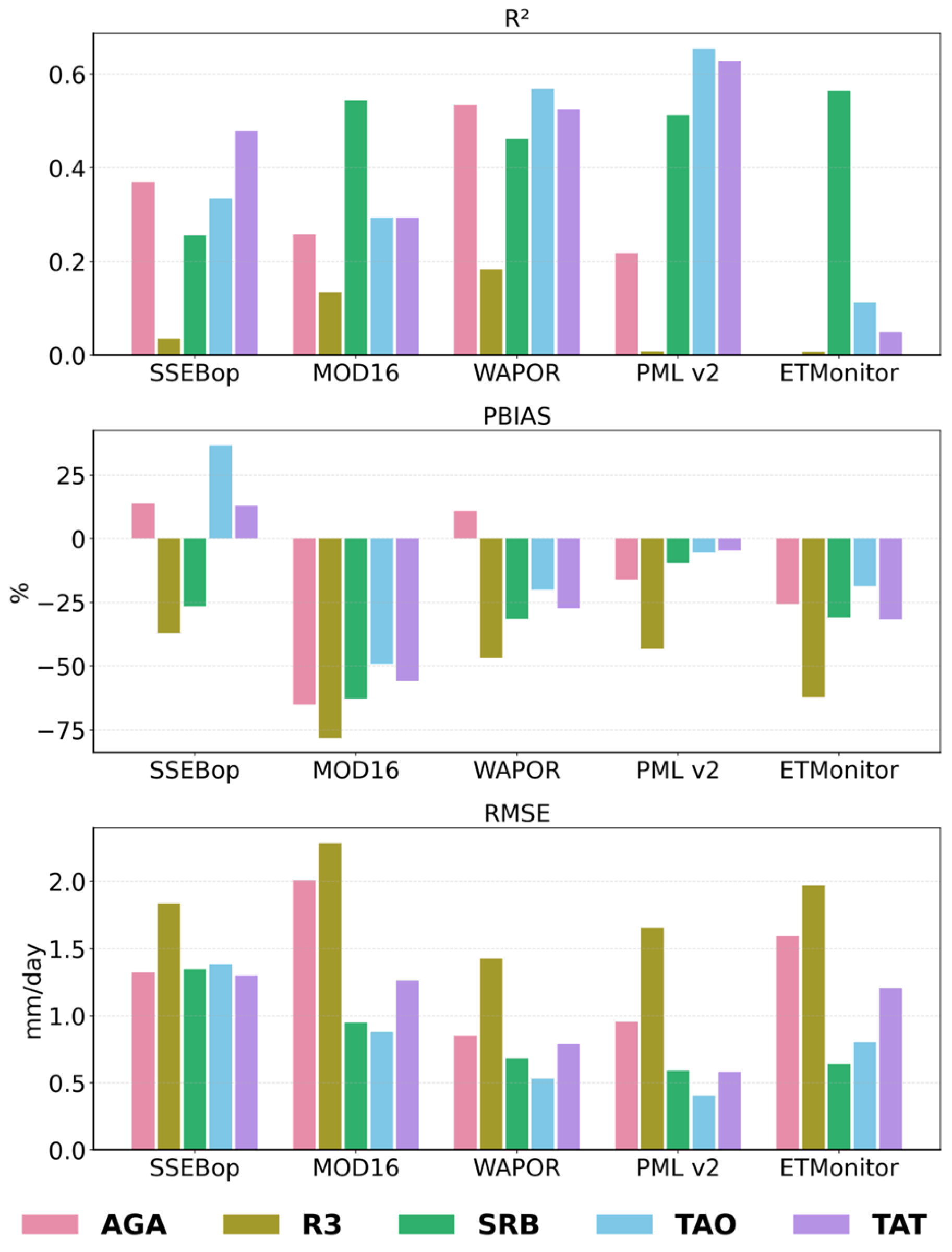
SSEBop demonstrated variable performance across the study sites (Figure 3). At the drip-irrigated citrus orchard (AGA), SSEBop captured seasonal trends with an R2 of 0.37, RMSE of 1.32 mm/day, and a moderate overestimation (PBIAS = 13.81%). Seasonal trends were moderately captured at the flood-irrigated olive fields (TAO and TAT), with R2 values of 0.33 and 0.48, respectively (Figure 4). However, TAO showed substantial overestimation (PBIAS = 36.62%).
At the drip-irrigated olive site (R3) and rainfed wheat field (SRB), SSEBop performed poorly, with R2 values of 0.04 and 0.26, respectively. Temporal instability was evident at R3, where ET estimates fluctuated erratically. SRB exhibited frequent null values and moderate underestimation (PBIAS = −26.63%).
Spatially, SSEBop produced the highest annual ET values among all products, with a pronounced east–west gradient across the Haouz Plain. However, interannual variability was marked, including anomalous values in 2018 (notably at TAO and TAT).
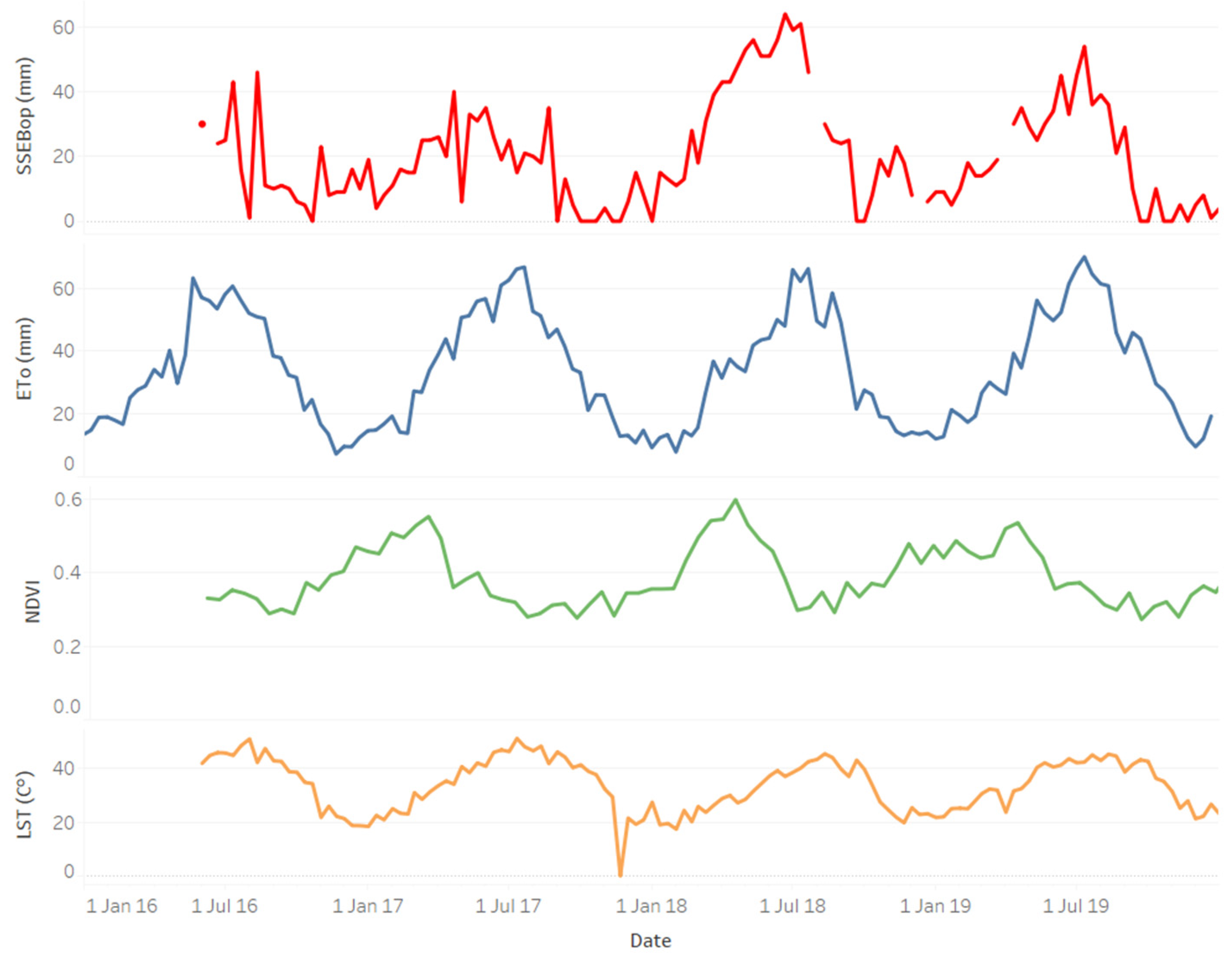
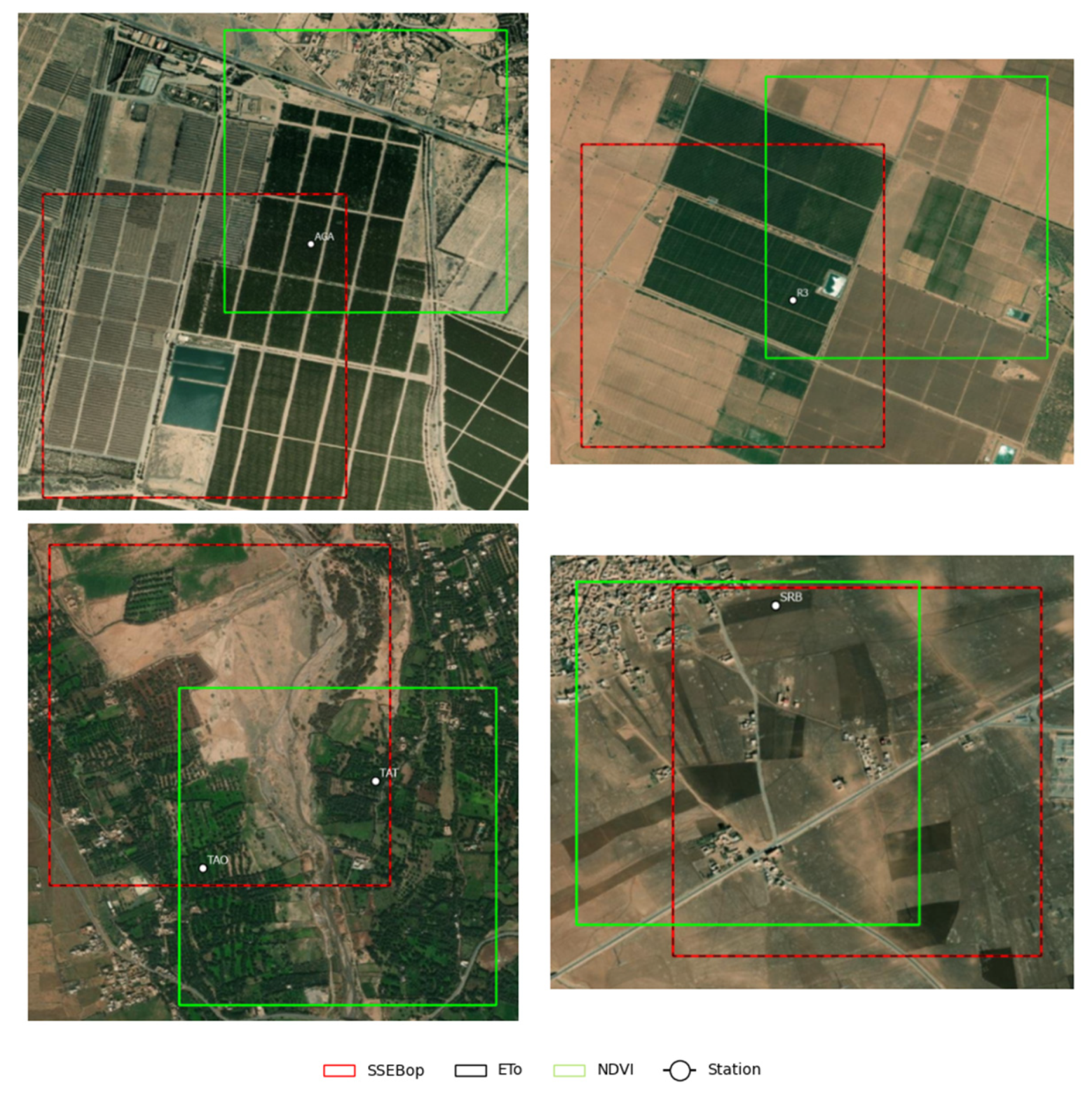
SSEBop’s contextual energy balance approach effectively captures seasonal ET trends in homogeneous, flood-irrigated systems like TAT, where it scales reference evapotranspiration (ETo) using land surface temperature (LST) gradients [56]. The algorithm’s use of MODIS NDVI and eMODIS LST ensures global consistency, enabling reliable identification of “cold/wet” reference pixels (NDVI ≥ 0.7) in well-watered areas. However, in semi-arid landscapes like Morocco’s Tensift Plain, persistent low vegetation density (NDVI < 0.2) activates SSEBop’s ET capping mechanism—limiting ET estimates to 32% of reference ETo and rounding values to integers. This results in artificially low or zero ET values even in actively cultivated fields [57]. This limitation is corroborated by [58], who found significant SSEBop underestimation in semi-arid croplands with low NDVI due to oversimplified energy balance assumptions. Similarly, ref. [59] demonstrated that SSEBop struggles in NDVI < 0.2 zones due to saturation effects, where sparse vegetation fails to meet the algorithm’s calibration requirements for reliable LST-NDVI coupling.
At R3, mixed-pixel contamination (olive trees + fallow fields) skewed LST/NDVI ratios, leading to overestimation, while borrowed Tc values from adjacent tiles misrepresented local conditions at TAO/TAT during dry periods. These issues are not unique to Tensift, ref. [60] observed similar degradation in fragmented East African landscapes, where heterogeneous land cover introduced systematic errors in SSEBop’s cold-pixel identification. Ref. [61] further validated this, showing ET underestimation in mixed-pixel agricultural systems due to unresolved sub-grid heterogeneity. The model’s dependency on idealized cold pixels, rare in semi-arid regions, is compounded by input data quality. For instance, ref. [45] identified MODIS LST anomalies as a key source of uncertainty, with poor-quality LST inputs amplifying errors during droughts.
Despite these limitations, SSEBop remains competitive in arid zones. Ref. [20] found it achieved lower RMSE (~90 mm) than other global products in water-limited regions, outperforming other products in open landscapes. However, comparative studies highlight context-dependent trade-offs: ref. [62] noted divergences between SSEBop and MOD16 over sparsely vegetated surfaces during dry spells, where MOD16’s humidity-driven approach better captured residual moisture. Collectively, these studies underscore the need for localized algorithm tuning and higher-resolution inputs to reconcile SSEBop’s operational simplicity with the complexities of semi-arid cropland ET dynamics.
Recent validation studies further reinforce these findings across diverse semi-arid settings. ref. [63] evaluated SSEBop across multiple Moroccan crops (wheat, maize, watermelon, and olive), reporting systematic ET underestimation during dry spells yet reasonable capture of seasonal dynamics. Similarly, ref. [64] found good agreement between SSEBop ET estimates and field observations in well-irrigated Mediterranean systems, but noted persistent errors in low-NDVI zones. In parallel, ref. [65] observed that sparse vegetation and coarse spatial inputs constrained model reliability in Mongolia’s Buir Lake–Khalkh River Basin. Nevertheless, ref. [66] demonstrated that despite moderate underestimation, SSEBop remains a practical alternative to more complex SEBAL and METRIC models for operational ET monitoring in arid and semi-arid regions.

3.2. MOD16 ET Product’s Evaluation

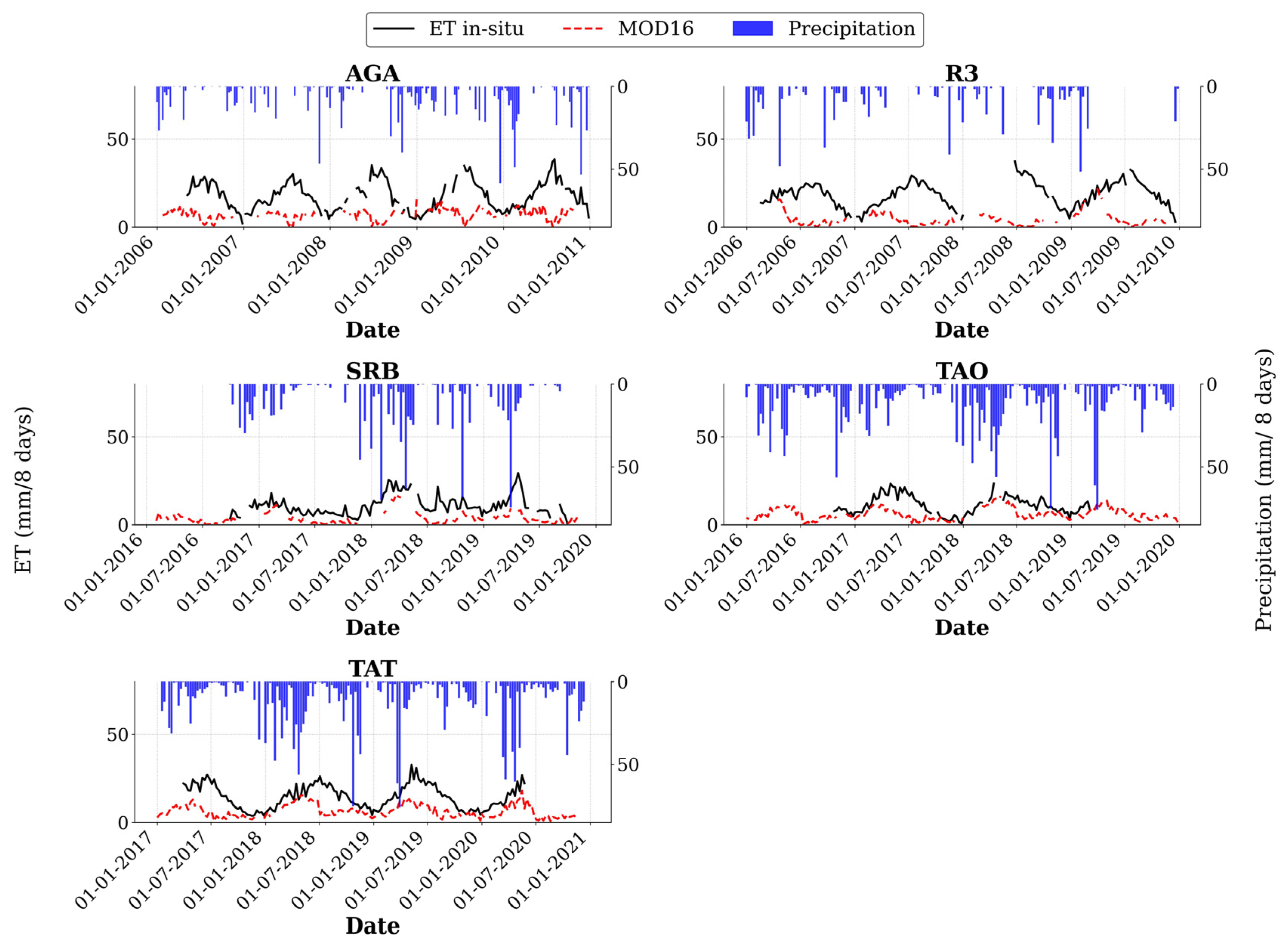
MOD16 consistently underestimated ET across all sites, with especially large discrepancies in irrigated fields (Figure 5). At the drip-irrigated citrus orchard (AGA) and drip-irrigated olive site (R3), MOD16 showed poor correlation with observed data (R2 = 0.26 and 0.13, respectively) and significant underestimation biases (PBIAS = −65.05% at AGA and −78.15% at R3) (Figure 4). RMSE values reached 2.01 mm/day (AGA) and 2.28 mm/day (R3), reflecting substantial daily errors. Seasonal patterns were poorly represented, with summer ET estimates deviating sharply from EC measurements.
Performance improved modestly at the rainfed wheat field (SRB), where MOD16 achieved moderate agreement (R2 = 0.54) but still exhibited strong underestimation (PBIAS = −62.71%, RMSE = 0.95 mm/day). At the flood-irrigated olive fields (TAO and TAT), MOD16 showed weak to moderate correlation (R2 ≈ 0.29) with PBIAS of −49.18% and −55.76%, respectively, and lower RMSE values (0.88–1.26 mm/day).
Temporally, MOD16 failed to detect irrigation-driven increases in ET during dry summer periods, leading to flat seasonal trajectories. In wetter years (e.g., 2018 at TAO, TAT, and SRB), discrepancies narrowed, with ET estimates better aligning with observed values due to increased soil moisture. Spatially, MOD16 produced the lowest annual ET estimates among all products and showed missing data in the western regions of the Haouz Plain.
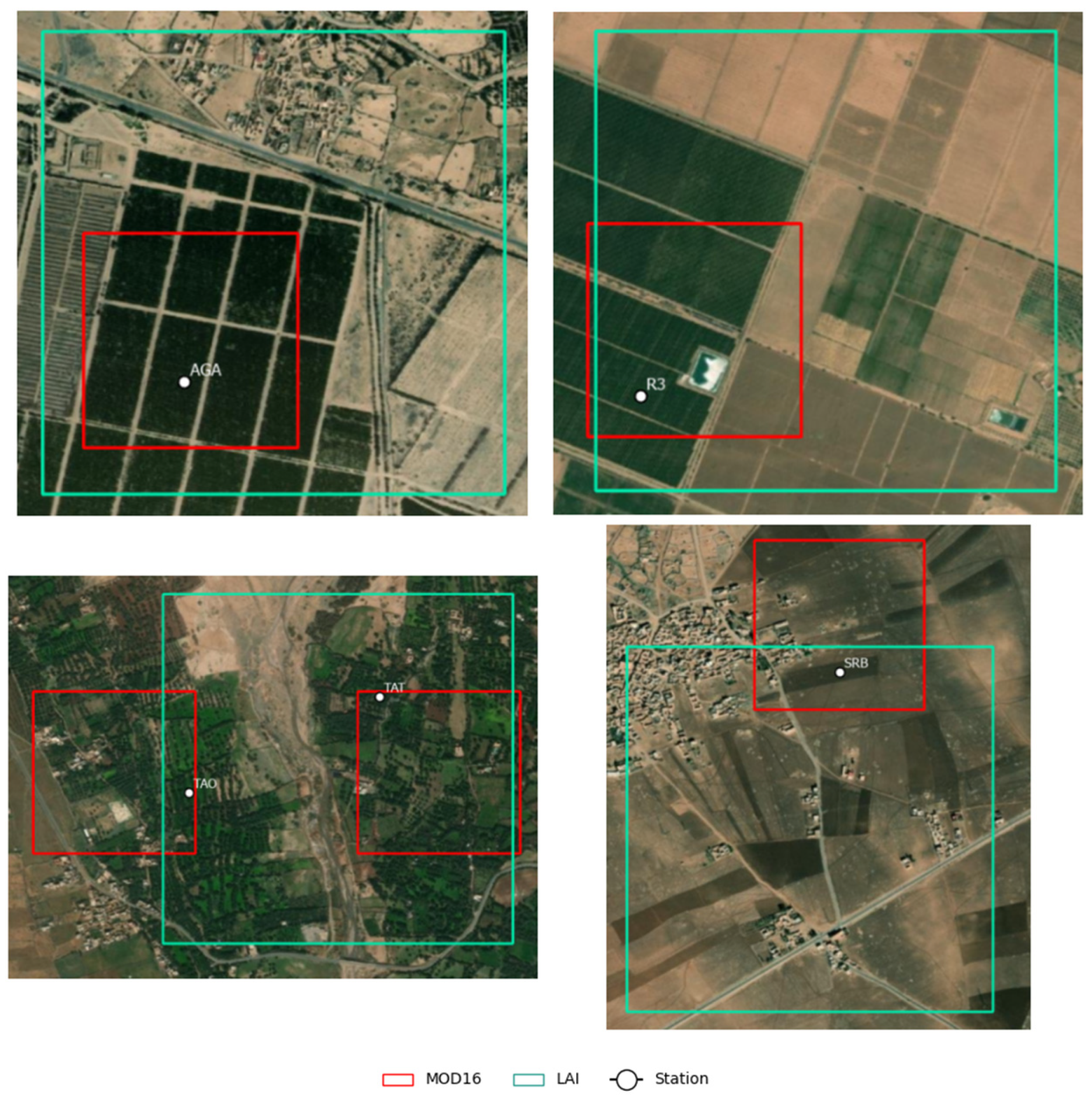
MOD16’s biome-specific Penman–Monteith framework, parameterized with MODIS land cover data, achieved moderate accuracy in rainfed wheat (SRB) by leveraging humidity- and radiation-driven soil evaporation during wet seasons [16]. The model’s global continuity since 2002 and 500 m resolution make it valuable for broad-scale hydrological studies in unmanaged ecosystems [16]. However, its neglect of irrigation dynamics and rigid 70% relative humidity threshold [67] led to catastrophic failures in drip-irrigated orchards (AGA/R3), where daily watering sustains ET despite arid atmospheric conditions [68]. Misclassification of olive/citrus groves as generic croplands further skewed stomatal conductance parameters, applying values calibrated for shallow-rooted annuals rather than deep-rooted perennials [69,70]. For instance, ref. [70] demonstrated that MOD16 systematically underestimated ET in semi-arid Australian ecosystems due to shallow-rooting assumptions misapplied to deep-rooted vegetation—a flaw echoed in ref. [71], where grassland parameters misrepresented perennial root systems. These systemic flaws highlight the incompatibility of reanalysis-driven models with human-managed water inputs.
Additional evaluations have identified key limitations of MOD16 in semi-arid regions. Studies noted inconsistent agreement between MOD16 and flux tower ET in savanna ecosystems [25], partly due to flux footprint versus pixel scale mismatches and model parameterization errors. For example, ref. [72] found that land cover misclassification (e.g., savannas labeled as forests) degraded MOD16’s accuracy by up to 30% in the Rio Grande basin. Similarly, in African savannas, ref. [25] attributed discrepancies to oversimplified stomatal conductance parameters and spatial resolution mismatches. The algorithm can systematically underestimate ET under high vegetation stress or overestimate in wet periods if its biome-specific parameters are not well-tuned [67,73]. Ref. [73] further emphasized that MOD16’s phenological assumptions fail to capture delayed greening in water-limited woodlands, leading to ET underestimation during critical growth phases.
MOD16 also struggles to capture fluxes in semi-arid environments with heterogeneous vegetation, as its poor performance in drip-irrigated orchards, where the model ignored daily irrigation pulses and over-relied on atmospheric humidity signals. This aligns with ref. [68], who reported MOD16’s inability to resolve water stress in irrigated croplands due to fixed humidity thresholds. Even in non-irrigated systems, ref. [74] confirmed MOD16’s inadequacy in Australian arid river basins with intermittent flooding, where sparse vegetation and dynamic soil moisture violated the model’s static biome parameters. These findings collectively underscore the importance of understanding MOD16’s assumptions—such as its exclusion of irrigation and reliance on reanalysis humidity data—when applying it in water-limited agriculture.
Recent assessments across semi-arid regions further substantiate these findings on MOD16’s performance limitations. Ref. [75] reported consistent ET underestimation in irrigated crops across South Africa’s Western Cape, attributing errors to the model’s neglect of irrigation pulses, though trends in rainfed fields were captured well. Similarly, ref. [76] observed comparable underestimations in irrigated systems across northwestern Mexico, emphasizing that crop misclassification distorted stomatal conductance parameters. These biases were echoed by ref. [77], who demonstrated MOD16’s limited ability to capture irrigation-driven ET increases in Argentina’s Pampas region, despite reasonable performance in rainfed crops. Evaluations in other semi-arid ecosystems, such as ref. [78] in desert steppe landscapes and ref. [79] in non-irrigated alfalfa systems, confirmed context-dependent accuracy—stronger agreement under natural moisture regimes and weaker under irrigation or transient soil wetness. Likewise, ref. [80] corroborated these trends in South African ecosystems, noting that MOD16 persistently underestimated ET when dynamic soil moisture and irrigation were ignored. Collectively, these studies reinforce that MOD16’s performance is largely governed by its omission of anthropogenic water inputs and simplified biome-specific parameterization.

3.3. WaPOR ET Product’s Evaluation

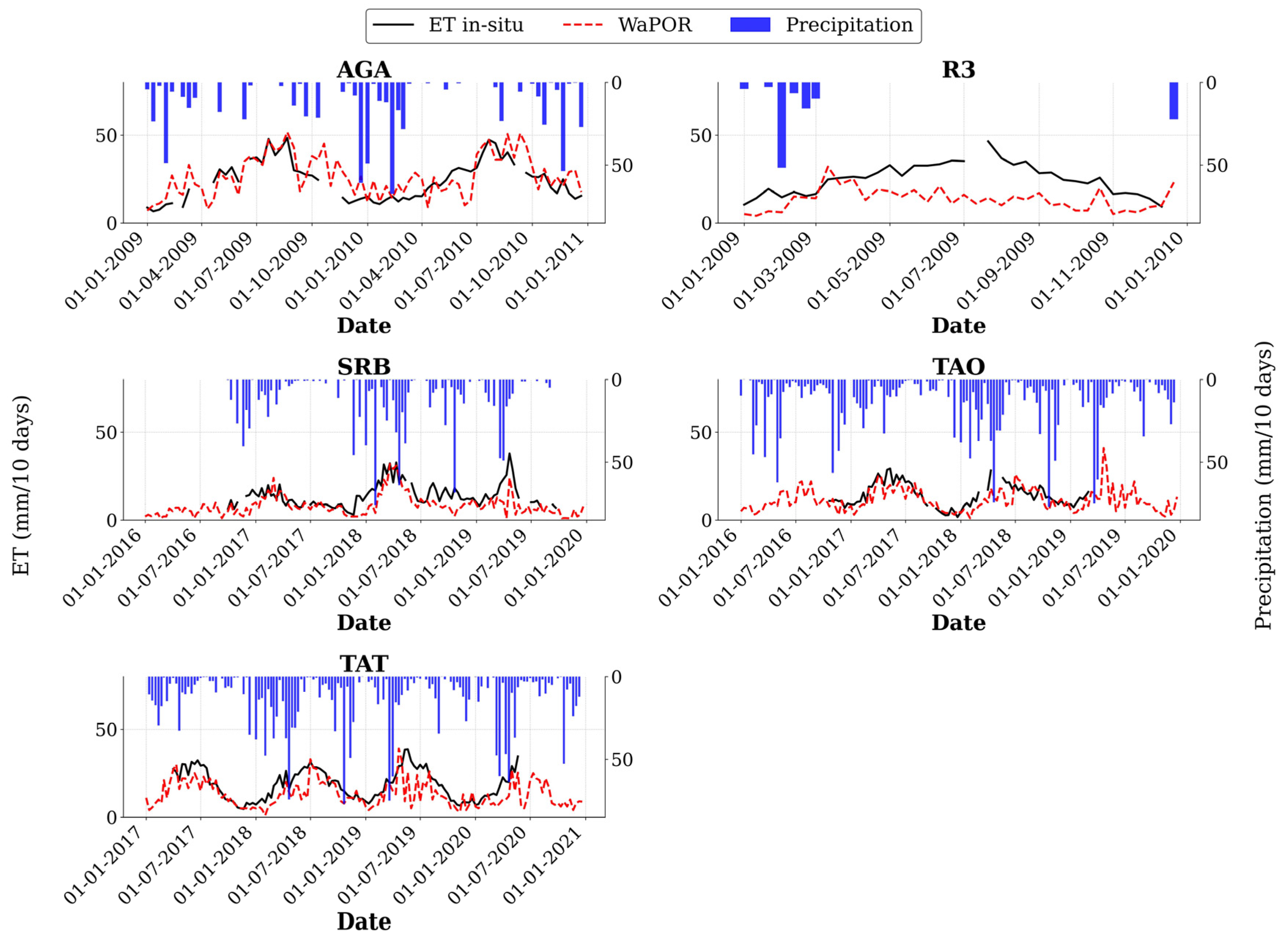
WaPOR effectively captured seasonal and annual ET variability at most sites but consistently underestimated evapotranspiration across the board (Figure 6). At the drip-irrigated citrus orchard (AGA), WaPOR showed moderate correlation (R2 = 0.53), with a slightly low RMSE of 0.85 mm/day and a small overestimation (PBIAS = 10.82%). Seasonal trends were more strongly detected at the flood-irrigated olive sites (TAO and TAT), with higher correlations (R2 = 0.57 at TAO, 0.53 at TAT), low RMSE values (0.53 and 0.79 mm/day, respectively), and moderate underestimation (PBIAS = −20.05% and −27.36%) (Figure 4).
At the rainfed wheat field (SRB), WaPOR achieved moderate agreement (R2 = 0.46) and recorded the lowest RMSE (0.68 mm/day) among all sites. However, it is still significantly underestimated ET (PBIAS = −31.52%). The weakest performance was observed at the drip-irrigated olive site (R3), with low correlation (R2 = 0.18), high RMSE (1.43 mm/day), and substantial underestimation (PBIAS = −46.85%), likely due to limited temporal coverage (only one year of data available).
Spatially, WaPOR displayed pronounced interannual variability, including anomalously high ET values in 2018. Its annual estimates closely aligned with PML v2 and SSEBop in wetter years, but significant divergences were observed during drought periods.
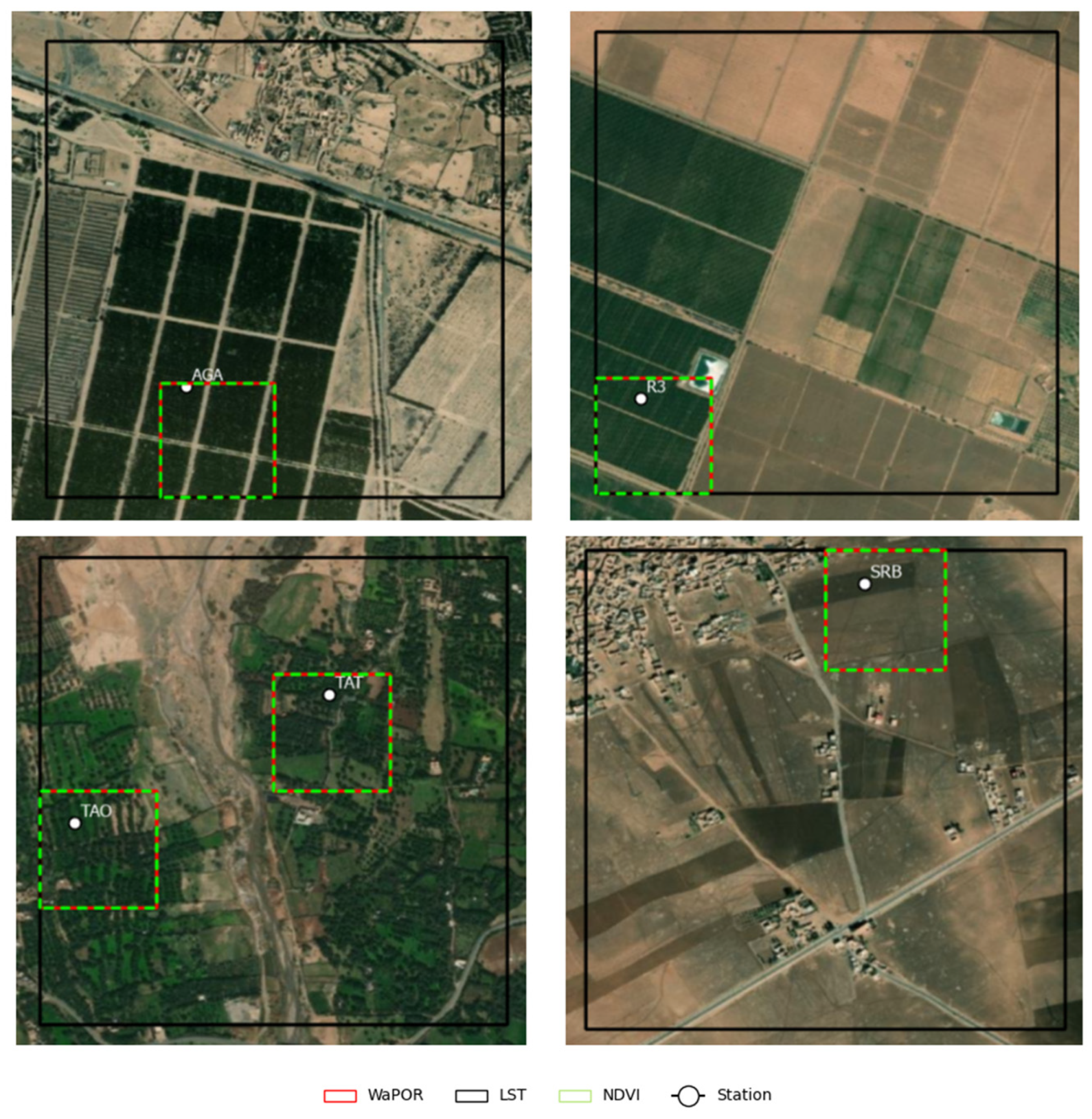
WaPOR excels in flood-irrigated systems (TAO/TAT) through its trapezoid method, which links high-resolution Proba-V NDVI (100 m) to MODIS LST to estimate soil moisture. This approach reliably detects irrigation-induced soil cooling in flood systems, achieving good results where saturated soils align with LST-NDVI assumptions [81]. However, in drip-irrigated plots (AGA/R3), the 1 km LST resolution averages thermal signals across irrigated trees and fallow fields, falsely indicating moisture stress—a limitation exacerbated in fragmented landscapes where regional calibration of the “dry edge” fails to adapt to localized irrigation practices [82,83]. For instance, ref. [83] demonstrated that WaPOR’s LST resolution mismatch reduces accuracy in irrigated blocks smaller than 1 ha, as thermal smoothing obscures active drip zones. Additionally, sparse olive canopies (low NDVI) conflict with the trapezoid’s assumption that high LST corresponds exclusively to water-limited conditions, a flaw highlighted in Mediterranean studies where NDVI thresholding misrepresented water use in low-density orchards [84]. While ideal for flood irrigation, WaPOR requires higher-resolution LST and explicit irrigation metadata to resolve pressurized systems.
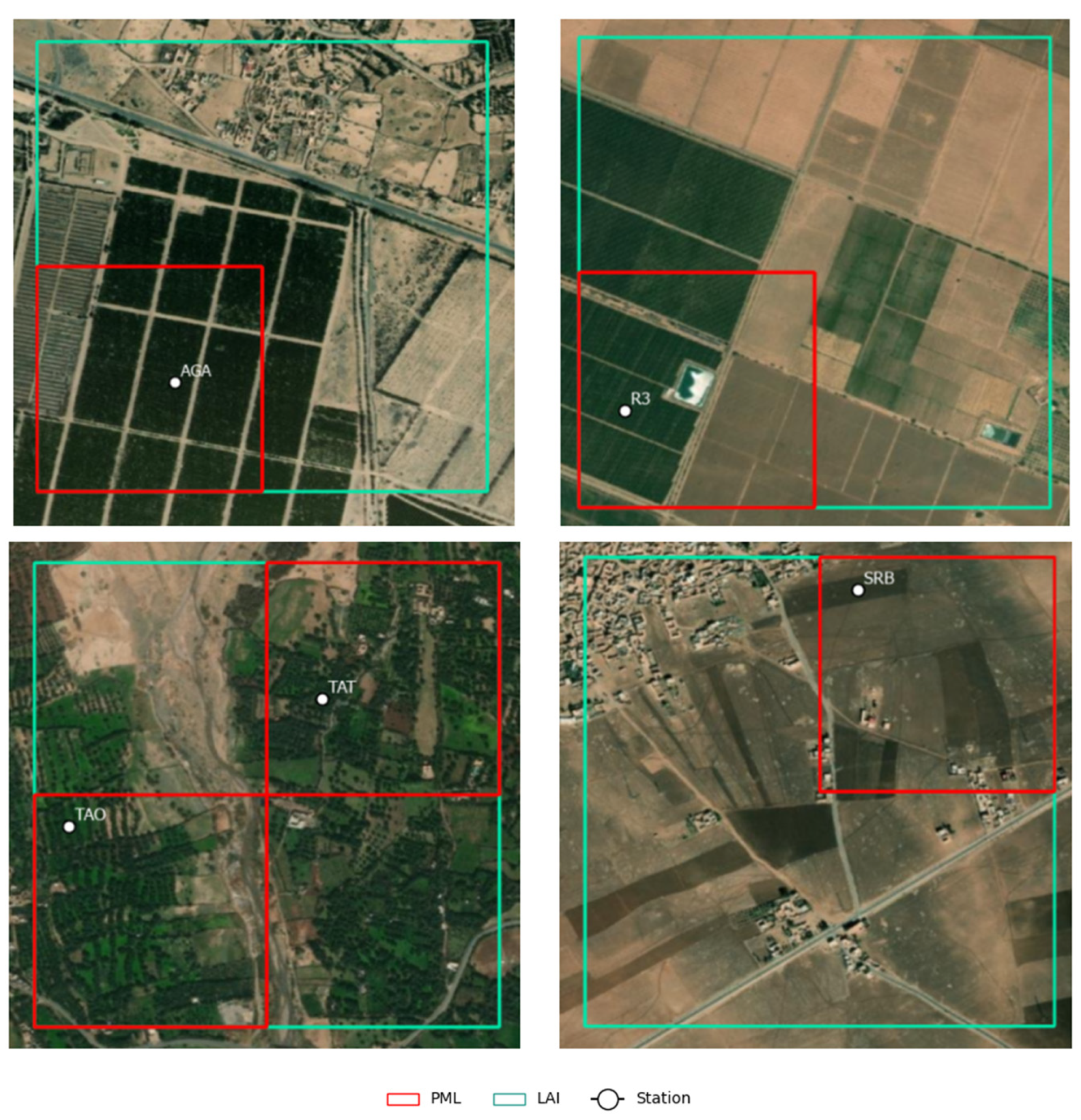
WaPOR generally performs well in semi-arid regions but exhibits a tendency to overestimate ET during dry periods and in irrigated areas. Direct validation against flux towers reported a mean correlation of ~0.71 and RMSE ~1.2 mm/day [81], but these aggregate metrics mask systematic biases. For example, ref. [85] found consistent overestimation during dry periods in Iran’s Lake Urmia Basin, where WaPOR misattributed bare soil heating to transpiration. The product’s accuracy also depends on spatial scale: its 250 m and 100 m products demonstrated consistent performance across large irrigation schemes, but the 30 m product showed variable bias in smaller fields due to mixed-pixel effects and local advection [84,86]. Ref. [86] cautioned that WaPOR’s default crop coefficients, designed for broad agroclimatic zones, often mismatch site-specific phenology, leading to errors in water-stressed regions. These findings reinforce the need for careful consideration of WaPOR’s scale-dependent performance and input data quality when applying it to agricultural water management in semi-arid regions.

3.4. ETMonitor Product’s Evaluation

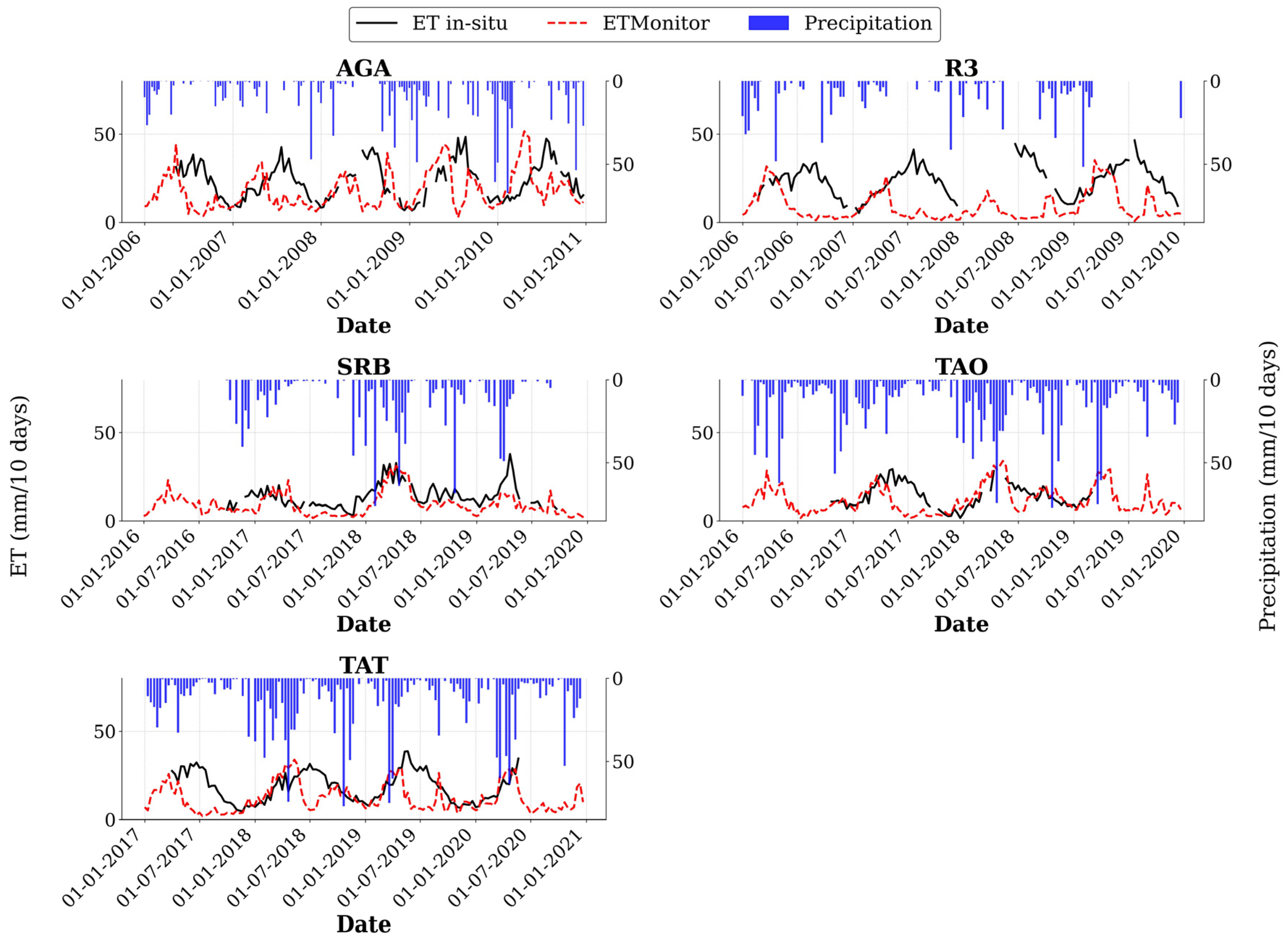
ETMonitor exhibited poor performance in irrigated fields but showed moderate accuracy at the rainfed site (Figure 7). At the drip-irrigated citrus orchard (AGA) and olive sites (R3, TAO, TAT), correlations with observed ET were very low (R2 = 0.01–0.11), with high RMSE values ranging from 0.80 to 1.97 mm/day, and substantial underestimation biases (PBIAS = −18.55% to −62.27%) (Figure 4). Seasonal trends were largely absent at these sites, with ET estimates declining sharply during dry summer periods despite active irrigation inputs.
In contrast, the rainfed wheat field (SRB) showed moderate correlation (R2 = 0.56) and recorded the lowest RMSE across all sites (0.64 mm/day), though it still exhibited notable underestimation (PBIAS = −30.97%). ETMonitor was able to capture precipitation-driven ET spikes at SRB but failed to reflect post-rainfall drying accurately. Temporal patterns suggest that the model is sensitive to rainfall events but lacks the capacity to sustain ET estimates under irrigation-driven soil moisture conditions.
ETMonitor demonstrated robust performance in rainfed wheat (SRB) through its dual-source Shuttleworth–Wallace model, which partitions soil evaporation and transpiration using FLUXNET-trained machine learning algorithms [87]. The model’s daily resolution and passive microwave soil moisture inputs (disaggregated to 1 km) effectively captured short-term moisture dynamics in rainfed systems, outperforming single-source models in semi-arid regions like China’s inland river basins [88,89]. However, its reliance on 25 km soil moisture data averaged signals across irrigated and non-irrigated areas, imposing artificial water stress in drip-irrigated plots (AGA/R3). For instance, ref. [90] reported ETMonitor underestimated ET by 25–35% in irrigated segments of the Tarim River Basin due to this coarse resolution, while [91] attributed similar errors in Lake Chad to generalized land class parameterization. Misclassification of olive groves as croplands further skewed transpiration estimates, as crop-specific canopy resistance parameters poorly represent deep-rooted trees—a limitation exacerbated in fragmented agroecosystems where the model’s static land cover assumptions clash with heterogeneous vegetation [92,93].
While ETMonitor excels in data-rich, rainfed regions, its coarse soil moisture inputs and lack of irrigation metadata limit its utility in arid agroecosystems. Ref. [93] confirmed these weaknesses in arid zones, where missing irrigation tags and inadequate moisture constraints degraded accuracy despite the model’s all-weather capabilities. Proposed solutions include assimilating high-resolution soil moisture data to resolve spatial variability in irrigation [89] and integrating sprinkler irrigation models to address pressurized systems [94]. These adaptations could bridge the gap between ETMonitor’s current framework and the realities of modern agricultural water management.
Recent regional and multi-scale evaluations further reinforce ETMonitor’s context-dependent performance. Ref. [88] first demonstrated that although ETMonitor effectively captures ET dynamics in semi-arid inland river basins, coarse spatial resolution and static land cover assumptions caused underestimation in irrigated mosaics. Building on this, ref. [47,95] both confirmed that low-resolution soil moisture inputs induced artificial water stress, leading to ET underestimation in Pakistan’s irrigated agricultural zones and across arid regions more broadly. Similar findings were reported by ref. [91], who highlighted the necessity of incorporating high-resolution soil moisture and irrigation metadata to improve accuracy in semi-arid croplands. Large-scale analyses such as [95] corroborated these biases across Pan-Eurasian and African agroecosystems, showing that the model’s 25 km soil moisture averaging fails to represent irrigation-induced variability. Likewise, ref. [27] demonstrated that while ETMonitor performs well in rainfed conditions, irrigated fields remain prone to ET underestimation due to static crop parameterization and unresolved heterogeneity. Collectively, these studies affirm that ETMonitor’s strong performance in naturalized systems diminishes under intensive irrigation, underscoring the importance of finer-resolution soil moisture assimilation and dynamic irrigation representation for improved ET retrieval in arid and semi-arid regions.

3.5. PML v2 Product’s Evaluation

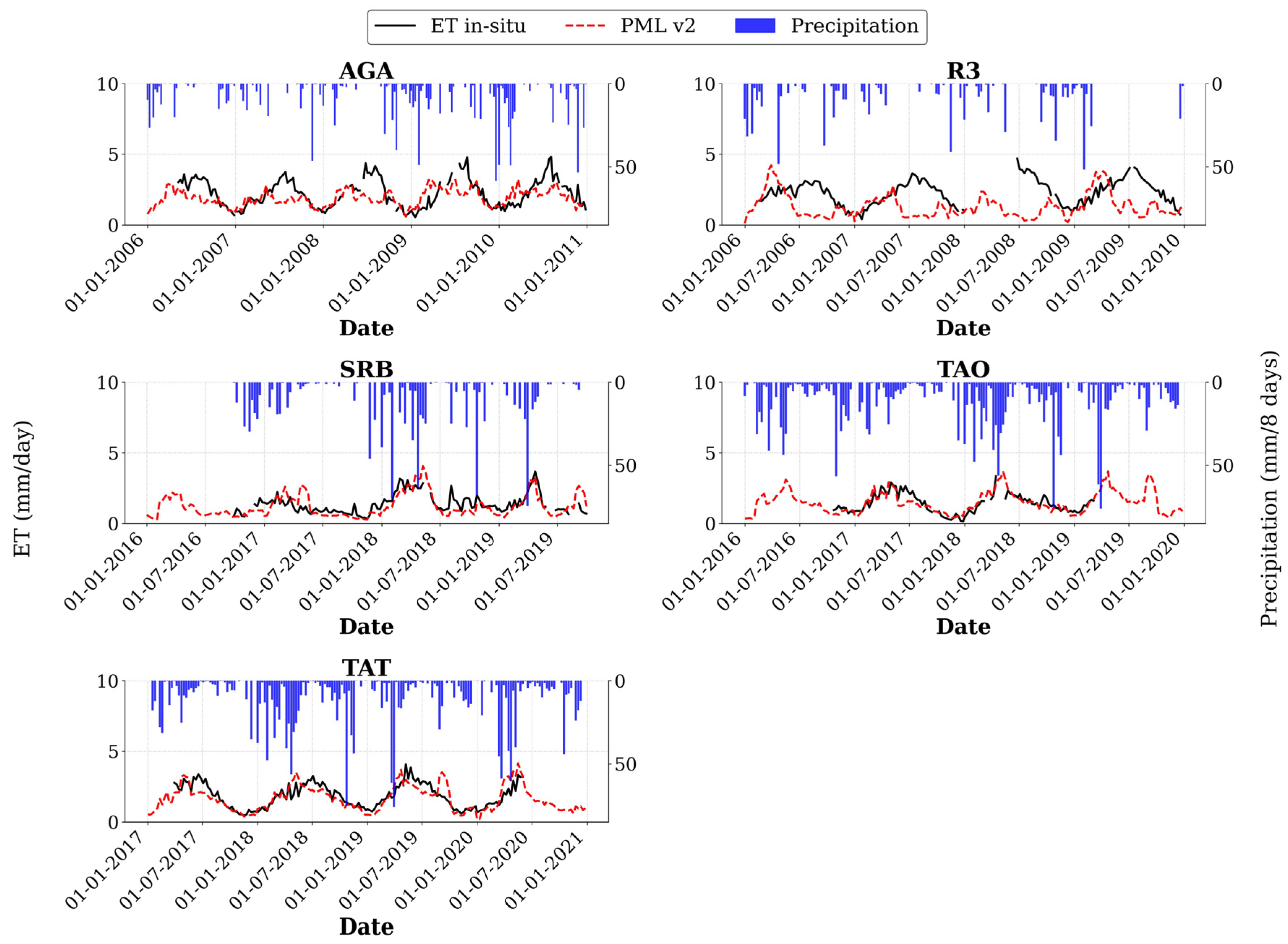
PML v2 demonstrated variable but generally strong performance across sites, particularly in croplands (Figure 8). At the flood-irrigated olive fields (TAO and TAT), PML v2 achieved the highest correlations among all products (R2 = 0.65 and 0.63, respectively), the lowest RMSE values (0.41 and 0.58 mm/day), and minimal underestimation (PBIAS = −5.48% and −4.75%). Seasonal trends closely aligned with observed ET, although slight underestimations occurred during peak summer irrigation periods.
At the rainfed wheat field (SRB), PML v2 also performed well, with moderate correlation (R2 = 0.51), low RMSE (0.59 mm/day), and small bias (PBIAS = −9.59%). In contrast, performance declined at the drip-irrigated citrus orchard (AGA) and the drip-irrigated olive site (R3), where PML v2 exhibited low correlations (R2 = 0.22 and 0.01) and higher RMSE values (0.95 and 1.66 mm/day, respectively), along with moderate to high underestimation (PBIAS = −16.06% at AGA and −43.30% at R3) (Figure 4). At R3, ET estimates dropped sharply during summer despite irrigation, reflecting a precipitation-driven response rather than irrigation-driven soil moisture dynamics.
Spatially, PML v2 produced some of the most consistent annual ET estimates across the Haouz Plain, maintaining a stable east–west gradient—from higher ET in the vegetated northeast to lower ET in the arid west. Temporal trends corresponded well with interannual precipitation variability, with elevated ET in wetter years (e.g., 2018) and declines during drought periods.
PML v2’s coupled water–carbon model outperformed other products in rainfed (SRB) and flood-irrigated systems (TAO/TAT) by dynamically linking transpiration to photosynthesis using MODIS LAI and precipitation-driven soil moisture [96]. The algorithm’s 500 m resolution and integration with Google Earth Engine facilitate field-scale analyses in regions where ET aligns with natural water availability, such as China’s precipitation-driven croplands [96,97]. However, its precipitation-centric soil moisture parameterization (f in Equation (A31)) ignores supplemental irrigation, causing severe underestimation in drip-irrigated orchards (AGA/R3). For example, ref. [98] demonstrated that PML v2 underestimated ET in irrigated wheat plots by 15–30% due to static crop parameters and reliance on precipitation-based soil moisture proxies. Misclassification of olive groves as croplands compounded errors, as grass-specific stomatal conductance parameters misrepresented woody perennials—a systemic issue in fragmented irrigation mosaics where PML v2’s static land cover assumptions fail to resolve crop-specific water use [99,100]. PML v2’s strength in naturalized systems is counterbalanced by its inability to account for modern irrigation practices, particularly in arid regions where anthropogenic water inputs dominate [90].
The PML v2 algorithm was improved for arid regions by constraining soil evaporation with precipitation data, enhancing accuracy in dry climates [101]. This adaptation addresses a key challenge in remote sensing ET models, where precipitation and soil moisture constraints are critical in water-limited environments [96]. However, the model’s reliance on precipitation as the primary soil moisture driver limits its applicability in intensively irrigated systems. In the Tarim River Basin, ref. [90] found PML v2 underestimated ET by up to 40% in cotton fields where irrigation replaced rainfall as the dominant water source. Similarly, in Southern Chile, ref. [102] noted PML v2 overestimated moisture limitations in well-watered pastures, reflecting inflexibility in soil moisture dynamics. Recent work by ref. [101] proposes integrating root zone moisture data into PML v2’s framework, which partially mitigates these issues in drylands but does not resolve the core disconnect between model assumptions and managed water inputs.
Recent evaluations further substantiate PML v2’s strengths and limitations in semi-arid and irrigation-dominated environments. Ref. [103] demonstrated that while PML v2 performs robustly in rainfed and precipitation-driven systems, it consistently underestimates ET in irrigated croplands. Similarly, refs. [104,105] found that PML v2 effectively reproduces ET dynamics across arid regions of China but fails to capture irrigation-induced fluxes due to its precipitation-centric soil moisture parameterization. Subsequent refinements, such as the shortwave-infrared surface water stress constraint introduced by ref. [105], improved ET accuracy in rainfed fields but still could not resolve biases in irrigated orchards and fragmented agricultural landscapes. Multi-scale analyses by ref. [106] confirmed that PML v2 performs best under natural moisture regimes, whereas irrigation management strongly modulates its accuracy. Adaptive parameterization efforts, like those by ref. [107], suggest that tuning PML v2 under varying irrigation intensities can significantly reduce ET underestimation. Comparative studies such as ref. [108] emphasized that integrating management-driven irrigation processes enables PML v2 to outperform MOD16 in different crops in semi-arid regions. Region-specific applications, including ref. [109] across many African regions and [110] in Ethiopia’s upper Blue Nile, similarly revealed that accounting for irrigation timing and magnitude markedly enhances ET estimation, underscoring the necessity of contextual model calibration for managed agricultural systems.

3.6. Common Challenges in Semi-Arid Agricultural Applications

Remote sensing ET models face several persistent challenges in semi-arid agricultural regions. Spatial resolution mismatch between satellite products and the heterogeneous landscape of irrigated fields leads to mixed-pixel problems, particularly for tree crops with significant inter-row spacing. Algorithmic assumptions based on natural rainfall-soil moisture relationships often fail to capture artificial irrigation patterns, especially in modern pressurized systems where water inputs are precisely controlled.
Input data quality significantly affects performance across all products. Errors in land surface temperature, misclassification of crop types, or inaccurate vegetation indices can propagate through the models and magnify ET estimation errors. For example, poor-quality MODIS LST inputs directly impact SSEBop accuracy, while land cover misclassification affects parameter selection in MOD16, PML v2, and ETMonitor.
As demonstrated in our evaluation, performance varies critically by irrigation method: PML v2 and WaPOR achieved moderate accuracy in flood-irrigated olive systems, but failed in drip-irrigated orchards, where localized wet zones violate model assumptions of uniform soil moisture.
A further source of uncertainty arises from the mismatch between the EC footprint and satellite pixel size. EC towers capture fluxes from a dynamic footprint that shifts every 30 min with wind direction, atmospheric stability, and local roughness [54], whereas satellite products represent static pixels ranging from 100 m (WaPOR) to 500 m (MOD16, PML v2) and 1 km (SSEBop, ETMonitor), aggregated over 8–10 days.
In heterogeneous landscapes like drip-irrigated orchards (AGA, R3), irrigated tree rows intermingle with dry inter-row soil, creating sub-pixel mixtures unresolved by coarser products. Footprint–pixel mismatch has been shown to be a major source of error in semi-arid environments [25,57,81,82], explaining why MOD16 (500 m) and 1 km products (SSEBop, ETMonitor) performed poorly in these systems and smoothed ET dynamics. Even WaPOR, despite finer NDVI inputs (100–250 m), relies on 1 km LST, making it partially sensitive to footprint mismatch in tree orchards.
Conversely, footprint mismatch was less problematic in flood-irrigated olive systems (TAO, TAT), where irrigated areas are more homogeneous at the 1 km scale, partly explaining the higher accuracy of several ET products at these sites.
Recent research suggests that improvements in ET estimation accuracy in semi-arid agriculture require: (1) higher spatial resolution thermal imagery that can resolve field-scale irrigation patterns, (2) explicit incorporation of irrigation metadata into model parameterization, and (3) refinement of algorithms to better represent water–vegetation relationships in managed agricultural systems. These adaptations would address the fundamental limitations identified in all five products when applied to modern irrigation practices in water-scarce environments.

3.7. Spatiotemporal Variation in ET over Tensift–Haouz Plain

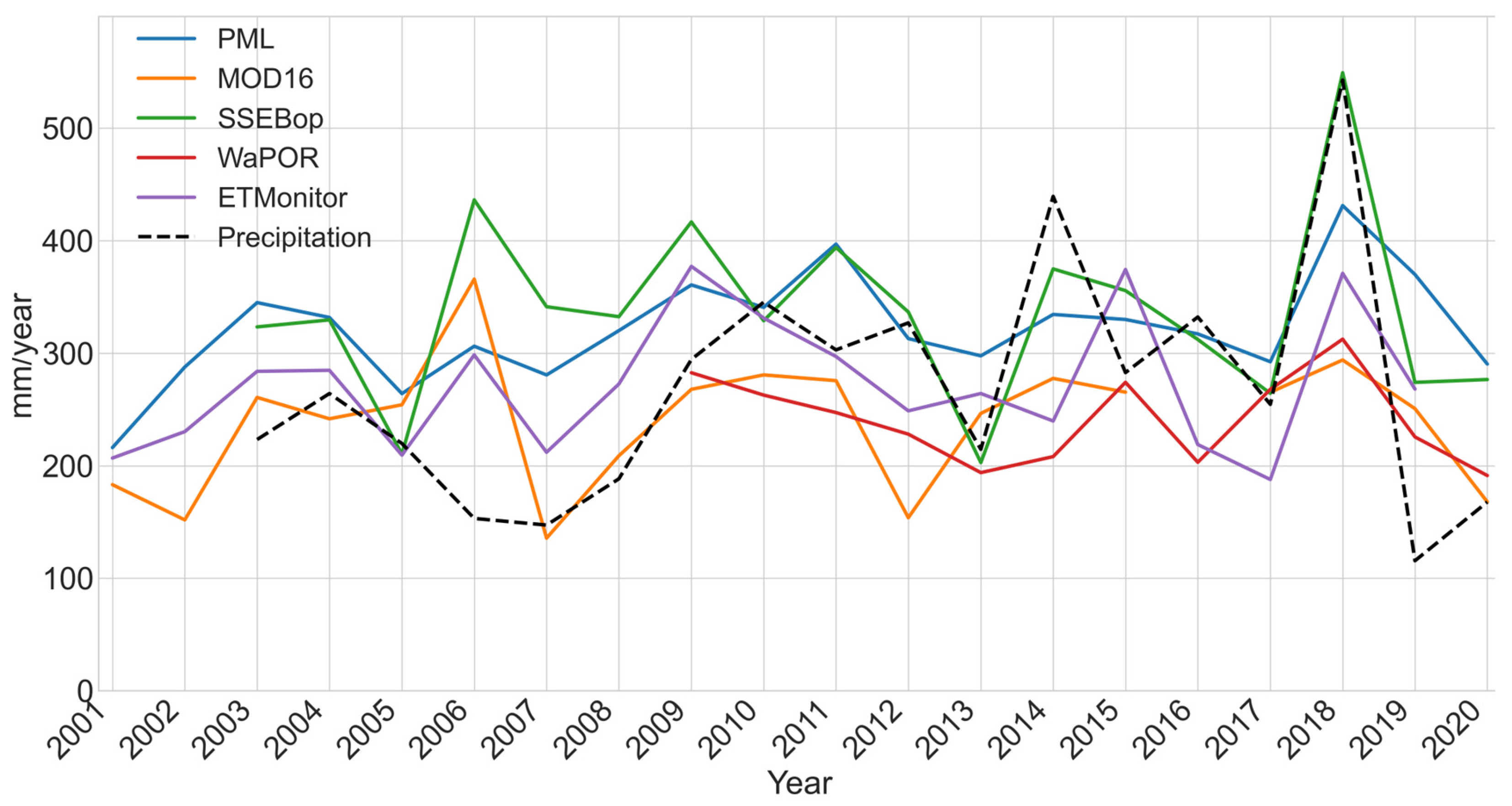
To assess the spatiotemporal dynamics of evapotranspiration (ET) across the Haouz–Tensift plain, we analyzed yearly totals from the five ET products, focusing on how performance varied under contrasting hydroclimatic conditions. The temporal comparison (Figure 9) revealed consistent interannual patterns among products, with similar responses in 2005, 2006, 2009, 2017, and 2018, corresponding to wetter and drier years driven by precipitation variability. MOD16 showed a marked drop in 2007, whereas SSEBop exhibited a pronounced peak in 2018, reflecting product-specific sensitivities to climate conditions and algorithmic formulations. Overall, SSEBop tended to overestimate ET, while MOD16 consistently produced the lowest values. In contrast, WaPOR and PML v2 remained relatively stable across years, indicating greater reliability and robustness in their moisture response.
Product behavior varied distinctly between wet and dry regimes. During wetter years (e.g., 2018), MOD16 and ETMonitor aligned better with EC measurements, benefiting from their humidity- and precipitation-based parameterizations. Conversely, during dry years, PML v2 and WaPOR maintained more consistent performance, while all models struggled under drip irrigation (AGA, R3), where human-managed water inputs decoupled ET from rainfall signals. Seasonally, ET dynamics were better captured in the winter–spring period—when precipitation and vegetation growth dominated—than in the dry summer months, when irrigation timing and method became primary controls. This divergence was particularly evident in drip-irrigated orchards, where underestimation reached up to 40–80% (MOD16, ETMonitor), compared to flood-irrigated systems where biases remained below 30% (PML v2, WaPOR).
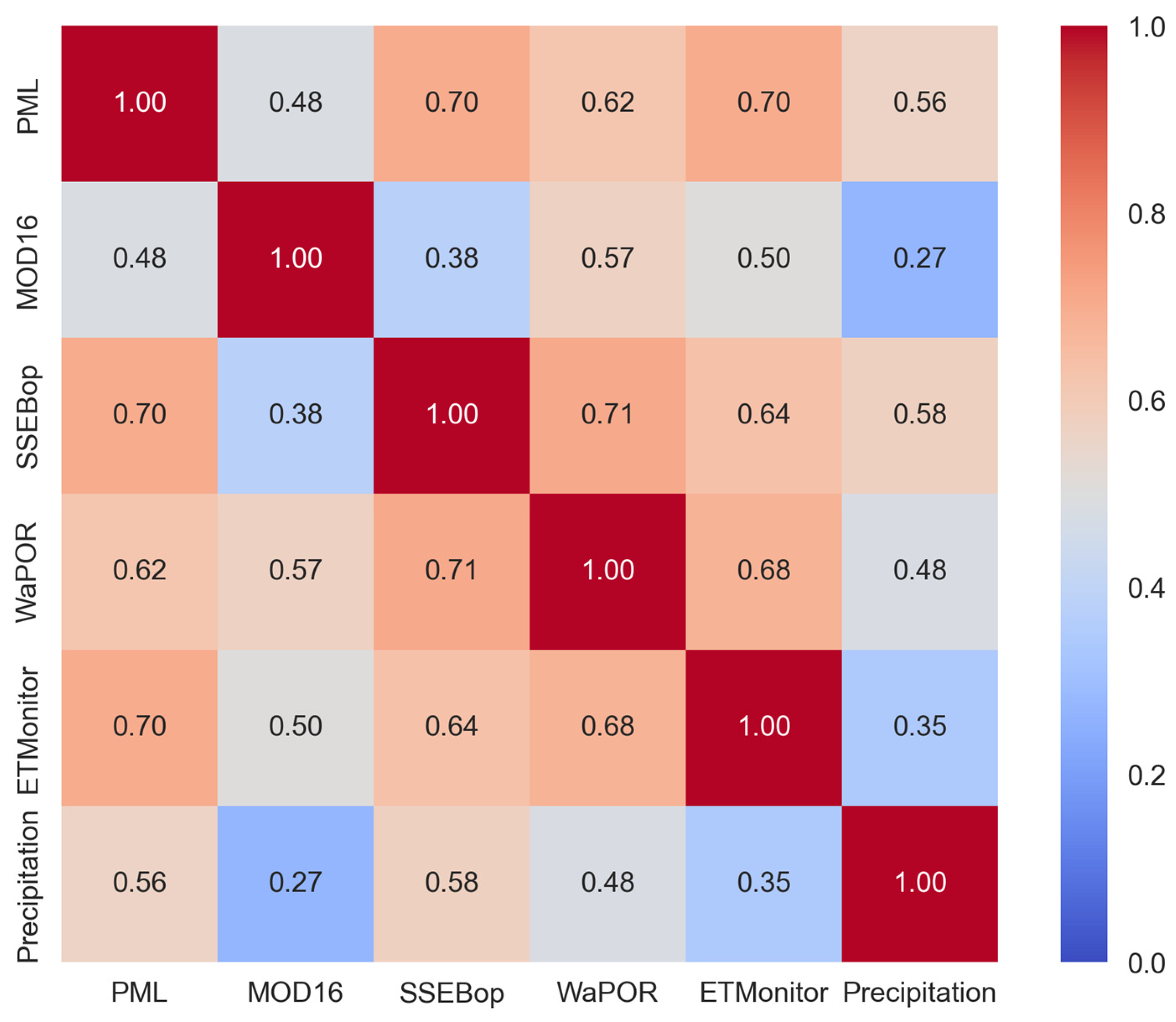
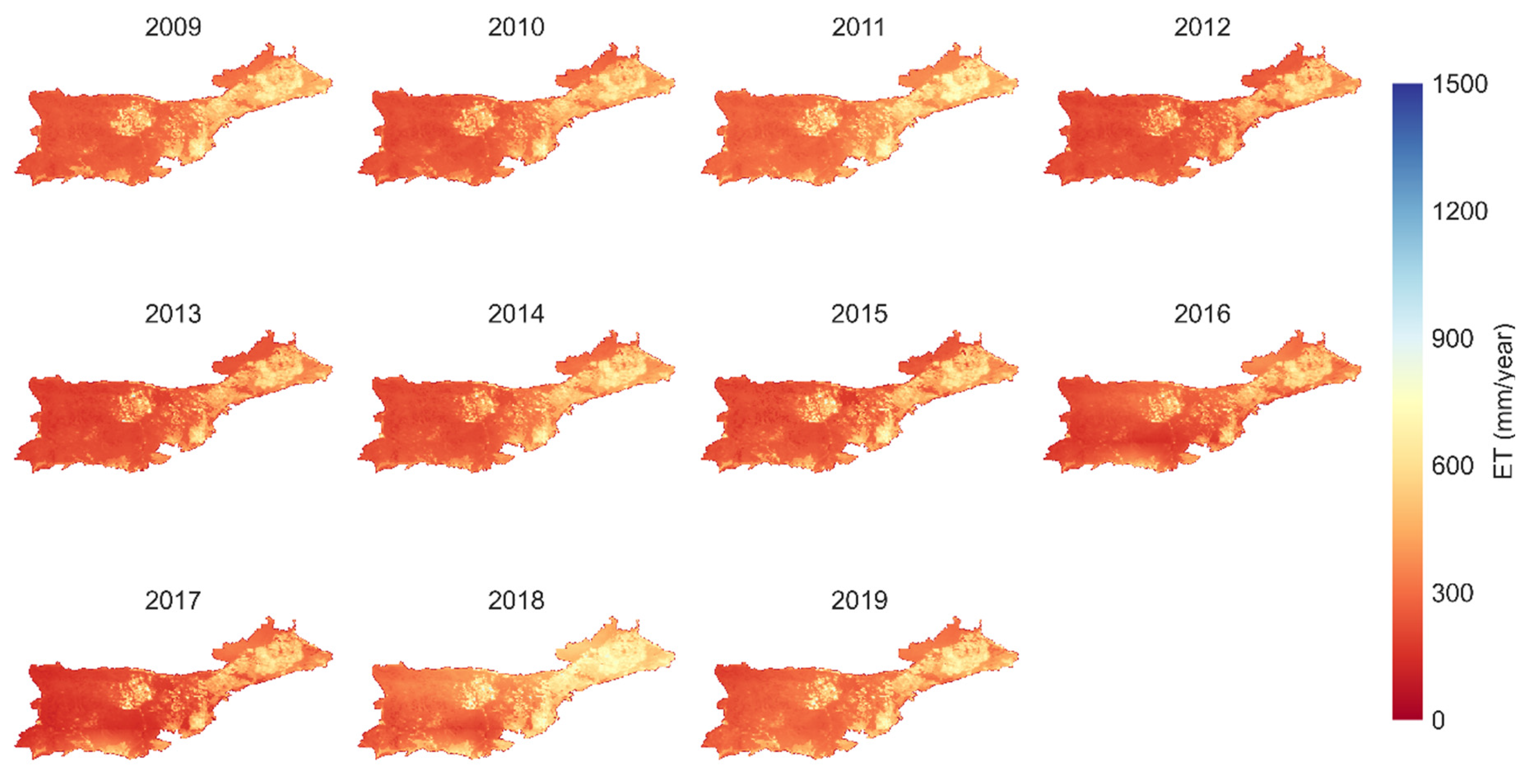
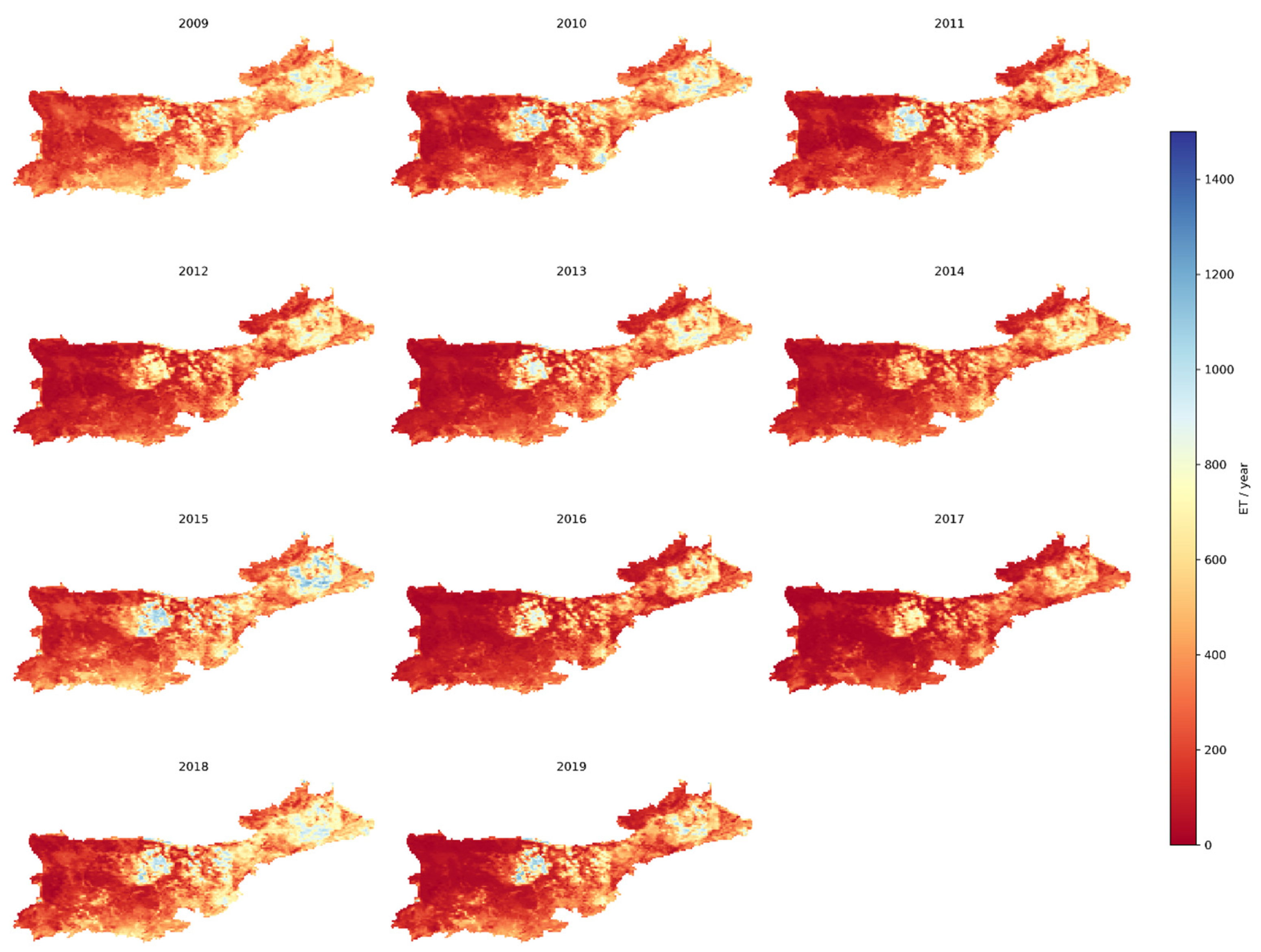
Among all products, PML v2 demonstrated the most consistent and balanced performance (Figure 10), showing moderate-to-high correlations with the others (R = 0.48–0.70) and capturing regional ET dynamics representative of multiple modeling approaches. Spatially (Figure 11), PML v2 maintained stable east–west ET gradients throughout the study period, while MOD16 produced lower overall estimates and missing data in complex terrain. SSEBop and ETMonitor exhibited comparable spatial patterns but greater variability, and WaPOR displayed higher interannual fluctuations, particularly during anomalous years (e.g., 2018). Despite methodological differences, all products reproduced the dominant climatic and topographic ET gradient across the Tensift plain, emphasizing both their complementary strengths and the importance of understanding algorithmic limitations for hydrological applications in semi-arid regions.
Among all the products, PML appears to be the most consistent (Figure 10). This conclusion can be drawn from observing that PML maintains relatively high and stable correlation coefficients with all other products: 0.70 with both SSEBop and ETMonitor, 0.62 with WaPOR, and 0.48 with MOD16. While not having the highest individual correlation value (which is 0.71 between SSEBop and WaPOR), PML’s consistency across all comparisons suggests it represents a more middle-ground or balanced estimate that aligns reasonably well with all other products. This consistent performance across comparisons indicates that PML might be capturing ET patterns in a way that is more broadly representative of the consensus among different estimation approaches, making it potentially more reliable for general applications where the true ET values are unknown.
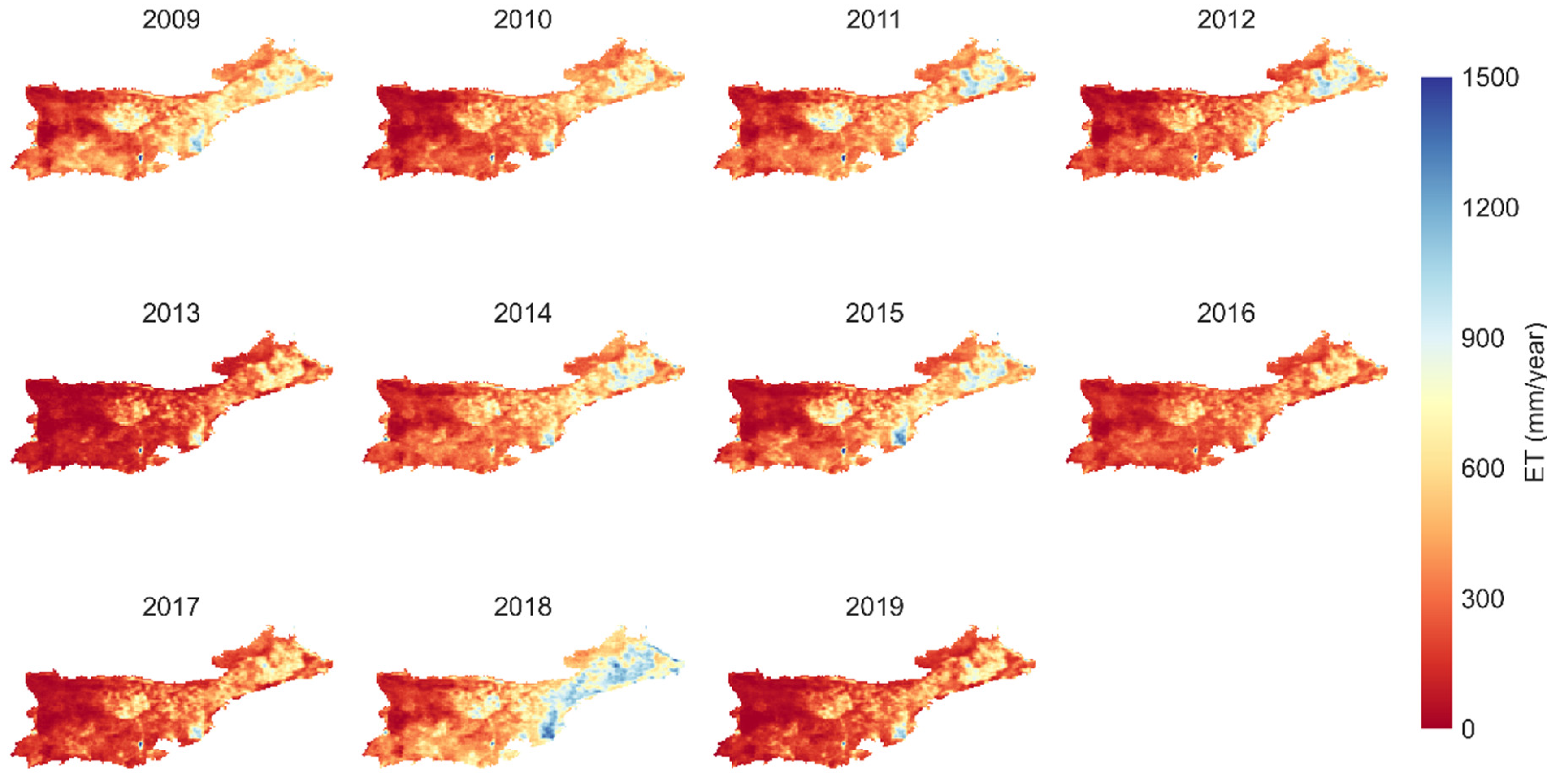
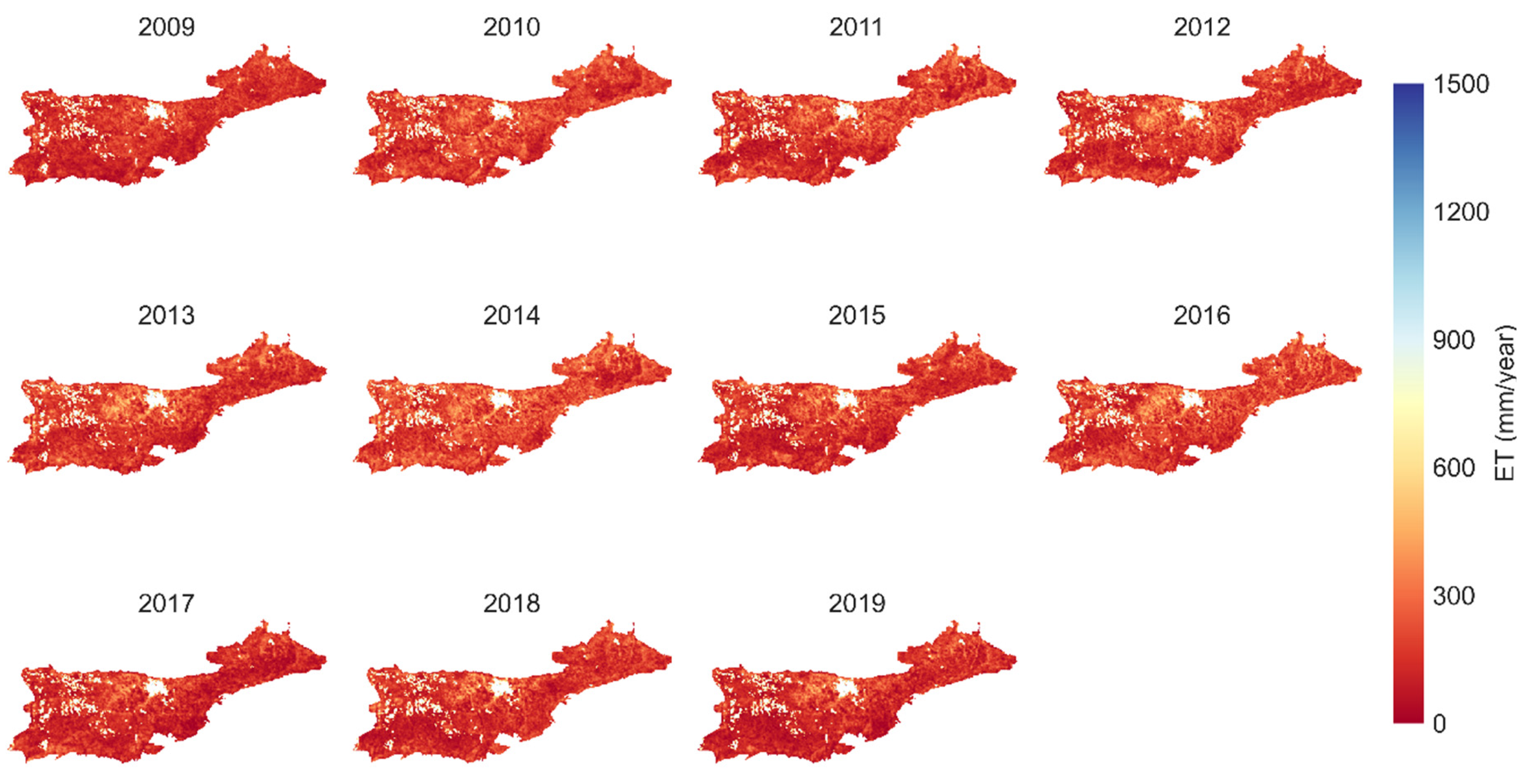
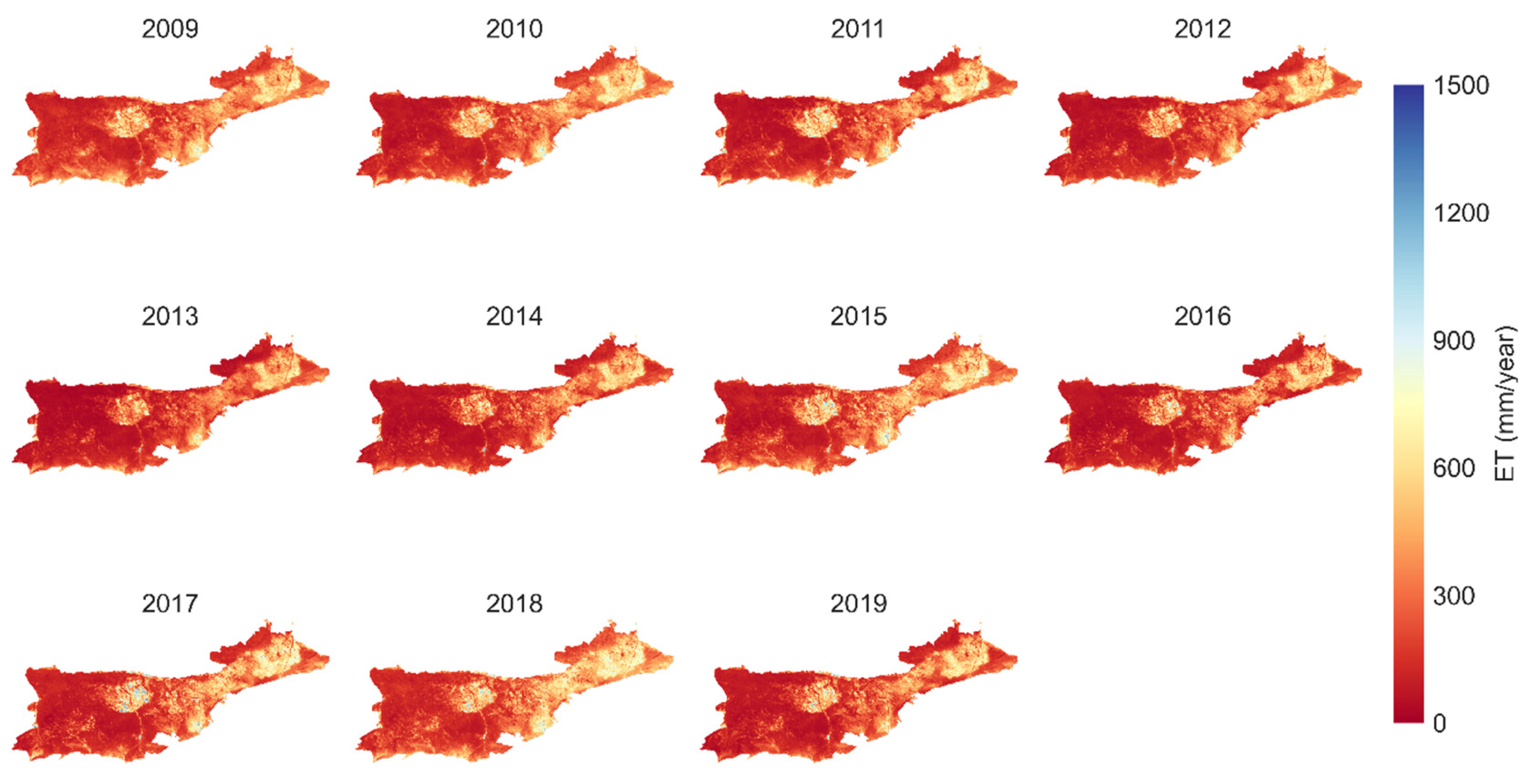
Based on the temporal analysis of the five ET products from 2009 to 2019, significant variations in spatial patterns and consistency are evident. The PML product demonstrates remarkable temporal stability, maintaining consistent spatial patterns throughout the study period, particularly in capturing the gradient from higher ET values in the northeastern region to lower values in the west (Figure 10). MOD16 exhibits notably lower ET estimates overall, with distinct patches of missing data in the western portion of the study area, potentially indicating challenges in ET estimation over complex terrain or certain land cover types (Figure A2). SSEBop and ETMonitor show similar spatial patterns to PML, though with some differences in absolute values, supporting their moderate to high correlations (Figure A1 and Figure A4). WaPOR displays more pronounced interannual variability, particularly evident in 2018 with anomalously high ET values represented by blue coloration, suggesting potential sensitivity to extreme climate events or methodological inconsistencies (Figure A3). Despite these differences, all products consistently capture the general east–west ET gradient, reflecting the underlying climatic and topographic controls on ET in the region. The observed variations among products highlight the importance of understanding the strengths and limitations of each ET estimation approach when selecting datasets for hydrological applications in this geographical context.

4. Conclusions

This study evaluated the performance of five global ET products (SSEBop, MOD16, WaPOR, ETMonitor, and PML v2) across five sites in the Tensift Plain. Overall, PML v2, WaPOR, and SSEBop most successfully captured seasonal trends and yearly variability of ET, although each displayed notable biases linked to factors such as irrigation, spatial resolution, and precipitation. Notably, no single physical concept or modeling approach consistently outperformed the others: among the top products, one is contextual while another is more physically based.
Despite offering longer temporal coverage, MOD16 exhibited weaker performance. ETMonitor and PML v2 ceased data production in 2020–2021, limiting their ongoing utility. WaPOR, though relatively new and currently restricted to Africa, shows promise in capturing both magnitude and variability. Overall, while these products can meet diverse research needs, their moderate performance highlights the need for further improvements. Future high-resolution missions like TRISHNA and LSTM may help enhance ET estimations in diverse landscapes.

Author Contributions

Conceptualization, M.H.K., V.S., and S.E.-R.; methodology, M.H.K., V.S., and S.E.-R.; software, Y.M.; validation, Y.M.; formal analysis, Y.M.; investigation, Y.M.; data curation, Y.M.; writing—original draft preparation, Y.M.; writing—review and editing, M.H.K., V.S., S.K., L.J., J.E., and S.E.-R.; visualization, Y.M.; supervision, M.H.K., V.S., and S.E.-R. All authors have read and agreed to the published version of the manuscript.

Funding

The study was conducted within the International Water Research Institute (IWRI) and supported by the ASSIWAT project funded by the OCP Group S.A. (Office Chérifien des Phosphates) (grant agreement no: AS_71). Other fundings were provided by the APRD research program (GEANTech) and the PRIMA BIOMEnext project.

Institutional Review Board Statement

Not applicable.

Informed Consent Statement

Not applicable.

Data Availability Statement

The data presented in this study are available on request from the corresponding author due to restrictions in the observatory’s data-sharing policy.

Acknowledgments

The authors would like to thank the Tensift Observatory in the frame of the SudMed project and the TREMA International Joint Laboratory (https://www.lmi-trema.ma/; last accessed 16 December 2025) funded by the University Cadi Ayyad (UCA, Morocco) and the French Research Institute for Development (IRD, CESBIO Laboratory, France) for providing the in situ data.

Conflicts of Interest

The authors declare no conflicts of interest.

Abbreviations

The following abbreviations are used in this manuscript:
ETEvapotranspiration
SSEBopThe Operational Simplified Surface Energy Balance
MOD16MODIS-16
PML v2Penman–Monteith–Leuning Version 2
LELatent heat flux
EC EddyCovariance
PBIASPercent bias
RMSERoot Mean Square Error
LSTLand Surface Temperature
NDVINormalized Difference Vegetation Index

Appendix A

In this section, we provide a overview of the essential physical basis and equations employed in the algorithms of each product used in this study.
SSEBop [45].
Evaporative Fraction (ETf): The ET fraction is calculated as a function of the difference between the land surface temperature (Ts) and the cold/wet reference limit (Tc), normalized by the surface psychrometric constant (γs).
E T f = 1 γ S ( T s T c )
Equation (A2) is used to calculate the actual evapotranspiration (ET) for each pixel, which is the product of ETf and ETo scaled by a coefficient k. k is 1.25, which converts grass-reference ETo to alfalfa-reference ETo for maximum ET.
Actual Evapotranspiration (AET): The final AET is calculated as the product of the evaporative fraction (ETf) and a scaled reference ET. The coefficient k (typically 1.25) converts grass-reference ETo to an alfalfa-reference value.
A E T = E T f × k × E T o
Surface psychrometric constant (γs): is related to the specific heat of air at constant pressure (Cp), density of air (ρ), net radiation (Rn) and aerodynamic resistance over bare soil (rah).
γ S = C p ρ R n × r a h
Equation (A4) is used to determine the cold/wet reference limit (Tc), which is derived from the maximum air temperature (Ta) using a correction coefficient c. c is based on the ratio of Ts and Ta at well-vegetated pixels.
T c = c × T a
Equation (A5) is used to calculate the correction coefficient c, which is the 5th percentile of the distribution of Ts/Ta values for each sub-tile.
c = T c o r r m e a n 2 × S T D
MOD16 [16].
Total Evapotranspiration: The final ET is the sum of three independently calculated components: evaporation from the wet canopy ( λ E w e t _ c ), transpiration from the dry canopy ( λ E t r a n s ), and evaporation from the soil surface ( λ E s o i l ).
λ E = λ E w e t _ c + λ E t r a n s + λ E s o i l
Wet Canopy Evaporation or Interception (Ei): The Penman–Monteith equation is used to calculate evaporation from the wet fraction (F wet) of the canopy surface
λ E w e t _ c = s A c + ρ C p e s a t e F c / r h r c s + P a C p r v c λ ε r h r c F w e t
where λ E w e t _ c : Latent Heat Flux (W·m−2) of wet canopy (interception). ρ : Air density (kg·m−3). s: Slope of the saturation vapor pressure curve (Pa·K−1). A c : Part of net radiation allocated to canopy (W·m−2). C p : Specific heat of air (J·kg−1·K−1). ( e s a t e ): Vapor Pressure Deficit (VPD, in Pa). P a : Atmospheric Pressure (Pa). r h r c ,   r v c : aerodynamic resistance and resistance to latent heat flux, (s·m−1). F w e t : Fraction of the surface that is wet, based on Relative Humidity (RH) (dimensionless). F c : Fraction of vegetation cover (dimensionless).
Dry Canopy Transpiration (Et): The Penman–Monteith equation is applied to the dry fraction of the canopy (Equation (A9)) where transpiration is controlled by both surface resistance ( r s ) and aerodynamic resistance ( r a ).
λ E t r a n s = s A c + ρ C p e s a t e / r a F c s + γ 1 + r s / r a 1 F w e t
where λ E t r a n s : Latent Heat Flux (W·m−2) of dry canopy (transpiration). ρ : Air density (kg·m−3). s: Slope of the saturation vapor pressure curve (Pa·K−1). A c : Net radiation of canopy (W·m−2). C p : Specific heat of air (J·kg−1·K−1). ( e s a t e ): Vapor Pressure Deficit (VPD, in Pa). r a ,   r s : aerodynamic resistance and surface resistance, respectively (s·m−1). γ : Psychrometric constant (Pa·K−1) F w e t : Fraction of the surface that is wet, based on Relative Humidity (RH) (dimensionless). F c : Fraction of vegetation cover (dimensionless).
Canopy Conductance (Cc): This Equation (A9) calculates the overall conductance of the dry portion of the canopy. It integrates stomatal ( G s ), the i in G s _ i is a variable that reflects daytime or nighttime stomatal conductance-cuticular ( G c u ), and leaf boundary-layer ( G s 2 ) conductances, scaled by LAI.
C c = G s 2 . ( G s _ i 1 + G c u ) G s _ i 1 + G s 2 G c u L A I 1 F w e t
Stomatal Conductance ( C c ): This equation from the old algorithm shows how potential stomatal conductance ( C L ) is limited by environmental stress multipliers for minimum air temperature ( m T m i n ) and vapor pressure deficit ( m V P D ).
C s = C L m T m i n m V P D
Aerodynamic Resistance ( r a ): The resistance to heat and water vapor transfer from the canopy, calculated as the parallel resistance to convective ( r h ) and radiative ( r r ) heat transfer.
r a = r h + r r r h r r
Soil Evaporation (Es): This equation shows the component from the moist surface as the potential rate ( λ E S O I L _ p o t ) constrained by a function of relative humidity (RH) and VPD. Note: This is a simplified representation; the full equation combines the wet and moist parts (Equation (A11)).
λ E s o i l = λ E w e t _ s o i l + λ E S O I L _ p o t R H 100 V P D β
where β : A parameter for the soil moisture constraint (set to 200).
Soil Evaporation (Full Form): This is the complete formulation, combining potential evaporation from the wet soil fraction ( F w e t ) and moisture-constrained evaporation from the moist fraction.
λ E s o i l = s A s o i l + ρ C p 1 F c V P D / r a s s + γ r t o t / r a s F w e t + 1 F w e t R H 100 V P D / β
where r a s   is the specific aerodynamic resistance to calculate the sensible heat flux component of soil evaporation. r t o t   is total bare soil resistance.
Total Bare Soil Resistance (rtotc): The resistance of the soil surface ( r t o t ) is calculated with this piecewise function. It interpolates the resistance between a biome-specific maximum ( r b l m a x ) and minimum ( r b l m i n ) based on VPD thresholds ( V P D o p e n , V P D c l o s e )
r t o t c = r b l m a x r b l m a x V P D c l o s e V P D o p e n r b l m a x r b l m i n V P D c l o s e V P D r b l m i n  
r b l m i n and r b l m a x are the minimum and maximum boundary layer resistances for bare soil, respectively.
WaPOR.
Interception (I): This equation models the amount of precipitation (P) that is intercepted by the plant canopy and evaporates directly from the leaf surfaces. It is a function of the vegetation cover fraction ( C v e g ) and the leaf area index ( l l a i )
I = 0.2 l l a i 1 1 1 + C v e g 0.2 l l a i
Soil Evaporation (E). This is the Penman–Monteith equation adapted for the soil surface. It calculates the evaporation rate based on the net radiation reaching the soil ( R n , s o i l ), soil heat flux ( G ), and the resistances to vapor transfer from the soil ( r a , s o i l and r s , s o i l ).
λ E = δ R n , s o i l G + ρ a i r C p e s a t e a r a , s o i l δ + γ 1 + r s , s o i l r a , s o i l
where δ: Slope of the saturation vapor pressure–temperature curve (kPa·°C−1). R n , s o i l : Net radiation at the soil surface (MJ·m−2/day). G : Soil heat flux (MJ·m−2/day). ρ a i r : Density of air (kg·m−3). C p : Specific heat of air (MJ·kg−1·°C−1). ( e s a t e a ): Vapor Pressure Deficit (VPD) (kPa). γ: Psychrometric constant (kPa·°C−1). r a , s o i l : Aerodynamic resistances for soil (s·m−1). r s , s o i l : Surface resistances for soil (s·m−1).
Canopy Transpiration (T): This is the Penman–Monteith equation adapted for the vegetated canopy. It calculates the transpiration rate based on the net radiation absorbed by the canopy ( R n , c a n o p y ) and the resistances to vapor transfer from the plant leaves ( r a , c a n o p y and r s , c a n o p y )
λ T = δ R n , c a n o p y + ρ a i r C p e s a t e a r a , c a n o p y δ + γ 1 + r s , c a n o p y r a , c a n o p y
Total Evapotranspiration ( E T I a ): The final product is the sum of the three independently calculated components: soil evaporation ( λ E ), canopy transpiration ( λ E ) , and interception loss (I).
E T I a = λ E + λ T + I
ETMonitor [87].
Surface Energy Balance: This fundamental equation states that the available energy at the surface ( R n G ) is partitioned into latent heat flux ( λ E T ) and sensible heat flux ( H ).
R n G = λ E T + H
where R n : Net radiation flux (W⋅m−2). G : Ground heat flux (W⋅m−2). λ E T : Latent heat flux (W⋅m−2). H : Sensible heat flux (W⋅m−2).
Net Radiation ( R n ): Calculates the total net radiation as the balance between incoming shortwave ( R S ) and longwave ( R L ) radiation, and outgoing shortwave (controlled by albedo α 0 ) and longwave radiation.
R n = 1 α 0 R S + R L σ ϵ T 4 1 ϵ R L
α 0 : Land surface albedo (dimensionless). R S : Incoming shortwave radiation (W⋅m−2). R L : Incoming longwave radiation (W⋅m−2) * σ: Stefan–Boltzmann constant (5.67 × 10 −8 W⋅m−2⋅K−4) ϵ : Broadband land surface emissivity (dimensionless). T: Daily averaged air temperature (K).
Canopy Surface Resistance ( r s c ): Calculates the resistance of the plant canopy to transpiration. It starts with a minimum leaf stomatal resistance ( r s , m i n ) and increases based on environmental stress factors and the effective leaf area index ( L A I e f f )
r s c = r s , m i n / f R S f V P D f T a f θ r o o t L A I e f f
where θ r o o t : Root zone soil moisture (m3.m−3)
Environmental Constraint Functions (Equations (A22)–(A25)): These empirical functions quantify the environmental stress on stomatal conductance, with values ranging from 0 (maximum stress, stomata closed) to 1 (no stress, stomata fully open)
f ( R S ) = 1 e x p ( R S / K R )
f ( V P D ) = 1 K D V P D
f T a = T a T m i n T m a x T a T o p t T m i n T m a x T o p t T m a x T o p t T o p t T m i n
f ( θ r o o t ) = m i n ( 1 , m a x [ 0 , ( θ r o o t θ w i l t ) / ( θ f c θ w i l t ) ] )
where R S : Incoming shortwave radiation (W⋅m−2). VPD: Vapor pressure deficit (kPa). Ta: Air temperature (K). θ r o o t : Root zone soil moisture (m3.m−3). K R , K D : Fitting parameters for radiation and VPD sensitivity. T m i n , T m a x , T o p t : Minimum, maximum, and optimum air temperatures for stomatal activity. θ w i l t , θ f c : Soil moisture at permanent wilting point and field capacity.
Soil Surface Resistance ( r s s ): Calculates the resistance of the soil surface to evaporation. It starts with a minimum resistance ( r s s , m i n ) and increases as the surface soil moisture ( θ s u r f ) decreases.
r s s = r s s , m i n / θ s u r f b
where b : Parameter describing sensitivity to soil moisture
Total Evapotranspiration (ET): Defines the total ET as the sum of its five components: plant transpiration (Ec), soil evaporation (Es), canopy interception (Ei), open water evaporation (Ew), and snow/ice sublimation (Ess). Both Ec and Es are calculated based on S-W dual source model that takes as principal inputs the Equations (A21) and (A26).
E T = E c + E s + E i + E w + E s s
PML v2 [48].
Canopy Transpiration ( λ E c ): This is the Penman–Monteith equation applied to the canopy. Its accuracy depends on the canopy conductance ( G c ), which is calculated in the next step by coupling water and carbon cycles.
λ E c = ϵ Q A , c + ρ c p / γ D a G a ϵ + 1 + G a / G c
λ E c : Latent heat flux of transpiration (W⋅m−2). ϵ: Ratio of the slope of the vapor pressure curve to the psychrometric constant (Δ/γ). Q A , c : Available energy at the canopy (W⋅m−2) * ρ : Air density (kg⋅m−3) * c p : Specific heat of air (J⋅kg−1K−1). D a : Vapor pressure deficit of the air (kPa). G a : Aerodynamic conductance (m⋅s−1). G c : Canopy conductance (m⋅s−1)
Coupled Canopy Conductance ( G c ): This is the core equation of the PML-V2 model. It calculates canopy conductance by integrating leaf-level stomatal conductance (which is linked to photosynthesis) up to the canopy scale. It uses the intermediate P-terms defined in the Appendix of the paper.
G c = m P 1 k ( P ) 2 + P 4 k L A I + l n P 2 + P 3 + P 4 P 2 + P 3 e k L A I P 4 1 + D D 0
where m is the stomatal conductance coefficient P1, P2, P3, and P4 are functions of photosynthetically active radiation (PAR), CO2 concentration (Ca), temperature (T), and atmospheric pressure (Pa), k is the extinction coefficient of PAR, LAI is the leaf area index, and D and D0 are the water VPD of the air and a reference value, respectively.
Gross Primary Production (GPP): This equation calculates the total canopy photosynthesis. It is structurally linked to the canopy conductance equation, demonstrating the model’s coupled nature
G P P = P 1 C a k P 2 + P 4 k L A I + ln P 2 + P 3 + P 4 P 2 + P 3 exp k L A I + P 4
where GPP is Gross Primary Production (μmol⋅m−2s−1), C a : Atmospheric CO2 concentration (μmol⋅mol−1).
Soil Evaporation Coefficient (f): This coefficient represents moisture availability for soil evaporation, calculated as the ratio of cumulative precipitation ( P ) to cumulative potential soil evaporation ( E e q , s ) over a preceding time period (e.g., n = 32 days)
f = m i n ( i = i n i P i i = i n i E e q , s , i , 1 )
where n is the length of the “time lag” used to balance soil water content after precipitation, Pi is precipitation in the ith day, and Eeq,s,i is the equilibrium soil evaporation in the ith day. This equation calculates f as the accumulative proportion of precipitation to soil evaporative demand of the previous n days. The value of f ranges from 0 to 1, where 0 means no soil evaporation and 1 means maximum soil evaporation. The value of n is insensitive to variations and can be given as 32 days in this model.
Soil Evaporation ( E s ): This is the Priestley–Taylor equation, which calculates potential soil evaporation based on the available energy at the soil surface ( A s ). This potential rate is then scaled by the soil evaporation coefficient (f) to account for water limits.
λ E s = f ϵ A s ϵ + 1
where λ E s : Latent heat flux of soil evaporation (W⋅m−2) * f: Soil evaporation coefficient. ϵ: As defined above. A s : Available energy at the soil surface (W⋅m−2).
Interception (Ei) was calculated using the complex Gash analytical model.
Total Evapotranspiration (ET): The final total ET is the sum of the three main components: Canopy transpiration, soil evaporation and interception:
λ E T = λ T + λ E s + E i

Appendix B

In this section, we present the rest of the figures.
Figure A1. Comparison of SSEBop with its intermediary datasets over TAO site.
Atmosphere 16 01407 g0a1
Figure A2. Annual ET estimates from SSEBop (2009–2019). ET ranges from <50 mm/year (arid southwest) to >900 mm/year (vegetated northeast), with a pronounced east–west gradient reflecting precipitation patterns. All maps share a unified color scale range of 0–1500 mm year−1 to enable consistent comparison across years.
Atmosphere 16 01407 g0a2
Figure A3. Annual ET estimates from MOD16 (2009–2019). Lower overall ET (50–400 mm/year) compared to other products, with minimal spatial variability and weak gradients. Highest values occur in the northeast agricultural zone. All maps share a unified color scale range of 0–1500 mm year−1 to enable consistent comparison across years.
Atmosphere 16 01407 g0a3
Figure A4. Annual ET estimates from WaPOR (2009–2019). ET ranges from <100 mm/year (western desert) to >900 mm/year (central irrigated plains), highlighting strong north–south moisture gradients. All maps share a unified color scale range of 0–1500 mm year−1 to enable consistent comparison across years.
Atmosphere 16 01407 g0a4
Figure A5. Annual ET estimates from ETMonitor (2009–2019). ET varies from <200 mm/year (southwest) to >900 mm/year (northeast), following topographic and precipitation-driven moisture availability. All maps share a unified color scale range of 0–1500 mm year−1 to enable consistent comparison across years.
Atmosphere 16 01407 g0a5
For the climatic inputs, we chose not to include them due to their coarser spatial resolution. Including them in our figures would require zooming out, which would result in a loss of visibility for the parcels, site location, and the actual size of the product’s pixel footprints.
Figure A6. SSEBop pixel footprint above our sites, along with its input data.
Atmosphere 16 01407 g0a6
Figure A7. MOD16 pixel footprint above our sites, along with its input data.
Atmosphere 16 01407 g0a7
Figure A8. PML pixel footprint above our sites, along with its input data.
Atmosphere 16 01407 g0a8
Figure A9. WaPOR pixel footprint above our sites, along with its input data.
Atmosphere 16 01407 g0a9
Figure A10. ETMonitor pixel footprint above our sites, along with its input data.
Atmosphere 16 01407 g0a10
Figure A11. Photos of stations.
Atmosphere 16 01407 g0a11

References

  1. Wild, M.; Grieser, J.; Schär, C. Combined surface solar brightening and increasing greenhouse effect support recent intensification of the global land-based hydrological cycle. Geophys. Res. Lett. 2008, 35. [Google Scholar] [CrossRef]
  2. Miralles, D.G.; van den Berg, M.J.; Gash, J.H.; Parinussa, R.M.; de Jeu, R.A.M.; Beck, H.E.; Holmes, T.R.H.; Jiménez, C.; Verhoest, N.E.C.; Dorigo, W.A.; et al. El Niño–La Niña cycle and recent trends in continental evaporation. Nat. Clim. Change 2014, 4, 122–126. [Google Scholar] [CrossRef]
  3. Wang, K.; Dickinson, R.E. A review of global terrestrial evapotranspiration: Observation, modeling, climatology, and climatic variability. Rev. Geophys. 2012, 50, 23–26. [Google Scholar] [CrossRef]
  4. Sörensson, A.A.; Ruscica, R.C. Intercomparison and Uncertainty Assessment of Nine Evapotranspiration Estimates Over South America. Water Resour. Res. 2018, 54, 2891–2908. [Google Scholar] [CrossRef]
  5. Sheffield, J.; Wood, E.F.; Roderick, M.L. Little change in global drought over the past 60 years. Nature 2012, 491, 435–438. [Google Scholar] [CrossRef]
  6. Kousari, M.R.; Ahani, H. An investigation on reference crop evapotranspiration trend from 1975 to 2005 in Iran. Int. J. Climatol. 2012, 32, 2387–2402. [Google Scholar] [CrossRef]
  7. Jian, D.; Li, X.; Sun, H.; Tao, H.; Jiang, T.; Su, B.; Hartmann, H. Estimation of Actual Evapotranspiration by the Complementary Theory-Based Advection–Aridity Model in the Tarim River Basin, China. J. Hydrometeorol. 2018, 19, 289–303. [Google Scholar] [CrossRef]
  8. Allen, R.G.; Howell, T.; Pruitt, W.O.; Walter, I.A.; Jensen, M.E. Lysimeters for Evapotranspiration and Environmental Measurements; ASCE: Reston, VA, USA, 1991. [Google Scholar]
  9. Bowen, I.S. The Ratio of Heat Losses by Conduction and by Evaporation from any Water Surface. Phys. Rev. 1926, 27, 779–787. [Google Scholar] [CrossRef]
  10. Everson, C.; Clulow, A.; Mengitsu, M. Feasibility Study on the Determination of Riparian Evaporation in Non-Perennial Systems; Water Research Commission: Pretoria, South Africa, 2009. [Google Scholar]
  11. Majozi, N.P.; Mannaerts, C.M.; Ramoelo, A.; Mathieu, R.; Mudau, A.E.; Verhoef, W. An intercomparison of satellite-based daily evapotranspiration estimates under different eco-climatic regions in South Africa. Remote Sens. 2017, 9, 307. [Google Scholar] [CrossRef]
  12. Su, Z. The Surface Energy Balance System (SEBS) for estimation of turbulent heat fluxes. Hydrol. Earth Syst. Sci. 2002, 6, 85–100. [Google Scholar] [CrossRef]
  13. Fisher, J.B.; Tu, K.P.; Baldocchi, D.D. Global estimates of the land–atmosphere water flux based on monthly AVHRR and ISLSCP-II data, validated at 16 FLUXNET sites. Remote Sens. Environ. 2008, 112, 901–919. [Google Scholar] [CrossRef]
  14. Miralles, D.G.; De Jeu, R.A.M.; Gash, J.H.; Holmes, T.R.H.; Dolman, A.J. Magnitude and variability of land evaporation and its components at the global scale. Hydrol. Earth Syst. Sci. 2011, 15, 967–981. [Google Scholar] [CrossRef]
  15. Miralles, D.G.; Holmes, T.R.H.; De Jeu, R.A.M.; Gash, J.H.; Meesters, A.G.C.A.; Dolman, A.J. Global land-surface evaporation estimated from satellite-based observations. Hydrol. Earth Syst. Sci. 2011, 15, 453–469. [Google Scholar] [CrossRef]
  16. Mu, Q.; Zhao, M.; Running, S.W. Improvements to a MODIS global terrestrial evapotranspiration algorithm. Remote Sens. Environ. 2011, 115, 1781–1800. [Google Scholar] [CrossRef]
  17. Schellekens, J.; Dutra, E.; Martínez-de la Torre, A.; Balsamo, G.; van Dijk, A.; Sperna Weiland, F.; Minvielle, M.; Calvet, J.C.; Decharme, B.; Eisner, S.; et al. A global water resources ensemble of hydrological models: The eartH2Observe Tier-1 dataset. Earth Syst. Sci. Data 2017, 9, 389–413. [Google Scholar] [CrossRef]
  18. Glenn, E.P.; Huete, A.R.; Nagler, P.L.; Hirschboeck, K.K.; Brown, P. Integrating Remote Sensing and Ground Methods to Estimate Evapotranspiration. Crit. Rev. Plant Sci. 2007, 26, 139–168. [Google Scholar] [CrossRef]
  19. Kalma, J.D.; McVicar, T.R.; McCabe, M.F. Estimating Land Surface Evaporation: A Review of Methods Using Remotely Sensed Surface Temperature Data. Surv. Geophys. 2008, 29, 421–469. [Google Scholar] [CrossRef]
  20. Zhu, W.; Tian, S.; Wei, J.; Jia, S.; Song, Z. Multi-scale evaluation of global evapotranspiration products derived from remote sensing images: Accuracy and uncertainty. J. Hydrol. 2022, 611, 127982. [Google Scholar] [CrossRef]
  21. Tang, R.; Peng, Z.; Liu, M.; Li, Z.-L.; Jiang, Y.; Hu, Y.; Huang, L.; Wang, Y.; Wang, J.; Jia, L.; et al. Spatial-temporal patterns of land surface evapotranspiration from global products. Remote Sens. Environ. 2024, 304, 114066. [Google Scholar] [CrossRef]
  22. Elfarkh, J.; Ezzahar, J.; Er-Raki, S.; Simonneaux, V.; Ait Hssaine, B.; Rachidi, S.; Brut, A.; Rivalland, V.; Khabba, S.; Chehbouni, A.; et al. Multi-Scale Evaluation of the TSEB Model over a Complex Agricultural Landscape in Morocco. Remote Sens. 2020, 12, 1181. [Google Scholar] [CrossRef]
  23. Chehbouni, A.; Escadafal, R.; Duchemin, B.; Boulet, G.; Simonneaux, V.; Dedieu, G.; Mougenot, B.; Khabba, S.; Kharrou, H.; Maisongrande, P.; et al. An integrated modelling and remote sensing approach for hydrological study in arid and semi-arid regions: The SUDMED Programme. Int. J. Remote Sens. 2008, 29, 5161–5181. [Google Scholar] [CrossRef]
  24. Jarlan, L.; Khabba, S.; Er-Raki, S.; Le Page, M.; Hanich, L.; Fakir, Y.; Merlin, O.; Mangiarotti, S.; Gascoin, S.; Ezzahar, J.; et al. Remote Sensing of Water Resources in Semi-Arid Mediterranean Areas: The joint international laboratory TREMA. Int. J. Remote Sens. 2015, 36, 4879–4917. [Google Scholar] [CrossRef]
  25. Ramoelo, A.; Majozi, N.; Mathieu, R.; Jovanovic, N.; Nickless, A.; Dzikiti, S. Validation of Global Evapotranspiration Product (MOD16) using Flux Tower Data in the African Savanna, South Africa. Remote Sens. 2014, 6, 7406–7423. [Google Scholar] [CrossRef]
  26. Veysi, S.; Nouri, M.; Jabbari, A. Reference evapotranspiration estimation using reanalysis and WaPOR products in dryland Croplands. Heliyon 2024, 10, e26531. [Google Scholar] [CrossRef]
  27. Zhang, Y.; Liu, S.; Song, L.; Li, X.; Jia, Z.; Xu, T.; Xu, Z.; Ma, Y.; Zhou, J.; Yang, X.; et al. Integrated Validation of Coarse Remotely Sensed Evapotranspiration Products over Heterogeneous Land Surfaces. Remote Sens. 2022, 14, 3467. [Google Scholar] [CrossRef]
  28. Elkatoury, A.; Alazba, A.A.; Radwan, F.; Kayad, A.; Mossad, A. Evapotranspiration Estimation Assessment Using Various Satellite-Based Surface Energy Balance Models in Arid Climates. Earth Syst. Environ. 2024, 8, 1347–1369. [Google Scholar] [CrossRef]
  29. Simonneaux, V.; Le Page, M.; Helson, D.; Metral, J.; Thomas, S.; Duchemin, B.; Cherkaoui, M.; Kharrou, H.; Berjamy, B.; Chehbouni, A. Estimation spatialisée de l’Evapotranspiration des cultures irriguées par télédétection. Application à la gestion de l’Irrigation dans la plaine du Haouz (Marrakech, Maroc). Sécheresse 2009, 20, 123–130. [Google Scholar] [CrossRef]
  30. Le Page, M.; Berjamy, B.; Fakir, Y.; Bourgin, F.; Jarlan, L.; Abourida, A.; Benrhanem, M.; Jacob, G.; Huber, M.; Sghrer, F.; et al. An Integrated DSS for Groundwater Management Based on Remote Sensing. The Case of a Semi-arid Aquifer in Morocco. Water Resour. Manag. 2012, 26, 3209–3230. [Google Scholar] [CrossRef]
  31. Aouade, G.; Jarlan, L.; Ezzahar, J.; Er-Raki, S.; Napoly, A.; Benkaddour, A.; Khabba, S.; Boulet, G.; Garrigues, S.; Chehbouni, A.; et al. Evapotranspiration partition using the multiple energy balance version of the ISBA-A-gs land surface model over two irrigated crops in a semi-arid Mediterranean region (Marrakech, Morocco). Hydrol. Earth Syst. Sci. 2020, 24, 3789–3814. [Google Scholar] [CrossRef]
  32. Dijk, A.; Moene, A.F.; de Bruin, H. The Principles of Surface Flux Physics: Theory, Practice and Description of the ECPACK Library. Princ. Surf. Flux Phys. Theory Pract. Descr. ECPACK Libr. 2004, 99, 525. Available online: https://zenodo.org/records/10968475 (accessed on 25 November 2025).
  33. Wilczak, J.M.; Oncley, S.P.; Stage, S.A. Sonic Anemometer Tilt Correction Algorithms. Bound. Layer Meteorol. 2001, 99, 127–150. [Google Scholar] [CrossRef]
  34. Dijk, A.; Kohsiek, W.; de Bruin, H. Oxygen Sensitivity of Krypton and Lyman? Hygrometers. J. Atmos. Ocean. Technol. 2003, 20, 143–151. [Google Scholar] [CrossRef]
  35. Schotanus, P.; Nieuwstadt, F.T.M.; De Bruin, H.A.R. Temperature measurement with a sonic anemometer and its application to heat and moisture fluxes. Bound. Layer Meteorol. 1983, 26, 81–93. [Google Scholar] [CrossRef]
  36. Horst, T.W. The Footprint for Estimation of Atmosphere-Surface Exchange Fluxes by Profile Techniques. Bound. Layer Meteorol. 1999, 90, 171–188. [Google Scholar] [CrossRef]
  37. Webb, E.K.; Pearman, G.I.; Leuning, R. Correction of flux measurements for density effects due to heat and water vapour transfer. Q. J. R. Meteorol. Soc. 1980, 106, 85–100. [Google Scholar] [CrossRef]
  38. Ait Hssaine, B.; Merlin, O.; Ezzahar, J.; Ojha, N.; Er-Raki, S.; Khabba, S. An evapotranspiration model self-calibrated from remotely sensed surface soil moisture, land surface temperature and vegetation cover fraction: Application to disaggregated SMOS and MODIS data. Hydrol. Earth Syst. Sci. 2020, 24, 1781–1803. [Google Scholar] [CrossRef]
  39. Merlin, O.; Olivera-Guerra, L.; Aït Hssaine, B.; Amazirh, A.; Rafi, Z.; Ezzahar, J.; Gentine, P.; Khabba, S.; Gascoin, S.; Er-Raki, S. A phenomenological model of soil evaporative efficiency using surface soil moisture and temperature data. Agric. For. Meteorol. 2018, 256–257, 501–515. [Google Scholar] [CrossRef]
  40. Amazirh, A.; Merlin, O.; Er-Raki, S.; Gao, Q.; Rivalland, V.; Malbeteau, Y.; Khabba, S.; Escorihuela, M.J. Retrieving surface soil moisture at high spatio-temporal resolution from a synergy between Sentinel-1 radar and Landsat thermal data: A study case over bare soil. Remote Sens. Environ. 2018, 211, 321–337. [Google Scholar] [CrossRef]
  41. Er-Raki, S.; Khabba, S.; Erraji, T.; Ezzahar, J.; Jarlan, L.; Le Page, M.; Chehbouni, A.; Hanich, L. Evaluation of the Sap Flow Measurements Determined with Heat Balance Method for Citrus Orchards in Semi-arid Region. In International Workshop on Sap Flow, Proceedings of the VIIIth International Workshop on Sap Flow, Leuven, Belgium, 8–12 May 2011; Sebastiani, L., Tognetti, R., Motisi, A., Eds.; ISHS: Leuven, Belgium, 2012; pp. 259–267. Available online: https://www.documentation.ird.fr/intranet/publi/depot/2013-11-28/010060188.pdf (accessed on 25 November 2025).
  42. Nassah, H.; Er-Raki, S.; Khabba, S.; Fakir, Y.; Raibi, F.; Merlin, O.; Mougenot, B. Evaluation and analysis of deep percolation losses of drip irrigated citrus crops under non-saline and saline conditions in a semi-arid area. Biosyst. Eng. 2018, 165, 10–24. [Google Scholar] [CrossRef]
  43. Kharrou, M.H.; Simonneaux, V.; Er-Raki, S.; Le Page, M.; Khabba, S.; Chehbouni, A. Assessing Irrigation Water Use with Remote Sensing-Based Soil Water Balance at an Irrigation Scheme Level in a Semi-Arid Region of Morocco. Remote Sens. 2021, 13, 1133. [Google Scholar] [CrossRef]
  44. Diarra, A.; Jarlan, L.; Khabba, S.; Le Page, M.; Er-Raki, S.; Balaghi, R.; Charafi, S.; Chehbouni, A.; El Alami, R. Medium-Resolution Mapping of Evapotranspiration at the Catchment Scale Based on Thermal Infrared MODIS Data and ERA-Interim Reanalysis over North Africa. Remote Sens. 2022, 14, 5071. [Google Scholar] [CrossRef]
  45. Senay, G.B.; Kagone, S.; Velpuri, N.M. Operational Global Actual Evapotranspiration: Development, Evaluation, and Dissemination. Sensors 2020, 20, 1915. [Google Scholar] [CrossRef] [PubMed]
  46. Allen, R. Penman–Monteith Equation. In Encyclopedia of Soils in the Environmen; Hillel, D., Ed.; Elsevier: Oxford, UK, 2005; pp. 180–188. [Google Scholar]
  47. Zheng, C.; Jia, L.; Hu, G.; Lu, J.; Wang, K.; Li, Z. Global evapotranspiration derived by ETMonitor model based on earth observations. In Proceedings of the 2016 IEEE International Geoscience and Remote Sensing Symposium (IGARSS), Beijing, China, 10–15 July 2016; pp. 222–225. [Google Scholar]
  48. Gan, R.; Zhang, Y.; Shi, H.; Yang, Y.; Eamus, D.; Cheng, L.; Chiew, F.H.S.; Yu, Q. Use of satellite leaf area index estimating evapotranspiration and gross assimilation for Australian ecosystems. Ecohydrology 2018, 11, e1974. [Google Scholar] [CrossRef]
  49. Zhang, Y.; Kong, D.; Gan, R.; Chiew, F.H.S.; McVicar, T.R.; Zhang, Q.; Yang, Y. Coupled estimation of 500 m and 8-day resolution global evapotranspiration and gross primary production in 2002–2017. Remote Sens. Environ. 2019, 222, 165–182. [Google Scholar] [CrossRef]
  50. Leuning, R.; Zhang, Y.Q.; Rajaud, A.; Cleugh, H.; Tu, K. A simple surface conductance model to estimate regional evaporation using MODIS leaf area index and the Penman-Monteith equation. Water Resour. Res. 2008, 44. [Google Scholar] [CrossRef]
  51. Gash, J.H.C.; Lloyd, C.R.; Lachaud, G. Estimating sparse forest rainfall interception with an analytical model. J. Hydrol. 1995, 170, 79–86. [Google Scholar] [CrossRef]
  52. FAO. WaPOR Database Methodology: Version 2 Release, April 2020; Food and Agriculture Organization: Rome, Italy, 2020. [Google Scholar]
  53. Lucas-Moffat, A.M.; Schrader, F.; Herbst, M.; Brümmer, C. Multiple gap-filling for eddy covariance datasets. Agric. For. Meteorol. 2022, 325, 109114. [Google Scholar] [CrossRef]
  54. Kljun, N.; Calanca, P.; Rotach, M.W.; Schmid, H.P. A simple two-dimensional parameterisation for Flux Footprint Prediction (FFP). Geosci. Model Dev. 2015, 8, 3695–3713. [Google Scholar] [CrossRef]
  55. McCabe, M.F.; Rodell, M.; Alsdorf, D.E.; Miralles, D.G.; Uijlenhoet, R.; Wagner, W.; Lucieer, A.; Houborg, R.; Verhoest, N.E.C.; Franz, T.E.; et al. The future of Earth observation in hydrology. Hydrol. Earth Syst. Sci. 2017, 21, 3879–3914. [Google Scholar] [CrossRef]
  56. Senay, G.B.; Bohms, S.; Singh, R.K.; Gowda, P.H.; Velpuri, N.M.; Alemu, H.; Verdin, J.P. Operational Evapotranspiration Mapping Using Remote Sensing and Weather Datasets: A New Parameterization for the SSEB Approach. JAWRA J. Am. Water Resour. Assoc. 2013, 49, 577–591. [Google Scholar] [CrossRef]
  57. Chen, M.; Senay, G.B.; Singh, R.K.; Verdin, J.P. Uncertainty analysis of the Operational Simplified Surface Energy Balance (SSEBop) model at multiple flux tower sites. J. Hydrol. 2016, 536, 384–399. [Google Scholar] [CrossRef]
  58. Acharya, B.; Sharma, V. Comparison of Satellite Driven Surface Energy Balance Models in Estimating Crop Evapotranspiration in Semi-Arid to Arid Inter-Mountain Region. Remote Sens. 2021, 13, 1822. [Google Scholar] [CrossRef]
  59. Zhuang, Q.; Shi, Y.; Shao, H.; Zhao, G.; Chen, D. Evaluating the SSEBop and RSPMPT Models for Irrigated Fields Daily Evapotranspiration Mapping with MODIS and CMADS Data. Agriculture 2021, 11, 424. [Google Scholar] [CrossRef]
  60. Senkondo, W.; Munishi, S.E.; Tumbo, M.; Nobert, J.; Lyon, S.W. Comparing Remotely-Sensed Surface Energy Balance Evapotranspiration Estimates in Heterogeneous and Data-Limited Regions: A Case Study of Tanzania’s Kilombero Valley. Remote Sens. 2019, 11, 1289. [Google Scholar] [CrossRef]
  61. Alemayehu, T.; Griensven, A.V.; Senay, G.B.; Bauwens, W. Evapotranspiration Mapping in a Heterogeneous Landscape Using Remote Sensing and Global Weather Datasets: Application to the Mara Basin, East Africa. Remote Sens. 2017, 9, 390. [Google Scholar] [CrossRef]
  62. Castelli, M. Evapotranspiration Changes over the European Alps: Consistency of Trends and Their Drivers between the MOD16 and SSEBop Algorithms. Remote Sens. 2021, 13, 4316. [Google Scholar] [CrossRef]
  63. El Hazdour, I.; Le Page, M.; Hanich, L.; Chakir, A.; Lopez, O.; Jarlan, L. A GEE TSEB workflow for daily high-resolution fully remote sensing evapotranspiration: Validation over four crops in semi-arid conditions and comparison with the SSEBop experimental product. Environ. Model. Softw. 2025, 187, 106365. [Google Scholar] [CrossRef]
  64. López-Pérez, E.; Manzano-Juaréz, J.; Jimenez-Bello, M.A.; García-Prats, A.; Sanchis-Ibor, C.; Rubio-Martin, A.; Boubekri, F.Z.; Kajji, A.; Tufoni, P.; Nunes, L.M.; et al. A Spatial Framework for Assessing Irrigation Water Use in Overexploited Mediterranean Aquifers. Preprints 2025. [Google Scholar] [CrossRef]
  65. Munkhtur, P.; Tseveengerel, B.; Bumtsend, B. Water accounting: A case study in the Buir Lake—Khalkh River Basin. Proc. Mong. Acad. Sci. 2025, 65, 29–51. [Google Scholar] [CrossRef]
  66. Kumar, N.; Hamouda, M.A. Utility of single-source surface energy balance models in estimation of daily actual evapotranspiration in arid regions. Hydrol. Sci. J. 2025, 70, 664–686. [Google Scholar] [CrossRef]
  67. Feng, F.; Chen, J.; Li, X.; Yao, Y.; Liang, S.; Liu, M.; Zhang, N.; Guo, Y.; Yu, J.; Sun, M. Validity of Five Satellite-Based Latent Heat Flux Algorithms for Semi-arid Ecosystems. Remote Sens. 2015, 7, 16733–16755. [Google Scholar] [CrossRef]
  68. Liaqat, U.W.; Choi, M. Accuracy comparison of remotely sensed evapotranspiration products and their associated water stress footprints under different land cover types in Korean peninsula. J. Clean. Prod. 2017, 155, 93–104. [Google Scholar] [CrossRef]
  69. Purdy, A.J.; Fisher, J.B.; Goulden, M.L.; Colliander, A.; Halverson, G.; Tu, K.; Famiglietti, J.S. SMAP soil moisture improves global evapotranspiration. Remote Sens. Environ. 2018, 219, 1–14. [Google Scholar] [CrossRef]
  70. Abiodun, O.O.; Guan, H.; Post, V.E.A.; Batelaan, O. Comparison of MODIS and SWAT evapotranspiration over a complex terrain at different spatial scales. Hydrol. Earth Syst. Sci. 2018, 22, 2775–2794. [Google Scholar] [CrossRef]
  71. Qiao, L.; Will, R.; Wagner, K.; Zhang, T.; Zou, C. Improvement of evapotranspiration estimates for grasslands in the southern Great Plains: Comparing a biophysical model (SWAT) and remote sensing (MODIS). J. Hydrol. Reg. Stud. 2022, 44, 101275. [Google Scholar] [CrossRef]
  72. Ruhoff, A.L.; Paz, A.R.; Aragao, L.E.O.C.; Mu, Q.; Malhi, Y.; Collischonn, W.; Rocha, H.R.; Running, S.W. Assessment of the MODIS global evapotranspiration algorithm using eddy covariance measurements and hydrological modelling in the Rio Grande basin. Hydrol. Sci. J. 2013, 58, 1658–1676. [Google Scholar] [CrossRef]
  73. Zimba, H.M.; Coenders-Gerrits, M.; Banda, K.E.; Hulsman, P.; van de Giesen, N.; Nyambe, I.A.; Savenije, H.H.G. On the importance of plant phenology in the evaporative process of a semi-arid woodland: Could it be why satellite-based evaporation estimates in the miombo differ? Hydrol. Earth Syst. Sci. 2024, 28, 3633–3663. [Google Scholar] [CrossRef]
  74. Mohammadi, A.; Costelloe, J.; Ryu, D. Evaluation of remotely sensed evapotranspiration products in a large scale Australian arid region: Cooper Creek, Queensland. In Proceedings of the 21st International Congress on Modelling and Simulation, Broadbeach, Australian, 13 December 2015. [Google Scholar]
  75. Richard, B.; César Luis, G.; Nebo, J.; Ingrid, T.; Manfred, F.; Sebinasi, D. Estimating evapotranspiration in a semi-arid catchment: A comparison of hydrological modelling and remote-sensing approaches. Water SA 2020, 46, 168. [Google Scholar] [CrossRef]
  76. Aguilar, A.L.; Flores, H.; Crespo, G.; Marín, M.I.; Campos, I.; Calera, A. Performance Assessment of MOD16 in Evapotranspiration Evaluation in Northwestern Mexico. Water 2018, 10, 901. [Google Scholar] [CrossRef]
  77. Degano, M.F.; Rivas, R.E.; Carmona, F.; Niclòs, R.; Sánchez, J.M. Evaluation of the MOD16A2 evapotranspiration product in an agricultural area of Argentina, the Pampas region. Egypt. J. Remote Sens. Space Sci. 2021, 24, 319–328. [Google Scholar] [CrossRef]
  78. Feng, Y.; Wang, L.; Liu, C.; Zhang, B.; Wang, J.; Zhang, P.; Wang, R. Modeling and Spatiotemporal Analysis of Actual Evapotranspiration in a Desert Steppe Based on SEBS. Hydrology 2025, 12, 205. [Google Scholar] [CrossRef]
  79. Wagle, P.; Gowda, P.H.; Northup, B.K. Dynamics of evapotranspiration over a non-irrigated alfalfa field in the Southern Great Plains of the United States. Agric. Water Manag. 2019, 223, 105727. [Google Scholar] [CrossRef]
  80. Dzikiti, S.; Jovanovic, N.Z.; Bugan, R.D.H.; Ramoelo, A.; Majozi, N.P.; Nickless, A.; Cho, M.A.; Le Maitre, D.C.; Ntshidi, Z.; Pienaar, H.H. Comparison of two remote sensing models for estimating evapotranspiration: Algorithm evaluation and application in seasonally arid ecosystems in South Africa. J. Arid Land 2019, 11, 495–512. [Google Scholar] [CrossRef]
  81. Blatchford, M.L.; Mannaerts, C.M.; Njuki, S.M.; Nouri, H.; Zeng, Y.; Pelgrum, H.; Wonink, S.; Karimi, P. Evaluation of WaPOR V2 evapotranspiration products across Africa. Hydrol. Process. 2020, 34, 3200–3221. [Google Scholar] [CrossRef]
  82. Saadi, S.; Boulet, G.; Bahir, M.; Brut, A.; Delogu, É.; Fanise, P.; Mougenot, B.; Simonneaux, V.; Lili Chabaane, Z. Assessment of actual evapotranspiration over a semiarid heterogeneous land surface by means of coupled low-resolution remote sensing data with an energy balance model: Comparison to extra-large aperture scintillometer measurements. Hydrol. Earth Syst. Sci. 2018, 22, 2187–2209. [Google Scholar] [CrossRef]
  83. van Niekerk, A.; Stephenson, C.J.G.; du Plessis, J.; Higgs, C.; Ndyafi, V.; Mashimbye, Z. The Application of National Scale Remotely Sensed Evapotranspiration (et) Estimates to Quantify Water Use and Differences Between Plantations in Commercial Forestry Regions of South Africa; Water Research Commission: Pretoria, South Africa, 2023. [Google Scholar]
  84. Elfarkh, J.; Simonneaux, V.; Jarlan, L.; Ezzahar, J.; Boulet, G.; Chakir, A.; Er-Raki, S. Evapotranspiration estimates in a traditional irrigated area in semi-arid Mediterranean. Comparison of four remote sensing-based models. Agric. Water Manag. 2022, 270, 107728. [Google Scholar] [CrossRef]
  85. Javadian, M.; Behrangi, A.; Gholizadeh, M.; Tajrishy, M. METRIC and WaPOR Estimates of Evapotranspiration over the Lake Urmia Basin: Comparative Analysis and Composite Assessment. Water 2019, 11, 1647. [Google Scholar] [CrossRef]
  86. Poudel, U.; Stephen, H.; Ahmad, S. Evaluating Irrigation Performance and Water Productivity Using EEFlux ET and NDVI. Sustainability 2021, 13, 7967. [Google Scholar] [CrossRef]
  87. Zheng, C.; Jia, L.; Hu, G. Global land surface evapotranspiration monitoring by ETMonitor model driven by multi-source satellite earth observations. J. Hydrol. 2022, 613, 128444. [Google Scholar] [CrossRef]
  88. Hu, G.; Jia, L. Monitoring of Evapotranspiration in a Semi-Arid Inland River Basin by Combining Microwave and Optical Remote Sensing Observations. Remote Sens. 2015, 7, 3056–3087. [Google Scholar] [CrossRef]
  89. Zhang, Y.; Zhang, L.; Hou, J.; Gu, J.; Huang, C. Development of an Evapotranspiration Data Assimilation Technique for Streamflow Estimates: A Case Study in a Semi-Arid Region. Sustainability 2017, 9, 1658. [Google Scholar] [CrossRef]
  90. Xiao, J.; Sun, F.; Wang, T.; Wang, H. Estimation and validation of high-resolution evapotranspiration products for an arid river basin using multi-source remote sensing data. Agric. Water Manag. 2024, 298, 108864. [Google Scholar] [CrossRef]
  91. Bennour, A.; Jia, L.; Menenti, M.; Zheng, C.; Zeng, Y.; Asenso Barnieh, B.; Jiang, M. Calibration and Validation of SWAT Model by Using Hydrological Remote Sensing Observables in the Lake Chad Basin. Remote Sens. 2022, 14, 1511. [Google Scholar] [CrossRef]
  92. Lu, J.; Jia, L.; Zheng, C.; Tang, R.; Jiang, Y. A Scheme to Estimate Diurnal Cycle of Evapotranspiration from Geostationary Meteorological Satellite Observations. Water 2020, 12, 2369. [Google Scholar] [CrossRef]
  93. Ren, Z.; Che, T.; Xu, F.; Zhang, Y.; Tan, J.; Wang, J.; Wang, W. Validation of Remotely Sensed Evapotranspiration Products Using Optical–Microwave Scintillometer Flux Measurements Over the Heterogeneous Surfaces. IEEE J. Sel. Top. Appl. Earth Obs. Remote Sens. 2025, 18, 5687–5703. [Google Scholar] [CrossRef]
  94. Zheng, C.; Li, J.; Massimo, M.; Guangcheng, H.; Jing, L.; Qiting, C.; Min, J.; Marco, M.; Corbari, C. Integrating hydrologic modeling and satellite remote sensing to assess the performance of sprinkler irrigation. Geo-Spat. Inf. Sci. 2024, 27, 934–952. [Google Scholar] [CrossRef]
  95. Zheng, C.; Jia, L.; Hu, G.; Menenti, M.; Lu, J.; Zhou, J.; Wang, K.; Li, Z. Assessment of Water Use in Pan-Eurasian and African Continents by ETMonitor with Multi-Source Satellite Data. IOP Conf. Ser. Earth Environ. Sci. 2017, 57, 012050. [Google Scholar] [CrossRef]
  96. He, S.; Zhang, Y.; Ma, N.; Tian, J.; Kong, D.; Liu, C. A daily and 500 m coupled evapotranspiration and gross primary production product across China during 2000–2020. Earth Syst. Sci. Data 2022, 14, 5463–5488. [Google Scholar] [CrossRef]
  97. Zhao, Y.; Lu, Z.; Wei, Y. An Assessment of Global Precipitation and Evapotranspiration Products for Regional Applications. Remote Sens. 2019, 11, 1077. [Google Scholar] [CrossRef]
  98. Wang, X.; Lei, H.; Li, J.; Huo, Z.; Zhang, Y.; Qu, Y. Estimating evapotranspiration and yield of wheat and maize croplands through a remote sensing-based model. Agric. Water Manag. 2023, 282, 108294. [Google Scholar] [CrossRef]
  99. Zhao, G.; Zhao, L.; Song, L.; Wu, H.; Xie, Q.; Liu, S.; Xue, K.; Tao, S.; Wu, P.; Zhang, L. A Two-Step Reconstruction Framework for Mapping Seamless All-Weather Daily Evapotranspiration Using Thermal Infrared Data. IEEE J. Sel. Top. Appl. Earth Obs. Remote Sens. 2025, 18, 424–434. [Google Scholar] [CrossRef]
  100. Chen, H.; Gnanamoorthy, P.; Chen, Y.; Mansaray, L.R.; Song, Q.; Liao, K.; Shi, A.; Feng, G.; Sun, C. Assessment and Inter-Comparison of Multi-Source High Spatial Resolution Evapotranspiration Products over Lancang–Mekong River Basin, Southeast Asia. Remote Sens. 2022, 14, 479. [Google Scholar] [CrossRef]
  101. Duan, H.; Zhao, H.; Li, Q.; Xu, H.; Han, C. Estimation of Evapotranspiration Based on a Modified Penman–Monteith–Leuning Model Using Surface and Root Zone Soil Moisture. Water 2023, 15, 1418. [Google Scholar] [CrossRef]
  102. Moletto-Lobos, I.; Mattar, C.; Barichivich, J. Performance of Satellite-Based Evapotranspiration Models in Temperate Pastures of Southern Chile. Water 2020, 12, 3587. [Google Scholar] [CrossRef]
  103. Zhao, J.; Sun, S.; Yin, Y.; Wang, E.; Li, C.; Sun, J.; Tang, Y.; Wang, Y. Two improved shuttleworth-wallace models for estimating consecutive daily evapotranspiration. Agric. For. Meteorol. 2025, 367, 110498. [Google Scholar] [CrossRef]
  104. Shi, X.; She, D.; Xia, J.; Liu, R.; Wang, T. The intercomparison of six 0.1° × 0.1° spatial resolution evapotranspiration products across mainland China. J. Hydrol. 2024, 633, 130949. [Google Scholar] [CrossRef]
  105. Yang, Y. Estimating actual evapotranspiration across China by improving the PML algorithm with a shortwave infrared-based surface water stress constraint. Remote Sens. Environ. 2025, 318, 114544. [Google Scholar] [CrossRef]
  106. Qian, L.; Wu, L.; Dong, N.; Dai, T.; Yu, X.; Bai, X.; Yang, Q.; Liu, X.; Chen, J.; Zhang, Z. A Multi-Scale Comprehensive Evaluation for Nine Evapotranspiration Products Across Mainland China Under Extreme Climatic Conditions. Agriculture 2025, 15, 1945. [Google Scholar] [CrossRef]
  107. Wang, C.; Mao, H.; Nemoto, T.; He, Y.; Hu, J.; Li, R.; Wu, Q.; Wang, M.; Song, X.; Duan, Z. An Adaptive Process-Wise Fitting Approach for Hydrological Modeling Based on Streamflow and Remote Sensing Evapotranspiration. Water 2024, 16, 3446. [Google Scholar] [CrossRef]
  108. Huang, L.; Liu, M.; Yao, N. Evaluation of Ecosystem Water Use Efficiency Based on Coupled and Uncoupled Remote Sensing Products for Maize and Soybean. Remote Sens. 2023, 15, 4922. [Google Scholar] [CrossRef]
  109. Nkiaka, E.; Bryant, R.G.; Ntajal, J.; Biao, E.I. Evaluating the accuracy of gridded water resources reanalysis and evapotranspiration products for assessing water security in poorly gauged basins. Hydrol. Earth Syst. Sci. 2022, 26, 5899–5916. [Google Scholar] [CrossRef]
  110. Mekonnen, Y.G.; Alamirew, T.; Chukalla, A.D.; Malede, D.A.; Yalew, S.G.; Mengistu, A.F. Remote sensing in hydrology: A systematic review of its applications in the Upper Blue Nile Basin, Ethiopia. HydroResearch 2025, 8, 1–12. [Google Scholar] [CrossRef]
Figure 1. Spatial Distribution of Eddy Covariance (EC) and Meteorological Stations across Haouz plain in Central Morocco.
Atmosphere 16 01407 g001
Figure 2. Workflow for the Comparison and Evaluation of the ET Products.
Atmosphere 16 01407 g002
Figure 3. SSEBop ET estimates (blue) versus eddy covariance (EC) measurements (black) at five sites in Morocco’s Tensift Plain. Seasonal trends are captured in flood-irrigated olive fields (TAO, TAT), but SSEBop overestimates summer ET (2006–2010) at AGA (orange trees). Erratic fluctuations at R3 (drip-irrigated olive) coincide with sparse vegetation periods, while frequent null values at SRB (rainfed wheat) reflect NDVI-based capping.
Atmosphere 16 01407 g003
Figure 4. Comparative performance evaluation of the five products (SSEBop, MOD16, WaPOR, PML v2, and ETMonitor) across our sites.
Atmosphere 16 01407 g004
Figure 5. MOD16 ET estimates (red) and EC observations (black) across irrigated and rainfed sites. Flat trajectories at AGA (citrus) and R3 (olive) indicate MOD16’s inability to detect drip irrigation pulses. Improved alignment during wet years (2018) at TAO/TAT (flood-irrigated olive) reflects humidity-driven soil evaporation. Persistent underestimation in non-precipitation periods highlights MOD16’s neglect of irrigation inputs.
Atmosphere 16 01407 g005
Figure 6. WaPOR ET estimates (red) and EC data (black) for orange (AGA), olive (R3, TAO, TAT), and wheat (SRB) sites. WaPOR tracks flood irrigation pulses at TAO/TAT. At R3, erratic estimates align with mixed-pixel effects (olive trees + fallow soil). Rainfed SRB shows moderate seasonal alignment but underestimates post-rainfall drying trends.
Atmosphere 16 01407 g006
Figure 7. ETMonitor ET estimates (red) versus EC measurements (black). Sharp declines during dry summers at irrigated sites (AGA, R3, TAO/TAT) contrast with observed stable ET, reflecting coarse soil moisture inputs (25 km). At SRB (rainfed wheat), ETMonitor captures precipitation-driven spikes but fails to sustain post-rainfall evaporation. Frequent zeros at R3 correspond to algorithm constraints in heterogeneous canopies.
Atmosphere 16 01407 g007
Figure 8. PML v2 ET estimates (orange) and EC data (black). Strong seasonal alignment in flood-irrigated olive (TAO/TAT) and rainfed wheat (SRB) contrasts with summer underestimation in drip-irrigated citrus (AGA) due to missing irrigation parameterization. PML v2 mirrors interannual precipitation variability (e.g., low ET in the 2016 drought) but struggles with localized irrigation pulses at R3 (drip-irrigated olive).
Atmosphere 16 01407 g008
Figure 9. Interannual variability of ET estimates (2009–2020). PML v2 and WaPOR show consistent year-to-year trends, while SSEBop and MOD16 exhibit anomalous spikes (e.g., SSEBop in 2018).
Atmosphere 16 01407 g009
Figure 10. Cross-correlation matrix of annual ET estimates among products (2009–2019). PML v2 correlates strongly with WaPOR, and ETMonitor (R = 0.70), and SSEBop (R = 0.65). MOD16’s low correlation with others (R < 0.5) underscores its algorithmic divergence (e.g., relative humidity-driven soil evaporation).
Atmosphere 16 01407 g010
Figure 11. Annual ET estimates from PML v2 (2009–2019). Higher ET in the vegetated northeast (400–800 mm/year) contrasts with arid western regions (<200 mm/year). All maps share a unified color scale range of 0–1500 mm year−1 to enable consistent comparison across years.
Atmosphere 16 01407 g011
Disclaimer/Publisher’s Note: The statements, opinions and data contained in all publications are solely those of the individual author(s) and contributor(s) and not of MDPI and/or the editor(s). MDPI and/or the editor(s) disclaim responsibility for any injury to people or property resulting from any ideas, methods, instructions or products referred to in the content.