Article

The Response of Maximum Freezing Depth in the Permafrost Region of the Source Region of the Yellow River to Ground Temperature Change


1
School of Water and Environment, Chang’an University, No. 126 Yanta Road, Xi’an 710054, China
2
Key Laboratory of Subsurface Hydrology and Ecological Effects in Arid Region, Chang’an University, No. 126 Yanta Road, Xi’an 710054, China
3
Key Laboratory of Eco-Hydrology and Water Security in Arid and Semi-Arid Regions of Ministry of Water Resources, Chang’an University, No. 126 Yanta Road, Xi’an 710054, China
*
Author to whom correspondence should be addressed.
Atmosphere 2025, 16(12), 1399; https://doi.org/10.3390/atmos16121399 (registering DOI)
Submission received: 4 November 2025 / Revised: 7 December 2025 / Accepted: 9 December 2025 / Published: 12 December 2025

Abstract

The source region of the Yellow River on the Tibetan Plateau constitutes a critical ecological security barrier and a key water-conservation region, where permafrost dynamics exercise primary control over ecosystem stability and hydrological processes. Although observations document intensifying freeze–thaw processes under climate warming, the historical and future evolution of maximum freezing depth, abbreviated as MFD, in the source region of the Yellow River remains poorly constrained. Using ground-temperature and meteorological records from 15 stations for 1981–2014, we estimated MFD with a Stefan-type formulation, assessed trend significance using the Mann–Kendall test and Sen’s slope, and characterized changes through 2100 using CMIP6 projections under four shared socioeconomic pathways: SSP1-2.6, SSP2-4.5, SSP3-7.0, and SSP5-8.5. We found a strong inverse association between MFD and annual mean ground temperature, such that a 1 °C increase corresponds to an average decrease of approximately 13.2 cm. Historically, MFD has progressively shallowed and exhibits a clear meridional gradient—deeper in the north and shallower in the south; low-value zones declined from 0.75 to 0.50 m, whereas high-value zones decreased from 2.92 to 2.83 m. Across future scenarios, MFD continues to shallow; the strongest signal occurs under SSP5-8.5, yielding an additional decline of approximately 42 percent relative to the historical baseline, with degradation most pronounced at lower elevations. These findings provide actionable guidance for understanding ecohydrological processes and for water resource management in the source region of the Yellow River under climate warming.

1. Introduction

Ongoing global warming is exerting unprecedented impacts on the Earth’s system, with high-latitude and high-altitude regions exhibiting exceptional sensitivity to climatic fluctuations [1,2] and experiencing warming rates that substantially exceed the global average [3,4]. Amid a sustained rise in air temperature, permafrost degradation has intensified, triggering a cascade of ecological, hydrological, and geomorphological consequences, including thickening of the active layer, proliferation of thermokarst landforms, disequilibrium in runoff generation and convergence, anomalous lake expansion, and heightened risks of landslides and debris flows [5,6,7,8,9]. Accordingly, clarifying the response mechanisms of permafrost degradation to climate change, the evolutionary trajectories of ecosystems, and the coupled dynamics of hydrological processes in the source region of the Yellow River on the Tibetan Plateau is of profound scientific and practical significance [10,11].
Against the backdrop of global warming, the permafrost system is undergoing pronounced degradation. Global models and CMIP6 assessments indicate that, under high-emission scenarios, the spatial extent of permafrost will contract rapidly by the end of this century, exhibiting a non-linear sensitivity to rising temperatures—wherein each additional 1 °C of warming in high-latitude and high-altitude regions may reduce the frozen area by more than 10%—with multi-model projections converging with a high degree of consistency [12,13,14]. Long-term monitoring further reveals that, in Arctic regions, the insulating effect of thick snow cover diminishes freezing depth while accelerating the thickening of the active layer [15]; on the Tibetan Plateau, soil temperature, heat flux, and cumulative negative air temperature collectively govern variations in maximum freezing depth and freeze duration [16], and the critical threshold for permafrost transitioning into seasonally frozen ground has already been surpassed [17]. Moreover, remote sensing and meteorological observations demonstrate a strong correlation between permafrost degradation in the Yellow River source region and regional warming [18]. Future scenario projections further underscore that, under high-emission pathways, the freeze period will shorten and maximum freezing depth will continue to decline [19].
The Stefan equation and the Mann–Kendall trend test have been widely applied to examine the responses of permafrost to climatic variability [20,21]. In permafrost regions such as Alaska and Siberia, the Stefan equation, a classical model grounded in the principles of heat conduction, has proven effective in revealing the sensitivity of freezing depth to air temperature fluctuations and has been extensively employed to assess changes in the interfaces of freezing and thawing under global warming [22,23,24]. Across permafrost regions in North America and Eurasia, both domestic and international researchers have applied the Mann–Kendall trend test in combination with Sen’s slope estimation to uncover the temporal patterns of pronounced permafrost degradation over the past several decades [25,26]. While physical models are capable of reflecting underlying mechanisms, statistical tests provide quantitative assessments of long-term trends [27,28]. Nevertheless, the combined application of the Stefan equation and the Mann–Kendall test remains relatively rare in the permafrost regions of the Tibetan Plateau.
We develop a predictive model of permafrost degradation on the Tibetan Plateau. Using ground temperature and meteorological records from 15 stations during 1981–2014, the maximum freezing depth was estimated through the Stefan equation, while the Mann–Kendall trend test together with Sen’s slope estimation was employed to identify long-term trends and abrupt change points. Based on four emission scenarios, projections were extended to the year 2100, yielding insights into elevation-dependent characteristics and critical temperature thresholds. The findings provide a scientific basis for regional water resource risk assessment, permafrost-related engineering design, and the formulation of climate adaptation strategies.

2. Materials and Methods

2.1. Study Area

The source region of the Yellow River, located upstream of the Longyangxia Reservoir along the main stem of the river, encompasses a catchment area of 14.53 × 10⁴ km2 at 32°10′–36°59′ N, 95°54′–103°24′ E. The terrain declines from southwest to northeast, with elevations ranging from 2422 to 6252 m. The region experiences a mean annual air temperature of approximately −3 to −4.1 °C and annual precipitation between 300 and 700 mm, forming a spatial pattern characterized as warm–humid in the southeast and cold–arid in the northwest [29,30,31]. Both temperature and precipitation exhibit pronounced spatial gradients controlled by topography and elevation, defining a typical transitional zone between permafrost and seasonally frozen ground [18,32,33]. Over the past several decades, the rate of warming in this area has exceeded the average for the Tibetan Plateau, accompanied by intensified precipitation variability, leading to accelerated glacier retreat and permafrost degradation [32,34].

2.2. Data Sources and Processing

2.2.1. Climate Data

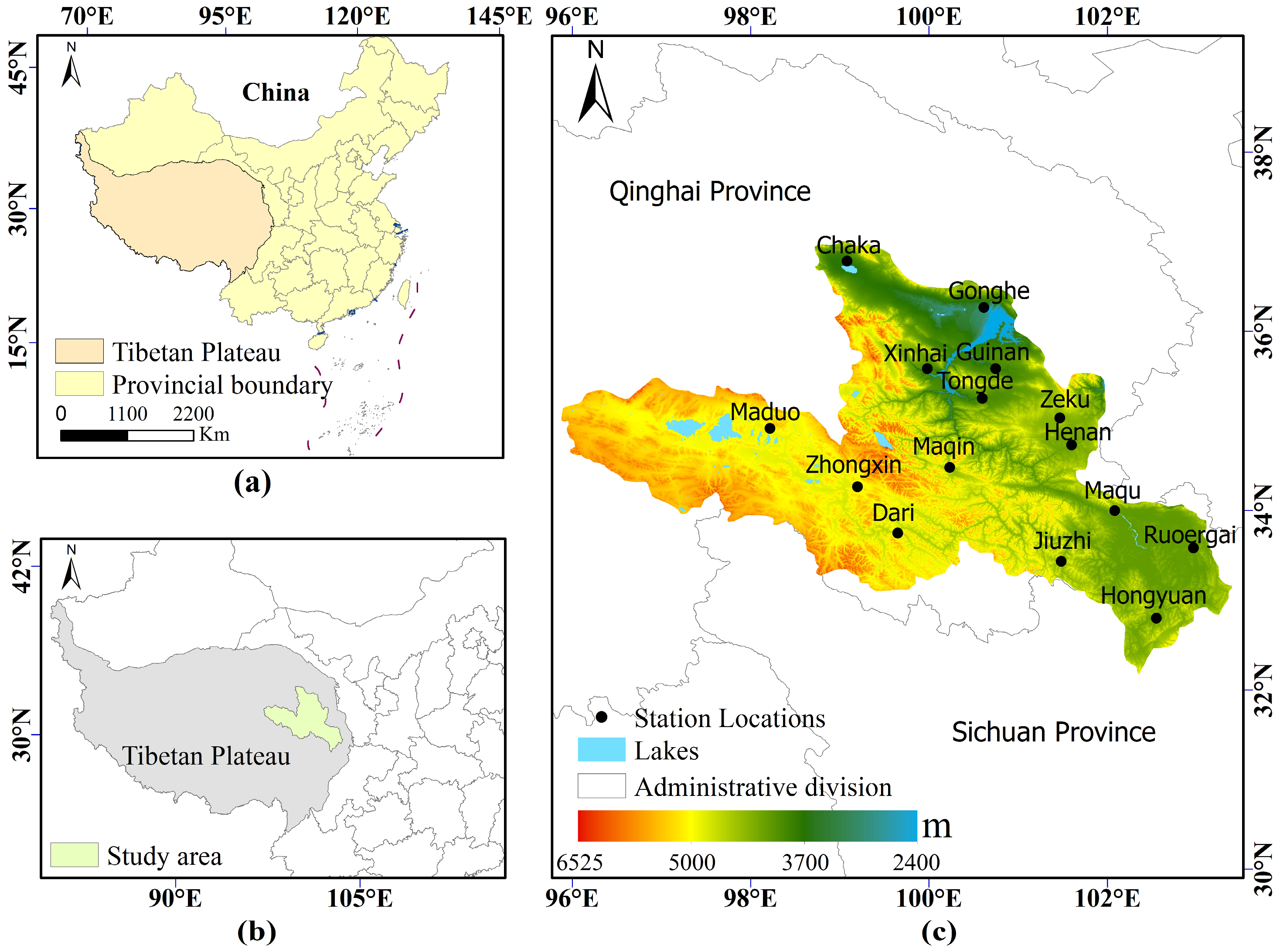
The meteorological data used in this study were obtained from the National Tibetan Plateau Data Center (http://data.tpdc.ac.cn, accessed on 15 June 2024). Due to the temporal limitation of publicly available records (up to 2014), observations after 2015 were not incorporated. As shown in Figure 1, based on the principles of data completeness and spatial representativeness, continuous observation series from 15 meteorological stations in the source region of the Yellow River were selected for the period 1981–2014, spanning a total of 34 years.
The climate projection data employed in this study were derived from the CNRM-CM6-1, a high-resolution Earth system model jointly developed by the National Centre for Meteorological Research and the Centre Européen de Recherche et de Formation Avancée en Calcul Scientifique. Within the framework of the sixth phase of the Coupled Model Intercomparison Project (CMIP6), this model implemented comprehensive simulations under the ScenarioMIP experiment, encompassing four Shared Socioeconomic Pathways—SSP1-2.6 (low-carbon transition), SSP2-4.5 (baseline development), SSP3-7.0 (regional rivalry), and SSP5-8.5 (fossil-fueled development). SSP1-2.6 assumes a swift global transition to a low-carbon economy, driven by the adoption of sustainable technologies, a substantial reduction in greenhouse gas emissions, and enhanced international cooperation. By 2100, radiative forcing is projected to reach 2.6 W·m−2. SSP2-4.5 envisions societal, economic, and technological development along current trajectories, with moderate mitigation efforts and greenhouse gas emissions remaining at intermediate levels, resulting in a radiative forcing of 4.5 W·m−2 by 2100. SSP3-7.0 foresees a fragmented global society, intensifying regional competition, limited climate policy cooperation, and elevated greenhouse gas emissions, leading to a radiative forcing of 7.0 W·m−2. SSP5-8.5 assumes a global economy heavily dependent on fossil fuels, with significant greenhouse gas emissions and delayed mitigation actions, resulting in a radiative forcing of 8.7 W·m−2 by 2100 [35].

2.2.2. Soil and DEM Data

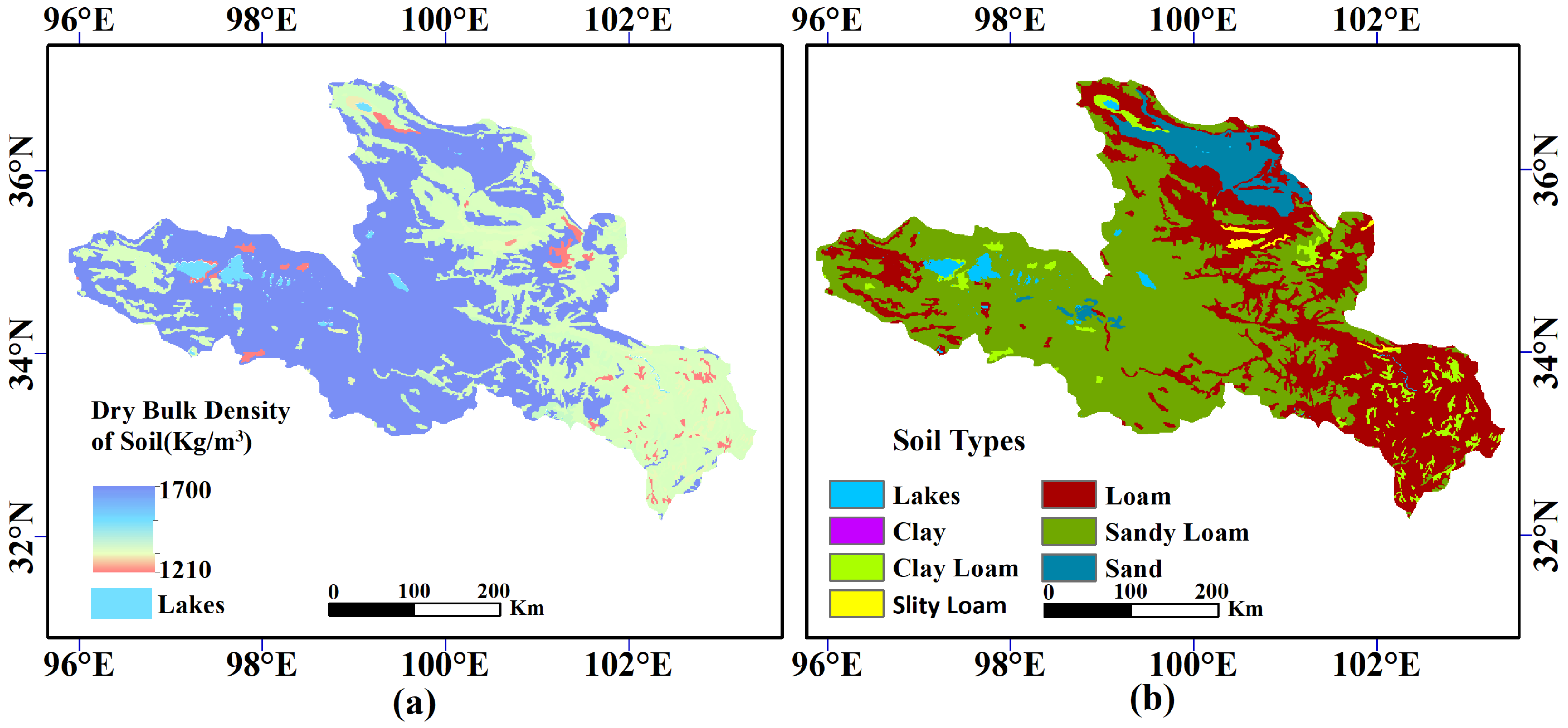
The soil-type data were obtained from the World Soil Database hosted by the Heihe Plan Data Management Center. For mainland China, the dataset is based on the 1:1,000,000-scale soil map compiled by the Nanjing Institute of Soil Science for the Second National Land Survey. Using field observations from the Yellow River source region together with the Engineering Classification Standard for Soil (GB/T 50145–2007) [36], soils in the study area were reclassified, yielding a map of the spatial distribution of soil dry bulk density, as shown in Figure 2.
The digital elevation model (DEM) was obtained from the National Tibetan Plateau Data Center, based on the Shuttle Radar Topography Mission data provided by the Global Land Cover Network. The original dataset is gridded by latitude and longitude in the WGS84 coordinate system, with a spatial resolution of 3″. After mosaicking, missing values generated during the process were interpolated and filled. The dataset was then projected using the Albers equal-area conic projection, resulting in a spatial resolution of 90 m. The DEM was clipped to the boundary of the Yellow River source region to derive the regional elevation dataset.

2.3. Methods

2.3.1. Freezing Index Calculation

The freezing index is defined as the cumulative sum of daily mean air or ground temperatures below 0 °C during the freezing season. Following Frauenfeld et al. (2006) [37], the freezing season is defined as extending from 1 July to 30 June of the subsequent year, thereby maximizing the inclusion of subzero temperatures within a single cold period and ensuring that negative temperatures are consistently accumulated across the entire season, given as Equation (1).
F I = i = 1 365 | T i | I ( T i < 0 )
where FI (Freezing indices) denotes the freezing index (°C·d), calculated as the absolute value of the cumulative sum of daily mean temperatures below 0 °C during the freezing season; Ti is the daily mean temperature on day i; and I(·) is the indicator function, which equals 1 when the condition is satisfied and 0 otherwise.

2.3.2. Stefan Equation

In this study, soil freezing depth was estimated using the Stefan equation, given as Equation (2).
S F D = C f F I g
where SFD is the soil freezing depth (m); FI is the freezing index (°C·d); and Cf is a comprehensive parameter that reflects the combined influence of soil thermal properties, bulk density, and moisture conditions on the freezing process, with its expression given in Equation (3).
C f = 2 λ f L γ c k ( w f w u )
where λf is the thermal conductivity of frozen soil (W·m−1·°C−1); L is the latent heat of fusion for ice, with a value of 3.3 × 10⁵ (J·kg−1); γck is the dry bulk density of the soil (kg·m−3); Wf is the total water content in frozen soil during freezing; and Wu is the unfrozen water content in frozen soil.
As shown in Figure 2, the soil types of the Yellow River source region were derived from the 1:1,000,000 soil dataset provided by the Nanjing Institute of Soil Science under the Second National Land Survey. Soil moisture content was determined based on soil types and partial field measurements from the study area. The thermal parameters of each soil category were specified according to the Code for Investigation of Frozen Soil Engineering Geology (GB 50324–2014) [38]. The mean unfrozen water content was estimated to be 5%, as summarized in Table 1.

2.3.3. The Mann–Kendall Trend Test

The Mann–Kendall trend test is a commonly used nonparametric method for evaluating temporal trends in hydrometeorological datasets. It does not require distributional assumptions and is robust to a limited number of outliers; consequently, it has been widely applied in hydrology and meteorology [39,40]. In this study, trend significance is assessed at conventional confidence levels: for a two-sided test, a trend is considered statistically significant at the 95% level when the absolute value of the Z statistic exceeds 1.96.
In the Mann–Kendall trend test, UB (Upper Bound) and UF (Lower Bound) represent the upper and lower limits, respectively, used to quantify the uncertainty of the estimated trend. UB indicates the upper limit of the estimated rate of change, representing the maximum possible value, and reflects the highest confidence in the trend’s rate of change. In contrast, UF represents the lower limit of the estimated rate of change, indicating the minimum possible value, and reflects the lowest confidence in the trend’s rate of change. Further computational details are provided in Shi et al. (2019) [40].

3. Results

3.1. Response of MFD to Ground Temperature

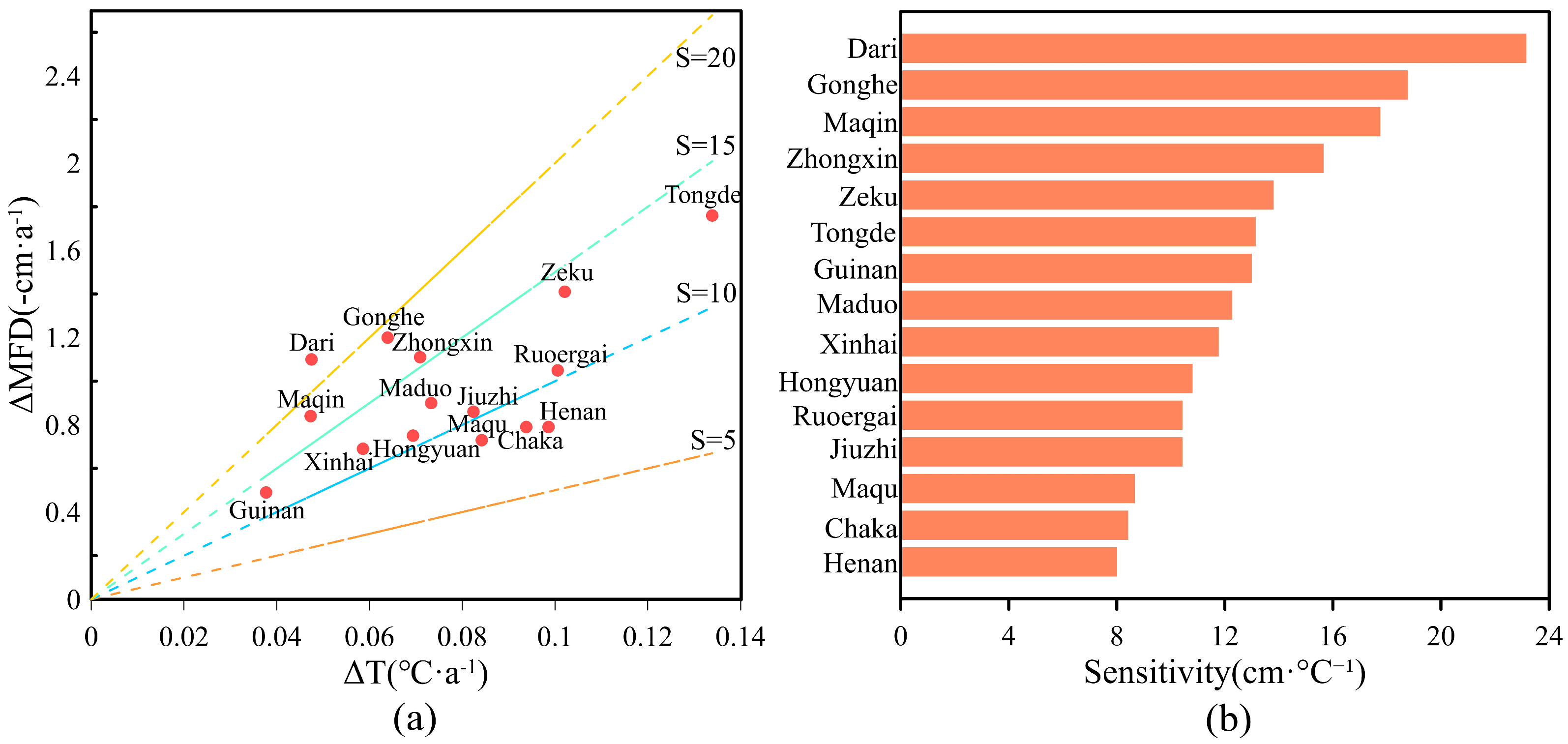
We used mean annual ground temperature (MAGT) as a key indicator to elucidate the response of the maximum freezing depth (MFD) of seasonally frozen ground in the Yellow River source region to climate change. Using ArcGIS 10.7 statistical tools, we conducted spatial interpolation and trend analyses of MFD for 15 stations from 1981 to 2014, and we estimated station-specific MFD rates of change over the 34-year record. Figure 3 shows the correlation and spatial heterogeneity between ΔT and ΔMFD across meteorological stations in the Yellow River source region for 1981–2014. To quantify the sensitivity of MFD to warming, we define a coefficient termed Sensitivity, denoted as S, with units cm·°C−1, which represents the decrease in maximum freezing depth per 1 °C increase in temperature. Figure 3a shows the ranking of station-level S values. The highest sensitivity occurs at Dari, at least 20 cm·°C−1, followed by Gonghe and Maqin and Zhongxin, about 15–18 cm·°C−1. Stations with moderate sensitivity, including Zeku, Tongde, and Guinan, mostly fall within 10–14 cm·°C−1, whereas lower sensitivities of 7–9 cm·°C−1 occur at Henan, Chaka, Maqu, and additional sites. Figure 3b shows the station-wise scatter of ΔT against ΔMFD, with reference lines for S overlaid to provide a consistent evaluation baseline. The points align along a positive slope, indicating a coupled relationship in which larger ΔT corresponds to a more rapid reduction in MFD. Most stations, including Xinghai, Hongyuan, Maduo, Maqu, Jiuzhi, Henan, Ruoergai, and Guinan, cluster around S equal to 10–15 cm·°C−1, whereas a smaller subset, including Zhongxin, Maqin, Gonghe, and especially Dari, exceeds S equal to 15; Dari reaches at least 20 cm·°C−1 and shows the strongest sensitivity to warming. Overall, the region shows a long-term tendency of warming accompanied by shallower MFD, with pronounced spatial variability in S across stations.
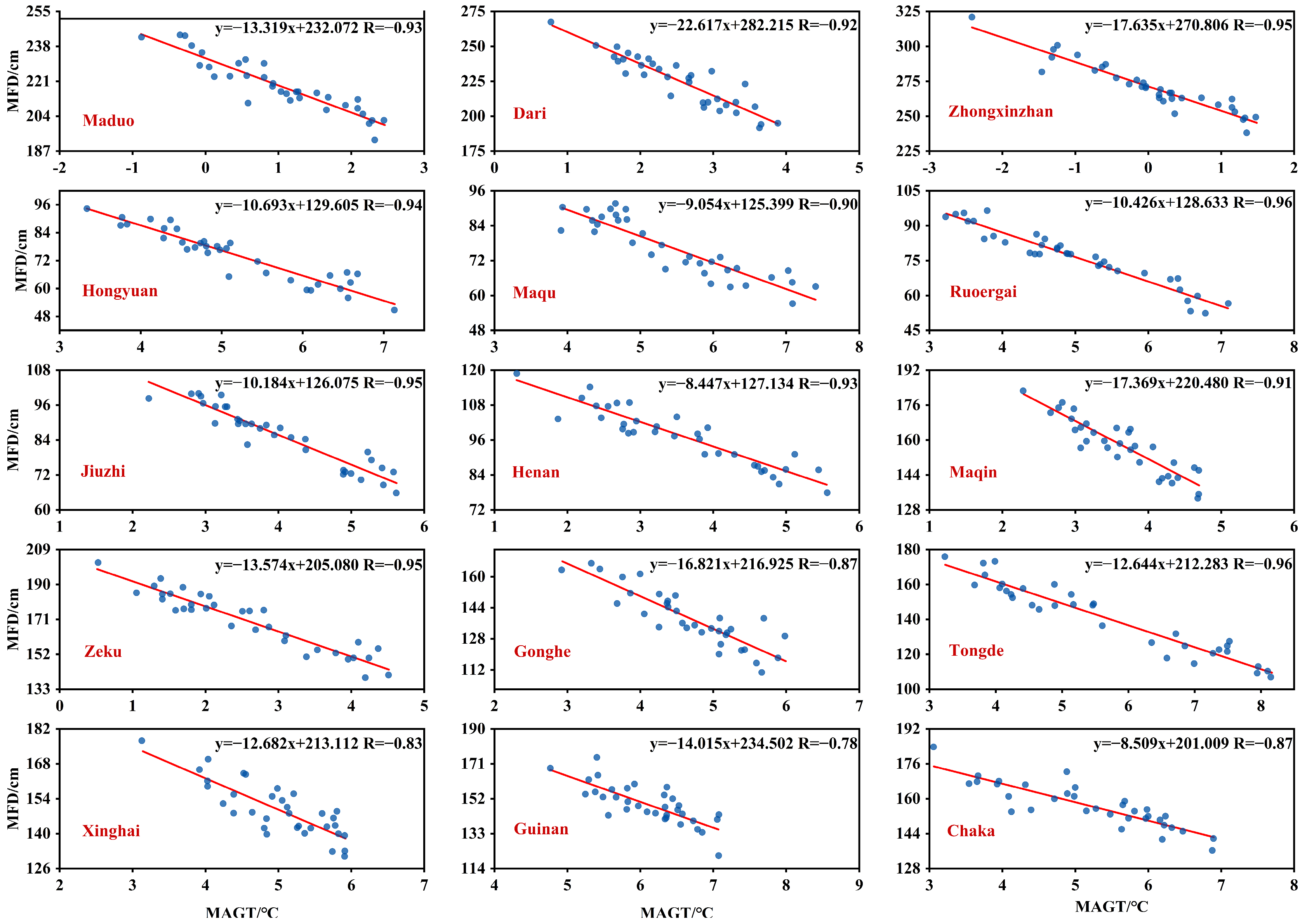
Figure 4 shows linear regressions between MFD and MAGT for 15 stations in the Yellow River source region from 1981 to 2014. All stations exhibit negative regression slopes, and the relationship between MFD and MAGT is significantly negative at the 0.01 level; the correlation coefficient R ranges from −0.78 to −0.96. Over this period, a 1 °C increase in MAGT corresponds to an 8 to 22 cm reduction in MFD. High-elevation stations above 3800 m include Maduo, Dari, and Zhongxin, and they generally show greater freezing depths. Mid-elevation stations between 3400 and 3800 m include Hongyuan, Maqu, Ruoergai, Jiuzhi, Henan, Maqin, and Zeku and they are markedly shallower. Several low-elevation stations below 3400 m, including Gonghe, Tong-de, Xinghai, Guinan, and Chaka, exhibit freezing depths that exceed those observed at mid elevations
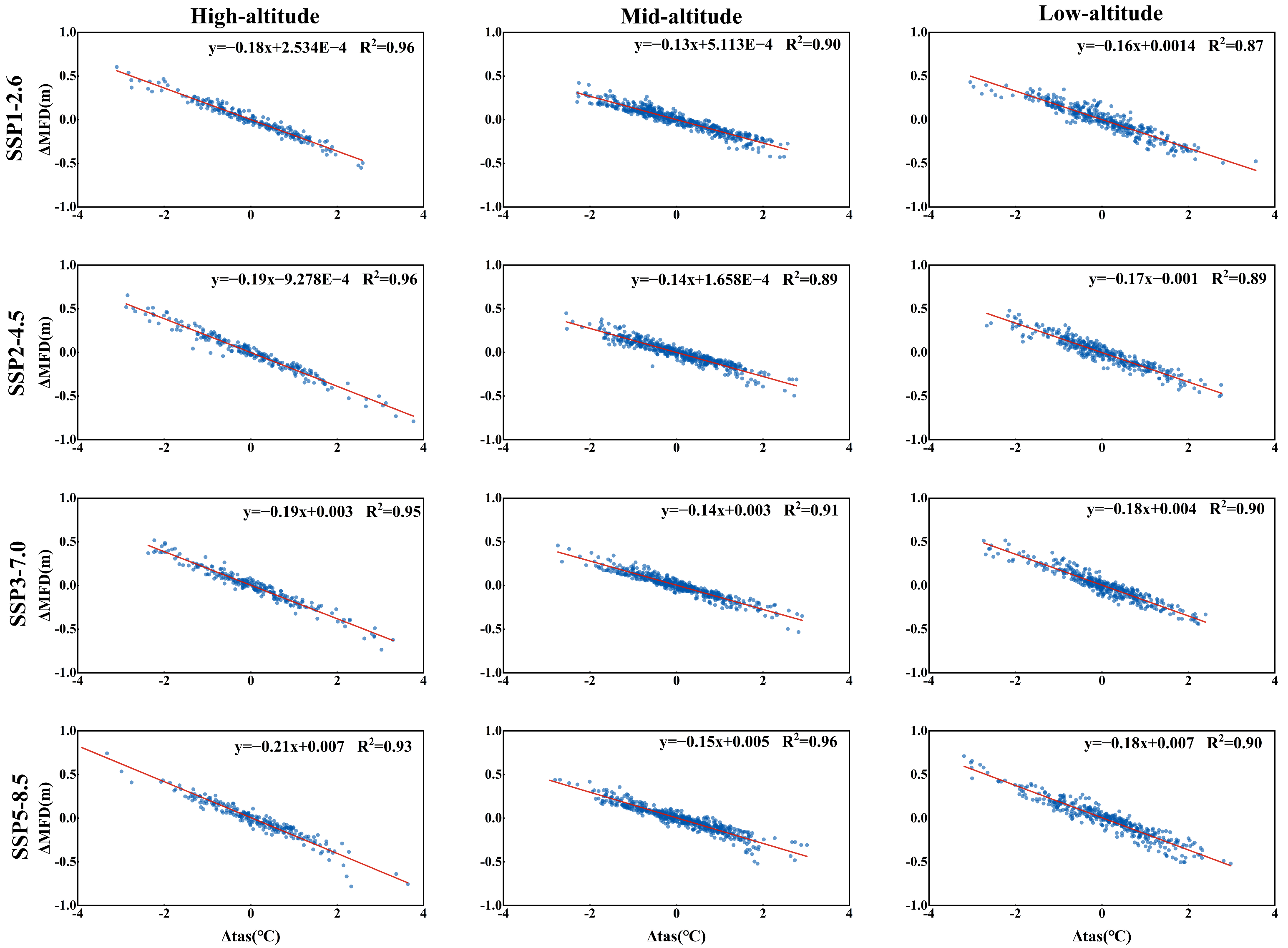
Figure 5 shows how MFD responds to near-surface (2 m) air temperature (tas) across elevation bands in the Yellow River source region under four SSP scenarios: SSP1-2.6, SSP2-4.5, SSP3-7.0, and SSP5-8.5. Under future warming, MFD remains strongly and negatively related to tas, and the coefficient of determination R2 generally exceeds 0.87, indicating that freezing depth decreases as temperature rises, consistent with the historical pattern. Relative to 1981–2014, future regression slopes are generally steeper. Across scenarios, the sensitivity of MFD to warming is greatest under SSP5-8.5, exceeding that in the lower-emission pathways. Relative to the historical period shown in Figure 4, the MFD decreases by 13–18 cm per 1 °C increase in air temperature, exceeding the historical rate of 13.2 cm; the sensitivity is stronger under SSP5-8.5.
As shown in Table 2, the rate of change in Maximum Freezing Depth (MFD) is significantly higher at most low-elevation stations, with ΔMFD values reaching 1.41 cm·year−1 at Chaka station and 1.2 cm·year−1 at Guinan station. This trend is primarily driven by the interaction between the region’s intrinsic characteristics and its climatic response mechanisms. Low-elevation stations are mainly situated in arid basins or regions with hilly terrain, where elevation fluctuations and wind erosion are prominent, resulting in uneven snow distribution and thin, unstable snow cover [41,42]. The soils in these areas are predominantly Sandy Loam and Loam, which, despite their good moisture drainage capacity, suffer a significant loss of thermal insulation due to the combined effects of aridity and wind erosion, leading to substantial fluctuations in soil temperature. Moreover, sparse vegetation further weakens the soil’s insulating properties [43,44]. Consequently, snow cover in low-elevation regions remains thin and unstable, exacerbated by intense surface heat exchange, causing MFD to exhibit considerable variability. This effect is especially pronounced during winter when temperature fluctuations are more extreme, accelerating soil temperature variations and dynamic permafrost changes [45,46].
In contrast, MFD variation at middle-elevation stations is relatively stable, with a significantly lower rate of change. For instance, the ΔMFD at Maqu station is 0.73 cm·yr−1, and at Henan station, it is 0.79 cm·yr−1, values considerably lower than those observed at low-elevation stations. This pattern is closely tied to the ecological environment and geomorphological features of the middle-elevation region, which is characterized by wetlands, lakes, and wetland meadows. In these areas, snow cover is more stable and persistent, providing a natural insulating layer for the soil [47,48]. Additionally, the high soil moisture content and deep organic layers in this region create an efficient thermal insulation barrier, significantly reducing surface heat loss [49,50]. Dense vegetation cover, particularly in wetland meadows, further enhances water retention, and its shielding effect increases soil heat capacity, thereby improving temperature regulation [31,51]. As a result, the unique thermal and hydrological properties of the wetland soils at middle elevations effectively mitigate the rapid degradation of permafrost, maintaining a relatively stable MFD despite temperature fluctuations. This observation aligns with previous research [48,50,51,52].
Table 2. Comprehensive Analysis of Environmental Factors and ΔMFD Across 15 Stations in the Yellow River Source Area [43,46,48,49].
Station NameElevation ClassificationTopographical FeaturesVegetation
Coverage
Soil TypeΔMFD (cm·yr−1)
MadoHighMountain plateau, valleys crisscrossedHigh: Huge biomass, dominated by KobresiaClay Loam0.9
DariHighMountain hills and basinsMedium–High: Predominantly meadow grasslandsLoam1.1
Central StationHighPlateau and hill boundary terrainLow: Desertified grassland coverSand0.75
Ruoer GaiMediumWetlands, lake landformsVery High: Wetland meadows coverageLoam1.05
HongyuanMediumMountain hills, large elevation changesHigh: Meadow grasslandsLoam0.86
JiuzhiMediumWetlands, river valleysMedium–High: Well-covered meadowsLoam0.79
ZekuMediumMountain hills and river valleys intersectMedium: Wetland grassland coverLoam0.79
MaquMediumWetlands, lakes, flat and openHigh: Wetland meadows, high coverageLoam0.73
MaqinMediumPlateau hills, deep ravinesLow: Desertified meadowsLoam0.84
HenanMediumFront plain and hilly boundaryMedium: Grassland coverage, sparse vegetationLoam0.79
GongheLowBasin and hilly terrainLow: Sparse grassland coverSandy Loam0.49
GuinanLowMountain hills and basinsLow: Degraded grasslandsLoam1.2
TongdeLowBasin and hill boundary areaLow: Grasslands and desertified meadowsLoam1.11
ChakaLowBasin center, salt lake landformsNone: Salinized land, no vegetation coverClay Loam1.41
XinghaiLowMountain hills and basins, relatively flatLow: Desertified grasslands, sparse vegetationLoam1.2

3.2. Spatial Patterns of MFD in Historical and Future Periods

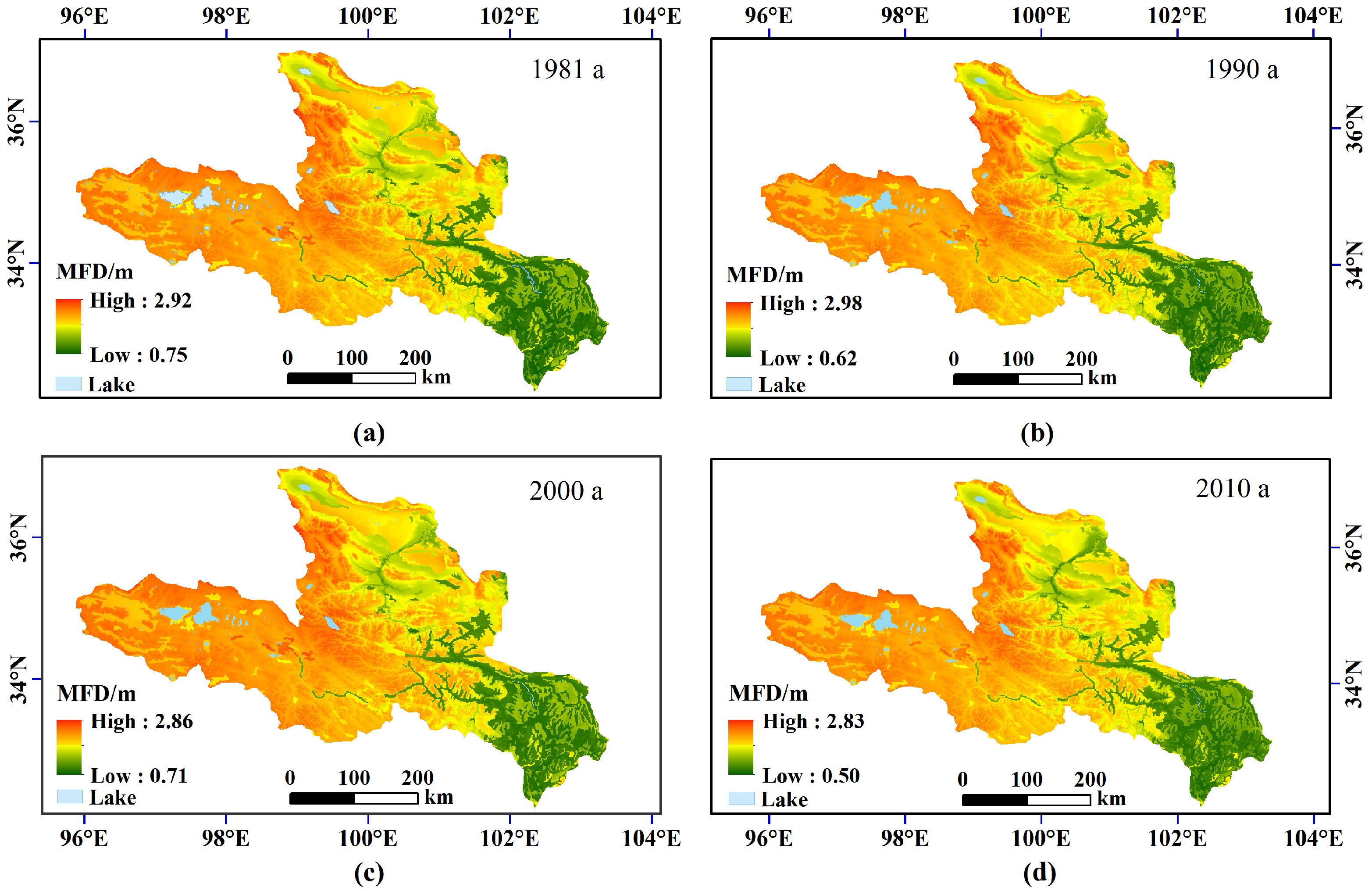
To quantify MFD in seasonally frozen ground, we constructed a 90 m resolution raster dataset on the ArcGIS platform that includes soil thermal conductivity, the freezing index, and related parameters, and we computed MFD using the Stefan equation. Figure 6 shows the spatial distribution of MFD for 1981 to 2014 across the seasonally frozen ground of the Tibetan Plateau, with a mean of 1.46 m and a standard deviation of 0.23 m. Minimum values occur in the Ruoergai wetland and along northeastern valley corridors, whereas maxima appear within the transition zone near the permafrost boundary. The spatial pattern is characterized by greater freezing depths in the northwest and shallower depths in the southeast. When compared with observations from nine meteorological stations with permafrost records for 1997 to 2014, errors remain within ±20% at all sites except Hongyuan, where the relative bias is 25.3% and exceeds this threshold, as reported in Table 3.
Figure 6 shows the spatiotemporal variability of maximum freezing depth, MFD, for 1981–2010, showing pronounced spatial heterogeneity and temporal dynamics across the source region of the Yellow River. The spatial pattern exhibits a clear gradient, with deeper freezing in the north and shallower conditions in the south. Declines differ markedly among subregions: low-value zones decline from 0.75 m to 0.50 m, representing a maximum reduction of 33.3 percent, whereas high-value zones decline from 2.92 m to 2.83 m, a reduction of only 3.1 percent. Overall, MFD has progressively shallowed, with the shallowing more pronounced where initial depths were smaller. Spatially, the region exhibits a northwest-deep–southeast-shallow gradient, with especially shallow values in southeastern sectors characterized by higher vegetation cover. Such heterogeneous responses are closely linked to regional warming, to differences in snowfall and snowpack insulation, to soil-moisture and organic-matter content, and to contrasts in the surface energy budget driven by elevation and aspect. The effect is strongest in low-elevation valleys and plains, where intermittent snow cover, enhanced surface heat loss, and active variations in near-surface soil moisture make MFD more sensitive to rising air temperature, resulting in comparatively larger reductions.
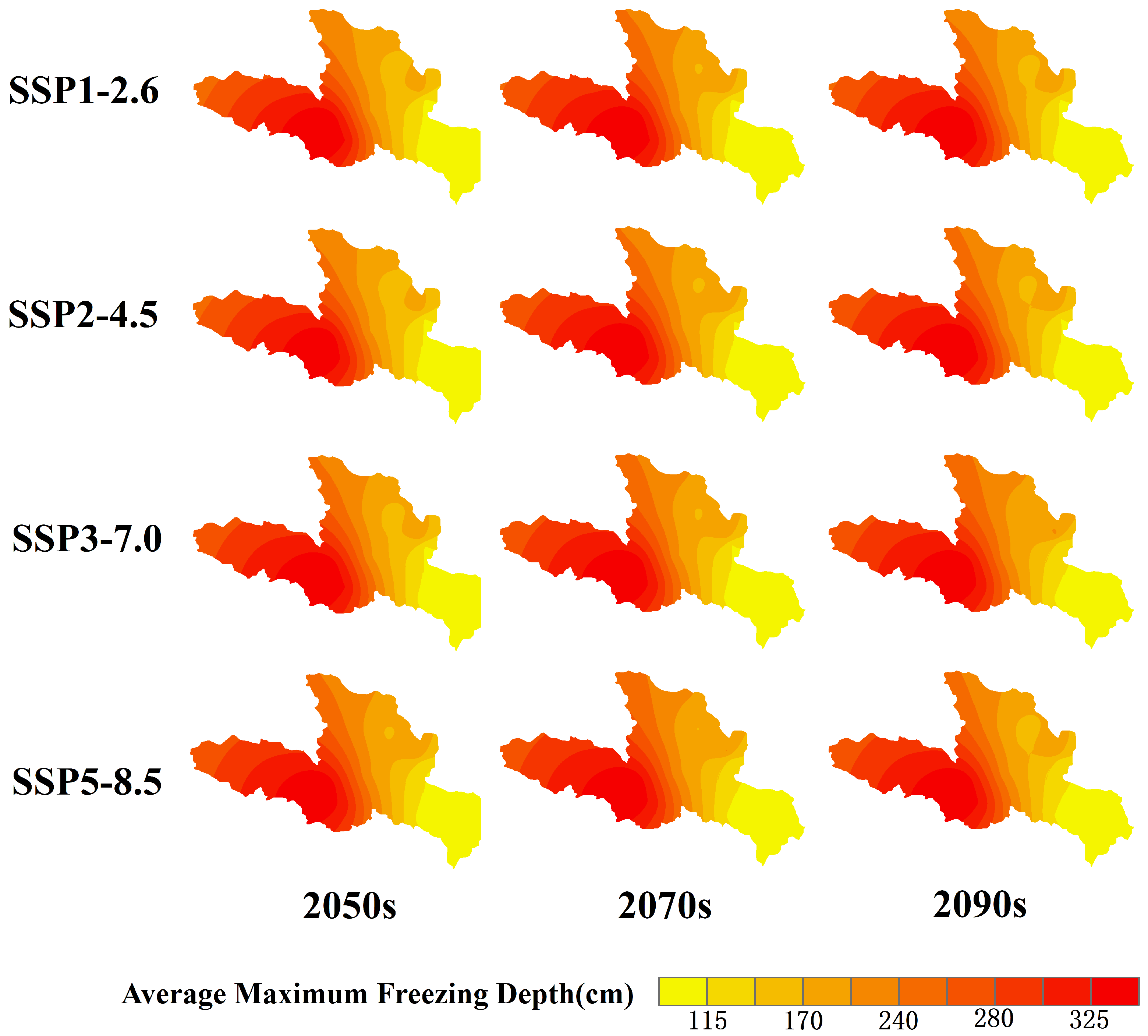
Within a forward-looking climate scenario framework, we applied spatial interpolation to generate grid-based simulations for the 2050s, 2070s, and 2090s across the source region of the Yellow River, followed by comparative analyses to elucidate spatiotemporal trajectories and differential climate responses. Figure 7 indicates a region wide decline in MFD under all SSP scenarios, with values highest in the 2050s, lower in the 2070s, and lowest in the 2090s, and with the steepest contraction under SSP5-8.5. Under SSP1-2.6, MFD remains comparatively stable through the 2090s and retains relatively high levels, which implies a measure of freezing stability. Under SSP2-4.5 and SSP3-7.0, pronounced losses emerge in several locales, and by the 2090s the areal extent of lighter shaded areas expands as the frozen layer continues to thin. Under SSP5-8.5, the central sector exhibits decreases that are intermediate between the southeast and the northwest, indicating a moderate level of climate forcing in that belt. Spatially, the southeastern sector is most sensitive to warming; by the 2090s, under SSP5–8.5, it appears almost entirely in light-yellow tones on the maps, indicating a marked reduction in MFD. In the northern high-elevation region, MFD also decreases but remains comparatively large, with a slower rate of decline that reflects lag and buffering effects. Meanwhile, the deep-freezing zones previously highlighted in red continue to contract, indicating further retreat of the permafrost boundary. This phenomenon represents the contraction of permafrost extent in the context of climate warming. As temperatures rise, the permafrost surface gradually becomes shallower, potentially transitioning into seasonal frozen soil. The core mechanism involves the descent of the permafrost surface, rather than an increase in its temperature. Essentially, the thickening of the thawed layer drives the gradual retreat of permafrost distribution.

3.3. Temporal Evolution of MFD in Historical and Future Periods

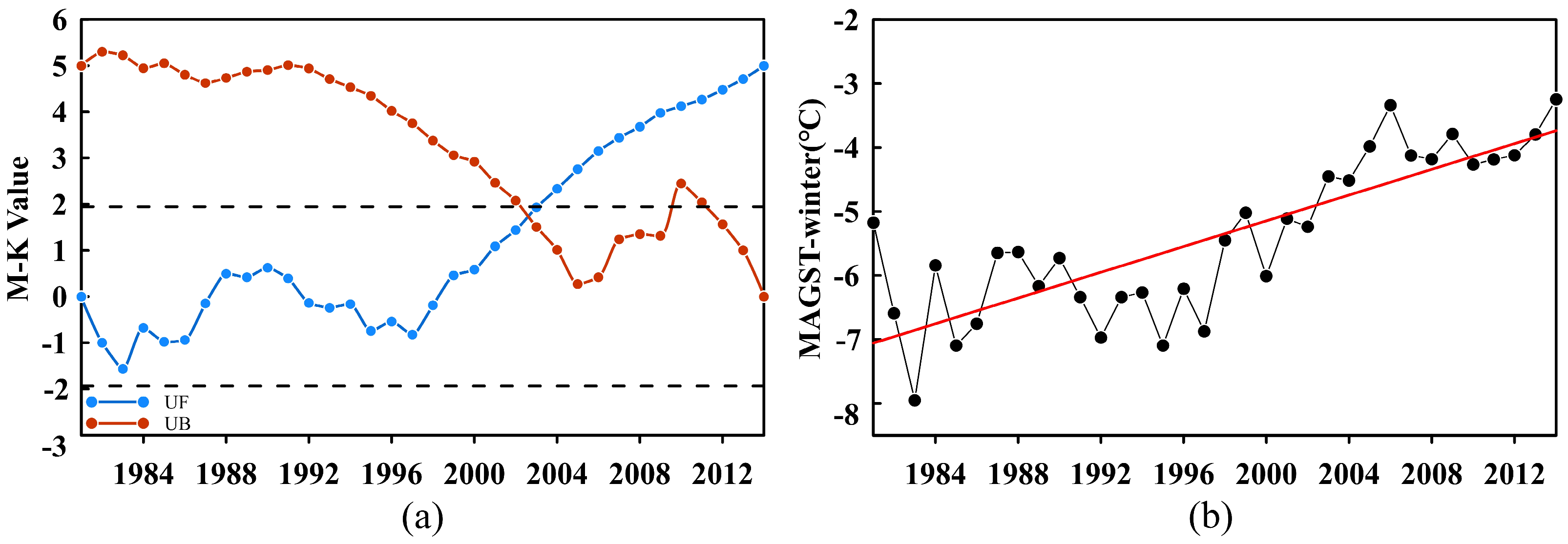
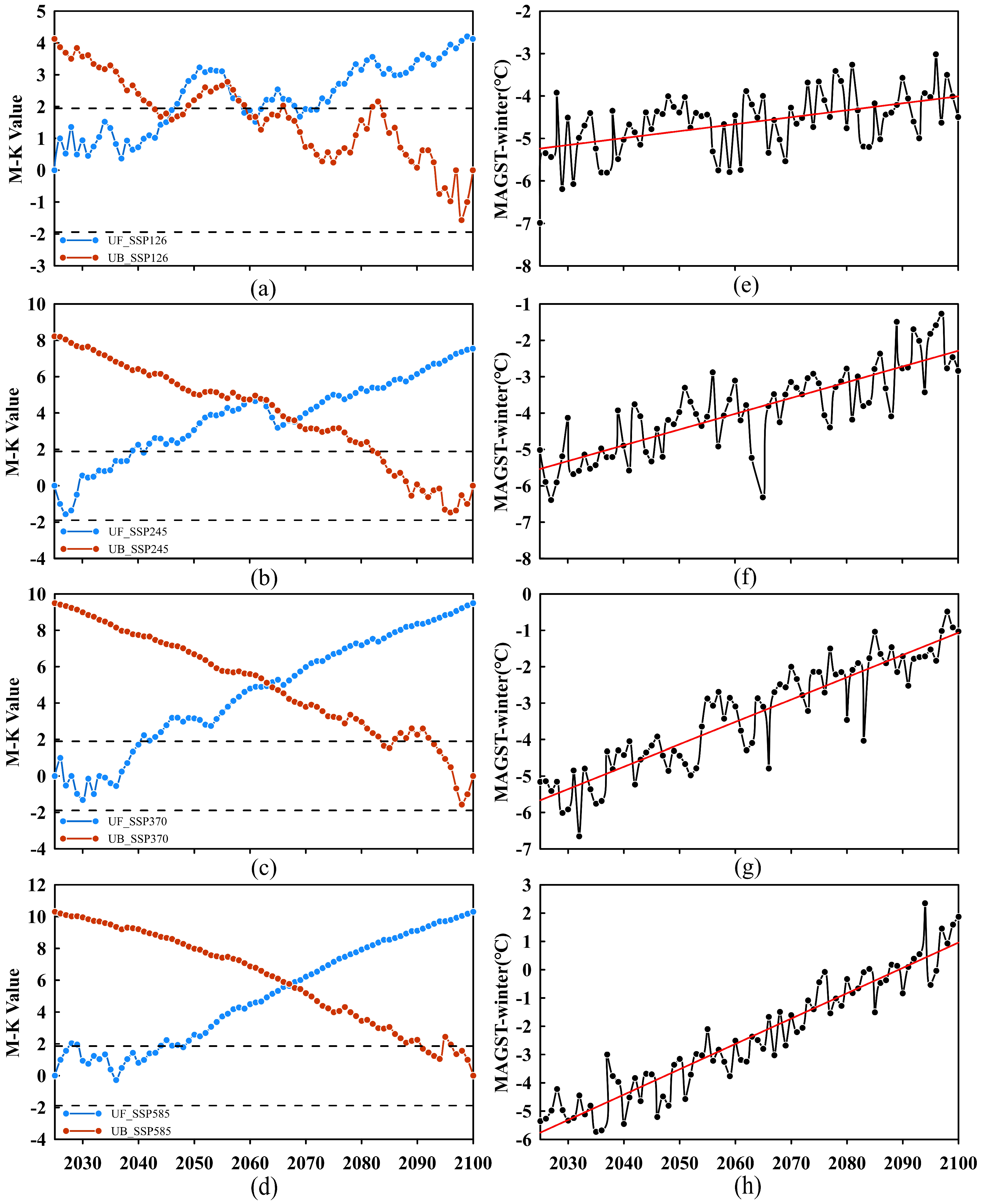
To characterize the historical evolution and future trajectory of the temperature regime in the source region of the Yellow River, we adopt the freezing-season mean ground temperature, abbreviated as MAGST-winter, as the diagnostic indicator. The freezing season is defined as 1 July of a given year through 30 June of the next year. For the historical period, MAGST-winter is computed from in situ ground-temperature observations at meteorological stations for 1981–2014. For the future period, MAGST-winter is derived from CMIP6 projections of 2 m near-surface air temperature for 2024–2100, using the same freezing-season definition, thereby characterizing the regional warming context. To quantify trends in these two time series and assess their statistical significance, we apply the Mann–Kendall test, abbreviated as MK; the corresponding results are presented in Figure 8 and Figure 9. The Mann–Kendall analysis of 0 cm ground temperature in Figure 8a shows UF shifting from negative to positive with sustained increases, UB declining toward it, and their intersection near 2003 beyond the ±1.96 threshold, which signals a statistically significant shift and the onset of intensified warming. The interannual series in Figure 8b together with the linear fit indicate robust warming, with a mean rise of 1.0 °C and an average rate close to 0.3 °C per decade. The minimum occurs in 1983 at −7.95 °C, and the maximum in 2014 at −3.25 °C. During 1981 to 1998, temperatures fluctuate yet remain below the 1981 baseline of −5.17 °C and the warming is muted. Around 1999, the series crosses the baseline for the first time and the subsequent warming strengthens.
Figure 9 shows the interannual evolution of MAGST-winter, across the source region of the Yellow River for 2024–2100. Relative to the historical baseline, warming intensifies under all scenarios, although both magnitude and rate differ across pathways. The Mann–Kendall diagnostics in Figure 10a–d corroborate these patterns. The Mann–Kendall diagnostics in panels a through d corroborate these patterns. All four scenarios yield statistically significant increases in tas, while the temporal evolution of UF departs from the historical shift. Under SSP1-2.6, UF oscillates through 2021 to 2050 without exceeding the 95% confidence interval, consistent with muted variability and a later change point than in the historical record. Under SSP5-8.5, UF rises above the confidence threshold near 2040 and remains there, implying a regime shift that occurs about forty years after the historical turning point, yet with a markedly shorter interval from the current baseline to the shift, indicative of accelerated warming. Figure 9e–h show persistent, near-monotonic warming across all emission pathways, although both the magnitude and rate differ markedly among scenarios. Under SSP1−1.26, temperature increases from −5.79 °C in 2024 to −4.50 °C in 2100, yielding a mean warming rate of 0.16 °C·decade−1, the slowest among the scenarios and comparatively subdued. Under SSP2-2.45, temperature increases from −5.02 °C to −2.84 °C at an average rate of approximately 0.43 °C·decade−1, which exceeds that in SSP1−1.26. Under SSP3-3.70, temperature warms from −5.16 °C to −1.03 °C at a mean rate of approximately 0.61 °C·decade−1, following a trajectory broadly comparable to that under SSP2-2.45. Under SSP5-8.5, temperature climbs from −5.35 °C in 2024 to 1.87 °C by 2100, with a mean rate of 0.91 °C·decade−1, the highest among scenarios and approximately three times the historical rate.
Mann–Kendall diagnostics and Sen’s slope estimates for the source region of the Yellow River under future scenarios are summarized in Figure 10 and Table 4. MFD declines significantly from the historical baseline through 2100, yet both amplitude and pace vary systematically by period and scenario. During the early 1980s, deviations from the baseline are modest, and the UF and UB series remain near zero, indicating no pronounced trend and aligning with the lack of concurrent warming in ground temperature. Sen’s slope estimates yield decline rates of 1.57 cm·yr−1 for 1981 to 1990, 1.45 cm per year for 1991 to 1999, and 1.20 cm per year for 2000 to 2014. Despite clear variability across periods, the net tendency is persistently negative, and the magnitude of decline is significantly and inversely related to the rate of ground temperature warming over the same intervals.
Across SSP1-2.6, SSP2-4.5, SSP3-7.0, and SSP5-8.5, MFD declines persistently, with the magnitude, rate, and statistical significance stratified by emissions intensity. Under SSP5-8.5, the decline is strongest. UF drops below the critical value of −1.96 around 2030 and remains negative thereafter, whereas UB exceeds +1.96 over the same interval, jointly indicating strong statistical support. Sen’s slope estimates indicate rates of −0.53 cm·yr−1 for 2024–2050 and −1.07 cm·yr−1 for 2051–2100, representing nearly a twofold increase in the later window and under-scoring accelerating, increasingly irreversible shallowing. By contrast, SSP1-2.6 exhibits the weakest declines. UF crosses the significance threshold later in time, UB shows only modest positive deviation, and Sen’s slope moderates from −0.72 to −0.27 cm·yr−1 between the early and later periods. These patterns indicate that stringent mitigation substantially delays the loss of freezing depth and is consistent with the minimal warming rate under this pathway.

4. Discussion

4.1. Comparison with Previous Studies

The results of this study show that the maximum freezing depth, abbreviated as MFD, in the source region of the Yellow River has a significant negative correlation with ground temperature; over the historical period, a 1 °C increase in ground temperature corresponded to an average decrease of approximately 13.2 cm in MFD. This finding indicates that the seasonal frozen layer in this region is highly sensitive to warming and is consistent with recent observational and modeling studies on seasonal frozen ground in the Yellow River source region and along the northeastern margin of the Tibetan Plateau [10,53]. Using station observations and numerical simulations, Ju et al. (2023) [10] reported that since the late twentieth century the regional MFD has progressively shallowed and is highly sensitive to interannual fluctuations in near-surface air temperature; the decline in MFD is pronounced under warming scenarios. Similarly, Wang et al. (2024) [53] analyzed the standard freezing depth of seasonally frozen ground across China and found an overall decreasing trend over recent decades, with greater reductions in warm and dry years and higher sensitivity in low-elevation zones and in areas with disturbed surface conditions. The quantitative sensitivity obtained here is slightly higher than most regional estimates, likely reflecting the study area’s position on the eastern flank of the Tibetan Plateau, where temperature increases are relatively greater and soil hydrothermal conditions are more susceptible to external perturbations. This conclusion is consistent with findings by Li et al. (2023) [18] and by Cao et al. (2021) [41], which reveal pronounced spatial heterogeneity in the source region’s frozen-ground responses, with faster degradation at lower elevations.
For future projections, this study evaluates four CMIP6 Shared Socioeconomic Pathways, abbreviated as SSPs, and shows that under a high-emissions scenario the maximum freezing depth, abbreviated as MFD, in the source region of the Yellow River may decline by as much as 42 percent by mid-century relative to the historical period, with degradation particularly pronounced at low elevations and within valley corridors. This projected trajectory is consistent with studies published in the past two years on permafrost–hydrology coupling in the source and upper reaches of the Yellow River [47,54,55]. Using historical-to-future integrated simulations, Chen et al. (2024) [47] reported that under high-emissions forcing, freezing depth in the source region becomes markedly shallower and that the impacts on the redistribution of surface energy and moisture are further amplified. Building on this evidence, Fang et al. (2025) [54] and Guo et al. (2025) [55] showed that continued permafrost thinning and active layer thickening trigger a suite of hydro-ecological responses, including earlier surface runoff timing, increased groundwater recharge accompanied by a weakened summer runoff peak, and a reduction in wetland area. These findings corroborate our conclusion that permafrost change will profoundly affect regional ecosystems and hydrological regimes. Moreover, a comprehensive review by Jin et al. (2022) [5] covering six decades of permafrost change in the source region indicates that degradation did not begin in the last ten years; rather, it was already underway by the late twentieth century and has become more conspicuous in recent years because of accelerated warming and intensified human activity. This pattern also helps explain the historical records cited here: freezing depths of 2.35 m in the 1980s and 2.23 m in the 1990s, a cumulative reduction of approximately 0.12 m, as well as the numerical differences from our simulated historical baseline, which arise from different time windows and from spatial non-uniformity associated with station siting and land-surface conditions.

4.2. Potential Implications and Limitations

This study uses a daily-scale Stefan-type model, jointly calibrated with in situ observations and scenario-driven datasets, to quantify the mechanistic linkage between maximum freezing depth, abbreviated as MFD, and climatic drivers. In the current implementation, part of the land–atmosphere heat coupling is implicitly absorbed into the effective forcings and parameter set, and the freezing N factor, denoted Nf, has not yet been parameterized explicitly. Because Nf converts the air freezing index to a surface freezing index, thereby capturing the modulation of the surface thermal regime by snow cover and vegetation, and because snow depth and snow-cover fraction in the Yellow River source region exhibit pronounced spatiotemporal heterogeneity, incorporating Nf is expected to enhance the robustness of cross-scenario extrapolations [10,18,53]. At the same time, we acknowledge that this study did not incorporate precipitation effects, which can significantly influence freezing dynamics, particularly the soil moisture prior to winter and the thickness of the snow cover. In future studies, we plan to consider the impact of precipitation on freezing depth, which will improve the robustness of the model and provide a more comprehensive view of the freezing dynamics. Model results further show that under continued warming a 1 °C increase in ground temperature corresponds to an average decrease of approximately 13.2 cm in MFD; under the SSP5-8.5 pathway, MFD declines by up to 42 percent. These shifts imply an earlier onset of spring thaw, a reorganization of intra-annual runoff timing and source contributions, and a systematic redistribution of groundwater recharge fluxes and soil-ice content. They also point to heightened vulnerability of alpine grasslands and wetlands, together with increased frost-heave–thaw-settlement risks for infrastructure, impacts that should be integrated into basin operations, ecological restoration, and engineering adaptation assessments [5,54]. Future work will integrate the impact of precipitation, estimating Nf stratified by elevation bands and surface types, and will conduct cross-calibration, incorporating Nf with snow depth, snow-water equivalent (SWE), and soil thermal properties. This coupled approach aims to improve the accuracy of MFD retrievals and to strengthen uncertainty quantification.
Comparative analysis with existing studies shows that the linkage among warming, MFD shallowing, and hydro-ecological responses, established using a daily-scale Stefan model, is highly consistent with observational and modeling evidence published in the past five years. Assessments for the upper Yellow River basin indicate a pronounced downward trend in the maximum freezing depth (MFD) of seasonally frozen ground and a lengthening of the freeze–thaw period [32]. Integrated station observations and modeling for the source region further demonstrate that MFD is highly sensitive to interannual fluctuations in air temperature [10]. Concurrently, remote sensing and surface deformation datasets reveal marked spatial heterogeneity in MFD change, with greater vulnerability at low elevations and within valley corridors [18,41]. Building on this foundation, the present study contributes in two principal ways: (i) it provides an operational, quantitatively constrained linear sensitivity of MFD to ground temperature based on the daily-scale Stefan framework; and (ii) it identifies degradation hotspots along elevation and landform belts—particularly low-elevation and valley zones—thereby offering actionable scientific guidance for optimizing monitoring networks and setting risk thresholds [10,18,32].

5. Conclusions

Drawing on ground observations from 1981 to 2014 together with CMIP6 multi-scenario simulations, this study provides a systematic assessment of the spatiotemporal evolution of MFD in the source region of the Yellow River and its response to climate change, thereby supplying quantitative evidence for ecological and water-resource management in the source region. The principal conclusions are as follows.
(1) MFD is strongly and inversely correlated with annual mean ground temperature. During the historical period, each one-degree Celsius increase in ground temperature corresponds to an average reduction of about 13.2 cm in MFD. This negative association persists under future scenarios, with low-elevation zones exhibiting greater sensitivity.
(2) At the regional scale, MFD displays a pronounced gradient from north to south. During the historical period, low-value zones decline from 0.75 m to 0.50 m for a maximum reduction of about 33.3%, whereas high-value zones decrease from 2.92 m to 2.83 m for about 3.1%. From the 2050s to the 2090s, MFD continues to shallow across scenarios, most markedly under SSP5-8.5 and relatively steadily under SSP1-2.6, with degradation most conspicuous at lower elevations.
(3) Trend diagnostics and rates indicate persistent shallowing with signs of acceleration. In the historical record, ground temperature undergoes an abrupt shift around 2003 and enters a phase of intensified warming. The Sen’s slope for MFD is approximately −1.57, −1.45, and −1.20 cm per year for 1981 to 1990, 1991 to 1999, and 2000 to 2014. Under SSP5-8.5, the UF series crosses −1.96 near 2030 and remains strongly negative thereafter, and the Sen’s slope steepens from about −0.53 cm per year in 2024 to 2050 to about −1.07 cm per year in 2051 to 2100, whereas low-emissions pathways cross the threshold later and with smaller amplitudes.

Author Contributions

X.B.: Writing—original draft, Methodology, Formal analysis, Data curation, Validation, Conceptualization, Visualization. W.W.: Writing—review and editing, Supervision, Validation, Resources, Funding acquisition, Conceptualization. All authors have read and agreed to the published version of the manuscript.

Funding

This research was supported by the Postdoctoral Fellowship Program of CPSF under Grant Number GZC20252062 and the Fundamental Research Funds for the Central Universities, CHD, Key Laboratory of Eco-hydrology and Water Security in Arid and Semi-arid Regions of Ministry of Water Resources, Chang’an University Open Fund Funding (Grant No.300102295504).

Institutional Review Board Statement

Not applicable.

Informed Consent Statement

Not applicable.

Data Availability Statement

The original data presented in the study are openly available in http://data.tpdc.ac.cn (accessed on 15 June 2024).

Conflicts of Interest

The authors declare no conflicts of interest.

References

  1. Alexandrov, G.A.; Ginzburg, V.A.; Insarov, G.E.; Romanovskaya, A.A. CMIP6 model projections leave no room for permafrost to persist in Western Siberia under the SSP5-8.5 scenario. Clim. Change 2021, 169, 42. [Google Scholar] [CrossRef]
  2. Piao, S.; Niu, B.; Zhu, J.; Zhang, X.; Wang, T.; Wang, S.; Liang, E. Responses and feedback of the Tibetan Plateau’s alpine ecosystem to climate change. Chin. Sci. Bull. 2019, 64, 2842–2855. [Google Scholar] [CrossRef]
  3. Chen, Y.; Huang, C.C.; Zhang, Y.; Zhou, Y.; Zha, X.; Wang, N.; Shang, R.; Rong, X.; Jia, Y.n.; Wang, H. Palaeoflood events during the last deglaciation in the Yellow River source area on the northeast Tibetan Plateau. Geol. J. 2021, 56, 4293–4309. [Google Scholar] [CrossRef]
  4. Di Luca, A.; Pitman, A.J.; de Elía, R. Decomposing Temperature Extremes Errors in CMIP5 and CMIP6 Models. Geophys. Res. Lett. 2020, 47, e2020GL088031. [Google Scholar] [CrossRef]
  5. Jin, X.-Y.; Jin, H.-J.; Iwahana, G.; Marchenko, S.S.; Luo, D.-L.; Li, X.-Y.; Liang, S.-H. Impacts of climate-induced permafrost degradation on vegetation: A review. Adv. Clim. Chang. Res. 2021, 12, 29–47. [Google Scholar] [CrossRef]
  6. Sharma, S.; Talchabhadel, R.; Nepal, S.; Ghimire, G.R.; Rakhal, B.; Panthi, J.; Adhikari, B.R.; Pradhanang, S.M.; Maskey, S.; Kumar, S. Increasing risk of cascading hazards in the central Himalayas. Nat. Hazards 2022, 119, 1117–1126. [Google Scholar] [CrossRef]
  7. Wang, S.; Song, Q.; Zhao, J.; Lu, Z.; Zhang, H. Identification of Key Areas and Early-Warning Points for Ecological Protection and Restoration in the Yellow River Source Area Based on Ecological Security Pattern. Land 2023, 12, 1643. [Google Scholar] [CrossRef]
  8. Yang, J.; Wang, T.; Yang, D.; Yang, Y. Insights into runoff changes in the source region of Yellow River under frozen ground degradation. J. Hydrol. 2023, 617, 128892. [Google Scholar] [CrossRef]
  9. Yang, Y.; Qin, T.; Yan, D.; Liu, S.; Feng, J.; Wang, Q.; Liu, H.; Gao, H. Analysis of the evolution of ecosystem service value and its driving factors in the Yellow River Source Area, China. Ecol. Indic. 2024, 158, 111344. [Google Scholar] [CrossRef]
  10. Ju, Q.; Shen, T.; Zhao, W.; Wang, X.; Jiang, P.; Wang, G.; Liu, Y.; Wang, Q.; Yu, Z. Simulation and prediction of changes in maximum freeze depth in the source region of the Yellow River under climate change. Sci. Total Environ. 2023, 905, 167136. [Google Scholar] [CrossRef]
  11. Li, H.; Pan, X.; Washakh, R.M.A.; Nie, X. A New Method of Diagnosing the Historical and Projected Changes in Permafrost on the Tibetan Plateau. Earth’s Future 2024, 12, e2023EF003897. [Google Scholar] [CrossRef]
  12. Burke, E.J.; Zhang, Y.; Krinner, G. Evaluating permafrost physics in the Coupled Model Intercomparison Project 6 (CMIP6) models and their sensitivity to climate change. Cryosphere 2020, 14, 3155–3174. [Google Scholar] [CrossRef]
  13. Eyring, V.; Bony, S.; Meehl, G.A.; Senior, C.A.; Stevens, B.; Stouffer, R.J.; Taylor, K.E. Overview of the Coupled Model Intercomparison Project Phase 6 (CMIP6) experimental design and organization. Geosci. Model Dev. 2016, 9, 1937–1958. [Google Scholar] [CrossRef]
  14. Koven, C.D.; Riley, W.J.; Subin, Z.M.; Tang, J.Y.; Torn, M.S.; Collins, W.D.; Bonan, G.B.; Lawrence, D.M.; Swenson, S.C. The effect of vertically resolved soil biogeochemistry and alternate soil C and N models on C dynamics of CLM4. Biogeosciences 2013, 10, 7109–7131. [Google Scholar] [CrossRef]
  15. Yi, Y.; Kimball, J.S.; Chen, R.H.; Moghaddam, M.; Miller, C.E. Sensitivity of active-layer freezing process to snow cover in Arctic Alaska. Cryosphere 2019, 13, 197–218. [Google Scholar] [CrossRef]
  16. You, Y.; Guo, L.; Yu, Q.; Wang, X.; Pan, X.; Wu, Q.; Wang, D.; Wang, G. Spatial variability and influential factors of active layer thickness and permafrost temperature change on the Qinghai-Tibet Plateau from 2012 to 2018. Agric. For. Meteorol. 2022, 318, 108913. [Google Scholar] [CrossRef]
  17. Zhang, G.; Nan, Z.; Yin, Z.; Zhao, L. Isolating the Contributions of Seasonal Climate Warming to Permafrost Thermal Responses Over the Qinghai-Tibet Plateau. J. Geophys. Res. Atmos. 2021, 126, e2021JD035218. [Google Scholar] [CrossRef]
  18. Li, C.; Zhao, L.; Wang, L.; Liu, S.; Zhou, H.; Li, Z.; Liu, G.; Du, E.; Zou, D.; Hou, Y. Ground Deformation and Permafrost Degradation in the Source Region of the Yellow River, in the Northeast of the Qinghai-Tibet Plateau. Remote Sens. 2023, 15, 3153. [Google Scholar] [CrossRef]
  19. Chang, T.; Yi, Y.; Jiang, H.; Li, R.; Lu, P.; Liu, L.; Wang, L.; Zhao, L.; Zwieback, S.; Zhao, J. Unraveling the non-linear relationship between seasonal deformation and permafrost active layer thickness. npj Clim. Atmos. Sci. 2024, 7, 308. [Google Scholar] [CrossRef]
  20. Langer, M.; Nitzbon, J.; Groenke, B.; Assmann, L.-M.; Schneider von Deimling, T.; Stuenzi, S.M.; Westermann, S. The evolution of Arctic permafrost over the last 3 centuries from ensemble simulations with the CryoGridLite permafrost model. Cryosphere 2024, 18, 363–385. [Google Scholar] [CrossRef]
  21. Peng, X.; Zhang, T.; Frauenfeld, O.W.; Mu, C.; Wang, K.; Wu, X.; Guo, D.; Luo, J.; Hjort, J.; Aalto, J.; et al. Active Layer Thickness and Permafrost Area Projections for the 21st Century. Earth’s Future 2023, 11, e2023EF003573. [Google Scholar] [CrossRef]
  22. Ohara, N.; Jones, B.M.; Parsekian, A.D.; Hinkel, K.M.; Yamatani, K.; Kanevskiy, M.; Rangel, R.C.; Breen, A.L.; Bergstedt, H. A new Stefan equation to characterize the evolution of thermokarst lake and talik geometry. Cryosphere 2022, 16, 1247–1264. [Google Scholar] [CrossRef]
  23. Park, S.-E.; Jung, Y.T.; Kim, H.-C. Monitoring permafrost changes in central Yakutia using optical and polarimetric SAR data. Remote Sens. Environ. 2022, 274, 112989. [Google Scholar] [CrossRef]
  24. Zhang, T.; Armstrong, R.L.; Smith, J. Investigation of the near-surface soil freeze-thaw cycle in the contiguous United States: Algorithm development and validation. J. Geophys. Res. Atmos. 2003, 108, GCP21. [Google Scholar] [CrossRef]
  25. Bennett, K.E.; Schwenk, J.; Bachand, C.; Gasarch, E.; Stachelek, J.; Bolton, W.R.; Rowland, J.C. Recent streamflow trends across permafrost basins of North America. Front. Water 2023, 5, 1099660. [Google Scholar] [CrossRef]
  26. Correia, T.P.; Francelino, M.R.; Veloso, G.V.; Michel, R.F.; Schaefer, C.E.; Fernandes Filho, E.I.; Justino, F.B.; Lyra, G.B. Ground temperature trend and active layer dynamics in the Fildes Peninsula, King George Island—Marine Antarctica. An. Da Acad. Bras. De Ciências 2024, 96, e20230743. [Google Scholar] [CrossRef]
  27. Jiang, J.; Zhou, T.; Cao, B. Surface Warming Constraint Projects Less Permafrost Thawing in High Mountain Asia. Geophys. Res. Lett. 2024, 51, e2024GL110465. [Google Scholar] [CrossRef]
  28. Nitzbon, J.; Schneider von Deimling, T.; Aliyeva, M.; Chadburn, S.E.; Grosse, G.; Laboor, S.; Lee, H.; Lohmann, G.; Steinert, N.J.; Stuenzi, S.M.; et al. No respite from permafrost-thaw impacts in the absence of a global tipping point. Nat. Clim. Chang. 2024, 14, 573–585. [Google Scholar] [CrossRef]
  29. Bao, Z.; Zhang, J.; Lian, Y.; Wang, G.; Jin, J.; Ning, Z.; Zhang, J.; Liu, Y.; Wang, X. Changes in Headwater Streamflow from Impacts of Climate Change in the Tibetan Plateau. Engineering 2024, 34, 133–142. [Google Scholar] [CrossRef]
  30. Brierley, G.J.; Han, M.; Li, X.; Li, Z.; Huang, H.Q. Geo-eco-hydrology of the Upper Yellow River. WIREs Water 2022, 9, e1587. [Google Scholar] [CrossRef]
  31. Zhang, M.; Li, R.; Pei, W.; Zhou, Y.; Li, G.; Yang, S. Permafrost Degradation Risk Evaluation in the Qinghai-Tibet Plateau Under Climate Change Based on Machine Learning Models. J. Geophys. Res. Atmos. 2024, 129, e2023JD039611. [Google Scholar] [CrossRef]
  32. Song, L.; Wang, L.; Luo, D.; Chen, D.; Zhou, J. Assessing hydrothermal changes in the upper Yellow River Basin amidst permafrost degradation. npj Clim. Atmos. Sci. 2024, 7, 57. [Google Scholar] [CrossRef]
  33. Zou, D.; Zhao, L.; Hu, G.; Du, E.; Liu, G.; Wang, C.; Li, W. Permafrost temperature baseline at 15 m depth on the Qinghai–Tibetan Plateau (2010–2019). Earth Syst. Sci. Data 2025, 17, 1731–1742. [Google Scholar] [CrossRef]
  34. Hu, Y.n.; Li, H.; Yu, D.; Feng, X.; Ba, W. Analysis of lake changes and their influence factors in the three river regions from 2000 to 2020 in the Sanjiangyuan Region, China. Heliyon 2024, 10, e35672. [Google Scholar] [CrossRef]
  35. Meinshausen, M.; Nicholls, Z.R.J.; Lewis, J.; Gidden, M.J.; Vogel, E.; Freund, M.; Beyerle, U.; Gessner, C.; Nauels, A.; Bauer, N.; et al. The shared socio-economic pathway (SSP) greenhouse gas concentrations and their extensions to 2500. Geosci. Model Dev. 2020, 13, 3571–3605. [Google Scholar] [CrossRef]
  36. GB/T 50145–2007Standard for Engineering Classification of Soil; Ministry of Construction of the People’s Republic of China and the General Admistration of Quality Supervision, Inspection and Quarantine of the People’s Republic of China: Beijing, China, 2007.
  37. Frauenfeld, O.W.; Zhang, T.; McCreight, J.L. Northern Hemisphere freezing/thawing index variations over the twentieth century. Int. J. Climatol. 2006, 27, 47–63. [Google Scholar] [CrossRef]
  38. GB 50324–2014; Code for Engineering Geological Investigation of Frozen Ground. China Planning Press: Beijing, China, 2014.
  39. Gocic, M.; Trajkovic, S. Analysis of changes in meteorological variables using Mann-Kendall and Sen’s slope estimator statistical tests in Serbia. Glob. Planet. Chang. 2013, 100, 172–182. [Google Scholar] [CrossRef]
  40. Shi, Y.; Niu, F.; Lin, Z.; Luo, J. Freezing/thawing index variations over the circum-Arctic from 1901 to 2015 and the permafrost extent. Sci. Total Environ. 2019, 660, 1294–1305. [Google Scholar] [CrossRef] [PubMed]
  41. Cao, H.; Gao, B.; Gong, T.; Wang, B. Analyzing Changes in Frozen Soil in the Source Region of the Yellow River Using the MODIS Land Surface Temperature Products. Remote Sens. 2021, 13, 180. [Google Scholar] [CrossRef]
  42. Gao, H.; Wang, J.; Yang, Y.; Pan, X.; Ding, Y.; Duan, Z. Permafrost Hydrology of the Qinghai-Tibet Plateau: A Review of Processes and Modeling. Front. Earth Sci. 2021, 8, 576838. [Google Scholar] [CrossRef]
  43. Shen, T.; Jiang, P.; Ju, Q.; Zhao, J.; Chen, X.; Lin, H.; Yang, B.; Tan, C.; Zhang, Y.; Fu, X.; et al. Permafrost on the Tibetan Plateau is degrading: Historical and projected trends. J. Hydrol. 2024, 628, 130501. [Google Scholar] [CrossRef]
  44. Zhao, J.; Zhao, L.; Sun, Z.; Hu, G.; Zou, D.; Xiao, M.; Liu, G.; Pang, Q.; Du, E.; Li, Z.; et al. The thermal state of permafrost under climate change on the Qinghai–Tibet Plateau (1980–2022): A case study of the West Kunlun. Cryosphere 2025, 19, 4211–4236. [Google Scholar] [CrossRef]
  45. Wei, R.; Hu, X.; Zhao, S. Changes in the Distribution of Thermokarst Lakes on the Qinghai-Tibet Plateau from 2015 to 2020. Remote Sens. 2025, 17, 1174. [Google Scholar] [CrossRef]
  46. Ziteng, F.; Qingbai, W.; Anping, C.; Luyang, W.; Guanli, J.; Siru, G.; Hanbo, Y.; Ji, C. Non-temperature environmental drivers modulate warming-induced 21st-century permafrost degradation on the Tibetan Plateau. Nat. Commun. 2025, 16, 7556. [Google Scholar] [CrossRef]
  47. Chen, X.-G.; Yu, Z.-B.; Lin, H.; Shen, T.-Q.; Jiang, P. Hydrological responses to permafrost degradation on Tibetan Plateau under changing climate. Water Sci. Eng. 2024, 17, 209–216. [Google Scholar] [CrossRef]
  48. Sun, Z.-Z.; Ma, W.; Wu, G.-L.; Liu, Y.-Z.; Li, G.-Y. Permafrost degradation along the Qinghai–Tibet Highway from 1995 to 2020. Adv. Clim. Chang. Res. 2023, 14, 248–254. [Google Scholar] [CrossRef]
  49. Wei, T.; Wang, J.; Xie, M.; Feng, P. Formation mechanism of climate warming-induced landslides in permafrost along the Qinghai-Tibet Engineering corridor. Front. Earth Sci. 2024, 12, 1503980. [Google Scholar] [CrossRef]
  50. Zhang, G.; Nan, Z.; Hu, N.; Yin, Z.; Zhao, L.; Cheng, G.; Mu, C. Qinghai-Tibet Plateau Permafrost at Risk in the Late 21st Century. Earth’s Future 2022, 10, e2022EF002652. [Google Scholar] [CrossRef]
  51. Li, T.; Liu, W.; Li, Q.; Liu, Y.; Liu, H.; Li, Q.; Luo, B.; Zhang, J.; He, R.; Yang, H. Large-scale Surface Subsidence Monitoring for Permafrost Degradation along the Qinghai-Tibet Highway Corridor Using SBAS-InSAR and Machine Learning. Res. Cold Arid Reg. 2025, in press. [Google Scholar] [CrossRef]
  52. Shen, T.; Yu, Z.; Zhang, D.; Ju, Q.; Chen, X.; Lin, H.; Nie, T.; Wang, Q.; Si, X.; Jiang, P. How will permafrost carbon respond to future climate change? A new assessment for future thaw trends of permafrost carbon on the Tibetan Plateau. Geoderma 2024, 446, 116898. [Google Scholar] [CrossRef]
  53. Wang, S.; Ning, Z.-J.; Ran, Y.-H.; Cao, W.; Peng, E.-X.; Peng, C.-Y.; Wu, J.-C.; Wang, B.-Q.; Sheng, Y. Changes in the standard freezing depth of seasonally frozen ground in China over the last 50 years. GIScience Remote Sens. 2024, 56, 2395090. [Google Scholar] [CrossRef]
  54. Fang, P.; Wang, T.; Yang, D.; Yang, J.; Tang, L. Permafrost degradation and concomitant hydrological changes dominated by anthropogenic greenhouse gas emissions in the Northeastern Tibetan Plateau. Geophys. Res. Lett. 2025, 52, e2024GL113679. [Google Scholar] [CrossRef]
  55. Guo, L.; Wang, G.; Song, C.; Sun, S.; Li, J.; Li, K.; Huang, P.; Ma, J. Hydrological changes caused by integrated warming, wetting, and greening in permafrost regions of the Qinghai–Tibetan Plateau. Water Resour. Res. 2025, 61, e2024WR038465. [Google Scholar] [CrossRef]
Figure 1. Location of the study area at (a) China, (b) the Tibetan Plateau, and (c) the source region of the Yellow River.
Atmosphere 16 01399 g001
Figure 2. Spatial distribution of soil dry-bulk density (a) and soil types (b) in the source region of the Yellow River.
Atmosphere 16 01399 g002
Figure 3. Sensitivity of maximum freezing depth, abbreviated as MFD, to warming at stations in the Yellow River headwaters, 1981–2014. (a) Scatterplot of the rates of change ΔT and ΔMFD; ΔT in °C·a−1 and ΔMFD in cm·a−1; dashed lines indicate reference sensitivities S = 5, 10, 15, and 20 cm·°C−1. (b) Station-wise ranking of sensitivity S; S in cm·°C−1. A positive ΔMFD indicates shallowing.
Atmosphere 16 01399 g003
Figure 4. Relationship between maximum freezing depth (MFD) and ground temperature (MAGT) in the source region of the Yellow River, 1981–2014.
Atmosphere 16 01399 g004
Figure 5. Relationship between MFD and tas in the source region of the Yellow River under four CMIP6 scenarios: SSP1-2.6, SSP2-4.5, SSP3-7.0, and SSP5-8.5.
Atmosphere 16 01399 g005
Figure 6. Spatial distribution of the seasonal maximum freezing depth in the source region of the Yellow River for (a) 1981, (b) 1990, (c) 2000, and (d) 2010.
Atmosphere 16 01399 g006
Figure 7. Spatial distribution of MFD in the source region of the Yellow River for the 2050s, 2070s, and 2090s under four CMIP6 SSP scenarios.
Atmosphere 16 01399 g007
Figure 8. (a) Mann–Kendall trend test for freezing-season mean ground temperature, abbreviated as MAGST-winter, in the source region of the Yellow River, 1981–2014; UB shown in red, UF in blue, with ±1.96 significance thresholds as dashed lines. (b) Interannual series of MAGST-winter and its linear fit.
Atmosphere 16 01399 g008
Figure 9. Temporal evolution of MAGST-winter in the source region of the Yellow River, 2025–2100. Left column (ad): Mann–Kendall UF and UB with ±1.96 thresholds. Right column (eh): interannual MAGST-winter with linear trends. Rows correspond to SSP1-2.6, SSP2-4.5, SSP3-7.0, and SSP5-8.5.
Atmosphere 16 01399 g009
Figure 10. Mann–Kendall trend analysis of MFD in the source region of the Yellow River for the historical period and future scenarios. Panel (a) shows 1981–2014; panels (be) correspond to SSP1-2.6, SSP2-4.5, SSP3-7.0, and SSP5-8.5. UB is shown in red, UF in blue; dashed lines de-note the ±1.96 significance thresholds.
Atmosphere 16 01399 g010
Table 1. Thermophysical parameters of different soil properties.
Soil Typeλck
/(kg·m−3)
λf
/(W·m−1·°C−1)
Wf
/(%)
Wu
/(%)
Clay12301.52355
ClayLoam13101.48315
SiltyLoam13501.57295
Loam14001.45265
SandyLoam16101.02155
Sand17002.20105
Table 3. Comparison between observed values and simulated values of freezing depth at some stations in seasonally frozen soil area.
StationMaduoDariXinhaiGuinanHenanJiuzhiMaquRuoergaiHongyuan
Longitude/E98.2299.6599.98100.75101.6101.48102.08102.97102.55
Latitude/N34.9233.7535.5835.5834.7333.4334.0033.5832.80
Elevation/m427239683323312035003629347134413492
Simulated value/m2.221.821.481.381.020.790.790.720.61
Measured value/m2.131.831.401.441.220.770.670.610.47
Table 4. Sen’s slope estimates for maximum freezing depth MFD.
PeriodTime SpanSen’s Slope (cm·yr−1)Station Median [IQR] (cm·yr−1)
Historical1981–1990−1.57−1.39 [−1.54, −0.87]
Historical1991–1999−1.45−1.57 [−2.14, −1.43]
Historical2000–2014−1.20−1.10 [−1.39, −0.87]
SSP1-2.62024–2050−0.72−0.73 [−0.88, −0.57]
2051–2100−0.20−0.27 [−0.34, −0.17]
SSP2-4.52024–2050−0.74−0.80 [−0.98, −0.62]
2051–2100−0.37−0.40 [−0.53, −0.29]
SSP3-7.02024–2050−0.52−0.64 [−0.79, −0.49]
2051–2100−0.47−0.52 [−0.66, −0.39]
SSP5-8.52024–2050−0.53−0.69 [−0.86, −0.53]
2051–2100−1.07−1.17 [−1.66, −0.70]
Disclaimer/Publisher’s Note: The statements, opinions and data contained in all publications are solely those of the individual author(s) and contributor(s) and not of MDPI and/or the editor(s). MDPI and/or the editor(s) disclaim responsibility for any injury to people or property resulting from any ideas, methods, instructions or products referred to in the content.