
Different Modes of Wave Response over the Past Four Decades: Coastal vs. Open-Ocean Regions


Abstract
1. Introduction
2. Data and Methods
2.1. IBTrACS Best Track Data
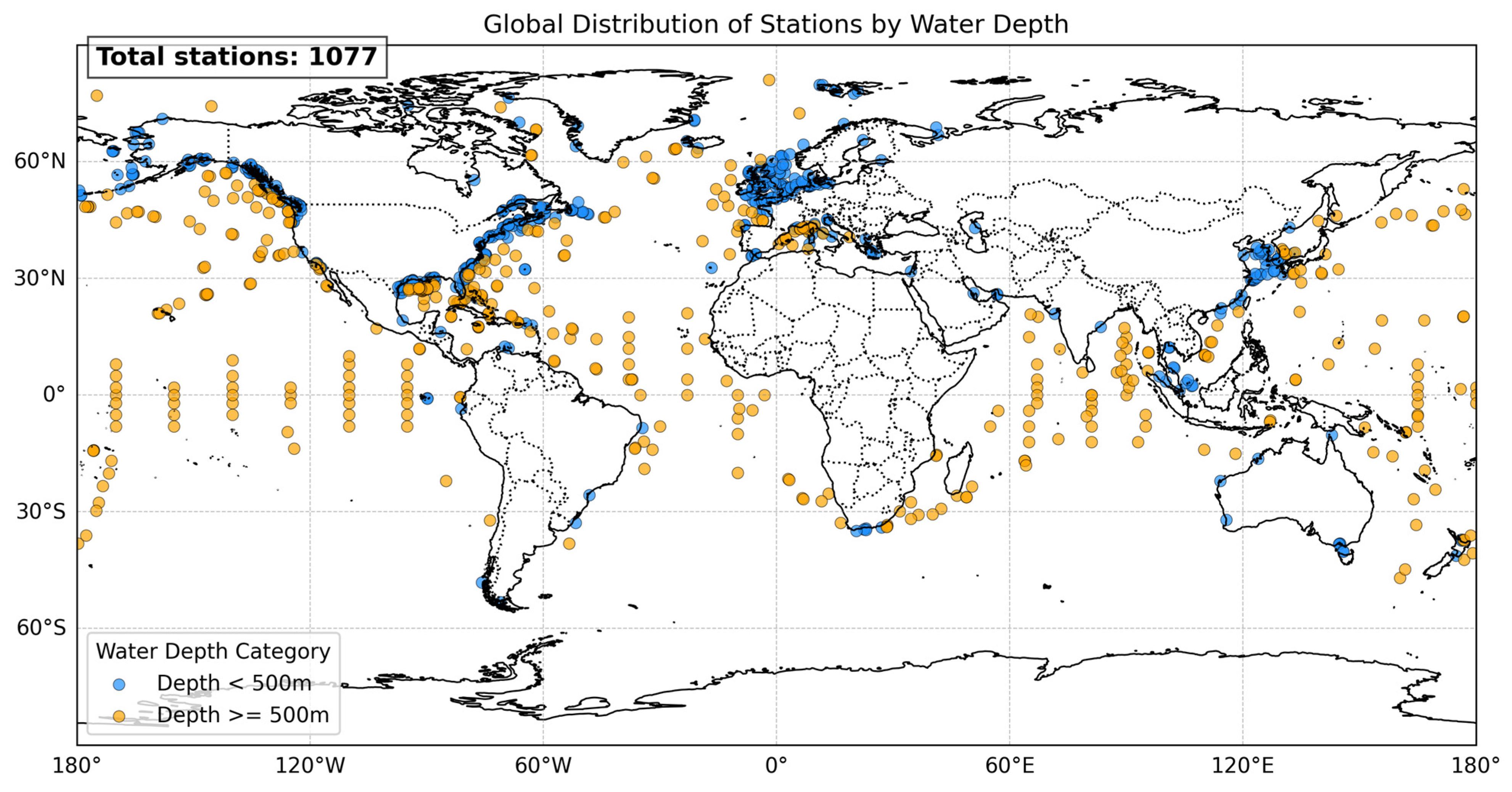
2.2. NDBC Buoy Data
2.3. ERA5 Wave Reanalysis
2.4. Comparison Between Buoy and ERA5 Data
3. Results
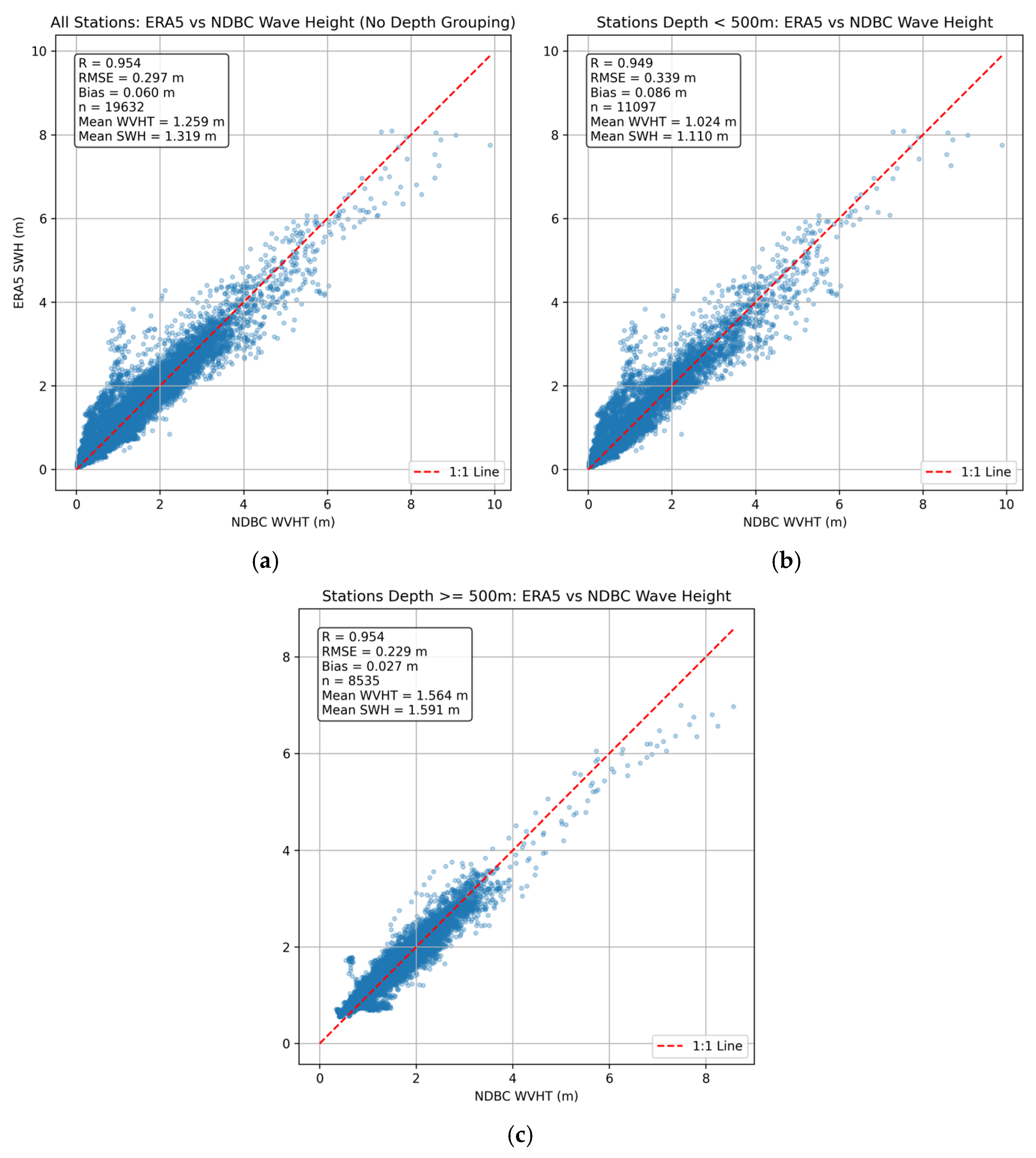
3.1. Comparison of Wave Heights from ERA5 and NDBC Buoys (Coastal Region vs. Open Ocean)
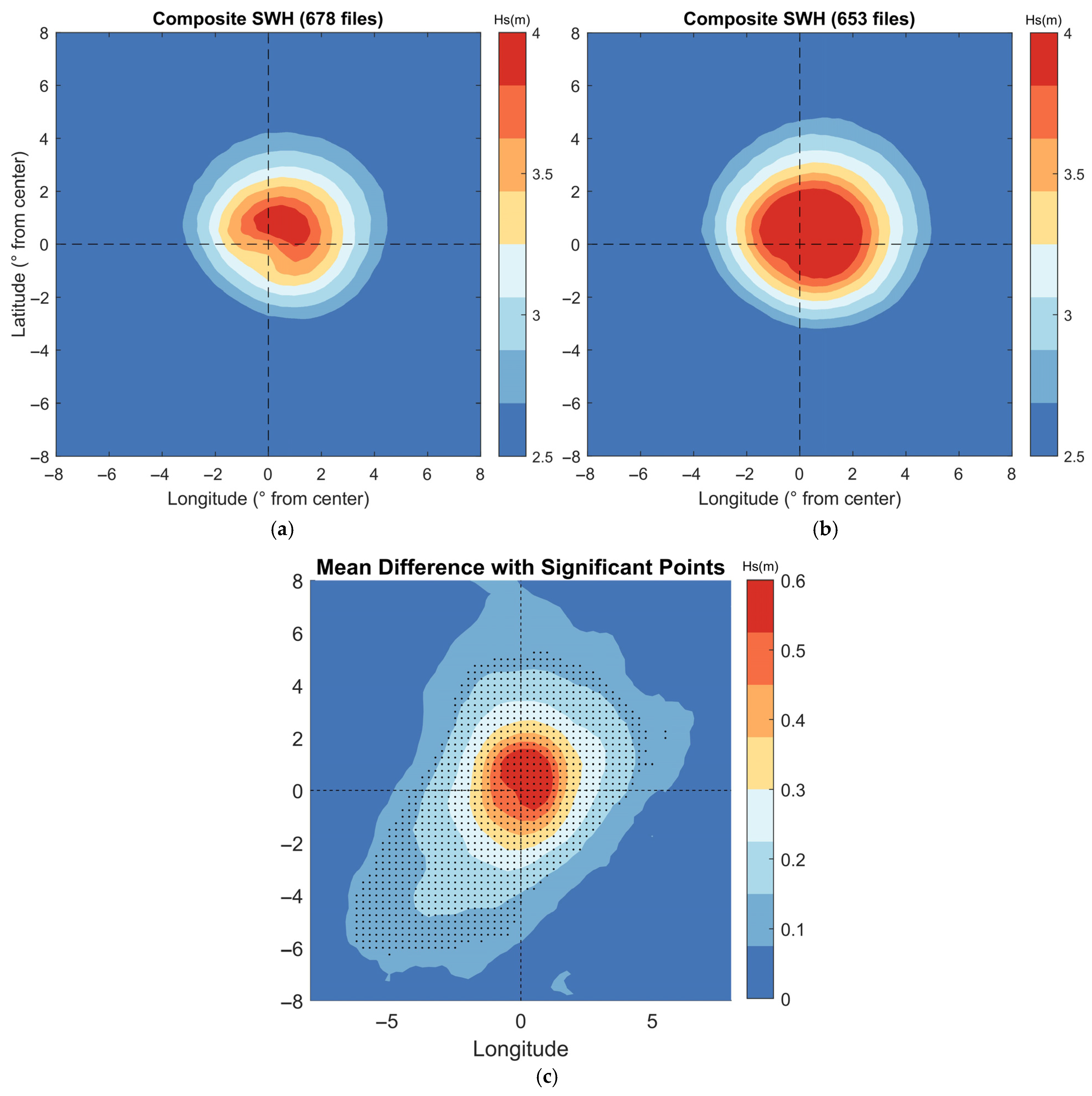
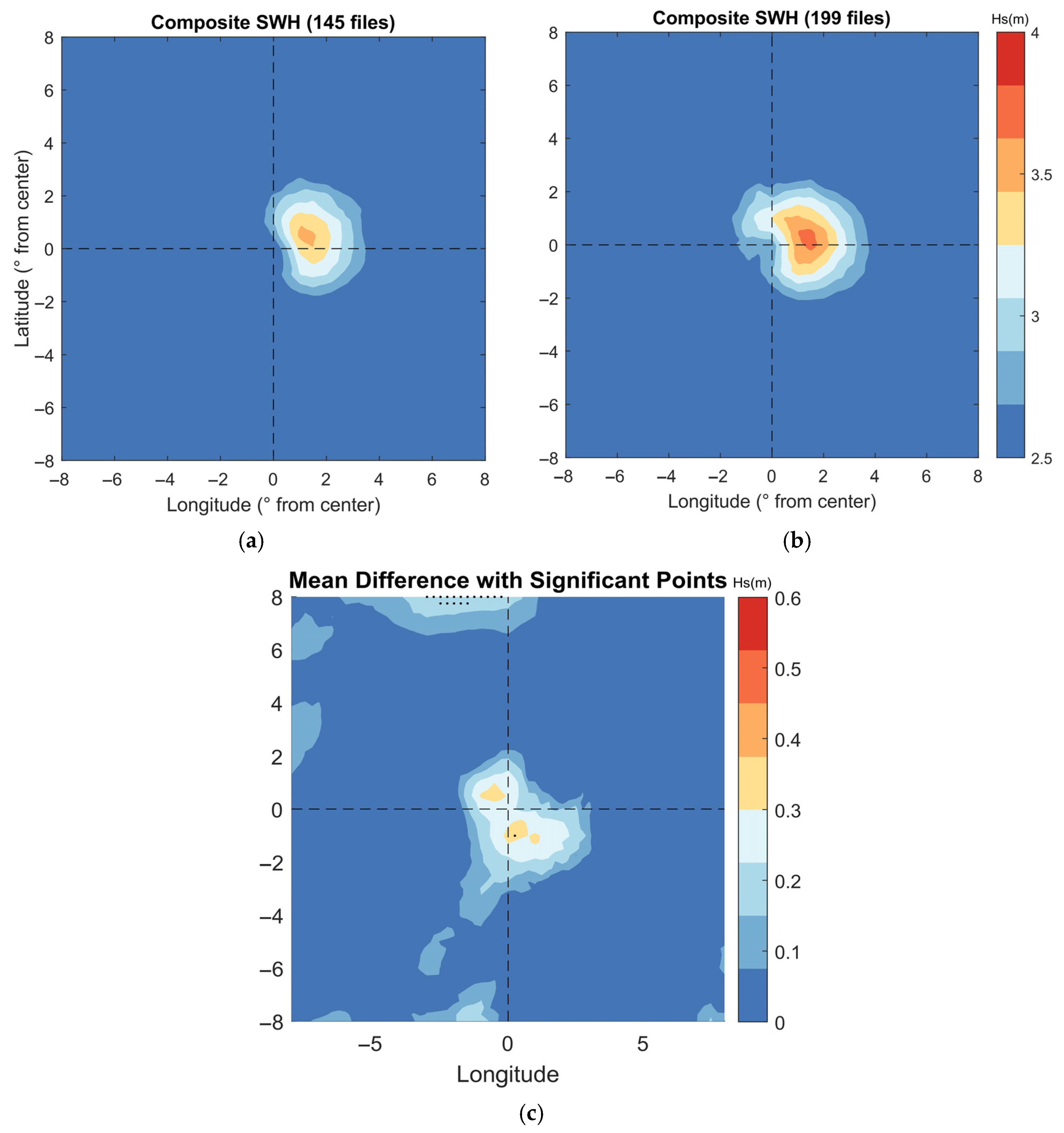
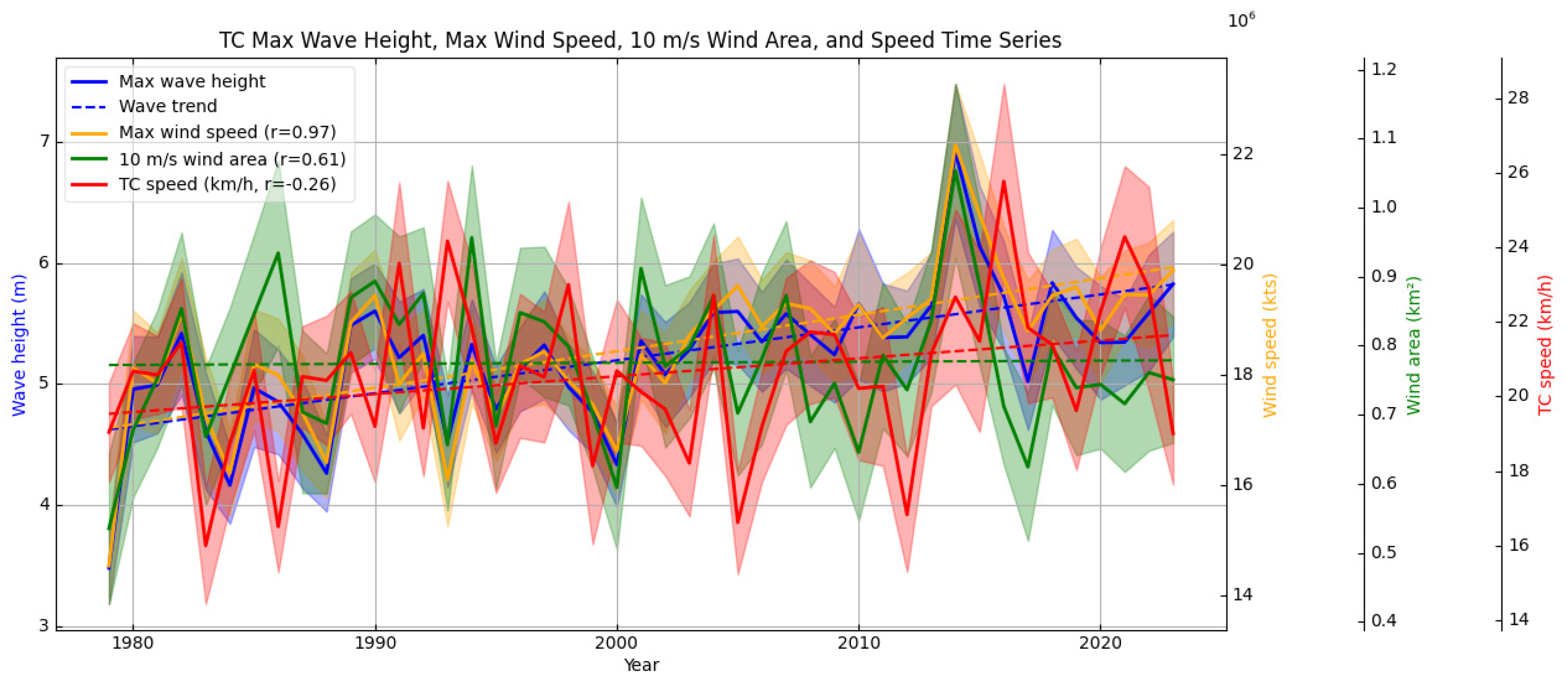
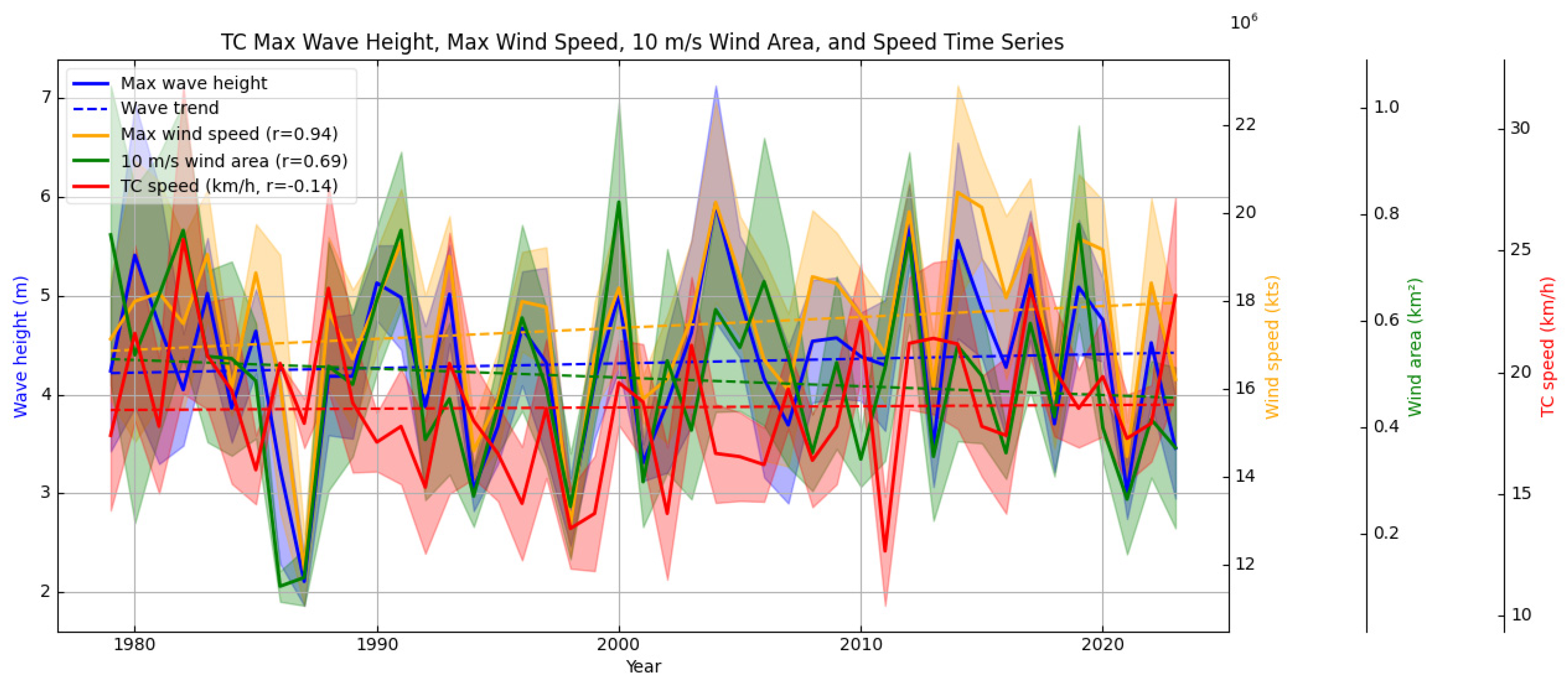
3.2. Manifestation of the Height and the Area of TC Waves (Coastal Region vs. Open Ocean)
3.3. Possible Mechanism Driving the Contrasting TCW Responses (Coastal vs. Open Ocean)
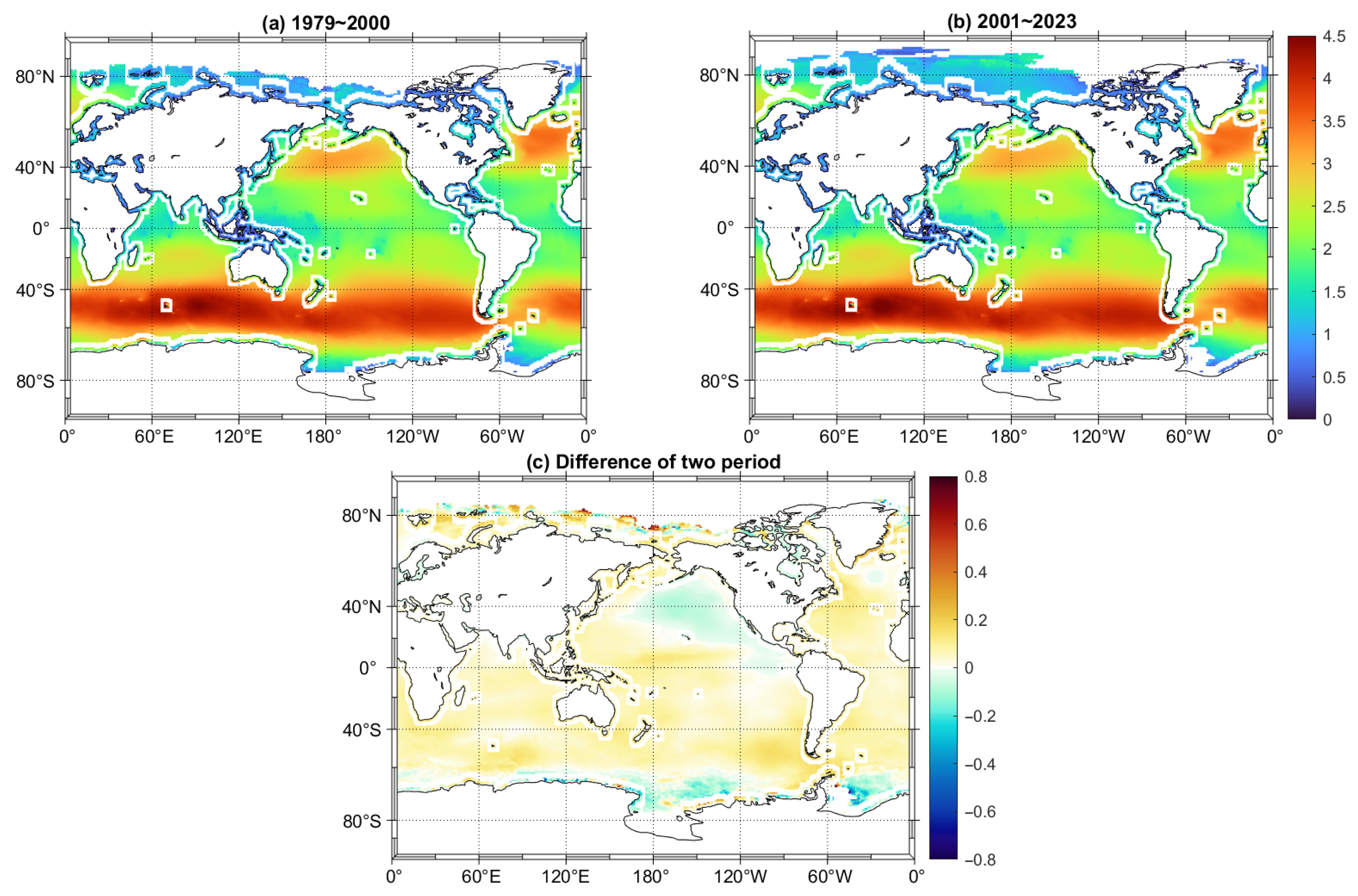
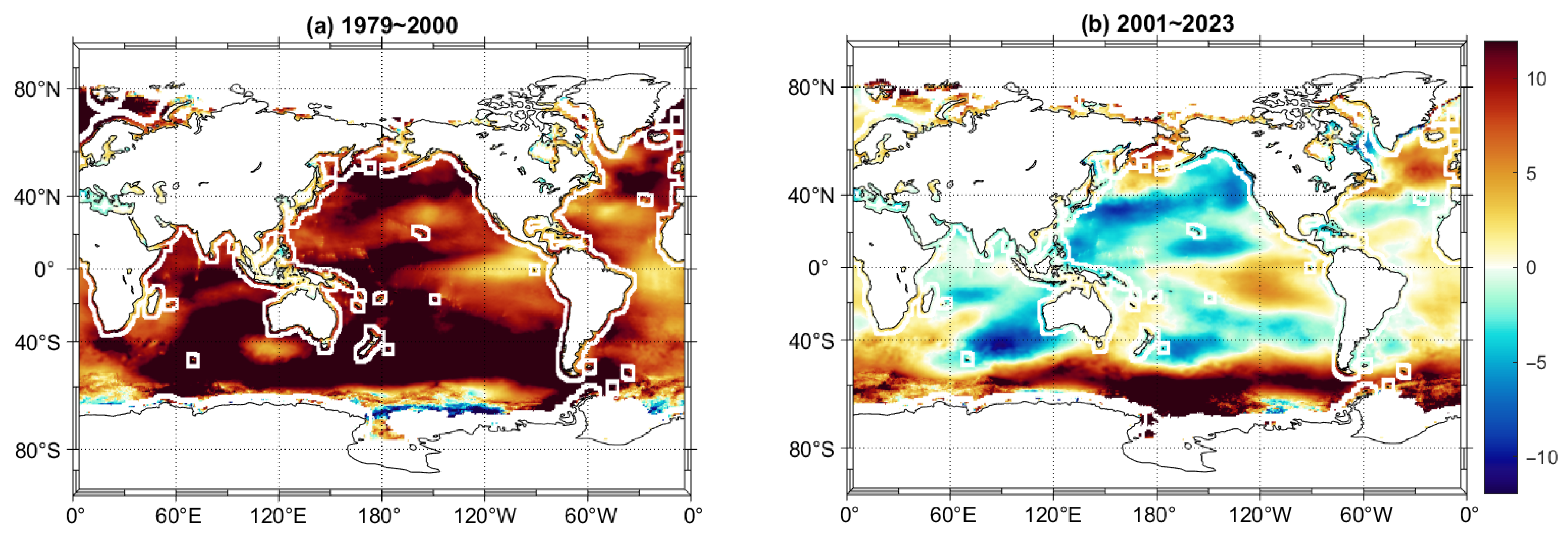
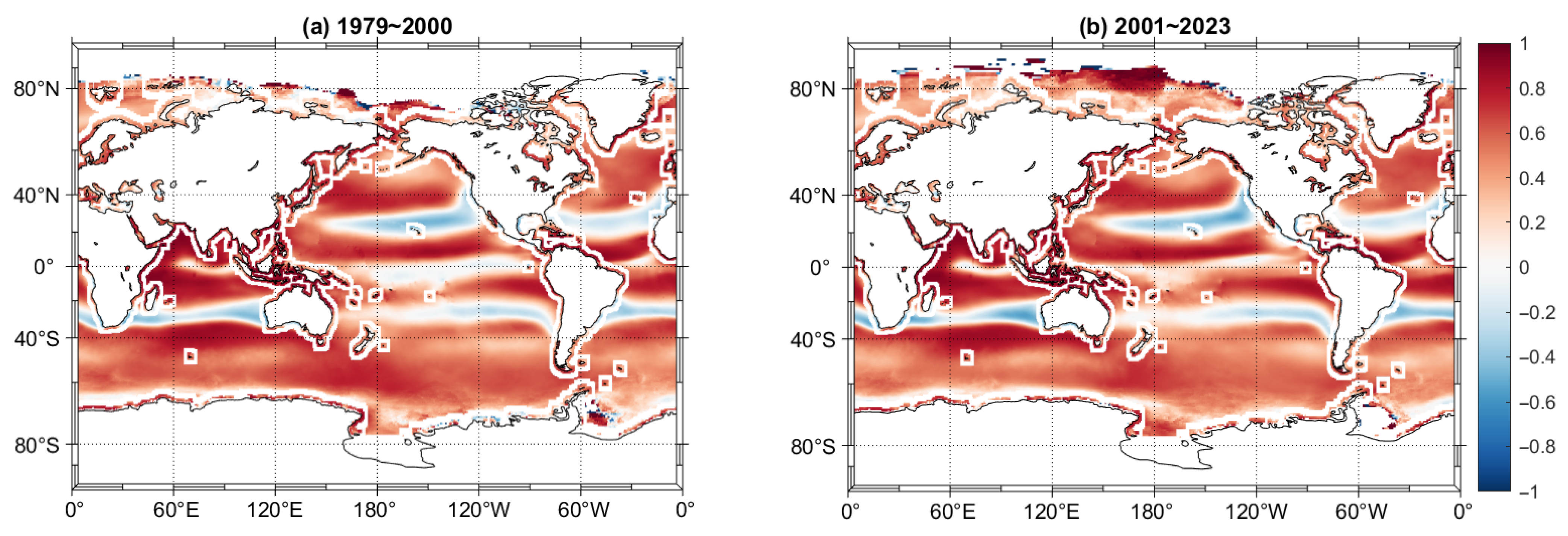
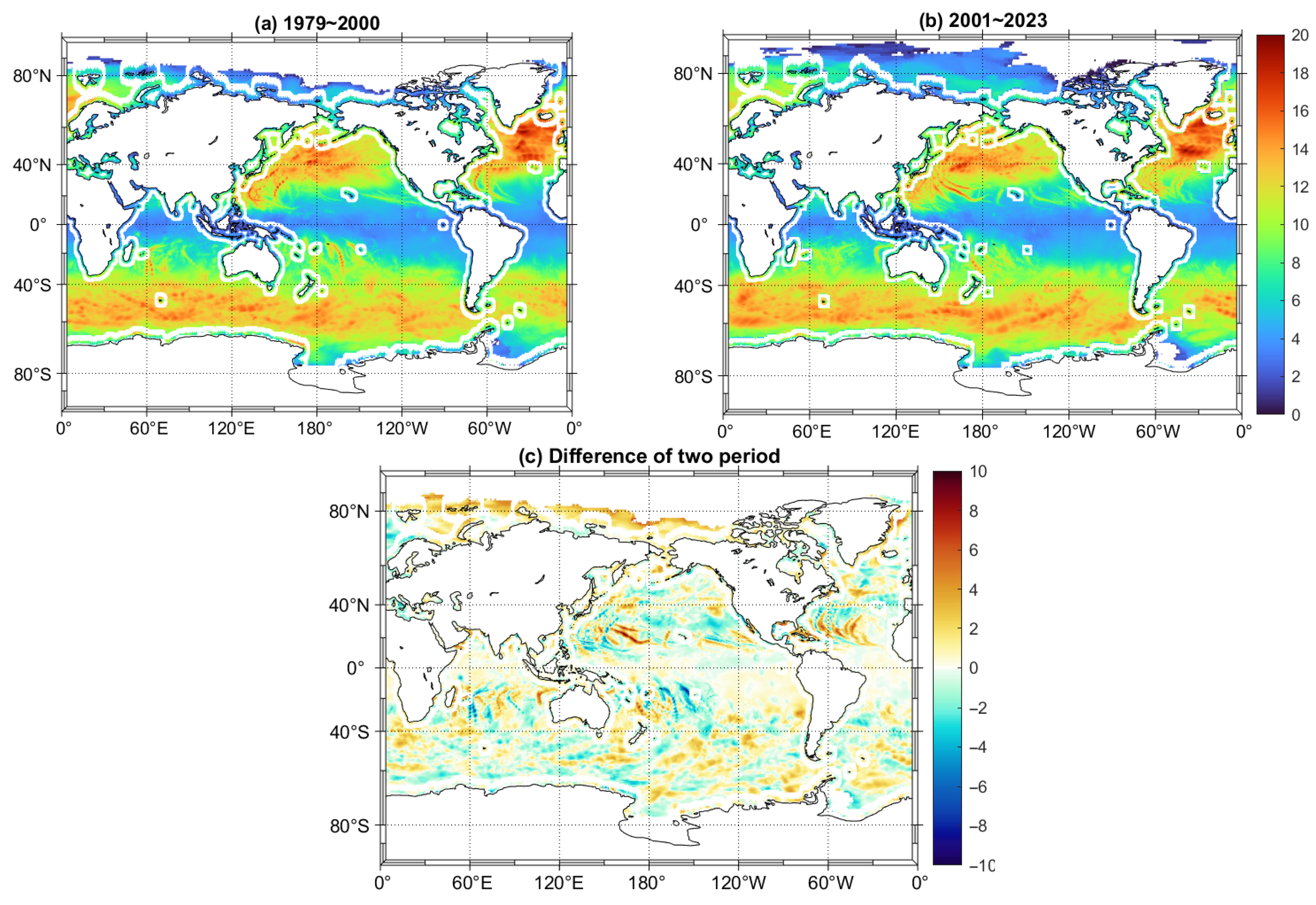
4. Characteristic of Global Wave Height in a Warming World (1979~2023)
5. Conclusions
Author Contributions
Funding
Institutional Review Board Statement
Informed Consent Statement
Data Availability Statement
Conflicts of Interest
References
- Liu, T.; Chen, Y.; Chen, S.; Li, W.; Zhang, A. Mechanisms of the transport height of water vapor by tropical cyclones on heavy rainfall. Weather Clim. Extrem. 2023, 41, 100587. [Google Scholar] [CrossRef]
- Chen, Y.; Yu, X. Sensitivity of storm wave modeling to wind stress evaluation methods. J. Adv. Model. Earth Syst. 2017, 9, 893–913. [Google Scholar] [CrossRef]
- Marcos, M.; Rohmer, J.; Vousdoukas, M.-I.; Mentaschi, L.; Le Cozannet, G.; Amores, A. Increased extreme coastal water levels due to the combined action of storm surges and wind waves. Geophys. Res. Lett. 2019, 46, 4356–4364. [Google Scholar] [CrossRef]
- Wahl, T.; Jain, S.; Bender, J.; Meyers, S.D.; Luther, M.E. Increasing risk of compound flooding from storm surge and rainfall for major US cities. Nat. Clim. Change 2015, 5, 1093–1097. [Google Scholar] [CrossRef]
- Tan, Y.; Zhang, W.; Feng, X.; Guo, Y.P.; Hoitink, A.J.F. Storm surge variability and prediction from ENSO and tropical cyclones. Environ. Res. Lett. 2023, 18, 024016. [Google Scholar] [CrossRef]
- Oliva, V.; Pfaff, S.; Willis, M. Messaging the rip current threat from distant tropical cyclones in the Carolinas. J. Oper. Meteorol. 2024, 12, 107–118. [Google Scholar] [CrossRef]
- Shi, J.; Feng, X.; Toumi, R.; Zhang, C.; Hodges, K.-I.; Tao, A.; Zhang, W.; Zhang, J. Global increase in tropical cyclone ocean surface waves. Nat. Commun. 2024, 15, 174. [Google Scholar] [CrossRef] [PubMed]
- Hell, M.-C.; Ayet, A.; Chapron, B. Swell generation under extra-tropical storms. J. Geophys. Res. Ocean. 2021, 126, e2021JC017637. [Google Scholar] [CrossRef]
- Meucci, A.; Young, I.R.; Hemer, M.; Kirezci, E.; Ranasinghe, R. Projected 21st century changes in extreme wind-wave events. Sci. Adv. 2020, 6, eaaz7295. [Google Scholar] [CrossRef]
- Shimura, T.; Pringle, W.J.; Mori, N.; Miyashita, T.; Yoshida, K. Seamless projections of global storm surge and ocean waves under a warming climate. Geophys. Res. Lett. 2022, 49, e2021GL097427. [Google Scholar] [CrossRef]
- Belmadani, A.; Dalphinet, A.; Chauvin, F.; Pilon, R.; Palany, P. Projected future changes in tropical cyclone-related wave climate in the North Atlantic. Clim. Dyn. 2021, 56, 3687–3708. [Google Scholar] [CrossRef]
- Shimura, T.; Mori, N.; Mase, H. Future projections of extreme ocean wave climates and the relation to tropical cyclones: Ensemble experiments of MRI-AGCM3.2H. J. Clim. 2015, 28, 9838–9856. [Google Scholar] [CrossRef]
- Timmermans, B.; Stone, D.; Wehner, M.; Krishnan, H. Impact of tropical cyclones on modeled extreme wind-wave climate. Geophys. Res. Lett. 2017, 44, 1393–1401. [Google Scholar] [CrossRef]
- Chen, Q.; Wang, L.; Zhao, H. Hydrodynamic investigation of coastal bridge collapse during Hurricane Katrina. J. Hydraul. Eng. 2009, 135, 175–186. [Google Scholar] [CrossRef]
- Rappaport, E.N. Fatalities in the United States from Atlantic tropical cyclones: New data and interpretation. Bull. Am. Meteorol. Soc. 2014, 95, 341–346. [Google Scholar] [CrossRef]
- Lawrence, M.B.; Mayfield, B.M.; Avila, L.A.; Pasch, R.J.; Rappaport, E.N. Atlantic hurricane season of 1995. Mon. Weather Rev. 1998, 126, 1124–1151. [Google Scholar] [CrossRef][Green Version]
- Reguero, B.G.; Losada, I.J.; Méndez, F.J. A recent increase in global wave power as a consequence of oceanic warming. Nat. Commun. 2019, 10, 205. [Google Scholar] [CrossRef]
- Morim, J.; Vitousek, S.; Hemer, M.; Reguero, B.; Erikson, L.; Casas-Prat, M.; Wang, X.L.; Semedo, A.; Mori, N.; Shimura, T.; et al. Global-scale changes to extreme ocean wave events due to anthropogenic warming. Environ. Res. Lett. 2021, 16, 084056. [Google Scholar] [CrossRef]
- Moon, I.-J.; Kim, S.-H.; Chan, J.C.L. Climate change and tropical cyclone trend. Nature 2019, 570, E3–E5. [Google Scholar] [CrossRef]
- Chu, J.E.; Lee, S.S.; Timmermann, A.; Wengel, C.; Stuecker, M.F.; Yamaguchi, R. Reduced tropical cyclone densities and ocean effects due to anthropogenic greenhouse warming. Sci. Adv. 2020, 6, eabd5109. [Google Scholar] [CrossRef] [PubMed]
- Knutson, T.R.; McBride, J.L.; Chan, J.; Emanuel, K.; Holland, G.; Landsea, C.; Held, I.; Kossin, J.P.; Srivastava, A.K.; Sugi, M. Tropical cyclones and climate change. Nat. Geosci. 2010, 3, 157–163. [Google Scholar] [CrossRef]
- Jullien, S.; Aucan, J.; Kestenare, E.; Lengaigne, M.; Menkes, C. Unveiling the global influence of tropical cyclones on extreme waves approaching coastal areas. Nat. Commun. 2024, 15, 50929. [Google Scholar] [CrossRef]
- Lobeto, H.; Menendez, M.; Losada, I.J. Future behavior of wind wave extremes due to climate change. Sci. Rep. 2021, 11, 7869. [Google Scholar] [CrossRef]
- Knapp, K.R.; Kruk, M.C.; Levinson, D.H.; Diamond, H.J.; Neumann, C.J. The International Best Track Archive for Climate Stewardship (IBTrACS): Unifying tropical cyclone best track data. Bull. Am. Meteorol. Soc. 2010, 91, 363–376. [Google Scholar] [CrossRef]
- National Data Buoy Center. Handbook of Automated Data Quality Control Checks and Procedures (Technical Document T80-10); NOAA: Silver Spring, MD, USA, 2023. [Google Scholar]
- ECMWF. Open Data; European Centre for Medium-Range Weather Forecasts: Reading, UK, 2021. [Google Scholar] [CrossRef]
- Combes, V.; Matano, R.P.; Meredith, M.P.; Young, E.F. Variability of the shelf circulation around South Georgia, Southern Ocean. J. Geophys. Res. Ocean. 2023, 128, e2022JC019257. [Google Scholar] [CrossRef]
- Young, I.R.; Zieger, S.; Babanin, A.V. Global trends in wind speed and wave height. Science 2011, 332, 451–455. [Google Scholar] [CrossRef]
- Fanti, V.; Ferreira, Ó.; Kümmerer, V.; Loureiro, C. Improved estimates of extreme wave conditions in coastal areas from calibrated global reanalyses. Commun. Earth Environ. 2023, 4, 151. [Google Scholar] [CrossRef]
- Bechle, A.J.; Wu, C.H. Wind wave analysis in Lake Michigan using unstructured-grid models. J. Geophys. Res. Ocean. 2016, 121, 346–367. [Google Scholar] [CrossRef]
- Peng, J.; Mao, M.; Xia, M. Dynamics of wave generation and dissipation processes during cold wave events in the Bohai Sea. Estuar. Coast. Shelf Sci. 2023, 280, 108161. [Google Scholar] [CrossRef]
- Sun, C.; Liu, Y.; Liu, Q. Spatial–temporal variability of coastal wave spectra and modulation by wind forcing. J. Phys. Oceanogr. 2023, 54, 123–138. [Google Scholar] [CrossRef]
- Virtanen, P.; Gommers, R.; Oliphant, T.E.; Haberland, M.; Reddy, T.; Cournapeau, D.; Burovski, E.; Peterson, P.; Weckesser, W.; Bright, J.; et al. SciPy 1.0: Fundamental algorithms for scientific computing in Python. Nat. Methods 2020, 17, 261–272. [Google Scholar] [CrossRef]
- Shapiro, L.J. The asymmetric boundary layer flow under a translating hurricane. J. Atmos. Sci. 1983, 40, 1984–1998. [Google Scholar] [CrossRef]
- Uhlhorn, E.W.; Nolan, D.S.; Vigh, J.L.; Schroeder, J.L.; Damiani, R. Observed hurricane wind speed asymmetries and relationships to motion and environmental shear. Mon. Weather Rev. 2014, 142, 1325–1344. [Google Scholar] [CrossRef]
- Moon, I.-J.; Toba, Y. Sensitivity of wind waves to hurricane wind characteristics. Ocean Model. 2007, 18, 37–52. [Google Scholar] [CrossRef]
- Prakash, K.R.; Pant, V. On the wave–current interaction during the passage of a tropical cyclone in the Bay of Bengal. Deep-Sea Res. Part II Top. Stud. Oceanogr. 2020, 172, 104658. [Google Scholar] [CrossRef]
- Liao, Y.P.; Kaihatu, J.M. Numerical investigation of wind waves in the Persian Gulf: Bathymetry effects. J. Atmos. Ocean. Technol. 2016, 33, 17–31. [Google Scholar] [CrossRef]
- Chen, J.L.; Ralston, D.K.; Geyer, W.R.; Sommerfield, C.K.; Chant, R.J. Wave generation, dissipation, and disequilibrium in an embayment with complex bathymetry. J. Geophys. Res. Ocean. 2018, 123, 7856–7876. [Google Scholar] [CrossRef]
- Fagherazzi, S.; Wiberg, P.L. Importance of wind conditions, fetch, and water levels on wave-generated shear stresses in shallow intertidal basins. J. Geophys. Res. Earth Surf. 2009, 114, F03022. [Google Scholar] [CrossRef]
- Janssen, P.A.E.M. The Interaction of Ocean Waves and Wind; Cambridge University Press: Cambridge, UK, 2004. [Google Scholar]
- Hwang, P.A. Duration- and fetch-limited growth functions of wind-generated waves parameterized with three different scaling wind velocities. J. Geophys. Res. Ocean. 2006, 111, C02005. [Google Scholar] [CrossRef]
- Lin, I.I.; Wu, C.C.; Pun, I.F.; Ko, D.S. Upper-ocean thermal structure and the Western North Pacific Category-5 typhoons. Part I: Ocean features and the typhoons’ intensification. Mon. Weather Rev. 2008, 136, 3288–3306. [Google Scholar] [CrossRef]
- Saengsupavanich, C.; Ariffin, E.H.; Yun, L.S.; Pereira, D.A. Environmental impact of submerged and emerged breakwaters. Heliyon 2022, 8, e12626. [Google Scholar] [CrossRef]
- Foti, G.; Barbaro, G.; Barillà, G.C.; Mancuso, P. Shoreline changes due to the construction of ports: Case study—Calabria (Italy). J. Mar. Sci. Eng. 2023, 11, 2382. [Google Scholar] [CrossRef]
- Cherchi, A.; Ambrizzi, T.; Behera, S.; Freitas, A.C.V.; Morioka, Y.; Zhou, T. The response of subtropical highs to climate change. Curr. Clim. Change Rep. 2018, 4, 371–382. [Google Scholar] [CrossRef]
- Young, I.R.; Ribal, A. Multiplatform evaluation of global trends in wind speed and wave height. Science 2019, 364, 548–552. [Google Scholar] [CrossRef] [PubMed]
- Cao, Y.; Dong, C.; Young, I.R.; Yang, J. Global wave height slowdown trend during a recent global warming slowdown. Remote Sens. 2021, 13, 4096. [Google Scholar] [CrossRef]
- Timmermans, B.W.; Gommenginger, C.P.; Dodet, G.; Bidlot, J.R. Global wave height trends and variability from new multimission satellite altimeter products, reanalyses, and wave buoys. Geophys. Res. Lett. 2020, 47, e2019GL086880. [Google Scholar] [CrossRef]
- Muilwijk, M.; Hattermann, T.; Martin, T.; Granskog, M.A. Future sea ice weakening amplifies wind-driven trends in surface stress and Arctic Ocean spin-up. Nat. Commun. 2024, 15, 6889. [Google Scholar] [CrossRef]
- Hersbach, H.; Bell, B.; Berrisford, P.; Hirahara, S.; Horányi, A.; Muñoz-Sabater, J.; Nicolas, J.; Peubey, C.; Radu, R.; Schepers, D.; et al. The ERA5 global reanalysis. Q. J. R. Meteorol. Soc. 2020, 146, 1999–2049. [Google Scholar] [CrossRef]
- Janssen, P.A.E.M. Progress in ocean wave forecasting. J. Comput. Phys. 2008, 227, 3572–3594. [Google Scholar] [CrossRef]
- Komen, G.J.; Cavaleri, L.; Donelan, M.; Hasselmann, K.; Hasselmann, S.; Janssen, P. Dynamics and Modelling of Ocean Waves; Cambridge University Press: Cambridge, UK, 1994. [Google Scholar]
- Bidlot, J.-R.; Janssen, P.; Abdalla, S. A Revised Formulation for Ocean Wave Dissipation and Its Model Impact; ECMWF Technical Memorandum: Reading, UK, 2002. [Google Scholar]
- Masselink, G.; Hughes, M.G. Introduction to Coastal Processes and Geomorphology; Arnold Publishers: London, UK, 2003. [Google Scholar]


Disclaimer/Publisher’s Note: The statements, opinions and data contained in all publications are solely those of the individual author(s) and contributor(s) and not of MDPI and/or the editor(s). MDPI and/or the editor(s) disclaim responsibility for any injury to people or property resulting from any ideas, methods, instructions or products referred to in the content. |
© 2025 by the authors. Licensee MDPI, Basel, Switzerland. This article is an open access article distributed under the terms and conditions of the Creative Commons Attribution (CC BY) license (https://creativecommons.org/licenses/by/4.0/).
Share and Cite
Liang, Y.-L.; Zheng, Z.-W.; Lin, J.-Y. Different Modes of Wave Response over the Past Four Decades: Coastal vs. Open-Ocean Regions. Atmosphere 2025, 16, 1345. https://doi.org/10.3390/atmos16121345
Liang Y-L, Zheng Z-W, Lin J-Y. Different Modes of Wave Response over the Past Four Decades: Coastal vs. Open-Ocean Regions. Atmosphere. 2025; 16(12):1345. https://doi.org/10.3390/atmos16121345
Chicago/Turabian StyleLiang, Ya-Lin, Zhe-Wen Zheng, and Jia-Yi Lin. 2025. "Different Modes of Wave Response over the Past Four Decades: Coastal vs. Open-Ocean Regions" Atmosphere 16, no. 12: 1345. https://doi.org/10.3390/atmos16121345
APA StyleLiang, Y.-L., Zheng, Z.-W., & Lin, J.-Y. (2025). Different Modes of Wave Response over the Past Four Decades: Coastal vs. Open-Ocean Regions. Atmosphere, 16(12), 1345. https://doi.org/10.3390/atmos16121345