Article

Fire-Enhanced Soil Carbon Sequestration in Wetlands: A 5000-Year Record from the Ussuri River, Northeast China

1
Academy of Eco-Civilization Development for Jing-Jin-Ji Megalopolis, Tianjin Normal University, Tianjin 300387, China
2
Faculty of Geography, Tianjin Normal University, Tianjin 300387, China
*
Author to whom correspondence should be addressed.
Atmosphere 2025, 16(12), 1322; https://doi.org/10.3390/atmos16121322
Submission received: 8 October 2025 / Revised: 21 November 2025 / Accepted: 21 November 2025 / Published: 23 November 2025
(This article belongs to the Special Issue The Evolution of Climate and Environment in the Holocene)

Abstract

Using high-resolution charcoal and TOC records from a sediment core collected in a coastal wetland along the middle reaches of the Ussuri River, the local fire history and carbon accumulation patterns were reconstructed for the past 5000 years. Results indicate that fire intensity remained relatively low and stable from 5000 to 1500 cal. yr BP, after which it increased markedly. This trend intensified over the past 400 years, likely due to rapid population growth and heightened anthropogenic disturbance. Regional fire frequency averaged approximately 3.1 fires per 1500 years, with notable peaks during 5000–4600 cal. yr BP, 3400–2400 cal. yr BP, and 1500 cal. yr BP to present. These high-fire intervals correspond closely to regional warm and dry climatic conditions, underscoring the strong influence of climate variability on fire activity. Carbon accumulation rates also showed a significant increase, rising from 0.11 g·kg−1·a−1 around 5000 years ago to 1.60 g·kg−1·a−1 in recent centuries. Importantly, a significant positive correlation was observed between fire regimes and carbon accumulation rates, suggesting that fires have potentially played a key role in enhancing long-term carbon sequestration in wetlands of this region. These findings highlight the complex interplay between fire, climate, and carbon dynamics in wetland ecosystems.

1. Introduction

Wildfires play a complex and critical role in regulating terrestrial ecosystem functions by influencing soil nutrient cycling, vegetation succession, and the global carbon balance [1,2]. During combustion, wildfires release substantial amounts of gases and aerosols—such as carbon dioxide (CO2), nitrogen oxides (NOₓ), methane (CH4) and black carbon (BC)—into the atmosphere [3]. In recent decades, rising global temperatures and increasing frequency of extreme drought events have intensified wildfire activity across many regions worldwide. Beyond atmospheric emissions, wildfires also significantly disrupt ecosystem carbon cycling [4,5,6], particularly in forests and grasslands, where they alter the balance between carbon uptake and release.
Globally, wildfires contribute an estimated 2–4 Pg of carbon to the atmosphere annually [7]. The long-term effects of fire on ecosystem–atmosphere carbon exchange largely depend on post-fire biogeochemical processes, including the accumulation and decomposition of carbon in vegetation and soils. Notably, carbon emissions from biomass combustion represent only a fraction of total fire-related carbon fluxes [8]. Soils, which store approximately 2344 Pg of carbon globally, are the largest terrestrial carbon reservoir [9]. Soil carbon accumulation results from long-term imbalances between plant productivity and organic matter decomposition. Wildfires can exert lasting impacts on soil organic carbon (SOC) through oxidation, physical disturbance, and altered decomposition dynamics during and after fire events [10].
However, most studies still compare SOC stocks only immediately before and after individual fires, leaving centennial- to millennial-scale fire histories and their attendant carbon dynamics largely undocumented. This short-term perspective obscures fire’s true role in long-term soil-carbon sequestration. Compounding the issue, both fire regimes and SOC accumulation are climate-sensitive and covary over long timescales [11], so high-resolution, continuous records spanning centuries are indispensable for disentangling their interactions.
Over the past two decades, numerous studies have explored the effects of fire regimes on surface organic carbon. Some report significant negative impacts on carbon sequestration [12], while others find minimal or even positive effects over millennial timescales [13]. These divergent outcomes are often attributed to climate-driven changes in vegetation cover and soil moisture. Consequently, selecting study sites in climate-sensitive regions is crucial for understanding long-term fire–carbon interactions.
The Ussuri River, located at the northern margin of the East Asian summer monsoon zone, is highly sensitive to climate variability [14]. Ecosystem processes and biogeochemical cycles in this region are strongly influenced by changes in temperature and precipitation. The widespread distribution of freshwater marshes along the Ussuri River provides ideal conditions for SOC accumulation under anaerobic, low-decomposition environments [15]. As such, sedimentary records from these wetlands can serve as valuable archives for reconstructing long-term fire history and carbon dynamics.
While the effects of fire on soil organic carbon (SOC) have been extensively studied in forests, grasslands, and peatlands, research on fire regimes in wetlands and their long-term impacts on SOC remains scarce. This study addresses that knowledge gap by conducting a high-resolution analysis of charcoal and SOC content in wetland sediments along the Ussuri River. Our objectives are to (1) reconstruct the Holocene fire history of wetlands in the Ussuri River basin; (2) evaluate the long-term effects of fire regimes on carbon accumulation patterns; and (3) assess the potential role of hydrologically similar wetlands in the Sanjiang Plain in future regional carbon cycling.

2. Regional Setting

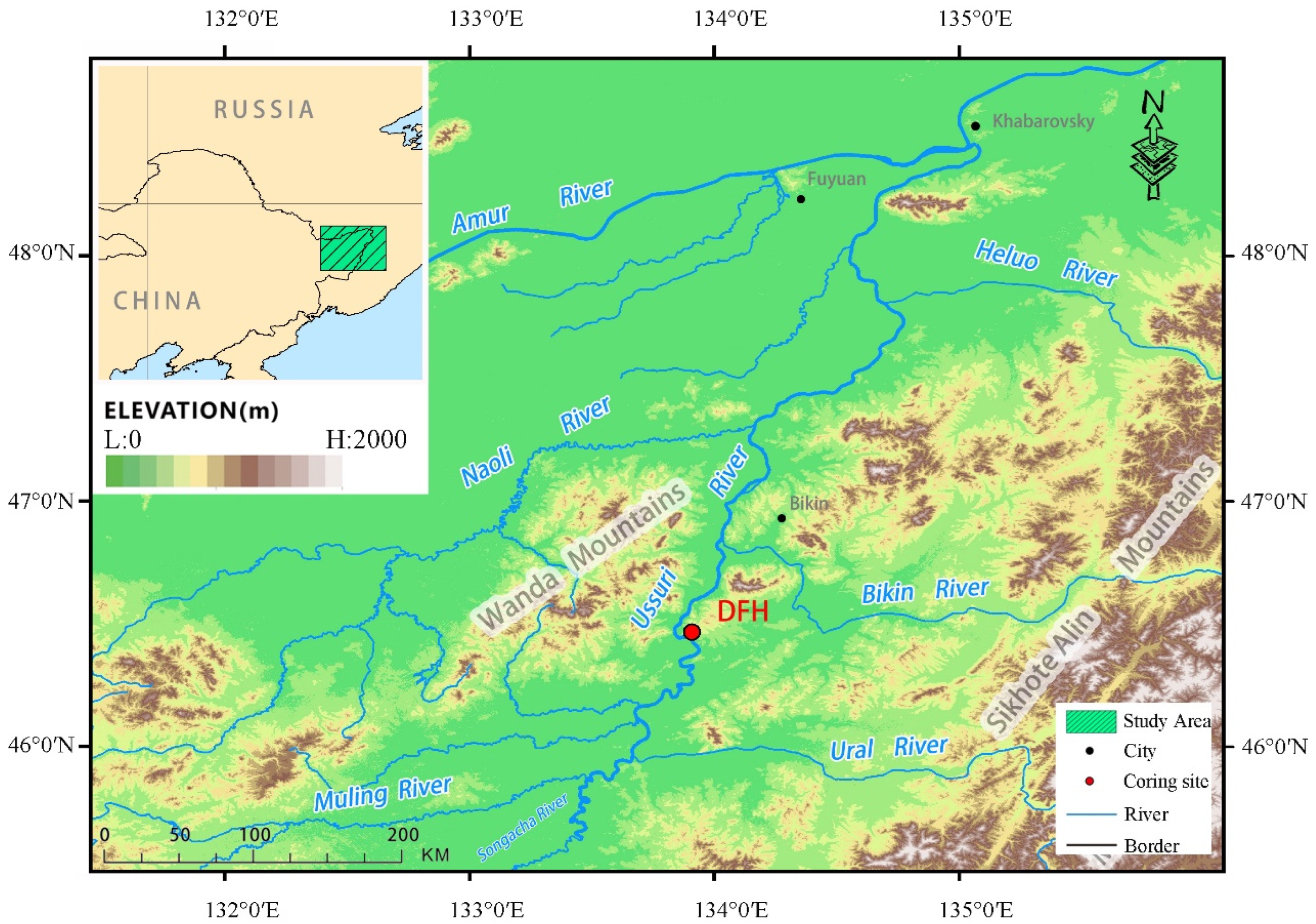
The Ussuri River, located in northeast Asia, originates from the confluence of the Ural and Bikin rivers on the southwestern slopes of the Sikhote-Alin Mountains (Figure 1). Stretching 905 km in total, the lower 492 km—from the Songacha River estuary to its confluence with the Amur River—forms the Sino-Russian border, while the upper 413 km lies within Russian territory. The river flows primarily across a low-relief plain, with broad valleys in the upper and middle reaches and extensive depressions and swampy wetlands in the lower reaches. These wetlands have accumulated thick, continuous Holocene sediment sequences under anaerobic conditions, providing excellent archives for long-term paleoenvironmental reconstruction.
As part of the vast Sanjiang Plain, the Ussuri River basin is a low-lying, flat region where freshwater marshes blanket more than 70% of its surface. Formed during the Holocene, these marshes preserve thick, organic-rich swamp deposits that have accumulated under near-natural conditions and remain largely undisturbed by human activity. Consequently, they offer exceptionally well-preserved archives with multiple proxies for reconstructing the regional environmental history far beyond the span of instrumental records. The area experiences a temperate monsoon climate, with warm, humid summers and long, cold winters. Mean annual temperature is below 3.9 °C, and sub-zero temperatures can persist for up to six months [16]. Owing to the Southeast Asian summer monsoon, ~70% of the annual precipitation falls between June and September. Average annual precipitation is approximately 520 mm and exhibits a clear east–west gradient, declining from the humid east to the drier west.

3. Materials and Methods

3.1. Field Sampling and Chronology Construction

Following a preliminary field survey, a pristine wetland in the Dongfanghong National Natural Reserve on the left bank of the middle Ussuri River was selected for sediment coring. The modern vegetation at the sampling site is dominated by naturally established Deyeuxia angustifolia, with negligible anthropogenic disturbance. A 100-cm sediment core (DFH; 46°25.180′ N, 133°48.406′ E) was retrieved from the wetland centre with a Russian peat corer and sliced at 1-cm intervals (100 subsamples). This contiguous, centimetre-scale sampling was chosen to provide temporal resolution of ~50 yr cm−1, sufficient to resolve multi-decadal fire events and associated SOC changes while yielding enough material (≥3 g dry wt per slice) for simultaneous charcoal, SOC, geochemical and AMS 14C analyses without introducing smearing across depth boundaries. Radiocarbon chronology for core DFH was adopted from Cong et al. [17], and detailed dating procedures are described therein.

3.2. Charcoal and Soil Organic Carbon Analyses

Charcoal preparation followed standard palaeofire protocols. Approximately 2 g of dry sediment per subsample was treated with 10% NaOH at 80 °C for ≥30 min to dissolve organic matter. Siliceous material was then removed by digestion in 40% HF, and the residue was wet-sieved through a 125-µm mesh. The >125 µm fraction was transferred to a Petri dish and dried at 40 °C. Charcoal particles were identified and enumerated under an Olympus binocular microscope at 40× magnification. Morphometric classification distinguished sub-elongated grains (length/width > 2.5) from sub-rounded grains (ratio < 2.5) [18,19].
Soil organic carbon (SOC) content was determined by the external-heat potassium dichromate oxidation method. Air-dried sediment (0.05–0.30 g, <0.5 mm) was placed in a borosilicate test tube together with 10 mL of 0.8 mol L−1 K2Cr2O7–concentrated H2SO4 mixture (1:1 v/v). Tubes were heated in an oil bath at 180 °C for 5 min after onset of boiling. Once cooled, the excess dichromate was titrated with 0.1 mol L−1 FeSO4·7H2O using ferroin indicator. SOC content (‰) was calculated as
SOC = W(V0 − V) × c × 0.003 × 1.08 × 1000
where V0 and V are FeSO4 volumes (mL) consumed by the blank and sample, respectively; c is the FeSO4 concentration; 1.08 is the oxidation correction factor; and W is the air-dried sample mass (g).

3.3. Fire-History Reconstruction

Charcoal data were analysed using the CharAnalysis 1.1 [20,21,22]. Age-depth modelling provided irregular sampling intervals; therefore, charcoal accumulation rates (CHAR, particles cm−2 yr−1) were interpolated to a constant median temporal resolution (C_int) for the entire record. Background charcoal component (C_back) was estimated with a 500-yr LOWESS smoother; the residual (C_peak = C_int − C_back) represents potential fire episodes. A locally defined threshold (t)—the 95th percentile of a Gaussian mixture model fitted to C_peak values—was used to separate fire-related peaks (C_fire) from noise (C_noise). Only peaks exceeding t within a 1000-yr moving window were retained as fire events. Fire frequency (FF, events 1500 yr−1) was calculated with a 1500-yr Gaussian kernel. Peak magnitude was defined as the charcoal sum of each identified peak. Finally, linear regression was used to evaluate relationships between (i) FF and carbon accumulation rate (CAR), and (ii) charcoal influx and CAR.

4. Results

4.1. Chronology

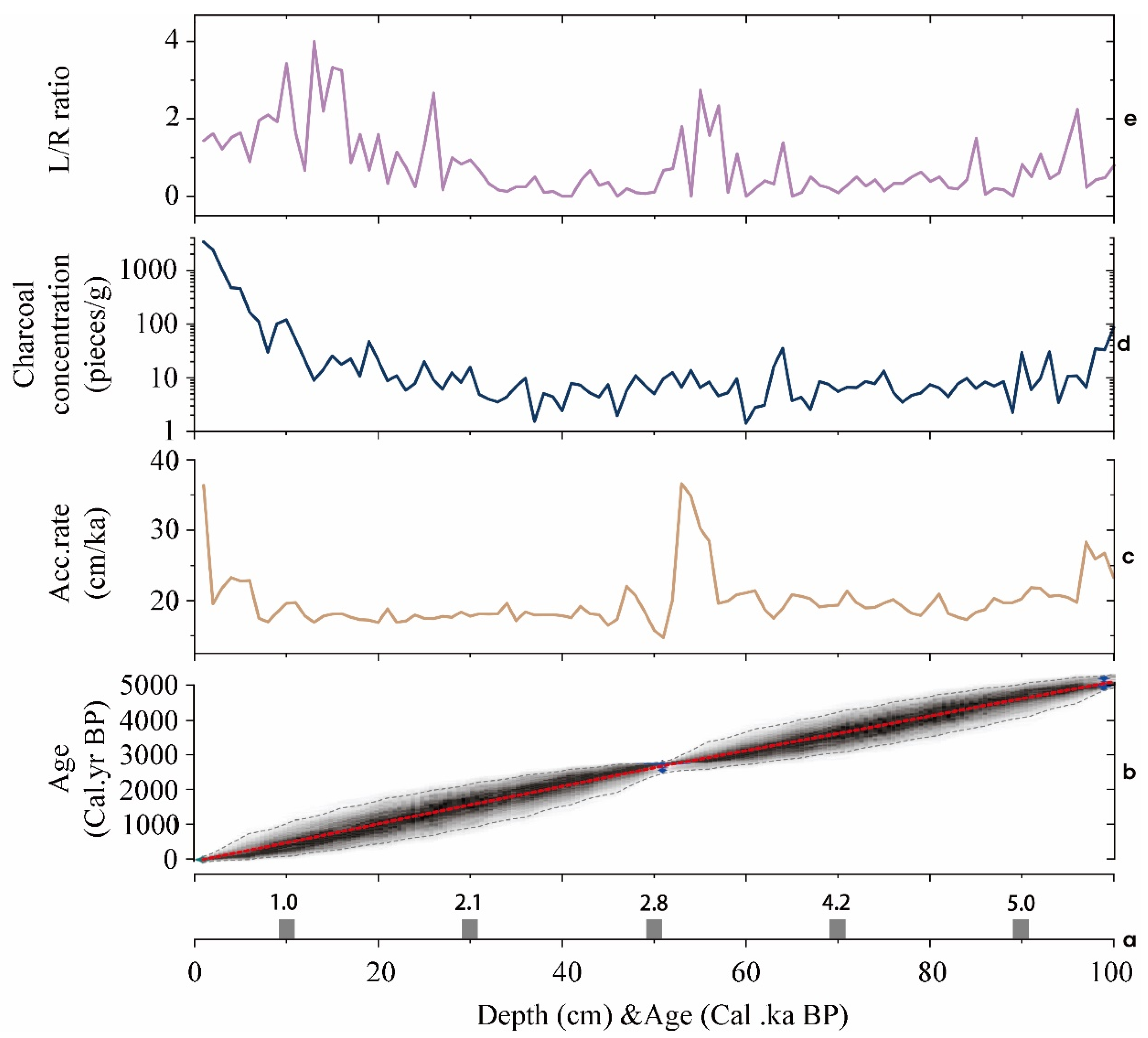
The Bacon age–depth model indicates that the DFH sediment record spans the last ~5000 cal yr BP (Figure 2a–c). Sediment-accumulation rates vary between 14.75 and 36.63 cm ka−1, with a mean of 19.54 cm ka−1.

4.2. Charcoal Concentration and Paleovegetation

Charcoal concentration ranges from 1.5 to 3372.7 particles g−1 (mean = 93.3 particles g−1) and increases sharply in the upper 15 cm of the core (Figure 2d). Particles were classified by length/width (L/W) ratio: sub-elongated (L/W > 2.5, indicative of herbaceous fuels) and sub-rounded (L/W < 2.5, typical of woody fuels) [23,24]. The L/R ratio (sub-elongated/sub-rounded) varies between 0 and 4.0 (mean = 0.82; Figure 2e), implying that the fire-prone vegetation around the site was a mixed herbaceous–woody assemblage dominated by woody plants for most of the last 5000 years.

4.3. Fire History and Carbon Accumulation Rate (CAR)

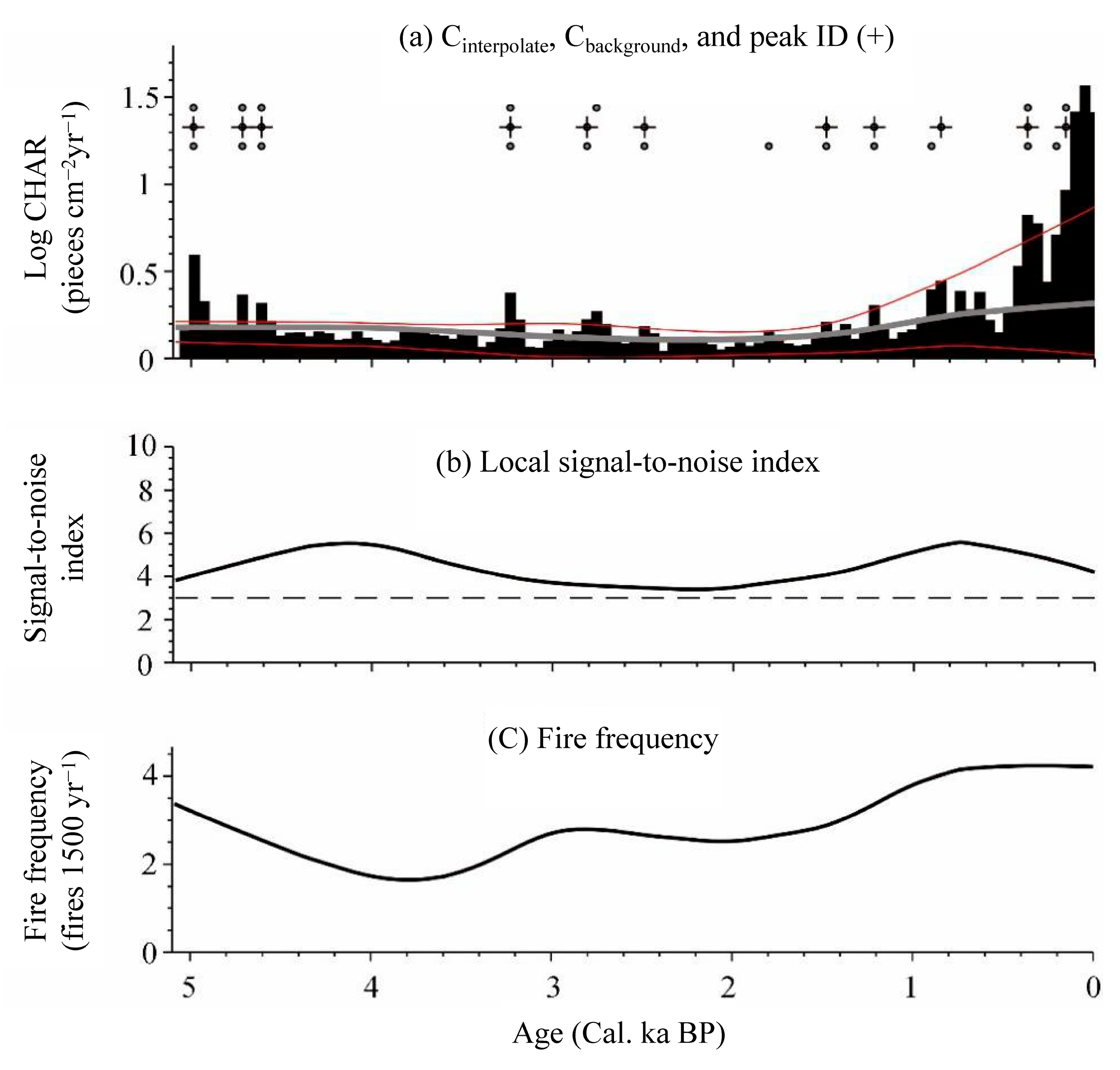
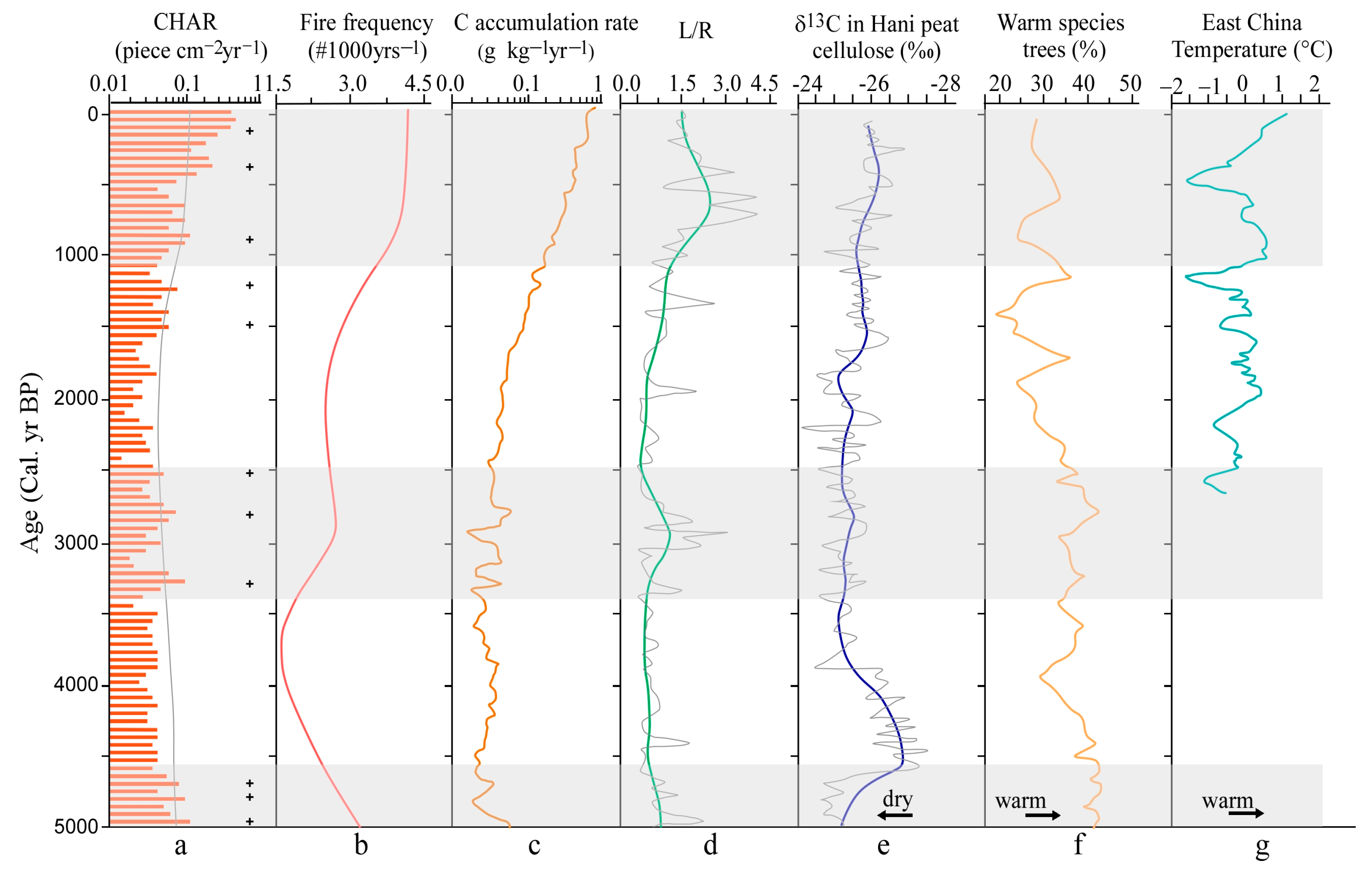
Background charcoal influx ranges from 0.107 to 0.317 particles cm−2 yr−1 (mean = 0.173) (Figure 3). CharAnalysis resolved eleven fire events (median signal-to-noise index = 4.4), yielding an average fire frequency of 3.1 events per millennium over the last 5000 years. Fire frequency accelerates after ~2000 cal yr BP and peaks around 700 cal yr BP; the largest fire event occurs at ~150 cal yr BP (Figure 4a,b). Three prominent fire intervals are identified: 5000–4600, 3400–2400, and 1500 cal yr BP–2000 AD.

4.4. Carbon Sequestration Versus Fire Regime

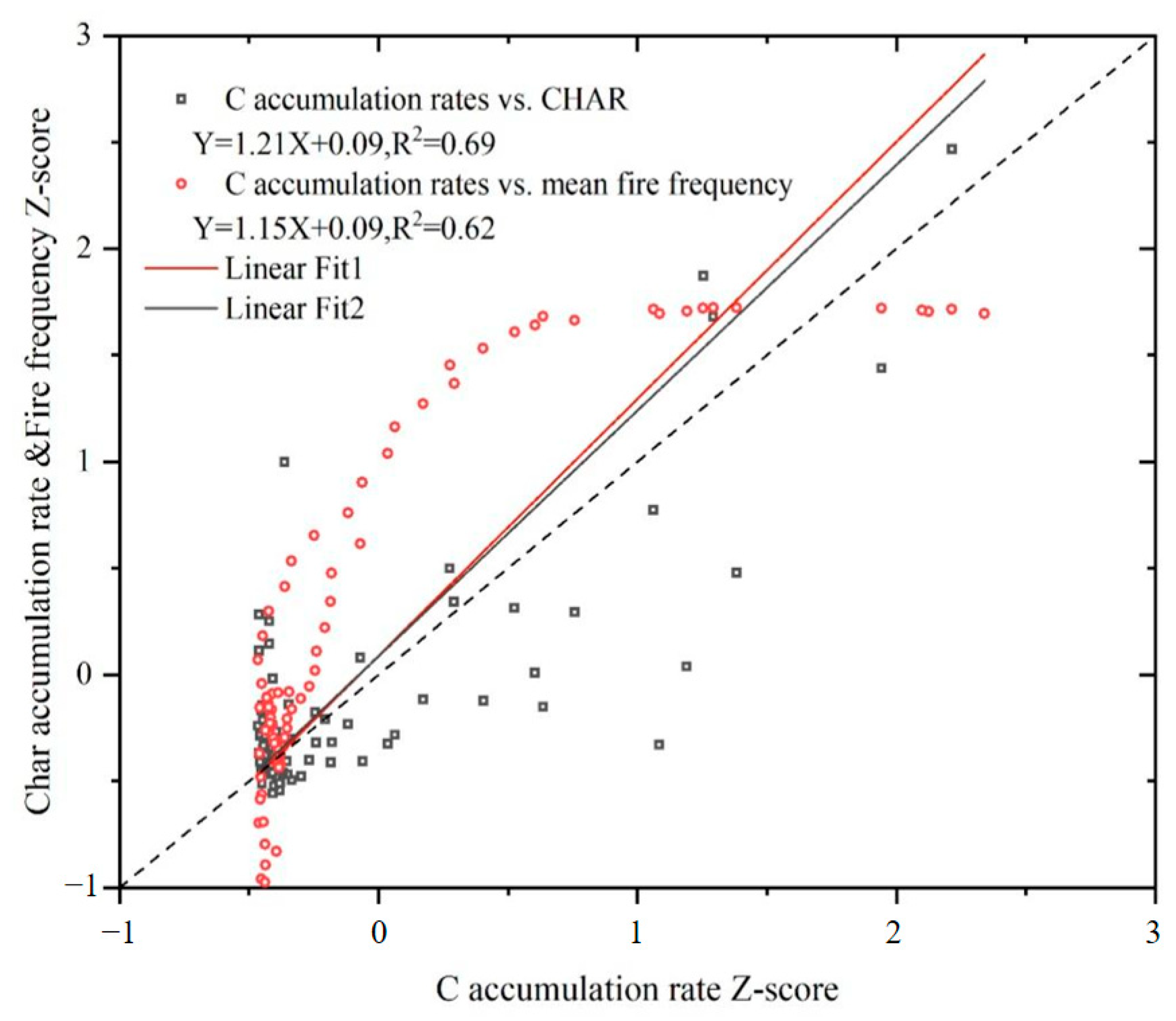
Holocene CAR spans 0.02–3.14 g kg−1 yr−1 (mean = 0.22 g kg−1 yr−1). CAR remains low and stable until ~1500 cal yr BP, thereafter increasing exponentially (Figure 4c). No detectable long-term decay trend is observed for the interval 5200–1500 cal yr BP. Linear regression shows significant positive relationships between (i) fire frequency and CAR (p < 0.01) and (ii) fire magnitude (peak charcoal) and CAR (p < 0.01) (Figure 5), indicating that frequent and/or intense fires have enhanced carbon sequestration in this wetland over the last five millennia.

5. Discussion

5.1. Wetland Fire History

Macro-charcoal (>125 µm), formed through the incomplete combustion of vegetation, reliably archives local fire events and concurrently tracks long-term vegetation composition [25,26,27]. In wetland stratigraphy, charcoal input is routinely quantified as the charcoal accumulation rate (CHAR; pieces cm−2 yr−1) and is interpreted as an index of fire intensity [28,29,30]. Relative to other sedimentary environments, wetland charcoal source areas are comparatively simple: fragments either settle in situ or arrive via short-range atmospheric deposition during the fire episode itself [31]. Travel distance is governed by injection height, fire intensity, burn type, wind speed, and local topography, with larger particles generally falling closer to the burn than smaller ones [32,33]. Peaks in macro-charcoal (>125 µm) thus register “local” fires occurring within 500–1000 m of the coring site. Once emplaced in a water-logged wetland, charcoal is seldom remobilised and is preserved essentially in place [34]. Consequently, the background influx of large-particle charcoal chiefly reflects local burning, while pronounced peaks chart the evolving history of fire activity [35]; we therefore regard macro-charcoal (>125 µm) enumeration as a robust approach for reconstructing wetland fire regimes.
Applying charcoal data within the CharAnalysis 1.1 framework, we have reconstructed a 5000-year fire history for the DFH wetland on the middle left bank of the Ussuri River and have extracted both local fire intensity and fire frequency. Over the past five millennia, wetland fire frequency has remained broadly low, yet three high-fire stages are clearly resolved from CHAR and fire-frequency curves (Figure 4). Earlier work demonstrates that forest-fire frequency typically increases during periods of elevated summer temperature and sunshine and declines under colder climate states [36,37]. However, marked disparities exist between forest and wetland fire regimes, stemming not only from differences in the sedimentary archives of lakes versus marshes but also from potentially divergent sensitivities of fire drivers to climatic variables. In forested landscapes, climate principally regulates fire onset through summer drought events triggered by shifts in temperature, precipitation, and wind speed [37]. In wetlands, water-level fluctuations and vegetation composition changes induced by climate variability exert an equally critical influence on fire occurrence [13]. A full understanding of paleo-fire controls in the study area must therefore integrate these wetland-specific factors.
The DFH wetland exhibits a long-term mean fire frequency of ~3.1 events per 1000 yr, with a discernible upward trend from the base of the record to the present. To assess climatic influences on charcoal deposition and fire regimes, we compared our data with regional precipitation and temperature reconstructions derived from nearby speleothem proxies and pollen records. As shown in Figure 4, the two prominent fire-rich intervals (~5000–4500 and ~3400–2400 cal yr BP) align closely with warm, dry climatic signatures preserved in cave and lake sediments [38,39], corroborating the view that reduced precipitation coupled with rising temperature fosters fire-conducive conditions. Conversely, two intervals of suppressed fire activity (~3800 and ~2000 cal yr BP) coincide with cooler, wetter climate phases, further supporting warmth–aridity as a key driver of fire occurrence. From ~1500 cal yr BP to the present, CHAR and fire frequency climb steadily and reach values substantially higher than any earlier period, yet pollen spectra of thermophilous arboreal taxa and indices of East Asian summer monsoon strength show no equivalent upward trend [40]. As the anthropogenic population expanded after ~1200 cal yr BP across the Sanjiang Plain, wetland ecosystems became progressively subject to human disturbance [17]. We therefore hypothesize that increasing population density and intensified land-use activities in northeast China since ~1000 cal yr BP have contributed to elevated fire frequency and severity, particularly within the last 400 years. Superimposed upon human forcing, temperature-driven water-level fluctuations may enlarge the exposure of dry fuels and enhance fuel connectivity, further amplifying fire potential.
Beyond modulating water levels, long-term climate variability can steer marsh-fire occurrence by reshaping vegetation cover and hence fuel continuity. The two high-frequency fire phases centred at ~2900 and ~500 cal yr BP correspond to elevated L/R ratios, implying that fires proliferated when herbaceous vegetation dominated the wetland. Across the low-lying marshes of the Sanjiang Plain, plant zonation typically progresses from Carex appendiculata and C. meyeriana in the centre, through C. lasiocarpa, C. pseudo-curaica, to Deyeuxia angustifolia at the margin. D. angustifolia, which colonies depressions and riparian edges, is particularly flammable; under ignition-prone weather, such herbaceous swards burn readily. Although persistent tree cover can facilitate fire spread, dense herbaceous stands at intermediate water-table heights are more combustible than woody vegetation. Vegetation type must therefore be regarded as a critical factor governing fire regimes in swampy wetlands.

5.2. Fire Regimes and Wetland Soil Organic Carbon

Regression analysis reveals a significant positive relationship between both fire frequency and charcoal accumulation rate (CHAR) with carbon accumulation rate (CAR) (Figure 5), implying that fire exerts a sustained, millennial-scale control on soil C sequestration in the DFH wetland. Although fire is commonly viewed as a C source via direct combustion and post-burn emissions, its impact on wetlands is qualitatively different. A stable water table impedes downward heat penetration, confining most burns to surface litter and living biomass; the sub-aqueous root zone and peat beneath remain largely intact. Consequently, the moderate fire regime documented at DFH—dominated by low-intensity surface fires—creates a distinct pathway for long-term C gain.
In herbaceous wetlands, surface fires remove above-ground biomass yet leave root systems in place. Subsequent root mortality, facilitated by soil fauna, transfers additional organic matter into the saturated horizon where slow decomposition preserves C [17]. Moreover, periodic burning enhances species diversity and stimulates primary productivity, increasing litterfall and root exudation that further augment soil C inputs [41]. Frequent, but not catastrophic, fire therefore elevates both above-ground turnover and below-ground C incorporation, driving the observed rise in CAR.
Beyond immediate biomass effects, fire-generated residues (charcoal, carbon black) contribute disproportionately to long-term C storage. These pyrogenic materials exhibit high aromaticity, low microbial degradability, and large surface areas that foster organo-mineral associations [42]. Within wetland soils they constitute the most stable C fraction, while moderate concentrations can enhance plant productivity by improving nutrient retention and soil structure, thereby increasing litter-derived C inputs [43]. Elevated aromatic C content, mirrored in our samples, signals greater biochemical stability and prolonged residence times. We conclude that wetland fires not only boost total soil C stocks but also strengthen their stability through the accumulation of fire-resistant residues, reinforcing sequestration over multi-millennial timescales.
Over the past 1200 years, gradually rising population in Heilongjiang Province has increased anthropogenic ignition pressure, a trend that accelerated markedly during the last four centuries. Repeated, controlled burning to reclaim farmland has produced anomalously high background CHAR in our record. Despite this anthropogenic overprint, the positive fire-CAR relationship persists, underscoring that even human-mediated fires continue to shape C accumulation patterns in these wetland systems.

5.3. The Future Role of Wetlands in the Carbon Cycle

This study deepens our understanding of how fire influences soil-carbon sequestration in wetlands. The documented fire regimes strongly modulate long-term carbon storage along the Ussuri River and should apply equally to other Sanjiang Plain wetlands with similar hydrological characteristics. Yet ongoing climate change and escalating human pressures are jointly reducing wetland extent, potentially altering the climate–fire–carbon feedback [37].
Northeast China—located at high latitudes in eastern Eurasia—ranks among the most climate-sensitive regions on Earth. Over the past 60 years mean temperatures have risen by 0.36 °C decade−1, almost double the national average, and climate projections indicate further intensification of warming. Higher temperatures will increase both the frequency and severity of fires while accelerating the conversion of wetlands to grasslands as water tables continue to fall. Although warming may enhance biomass production, it also heightens drought risk, forcing farmers to substitute groundwater for surface water to maintain rice yields [43]. Declining groundwater levels and reservoir storage thus indirectly drive wetland loss and degradation [44]; nevertheless, human activity remains the dominant driver of wetland shrinkage on the Sanjiang Plain [45].
Before the 1950s the plain was dominated by pristine marshy wetlands interspersed with forests and fluvial islands, and local communities relied primarily on fishing and limited mountain agriculture. Thereafter, large-scale reclamation for food production has eliminated > 80% of the original wetland area. Wetland loss rates were 38% (1976–1986), 16% (1986–1995), and 31% (1995–2005); although the rate has slowed, drainage and conversion to paddy fields continue. Extensive canal networks lower water levels and destroy perennially saturated, anaerobic horizons, accelerating decomposition of soil organic carbon and releasing greenhouse gases to the atmosphere [46]. As marsh area contracts and water levels drop, more frequent and severe fires will increasingly consume centuries of accumulated soil carbon, shifting these ecosystems from net carbon sinks to net carbon sources.

6. Conclusions

This study set out to reconstruct the 5000-year fire history of Ussuri River wetlands and to quantify the long-term influence of fire regimes on soil-carbon sequestration. Integrating high-resolution charcoal and soil organic-carbon records, we find that infrequent surface fires enhance long-term soil carbon accumulation by preserving sub-aqueous peat, stimulating root inputs and forming stable pyrogenic carbon. Fire frequency and carbon accumulation are significantly positively correlated, confirming low-severity fire as a key driver of the wetland carbon sink. However, drainage and rapid warming are lowering water tables and increasing fuel connectivity, shifting combustion from surface to depth and accelerating peat mineralization. If wetland loss continues, this region will switch from a fire-promoted carbon sink to a net atmospheric source; maintaining water levels and appropriate fire management are essential to preserve the wetland’s carbon function.

Author Contributions

Conceptualization, methodology, investigation, resources, and supervision, Z.Z.; formal analysis, software, data curation, and writing—original draft preparation, Y.Z.; writing—review and editing, X.H. All authors have read and agreed to the published version of the manuscript.

Funding

This work was supported by the Third Xinjiang Scientific Expedition Program (grant number: 2022xjkk0600).

Institutional Review Board Statement

Not applicable.

Informed Consent Statement

Not applicable.

Data Availability Statement

The data presented in this study are available on request from the corresponding author. The data are not publicly available due to privacy concerns.

Conflicts of Interest

The authors declare that they do not have any commercial or associative interest that represents a conflict of interest in connection with the work submitted.

References

  1. Randerson, J.T.; Liu, H.; Flanner, M.G.; Chambers, S.D.; Jin, Y.; Hess, P.G.; Pfister, G.; Mack, M.; Treseder, K.; Welp, L. The impact of boreal forest fire on climate warming. Science 2006, 314, 1130–1132. [Google Scholar] [CrossRef]
  2. Knicker, H. How does fire affect the nature and stability of soil organic nitrogen and carbon? A review. Biogeochemistry 2007, 85, 91–118. [Google Scholar] [CrossRef]
  3. Wiedinmyer, C.; Quayle, B.; Geron, C.; Belote, A.; Mckenzie, D.; Zhang, X.; O’neill, S.; Wynne, K.K. Estimating emissions from fires in North America for air quality modeling. Atmos. Environ. 2006, 40, 3419–3432. [Google Scholar] [CrossRef]
  4. Oluwole, F.A.; Sambo, J.M.; Sikhalazo, D. Long-term effects of different burning frequencies on the dry savannah grassland in South Africa. Afr. J. Agric. Res. 2008, 3, 147–153. [Google Scholar]
  5. Hatten, J.; Zabowski, D. Changes in soil organic matter pools and carbon mineralization as influenced by fire severity. Soil Sci. Soc. Am. J. 2009, 73, 262–273. [Google Scholar] [CrossRef]
  6. Bremer, D.J.; Ham, J.M. Net carbon fluxes over burned and unburned native tallgrass prairie. Rangel. Ecol. Manag. 2010, 63, 72–81. [Google Scholar] [CrossRef]
  7. Werf, G.; Randerson, J.T.; Giglio, L.; Collatz, G.J.; Kasibhatla, P.S.; Arellano, A.F., Jr. Interannual variability in global biomass burning emissions from 1997 to 2004. Atmos. Chem. Phys. 2006, 6, 3423–3441. [Google Scholar] [CrossRef]
  8. Kaye, J.P.; Romanyà, J.; Vallejo, V.R. Plant and soil carbon accumulation following fire in Mediterranean woodlands in Spain. Oecologia 2010, 164, 533–543. [Google Scholar] [CrossRef]
  9. Jobbágy, E.G.; Jackson, R.B. The vertical distribution of soil organic carbon and its relation to climate and vegetation. Ecol. Appl. 2000, 10, 423–436. [Google Scholar] [CrossRef]
  10. Fernández, I.; Cabaneiro, A.; Carballas, T. Carbon mineralization dynamics in soils after wildfires in two Galician forests. Soil Biol. Biochem. 1999, 31, 1853–1865. [Google Scholar] [CrossRef]
  11. Gao, C.; Wang, G.; Cong, J.; Freeman, C.; Jiang, M.; Qin, L. High intensity fire accelerates accumulation of a stable carbon pool in permafrost peatlands under climate warming. CATENA 2023, 227, 107108. [Google Scholar] [CrossRef]
  12. Gordon, C.E.; Bendall, E.R.; Stares, M.G.; Collins, L.; Bradstock, R.A. Aboveground carbon sequestration in dry temperate forests varies with climate not fire regime. Glob. Change Biol. 2018, 24, 4280–4292. [Google Scholar] [CrossRef]
  13. Van Bellen, S.; Garneau, M.; Ali, A.A.; Bergeron, Y. Did fires drive Holocene carbon sequestration in boreal ombrotrophic peatlands of eastern Canada? Quat. Res. 2012, 78, 50–59. [Google Scholar] [CrossRef]
  14. An, Z. The history and variability of the East Asian paleomonsoon climate. Quat. Sci. Rev. 2000, 19, 171–187. [Google Scholar] [CrossRef]
  15. Zhang, Z.; Yao, Q.; Liu, K.b.; Xu, Q.; Wang, G. Hydrological regime responses to Holocene East Asian summer monsoon circulation in marshes of the Sanjiang Plain, NE China. Land Degrad. Dev. 2020, 31, 240–250. [Google Scholar] [CrossRef]
  16. Shi, Y.; Shen, Y.; Kang, E.; Li, D.; Ding, Y.; Zhang, G.; Hu, R. Recent and future climate change in northwest China. Clim. Change 2007, 80, 379–393. [Google Scholar] [CrossRef]
  17. Cong, J.; Gao, C.; Zhang, Y.; Zhang, S.; He, J.; Wang, G. Dating the period when intensive anthropogenic activity began to influence the Sanjiang Plain, Northeast China. Sci. Rep. 2016, 6, 22153. [Google Scholar] [CrossRef] [PubMed]
  18. Tan, Z.; Huang, C.; Pang, J.; Ding, M. Wildfire history and human land use over Weihe River Basin since Holocene: Evidence from charcoal records. J. Jilin Univ. Earth Sci. Ed. 2014, 44, 1297–1306. [Google Scholar]
  19. Higuera, P.E.; Brubaker, L.B.; Anderson, P.M.; Hu, F.S.; Brown, T.A. Vegetation mediated the impacts of postglacial climate change on fire regimes in the south-central Brooks Range, Alaska. Ecol. Monogr. 2009, 79, 201–219. [Google Scholar] [CrossRef]
  20. Marguerie, D.; Krause, T.R.; Whitlock, C. What was burning in the past? Charcoal identifications supplement an early-Holocene fire-history reconstruction in Yellowstone National Park, USA. Quat. Int. 2021, 20, 593–594. [Google Scholar] [CrossRef]
  21. Petra, A.; Istrate, D. The comparative use of charcoal frequency, area and morphology to reconstruct fire history in a late Holocene peat sequence from NW Romania. Mires Peat 2023, 29, 11. [Google Scholar] [CrossRef]
  22. Cui, Q.; Gaillard, M.J.; Vannière, B.; Colombaroli, D.; Lemdahl, G.; Olsson, F.; Benito, B.; Zhao, Y. Evaluating fossil charcoal representation in small peat bogs: Detailed holocene fire records from southern sweden. Holocene 2020, 30, 1540–1551. [Google Scholar] [CrossRef]
  23. Umbanhowar, C.E., Jr.; Mcgrath, M.J. Experimental production and analysis of microscopic charcoal from wood, leaves and grasses. Holocene 1998, 8, 341–346. [Google Scholar] [CrossRef]
  24. Zhang, J.; Lv, H. Preliminary study of charcoal morphology and its environmental significance. Quat. Sci. 2006, 26, 857–863. [Google Scholar]
  25. Millspaugh, S.H.; Whitlock, C. A 750-year fire history based on lake sediment records in central Yellowstone National Park, USA. Holocene 1995, 5, 283–292. [Google Scholar] [CrossRef]
  26. Glasspool, I.J.; Edwards, D.; Axe, L. Charcoal in the Early Devonian: A wildfire-derived Konservat–Lagerstätte. Rev. Palaeobot. Palynol. 2006, 142, 131–136. [Google Scholar] [CrossRef]
  27. Scott, A.C. Charcoal recognition, taphonomy and uses in palaeoenvironmental analysis. Palaeogeogr. Palaeoclimatol. Palaeoecol. 2010, 291, 11–39. [Google Scholar] [CrossRef]
  28. Huang, C.; Pang, J.; Su, H.; Han, J.; Cao, Y.; Zhao, W.; Tan, Z. Charcoal records of fire history in the Holocene loess–soil sequences over the southern Loess Plateau of China. Palaeogeogr. Palaeoclimatol. Palaeoecol. 2006, 239, 28–44. [Google Scholar] [CrossRef]
  29. Jiang, W.; Leroy, S.A.; Ogle, N.; Chu, G.; Wang, L.; Liu, J. Natural and anthropogenic forest fires recorded in the Holocene pollen record from a Jinchuan peat bog, northeastern China. Palaeogeogr. Palaeoclimatol. Palaeoecol. 2008, 261, 47–57. [Google Scholar] [CrossRef]
  30. Wang, X.; Ding, Z. Changes in fire regimes on the Chinese Loess Plateau since the last glacial maximum and implications for linkages to paleoclimate and past human activity. Palaeogeogr. Palaeoclimatol. Palaeoecol. 2012, 315, 61–74. [Google Scholar] [CrossRef]
  31. Markgraf, V.; Huber, U.M. Late and postglacial vegetation and fire history in Southern Patagonia and Tierra del Fuego. Palaeogeogr. Palaeoclimatol. Palaeoecol. 2010, 297, 351–366. [Google Scholar] [CrossRef]
  32. Clark, J.S. Particle motion and the theory of charcoal analysis: Source area, transport, deposition, and sampling. Quat. Res. 1988, 30, 67–80. [Google Scholar] [CrossRef]
  33. Tinner, W.; Hofstetter, S.; Zeugin, F.; Conedera, M.; Wohlgemuth, T.; Zimmermann, L.; Zweifel, R. Long-distance transport of macroscopic charcoal by an intensive crown fire in the Swiss Alps-implications for fire history reconstruction. Holocene 2006, 16, 287–292. [Google Scholar] [CrossRef]
  34. Rhodes, A.N. Moorland Fire History from Microscopic Charcoal in Soils and Lake Sediments. Ph.D. Thesis, Newcastle University, Newcastle upon Tyne, UK, 1996. [Google Scholar]
  35. Clark, J.; Richard, P. The role of paleofire in boreal and other cool-coniferous forests. In Fire in Ecosystems of Boreal Eurasia; Springer: Dordrecht, The Netherlands, 1996; pp. 65–89. [Google Scholar]
  36. Ali, A.A.; Carcaillet, C.; Bergeron, Y. Long-term fire frequency variability in the eastern Canadian boreal forest: The influences of climate vs. local factors. Global Change Biol. 2009, 15, 1230–1241. [Google Scholar] [CrossRef]
  37. Hély, C.; Girardin, M.P.; Ali, A.A.; Carcaillet, C.; Brewer, S.; Bergeron, Y. Eastern boreal North American wildfire risk of the past 7000 years: A model-data comparison. Geophys. Res. Lett. 2010, 37, L14709. [Google Scholar] [CrossRef]
  38. Bergeron, Y.; Cyr, D.; Girardin, M.P.; Carcaillet, C. Will climate change drive 21st century burn rates in Canadian boreal forest outside of its natural variability: Collating global climate model experiments with sedimentary charcoal data. Int. J. Wildland Fire 2010, 19, 1127–1139. [Google Scholar] [CrossRef]
  39. Hong, Y.; Jiang, H.; Liu, T.; Zhou, L.; Beer, J.; Li, H.; Leng, X.; Hong, B.; Qin, X. Response of climate to solar forcing recorded in a 6000-year δ18O time-series of Chinese peat cellulose. Holocene 2000, 10, 1–7. [Google Scholar] [CrossRef]
  40. Li, C.; Wu, Y.; Hou, X. Holocene vegetation and climate in Northeast China revealed from Jingbo Lake sediment. Quat. Int. 2011, 229, 67–73. [Google Scholar] [CrossRef]
  41. Zhao, H.; Tong, D.Q.; Lin, Q.; Lu, X.; Wang, G. Effect of fires on soil organic carbon pool and mineralization in a Northeastern China wetland. Geoderma 2012, 189, 532–539. [Google Scholar] [CrossRef]
  42. Turetsky, M.R.; Benscoter, B.; Page, S.; Rein, G.; Van Der Werf, G.R.; Watts, A. Global vulnerability of peatlands to fire and carbon loss. Nat. Geosci. 2015, 8, 11–14. [Google Scholar] [CrossRef]
  43. Wang, X.; Zhang, G.; Xu, Y.J.; Sun, G. Identifying the regional-scale groundwater-surface water interaction on the Sanjiang Plain, Northeast China. Environ. Sci. Pollut. Res. Int. 2015, 22, 16951–16961. [Google Scholar] [CrossRef] [PubMed]
  44. Wang, H.; Richardson, C.J.; Ho, M. Dual controls on carbon loss during drought in peatlands. Nat. Clim. Change 2015, 5, 584–587. [Google Scholar] [CrossRef]
  45. Song, K.; Wang, Z.; Du, J.; Liu, L.; Zeng, L.; Ren, C. Wetland degradation: Its driving forces and environmental impacts in the Sanjiang Plain, China. Environ. Manag. 2014, 54, 255–271. [Google Scholar] [CrossRef] [PubMed]
  46. Song, C.; Xu, X.; Tian, H.; Wang, Y. Ecosystem–atmosphere exchange of CH4 and N2O and ecosystem respiration in wetlands in the Sanjiang Plain, Northeastern China. Global Change Biol. 2009, 15, 692–705. [Google Scholar] [CrossRef]
Figure 1. Digital map of the Sanjiang Plain geography; the sampling site (DFH, red dot) lies in the centre of an undisturbed marsh on the west bank of the Ussuri River.
Atmosphere 16 01322 g001
Figure 2. (a) Age-depth model, (b) chronological framework (The red line indicates the optimal fitted age-deep model; the black shading represents the model uncertainty envelope; the blue points show the calibrated radiometric dates used to constrain the model.), and variations of (c) accumulating rate, (d) charcoal concentration profile, and (e) L/R ratio for core DFH.
Atmosphere 16 01322 g002
Figure 3. (a) CHAR sequences with Cback (thick grey) and threshold (thin red); fire events marked by “+”; Grey dots: insignificant charcoal peaks; (b) local signal-to-noise index; (c) inferred fire frequency.
Atmosphere 16 01322 g003
Figure 4. (a) Holocene CHAR with Cback (thick grey) and fire events (“+”); (b) fire frequency (Cpeak per 1 kyr); (c) C accumulation rate; (d) charcoal L/R ratio with the raw data and five-point moving average marked in thin black and green lines, respectively; (e) δ13C of Hani peat cellulose used as a proxy of East Asian summer monsoon variation, with its raw data and five-point moving average marked in thin black and blue lines, respectively; (f) warm-tree pollen percentage; (g) East China temperature history.
Atmosphere 16 01322 g004
Figure 5. Regression analyses of CAR against fire regimes: CAR vs. mean fire frequency (red) and CAR vs. CHAR (grey). The dashed line indicate the absolutely strong relationship between C accumulation rates and mean fire frequency. The dashed line highlights an exceptionally strong correlation between carbon accumulation rates and mean fire frequency.
Atmosphere 16 01322 g005
Disclaimer/Publisher’s Note: The statements, opinions and data contained in all publications are solely those of the individual author(s) and contributor(s) and not of MDPI and/or the editor(s). MDPI and/or the editor(s) disclaim responsibility for any injury to people or property resulting from any ideas, methods, instructions or products referred to in the content.