


Abstract
Previous studies have suggested that Earth’s annual cycle of modern climate provides information relevant to orbital-scale climate variability, since both are driven by solar insolation changes determined by orbital geometry. However, there has been no systematic assessment of the climate response to annual-scale insolation changes in climate models, leading to large uncertainty in orbital-scale simulation. In this study, we evaluate the Northern Hemisphere land surface air temperature response to the annual insolation cycle in the Coupled Model Intercomparison Project Phase 6 (CMIP6) models. A polynomial transfer framework reveals that CMIP6 models broadly capture the observed 20–30-day lag between insolation and temperature, indicating realistic land thermal inertia. However, CMIP6 models consistently overestimate temperature sensitivities to insolation, with particularly strong biases over mid-latitude and high-latitude regions in summer and winter, respectively. Applying the annual-scale polynomial transfer framework to the middle Holocene (~6000 years ago) shows that models with the highest sensitivity simulate significantly larger seasonal temperature anomalies than the lowest-sensitivity models, underscoring the impact of modern biases on orbital-scale paleoclimate simulations. The results highlight systematic overestimation of temperature–insolation sensitivity in CMIP6 models, emphasizing the importance of constraining seasonal sensitivity for robust orbital-scale climate modeling.
1. Introduction
One of the most prominent features of Earth’s climate is its distinct annual cycle, which arises directly from the geometry of Earth’s orbit around the Sun [1,2,3]. In the present-day orbital configuration, at the summer solstice (~20–22 June), the subsolar point lies on the Tropic of Cancer and the Northern Hemisphere receives its annual maximum solar insolation; at the winter solstice (~21–23 December), when the subsolar point is on the Tropic of Capricorn, insolation in the Northern Hemisphere reaches its annual minimum. These variations produce strong seasonal contrasts in energy input and temperature, giving rise to the well-known climatic differences between hot boreal summers and cold boreal winters.
On geological timescales, Earth’s orbit undergoes quasi-periodic variations described by three parameters: eccentricity (~100 ka period), obliquity (~41 ka period), and precession (~19–23 ka period) [4,5]. Eccentricity modulates the difference in Sun–Earth distance between perihelion and aphelion; obliquity controls the contrast in seasonal insolation between hemispheres, strongly influencing high-latitude seasonality and the growth and decay of ice sheets; and precession determines the timing of perihelion and aphelion relative to the seasons, thereby shifting the seasonal cycle in phase. While eccentricity has only a weak direct effect on annual mean insolation, it amplifies the climatic impact of precession by altering seasonal contrasts [6]. Together, these orbital parameters form the fundamental template for Earth’s seasonal distribution of insolation. Over the past million years, Earth’s climate has exhibited strong pacing with these orbital-scale variations, most clearly expressed in the 100-ka glacial–interglacial cycles preserved in marine sediments, ice cores, and speleothems [7,8,9,10]. In addition, many low-latitude climate records, particularly those related to monsoon variability, exhibit a pronounced ~20-ka periodicity that is phase-locked to precession, underscoring the strong sensitivity of tropical and subtropical climates to seasonal shifts in insolation [11,12,13,14].
Since both the modern annual cycle and orbital-scale climate change are driven by insolation variations arising from orbital geometry, their dynamics are inherently linked [1,3]. Laepple and Lohmann [1] proposed that the present-day seasonal response of the climate system to insolation provides a “template” for interpreting the climate’s sensitivity to orbital forcing. They demonstrated that the latitudinal patterns of amplitude and phase in surface temperature responses to modern seasonal forcing resemble those seen under orbital forcing in paleoclimate simulations. Moreover, complex climate feedbacks, such as the high-latitude ice–albedo feedback and the cloud feedback associated with tropical monsoon systems, can amplify seasonal insolation changes even when changes in the annual mean insolation are negligible [15,16,17,18,19,20,21].
Climate models are indispensable tools for testing such hypotheses, as paleoclimate proxy records are often spatially sparse, temporally coarse, and restricted to a limited set of variables (e.g., temperature and precipitation). However, despite the importance of the orbitally driven fingerprint in both modern and past climate dynamics [22,23,24], there has been no systematic evaluation of how well current climate models reproduce its key characteristics, particularly the amplitude and phase of temperature responses to annual insolation changes. Such an evaluation is crucial because models that fail to capture the processes and feedbacks governing today’s seasonal cycle are likely to misrepresent climate responses to orbital-scale forcing. In this study, we present a systematic assessment of Northern Hemisphere land surface temperature responses to the seasonal cycle of solar insolation in the Coupled Model Intercomparison Project Phase 6 (CMIP6) models. We quantify the amplitude and phase biases relative to reanalysis data and discuss the implications of these biases for simulating climate responses to orbital forcing in paleoclimate contexts.
2. Data and Methods
Daily surface air temperature and downward shortwave flux at the top-of-atmosphere (TOA) (i.e., integrated solar radiation mainly over 0.2–4 µm, referred to as shortwave compared to the Earth’s longwave radiation) data are obtained from the NCEP2/DOE reanalysis [25] and historical simulations of 41 CMIP6 models (Table 1). The ERA5 reanalysis is also used in comparison with the result derived from NCEP2/DOE reanalysis. We analyze the climatological annual cycle over the period of 1980–2014, with leap days removed. All datasets are interpolated to a uniform horizontal resolution of 2° × 2°.
Table 1.
Information on CMIP6 climate models used in this study.
To better illustrate the method used to quantify the annual-scale relationship between local surface air temperature and solar insolation, we apply the approach of Laepple and Lohmann [1] to a representative region (45–50° N, 130–140° E) as an example. The insolation–temperature relationship is described by a third-order polynomial fit:
where T is the temperature, t is the time of year, x is the location, I is the insolation, and τ is the time lag between insolation and temperature. The function F represents the polynomial transfer function between insolation and temperature.
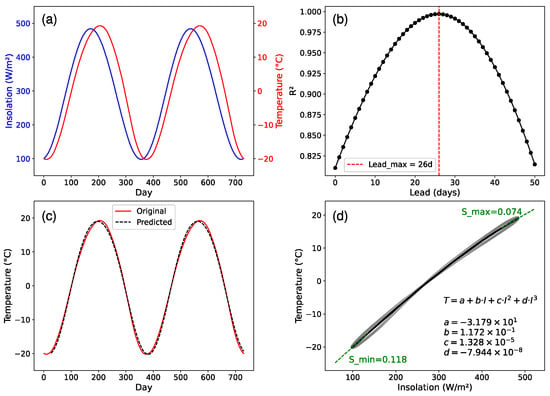
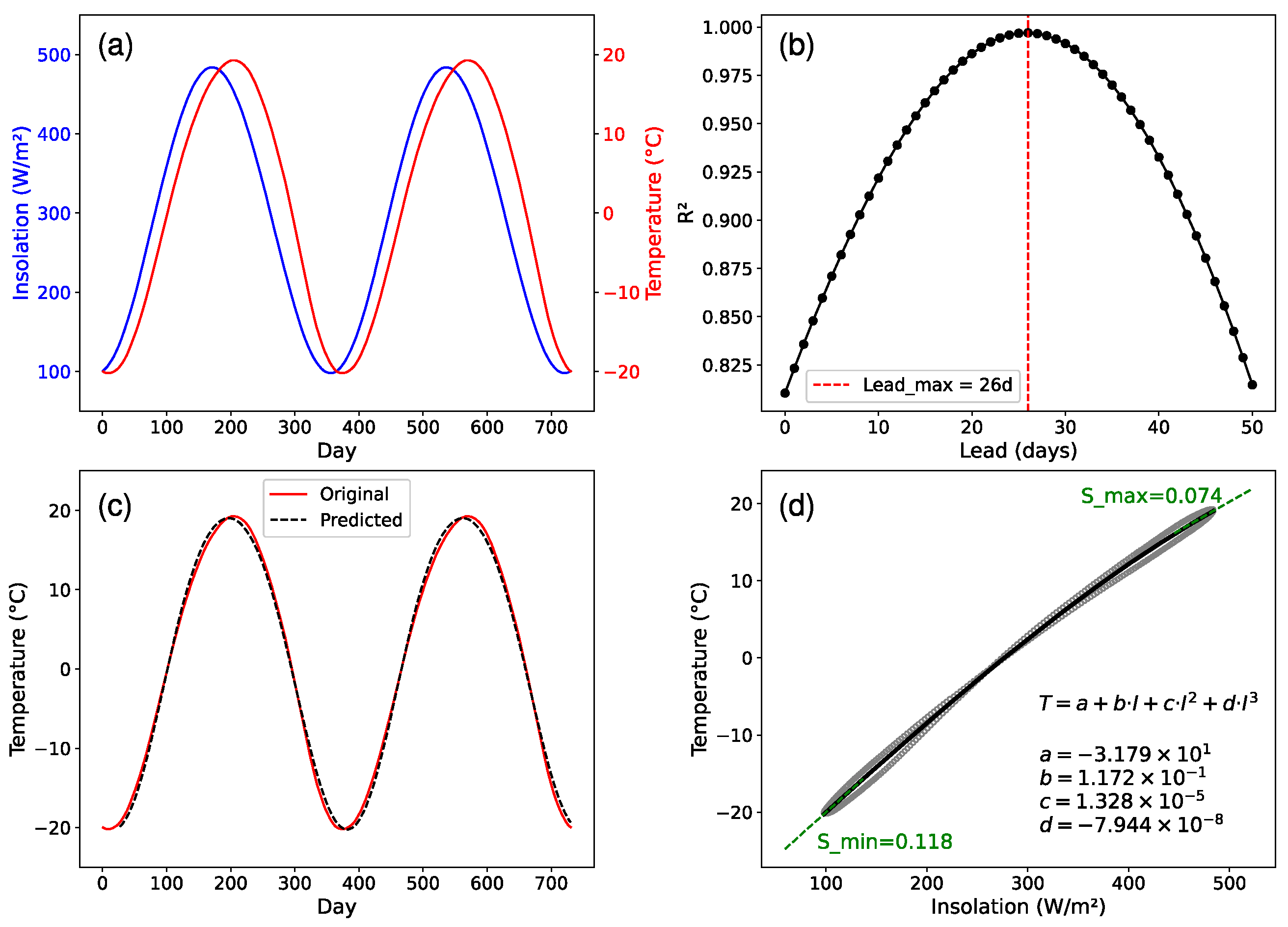
In the selected region, both temperature and insolation display a pronounced annual cycle, with insolation leading surface temperature (Figure 1a). When a third-order polynomial transfer function F (Equation (1)) is applied, the highest explained variance (R2) reaches over 0.99, occurring when insolation leads surface temperature by ~26 days (Figure 1b). The predicted temperature derived from the transfer function reproduces the temperature cycle in NCEP/DOE with remarkable accuracy, which indicates that this function captures most insolation-induced temperature annual cycles (Figure 1c). The polynomial transfer function indicates that local temperature responds nearly linearly to annual insolation variations (Figure 1d). However, it is also observed that the sensitivity of temperature to insolation varies across the insolation range. Such temperature sensitivity can be quantified by the derivatives of F at the maximum local insolation Imax and minimum local insolation Imin, which are represented as Smax and Smin respectively:
Figure 1.
Annual insolation–temperature relationship over 45–50° N and 130–140° E in NCEP2/DOE reanalysis: (a) daily insolation (in W m−2) and surface temperature (in °C) over a two-year period. (b) Lead-lag determination coefficient R2 (unitless; fraction of temperature variance explained by insolation) as a function of lag in days. (c) Original versus polynomial-predicted temperature at the optimal 26-day lag. (d) Aligned temperature plotted against insolation with a third-order polynomial fit; Smin and Smax denote the sensitivities (∂T/∂I) at the minimum and maximum insolation (green dashed lines), respectively (in °C per W m−2).
For the NH, Smax measures the temperature sensitivity to summer maximum insolation, and Smin measures that to winter minimum insolation. In the given region, we find that Smax equals 0.074 °C per W/m2, and Smin equals 0.118 °C per W/m2, which means that the local temperature is strongly winter-sensitive (Figure 1d).
3. Results
3.1. Possible Common Biases in CMIP6 Models
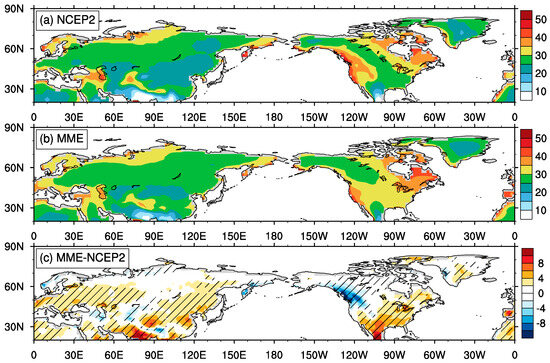
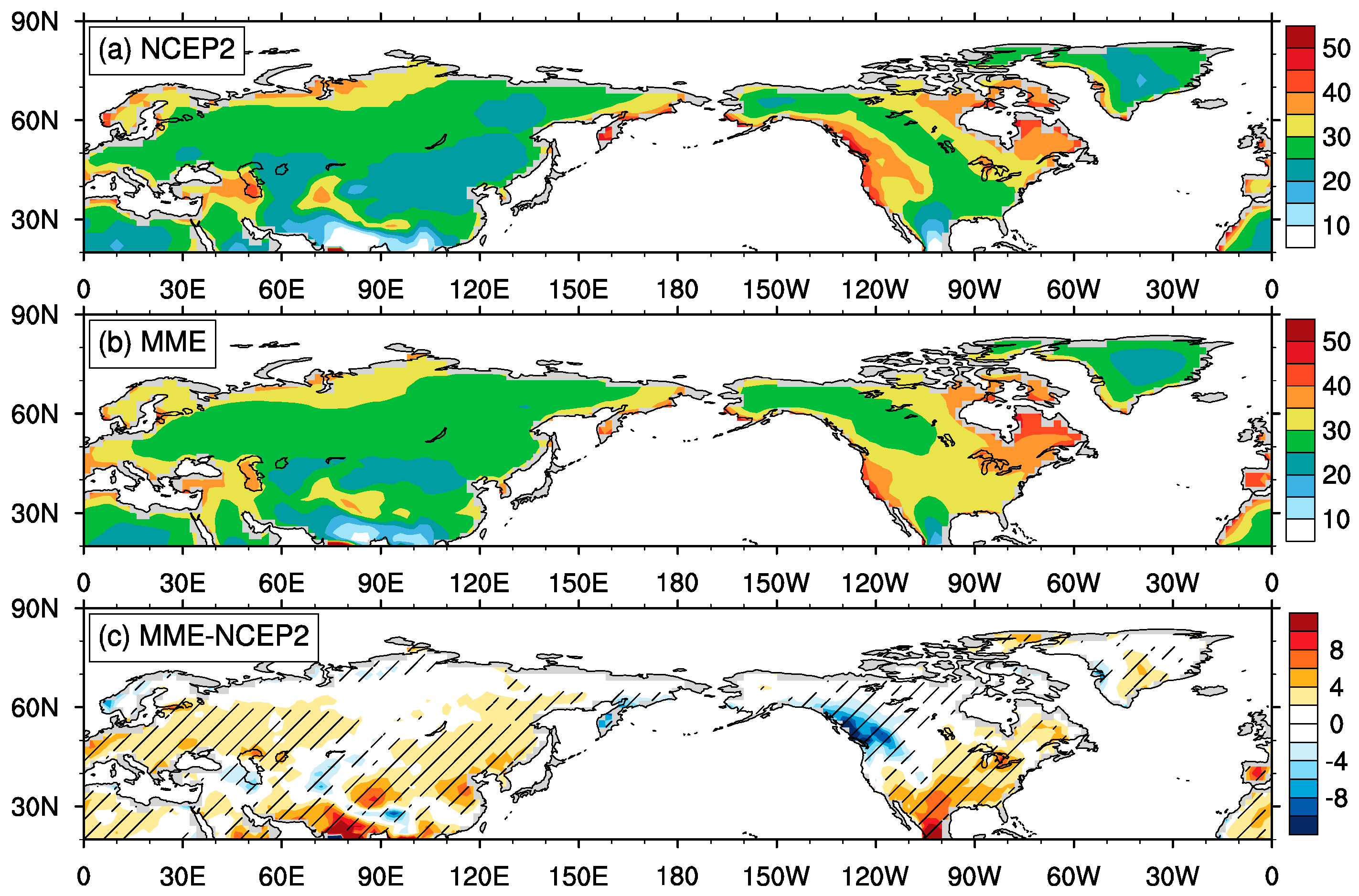
The time lag between solar insolation and surface temperature (i.e., response time) is a key aspect of insolation–temperature relationship, as it also affects the phase relationship between the Earth’s orbital forcing and climate in the paleoclimate context. In the NH land areas, the observed lag times of surface temperature range from about 20–30 days (Figure 2a); that is to say, the land surface can respond rapidly to insolation change. For example, the maximum annual insolation typically occurs around 20 June, and the warmest months are July and August. This short response time reflects the small thermal inertia of land surfaces [26,27]. At high-altitude regions, such as the southern Tibetan Plateau and Rocky Mountains, and high-latitude regions, the lag times extend to 30–40 days (Figure 2a). This slightly longer response time is likely due to the snow–albedo feedback that modify the insolation–temperature relationship there [28,29]. Meanwhile, in the low-latitude region (e.g., India), the shorter response time may be caused by the cloud–albedo feedback associated with monsoonal precipitation [30]. The CMIP6 multi-model mean (MME) generally captures the observed response times of surface temperature well, with most regions showing lag times shorter than one month (Figure 2b). The biases of lag time are typically less than 4 days. While in the regions with additional feedback processes (e.g., monsoon regions; Rocky Mountains), the biases can exceed 8 days (Figure 2c). Despite that, these results suggest that CMIP6 models have relatively small biases in simulating the response time of temperature to insolation change, which is unlikely to cause substantial phase mismatch of the orbital-scale insolation–temperature relationship.
Figure 2.
Spatial distribution of optimal lag time between temperature and insolation in annual scale: (a) NCEP2/DOE reanalysis, (b) CMIP6 MME mean, and (c) MME mean bias; slashed areas denote where more than two-thirds of the individual models agree with the MME mean bias. Units: days.
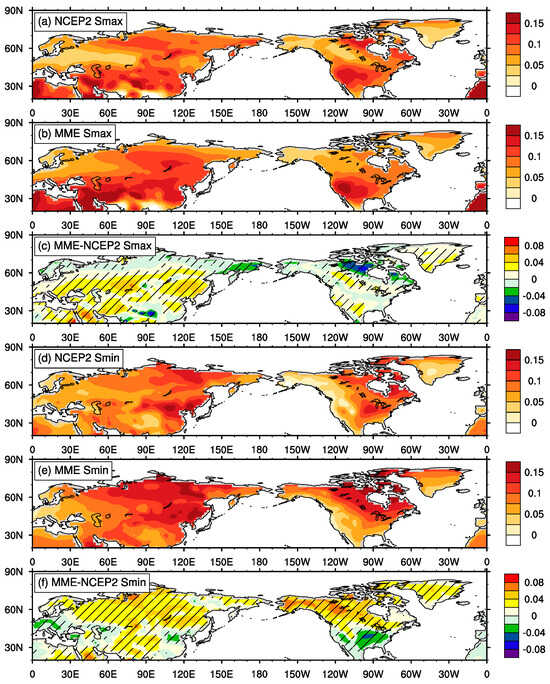
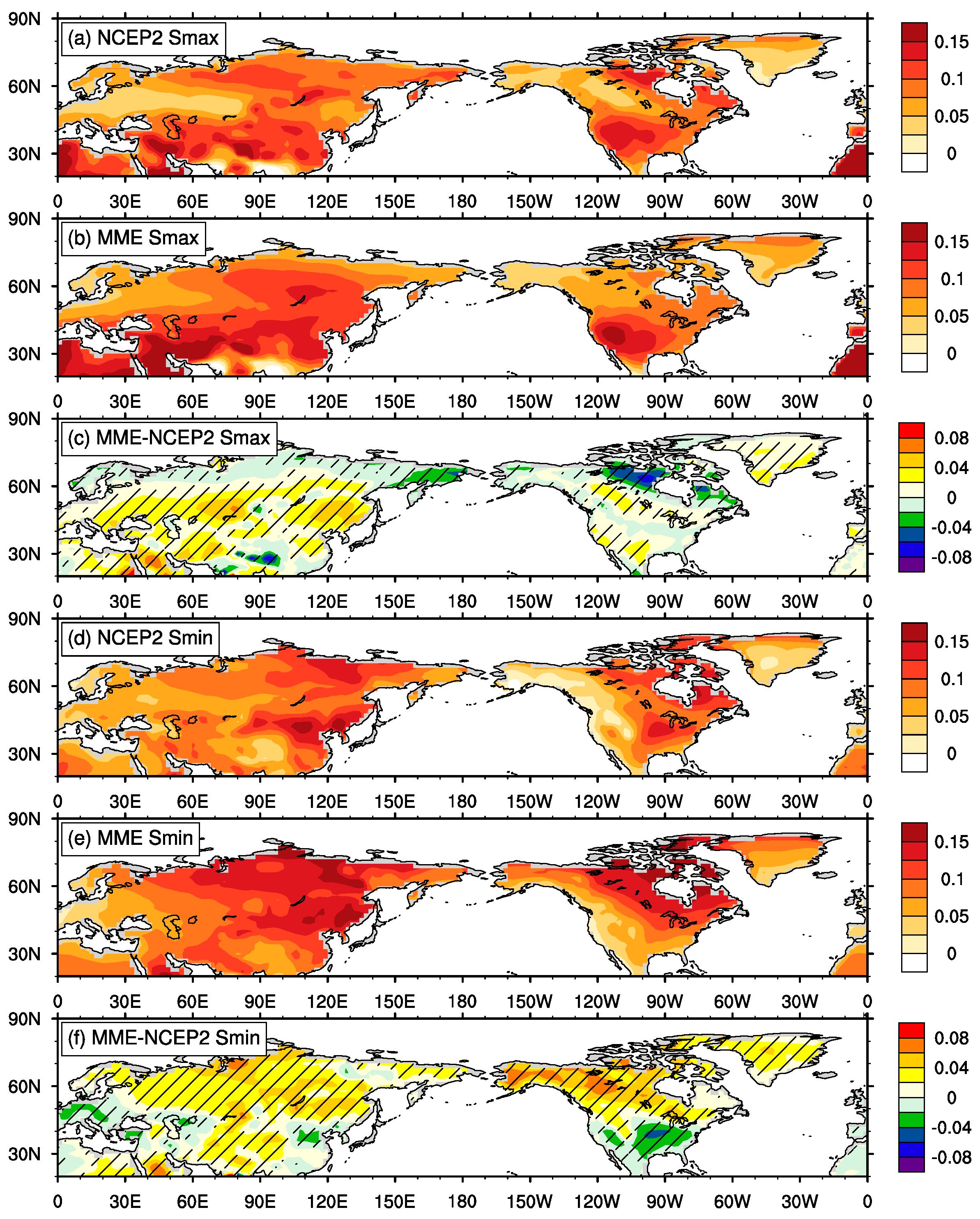
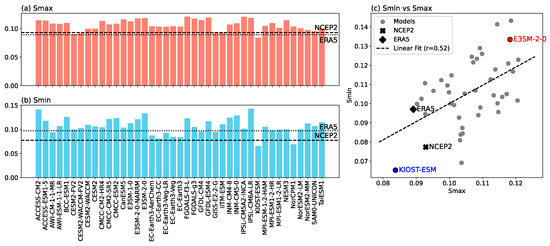
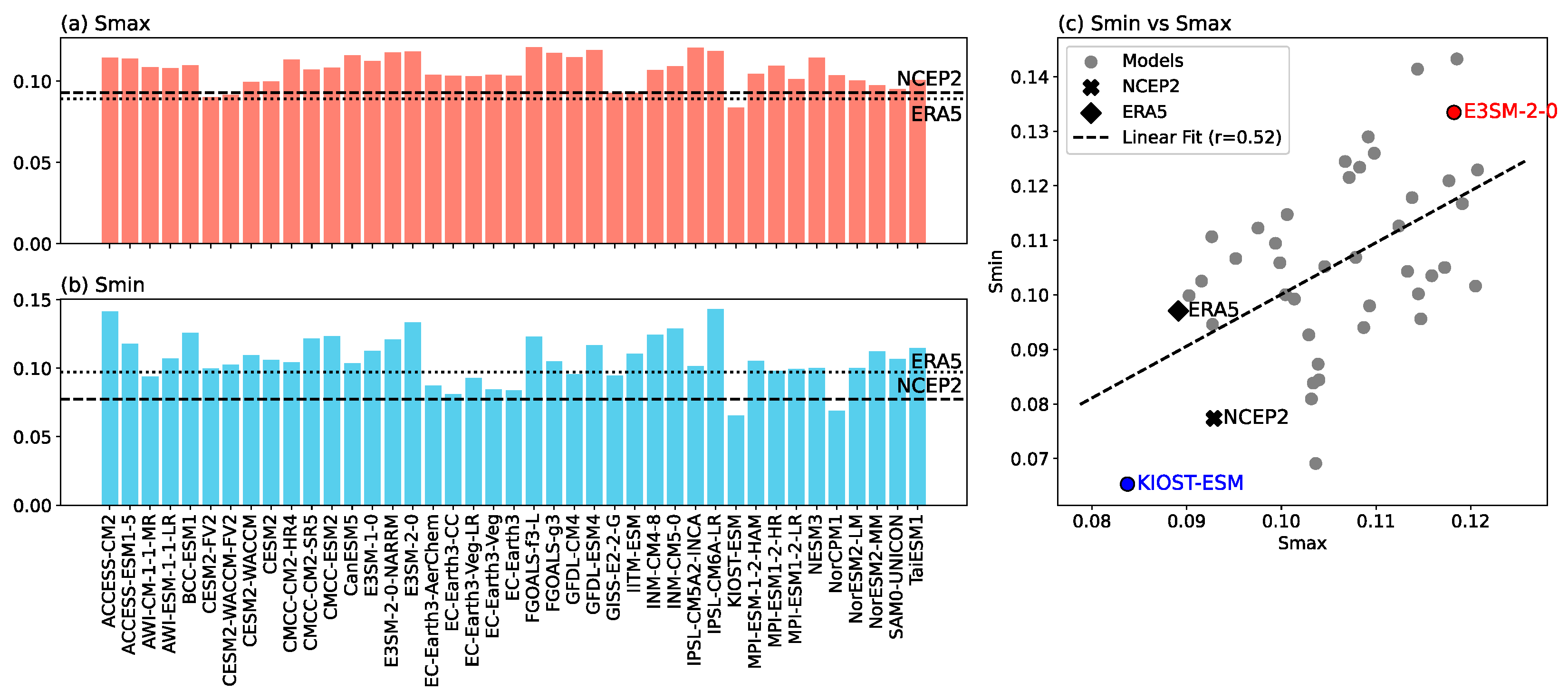
We next examine the sensitivity of NH land surface temperature to annual insolation variation. In summertime, NCEP/DOE data show that the NH continent warms by ~0.09 °C when solar insolation increases by 1 Wm−2 (Figure 3a). This summer temperature sensitivity is somewhat larger in low latitudes (greater than 0.1 °C per Wm−2). While the CMIP6 MME generally reproduces the observed spatial distribution of summer sensitivity of temperature, it overestimates values over much of Eurasian continent, especially at the middle latitudes, where biases can be as large as 50% (Figure 3b,c). This bias is not only reflected in the MME, but also across individual models. We calculate the regional mean summer sensitivity over 20–60° N over NH land areas, and the results indicate that the majority of CMIP6 models (36 out of 41) simulate a greater summer sensitivity than observed (Figure 4a). Regarding to the winter sensitivity, the NH land cools ~0.07 °C when insolation decreases 1 Wm−2, with the sensitivity increasing towards higher latitudes, which differs from that of the summer sensitivity (Figure 3d). Although the NH mean temperature is almost linearly responsive to annual insolation change, Figure 3 implies that temperature at low latitudes is more summer-sensitive and more winter-sensitive at high latitudes. This may be attributed to the seasonal variation in high-latitude snow/ice cover. During wintertime, the extensive snow/ice cover reflects more solar insolation to affect the surface air, closely coupling the insolation and surface air temperature. Similarly to the summer sensitivity, CMIP6 MME also has an overall overestimation of winter sensitivity especially over the NH high latitudes (Figure 3e,f). For the high-latitude regional mean (50–90° N), 39 out of 41 CMIP6 models show a larger winter sensitivity than observed (Figure 4b). Therefore, the overestimation of temperature sensitivity, no matter in winter or summer, is a common bias among CMIP6 models. It is worth noting that, in addition to the generally latitude-dependent sensitivity distribution, pronounced regional features are also evident, particularly in the transition zones between low- and high-latitude regions (e.g., shown in Figure 1), implying the presence of potentially complex regional processes.
Figure 3.
Smax of (a) NCEP2/DOE reanalysis, (b) MME mean, and (c) MME mean bias; (d–f) are the same as (a–c), respectively, but for Smin. Slashed areas in (c,f) denote where more than two-thirds of the individual models agree with the MME mean bias. Units: °C per W m−2.
Figure 4.
Comparison of seasonal temperature sensitivities in CMIP6 models and reanalysis (a) Smax for CMIP6 models (bars) with the observed value (dashed line). (b) Smin for CMIP6 models (bars) with NCEP2/DOE (dashed line) and ERA5 value (dotted line). (c) Scatter plot of Smin versus Smax for CMIP6 models (dots), highlighting the NCEP2/DOE, ERA5, and KIOST-ESM and E3SM-2-0, together with linear regression line (dashed line) and correlation coefficient. Units: °C per W m−2.
It is noted that the summer and winter sensitivity among individual CMIP6 models is significantly correlated, with an inter-model correlation coefficient of 0.52 (p < 0.01) (Figure 4c). Excluding one outlier (KIOST-ESM [31]) reduces the inter-model correlation to 0.42, still significant at the 0.01 confidence level. That means models with overly strong summer responses also tend to exaggerate winter responses.
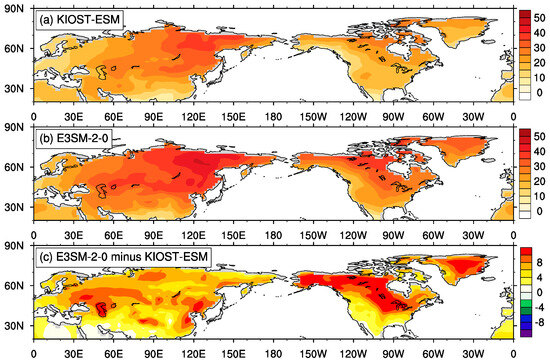
To better illustrate the implications of these biases in temperature sensitivity for simulated annual climate, we compare two models, KIOST-ESM and E3SM-2-0 [32], which exhibit the largest and most contrasting biases. In theory, if a model’s temperature sensitivity is underestimated (overestimated) during summer and winter, it will simulate a colder (warmer) summer and warmer (colder) winter, and the seasonal difference will be smaller (larger). For KIOST-ESM, summer is about 25 °C warmer than winter over NH land, while for E3SM-2-0, its summer temperature is 30 °C higher than winter, especially over NH high latitudes (Figure 5a,b). Compared with KIOST-ESM, E3SM-2-0 has an annual temperature range about 6 °C larger (Figure 5c). Since subtracting winter from summer temperature largely removes the greenhouse gas effect, these large discrepancies in the annual temperature range are mainly attributable to differences in temperature sensitivity to insolation rather than to greenhouse gases.
Figure 5.
Summer minus winter surface air temperature in (a) KIOST-ESM, (b) E3SM-2-0 and (c) their difference (E3SM-2-0 minus KIOST-ESM). Units: °C.
Overall, the comparison between KIOST-ESM and E3SM-2-0 clearly demonstrates that the CMIP6 models have substantial uncertainties in simulating the annual temperature cycle, largely related to their biases in temperature sensitivity to annual insolation variations. Such biases further raise concerns about the reliability of orbital-scale climate simulations with these models.
3.2. Implication for Middle Holocene Simulation
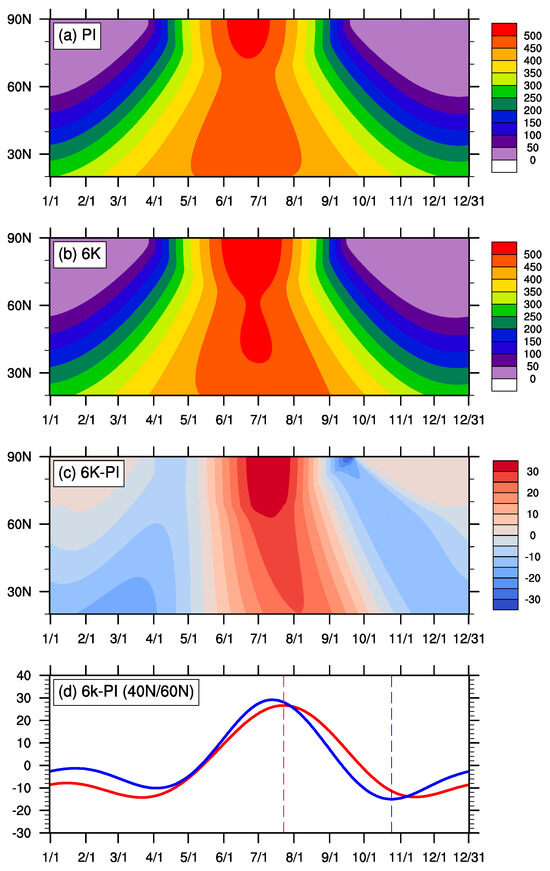
In this section, we will show how the uncertainty in the annual insolation–temperature relationship possibly influences the orbital-scale paleoclimate simulation. We target the middle Holocene (MH, ~6000 years ago), which is a key benchmark period for the Paleoclimate Modelling Intercomparison Project (PMIP) [33]. During the MH, Earth’s orbital configuration differed markedly from that of the preindustrial (PI) period (Table 2) [4], leading to substantial and latitudinally dependent changes in solar insolation (Figure 6). In particular, boreal summer insolation increased significantly, especially at NH high latitudes, while insolation during boreal spring and autumn decreased, most notably at NH mid-latitudes (Figure 6c). The annual cycle of insolation changes during the MH/PI shows that for the middle latitudes, the maximum insolation increase occurs at the end of July (Figure 6d). Consequently, we evaluate the response of the August–September mean temperature to the maximum insolation increase, given that the temperature response typically lags the insolation by approximately one month. Similarly, the November–December mean temperature response is investigated to assess the effect of the maximum insolation decrease at the end of October (Figure 6d).
Table 2.
Orbital parameters for PI and MH period.
Figure 6.
Zonal mean solar insolation of (a) PI, (b) MH, and (c) their difference (MH minus PI); (d) MH solar insolation anomalies at 40° N (red) and 60° N (blue), with vertical dashed lines marking the maxima (red) and minima (blue), respectively. Units: W m−2. Solar insolation is calculated following the astronomical solution of Berger [22], using the orbital parameters listed in Table 2 and the solar constant of 1360.7 W m−2.
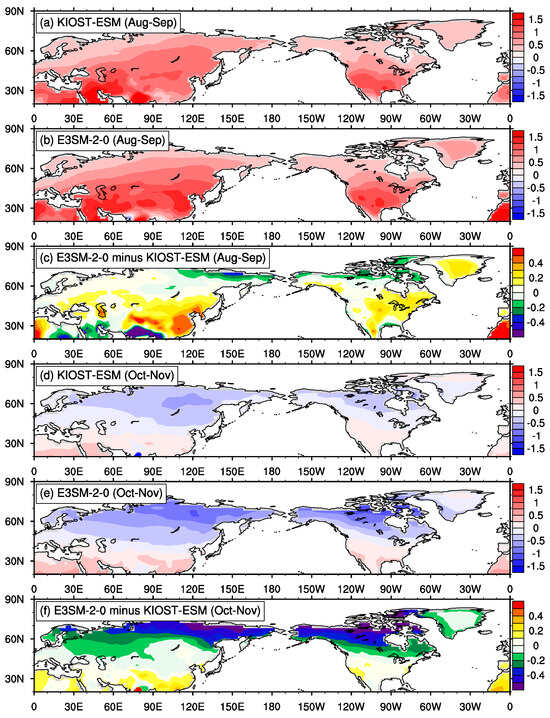
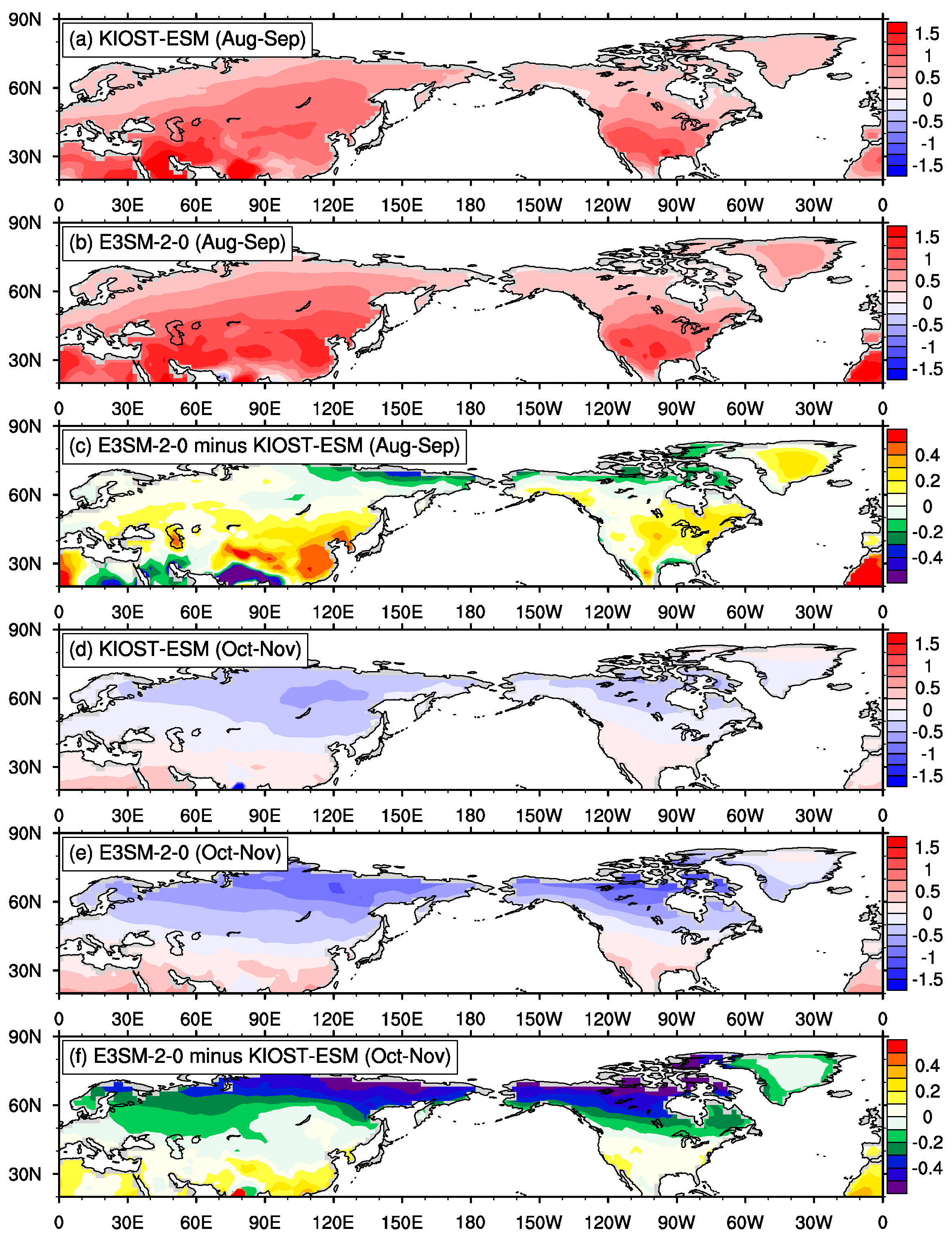
The surface temperature for the MH and PI is predicted by the polynomial model according to the corresponding insolation at each period. Consistent with expectations, during the MH, August–September temperature strongly increases due to the increased July–August solar insolation. In the lowest-sensitivity model (KIOST-ESM), the middle-latitude temperature increase is about 0.8 °C, whereas in the highest-sensitivity model (E3SM-2-0), warming exceeds 1 °C (Figure 7a,b). Conversely, November–December temperature decreases by ~0.4 °C and 0.6 °C in KIOST-ESM and E3SM-2-0, respectively, in response to reduced October–November insolation (Figure 7d,e). The consistent predicted seasonal temperature changes during the MH using the polynomial framework in these two models qualitatively agree with the MH simulations using comprehensive climate models [22,34], which further demonstrates the linkage between the annual- and orbital-scale insolation–temperature relationship. However, differences between KIOST-ESM and E3SM-2-0 imply that uncertainty in modern temperature sensitivity may lead to inter-model discrepancies of up to ~30% in MH seasonal temperature responses, as suggested by the polynomial framework (Figure 7c,f).
Figure 7.
(a) August–September surface temperature anomalies in MH relative to PI in (a) KIOST-ESM and (b) E3SM-2-0 and their difference (E3SM-2-0 minus KIOST-ESM); (d–f) are the same as (a–c), respectively, but for November–December. Units: °C.
It is important to note that polynomial framework used in this study focuses on the direct temperature response to insolation change and does not fully capture feedback processes critical to the MH climate. For example, PMIP simulations indicate that enhanced summer insolation strongly reduces high-latitude sea ice [35,36,37], which can further warm the Arctic in subsequent months, a process that absent from the polynomial model. Moreover, the lower-latitude monsoon is also strengthened, causing additional cooling although solar insolation increases [38,39]. Simulation of these feedbacks in climate models likely contributes additional uncertainty to modeled MH temperature beyond that stemming from biases in direct insolation sensitivity.
4. Discussion and Conclusions
In this study, we systematically assessed how Northern Hemisphere land surface temperature responds to the seasonal cycle of solar insolation in CMIP6 climate models, focusing on the amplitude and phase of the insolation–temperature relationship. By applying a polynomial transfer framework between temperature and insolation at the annual timescale, our analysis demonstrates that CMIP6 models generally reproduce the observed lag of 20–30 days between insolation and surface temperature, which indicates that they broadly have a reasonable thermal inertia of land. However, in high-latitude and monsoon areas, CMIP6 models have large biases in the response time to annual insolation change, attributed to additional feedback processes. Meanwhile, CMIP6 models exhibit a pervasive bias in temperature sensitivity to insolation change. Specifically, most CMIP6 models overestimate both summer and winter temperature sensitivities, with particularly strong biases over Eurasian mid-latitude and high-latitude regions, respectively. These biases translate into exaggerated annual temperature ranges and inter-model discrepancies of several degrees Celsius. It should also be noted that reanalysis data are not direct observations, but rather the output of a model-based data assimilation system. The near-surface air temperature depends on the model’s boundary-layer parameterization and therefore carries its own biases. As a result, the insolation–temperature relationship identified in this study may vary depending on the reference dataset used. To assess this, we repeated the analysis using ERA5 reanalysis data, which show qualitative agreement with the NCEP/DOE results (Figure 4). The similarity between results derived from different reanalysis products (e.g., NCEP2 and ERA5) supports the robustness of our main conclusions. Such overall overestimation of temperature sensitivity raises concerns about the fidelity of orbital-scale simulations. Application of the polynomial transfer framework to the MH and PI periods further highlights the implications of these biases: models with the highest insolation sensitivity project up to 30% greater warming in late summer and enhanced cooling in early winter compared to the lowest-sensitivity models. Previous PMIP MH simulations have documented substantial inter-model differences in temperature responses [22], which may, at least in part, be attributed to differences in their present-day insolation sensitivities. Importantly, the uncertainty in paleoclimate simulations is likely even larger than estimated here, because the polynomial framework does not explicitly account for key feedback processes, such as ice–albedo feedback and monsoon–cloud interactions, that can either amplify or dampen the climatic response.
The biases of temperature response to solar insolation should be caused by all the processes between the TOA and surface in climate models. For instance, cloud feedback is the most uncertain source of climate modeling [40,41]. In CMIP6 models, the positive low-level cloud feedback (i.e., warming reduces low-level cloud cover, which weakens the shortwave radiative effect and leads to further warming [42]) generally gets stronger than its former generation CMIP5 [43], due to greater reductions in low cloud cover and weaker increases in low cloud water content with warming. This change is related to the improvement of cloud parametrization in CMIP6 models, that is, the increase in mean-state supercooled liquid water in mixed-phase clouds. Because ice-related sinks weaken under warming, condensate lifetime tends to increase and sustain cloud cover, but this effect is weaker when the initial liquid water is already large [43,44]. This modification of cloud microphysics in CMIP6 models makes them more sensitive to effective radiative forcing, which is the TOA solar insolation in our case. Moreover, differences in boundary layer and convection parameterizations control cloud cover, moisture transport, and precipitation efficiency, leading to systematic biases in shortwave reflection and surface temperature response across models [45]. In contrast, radiative transfer schemes affect how gases, aerosols, and clouds interact with solar radiation; simplified spectral treatment, cloud optical assumptions, or coarse temporal sampling often cause biases in surface shortwave fluxes [45,46,47]. Together, these parameterization choices make the responses to TOA solar insolation more complicated in climate models. In addition, other aspects of model parameterizations and configurations, such as model resolution and atmosphere–ocean coupling strategies, may also contribute to these differences and warrant further investigation.
Our findings emphasize the importance of evaluating and constraining seasonal sensitivity in modern simulations as a prerequisite for reliable orbital-scale climate modeling. Improving the representation of cloud feedbacks may be a priority for the next generation of models. Finally, bridging modern observational constraints with paleoclimate simulations provides a powerful avenue for model evaluation, offering a way to reduce uncertainties in projecting both past and future climate under varying boundary conditions.
Author Contributions
Conceptualization, J.S.; methodology, J.S.; software, S.L. and J.S.; validation, J.S.; formal analysis, S.L. and J.S.; investigation, S.L. and J.S.; resources, J.S.; data J.S.; writing—original draft preparation, S.L. and J.S.; writing—review and editing, J.S. and S.L.; visualization, S.L. and J.S.; supervision, J.S.; project administration, J.S.; funding acquisition, J.S. All authors have read and agreed to the published version of the manuscript.
Funding
This research was funded by the National Natural Science Foundation of China, grant number 42088101.
Institutional Review Board Statement
Not applicable.
Informed Consent Statement
Not applicable.
Data Availability Statement
Daily data of NCEP2/DOE reanalysis can be downloaded at https://psl.noaa.gov/data/gridded/data.ncep.reanalysis2.html (accessed on 10 August 2025). CMIP6 historical simulation data can be accessed at https://esgf-node.ipsl.upmc.fr/search/cmip6-ipsl/ (accessed on 10 August 2025).
Conflicts of Interest
The authors declare no conflicts of interest.
References
- Laepple, T.; Lohmann, G. Seasonal cycle as template for climate variability on astronomical timescales. Paleoceanography 2009, 24, PA4201. [Google Scholar] [CrossRef] [Scilit]
- Fasullo, J.T.; Trenberth, K.E. The annual cycle of the energy budget. Part I: Global mean and land–ocean exchanges. J. Clim. 2008, 21, 2297–2312. [Google Scholar] [CrossRef] [Scilit]
- Huybers, P.; Curry, W. Links between annual, Milankovitch and continuum temperature variability. Nature 2006, 441, 329–332. [Google Scholar] [CrossRef] [Scilit] [PubMed]
- Berger, A.L. Long-term variations of daily insolation and Quaternary climatic changes. J. Atmos. Sci. 1978, 35, 2362–2367. [Google Scholar] [CrossRef] [Scilit]
- Laskar, J.; Robutel, P.; Joutel, F.; Gastineau, M.; Correia, A.C.; Levrard, B. A long-term numerical solution for the insolation quantities of the Earth. Astron. Astrophys. 2004, 428, 261–285. [Google Scholar] [CrossRef] [Scilit]
- Huybers, P.; Aharonson, O. Orbital tuning, eccentricity, and the frequency modulation of climatic precession. Paleoceanography 2010, 25, PA4205. [Google Scholar] [CrossRef] [Scilit]
- Huybers, P. Glacial variability over the last two million years: An extended depth-derived age model, continuous obliquity pacing, and the Pleistocene progression. Quat. Sci. Rev. 2007, 26, 37–55. [Google Scholar] [CrossRef] [Scilit]
- Huybers, P. Early Pleistocene glacial cycles and the integrated summer insolation forcing. Science 2006, 313, 508–511. [Google Scholar] [CrossRef] [Scilit]
- Mudelsee, M.; Schulz, M. The Mid-Pleistocene climate transition: Onset of 100 ka cycle lags ice volume build-up by 280 ka. Earth Planet. Sci. Lett. 1997, 151, 117–123. [Google Scholar] [CrossRef] [Scilit]
- Hughes, P.D.; Gibbard, P.L. Global glacier dynamics during 100 ka Pleistocene glacial cycles. Quat. Res. 2018, 90, 222–243. [Google Scholar] [CrossRef] [Scilit]
- Wang, Y.; Cheng, H.; Edwards, R.L.; Kong, X.; Shao, X.; Chen, S.; Wu, J.; Jiang, X.; Wang, X.; An, Z. Millennial- and orbital-scale changes in the East Asian monsoon over the past 224,000 years. Nature 2008, 451, 1090–1093. [Google Scholar] [CrossRef] [Scilit]
- Cheng, H.; Li, H.; Sha, L.; Sinha, A.; Shi, Z.; Yin, Q.; Lu, Z.; Zhao, D.; Cai, Y.; Hu, Y.; et al. Milankovitch theory and monsoon. Innovation 2022, 3, 100234. [Google Scholar] [CrossRef] [Scilit] [PubMed]
- Beaufort, L.; Van der Kaars, S.; Bassinot, F.C.; Moron, V. Past dynamics of the Australian monsoon: Precession, phase and links to the global monsoon concept. Clim. Past 2010, 6, 695–706. [Google Scholar] [CrossRef] [Scilit]
- Tabor, C.R.; Otto-Bliesner, B.L.; Brady, E.C.; Nusbaumer, J.; Zhu, J.; Erb, M.P.; Wong, T.E.; Liu, Z.; Noone, D. Interpreting precession-driven δ18O variability in the South Asian monsoon region. J. Geophys. Res. Atmos. 2018, 123, 5927–5946. [Google Scholar] [CrossRef] [Scilit]
- Hall, A. The role of surface albedo feedback in climate. J. Clim. 2004, 17, 1550–1568. [Google Scholar] [CrossRef] [Scilit]
- Rose, B.E.J.; Cronin, T.W.; Bitz, C.M. Ice Caps and Ice Belts: The effects of obliquity on ice–albedo feedback. Astrophys. J. 2017, 846, 28. [Google Scholar] [CrossRef] [Scilit]
- McGehee, R.; Lehman, C. A paleoclimate model of ice–albedo feedback forced by variations in Earth’s orbit. SIAM J. Appl. Dyn. Syst. 2012, 11, 684–707. [Google Scholar] [CrossRef] [Scilit]
- Jalihal, C.; Srinivasan, J.; Chakraborty, A. Modulation of Indian monsoon by water vapor and cloud feedback over the past 22,000 years. Nat. Commun. 2019, 10, 5701. [Google Scholar] [CrossRef] [Scilit]
- Kniffka, A.; Knippertz, P.; Fink, A.H. The role of low-level clouds in the West African monsoon system. Atmos. Chem. Phys. 2019, 19, 1623–1647. [Google Scholar] [CrossRef] [Scilit]
- Berger, M.; Brandefelt, J.; Nilsson, J. The sensitivity of the Arctic sea ice to orbitally induced insolation changes: A study of the mid-Holocene Paleoclimate Modelling Intercomparison Project 2 and 3 simulations. Clim. Past 2013, 9, 969–982. [Google Scholar] [CrossRef] [Scilit]
- Mohtadi, M.; Prange, M.; Steinke, S. Palaeoclimatic insights into forcing and response of monsoon rainfall. Nature 2016, 533, 191–199. [Google Scholar] [CrossRef] [Scilit]
- Brierley, C.M.; Zhao, A.; Harrison, S.P.; Braconnot, P.; Williams, C.J.; Thornalley, D.J.; Shi, X.; Peterschmitt, J.-Y.; Ohgaito, R.; Kaufman, D.S.; et al. Large-scale features and evaluation of the PMIP4-CMIP6 mid-Holocene simulations. Clim. Past 2020, 16, 1847–1876. [Google Scholar] [CrossRef] [Scilit]
- Otto-Bliesner, B.L.; Brady, E.C.; Zhao, A.; Brierley, C.M.; Axford, Y.; Capron, E.; Govin, A.; Hoffman, J.S.; Isaacs, E.; Kageyama, M.; et al. Large-scale features of Last Interglacial climate: Results from evaluating the lig127k simulations for the Coupled Model Intercomparison Project (CMIP6)–Paleoclimate Modeling Intercomparison Project (PMIP4). Clim. Past 2021, 17, 63–94. [Google Scholar] [CrossRef] [Scilit]
- Guarino, M.V.; Sime, L.C.; Schröeder, D.; Malmierca-Vallet, I.; Rosenblum, E.; Ringer, M.; Ridley, J.; Feltham, D.; Bitz, C.; Steig, E.J.; et al. Sea-ice-free Arctic during the Last Interglacial supports fast future loss. Nat. Clim. Change 2020, 10, 928–932. [Google Scholar] [CrossRef] [Scilit]
- Kanamitsu, M.; Ebisuzaki, W.; Woollen, J.; Yang, S.K.; Hnilo, J.J.; Fiorino, M.; Potter, G.L. NCEP–DOE AMIP-II Reanalysis (R-2). Bull. Am. Meteorol. Soc. 2002, 83, 1631–1644. [Google Scholar] [CrossRef] [Scilit]
- Donohoe, A.; Dawson, E.; McMurdie, L.; Battisti, D.S.; Rhines, A. Seasonal asymmetries in the lag between insolation and surface temperature. J. Clim. 2020, 33, 3921–3945. [Google Scholar] [CrossRef] [Scilit]
- Stine, A.R.; Huybers, P.; Fung, I.Y. Changes in the phase of the annual cycle of surface temperature. Nature 2009, 457, 435–440. [Google Scholar] [CrossRef] [Scilit] [PubMed]
- Ghatak, D.; Sinsky, E.; Miller, J. Role of snow–albedo feedback in higher elevation warming over the Himalayas, Tibetan Plateau and Central Asia. Environ. Res. Lett. 2014, 9, 114008. [Google Scholar] [CrossRef] [Scilit]
- Minder, J.R.; Letcher, T.W.; Skiles, S.M.K. An evaluation of high-resolution regional climate model simulations of snow cover and albedo over the Rocky Mountains, with implications for the simulated snow-albedo feedback. J. Geophys. Res. Atmos. 2016, 121, 9069–9088. [Google Scholar] [CrossRef] [Scilit]
- Wu, G.; Zhang, C.; Zhao, R.; Qin, P.; Qin, Y. Asymmetries of the lag between air temperature and insolation in gauge observations and reanalyses over China. Atmos. Res. 2023, 288, 106729. [Google Scholar] [CrossRef] [Scilit]
- Pak, G.; Noh, Y.; Lee, M.-I.; Yeh, S.-W.; Kim, D.; Kim, S.-Y.; Lee, J.-L.; Lee, H.J.; Hyun, S.-H.; Lee, K.-Y.; et al. Korea Institute of Ocean Science and Technology Earth System Model and its simulation characteristics. Ocean Sci. J. 2021, 56, 18–45. [Google Scholar] [CrossRef] [Scilit]
- Golaz, J.C.; Van Roekel, L.P.; Zheng, X.; Roberts, A.F.; Wolfe, J.D.; Lin, W.; Bradley, A.M.; Tang, Q.; Maltrud, M.E.; Forsyth, R.M.; et al. The DOE E3SM Model Version 2: Overview of the physical model and initial model evaluation. J. Adv. Model. Earth Syst. 2022, 14, e2022MS003156. [Google Scholar] [CrossRef] [Scilit]
- Otto-Bliesner, B.L.; Braconnot, P.; Harrison, S.P.; Lunt, D.J.; Abe-Ouchi, A.; Albani, S.; Bartlein, P.J.; Capron, E.; Carlson, A.E.; Dutton, A.; et al. The PMIP4 contribution to CMIP6–Part 2: Two interglacials, scientific objectives and experimental design for Holocene and Last Interglacial simulations. Geosci. Model Dev. 2017, 10, 3979–4003. [Google Scholar] [CrossRef] [Scilit]
- Tian, Z.; Jiang, D. Enhanced seasonality of surface air temperature over China during the mid-Holocene. Atmos. Ocean. Sci. Lett. 2023, 16, 100393. [Google Scholar] [CrossRef] [Scilit]
- Park, H.S.; Kim, S.J.; Stewart, A.L.; Son, S.W.; Seo, K.H. Mid-Holocene Northern Hemisphere warming driven by Arctic amplification. Sci. Adv. 2019, 5, eaax8203. [Google Scholar] [CrossRef] [Scilit] [PubMed]
- Park, H.S.; Kim, S.J.; Seo, K.H.; Stewart, A.L.; Kim, S.Y.; Son, S.W. The impact of Arctic sea ice loss on mid-Holocene climate. Nat. Commun. 2018, 9, 4571. [Google Scholar] [CrossRef] [Scilit]
- Yoshimori, M.; Suzuki, M. The relevance of mid-Holocene Arctic warming to the future. Clim. Past 2019, 15, 1375–1394. [Google Scholar] [CrossRef] [Scilit]
- Zhao, Y.; Braconnot, P.; Marti, O.; Harrison, S.P.; Hewitt, C.; Kitoh, A.; Liu, Z.; Mikolajewicz, U.; Otto-Bliesner, B.; Weber, S.L. A multi-model analysis of the role of the ocean on the African and Indian monsoon during the mid-Holocene. Clim. Dyn. 2005, 25, 777–800. [Google Scholar] [CrossRef] [Scilit]
- Jiang, D.; Lang, X.; Tian, Z.; Ju, L. Mid-Holocene East Asian summer monsoon strengthening: Insights from Paleoclimate Modeling Intercomparison Project (PMIP) simulations. Palaeogeogr. Palaeoclimatol. Palaeoecol. 2013, 369, 422–429. [Google Scholar] [CrossRef] [Scilit]
- Ceppi, P.; Brient, F.; Zelinka, M.D.; Hartmann, D.L. Cloud feedback mechanisms and their representation in global climate models. WIREs Clim. Change 2017, 8, e465. [Google Scholar] [CrossRef] [Scilit]
- Stephens, G.L. Cloud feedbacks in the climate system: A critical review. J. Clim. 2005, 18, 237–273. [Google Scholar] [CrossRef] [Scilit]
- Brient, F.; Bony, S. Interpretation of the positive low-cloud feedback predicted by a climate model under global warming. Clim. Dyn. 2013, 40, 2415–2431. [Google Scholar] [CrossRef] [Scilit]
- Zelinka, M.D.; Myers, T.A.; McCoy, D.T.; Po-Chedley, S.; Caldwell, P.M.; Ceppi, P.; Klein, S.A.; Taylor, K.E. Causes of higher climate sensitivity in CMIP6 models. Geophys. Res. Lett. 2020, 47, e2019GL085782. [Google Scholar] [CrossRef] [Scilit]
- Ceppi, P.; Myers, T.A.; Nowack, P.; Wall, C.J.; Zelinka, M.D. Implications of a pervasive climate model bias for low-cloud feedback. Geophys. Res. Lett. 2024, 51, e2024GL110525. [Google Scholar] [CrossRef] [Scilit]
- Forster, P.; Storelvmo, T.; Armour, K.; Collins, W.; Dufresne, J.-L.; Frame, D.; Lunt, D.; Mauritsen, T.; Palmer, M.; Watanabe, M.; et al. The Earth’s energy budget, climate feedbacks, and climate sensitivity. In Climate Change 2021: The Physical Science Basis. Contribution of Working Group I to the Sixth Assessment Report of the Intergovernmental Panel on Climate Change; Masson-Delmotte, V., Zhai, V., Pirani, A., Conners, S.L., Péan, C., Berger, S., Caud, N., Chen, Y., Goldfarb, L., Gomis, M.I., et al., Eds.; Cambridge University Press: Cambridge, UK, 2021. [Google Scholar]
- He, J.; Hong, L.; Shao, C.; Tang, W. Global evaluation of simulated surface shortwave radiation in CMIP6 models. Atmos. Res. 2023, 292, 106896. [Google Scholar] [CrossRef] [Scilit]
- Freidenreich, S.; Paynter, D.; Lin, P.; Ramaswamy, V.; Jones, A.L.; Feldman, D.; Collins, W.D. An investigation into biases in instantaneous aerosol radiative effects calculated by shortwave parameterizations in two Earth System Models. J. Geophys. Res. Atmos. 2021, 126, e2019JD032323. [Google Scholar] [CrossRef] [Scilit]

Disclaimer/Publisher’s Note: The statements, opinions and data contained in all publications are solely those of the individual author(s) and contributor(s) and not of MDPI and/or the editor(s). MDPI and/or the editor(s) disclaim responsibility for any injury to people or property resulting from any ideas, methods, instructions or products referred to in the content. |
© 2025 by the authors. Licensee MDPI, Basel, Switzerland. This article is an open access article distributed under the terms and conditions of the Creative Commons Attribution (CC BY) license (https://creativecommons.org/licenses/by/4.0/).