Article

Aerosol Transport from Amazon Biomass Burning to Southern Brazil: A Case Study of an Extreme Event During September 2024


by
Fernando Primo Forgioni
1,
Caroline Bresciani
2,
André Reis
3,
Gabriela Viviana Müller
4,5,*,
Dirceu Luis Herdies
3,
Jório Bezerra Cabral Júnior
6 and
Fabrício Daniel dos Santos Silva
7
1
Department of Physics, Federal University of Santa Maria (UFSM), Santa Maria 97105-900, Brazil
2
Federal Institute of Education, Science and Technology of Santa Catarina (IFSC), Av. Mauro Ramos, 950, Centro, Florianópolis 88020-300, Brazil
3
National Institute for Space Research (INPE), Cachoeira Paulista 12227-010, Brazil
4
Consejo Nacional de Investigaciones Científicas y Técnicas, Buenos Aires B8000, Argentina
5
Centro de Estudios de Variabilidad y CambioClimático (CEVARCAM), Facultad de Ingeniería y CienciasHídricas (FICH), Universidad Nacional del Litoral (UNL), Santa Fe 3000, Argentina
6
Institute of Geography, Development and Environment (IGDEMA), Federal University of Alagoas, Maceió 57072-970, Brazil
7
Institute of Atmospheric Sciences, Federal University of Alagoas (UFAL), Maceió 57072-260, Brazil
*
Author to whom correspondence should be addressed.
Atmosphere 2025, 16(10), 1138; https://doi.org/10.3390/atmos16101138
Submission received: 9 August 2025 / Revised: 17 September 2025 / Accepted: 23 September 2025 / Published: 27 September 2025
(This article belongs to the Section Aerosols)

Abstract

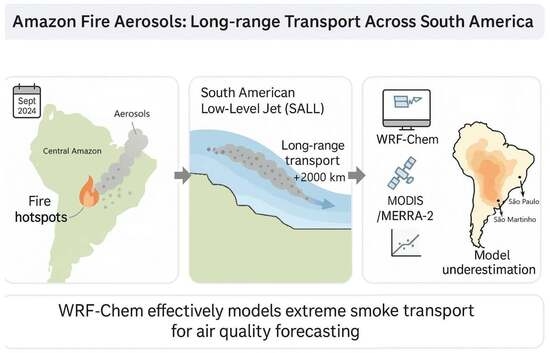
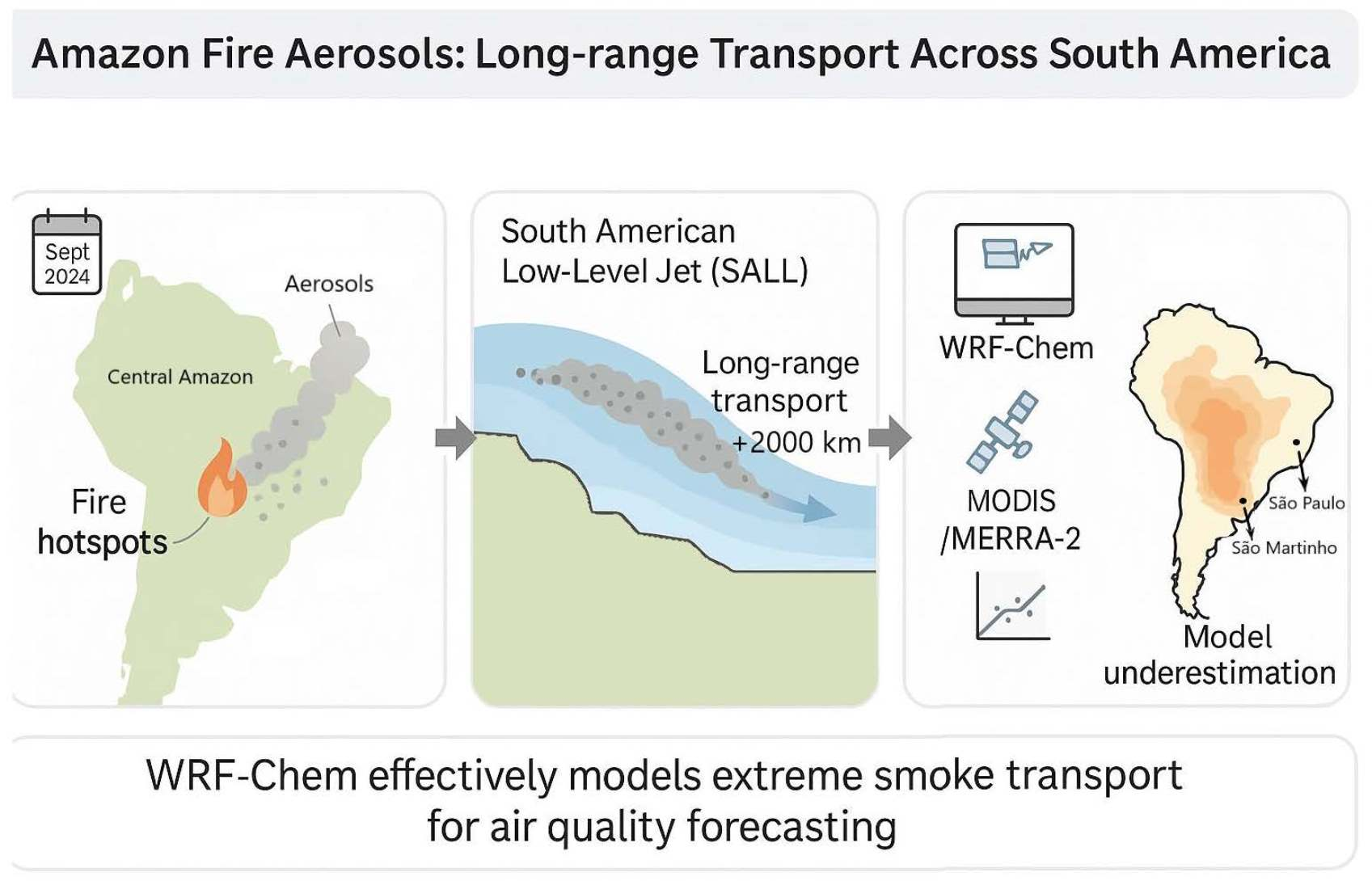
Biomass burning in the Amazon region, especially during the dry season, generates aerosol dispersion events across the southern part of the continent, with impacts observable thousands of kilometers from the emission source. This study presents a long-range aerosol transport case from September 2024, in which smoke aerosols from forest fires in the central Amazon reached southeastern and southern Brazil, affecting the air quality in distant areas such as São Paulo and São Martinho. The event was simulated using the Weather Research and Forecasting model with Chemistry (WRF-Chem), configured with the MOZCART chemical mechanism, combined with MERRA-2 reanalysis data and by using the 3BEM biomass burning emission inventory. Satellite datasets from MODIS and MERRA-2 reanalysis were used to evaluate the model’s performance. The results indicate that the South American Low-Level Jet (SALLJ) played a key role in transporting carbonaceous aerosols over long distances. The model successfully captured the spatial and temporal evolution of the aerosol plume and its impacts, although it tended to underestimate aerosol optical depth (AOD) values compared with satellite observations. This study highlights the WRF-Chem’s capability to simulate extreme smoke transport events in South America and supports its potential application in forecasting and air quality assessments.

Graphical Abstract

1. Introduction

Aerosols are mixtures of small solid and liquid particles suspended in the atmosphere, with a standard radius of 0.001–100 µm [1,2]. The scientific community is highly interested in aerosols due to their impact on global climate, radiative balance, air quality, human health, cloud microphysical properties, the hydrological cycle, ecosystems, and agriculture [3,4,5].
Various studies have been conducted on aerosols in different regions of the world to understand their behavior [6]. Atmospheric aerosols are classified as primary when they are released directly into the atmosphere as particles from various sources or as secondary when they form within the atmosphere through chemical reactions involving trace gases emitted into the air [7,8,9,10]. Furthermore, these particles can be transported over vast distances, a process known as aerosol atmospheric river formation, and can also be vertically transported to the upper troposphere or formed in the upper troposphere [11,12,13,14,15].
In South America (SA), biomass burning represents a major source of aerosol particles on a global scale during the dry season and therefore has a substantial impact on the Earth system [16,17]. In this region, where large-scale and seasonal burning practices are carried out annually, significant anthropogenic disturbances can occur [18]. The Brazilian Amazon rainforest and Cerrado, for example, are regions where an annual burning season that typically runs from August to October, although its timing can vary somewhat depending on the specific locality, resulting in the accumulation of a large atmospheric aerosol load that can affect the climate [19,20,21,22].
In recent years, wildfire activity has been more intense in several ecosystems, with environmental, health, and economic impacts in many countries [23,24,25]. The impacts of wildfires are felt not only in communities close to the deforestation arc in the Amazon but also in cities kilometers away, due to the long-range transport of smoke plumes [22,25,26,27]. Chakraborty et al. [28] extended the concept of atmospheric rivers to aerosols and showed that cities such as São Paulo are influenced by aerosols from fires in the Amazon region.
Human-induced wildfires, compounded by anthropogenic climate change, have substantially intensified the frequency and severity of wildfires [23,29]. In recent years, the Amazon rainforest has experienced recurrent and severe wildfire events [24,30,31,32]. Notably, however, unprecedented wildfires also impacted vast areas of the Brazilian Pantanal wetlands in 2020 and 2024, raising serious concern due to their scale and the extensive biodiversity affected [33,34] Although aerosol transport has been extensively documented in the scientific literature (e.g., [22,35,36,37]), studies specifically focused on the long-range transport of wildfire-related pollution originating from South America remain limited.
One of the primary methods for analyzing and assessing air pollution from biomass burning and other emission sources involves projecting the future state of the atmosphere, including its chemical and physical perturbations. These projections are generated using numerical models running on high-performance computing systems. To produce results that are physically consistent with real-world observations, atmospheric models must accurately incorporate emission sources and effectively simulate the transport and transformation of pollutants within the atmosphere. To address this, a specialized modeling system has been developed to simulate the dispersion of smoke from Amazonian wildfires across South America. This system is based on coupling of the Weather Research and Forecasting model (WRF-ARW) with a chemistry module, resulting in the WRF-Chem [22,38]. The WRF-Chem has been employed in numerous studies worldwide for both research purposes and operational forecasting (e.g., [39,40] and more recently by Vara Vela et al. [22] in the South American context).
In their study, Vara Vela et al. conducted 48-h simulations covering the entire South American continent for wildfire events that occurred in August and September 2018 and 2019. The model outputs were compared with satellite data (MODIS) and ground-based air quality measurements. The findings indicate that the CPTEC WRF-Chem system is capable of reproducing the general spatial and temporal patterns of total aerosols (AOD at 550 nm) and the total column carbon monoxide (CO). Specifically, during the 19 August 2019 long-range transport event, previous work reported that the CPTEC WRF-Chem system reproduced the spatial and temporal patterns seen by MODIS while underestimating the AOD magnitudes [22]. Although some discrepancies were noted, the authors concluded that the WRF-Chem system is a reliable tool for forecasting the dispersion of wildfire smoke plumes across South America. The generation of meteorological and atmospheric composition forecasts from this modeling system provides valuable information for atmospheric scientists and policymakers involved in regional air quality management, particularly during large-scale wildfire events.
This study examines the unprecedented aerosol transport event of September 2024 and the occurrence of “black rain” in distant regions. This event took place during a period of severe drought in the Amazon, which had persisted since the austral summer of 2022–2023 [41,42]. The drought was driven by a combination of climatic factors, including positive phases of the El Niño–Southern Oscillation (ENSO) and the Indian Ocean Dipole (IOD), the warm phase of the Tropical North Atlantic, and the broader effects of climate change. These conditions played a key role in triggering and intensifying the drought, leading to reduced soil moisture, stressed vegetation, and an increased risk of wildfires [42]. This work provides a benchmark by analyzing WRF-Chem performance under extreme conditions. By combining WRF-Chem simulations with MODIS, AERONET, and MERRA-2 data, we assess the model’s ability to represent the spatial distribution and timing of aerosol dispersion during this high-impact case.

2. Materials and Methods

2.1. Study Area

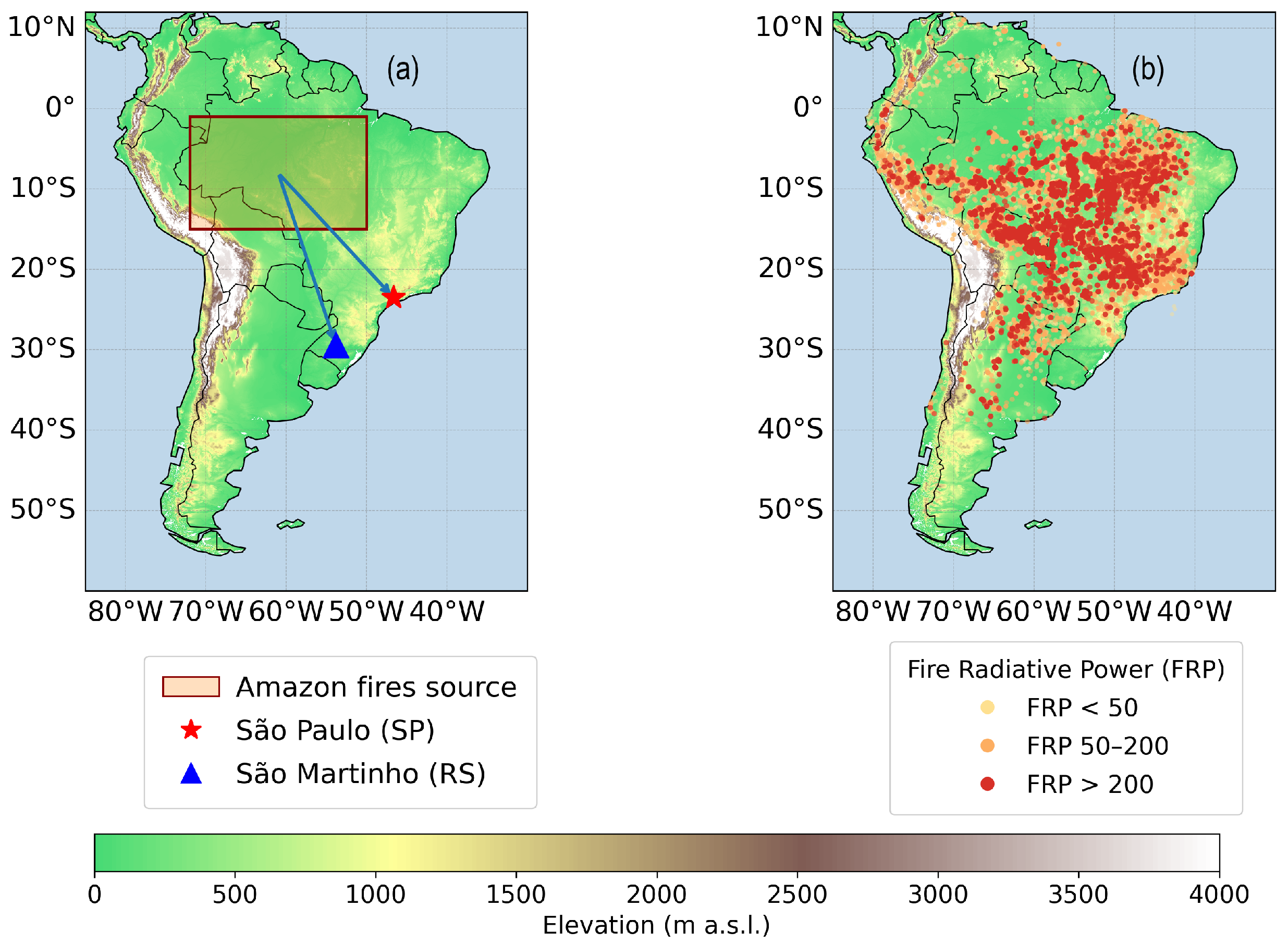
This study focused on two locations, namely São Paulo, SP (latitude −23.54, longitude −46.63), situated in the southeastern region of South America, and São Martinho, RS (latitude −27.7069; longitude −53.96), located in the southern part of South America, specifically in the central area of the state of Rio Grande do Sul, as shown in Figure 1. Both cities experienced significant impacts from aerosol transport during the biomass burning event in September 2024, including documented occurrences of “black rain”. This is a phenomenon where precipitation is visibly darkened due to high concentrations of soot and particulate matter from wildfire smoke in the atmosphere.
Both locations, São Paulo and São Martinho, host instrumented field stations for aerosol measurements equipped with ground-based sun photometers that capture the properties of atmospheric aerosols. These instruments are part of the Aerosol Robotic Network (AERONET) of the National Aeronautics and Space Administration (NASA), a global network that provides high-quality, standardized aerosol data. Measurements have been taken continuously from 1 January 2001 on São Paulo and 1 August 2008 for São Martinho to the present [43].
Figure 1b shows active MODIS fire pixels in South America from 1 to 15 September 2024, color-coded by fire radiative power (FRP). The hotspots cluster over the central Amazon, indicating widespread burning while the region was still under the influence of the persistent severe drought that has persisted since the austral summer of 2022–2023 [41,42].

2.2. Fire Pixel Detection Using MODIS

In this study, fire occurrence was identified using data from NASA’s Moderate Resolution Imaging Spectroradiometer (MODIS), an instrument onboard both the Terra and Aqua satellites accessed via the Fire Information for Resource Management System (FIRMS). Terra, launched in December 1999, is part of NASA’s Earth Observing System (EOS) and crosses the equator from north to south in the morning. Aqua, launched in May 2002, is also part of the EOS and crosses the equator from south to north in the afternoon. Together, these Sun-synchronous polar orbiting satellites provide complementary daily global coverage, allowing for the frequent monitoring of Earth’s surface conditions, including active fires [44]. MODIS has a wide swath of 2330 km and captures data at multiple spatial resolutions ranging from 250 m to 1 km, depending on the spectral channel used. Thanks to this orbital configuration, MODIS can observe each point on the Earth’s surface approximately once every 1–2 days. To refine the results obtained from the satellite measurements, we applied a filter based on the “confidence level” variable. Only fire detections with a confidence level equal to or greater than 80% were considered, following NASA and FIRMS recommendations and previous studies that adopted this threshold to minimize false positives [44]. MODIS active fire detections may miss events obscured by clouds, but this limitation was mitigated in this case study by complementing the analysis with MERRA-2 AOD reanalysis. The climatological period used for this analysis spanned from 2003 to 2023.

2.3. MERRA-2 Reanalysis

AOD data and wind at 850 hPa data used in this study were obtained from the Modern-Era Retrospective Analysis for Research and Applications, Version 2 (MERRA-2), provided by NASA. MERRA-2 is a global atmospheric reanalysis covering the period from 1980 to the present, aligning with the beginning of the modern era of remote sensing [45,46]. With a spatial resolution of 0.5° × 0.625° latitude and longitude, respectively, and 72 vertical levels extending from the surface to 0.01 hPa, MERRA-2 is produced every 3 h using the assimilated system of Version 5.12.4 of the Goddard Earth Observing System (GEOS-5) [46]. MERRA-2 represents the first global reanalysis to assimilate spatially distributed aerosol observations while accounting for interactions between aerosols and other atmospheric physical processes. The model simulates the sources, sinks, and chemical processes of five aerosol species: mineral dust, sea salt, black carbon (BC), organic carbon (OC), and sulfate [45,46]. MERRA-2 reanalysis assimilates information from the AERONET network, the MODIS instrument onboard the Aqua and Terra satellites, the Advanced Very High-Resolution Radiometer (AVHRR), and the Multi-Angle Imaging Spectroradiometer (MISR) [45]. This study used tri-hourly total AOD data at 550 nm and the mean temperature at 2 m above ground obtained from NASA’s Goddard Earth Sciences Data Information Services Center (GES DISC) for the period of 2003–2023. MERRA-2 reanalysis data in these locations were validated by Gueymard and Yang [47] based on the MODIS satellites and AERONET observation network during the period of 2003–2017. The authors showed that the AOD data from MERRA-2 have good overall performance compared with the satellite data, even with low errors and biases [45,47,48].
Also, from MERRA-2 we used the black and organic carbon u-v wind mass flux combined in the zonal (BCFLUXU and OCFLUXU) and meridional (BCFLUXV and OCFLUXV) directions, which denote the vertically integrated aerosol mass flux. So, to compute the integrated BCFLUX and OCFLUX transport, we calculate the following:
B C F L U X = B C F L U X U 2 + B C F L U X V 2
O C F L U X = O C F L U X U 2 + O C F L U X V 2
The total CA is the sum of BCFLUX and OCFLUX.

2.4. WRF-Chem

In this study, a numerical simulation was conducted using the Weather Research and Forecasting with Chemistry community (WRF-Chem), version 3.9.9.1, for the period from 1–15 September 2024. The WRF-Chem [38] is a fully coupled meteorology–chemistry transport system used to simulate atmospheric processes at the regional scale. In this study, anthropogenic emissions, including biomass burning, were considered, and a chemistry–aerosol module was applied to simulate the evolution of the aerosol optical depth (AOD):
  • 1 No wet deposition is handled with Ferrier microphysics.
  • 2 This includes a sub-gridscale plume rise algorithm.
Table 1 presents the domain configurations, model input data, and physics and chemistry options employed. The model grid (Figure 1) was centered at 13.32° S and 58.27° W, with 453 × 493 grid points and a spatial resolution of 12 km, featuring 45 vertical levels extending from the surface up to 50 mb. The domain was chosen to encompass the main fire hotspots observed in the central region of South America, including Brazil, Peru, Bolivia, Paraguay, and Argentina, as well as areas affected by smoke transport from the fires. The model was initialized and constrained at the lateral boundaries, with meteorological fields from the fifth-generation reanalysis of the European Centre for Medium-Range Weather Forecasts (ERA5) and with chemical fields from the Whole Atmosphere Community Climate Model (WACCM), developed by the National Center for Atmospheric Research (NCAR). Boundary conditions were provided at 6-h intervals. The model also incorporated emission inventories for anthropogenic, biogenic, and biomass burning emissions. Biogenic emissions were calculated online in WRF-Chem using the Model of Emissions of Gases and Aerosols from Nature (MEGAN) [49]. MEGAN estimates emissions by considering meteorological conditions (e.g., temperature, solar radiation, and soil moisture), the leaf area index (LAI), and plant functional types (PFTs). In the present simulations, aerosol-radiation feedback was not activated, and cloud-aerosol chemistry and wet scavenging processes were also not considered.
For anthropogenic emissions, the Emissions Database for Global Atmospheric Research (EDGAR v2) was selected, which compiles information on anthropogenic emission sources worldwide [50]. EDGAR provides global coverage with a resolution of 0.1º longitude × 0.1º latitude and includes two-dimensional emissions of CH4, CO, SO2, NOx (NO + NO2), total non-methane volatile organic compounds (NMVOCs), NH3, PM10, PM2.5, BC, and OC. The gridded diurnal anthropogenic emission files in WRF format were generated using the anthro_emis utility. The anthro_emis tool is a Fortran-based preprocessor designed to create anthropogenic emission files ready for WRF-Chem, derived from global inventories in a lat/lon projection.
For biomass burning emissions, the Brazilian Biomass Burning Emission Model (3BEM) [51] was employed. The 3BEM is based on remote sensing products to determine fire emissions and the plume rise characteristics of trace gases and aerosol particles derived from biomass burning, including forest fires and agricultural fires. The fire database used is derived from the fire product of the National Institute for Space Research (INPE), which is based on the Advanced Very High-Resolution Radiometer (AVHRR) aboard a series of polar orbiting satellites. To generate data compatible with WRF-Chem, the chemical emission preprocessor PREP-CHEM-SRC [52] was used. The model’s chemical and physical configurations followed those described for the CPTEC WRF-Chem system [22]. In the CPTEC WRF-Chem system, gas-phase chemistry is handled by the Model for Ozone And Related Chemical Tracers (MOZART; [53]), while aerosols are treated by Goddard Chemistry Aerosol Radiation and Transport (GOCART; [54]). The coupling of MOZART and GOCART is known as MOZCART. GOCART simulates the main types of tropospheric aerosols, including sulfate, dust, organic carbon, black carbon and sea salt aerosols, providing the global distributions of aerosol concentrations, vertical profiles, and optical thicknesses of individual and total aerosols [55]. MOZART is linked to a model parameter that controls the partitioning between smoldering and flaming emissions within the plume rise model [56,57].

2.5. Fire Climatology Based on MODIS and AOD Climatology Based on MERRA-2

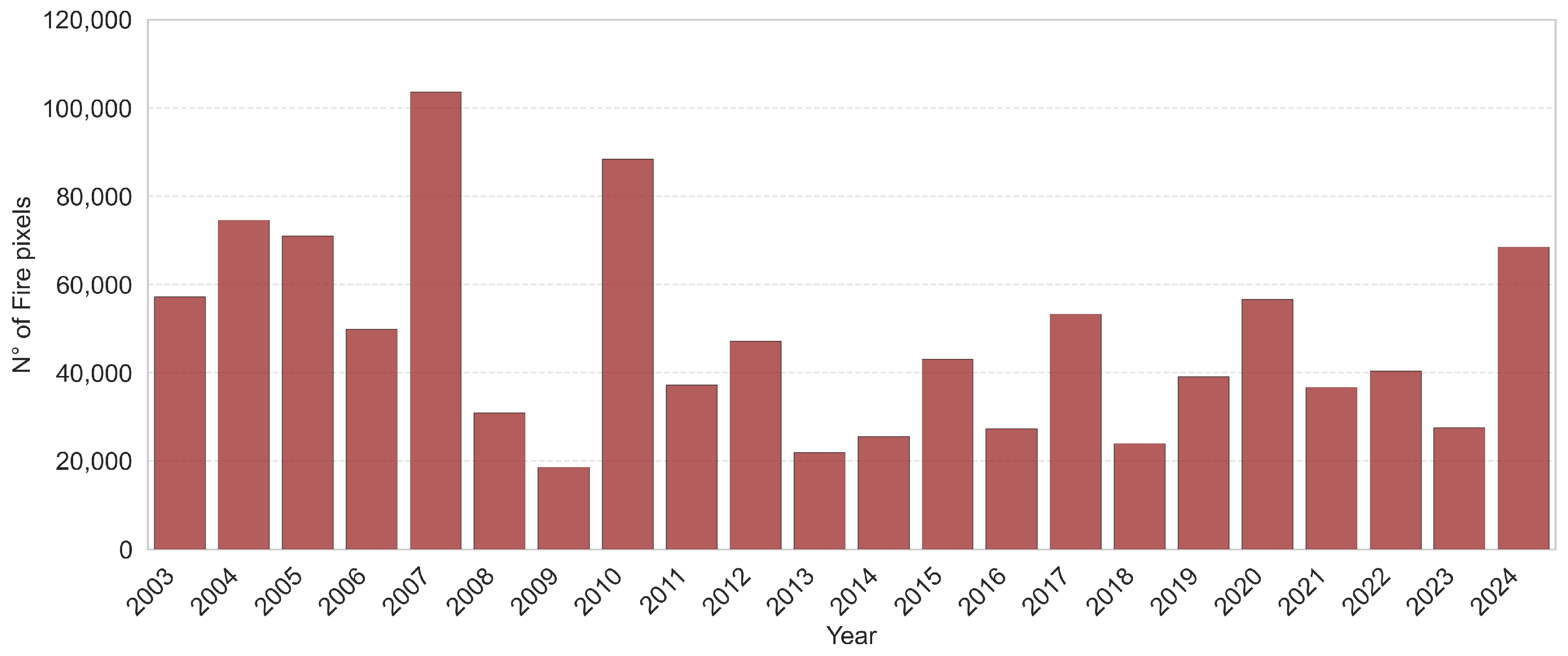
The fire climatology for the period of 2003–2023 was analyzed using the average number of fire-detecting pixels recorded by MODIS satellite data across the entire Brazilian territory, as shown in Figure 2. The fire season extends from August to October, and September exhibited the highest number of fire pixels. This period of elevated fire activity coincides with the fire seasons in Paraguay, Bolivia, and Argentina [22,58,59]. It should be noted that MODIS active fire detections are subject to uncertainties, as fires occurring under cloudy conditions may not be detected, and short-lived fires can be missed due to the relatively infrequent satellite overpasses [44].

2.6. Event Selection

Using 550-nm AOD data from MERRA-2, a climatological average was calculated for the period of 2003–2023. The AOD climatology and standard deviation values were analyzed to identify the period with the highest AOD concentration at both stations, as shown in Table 1. The AOD climatology was derived from the total AOD data from the nearest grid points. Thus, the event selected for this case study was based on two primary criteria. First, September consistently exhibited the highest number of fire pixels each year, except in 2001 and 2021. Second, the AOD concentrations at these sites exceeded the climatological mean by more than two standard deviations (SDs), indicating anomalously high AOD levels during the study period (Table 2). During September 2024, daily peak AOD values reached 0.95 in São Paulo and 1.32 in São Martinho, which are more than double the September reference thresholds shown in Table 2. Additionally, we used the same climatological thresholds ( μ + 2 σ ) to derive the exposure metrics for each site, including the event duration (number of days above the threshold), total integrated AOD ( Σ AOD), exceedance-weighted exposure [ Σ max ( 0 , AOD ( μ + 2 σ ) ) ], and distribution statistics (median and P90). These metrics are presented in Section 3.1 to objectively compare the aerosol burden between São Paulo and São Martinho. To test whether September 2024 represented a statistically significant anomaly relative to the historical distribution, we applied a one-sided Mann–Whitney U test (2024 > climatology) using daily MERRA-2 AOD values for September (2003–2023 vs. 2024). This nonparametric test was selected because it does not assume normality and is well suited to positively skewed distributions such as the AOD.

3. Results

3.1. Fire Occurrence and Total AOD Concentrations During Events over São Paulo and São Martinho

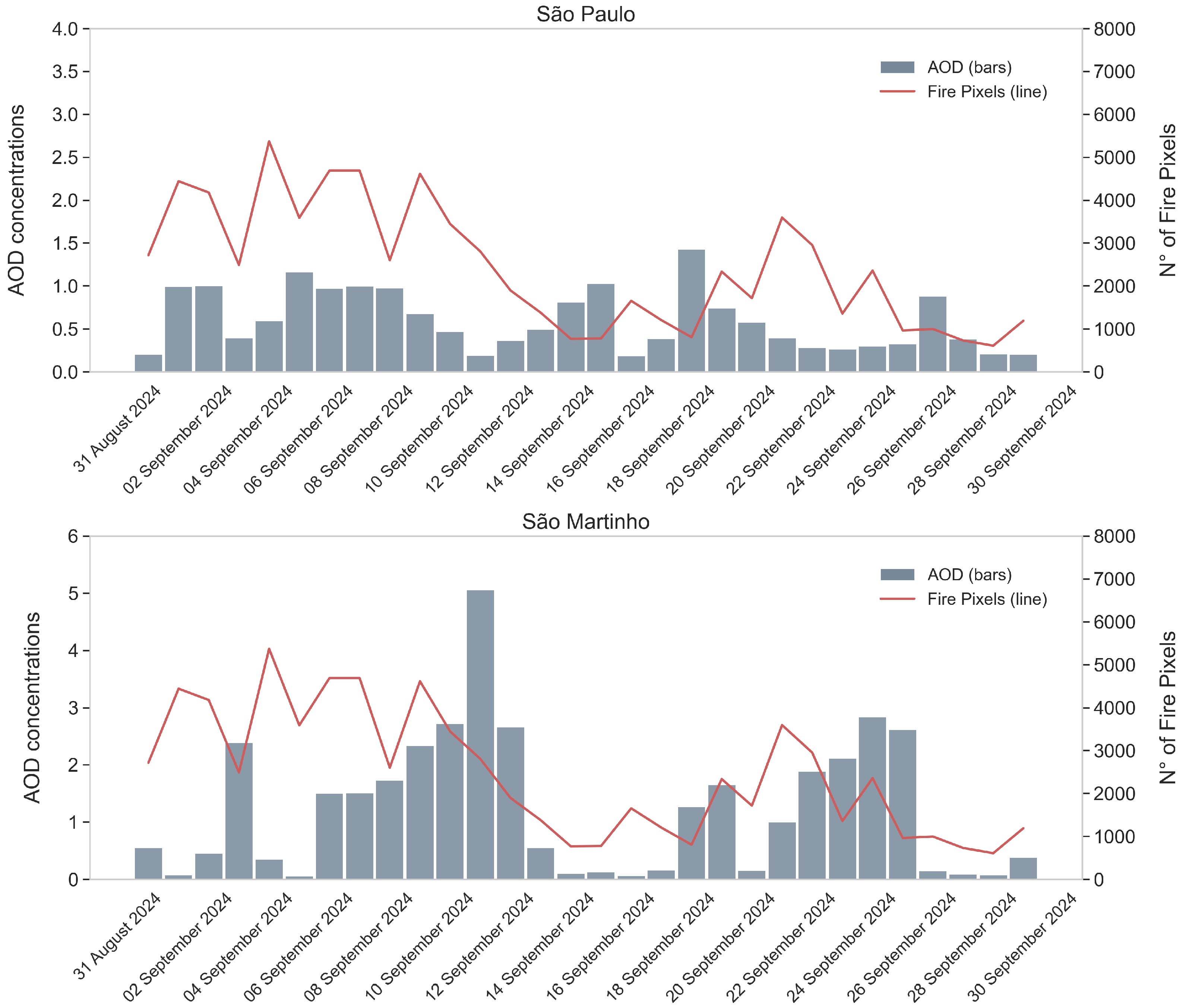
Figure 3 presents the daily evolution of the AOD concentrations and MODIS active fire detections aggregated within a central Amazon source polygon (78–48° W; 12–3° N) for September 2024, together with the AODs at São Paulo (Figure 3) and São Martinho (Figure 3). In São Paulo, AOD peaks lagged fire activity by about two days, showing a strong and statistically significant relationship (95% confidence level), consistent with long-range transport by the South American Low-Level Jet. In contrast, São Martinho did not show a significant correlation with the Amazon fire counts, suggesting that aerosol variability at this site was strongly modulated by local meteorology and additional sources, although high AOD values were observed during the event. São Martinho exhibited a higher September reference value (0.72) compared with São Paulo (0.47). This difference reflects its proximity to biomass burning regions in southern South America and its rural setting, which makes it more directly affected by transported fire emissions. Furthermore, the MERRA-2 AOD values at intermediate sites along the transport pathway, such as Cuiabá (15.6° S, 56.1° W) and Ji-Paraná (10.9° S, 61.8° W), also exhibited anomalous conditions during September 2024, with monthly means of 0.87 and 1.72, respectively, both frequently exceeding their local μ + 2 σ thresholds. These results further support the interpretation of a progressive southward transport of the plume from central Amazonia to southeastern and southern Brazil. At both locations, extreme AOD values were recorded, São Paulo reached values close to 1.0, while São Martinho exhibited higher concentrations, averaging about 3.0 and peaking near 5.0 on 11 September 2024. We quantified the event exposure metrics using the climatological thresholds defined in Section 2.6. São Paulo exceeded its threshold (0.60) over 12 days, with a total integrated AOD of 17.7 and an exceedance-weighted exposure of 4.4. In contrast, São Martinho exceeded its threshold (0.73) over 15 days, with a substantially higher integrated exposure (36.4) and exceedance (22.2) and daily peaks reaching 5.05. These results confirm that São Martinho experienced shorter but more intense aerosol peaks, while São Paulo exhibited a longer-lasting episode of a lower magnitude. Although AOD values near 5.0 are extreme, they are consistent with MERRA-2 reanalysis, which assimilates MODIS and AERONET observations with strict quality controls [45,46,47,48]. These values most likely reflect a real and exceptional smoke episode rather than retrieval artifacts.

3.2. Aerosol Transport from the Amazon to Southern Brazil

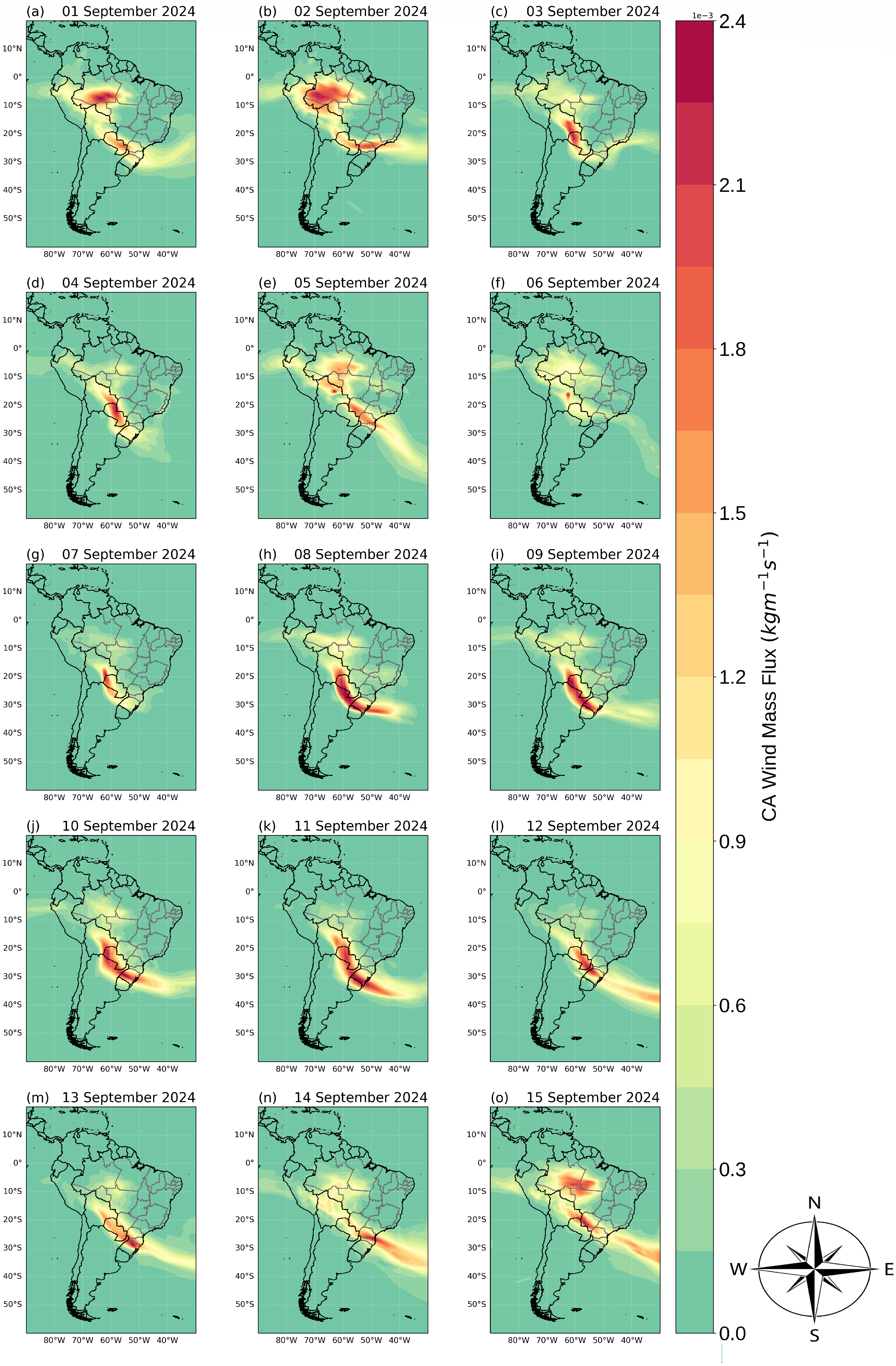
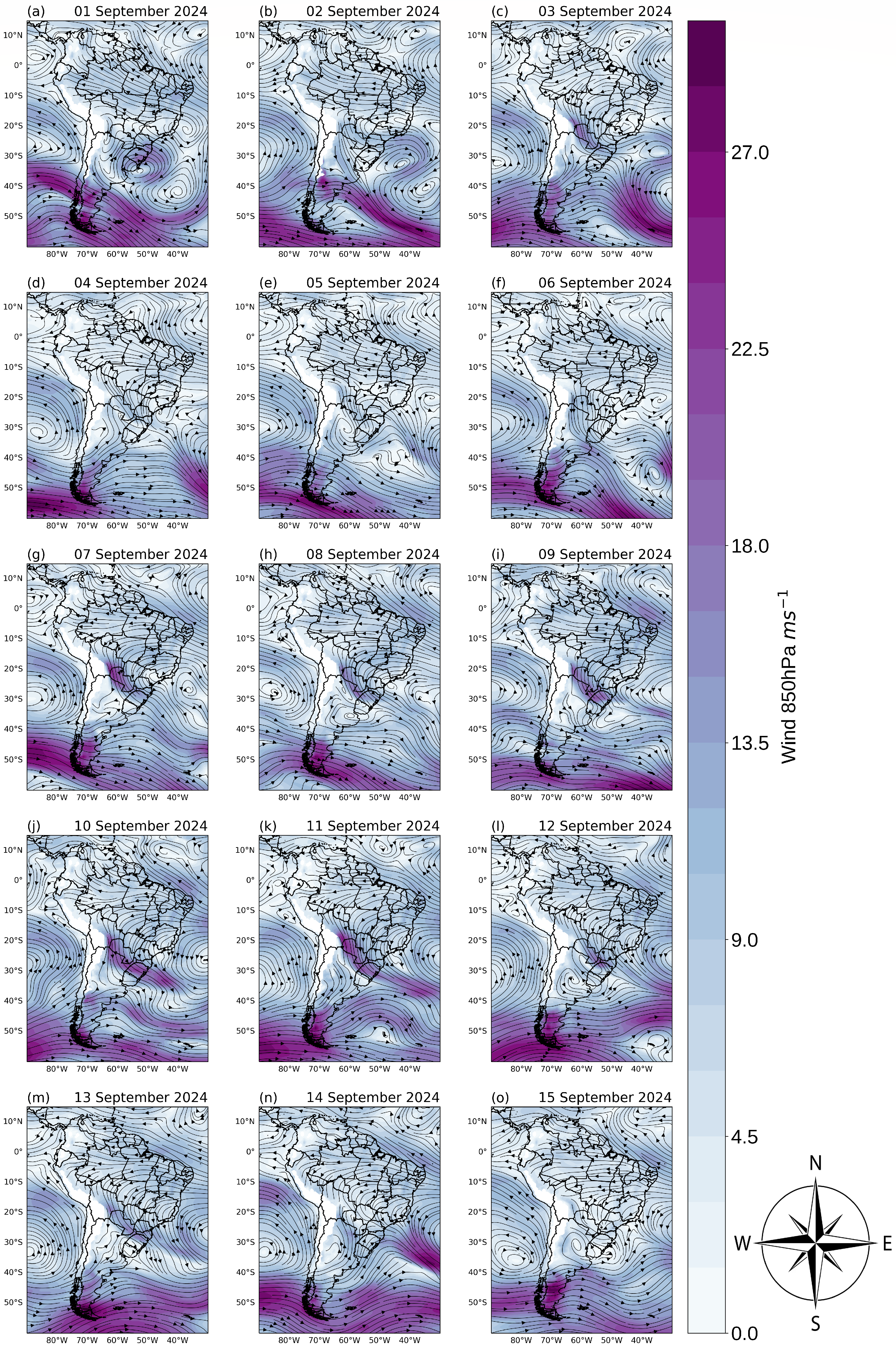
Figure 4 and Figure 5 illustrate the aerosol mass flux and atmospheric circulation during the first half of September 2024. Figure 4 depicts the aerosol mass flux, which represents the product of the carbonaceous aerosol concentration and wind, allowing for inferences about aerosol concentrations in the region as well as their transport. Figure 5, on the other hand, shows the atmospheric circulation, providing an essential context to support the analysis. The analysis revealed that the main sources of aerosol emissions were in the Amazon region. Subsequently, these aerosols were transported to southern and southeastern Brazil, mainly driven by the South American Low-Level Jet (SALLJ), as evidenced in Figure 5. The SALLJ, characterized by strong winds primarily at the level of 850 hPa [60,61,62], has been widely described by several authors as the main mechanism responsible for transporting heat and moisture from the Amazon to southern Brazil, as well as carrying biomass burning products from the Amazon to subtropical regions [63,64,65].
During the initial days of the analyzed period (1 september and 2 September 2024), an increase in aerosol mass flux values (up to 2.4 kg m−1s−1) was observed over the Amazon region, driven by intense fire activity. Already in these first two days, the southward transport of aerosols could be identified, reaching the São Martinho region on 1 September 2024, although with a low intensity. Due to changes in atmospheric circulation (Figure 5), these aerosols subsequently reached the São Paulo region by 2 September 2024. Between 3 and 7 September 2024, the southward transport of aerosols was observed. However, the aerosol mass flux values were less intense, and due to changes in atmospheric circulation, the intensities alternated between the cities of São Martinho and São Paulo.
On 7 September 2024, an intensification in wind speed toward the south was observed (Figure 5g), which persisted until 11 September 2024 (Figure 5k). On 8 September 2024, aerosol mass flux values intensified once again (Figure 4h), with the reestablishment of transport toward southern Brazil, driven by atmospheric circulation. This transport directly impacted the city of São Martinho and persisted in the region until 11 September 2024 (Figure 4k). This pattern is also evident in Figure 3, where the AOD begins to increase on 6 September 2024, reaching its peak on 11 September 2024.
In the following days (13–15 September 2024), a decrease in the intensity of the winds was observed in some areas of southern Brazil, which was associated with the passage of a high-pressure system that settled over part of Uruguay and southern Brazil (Figure 5m–o), causing the wind flow to change to a more southerly component toward the east. Consequently, the aerosol plume began to shift northward (Figure 4m–o). This shift enabled higher concentrations of carbonaceous aerosols to reach São Paulo and considerably increase the AOD concentrations during this period (Figure 3).
Aerosol mass flux is a widely used variable for identifying regions of aerosol concentration and long-range transport. It has been recognized by several authors as a key indicator of aerosol atmospheric rivers (AARs) in various regions [28,66,67]. The aerosol mass flux values observed during this event, as well as the extent of the transport, are comparable to those associated with an AAR identified by Chakraborty et al. [66] on 18 August 2019, albeit more intense. This same event was also analyzed by Vara-Vela et al. [22], as it was marked by the occurrence of “black rain” in the state of São Paulo. The authors investigated biomass burning events during the 2018–2019 fire seasons using the WRF-Chem and found that it adequately represented the spatial evolution of smoke plumes, although with some limitations regarding AOD magnitudes.
That aside, in São Martinho, the event was shorter in duration but more intense, whereas in São Paulo, it lasted longer but was of a lower magnitude. This difference may be attributed to local meteorological conditions that modulate aerosol dispersion and accumulation. For instance, a reduced boundary layer height can trap aerosols near the surface, enhancing their optical depth, while strong atmospheric stability further limits vertical mixing. In addition, weaker wind speeds reduce horizontal ventilation, favoring the build-up of particles, whereas stronger winds can dilute concentrations by promoting dispersion. These processes together help explain the observed differences in the baseline AOD values between the two sites [27,68].
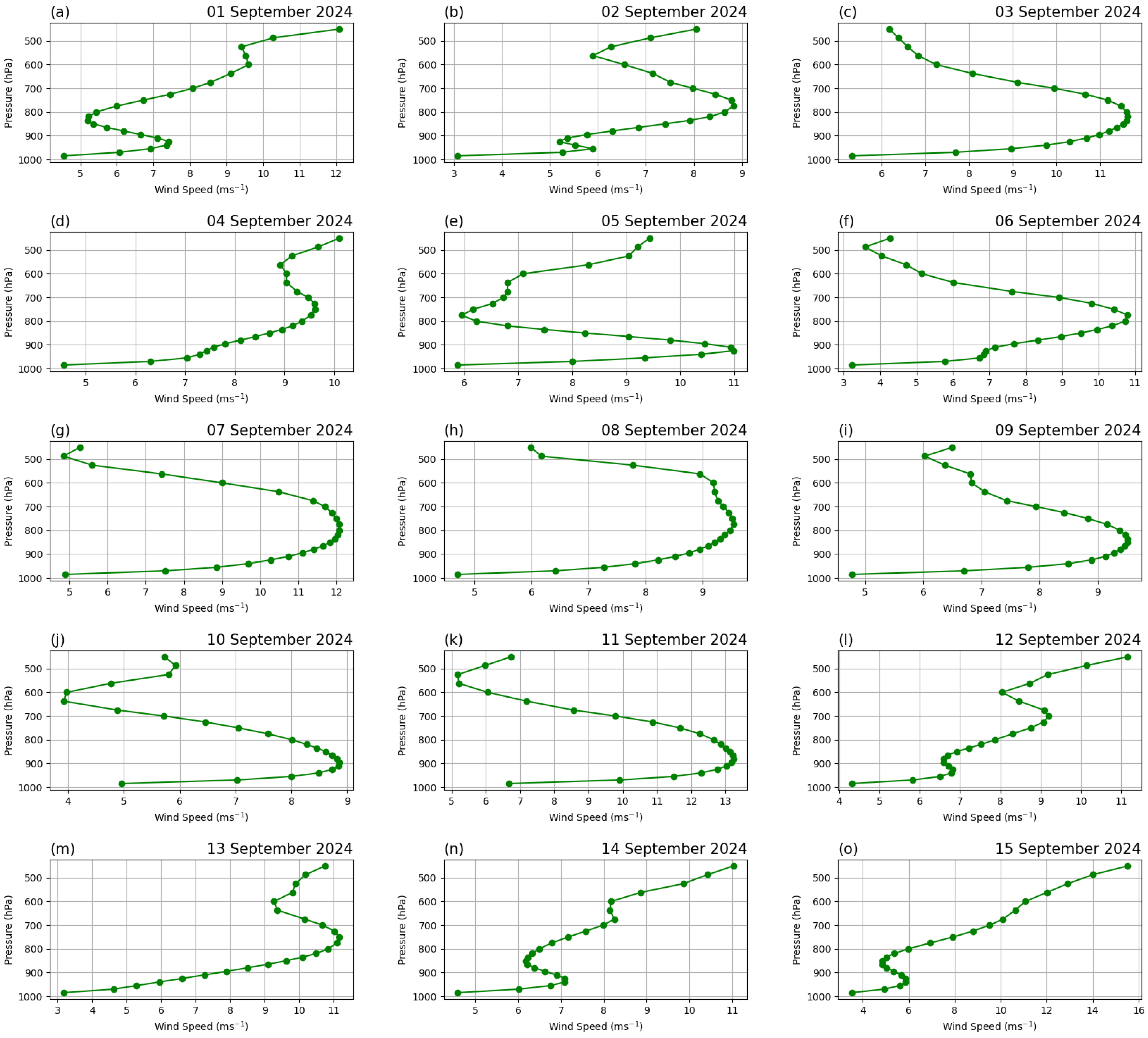
In addition to the circulation indicating the southward and southeastward transport of particulate matter from the burning region, it is possible to identify that the South American Low-Level Jet (SALLJ) influenced the area for several days and contributed to more intense transport, particularly toward the southern region, where the highest AOD values were observed. Figure 6 illustrates the average wind speed over the approximately identified SALLJ region [60,61,62] at various vertical levels.
The results of this simulation are consistent with previous studies indicating that meridional aerosol transport is primarily driven by the SALLJ, which carries emissions from the Amazon toward southern regions such as São Paulo and São Martinho. Similar studies have identified atmospheric circulation as the main driver behind the increase in particle concentrations in southern and southeastern regions of South America [61,62,69]. Miranda et al. [70] analyzed the atmospheric conditions and chemical composition in São Paulo over a 15-day period during the austral winter of 2012 and founded that the city received particulate matter originating from biomass burning in central Brazil, depending on the wind conditions. These findings are in line with those observed in the present study.
Furthermore, Mulena et al. [71] used remote sensing measurements combined with trajectory modeling to analyze the transport of biomass burning aerosols across South America, focusing on northwestern Argentina during the period from July to December 2019. Their findings indicated that biomass burning aerosols detected in the study area were transported by the SALLJ, originating both from nearby regions and remote sources in the Amazon. This highlights the capacity of the SALLJ to carry biomass burning emissions from the Amazon over long distances, reaching diverse regions across the continent.
Aside from that, Fast et al. (2024) [72] described measurements of the aerosol number, size, composition, mixing state, and cloud condensation nuclei (CCNs) collected on the ground and using aircraft during the Cloud, Aerosol, and Complex Terrain Interactions (CACTI) field campaign. CACTI was a campaign that took place between October 2018 and April 2019 over the Sierras de Córdoba range of central Argentina. The authors also used modeling to simulate the transport of aerosols to central Argentina, and the results suggested a relationship between the high aerosol concentration over central Argentina and the biomass burning from Amazon, mainly due to the transport by the SALLJ.

3.3. Statical Comparison with Historical Climatology

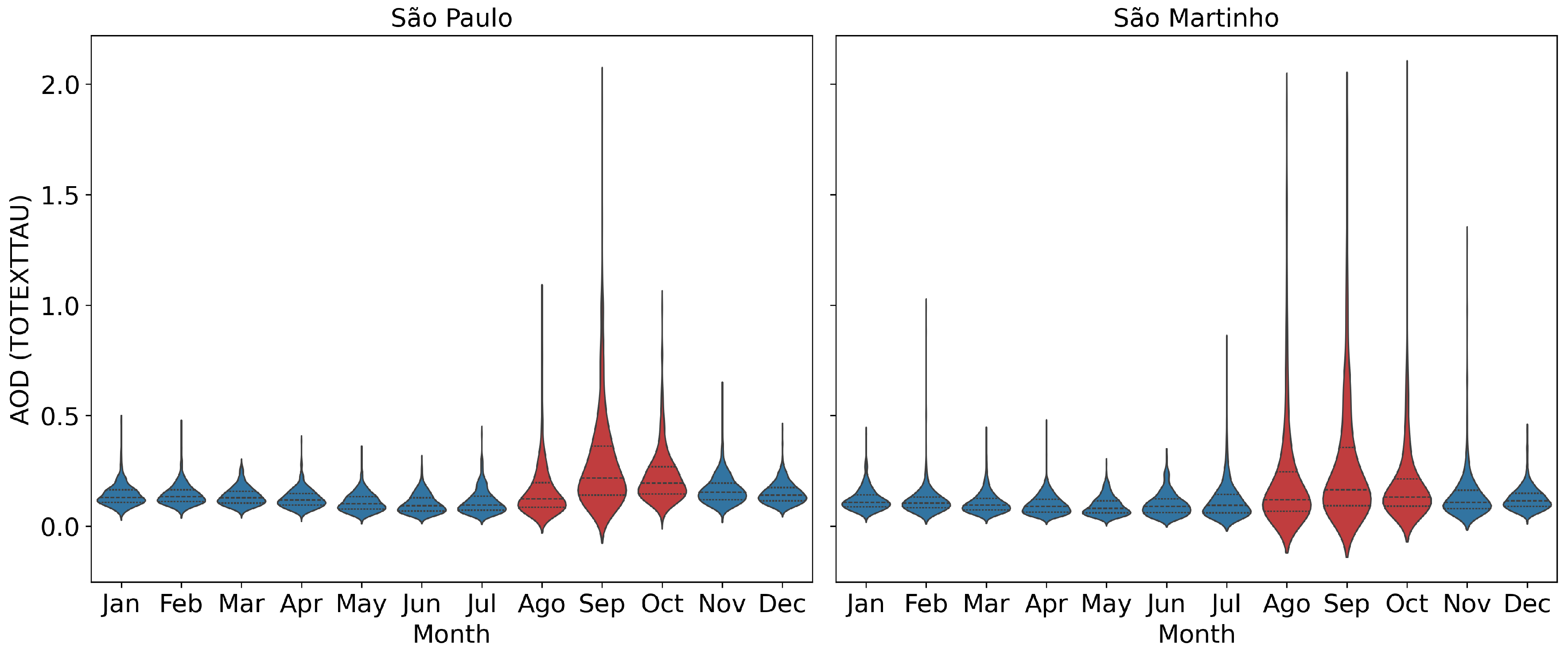
To contextualize the aerosol concentrations observed during the September 2024 event, the monthly distributions of AODs from MERRA-2 were analyzed over the historical period from 2003 to 2024. Figure 7 presents violin plots for each month, highlighting the major concentration months (August–October) in red. These months are typically associated with an increase in biomass burning in South America and correspond to the season during which the 2024 event occurred [63,64,65].
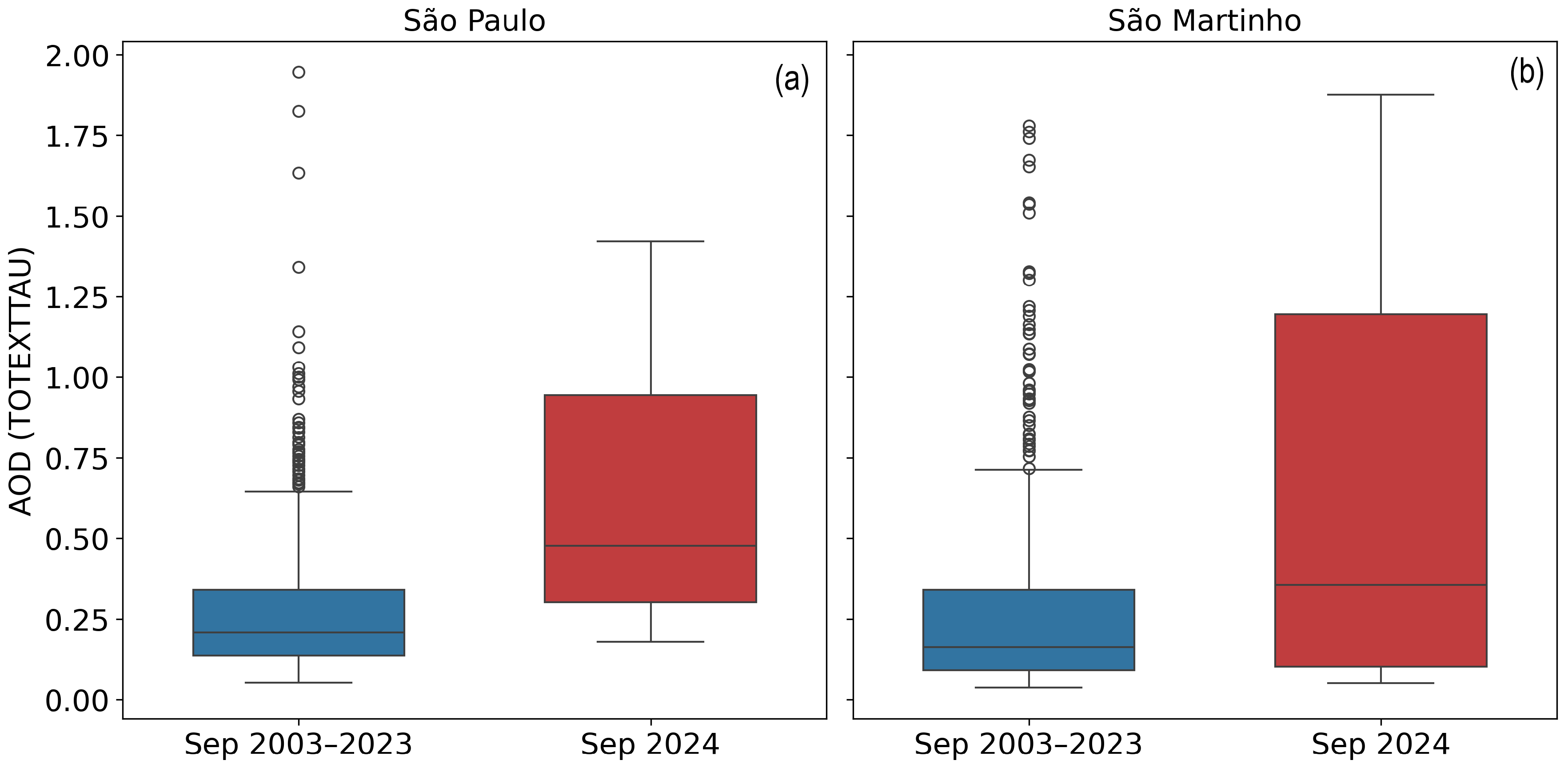
Both São Martinho and São Paulo exhibited clear seasonal variability, with higher AOD values during the dry season months. Notably, the September distributions showed broader tails and higher medians, especially in São Martinho, indicating the seasonal influence of regional fire activity and long-range transport of aerosols. These results are consistent with the findings of Sena et al. [68] and Rogers et al. [27]. These climatological distributions serve as a reference for interpreting the anomaly observed in September 2024, which is further explored in Figure 8. Figure 8 shows boxplots that compare the AOD distributions for September 2024 with those of historical climatology (2003–2023). For both São Paulo and São Martinho, the 2024 values showed a clear upward shift in the median, interquartile range, and extreme values.
In São Martinho, the median AOD for September 2024 was nearly three times higher than the historical median, with a broader spread of values and fewer low-concentration days. São Paulo also exhibited a significant increase, although with less dispersion than São Martinho. These results confirm that the September 2024 episode stands out not only in terms of daily intensity but also its cumulative magnitude and statistical deviation from historical patterns, highlighting the importance of climatological baselines for identifying anomalous aerosol episodes [28]. A Mann–Whitney U test confirmed that the September 2024 AOD values were significantly higher than the historical September distributions at both sites (São Paulo: p < 0.001 ; São Martinho: p = 0.046 ), consistent with the anomalies illustrated in Figure 7 and Figure 8.

3.4. WRF-Chem System Performance Evaluation

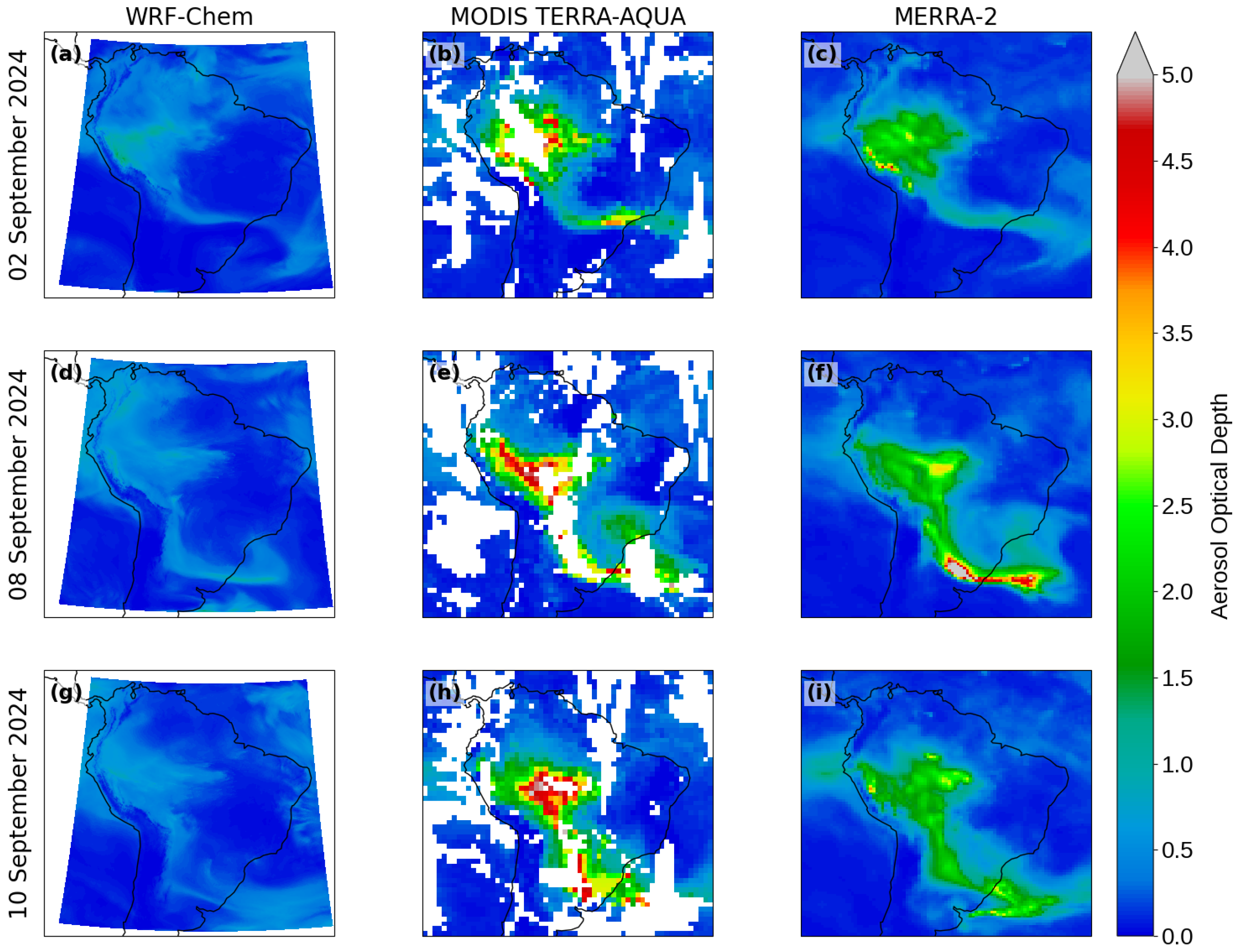
Figure 9 illustrates the temporal evolution of aerosol concentrations as represented by the WRF-Chem(Figure 9a,d,g), MODIS satellite observations (panels in Figure 9b,e,h), and MERRA-2 reanalysis data (Figure 9c,f,i) for 2 september 2024, 8, and 10 September 2024. On 2 September (Figure 9a–c), the WRF-Chem adequately reproduced aerosol concentrations originating from fires in the Amazon region, showing good agreement with the MODIS observational data in terms of spatial patterns. The model successfully captured the spatial extent of the aerosol plume, including the long-range transport of particles from northern Brazil toward the southern and southeastern regions, demonstrating its ability to represent large-scale aerosol dispersion processes.
However, the magnitude of the AOD from the model was clearly less than the AOD observed by satellite, as WRF-Chem slightly underestimated the aerosol concentrations compared to MODIS. The MERRA-2 reanalysis showed a similar structure to MODIS and WRF-Chem (partly because the model is driven by MERRA-2 data), but it exhibited slightly lower concentrations and a smoother spatial distribution, likely due to the assimilation of observational data. However, the magnitude of the aerosol optical depth (AOD) simulated by the WRF-Chem was consistently lower than the observed AOD values from MODIS. On this date, the model underestimated aerosol concentrations by 45.1% compared with MODIS. Compared with MERRA-2, the average underestimation was 35.1%. This bias is likely due to the simplifications in aerosol microphysics processes and the model’s resolution, which can smooth localized AOD peaks. Despite these underestimations, the model remained effective in representing the overall aerosol distribution and transport patterns. Several factors may contribute to the systematic underestimation of AOD in both WRF-Chem and MERRA-2, such as uncertainties in the fire emission inventory and the limitations of the chemical mechanisms in the models. These limitations are crucial to understanding the discrepancies between simulated and observed aerosol concentrations. However, despite these challenges, the model remained effective in capturing the broader patterns of aerosol transport.
On 8 September 2024 (Figure 9d–f), the aerosol plume started dispersing southward, increasing its extent, consistent with the circulation fields presented in Figure 5. This transport was favored by the occurrence of a SALLJ event. WRF-Chem clearly depicts the aerosol plume extending southeastward from the Amazon region toward southern Brazil. This behavior is consistent with MODIS observations, which showed high aerosol concentrations across an extensive area, indicating again that WRF-Chem underestimated the aerosol magnitudes. MERRA-2 once again showed lower aerosol values compared with MODIS and WRF-Chem. Although MERRA-2 accurately captured the direction of aerosol transport, it underestimated the intensity of the event observed by MODIS.
Finally, on September 10 2024 (panels Figure 9g–i), the WRF-Chem output indicated an increase in aerosol concentrations from fires in the Amazon, which continued to be transported southward and southeastward via the SALLJ, as also shown in the wind fields in Figure 5. This transport particularly affected the São Martinho region and surrounding areas in southern Brazil. MODIS observations consistently reported extremely high aerosol concentrations. MERRA-2 reproduced the spatial structure observed by MODIS, mainly because MODIS provides the vast majority of AOD observations assimilated in MERRA-2 from Terra and Aqua satellite data [46,73], although MERRA-2 still underestimated the AOD values, and the reason for this could be the missing emissions in the aerosol model or cloud contamination [48].
The results of this study are consistent with those reported by Vara-Vela et al. [22], particularly in the comparison between satellite observations from MODIS and simulations from the WRF-Chem (Figure 8). However, the AOD values from the observed and reanalysis data (MODIS and MERRA-2, respectively) analyzed in this study were higher than those reported by the previously cited works, characterizing this event as more intense. While Vara-Vela et al. [22] described an event where the AOD reached up to 1.6, this study showed AOD values higher than 4.5, characterizing this event as more intense.
These findings highlight the increasing severity of recent biomass burning events, as the AOD values observed in this study were exceptionally high, even in regions located far from the fire hotspots. In this context, it is essential to investigate the meteorological systems that influence aerosol transport as well as broader climatic conditions, such as the drought in the Amazon region, which may have contributed significantly to the alarming intensity of the fires during this period.
Moreover, this study contributes to identifying areas for improvement in numerical models, which could eventually be used to issue alerts to populations in regions likely to be affected by smoke. Given that events of this magnitude can trigger serious respiratory health problems, especially among vulnerable populations, the development of predictive and preventive capabilities becomes increasingly important from a public health perspective.

4. Discussion and Conclusions

This study aimed to analyze the transport of aerosols resulting from biomass burning events that occurred in September 2024. The event lasted nearly 15 days, during which smoke plumes were transported to the southern and southeastern regions of Brazil. In addition, this event occurred during a period of severe drought in the Amazon from 2022 to 2024 [41,42]. A combination of an El Niño event, the positive phases of the IOD, the warm phase of the tropical North Atlantic, and the effects of climate change contributed to the Amazon drought, reduced soil moisture, and stressed vegetation, which increased the risk of wildfires [42].
This event resulted in several consecutive days of hazy skies across numerous cities and led to the occurrence of “black rain” in many locations. Therefore, in contrast with the climatology of 2003–2023 and with previously reported episodes in South America, the September 2024 event can be considered exceptional in terms of both intensity and duration, exceeding the range of typical interannual variability observed at So Paulo and So Martinho. Similar extreme AOD values have rarely been documented in South America, with previous studies typically reporting maxima below 2.0–2.5 during large fire events [22,28]. This further supports the notion that the September 2024 episode exceeded the expected range of variability and represents an unprecedented case.
The dynamics of aerosol transport showed clear temporal variability. The initial aerosol plumes were transported southward, initially affecting the So Martinho region and subsequently São Paulo. Later, a change in wind patterns, associated with shifts in atmospheric circulation and the passage of a high-pressure system, redirected aerosol transport northward, significantly impacting aerosol concentrations in São Paulo.
This aerosol transport behavior is closely related to the dynamics of the SALLJ, which plays a key role in the advection of heat, moisture, and particulate matter into the region [71]. Similar results have been reported in previous studies conducted in nearby areas. For example, Ulke [74] demonstrated changes in aerosol concentrations in Buenos Aires associated with biomass burning in central South America.
In addition, de Oliveira et al. [75] characterized aerosol particles and their transport to southern Brazil during the austral winter between 2002 and 2011. The authors observed a significant increase in aerosol concentrations during this period, particularly in August, primarily influenced by long-range transport from biomass burning events.
The spatial pattern and temporal evolution of aerosols originating from fires in the Amazon show good agreement with MODIS satellite observations, although the magnitude of the AOD of the model was clearly less than the AOD observed via satellite and the MERRA-2 reanalysis data. This underestimation likely reflects uncertainties in fire emission inventories, simplified aerosol microphysics and removal processes, and the coarse resolution of the model, which tends to smooth localized AOD peaks, as also observed in previous evaluations of WRF-Chem and MERRA-2 performance [22,47].
These results highlight that the WRF-Chem performed well in adequately reproducing the general dynamics of aerosol transport influenced by regional circulation patterns. This study did not include a specific evaluation of the influence of the planetary boundary layer (PBL) parameterization on the evolution of the aerosol plume. Nevertheless, it is well established that aerosol transport is highly sensitive to vertical mixing and PBL dynamics. Different PBL schemes available in the WRF-Chem can substantially affect the vertical and horizontal dispersion of plumes, thereby influencing simulated concentrations and transport patterns. A more detailed assessment involving sensitivity experiments with alternative PBL parameterizations could provide valuable insights into the magnitude of these impacts and represents a relevant direction for future work. Regarding aerosol quantities from these fires, systematic underestimation occurred in both the WRF-Chem outputs and MERRA-2 reanalysis data, with the WRF-CHEM model displaying greater underestimation of AOD concentrations compared with MERRA-2.
The use of MERRA-2 reanalysis as forcing data for the WRF-Chem indicates that it is appropriate for inclusion in model simulations. In both cases, the WRF-Chem model and MERRA-2 reanalysis adequately represented this transport pattern. These findings align with the study conducted by Vara-Vela et al. [22], who demonstrated that WRF-Chem simulations adequately represent circulation patterns associated with transporting large aerosol fluxes to regions distant from their original sources during fire episodes in 2019.
The same event that occurred in 2019 was also analyzed by Mulena et al. [71], who reported elevated AOD values in northern and central Argentina between July and December 2019. The study identified aerosols originating from biomass burning in South America, primarily based on the physical characteristics of the particles and low-level atmospheric circulation patterns that facilitated their long-range transport.
Based on these results, it was possible to identify areas affected by the extensive biomass burning that occurred in central South America. Furthermore, the findings highlighted the crucial role of atmospheric circulation in transporting particulate matter to distant regions. On this occasion, changes in circulation patterns contributed to increased concentrations of particulate matter in two geographically distant areas.
For future studies, it would be valuable to investigate how the presence of this particulate matter can impact human health, even in regions far from the original burning sites, by analyzing data on healthcare services for respiratory problems during the occurrence of events like this. In addition, establishing a monitoring network for aerosol analysis and characterization would be highly beneficial in assessing the influence of these aerosols on regional climate, as different types of aerosol can affect the climate in different ways, depending on their composition and location. Although health impacts were not directly assessed in this study, the magnitude of the September 2024 aerosol episode raises serious concerns. Previous works have demonstrated that fire-related pollution episodes in Brazil are associated with increased hospital admissions and respiratory morbidity, such as in São Paulo [76] and Amazonian cities [77], and that biomass burning emissions frequently drive PM2.5 concentrations above World Health Organization guidelines [26]. Considering that the September 2024 AOD values exceeded historical records at both São Paulo and São Martinho, it is reasonable to expect that this event also posed significant risks to human health.

Author Contributions

Conceptualization, F.P.F.; Methodology, F.P.F. and C.B.; Software, F.P.F., C.B. and A.R.; Validation, F.P.F., C.B. and A.R.; Formal analysis, F.P.F., C.B. and A.R.; Investigation, F.P.F. and C.B.; Data curation, F.P.F. and C.B.; Writing—original draft, F.P.F. and C.B.; Writing—review & editing, G.V.M., D.L.H., J.B.C.J. and F.D.d.S.S.; Supervision, G.V.M. and D.L.H. All authors have read and agreed to the published version of the manuscript.

Funding

This research received no external funding.

Institutional Review Board Statement

Not applicable.

Informed Consent Statement

Not applicable.

Data Availability Statement

The data presented in this study are available from the following public domain resources. MODIS data from the Fire Information for Resource Management System (FIRMS) are available at https://firms.modaps.eosdis.nasa.gov/download/ (accessed on 10 March 2025). AERONET data from the AERONET network are available at https://aeronet.gsfc.nasa.gov/(accessed on 8 April 2025). MERRA-2 reanalysis data from NASA’s Goddard Earth Sciences Data and Information Services Center (GES DISC) are available at https://disc.gsfc.nasa.gov/(accessed on 15 April 2025). The WRF-Chem simulation outputs generated in this study are available from the corresponding author upon reasonable request.

Acknowledgments

The authors thank Coordination for the Improvement of Higher Education Personnel–Brazil (CAPES, Brazil). We also thank the National Council for Scientific and Technological Development (CNPq, Brazil). C. Bresciani gratefully acknowledges the Federal Institute of Santa Catarina (IFSC) and the Santa Catarina Research and Innovation Support Foundation (FAPESC) for their institutional support.

Conflicts of Interest

The authors declare no conflicts of interest.

References

  1. Twomey, S. The Influence of Pollution on the Shortwave Albedo of Clouds. J. Atmos. Sci. 1977, 34, 1149–1152. [Google Scholar] [CrossRef]
  2. Seinfeld, J.H.; Pandis, S.N. Atmospheric Chemistry and Physics: From Air Pollution to Climate Change; John Wiley & Sons: Hoboken, NJ, USA, 2016. [Google Scholar]
  3. Charlson, R.J.; Schwartz, S.; Hales, J.; Cess, R.D.; Coakley, J., Jr.; Hansen, J.; Hofmann, D. Climate forcing by anthropogenic aerosols. Science 1992, 255, 423–430. [Google Scholar] [CrossRef] [PubMed]
  4. Xia, X.A.; Chen, H.B.; Wang, P.C.; Zhang, W.X.; Goloub, P.; Chatenet, B.; Eck, T.F.; Holben, B.N. Variation of column-integrated aerosol properties in a Chinese urban region. J. Geophys. Res. Atmos. 2006, 111, D05204. [Google Scholar] [CrossRef]
  5. Ali, M.A.; Bilal, M.; Wang, Y.; Qiu, Z.; Nichol, J.E.; de Leeuw, G.; Ke, S.; Mhawish, A.; Almazroui, M.; Mazhar, U.; et al. Evaluation and comparison of CMIP6 models and MERRA-2 reanalysis AOD against Satellite observations from 2000 to 2014 over China. Geosci. Front. 2022, 13, 101325. [Google Scholar] [CrossRef]
  6. Zhang, Z.; Zhang, M.; Bilal, M.; Su, B.; Zhang, C.; Guo, L. Comparison of MODIS- and CALIPSO-Derived Temporal Aerosol Optical Depth over Yellow River Basin (China) from 2007 to 2015. Earth Syst. Environ. 2020, 4, 535–550. [Google Scholar] [CrossRef]
  7. Wang, M.; Penner, J.E. Aerosol indirect forcing in a global model with particle nucleation. Atmos. Chem. Phys. 2009, 9, 239–260. [Google Scholar] [CrossRef]
  8. Yu, F.; Luo, G. Simulation of particle size distribution with a global aerosol model: Contribution of nucleation to aerosol and CCN number concentrations. Atmos. Chem. Phys. 2009, 9, 7691–7710. [Google Scholar] [CrossRef]
  9. Pierce, J.R.; Adams, P.J. Uncertainty in global CCN concentrations from uncertain aerosol nucleation and primary emission rates. Atmos. Chem. Phys. 2009, 9, 1339–1356. [Google Scholar] [CrossRef]
  10. Carslaw, K.S. Aerosols and Climate; Elsevier: Amsterdam, The Netherlands, 2022. [Google Scholar]
  11. Yu, P.; Toon, O.B.; Neely, R.R.; Martinsson, B.G.; Brenninkmeijer, C.A.M. Composition and physical properties of the Asian Tropopause Aerosol Layer and the North American Tropospheric Aerosol Layer. Geophys. Res. Lett. 2015, 42, 2540–2546. [Google Scholar] [CrossRef]
  12. Lau, W.; Yuan, C.; Li, Z. Origin, Maintenance and Variability of the Asian Tropopause Aerosol Layer (ATAL): The roles of monsoon dynamics. Sci. Rep. 2018, 8, 3960. [Google Scholar] [CrossRef]
  13. Andreae, M.O.; Afchine, A.; Albrecht, R.; Holanda, B.A.; Artaxo, P.; Barbosa, H.M.J.; Borrmann, S.; Cecchini, M.A.; Costa, A.; Dollner, M.; et al. Aerosol characteristics and particle production in the upper troposphere over the Amazon Basin. Atmos. Chem. Phys. 2018, 18, 921–961. [Google Scholar] [CrossRef]
  14. Williamson, C.J.; Kupc, A.; Axisa, D.; Bilsback, K.R.; Bui, T.; Campuzano-Jost, P.; Dollner, M.; Froyd, K.D.; Hodshire, A.L.; Jimenez, J.L.; et al. A large source of cloud condensation nuclei from new particle formation in the tropics. Nature 2019, 574, 399–403. [Google Scholar] [CrossRef]
  15. Bresciani, C.; Herdies, D.L.; Figueroa, S.N.; Buchard, V.; da Silva, A.M.; Jones, C.; Carvalho, L.M.V. The South American Tropopause Aerosol Layer (SATAL). Bull. Am. Meteorol. Soc. 2024, 105, E176–E192. [Google Scholar] [CrossRef]
  16. Bond, T.C.; Doherty, S.J.; Fahey, D.W.; Forster, P.M.; Berntsen, T.; DeAngelo, B.J.; Flanner, M.G.; Ghan, S.; Kärcher, B.; Koch, D.; et al. Bounding the Role of Black Carbon in the Climate System: A Scientific Assessment. J. Geophys. Res. Atmos. 2013, 118, 5380–5552. [Google Scholar] [CrossRef]
  17. Mishra, A.K.; Lehahn, Y.; Rudich, Y.; Koren, I. Co-variability of smoke and fire in the Amazon basin. Atmos. Environ. 2015, 109, 97–104. [Google Scholar] [CrossRef]
  18. Morgan, W.T.; Darbyshire, E.; Spracklen, D.V.; Artaxo, P.; Coe, H. Non-deforestation drivers of fires are increasingly important sources of aerosol and carbon dioxide emissions across Amazonia. Sci. Rep. 2019, 9, 16975. [Google Scholar] [CrossRef] [PubMed]
  19. Artaxo, P.; Martins, J.V.; Yamasoe, M.A.; Procópio, A.S.; Pauliquevis, T.M.; Andreae, M.O.; Guyon, P.; Gatti, L.V.; Leal, A.M.C. Physical and chemical properties of aerosols in the wet and dry seasons in Rondônia, Amazonia. J. Geophys. Res. Atmos. 2002, 107, LBA 49-1–LBA 49-14. [Google Scholar] [CrossRef]
  20. Hoelzemann, J.J.; Longo, K.M.; Fonseca, R.M.; Do Rosário, N.M.E.; Elbern, H.; Freitas, S.R.; Pires, C. Regional representativity of AERONET observation sites during the biomass burning season in South America determined by correlation studies with MODIS Aerosol Optical Depth. J. Geophys. Res. Atmos. 2009, 114. [Google Scholar] [CrossRef]
  21. Alvim, D.S.; Pendharkar, J.; Capistrano, V.B.; Frassoni, A.; Enoré, D.P.; Leandro de Menezes Neto, O.; Gutierrez, E.R.; Choudhury, A.D.; Kubota, P.Y.; da Silva, J.; et al. Aerosol distribution over Brazil with ECHAM-HAM and CAM5-MAM3 simulations and its comparison with ground-based and satellite data. Atmos. Pollut. Res. 2017, 8, 718–728. [Google Scholar] [CrossRef]
  22. Vara-Vela, A.L.; Herdies, D.L.; Alvim, D.S.; Vendrasco, É.P.; Figueroa, S.N.; Pendharkar, J.; Reyes Fernandez, J.P. A New Predictive Framework for Amazon Forest Fire Smoke Dispersion over South America. Bull. Am. Meteorol. Soc. 2021, 102, E1700–E1713. [Google Scholar] [CrossRef]
  23. Balch, J.K.; Bradley, B.A.; Abatzoglou, J.T.; Nagy, R.C.; Fusco, E.J.; Mahood, A.L. Human-started wildfires expand the fire niche across the United States. Proc. Natl. Acad. Sci. 2017, 114, 2946–2951. [Google Scholar] [CrossRef] [PubMed]
  24. Souto-Oliveira, C.E.; Marques, M.T.; Nogueira, T.; Lopes, F.J.; Medeiros, J.A.; Medeiros, I.M.; Moreira, G.A.; Da Silva Dias, P.L.; Landulfo, E.; Andrade, M.D.F. Impact of extreme wildfires from the Brazilian Forests and sugarcane burning on the air quality of the biggest megacity on South America. Sci. Total Environ. 2023, 888, 163439. [Google Scholar] [CrossRef] [PubMed]
  25. Teixeira, M.J.; Machado, L.A.T.; Artaxo, P.; Calheiros, A.; Correa, P.; Franco, M.A.; Shimbo, J.; Rizzo, L.V. Analyzing and forecasting the morphology of Amazon deforestation. For. Ecol. Manag. 2025, 586, 122662. [Google Scholar] [CrossRef]
  26. Reddington, C.L.; Butt, E.W.; Ridley, D.A.; Artaxo, P.; Morgan, W.T.; Coe, H.; Spracklen, D.V. Air quality and human health improvements from reductions in deforestation-related fire in Brazil. Nat. Geosci. 2015, 8, 768–771. [Google Scholar] [CrossRef]
  27. Rogers, H.M.; Ditto, J.C.; Gentner, D.R. Evidence for impacts on surface-level air quality in the northeastern US from long-distance transport of smoke from North American fires during the Long Island Sound Tropospheric Ozone Study (LISTOS) 2018. Atmos. Chem. Phys. 2020, 20, 671–682. [Google Scholar] [CrossRef]
  28. Chakraborty, S.; Guan, B.; Waliser, D.E.; da Silva, A.M.; Uluatam, S.; Hess, P. Extending the atmospheric river concept to aerosols: Climate and air quality impacts. Geophys. Res. Lett. 2021, 48, e2020GL091827. [Google Scholar] [CrossRef]
  29. Jolly, W.M.; Cochrane, M.A.; Freeborn, P.H.; Holden, Z.A.; Brown, T.J.; Williamson, G.J.; Bowman, D.M.J.S. Climate-induced variations in global wildfire danger from 1979 to 2013. Nat. Commun. 2015, 6, 7537. [Google Scholar] [CrossRef]
  30. Satar, E.; Berhanu, T.A.; Brunner, D.; Henne, S.; Leuenberger, M. Continuous CO2/CH4/CO measurements (2012–2014) at Beromünster tall tower station in Switzerland. Biogeosciences 2016, 13, 2623–2635. [Google Scholar] [CrossRef]
  31. Escobar, H. Amazon Fires Clearly Linked to Deforestation, Scientists Say; AAAS: Washington, DC, USA, 2019. [Google Scholar]
  32. IPAM-Amazônia. About 17.5% of Brazil has Burned at Least Once in the Last 20 Years. 2020. Available online: https://ipam.org.br/17-5-of-brazil-has-burned-at-least-once-in-the-last-20years (accessed on 24 March 2025).
  33. Mega, E.R. ‘Apocalyptic’ fires are ravaging the world’s largest tropical wetland. Nature 2020, 586, 20–21. [Google Scholar] [CrossRef]
  34. NASA Earth Observatory. Fires Char the Pantanal. 2020. Available online: https://earthobservatory.nasa.gov/images/147269/fires-char-the-pantanal (accessed on 24 March 2025).
  35. Torres, O.; Tanskanen, A.; Veihelmann, B.; Ahn, C.; Braak, R.; Bhartia, P.K.; Veefkind, P.; Levelt, P. Aerosols and surface UV products from Ozone Monitoring Instrument observations: An overview. J. Geophys. Res. Atmos. 2007, 112. [Google Scholar] [CrossRef]
  36. Duflot, V.; Royer, P.; Chazette, P.; Baray, J.L.; Courcoux, Y.; Delmas, R. Marine and biomass burning aerosols in the southern Indian Ocean: Retrieval of aerosol optical properties from shipborne lidar and Sun photometer measurements. J. Geophys. Res. 2011, 116. [Google Scholar] [CrossRef]
  37. Bègue, N.; Shikwambana, L.; Bencherif, H.; Pallotta, J.; Sivakumar, V.; Wolfram, E.; Mbatha, N.; Orte, F.; Du Preez, D.J.; Ranaivombola, M.; et al. Statistical analysis of the long-range transport of the 2015 Calbuco volcanic plume from ground-based and space-borne observations. Ann. Geophys. 2020, 38, 395–420. [Google Scholar] [CrossRef]
  38. Grell, G.A.; Peckham, S.E.; Schmitz, R.; McKeen, S.A.; Frost, G.; Skamarock, W.C.; Eder, B. Fully coupled “online” chemistry within the WRF model. Atmos. Environ. 2005, 39, 6957–6975. [Google Scholar] [CrossRef]
  39. Solazzo, E.; Bianconi, R.; Hogrefe, C.; Curci, G.; Tuccella, P.; Alyuz, U.; Balzarini, A.; Baró, R.; Bellasio, R.; Bieser, J.; et al. Evaluation and error apportionment of an ensemble of atmospheric chemistry transport modeling systems: Multivariable temporal and spatial breakdown. Atmos. Chem. Phys. 2017, 17, 3001–3054. [Google Scholar] [CrossRef] [PubMed]
  40. Petersen, A.K.; Brasseur, G.P.; Bouarar, I.; Flemming, J.; Gauss, M.; Jiang, F.; Kouznetsov, R.; Kranenburg, R.; Mijling, B.; Peuch, V.H.; et al. Ensemble forecasts of air quality in eastern China—Part 2: Evaluation of the MarcoPolo–Panda prediction system, version 1. Geosci. Model Dev. 2019, 12, 1241–1266. [Google Scholar] [CrossRef]
  41. Marengo, J.A.; Cunha, A.P.; Espinoza, J.C.; Fu, R.; Schöngart, J.; Jimenez, J.C.; Costa, M.C.; Ribeiro, J.M.; Wongchuig, S.; Zhao, S. The drought of Amazonia in 2023–2024. Am. J. Clim. Chang. 2024, 13, 567–597. [Google Scholar] [CrossRef]
  42. Toreti, A.; Bavera, D.; Acosta, N.J.; Acquafresca, L.; Azas, K.; Barbosa, P.; De, J.A.; Ficchi, A.; Fioravanti, G.; Grimaldi, S.; et al. Global Drought Overview September 2024; Publications Office of the European Union: Luxembourg, 2024. [Google Scholar]
  43. Holben, B.N.; Eck, T.F.; Slutsker, I.a.; Tanre, D.; Buis, J.; Setzer, A.; Vermote, E.; Reagan, J.A.; Kaufman, Y.; Nakajima, T.; et al. AERONET—A federated instrument network and data archive for aerosol characterization. Remote Sens. Environ. 1998, 66, 1–16. [Google Scholar] [CrossRef]
  44. Giglio, L.; Schroeder, W.; Justice, C.O. The collection 6 MODIS active fire detection algorithm and fire products. Remote Sens. Environ. 2016, 178, 31–41. [Google Scholar] [CrossRef]
  45. Randles, C.A.; Da Silva, A.M.; Buchard, V.; Colarco, P.R.; Darmenov, A.; Govindaraju, R.; Flynn, C.J. The MERRA-2 aerosol reanalysis, 1980 onward. Part I: System description and data assimilation evaluation. J. Clim. 2017, 30, 6823–6850. [Google Scholar] [CrossRef]
  46. Gelaro, R.; McCarty, W.; Suárez, M.; Todling, R.; Molod, A.; Takacs, L.; Randles, C.; Darmenov, A.; Bosilovich, M.; Reichle, R.; et al. The Modern-Era Retrospective Analysis for Research and Applications, Version 2 (MERRA-2). J. Clim. 2017, 30, 5419–5454. [Google Scholar] [CrossRef]
  47. Gueymard, C.A.; Yang, D. Worldwide validation of CAMS and MERRA-2 reanalysis aerosol optical depth products using 15 years of AERONET observations. Atmos. Environ. 2020, 225, 117216. [Google Scholar] [CrossRef]
  48. Buchard, V.; Randles, C.A.; Da Silva, A.M.; Darmenov, A.; Colarco, P.R.; Govindaraju, R.; Yu, H. The MERRA-2 aerosol reanalysis, 1980 onward. Part II: Evaluation and case studies. J. Climate 2017, 30, 6851–6872. [Google Scholar] [CrossRef] [PubMed]
  49. Guenther, A.; Karl, T.; Harley, P.; Wiedinmyer, C.; Palmer, P.I.; Geron, C. Estimates of global terrestrial isoprene emissions using MEGAN (Model of Emissions of Gases and Aerosols from Nature). Atmos. Chem. Phys. 2006, 6, 3181–3210. [Google Scholar] [CrossRef]
  50. Janssens-Maenhout, G.; Crippa, M.; Guizzardi, D.; Muntean, M.; Schaaf, E.; Dentener, F.; Bergamaschi, P.; Pagliari, V.; Olivier, J.G.; Peters, J.A.; et al. EDGAR v4. 3.2 Global Atlas of the three major Greenhouse Gas Emissions for the period 1970–2012. Earth Syst. Sci. Data Discuss. 2017, 2017, 1–55. [Google Scholar]
  51. Longo, K.M.; Freitas, S.R.; Andreae, M.O.; Setzer, A.; Prins, E.; Artaxo, P. The Coupled Aerosol and Tracer Transport model to the Brazilian developments on the Regional Atmospheric Modeling System (CATT-BRAMS)—Part 2: Model sensitivity to the biomass burning inventories. Atmos. Chem. Phys. 2010, 10, 5785–5795. [Google Scholar] [CrossRef]
  52. Freitas, S.R.; Longo, K.M.; Alonso, M.F.; Pirre, M.; Marecal, V.; Grell, G.; Stockler, R.; Mello, R.F.; Sánchez Gácita, M. PREP-CHEM-SRC – 1.0: A preprocessor of trace gas and aerosol emission fields for regional and global atmospheric chemistry models. Geosci. Model Dev. 2011, 4, 419–433. [Google Scholar] [CrossRef]
  53. Emmons, L.K.; Apel, E.C.; Lamarque, J.F.; Hess, P.G.; Avery, M.; Blake, D.; Brune, W.; Campos, T.; Crawford, J.; DeCarlo, P.F.; et al. Impact of Mexico City emissions on regional air quality from MOZART-4 simulations. Atmos. Chem. Phys. 2010, 10, 6195–6212. [Google Scholar] [CrossRef]
  54. Chin, M.; Rood, R.B.; Lin, S.; Müller, J.; Thompson, A.M. Atmospheric sulfur cycle simulated in the global model GOCART: Model description and global properties. J. Geophys. Res. Atmos. 2000, 105, 24671–24687. [Google Scholar] [CrossRef]
  55. Chin, M.; Ginoux, P.; Kinne, S.; Torres, O.; Holben, B.; Duncan, B.; Martin, R.; Logan, J.; Higurashi, A.; Nakajima, T. Tropospheric Aerosol Optical Thickness from the GOCART Model and Comparisons with Satellite and Sun Photometer Measurements. J. Atmos. Sci. 2002, 59, 461–483. [Google Scholar] [CrossRef]
  56. Freitas, S.R.; Longo, K.M.; Chatfield, R.; Latham, D.; Silva Dias, M.A.F.; Andreae, M.O.; Prins, E.; Santos, J.C.; Gielow, R.; Carvalho, J.A. Including the sub-grid scale plume rise of vegetation fires in low resolution atmospheric transport models. Atmos. Chem. Phys. 2007, 7, 3385–3398. [Google Scholar] [CrossRef]
  57. Grell, G.; Freitas, S.R.; Stuefer, M.; Fast, J. Inclusion of biomass burning in WRF-Chem: Impact of wildfires on weather forecasts. Atmos. Chem. Phys. 2011, 11, 5289–5303. [Google Scholar] [CrossRef]
  58. Bencherif, H.; Bègue, N.; Kirsch Pinheiro, D.; du Preez, D.J.; Cadet, J.M.; da Silva Lopes, F.J.; Shikwambana, L.; Landulfo, E.; Vescovini, T.; Labuschagne, C.; et al. Investigating the Long-Range Transport of Aerosol Plumes Following the Amazon Fires (August 2019): A Multi-Instrumental Approach from Ground-Based and Satellite Observations. Remote Sens. 2020, 12, 3846. [Google Scholar] [CrossRef]
  59. Vidal-Riveros, C.; Souza-Alonso, P.; Bravo, S.; Laino, R.; Ngo Bieng, M.A. A review of wildfires effects across the Gran Chaco region. For. Ecol. Manag. 2023, 549, 121432. [Google Scholar] [CrossRef]
  60. Jones, C. Recent changes in the South America low-level jet. NPJ Clim. Atmos. Sci. 2019, 2, 20. [Google Scholar] [CrossRef]
  61. Montini, T.L.; Jones, C.; Carvalho, L.M.V. The South American Low-Level Jet: A New Climatology, Variability, and Changes. J. Geophys. Res. Atmos. 2019, 124, 1200–1218. [Google Scholar] [CrossRef]
  62. Jones, C.; Mu, Y.; Carvalho, L.M.; Ding, Q. The South America Low-Level Jet: Form, variability and large-scale forcings. NPJ Clim. Atmos. Sci. 2023, 6, 175. [Google Scholar] [CrossRef]
  63. Ulke, A.G.; Longo, K.M.; Freitas, S.R. Biomass Burning in South America: Transport Patterns and Impacts; InTech: Rijeka, Croatia, 2011. [Google Scholar] [CrossRef]
  64. Freitas, S.R.; Longo, K.M.; Silva Dias, M.A.F.; Chatfield, R.; Silva Dias, P.; Artaxo, P.; Andreae, M.O.; Grell, G.; Rodrigues, L.F.; Fazenda, A.; et al. The Coupled Aerosol and Tracer Transport model to the Brazilian developments on the Regional Atmospheric Modeling System (CATT-BRAMS)—Part 1: Model description and evaluation. Atmos. Chem. Phys. 2009, 9, 2843–2861. [Google Scholar] [CrossRef]
  65. Martins, L.D.; Hallak, R.; Alves, R.C.; De Almeida, D.S.; Squizzato, R.; Moreira, C.A.; Beal, A.; Da Silva, I.; Rudke, A.; Martins, J.A. Long-range Transport of Aerosols from Biomass Burning over Southeastern South America and their Implications on Air Quality. Aerosol Air Qual. Res. 2018, 18, 1734–1745. [Google Scholar] [CrossRef]
  66. Chakraborty, S.; Guan, B.; Waliser, D.; da Silva, A. Aerosol atmospheric rivers: Climatology, event characteristics, and detection algorithm sensitivities. Atmos. Chem. Phys. Discuss. 2022, 2022, 1–41. [Google Scholar] [CrossRef]
  67. Chakraborty, S.; Guan, B.; Waliser, D.E.; Jiang, J.H. Aerosol Atmospheric Rivers as Drivers of Extreme Poor Air Quality Events and Record PM2. 5 Levels. Authorea Preprints 2023. [Google Scholar] [CrossRef]
  68. Sena, E.T.; Artaxo, P.; Correia, A.L. Spatial variability of the direct radiative forcing of biomass burning aerosols and the effects of land use change in Amazonia. Atmos. Chem. Phys. 2013, 13, 1261–1275. [Google Scholar] [CrossRef]
  69. Herdies, D.L.; da Silva, A.; Silva Dias, M.A.F.; Nieto Ferreira, R. Moisture budget of the bimodal pattern of the summer circulation over South America. J. Geophys. Res. Atmos. 2002, 107, LBA 42-1–LBA 42-10. [Google Scholar] [CrossRef]
  70. De Miranda, R.M.; Lopes, F.; Do Rosário, N.É.; Yamasoe, M.A.; Landulfo, E.; De Fatima Andrade, M. The relationship between aerosol particles chemical composition and optical properties to identify the biomass burning contribution to fine particles concentration: A case study for São Paulo city, Brazil. Environ. Monit. Assess. 2017, 189, 6. [Google Scholar] [CrossRef] [PubMed]
  71. Mulena, G.C.; Asmi, E.M.; Ruiz, J.J.; Pallotta, J.V.; Jin, Y. Biomass Burning Aerosol Observations and Transport over Northern and Central Argentina: A Case Study. Remote Sens. 2024, 16, 1780. [Google Scholar] [CrossRef]
  72. Fast, J.D.; Varble, A.C.; Mei, F.; Pekour, M.; Tomlinson, J.; Zelenyuk, A.; Sedlacek, A.J., III; Zawadowicz, M.; Emmons, L. Large spatiotemporal variability in aerosol properties over central Argentina during the CACTI field campaign. Atmos. Chem. Phys. 2024, 24, 13477–13502. [Google Scholar] [CrossRef]
  73. Darmenov, A.; da Silva, A. The quick fire emissions dataset (QFED): Documentation of versions 2.1, 2.2 and 2.4. NASA Tech. Rep. Ser. Glob. Model. Data Assim. NASA TM-2013 2015, 32, 183. [Google Scholar]
  74. Ulke, A.G. Influence of Regional Transport Mechanisms on the Fingerprint of Biomass-Burning Aerosols in Buenos Aires. Adv. Meteorol. 2019, 2019, 6792161. [Google Scholar] [CrossRef]
  75. de Oliveira, A.M.; Mariano, G.L.; Alonso, M.F.; Mariano, E.V.C. Analysis of incoming biomass burning aerosol plumes over southern Brazil. Atmos. Sci. Lett. 2016, 17, 577–585. [Google Scholar] [CrossRef]
  76. Arbex, M.A.; Martins, L.C.; de Oliveira, R.C.; Pereira, L.A.A.; Arbex, F.F.; Cançado, J.E.D.; Saldiva, P.H.N.; Braga, A.L.F. Air pollution from biomass burning and asthma hospital admissions in a sugar cane plantation area in Brazil. J. Epidemiol. Community Health 2007, 61, 395–400. [Google Scholar] [CrossRef]
  77. Ignotti, E.; Valente, J.G.; Longo, K.M.; Freitas, S.R.; Hacon, S.d.S.; Artaxo Netto, P. Impact on human health of particulate matter emitted from burnings in the Brazilian Amazon region. Rev. Saude Publica 2010, 44, 121–130. [Google Scholar] [CrossRef]
Figure 1. (a) Geographical map of South America highlighting the study domain. The red rectangle marks the Central Amazon fire source region, and blue arrows indicate approximate plume pathways toward the observational sites (São Paulo and São Martinho, shown by the red star and blue triangle). (b) MODIS active fire pixels across South America for 1–15 September 2024, color coded by FRP expressed in MW.
Atmosphere 16 01138 g001
Figure 2. Monthly average number of fire-detecting pixels for September from 2001 to 2023 across the Brazilian territory, based on MODIS satellite data.
Atmosphere 16 01138 g002
Figure 3. Average daily AOD concentrations (gray bars, left axis) and fire pixel counts within the selected source region (red line, right axis) for São Paulo (upper) and São Martinho (lower) during September 2024.
Atmosphere 16 01138 g003
Figure 4. CA (BC+OC) wind mass flux (kg m−1s−1) in South America from MERRA-2 Reanalysis, 1 September to 15 September 2024.
Atmosphere 16 01138 g004
Figure 5. Daily evolution of 850-hPa wind over South America from MERRA-2 Reanalysis, 1 September to 15 September 2024. Shading denotes wind speed (m s−1), and streamlines/arrows indicate wind direction. A north-arrow compass is included for orientation.
Atmosphere 16 01138 g005
Figure 6. Daily evolution of vertical profiles of wind speed (m s−1) over the region 12° S–25° S, 55° W–65° W, from 1 September to 15 September 2024. Pressure is shown in hPa on the vertical axis.
Atmosphere 16 01138 g006
Figure 7. Monthly distribution of AOD concentrations (2003–2024) for São Paulo and São Martinho. The red violins represent the major AOD concentration months, which include the 2024 biomass burning event.
Atmosphere 16 01138 g007
Figure 8. Boxplots of daily AOD concentrations for September 2003–2023 and September 2024 in São Martinho (a) and São Paulo (b).
Atmosphere 16 01138 g008
Figure 9. AOD from WRF-Chem (a,d,g), MODIS (b,e,h), and MERRA-2 (c,f,i) for 2 September 2024, 8 September 2024, and 10 September 2024.
Atmosphere 16 01138 g009
Table 1. WRF-Chem configuration. Superscripts indicate: 1 No wet deposition is handled with Ferrier microphysics. 2 This includes a sub-gridscale plume rise algorithm.
AttributesSettings
Physical Options
Boundary layerYonsei University scheme
SurfaceUnified Noah
Cloud microphysicsFerrier 1
Surface layerRevised Monin–Obukhov scheme
RadiationShort wave and long wave: RRTMG scheme
CumulusGrell–Freitas
Chemistry Options
Gas phase chemistryMOZART
Aerosol moduleGOCART
Dry depositionWesely
AdvectionPositive definite and monotonic
Data
Meteorological initial and boundary conditionERA5
Chemical initial and boundary conditionWhole Atmosphere Community Climate Model
Biogenic emissionsMEGAN
Anthropogenic emissionsHTAPv2.2
Biomass burning emissions3BEM 2
Table 2. Reference values of total AOD concentrations used for event selection.
StationLatitudeLongitudeAltitude (m.a.s.l)AOD (Climatology)SD2 SDReference Value (September)
São Paulo−23.56−46.737860.240.180.360.47
São Martinho−29.44−53.827860.340.190.390.72
Disclaimer/Publisher’s Note: The statements, opinions and data contained in all publications are solely those of the individual author(s) and contributor(s) and not of MDPI and/or the editor(s). MDPI and/or the editor(s) disclaim responsibility for any injury to people or property resulting from any ideas, methods, instructions or products referred to in the content.