Numerical Study of Effects of Warm Ocean Eddies on Tropical Cyclones Intensity in Northwest Pacific


Abstract
1. Introduction
2. Methods
2.1. HWRF Coupled Model Description and Initialization
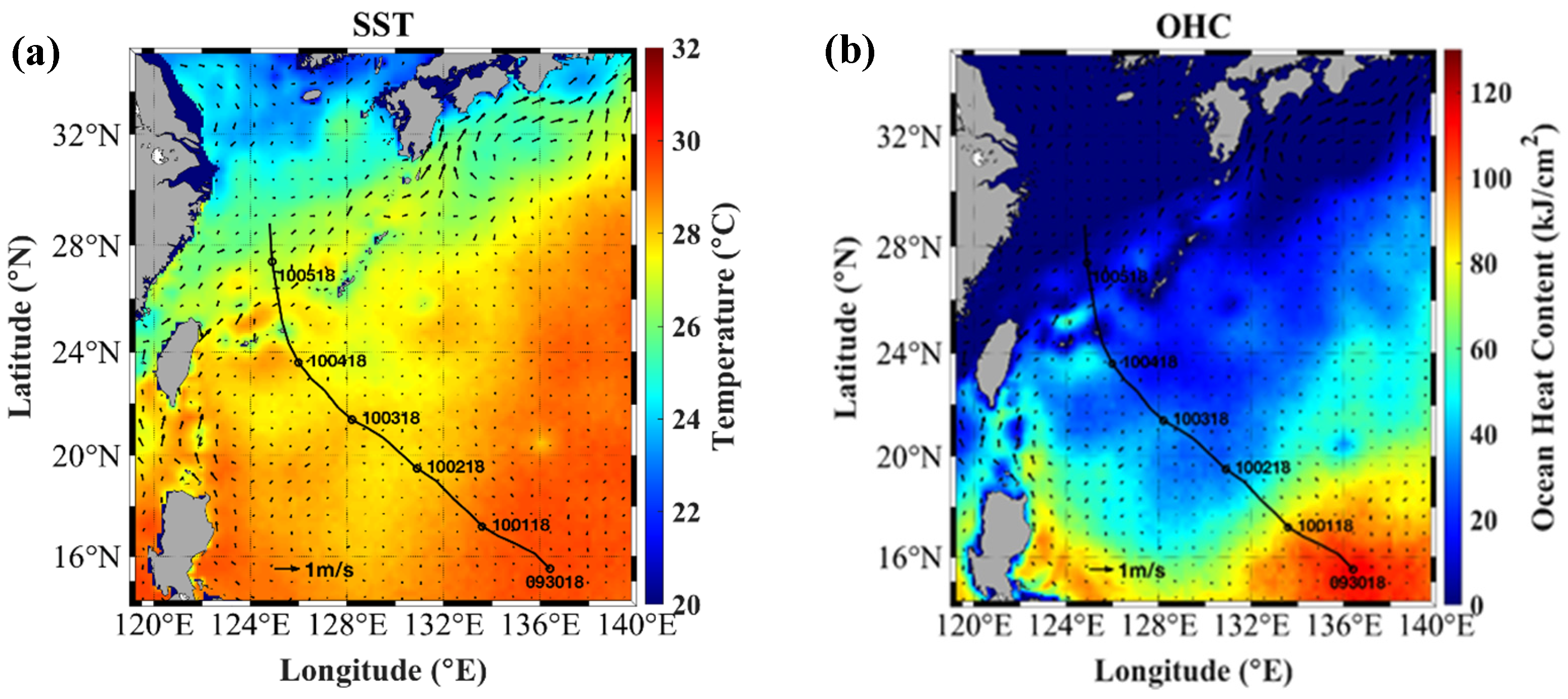
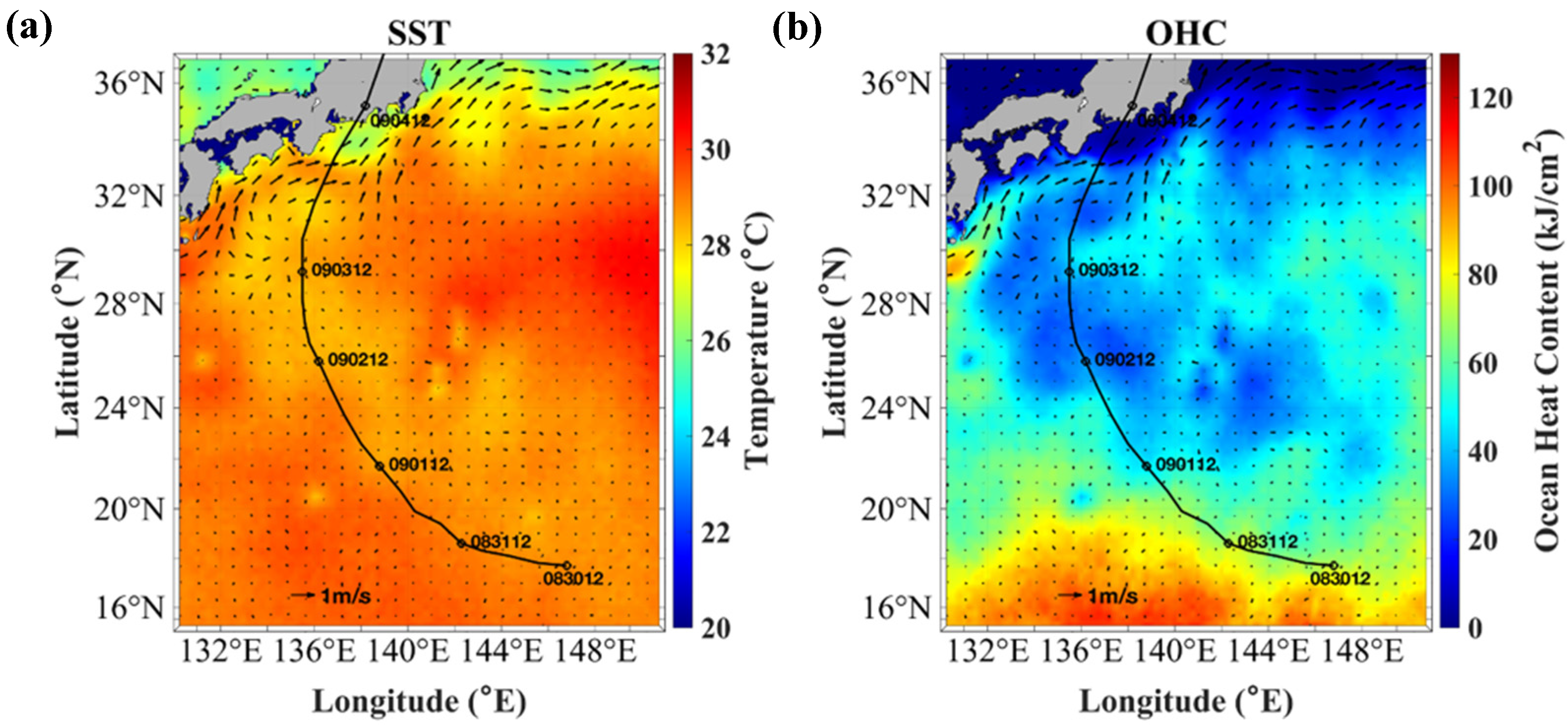
2.2. Model Experiments
2.2.1. Control Experiments
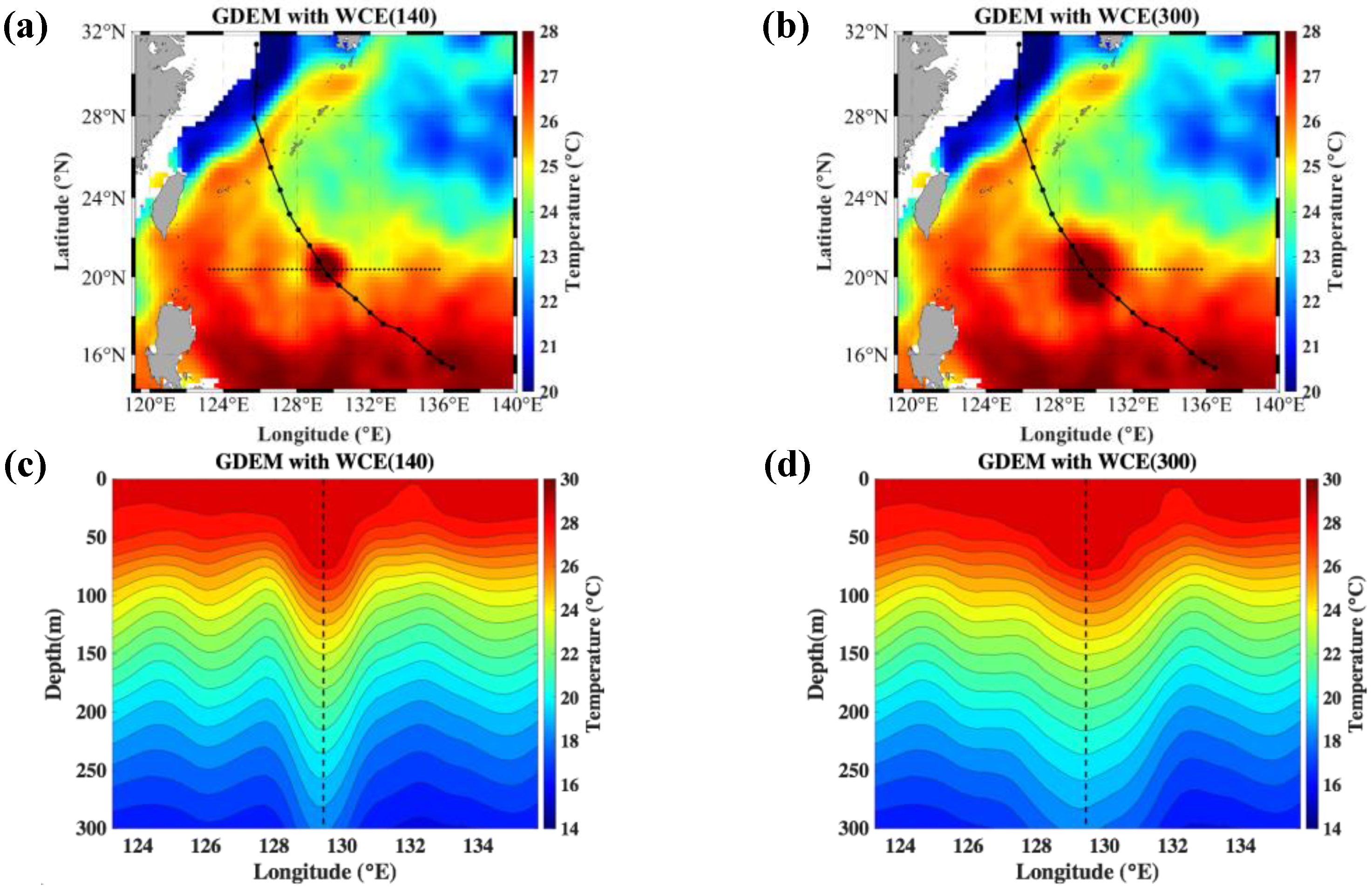
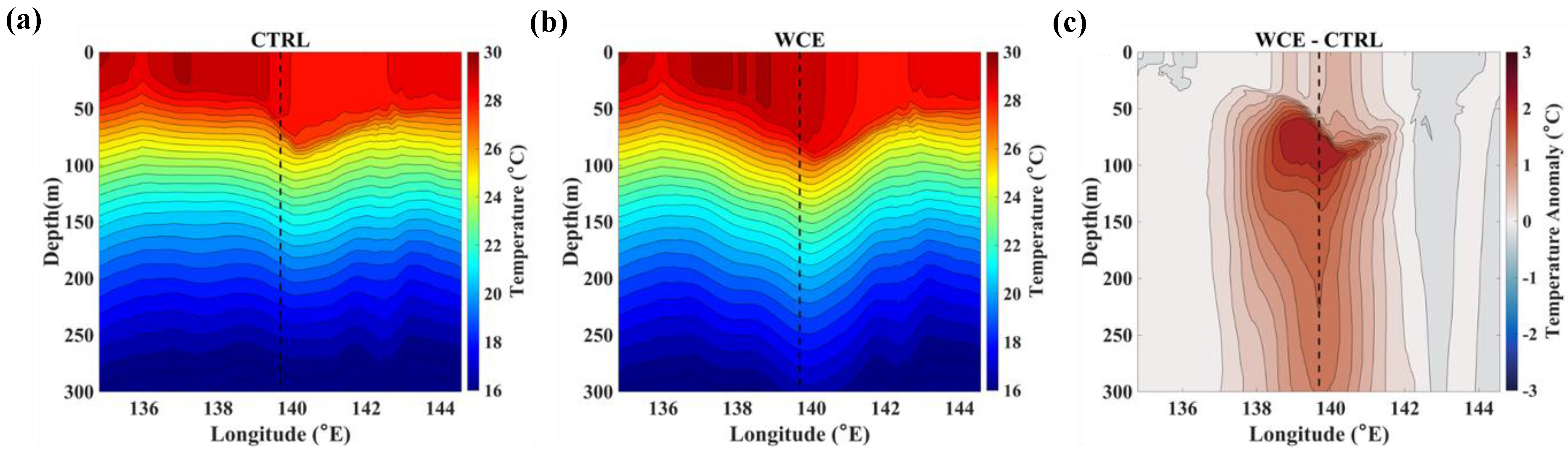
2.2.2. Warm Core Eddy Experiments
2.2.3. Uncoupled Experiments
3. Results
3.1. Ocean Response to TCs in Control Experiments
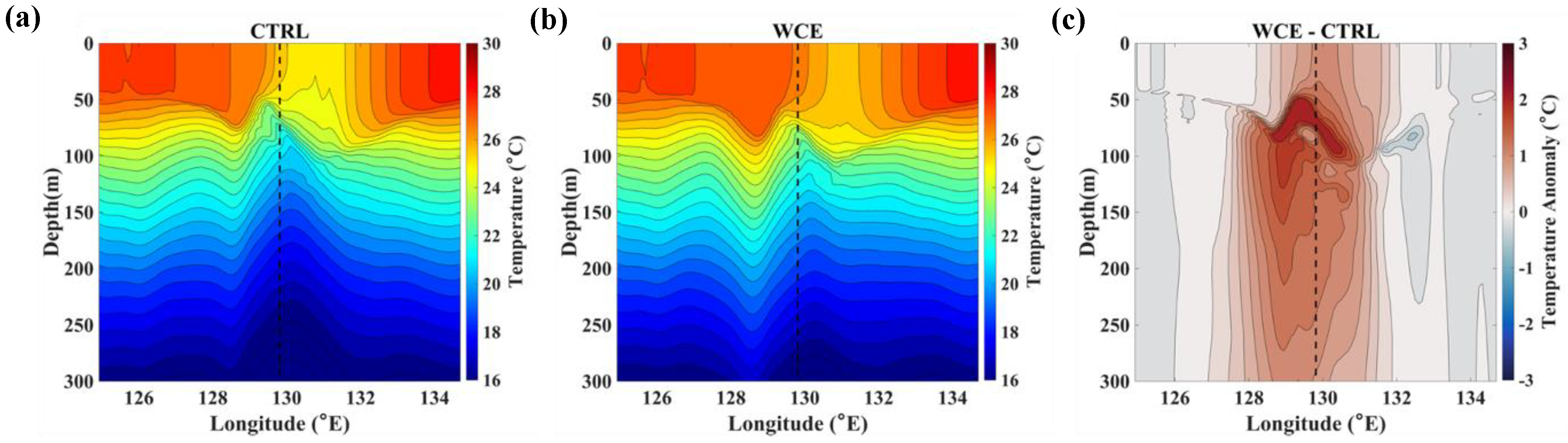
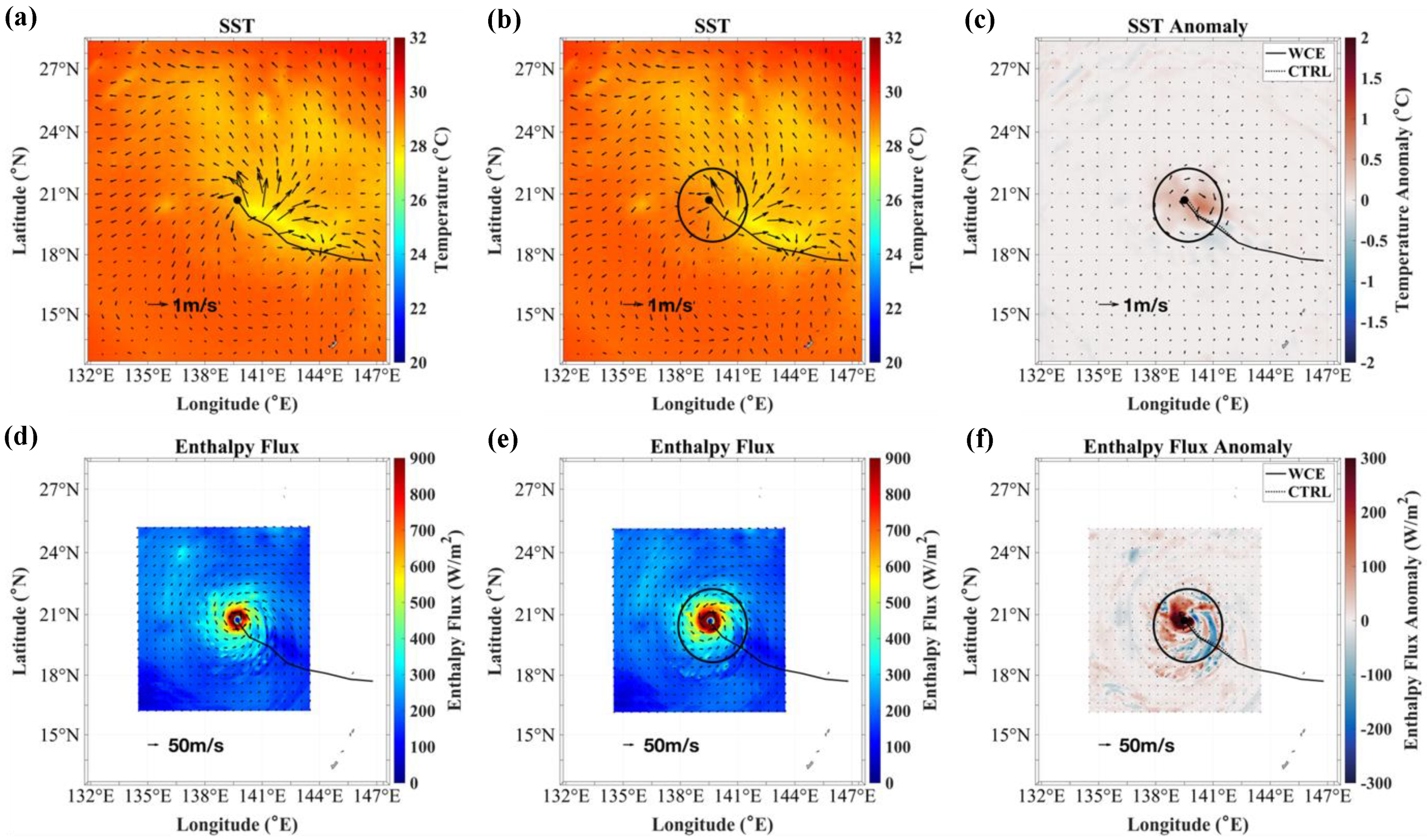
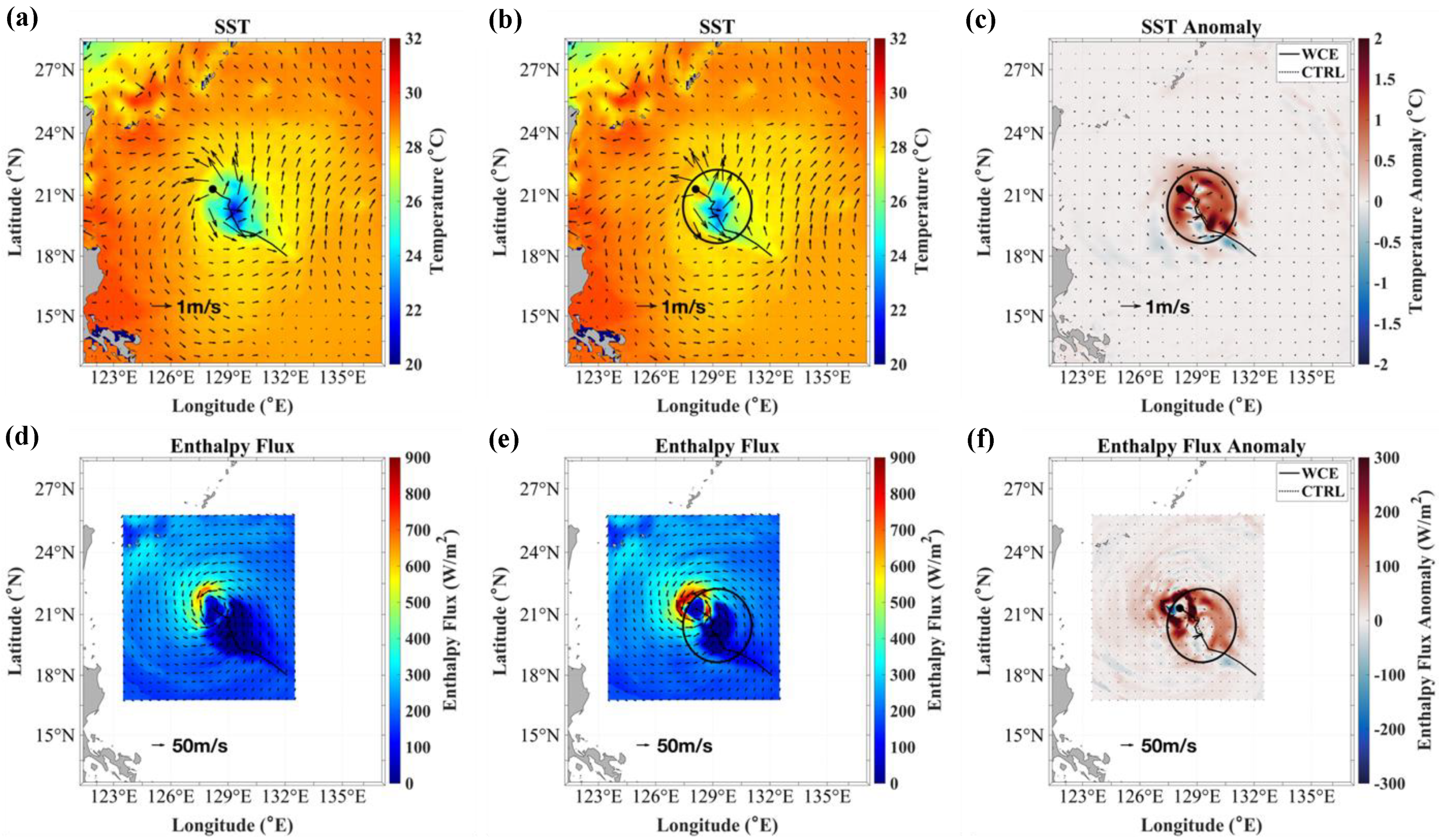
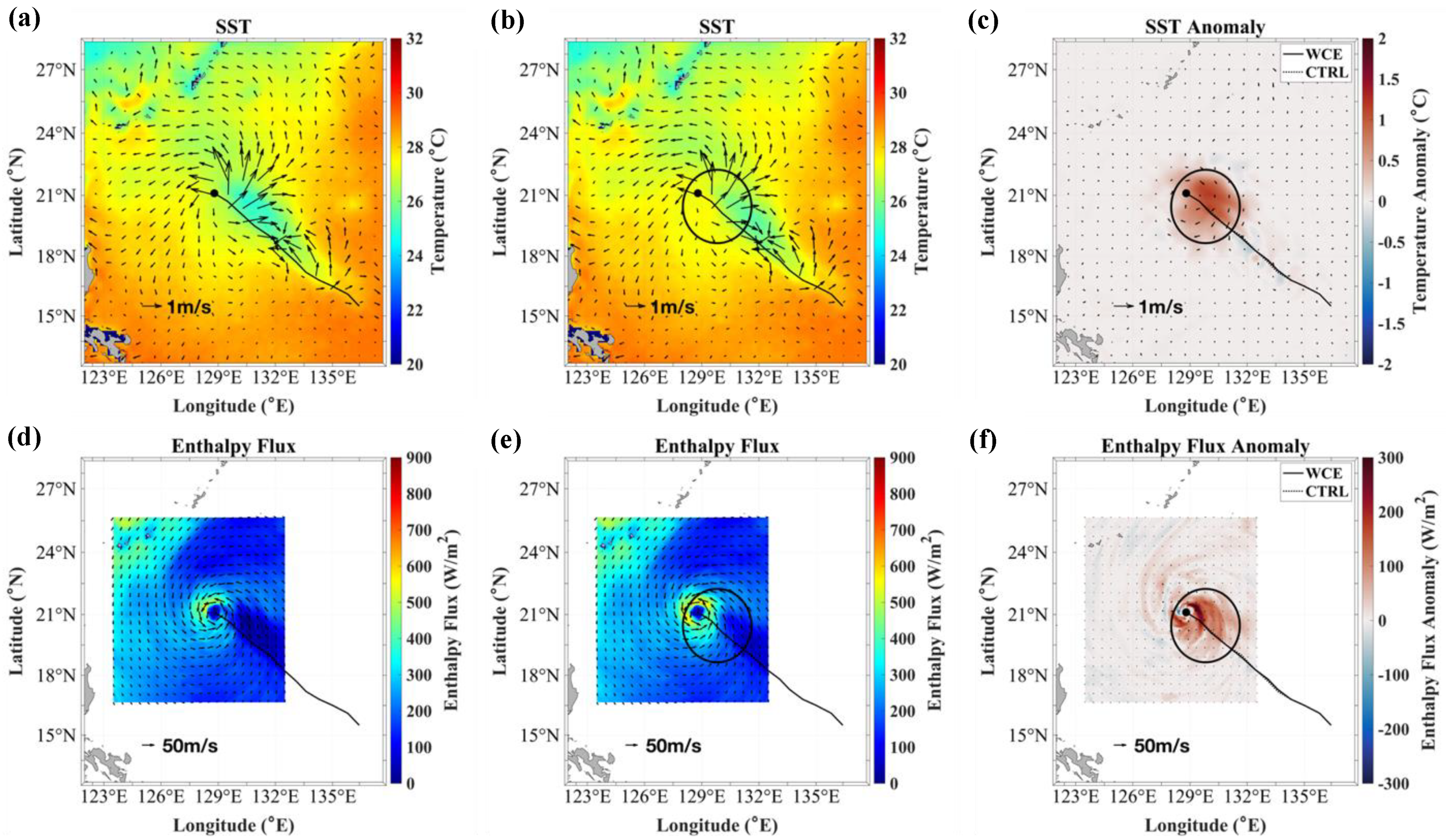
3.2. Ocean Response to TCs in WCE Experiments
3.3. Impact of WCEs on TC Intensity
4. Summary and Discussions
Author Contributions
Funding
Institutional Review Board Statement
Informed Consent Statement
Data Availability Statement
Acknowledgments
Conflicts of Interest
References
- Emanuel, K.A. An air-sea interaction theory for tropical cyclones. Part I: Steady-state maintenance. J. Atmos. Sci. 1986, 43, 585–605. [Google Scholar] [CrossRef]
- Cione, J.J.; Uhlhorn, E.W. Sea surface temperature variability in hurricanes: Implications with respect to intensity change. Mon. Weather Rev. 2003, 131, 1783–1796. [Google Scholar] [CrossRef]
- Bao, J.W.; Fairall, C.W.; Michelson, S.A.; Bianco, L. Parameterizations of sea-spray impact on the air–sea momentum and heat fluxes. Mon. Weather Rev. 2011, 139, 3781–3797. [Google Scholar] [CrossRef]
- Kowaleski, A.M.; Evans, J.L. Thermodynamic observations and flux calculations of the tropical cyclone surface layer within the context of potential intensity. Weather Forecast. 2015, 30, 1303–1320. [Google Scholar] [CrossRef]
- Price, J.F. Upper ocean response to a hurricane. J. Phys. Oceanogr. 1981, 11, 153–175. [Google Scholar] [CrossRef]
- Ginis, I. Tropical cyclone-ocean interactions. Adv. Fluid Mech. Ser. 2002, 33, 83–114. [Google Scholar]
- Bender, M.A.; Ginis, I. Real-case simulations of hurricane–ocean interaction using a high-resolution coupled model: Effects on hurricane intensity. Mon. Weather Rev. 2000, 128, 917–946. [Google Scholar] [CrossRef]
- Shay, L.K.; Goni, G.J.; Black, P.G. Effects of a warm oceanic feature on hurricane Opal. Mon. Weather Rev. 2000, 128, 1366–1383. [Google Scholar] [CrossRef]
- Schade, L.R.; Emanuel, K.A. The ocean’s effect on the intensity of tropical cyclones: Results from a simple coupled atmosphere–ocean model. J. Atmos. Sci. 1999, 56, 642–651. [Google Scholar] [CrossRef]
- Chan, J.C.L.; Duan, Y.; Shay, L.K. Tropical cyclone intensity change from a simple ocean–atmosphere coupled model. J. Atmos. Sci. 2001, 58, 154–172. [Google Scholar] [CrossRef]
- Jaimes, B.; Shay, L.K.; Uhlhorn, E.W. Enthalpy and momentum fluxes during hurricane Earl relative to underlying ocean features. Mon. Weather Rev. 2015, 143, 111–131. [Google Scholar] [CrossRef]
- Lin, I.-I.; Wu, C.-C.; Emanuel, K.A.; Lee, I.-H.; Wu, C.-R.; Pun, I.-F. The interaction of supertyphoon Maemi (2003) with a warm ocean eddy. Mon. Weather Rev. 2005, 133, 2635–2649. [Google Scholar] [CrossRef]
- Wang, G.; Zhao, B.; Qiao, F.; Zhao, C. Rapid intensification of super typhoon Haiyan: The important role of a warm-core ocean eddy. Ocean Dyn. 2018, 68, 1649–1661. [Google Scholar] [CrossRef]
- Hong, X.; Chang, S.W.; Raman, S.; Shay, L.K.; Hodur, R. The interaction between hurricane Opal (1995) and a warm core ring in the Gulf of Mexico. Mon. Weather Rev. 2000, 128, 1347–1365. [Google Scholar] [CrossRef]
- Emanuel, K.; DesAutels, C.; Holloway, C.; Korty, R. Environmental control of tropical cyclone intensity. J. Atmos. Sci. 2004, 61, 843–858. [Google Scholar] [CrossRef]
- Wu, C.-C.; Lee, C.-Y.; Lin, I.-I. The effect of the ocean eddy on tropical cyclone intensity. J. Atmos. Sci. 2007, 64, 3562–3578. [Google Scholar] [CrossRef]
- McTaggart-Cowan, R.; Bosart, L.F.; Gyakum, J.R.; Atallah, E.H. Hurricane Katrina (2005). Part I: Complex life cycle of an intense tropical cyclone. Mon. Weather Rev. 2007, 135, 3905–3926. [Google Scholar] [CrossRef]
- Vianna, M.L.; Menezes, V.V.; Pezza, A.B.; Simmonds, I. Interactions between hurricane Catarina (2004) and warm core rings in the South Atlantic ocean. J. Geophys. Res. 2010, 115, C07002. [Google Scholar] [CrossRef]
- Yablonsky, R.M.; Ginis, I. Impact of a warm ocean eddy’s circulation on hurricane-induced sea surface cooling with implications for hurricane intensity. Mon. Weather Rev. 2012, 141, 997–1021. [Google Scholar] [CrossRef]
- Jaimes, B.; Shay, L.K. Enhanced wind-driven downwelling flow in warm oceanic eddy features during the intensification of tropical cyclone Isaac (2012): Observations and theory. J. Phys. Oceanogr. 2015, 45, 1667–1689. [Google Scholar] [CrossRef]
- Jaimes, B.; Shay, L.K.; Brewster, J.K. Observed air-sea interactions in tropical cyclone Isaac over Loop Current mesoscale eddy features. Dyn. Atmos. Ocean. 2016, 76, 306–324. [Google Scholar] [CrossRef]
- Emanuel, K. Increasing destructiveness of tropical cyclones over the past 30 years. Nature 2005, 436, 686–688. [Google Scholar] [CrossRef] [PubMed]
- Peduzzi, P.; Chatenoux, B.; Dao, H.; De Bono, A.; Herold, C.; Kossin, J.; Mouton, F.; Nordbeck, O. Global trends in tropical cyclone risk. Nat. Clim. Chang. 2012, 2, 289–294. [Google Scholar] [CrossRef]
- Lin, I.-I.; Black, P.; Price, J.F.; Yang, C.-Y.; Chen, S.S.; Lien, C.-C.; Harr, P.; Chi, N.-H.; Wu, C.-C.; D’Asaro, E.A. An ocean coupling potential intensity index for tropical cyclones. Geophys. Res. Lett. 2013, 40, 1878–1882. [Google Scholar] [CrossRef]
- Qiu, B. Seasonal eddy field modulation of the North Pacific subtropical countercurrent: TOPEX/Poseidon Observations and Theory. J. Phys. Oceanogr. 1999, 29, 2471–2486. [Google Scholar] [CrossRef]
- Roemmich, D.; Gilson, J. Eddy transport of heat and thermocline waters in the North Pacific: A key to interannual/decadal climate variability? J. Phys. Oceanogr. 2001, 31, 675–687. [Google Scholar] [CrossRef]
- Hwang, C.; Wu, C.-R.; Kao, R. TOPEX/Poseidon observations of mesoscale eddies over the subtropical countercurrent: Kinematic characteristics of an anticyclonic eddy and a cyclonic eddy. J. Geophys. Res. Ocean. 2004, 109. [Google Scholar] [CrossRef]
- Yablonsky, R.M.; Ginis, I. Limitation of one-dimensional ocean models for coupled hurricane–ocean model forecasts. Mon. Weather Rev. 2009, 137, 4410–4419. [Google Scholar] [CrossRef]
- Ma, Z.; Fei, J.; Liu, L.; Huang, X.; Li, Y. An investigation of the influences of mesoscale ocean eddies on tropical cyclone intensities. Mon. Weather Rev. 2017, 145, 1181–1201. [Google Scholar] [CrossRef]
- Sun, J.; Wang, G.; Xiong, X.; Hui, Z.; Hu, X.; Ling, Z.; Yu, L.; Yang, G.; Guo, Y.; Ju, X.; et al. Impact of warm mesoscale eddy on tropical cyclone intensity. Acta Oceanol. Sin. 2020, 39, 1–13. [Google Scholar] [CrossRef]
- Wada, A. Roles of oceanic mesoscale eddy in rapid weakening of typhoons Trami and Kong-Rey in 2018 simulated with a 2-km-mesh atmosphere-wave-ocean coupled model. J. Meteorol. Soc. Jpn. 2021, 99, 1453–1482. [Google Scholar] [CrossRef]
- Kawakami, Y.; Nakano, H.; Urakawa, L.S.; Toyoda, T.; Sakamoto, K.; Yoshimura, H.; Shindo, E.; Yamanaka, G. Interactions between ocean and successive typhoons in the Kuroshio region in 2018 in atmosphere–ocean coupled model simulations. J. Geophys. Res. Ocean. 2022, 127, e2021JC018203. [Google Scholar] [CrossRef]
- Chang, K.F.; Wu, C.C.; Ito, K. On the rapid weakening of typhoon Trami (2018): Strong sea surface temperature cooling associated with slow translation speed. Mon. Weather Rev. 2023, 151, 227–251. [Google Scholar] [CrossRef]
- Li, X.; Cheng, X.; Fei, J.; Huang, X.; Ding, J. The modulation effect of sea surface cooling on the eyewall replacement cycle in typhoon Trami (2018). Mon. Weather Rev. 2022, 150, 1417–1436. [Google Scholar] [CrossRef]
- Li, X.; Cheng, X.; Fei, J.; Huang, X. A numerical study on the role of mesoscale cold-core eddies in modulating the upper-ocean responses to typhoon Trami (2018). J. Phys. Oceanogr. 2022, 52, 3101–3122. [Google Scholar] [CrossRef]
- Hirano, S.; Ito, K.; Yamada, H.; Tsujino, S.; Tsuboki, K.; Wu, C.C. Deep eye clouds in tropical cyclone Trami (2018) during T-PARCII dropsonde observations. J. Atmos. Sci. 2022, 79, 683–703. [Google Scholar] [CrossRef]
- Tallapragada, V.; Bernardet, L.; Biswas, M.K.; Gopalakrishnan, S.; Kwon, Y.; Liu, Q.; Marchok, T.; Sheinin, D.; Tong, M.; Trahan, S.; et al. Hurricane Weather Research and Forecasting (HWRF) model: 2013 scientific documentation. HWRF Dev. Testbed Cent. Tech. Rep. 2014, 99, 1–13. Available online: http://www.dtcenter.org/HurrWRF/users/docs/ (accessed on 3 February 2024).
- Biswas, M.K.; Carson, L.; Newman, K.; Bernardet, L.; Kalina, E.; Grell, E.; Frimel, J. Community HWRF Users Guide v3.9a. 2018. Available online: https://repository.library.noaa.gov/view/noaa/16281 (accessed on 3 February 2024).
- Yablonsky, R.M.; Ginis, I.; Thomas, B.; Tallapragada, V.; Sheinin, D.; Bernardet, L. Description and analysis of the ocean component of NOAA’s operational Hurricane Weather Research and Forecasting Model (HWRF). J. Atmos. Ocean. Technol. 2015, 32, 144–163. [Google Scholar] [CrossRef]
- Yablonsky, R.M.; Ginis, I.; Thomas, B. Ocean modeling with flexible initialization for improved coupled tropical cyclone-ocean model prediction. Environ. Model. Softw. 2015, 67, 26–30. [Google Scholar] [CrossRef]
- Mellor, G.L.; Yamada, T. Development of a turbulence closure model for geophysical fluid problems. Rev. Geophys. 1982, 20, 851. [Google Scholar] [CrossRef]
- Carnes, M.R. Description and Evaluation of GDEM-V 3.0; Naval Research Laboratory: Washington, DC, USA, 2009; pp. 1–24. [Google Scholar]
- Reynolds, R.W.; Smith, T.M. Improved global sea surface temperature analyses using optimum interpolation. J. Clim. 1994, 7, 929–948. [Google Scholar] [CrossRef]
- Yablonsky, R.M.; Ginis, I. Improving the ocean initialization of coupled hurricane–ocean models using feature-based data assimilation. Mon. Weather Rev. 2008, 136, 2592–2607. [Google Scholar] [CrossRef][Green Version]
- Trahan, S.; Sparling, L. An analysis of NCEP tropical cyclone vitals and potential effects on forecasting models. Weather Forecast. 2012, 27, 744–756. [Google Scholar] [CrossRef]
- Cheng, Y.H.; Ho, C.R.; Zheng, Q.; Kuo, N.J. Statistical characteristics of mesoscale eddies in the North Pacific derived from satellite altimetry. Remote Sens. 2014, 6, 5164–5183. [Google Scholar] [CrossRef]
- Liu, Y.; Dong, C.; Guan, Y.; Chen, D.; McWilliams, J.; Nencioli, F. Eddy analysis in the subtropical zonal band of the North Pacific ocean. Deep Sea Res. Part I Oceanogr. Res. Pap. 2012, 68, 54–67. [Google Scholar] [CrossRef]
- Wada, A.; Usui, N. Importance of tropical cyclone heat potential for tropical cyclone intensity and intensification in the Western North Pacific. J. Oceanogr. 2007, 63, 427–447. [Google Scholar] [CrossRef]
- Wada, A. Verification of tropical cyclone heat potential for tropical cyclone intensity forecasting in the Western North Pacific. J. Oceanogr. 2015, 71, 373–387. [Google Scholar] [CrossRef]
- Song, D.; Xiang, L.; Guo, L.; Li, B. Estimating typhoon-induced sea surface cooling based upon satellite observations. Water 2020, 12, 3060. [Google Scholar] [CrossRef]
- Kang, S.K.; Kim, S.-H.; Lin, I.-I.; Park, Y.-H.; Choi, Y.; Ginis, I.; Cione, J.; Shin, J.Y.; Kim, E.J.; Kim, K.O.; et al. The North Equatorial Current and rapid intensification of super typhoons. Nat. Commun. 2024, 15, 1742. [Google Scholar] [CrossRef]







| Name | Initial Time | Experiments | ||||
|---|---|---|---|---|---|---|
| JEBI1 | 1200 UTC 30 August | CTRL | UNCL | WCE (200) | WCE (140) | WCE (300) |
| JEBI2 | 0000 UTC 31 August | CTRL | UNCL | WCE (200) | ||
| TRAMI1 | 1800 UTC 23 September | CTRL | UNCL | WCE (200) | WCE (140) | WCE (300) |
| TRAMI2 | 0600 UTC 24 September | CTRL | UNCL | WCE (200) | ||
| KONG-REY1 | 1800 UTC 30 September | CTRL | UNCL | WCE (200) | WCE (140) | WCE (300) |
| KONG-REY2 | 0600 UTC 1 October | CTRL | UNCL | WCE (200) | ||
| TC | SST (°C) | |||
|---|---|---|---|---|
| 0.43 | 100.51 | 6.00 | ||
| JEBI | 1.27 | 256.97 | 12.50 | |
| MWPI | 33.9% | 39.1% | 48.0% | |
| 1.07 | 181.59 | 9.00 | ||
| TRAMI | 3.36 | 735.99 | 43.50 | |
| MWPI | 31.8% | 24.7% | 20.7% | |
| 0.52 | 71.70 | 3.50 | ||
| KONG-REY | 1.41 | 219.52 | 13.00 | |
| MWPI | 36.9% | 32.7% | 26.9% |
| Name | SST (°C) | ||||||
|---|---|---|---|---|---|---|---|
| 140 km | 200 km | 300 km | 140 km | 200 km | 300 km | ||
| 0.31 | 0.40 | 0.42 | 3 | 5 | 5 | ||
| JEBI1 | 1.14 | 1.14 | 1.14 | 16 | 16 | 16 | |
| MWPI | 27.2% | 35.1% | 36.8% | 18.8% | 31.3% | 31.3% | |
| 0.77 | 0.80 | 0.97 | 12 | 13 | 14 | ||
| TRAMI1 | 3.75 | 3.75 | 3.75 | 44 | 44 | 44 | |
| MWPI | 20.5% | 21.3% | 25.9% | 27.3% | 29.5% | 31.8% | |
| 0.50 | 0.66 | 0.73 | 2 | 3 | 9 | ||
| KONG-REY1 | 1.69 | 1.69 | 1.69 | 18 | 18 | 18 | |
| MWPI | 29.6% | 39.1% | 43.2% | 11.1% | 16.7% | 50.0% | |
Disclaimer/Publisher’s Note: The statements, opinions and data contained in all publications are solely those of the individual author(s) and contributor(s) and not of MDPI and/or the editor(s). MDPI and/or the editor(s) disclaim responsibility for any injury to people or property resulting from any ideas, methods, instructions or products referred to in the content. |
© 2024 by the authors. Licensee MDPI, Basel, Switzerland. This article is an open access article distributed under the terms and conditions of the Creative Commons Attribution (CC BY) license (https://creativecommons.org/licenses/by/4.0/).
Share and Cite
Ma, I.; Ginis, I.; Kang, S.K. Numerical Study of Effects of Warm Ocean Eddies on Tropical Cyclones Intensity in Northwest Pacific. Atmosphere 2024, 15, 445. https://doi.org/10.3390/atmos15040445
Ma I, Ginis I, Kang SK. Numerical Study of Effects of Warm Ocean Eddies on Tropical Cyclones Intensity in Northwest Pacific. Atmosphere. 2024; 15(4):445. https://doi.org/10.3390/atmos15040445
Chicago/Turabian StyleMa, Ilkyeong, Isaac Ginis, and Sok Kuh Kang. 2024. "Numerical Study of Effects of Warm Ocean Eddies on Tropical Cyclones Intensity in Northwest Pacific" Atmosphere 15, no. 4: 445. https://doi.org/10.3390/atmos15040445
APA StyleMa, I., Ginis, I., & Kang, S. K. (2024). Numerical Study of Effects of Warm Ocean Eddies on Tropical Cyclones Intensity in Northwest Pacific. Atmosphere, 15(4), 445. https://doi.org/10.3390/atmos15040445