Review

Phylogeny and Phylogeography of Rhizobial Symbionts Nodulating Legumes of the Tribe Genisteae

by
Tomasz Stępkowski
1,*,
Joanna Banasiewicz
1,
Camille E. Granada
2,
Mitchell Andrews
3 and
Luciane M. P. Passaglia
4
1
Autonomous Department of Microbial Biology, Faculty of Agriculture and Biology, Warsaw University of Life Sciences (SGGW), Nowoursynowska 159, 02-776 Warsaw, Poland
2
Universidade do Vale do Taquari—UNIVATES, Rua Avelino Tallini, 171, 95900-000 Lajeado, RS, Brazil
3
Faculty of Agriculture and Life Sciences, Lincoln University, P.O. Box 84, Lincoln 7647, New Zealand
4
Departamento de Genética, Instituto de Biociências, Universidade Federal do Rio Grande do Sul. Av. Bento Gonçalves, 9500, Caixa Postal 15.053, 91501-970 Porto Alegre, RS, Brazil
*
Author to whom correspondence should be addressed.
Genes 2018, 9(3), 163; https://doi.org/10.3390/genes9030163
Submission received: 31 January 2018 / Revised: 2 March 2018 / Accepted: 5 March 2018 / Published: 14 March 2018
(This article belongs to the Special Issue Genetics and Genomics of the Rhizobium-Legume Symbiosis)

Abstract

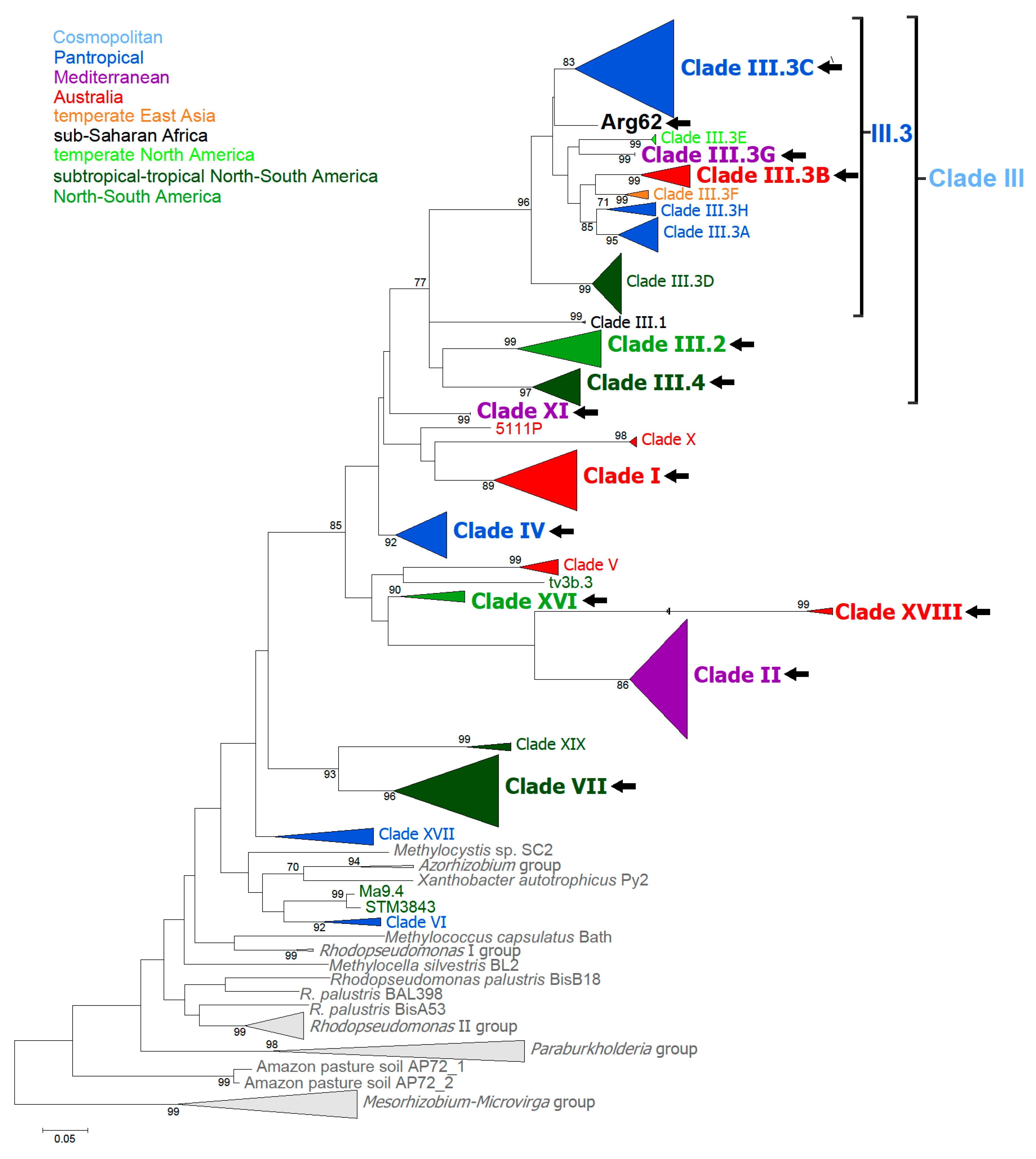
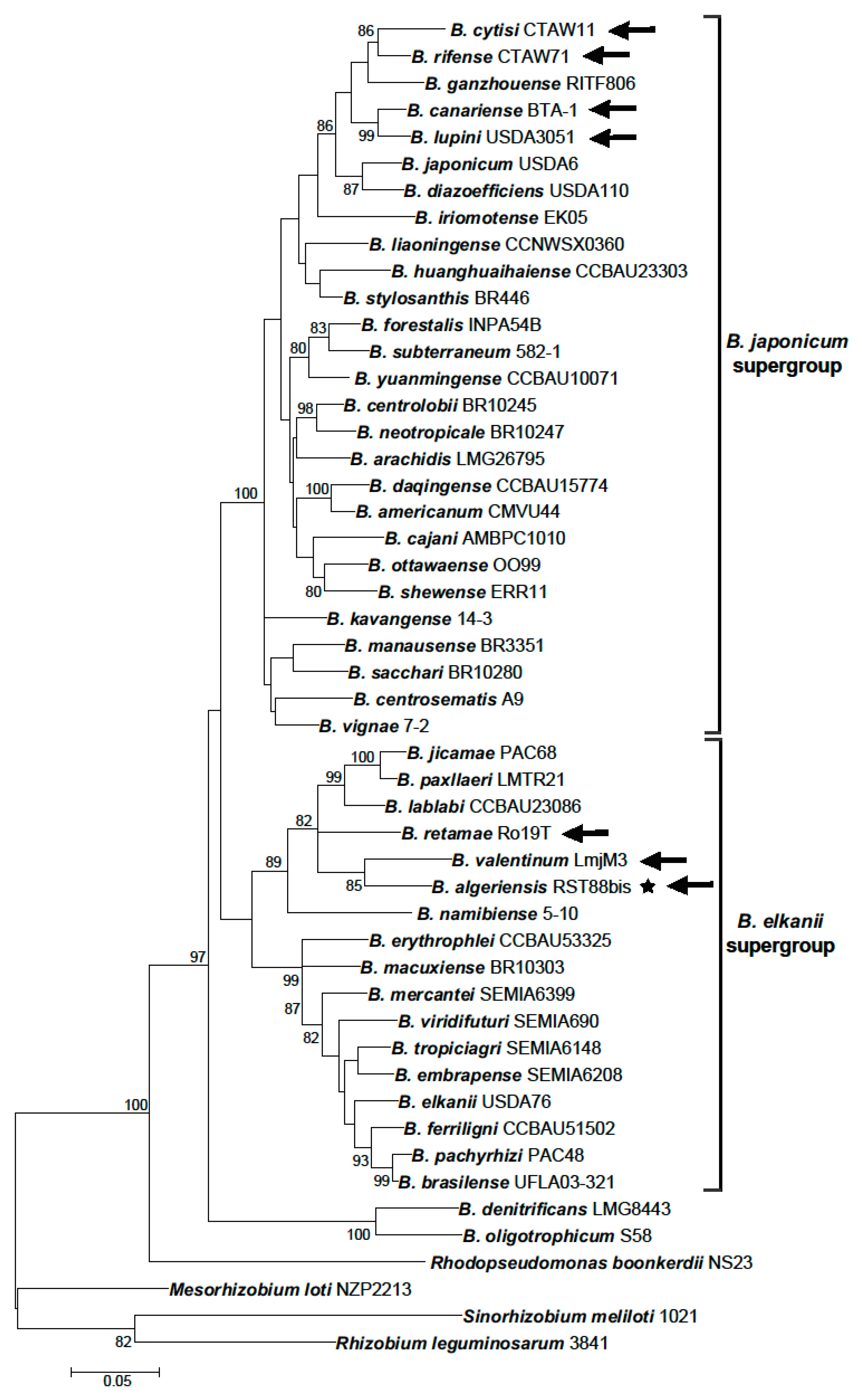
The legume tribe Genisteae comprises 618, predominantly temperate species, showing an amphi-Atlantic distribution that was caused by several long-distance dispersal events. Seven out of the 16 authenticated rhizobial genera can nodulate particular Genisteae species. Bradyrhizobium predominates among rhizobia nodulating Genisteae legumes. Bradyrhizobium strains that infect Genisteae species belong to both the Bradyrhizobium japonicum and Bradyrhizobium elkanii superclades. In symbiotic gene phylogenies, Genisteae bradyrhizobia are scattered among several distinct clades, comprising strains that originate from phylogenetically distant legumes. This indicates that the capacity for nodulation of Genisteae spp. has evolved independently in various symbiotic gene clades, and that it has not been a long-multi-step process. The exception is Bradyrhizobium Clade II, which unlike other clades comprises strains that are specialized in nodulation of Genisteae, but also Loteae spp. Presumably, Clade II represents an example of long-lasting co-evolution of bradyrhizobial symbionts with their legume hosts.
Keywords: Bradyrhizobium; Genisteae; Microvirga; nifD; nodA; phylogeography Bradyrhizobium; Genisteae; Microvirga; nifD; nodA; phylogeography