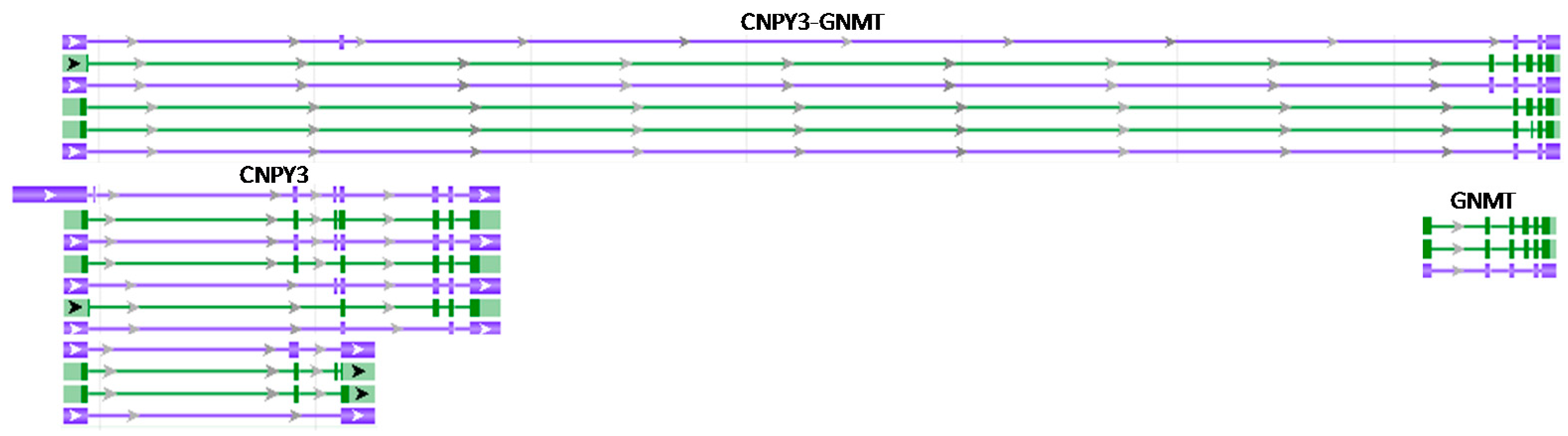
Transcriptional-Readthrough RNAs Reflect the Phenomenon of “A Gene Contains Gene(s)” or “Gene(s) within a Gene” in the Human Genome, and Thus Are Not Chimeric RNAs

Abstract
Share and Cite
He, Y.; Yuan, C.; Chen, L.; Lei, M.; Zellmer, L.; Huang, H.; Liao, D.J. Transcriptional-Readthrough RNAs Reflect the Phenomenon of “A Gene Contains Gene(s)” or “Gene(s) within a Gene” in the Human Genome, and Thus Are Not Chimeric RNAs. Genes 2018, 9, 40. https://doi.org/10.3390/genes9010040
He Y, Yuan C, Chen L, Lei M, Zellmer L, Huang H, Liao DJ. Transcriptional-Readthrough RNAs Reflect the Phenomenon of “A Gene Contains Gene(s)” or “Gene(s) within a Gene” in the Human Genome, and Thus Are Not Chimeric RNAs. Genes. 2018; 9(1):40. https://doi.org/10.3390/genes9010040
Chicago/Turabian StyleHe, Yan, Chengfu Yuan, Lichan Chen, Mingjuan Lei, Lucas Zellmer, Hai Huang, and Dezhong Joshua Liao. 2018. "Transcriptional-Readthrough RNAs Reflect the Phenomenon of “A Gene Contains Gene(s)” or “Gene(s) within a Gene” in the Human Genome, and Thus Are Not Chimeric RNAs" Genes 9, no. 1: 40. https://doi.org/10.3390/genes9010040
APA StyleHe, Y., Yuan, C., Chen, L., Lei, M., Zellmer, L., Huang, H., & Liao, D. J. (2018). Transcriptional-Readthrough RNAs Reflect the Phenomenon of “A Gene Contains Gene(s)” or “Gene(s) within a Gene” in the Human Genome, and Thus Are Not Chimeric RNAs. Genes, 9(1), 40. https://doi.org/10.3390/genes9010040