
Article

Generation of a Highly Efficient and Chemically Inducible Gene Expression System
1
School of Ecological Engineering, Guizhou University of Engineering Science, Bijie 551700, China
2
School of Mining Engineering, Guizhou University of Engineering Science, Bijie 551700, China
*
Author to whom correspondence should be addressed.
These authors contributed equally to this work.
Genes 2026, 17(9), 1142; https://doi.org/10.3390/genes17091142
Submission received: 16 August 2026 / Revised: 15 September 2026 / Accepted: 16 September 2026 / Published: 18 September 2026
(This article belongs to the Section Technologies and Resources for Genetics)

Abstract

Background: Chemically inducible gene expression systems provide precise control over the temporal and spatial expression of genes. They are powerful tools for analyzing gene function during plant development and can effectively avoid the issues associated with transgene expression driven by constitutive promoters. The alc gene expression system derived from Aspergillus nidulans is one of the most promising chemically inducible expression systems in plants, owing to its significant potential for both basic research and agricultural applications. Previous studies have demonstrated the utility of the alc system in several dicot species, but systematic optimisation of promoter architecture and induction methodology in Arabidopsis remains comparatively limited. Methods: We employed a multi-level study design, combining Agrobacterium-mediated genetic transformation, GUS histochemical staining, and GUS quantitative assays. First, different types of alc gene expression systems were constructed through codon optimization of the GUS and alcR genes, and by incorporating the CaMV 35S minimal promoter (min35S), the TMV omega sequence, the Kozak sequence, and specific binding sites for the AlcR transcription factor. Second, these distinct alc expression systems were individually transformed into Arabidopsis thaliana to obtain single T-DNA insertion homozygous transgenic plants. Third, ethanol was applied via root drench, foliar spray, or vapor induction, and the performance of different alc systems was evaluated based on GUS protein expression, to determine the optimal induction conditions and identify the most efficient ethanol-inducible gene expression system. Results: Four alc systems (Ves1–Ves4) were successfully developed. GUS gene expression driven by these systems was precisely regulated by ethanol and was dependent on induction time and the method of induction. Among the induction methods, ethanol vapor was the most effective, followed by root drench, whereas foliar spray was the least effective. Furthermore, Ves1 was identified as the most efficient alc expression system, Ves2 as an efficient alc expression system, Ves3 as a usable alc expression system, and Ves4 as potentially defective with limited practical application value. Conclusions: This work lays a foundation for further research on the efficient alc system and the exploration of its molecular mechanism underlying high expression efficiency. The most efficient Ves1 and the highly efficient Ves2 provide a clear basis for selection in subsequent applied research, and they are expected to play a greater role in plant functional genomics and agricultural biotechnology.

1. Introduction

Since the first successful genetically modified crop in 1983, transgenic technology has continuously evolved, with various promoters being applied in plant genetic engineering. In genetic engineering, precise control of gene expression—primarily regulated by promoters and also influenced by enhancers and transcription factors—is crucial for achieving desired outcomes [1,2]. To date, a variety of constitutive promoters have been successfully used in transgenic plants. Such as the cauliflower mosaic virus (CaMV) 35S promoter and the Agrobacterium nopaline synthase (NOS) promoter [3,4], the actin promoter [5], and the ubiquitin promoter [6,7] have been widely employed. Constitutive promoters drive the expression of target genes in all organs throughout the entire developmental process, effectively enhancing the expression levels of target genes. This characteristic has led to the widespread application of constitutive promoters in transgenic plants, laying a solid foundation for the establishment of transgenic plants and the study and identification of gene functions. However, it is understandable that the constitutive overexpression of certain transgenes in all tissues throughout development may be unnecessary or even have detrimental effects on the plant [8,9], as under normal conditions, such overexpression may compete for energy required for protein or RNA synthesis, which is also essential for plant growth [10]. Furthermore, this system is not suitable for studies requiring the restriction of target gene expression to specific organs or particular stages of plant development, nor does it allow for artificial regulation of target gene expression [11,12].
To enable temporal and spatial control of target gene expression, several promoters have been adopted in gene expression systems, including tissue-specific promoters [12,13,14,15], environment-responsive promoters [16,17,18], stress-inducible promoters [19,20,21], and wound-responsive promoters [22,23], etc. Although these gene expression systems perform well in some plants, they are far from satisfactory for gene function identification and plant genetic improvement, and the limited number of tissue-specific promoters restricts the analysis of several cell types or tissues [24]. Furthermore, due to the iterative mode of plant development, there is no absolute definition in different developmental stages. Therefore, these promoters do not have a temporally restricted expression patter in a strict sense [12,25]. Simultaneously, the regulatory mechanism of most tissue-specific promoters at the transcriptional level is still unclear, resulting in uncertainties when target genes are driven by them, which hinders the wide application of this kind of promoter [26]. Due to the variability and complexity of environmental factors and unpredictable wounding, both environment-responsive promoters and wound-inducible promoters driving target genes can produce unexpected outcomes. This makes it difficult to precisely regulate the expression of exogenous target genes using these two types of promoters, and also limits their application in gene function studies and plant genetic improvement [26].
Compared with tissue-specific expression systems, environment-responsive expression systems, stress-inducible expression systems, and wound-responsive expression systems, chemical-inducible gene expression systems enable both temporal and spatial regulation of gene expression by artificial control, and can be used to more precisely studied gene function in plants [27,28]. Chemical-inducible expression system can induce the expression of the target gene at the desired time point, and the expression level can be easily controlled by changing the concentration of the inducer, the problems that may be related to constitutive overexpression can be avoided, and the main molecular events caused by the activation of specific genes can be revealed [13,29]. Therefore, the system is easy to be applied to various research, industrial fields and agricultural fields [13]. To date, scientists have successfully developed a series of chemical-inducible gene expression systems, including the tetracycline-inducible system [30,31], steroid-inducible system [32,33,34], ecdysone-inducible system [35,36], copper-inducible system [37,38], and ethanol-inducible system [39,40,41,42]. These systems have been widely applied in various research fields such as gene function analysis [43], marker-free transformation systems [44], site-specific excision [45], and RNA silencing [46,47,48], etc., providing powerful tools for basic research in plant biology and biotechnological applications. Among them, ethanol-inducible expression system has been considered as the most likely chemical-inducible system for field application because of its high induction efficiency, low background level, low cost, flexible use, and environmental safety [24,26]. The system consists of two components. The first one is the expression cassette of produced transcription factor AlcR (CaMV35S promoter/tissue-specific promoter: alcR), which is composed of CaMV35S promoter or tissue-specific promoter and alcR gene. The other one is target gene expression cassette (palcA: min35S: target gene), which is composed of the upstream activator region of the alcA promoter (palcA) and a 35S minimal promoter as well as a target gene. The active transcription factor AlcR binds to specific sites in the alcA promoter to drive target gene expression [12,27,42]. The mode of action of this system has been validated in Arabidopsis [39,43], tobacco [29,49,50], poplar [40], Catharanthus roseus [51], tomato [52], potato [29], sugarcane [41], and algae [42], etc. Meanwhile, studies have used this system to drive alcR expression under the control of the promoter of the floral meristem identity gene LEAFY, achieving flower-specific, ethanol-inducible gene expression in Arabidopsis [28].
Although these studies have enhanced our understanding of the ethanol-inducible expression system (alcR/alcA) and laid a foundation for gene expression regulation, the constructs used in them were mostly generated by fusing only the 35S minimal promoter sequence (min35S) downstream of the alcA promoter. These studies rarely involve the integration of enhancer sequences, Kozak sequences, the specific binding site sequence for the action of the AlcR transcription factor, and few studies have addressed codon optimization of the alcR gene and the GUS reporter gene. In addition, there is currently a lack of comparative studies among target genes driven by the alcR/alcA system, those driven by the 35S promoter, and those driven by the native alcA promoter. Therefore, we report an efficient alc gene switch developed through multilevel optimization in A. thaliana. Transgenic plants harboring this improved alc gene expression system displayed stable, ethanol-inducible gene expression. The improved alc gene switch was effectively induced in soil-grown plants through ethanol root drench, foliar spray, and vapor induction. The development of a highly efficient and chemically inducible gene expression system holds significant theoretical and practical value for the study of plant gene function and the real-time control of target gene expression, and may enhance its application in basic plant biology research and crop genetic improvement.

2. Materials and Methods

2.1. Vector Construction

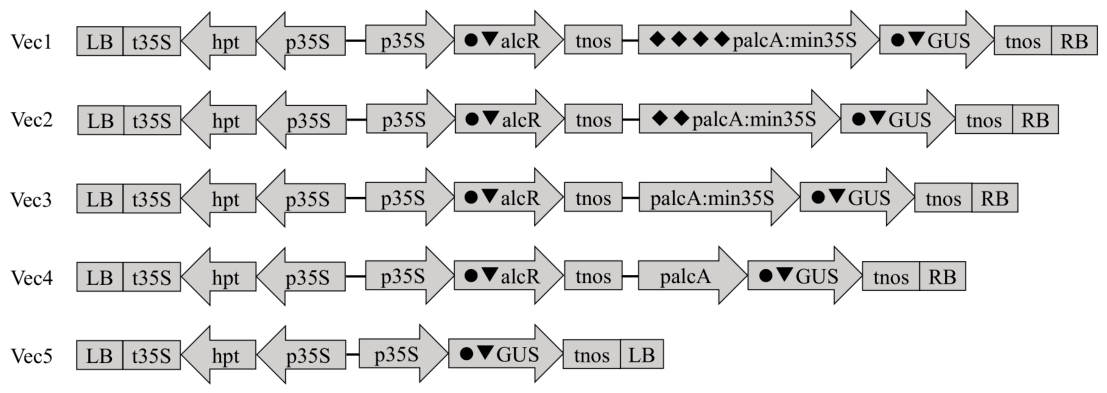
According to the literature [27,53,54,55], the sequences of the cauliflower mosaic virus 35S (CaMV 35S) promoter sequence, the 35S minimal promoter sequence (min35S), the alcA promoter sequence, the Agrobacterium nopaline synthase (NOS) terminator sequence, the alcR gene coding sequence, the specific binding site sequence for the action of the AlcR transcription factor, the GUS (β-glucuronidase) gene coding sequence, the enhancer sequence, and the Kozak sequence were retrieved from the National Center for Biotechnology Information (NCBI) (http://www.ncbi.nlm.nih.gov). Restriction enzyme site analysis of the GUS and alcR gene nucleotide sequences was performed using DNAMAN software(9.0), while the pCAMBIA1300 vector sequence was analyzed with SnapGene software to identify suitable restriction sites. The details are as follows: (1) Rare codons in the alcR and GUS genes were identified using the GenScript website (https://www.genscript.com.cn/tools/rare-codon-analysis) (accessed on 6 March 2026) and DETAIBIO website (https://www.detaibio.com/contact-us.html) (accessed on 6 March 2026) based on the codon usage bias of A. thaliana, without altering the encoded protein sequences, the codons were modified to those preferred by A. thaliana. (2) The translational enhancer sequence from the tobacco mosaic virus (TMV) followed by an alternative Kozak sequence were placed immediately upstream of the alcR and GUS coding sequences. (3) Different numbers of specific binding site sequences for the action of the AlcR protein and the CaMV 35S minimal promoter sequence (min35S) were integrated upstream and downstream of the alcA promoter, respectively. (4) GUS gene expression driven by the CaMV35S promoter as a control of the a high-efficient alc gene switch. (5) Based on the structure of the pCAMBIA1300 vector, restriction enzyme recognition sites were placed at the corresponding positions of each gene expression cassette. The various sequences were assembled and synthesized, and subsequently cloned into the pCAMBIA1300 vector. This process yielded different types of vectors for alcR/alcA-driven or 35S-driven expression of the GUS reporter gene: pCA13alcRalcA1-GUS (Vec1), pCA13alcRalcA2-GUS (Vec2), pCA13alcRalcA3-GUS (Vec3), pCA13alcRalcA4-GUS (Vec4), and pCA13-35-GUS (Vec5). The T-DNA regions of each vector are listed in Figure 1.

2.2. Plant Transformation, Growth, and Maintenance

The Columbia ecotype (wild type, WT) of A. thaliana used for genetic transformation was maintained by our laboratory. Agrobacterium GV3101 cells harboring the recombinant plasmid were selected, and a single colony was inoculated into 50 mL of YEB medium (containing 50 μL Kan, 50 μL Rif, and 25 μL Str) and cultured at 28 °C with shaking at 230 rpm until OD600 reached 0.7 (approximately 24 h). The bacterial cells were collected and resuspended in infiltration solution to an OD600 of 0.6, followed by the addition of Silwet L-77 to a final concentration of 0.04%. A. thaliana plants grown in a nutrient soil and vermiculite mixture (3:1, v/v) in pots (length × width × height = 7 × 7 × 8 cm) had all open flowers and mature siliques removed, and the inflorescences were immersed in the infiltration solution for 30 s. The plants were then placed horizontally in plastic boxes (length × width × height = 53 cm × 39 cm × 32 cm) and incubated in the dark for 24 h, after which they were transferred to a light incubator (12,000 Lux, 23.0 °C, 16 h light; 0 Lux, 22.0 °C, 8 h dark) until the seeds matured. Seeds (T0) were harvested, dried, and stored at 4 °C.

2.3. Screening for Transgenic Homozygous Plants with a Single T-DNA Insertion

T0 seeds were surface-sterilized with 5.0% NaClO solution for 10 min, thoroughly rinsed with sterile water, and sown on MS medium containing hygromycin. After stratification at 4 °C for 55 h, the plates were transferred to a light incubator under the following conditions: 12,000 Lux, 23.0 °C, 16 h light; 0 Lux, 22.0 °C, 8 h dark. Resistant seedlings were transplanted into pots (length × width × height = 7 cm × 7 cm × 8 cm), and transgenic plants were confirmed by PCR using GUS-specific primers (Thermo Fisher Scientific, Waltham, MA, USA) (forward: 5′- cgccatgcttagacctgttg-3′; reverse: 5′- cattgtttacctccttgttgagg-3′) and GUS staining. The PCR cycling conditions were: 94 °C for 3 min; 40 cycles of 94 °C for 30 s, 59 °C for 30 s, and 72 °C for 2 min; and a final extension at 72 °C for 5 min. These plants were then self-pollinated, and seeds (T1) were collected from individual plants. After drying, 30 seeds from a single T1 plant were processed and cultured using the same method as described above. Following PCR and GUS staining identification, the numbers of transgenic and non-transgenic plants were counted. A chi-square test was performed to determine the inheritance pattern of the transgene. Upon maturity, seeds (T2) were collected from individual plants. The process of sowing, screening, and collecting seeds from single plants was repeated until homozygous transgenic plants were obtained. Ultimately, homozygous transformants carrying a single T-DNA insertion for each vector construct were obtained.

2.4. Ethanol Treatment

Three-week-old soil-grown A. thaliana seedlings in pots (length × width × height = 7 cm × 7 cm × 8 cm) were placed in a transparent plastic container (length × width × height = 53 cm × 39 cm × 32 cm). Ethanol treatments were applied as follows: 1.5% ethanol (v/v) was used for root drench (12 mL per pot), 5.0% ethanol (v/v) was applied as a foliar spray until droplets run off, and 5.5 mL of 95% ethanol (v/v) was put into a 10 mL glass beaker, which was then positioned in one corner of a sealed transparent plastic container and was used for vapor induction (the lid was removed after 96 h). The seedlings were then cultured in a light incubator under the following conditions: 12,000 Lux, 23.0 °C, 16 h light; 0 Lux, 22.0 °C, 8 h dark. Leaf samples (0.1 g each) were collected at 12 h, 24 h, and 48 h after treatment for GUS protein.

2.5. Analysis of GUS Accumulation

Protein was extracted from the leaves of three-week-old plants by using the method described [56]. Extraction solution contains 50 mM Na3PO4, 10 mM Na2EDTA, 1.6 mM TritonX-100, 3.4 mM sarcosyl, and 10 mM β-Mercaptoethanol. The total soluble protein was determined as described by Modified Bradford Protein Assay Kit (Sangon, Shanghai, China). For histochemical analysis, the GUS activity was determined as described by GUS Staining Kit (Coolaber, Beijing, China). The young leaves and the flower buds were soaked in GUS staining solution and incubated at 37 °C in the dark for 6 h. After discarding the staining solution, decolorization was performed four times with 75.0% ethanol, each time for 1 h, until the negative control materials were completely decolorized. For quantitative analysis, a fluorimetric assay was conducted using 4-methylumbelliferyl β-D-glucuronide as a substrate. GUS activity was quantified using a Microplate Reader (Tecan Company, Männedorf, Switzerland) at excitation and emission wavelengths of 365 nm and 455 nm, respectively. Quantification was performed using 100 mM 4-methylumbelliferone (4MU) as a standard.

2.6. Analysis of Agronomic Traits and Physiological Indexes

Three-week-old soil-grown A. thaliana seedlings in pots (length × width × height = 7 cm × 7 cm × 8 cm) were placed in a transparent plastic container (length × width × height = 53 cm × 39 cm × 32 cm), and were subjected to root drench with 1.5% ethanol for 48 h. Chlorophyll content, superoxide dismutase (SOD), peroxidase (POD), and catalase (CAT) activities were determined [57,58]. When the seeds were mature, the plant height and seeds per silique were analyzed.

2.7. Statistical Analysis

A one-way analysis of variance was performed to determine the differences.

3. Results

3.1. Construction and Testing of Inducible Plant Gene Expression Vectors

To generate a highly efficient alc gene switch in A. thaliana, we designed and tested four different alcA promoter vectors and one 35S promoter vector as a control (Figure 1; Supplemental Table S1). The specific protocol was as follows: (1) The rare codons in the alcR and GUS genes were identified and modified using the GenScript and DETAIBIO websites, as these rare codons have been demonstrated to significantly reduce translation rates and the yield of the encoded proteins [59]. (2) A 35S minimal promoter containing only those sequences between positions −31 and +3, which lacks the ability to initiate transcription, was fused downstream of the alcA promoter, and the resulting construct was verified to substantially increase chemical-inducible gene expression in Nicotiana tabacum [60,61]. (3) It was verified that the fusion of the entire upstream region of the A. nidulans alcA promoter, which contains an additional AlcR binding site, is important for ethanol inducibility [62]. (4) In the alc gene switch, fusing different numbers of tandem AlcR inverted repeat binding sites—which have been shown to enhance protein expression levels—leads to higher transcriptional activity [41]. (5) Incorporation of the Kozak sequence into eukaryotic gene expression vectors can improve protein expression levels in cells without affecting the properties or functions of the target protein [63]. (6) Fusion of the translational enhancer sequence of the tobacco mosaic virus (TMV) omega element, placed immediately upstream of the alcR and GUS coding sequences, could increase the translational efficiency of plant mRNAs to which it was fused by 1.5- to 3-fold [64,65].
To obtain transgenic A. thaliana lines with a homozygous single T-DNA insertion, positive seedlings were selected on hygromycin-containing medium and subsequently transplanted to soil. Then the plants were self-pollinated, and progeny were subject to segregation analysis for hygromycin resistance. Single T-DNA insertion plants transformed (hygR: hygS = 3:1 p > 0.30) with Vec1, Vec2, Vec3, Vec4, and Vec5 vectors were obtained, with 115, 112, 96, 104, and 95 plants, respectively. Subsequently, homozygous single T-DNA insertion transgenic lines were obtained (Supplemental Table S2).
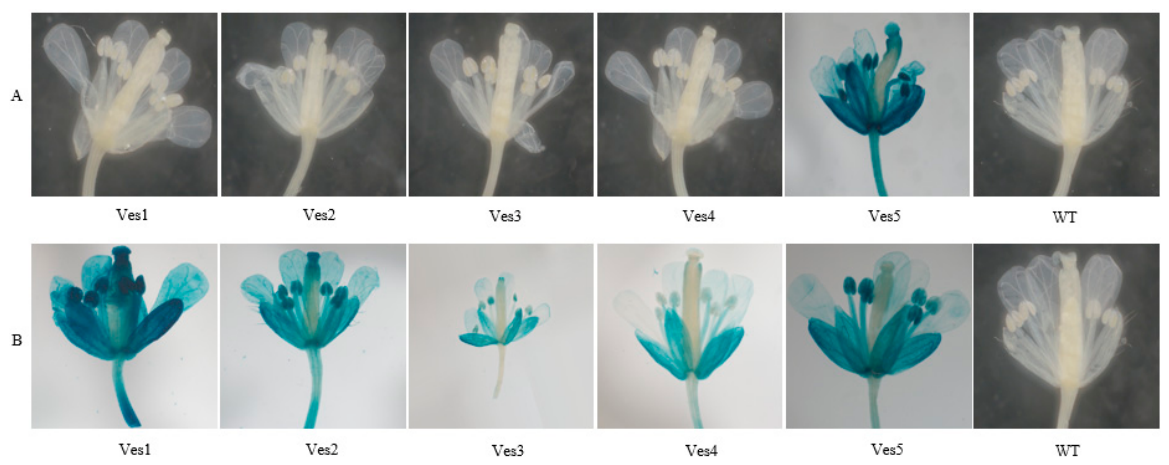
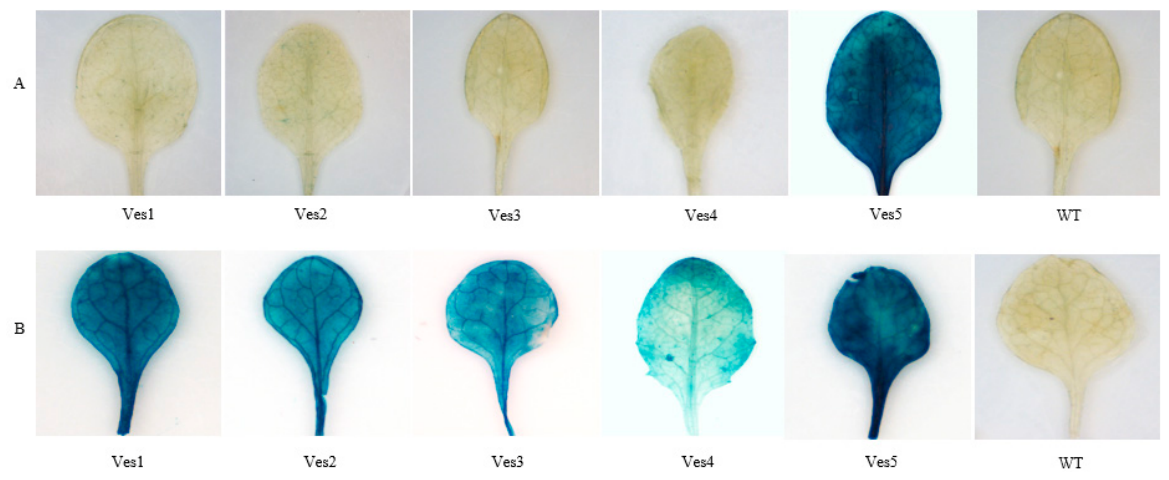
Ethanol-inducible GUS gene expression was further studied using GUS histochemical staining of the leaves and the flower buds from three-week-old soil-grown A. thaliana seedlings treated with 1.5% ethanol via root drench for 16 h. The results showed that when treated with distilled water, no GUS protein was produced in the stigmas, styles, stamens, petals, leaves, and other tissues of plants containing Ves1, Ves2, Ves3, or Ves4, nor in WT plants (Ves1–Ves4 and WT in Figure 2A and Figure 3A). In contrast, when treated with a 1.5% ethanol, GUS protein was produced in the stigmas, styles, stamens, petals, leaves, and other tissues of plants containing Ves1, Ves2, Ves3, or Ves4 (Ves1–Ves4 in Figure 2B and Figure 3B), but no GUS protein was detected in WT plants (WT in Figure 2 and Figure 3). Plants containing Ves5 produced GUS protein regardless of whether they were treated with distilled water or a 1.5% ethanol (Ves5 in Figure 2 and Figure 3). These results indicate that GUS gene expression in plants containing Ves1, Ves2, Ves3, or Ves4 is precisely regulated by ethanol, whereas neither the plants containing Ves5 nor the wild-type plants exhibit this characteristic.

3.2. Comparisons Between the Inducible alc Expression and the CaMV35S Expression

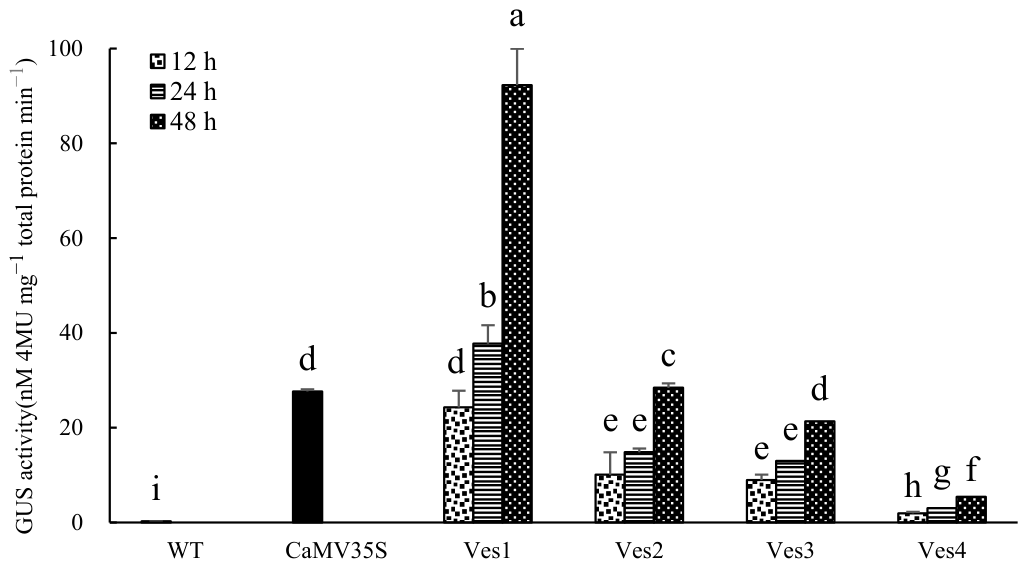
To test the efficiency of the inducible alc expression system, the CaMV35S promoter driving the same GUS gene was used as a reference. Ethanol induction was performed via root drench, foliar spray, and ethanol vapor, and GUS accumulation was examined at different induction times. For the 1.5% ethanol root drench, the CaMV35S expression system was not affected by ethanol, while the alc expression systems (Ves1–Ves4) were regulated by ethanol induction, with significant variations observed. Ves1 achieved a relatively high GUS expression level of 24.2991 at the early induction stage (12 h), which was slightly lower than that of CaMV35S expression system (27.6552) with no significant difference, but significantly higher than that of Ves2 and Ves3 at both 12 h and 24 h after induction. At 24 h after induction, an even higher GUS expression level of 37.7278 was observed, which was 1.36-fold that of the CaMV35S expression system and significantly exceeded the CaMV35S level. By 48 h after induction, the GUS expression level increased rapidly to 92.2728, representing a 3.34-fold increase over the CaMV35S expression system and showing a significant advantage over it (Figure 4). For Ves2 and Ves3, GUS expression levels were relatively low at both 12 h and 24 h after induction and were significantly lower than those of CaMV35S. At 48 h after induction, Ves2 showed significantly higher expression than CaMV35S, while Ves3 exhibited no significant difference compared to CaMV35S. In contrast, Ves4 demonstrated consistently low GUS expression levels, which were significantly lower than those of the other four constructed vectors. The results indicated that the alc systems displayed a gradient in performance under 1.5% ethanol root drench treatment (Ves1 > Ves2 > Ves3 > Ves4). Consequently, Ves1 and Ves2 were determined to be the most efficient and highly efficient chemical induction systems, respectively.
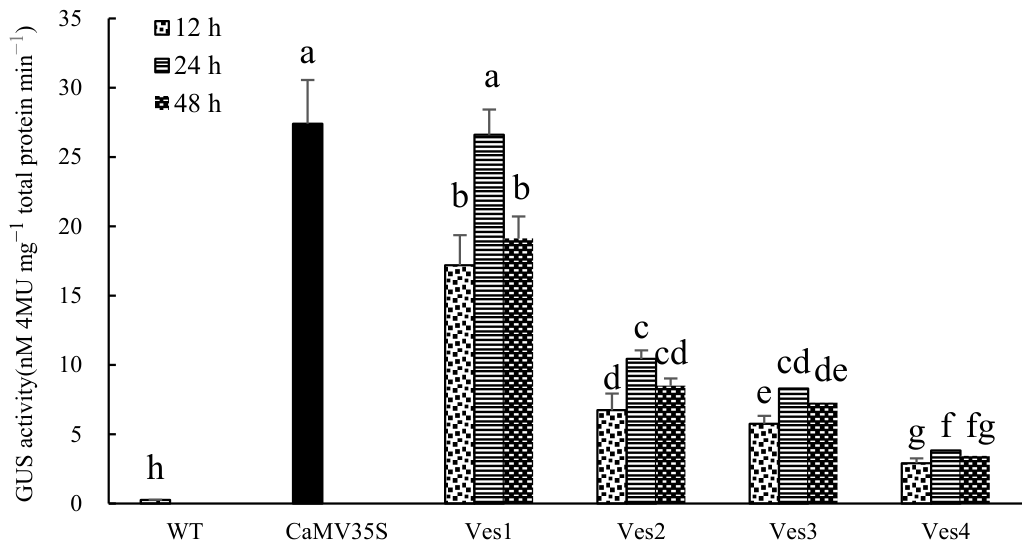
For the 5.0% ethanol foliar spray, ethanol had no effect on the CaMV35S system, while it significantly regulated the alc systems (Ves1–Ves4). GUS expression levels of Ves1 at 12 h and 48 h after induction were 17.1952 and 19.1231, respectively, both significantly lower than that of the CaMV35S expression system (27.4117). At 24 h after induction, its GUS expression (26.6142) was slightly lower than that of the CaMV35S system, but the difference was not significant. In contrast, Ves2–Ves4 showed relatively low GUS expression levels at 12 h, 24 h, and 48 h after induction, all significantly lower than the CaMV35S system (Figure 5). The results indicated that the alc systems exhibited a gradient in performance under 5.0% ethanol foliar spray (Ves1 > Ves2 > Ves3 > Ves4). Therefore, Ves1 can serve as a relatively efficient chemically inducible system.
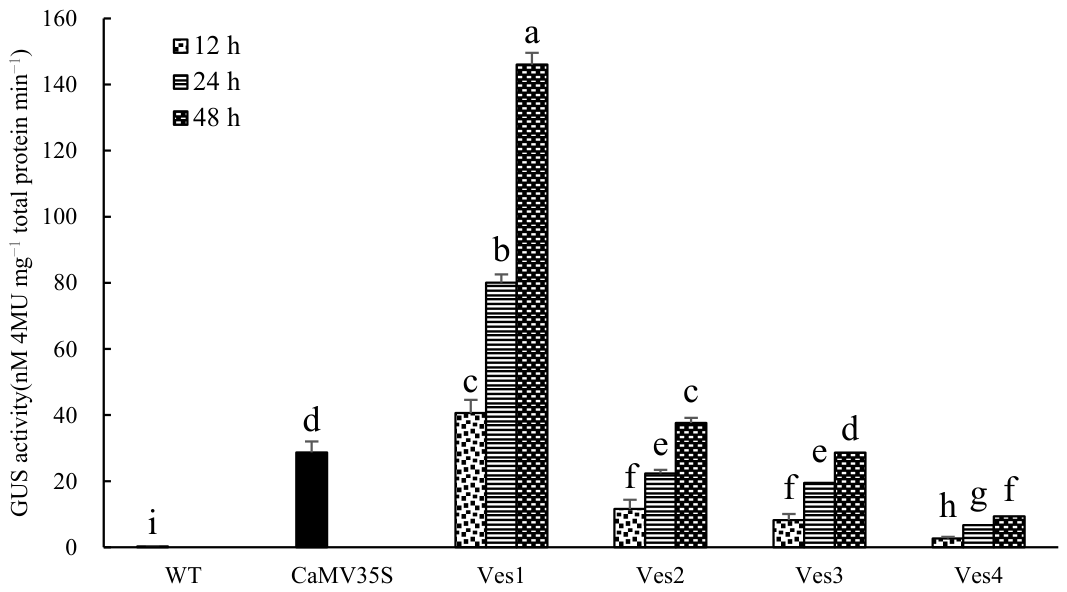
For the 95% ethanol vapor induction, the CaMV35S expression system was not affected by ethanol, while the alc expression systems (Ves1–Ves4) were regulated by ethanol induction, with significant variations observed. Ves1 could obtain a higher GUS expression level of 40.6154 within a short induction time (12 h), which was 1.41-fold that of CaMV35S (27.6552) with a significant difference. Moreover, it also was significantly higher than the expression levels of Ves2 and Ves3 at 12 h and 24 h after induction. At 24 h after induction, an even higher GUS expression level of 80.0552 was observed, which was 2.79-fold that of the CaMV35S expression system and significantly exceeded the CaMV35S level. By 48 h after induction, the GUS expression level increased rapidly to 146.0380, representing a 5.08-fold increase over the CaMV35S expression system and showing a significant advantage over it (Figure 6). For Ves2 and Ves3, GUS expression levels were relatively low at both 12 h and 24 h after induction and were significantly lower than that of CaMV35S. At 48 h after induction, Ves2 and Ves3 were significantly higher than and had no significant difference with CaMV35S, respectively. In contrast, even after a long time of ethanol induction (24 h and 48 h), Ves4 still showed a persistently lower GUS expression level, which was significantly lower than that of the other four constructed vectors. The results indicated that under 95% ethanol vapor induction the GUS gene expression levels of the alc systems were sorted as: Ves1 > Ves2 > Ves3 > Ves4. Consequently, Ves1 and Ves2 were determined to be the most efficient and highly efficient chemical induction systems, respectively.

3.3. Efficiency Analysis of the alc System

To define the efficiency of the different Ves systems (Ves1–Ves4), we analyzed the induction fold and induction speed of GUS expression levels under different treatment methods. For the 1.5% ethanol root drench, in terms of induction fold, the GUS protein expression level of Ves1 12 h after induction was 55.54 times that of the uninduced control, and 86.23 times 24 h after induction. The induction folds at both time points were much higher than those of Ves2–Ves4, and the 24 h induction fold was 2.51 times that of Ves2. In terms of induction speed, a strong induction of 55.54-fold was achieved from 0 h to 12 h, accounting for 64.4% of the 24 h induction amount, indicating an extremely rapid response. Therefore, Ves1 is the most efficient alc induction system. For Ves2, the GUS protein expression level 12 h after induction was 23.39 times that of the uninduced control, and 34.39 times 24 h after induction. The induction folds at both time points were higher than those of Ves3 and Ves4. In terms of induction speed, a high induction of 23.39-fold was already achieved from 0 h to 12 h, accounting for 68.0% of the 24 h induction amount (Table 1), with a startup speed slightly faster than that of Ves1. Thus, Ves2 is an efficient alc induction system.
For the 5.0% ethanol foliar spray, Ves1 showed the best performance in terms of induction fold (at 12 h after induction, the GUS protein expression level was 44.04 times that of the uninduced control, and 68.16 times at 24 h after induction), much higher than those of Ves2–Ves4; its induction speed was such that 64.6% of the 24 h induction amount was already reached at 12 h after induction. Considering the expression advantages at both 12 h and 24 h after induction, Ves1 was defined as the most efficient alc induction system. Ves2 showed relatively good induction folds (at 12 h after induction, the GUS protein expression level was 17.96 times that of the uninduced control, and 27.85 times at 24 h after induction). Its induction speed (64.5% of the 24 h induction amount already reached at 12 h after induction) was consistent with that of Ves1, and its overall performance was better than those of Ves3 and Ves4 (Table 2), so it was defined as an efficient alc induction system.
For the 95% ethanol vapor induction, in terms of induction fold, the GUS protein expression level of Ves1 at 12 h after induction was 95.45 times that of the uninduced control, and 188.14 times at 24 h after induction. The induction folds at both time points were much higher than those of Ves2–Ves4, and the 24 h induction fold was 3.4 times that of Ves2. In terms of induction speed, a strong induction of 95.45-fold was already achieved from 0 h to 12 h, accounting for 50.7% of the 24 h induction amount, making it the most efficient and fast-responding alc system. For Ves2, the GUS protein expression level at 12 h after induction was 28.49 times that of the uninduced control, and 54.95 times at 24 h after induction. Its induction folds were much higher than those of Ves3 and Ves4. In terms of induction speed, a 28.49-fold increase was achieved from 0 h to 12 h, accounting for 51.8% of the 24 h induction amount, which was consistent with the induction speed of Ves1 (50.7%), but its induction fold was much lower than that of Ves1 (Table 3), making it an efficient and fast-responding alc system.

3.4. Analysis of Agronomic Traits and Physiological Indicators

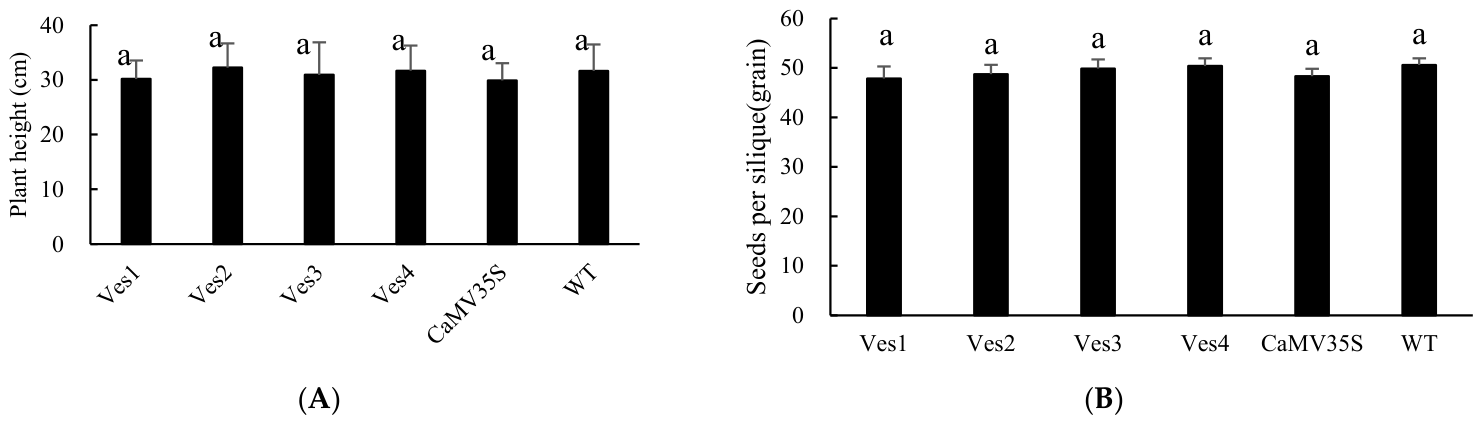
To investigate whether the concentration of ethanol used and the treatment duration affected plant growth and development, three-week-old soil-grown A. thaliana seedlings were treated with 1.5% ethanol root drench for 48 h. The physiological indicators of leaves and the agronomic traits of plants were then measured using an ultraviolet spectrophotometer (X-7S, Shanghai Yuanxi Instrument Co., Ltd., Shanghai, China) and a tape measure (Deli 2.0 m, Deli Group Co., Ltd., Ningbo, China), respectively. The results showed that the chlorophyll a, chlorophyll b, and total chlorophyll (a + b) content, SOD, POD, and CAT activities, and plant height and seeds per silique exhibited minimal variation. No significant differences were observed for these agronomic traits and physiological indicators among the five types of transgenic plants (Ves1, Ves2, Ves3, Ves4, and CaMV35S) and the wild-type plants (Table 4 and Table 5, and Figure 7). These results indicated that the treatment with 1.5% ethanol for 48 h had no effect on these physiological indices and agronomic traits of the plants.

4. Discussion

4.1. AlcR Binding Sites of the alc System

The design of the ethanol-inducible gene expression system was derived from A. nidulans [53,66]. In A. nidulans, the alcR gene encodes a specific activator (AlcR) of the ethanol utilization pathway. This activator regulates the expression of the alcA gene (encoding alcohol dehydrogenase I) and the aldA gene (encoding aldehyde dehydrogenase). In the absence of ethanol, the AlcR protein is inactive and cannot activate the expression of target genes. In the presence of ethanol, the AlcR protein is activated and binds to specific sites in the promoter of target genes, thereby inducing their expression [67,68]. To date, the working mechanism of the alc system and the specific promoter sequences bound by the AlcR protein have been well characterized, and the alc system has proven to be an important tool for analyzing gene function and for applications in plant biotechnology [24,54,69]. To develop an efficient alc system, we evaluated four different modifications of the alcA promoter. It was found that the tandem inverted repeat sequences bound by AlcR significantly increased the expression level of the alc system, indicating that this sequence possesses a unique ability to substantially enhance the alc system. Previous studies have shown that when the AlcR-binding sequence is positioned 240 bp upstream of the transcriptional start site, it is critical for ethanol-induced expression from the alcA promoter [62]. However, other studies have found that when the AlcR binding sites are located within 186 bp of the transcriptional start site, the alc system exhibits strong ethanol inducibility, suggesting that the exact positions of these binding sites are not crucial for ethanol-induced expression in plants [41]. We propose that the high efficiency of the alc system is associated with both the tandem inverted repeat sequences bound by AlcR and their positions. By optimizing the AlcR-binding inverted repeat sequences, integrating different copy numbers of these repeats, and simultaneously optimizing their positions within the alcA promoter, we are confident that a more efficient ethanol-inducible alc system can be developed. Ethanol root drench and vapor induction could effectively induce the alc system in A. thaliana, whereas foliar spray was relatively less effective. These results were supported by earlier studies in tobacco showing that a root drench and a vapor induction gave approximately 5-fold and 10-fold higher expression than an aerial spray in tobacco leaves, respectively [29]. The efficient alc system developed in this study will enable this important gene expression technology to be better applied in the fields of gene function and plant biotechnology.

4.2. Activation Method of the alc System

Currently, the main methods for inducing the alc system in plants include the root drench method, the foliar spray method, and the vapor method. Therefore, this study analyzed the alc system using these three methods.
For the root drench method, this study used 1.5% ethanol to analyze the performance of the constitutive expression system CaMV35S and four ethanol-inducible alc systems (Ves1–Ves4) in driving the expression of the GUS reporter gene. The results showed that the CaMV35S system was not affected by ethanol, whereas the alc system variants successfully achieved ethanol-inducible regulation. However, the induction efficiency varied significantly among the four alc systems (Ves1–Ves4), revealing differences in the effectiveness of their designs. Ves1 demonstrated excellent inducibility. At the early stage of induction (12 h), its GUS expression level had already reached a high level, showing no statistically significant difference from that of the strong constitutive promoter CaMV35S. As the induction time extended to 24 h and 48 h, the expression level of Ves1 not only significantly exceeded that of CaMV35S but also reached levels that were 1.36-fold and 3.34-fold those of the latter at 24 h and 48 h, respectively. Notably, the expression level of Ves1 in the late induction stage far surpassed that driven by the constitutive promoter, which is consistent with previous findings in plants such as tomato and sugarcane, where the alc system achieved expression levels comparable to or even higher than those of CaMV35S [41,52]. In contrast, the induction efficiencies of Ves2 and Ves3 were relatively low, being significantly weaker than that of the CaMV35S system at the early induction stages (12 h and 24 h). Although the expression level of Ves2 at 48 h significantly exceeded that of CaMV35S and Ves3 reached a high level with no statistically significant difference from the strong constitutive promoter CaMV35S, their overall induction kinetics were slower than those of Ves1. This indicates that, despite being based on the same alc regulatory principle, subtle differences in vector construction may significantly affect the binding efficiency of the transcription factor AlcR, chromatin accessibility, or interaction with the basal transcription machinery, ultimately leading to differences in induction strength and kinetics [12,41]. However, Ves4 consistently exhibited low-level expression throughout the experimental period, significantly lower than that of all other systems. This may suggest unexpected sequence issues or regulatory elements in the native alcA promoter (palcA), resulting in a very weak response to ethanol induction signals—or even the presence of inhibitory structures—which makes this promoter unsuitable as an effective inducible expression tool. This also highlights the necessity of incorporating the 35S minimal promoter into the alc system [27,41,42].
For the foliar spray method, this study used 5.0% ethanol foliar spray as the induction method to evaluate the expression characteristics of the constitutive CaMV35S system and the ethanol-inducible alc system (Ves1–Ves4). The results indicated that ethanol foliar spray could effectively regulate the alc system but did not affect the activity of the CaMV35S system. However, the overall expression level of the alc system under foliar spray was significantly lower than that observed in the previous study using 1.5% ethanol root drench. This phenomenon is highly consistent with the previous findings in sugarcane, which clearly showed that root drench treatment effectively induced the expression of the modified alc system in sugarcane leaves and stems, whereas the spray method was relatively inefficient [41]. This finding has significant methodological implications: the induction efficiency of the alc system is closely related to the application method of the inducer. We found that ethanol root drench effectively induced target gene expression of the alc system in Arabidopsis leaves and floral organs. This induction may result from the combined effects of ethanol transported to the leaves and floral organs via xylem vessels and ethanol vapor released from the soil. This could also explain why root drench is more effective than foliar spray. Ves1 system performed optimally under root drench conditions, but under 5.0% ethanol foliar spray induction, its GUS expression levels did not surpass those of the CaMV35S system at any of the three time points. This may be related to the dose-dependent induction characteristics of the alc system. Previous studies in tobacco and A. thaliana showed that expression mediated by the alc system was dose-dependent, with extremely low background activity in the absence of an exogenous inducer [39,49]. Due to the short retention time and limited absorption efficiency of ethanol on the leaf surface, foliar spray fails to deliver an effective dose sufficient to fully activate the alc system, resulting in lower expression levels of the target gene. Another possible reason is that the induction efficiency of the alc system is affected by the transport and distribution of the inducer within the plant. Research has confirmed that the alc system can induce expression in both leaves and roots simultaneously through root drench or whole-plant treatment [29]. This suggests that ethanol transport within the plant is limited, so foliar spray may primarily affect the treated leaves, making it difficult to achieve uniform induction throughout the whole plant, thus leading to lower expression levels of the target gene. The GUS expression levels of Ves2, Ves3, and Ves4 at the three time points (12 h, 24 h, and 48 h) were significantly lower than those of the CaMV35S system, showing a performance gradient of Ves1 > Ves2 > Ves3 > Ves4. This clearly indicates that even under the same regulatory principle, the specific combination of different regulatory elements has a decisive impact on induction efficiency, and subtle sequence differences can lead to substantial variations in transcriptional activation efficiency [12,41]. Nevertheless, Ves1 still demonstrated significant superiority over Ves2, Ves3, and Ves4 under these conditions, with its expression level consistently being the highest among the alc systems and reaching an efficiency comparable to the CaMV35S system at 24 h. This further consolidates the status of Ves1 as an efficient and reliable configuration within the alc system.
For the vapor induction method, this study used 95% ethanol vapor fumigation as the induction method to analyze the performance of the constitutive expression system CaMV35S and four ethanol-inducible alc systems (Ves1–Ves4) in driving the expression of the GUS reporter gene. The results showed that ethanol vapor did not affect the activity of the constitutive CaMV35S system but could efficiently activate the alc systems. However, the induction efficiency varied significantly among alc systems, revealing differences in their design effectiveness. Among these, Ves1 demonstrated exceptionally inducible expression performance. Its expression level significantly surpassed that of the strong constitutive CaMV35S system as early as 12 h after induction, reaching 5.08 times that of CaMV35S at 48 h. This finding highlights the powerful efficacy of combining ethanol vapor induction with optimized vector design, providing an ultra-efficient and tightly regulatable gene expression tool for the field of plant biotechnology. Compared with the previous root drench study (reaching 3.34 times that of CaMV35S at 48 h) and the foliar spray study (at most comparable to CaMV35S), the expression level of Ves1 under ethanol vapor induction achieved a qualitative leap. This result is highly consistent with the previous findings in tobacco, potato, and oilseed rape, which clearly indicated that low-concentration ethanol vapor can efficiently induce the alc system, and exposing the whole plant or foliar parts to an ethanol vapor environment enables uniform induction in both leaves and roots [29], as also confirmed in A. thaliana, where the alc system responds more strongly to ethanol vapor than to soil drench with ethanol [39]. The alc system variants showed a clear performance gradient of Ves1 > Ves2 > Ves3 > Ves4. The expression levels of Ves2 and Ves3 at 12 h and 24 h were significantly lower than those of CaMV35S, but by 48 h, Ves2 was significantly higher than CaMV35S, while Ves3 showed no significant difference from CaMV35S. Ves4 maintained consistently low expression levels even after prolonged induction (24 h and 48 h). This gradient is consistent with the patterns observed in the root drench and foliar spray studies, further confirming the decisive influence of structural differences among different alc system variants on induction efficiency. This may be related to the fact that the induction efficiency of the alc system is comprehensively affected by multiple factors, including the structure of the alcA promoter region, the copy number of AlcR binding sites, and the minimal promoter sequence [12,41]. The positioning of Ves1 as “the most efficient chemical induction system” and Ves2 as “a highly efficient chemical induction system” provides a clear basis for selection in subsequent applied research.

4.3. Performance of the Different alc System

The research results once again confirmed the existence of a clear performance gradient within the alc system (Ves1 > Ves2 > Ves3 > Ves4). Ves1 demonstrated superior performance compared to the other alc systems under all three different ethanol induction methods (root drench, foliar spraying, and vapor fumigation), with its advantage being amplified to an extremely high level, especially under vapor induction. This strongly suggests that the vector configuration of Ves1 (such as specific promoter elements, enhancer sequences, or the arrangement of AlcR binding sites) has been carefully optimized, endowing it with extremely high sensitivity to ethanol signals and potent transcriptional driving capability, allowing it to be classified as the “most efficient” alc system. Ves2 showed expression significantly higher than CaMV35S after 48 h of root drench and vapor induction and can be categorized as a “highly efficient” alc system. After 48 h of ethanol root drench or vapor induction, Ves3 has no significant difference in expression level with CaMV35S, which can be classified as an effective alc system. In contrast, Ves4 exhibited poorer performance. This performance difference provides researchers with a diverse set of tools: Ves1 is the preferred choice when maximizing expression output is required; Ves2 or Ves3 may be more suitable when moderate intensity or gentler induction is desired. The consistently low expression level of Ves4 suggests potential defects in its construction and limited practical utility [41]. Future research could further explore the molecular mechanisms underlying the high expression efficiency of Ves1, delve into the induction characteristics of Ves1 in different plant species, evaluate its application effects in studying gene functions related to important agronomic traits and in crop improvement, and combine it with the latest gene editing technologies to develop more precise and efficient chemical-inducible expression systems. With a deeper understanding of the regulatory mechanism of the alc system, this chemical-inducible expression system is poised to play an even greater role in the fields of plant functional genomics and agricultural biotechnology.

5. Conclusions

In this study, an ethanol-inducible gene expression system (alcR/alcA) was developed through codon optimization of the alcR gene and GUS gene, integration of enhancer sequences and Kozak sequences upstream of these genes, and incorporation of varying numbers of specific binding sites for the AlcR protein into the alcA promoter. Using the 35S promoter as a reference, a comparative study of the alc system was conducted via ethanol root drench, foliar spray, and vapor application. The following clear conclusions were drawn: (1) The ethanol-inducible alc system was successfully constructed and validated for its operability in plants. Significant differences among various alc systems highlight the necessity of meticulous design and screening promoter structures during the development and application of alc inducible systems. (2) Among 1.5% root drench, 5.0% foliar spray, and 95% vapor induction, ethanol vapor induction was identified as the optimal method for achieving ultra-high expression levels of the alc system. Its induction effect far exceeded that of root drench and foliar spray with foliar spray being the least effective induction method. (3) Ves1 was identified as the most efficient chemical induction system, demonstrating outstanding induction efficiency. Ves2 was identified as a highly efficient chemical induction system, serving as an alternative option for high-efficiency induction.

Supplementary Materials

The following supporting information can be downloaded at https://www.mdpi.com/article/10.3390/genes17091142/s1: Table S1: Structure of the various alc gene switch promoters tested in A. thaliana; Table S2: Separation of self-pollinated progenies from transgenic plants (T0) and screening for homozygous plants.

Author Contributions

Y.Z.: conceptualization, experimental design, visualization, writing—original draft, supervision. L.D.: conceptualization, experimental design, writing—original draft. Q.L.: review and editing. L.L.: data curation, formal analysis. All authors have read and agreed to the published version of the manuscript.

Funding

This project was supported by The Science and Technology Project of Bijie City (Bike Joint-[2023]21) and the Science and Technology Planning Project of Guizhou Province (QianKeHeZhiCheng-[2024]YiBan112).

Institutional Review Board Statement

Not applicable.

Informed Consent Statement

Not applicable.

Data Availability Statement

The data presented in this study are available from the corresponding authors upon reasonable request.

Conflicts of Interest

The authors declare no conflicts of interest.

References

  1. Honma, Y.; Yamakawa, T. High expression of GUS activities in sweet potato storage roots by sucrose-inducible minimal promoter. Plant Cell Rep. 2019, 38, 1417–1426. [Google Scholar] [CrossRef] [Scilit] [PubMed]
  2. Misra, S.; Ganesan, M. The impact of inducible promoters in transgenic plant production and crop improvement. Plant Gene 2021, 27, 100300. [Google Scholar] [CrossRef] [Scilit]
  3. Sanders, P.R.; Winter, J.A.; Barnason, A.R.; Rogers, S.G.; Fraley, R.T. Comparison of cauliflower mosaic virus 35S and nopaline synthase promoters in transgenic plants. Nucleic Acids Res. 1987, 15, 1543–1558. [Google Scholar] [CrossRef] [Scilit] [PubMed]
  4. Mitiouchkina, T.; Mishin, A.S.; Somermeyer, L.G.; Markina, N.M.; Chepurnyh, T.V.; Guglya, E.B.; Karataeva, T.A.; Palkina, K.A.; Shakhova, E.S.; Fakhranurova, L.I.; et al. Plants with genetically encoded autoluminescence. Nat. Biotechnol. 2020, 38, 944–946. [Google Scholar] [CrossRef] [Scilit] [PubMed]
  5. Hong, J.K.; Suh, E.J.; Kwon, S.J.; Lee, S.B.; Kim, J.A.; Lee, S.I.; Lee, Y.H. Promoter of chrysanthemum actin confers high-level constitutive gene expression in Arabidopsis and chrysanthemum. Sci. Hortic. 2016, 211, 8–18. [Google Scholar] [CrossRef] [Scilit]
  6. Rooke, L.; Byrne, D.; Salgueiro, S. Marker gene expression driven by the maize ubiquitin promoter in transgenic wheat. Ann. Appl. Biol. 2000, 136, 167–172. [Google Scholar] [CrossRef] [Scilit]
  7. Kishi-Kaboshi, M.; Aida, R.; Sasaki, K. Parsley ubiquitin promoter displays higher activity than the CaMV 35S promoter and the chrysanthemum actin 2 promoter for productive, constitutive, and durable expression of a transgene in Chrysanthemum morifolium. Breed. Sci. 2019, 69, 536–544. [Google Scholar] [CrossRef] [Scilit] [PubMed]
  8. Pino, M.T.; Skinner, J.S.; Park, E.J.; Jeknic, Z.; Hayes, P.M.; Thomashow, M.F.; Chen, T.H. Use of a stress inducible promoter to drive ectopic AtCBF expression improves potato freezing tolerance while minimizing negative effects on tuber yield. Plant Biotechnol. J. 2007, 5, 591–604. [Google Scholar] [CrossRef] [Scilit] [PubMed]
  9. Zhang, J.; Peng, Y.L.; Guo, Z.J. Constitutive expression of pathogen-inducible OsWRKY31 enhances disease resistance and affects root growth and auxin response in transgenic rice plants. Cell Res. 2008, 18, 508–521. [Google Scholar] [CrossRef] [Scilit] [PubMed]
  10. Rai, M.; He, C.K.; Wu, R. Comparative functional analysis of three abiotic stress-inducible promoters in transgenic rice. Transgenic Res. 2009, 18, 787–799. [Google Scholar] [CrossRef] [Scilit] [PubMed]
  11. Deprost, D.; Yao, L.; Sormani, R.; Moreau, M.; Leterreux, G.; Nicolai, M.; Bedu, M.; Robaglia, C.; Meyer, C. The Arabidopsis TOR kinase links plant growth, yield, stress resistance and mRNA translation. EMBO Rep. 2007, 8, 864–870. [Google Scholar] [CrossRef] [Scilit] [PubMed]
  12. Deveaux, Y.; Peaucelle, A.; Roberts, G.R.; Coen, E.; Simon, R.; Mizukami, Y.; Traas, J.; Murray, J.A.H.; Doonan, J.H.; Laufs, P. The ethanol switch: A tool for tissue-specific gene induction during plant development. Plant J. 2003, 36, 918–930. [Google Scholar] [CrossRef] [Scilit] [PubMed]
  13. Rahamkulov, I.; Bakhsh, A. Tissue-specific and stress-inducible promoters establish their suitability for containment of foreign gene(s) expression in transgenic potatoes. 3 Biotech 2020, 10, 426. [Google Scholar] [CrossRef] [Scilit] [PubMed]
  14. Lei, J.F.; Dai, P.H.; Li, J.Y.; Yang, M.; Li, X.Q.; Zhang, W.Q.; Zhou, G.T.; Guo, W.Z.; Liu, X.D. Tissue-specific CRISPR/Cas9 system of cotton pollen with GhPLIMP2b and GhMYB24 promoters. J. Plant Biol. 2021, 64, 13–21. [Google Scholar] [CrossRef] [Scilit]
  15. Xun, H.W.; Zhang, X.; Yu, J.M.; Pang, J.S.; Wang, S.C.; Liu, B.; Dong, Y.S.; Jiang, L.L.; Guo, D.Q. Analysis of expression characteristics of soybean leaf and root tissue-specific promoters in Arabidopsis and soybean. Transgenic Res. 2021, 30, 799–810. [Google Scholar] [CrossRef] [Scilit] [PubMed]
  16. Divya, K.; Pooja, B.M.; Sharma, K.K.; Vincent, V.; Reddy, P.S. Functional characterization of the promoter of pearl millet heat shock protein 10 (PgHsp10) in response to abiotic stresses in transgenic tobacco plants. Int. J. Biol. Macromol. 2020, 156, 103–110. [Google Scholar] [CrossRef] [Scilit] [PubMed]
  17. Luo, Q.L.; Li, Y.G.; Gu, H.Q.; Zhao, L.; Gu, X.P.; Li, W.B. The promoter of soybean photoreceptor GmPLP1 gene enhances gene expression under plant growth regulator and light stresses. Plant Cell Tissue Organ Cult. 2013, 114, 109–119. [Google Scholar] [CrossRef] [Scilit]
  18. Che, L.Z.; Wang, L.; Wang, H.R.; Sun, R.H.; You, L.L.; Zheng, Y.S.; Yuan, Y.J.; Li, D.D. Identification and characterization of a plastidial ω-3 fatty acid desaturase EgFAD8 from oil palm (Elaeis guineensis Jacq.) and its promoter response to light and low temperature. PLoS ONE 2018, 13, e0196693. [Google Scholar] [CrossRef] [Scilit] [PubMed]
  19. Dass, A.; Zainul, A.M.; Reddy, V.; Leelavathi, S. Isolation and characterization of the dehydration stress-inducible GhRDL1 promoter from the cultivated upland cotton (Gossypium hirsutum). J. Plant Biochem. Biotechnol. 2017, 26, 113–119. [Google Scholar] [CrossRef] [Scilit]
  20. Langille, P.; Wei, W.; Karagiannis, J.; Xing, T.; Tian, L. Evaluation of drought stress-inducible Wsi18 promoter in Brachypodium distachyon. Adv. Biosci. Biotechnol. 2018, 9, 596–612. [Google Scholar]
  21. Orbović, V.; Ravanfar, S.A.; Acanda, Y.; Narvaez, J.; Merritt, B.A.; Levy, A.; Lovatt, C.J. Stress-inducible Arabidopsis thaliana RD29A promoter constitutively drives Citrus sinensis APETALA1 and LEAFY expression and precocious flowering in transgenic Citrus spp. Transgenic Res. 2021, 30, 687–699. [Google Scholar] [CrossRef] [Scilit] [PubMed]
  22. Raipuria, R.K.; Kumar, V.; Guruprasad, K.N.; Bhat, S.B. Arabidopsis thaliana DHS2 (AT4G33510) gene promoter is highly wound responsive and requires a part of the first exon sequences for its function. J. Plant Biochem. Biotechnol. 2018, 27, 241–247. [Google Scholar] [CrossRef] [Scilit]
  23. Prakash, P.S.; Pal, S.S.; Shruti, S.; Krishnappa, C.; Sane, A.P. A strong early acting wound-inducible promoter, RbPCD1pro, activates cryIAc expression within minutes of wounding to impart efficient protection against insects. Plant Biotechnol. J. 2019, 17, 1458–1470. [Google Scholar] [CrossRef] [Scilit] [PubMed]
  24. Li, R.Z.; Jia, X.Y.; Mao, X. Ethanol-inducible gene expression system and its applications in plant functional genomics. Plant Sci. 2005, 169, 463–469. [Google Scholar] [CrossRef] [Scilit]
  25. Weigel, D.; Alvarez, J.; Smyth, D.R.; Yanofsky, M.F.; Meyerowitz, E.M. LEAFY controls floral meristem identity in Arabidopsis. Cell 1992, 69, 843–859. [Google Scholar] [CrossRef] [Scilit] [PubMed]
  26. Wang, R.H.; Zhou, X.F.; Wang, X.Z. Chemically regulated expression systems and their applications in transgenic plants. Transgenic Res. 2003, 12, 529–540. [Google Scholar] [CrossRef] [Scilit] [PubMed]
  27. Caddick, M.X.; Greenland, A.J.; Jepson, I.; Krause, K.P.; Qu, N.; Riddell, K.V.; Salter, M.G.; Schuch, W.; Sonnewald, U.; Tomsett, A.B. An ethanol inducible gene switch for plants used to manipulate carbon metabolism. Nat. Biotechnol. 1998, 16, 177–180. [Google Scholar] [CrossRef] [Scilit] [PubMed]
  28. Maizel, A.; Weigel, D. Temporally and spatially controlled induction of gene expression in Arabidopsis thaliana. Plant J. 2004, 38, 164–171. [Google Scholar] [CrossRef] [Scilit] [PubMed]
  29. Sweetman, J.P.; Chu, C.C.; Qu, N.; Greenland, A.J.; Sonnewald, U.; Jepson, I. Ethanol vapor is an efficient inducer of the alc gene expression system in model and crop plant species. Plant Physiol. 2002, 129, 943–948. [Google Scholar] [CrossRef] [Scilit] [PubMed]
  30. David, K.M.; Catherine, P.R. Characterization of a tobacco bright yellow 2 cell line expressing the tetracycline repressor at a high level for strict regulation of transgene expression. Plant Physiol. 2001, 125, 1548–1553. [Google Scholar] [CrossRef] [Scilit] [PubMed]
  31. Gossen, M.; Bujard, H. Tight control of gene expression in mammalian cells by tetracycline responsive promoters. Proc. Natl. Acad. Sci. USA 1992, 89, 5547–5551. [Google Scholar] [CrossRef] [Scilit] [PubMed]
  32. Aoyama, T.; Chua, N.H. A glucocorticoid-mediated transcriptional induction system in transgenic plants. Plant J. 1997, 11, 605–612. [Google Scholar] [CrossRef] [Scilit] [PubMed]
  33. Ouwerkerk, P.B.F.; Kam, R.J.D.; Hoge, J.H.C.; Meijer, A.H. Glucocorticoid-inducible gene expression in rice. Planta 2001, 213, 370–378. [Google Scholar] [CrossRef] [Scilit] [PubMed]
  34. Schena, M.; Lloyd, A.M.; Davis, R.W. A steroid-inducible gene expression system for plant cells. Proc. Natl. Acad. Sci. USA 1991, 88, 10421–10425. [Google Scholar] [CrossRef] [Scilit] [PubMed]
  35. Unger, E.; Cigan, A.M.; Trimnell, M.; Xu, R.J.; Kendall, T.; Roth, B.; Albertsen, M. A chimeric ecdysone receptor facilitates methoxyfenozide-dependent restoration of male fertility in ms45 maize. Transgenic Res. 2002, 11, 455–465. [Google Scholar] [CrossRef] [Scilit] [PubMed]
  36. Padidam, M.; Gore, M.; Lu, D.L.; Smirnova, O. Chemical-inducible, ecdysone receptor-based gene expression system for plants. Transgenic Res. 2003, 12, 101–109. [Google Scholar] [CrossRef] [Scilit] [PubMed]
  37. Mett, V.L.; Lochhead, L.P.; Reynolds, P.H.S. Copper-controllable gene expression system for whole plants. Proc. Natl. Acad. Sci. USA 1993, 90, 4567–4571. [Google Scholar] [CrossRef] [Scilit] [PubMed]
  38. Mett, V.L.; Podivinsky, A.M.; Tennant, A.M.; Lochhead, L.P.; Jones, W.T.; Reynolds, P.H.S. A system for tissue-specific copper-controllable gene expression in transgenic plants: Nodule-specific antisense of aspartate aminatransferase-P2. Transgenic Res. 1996, 5, 105–113. [Google Scholar] [CrossRef] [Scilit] [PubMed]
  39. Roslan, H.A.; Salter, M.G.; Wood, C.D.; White, M.R.H.; Croft, K.P.; Robson, F.; Coupland, G.; Doonan, J.; Laufs, P.; Tomsett, A.B.; et al. Characterization of the ethanol-inducible alc gene expression system in Arabidopsis thaliana. Plant J. 2001, 28, 225–235. [Google Scholar] [CrossRef] [Scilit] [PubMed]
  40. Filichkin, S.A.; Meilan, R.; Busov, V.B.; Ma, C.; Brunner, A.M.; Strauss, S.H. Alcohol-inducible gene expression in transgenic Populus. Plant Cell Rep. 2006, 25, 660–667. [Google Scholar] [CrossRef] [Scilit] [PubMed]
  41. Kinkema, M.; Geijskes, R.J.; Shand, K.; Coleman, H.D.; Lucca, P.C.; Palupe, A.; Harrison, M.D.; Jepson, I.; Dale, J.L.; Sainz, M.B. An improved chemically inducible gene switch that functions in the monocotyledonous plant sugar cane. Plant Mol. Biol. 2014, 84, 443–454. [Google Scholar] [CrossRef] [Scilit] [PubMed]
  42. Lee, S.J.; Lee, Y.J.; Choi, S.; Park, S.B.; Tran, Q.G.; Heo, J.; Kim, H.S. Development of an alcohol-inducible gene expression system for recombinant protein expression in Chlamydomonas reinhardtii. J. Appl. Phycol. 2018, 30, 2297–2304. [Google Scholar] [CrossRef] [Scilit] [PubMed]
  43. Battaglia, R.; Brambilla, V.; Colombo, L.; Stuitje, A.R.; Kater, M.M. Functional analysis of MADS-box genes controlling ovule development in Arabidopsis using the ethanol-inducible alc gene-expression system. Mech. Dev. 2006, 123, 267–276. [Google Scholar] [CrossRef] [Scilit] [PubMed]
  44. Kunkel, T.; Niu, Q.W.; Chan, Y.S.; Chua, N.H. Inducible isopentenyl transfease as a high efficiency marker for plant transformation. Nat. Biotechnol. 1999, 17, 916–919. [Google Scholar] [CrossRef] [Scilit] [PubMed]
  45. Zuo, J.R.; Niu, Q.W.; MraIler, S.G.; Chua, N.H. Chemical-regulated, site-specific DNA excision in transgenic plants. Nat. Biotechnol. 2001, 19, 157–161. [Google Scholar] [CrossRef] [Scilit] [PubMed]
  46. Chen, S.; Hofius, D.; Sonnewald, U.; Börnke, F. Temporal and spatial control of gene silencing in transgenic plants by inducible expression of double-stranded RNA. Plant J. 2003, 36, 731–740. [Google Scholar] [CrossRef] [Scilit] [PubMed]
  47. Guo, H.S.; Fei, J.F.; Xie, Q.; Chua, N.H. A chemical-regulated inducible RNAi system in plants. Plant J. 2003, 34, 383–392. [Google Scholar] [CrossRef] [Scilit] [PubMed]
  48. Lo, C.; Wang, N.; Lam, E. Inducible double-stranded RNA expression activates reversible transcript turnover and stable translational suppression of a target gene in transgenic tobacco. FEBS Lett. 2005, 579, 1498–1502. [Google Scholar] [CrossRef] [Scilit] [PubMed]
  49. Salter, M.G.; Paine, J.A.; Riddell, K.V.; Jepson, I.; Greenland, A.J.; Caddick, M.X.; Tomsett, A.B. Characterisation of the ethanol-inducible alc gene expression system for transgenic plants. Plant J. 1998, 16, 127–132. [Google Scholar]
  50. Sara, S.; Nan, Q.; Dieter, S.; Uwe, S.; Bettina, H. Local induction of the alc gene switch in transgenic tobacco plants by acetaldehyde. Plant Cell Physiol. 2004, 45, 1566–1577. [Google Scholar] [CrossRef] [Scilit] [PubMed]
  51. Peebles, C.A.M.; Gibson, S.I.; Shanks, J.V.; San, K.Y. Characterization of an ethanol-inducible promoter system in Catharanthus roseus hairy roots. Biotechnol. Prog. 2007, 23, 1258–1260. [Google Scholar] [CrossRef] [Scilit] [PubMed]
  52. Garoosi, G.A.; Salter, M.G.; Caddick, M.X.; Tomsett, A.B. Characterization of the ethanol-inducible alc gene expression system in tomato. J. Exp. Bot. 2005, 56, 1635–1642. [Google Scholar] [CrossRef] [Scilit] [PubMed]
  53. Felenbok, B.; Sequeval, D.; Mathieu, M.; Sibley, S.; Gwynne, D.I.; Davies, R.W. The ethanol regulon in Aspergillus nidulans: Characterization and sequence of the positive regulatory gene alcR. Gene 1988, 73, 385–396. [Google Scholar] [CrossRef] [Scilit] [PubMed]
  54. Kulmburg, P.; Judewicz, N.; Mathieu, M.; Lenouvel, F.; Sequeval, D.; Felenbok, B. Specific binding sites for the activator protein, ALCR, in the alcA promoter of the ethanol regulon of Aspergillus niduluns. J. Biol. Chem. 1992, 267, 21146–21153. [Google Scholar] [CrossRef] [Scilit]
  55. Schlaman, H.R.M.; Risseeuw, E.; Franke-Van Dijk, M.E.I.; Hooykaas, P.J.J. Nucleotide sequence corrections of the uidA open reading frame encoding beta-glucuronidase. Gene 1994, 138, 259–260. [Google Scholar] [CrossRef] [Scilit] [PubMed]
  56. Jefferson, R.A.; Kavanagh, T.A.; Bevan, M.W. GUS fusions: β-glucuronidase as a sensitive and versatile gene fusion marker in higher plants. EMBO J. 1987, 6, 3901–3907. [Google Scholar] [CrossRef] [Scilit] [PubMed]
  57. Zhang, Z.L.; Qu, W.J.; Li, X.F. Laboratory Guide to Plant Physiology; Higher Education Press: Beijing, China, 2009; pp. 58–60. [Google Scholar]
  58. Zhu, L.Q. Fundamental Principles and Methods of Biochemistry Experiments; Science Press: Beijing, China, 2020; pp. 114–122. [Google Scholar]
  59. Guo, X.Q.; Su, Y.H. Concise Molecular Biology, 2nd ed.; China Agriculture Press: Beijing, China, 2017; p. 157. [Google Scholar]
  60. Odell, J.T.; Nagy, F.; Chua, N.H. Identification of DNA sequences required for activity of the cauliflower mosaic virus 35S promoter. Nature 1985, 313, 810–812. [Google Scholar] [CrossRef] [Scilit] [PubMed]
  61. Martinez, A.; Sparks, C.; Hart, C.A.; Thompson, J.; Jepson, I. Ecdysone agonist inducible transcription in transgenic tobacco plants. Plant J. 1999, 19, 97–106. [Google Scholar] [CrossRef] [Scilit] [PubMed]
  62. Panozzo, C.; Capuano, V.; Fillinger, S.; Felenbok, B. The zinc binuclear cluster activator AlcR is able to bind to single sites but requires multiple repeated sites for synergistic activation of the alcA gene in Aspergillus nidulans. J. Biol. Chem. 1997, 272, 22859–22865. [Google Scholar] [CrossRef] [Scilit] [PubMed]
  63. Ambrosini, C.; Destefanis, E.; Kheir, E.; Broso, F.; Alessandrini, F.; Longhi, S.; Battisti, N.; Pesce, I.; Dassi, E.; Petris, G.; et al. Translational enhancement by base editing of the Kozak sequence rescues haploinsufficiency. Nucleic Acids Res. 2022, 50, 10756–10771. [Google Scholar] [CrossRef] [Scilit] [PubMed]
  64. Schmitz, J.; Prufer, D.; Rohde, W.; Tacke, E. Non-canonical translation mechanisms in plants: Efficient in vitro and in planta initiation at AUU codons of the tobacco mosaic virus enhancer sequence. Nucleic Acids Res. 1996, 24, 257–263. [Google Scholar] [CrossRef] [Scilit] [PubMed][Green Version]
  65. Wei, H.; Meilan, R.; Brunner, A.M.; Skinner, J.S.; Ma, C.; Strauss, S.H. Transgenic sterility in Populus: Expression properties of the poplar PTLF, Agrobacterium NOS and two minimal 35S promoters in vegetative tissues. Tree Physiol. 2006, 26, 401–410. [Google Scholar] [CrossRef] [Scilit] [PubMed]
  66. Felenbok, B. The ethanol utilization regulon of Aspergillus nidulans: The alcA-alcR system as a tool for the expression of recombinant proteins. J. Biotechnol. 1991, 17, 11–17. [Google Scholar] [CrossRef] [Scilit] [PubMed]
  67. Lockington, R.A.; Sealy-Lewis, H.M.; Scazzocchio, C.; Davies, R.W. Cloning and characterization of the ethanol utilization regulon in Aspergillus nidulans. Gene 1985, 33, 137–149. [Google Scholar] [CrossRef] [Scilit] [PubMed]
  68. Pickett, M.; Gwynne, D.I.; Buxton, F.P.; Elliot, R.; Davies, R.W.; Lockington, R.A.; Scazzocchio, C.; Sealy Lewis, H.M. Cloning and characterisation of the aldA gene of Aspergillus nidulans. Gene 1987, 1, 217–226. [Google Scholar] [CrossRef] [Scilit] [PubMed]
  69. Werner, S.; Breus, O.; Symonenko, Y.; Marillonnet, S.; Gleba, Y. High-level recombinant protein expression in transgenic plants by using a double-inducible viral vector. Proc. Natl. Acad. Sci. USA 2011, 108, 14061–14066. [Google Scholar] [CrossRef] [Scilit] [PubMed]
Figure 1. Schematic diagram of the alcA constructs. For Vec1, Vec2, Vec3, and Vec4, p35S: hpt and p35S: alcR both use the CaMV 35S promoter to express HPT protein and AlcR protein from their respective CDSs. The alcA reporter cassette, palcA: min35S: GUS, contains a fusion promoter using the AlcR binding sites of the alcA promoter with the sequences downstream of the TATA sequence from the CaMV 35S promoter, to direct expression of the GUS reporter gene. For Vec5, p35S: hpt and p35S: GUS both use the CaMV 35S promoter to express HPT protein and GUS protein from their respective CDSs. ●, ▼, and ◆ represent translational enhancer sequence from the tobacco mosaic virus (TMV) (tatttttacaacaattaccaacaacaacaaacaacaaacaacattacaattactatttacaattaca), Kozak sequence (gcggccgcc), and the specific binding site sequences for the action of the AlcR protein (atgcatgcggaaccgcacgagg), respectively.
Genes 17 01142 g001
Figure 2. Ethanol-inducible GUS expression from the alc system in transgenic A. thaliana. Histochemical staining of flower buds for GUS activity was conducted using three-week-old soil-grown single T-DNA insertion homozygous seedlings containing different alc systems. Induction was achieved by root drench with 1.5% ethanol or distilled water for 16 h before analysis. A wild-type (WT) plant and a constitutive 35S-GUS plant were used as negative and positive controls, respectively. (A,B) were treated with distilled water and ethanol, respectively.
Genes 17 01142 g002
Figure 3. Ethanol-inducible GUS expression from the alc system in transgenic A. thaliana. Histochemical staining of young leaves for GUS activity was conducted using three-week-old soil-grown single T-DNA insertion homozygous seedlings containing different alc systems. Induction was achieved by root drench with 1.5% ethanol or distilled water for 16 h before analysis. A wild-type (WT) plant and a constitutive 35S-GUS plant were used as negative and positive controls, respectively. (A,B) were treated with distilled water and ethanol, respectively.
Genes 17 01142 g003
Figure 4. Comparison of constitutive and ethanol-inducible expression in transgenic A. thaliana. GUS expression level in leaves was analyzed using 3-week-old wild-type (WT) plants and transgenic plants containing a single T-DNA insertion of the 35S-GUS or alcA-GUS construct. Mean GUS expression level was shown for wild-type plants and 35S-GUS plants as well as four independent alcA-GUS plants at various times after treatment with 1.5% ethanol root drench. Data are mean ± SD. Different letters on the column chart indicate significant differences (p < 0.05).
Genes 17 01142 g004
Figure 5. Comparison of constitutive and ethanol-inducible expression in transgenic A. thaliana. GUS expression level in leaves was analyzed using 3-week-old wild-type (WT) plants and transgenic plants containing a single T-DNA insertion of the 35S-GUS or alcA-GUS construct. Mean GUS expression level was shown for wild-type plants and 35S-GUS plants as well as four independent alcA-GUS plants at various times after treatment with 5.0% ethanol foliar spray. Data are mean ± SD. Different letters on the column chart indicate significant differences (p < 0.05).
Genes 17 01142 g005
Figure 6. Comparison of constitutive and ethanol-inducible expression in transgenic A. thaliana. GUS expression level in leaves were analyzed using 3-week-old wild-type (WT) plants and transgenic plants containing a single T-DNA insertion of the 35S-GUS or alcA-GUS construct. Mean GUS expression level was shown for wild-type plants and 35S-GUS plants as well as four independent alcA-GUS plants at various times after treatment with 95% ethanol vapor induction. Data are mean ± SD. Different letters on the column chart indicate significant differences (p < 0.05).
Genes 17 01142 g006
Figure 7. Plant heights (A) and seeds per silique (B) of transgenic A. thaliana. Three-week-old soil-grown wild-type plants, 35S-GUS plants, and four independent alcA-GUS plants were treated with 1.5% ethanol root drench for 48 h. When their seeds matured, plant height and seeds per silique were measured. Mean plant height and seeds per silique were shown for wild-type plants, 35S-GUS plants, and four independent alcA-GUS plants. Data are mean ± SD. The same letters in the same column chart indicate no significant differences (p > 0.05).
Genes 17 01142 g007
Table 1. Comparison of ethanol-inducible alc system expression in A. thaliana via root drench.
PlantInduction TimeRatio
0 h12 h24 h12 h/0 h24 h/0 h
Ves10.437524.299137.727855.5486.23
Ves20.431510.093714.839823.3934.39
Ves30.41628.978312.994521.5731.22
Ves40.39491.94983.04944.947.72
Table 2. Comparison of ethanol-inducible alc system expression in A. thaliana via leaf spray.
PlantInduction TimeRatio
0 h12 h24 h12 h/0 h24 h/0 h
Ves10.390417.195226.614244.0468.16
Ves20.37476.729210.434317.9627.85
Ves30.36655.75198.297115.6922.64
Ves40.35732.90593.82408.1310.70
Table 3. Comparison of ethanol-vapor-inducible alc system expression in A. thaliana.
PlantInduction TimeRatio
0 h12 h24 h12/0 h24/0 h
Ves10.425540.615480.055295.45188.14
Ves20.406411.576422.332728.4954.95
Ves30.40748.222719.465120.1847.78
Ves40.39922.68566.66456.7316.69
Table 4. Chlorophyll content of the leaves of transgenic A. thaliana.
PlantChlorophyll a
(mg/g)
Chlorophyll b
(mg/g)
Chlorophyll (a + b)
(mg/g)
Ves10.5295 ± 0.0084 a0.2887 ± 0.0036 b0.8183 ± 0.0120 c
Ves20.5121 ± 0.0335 a0.2902 ± 0.0104 b0.8023 ± 0.0233 c
Ves30.5570 ± 0.0271 a0.2575 ± 0.0094 b0.8144 ± 0.0279 c
Ves40.5207 ± 0.0142 a0.2900 ± 0.0102 b0.8107 ± 0.0240 c
Ves50.5434 ± 0.0480 a0.2775 ± 0.0112 b0.8209 ± 0.0391 c
WT0.5485 ± 0.0443 a0.2668 ± 0.0117 b0.8154 ± 0.0367 c
Chlorophyll contents were measured in leaves using 3-week-old wild-type (WT) plants and transgenic plants containing a single T-DNA insertion of the 35S-GUS or alcA-GUS construct. Mean chlorophyll contents were shown for wild-type plants, 35S-GUS plants, and four independent alcA-GUS plants for 48 h after treatment with 1.5% ethanol root drench. Data are mean ± SD. The same letters in the same column indicate no significant differences (p > 0.05).
Table 5. POD, SOD, and CAT activities of transgenic A. thaliana.
PlantPOD Activities
(ΔOD470.min−1. g−1 FW)
SOD Activities
(Unit.g−1 FW)
CAT Activities
(mg.min−1. g−1 FW)
Ves14.46 ± 0.85 a105.68 ± 4.54 a7.35 ± 0.11 a
Ves 24.40 ± 1.25 a106.9 ± 3.45 a7.32 ± 0.05 a
Ves 34.65 ± 0.99 a108.7 ± 2.97 a7.31 ± 0.07 a
Ves 44.37 ± 0.69 a101.61 ± 4.82 a7.30 ± 0.16 a
CaMV35 S5.16 ± 1.39 a107.18 ± 2.72 a7.28 ± 0.05 a
WT4.58 ± 2.60 a101.46 ± 4.82 a7.30 ± 0.12 a
POD, SOD, and CAT activities were measured in leaves using 3-week-old wild-type (WT) plants and transgenic plants containing a single T-DNA insertion of the 35S-GUS or alcA-GUS construct. Mean activities were shown for wild-type-plants, 35S-GUS plants, and four independent alcA-GUS plants for 48 h after treatment with 1.5% ethanol root drench. Data are mean ± SD. The same letters in the same column indicate no significant differences (p > 0.05).
Disclaimer/Publisher’s Note: The statements, opinions and data contained in all publications are solely those of the individual author(s) and contributor(s) and not of MDPI and/or the editor(s). MDPI and/or the editor(s) disclaim responsibility for any injury to people or property resulting from any ideas, methods, instructions or products referred to in the content.