


Allelic Variants of the DPYD Gene in Russian Patients with Cancer: The Results of Exome Sequencing
 ,
,  , , , , ,
Abstract
1. Introduction
2. Materials and Methods
2.1. Whole-Exome Sequencing
2.2. Genetic Variant Calling and Filtering
2.3. Extraction and Annotation of DPYD Variants
3. Results
3.1. Overall Summary of Genotyping Results
3.2. DPYD Genotype and Allele Frequencies
4. Discussion
4.1. Comparison with European and Asian Population Data
4.2. Clinically Relevant Variants
4.3. Rare and Potentially Relevant Variants
4.4. Variants of Potential Research Interest Without Established Clinical Utility
4.5. Variants Without Established Clinical Significance
4.6. Limitations
5. Conclusions
Supplementary Materials
Author Contributions
Funding
Institutional Review Board Statement
Informed Consent Statement
Data Availability Statement
Conflicts of Interest
Abbreviations
| Abbreviation | Definition |
| BAM | Binary Alignment Map |
| BQSR | Base Quality Score Recalibration |
| BWA-MEM | Burrows–Wheeler Aligner with Maximal Exact Matches |
| CADD | Combined Annotation Dependent Depletion |
| CCDS | Consensus Coding Sequence |
| CPIC | Clinical Pharmacogenetics Implementation Consortium |
| DPD | Dihydropyrimidine dehydrogenase |
| DPYD | Dihydropyrimidine dehydrogenase gene |
| EAS | East Asian |
| FASTQ | Format for storing nucleotide sequences and their quality scores |
| FLOT | Fluorouracil, leucovorin, oxaliplatin, and docetaxel |
| FOLFIRINOX | Folinic acid, fluorouracil, irinotecan, and oxaliplatin |
| FOLFOX | Folinic acid, fluorouracil, and oxaliplatin |
| FS | Fisher strand bias |
| GATK | Genome Analysis Toolkit |
| GERP | Genomic Evolutionary Rate Profiling |
| gnomAD | Genome Aggregation Database |
| GRCh38 | Genome Reference Consortium Human Build 38 |
| HGVSc | Human Genome Variation Society coding DNA sequence nomenclature |
| HGVSp | Human Genome Variation Society protein sequence nomenclature |
| indel | Insertion or deletion |
| MANE | Matched Annotation from NCBI and EMBL-EBI |
| MQ | Mapping quality |
| mut | Mutant allele |
| NA | Not available |
| NFE | Non-Finnish European |
| PCR | Polymerase chain reaction |
| QD | Quality by depth |
| REVEL | Rare Exome Variant Ensemble Learner |
| SAMtools | Sequence Alignment/Map tools |
| SIFT | Sorting Intolerant From Tolerant |
| SNV | Single-nucleotide variant |
| VCF | Variant Call Format |
| VEP | Variant Effect Predictor |
| WES | Whole-exome sequencing |
| WT | Wild type |
References
- White, C.; Scott, R.J.; Paul, C.; Ziolkowski, A.; Mossman, D.; Ackland, S. Ethnic Diversity of DPD Activity and the DPYD Gene: Review of the Literature. Pharmgenom. Pers. Med. 2021, 14, 1603–1617. [Google Scholar] [CrossRef] [Scilit] [PubMed]
- European Medicines Agency (EMA). EMA Recommendations on DPD Testing Prior to Treatment with Fluorouracil, Capecitabine, Tegafur and Flucytosine. Internet Document: 30 April 2020. Available online: https://www.ema.europa.eu/en/news/ema-recommendations-dpd-testing-prior-treatment-fluorouracil-capecitabine-tegafur-flucytosine (accessed on 7 May 2026).
- Medicines and Healthcare Products Regulatory Agency. 5-Fluorouracil, Capecitabine and Tegafur: DPD Testing Recommended Before Initiation to Identify Patients at Increased Risk of Severe and Fatal Toxicity. Drug Safety Update. Internet Document: 22 October 2020. Available online: https://www.gov.uk/drug-safety-update/5-fluorouracil-intravenous-capecitabine-tegafur-dpd-testing-recommended-before-initiation-to-identify-patients-at-increased-risk-of-severe-and-fatal-toxicity (accessed on 7 May 2026).
- Lunenburg, C.A.T.C.; Van Der Wouden, C.H.; Nijenhuis, M.; Crommentuijn-van Rhenen, M.H.; De Boer-Veger, N.J.; Buunk, A.M.; Houwink, E.J.F.; Mulder, H.; Rongen, G.A.; Van Schaik, R.H.N.; et al. Dutch Pharmacogenetics Working Group (DPWG) Guideline for the Gene–Drug Interaction of DPYD and Fluoropyrimidines. Eur. J. Hum. Genet. 2020, 28, 508–517. [Google Scholar] [CrossRef] [Scilit] [PubMed]
- García-Alfonso, P.; Saiz-Rodríguez, M.; Mondéjar, R.; Salazar, J.; Páez, D.; Borobia, A.M.; Safont, M.J.; García-García, I.; Colomer, R.; García-González, X.; et al. Consensus of Experts from the Spanish Pharmacogenetics and Pharmacogenomics Society and the Spanish Society of Medical Oncology for the Genotyping of DPYD in Cancer Patients Who Are Candidates for Treatment with Fluoropyrimidines. Clin. Transl. Oncol. 2022, 24, 483–494. [Google Scholar] [CrossRef] [Scilit] [PubMed]
- Deenen, M.J.; Meulendijks, D.; Cats, A.; Sechterberger, M.K.; Severens, J.L.; Boot, H.; Smits, P.H.; Rosing, H.; Mandigers, C.M.P.W.; Soesan, M.; et al. Upfront Genotyping of DPYD*2A to Individualize Fluoropyrimidine Therapy: A Safety and Cost Analysis. J. Clin. Oncol. 2016, 34, 227–234. [Google Scholar] [CrossRef] [Scilit] [PubMed]
- Henricks, L.M.; Lunenburg, C.A.T.C.; De Man, F.M.; Meulendijks, D.; Frederix, G.W.J.; Kienhuis, E.; Creemers, G.-J.; Baars, A.; Dezentjé, V.O.; Imholz, A.L.T.; et al. DPYD Genotype-Guided Dose Individualisation of Fluoropyrimidine Therapy in Patients with Cancer: A Prospective Safety Analysis. Lancet Oncol. 2018, 19, 1459–1467. [Google Scholar] [CrossRef] [Scilit] [PubMed]
- Amstutz, U.; Henricks, L.M.; Offer, S.M.; Barbarino, J.; Schellens, J.H.M.; Swen, J.J.; Klein, T.E.; McLeod, H.L.; Caudle, K.E.; Diasio, R.B.; et al. Clinical Pharmacogenetics Implementation Consortium (CPIC) Guideline for Dihydropyrimidine Dehydrogenase Genotype and Fluoropyrimidine Dosing: 2017 Update. Clin. Pharmacol. Ther. 2018, 103, 210–216. [Google Scholar] [CrossRef] [Scilit] [PubMed]
- Meulendijks, D.; Henricks, L.M.; Sonke, G.S.; Deenen, M.J.; Froehlich, T.K.; Amstutz, U.; Largiadèr, C.R.; Jennings, B.A.; Marinaki, A.M.; Sanderson, J.D.; et al. Clinical Relevance of DPYD Variants c.1679T>G, c.1236G>A/HapB3, and c.1601G>A as Predictors of Severe Fluoropyrimidine-Associated Toxicity: A Systematic Review and Meta-Analysis of Individual Patient Data. Lancet Oncol. 2015, 16, 1639–1650. [Google Scholar] [CrossRef] [Scilit] [PubMed]
- Pratt, V.M.; Cavallari, L.H.; Fulmer, M.L.; Gaedigk, A.; Hachad, H.; Ji, Y.; Kalman, L.V.; Ly, R.C.; Moyer, A.M.; Scott, S.A.; et al. DPYD Genotyping Recommendations. J. Mol. Diagn. 2024, 26, 851–863. [Google Scholar] [CrossRef] [Scilit] [PubMed]
- De Luca, O.; Salerno, G.; De Bernardini, D.; Torre, M.S.; Simmaco, M.; Lionetto, L.; Gentile, G.; Borro, M. Predicting Dihydropyrimidine Dehydrogenase Deficiency and Related 5-Fluorouracil Toxicity: Opportunities and Challenges of DPYD Exon Sequencing and the Role of Phenotyping Assays. Int. J. Mol. Sci. 2022, 23, 13923. [Google Scholar] [CrossRef] [Scilit] [PubMed]
- De Mattia, E.; Silvestri, M.; Polesel, J.; Ecca, F.; Mezzalira, S.; Scarabel, L.; Zhou, Y.; Roncato, R.; Lauschke, V.M.; Calza, S.; et al. Rare Genetic Variant Burden in DPYD Predicts Severe Fluoropyrimidine-Related Toxicity Risk. Biomed. Pharmacother. 2022, 154, 113644. [Google Scholar] [CrossRef] [Scilit] [PubMed]
- Larrue, R.; Fellah, S.; Hennart, B.; Sabaouni, N.; Boukrout, N.; Van Der Hauwaert, C.; Delage, C.; Cheok, M.; Perrais, M.; Cauffiez, C.; et al. Integrating Rare Genetic Variants into DPYD Pharmacogenetic Testing May Help Preventing Fluoropyrimidine-Induced Toxicity. Pharmacogenom. J. 2024, 24, 1. [Google Scholar] [CrossRef] [Scilit] [PubMed]
- Andrews, S. FastQC: A Quality Control Tool for High Throughput Sequence Data. 2010. Available online: https://www.bioinformatics.babraham.ac.uk/projects/fastqc/ (accessed on 7 May 2026).
- Chen, S.; Zhou, Y.; Chen, Y.; Gu, J. Fastp: An Ultra-Fast All-in-One FASTQ Preprocessor. Bioinformatics 2018, 34, i884–i890. [Google Scholar] [CrossRef] [Scilit] [PubMed]
- Danecek, P.; Bonfield, J.K.; Liddle, J.; Marshall, J.; Ohan, V.; Pollard, M.O.; Whitwham, A.; Keane, T.; McCarthy, S.A.; Davies, R.M.; et al. Twelve Years of SAMtools and BCFtools. GigaScience 2021, 10, giab008. [Google Scholar] [CrossRef] [Scilit] [PubMed]
- McKenna, A.; Hanna, M.; Banks, E.; Sivachenko, A.; Cibulskis, K.; Kernytsky, A.; Garimella, K.; Altshuler, D.; Gabriel, S.; Daly, M.; et al. The Genome Analysis Toolkit: A MapReduce Framework for Analyzing next-Generation DNA Sequencing Data. Genome Res. 2010, 20, 1297–1303. [Google Scholar] [CrossRef] [Scilit] [PubMed]
- DePristo, M.A.; Banks, E.; Poplin, R.; Garimella, K.V.; Maguire, J.R.; Hartl, C.; Philippakis, A.A.; Del Angel, G.; Rivas, M.A.; Hanna, M.; et al. A Framework for Variation Discovery and Genotyping Using Next-Generation DNA Sequencing Data. Nat. Genet. 2011, 43, 491–498. [Google Scholar] [CrossRef] [Scilit] [PubMed]
- Van Der Auwera, G.A.; O’Connor, B.D. Genomics in the Cloud: Using Docker, GATK, and WDL in Terra, 1st ed.; O’Reilly Media: Sebastopol, CA, USA, 2020. [Google Scholar]
- McLaren, W.; Gil, L.; Hunt, S.E.; Riat, H.S.; Ritchie, G.R.S.; Thormann, A.; Flicek, P.; Cunningham, F. The Ensembl Variant Effect Predictor. Genome Biol. 2016, 17, 122. [Google Scholar] [CrossRef] [Scilit] [PubMed]
- Liu, X.; Li, C.; Mou, C.; Dong, Y.; Tu, Y. dbNSFP v4: A Comprehensive Database of Transcript-Specific Functional Predictions and Annotations for Human Nonsynonymous and Splice-Site SNVs. Genome Med. 2020, 12, 103. [Google Scholar] [CrossRef] [Scilit] [PubMed]
- Rentzsch, P.; Witten, D.; Cooper, G.M.; Shendure, J.; Kircher, M. CADD: Predicting the Deleteriousness of Variants throughout the Human Genome. Nucleic Acids Res. 2019, 47, D886–D894. [Google Scholar] [CrossRef] [Scilit] [PubMed]
- Ioannidis, N.M.; Rothstein, J.H.; Pejaver, V.; Middha, S.; McDonnell, S.K.; Baheti, S.; Musolf, A.; Li, Q.; Holzinger, E.; Karyadi, D.; et al. REVEL: An Ensemble Method for Predicting the Pathogenicity of Rare Missense Variants. Am. J. Hum. Genet. 2016, 99, 877–885. [Google Scholar] [CrossRef] [Scilit] [PubMed]
- Karczewski, K.J.; Francioli, L.C.; Tiao, G.; Cummings, B.B.; Alföldi, J.; Wang, Q.; Collins, R.L.; Laricchia, K.M.; Ganna, A.; Birnbaum, D.P.; et al. The Mutational Constraint Spectrum Quantified from Variation in 141,456 Humans. Nature 2020, 581, 434–443. [Google Scholar] [CrossRef] [Scilit] [PubMed]
- Chan, T.H.; Zhang, J.E.; Pirmohamed, M. DPYD Genetic Polymorphisms in Non-European Patients with Severe Fluoropyrimidine-Related Toxicity: A Systematic Review. Br. J. Cancer 2024, 131, 498–514. [Google Scholar] [CrossRef] [Scilit] [PubMed]
- Le Teuff, G.; Cozic, N.; Boyer, J.-C.; Boige, V.; Diasio, R.B.; Taieb, J.; Meulendijks, D.; Palles, C.; Schwab, M.; Deenen, M.; et al. Dihydropyrimidine Dehydrogenase Gene Variants for Predicting Grade 4-5 Fluoropyrimidine-Induced Toxicity: FUSAFE Individual Patient Data Meta-Analysis. Br. J. Cancer 2024, 130, 808–818. [Google Scholar] [CrossRef] [Scilit] [PubMed]
- Hamzic, S.; Schärer, D.; Offer, S.M.; Meulendijks, D.; Nakas, C.; Diasio, R.B.; Fontana, S.; Wehrli, M.; Schürch, S.; Amstutz, U.; et al. Haplotype Structure Defines Effects of Common DPYD Variants c.85T > C (Rs1801265) and c.496A > G (Rs2297595) on Dihydropyrimidine Dehydrogenase Activity: Implication for 5-fluorouracil Toxicity. Br. J. Clin. Pharmacol. 2021, 87, 3234–3243. [Google Scholar] [CrossRef] [Scilit] [PubMed]
- Deenen, M.J.; Tol, J.; Burylo, A.M.; Doodeman, V.D.; De Boer, A.; Vincent, A.; Guchelaar, H.-J.; Smits, P.H.M.; Beijnen, J.H.; Punt, C.J.A.; et al. Relationship between Single Nucleotide Polymorphisms and Haplotypes in DPYD and Toxicity and Efficacy of Capecitabine in Advanced Colorectal Cancer. Clin. Cancer Res. 2011, 17, 3455–3468. [Google Scholar] [CrossRef] [Scilit] [PubMed]
- Fernandez-Rozadilla, C.; Cazier, J.B.; Moreno, V.; Crous-Bou, M.; Guinó, E.; Durán, G.; Lamas, M.J.; López, R.; Candamio, S.; Gallardo, E.; et al. Pharmacogenomics in Colorectal Cancer: A Genome-Wide Association Study to Predict Toxicity after 5-Fluorouracil or FOLFOX Administration. Pharmacogenom. J. 2013, 13, 209–217. [Google Scholar] [CrossRef] [Scilit] [PubMed]
- Boige, V.; Vincent, M.; Alexandre, P.; Tejpar, S.; Landolfi, S.; Le Malicot, K.; Greil, R.; Cuyle, P.J.; Yilmaz, M.; Faroux, R.; et al. DPYD Genotyping to Predict Adverse Events Following Treatment with Fluorouracil-Based Adjuvant Chemotherapy in Patients with Stage III Colon Cancer: A Secondary Analysis of the PETACC-8 Randomized Clinical Trial. JAMA Oncol. 2016, 2, 655. [Google Scholar] [CrossRef] [Scilit] [PubMed]
- Ruzzo, A.; Graziano, F.; Galli, F.; Galli, F.; Rulli, E.; Lonardi, S.; Ronzoni, M.; Massidda, B.; Zagonel, V.; Pella, N.; et al. Dihydropyrimidine Dehydrogenase Pharmacogenetics for Predicting Fluoropyrimidine-Related Toxicity in the Randomised, Phase III Adjuvant TOSCA Trial in High-Risk Colon Cancer Patients. Br. J. Cancer 2017, 117, 1269–1277. [Google Scholar] [CrossRef] [Scilit] [PubMed]
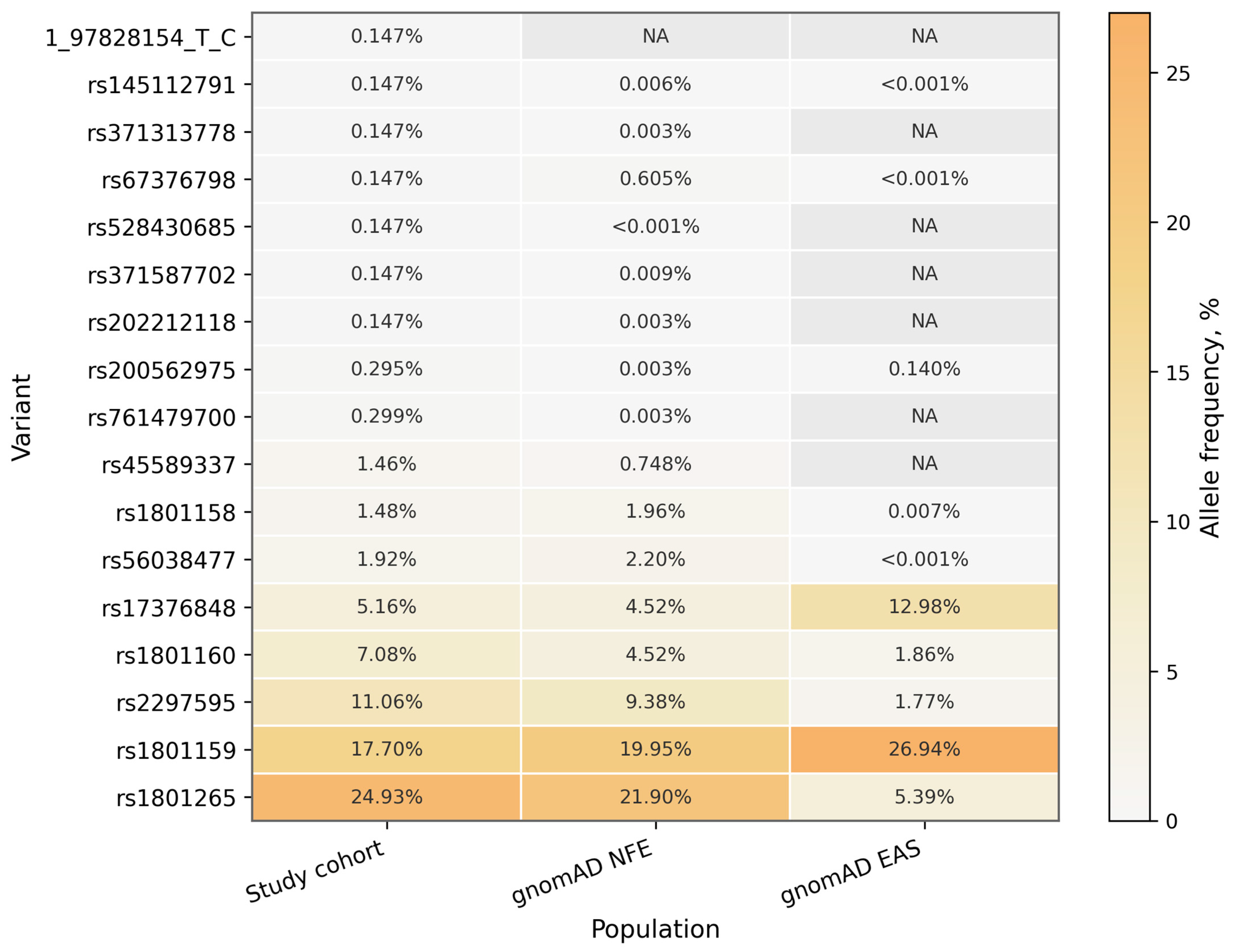

| Variant (rsID) | Nucleotide Substitution | Protein Change | Number of Genotyped Patients | Ref/Ref, n (%) | Ref/Alt, n (%) | Alt/Alt, n (%) | Alternative Allele Frequency, % | HWE Exact p-Value |
|---|---|---|---|---|---|---|---|---|
| No rsID assigned | c.193A>G | p.Thr65Ala | 339 | 338 (99.71) | 1 (0.29) | 0 | 0.147 | 1.000 |
| rs145112791 | c.934C>T | p.Leu312Phe | 339 | 338 (99.71) | 1 (0.29) | 0 | 0.147 | 1.000 |
| rs17376848 | c.1896T>C | p.Phe632= | 339 | 304 (89.68) | 35 (10.32) | 0 | 5.162 | 1.000 |
| rs1801158 | c.1601G>A | p.Ser534Asn | 339 | 329 (97.05) | 10 (2.95) | 0 | 1.475 | 1.000 |
| rs1801159 | c.1627A>G | p.Ile543Val | 339 | 234 (69.03) | 90 (26.55) | 15 (4.42) | 17.699 | 0.133 |
| rs1801160 | c.2194G>A | p.Val732Ile | 339 | 294 (86.73) | 42 (12.39) | 3 (0.88) | 7.080 | 0.226 |
| rs1801265 | c.85T>C | p.Cys29Arg | 339 | 194 (57.23) | 121 (35.69) | 24 (7.08) | 24.926 | 0.386 |
| rs200562975 | c.451A>G | p.Asn151Asp | 339 | 337 (99.41) | 2 (0.59) | 0 | 0.295 | 1.000 |
| rs202212118 | c.2071G>T | p.Val691Leu | 339 | 338 (99.71) | 1 (0.29) | 0 | 0.147 | 1.000 |
| rs2297595 | c.496A>G | p.Met166Val | 339 | 265 (78.17) | 73 (21.53) | 1 (0.29) | 11.062 | 0.099 |
| rs371313778 | c.2434G>A | p.Val812Ile | 339 | 338 (99.71) | 1 (0.29) | 0 | 0.147 | 1.000 |
| rs371587702 | c.194C>T | p.Thr65Met | 339 | 338 (99.71) | 1 (0.29) | 0 | 0.147 | 1.000 |
| rs45589337 | c.775A>G | p.Lys259Glu | 308 | 299 (97.08) | 9 (2.92) | 0 | 1.461 | 1.000 |
| rs528430685 | c.1228C>A | p.Arg410= | 339 | 338 (99.71) | 1 (0.29) | 0 | 0.147 | 1.000 |
| rs56038477 | c.1236G>A | p.Glu412= | 339 | 326 (96.17) | 13 (3.83) | 0 | 1.917 | 1.000 |
| rs67376798 | c.2846A>T | p.Asp949Val | 339 | 338 (99.71) | 1 (0.29) | 0 | 0.147 | 1.000 |
| rs761479700 | c.802C>G | p.Leu268Val | 335 | 333 (99.40) | 2 (0.60) | 0 | 0.299 | 1.000 |
| Allelic Variant | Protein Change | Number of Carriers | Mutant Allele Frequency, % | ClinVar Annotation in the Source Data | CADD | Interpretation |
|---|---|---|---|---|---|---|
| No rsID assigned | p.Thr65Ala | 1 | 0.147 | Not available | 26.9 | Rare variant with a potential functional effect |
| rs145112791 | p.Leu312Phe | 1 | 0.147 | Not available | 24.7 | Rare variant with limited clinical evidence |
| rs200562975 | p.Asn151Asp | 2 | 0.295 | Conflicting classifications | 27.2 | Variant of uncertain clinical significance |
| rs202212118 | p.Val691Leu | 1 | 0.147 | Uncertain significance | 26.6 | Variant of uncertain clinical significance. |
| rs371313778 | p.Val812Ile | 1 | 0.147 | Not available | 23.3 | Rare variant with limited functional evidence |
| rs371587702 | p.Thr65Met | 1 | 0.147 | Uncertain significance | 32.0 | Variant with a high predicted potential for a deleterious effect |
| rs45589337 | p.Lys259Glu | 9 | 1.461 | Conflicting classifications | 21.5 | Potential research marker |
| rs761479700 | p.Leu268Val | 2 | 0.299 | No definitive clinical classification is available | 19.7 | Rare variant of uncertain significance |
Disclaimer/Publisher’s Note: The statements, opinions and data contained in all publications are solely those of the individual author(s) and contributor(s) and not of MDPI and/or the editor(s). MDPI and/or the editor(s) disclaim responsibility for any injury to people or property resulting from any ideas, methods, instructions or products referred to in the content. |
© 2026 by the authors. Licensee MDPI, Basel, Switzerland. This article is an open access article distributed under the terms and conditions of the Creative Commons Attribution (CC BY) license.
Share and Cite
Fedorinov, D.; Lyadov, V.; Lyadova, M.; Abdullaev, S.; Sychev, I.; Filatova, A.; Danilov, L.; Glotov, O.; Budagova, I.; Mirzaev, K.; et al. Allelic Variants of the DPYD Gene in Russian Patients with Cancer: The Results of Exome Sequencing. Genes 2026, 17, 1082. https://doi.org/10.3390/genes17091082
Fedorinov D, Lyadov V, Lyadova M, Abdullaev S, Sychev I, Filatova A, Danilov L, Glotov O, Budagova I, Mirzaev K, et al. Allelic Variants of the DPYD Gene in Russian Patients with Cancer: The Results of Exome Sequencing. Genes. 2026; 17(9):1082. https://doi.org/10.3390/genes17091082
Chicago/Turabian StyleFedorinov, Denis, Vladimir Lyadov, Marina Lyadova, Sherzod Abdullaev, Ivan Sychev, Anna Filatova, Lavrentii Danilov, Oleg Glotov, Iuliia Budagova, Karin Mirzaev, and et al. 2026. "Allelic Variants of the DPYD Gene in Russian Patients with Cancer: The Results of Exome Sequencing" Genes 17, no. 9: 1082. https://doi.org/10.3390/genes17091082
APA StyleFedorinov, D., Lyadov, V., Lyadova, M., Abdullaev, S., Sychev, I., Filatova, A., Danilov, L., Glotov, O., Budagova, I., Mirzaev, K., & Sychev, D. (2026). Allelic Variants of the DPYD Gene in Russian Patients with Cancer: The Results of Exome Sequencing. Genes, 17(9), 1082. https://doi.org/10.3390/genes17091082

