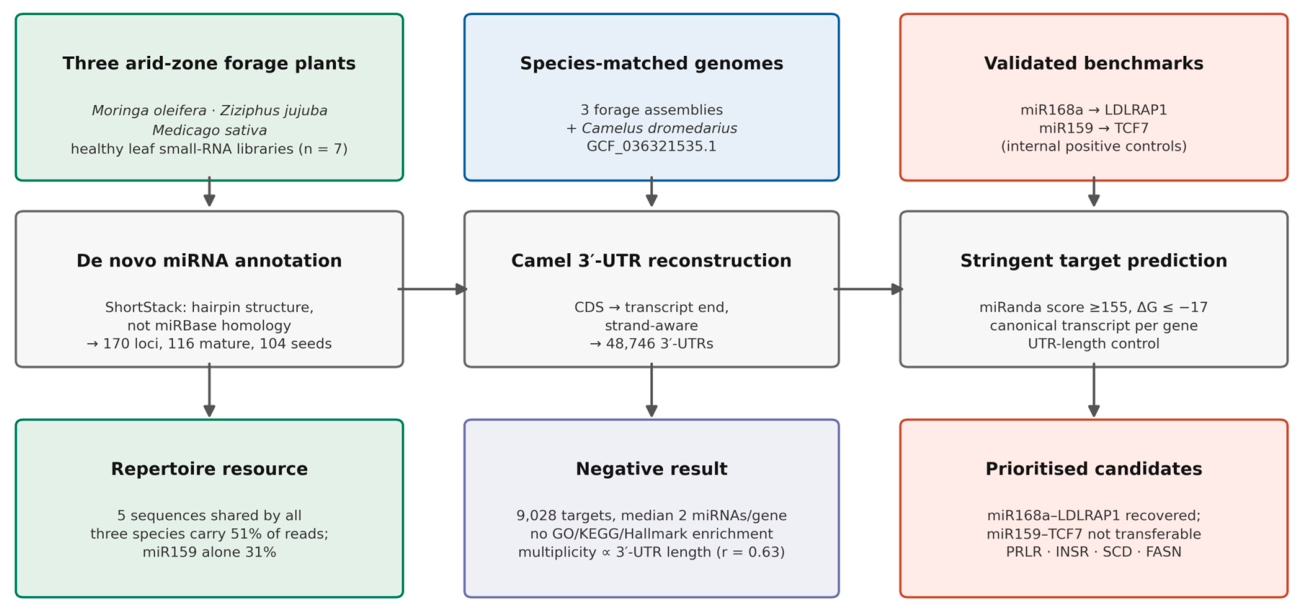
Five Conserved microRNAs Dominate the Small-RNA Pool of Three Arid-Zone Camel-Forage Plants: De Novo Repertoires and a Species-Matched Test of Cross-Kingdom Targeting in the Dromedary

 , ,
, ,  , ,
, ,  , , ,
, , ,  and
and
Abstract
1. Introduction
2. Materials and Methods
2.1. Forage-Plant Selection and Datasets

| Run | Species | Sample/Cultivar | Raw Reads | Passed Reads | Passed (%) | Peak (nt) | miRNA (%) |
|---|---|---|---|---|---|---|---|
| SRR7770291 | M. oleifera | leaf rep1 | 24,996,624 | 5,729,028 | 22.9 | 21 | 2.6 |
| SRR7770292 | M. oleifera | leaf rep2 | 22,743,760 | 4,135,123 | 18.2 | 21 | 2.2 |
| SRR7770293 | M. oleifera | leaf rep3 | 24,160,017 | 7,565,465 | 31.3 | 19 * | 10.3 |
| SRR4334534 | Z. jujuba | healthy WT leaf | 14,171,805 | 7,812,588 | 55.1 | 21 | 7.1 |
| SRR1201405 | M. sativa | leaf, cv. DS | 7,035,161 | 3,369,235 | 47.9 | 21 | 2.0 |
| SRR1201406 | M. sativa | leaf, cv. NM | 6,765,502 | 3,336,696 | 49.3 | 24 * | 2.9 |
| SRR1201407 | M. sativa | leaf, cv. NS | 7,145,001 | 2,402,795 | 33.6 | 24 * | 2.3 |

2.2. Read Processing and Quality Control
2.3. De Novo miRNA Identification
2.4. Seed-Level Sensitivity Control
2.5. Camel 3′-UTR Reconstruction
2.6. Cross-Kingdom Target Prediction
2.7. Abundance-Weighted Scoring
2.8. Functional Analysis, Controls, and Statistics
2.9. Robustness: Threshold Sensitivity and a Matched Null Model
3. Results
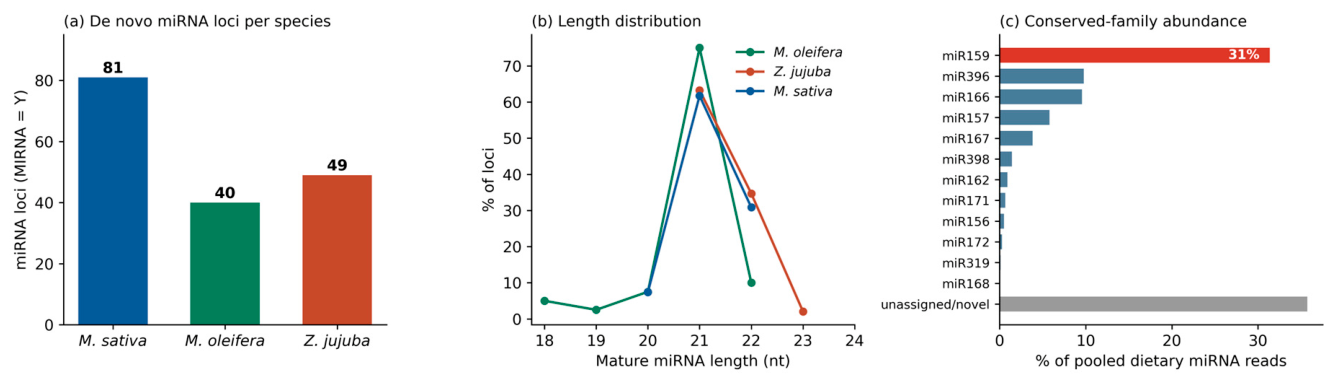
3.1. Five Sequences Carry Half of the Pooled Forage Read Set
3.2. Positive Controls: One Reported Interaction Recovered, One Not
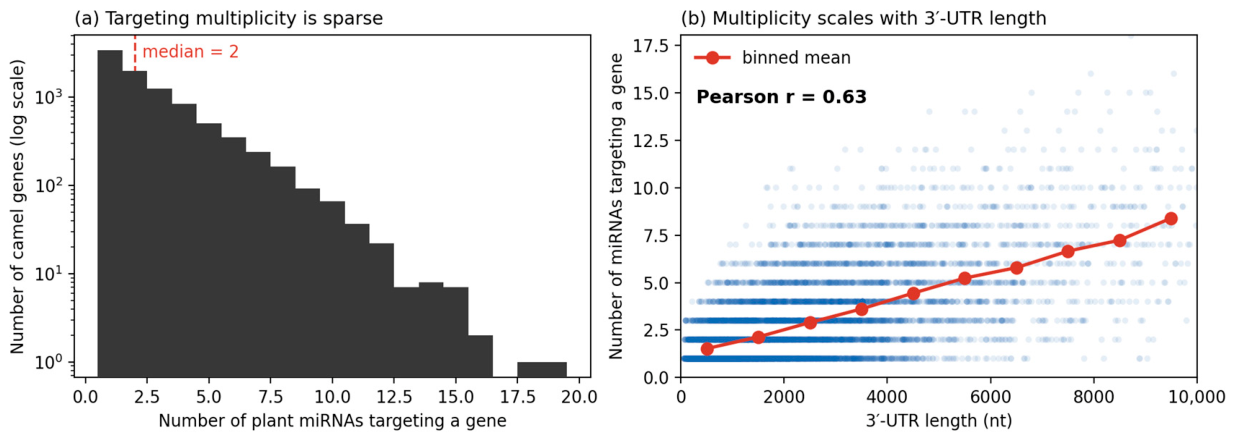
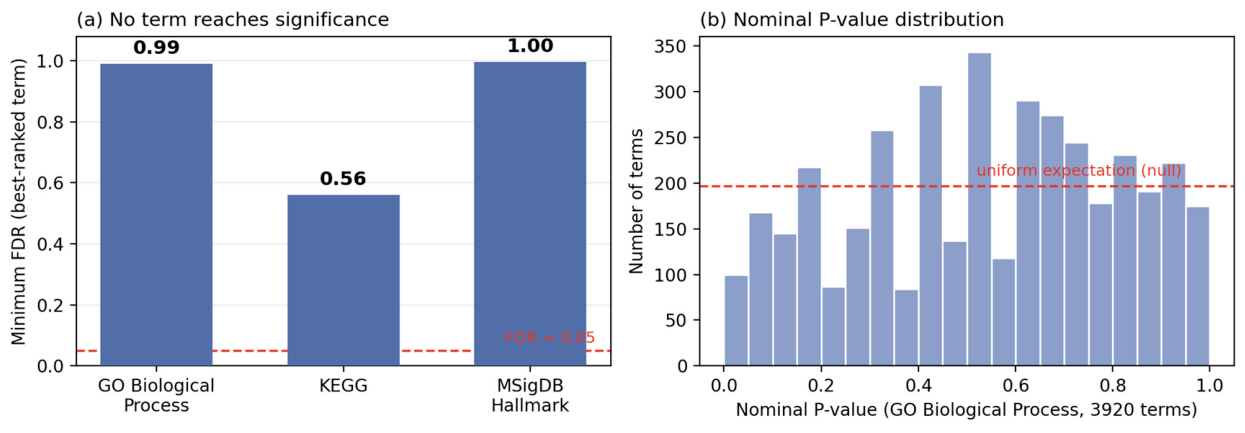
3.3. Sparse Targeting, No Detectable Enrichment, and a Length Relationship
3.4. A Prioritised Candidate List for Camel-Milk Biology
3.5. The Negative Picture Is Stable Across Thresholds and Matched to a Length Null
4. Discussion
4.1. A Concentrated Read Set Makes the Hypothesis Experimentally Tractable
4.2. Species-Matched Analysis Changes the Answer
4.3. Why the Negative Result Is Consistent Across the Tested Analyses
4.4. Candidates for Camel-Milk Biology and Applied Value
4.5. Does the Transfer Premise Hold? The State of the Evidence
4.6. Implications for Camel Milk, Human Health, and Dryland Livestock
4.7. Scope of the Present Inference
4.8. Future Directions
5. Conclusions
Supplementary Materials
Author Contributions
Funding
Institutional Review Board Statement
Informed Consent Statement
Data Availability Statement
Acknowledgments
Conflicts of Interest
References
- Faye, B. The camel today: Assets and potentials. Anthropozoologica 2014, 49, 167–176. [Google Scholar] [CrossRef] [Scilit]
- Konuspayeva, G.; Faye, B.; Loiseau, G. The composition of camel milk: A meta-analysis of the literature data. J. Food Compos. Anal. 2009, 22, 95–101. [Google Scholar] [CrossRef] [Scilit]
- Swelum, A.A.; El-Saadony, M.T.; Abdo, M.; Ombarak, R.A.; Hussein, E.O.; Suliman, G.; Alhimaidi, A.R.; Ammari, A.A.; Ba-Awadh, H.; Taha, A.E.; et al. Nutritional, antimicrobial and medicinal properties of camel’s milk: A review. Saudi J. Biol. Sci. 2021, 28, 3126–3136. [Google Scholar] [CrossRef] [Scilit] [PubMed]
- Wu, H.; Guang, X.; Al-Fageeh, M.B.; Cao, J.; Pan, S.; Zhou, H.; Zhang, L.; AbuTarboush, M.H.; Xing, Y.; Xie, Z.; et al. Camelid genomes reveal evolution and adaptation to desert environments. Nat. Commun. 2014, 5, 5188. [Google Scholar] [CrossRef] [Scilit] [PubMed]
- Hamid, M.M.A.; Tharwat, M.; Ebeid, T.A.; Alshanbari, F.A. Nutritional disorders and metabolic adaptations in dromedary camels: Insights into foregut fermentation and mineral balance. Animals 2026, 16, 689. [Google Scholar] [CrossRef] [Scilit] [PubMed]
- Nagy, P.; Juhász, J. Review of present knowledge on machine milking and intensive milk production in dromedary camels and future challenges. Trop. Anim. Health Prod. 2016, 48, 915–926. [Google Scholar] [CrossRef] [Scilit] [PubMed]
- Chimsa, M.B.; Mummed, Y.; Kurtu, M.; Leta, M.U.; Hassen, A.; Gemeda, B.S. Forage preference of camel calves (Camelus dromedarius) in eastern Ethiopia. J. Anim. Plant Sci. 2013, 23, 1236–1241. [Google Scholar]
- Dereje, M.; Udén, P. The browsing dromedary camel: I. Behaviour, plant preference and quality of forage selected. Anim. Feed Sci. Technol. 2005, 121, 297–308. [Google Scholar]
- Lakhdari, K.; Belhamra, M.; Mayouf, R. Forage species preferred by dromedaries and their chemical composition in arid rangelands of Algeria. Livest. Res. Rural Dev. 2015, 27, 205. [Google Scholar]
- Iqbal, A.; Khan, B.B. Feeding behaviour of camel: A review. Pak. J. Agric. Sci. 2001, 38, 3–4. [Google Scholar]
- Amad, A.A.; Zentek, J. The use of Moringa oleifera in ruminant feeding and its contribution to climate change mitigation. Front. Anim. Sci. 2023, 4, 1137562. [Google Scholar] [CrossRef] [Scilit]
- Bartel, D.P. MicroRNAs: Target recognition and regulatory functions. Cell 2009, 136, 215–233. [Google Scholar] [CrossRef] [Scilit] [PubMed]
- Jones-Rhoades, M.W.; Bartel, D.P.; Bartel, B. MicroRNAs and their regulatory roles in plants. Annu. Rev. Plant Biol. 2006, 57, 19–53. [Google Scholar] [CrossRef] [Scilit] [PubMed]
- Yu, B.; Yang, Z.; Li, J.; Minakhina, S.; Yang, M.; Padgett, R.W.; Stewalrd, R.; Chen, X. Methylation as a crucial step in plant microRNA biogenesis. Science 2005, 307, 932–935. [Google Scholar] [CrossRef] [Scilit] [PubMed]
- Axtell, M.J.; Meyers, B.C. Revisiting criteria for plant microRNA annotation in the era of big data. Plant Cell 2018, 30, 272–284. [Google Scholar] [CrossRef] [Scilit] [PubMed]
- Li, Z.; Yang, J.; Cai, X.; Zeng, X.; Zou, J.-J.; Xing, W. A systematic review on the role of miRNAs in plant response to stresses under the changing climatic conditions. Plant Stress 2024, 14, 100674. [Google Scholar] [CrossRef] [Scilit]
- Zhang, L.; Hou, D.; Chen, X.; Li, D.; Zhu, L.; Zhang, Y.; Li, J.; Bian, Z.; Liang, X.; Cai, X.; et al. Exogenous plant MIR168a specifically targets mammalian LDLRAP1: Evidence of cross-kingdom regulation by microRNA. Cell Res. 2012, 22, 107–126. [Google Scholar] [CrossRef] [Scilit] [PubMed]
- Zhou, Z.; Li, X.; Liu, J.; Dong, L.; Chen, Q.; Liu, J.; Kong, H.; Zhang, Q.; Qi, X.; Hou, D.; et al. Honeysuckle-encoded atypical microRNA2911 directly targets influenza A viruses. Cell Res. 2015, 25, 39–49. [Google Scholar] [CrossRef] [Scilit] [PubMed]
- Chin, A.R.; Fong, M.Y.; Somlo, G.; Wu, J.; Swiderski, P.; Wu, X.; Wang, S.E. Cross-kingdom inhibition of breast cancer growth by plant miR159. Cell Res. 2016, 26, 217–228. [Google Scholar] [CrossRef] [Scilit] [PubMed]
- Chen, X.; Rechavi, O. Plant and animal small RNA communications between cells and organisms. Nat. Rev. Mol. Cell Biol. 2022, 23, 185–203. [Google Scholar] [CrossRef] [Scilit] [PubMed]
- Zhang, L.; Chen, T.; Yin, Y.; Zhang, C.Y.; Zhang, Y.L. Dietary microRNA–-A novel functional component of food. Adv. Nutr. 2019, 10, 711–721. [Google Scholar] [CrossRef] [Scilit] [PubMed]
- Zhao, Y.; Cong, L.; Lukiw, W.J. Plant and animal microRNAs (miRNAs) and their potential for inter-kingdom communication. Cell. Mol. Neurobiol. 2018, 38, 133–140. [Google Scholar] [CrossRef] [Scilit] [PubMed]
- Lukasik, A.; Zielenkiewicz, P. In silico identification of plant miRNAs in mammalian breast milk exosomes—A small step forward? PLoS ONE 2014, 9, e99963. [Google Scholar] [CrossRef] [Scilit] [PubMed]
- Izumi, H.; Tsuda, M.; Sato, Y.; Kosaka, N.; Ochiya, T.; Iwamoto, H.; Namba, K.; Takeda, Y. Bovine milk exosomes contain microRNA and mRNA and are taken up by human macrophages. J. Dairy Sci. 2015, 98, 2920–2933. [Google Scholar] [CrossRef] [Scilit] [PubMed]
- Alsaweed, M.; Lai, C.T.; Hartmann, P.E.; Geddes, D.T.; Kakulas, F. Human milk miRNAs primarily originate from the mammary gland resulting in unique miRNA profiles of fractionated milk. Sci. Rep. 2016, 6, 20680. [Google Scholar] [CrossRef] [Scilit] [PubMed]
- Zempleni, J.; Aguilar-Lozano, A.; Sadri, M.; Sukreet, S.; Manca, S.; Wu, D.; Zhou, F.; Mutai, E. Biological activities of extracellular vesicles and their cargos from bovine and human milk in humans and implications for infants. J. Nutr. 2017, 147, 3–10. [Google Scholar] [CrossRef] [Scilit] [PubMed]
- Rani, P.; Vashisht, M.; Golla, N.; Shandilya, S.; Onteru, S.K.; Singh, D. Milk miRNAs encapsulated in exosomes are stable to human digestion and permeable to the intestinal barrier in vitro. J. Funct. Foods 2017, 34, 431–439. [Google Scholar] [CrossRef] [Scilit]
- Papakonstantinou, E.; Dragoumani, K.; Mitsis, T.; Chrousos, G.P.; Vlachakis, D. Milk exosomes and a new way of communication between mother and child. EMBnet J. 2024, 29, e1050. [Google Scholar] [CrossRef] [Scilit] [PubMed]
- Carrillo-Lozano, E.; Sebastián-Vallés, F.; Knott-Torcal, C. Circulating microRNAs in breast milk and their potential impact on the infant. Nutrients 2020, 12, 3066. [Google Scholar] [CrossRef] [Scilit] [PubMed]
- Yang, J.; Farmer, L.M.; Agyekum, A.A.; Hirschi, K.D. Detection of dietary plant-based small RNAs in animals. Cell Res. 2015, 25, 517–520. [Google Scholar] [CrossRef] [Scilit] [PubMed]
- Dickinson, B.; Zhang, Y.; Petrick, J.S.; Heck, G.; Ivashuta, S.; Marshall, W.S. Lack of detectable oral bioavailability of plant microRNAs after feeding in mice. Nat. Biotechnol. 2013, 31, 965–967. [Google Scholar] [CrossRef] [Scilit] [PubMed]
- Snow, J.W.; Hale, A.E.; Isaacs, S.K.; Baggish, A.L.; Chan, S.Y. Ineffective delivery of diet-derived microRNAs to recipient animal organisms. RNA Biol. 2013, 10, 1107–1116. [Google Scholar] [CrossRef] [Scilit] [PubMed]
- Witwer, K.W. Alternative miRNAs? Human sequences misidentified as plant miRNAs in plant studies and in human plasma. F1000Research 2018, 7, 244. [Google Scholar] [CrossRef] [Scilit] [PubMed]
- Title, A.C.; Denzler, R.; Stoffel, M. Uptake and function studies of maternal milk-derived microRNAs. J. Biol. Chem. 2015, 290, 23680–23691. [Google Scholar] [CrossRef] [Scilit] [PubMed]
- Enright, A.J.; John, B.; Gaul, U.; Tuschl, T.; Sander, C.; Marks, D.S. MicroRNA targets in Drosophila. Genome Biol. 2003, 5, R1. [Google Scholar] [CrossRef] [Scilit] [PubMed]
- Betel, D.; Koppal, A.; Agius, P.; Sander, C.; Leslie, C. Comprehensive modeling of microRNA targets predicts functional non-conserved and non-canonical sites. Genome Biol. 2010, 11, R90. [Google Scholar] [CrossRef] [Scilit] [PubMed]
- Agarwal, V.; Bell, G.W.; Nam, J.-W.; Bartel, D.P. Predicting effective microRNA target sites in mammalian mRNAs. eLife 2015, 4, e05005. [Google Scholar] [CrossRef] [Scilit] [PubMed]
- Axtell, M.J. ShortStack: Comprehensive annotation and quantification of small RNA genes. RNA 2013, 19, 740–751. [Google Scholar] [CrossRef] [Scilit] [PubMed]
- Johnson, N.R.; Yeoh, J.M.; Coruh, C.; Axtell, M.J. Improved placement of multi-mapping small RNAs. G3 Genes Genomes Genet. 2016, 6, 2103–2111. [Google Scholar] [CrossRef] [Scilit] [PubMed]
- Pirrò, S.; Matic, I.; Guidi, A.; Zanella, L.; Gismondi, A.; Cicconi, R.; Bernardini, R.; Colizzi, V.; Canini, A.; Mattei, M.; et al. Identification of microRNAs and relative target genes in Moringa oleifera leaf and callus. Sci. Rep. 2019, 9, 15145. [Google Scholar] [CrossRef] [Scilit] [PubMed]
- Shao, F.; Zhang, Q.; Liu, H.; Lu, S.; Qiu, D. Genome-wide identification and analysis of microRNAs involved in witches’-broom phytoplasma response in Ziziphus jujuba. PLoS ONE 2016, 11, e0166099. [Google Scholar] [CrossRef] [Scilit] [PubMed]
- Martin, M. Cutadapt removes adapter sequences from high-throughput sequencing reads. EMBnet J. 2011, 17, 10–12. [Google Scholar] [CrossRef] [Scilit]
- Langmead, B.; Trapnell, C.; Pop, M.; Salzberg, S.L. Ultrafast and memory-efficient alignment of short DNA sequences to the human genome. Genome Biol. 2009, 10, R25. [Google Scholar] [CrossRef] [Scilit] [PubMed]
- Liu, M.-J.; Zhao, J.; Cai, Q.-L.; Liu, G.-C.; Wang, J.-R.; Zhao, Z.-H.; Liu, P.; Dai, L.; Yan, G.; Wang, W.-J.; et al. The complex jujube genome provides insights into fruit tree biology. Nat. Commun. 2014, 5, 5315. [Google Scholar] [CrossRef] [Scilit] [PubMed]
- Lorenz, R.; Bernhart, S.H.; Höner zu Siederdissen, C.; Tafer, H.; Flamm, C.; Stadler, P.F.; Hofacker, I.L. ViennaRNA Package 2.0. Algorithms Mol. Biol. 2011, 6, 26. [Google Scholar] [CrossRef] [Scilit] [PubMed]
- Kozomara, A.; Birgaoanu, M.; Griffiths-Jones, S. miRBase: From microRNA sequences to function. Nucleic Acids Res. 2019, 47, D155–D162. [Google Scholar] [CrossRef] [Scilit] [PubMed]
- Fitak, R.R.; Mohandesan, E.; Corander, J.; Burger, P.A. The de novo genome assembly and annotation of a female domestic dromedary of North African origin. Mol. Ecol. Resour. 2016, 16, 314–324. [Google Scholar] [CrossRef] [Scilit] [PubMed]
- Pertea, G.; Pertea, M. GFF Utilities: GffRead and GffCompare. F1000Research 2020, 9, 304. [Google Scholar] [CrossRef] [Scilit]
- Quinlan, A.R.; Hall, I.M. BEDTools: A flexible suite of utilities for comparing genomic features. Bioinformatics 2010, 26, 841–842. [Google Scholar] [CrossRef] [Scilit] [PubMed]
- Danecek, P.; Bonfield, J.K.; Liddle, J.; Marshall, J.; Ohan, V.; Pollard, M.O.; Whitwham, A.; Keane, T.; McCarthy, S.A.; Davies, R.M.; et al. Twelve years of SAMtools and BCFtools. GigaScience 2021, 10, giab008. [Google Scholar] [CrossRef] [Scilit] [PubMed]
- Mayr, C. Regulation by 3′-untranslated regions. Annu. Rev. Genet. 2017, 51, 171–194. [Google Scholar] [CrossRef] [Scilit] [PubMed]
- Ashburner, M.; Ball, C.A.; Blake, J.A.; Botstein, D.; Butler, H.; Cherry, J.M.; Davis, A.P.; Dolinski, K.; Dwight, S.S.; Eppig, J.T.; et al. Gene Ontology: Tool for the unification of biology. Nat. Genet. 2000, 25, 25–29. [Google Scholar] [CrossRef] [Scilit] [PubMed]
- Kanehisa, M.; Goto, S. KEGG: Kyoto Encyclopedia of Genes and Genomes. Nucleic Acids Res. 2000, 28, 27–30. [Google Scholar] [CrossRef] [Scilit] [PubMed]
- Liberzon, A.; Birger, C.; Thorvaldsdóttir, H.; Ghandi, M.; Mesirov, J.P.; Tamayo, P. The Molecular Signatures Database (MSigDB) Hallmark gene set collection. Cell Syst. 2015, 1, 417–425. [Google Scholar] [CrossRef] [Scilit] [PubMed]
- Kuleshov, M.V.; Jones, M.R.; Rouillard, A.D.; Fernandez, N.F.; Duan, Q.; Wang, Z.; Koplev, S.; Jenkins, S.L.; Jagodnik, K.M.; Lachmann, A.; et al. Enrichr: A comprehensive gene set enrichment analysis web server 2016 update. Nucleic Acids Res. 2016, 44, W90–W97. [Google Scholar] [CrossRef] [Scilit] [PubMed]
- Fang, Z.; Liu, X.; Peltz, G. GSEApy: A comprehensive package for performing gene set enrichment analysis in Python. Bioinformatics 2023, 39, btac757. [Google Scholar] [CrossRef] [Scilit] [PubMed]
- Benjamini, Y.; Hochberg, Y. Controlling the false discovery rate: A practical and powerful approach to multiple testing. J. R. Stat. Soc. Ser. B Methodol. 1995, 57, 289–300. [Google Scholar] [CrossRef] [Scilit]
- Bionaz, M.; Loor, J.J. Gene networks driving bovine milk fat synthesis during the lactation cycle. BMC Genom. 2008, 9, 366. [Google Scholar] [CrossRef] [Scilit] [PubMed]
- Peterson, S.M.; Thompson, J.A.; Ufkin, M.L.; Sathyanarayana, P.; Liaw, L.; Congdon, C.B. Common features of microRNA target prediction tools. Front. Genet. 2014, 5, 23. [Google Scholar] [CrossRef] [Scilit] [PubMed]
- Sandberg, R.; Neilson, J.R.; Sarma, A.; Sharp, P.A.; Burge, C.B. Proliferating cells express mRNAs with shortened 3′ untranslated regions and fewer microRNA target sites. Science 2008, 320, 1643–1647. [Google Scholar] [CrossRef] [Scilit] [PubMed]
- Tosar, J.P.; Rovira, C.; Naya, H.; Cayota, A. Mining of public sequencing databases supports a non-dietary origin for putative foreign miRNAs: Underestimated effects of contamination in NGS. RNA 2014, 20, 754–757. [Google Scholar] [CrossRef] [Scilit] [PubMed]
- Witwer, K.W.; McAlexander, M.A.; Queen, S.E.; Adams, R.J. Real-time quantitative PCR and droplet digital PCR for plant miRNAs in mammalian blood provide little evidence for general uptake of dietary miRNAs. RNA Biol. 2013, 10, 1080–1086. [Google Scholar] [CrossRef] [Scilit] [PubMed]
- Kang, W.; Bang-Berthelsen, C.H.; Holm, A.; Houben, A.J.; Müller, A.H.; Thymann, T.; Pociot, F.; Estivill, X.; Friedländer, M.R. Survey of 800+ data sets from human tissue and body fluid reveals xenomiRs are likely artifacts. RNA 2017, 23, 433–445. [Google Scholar] [CrossRef] [Scilit] [PubMed]
- Zhang, Y.; Wiggins, B.E.; Lawrence, C.; Petrick, J.; Ivashuta, S.; Heck, G. Analysis of plant-derived miRNAs in animal small RNA datasets. BMC Genom. 2012, 13, 381. [Google Scholar] [CrossRef] [Scilit] [PubMed]
- Witwer, K.W.; Hirschi, K.D. Transfer and functional consequences of dietary microRNAs in vertebrates: Concepts in search of corroboration. BioEssays 2014, 36, 394–406. [Google Scholar] [CrossRef] [Scilit] [PubMed]
- Yang, J.; Hirschi, K.D.; Farmer, L.M. Dietary RNAs: New stories regarding oral delivery. Nutrients 2015, 7, 3184–3199. [Google Scholar] [CrossRef] [Scilit] [PubMed]
- Askenase, P.W. Exosome carrier effects; resistance to digestion in phagolysosomes may assist transfers to targeted cells; II transfers of miRNAs are better analyzed via systems approach as they do not fit conventional reductionist stoichiometric concepts. Int. J. Mol. Sci. 2022, 23, 6192. [Google Scholar] [CrossRef] [Scilit] [PubMed]
- Yassin, A.M.; Abdel Hamid, M.I.; Farid, O.A.; Amer, H.; Warda, M. Dromedary milk exosomes as mammary transcriptome nano-vehicle: Their isolation, vesicular and phospholipidomic characterizations. J. Adv. Res. 2016, 7, 749–756. [Google Scholar] [CrossRef] [Scilit]
- Shaban, A.M.; Raslan, M.; Sharawi, Z.W.; Abdelhameed, M.S.; Hammouda, O.; El-Masry, H.M.; Elsayed, K.N.M.; El-Magd, M.A. Antibacterial, antifungal, and anticancer effects of camel milk exosomes: An in vitro study. Vet. Sci. 2023, 10, 124. [Google Scholar] [CrossRef] [Scilit] [PubMed]
- El-Kattawy, A.M.; Algezawy, O.; Alfaifi, M.Y.; Noseer, E.A.; Hawsawi, Y.M.; Alzahrani, O.R.; Algarni, A.; Kahilo, K.A.; El-Magd, M.A. Therapeutic potential of camel milk exosomes against HepaRG cells with potent apoptotic, anti-inflammatory and anti-angiogenesis effects for colostrum exosomes. Biomed. Pharmacother. 2021, 143, 112220. [Google Scholar] [CrossRef] [Scilit] [PubMed]
- Ibrahim, H.M.; Mohammed-Geba, K.; Tawfic, A.A.; El-Magd, M.A. Camel milk exosomes modulate cyclophosphamide-induced oxidative stress and immuno-toxicity in rats. Food Funct. 2019, 10, 7523–7532. [Google Scholar] [CrossRef] [Scilit] [PubMed]
- Pieters, B.C.; Arntz, O.J.; Bennink, M.B.; Broeren, M.G.A.; van Caam, A.P.M.; Koenders, M.I.; van Lent, P.L.E.M.; Berg, W.B.v.D.; de Vries, M.; van der Kraan, P.M.; et al. Commercial cow milk contains physically stable extracellular vesicles expressing immunoregulatory TGF-β. PLoS ONE 2015, 10, e0121123. [Google Scholar] [CrossRef] [Scilit] [PubMed]
- Tong, L.; Hao, H.; Zhang, X.; Zhang, Z.; Lv, Y.; Zhang, L.; Yi, H. Oral administration of bovine milk-derived extracellular vesicles alters the gut microbiota and enhances intestinal immunity in mice. Mol. Nutr. Food Res. 2020, 64, 1901251. [Google Scholar] [CrossRef] [Scilit] [PubMed]
- Zhou, F.; Paz, H.A.; Sadri, M.; Cui, J.; Kachman, S.D.; Fernando, S.C.; Zempleni, J. Dietary bovine milk exosomes elicit changes in bacterial communities in C57BL/6 mice. Am. J. Physiol. Gastrointest. Liver Physiol. 2019, 317, G618–G624. [Google Scholar] [CrossRef] [Scilit] [PubMed]
- Minutolo, A.; Potestà, M.; Roglia, V.; Cirilli, M.; Iacovelli, F.; Cerva, C.; Fokam, J.; Desideri, A.; Andreoni, M.; Grelli, S.; et al. Plant microRNAs from Moringa oleifera regulate immune response and HIV infection. Front. Pharmacol. 2021, 11, 620038. [Google Scholar] [CrossRef] [Scilit] [PubMed]
- Potestà, M.; Roglia, V.; Fanelli, M.; Pietrobono, E.; Gismondi, A.; Vumbaca, S.; Tsangueu, R.G.N.; Canini, A.; Colizzi, V.; Grelli, S.; et al. Effect of microvesicles from Moringa oleifera containing miRNA on proliferation and apoptosis in tumour cell lines. Cell Death Discov. 2020, 6, 43. [Google Scholar] [CrossRef] [Scilit] [PubMed]
- Roglia, V.; Potestà, M.; Minchella, A.; Bruno, S.P.; Bernardini, R.; Lettieri-Barbato, D.; Iacovelli, F.; Gismondi, A.; Aquilano, K.; Canini, A.; et al. Exogenous miRNAs from Moringa oleifera Lam. recover a dysregulated lipid metabolism. Front. Mol. Biosci. 2022, 9, 1012359. [Google Scholar] [CrossRef] [Scilit] [PubMed]
- Zoziuk, M.; Colizzi, V.; Krysenko, P.; Mattei, M.; Bernardini, R.; Zanzotto, F.M.; Marini, S.; Koroliouk, D. Plant miRNAs for improved gene regulation in a wide range of human cancers. Curr. Issues Mol. Biol. 2025, 47, 42. [Google Scholar] [CrossRef] [Scilit] [PubMed]


| Family | Representative Mature Sequence (5′→3′) | Length | Abundance | Variants | Species |
|---|---|---|---|---|---|
| miR159 | TTTGGATTGAAGGGAGCTCTA | 21 nt | 31.4% | 1 | all three |
| miR166 | TCGGACCAGGCTTCATTCCCC | 21 nt | 10.9% | 3 | all three |
| miR396 | TTCCACAGCTTTCTTGAACTT | 21 nt | 9.8% | 2 | all three |
| miR157 | TTGACAGAAGATAGAGAGCAC | 21 nt | 5.8% | 1 | M. oleifera |
| miR167 | TGAAGCTGCCAGCATGATCTG | 21 nt | 3.8% | 3 | all three |
| miR398 | TGTGTTCTCAGGTCGCCCCTG | 21 nt | 1.4% | 2 | M. sativa, Z. jujuba |
| miR162 | TCGATAAACCTCTGCATCCAG | 21 nt | 0.9% | 1 | M. sativa, Z. jujuba |
| unassigned | GGTGGACTGCTCGAGCTGCT | 20 nt | 15.5% | 1 | M. oleifera |
| Reported Mammalian Pair | Cognate miRNA in Forage | Camel Gene Targeted (Any miRNA) | Cognate Pair Recovered | Interpretation |
|---|---|---|---|---|
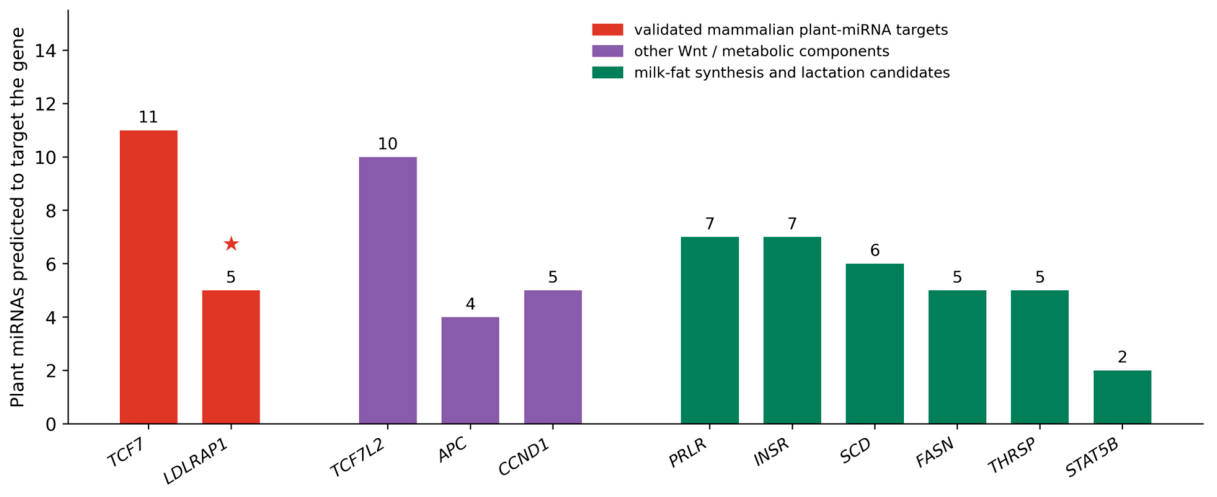
| miR168a → LDLRAP1 [17] | yes (exact match, M. sativa) | yes, 5 miRNAs | Yes | a near-complementary site is recovered at sequence level |
| miR159 → TCF7 [19] | yes (most abundant, all species) | yes, 14 miRNAs | No | consistent with 3′-UTR sequence divergence between species |
| Gene | Role in Lactation or Milk-Fat Synthesis | miRNAs | 3′-UTR (nt) |
|---|---|---|---|
| PRLR | prolactin receptor; principal lactogenic signal | 7 | 7085 |
| INSR | insulin receptor; metabolic control of lipogenesis | 7 | 4623 |
| SCD | stearoyl-CoA desaturase; unsaturated milk fatty acids | 6 | 3767 |
| FASN | fatty-acid synthase; de novo fatty-acid synthesis | 5 | 518 |
| THRSP | Spot14; lipogenic transcriptional regulator | 5 | 3947 |
| GPAM | glycerol-3-phosphate acyltransferase; triacylglycerol synthesis | 2 | 3655 |
| STAT5B | prolactin signal transducer; lactogenesis | 2 | 2444 |
| ACACA | acetyl-CoA carboxylase α; rate-limiting lipogenic step | 1 | 2114 |
| LPL | lipoprotein lipase; fatty-acid uptake from circulation | 1 | 1546 |
| XDH | xanthine dehydrogenase; MFG secretion | 1 | 554 |
| BTN1A1 | butyrophilin; MFG membrane | 1 | 1193 |
| ACACB | acetyl-CoA carboxylase β | 1 | 189 |
Disclaimer/Publisher’s Note: The statements, opinions and data contained in all publications are solely those of the individual author(s) and contributor(s) and not of MDPI and/or the editor(s). MDPI and/or the editor(s) disclaim responsibility for any injury to people or property resulting from any ideas, methods, instructions or products referred to in the content. |
© 2026 by the authors. Licensee MDPI, Basel, Switzerland. This article is an open access article distributed under the terms and conditions of the Creative Commons Attribution (CC BY) license.
Share and Cite
Zoziuk, M.; Ali, A.; Djibagao, A.D.; Montesano, C.; Potestà, M.; Minchella, A.; Terrinoni, A.; Caroleo, M.C.; Cappelli, G.; Koroliouk, D.; et al. Five Conserved microRNAs Dominate the Small-RNA Pool of Three Arid-Zone Camel-Forage Plants: De Novo Repertoires and a Species-Matched Test of Cross-Kingdom Targeting in the Dromedary. Genes 2026, 17, 1022. https://doi.org/10.3390/genes17091022
Zoziuk M, Ali A, Djibagao AD, Montesano C, Potestà M, Minchella A, Terrinoni A, Caroleo MC, Cappelli G, Koroliouk D, et al. Five Conserved microRNAs Dominate the Small-RNA Pool of Three Arid-Zone Camel-Forage Plants: De Novo Repertoires and a Species-Matched Test of Cross-Kingdom Targeting in the Dromedary. Genes. 2026; 17(9):1022. https://doi.org/10.3390/genes17091022
Chicago/Turabian StyleZoziuk, Maksym, Abdirahman Ali, Abel Dafogo Djibagao, Carla Montesano, Marina Potestà, Alessandra Minchella, Alessandro Terrinoni, Maria Cristina Caroleo, Giulia Cappelli, Dimitri Koroliouk, and et al. 2026. "Five Conserved microRNAs Dominate the Small-RNA Pool of Three Arid-Zone Camel-Forage Plants: De Novo Repertoires and a Species-Matched Test of Cross-Kingdom Targeting in the Dromedary" Genes 17, no. 9: 1022. https://doi.org/10.3390/genes17091022
APA StyleZoziuk, M., Ali, A., Djibagao, A. D., Montesano, C., Potestà, M., Minchella, A., Terrinoni, A., Caroleo, M. C., Cappelli, G., Koroliouk, D., Jimale, M. A., Ciani, E., & Colizzi, V. (2026). Five Conserved microRNAs Dominate the Small-RNA Pool of Three Arid-Zone Camel-Forage Plants: De Novo Repertoires and a Species-Matched Test of Cross-Kingdom Targeting in the Dromedary. Genes, 17(9), 1022. https://doi.org/10.3390/genes17091022