Article

PfbHLH131 Mediates the Biosynthesis of Fragrance Compounds in Primula forbesii Franch


1
Chengdu Botanical Garden (Chengdu Park City Botanical Science Research Institute), Chengdu 610083, China
2
College of Landscape Architecture, Sichuan Agricultural University, Chengdu 611130, China
*
Authors to whom correspondence should be addressed.
These authors contributed equally to this work.
Genes 2026, 17(7), 785; https://doi.org/10.3390/genes17070785 (registering DOI)
Submission received: 10 June 2026 / Revised: 5 July 2026 / Accepted: 6 July 2026 / Published: 8 July 2026
(This article belongs to the Section Plant Genetics and Genomics)

Abstract

Objectives: This study aims to provide a theoretical basis for a deeper understanding of the transcriptional regulatory network underlying the formation of Primula forbesii floral scent, and also offers important genetic resources for the molecular improvement of floral scent traits in Primula species. Methods: Using the P. forbesii cultivar ‘Pink violet’ as experimental material, we cloned PfbHLH131 and analyzed its expression pattern. We also validated its function via virus-induced gene silencing (VIGS) and used gas chromatography–mass spectrometry (GC-MS) to analyze changes in floral aroma components in silenced plants. Additionally, we detected the expression levels of key structural genes involved in floral aroma biosynthesis in silenced plants via qRT-PCR to elucidate the regulatory role of PfbHLH131 in the biosynthesis of P. forbesii floral aroma. Results: The cloned PfbHLH131 open reading frame is 922 bp in length, encoding a total of 307 amino acids, and contains a bHLH_AtBPE_like domain characteristic of the bHLH gene family. Quantitative real-time PCR (qRT-PCR) revealed that PfbHLH131 is highly expressed in floral organs, peaking during full bloom. Subcellular localization studies indicated that it is localized to the nucleus. VIGS-mediated transient silencing of PfbHLH131 significantly reduced the release of terpenoid and phenylpropanoid floral odor compounds and suppressed the expression of multiple key structural genes in both synthetic pathways. Conclusions: PfbHLH131 is a positive regulator of scent biosynthesis in P. forbesii.

1. Introduction

Floral fragrance is a complex mixture of various low-molecular-weight volatile organic compounds released by plants [1]. As a key secondary metabolite, it not only significantly enhances the aesthetic and commercial value of ornamental plants but also plays a central role in ecological interactions. Specifically, specific floral scents can precisely attract pollinators, ensuring the success of sexual reproduction and helping plants cope with biotic and abiotic stresses [2,3,4]. At the same time, these aromatic compounds serve as important raw materials for the perfume, cosmetics, and food and pharmaceutical industries, harboring immense economic potential [5]. Despite the significant value of floral scents, research on them has been relatively scarce compared to studies on flower color, shape, and flowering time, due to their complex and variable nature. Currently, approximately 1700 plant floral volatile compounds have been identified, which are primarily classified into three major categories based on their synthetic precursors and metabolic pathways: terpenes, phenylpropanoids, and fatty acid derivatives [2]. Terpenoid compounds are the most diverse group, and their synthesis relies on two distinct yet interconnected pathways within the cell. In the cytoplasm, the mevalonate pathway, starting from acetyl–CoA, ultimately synthesizes sesquiterpene precursors such as farnesyl pyrophosphate [6]. In the plastids, the methyl erythritol phosphate pathway utilizes pyruvate and glyceraldehyde-3-phosphate to generate precursors for monoterpenes and diterpenes, such as geranyl pyrophosphate [7]. The isopentenyl pyrophosphate and its isomers produced by these two pathways are ultimately catalyzed by terpenesynthases to form structurally diverse terpenoid volatiles [8,9]. Phenylpropanoid compounds constitute the second largest class of floral aroma components, and their synthesis originates from phenylalanine derived from the shikimate pathway. This pathway begins with a deamination reaction catalyzed by phenylalanine deaminase, yielding trans-cinnamic acid as a key intermediate. Subsequently, through a series of modifications by methyltransferases, reductases, and acyltransferases, it is converted into aromatic volatile compounds such as benzaldehyde and phenethyl alcohol [10,11,12]. Fatty acid derivatives are primarily synthesized from C18 fatty acids such as linoleic acid and linolenic acid. These serve as substrates in the lipoxygenase pathway to generate hydroperoxides, which are then catalyzed by a cascade of enzymes—including lyases, dehydrogenases, and acyltransferases—to form small-molecule volatiles, including C6/C9 aldehydes, alcohols, and esters [13]. Currently, the synthetic pathways for floral compounds have been largely elucidated, but the transcriptional regulators upstream of structural genes remain to be further identified.
Transcription factors (TFs) are essentially protein molecules located within the cell nucleus. Their primary function is to specifically bind to cis-acting elements in the promoter regions of target genes, ultimately regulating the spatiotemporal expression of those genes. Currently, several transcription factors have been shown to be involved in the biosynthesis of floral compounds, including MYB [14], bHLH [15], WRKY [16], ERF/AP2 [17], and bZIP [18]. Among the numerous transcription factor families, the basic helix-loop-helix (bHLH) family has attracted significant attention due to its conserved domains and extensive functions in growth and development, stress responses, and secondary metabolism [19,20,21,22,23,24,25]. However, research on the biosynthesis of floral aroma compounds within this family remains relatively scarce, having been conducted only in a limited number of ornamental plants. For example, in Arabidopsis thaliana, it was found that AtMYC2 can directly bind to the promoters of the sesquiterpene synthase genes AtTPS21 and AtTPS11 and activate their expression, thereby inducing an increase in the release of sesquiterpenes [26]. To investigate the regulation of floral fragrance biosynthesis in Phalaenopsis bellina, researchers conducted comparative transcriptomic analyses of fragrant and non-fragrant P. bellina plants, identifying five highly expressed transcription factors: PbbHLH4, PbbHLH6, PbbZIP4, PbERF1, and PbNAC1. Through heterologous transient expression experiments, it was found that PbbHLH4 can induce the production of monoterpenes in scentless orchids, increasing monoterpene production by 950-fold [27]. In a study of Lilium ‘Siberia’, researchers functionally characterized the two genes LibHLH22 and LibHLH63 and performed transient overexpression and virus-induced gene silencing (VIGS) of these genes. They found that these two genes significantly promote the expression of LiDXR and LiTPS, thereby enhancing the release of floral fragrance [28]. Similarly, in a study of Dendrobium officinale, it was found that DobHLH4 is highly expressed in petals and can bind to the promoter to upregulate the expression of DoTPS10, thereby increasing linalool content and promoting the release of floral fragrance [29].
Primula is one of the world’s three most famous alpine flowers and derives its name from its early spring blooming. After years of introduction, domestication, and cultivation, a large number of Primula species are now available in the horticultural market. However, their ornamental traits are primarily focused on their vibrant and diverse flower colors, while fragrant characteristics are generally lacking. P. forbesii Franch. is a native plant of Sichuan and Yunnan provinces in China. Its intense fragrance makes it an ideal material for researching and improving the floral aroma of Primula species. In this study, we identified the candidate gene PfbHLH131, which is highly expressed specifically in floral organs, based on whole-genome and transcriptomic data. We analyzed the spatiotemporal expression patterns and subcellular localization of PfbHLH131 and validated its function using virus-induced gene silencing (VIGS) technology. The aim is to elucidate the regulatory role of PfbHLH131 in the synthesis of P. forbesii’s floral fragrance, thereby providing a basis for a deeper understanding of the transcriptional regulatory network underlying the formation of P. forbesii’s floral fragrance.

2. Materials and Methods

2.1. Plant Materials

P. forbesii ‘Pink violet’ was used as the experimental material. It was propagated by seed in the greenhouse of the College of Landscape Architecture at Sichuan Agricultural University (30°42′ N, 103°51′ E) using a growing medium of peat moss and perlite (mixed in a 2:1 ratio). The temperature was maintained at 18 ± 2 °C, with a relative humidity of 80%, and standard water and fertilizer management practices were followed. Flower buds, early-flowering, peak-flowering, and late-flowering stages were selected as floral organs representing different developmental phases, while roots, flower stalks, leaves, and flowers were used as organ samples. These were rapidly frozen in liquid nitrogen and stored at −80 °C for RNA extraction and spatiotemporal expression pattern analysis. Nicotiana benthamiana plants, used for subcellular localization studies, were grown in a greenhouse under environmental conditions of 25 ± 2 °C and a 12/12 h photoperiod; they were used for injection experiments four weeks after planting.

2.2. Cloning and Bioinformatics Analysis of PfbHLH131

Total RNA was extracted from P. forbesii flowers using the TIANGE Centrifugal Column Type S Polysaccharide and Polyphenol RNA Extraction Kit (Tiangen Biotech, Beijing, China). RNA concentration was measured using a Nanodrop 2000 ultra-micro spectrophotometer (Thermo Fisher Scientific, Waltham, MA, USA), and RNA samples with a concentration of 600 or higher, with an OD260/280 ratio between 1.8 and 2.1 and an OD260/230 ratio between 1.9 and 2.1. The extracted RNA was reverse-transcribed into cDNA using the Evo M-ML V Reverse Transcription Master Mix Kit (Accurate Biology, Changsha, China), followed by PCR amplification and cloning according to the following protocol: 94 °C for 3 min; 94 °C for 30 s; annealing at 60 °C for 30 s; 72 °C for 1 min, repeated 35 times; 72 °C for 10 min; cool to 4 °C. The PCR products were purified and ligated into the pTOPO-TA/Blunt cloning vector (Aidlab Biotech, Beijing, China); the primer sequences used are shown in Supplementary Table S1.
The conserved domains, physicochemical properties, transmembrane domains, signal peptide, phosphorylation sites, secondary structure characterization, and tertiary structure modeling of PfbHLH131 were determined using the CD-Search tool (NCBI, Bethesda, MD, USA), Expasy ProtParam tool (NCBI, Bethesda, MD, USA), TMHMM v.2.0 (DTU, Copenhagen, Denmark), SignalP 6.0 (DTU, Copenhagen, Denmark), NetPhos 3.1 Server (DTU, Copenhagen, Denmark), SOPMA (IBCP, CNRS, Lyon, France), and SWISS-MODEL (SIB, Geneva, Switzerland) from the NCBI database, respectively. The sequence of the PfbHLH131 homolog was downloaded from GenBank, and amino acid sequence alignment was performed using DNAMAN (Version 8.0). The sequences of the A. thaliana bHLH family proteins were downloaded from PlantTFDB 5.0, and a phylogenetic tree was constructed using MEGA (Version 11). See Table S2 for the corresponding accession numbers or web links.

2.3. Analysis of the Spatiotemporal Expression Pattern of PfbHLH131

qRT-PCR analysis was performed using PfEIF5A as an internal control [30]; the primer sequences used are shown in Supplementary Table S1. qRT-PCR assays were conducted using the SYBR Green Pro Taq HS qPCR Master Mix (ACCURATE, Changsha, China) on a real-time quantitative PCR instrument (CFX Connect Bio-Rad, Hercules, CA, USA). The reaction program was as follows: 94 °C for 30 s; 94 °C for 5 s, 60 °C for 30 s, for 45 cycles. The assay was performed in triplicate, and relative gene expression levels were calculated using the 2-ΔΔCt method [31]. In addition, floral organs and S1 samples were used as calibration samples.

2.4. Subcellular Localization Analysis of PfbHLH131

The PfbHLH131 gene was cloned into the KpnI/SalI sites of the pCAMBIA2300-GFP vector using a seamless cloning method, and the fusion plasmid was subsequently transformed into Agrobacterium strain GV3101. The primers used to construct the subcellular localization vector are listed in Supplementary Table S1. The Agrobacterium suspension was cultured overnight, resuspended in a solution containing 10 mmol/L MES, 10 mmol/L MgCl2, and 200 μmol/L AS to an OD600 of 1.0, and allowed to stand at room temperature for 1–2 h. It was then used to inoculate 4-week-old N. benthamiana plants. After inoculation, the plants were cultured in the dark for 24 h, followed by 1–2 days of light-dependent growth. Finally, GFP fluorescence signals were observed using a confocal microscope (Leica TCS SP8, Wetzlar, Germany).

2.5. VIGS-Mediated Transient Silencing of PfbHLH131

The target fragment of PfbHLH131 was inserted into the EcoRI/XhoI sites of the pTRV2 vector to construct the pTRV2-PfbHLH131 recombinant plasmid. Cultivate Agrobacterium suspensions containing pTRV1, pTRV2, and pTRV2-PfbHLH131 separately until OD600 = 1.0, then resuspend them in infection medium (10 mmol/L MES, 10 mmol/L MgCl2, and 200 μmol/L AS). Mix pTRV2-PfbHLH131: pTRV2 was mixed with pTRV1 in a 1:1 ratio. When the flower stalks of P. forbesii had emerged but the flowers had not yet opened, the mixed bacterial suspension was injected into the plants via the underside of the leaves using a syringe. After inoculation, the plants were kept in the dark for 24 h and then transferred to a controlled environmental chamber for normal cultivation. After 30–40 days, in plants injected with pTRV1 + pTRV2-PfPDS, PfPDS gene silencing caused characteristic bleaching of newly emerged leaves, confirming that the virus successfully infected this species and achieved systemic gene silencing, indicating that the silencing system is functioning effectively. PCR-positive identification was performed using TRV-specific primers (Supplementary Table S1). Petals were collected from positive plants at peak flowering, RNA was extracted and reverse-transcribed, and the silencing efficiency of the PfbHLH131 gene in positive plants was detected via qRT-PCR. Approximately 0.3 g of fresh petal samples were weighed and placed in 20 mL headspace vials, to which 5 μL of 0.5% ethyl decanoate was added. Headspace solid-phase microextraction coupled with gas chromatography–mass spectrometry (GC-MS) was employed to analyze floral aroma components. Compounds were identified using the NIST spectral library, and the relative content of each component (μg/g FW) was calculated using the internal standard method. The calculation formula is as follows: Relative content of each aromatic compound = (peak area of each compound/peak area of the internal standard) × (concentration of the internal standard × volume of the internal standard/mass of the sample). Concurrently, qRT-PCR was used to detect the expression levels of key structural genes involved in floral aroma synthesis in the petals of silenced plants and control plants (Supplementary Table S1).

3. Results

3.1. Bioinformatic Characterization of PfbHLH131

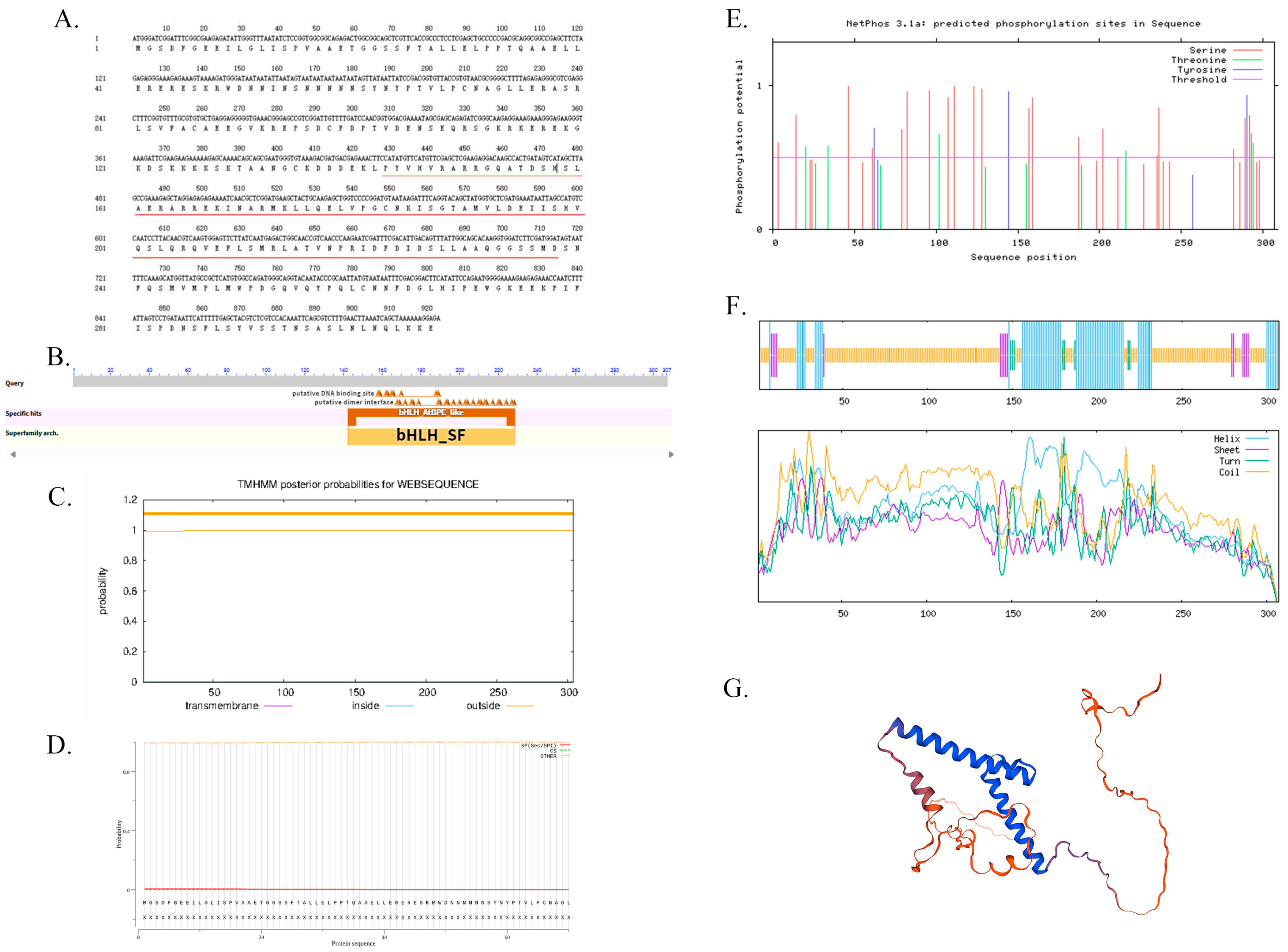
Based on whole-genome data and four sets of flowering-stage transcriptomic data from P. forbesii, this study identified a bHLH transcription factor whose expression pattern during full bloom aligns with the synthesis and release of floral odor compounds in P. forbesii. Based on its chromosomal localization, it was named PfbHLH131. The open reading frame of PfbHLH131 is 922 bp and encodes 307 amino acids (Figure 1A). Analysis of conserved domains indicates that it belongs to the bHLH superfamily and possesses a typical BPE domain (Figure 1B). The theoretical isoelectric point (pl) of PfbHLH131 is 5.60, its theoretical relative molecular weight is 34.21 kDa, the total number of positively charged residues (Arg + Lys) is 39, and the total number of negatively charged residues (Asp + Glu) is 44. Furthermore, PfbHLH131 has an instability index of 73.09 (>40) and a total average hydrophilicity of −0.665 (<0), indicating that it is an unstable hydrophilic protein. The transmembrane structure of the protein indicates that PfbHLH131 lacks transmembrane helices, does not undergo transmembrane movement, is not a membrane protein, and lacks a distinct signal peptide sequence, classifying it as a non-secretory protein (Figure 1C,D). The phosphorylation site prediction results indicate the presence of 29 phosphorylation sites (Figure 1E). The protein secondary structure reveals 83 α-helices, 8 β-turns, 16 extended chains, and 203 random coils (Figure 1F), as well as the predicted tertiary structure shown in Figure 1G.
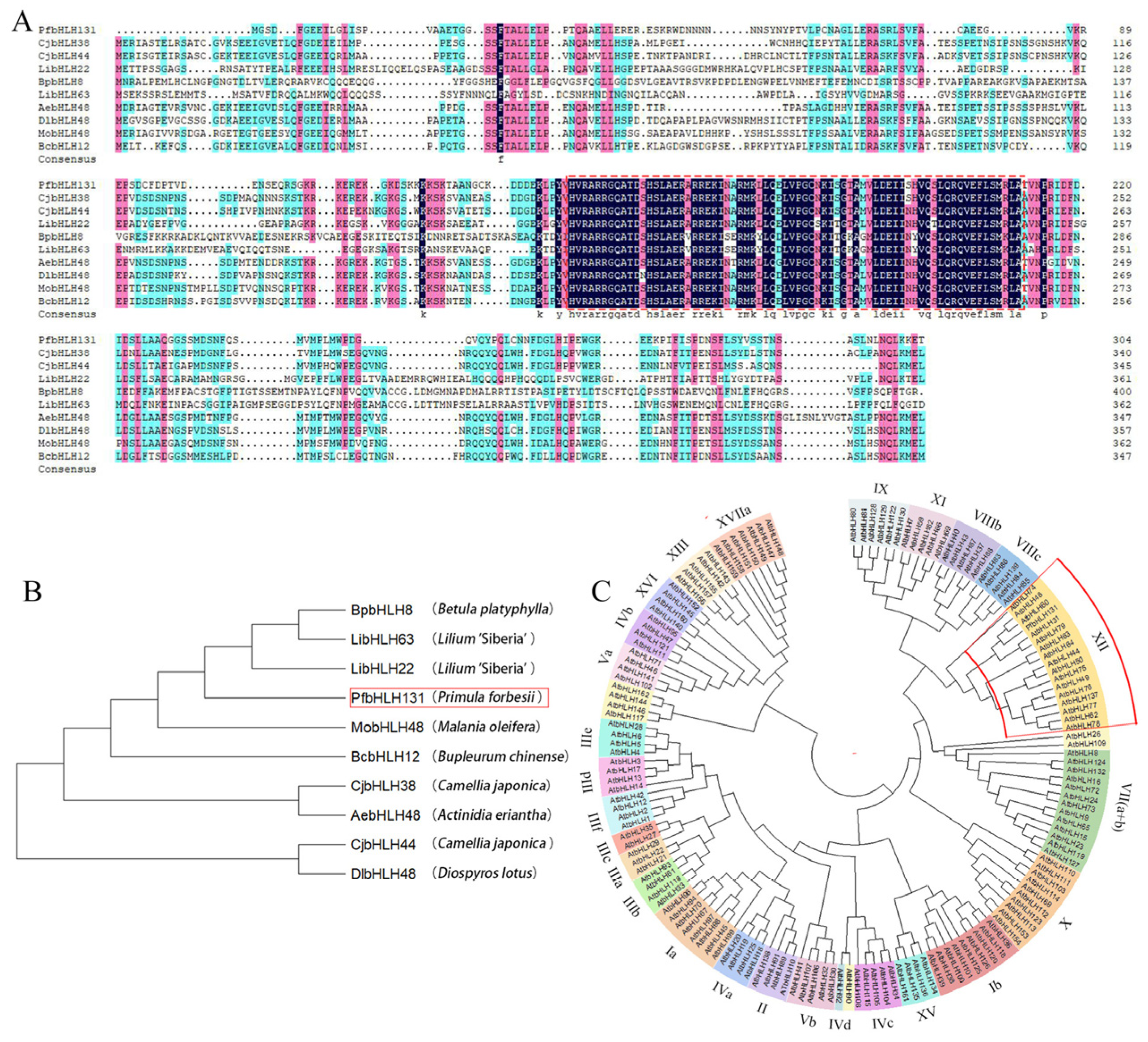
Phylogenetic tree analysis indicates that PfbHLH131 belongs to subfamily XII (Figure 2C). Multiple sequence alignment reveals that PfbHLH131 is closely related to Lilium (Lilium) LibHLH22 and LibHLH63 (Figure 2B), as well as Betula platyphylla BpbHLH8, and all possess the BPE domain common to bHLH family members (Figure 2A).

3.2. Analysis of the Spatiotemporal Expression Pattern and Subcellular Localization of PfbHLH131

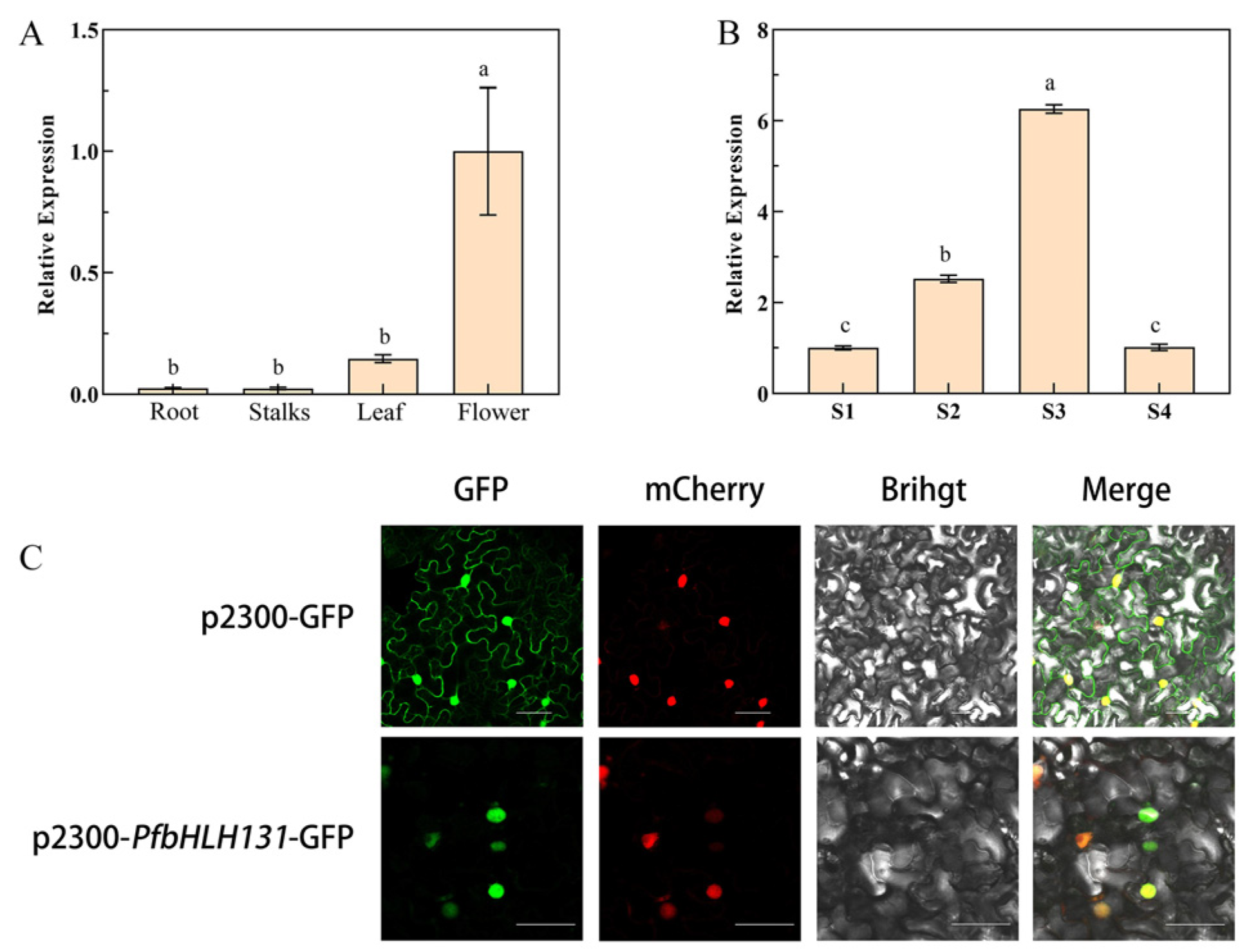
qRT-PCR analysis indicated that PfbHLH131 is expressed in the roots, flower stalks, leaves, and floral organs of P. forbesii, but exhibits significant organ specificity. The relative expression level of this gene was highest in floral organs, significantly higher than in the three other organs—flower stalks, leaves, and roots—among which there were no significant differences in relative expression levels (Figure 3A).
The development of a flower is divided into four stages: S1–S4 represent the bud stage, early flowering stage, full blooming stage, and late flowering stage, respectively. In stage S1, the petals are enclosed by the sepals, and neither the sepals nor the petals have expanded. In stage S2, the sepals spread out, the petals elongate, and the flower is half-open. At stage S3, the sepals and petals are fully expanded, and the petals are in full bloom. At stage S4, the petals contract, change color, curl outward, wither, and are prone to falling off. The expression level of PfbHLH131 was significantly higher in the S3 period than in the S2 period, and significantly higher in the S2 period than in both the S1 and S4 periods; there was no significant difference between the S1 and S4 periods. Overall, the expression level of PfbHLH131 undergoes dynamic changes, gradually increasing from the bud stage to full bloom, peaking at full bloom, and subsequently declining during the late flowering stage (Figure 3B).
Confocal scanning microscopy was used to detect GFP fluorescence signals in transiently transformed N. benthamiana plants. The results showed that the PfbHLH131 fusion protein was primarily localized to the cell nucleus (Figure 3C).

3.3. Functional Validation of PfbHLH131 Silencing via VIGS

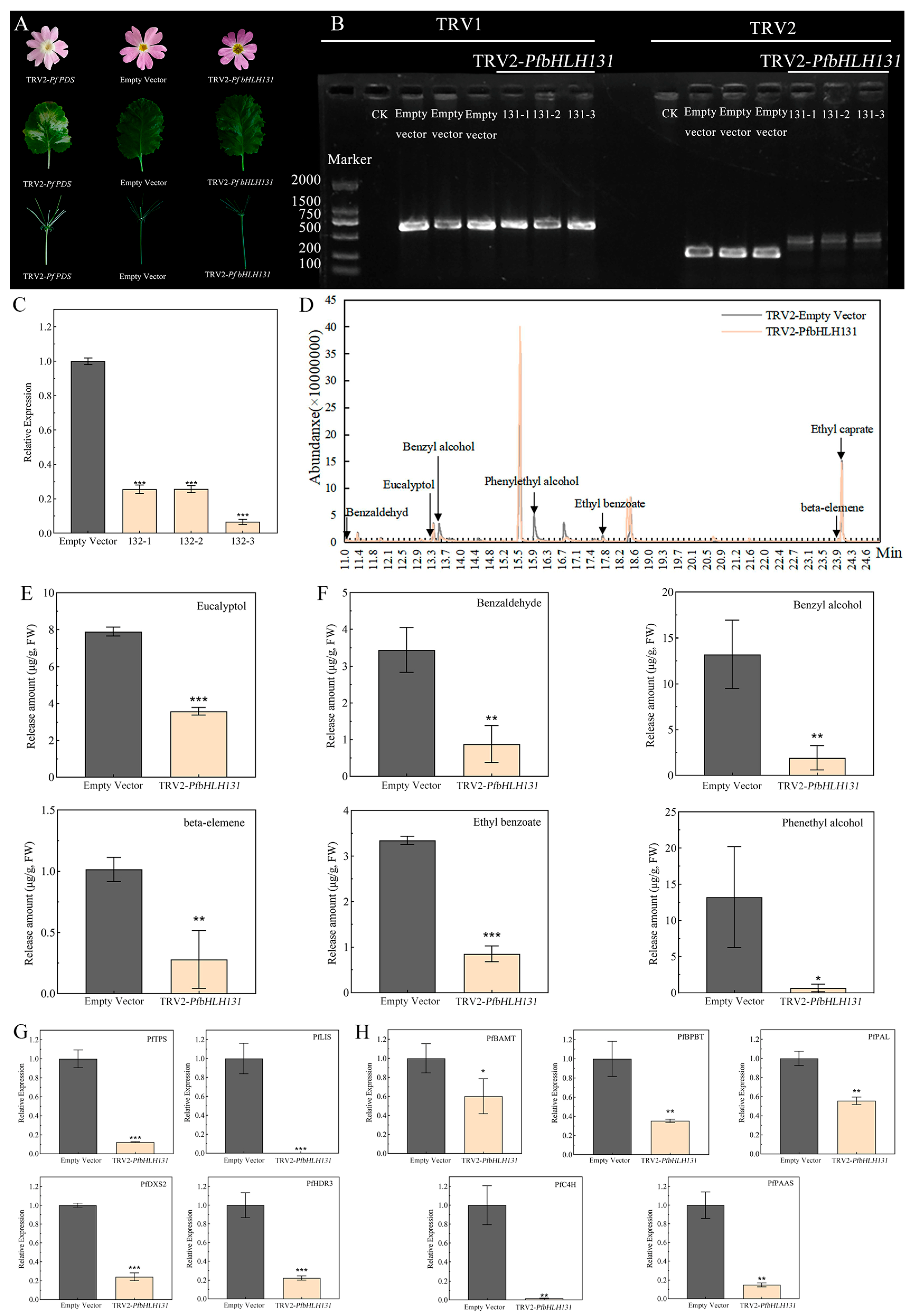
Thirty days after injection of the infection solution, plants injected with pTRV2-PfPDS exhibited typical leaf and flower stalk bleaching, confirming the effectiveness of the VIGS system, whereas plants injected with pTRV2-PfbHLH131 showed no obvious morphological differences compared to the empty vector control (Figure 4A). The presence of the viral vector in the silenced plants was confirmed by PCR (Figure 4B). qRT-PCR analysis showed that, compared to the empty vector control, the expression levels of the target gene in the three independent PfbHLH131 silenced lines decreased by 74%, 74%, and 93%, indicating that the PfbHLH131 gene was effectively silenced (Figure 4C).
GC-MS analysis indicated that PfbHLH131 silencing significantly reduced the release of major floral aroma compounds from P. forbesii petals (Figure 4D). Among terpenes, the release of eucalyptol and β-elemene decreased by 40.68% and 72.49%, respectively (Figure 4E). Among the phenylpropanoids, phenethyl alcohol showed the greatest decrease, followed by phenylmethanol, ethyl benzoate, and benzaldehyde, with reductions of 94.84%, 85.34%, 74.5%, and 74.4%, respectively (Figure 4F).
To investigate the molecular mechanism by which PfbHLH131 regulates floral fragrance biosynthesis, we examined changes in the expression of key genes in the relevant biosynthetic pathways. In PfbHLH131 silenced plants, the expression of key genes in the terpenoid biosynthesis pathways was generally downregulated. Among them, the expression levels of the monoterpene synthase genes PfLIS and PfTPS decreased to 0.00-fold and 0.12-fold of the control, respectively. The key genes of the MEP pathway, PfDXS2 and PfHDR3, also decreased to 0.24-fold and 0.22-fold of the control, respectively (Figure 4G). Concurrently, the expression of multiple genes in the phenylpropanoid synthesis pathway was also significantly suppressed, with the relative expression levels of PfBAMT, PfPAAS, PfC4H, PfBPBT, and PfPAL decreasing to 0.61, 0.12, 0.04, 0.56, and 0.63 times that of the control, respectively (Figure 4H).

4. Discussion

As a defining characteristic of P. forbesii, floral fragrance not only plays a crucial role in regulating pollination and enhancing environmental adaptability, but also serves as a key indicator for assessing their ornamental value, while simultaneously influencing their market potential and prospects for development and utilization. To date, there has been relatively little research on the floral aroma of P. forbesii. However, existing studies have preliminarily revealed the key regulatory network governing terpenoid metabolism in its flowers: based on transcriptomic sequencing, the key enzyme gene PfDXS2 in the terpenoid biosynthetic pathway was successfully identified, and virus-induced gene silencing (VIGS) experiments confirmed that downregulation of its expression significantly reduces the relative content of the major monoterpenes linalool and α-pinene [32]. At the same time, the ethylene-responsive factor PfERF106 was cloned and characterized for the first time from P. forbesii. Its expression is induced by exogenous ethylene, and bidirectional validation via transient silencing and heterologous overexpression demonstrated that it positively regulates the biosynthesis of various terpenoids, including linalool, linalyl acetate, and elemol [33]. The above study has laid the molecular foundation for an in-depth analysis of the transcriptional regulatory network governing terpenoid metabolism in P. forbesii. However, to date, there have been no reports on whether bHLH transcription factors are involved in the regulation of terpenoid metabolism in P. forbesii.
bHLH is one of the largest families of transcription factors; it is widely distributed in eukaryotes and plays a key role in plant growth, development, and secondary metabolism [34,35,36]. Two functional domains are conserved in bHLH transcription factors: the basic domain, which mediates sequence-specific DNA binding, and the HLH domain, which is involved in homodimerization or heterodimerization [37]. PfbHLH131, identified in this study, belongs to bHLH subfamily XII and shares the BPE domain with other members of the bHLH family. Multiple sequence alignment revealed that PfbHLH131 is closely related to two Lilium genes, LibHLH22 and LibHLH63, which are involved in the biosynthesis of terpenoid floral compounds [28]. Therefore, it is highly likely that PfbHLH131 is involved in the biosynthesis of floral compounds in P. forbesii.
We further analyzed the spatiotemporal expression patterns and subcellular localization of PfbHLH131 in different organs and at different stages of flower development. The results showed that PfbHLH131 is expressed in four organs: roots, flower stalks, leaves, and flowers. Expression levels were highest in floral organs, significantly higher than in other organs, indicating a clear organ-specific expression preference, which suggests that it may be specifically involved in regulatory processes related to floral development. For example, in Rhododendron × pulchrum Sweet, multiple RpbHLHs genes exhibit significant spatiotemporal specificity in floral organs, and their expression levels are highly correlated with the dynamics of anthocyanin accumulation [38]. Similarly, in Chimonanthus praecox, multiple CpbHLHs genes exhibit differential expression patterns across different organs and stages of floral development, with some members confirmed to participate in the coordinated regulation of secondary metabolites such as flower color and fragrance [39]. In Osmanthus fragrans, OfbHLH79 is most highly expressed in the petals; its overexpression significantly upregulates the expression of OfXTH28, which may be involved in regulating petal cell expansion during the flower opening process [40]. Relative expression levels across the four flowering stages show a trend of first increasing and then decreasing, peaking during full bloom. This pattern aligns with the fragrance release dynamics of P. forbesii and is highly similar to the expression characteristics of genes known to function in fragrance synthesis across multiple species. Such as LibHLH22 and LibHLH63 in Lilium [28], D. officinale’s DobHLH4 [29], and Petunia × atkinsiana’s PhbHLH19 [41], all of which are highly expressed in petals and promote the synthesis and accumulation of terpenoids and phenylpropanoids. Therefore, PfbHLH131 may be involved in the biosynthesis of terpenoid and phenylpropanoid floral odorants in P. forbesii.
Transcription factors, as key molecules in the regulation of gene expression, exert their effects by binding to specific DNA sequences, and their subcellular localization directly determines how they function [42]. Subcellular localization results indicate that PfbHLH131 is localized to the nucleus, consistent with the characteristic of transcription factors acting within the nucleus, and aligns with the nuclear localization of bHLH transcription factors in the vast majority of plants. For example, bHLH transcription factors in plants such as Prunus avium [43], Camellia sinensis [44], Chrysanthemum morifolium [45,46] and Vitis vinifera [47] are all localized to the nucleus. The nucleus is the primary site for gene transcription regulation. The nuclear localization of PfbHLH131 indicates that it may possess transcriptional factor activity, enabling it to bind to DNA and regulate the expression of downstream genes, thereby influencing plant physiological processes. Combined with the consistency between its organ-specific expression pattern and the rhythm of floral fragrance release, the nuclear localization results further support the hypothesis that PfbHLH131 may participate in the transcriptional regulatory network governing the formation of P. forbesii floral fragrance by directly regulating the expression of structural genes in the floral fragrance synthesis pathway.
In this study, we investigated the regulatory role of PfbHLH131 in the biosynthesis of floral compounds in P. forbesii using virus-mediated gene silencing. The results showed that following silencing of the PfbHLH131 gene, the release levels of both phenylpropanoid and terpenoid floral compounds in P. forbesii exhibited a significant downward trend, while the expression levels of several key structural genes in the floral compound biosynthetic pathways were also significantly downregulated. These findings provide new experimental evidence for the involvement of bHLH transcription factors in regulating plant floral aroma metabolism and lay the foundation for a deeper understanding of the molecular regulatory network underlying floral aroma formation in P. forbesii. bHLH transcription factors are a class of important transcriptional regulators in eukaryotes, widely involved in various biological processes such as plant growth and development, hormone responses, and the regulation of secondary metabolism. In recent years, the role of bHLH family members in floral fragrance regulation has gradually garnered attention. For example, in C. praecox, overexpression of CpMYC2 significantly increased the content of linalool [48]. In Lavandula angustifolia, overexpression of LaMYC4 significantly affected the production of volatile terpenes [49]. And in Artemisia annua, transient expression of AabHLH1 significantly increased the expression of artemisinin [50]. Similarly, in PfbHLH131-silenced lines, β-elemene and eucalyptol levels decreased significantly, and PfbHLH131 regulates a broad range of terpenoid biosynthesis genes, affecting not only downstream terpene synthase genes but also key enzyme genes in the upstream MEP and MVA pathways. The suggesting that these transcription factors may occupy upstream nodes in the terpenoid metabolic regulatory network, influencing terpenoid synthesis flux through multi-level regulation.
Current research has primarily focused on the regulation of terpenoid floral compounds by bHLH transcription factors, and reports on whether bHLH members participate in the metabolism of phenylpropanoid compounds are relatively limited. A recent study reported that PhbHLH19 in Petunia may participate in the regulation of phenylpropanoid compound synthesis by activating PhPAL2 expression [41], providing an important reference framework for this study. Silencing the PfbHLH131 gene in P. forbesii not only resulted in a significant decrease in terpenoid content but also caused a marked reduction in the release of phenylpropanoid compounds, suggesting that PfbHLH131 may simultaneously participate in the regulatory networks of multiple floral aroma metabolic pathways. In the PfbHLH131-silenced line, the contents of phenethyl alcohol and phenylmethanol both showed a significant decrease, and several key genes in phenylpropanoid metabolism, including PfPAL, PfC4H, PfPAAS, and PfBPBT, were significantly downregulated. This result is similar to the pattern of ODO1, EOBI, and EOBII regulating phenylpropanoid biosynthesis in Petunias, where ODO1 activates the expression of multiple structural genes in the phenylpropanoid metabolic pathway [51]. Therefore, PfbHLH131 may participate in the transcriptional regulation of the phenylpropanoid metabolic pathway in a similar manner, but its specific target genes and regulatory mechanisms require further verification.

5. Conclusions

In this study, we cloned and characterized the bHLH transcription factor PfbHLH131 from P. forbesii. Spatiotemporal expression and subcellular localization analyses revealed that this gene is highly expressed in floral organs, reaching peak expression during full bloom, and is localized to the nucleus. Transient silencing of PfbHLH131 via virus-induced gene silencing (VIGS) significantly reduced the release of terpenoid and phenylpropanoid floral odor compounds and suppressed the expression of multiple key structural genes in both synthetic pathways, indicating that PfbHLH131 acts as a positive regulator of floral odor synthesis in P. forbesii. This study provides genetic resources for the molecular improvement of floral aroma traits in Primula species. Further research can explore the target genes directly regulated by this gene to elucidate its fine-tuning regulatory network.

Supplementary Materials

The following supporting information can be downloaded at: https://www.mdpi.com/article/10.3390/genes17070785/s1, Table S1: Primers used in this study. Table S2: Gene name and gene accession number or web link.

Author Contributions

Y.H. and W.D. designed and conducted the experiments and drafted the manuscript. Y.L. organized and analyzed the data. B.M., Z.L. and H.Y. assisted in experimental investigations. Y.P. and B.J. reviewed and edited the final version of the manuscript. P.T. and Y.J. directed the experimental design, obtained funding, reviewed, and edited the final version of the manuscript. All authors have read and agreed to the published version of the manuscript.

Funding

This research was supported by the Construction of the Chengdu National Botanical Garden System (Grant No. 202511KY0007).

Institutional Review Board Statement

Not applicable.

Informed Consent Statement

Not applicable.

Data Availability Statement

The original contributions presented in this study are included in the article/Supplementary Materials. Further inquiries can be directed to the corresponding authors.

Acknowledgments

The authors would like to thank the Chengdu Botanical Garden (Chengdu Park City Botanical Science Research Institute) and College of Landscape Architecture, Sichuan Agricultural University.

Conflicts of Interest

The authors declare that they have no conflicts of interest.

References

  1. Muhlemann, J.K.; Klempien, A.; Dudareva, N. Floral volatiles: From biosynthesis to function. Plant Cell Environ. 2014, 37, 1936–1949. [Google Scholar] [CrossRef] [PubMed]
  2. de Vega, C.; Herrera, C.M.; Dötterl, S. Floral volatiles play a key role in specialized ant pollination. Perspect. Plant Ecol. Evol. Syst. 2014, 16, 32–42. [Google Scholar] [CrossRef]
  3. Dudareva, N.; Pichersky, E. Biochemical and molecular genetic aspects of floral scents. Plant Physiol. 2000, 122, 627–633. [Google Scholar] [CrossRef] [PubMed]
  4. Dong, F.; Fu, X.; Watanabe, N.; Su, X.; Yang, Z. Recent advances in the emission and Functions of plant vegetative volatiles. Molecules 2016, 21, 124. [Google Scholar] [CrossRef] [PubMed]
  5. Mostafa, S.; Wang, Y.; Zeng, W.; Jin, B. Floral scents and fruit aromas: Functions, compositions, biosynthesis, and regulation. Front. Plant Sci. 2022, 13, 860157. [Google Scholar] [CrossRef] [PubMed]
  6. Tholl, D. Biosynthesis and biological functions of terpenoids in plants. Biotechnol. Isoprenoids 2015, 148, 63–106. [Google Scholar] [CrossRef] [PubMed]
  7. Huang, Y.; Xie, F.J.; Cao, X.; Li, M.Y. Research progress in biosynthesis and regulation of plant terpenoids. Biotechnol. Biotechnol. Equip. 2021, 35, 1799–1808. [Google Scholar] [CrossRef]
  8. Degenhardt, J.; Köllner, T.G.; Gershenzon, J. Monoterpene and sesquiterpene synthases and the origin of terpene skeletal diversity in plants. Phytochemistry 2009, 70, 1621–1637. [Google Scholar] [CrossRef] [PubMed]
  9. Tholl, D. Terpene synthases and the regulation, diversity and biological roles of terpene metabolism. Curr. Opin. Plant Biol. 2006, 9, 297–304. [Google Scholar] [CrossRef] [PubMed]
  10. Koukol, J.; Conn, E.E. The metabolism of aromatic compounds in higher plants: IV. Purification and properties of the phenylalanine deaminase of Hordeum vulgare. J. Biol. Chem. 1961, 236, 2692–2698. [Google Scholar] [CrossRef]
  11. Dudareva, N.; Murfitt, L.M.; Mann, C.J.; Gorenstein, N.; Kolosova, N.; Kish, C.M.; Bonham, C.; Wood, K. Developmental regulation of methyl benzoate biosynthesis and emission in snapdragon flowers. Plant Cell 2000, 12, 949–961. [Google Scholar] [CrossRef] [PubMed]
  12. Oliva, M.; Bar, E.; Ovadia, R.; Perl, A.; Galili, G.; Lewinsohn, E.; Oren-Shamir, M. Phenylpyruvate contributes to the synthesis of fragrant benzenoid–phenylpropanoids in Petunia × hybrida flowers. Front. Plant Sci. 2017, 8, 769. [Google Scholar] [CrossRef] [PubMed]
  13. Zhu, Z.J.; Chen, H.M.; Chen, J.J.; Yan, X.J. One-step bioconversion of fatty acids into C8–C9 volatile aroma compounds by a multifunctional lipoxygenase cloned from Pyropia haitanensis. J. Agric. Food Chem. 2018, 66, 1233–1241. [Google Scholar] [CrossRef] [PubMed]
  14. Ramya, M.; Kwon, O.K.; An, H.R.; Park, P.M.; Baek, Y.S.; Park, P.H. Floral scent: Regulation and role of MYB transcription factors. Phytochem. Lett. 2017, 19, 114–120. [Google Scholar] [CrossRef]
  15. Bao, M.; Xu, Y.; Wei, G.; Bai, M.; Wang, J.; Feng, L. The MYC Gene RrbHLH105 Contributes to Salt Stress–Induced Geraniol in Rose by Regulating Trehalose-6-Phosphate Signalling. Plant Cell Environ. 2025, 48, 1947–1962. [Google Scholar] [CrossRef] [PubMed]
  16. Schluttenhofer, C.; Yuan, L. Regulation of specialized metabolism by WRKY transcription factors. Plant Physiol. 2015, 167, 295–306. [Google Scholar] [CrossRef] [PubMed]
  17. Liu, F.; Xiao, Z.; Yang, L.; Chen, Q.; Shao, L.; Liu, J.; Yu, Y. PhERF6, interacting with EOBI, negatively regulates fragrance biosynthesis in petunia flowers. New Phytol. 2017, 215, 1490–1502. [Google Scholar] [CrossRef] [PubMed]
  18. Fu, J.; Yu, G.; Qing, H.; Liu, X.; Zhang, C. Petunia bZIP transcription factor PhbZIP3 is involved in floral volatile benzenoid/phenylpropanoid biosynthesis through regulating the expression of PhPAL2 and PhBSMT. Sci. Hortic. 2024, 326, 112719. [Google Scholar] [CrossRef]
  19. Teng, S.; Liu, Q.; Chen, G.; Chang, Y.; Cui, X.; Wu, J.; Ai, P.; Sun, X.; Zhang, Z.; Lu, T. OsbHLH92, in the noncanonical brassinosteroid signaling pathway, positively regulates leaf angle and grain weight in rice. New Phytol. 2023, 240, 1066–1081. [Google Scholar] [CrossRef] [PubMed]
  20. Hong, Y.; Zhang, J.; Lv, Y.; Yao, N.; Liu, X. The safflower bHLH transcription factor CtbHLH41 negatively regulates SA-induced leaf senescence through interaction with CtCP1. Environ. Exp. Bot. 2022, 199, 104883. [Google Scholar] [CrossRef]
  21. Seo, J.S.; Joo, J.; Kim, M.J.; Kim, Y.K.; Nahm, B.H.; Song, S.I.; Cheong, J.J.; Lee, J.S.; Kim, J.K.; Choi, Y.D. OsbHLH148, a basic helix-loop-helix protein, interacts with OsJAZ proteins in a jasmonate signaling pathway leading to drought tolerance in rice. Plant J. 2011, 65, 907–921. [Google Scholar] [CrossRef] [PubMed]
  22. Zhao, Q.; Fan, Z.; Qiu, L.; Che, Q.; Wang, T.; Li, Y.; Wang, Y. MdbHLH130, an apple bHLH transcription factor, confers water stress resistance by regulating stomatal closure and ROS homeostasis in transgenic tobacco. Front. Plant Sci. 2020, 11, 543696. [Google Scholar] [CrossRef] [PubMed]
  23. Jin, R.; Kim, H.S.; Yu, T.; Zhang, A.; Yang, Y.; Liu, M.; Yu, W.; Peng, Z.; Zhang, Q.; Cao, Q.; et al. Identification and function analysis of bHLH genes in response to cold stress in sweetpotato. Plant Physiol. Biochem. 2021, 169, 224–235. [Google Scholar] [CrossRef] [PubMed]
  24. Qian, Y.; Hu, Z.; Tang, Y.; Meng, J.; Tao, J.; Zhao, D. Isolation and function analysis of herbaceous peony bHLH transcription factor PlbHLH87 in response to high-temperature stress. Sci. Hortic. 2024, 329, 112993. [Google Scholar] [CrossRef]
  25. Qi, Y.; Zhou, L.; Han, L.; Zou, H.; Miao, K.; Wang, Y. PsbHLH1, a novel transcription factor involved in regulating anthocyanin biosynthesis in tree peony (Paeonia suffruticosa). Plant Physiol. Biochem. 2020, 154, 396–408. [Google Scholar] [CrossRef] [PubMed]
  26. Hong, G.J.; Xue, X.Y.; Mao, Y.B.; Wang, L.J.; Chen, X.Y. Arabidopsis MYC2 interacts with DELLA proteins in regulating sesquiterpene synthase gene expression. Plant Cell 2012, 24, 2635–2648. [Google Scholar] [CrossRef] [PubMed]
  27. Chuang, Y.C.; Hung, Y.C.; Tsai, W.C.; Chen, W.H.; Chen, H.H. PbbHLH4 regulates floral monoterpene biosynthesis in Phalaenopsis orchids. J. Exp. Bot. 2018, 69, 4363–4377. [Google Scholar] [CrossRef] [PubMed]
  28. Feng, Y.; Guo, Z.; Zhong, J.; Liang, Y.; Zhang, P.; Sun, M. The LibHLH22 and LibHLH63 from Lilium ‘Siberia’can positively regulate volatile terpenoid biosynthesis. Horticulturae 2023, 9, 459. [Google Scholar] [CrossRef]
  29. Yu, Z.; Zhang, G.; da Silva, J.A.T.; Zhao, C.; Duan, J. The methyl jasmonate-responsive transcription factor DobHLH4 promotes DoTPS10, which is involved in linalool biosynthesis in Dendrobium officinale during floral development. Plant Sci. 2021, 309, 110952. [Google Scholar] [CrossRef] [PubMed]
  30. Liu, Y.; Si, W.J.; Fu, S.T.; Wang, J.; Cheng, T.R.; Zhang, Q.X.; Pan, H.T. PfPIN5 promotes style elongation by regulating cell length in Primula forbesii French. Ann. Bot. 2024, 133, 473–482. [Google Scholar] [CrossRef] [PubMed]
  31. Livak, K.J.; Schmittgen, T.D. Analysis of relative gene expression data using real-time quantitative PCR and the 2−ΔΔCT method. Methods 2001, 25, 402–408. [Google Scholar] [CrossRef] [PubMed]
  32. Jia, Y.; Yin, X.C.; Yang, H.C.; Xiang, Y.; Ding, K.Y.; Pan, Y.Z.; Jiang, B.B.; Yong, X. Transcriptome analyses reveal the aroma terpeniods biosynthesis pathways of Primula Forbesii Franch. and the functional characterization of the PfDXS2 gene. Int. J. Mol. Sci. 2023, 24, 12730. [Google Scholar] [CrossRef] [PubMed]
  33. Yin, X.C.; Yang, H.C.; Ding, K.Y.; Luo, Y.Z.; Deng, W.Q.; Liao, J.W.; Pan, Y.Z.; Jiang, B.B.; Yong, X.; Jia, Y. PfERF106, a novel key transcription factor regulating the biosynthesis of floral terpenoids in Primula forbesii Franch. BMC Plant Biol. 2024, 24, 851. [Google Scholar] [CrossRef] [PubMed]
  34. Castillon, A.; Shen, H.; Huq, E. Phytochrome interacting factors: Central players in phytochrome-mediated light signaling networks. Trends Plant Sci. 2007, 12, 514–521. [Google Scholar] [CrossRef] [PubMed]
  35. Duek, P.D.; Fankhauser, C. HFR1, a putative bHLH transcription factor, mediates both phytochrome A and cryptochrome signalling. Plant J. 2003, 34, 827–836. [Google Scholar] [CrossRef] [PubMed]
  36. Kondou, Y.; Nakazawa, M.; Kawashima, M.; Ichikawa, T.; Yoshizumi, T.; Suzuki, K.; Ishikawa, A.; Koshi, T.; Matsui, R.; Muto, S. RETARDED GROWTH OF EMBRYO1, a new basic helix-loop-helix protein, expresses in endosperm to control embryo growth. Plant Physiol. 2008, 147, 1924–1935. [Google Scholar] [CrossRef] [PubMed]
  37. Massari, M.E.; Murre, C. Helix-loop-helix proteins: Regulators of transcription in eucaryotic organisms. Mol. Cell. Biol. 2000, 20, 429–440. [Google Scholar] [CrossRef] [PubMed]
  38. Sheng, J.; Shen, J.; Shan, Y.; Chen, X.; Li, X.; Wang, H.; Jin, S. Identification and Expression Analysis of the bHLH Gene Family in Rhododendron × pulchrum Sweet with Different Flower Colors. Plants 2025, 14, 1713. [Google Scholar] [CrossRef] [PubMed]
  39. Kamran, H.M.; Fu, X.; Wang, H.; Yang, N.; Chen, L. Genome-wide identification and expression analysis of the bHLH transcription factor family in wintersweet (Chimonanthus praecox). Int. J. Mol. Sci. 2023, 24, 13462. [Google Scholar] [CrossRef] [PubMed]
  40. Miao, Y.; Yang, Y.; Zhu, H.; Li, W.; Liu, X.; Zhang, S.; Lan, Y.; Zhao, H. The basic/helix-loop-helix 79 (bHLH79)-xyloglucan endotransglucosylase/hydrolase 28 (XTH28) regulatory module mediates flower opening in Osmanthus fragrans. Int. J. Biol. Macromol. 2025, 322, 146633. [Google Scholar] [CrossRef] [PubMed]
  41. Zhang, C.; Jiang, L.L.; Qian, J.Y.; Yu, G.; Qing, H.S.; Li, L.; Fu, J.X. Genome-wide analysis of basic helix-loop-helix (bHLH) transcription factors in petunia and identification of the putative candidate member involved in floral volatile benzenoids/phenylpropanoids metabolism. Gene 2025, 938, 149150. [Google Scholar] [CrossRef] [PubMed]
  42. Ogbourne, S.; Antalis, T.M. Transcriptional control and the role of silencers in transcriptional regulation in eukaryotes. Biochem. J. 1998, 331, 1–14. [Google Scholar] [CrossRef] [PubMed]
  43. Tang, W.; Li, H.F.; Huang, Y.; Niu, W.; Du, Q.; Chu, Y.; Gao, Y.; He, R.; Tang, Y.; Chen, H.; et al. PavbHLH102 functions as a positive regulator of anthocyanin biosynthesis in sweet cherry fruit by targeting multiple key genes. Hortic. Plant J. 2025, 12, 317–332. [Google Scholar] [CrossRef]
  44. Xie, N.; Zhou, P.; Wang, K.; Huang, F.; Yu, S.; Fu, H.; Li, S.; Li, J.; Liu, Z.; Wang, K. CsMYB213-CsbHLH35 module regulates theanine biosynthesis in tea plants (Camellia sinensis L.). Plant Biotechnol. J. 2025, 23, 3465–3477. [Google Scholar] [CrossRef] [PubMed]
  45. Huang, Y.; Xing, X.; Jin, J.; Tang, Y.; Ding, L.; Song, A.; Chen, S.; Chen, F.; Jiang, J.; Fang, W. CmbHLH110, a novel bHLH transcription factor, accelerates flowering in chrysanthemum. Hortic. Plant J. 2024, 10, 1437–1448. [Google Scholar] [CrossRef]
  46. Huang, Y.; Yang, M.; Lv, J.; Zhao, K.; Wen, J.; Zhao, Y.; Deng, M. Functional Characterization of Chrysanthemum Transcription Factor CmbHLH112 in Flowering and Drought Response. Horticulturae 2026, 12, 383. [Google Scholar] [CrossRef]
  47. Sun, Q.; Liu, Z.; Wang, X.; Yan, A.; Ren, J.; Wang, H.; Lei, S. Whole-genome identification and functional analysis of grape bHLH transcription factors: New insights into the regulation of monoterpene biosynthesis. Front. Plant Sci. 2025, 16, 1653650. [Google Scholar] [CrossRef] [PubMed]
  48. Aslam, M.Z.; Lin, X.; Li, X.; Yang, N.; Chen, L. Molecular cloning and functional characterization of CpMYC2 and CpBHLH13 transcription factors from wintersweet (Chimonanthus praecox L.). Plants 2020, 9, 785. [Google Scholar] [CrossRef] [PubMed]
  49. Dong, Y.; Zhang, W.; Li, J.; Wang, D.; Bai, H.; Li, H.; Shi, L. The transcription factor LaMYC4 from lavender regulates volatile terpenoid biosynthesis. BMC Plant Biol. 2022, 22, 289. [Google Scholar] [CrossRef] [PubMed]
  50. Ji, Y.; Xiao, J.; Shen, Y.; Ma, D.; Li, Z.; Pu, G.; Li, X.; Huang, L.; Liu, B.; Ye, H.; et al. Cloning and characterization of AabHLH1, a bHLH transcription factor that positively regulates artemisinin biosynthesis in Artemisia annua. Plant Cell Physiol. 2014, 55, 1592–1604. [Google Scholar] [CrossRef] [PubMed]
  51. Spitzer-Rimon, B.; Farhi, M.; Albo, B.; Cna’ani, A.; Zvi, M.M.B.; Masci, T.; Edelbaum, O.; Yu, Y.; Shklarman, E.; Ovadis, M.; et al. The R2R3-MYB–like regulatory factor EOBI, acting downstream of EOBII, regulates scent production by activating ODO1 and structural scent-related genes in petunia. Plant Cell 2012, 24, 5089–5105. [Google Scholar] [CrossRef] [PubMed]
Figure 1. PfbHLH131 protein characterization. (A) Sequence characteristics of PfbHLH131 (The red underlined parts are the conserved domain amino acid sequences); (B) Conserved domains analysis of PfbHLH131 protein; (C) Predicted transmembrane structure of the PfbHLH131 protein; (D) Signal peptide prediction for PfbHLH131; (E) Prediction of phosphorylation sites in PfbHLH131; (F) Secondary structure prediction; (G) 3D model building.
Genes 17 00785 g001
Figure 2. Gene sequence analysis. (A) PfbHLH131 homologous protein sequence alignment, the red box indicates the BPE domain sequence; (B) Phylogenetic tree of the PfbHLH131 protein; (C) Comparison of the PfbHLH131 protein with bHLH family proteins of A. thaliana. The red box indicates that these genes belong to the bHLH subfamily XII.
Genes 17 00785 g002
Figure 3. Spatiotemporal expression and subcellular localization of PfbHLH131. (A) Expression of PfbHLH131 in different organs of P. forbesii. The letters in the figure represent the salience of the components; (B) Expression of PfbHLH131 at different flowering stages of P. forbesii (S1, petals of the bud stage; S2, first flowering stage; S3, full blooming stage; S4, late flowering stage). The different lowercase letters in the figure indicate significant differences at the p < 0.05 threshold; (C) Subcellular localization of PfbHLH131. “GFP” stands for green fluorescent protein, which indicates the distribution of this protein within the cell. “mCherry” indicates the location of the cell nucleus within the cell. “Bright” refers to a bright-field image that shows the morphological structure of the cells. “Merge” is a composite image created by overlaying the GFP, mCherry, and Bright images. Scale bar = 50 µm.
Genes 17 00785 g003
Figure 4. Transient silencing of PfbHLH131 in P. forbesii. (A) Phenotypes of the whole plant, flowers, stems, and leaves after the transient silencing of PfbHLH131 in P. forbesii; (B) Detection of PCR-positive results in the PfbHLH131 knockdown line. Normal plants that were not injected with the staining solution were used as the control (CK); (C) Detection of the relative expression of PfbHLH131 in different lines; (D) The floral contents of PfbHLH131-silenced plants were detected by GC-MS; (E) Relative contents of key terpenoids in flowers of control and silenced plants; (F) Relative content of key phenylpropanoid compounds in flowers of the control group and plants subjected to silencing treatment; (G) Expression of key genes involved in the biosynthesis of terpenoids; (H) Expression of key genes involved in the biosynthesis of propylbenzene compounds. Data are expressed as means ± standard deviations of three replicates (***, p < 0.001; **, p < 0.01; *, p < 0.05).
Genes 17 00785 g004
Disclaimer/Publisher’s Note: The statements, opinions and data contained in all publications are solely those of the individual author(s) and contributor(s) and not of MDPI and/or the editor(s). MDPI and/or the editor(s) disclaim responsibility for any injury to people or property resulting from any ideas, methods, instructions or products referred to in the content.