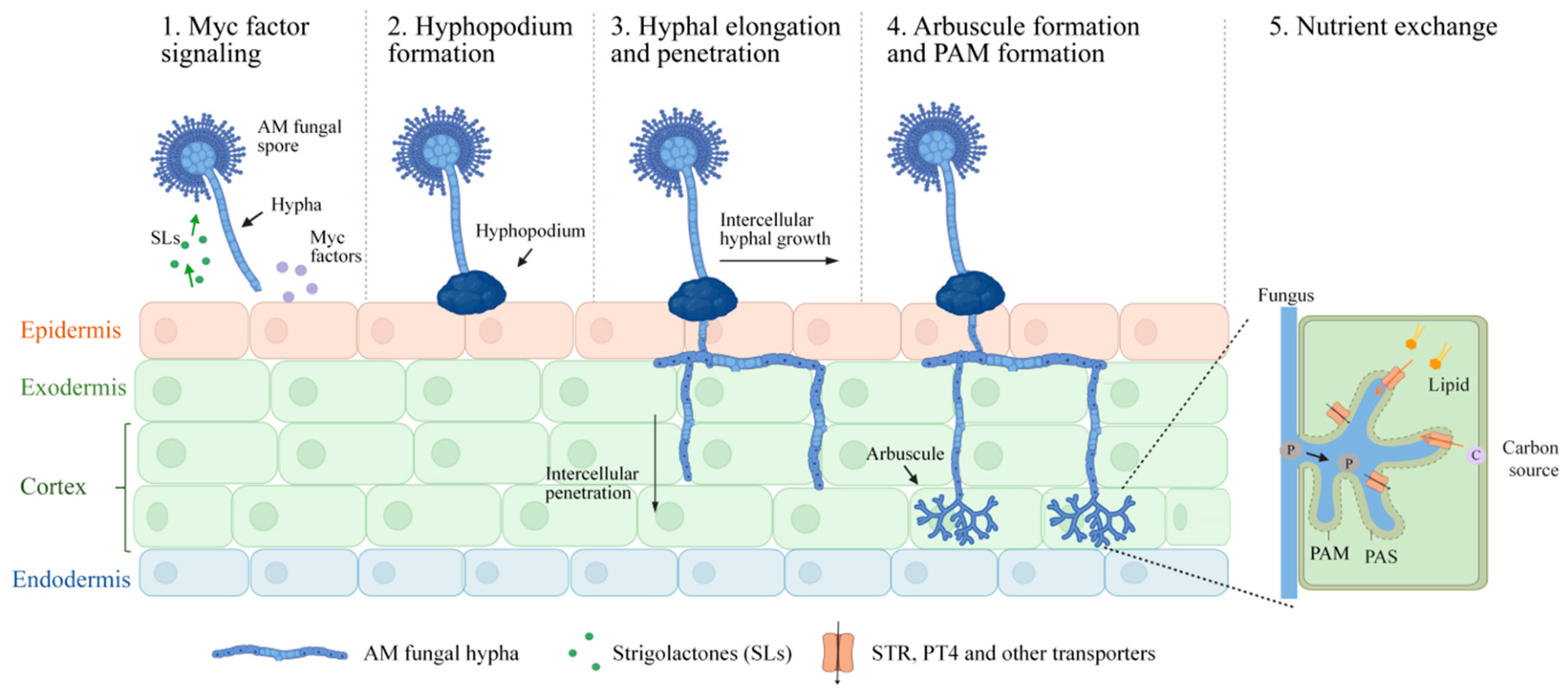
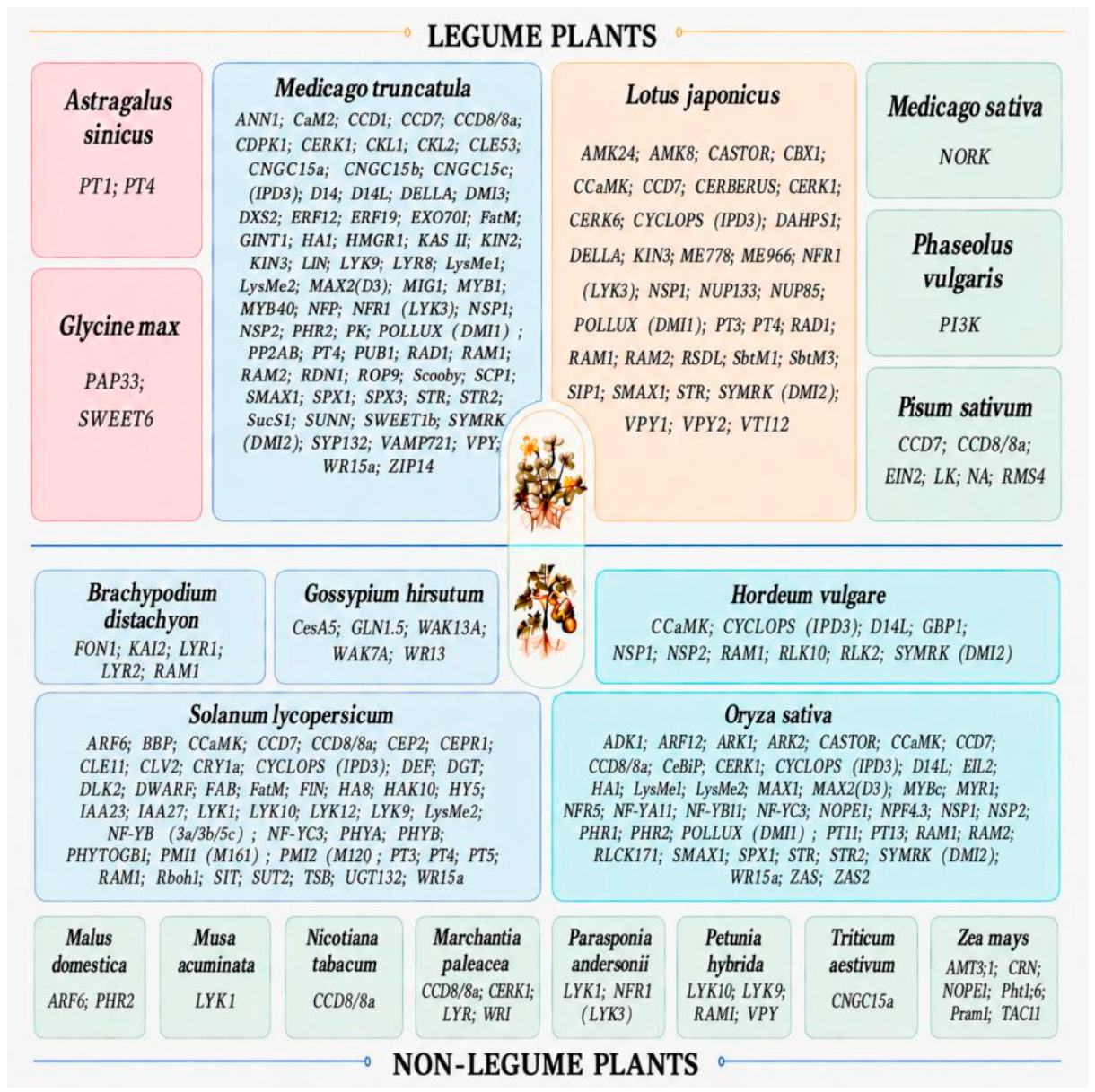
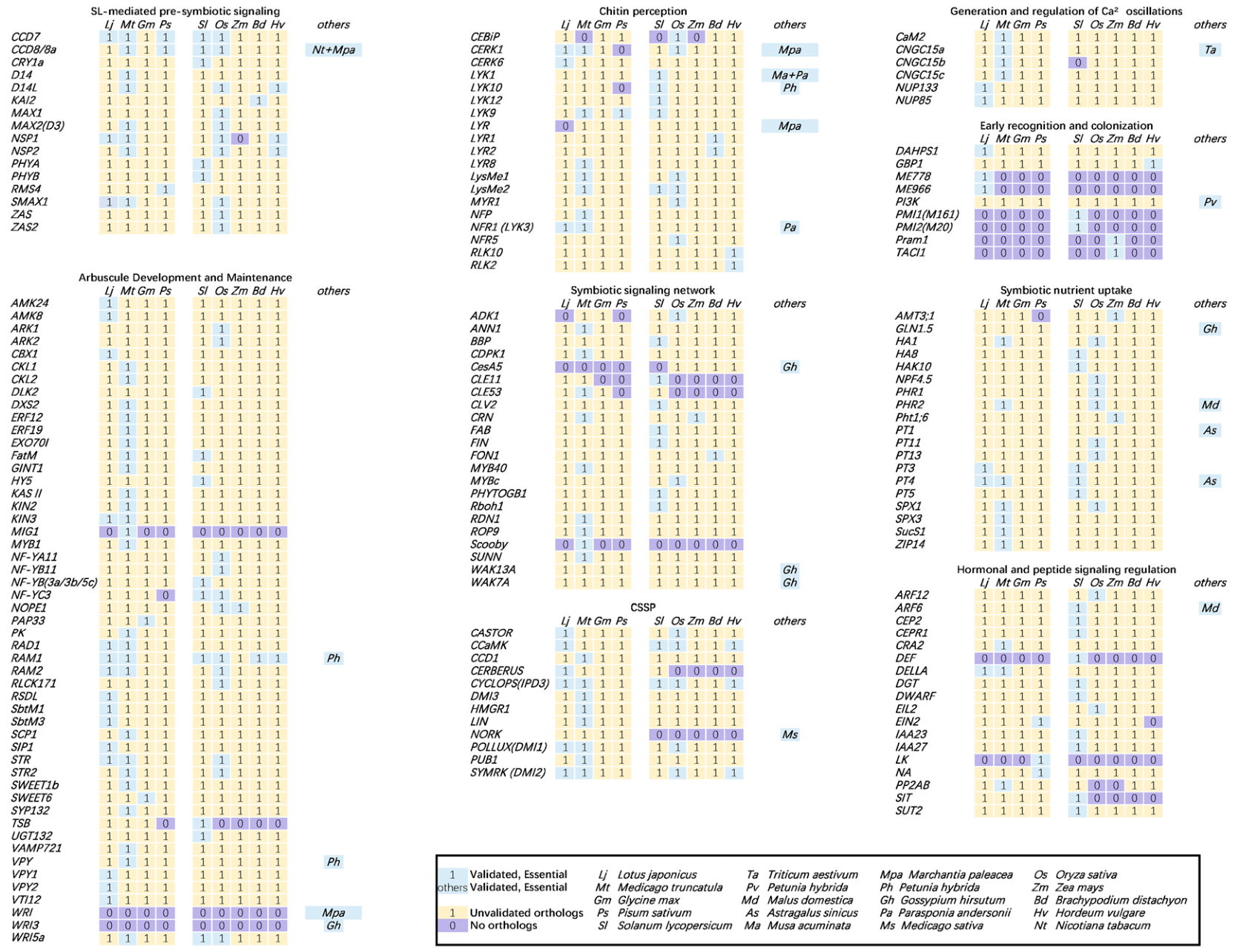
Functional Overview of Plant Genes Essential for Arbuscular Mycorrhizal Symbiosis


Abstract
1. Introduction
2. SL-Mediated Pre-Symbiotic Signaling
2.1. Key SL Biosynthetic Enzymes Associated with AM Pre-Symbiotic Signaling
2.2. Functional Diversification of SL Receptors in Regulating AM Symbiosis
2.3. Regulatory Network and Adaptive Plasticity of SL Symbiotic Signaling
3. Chitin Perception
4. Generation and Regulation of Ca2+ Oscillations
Early Recognition and Colonization
5. CSSP
5.1. Upstream Signal Perception and Initiation of Ca2+ Spiking
5.2. Ca2+ Signal Decoding and Downstream Responses
5.3. Coordinated Roles of CSSP Core Components in Ca2+ Oscillations
5.4. E3 Ubiquitin Ligase Regulation Within the CSSP
6. Symbiotic Signaling Network
7. Arbuscule Development and Maintenance
7.1. Transcriptional Regulatory Network of Arbuscule Formation
7.2. Lipid Biosynthesis and Metabolic Regulation
7.3. PAM Formation and Vesicle Trafficking
7.4. Arbuscule Maintenance and Receptor-like Kinase Regulation
7.5. Arbuscule Degeneration and Senescence
8. Symbiotic Nutrient Uptake
8.1. Transcriptional Regulation of Phosphate Uptake
8.2. Phosphate Transporters
8.3. Energy Supply
8.4. Nitrogen Uptake and Assimilation
8.5. Potassium and Zinc Uptake
8.6. Carbon Supply and Symbiosis Maintenance
8.7. Hormonal and Peptide Signaling Regulation
9. Conclusions and Perspectives
Supplementary Materials
Author Contributions
Funding
Institutional Review Board Statement
Informed Consent Statement
Data Availability Statement
Acknowledgments
Conflicts of Interest
References
- Tan, X.; Wang, D.; Zhang, X.; Zheng, S.; Jia, X.; Liu, H.; Liu, Z.; Yang, H.; Dai, H.; Chen, X.; et al. A pair of LysM receptors mediates symbiosis and immunity discrimination in Marchantia. Cell 2025, 188, 1330–1348. [Google Scholar] [CrossRef]
- Wipf, D.; Krajinski, F.; van Tuinen, D.; Recorbet, G.; Courty, P.E. Trading on the arbuscular mycorrhiza market: From arbuscules to common mycorrhizal networks. New Phytol. 2019, 223, 1127–1142. [Google Scholar] [CrossRef] [PubMed]
- Parniske, M. Arbuscular mycorrhiza: The mother of plant root endosymbioses. Nat. Rev. Microbiol. 2008, 6, 763–775. [Google Scholar] [CrossRef]
- Luginbuehl, L.H.; Menard, G.N.; Kurup, S.; Van Erp, H.; Radhakrishnan, G.V.; Breakspear, A.; Oldroyd, G.E.D.; Eastmond, P.J. Fatty acids in arbuscular mycorrhizal fungi are synthesized by the host plant. Science 2017, 356, 1175–1178. [Google Scholar] [CrossRef]
- Akiyama, K.; Matsuzaki, K.-I.; Hayashi, H. Plant sesquiterpenes induce hyphal branching in arbuscular mycorrhizal fungi. Nature 2005, 435, 824–827. [Google Scholar] [CrossRef]
- Harrison, M.J. Cellular programs for arbuscular mycorrhizal symbiosis. Curr. Opin. Plant Biol. 2012, 15, 691–698. [Google Scholar] [CrossRef]
- Harrison, M.J.; Dewbre, G.R.; Liu, J. A Phosphate Transporter from Medicago truncatula Involved in the Acquisition of Phosphate Released by Arbuscular Mycorrhizal Fungi. Plant Cell 2002, 14, 2413–2429. [Google Scholar] [CrossRef]
- Pumplin, N.; Harrison, M.J. Live-Cell Imaging Reveals Periarbuscular Membrane Domains and Organelle Location in Roots during Arbuscular Mycorrhizal Symbiosis. Plant Physiol. 2009, 151, 809–819. [Google Scholar] [CrossRef]
- Wang, W.; Shi, J.; Xie, Q.; Jiang, Y.; Yu, N.; Wang, E. Nutrient Exchange and Regulation in Arbuscular Mycorrhizal Symbiosis. Mol. Plant 2017, 10, 1147–1158. [Google Scholar] [CrossRef] [PubMed]
- Luginbuehl, L.H.; Oldroyd, G.E. Understanding the Arbuscule at the Heart of Endomycorrhizal Symbioses in Plants. Curr. Biol. 2017, 27, R952–R963. [Google Scholar] [CrossRef] [PubMed]
- Shi, J.; Zhao, B.; Zheng, S.; Zhang, X.; Wang, X.; Dong, W.; Xie, Q.; Wang, G.; Xiao, Y.; Chen, F.; et al. A phosphate starvation response-centered network regulates mycorrhizal symbiosis. Cell 2021, 184, 5527–5540. [Google Scholar] [CrossRef]
- Li, X.; Sun, J.; Albinsky, D.; Zarrabian, D.; Hull, R.; Lee, T.; Jarratt-Barnham, E.; Chiu, C.; Jacobsen, A.; Soumpourou, E.; et al. Nutrient regulation of lipochitooligosaccharide recognition in plants via NSP1 and NSP2. Nat. Commun. 2022, 13, 6421. [Google Scholar] [CrossRef]
- Vogel, J.T.; Walter, M.H.; Giavalisco, P.; Lytovchenko, A.; Kohlen, W.; Charnikhova, T.; Simkin, A.J.; Goulet, C.; Strack, D.; Bouwmeester, H.J.; et al. SlCCD7 controls strigolactone biosynthesis, shoot branching and mycorrhiza-induced apocarotenoid formation in tomato. Plant J. 2010, 61, 300–311. [Google Scholar] [CrossRef]
- Ge, S.; He, L.; Jin, L.; Xia, X.; Li, L.; Ahammed, G.J.; Qi, Z.; Yu, J.; Zhou, Y. Light-dependent activation of HY5 promotes mycorrhizal symbiosis in tomato by systemically regulating strigolactone biosynthesis. New Phytol. 2022, 233, 1900–1914. [Google Scholar] [CrossRef]
- Liu, J.; Novero, M.; Charnikhova, T.; Ferrandino, A.; Schubert, A.; Ruyter-Spira, C.; Bonfante, P.; Lovisolo, C.; Bouwmeester, H.J.; Cardinale, F. CAROTENOID CLEAVAGE DIOXYGENASE 7 modulates plant growth, reproduction, senescence, and determinate nodulation in the model legume Lotus japonicus. J. Exp. Bot. 2013, 64, 1967–1981. [Google Scholar] [CrossRef]
- Kohlen, W.; Charnikhova, T.; Lammers, M.; Pollina, T.; Tóth, P.; Haider, I.; Pozo, M.J.; de Maagd, R.A.; Ruyter-Spira, C.; Bouwmeester, H.J.; et al. The tomato CAROTENOID CLEAVAGE DIOXYGENASE8 (SlCCD8) regulates rhizosphere signaling, plant architecture and affects reproductive development through strigolactone biosynthesis. New Phytol. 2012, 196, 535–547. [Google Scholar] [CrossRef] [PubMed]
- Gomez-Roldan, V.; Fermas, S.; Brewer, P.B.; Puech-Pagès, V.; Dun, E.A.; Pillot, J.-P.; Letisse, F.; Matusova, R.; Danoun, S.; Portais, J.C.; et al. Strigolactone inhibition of shoot branching. Nature 2008, 455, 189–194. [Google Scholar] [CrossRef]
- Zhao, M.; Zheng, X.; Su, Z.; Shen, G.; Xu, Y.; Feng, Z.; Li, W.; Zhang, S.; Cao, G.; Zhang, J.; et al. MicroRNA399s and strigolactones mediate systemic phosphate signaling between dodder-connected host plants and control association of host plants with rhizosphere microbes. New Phytol. 2025, 245, 1263–1276. [Google Scholar] [CrossRef] [PubMed]
- Kumar, A.; Lin, H.; Li, Q.; Ruan, Y.; Cousins, D.; Li, F.; Gao, S.; Jackson, K.; Wen, J.; Murray, J.D.; et al. Anthocyanin pigmentation as a quantitative visual marker for arbuscular mycorrhizal fungal colonization of roots. New Phytol. 2022, 236, 1988–1998. [Google Scholar] [CrossRef] [PubMed]
- Lv, S.; Zhang, Y.; Pan, L.; Liu, Z.; Yang, N.; Pan, L.; Wu, J.; Wang, J.; Yang, J.; Lv, Y.; et al. Strigolactone-triggered stomatal closure requires hydrogen peroxide synthesis and nitric oxide production in an abscisic acid-independent manner. New Phytol. 2018, 217, 290–304. [Google Scholar] [CrossRef]
- Gutjahr, C.; Radovanovic, D.; Geoffroy, J.; Zhang, Q.; Siegler, H.; Chiapello, M.; Casieri, L.; An, K.; An, G.; Guiderdoni, E.; et al. The half-size ABC transporters STR1 and STR2 are indispensable for mycorrhizal arbuscule formation in rice. Plant J. 2012, 69, 906–920. [Google Scholar] [CrossRef]
- Kodama, K.; Rich, M.K.; Yoda, A.; Shimazaki, S.; Xie, X.; Akiyama, K.; Mizuno, Y.; Komatsu, A.; Luo, Y.; Suzuki, H.; et al. An ancestral function of strigolactones as symbiotic rhizosphere signals. Nat. Commun. 2022, 13, 3974. [Google Scholar] [CrossRef]
- Votta, C.; Fiorilli, V.; Haider, I.; Wang, J.Y.; Balestrini, R.; Petřík, I.; Tarkowská, D.; Novák, O.; Serikbayeva, A.; Bonfante, P.; et al. Zaxinone synthase controls arbuscular mycorrhizal colonization level in rice. Plant J. 2022, 111, 1688–1700. [Google Scholar] [CrossRef]
- Ablazov, A.; Votta, C.; Fiorilli, V.; Wang, J.Y.; Aljedaani, F.; Jamil, M.; Balakrishna, A.; Balestrini, R.; Liew, K.X.; Rajan, C.; et al. ZAXINONE SYNTHASE 2 regulates growth and arbuscular mycorrhizal symbiosis in rice. Plant Physiol. 2023, 191, 382–399. [Google Scholar] [CrossRef] [PubMed]
- Floss, D.S.; Schliemann, W.; Schmidt, J.; Strack, D.; Walter, M.H. RNA Interference-Mediated Repression of MtCCD1 in Mycorrhizal Roots of Medicago truncatula Causes Accumulation of C27 Apocarotenoids, Shedding Light on the Functional Role of CCD1. Plant Physiol. 2008, 148, 1267–1282. [Google Scholar] [CrossRef]
- Choi, J.; Lee, T.; Cho, J.; Servante, E.K.; Pucker, B.; Summers, W.; Bowden, S.; Rahimi, M.; An, K.; An, G.; et al. The negative regulator SMAX1 controls mycorrhizal symbiosis and strigolactone biosynthesis in rice. Nat. Commun. 2020, 11, 2114. [Google Scholar] [CrossRef]
- Gutjahr, C.; Gobbato, E.; Choi, J.; Riemann, M.; Johnston, M.G.; Summers, W.; Carbonnel, S.; Mansfield, C.; Yang, S.-Y.; Nadal, M.; et al. Rice perception of symbiotic arbuscular mycorrhizal fungi requires the karrikin receptor complex. Science 2015, 350, 1521–1524. [Google Scholar] [CrossRef] [PubMed]
- Salem, M.A.; Jamil, M.; Wang, J.Y.; Berqdar, L.; Liew, K.X.; Paramita, A.; Ablazov, A.; Balakrishna, A.; Al-Babili, S. Disruption of the karrikin receptor DWARF 14 LIKE (D14L) gene leads to distinct effects on root and shoot growth, and reprogramming of central metabolism in rice. J. Exp. Bot. 2025, 76, 4114–4128. [Google Scholar] [CrossRef]
- Meng, Y.; Varshney, K.; Incze, N.; Badics, E.; Kamran, M.; Davies, S.F.; Oppermann, L.M.F.; Magne, K.; Dalmais, M.; Bendahmane, A.; et al. KARRIKIN INSENSITIVE2 regulates leaf development, root system architecture and arbuscular-mycorrhizal symbiosis in Brachypodium distachyon. Plant J. 2022, 109, 1559–1574. [Google Scholar] [CrossRef] [PubMed]
- Chen, G.; Wang, J.; Votta, C.; Braguy, J.; Jamil, M.; Kirschner, G.K.; Fiorilli, V.; Berqdar, L.; Balakrishna, A.; Blilou, I.; et al. Disruption of the rice 4-DEOXYOROBANCHOL HYDROXYLASE unravels specific functions of canonical strigolactones. Proc. Natl. Acad. Sci. USA 2023, 120, e230626312. [Google Scholar] [CrossRef]
- Das, D.; Varshney, K.; Ogawa, S.; Torabi, S.; Hüttl, R.; Nelson, D.C.; Gutjahr, C. Ethylene promotes SMAX1 accumulation to inhibit arbuscular mycorrhiza symbiosis. Nat. Commun. 2025, 16, 2025. [Google Scholar] [CrossRef]
- Foo, E.; Yoneyama, K.; Hugill, C.J.; Quittenden, L.J.; Reid, J.B. Strigolactones and the Regulation of Pea Symbioses in Response to Nitrate and Phosphate Deficiency. Mol. Plant 2013, 6, 76–87. [Google Scholar] [CrossRef]
- Liu, W.; Kohlen, W.; Lillo, A.; Op den Camp, R.; Ivanov, S.; Hartog, M.; Limpens, E.; Jamil, M.; Smaczniak, C.; Kaufmann, K.; et al. Strigolactone Biosynthesis in Medicago truncatula and Rice Requires the Symbiotic GRAS-Type Transcription Factors NSP1 and NSP2. Plant Cell 2011, 23, 3853–3865. [Google Scholar] [CrossRef] [PubMed]
- Boyer, F.D.; Germain, A.d.S.; Pillot, J.P.; Pouvreau, J.B.; Chen, V.X.; Ramos, S.; Stévenin, A.; Simier, P.; Delavault, P.; Beau, J.-M.; et al. Structure-Activity Relationship Studies of Strigolactone-Related Molecules for Branching Inhibition in Garden Pea: Molecule Design for Shoot Branching. Plant Physiol. 2012, 159, 1524–1544. [Google Scholar] [CrossRef]
- Maillet, F.; Poinsot, V.; André, O.; Puech-Pagès, V.; Haouy, A.; Gueunier, M.; Cromer, L.; Giraudet, D.; Formey, D.; Niebel, A.; et al. Fungal lipochitooligosaccharide symbiotic signals in arbuscular mycorrhiza. Nature 2011, 469, 58–63. [Google Scholar] [CrossRef] [PubMed]
- Takeda, N.; Tsuzuki, S.; Suzaki, T.; Parniske, M.; Kawaguchi, M. CERBERUS and NSP1 of Lotus japonicus are Common Symbiosis Genes that Modulate Arbuscular Mycorrhiza Development. Plant Cell Physiol. 2013, 54, 1711–1723. [Google Scholar] [CrossRef] [PubMed]
- Servanté, E.K.; Halitschke, R.; Rocha, C.; Baldwin, I.T.; Paszkowski, U. Independent regulation of strigolactones and blumenols during arbuscular mycorrhizal symbiosis in rice. Plant J. 2024, 119, 1289–1298. [Google Scholar] [CrossRef]
- Gobena, D.; Shimels, M.; Rich, P.J.; Ruyter-Spira, C.; Bouwmeester, H.; Kanuganti, S.; Mengiste, T.; Ejeta, G. Mutation in sorghum LOW GERMINATION STIMULANT 1 alters strigolactones and causes Striga resistance. Proc. Natl. Acad. Sci. USA 2017, 114, 4471–4476. [Google Scholar] [CrossRef]
- Zhang, C.; He, J.; Dai, H.; Wang, G.; Zhang, X.; Wang, C.; Shi, J.; Chen, X.; Wang, D.; Wang, E. Discriminating symbiosis and immunity signals by receptor competition in rice. Proc. Natl. Acad. Sci. USA 2021, 118, e2023738118. [Google Scholar] [CrossRef]
- He, J.; Zhang, C.; Dai, H.; Liu, H.; Zhang, X.; Yang, J.; Chen, X.; Zhu, Y.; Wang, D.; Qi, X.; et al. A LysM Receptor Heteromer Mediates Perception of Arbuscular Mycorrhizal Symbiotic Signal in Rice. Mol. Plant 2019, 12, 1561–1576. [Google Scholar] [CrossRef]
- Zhang, X.; Dong, W.; Sun, J.; Feng, F.; Deng, Y.; He, Z.; Oldroyd, G.E.; Wang, E. The receptor kinase CERK1 has dual functions in symbiosis and immunity signalling. Plant J. 2015, 81, 258–267. [Google Scholar] [CrossRef]
- Chiu, C.; Roszak, P.; Orvosova, M.; Paszkowski, U. Arbuscular mycorrhizal fungi induce lateral root development in angiosperms via a conserved set of MAMP receptors. Curr. Biol. 2024, 37, 91. [Google Scholar] [CrossRef]
- Liao, D.; Sun, X.; Wang, N.; Song, F.; Liang, Y. Tomato LysM Receptor-Like Kinase SlLYK12 Is Involved in Arbuscular Mycorrhizal Symbiosis. Front. Plant Sci. 2018, 9, 1004. [Google Scholar] [CrossRef] [PubMed]
- Bozsoki, Z.; Cheng, J.; Feng, F.; Gysel, K.; Vinther, M.; Andersen, K.R.; Oldroyd, G.; Blaise, M.; Radutoiu, S.; Stougaard, J. Receptor-mediated chitin perception in legume roots is functionally separable from Nod factor perception. Proc. Natl. Acad. Sci. USA 2017, 114, E8118–E8127. [Google Scholar] [CrossRef]
- Fukuda, H.; Mamiya, R.; Akamatsu, A.; Takeda, N. Two LysM receptor-like kinases regulate arbuscular mycorrhiza through distinct signaling pathways in Lotus japonicus. New Phytol. 2024, 243, 519–525. [Google Scholar] [CrossRef] [PubMed]
- Binci, F.; Offer, E.; Crosino, A.; Sciascia, I.; Kleine-Vehn, J.; Genre, A.; Giovannetti, M.; Navazio, L. Spatially and temporally distinct Ca2+ changes in Lotus japonicus roots orient fungal-triggered signalling pathways towards symbiosis or immunity. J. Exp. Bot. 2024, 75, 605–619. [Google Scholar] [CrossRef]
- Gibelin-Viala, C.; Amblard, E.; Puech-Pages, V.; Bonhomme, M.; Garcia, M.; Bascaules-Bedin, A.; Fliegmann, J.; Wen, J.; Mysore, K.S.; le Signor, C.; et al. The Medicago truncatula LysM receptor-like kinase LYK9 plays a dual role in immunity and the arbuscular mycorrhizal symbiosis. New Phytol. 2019, 223, 1516–1529. [Google Scholar] [CrossRef]
- Ding, Y.; Lesterps, Z.; Gasciolli, V.; Fuchs, A.-L.; Gaston, M.; Medioni, L.; de Regibus, A.; Remblière, C.; Vicédo, C.; Bensmihen, S.; et al. Several groups of LysM-RLKs are involved in symbiotic signal perception and arbuscular mycorrhiza establishment. Nat. Commun. 2025, 16, 5999. [Google Scholar] [CrossRef] [PubMed]
- Yu, H.; Bai, F.; Ji, C.; Fan, Z.; Luo, J.; Ouyang, B.; Deng, X.; Xiao, S.; Bisseling, T.; Limpens, E.; et al. Plant lysin motif extracellular proteins are required for arbuscular mycorrhizal symbiosis. Proc. Natl. Acad. Sci. USA 2023, 120, e2301884120. [Google Scholar] [CrossRef]
- Tian, L.; Hao, Y.; Guo, R.; Guo, H.; Cheng, J.; Liu, T.; Liu, H.; Lu, G.; Wang, B. Two lysin motif extracellular (LysMe) proteins are deployed in rice to facilitate arbuscular mycorrhizal symbiosis. New Phytol. 2024, 243, 720–737. [Google Scholar] [CrossRef]
- Liu, H.; Lin, J.; Luo, Z.; Sun, J.; Huang, X.; Yang, Y.; Xu, J.; Wang, Y.; Zhang, P.; Oldroyd, G.E.D.; et al. Constitutive activation of a nuclear-localized calcium channel complex in Medicago truncatula. Proc. Natl. Acad. Sci. USA 2022, 119, e2205920119. [Google Scholar] [CrossRef] [PubMed]
- Cook, N.M.; Gobbato, G.; Jacott, C.N.; Marchal, C.; Hsieh, C.Y.; Lam, A.H.C.; Simmonds, J.; del Cerro, P.; Gomez, P.N.; Rodney, C.; et al. Autoactive CNGC15 enhances root endosymbiosis in legume and wheat. Nature 2025, 638, 752–759. [Google Scholar] [CrossRef]
- del Cerro, P.; Cook, N.M.; Huisman, R.; Dangeville, P.; Grubb, L.E.; Marchal, C.; Lam, A.H.C.; Charpentier, M. Engineered CaM2 modulates nuclear calcium oscillation and enhances legume root nodule symbiosis. Proc. Natl. Acad. Sci. USA 2022, 119, e2200099119. [Google Scholar] [CrossRef]
- Kanamori, N.; Madsen, L.H.; Radutoiu, S.; Frantescu, M.; Quistgaard, E.M.; Miwa, H.; Downie, J.A.; James, E.K.; Felle, H.H.; Haaning, L.L.; et al. A nucleoporin is required for induction of Ca2+ spiking in legume nodule development and essential for rhizobial and fungal symbisis. Proc. Natl. Acad. Sci. USA 2006, 103, 359–364. [Google Scholar] [CrossRef]
- Saito, K.; Yoshikawa, M.; Yano, K.; Miwa, H.; Uchida, H.; Asamizu, E.; Sato, S.; Tabata, S.; Imaizumi-Anraku, H.; Umehara, Y.; et al. NUCLEOPORIN85 is required for calcium spiking, fungal and bacterial symbioses, and seed production in Lotus japonicus. Plant Cell 2007, 19, 610–624. [Google Scholar] [CrossRef]
- Nadal, M.; Sawers, R.; Naseem, S.; Bassin, B.; Kulicke, C.; Sharman, A.; An, G.; An, K.; Ahern, K.R.; Romag, A.; et al. An N-acetylglucosamine transporter required for arbuscular mycorrhizal symbioses in rice and maize. Nat. Plants 2017, 3, 17073. [Google Scholar] [CrossRef]
- Paszkowski, U.; Jakovleva, L.; Boller, T. Maize mutants affected at distinct stages of the arbuscular mycorrhizal symbiosis. Plant J. 2006, 47, 165–173. [Google Scholar] [CrossRef] [PubMed]
- Montiel, J.; García-Soto, I.; James, E.K.; Reid, D.; Cárdenas, L.; Napsucialy-Mendivil, S.; Ferguson, S.; Dubrovsky, J.G.; Stougaard, J. Aromatic amino acid biosynthesis impacts root hair development and symbiotic associations in Lotus japonicus. Plant Physiol. 2023, 193, 1508–1526. [Google Scholar] [CrossRef]
- Estrada-Navarrete, G.; Cruz-Mireles, N.; Lascano, R.; Alvarado-Affantranger, X.; Hernandez-Barrera, A.; Barraza, A.; Olivares, J.E.; Arthikala, M.K.; Cardenas, L.; Quinto, C.; et al. An Autophagy-Related Kinase Is Essential for the Symbiotic Relationship between Phaseolus vulgaris and Both Rhizobia and Arbuscular Mycorrhizal Fungi. Plant Cell 2016, 28, 2326–2341. [Google Scholar] [CrossRef]
- Wanke, A.; van Boerdonk, S.; Mahdi, L.K.; Wawra, S.; Neidert, M.; Chandrasekar, B.; Saake, P.; Saur, I.M.L.; Derbyshire, P.; Holton, N.; et al. A GH81-type β-glucan-binding protein enhances colonization by mutualistic in barley. Curr. Biol. 2023, 33, 5071–5084. [Google Scholar] [CrossRef] [PubMed]
- Gadkar, V.; David-Schwartz, R.; Nagahashi, G.; Douds, D.D.; Wininger, S.; Kapulnik, Y. Root exudate of pmi tomato mutant M161 reduces AM fungal proliferation in vitro. FEMS Microbiol. Lett. 2003, 223, 193–198. [Google Scholar] [CrossRef][Green Version]
- David-Schwartz, R.; Gadkar, V.; Wininger, S.; Bendov, R.; Galili, G.; Levy, A.A.; Kapulnik, Y. Isolation of a Premycorrhizal Infection (pmi2) Mutant of Tomato, Resistant to Arbuscular Mycorrhizal Fungal Colonization. Mol. Plant-Microbe Interact. 2003, 16, 382–388. [Google Scholar] [CrossRef]
- Lévy, J.; Bres, C.; Geurts, R.; Chalhoub, B.; Kulikova, O.; Duc, G.; Journet, E.; Ané, J.-M.; Lauber, E.; Bisseling, T.; et al. A Putative Ca2+ and Calmodulin-Dependent Protein Kinase Required for Bacterial and Fungal Symbioses. Science 2004, 303, 1361–1364. [Google Scholar] [CrossRef]
- Chabaud, M.; Genre, A.; Sieberer, B.J.; Faccio, A.; Fournier, J.; Novero, M.; Barker, D.G.; Bonfante, P. Arbuscular mycorrhizal hyphopodia and germinated spore exudates trigger Ca2+ spiking in the legume and nonlegume root epidermis. New Phytol. 2011, 189, 347–355. [Google Scholar] [CrossRef]
- Peiter, E.; Sun, J.; Heckmann, A.B.; Venkateshwaran, M.; Riely, B.K.; Otegui, M.S.; Edwards, A.; Freshour, G.; Hahn, M.G.; Cook, D.R.; et al. The Medicago truncatula DMI1 protein modulates cytosolic calcium signaling. Plant Physiol. 2007, 145, 192–203. [Google Scholar] [CrossRef]
- Seddas, P.M.A.; Arias, C.M.; Arnould, C.; van Tuinen, D.; Godfroy, O.; Benhassou, H.A.; Gouzy, J.; Morandi, D.; Dessaint, F.; Gianinazzi-Pearson, V. Symbiosis-Related Plant Genes Modulate Molecular Responses in an Arbuscular Mycorrhizal Fungus During Early Root Interactions. Mol. Plant-Microbe Interact. 2009, 22, 341–351. [Google Scholar] [CrossRef]
- Venkateshwaran, M.; Jayaraman, D.; Chabaud, M.; Genre, A.; Balloon, A.J.; Maeda, J.; Forshey, K.; Os, D.D.; Kwiecien, N.W.; Coon, J.J.; et al. A role for the mevalonate pathway in early plant symbiotic signaling. Proc. Natl. Acad. Sci. USA 2015, 112, 9781–9786. [Google Scholar] [CrossRef]
- Vernié, T.; Camut, S.; Camps, C.; Rembliere, C.; de Carvalho-Niebel, F.; Mbengue, M.; Timmers, T.; Gasciolli, V.; Thompson, R.D.; le Signor, C.; et al. PUB1 Interacts with the Receptor Kinase DMI2 and Negatively Regulates Rhizobial and Arbuscular Mycorrhizal Symbioses through Its Ubiquitination Activity in Medicago truncatula. Plant Physiol. 2016, 170, 2312–2324. [Google Scholar] [CrossRef]
- Siciliano, V.; Genre, A.; Balestrini, R.; Cappellazzo, G.; Dewit, P.J.G.M.; Bonfante, P. Transcriptome analysis of arbuscular mycorrhizal roots during development of the prepenetration apparatus. Plant Physiol. 2007, 144, 1455–1466. [Google Scholar] [CrossRef]
- Yano, K.; Yoshida, S.; Müller, J.; Singh, S.; Banba, M.; Vickers, K.; Markmann, K.; White, C.; Schuller, B.; Sato, S.; et al. CYCLOPS, a mediator of symbiotic intracellular accommodation. Proc. Natl. Acad. Sci. USA 2008, 105, 20540–20545. [Google Scholar] [CrossRef]
- Hornstein, E.D.; Charles, M.; Franklin, M.; Edwards, B.; Vintila, S.; Kleiner, M.; Sederoff, H. IPD3, a master regulator of arbuscular mycorrhizal symbiosis, affects genes for immunity and metabolism of non-host Arabidopsis when restored long after its evolutionary loss. Plant Mol. Biol. 2024, 114, 21. [Google Scholar] [CrossRef]
- Hayashi, T.; Banba, M.; Shimoda, Y.; Kouchi, H.; Hayashi, M.; Imaizumi-Anraku, H. A dominant function of CCaMK in intracellular accommodation of bacterial and fungal endosymbionts. Plant J. 2010, 63, 141–154. [Google Scholar] [CrossRef]
- Buendia, L.; Wang, T.; Girardin, A.; Lefebvre, B. The LysM receptor-like kinase SlLYK10 regulates the arbuscular mycorrhizal symbiosis in tomato. New Phytol. 2016, 210, 184–195. [Google Scholar] [CrossRef]
- Horváth, B.; Yeun, L.H.; Domonkos, A.; Halász, G.; Gobbato, E.; Ayaydin, F.; Miró, K.; Hirsch, S.; Sun, J.; Tadege, M.; et al. Medicago truncatula Is a Member of the Common Symbiotic Signaling Pathway Required for Rhizobial and Mycorrhizal Symbioses. Mol. Plant-Microbe Interact. 2011, 24, 1345–1358. [Google Scholar] [CrossRef]
- Lindsay, P.L.; Williams, B.N.; MacLean, A.M.; Harrison, M.J. A Phosphate-Dependent Requirement for Transcription Factors IPD3 and IPD3L During Arbuscular Mycorrhizal Symbiosis in Medicago truncatula. Mol. Plant-Microbe Interact. 2019, 32, 1277–1290. [Google Scholar] [CrossRef]
- Chen, C.; Ané, J.; Zhu, H. OsIPD3, an ortholog of the Medicago truncatula DMI3 interacting protein IPD3, is required for mycorrhizal symbiosis in rice. New Phytol. 2008, 180, 311–315. [Google Scholar] [CrossRef]
- Miyata, K.; Hosotani, M.; Akamatsu, A.; Takeda, N.; Jiang, W.D.; Sugiyama, T.; Takaoka, R.; Matsumoto, K.; Abe, S.; Shibuya, N.; et al. OsSYMRK Plays an Essential Role in AM Symbiosis in Rice (Oryza sativa). Plant Cell Physiol. 2023, 64, 378–391. [Google Scholar] [CrossRef]
- Stracke, S.; Kistner, C.; Yoshida, S.; Mulder, L.; Sato, S.; Kaneko, T.; Tabata, S.; Sandal, N.; Stougaard, J.; Szczyglowski, K.; et al. A plant receptor-like kinase required for both bacterial and fungal symbiosis. Nature 2002, 417, 959–962. [Google Scholar] [CrossRef]
- Gutjahr, C.; Banba, M.; Croset, V.; An, K.; Miyao, A.; An, G.; Hirochika, H.; Imaizumi-Anraku, H.; Paszkowski, U. Arbuscular Mycorrhiza-Specific Signaling in Rice Transcends the Common Symbiosis Signaling Pathway. Plant Cell 2008, 20, 2989–3005. [Google Scholar] [CrossRef]
- Imaizumi-Anraku, H.; Takeda, N.; Charpentier, M.; Perry, J.; Miwa, H.; Umehara, Y.; Kouchi, H.; Murakami, Y.; Mulder, L.; Vickers, K.; et al. Plastid proteins crucial for symbiotic fungal and bacterial entry into plant roots. Nature 2005, 433, 527–531. [Google Scholar] [CrossRef]
- Liu, M.; Jia, N.; Li, X.; Liu, R.; Xie, Q.; Murray, J.D.; Downie, J.A.; Xie, F. CERBERUS is critical for stabilization of VAPYRIN during rhizobial infection in Lotus japonicus. New Phytol. 2021, 229, 1684–1700. [Google Scholar] [CrossRef]
- Lu, L.; Zhang, Q.; Liu, J.; Shi, J.; Zou, X.; Wang, M.; Wang, S.; Dai, H.; Zhang, X.; Jiang, Y. The LIN and LINL E3 ligases function redundantly in arbuscular mycorrhizal symbiosis and nodulation of Medicago truncatula. New Phytol. 2026, 250, 2570–2585. [Google Scholar] [CrossRef]
- Gao, J.; Xia, C.; Chiu, C.; Chen, Q.; Jiang, S.; Wu, X.; Liang, W.; Sun, J.; Jhu, M.-Y.; Wen, J.; et al. An NSP2-MYB module orchestrates flavonoid biosynthesis and nodule symbiosis. Curr. Biol. 2026, 36, 940–953.E5. [Google Scholar] [CrossRef]
- Karlo, M.; Boschiero, C.; Landerslev, K.G.; Blanco, G.S.; Wen, J.; Mysore, K.S.; Dai, X.; Zhao, P.X.; de Bang, T.C. The CLE53-SUNN genetic pathway negatively regulates arbuscular mycorrhiza root colonization in Medicago truncatula. J. Exp. Bot. 2020, 71, 4972–4984. [Google Scholar] [CrossRef] [PubMed]
- Wulf, K.; Sun, J.; Wang, C.; Ho-Plagaro, T.; Kwon, C.-T.; Velandia, K.; Correa-Lozano, A.; Tamayo-Navarrete, M.I.; Reid, J.B.; Garrido, J.M.G.; et al. The Role of CLE Peptides in the Suppression of Mycorrhizal Colonization of Tomato. Plant Cell Physiol. 2024, 65, 107–119. [Google Scholar] [CrossRef]
- Wang, C.; Velandia, K.; Kwon, C.T.; Wulf, K.E.; Nichols, D.S.; Reid, J.B.; Foo, E. The role of CLAVATA signalling in the negative regulation of mycorrhizal colonization and nitrogen response of tomato. J. Exp. Bot. 2021, 72, 1702–1713. [Google Scholar] [CrossRef] [PubMed]
- Müller, L.M.; Flokova, K.; Schnabel, E.; Sun, X.; Fei, Z.; Frugoli, J.; Bouwmeester, H.J.; Harrison, M.J. A CLE-SUNN module regulates strigolactone content and fungal colonization in arbuscular mycorrhiza. Nat. Plants 2019, 5, 933–939. [Google Scholar] [CrossRef] [PubMed]
- Kiirika, L.M.; Bergmann, H.F.; Schikowsky, C.; Wimmer, D.; Korte, J.; Schmitz, U.; Niehaus, K.; Colditz, F. Silencing of the Rac1 GTPase MtROP9 in Medicago truncatula Stimulates Early Mycorrhizal and Oomycete Root Colonizations But Negatively Affects Rhizobial Infection. Plant Physiol. 2012, 159, 501–516. [Google Scholar] [CrossRef]
- Bashyal, S.; Everett, H.; Matsuura, S.; Müller, L.M. A plant CLE peptide and its fungal mimic promote arbuscular mycorrhizal symbiosis via CRN-mediated ROS suppression. Proc. Natl. Acad. Sci. USA 2025, 122, e2422215122. [Google Scholar] [CrossRef]
- Orosz, J.; Lin, E.X.; Ascurra, Y.C.T.; Kappes, M.; Lindsay, P.; Bashyal, S.; Everett, H.; Gautam, C.K.; Jackson, D.; Müller, L.M. The pseudokinase CORYNE modulates Medicago truncatula inflorescence meristem branching and plays a conserved role in the regulation of arbuscular mycorrhizal symbiosis. J. Exp. Bot. 2025, 76, 7086–7104. [Google Scholar] [CrossRef]
- Lin, Y.; He, C.; Li, Z.; Sun, Y.; Tong, L.; Chen, X.; Zeng, R.; Su, Z.; Song, Y. sly-miR408b Targets a Plastocyanin-Like Protein to Regulate Mycorrhizal Symbiosis in Tomato. Plant Cell Environ. 2025, 48, 3590–3602. [Google Scholar] [CrossRef]
- Ivashuta, S.; Liu, J.; Liu, J.; Lohar, D.P.; Haridas, S.; Bucciarelli, B.; VandenBosch, K.A.; Vance, C.P.; Harrison, M.J.; Gantt, J.S. RNA Interference Identifies a Calcium-Dependent Protein Kinase Involved in Medicago truncatula Root Development. Plant Cell 2005, 17, 2911–2921. [Google Scholar] [CrossRef]
- Guillory, A.; Fournier, J.; Kelner, A.; Hobecker, K.; Auriac, M.C.; Frances, L.; Delers, A.; Pedinotti, L.; Le Ru, A.; Keller, J.; et al. Annexin- and calcium-regulated priming of legume root cells for endosymbiotic infection. Nat. Commun. 2024, 15, 10639. [Google Scholar] [CrossRef]
- Martínez-Medina, A.; Pescador, L.; Fernández, I.; Rodríguez-Serrano, M.; García, J.M.; Romero-Puertas, M.C.; Pozo, M.J. Nitric oxide and phytoglobin PHYTOGB1 are regulatory elements in the Solanum lycopersicum–Rhizophagus irregularis mycorrhizal symbiosis. New Phytol. 2019, 223, 1560–1574. [Google Scholar] [CrossRef]
- Fan, X.; Xie, H.; Huang, X.; Zhang, S.; Nie, Y.; Chen, H.; Xie, X.; Tang, M. A module centered on the transcription factor Msn2 from arbuscular mycorrhizal fungus regulates drought stress tolerance in the host plant. New Phytol. 2023, 240, 1497–1518. [Google Scholar] [CrossRef]
- Zhang, X.; Jia, S.; He, Y.; Wen, J.; Li, D.; Yang, W.; Yue, Y.; Li, H.; Cheng, K.; Zhang, X. Wall-associated kinase GhWAK13 mediates arbuscular mycorrhizal symbiosis and wilt resistance in cotton. New Phytol. 2024, 242, 2180–2194. [Google Scholar] [CrossRef]
- Chien, H.; Kuo, T.Y.; Yao, C.H.; Su, Y.R.; Chang, Y.T.; Guo, Z.L.; Chang, K.C.; Hsieh, Y.H.; Yang, S.Y. Nuclear factors NF-YC3 and NF-YBs positively regulate arbuscular mycorrhizal symbiosis in tomato. Plant Physiol. 2024, 196, 1840–1856. [Google Scholar] [CrossRef]
- Xie, K.; Ren, Y.; Huang, Y.; Wang, L.; Li, L.; Ye, H.; Yang, C.; Wang, S.; Xu, G.; Chen, A. A conserved nuclear factor YC subunit, NF-YC3, is essential for arbuscule development. Plant J. 2025, 121, e17195. [Google Scholar] [CrossRef]
- Gobbato, E.; Marsh, J.F.; Vernié, T.; Wang, E.; Maillet, F.; Kim, J.; Miller, J.B.; Sun, J.; Bano, S.A.; Ratet, P.; et al. A GRAS-Type Transcription Factor with a Specific Function in Mycorrhizal Signaling. Curr. Biol. 2012, 22, 2236–2241. [Google Scholar] [CrossRef]
- Müller, L.M.; Campos-Soriano, L.; Levesque-Tremblay, V.; Bravo, A.; Daniels, D.A.; Pathak, S.; Park, H.J.; Harrison, M.J. Constitutive Overexpression of RAM1 Leads to an Increase in Arbuscule Density in Brachypodium distachyon. Plant Physiol. 2020, 184, 1263–1272. [Google Scholar] [CrossRef]
- Paries, M.; Hobecker, K.; Luelmo, S.H.; Binci, F.; Guercio, A.; Usländer, A.; Cardoso, C.; Si, Y.; Wankner, L.; Bashyal, S.; et al. The GRAS protein RAM1 interacts with WRI transcription factors to regulate plant genes required for arbuscule development and function. Proc. Natl. Acad. Sci. USA 2025, 122, e2427021122. [Google Scholar] [CrossRef]
- Rich, M.K.; Schorderet, M.; Bapaume, L.; Falquet, L.; Morel, P.; Vandenbussche, M.; Reinhardt, D. The Petunia GRAS Transcription Factor ATA/RAM1 Regulates Symbiotic Gene Expression and Fungal Morphogenesis in Arbuscular Mycorrhiza. Plant Physiol. 2015, 168, 788–797. [Google Scholar] [CrossRef]
- Park, H.J.; Floss, D.S.; Levesque-Tremblay, V.; Bravo, A.; Harrison, M.J. Hyphal Branching during Arbuscule Development Requires Reduced Arbuscular Mycorrhiza1. Plant Physiol. 2015, 169, 2774–2788. [Google Scholar] [CrossRef]
- Xue, L.; Cui, H.; Buer, B.; Vijayakumar, V.; Delaux, P.M.; Junkermann, S.; Bucher, M. Network of GRAS Transcription Factors Involved in the Control of Arbuscule Development in Lotus japonicus. Plant Physiol. 2015, 167, 854–871. [Google Scholar] [CrossRef]
- Heck, C.; Kuhn, H.; Heidt, S.; Walter, S.; Rieger, N.; Requena, N. Symbiotic Fungi Control Plant Root Cortex Development through the Novel GRAS Transcription Factor MIG1. Curr. Biol. 2016, 26, 2770–2778. [Google Scholar] [CrossRef]
- Bravo, A.; Brands, M.; Wewer, V.; Dörmann, P.; Harrison, M.J. Arbuscular mycorrhiza-specific enzymes FatM and RAM2 fine-tune lipid biosynthesis to promote development of arbuscular mycorrhiza. New Phytol. 2017, 214, 1631–1645. [Google Scholar] [CrossRef]
- Jiang, Y.; Wang, W.; Xie, Q.; Liu, N.; Liu, L.; Wang, D.; Zhang, X.; Yang, C.; Chen, X.; Tang, D.; et al. Plants transfer lipids to sustain colonization by mutualistic mycorrhizal and parasitic fungi. Science 2017, 356, 1172–1175. [Google Scholar] [CrossRef]
- Jiang, Y.; Xie, Q.; Wang, W.; Yang, J.; Zhang, X.; Yu, N.; Zhou, Y.; Wang, E. Medicago AP2-Domain Transcription Factor WRI5a Is a Master Regulator of Lipid Biosynthesis and Transfer during Mycorrhizal Symbiosis. Mol. Plant 2018, 11, 1344–1359. [Google Scholar] [CrossRef]
- Zhang, Q.; Wang, S.; Xie, Q.; Xia, Y.; Lu, L.; Wang, M.; Wang, G.; Long, S.; Cai, Y.; Xu, L.; et al. Control of arbuscule development by a transcriptional negative feedback loop in Medicago. Nat. Commun. 2023, 14, 5743. [Google Scholar] [CrossRef]
- Kloppholz, S.; Kuhn, H.; Requena, N. A Secreted Fungal Effector of Glomus intraradices Promotes Symbiotic Biotrophy. Curr. Biol. 2011, 21, 1204–1209. [Google Scholar] [CrossRef]
- Zhang, Q.; Blaylock, L.A.; Harrison, M.J. Two Medicago truncatula Half-ABC Transporters Are Essential for Arbuscule Development in Arbuscular Mycorrhizal Symbiosis. Plant Cell 2010, 22, 1483–1497. [Google Scholar] [CrossRef]
- Wang, C.; Zhu, H.; Jin, L.; Chen, T.; Wang, L.; Kang, H.; Hong, Z.; Zhang, Z. Splice variants of the SIP1 transcripts play a role in nodule organogenesis in Lotus japonicus. Plant Mol. Biol. 2013, 82, 97–111. [Google Scholar] [CrossRef]
- He, L.; Ge, S.; Li, L.; Mei, Y.; Liu, R.; Lin, R.; Wang, L.; Kang, H.; Yu, J.; Thomas, H.R.; et al. SlWRI5a and SlHY5 co-activate SlFatM-mediated fatty acid biosynthesis during arbuscular mycorrhizal symbiosis in tomato. New Phytol. 2026, 249, 1456–1473. [Google Scholar] [CrossRef]
- Rich, M.K.; Vigneron, N.; Libourel, C.; Keller, J.; Xue, L.; Hajheidari, M.; Radhakrishnan, G.V.; Le Ru, A.; Diop, S.I.; Potente, G.; et al. Lipid exchanges drove the evolution of mutualism during plant terrestrialization. Science 2021, 372, 864–868. [Google Scholar] [CrossRef]
- Wang, E.; Schornack, S.; Marsh, J.F.; Gobbato, E.; Schwessinger, B.; Eastmond, P.; Schultze, M.; Kamoun, S.; Oldroyd, G.E.D. A Common Signaling Process that Promotes Mycorrhizal and Oomycete Colonization of Plants. Curr. Biol. 2012, 22, 2242–2246. [Google Scholar] [CrossRef]
- Dai, H.; Zhang, X.; Zhao, B.; Shi, J.; Zhang, C.; Wang, G.; Yu, N.; Wang, E.T. Colonization of Mutualistic Mycorrhizal and Parasitic Blast Fungi Requires OsRAM2-Regulated Fatty Acid Biosynthesis in Rice. Mol. Plant-Microbe Interact. 2022, 35, 178–186. [Google Scholar] [CrossRef]
- Xue, L.; Klinnawee, L.; Zhou, Y.; Saridis, G.; Vijayakumar, V.; Brands, M.; Dörmann, P.; Gigolashvili, T.; Turck, F.; Bucher, M. AP2 transcription factor CBX1 with a specific function in symbiotic exchange of nutrients in mycorrhizal Lotus japonicus. Proc. Natl. Acad. Sci. USA 2018, 115, E9239–E9246. [Google Scholar] [CrossRef]
- Ivanov, S.; Harrison, M.J. Receptor-associated kinases control the lipid provisioning program in plant-fungal symbiosis. Science 2024, 383, 443–448. [Google Scholar] [CrossRef]
- Pumplin, N.; Mondo, S.J.; Topp, S.; Starker, C.G.; Gantt, J.S.; Harrison, M.J. Vapyrin is a novel protein required for arbuscular mycorrhizal symbiosis. Plant J. 2010, 61, 482–494. [Google Scholar] [CrossRef]
- Murray, J.D.; Muni, R.R.D.; Torres-Jerez, I.; Tang, Y.H.; Allen, S.; Andriankaja, M.; Li, G.; Laxmi, A.; Cheng, X.; Wen, J.; et al. Vapyrin, a gene essential for intracellular progression of arbuscular mycorrhizal symbiosis, is also essential for infection by rhizobia in the nodule symbiosis of Medicago truncatula. Plant J. 2011, 65, 244–252. [Google Scholar] [CrossRef]
- Sekhara Reddy, D.M.R.; Schorderet, M.; Feller, U.; Reinhardt, D. A petunia mutant affected in intracellular accommodation and morphogenesis of arbuscular mycorrhizal fungi. Plant J. 2007, 51, 739–750. [Google Scholar] [CrossRef]
- Feddermann, N.; Muni, R.R.D.; Zeier, T.; Stuurman, J.; Ercolin, F.; Schorderet, M.; Reinhardt, D. The PAM1 gene of petunia, required for intracellular accommodation and morphogenesis of arbuscular mycorrhizal fungi, encodes a homologue of VAPYRIN. Plant J. 2010, 64, 470–481. [Google Scholar] [CrossRef]
- Chen, M.; Bruisson, S.; Bapaume, L.; Darbon, G.; Glauser, G.; Schorderet, M.; Reinhardt, D. VAPYRIN attenuates defence by repressing PR gene induction and localized lignin accumulation during arbuscular mycorrhizal symbiosis of. New Phytol. 2021, 229, 3481–3496. [Google Scholar] [CrossRef]
- Zhang, X.; Pumplin, N.; Ivanov, S.; Harrison, M.J. EXO70I Is Required for Development of a Sub-domain of the Periarbuscular Membrane during Arbuscular Mycorrhizal Symbiosis. Curr. Biol. 2015, 25, 2189–2195. [Google Scholar] [CrossRef]
- Ivanov, S.; Fedorova, E.E.; Limpens, E.; De Mita, S.; Genre, A.; Bonfante, P.; Bisseling, T. Rhizobium–legume symbiosis shares an exocytotic pathway required for arbuscule formation. Proc. Natl. Acad. Sci. USA 2012, 109, 8316–8321. [Google Scholar] [CrossRef]
- Lota, F.; Wegmüller, S.; Buer, B.; Sato, S.; Bräutigam, A.; Hanf, B.; Bucher, M. The cis-acting CTTC–P1BS module is indicative for gene function of LjVTI12, a Qb-SNARE protein gene that is required for arbuscule formation in Lotus japonicus. Plant J. 2013, 74, 280–293. [Google Scholar] [CrossRef]
- Huisman, R.; Hontelez, J.; Mysore, K.S.; Wen, J.; Bisseling, T.; Limpens, E. A symbiosis-dedicated SYNTAXIN OF PLANTS 13II isoform controls the formation of a stable host-microbe interface in symbiosis. New Phytol. 2016, 211, 1338–1351. [Google Scholar] [CrossRef]
- Rech, S.S.; Heidt, S.; Requena, N. A tandem Kunitz protease inhibitor (KPI106)-serine carboxypeptidase (SCP1) controls mycorrhiza establishment and arbuscule development in Medicago truncatula. Plant J. 2013, 75, 711–725. [Google Scholar] [CrossRef]
- Garo, T.H.P.; Huertas, R.L.; Tamayo-Navarrete, M.A.; Blancaflor, E.; Gavara, N.; A-Garrido, J.M.G. A Novel Putative Microtubule-Associated Protein Is Involved in Arbuscule Development during Arbuscular Mycorrhiza Formation. Plant Cell Physiol. 2021, 62, 306–320. [Google Scholar] [CrossRef]
- Takeda, N.; Sato, S.; Asamizu, E.; Tabata, S.; Parniske, M. Apoplastic plant subtilases support arbuscular mycorrhiza development in Lotus japonicus. Plant J. 2009, 58, 766–777. [Google Scholar] [CrossRef]
- Roth, R.; Chiapello, M.; Montero, H.; Gehrig, P.; Grossmann, J.; O’HOlleran, K.; Hartken, D.; Walters, F.; Yang, S.-Y.; Hillmer, S.; et al. A rice Serine/Threonine receptor-like kinase regulates arbuscular mycorrhizal symbiosis at the peri-arbuscular membrane. Nat. Commun. 2018, 9, 4677. [Google Scholar] [CrossRef]
- Montero, H.; Lee, T.; Pucker, B.; Ferreras-Garrucho, G.; Oldroyd, G.; Brockington, S.F.; Miyao, A.; Paszkowski, U. A mycorrhiza-associated receptor-like kinase with an ancient origin in the green lineage. Proc. Natl. Acad. Sci. USA 2021, 118, e2105281118. [Google Scholar] [CrossRef]
- Leng, J.; Wei, X.; Jin, X.; Wang, L.; Fan, K.; Zou, K.; Zheng, Z.; Saridis, G.; Zhao, N.; Zhou, D.; et al. ARBUSCULAR MYCORRHIZA-INDUCED KINASES AMK8 and AMK24 associate with the receptor-like kinase KINASE3 to regulate arbuscular mycorrhizal symbiosis in Lotus japonicus. Plant Cell 2023, 35, 2006–2026. [Google Scholar] [CrossRef]
- Irving, T.B.; Chakraborty, S.; Ivanov, S.; Schultze, M.; Mysore, K.S.; Harrison, M.J.; Ané, J. KIN3 impacts arbuscular mycorrhizal symbiosis and promotes fungal colonisation in Medicago truncatula. Plant J. 2022, 110, 513–528. [Google Scholar] [CrossRef]
- Lindsay, P.L.; Ivanov, S.; Pumplin, N.; Zhang, X.; Harrison, M.J. Distinct ankyrin repeat subdomains control VAPYRIN locations and intracellular accommodation functions during arbuscular mycorrhizal symbiosis. Nat. Commun. 2022, 13, 5228. [Google Scholar] [CrossRef]
- Ho-Plágaro, T.; Morcillo, R.J.L.; Tamayo-Navarrete, M.I.; Huertas, R.; Molinero-Rosales, N.; López-Ráez, J.A.; Macho, A.P.; García-Garrido, J.M. DLK2 regulates arbuscule hyphal branching during arbuscular mycorrhizal symbiosis. New Phytol. 2021, 229, 548–562. [Google Scholar] [CrossRef]
- Floss, D.S.; Gomez, S.K.; Park, H.-J.; MacLean, A.M.; Müller, L.M.; Bhattarai, K.K.; Lévesque-Tremblay, V.; Maldonado-Mendoza, I.E.; Harrison, M.J. A Transcriptional Program for Arbuscule Degeneration during AM Symbiosis Is Regulated by MYB1. Curr. Biol. 2017, 27, 1206–1212. [Google Scholar] [CrossRef]
- An, J.; Zeng, T.; Ji, C.; de Graaf, S.; Zheng, Z.; Xiao, T.T.; Deng, X.; Xiao, S.; Bisseling, T.; Limpens, E.; et al. A Medicago truncatula SWEET transporter implicated in arbuscule maintenance during arbuscular mycorrhizal symbiosis. New Phytol. 2019, 224, 396–408. [Google Scholar] [CrossRef]
- Zheng, L.; Zhao, S.; Zhou, Y.; Yang, G.; Chen, A.; Li, X.; Wang, J.; Tian, J.; Liao, H.; Wang, X. The soybean sugar transporter GmSWEET6 participates in sucrose transport towards fungi during arbuscular mycorrhizal symbiosis. Plant Cell Environ. 2024, 47, 1041–1052. [Google Scholar] [CrossRef]
- Xu, Y.; Liu, F.; Wu, F.; Zou, R.; Zhao, M.; Wu, J.; Cheng, B.; Li, X. Zinc finger protein LjRSDL regulates arbuscule degeneration of arbuscular mycorrhizal fungi in Lotus japonicus. Plant Physiol. 2024, 196, 2905–2917. [Google Scholar] [CrossRef]
- Li, C.; Zhou, J.; Wang, X.; Liao, H. A purple acid phosphatase, GmPAP33, participates in arbuscule degeneration during arbuscular mycorrhizal symbiosis in soybean. Plant Cell Environ. 2019, 42, 2015–2027. [Google Scholar] [CrossRef]
- Moore, W.M.; Chan, C.; Ishikawa, T.; Rennie, E.A.; Wipf, H.M.-L.; Benites, V.; Kawai-Yamada, M.; Mortimer, J.C.; Scheller, H.V. Reprogramming sphingolipid glycosylation is required for endosymbiont persistence in Medicago truncatula. Curr. Biol. 2021, 31, 2374–2385. [Google Scholar] [CrossRef]
- Floß, D.S.; Hause, B.; Lange, P.R.; Küster, H.; Strack, D.; Walter, M.H. Knock-down of the MEP pathway isogene 1-deoxy-D-xylulose 5-phosphate synthase 2 inhibits formation of arbuscular mycorrhiza-induced apocarotenoids, and abolishes normal expression of mycorrhiza-specific plant marker genes. Plant J. 2008, 56, 86–100. [Google Scholar] [CrossRef] [PubMed]
- Chen, J.; Zhao, Q.; Xie, K.; Wang, M.; Li, L.; Zeng, D.; Wang, Q.; Wang, S.; Chen, A.; Xu, G. A Mycorrhiza-Induced UDP-Glucosyl Transferase Negatively Regulates the Arbuscular Mycorrhizal Symbiosis. Plant Cell Environ. 2025, 48, 1643–1655. [Google Scholar] [CrossRef] [PubMed]
- Shi, J.; Zhao, B.; Jin, R.; Hou, L.; Zhang, X.; Dai, H.; Yu, N.; Wang, E. A phosphate starvation response-regulated receptor-like kinase, OsADK1, is required for mycorrhizal symbiosis and phosphate starvation responses. New Phytol. 2022, 236, 2282–2293. [Google Scholar] [CrossRef]
- Wang, P.; Zhong, Y.; Li, Y.; Zhu, W.; Zhang, Y.; Li, J.; Chen, Z.; Limpens, E. The phosphate starvation response regulator PHR2 antagonizes arbuscule maintenance in Medicago. New Phytol. 2024, 244, 1979–1993. [Google Scholar] [CrossRef]
- Huang, Y.; Zhai, L.; Zhou, Y.; Lv, J.; Liu, Y.; Wu, T.; Zhang, X.; Han, Z.; Wang, Y. MdPHR2 and MdARF6-4 synergistically regulate arbuscular mycorrhizal symbiosis and the transcription of MdPHT1;13, enhancing phosphorus uptake in apple rootstocks. Plant J. 2025, 121, e70070. [Google Scholar] [CrossRef]
- Wang, P.; Snijders, R.; Kohlen, W.; Liu, J.; Bisseling, T.; Limpens, E. Medicago SPX1 and SPX3 regulate phosphate homeostasis, mycorrhizal colonization, and arbuscule degradation. Plant Cell 2021, 33, 3470–3486. [Google Scholar] [CrossRef] [PubMed]
- Maeda, D.; Ashida, K.; Iguchi, K.; Chechetka, S.A.; Hijikata, A.; Okusako, Y.; Deguchi, Y.; Izui, K.; Hata, S. Knockdown of an Arbuscular Mycorrhiza-inducible Phosphate Transporter Gene of Lotus japonicus Suppresses Mutualistic Symbiosis. Plant Cell Physiol. 2006, 47, 807–817. [Google Scholar] [CrossRef]
- Volpe, V.; Giovannetti, M.; Sun, X.; Fiorilli, V.; Bonfante, P. The phosphate transporters LjPT4 and MtPT4 mediate early root responses to phosphate status in non mycorrhizal roots. Plant Cell Environ. 2016, 39, 660–671. [Google Scholar] [CrossRef]
- Yang, S.Y.; Gronlund, M.; Jakobsen, I.; Grotemeyer, M.S.; Rentsch, D.; Miyao, A.; Hirochika, H.; Kumar, C.S.; Sundaresan, V.; Salamin, N.; et al. Nonredundant Regulation of Rice Arbuscular Mycorrhizal Symbiosis by Two Members of the PHOSPHATE TRANSPORTER1 Gene Family. Plant Cell 2012, 24, 4236–4251. [Google Scholar] [CrossRef] [PubMed]
- Fan, X.; He, J.; Zhou, X.; Xie, H.; Wang, Y.; Xie, X. A mycorrhiza-inducible phosphate transporter SlPT3 regulates phosphate uptake, iron homeostasis, and arbuscule development in tomato under combined nutrient stress conditions. Plant J. 2026, 125, e70687. [Google Scholar] [CrossRef]
- Javot, H.; Penmetsa, R.V.; Terzaghi, N.; Cook, D.R.; Harrison, M.J. A Medicago truncatula phosphate transporter indispensable for the arbuscular mycorrhizal symbiosis. Proc. Natl. Acad. Sci. USA 2007, 104, 1720–1725. [Google Scholar] [CrossRef]
- Wang, X.; Feng, H.; Wang, Y.; Wang, M.; Xie, X.; Chang, H.; Wang, L.; Qu, J.; Sun, K.; He, W.; et al. Mycorrhizal symbiosis modulates the rhizosphere microbiota to promote rhizobia-legume symbiosis. Mol. Plant 2021, 14, 503–516. [Google Scholar] [CrossRef]
- Xie, X.; Huang, W.; Liu, F.; Tang, N.; Liu, Y.; Lin, H.; Zhao, B. Functional analysis of the novel mycorrhiza-specific phosphate transporter AsPT1 and PHT1 family from Astragalus sinicus during the arbuscular mycorrhizal symbiosis. New Phytol. 2013, 198, 836–852. [Google Scholar] [CrossRef]
- Yu, B.; Zhou, C.; Wang, Z.; Bucher, M.; Schaaf, G.; Sawers, R.J.H.; Chen, X.; Hochholdinger, F.; Zou, C.Q.; Yu, P. Maize zinc uptake is influenced by arbuscular mycorrhizal symbiosis under various soil phosphorus availabilities. New Phytol. 2024, 243, 1936–1950. [Google Scholar] [CrossRef] [PubMed]
- Wang, E.; Yu, N.; Bano, S.A.; Liu, C.; Miller, A.J.; Cousins, D.; Zhang, X.; Ratet, P.; Tadege, M.; Mysore, K.S.; et al. A H+-ATPase That Energizes Nutrient Uptake during Mycorrhizal Symbioses in Rice and Medicago truncatula. Plant Cell 2014, 26, 1818–1830. [Google Scholar] [CrossRef]
- Liu, J.; Chen, J.; Xie, K.; Tian, Y.; Yan, A.; Liu, J.; Huang, Y.; Wang, S.; Zhu, Y.; Chen, A.; et al. A mycorrhiza-specific H+-ATPase is essential for arbuscule development and symbiotic phosphate and nitrogen uptake. Plant Cell Environ. 2020, 43, 1069–1083. [Google Scholar] [CrossRef]
- Zhang, X.; Wen, J.; Jia, S.; He, Y.; Yang, W.; Chen, W.; Li, D.; Liu, R.; Liu, Q.; Cai, Y.; et al. Glutamine synthetase GhGLN1.5 regulates arbuscular mycorrhizal symbiosis and Verticillium wilt resistance in cotton by modulating inorganic nitrogen assimilation. New Phytol. 2025, 246, 702–717. [Google Scholar] [CrossRef]
- Wang, S.; Chen, A.; Xie, K.; Yang, X.; Luo, Z.; Chen, J.; Zeng, D.; Ren, Y.; Yang, C.; Wang, L.; et al. Functional analysis of the OsNPF4.5 nitrate transporter reveals a conserved mycorrhizal pathway of nitrogen in. Proc. Natl. Acad. Sci. USA 2020, 117, 16649–16659. [Google Scholar] [CrossRef] [PubMed]
- Hui, J.; An, X.; Li, Z.; Neuhäuser, B.; Ludewig, U.; Wu, X.; Schulze, W.X.; Chen, F.; Feng, G.; Lambers, H.; et al. The mycorrhiza-specific ammonium transporter ZmAMT3;1 mediates mycorrhiza-dependent nitrogen uptake in maize roots. Plant Cell 2022, 34, 4066–4087. [Google Scholar] [CrossRef] [PubMed]
- Liu, J.; Liu, J.; Liu, J.; Cui, M.; Huang, Y.; Tian, Y.; Chen, A.; Xu, G. The Potassium Transporter SIHAK10 Is Involved in Mycorrhizal Potassium Uptake. Plant Physiol. 2019, 180, 465–479. [Google Scholar] [CrossRef]
- Watts-Williams, S.J.; Wege, S.; Ramesh, S.A.; Berkowitz, O.; Xu, B.; Gilliham, M.; Whelan, J.; Tyerman, S.D. The function of the Medicago truncatula ZIP transporter MtZIP14 is linked to arbuscular mycorrhizal fungal colonization. Plant Cell Environ. 2023, 46, 1691–1704. [Google Scholar] [CrossRef] [PubMed]
- Doidy, J.; van Tuinen, D.; Lamotte, O.; Corneillat, M.; Alcaraz, G.; Wipf, D. The Medicago truncatula Sucrose Transporter Family: Characterization and Implication of Key Members in Carbon Partitioning towards Arbuscular Mycorrhizal Fungi. Mol. Plant 2012, 5, 1346–1358. [Google Scholar] [CrossRef]
- Baier, M.C.; Keck, M.; Gödde, V.; Niehaus, K.; Küster, H.; Hohnjec, N. Knockdown of the Symbiotic Sucrose Synthase MtSucS1 Affects Arbuscule Maturation and Maintenance in Mycorrhizal Roots of Medicago truncatula. Plant Physiol. 2010, 152, 1000–1014. [Google Scholar] [CrossRef]
- Eckardt, N.A. A Symbiotic Sugar Transporter in the Arbuscular Mycorrhizal Fungus Glomus sp. Plant Cell 2011, 23, 3561. [Google Scholar] [CrossRef]
- Floss, D.S.; Levy, J.G.; Lévesque-Tremblay, V.; Pumplin, N.; Harrison, M.J. DELLA proteins regulate arbuscule formation in arbuscular mycorrhizal symbiosis. Proc. Natl. Acad. Sci. USA 2013, 110, E5025–E5034. [Google Scholar] [CrossRef]
- An, J.; Fang, L.; Cremers, W.; Aleksejeva, K.; Wang, Y.; Li, G.; Zhang, M.; Huang, J.; Ma, X.; Cao, Q.; et al. A mobile DELLA controls root cortex patterning to host arbuscular mycorrhizal fungi. Nat. Plants 2025, 11, 2156–2167. [Google Scholar] [CrossRef]
- Takeda, N.; Handa, Y.; Tsuzuki, S.; Kojima, M.; Sakakibara, H.; Kawaguchi, M. Gibberellins Interfere with Symbiosis Signaling and Gene Expression and Alter Colonization by Arbuscular Mycorrhizal Fungi in. Plant Physiol. 2015, 167, 545–557. [Google Scholar] [CrossRef] [PubMed]
- Li, L.; Liu, Q.; Ge, S.; Tang, M.; He, L.; Zou, Y.; Yu, J.; Zhou, Y. SlIAA23-SlARF6 module controls arbuscular mycorrhizal symbiosis by regulating strigolactone biosynthesis in tomato. Plant Cell Environ. 2023, 46, 1921–1934. [Google Scholar] [CrossRef]
- Guillotin, B.; Etemadi, M.; Audran, C.; Bouzayen, M.; Bécard, G.; Combier, J. Sl-IAA27 regulates strigolactone biosynthesis and mycorrhization in tomato (var. MicroTom). New Phytol. 2017, 213, 1124–1132. [Google Scholar] [CrossRef]
- Foo, E.; McAdam, E.L.; Weller, J.L.; Reid, J.B. Interactions between ethylene, gibberellins, and brassinosteroids in the development of rhizobial and mycorrhizal symbioses of pea. J. Exp. Bot. 2016, 67, 2413–2424. [Google Scholar] [CrossRef]
- Bitterlich, M.; Krügel, U.; Boldt-Burisch, K.; Franken, P.; Kühn, C. The sucrose transporter SlSUT2 from tomato interacts with brassinosteroid functioning and affects arbuscular mycorrhiza formation. Plant J. 2014, 78, 877–889. [Google Scholar] [CrossRef]
- Landgraf, R.; Schaarschmidt, S.; Hause, B. Repeated leaf wounding alters the colonization of Medicago truncatula roots by beneficial and pathogenic microorganisms. Plant Cell Environ. 2012, 35, 1344–1357. [Google Scholar] [CrossRef]
- Sanchez-Romera, B.; Calvo-Polanco, M.; Ruiz-Lozano, J.M.; Zamarreno, A.M.; Arbona, V.; Garcia-Mina, J.M.; Gomez-Cadenas, A.; Aroca, R. Involvement of the def-1 Mutation in the Response of Tomato Plants to Arbuscular Mycorrhizal Symbiosis Under Well-Watered and Drought Conditions. Plant Cell Physiol. 2018, 59, 248–261. [Google Scholar] [CrossRef] [PubMed]
- Charpentier, M.; Sun, J.; Wen, J.; Mysore, K.S.; Oldroyd, G.E. Abscisic Acid Promotion of Arbuscular Mycorrhizal Colonization Requires a Component of the PROTEIN PHOSPHATASE 2A Complex. Plant Physiol. 2014, 166, 2077–2090. [Google Scholar] [CrossRef]
- Hsieh, Y.; Wei, Y.; Lo, J.; Pan, H.; Yang, S. Arbuscular mycorrhizal symbiosis enhances tomato lateral root formation by modulating CEP2 peptide expression. New Phytol. 2022, 235, 292–305. [Google Scholar] [CrossRef] [PubMed]
- Pedinotti, L.; de la Serve, J.T.; Roudaire, T.; Clemente, H.S.; Aguilar, M.; Kohlen, W.; Frugier, F.; Frey, N.F.D. The CEP peptide-CRA2 receptor module promotes arbuscular mycorrhizal symbiosis. Curr. Biol. 2024, 34, 5366–5373.e4. [Google Scholar] [CrossRef]
- Feng, F.; Sun, J.; Radhakrishnan, G.V.; Lee, T.; Bozsóki, Z.; Fort, S.; Gavrin, A.; Gysel, K.; Thygesen, M.B.; Andersen, K.R.; et al. A combination of chitooligosaccharide and lipochitooligosaccharide recognition promotes arbuscular mycorrhizal associations in Medicago truncatula. Nat. Commun. 2019, 10, 5047. [Google Scholar] [CrossRef] [PubMed]
- Charpentier, M.; Sun, J.; Vaz Martins, T.; Radhakrishnan, G.V.; Findlay, K.; Soumpourou, E.; Thouin, J.; Véry, A.A.; Sanders, D.; Morris, R.J.; et al. Nuclear-localized cyclic nucleotide-gated channels mediate symbiotic calcium oscillations. Science 2016, 352, 1102–1105. [Google Scholar] [CrossRef]
- Barker, S.J.; Stummer, B.; Gao, L.; Dispain, I.; O’Connor, P.J.; Smith, S.E. A mutant in Lycopersicon esculentum Mill. with highly reduced VA mycorrhizal colonization: Isolation and preliminary characterisation. Plant J. 1998, 15, 791–797. [Google Scholar] [CrossRef] [PubMed]
- Jin, Y.; Liu, H.; Luo, D.; Yu, N.; Dong, W.; Wang, C.; Zhang, X.; Dai, H.; Yang, J.; Wang, E. DELLA proteins are common components of symbiotic rhizobial and mycorrhizal signalling pathways. Nat. Commun. 2016, 7, 12433. [Google Scholar] [CrossRef]
- Zhang, L.; Yuan, L.; Staehelin, C.; Li, Y.; Ruan, J.; Liang, Z.; Xie, Z.; Wang, W.; Xie, J.; Huang, S. The LYSIN MOTIF-CONTAINING RECEPTOR-LIKE KINASE 1 protein of banana is required for perception of pathogenic and symbiotic signals. New Phytol. 2019, 223, 1530–1546. [Google Scholar] [CrossRef]
- Rutten, L.; Miyata, K.; Roswanjaya, Y.P.; Huisman, R.; Bu, F.; Hartog, M.; Linders, S.; van Velzen, R.; van Zeijl, A.; Bisseling, T.; et al. Duplication of Symbiotic Lysin Motif Receptors Predates the Evolution of Nitrogen-Fixing Nodule Symbiosis. Plant Physiol. 2020, 184, 1004–1023. [Google Scholar] [CrossRef]
- Girardin, A.; Wang, T.; Ding, Y.; Keller, J.; Buendia, L.; Gaston, M.; Ribeyre, C.; Gasciolli, V.; Auriac, M.C.; Vernié, T.; et al. LCO receptors involved in arbuscular mycorrhiza are functional for rhizobia perception in legumes. Curr. Biol. 2019, 29, 4249–4259.e5. [Google Scholar] [CrossRef]
- Kojima, T.; Saito, K.; Oba, H.; Yoshida, Y.; Terasawa, J.; Umehara, Y.; Suganuma, N.; Kawaguchi, M.; Ohtomo, R. Isolation and phenotypic characterization of Lotus japonicus mutants specifically defective in arbuscular mycorrhizal formation. Plant Cell Physiol. 2014, 55, 928–941. [Google Scholar] [CrossRef]
- Czaja, L.F.; Hogekamp, C.; Lamm, P.; Maillet, F.; Martinez, E.A.; Samain, E.; Dénarié, J.; Küster, H.; Hohnjec, N. Transcriptional responses toward diffusible signals from symbiotic microbes reveal MtNFP- and MtDMI3-dependent reprogramming of host gene expression by arbuscular mycorrhizal fungal lipochitooligosaccharides. Plant Physiol. 2012, 159, 1671–1685. [Google Scholar] [CrossRef]
- Endre, G.; Kereszt, A.; Kevei, Z.; Mihacea, S.; Kaló, P.; Kiss, G.B. A receptor kinase gene regulating symbiotic nodule development. Nature 2002, 417, 962–966. [Google Scholar] [CrossRef]
- Ho-Plágaro, T.; Tamayo-Navarrete, M.I.; Ćavar Zeljković, S.; Tarkowski, P.; García-Garrido, J.M. A dual regulatory role for the arbuscular mycorrhizal master regulator RAM1 in tomato. J. Exp. Bot. 2024, 75, 5021–5036. [Google Scholar] [CrossRef] [PubMed]
- Wang, P.; Zhou, L.; Jamieson, P.; Zhang, L.; Zhao, Z.; Babilonia, K.; Shao, W.; Wu, L.; Mustafa, R.; Amin, I.; et al. The cotton wall-associated kinase GhWAK7A mediates responses to fungal wilt pathogens by complexing with the chitin sensory receptors. Plant Cell. 2020, 32, 3978–4001. [Google Scholar] [CrossRef] [PubMed]


Disclaimer/Publisher’s Note: The statements, opinions and data contained in all publications are solely those of the individual author(s) and contributor(s) and not of MDPI and/or the editor(s). MDPI and/or the editor(s) disclaim responsibility for any injury to people or property resulting from any ideas, methods, instructions or products referred to in the content. |
© 2026 by the authors. Licensee MDPI, Basel, Switzerland. This article is an open access article distributed under the terms and conditions of the Creative Commons Attribution (CC BY) license.
Share and Cite
Wang, S.; Yi, J.; Li, Z.; Wu, J.; Xu, Y.; Xue, R.; Wang, Y.; Duan, L.; Zhao, L.; Pi, E. Functional Overview of Plant Genes Essential for Arbuscular Mycorrhizal Symbiosis. Genes 2026, 17, 686. https://doi.org/10.3390/genes17060686
Wang S, Yi J, Li Z, Wu J, Xu Y, Xue R, Wang Y, Duan L, Zhao L, Pi E. Functional Overview of Plant Genes Essential for Arbuscular Mycorrhizal Symbiosis. Genes. 2026; 17(6):686. https://doi.org/10.3390/genes17060686
Chicago/Turabian StyleWang, Shang, Jiali Yi, Zheyu Li, Jiayao Wu, Yufeng Xu, Runhan Xue, Yiang Wang, Lihui Duan, Likang Zhao, and Erxu Pi. 2026. "Functional Overview of Plant Genes Essential for Arbuscular Mycorrhizal Symbiosis" Genes 17, no. 6: 686. https://doi.org/10.3390/genes17060686
APA StyleWang, S., Yi, J., Li, Z., Wu, J., Xu, Y., Xue, R., Wang, Y., Duan, L., Zhao, L., & Pi, E. (2026). Functional Overview of Plant Genes Essential for Arbuscular Mycorrhizal Symbiosis. Genes, 17(6), 686. https://doi.org/10.3390/genes17060686