Review

Functional Overview of Plant Genes Essential for Arbuscular Mycorrhizal Symbiosis

1
College of Life and Environmental Sciences, Hangzhou Normal University, Hangzhou 311121, China
2
Zhejiang Province Key Laboratory of Plant Secondary Metabolism and Regulation, Zhejiang Sci-Tech University, Hangzhou 310018, China
*
Author to whom correspondence should be addressed.
Genes 2026, 17(6), 686; https://doi.org/10.3390/genes17060686
Submission received: 17 May 2026 / Revised: 5 June 2026 / Accepted: 9 June 2026 / Published: 11 June 2026
(This article belongs to the Section Plant Genetics and Genomics)

Abstract

Since the first plant gene essential for arbuscular mycorrhizal (AM) symbiosis was identified, more than 170 such genes have been discovered. However, these findings remain scattered across species, and a systematic synthesis is urgently needed to guide future functional studies and breeding applications. This review provides a systematic classification and contextual overview of the currently reported plant genes essential for AM symbiosis, covering leguminous species (e.g., Medicago truncatula, Lotus japonicus) and non-leguminous species (e.g., Oryza sativa, Solanum lycopersicum). We classify these genes into functional modules corresponding to key stages of AM symbiosis: SL-mediated pre-symbiotic signaling, chitin signal perception, activation of the common symbiosis signaling pathway (CSSP), calcium (Ca2+) oscillation generation, arbuscule development and maintenance, and nutrient exchange. Beyond classification, we highlight conserved genetic modules across plant lineages and discuss their implications for engineering AM symbiosis in non-host or poorly symbiotic crops. This synthesis establishes a foundational genetic resource for molecular breeding aimed at enhancing nutrient-use efficiency and sustainable crop production.

1. Introduction

As the oldest and most widespread mutualistic symbiosis between terrestrial plants and fungi of the phylum Glomeromycota, AM symbiosis originated approximately 460 million years ago, coinciding with the emergence of the earliest land plants. By providing a critical interface for nutrient acquisition, this symbiosis has significantly facilitated the transition of plants from aquatic to terrestrial life. Among contemporary plants, approximately 80% of terrestrial plant species, including those from the Fabaceae (e.g., M. truncatula, L. japonicus), Poaceae (e.g., O. sativa, Zea mays), and Solanaceae (e.g., S. lycopersicum), are capable of establishing symbiotic associations with AMF. In contrast, Brassicaceae (including Arabidopsis thaliana) lack the capacity to form such interactions [1,2,3,4].
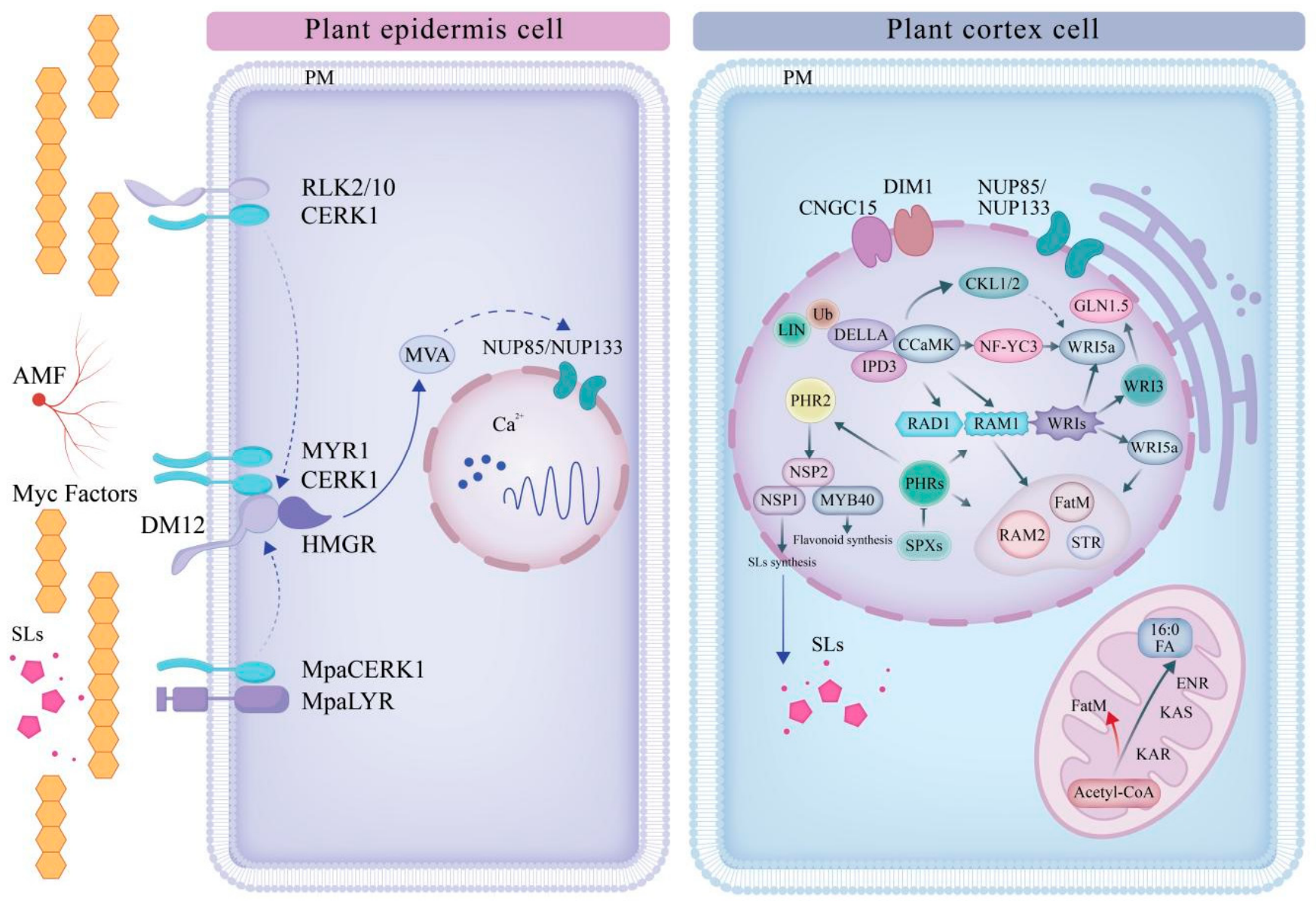
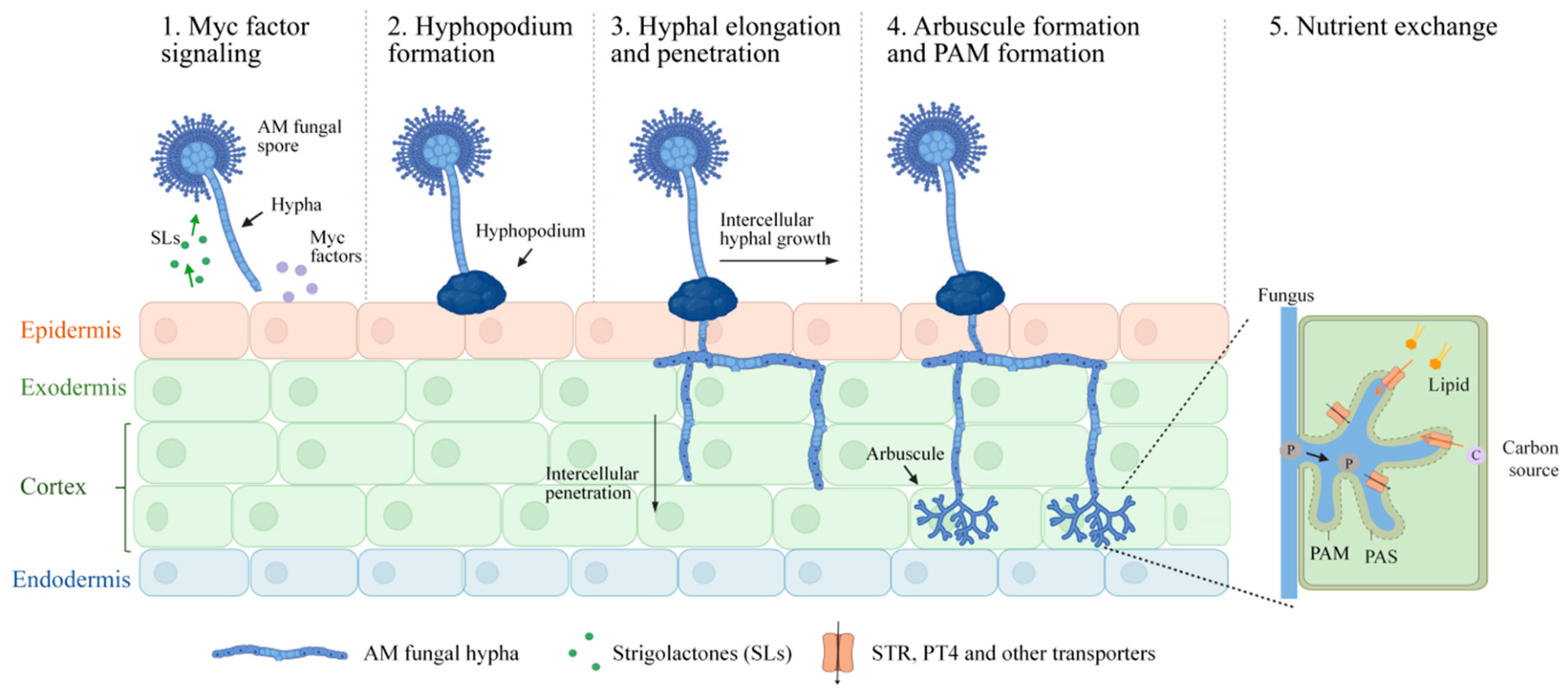
During the establishment of symbiosis, plant roots release SLs into the rhizosphere, which act as signaling molecules to stimulate hyphal branching of AMF. In turn, the fungi release diffusible signals such as chitin oligosaccharides (Myc-LCOs/COs), which are perceived by root epidermal cells. This recognition process activates a response that depends on the CSSP, involving components such as nucleoporins and nuclear membrane-localized cation channels. These events ultimately induce Ca2+ oscillations in the nucleus of host root cells. These Ca2+ oscillations are sensed by a calcium- and calmodulin-dependent protein kinase (CCaMK), which subsequently activates downstream transcription factors [3,5,6].
Once AMF hyphae penetrate the epidermis and enter root cortical cells, the root cortical cells undergo extensive transcriptional reprogramming to accommodate the symbiont. Within the cortical cells, the fungus develops highly branched arbusculars, which are enveloped by the plant-derived periarbuscular membrane (PAM) [7,8]. The PAM harbors phosphate, ammonium, nitrate, and lipid transporters (e.g., STR), which are responsible for the efficient transfer of nutrients such as phosphorus and nitrogen from the fungus to the plant. In exchange, the plant delivers up to 20% of its fixed carbon and essential fatty acids to the obligate biotrophic fungus via sugar transporters (SUTs, SWEETs) and the lipid transfer system (Figure 1) [2,6,9,10].
Since the first gene related to AM symbiosis was identified in legumes, systematic progress has been made in understanding the molecular mechanisms underlying this symbiosis. Subsequently, research on AM symbiosis in non-legumes has also entered a period of rapid development, greatly expanding our understanding of the conserved symbiotic mechanisms across different plant lineages. In mycorrhizal host plants, loss-of-function screening is often time-consuming and challenging due to genetic redundancy, resulting in many key regulatory factors, including transcription factors, remaining to be fully characterized [11].
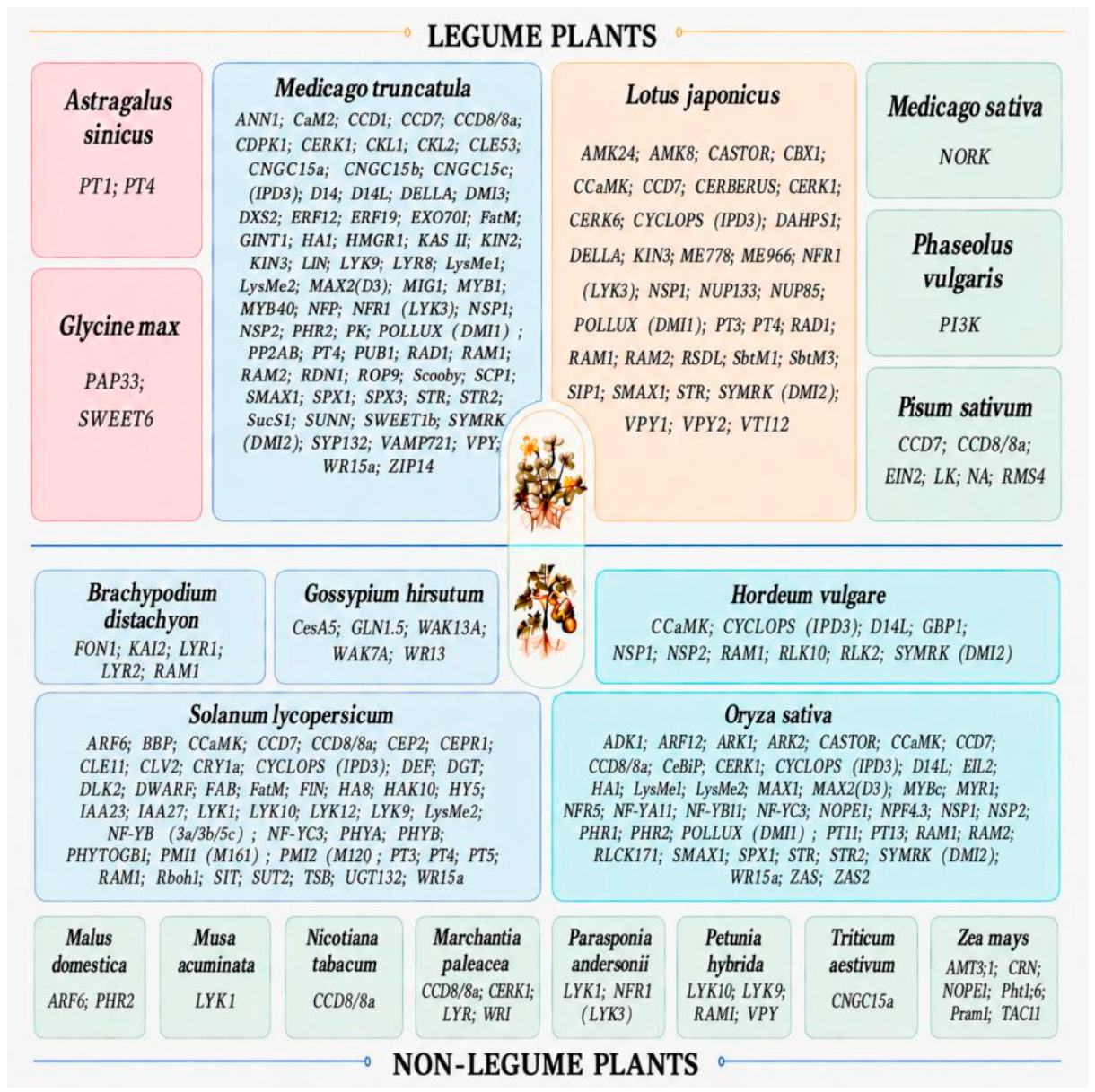
Based on this, the present review systematically summarizes AM symbiosis-related genes identified over the past three decades, compiling a total of 172 functionally validated genes (Table S1). These genes were classified according to the evolutionary status and research background of the species. They are primarily derived from legumes (e.g., M. truncatula, L. japonicus, Glycine max) and non-legumes (e.g., O. sativa, S. lycopersicum, Z. mays, Brachypodium distachyon) and also include orthologs identified in basal land plants (e.g., Marchantia paleacea). Based on the above classification, we constructed a species distribution map of AM symbiosis-related genes, illustrating the number and types of identified genes across different plant lineages (Figure 2).
Legumes (Fabaceae) include the following species: L. japonicus, Glycine max, Phaseolus vulgaris, Pisum sativum, M. sativa, M. truncatula, Astragalus sinicus. Non-legumes include the following species: B. distachyon, Gossypium hirsutum, Hordeum vulgare, Malus domestica, M. paleacea, Musa acuminata, Nicotiana tabacum, O. sativa, Parasponia andersonii, Petunia hybrida, S. lycopersicum, Triticum aestivum, Z. mays. The classification diagram intuitively displays the distribution of gene numbers across different plant lineages. See also Table S1 for detailed data.
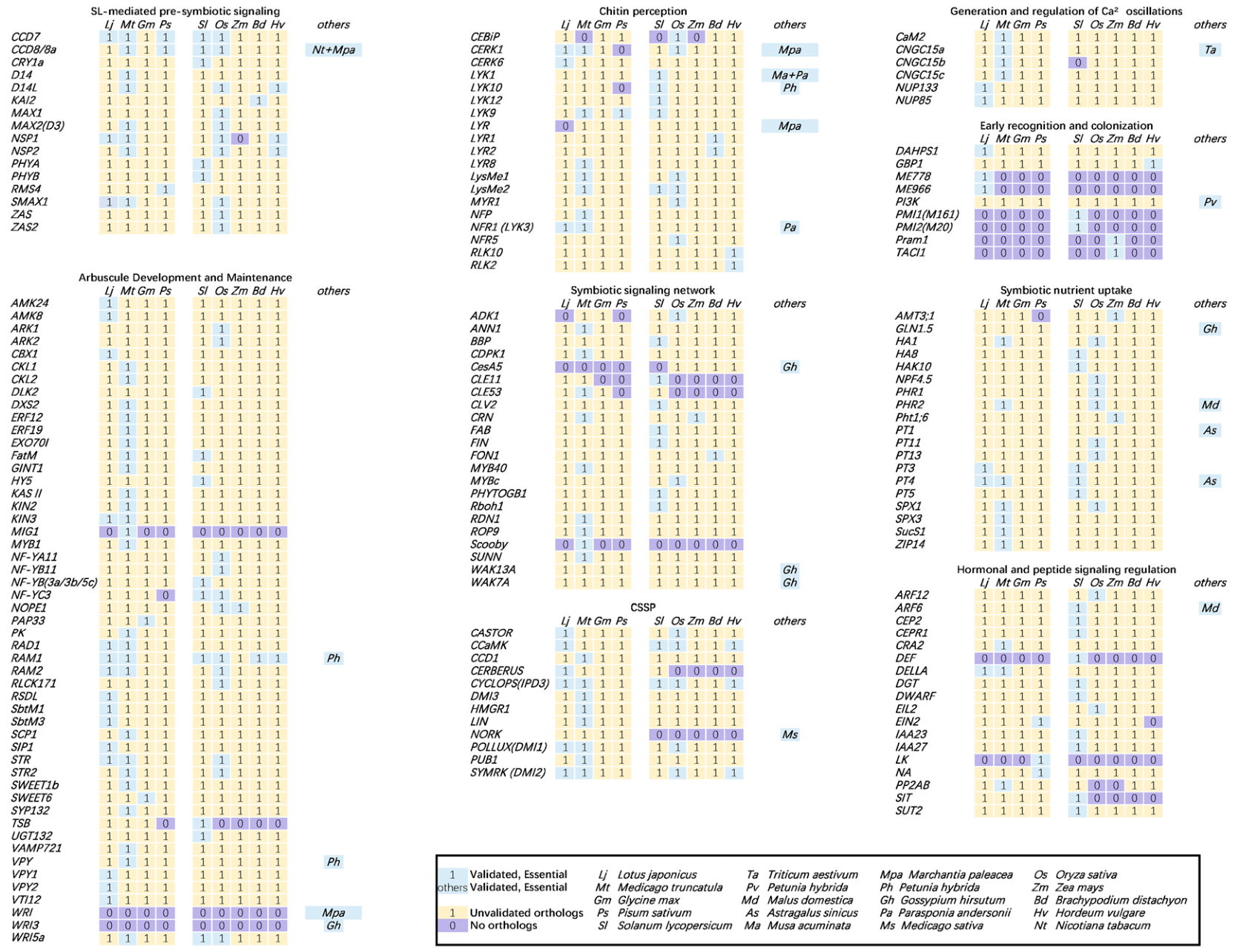
To investigate the evolutionary conservation and functional divergence of AM symbiosis-related genes across the plant kingdom, we selected nine representative species, covering the Fabaceae (including L. japonicus, M. truncatula, G. max, P. sativum), Solanaceae (S. lycopersicum), and Poaceae (O. sativa, Z. mays, B. distachyon, H. vulgare). These species possess well-annotated genomes and rich genetic resources and have accumulated extensive functional validation data in the field of AM symbiosis, providing a solid foundation for cross-species orthologous comparison. Based on the sequences of functionally validated genes, we performed systematic orthologous screening and comparative analysis. Subsequently, focusing on key steps in AM symbiosis establishment, including SL-mediated pre-symbiotic signaling, chitin signal perception, CSSP, Ca2+ spiking generation and decoding, early signal recognition and regulation, arbuscule development and maintenance, and symbiotic nutrient uptake, we summarized the presence (Figure 3), sequence features, and potential functional conservation of these genes across different species (Table S1). This analysis provides an important basis for understanding the evolutionary trajectory and species-specific adaptations of AM symbiosis. These findings not only deepen our understanding of the molecular network underlying plant–fungal mutualism but also provide important theoretical foundations and genetic resources for future genetic improvement aimed at enhancing crop nutrient use efficiency and agricultural sustainability.

2. SL-Mediated Pre-Symbiotic Signaling

SLs are multifunctional carotenoid-derived plant metabolites with diverse biological functions in plant growth and development. Crucially, root-secreted SLs act as core rhizosphere signaling molecules governing pre-symbiotic interactions with AM fungi. Although SL biosynthesis and signaling are not uniquely dedicated to symbiosis, the conserved SL synthetic and transduction machinery is specifically required for triggering early pre-symbiotic communication and facilitating AM symbiosis establishment under phosphate starvation.

2.1. Key SL Biosynthetic Enzymes Associated with AM Pre-Symbiotic Signaling

SL biosynthesis requires multiple enzymes, among which CCD7 (carotenoid cleavage dioxygenases) and CCD8 act as core rate-limiting components. These two enzymes are indispensable for SL-mediated pre-symbiotic signaling and AM symbiosis, with conserved but species-diversified regulatory functions.
Defective CCD7 impairs mycorrhizal colonization in M. truncatula [12] and tomato [13]. Furthermore, the ccd7 mutant displays defects in red-light-regulated AM symbiosis and phosphorus accumulation [14], whereas L. japonicus can maintain normal AM colonization despite reduced SL levels after LjCCD7 silencing, suggesting species-specific regulatory redundancy [15]. By contrast, CCD8 primarily supports early symbiosis establishment [16]. Reduced hyphal branching and impaired mycorrhizal colonization are observed in pea ccd7 and ccd8 mutants [17]. Mutations in tobacco [18] and M. truncatula [19] CCD8 consistently cause SL deficiency, defective fungal hyphal branching, and reduced colonization. In rice, the CCD8 homolog D10 is required for fungal appressorium formation and sustained root colonization [20,21]. Evolutionarily, CCD8-mediated SL synthesis represents an ancestral symbiotic mechanism, as redundant MpCCD8A/8B in the bryophyte M. paleacea ensures basal SL production and ancient AM symbiosis [22].
In addition, other CCD family members also modulate AM symbiosis by regulating apocarotenoid and SL metabolism. Rice OsZAS and OsZAS2 encode zaxinone synthases; the mutation disrupts SL biosynthesis and thereby reduces AM colonization [23,24]. MtCCD1 suppression disrupts symbiosis-related apocarotenoid metabolism and mildly affects arbuscule development [25].

2.2. Functional Diversification of SL Receptors in Regulating AM Symbiosis

Dwarf14 (D14) is a well-characterized receptor for SLs [26]. By contrast, Dwarf14-Like (D14L), an α/β hydrolase homologous to D14, acts as a receptor for a broader range of butenolides, including both SLs and karrikin-like molecules [12], and has been demonstrated to be essential for the establishment of AMF colonization in rice [27,28], M. truncatula and H. vulgare [12]. Under nutrient limitation, NSP1/NSP2 coordinate SL biosynthesis and chitin perception to amplify pre-symbiotic responses [12]. Accessories, including KAI2 [29], D3/MAX2 [20,26,27], and OsMAX1 [30] family proteins, further support D14L-dependent symbiotic signaling.

2.3. Regulatory Network and Adaptive Plasticity of SL Symbiotic Signaling

SL-mediated pre-symbiotic signaling is precisely modulated by endogenous and environmental cues to balance symbiotic performance and plant growth. The D14L signaling cascade activates AM symbiosis by promoting the degradation of the repressor SMAX1, while ethylene stabilizes SMAX1 protein to suppress mycorrhizal colonization [12,26,31]. Light signaling serves as a key environmental regulator: the phyB/cry1a-HY5 module transcriptionally upregulates CCD7, CCD8, and MAX1 to promote SL synthesis and symbiosis, while far-red light exerts negligible effects [14]. Multiple upstream regulators, including RMS4O [32], ORT1 [33], RMS1 [34], NSP1 and NSP2, further link nutrient status to SL signaling and fine-tune AM colonization efficiency [33,35]. Furthermore, NSP1 in M. truncatula, L. japonicus, and H. vulgare, as well as NSP2 in M. truncatula and H. vulgare, positively regulate AM colonization, with their mutants exhibiting significantly reduced AM colonization levels [12,33,35,36].
SL-mediated pre-symbiotic signaling exhibits conserved core mechanisms and flexible regulatory plasticity to sustain stable AM symbiosis. The core SL biosynthesis and D14L-dependent signaling pathways are evolutionarily conserved in land plants, and disruption of key genes severely impairs early mycorrhizal colonization. Meanwhile, this symbiotic pathway possesses remarkable functional redundancy and environmental adaptability across plant species and growth stages. Multiple compensatory mechanisms support symbiotic robustness, including temporal colonization recovery in rice d10 mutants [37], functional redundancy of LjCCD7 and MpCCD8a/8b [15,22], and unchanged symbiotic performance in sorghum lgs1 mutants with altered SL components [38]. Additionally, symbiosis-induced blumenols can partially compensate for impaired SL signaling to maintain symbiotic homeostasis [12]. Collectively, these layered conservation and compensatory mechanisms enable flexible plant–AM fungus interactions, offering valuable genetic targets for improving crop nutrient utilization efficiency.

3. Chitin Perception

AM fungi activate symbiosis through chitin-derived signals (LCOs and COs). Plant perception of these signals is not a simple on-off switch but a multi-layer, cell-surface signaling gateway that integrates ligand discrimination, immune suppression, and nutrient status to initiate the CSSP.
At the plasma membrane of epidermal cells, distinct LysM-RLK heterodimers discriminate between different chitinous ligands. In rice, the CO4-specific receptor OsMYR1 pairs with the dual-function kinase OsCERK1 (required for both symbiosis and immunity) to activate CSSP [39,40,41]. OsCEBiP is essential for longer CO8 perception; its loss reduces CO8 response but unexpectedly increases early colonization, indicating that dampening immune detection facilitates fungal entry [39,42]. In legumes, NFR1/LYK3 specifically perceives Myc-LCOs [40], while SlLYK1 acts as the key receptor responsible for long-chain chitin CO8 perception [43], and in barley, the NFR5 homolog HvRLK10 cooperates with RLK2 for LCO perception [12]. This receptor logic is deeply conserved: even the liverwort M. paleacea employs the ancient MpaCERK1-MpaLYR pair for chitin perception and AM symbiosis (Figure 4) [1].
Several LysM-RLKs have evolved bifunctional roles that help balance colonization with defense. Although a previous study reported that the lys6 mutant had no significant effect on mycorrhizal colonization [44], further analysis revealed that LYS6/CERK6 in L. japonicus recognizes long-chain chitin to trigger defense responses, positively regulates mycorrhizal colonization, and plays an important role in CO4/CO8-induced Ca2+ signaling [45,46]. Similarly, M. truncatula LYK9 plays a dual role in disease resistance and AM symbiosis [47]. LYR-IB group receptors (e.g., MtLYR8) exhibit high affinity for LCOs and both short- and long-chain COs; their mutations specifically impair AM symbiosis without affecting rhizobial nodulation [48].
Beyond membrane-bound receptors, secreted LysM proteins fine-tune the symbiotic dialog at the interface. LysMe1/2 are conserved apoplastic proteins localized to arbuscule-containing cells, and mutations in M. truncatula, tomato, and rice severely reduce AMF colonization and arbuscule formation [19,49,50]. Ligand perception does not operate in isolation; it is tightly integrated with plant nutritional status. NSP1 and NSP2 regulate LCO perception under nutrient starvation; their double mutation markedly attenuates Ca2+ oscillations. Furthermore, D14L plays a key role in LCO perception and AMF colonization [12].

4. Generation and Regulation of Ca2+ Oscillations

Nuclear Ca2+ oscillations are key events in symbiotic signal transduction, facilitating plant recognition of AMF. DMI1 and CNGC15 play essential roles in symbiotic Ca2+ oscillations [51]; functional mutations in either gene severely impair Ca2+ spiking. DMI1 and CNGC15 form a complex at the nuclear envelope to coordinate these oscillations. The gain-of-function mutation of CNGC15 (CNGC15GoF) induces spontaneous low-frequency Ca2+ oscillations and, in concert with DMI1, enables Nod factors to trigger higher-frequency oscillations, thereby significantly enhancing AM colonization in alfalfa and wheat [52].
In contrast, holo-CaM2 (the calcium-bound form of CaM2) interacts with CNGC15 and provides negative feedback to close the channel, thereby regulating nuclear Ca2+ oscillations. Engineered holo-CaM2 accelerates Ca2+ oscillation frequency and early symbiotic signaling, enhancing root nodule symbiosis but not AM symbiosis [53].
NUP85 and NUP133 are nucleoporins essential for Ca2+ oscillations in the common symbiosis signaling pathway. Mutations in either gene lead to mycorrhizal colonization defects: in the nup85 mutant, hyphae fail to penetrate the cortex; in both nup85 and nup133 mutants, Nod factors fail to induce Ca2+ spiking [54,55].

Early Recognition and Colonization

During the early recognition and invasion stage of symbiosis, Nope1 encodes an N-acetylglucosamine transporter belonging to the MFS superfamily. Its loss of function results in failure of appressorium formation in maize or formation of aberrant hyphopodia in rice, indicating its involvement in pre-contact early recognition [56]. In the Taci1 mutant, appressorium formation frequency is reduced, but morphology is normal, and hyphae can penetrate the epidermis; however, after entering the root, most hyphae become septated, leading to termination of fungal spread. Pram1 exhibits the opposite phenotype: earlier and enhanced fungal invasion with normal hyphal morphology, indicating that it acts as a negative regulator of symbiosis [57].
During the nutrient exchange and arbuscule formation stage, DAHPS1 is the first enzyme of the shikimate pathway; its mutants exhibit delayed AM colonization and a reduced arbuscule formation rate [58]. PI3K is essential for root hair growth and curling, infection thread migration, nodulation, and AM symbiosis; its loss of function severely impairs root hair growth and curling, and AM fungi fail to enter epidermal and cortical cells, resulting in failure to form typical arbuscules and severely impaired colonization [59].
Regarding host defense regulation, barley GBP1 and GBP2 are GH81-type β-1,3-endoglucanases that regulate host defense by recognizing fungal β-glucans; mutations in both genes impair beneficial fungal colonization and lead to excessive activation of cell wall defense responses [60]. The tomato pmi mutants M161 and M20 both suppress AM fungal proliferation through root exudates, with M20 exhibiting a stronger inhibitory Myc phenotype than M161 [61,62].

5. CSSP

The CSSP is a core signaling module shared by plants for establishing symbiosis with both rhizobia and AMF. Its key components were initially identified in M. truncatula through “Nod-Myc” mutants, which are defective in both nodulation and mycorrhizal colonization.

5.1. Upstream Signal Perception and Initiation of Ca2+ Spiking

DMI1 and DMI2 are upstream components of the CSSP that together mediate periodic nuclear Ca2+ spiking upon symbiotic signal perception. Both Nod factors from rhizobia and hyphopodium exudates from AM fungi require DMI1 and DMI2 to induce nuclear Ca2+ spiking [63]. In M. truncatula dmi1 and dmi2 mutants, AM fungal exudates fail to induce nuclear Ca2+ oscillations, and the mutants are defective in both nodulation and mycorrhization [64,65,66]. Notably, although Ca2+ spiking is abolished, dmi1 and dmi2 mutants still exhibit Nod-factor-induced rapid Ca2+ influx [63].
HMGR1, a key regulatory enzyme of the mevalonate (MVA) pathway, catalyzes the conversion of HMG-CoA to MVA, interacts with DMI2, and is essential for initiating Ca2+ oscillations and symbiotic gene expression, indicating a critical role for the MVA pathway in early symbiotic signaling [67]. PUB1 is an E3 ubiquitin ligase that interacts with DMI2 and negatively regulates AM fungal infection and colonization through its ubiquitination activity [68].

5.2. Ca2+ Signal Decoding and Downstream Responses

DMI3 plays a dual role in both nodulation and mycorrhizal symbiosis. Unlike DMI1 and DMI2, the dmi3 mutant can still generate Ca2+ spiking, indicating that DMI3 is not involved in Ca2+ spiking generation but rather in “reading” and “decoding” these Ca2+ signals [63,64,69]. DMI3/CCaMK act downstream of Ca2+ spiking, physically interact with the active kinase CYCLOPS, and phosphorylate CYCLOPS in vitro. Together, they coordinately regulate intracellular accommodation. CYCLOPS, a regulator of AM symbiosis, directly blocks arbuscular mycorrhiza formation when mutated in rice, H. vulgare, and L. japonicus [12,70,71]. Consistently, loss-of-function mutations of CCaMK in H. vulgare, L. japonicus, and S. lycopersicum all lead to defects in AM symbiosis [12,72,73]. In M. truncatula, ipd3 and ipd3l mutants exhibit reduced mycorrhizal colonization [74,75]. In rice, ipd3 mutation blocks AM symbiosis establishment, and the transcript of the mycorrhiza-specific phosphate transporter OsPT11 becomes undetectable [76].

5.3. Coordinated Roles of CSSP Core Components in Ca2+ Oscillations

SYMRK encodes a receptor-like kinase that acts as a co-receptor upstream of Ca2+ oscillations in the symbiotic signaling pathway; its dysfunction directly affects Ca2+ signaling initiation and AM symbiosis [77]. Both SYMRK and CASTOR mutations significantly reduce CO4-induced cytoplasmic Ca2+ peaks, maintain the first phase of cytoplasmic Ca2+ transients, but abolish the second phase of nuclear Ca2+ transients, suggesting their coordinated regulation of nuclear Ca2+ signals [46,72,78].
CASTOR and POLLUX both encode cation channels that act upstream of Ca2+ oscillations and are essential for Ca2+ spiking and nuclear Ca2+ signal generation. Mutations in either gene lead to Ca2+ oscillation defects, and mutants in L. japonicus and rice exhibit AM symbiosis defects: the fungus is restricted to forming hyphopodia and distorted hyphae on the root epidermis, failing to effectively invade the cortical layer, resulting in failure to form arbuscules and vesicles [46,72,79,80]. Loss of POLLUX function in rice also leads to loss of Blumenol accumulation, which is essential for cortical infection and arbuscule formation [37].

5.4. E3 Ubiquitin Ligase Regulation Within the CSSP

CERBERUS is a U-box protein with E3 ubiquitin ligase activity; its mutation reduces hyphal elongation along the root axis and decreases colonization levels [36,81]. LUMPY INFECTION (LIN) governs infection-thread polar growth during nodulation, yet its role in AM symbiosis remains unclear. Recent studies in M. truncatula reveal that LIN and its four homologs (LINL1–LINL4) function redundantly in both nodulation and AM symbiosis, and genetic disruption of these genes significantly impairs symbiotic colonization. The U-box, Armadillo-like, and WD40 domains are indispensable for LIN symbiotic activity. Both LIN and LINL1 exhibit U-box-dependent E3 ubiquitin ligase activity and interact with the core CSSP scaffold DELLA proteins through their U-box domains. Collectively, LIN/LINL family members represent redundant CSSP components that facilitate endosymbiotic microbial accommodation via U-box-mediated DELLA modulation [82].

6. Symbiotic Signaling Network

AM symbiosis establishment and homeostasis are governed by a sophisticated and interconnected regulatory network, covering upstream transcriptional control, plant endogenous post-transcriptional/protein fine-tuning, and fungal self-regulation coupled with plant immune balancing. These multi-dimensional modules act sequentially and synergistically to precisely control fungal infection, arbuscule morphogenesis, and the trade-off between symbiotic accommodation and immune defense.
At the transcriptional level, MYB transcription factors regulate AM symbiosis through distinct but interconnected pathways. OsMYBc regulates salt tolerance by targeting the potassium transporter gene OsHKT1;1 [11]. The legume-specific MYB40 directly binds to flavonoid biosynthesis gene promoters and interacts with NSP2, promoting AM colonization under nutrient starvation; the myb40 mutant exhibits an approximately 65% reduction in colonization rate, with normal arbuscule morphology and unaffected SL biosynthesis gene expression, indicating that the defect occurs at the early symbiotic signaling stage [83]. Notably, the flavonoid pathway plays a conserved positive role, as a gain-of-function mutation of CNGC15 enhances symbiosis and nutrient uptake by modulating flavonoid metabolism [52]. Together, these findings indicate that MYB factors and flavonoid metabolism form a regulatory network linking nutrient status, Ca2+ signaling, and transcriptional control of AM symbiosis.
Downstream of transcriptional regulation, multiple conserved post-transcriptional and signaling pathways fine-tune symbiotic intensity mainly through ROS, Ca2+/NO, and nutrient-dependent signaling. The CLE signaling pathway conservatively and negatively regulates AM symbiosis across multiple plant species. The MtCLE53-SUNN-RDN1 cascade restricts symbiotic progression, and mutation of this module enhances AMF colonization [84]. This regulatory function is conserved across plant species, as homologous CLE signaling components in tomato [85,86] and other crops similarly repress mycorrhization, representing a universal symbiotic constraint mechanism [85,86,87].
ROS homeostasis serves as a central regulatory hub, where small GTPase and pseudokinase proteins exert antagonistic effects to stabilize symbiosis. The small GTPase MtROP9 suppresses early fungal infection by promoting ROS accumulation, while its silencing facilitates symbiosis initiation [88]. By contrast, the CLE downstream pseudokinase MtCRN maintains ROS homeostasis to promote arbuscule development. The conserved function of CRN in M. truncatula [89] and maize [90] confirms the essential role of the CLE-ROP9-CRN regulatory axis in balancing symbiotic ROS responses.
miRNAs integrate nutrient and physiological signals to fine-tune symbiosis at the post-transcriptional level. miR399s act synergistically with SLs to negatively regulate mycorrhizal colonization under phosphate-sufficient conditions [18]. In tomato, the Sly-miR408b-SlBBP module modulates SOD activity and ROS scavenging, thereby dynamically adjusting mycorrhizal colonization to adapt internal plant physiological status [91]. Ca2+ and NO signaling act as core upstream sensing modules to support symbiosis activation and development. CDPK1 is involved in Ca2+ signaling and interacts with localized ROS production in epidermal cells during early fungal contact; its loss of function leads to significantly reduced colonization efficiency and arbuscule development [92]. MtAnn1 is a component of an ancient Ca2+ regulatory module, which is induced during AM symbiosis and is essential for normal arbuscule formation [93]. Additionally, PHYTOGB1 regulates AM symbiosis by modulating NO levels [94].
Complementing plant endogenous regulation, fungal self-regulation and plant immune reprogramming are essential prerequisites for successful symbiosis. The fungal transcription factor RiMsn2 controls fungal development and mycorrhization via the conserved RiHog1-RiMsn2-STREs module and impairs arbuscule formation and plant symbiotic adaptation [95]. At the plant immune interface, wall-associated kinases mediate the trade-off between symbiosis and defense: GhWAK13 suppresses immune responses to facilitate AM colonization, while GhWAK7A enhances immunity and restricts symbiosis. Cell wall damage signals such as oligogalacturonides further inhibit mycorrhization, confirming that active immune suppression is indispensable for symbiosis establishment [96].

7. Arbuscule Development and Maintenance

Arbuscule development and maintenance are the core functional stages of AM symbiosis, sustaining fungal accommodation and bidirectional nutrient exchange. This process is controlled by a sophisticated hierarchical regulatory network, in which the conserved RAM1–RAM2–WRI–FatM module acts as the central hub governing symbiosis-specific lipid biosynthesis, PAM assembly and arbuscule morphogenesis. Auxiliary transcription factors, vesicle trafficking components and receptor kinases fine-tune arbuscule development and stability, while senescence-related regulators mediate arbuscule turnover. These interconnected pathways collectively ensure the steady and sustainable operation of AM symbiosis.

7.1. Transcriptional Regulatory Network of Arbuscule Formation

The nuclear factor Y subunit NF-YC3 is a highly conserved positive regulator of AM symbiosis. In tomato and rice, NF-YC3 is strongly induced in arbuscule-containing cells, and its promoter is activated by the CYCLOPS-CCaMK complex. Knockdown or knockout of NF-YC3 leads to retarded or abnormally sized arbuscules, significantly reduced mycorrhizal colonization and arbuscule abundance, decreased phosphorus accumulation, and suppressed expression of AM marker genes (e.g., OsPT11) [97,98]. OsNF-YC3 is directly regulated by the phosphate starvation response master regulator OsPHRs and can form a heterotrimer with OsNF-YA11 and OsNF-YB11 to co-regulate symbiosis [98].
Downstream of NF-YC3 lies the central hub of the network RAM1, a core GRAS transcription factor highly conserved across multiple plant species, including M. truncatula, S. lycopersicum, B. distachyon, O. sativa, L. japonicus, H. vulgare, and P. hybrida. Loss of RAM1 function leads to failure or severe impairment of mycorrhizal colonization, defective appressorium formation, and blocked arbuscule development [11,12,99,100,101,102]. RAM1 interacts with another GRAS factor, RAD1, and together they regulate arbuscule development: RAD1 loss leads to slow intraradical colonization in M. truncatula or reduced arbuscule number and accelerated degeneration in L. japonicus [103,104]. MIG1 is a novel GRAS transcription factor that controls cortical cell expansion; its mutation leads to aberrant arbuscule morphology, reduced mature arbuscules, and increased malformed arbuscules [105].
WRI5s are AP2 transcription factors induced by AM fungi, regulating downstream target genes by binding to AW-box elements. WRI5a physically interacts with the bZIP factor SlHY5, and together they activate SlFatM-mediated fatty acid synthesis [106,107]. This regulatory module is conserved across plants: in M. truncatula, WRI5a acts downstream of CKL2 and participates in lipid supply by binding to the STR promoter [108]; loss of WRI5a/b in rice also leads to reduced mycorrhizal symbiosis [11]. ERF12 is a downstream negative regulator of WRI5a, suppressing arbuscule development and forming a negative feedback loop with WRI5a [109,110]. STR/STR1/STR2 are half-size ABCG transporters whose expression is regulated by the RAM1-WRI transcriptional module; mutations in these genes in M. truncatula, L. japonicus, and rice all lead to arbuscule formation defects [21,101,109,111]. SIP1 is an ARID-domain-containing transcription factor. Its long and short splice variants (SIP1L and SIP1S) can form oligomeric complexes. Mutation of SIP1 prevents fungal hyphae from entering cortical cells to form arbuscules, indicating that it specifically regulates fungal invasion and arbuscule establishment (Figure 4) [112].

7.2. Lipid Biosynthesis and Metabolic Regulation

Lipid biosynthesis is a key process for fungal colonization and PAM formation in AM symbiosis, regulated by a hierarchical network of upstream transcription factors. Multiple genes involved in the fatty acid biosynthesis pathway (e.g., MtPK, MtKAS I/II, MtKAR, MtENR I, MtFatM) are induced upon mycorrhizal fungal infection in M. truncatula and participate in AM symbiosis regulation [107].
SlFatM mediates the biosynthesis of 16-carbon fatty acids. Loss of SlFatM function or mutation of SlWRI5a/SlHY5 leads to impaired AM fungal colonization, defective PAM formation, and arbuscule collapse [113]. In the bryophyte M. paleacea, the WRINKLED (WRI) transcription factor directly regulates lipid metabolism in arbuscule-containing cells; CRISPR-Cas9 knockout of WRI results in arrested arbuscule development and fungal colonization restricted to intraradical hyphae, leading to termination of mutualistic symbiosis [114].
Downstream of transcriptional regulation, RAM1 directly activates its target gene RAM2, which encodes glycerol-3-phosphate acyltransferase (GPAT). RAM2 is essential for arbuscule formation and lipid export [106,115]; its mutation leads to reduced appressorium formation, aberrant arbuscules, and decreased fungal-specific lipid content, resulting in severely impaired colonization and abnormal hyphal branching after penetration in both L. japonicus and rice [101,116]. RAM1 also interacts with WRI transcription factors to co-regulate downstream genes required for arbuscule development [101]. FatM and RAM2 cooperatively fine-tune lipid synthesis to promote arbuscule development in M. truncatula [11].
CBX1, an AP2 transcription factor (a WRI1 homolog), co-regulates the expression of the phosphate transporter LjPT4 and the H+-ATPase LjHA1 by binding to CTTC and AW-box motifs [117] while also activating the lipid metabolism gene RAM2, thereby participating in fatty acid biosynthesis. The cortical-cell-membrane-localized CKL1 and CKL2 in M. truncatula are phosphorylation targets of DMI2 and LysM receptors and are essential for AM symbiosis. They initiate the lipid provisioning program by regulating transcription factor expression, a process that acts in concert with arbuscule branching and the RAM1 regulatory network [118].

7.3. PAM Formation and Vesicle Trafficking

Vesicle trafficking and PAM biogenesis form a core subnetwork supporting fungal intracellular accommodation and arbuscule development. The highly conserved VPY acts downstream of Ca2+ oscillations [119] and is indispensable for fungal intracellular colonization across multiple plant species [120,121,122,123]. Its homologous LjVPY2 also participates in mycorrhizal symbiosis [81]. VPY physically interacts and functionally coordinates with the AM-specific exocyst subunit EXO70I, which confers specialized exocytotic capacity to sustain PAM structural development [124]. A set of SNARE family proteins further fine-tune symbiotic membrane construction and arbuscule development: MtVAMP721d/e support normal arbuscule formation by regulating vesicle trafficking [125]. LjVTI12 modulates arbuscule maturation and senescence [126], and SYP132α specifically governs symbiotic exocytosis to prevent premature arbuscule collapse [127]. Moreover, multiple mycorrhiza-induced accessory proteins participate in symbiotic interface modulation. SCP1 promotes fungal development and normal arbuscule morphogenesis [128]. TSB maintains arbuscule branching and maturation via microtubule regulation [129], and SbtM1/3 facilitate intraradical hyphal growth and arbuscule colonization [130].

7.4. Arbuscule Maintenance and Receptor-like Kinase Regulation

Fine-tuning of arbuscule persistence and symbiotic homeostasis relies on a suite of conserved receptor-like kinases (RLKs) and cytoplasmic kinases, which act at the periarbuscular membrane to govern post-developmental symbiosis regulation. The PAM-localized serine/threonine kinases OsARK1 and OsARK2 function synergistically via a shared signaling pathway to sustain normal AM symbiosis; OsARK1 specifically facilitates vesicle formation and fungal colonization without altering arbuscule morphology [131], and the non-redundant activity of OsARK2 further consolidates this symbiotic regulatory process [132]. Beyond rice, the evolutionarily conserved KIN2-KIN3 RLK complex serves as a core positive regulator of symbiosis in legumes, with loss-of-function mutations (in M. truncatula and L. japonicus) leading to impaired mycorrhizal colonization and defective arbuscule development [133,134,135]. Mechanistically, KIN3 interacts physically with the cytoplasmic kinases AMK8 and AMK24 to form a complete RLK/RLCK regulatory cascade, and this module is transcriptionally controlled by CBX1 through AW-box-dependent binding; the conserved symbiotic function of this kinase module is further verified by the defective symbiotic phenotypes of rice OsRLCK171 (KIN3 ortholog) knockout plants [133]. Counterbalancing these symbiosis-promoting kinase modules, the RsbQ-like family protein SlDLK2 acts as a key negative regulator to prevent excessive symbiotic growth [136]. Together, these complementary positive and negative kinase signaling axes precisely balance arbuscule maintenance and symbiosis intensity, enabling robust and stable AM symbiosis.

7.5. Arbuscule Degeneration and Senescence

Arbuscule degeneration is an actively regulated program that balances nutrient exchange with plant resource allocation. Several transcriptional and hormonal regulators control the timing and extent of this process. MYB1 acts as a positive regulator of degeneration. MYB1 is involved in regulating arbuscule degeneration. Loss of MYB1 function leads to a significant reduction in the proportion of degenerated arbuscules and a marked increase in the proportion of medium and large arbuscules [137].
Sugar transport across the PAM is critical for arbuscule maintenance. MtSWEET1b is a sugar transporter localized to the PAM, primarily exhibiting sucrose efflux activity and participating in sucrose transport. Loss of its function leads to premature arbuscule collapse and a significant increase in the number of degenerated/collapsed arbuscules, indicating that MtSWEET1b plays a key role in arbuscule maintenance [138]. Similarly, mutation of the soybean SWEET6 also promotes arbuscule degeneration [139].
Beyond sugar transport, arbuscule degeneration is also tightly controlled by negative regulators such as LjRSDL. This C2H2 zinc finger protein regulates arbuscule degeneration through the hormone signal transduction pathway. Loss of LjRSDL blocks arbuscule degeneration, leading to increased mycorrhization rate and accumulation of large arbuscules; conversely, its overexpression accelerates arbuscule degeneration and suppresses mycorrhizal colonization and large arbuscule formation [140]. Thus, MYB1 and LjRSDL act antagonistically to fine-tune arbuscule lifespan.
Multiple metabolic enzymes influence degeneration through lipid remodeling, apocarotenoid synthesis, and glycosylation. GmPAP33 is a purple acid phosphatase involved in phospholipid hydrolysis during arbuscule degeneration. Its silencing blocks arbuscule degeneration and increases the proportion of small arbuscules [141]. MtGINT1 is a sphingolipid glycosyltransferase involved in the synthesis of specific glycosyl inositol phosphoryl ceramides (GIPCs) and is developmentally regulated in symbiotic tissues. Its silencing leads to impaired AM symbiosis, aberrant arbuscule development, and premature senescence [142]. MtDXS2 is a key enzyme in the MEP pathway, involved in the synthesis of apocarotenoids. Its mutation leads to reduced apocarotenoid accumulation, downregulation of marker genes such as MtPT4, and an increase in degenerated arbuscules accompanied by a decrease in mature arbuscules, indicating that the late stage of AM symbiosis is compromised [143]. SlUGT132 is a UDP-glycosyltransferase that negatively regulates AM development. Suppression of its function significantly promotes root colonization and arbuscule formation, suggesting that this enzyme maintains symbiotic homeostasis by limiting excessive symbiosis [144].

8. Symbiotic Nutrient Uptake

8.1. Transcriptional Regulation of Phosphate Uptake

The MYB transcription factors PHR1, PHR2, and PHR3 are core regulators of AM symbiosis. Loss of OsPHR1, OsPHR2, and OsPHR3 in rice leads to abnormal mycorrhizal colonization and impaired arbuscule development [11,145]. M. truncatula PHR2 regulates arbuscule development and phosphate uptake by activating P1BS-containing target genes [146]. Knockdown of MdPHR2 or MdARF6 in apple reduces mycorrhizal colonization and phosphate uptake. These two transcription factors synergistically activate MdPHT1;13 expression to promote phosphorus acquisition [147].
In rice, SPX proteins negatively regulate AM symbiosis by suppressing PHR activity. Because of high functional redundancy, only multigene knockout alleviates PHR inhibition, thereby enhancing mycorrhizal colonization and phosphate starvation responses through a derepression mechanism [11]. In contrast, Medicago SPX1 and SPX3 have more distinct functions: single mutants reduce mycorrhizal colonization and arbuscule abundance (suggesting positive regulation), whereas double mutants show both increased colonization and accelerated arbuscule degradation under low Pi, indicating that these proteins promote colonization while maintaining arbuscule stability [146,148].

8.2. Phosphate Transporters

The mycorrhiza-specific phosphate transporters of the PHT1 family are highly conserved across plant species and serve as core components for plant Pi acquisition in AM symbiosis. These proteins (e.g., LjPT3/LjPT4, OsPT11/OsPT13 in rice, SlPT3/SlPT4/SlPT5, MtPT4, AsPT1/AsPT4, and ZmPht1;6) mediate Pi uptake via the mycorrhizal pathway and maintain arbuscule structure and longevity. Loss of their function leads to reduced Pi uptake, decreased arbuscule number or premature degeneration, and in some cases (e.g., MtPT4) even termination of symbiosis [149,150,151,152,153,154,155]. Regulatorily, OsPT11 and OsPT13 are directly activated by the phosphate starvation regulator OsPHR2 via the P1BS element [151]. Furthermore, Pi transporters also respond to multiple nutrient stresses: SlPT3 is induced under combined Pi/Zn deficiency, participating in Pi transport, arbuscule development under Zn deficiency, and Fe homeostasis regulation [152]; ZmPht1;6 is involved in AM symbiosis and Pi/Zn uptake regulation [156]. This places the PHT1 transporters as the terminal effectors of the PSR network, translating transcriptional signals into nutrient flow.

8.3. Energy Supply

OsHA1, MtHA1, and SlHA8 are mycorrhiza-specific plasma membrane H+-ATPases primarily expressed in arbuscule-containing cells. They energize the symbiotic interface via proton pumping and are essential for arbuscule development and mycorrhizal phosphate uptake. Mutations lead to aberrant/degenerated arbuscules, reduced colonization, and severely impaired Pi uptake; SlHA8 also affects nitrogen uptake [157,158].

8.4. Nitrogen Uptake and Assimilation

Plants acquire nitrogen from AM fungi through both nitrate and ammonium transporters. GhGLN1.5 is a member of the glutamine synthetase family, catalyzing the conversion of inorganic nitrogen to glutamine and playing a key role in nitrogen assimilation. Silencing or knockout of this gene impairs AM symbiosis, resulting in reduced AM infection rates and decreased nitrogen uptake. The ethylene response factor GhWRI3 activates GhGLN1.5 expression via the AW-box, regulating nitrogen assimilation and AM symbiosis [159]. OsNPF4.5 is a mycorrhiza-induced nitrate transporter responsible for symbiotic nitrogen uptake; its mutation reduces nitrogen uptake by approximately 45% and significantly decreases arbuscule colonization [160]. ZmAMT3;1 is a high-affinity ammonium transporter localized to the PAM, mediating mycorrhizal nitrogen uptake; its RNAi silencing significantly reduces mycorrhiza-dependent nitrogen uptake, and its function does not depend on symbiosome formation [161].

8.5. Potassium and Zinc Uptake

SlHAK10 is a mycorrhiza-specific K+ transporter mediating mycorrhizal potassium uptake; enhanced potassium nutrition promotes fungal colonization [162]. MtZIP14 is a putative zinc transporter; its loss of function reduces fungal colonization, decreases vesicle and arbuscule colonization rates, and impairs AM colonization and AMF-mediated zinc uptake, particularly under low or sufficient Zn supply [163].

8.6. Carbon Supply and Symbiosis Maintenance

The plant provides carbon to the fungus in exchange. MtSucS1 (symbiotic sucrose synthase) plays a key role in arbuscule establishment and maintenance during AM symbiosis. Its knockdown significantly inhibits AM fungal colonization, impairs arbuscule development and maintenance, and leads to reduced plant phosphorus and nitrogen levels [164,165]. Carbon acquisition from the host plant is fundamental for maintaining AM symbiosis. MST2 is a plasma-membrane-localized high-affinity monosaccharide transporter primarily transporting glucose and is highly expressed during the fungal intraradical phase. Its loss of function reduces mycorrhization levels, decreases arbuscule number, and causes morphological abnormalities, indicating that MST2 is essential for functional AM symbiosis [166].

8.7. Hormonal and Peptide Signaling Regulation

Multiple plant hormones and peptide signals differentially govern AM symbiosis via cell-type-specific regulatory patterns.
Gibberellin (GA) negatively modulates AM symbiosis by repressing cortical arbuscule formation and maturation via DELLA-dependent signaling. GA negatively regulates AM symbiosis in cortical cells by repressing arbuscule formation and maturation in a DELLA-dependent manner. MtDELLA1/2 and DELLA proteins in L. japonicus are essential for normal symbiotic development, and GA restricts cortical arbuscule formation and symbiotic efficiency by promoting DELLA protein degradation [167,168,169].
Auxin signaling is essential for the establishment and maintenance of AM symbiosis in tomato. The nuclear-localized SlARF6–SlIAA23 module acts antagonistically to regulate SL biosynthesis, thereby modulating mycorrhizal colonization and symbiotic phosphorus uptake [170]. OsARF12/25 positively promote AM symbiosis by regulating auxin-dependent phosphate homeostasis [11].
IAA, Ethylene, BR, JA and ABA mediate AM symbiosis progression with distinct regulatory functions. Mutation of IAA27 leads to a significantly reduced mycorrhizal colonization rate and arbuscule number [171]. Ethylene acts as a negative regulator of mycorrhizal colonization, and mutations or RNAi of pea EIN2 and rice OsEIL2 both lead to enhanced colonization [172]. In contrast, BR serves as a positive regulator of AM development; mutations of BR biosynthesis genes DX and LK markedly impair mycorrhization and arbuscule formation, and the sucrose transporter SlSUT2 participates in symbiotic modulation by interacting with BR signaling proteins [173]. LK, an ortholog of the BR synthesis gene DET2, exhibits a reduced colonization rate and arbuscule formation when mutated [172]. Similarly, JA is involved in AM-mediated plant physiological responses [174]; the JA biosynthesis mutant def-1 also affects water regulation under AM symbiosis [175]. ABA-deficient tomato mutants also exhibit impaired mycorrhiza formation [136]. The PP2AB’1 functions downstream of ABA and Ca2+ signaling. It regulates fungal infection in epidermal cells and cortical cell growth, thereby promoting AM symbiosis establishment [176].
The CEP2–CEPR1/CRA2 peptide module coordinates root architecture and AM symbiosis. AM symbiosis downregulates CEP2 expression to relieve its inhibition on auxin-mediated lateral root growth [177]. The CEP2 receptor CRA2 positively regulates mycorrhizal colonization but restricts lateral root development. Alteration of CEP2 signaling disrupts the balance between root development and symbiosis, confirming its core regulatory role [178].

9. Conclusions and Perspectives

Over the past two decades, more than 170 plant genes essential for AM symbiosis have been characterized, establishing a comprehensive molecular framework spanning fungal signal perception, symbiotic signaling transduction, and bidirectional nutrient exchange. Despite these advances, multiple key knowledge gaps still hinder an in-depth and systematic understanding of AM symbiosis regulatory mechanisms. First, the functional coordination between evolutionarily conserved core pathways and variable peripheral regulatory modules remains elusive. Second, the cross-species functional conservation and regulatory divergence of symbiotic genes are poorly clarified, particularly for numerous genes identified only in individual plant species. Third, most current mechanistic models are generalized from bulk tissue data, lacking resolution of cell-type-specific regulatory patterns and epigenetic and hormonal dynamics underlying layered symbiotic responses.
The SL biosynthesis and perception cascade constitutes a highly conserved core module governing AM symbiosis in land plants, with key genes, including RAM1, CCaMK, CYCLOPS, and CCD7/8, acting as indispensable molecular switches across diverse plant species. However, the molecular mechanism coordinating the conserved core and plastic peripheral pathways of the SL regulatory network remains poorly understood. Accumulating evidence indicates that NSP transcription factors broadly regulate the biosynthesis of symbiosis-related apocarotenoids, including not only SLs but also blumenols and other mycorrhiza-associated derivatives. These apocarotenoid metabolites serve as key compensatory signaling components that confer regulatory flexibility to symbiotic signaling, while distinct interspecific SL dependency further shapes the plastic characteristics of AM symbiosis. The precise regulatory logic and functional coordination of these flexible peripheral pathways still require further systematic exploration. Furthermore, the cross-species functional conservation of numerous genes currently reported only in single species (e.g., ADK1, AMK24, AMT3;1) lacks systematic validation. Genes involved in fundamental cellular processes such as Ca2+ signaling and protein phosphorylation are likely to exhibit higher evolutionary conservation, whereas those involved in nitrogen transport and hormone-specific signaling are more prone to functional divergence. Addressing these questions will directly impact the cross-species breeding application value of core conserved genes and the research priority and translational potential of single-species-reported genes in major cereal crops.
Current mechanistic insights into plant AM symbiosis are mostly derived from bulk tissue-level analyses, which mask intrinsic cell-specific symbiotic regulatory characteristics. AM symbiosis is a spatially precise process dependent on coordinated functional interactions between root epidermal and cortical cells, which is fine-tuned by upstream chromatin modification and local hormonal dynamics, rather than uniform whole-root responses. Cortical cells are the core functional site for arbuscule formation and PAM-mediated nutrient exchange, while epidermal cells are primarily responsible for initial fungal chitin perception and symbiosis initiation. Accumulating evidence suggests that most AM symbiosis-related genetic regulatory programs operate in both cell layers with distinct functional partitioning, yet these cell-type-specific regulatory differences remain poorly resolved in current studies. Future research may transcend conventional tissue-averaged detection methods, focus on cell-specific local hormonal patterns and epigenetic reprogramming, and explore how epigenetic regulation coordinates layer-specific cellular responses to modulate arbuscule development and symbiosis maintenance, which will facilitate a more systematic understanding of the complex AM symbiosis regulatory network.
Advanced molecular and omics technologies provide powerful tools to address the above challenges. CRISPR/Cas9 gene editing enables high-throughput functional validation and cross-species assessment of core and species-specific symbiotic genes in staple crops including rice, wheat, and maize, facilitating the screening of elite genetic targets for improved mycorrhizal colonization and nutrient uptake efficiency. Furthermore, the integration of spatial transcriptomics and cell-specific profiling technologies allows dynamic, single-cell resolution tracing of arbuscule formation, maturation, and degeneration, enabling precise dissection of cell-layer-specific symbiotic regulatory mechanisms. In-depth elucidation of AM symbiosis regulatory networks will not only enrich the mechanistic understanding of plant–microbe symbiosis but also provide valuable gene resources and theoretical support for breeding nutrient-efficient crop varieties, reducing agricultural phosphate input, and promoting sustainable green agriculture.

Supplementary Materials

The following supporting information can be downloaded at: https://www.mdpi.com/article/10.3390/genes17060686/s1, Table S1: List of plant genes that have been functionally validated to play a role in AM symbiosis and Protein sequences of characterized AM symbiosis-related genes and their homologs identified in nine species [179,180,181,182,183,184,185,186,187,188,189,190].

Author Contributions

E.P. conceived the overall idea; S.W. wrote the manuscript; S.W., Z.L., J.W., Y.X., R.X., Y.W., L.D. and J.Y.; performed the literature search, data collection, table and figure preparation; E.P., L.Z. and J.Y. were responsible for manuscript revision, review, and final approval. All authors have read and agreed to the published version of the manuscript.

Funding

The authors declare that financial support was received for the research, authorship, and/or publication of this article. This work was supported by the National Natural Science Foundation of China (grant no. 31970286), Zhejiang Provincial-Local Collaborative Major Project: Dongyang Wood Carving Major Scientific and Technological Project (grant no. 2025SDXT004-2), and the Hangzhou Joint Fund of the Zhejiang Provincial Natural Science Foundation of China (grant nos. LHZQN25C130006 and LHZSZ24C010001).

Institutional Review Board Statement

Not applicable.

Informed Consent Statement

Not applicable.

Data Availability Statement

All data presented in this review are derived from previously published peer-reviewed literature, with the corresponding references provided in the main text and supplementary tables. All data supporting the findings of this study are included in this published article and its supplementary information files (Table S1). No primary experimental datasets were generated or analyzed during this study.

Acknowledgments

We sincerely appreciate Xing Wang and Hongfei Lu for their constructive comments and academic suggestions on this work.

Conflicts of Interest

The authors declare that there are no competing interests in this paper.

References

  1. Tan, X.; Wang, D.; Zhang, X.; Zheng, S.; Jia, X.; Liu, H.; Liu, Z.; Yang, H.; Dai, H.; Chen, X.; et al. A pair of LysM receptors mediates symbiosis and immunity discrimination in Marchantia. Cell 2025, 188, 1330–1348. [Google Scholar] [CrossRef]
  2. Wipf, D.; Krajinski, F.; van Tuinen, D.; Recorbet, G.; Courty, P.E. Trading on the arbuscular mycorrhiza market: From arbuscules to common mycorrhizal networks. New Phytol. 2019, 223, 1127–1142. [Google Scholar] [CrossRef] [PubMed]
  3. Parniske, M. Arbuscular mycorrhiza: The mother of plant root endosymbioses. Nat. Rev. Microbiol. 2008, 6, 763–775. [Google Scholar] [CrossRef]
  4. Luginbuehl, L.H.; Menard, G.N.; Kurup, S.; Van Erp, H.; Radhakrishnan, G.V.; Breakspear, A.; Oldroyd, G.E.D.; Eastmond, P.J. Fatty acids in arbuscular mycorrhizal fungi are synthesized by the host plant. Science 2017, 356, 1175–1178. [Google Scholar] [CrossRef]
  5. Akiyama, K.; Matsuzaki, K.-I.; Hayashi, H. Plant sesquiterpenes induce hyphal branching in arbuscular mycorrhizal fungi. Nature 2005, 435, 824–827. [Google Scholar] [CrossRef]
  6. Harrison, M.J. Cellular programs for arbuscular mycorrhizal symbiosis. Curr. Opin. Plant Biol. 2012, 15, 691–698. [Google Scholar] [CrossRef]
  7. Harrison, M.J.; Dewbre, G.R.; Liu, J. A Phosphate Transporter from Medicago truncatula Involved in the Acquisition of Phosphate Released by Arbuscular Mycorrhizal Fungi. Plant Cell 2002, 14, 2413–2429. [Google Scholar] [CrossRef]
  8. Pumplin, N.; Harrison, M.J. Live-Cell Imaging Reveals Periarbuscular Membrane Domains and Organelle Location in Roots during Arbuscular Mycorrhizal Symbiosis. Plant Physiol. 2009, 151, 809–819. [Google Scholar] [CrossRef]
  9. Wang, W.; Shi, J.; Xie, Q.; Jiang, Y.; Yu, N.; Wang, E. Nutrient Exchange and Regulation in Arbuscular Mycorrhizal Symbiosis. Mol. Plant 2017, 10, 1147–1158. [Google Scholar] [CrossRef] [PubMed]
  10. Luginbuehl, L.H.; Oldroyd, G.E. Understanding the Arbuscule at the Heart of Endomycorrhizal Symbioses in Plants. Curr. Biol. 2017, 27, R952–R963. [Google Scholar] [CrossRef] [PubMed]
  11. Shi, J.; Zhao, B.; Zheng, S.; Zhang, X.; Wang, X.; Dong, W.; Xie, Q.; Wang, G.; Xiao, Y.; Chen, F.; et al. A phosphate starvation response-centered network regulates mycorrhizal symbiosis. Cell 2021, 184, 5527–5540. [Google Scholar] [CrossRef]
  12. Li, X.; Sun, J.; Albinsky, D.; Zarrabian, D.; Hull, R.; Lee, T.; Jarratt-Barnham, E.; Chiu, C.; Jacobsen, A.; Soumpourou, E.; et al. Nutrient regulation of lipochitooligosaccharide recognition in plants via NSP1 and NSP2. Nat. Commun. 2022, 13, 6421. [Google Scholar] [CrossRef]
  13. Vogel, J.T.; Walter, M.H.; Giavalisco, P.; Lytovchenko, A.; Kohlen, W.; Charnikhova, T.; Simkin, A.J.; Goulet, C.; Strack, D.; Bouwmeester, H.J.; et al. SlCCD7 controls strigolactone biosynthesis, shoot branching and mycorrhiza-induced apocarotenoid formation in tomato. Plant J. 2010, 61, 300–311. [Google Scholar] [CrossRef]
  14. Ge, S.; He, L.; Jin, L.; Xia, X.; Li, L.; Ahammed, G.J.; Qi, Z.; Yu, J.; Zhou, Y. Light-dependent activation of HY5 promotes mycorrhizal symbiosis in tomato by systemically regulating strigolactone biosynthesis. New Phytol. 2022, 233, 1900–1914. [Google Scholar] [CrossRef]
  15. Liu, J.; Novero, M.; Charnikhova, T.; Ferrandino, A.; Schubert, A.; Ruyter-Spira, C.; Bonfante, P.; Lovisolo, C.; Bouwmeester, H.J.; Cardinale, F. CAROTENOID CLEAVAGE DIOXYGENASE 7 modulates plant growth, reproduction, senescence, and determinate nodulation in the model legume Lotus japonicus. J. Exp. Bot. 2013, 64, 1967–1981. [Google Scholar] [CrossRef]
  16. Kohlen, W.; Charnikhova, T.; Lammers, M.; Pollina, T.; Tóth, P.; Haider, I.; Pozo, M.J.; de Maagd, R.A.; Ruyter-Spira, C.; Bouwmeester, H.J.; et al. The tomato CAROTENOID CLEAVAGE DIOXYGENASE8 (SlCCD8) regulates rhizosphere signaling, plant architecture and affects reproductive development through strigolactone biosynthesis. New Phytol. 2012, 196, 535–547. [Google Scholar] [CrossRef] [PubMed]
  17. Gomez-Roldan, V.; Fermas, S.; Brewer, P.B.; Puech-Pagès, V.; Dun, E.A.; Pillot, J.-P.; Letisse, F.; Matusova, R.; Danoun, S.; Portais, J.C.; et al. Strigolactone inhibition of shoot branching. Nature 2008, 455, 189–194. [Google Scholar] [CrossRef]
  18. Zhao, M.; Zheng, X.; Su, Z.; Shen, G.; Xu, Y.; Feng, Z.; Li, W.; Zhang, S.; Cao, G.; Zhang, J.; et al. MicroRNA399s and strigolactones mediate systemic phosphate signaling between dodder-connected host plants and control association of host plants with rhizosphere microbes. New Phytol. 2025, 245, 1263–1276. [Google Scholar] [CrossRef] [PubMed]
  19. Kumar, A.; Lin, H.; Li, Q.; Ruan, Y.; Cousins, D.; Li, F.; Gao, S.; Jackson, K.; Wen, J.; Murray, J.D.; et al. Anthocyanin pigmentation as a quantitative visual marker for arbuscular mycorrhizal fungal colonization of roots. New Phytol. 2022, 236, 1988–1998. [Google Scholar] [CrossRef] [PubMed]
  20. Lv, S.; Zhang, Y.; Pan, L.; Liu, Z.; Yang, N.; Pan, L.; Wu, J.; Wang, J.; Yang, J.; Lv, Y.; et al. Strigolactone-triggered stomatal closure requires hydrogen peroxide synthesis and nitric oxide production in an abscisic acid-independent manner. New Phytol. 2018, 217, 290–304. [Google Scholar] [CrossRef]
  21. Gutjahr, C.; Radovanovic, D.; Geoffroy, J.; Zhang, Q.; Siegler, H.; Chiapello, M.; Casieri, L.; An, K.; An, G.; Guiderdoni, E.; et al. The half-size ABC transporters STR1 and STR2 are indispensable for mycorrhizal arbuscule formation in rice. Plant J. 2012, 69, 906–920. [Google Scholar] [CrossRef]
  22. Kodama, K.; Rich, M.K.; Yoda, A.; Shimazaki, S.; Xie, X.; Akiyama, K.; Mizuno, Y.; Komatsu, A.; Luo, Y.; Suzuki, H.; et al. An ancestral function of strigolactones as symbiotic rhizosphere signals. Nat. Commun. 2022, 13, 3974. [Google Scholar] [CrossRef]
  23. Votta, C.; Fiorilli, V.; Haider, I.; Wang, J.Y.; Balestrini, R.; Petřík, I.; Tarkowská, D.; Novák, O.; Serikbayeva, A.; Bonfante, P.; et al. Zaxinone synthase controls arbuscular mycorrhizal colonization level in rice. Plant J. 2022, 111, 1688–1700. [Google Scholar] [CrossRef]
  24. Ablazov, A.; Votta, C.; Fiorilli, V.; Wang, J.Y.; Aljedaani, F.; Jamil, M.; Balakrishna, A.; Balestrini, R.; Liew, K.X.; Rajan, C.; et al. ZAXINONE SYNTHASE 2 regulates growth and arbuscular mycorrhizal symbiosis in rice. Plant Physiol. 2023, 191, 382–399. [Google Scholar] [CrossRef] [PubMed]
  25. Floss, D.S.; Schliemann, W.; Schmidt, J.; Strack, D.; Walter, M.H. RNA Interference-Mediated Repression of MtCCD1 in Mycorrhizal Roots of Medicago truncatula Causes Accumulation of C27 Apocarotenoids, Shedding Light on the Functional Role of CCD1. Plant Physiol. 2008, 148, 1267–1282. [Google Scholar] [CrossRef]
  26. Choi, J.; Lee, T.; Cho, J.; Servante, E.K.; Pucker, B.; Summers, W.; Bowden, S.; Rahimi, M.; An, K.; An, G.; et al. The negative regulator SMAX1 controls mycorrhizal symbiosis and strigolactone biosynthesis in rice. Nat. Commun. 2020, 11, 2114. [Google Scholar] [CrossRef]
  27. Gutjahr, C.; Gobbato, E.; Choi, J.; Riemann, M.; Johnston, M.G.; Summers, W.; Carbonnel, S.; Mansfield, C.; Yang, S.-Y.; Nadal, M.; et al. Rice perception of symbiotic arbuscular mycorrhizal fungi requires the karrikin receptor complex. Science 2015, 350, 1521–1524. [Google Scholar] [CrossRef] [PubMed]
  28. Salem, M.A.; Jamil, M.; Wang, J.Y.; Berqdar, L.; Liew, K.X.; Paramita, A.; Ablazov, A.; Balakrishna, A.; Al-Babili, S. Disruption of the karrikin receptor DWARF 14 LIKE (D14L) gene leads to distinct effects on root and shoot growth, and reprogramming of central metabolism in rice. J. Exp. Bot. 2025, 76, 4114–4128. [Google Scholar] [CrossRef]
  29. Meng, Y.; Varshney, K.; Incze, N.; Badics, E.; Kamran, M.; Davies, S.F.; Oppermann, L.M.F.; Magne, K.; Dalmais, M.; Bendahmane, A.; et al. KARRIKIN INSENSITIVE2 regulates leaf development, root system architecture and arbuscular-mycorrhizal symbiosis in Brachypodium distachyon. Plant J. 2022, 109, 1559–1574. [Google Scholar] [CrossRef] [PubMed]
  30. Chen, G.; Wang, J.; Votta, C.; Braguy, J.; Jamil, M.; Kirschner, G.K.; Fiorilli, V.; Berqdar, L.; Balakrishna, A.; Blilou, I.; et al. Disruption of the rice 4-DEOXYOROBANCHOL HYDROXYLASE unravels specific functions of canonical strigolactones. Proc. Natl. Acad. Sci. USA 2023, 120, e230626312. [Google Scholar] [CrossRef]
  31. Das, D.; Varshney, K.; Ogawa, S.; Torabi, S.; Hüttl, R.; Nelson, D.C.; Gutjahr, C. Ethylene promotes SMAX1 accumulation to inhibit arbuscular mycorrhiza symbiosis. Nat. Commun. 2025, 16, 2025. [Google Scholar] [CrossRef]
  32. Foo, E.; Yoneyama, K.; Hugill, C.J.; Quittenden, L.J.; Reid, J.B. Strigolactones and the Regulation of Pea Symbioses in Response to Nitrate and Phosphate Deficiency. Mol. Plant 2013, 6, 76–87. [Google Scholar] [CrossRef]
  33. Liu, W.; Kohlen, W.; Lillo, A.; Op den Camp, R.; Ivanov, S.; Hartog, M.; Limpens, E.; Jamil, M.; Smaczniak, C.; Kaufmann, K.; et al. Strigolactone Biosynthesis in Medicago truncatula and Rice Requires the Symbiotic GRAS-Type Transcription Factors NSP1 and NSP2. Plant Cell 2011, 23, 3853–3865. [Google Scholar] [CrossRef] [PubMed]
  34. Boyer, F.D.; Germain, A.d.S.; Pillot, J.P.; Pouvreau, J.B.; Chen, V.X.; Ramos, S.; Stévenin, A.; Simier, P.; Delavault, P.; Beau, J.-M.; et al. Structure-Activity Relationship Studies of Strigolactone-Related Molecules for Branching Inhibition in Garden Pea: Molecule Design for Shoot Branching. Plant Physiol. 2012, 159, 1524–1544. [Google Scholar] [CrossRef]
  35. Maillet, F.; Poinsot, V.; André, O.; Puech-Pagès, V.; Haouy, A.; Gueunier, M.; Cromer, L.; Giraudet, D.; Formey, D.; Niebel, A.; et al. Fungal lipochitooligosaccharide symbiotic signals in arbuscular mycorrhiza. Nature 2011, 469, 58–63. [Google Scholar] [CrossRef] [PubMed]
  36. Takeda, N.; Tsuzuki, S.; Suzaki, T.; Parniske, M.; Kawaguchi, M. CERBERUS and NSP1 of Lotus japonicus are Common Symbiosis Genes that Modulate Arbuscular Mycorrhiza Development. Plant Cell Physiol. 2013, 54, 1711–1723. [Google Scholar] [CrossRef] [PubMed]
  37. Servanté, E.K.; Halitschke, R.; Rocha, C.; Baldwin, I.T.; Paszkowski, U. Independent regulation of strigolactones and blumenols during arbuscular mycorrhizal symbiosis in rice. Plant J. 2024, 119, 1289–1298. [Google Scholar] [CrossRef]
  38. Gobena, D.; Shimels, M.; Rich, P.J.; Ruyter-Spira, C.; Bouwmeester, H.; Kanuganti, S.; Mengiste, T.; Ejeta, G. Mutation in sorghum LOW GERMINATION STIMULANT 1 alters strigolactones and causes Striga resistance. Proc. Natl. Acad. Sci. USA 2017, 114, 4471–4476. [Google Scholar] [CrossRef]
  39. Zhang, C.; He, J.; Dai, H.; Wang, G.; Zhang, X.; Wang, C.; Shi, J.; Chen, X.; Wang, D.; Wang, E. Discriminating symbiosis and immunity signals by receptor competition in rice. Proc. Natl. Acad. Sci. USA 2021, 118, e2023738118. [Google Scholar] [CrossRef]
  40. He, J.; Zhang, C.; Dai, H.; Liu, H.; Zhang, X.; Yang, J.; Chen, X.; Zhu, Y.; Wang, D.; Qi, X.; et al. A LysM Receptor Heteromer Mediates Perception of Arbuscular Mycorrhizal Symbiotic Signal in Rice. Mol. Plant 2019, 12, 1561–1576. [Google Scholar] [CrossRef]
  41. Zhang, X.; Dong, W.; Sun, J.; Feng, F.; Deng, Y.; He, Z.; Oldroyd, G.E.; Wang, E. The receptor kinase CERK1 has dual functions in symbiosis and immunity signalling. Plant J. 2015, 81, 258–267. [Google Scholar] [CrossRef]
  42. Chiu, C.; Roszak, P.; Orvosova, M.; Paszkowski, U. Arbuscular mycorrhizal fungi induce lateral root development in angiosperms via a conserved set of MAMP receptors. Curr. Biol. 2024, 37, 91. [Google Scholar] [CrossRef]
  43. Liao, D.; Sun, X.; Wang, N.; Song, F.; Liang, Y. Tomato LysM Receptor-Like Kinase SlLYK12 Is Involved in Arbuscular Mycorrhizal Symbiosis. Front. Plant Sci. 2018, 9, 1004. [Google Scholar] [CrossRef] [PubMed]
  44. Bozsoki, Z.; Cheng, J.; Feng, F.; Gysel, K.; Vinther, M.; Andersen, K.R.; Oldroyd, G.; Blaise, M.; Radutoiu, S.; Stougaard, J. Receptor-mediated chitin perception in legume roots is functionally separable from Nod factor perception. Proc. Natl. Acad. Sci. USA 2017, 114, E8118–E8127. [Google Scholar] [CrossRef]
  45. Fukuda, H.; Mamiya, R.; Akamatsu, A.; Takeda, N. Two LysM receptor-like kinases regulate arbuscular mycorrhiza through distinct signaling pathways in Lotus japonicus. New Phytol. 2024, 243, 519–525. [Google Scholar] [CrossRef] [PubMed]
  46. Binci, F.; Offer, E.; Crosino, A.; Sciascia, I.; Kleine-Vehn, J.; Genre, A.; Giovannetti, M.; Navazio, L. Spatially and temporally distinct Ca2+ changes in Lotus japonicus roots orient fungal-triggered signalling pathways towards symbiosis or immunity. J. Exp. Bot. 2024, 75, 605–619. [Google Scholar] [CrossRef]
  47. Gibelin-Viala, C.; Amblard, E.; Puech-Pages, V.; Bonhomme, M.; Garcia, M.; Bascaules-Bedin, A.; Fliegmann, J.; Wen, J.; Mysore, K.S.; le Signor, C.; et al. The Medicago truncatula LysM receptor-like kinase LYK9 plays a dual role in immunity and the arbuscular mycorrhizal symbiosis. New Phytol. 2019, 223, 1516–1529. [Google Scholar] [CrossRef]
  48. Ding, Y.; Lesterps, Z.; Gasciolli, V.; Fuchs, A.-L.; Gaston, M.; Medioni, L.; de Regibus, A.; Remblière, C.; Vicédo, C.; Bensmihen, S.; et al. Several groups of LysM-RLKs are involved in symbiotic signal perception and arbuscular mycorrhiza establishment. Nat. Commun. 2025, 16, 5999. [Google Scholar] [CrossRef] [PubMed]
  49. Yu, H.; Bai, F.; Ji, C.; Fan, Z.; Luo, J.; Ouyang, B.; Deng, X.; Xiao, S.; Bisseling, T.; Limpens, E.; et al. Plant lysin motif extracellular proteins are required for arbuscular mycorrhizal symbiosis. Proc. Natl. Acad. Sci. USA 2023, 120, e2301884120. [Google Scholar] [CrossRef]
  50. Tian, L.; Hao, Y.; Guo, R.; Guo, H.; Cheng, J.; Liu, T.; Liu, H.; Lu, G.; Wang, B. Two lysin motif extracellular (LysMe) proteins are deployed in rice to facilitate arbuscular mycorrhizal symbiosis. New Phytol. 2024, 243, 720–737. [Google Scholar] [CrossRef]
  51. Liu, H.; Lin, J.; Luo, Z.; Sun, J.; Huang, X.; Yang, Y.; Xu, J.; Wang, Y.; Zhang, P.; Oldroyd, G.E.D.; et al. Constitutive activation of a nuclear-localized calcium channel complex in Medicago truncatula. Proc. Natl. Acad. Sci. USA 2022, 119, e2205920119. [Google Scholar] [CrossRef] [PubMed]
  52. Cook, N.M.; Gobbato, G.; Jacott, C.N.; Marchal, C.; Hsieh, C.Y.; Lam, A.H.C.; Simmonds, J.; del Cerro, P.; Gomez, P.N.; Rodney, C.; et al. Autoactive CNGC15 enhances root endosymbiosis in legume and wheat. Nature 2025, 638, 752–759. [Google Scholar] [CrossRef]
  53. del Cerro, P.; Cook, N.M.; Huisman, R.; Dangeville, P.; Grubb, L.E.; Marchal, C.; Lam, A.H.C.; Charpentier, M. Engineered CaM2 modulates nuclear calcium oscillation and enhances legume root nodule symbiosis. Proc. Natl. Acad. Sci. USA 2022, 119, e2200099119. [Google Scholar] [CrossRef]
  54. Kanamori, N.; Madsen, L.H.; Radutoiu, S.; Frantescu, M.; Quistgaard, E.M.; Miwa, H.; Downie, J.A.; James, E.K.; Felle, H.H.; Haaning, L.L.; et al. A nucleoporin is required for induction of Ca2+ spiking in legume nodule development and essential for rhizobial and fungal symbisis. Proc. Natl. Acad. Sci. USA 2006, 103, 359–364. [Google Scholar] [CrossRef]
  55. Saito, K.; Yoshikawa, M.; Yano, K.; Miwa, H.; Uchida, H.; Asamizu, E.; Sato, S.; Tabata, S.; Imaizumi-Anraku, H.; Umehara, Y.; et al. NUCLEOPORIN85 is required for calcium spiking, fungal and bacterial symbioses, and seed production in Lotus japonicus. Plant Cell 2007, 19, 610–624. [Google Scholar] [CrossRef]
  56. Nadal, M.; Sawers, R.; Naseem, S.; Bassin, B.; Kulicke, C.; Sharman, A.; An, G.; An, K.; Ahern, K.R.; Romag, A.; et al. An N-acetylglucosamine transporter required for arbuscular mycorrhizal symbioses in rice and maize. Nat. Plants 2017, 3, 17073. [Google Scholar] [CrossRef]
  57. Paszkowski, U.; Jakovleva, L.; Boller, T. Maize mutants affected at distinct stages of the arbuscular mycorrhizal symbiosis. Plant J. 2006, 47, 165–173. [Google Scholar] [CrossRef] [PubMed]
  58. Montiel, J.; García-Soto, I.; James, E.K.; Reid, D.; Cárdenas, L.; Napsucialy-Mendivil, S.; Ferguson, S.; Dubrovsky, J.G.; Stougaard, J. Aromatic amino acid biosynthesis impacts root hair development and symbiotic associations in Lotus japonicus. Plant Physiol. 2023, 193, 1508–1526. [Google Scholar] [CrossRef]
  59. Estrada-Navarrete, G.; Cruz-Mireles, N.; Lascano, R.; Alvarado-Affantranger, X.; Hernandez-Barrera, A.; Barraza, A.; Olivares, J.E.; Arthikala, M.K.; Cardenas, L.; Quinto, C.; et al. An Autophagy-Related Kinase Is Essential for the Symbiotic Relationship between Phaseolus vulgaris and Both Rhizobia and Arbuscular Mycorrhizal Fungi. Plant Cell 2016, 28, 2326–2341. [Google Scholar] [CrossRef]
  60. Wanke, A.; van Boerdonk, S.; Mahdi, L.K.; Wawra, S.; Neidert, M.; Chandrasekar, B.; Saake, P.; Saur, I.M.L.; Derbyshire, P.; Holton, N.; et al. A GH81-type β-glucan-binding protein enhances colonization by mutualistic in barley. Curr. Biol. 2023, 33, 5071–5084. [Google Scholar] [CrossRef] [PubMed]
  61. Gadkar, V.; David-Schwartz, R.; Nagahashi, G.; Douds, D.D.; Wininger, S.; Kapulnik, Y. Root exudate of pmi tomato mutant M161 reduces AM fungal proliferation in vitro. FEMS Microbiol. Lett. 2003, 223, 193–198. [Google Scholar] [CrossRef][Green Version]
  62. David-Schwartz, R.; Gadkar, V.; Wininger, S.; Bendov, R.; Galili, G.; Levy, A.A.; Kapulnik, Y. Isolation of a Premycorrhizal Infection (pmi2) Mutant of Tomato, Resistant to Arbuscular Mycorrhizal Fungal Colonization. Mol. Plant-Microbe Interact. 2003, 16, 382–388. [Google Scholar] [CrossRef]
  63. Lévy, J.; Bres, C.; Geurts, R.; Chalhoub, B.; Kulikova, O.; Duc, G.; Journet, E.; Ané, J.-M.; Lauber, E.; Bisseling, T.; et al. A Putative Ca2+ and Calmodulin-Dependent Protein Kinase Required for Bacterial and Fungal Symbioses. Science 2004, 303, 1361–1364. [Google Scholar] [CrossRef]
  64. Chabaud, M.; Genre, A.; Sieberer, B.J.; Faccio, A.; Fournier, J.; Novero, M.; Barker, D.G.; Bonfante, P. Arbuscular mycorrhizal hyphopodia and germinated spore exudates trigger Ca2+ spiking in the legume and nonlegume root epidermis. New Phytol. 2011, 189, 347–355. [Google Scholar] [CrossRef]
  65. Peiter, E.; Sun, J.; Heckmann, A.B.; Venkateshwaran, M.; Riely, B.K.; Otegui, M.S.; Edwards, A.; Freshour, G.; Hahn, M.G.; Cook, D.R.; et al. The Medicago truncatula DMI1 protein modulates cytosolic calcium signaling. Plant Physiol. 2007, 145, 192–203. [Google Scholar] [CrossRef]
  66. Seddas, P.M.A.; Arias, C.M.; Arnould, C.; van Tuinen, D.; Godfroy, O.; Benhassou, H.A.; Gouzy, J.; Morandi, D.; Dessaint, F.; Gianinazzi-Pearson, V. Symbiosis-Related Plant Genes Modulate Molecular Responses in an Arbuscular Mycorrhizal Fungus During Early Root Interactions. Mol. Plant-Microbe Interact. 2009, 22, 341–351. [Google Scholar] [CrossRef]
  67. Venkateshwaran, M.; Jayaraman, D.; Chabaud, M.; Genre, A.; Balloon, A.J.; Maeda, J.; Forshey, K.; Os, D.D.; Kwiecien, N.W.; Coon, J.J.; et al. A role for the mevalonate pathway in early plant symbiotic signaling. Proc. Natl. Acad. Sci. USA 2015, 112, 9781–9786. [Google Scholar] [CrossRef]
  68. Vernié, T.; Camut, S.; Camps, C.; Rembliere, C.; de Carvalho-Niebel, F.; Mbengue, M.; Timmers, T.; Gasciolli, V.; Thompson, R.D.; le Signor, C.; et al. PUB1 Interacts with the Receptor Kinase DMI2 and Negatively Regulates Rhizobial and Arbuscular Mycorrhizal Symbioses through Its Ubiquitination Activity in Medicago truncatula. Plant Physiol. 2016, 170, 2312–2324. [Google Scholar] [CrossRef]
  69. Siciliano, V.; Genre, A.; Balestrini, R.; Cappellazzo, G.; Dewit, P.J.G.M.; Bonfante, P. Transcriptome analysis of arbuscular mycorrhizal roots during development of the prepenetration apparatus. Plant Physiol. 2007, 144, 1455–1466. [Google Scholar] [CrossRef]
  70. Yano, K.; Yoshida, S.; Müller, J.; Singh, S.; Banba, M.; Vickers, K.; Markmann, K.; White, C.; Schuller, B.; Sato, S.; et al. CYCLOPS, a mediator of symbiotic intracellular accommodation. Proc. Natl. Acad. Sci. USA 2008, 105, 20540–20545. [Google Scholar] [CrossRef]
  71. Hornstein, E.D.; Charles, M.; Franklin, M.; Edwards, B.; Vintila, S.; Kleiner, M.; Sederoff, H. IPD3, a master regulator of arbuscular mycorrhizal symbiosis, affects genes for immunity and metabolism of non-host Arabidopsis when restored long after its evolutionary loss. Plant Mol. Biol. 2024, 114, 21. [Google Scholar] [CrossRef]
  72. Hayashi, T.; Banba, M.; Shimoda, Y.; Kouchi, H.; Hayashi, M.; Imaizumi-Anraku, H. A dominant function of CCaMK in intracellular accommodation of bacterial and fungal endosymbionts. Plant J. 2010, 63, 141–154. [Google Scholar] [CrossRef]
  73. Buendia, L.; Wang, T.; Girardin, A.; Lefebvre, B. The LysM receptor-like kinase SlLYK10 regulates the arbuscular mycorrhizal symbiosis in tomato. New Phytol. 2016, 210, 184–195. [Google Scholar] [CrossRef]
  74. Horváth, B.; Yeun, L.H.; Domonkos, A.; Halász, G.; Gobbato, E.; Ayaydin, F.; Miró, K.; Hirsch, S.; Sun, J.; Tadege, M.; et al. Medicago truncatula Is a Member of the Common Symbiotic Signaling Pathway Required for Rhizobial and Mycorrhizal Symbioses. Mol. Plant-Microbe Interact. 2011, 24, 1345–1358. [Google Scholar] [CrossRef]
  75. Lindsay, P.L.; Williams, B.N.; MacLean, A.M.; Harrison, M.J. A Phosphate-Dependent Requirement for Transcription Factors IPD3 and IPD3L During Arbuscular Mycorrhizal Symbiosis in Medicago truncatula. Mol. Plant-Microbe Interact. 2019, 32, 1277–1290. [Google Scholar] [CrossRef]
  76. Chen, C.; Ané, J.; Zhu, H. OsIPD3, an ortholog of the Medicago truncatula DMI3 interacting protein IPD3, is required for mycorrhizal symbiosis in rice. New Phytol. 2008, 180, 311–315. [Google Scholar] [CrossRef]
  77. Miyata, K.; Hosotani, M.; Akamatsu, A.; Takeda, N.; Jiang, W.D.; Sugiyama, T.; Takaoka, R.; Matsumoto, K.; Abe, S.; Shibuya, N.; et al. OsSYMRK Plays an Essential Role in AM Symbiosis in Rice (Oryza sativa). Plant Cell Physiol. 2023, 64, 378–391. [Google Scholar] [CrossRef]
  78. Stracke, S.; Kistner, C.; Yoshida, S.; Mulder, L.; Sato, S.; Kaneko, T.; Tabata, S.; Sandal, N.; Stougaard, J.; Szczyglowski, K.; et al. A plant receptor-like kinase required for both bacterial and fungal symbiosis. Nature 2002, 417, 959–962. [Google Scholar] [CrossRef]
  79. Gutjahr, C.; Banba, M.; Croset, V.; An, K.; Miyao, A.; An, G.; Hirochika, H.; Imaizumi-Anraku, H.; Paszkowski, U. Arbuscular Mycorrhiza-Specific Signaling in Rice Transcends the Common Symbiosis Signaling Pathway. Plant Cell 2008, 20, 2989–3005. [Google Scholar] [CrossRef]
  80. Imaizumi-Anraku, H.; Takeda, N.; Charpentier, M.; Perry, J.; Miwa, H.; Umehara, Y.; Kouchi, H.; Murakami, Y.; Mulder, L.; Vickers, K.; et al. Plastid proteins crucial for symbiotic fungal and bacterial entry into plant roots. Nature 2005, 433, 527–531. [Google Scholar] [CrossRef]
  81. Liu, M.; Jia, N.; Li, X.; Liu, R.; Xie, Q.; Murray, J.D.; Downie, J.A.; Xie, F. CERBERUS is critical for stabilization of VAPYRIN during rhizobial infection in Lotus japonicus. New Phytol. 2021, 229, 1684–1700. [Google Scholar] [CrossRef]
  82. Lu, L.; Zhang, Q.; Liu, J.; Shi, J.; Zou, X.; Wang, M.; Wang, S.; Dai, H.; Zhang, X.; Jiang, Y. The LIN and LINL E3 ligases function redundantly in arbuscular mycorrhizal symbiosis and nodulation of Medicago truncatula. New Phytol. 2026, 250, 2570–2585. [Google Scholar] [CrossRef]
  83. Gao, J.; Xia, C.; Chiu, C.; Chen, Q.; Jiang, S.; Wu, X.; Liang, W.; Sun, J.; Jhu, M.-Y.; Wen, J.; et al. An NSP2-MYB module orchestrates flavonoid biosynthesis and nodule symbiosis. Curr. Biol. 2026, 36, 940–953.E5. [Google Scholar] [CrossRef]
  84. Karlo, M.; Boschiero, C.; Landerslev, K.G.; Blanco, G.S.; Wen, J.; Mysore, K.S.; Dai, X.; Zhao, P.X.; de Bang, T.C. The CLE53-SUNN genetic pathway negatively regulates arbuscular mycorrhiza root colonization in Medicago truncatula. J. Exp. Bot. 2020, 71, 4972–4984. [Google Scholar] [CrossRef] [PubMed]
  85. Wulf, K.; Sun, J.; Wang, C.; Ho-Plagaro, T.; Kwon, C.-T.; Velandia, K.; Correa-Lozano, A.; Tamayo-Navarrete, M.I.; Reid, J.B.; Garrido, J.M.G.; et al. The Role of CLE Peptides in the Suppression of Mycorrhizal Colonization of Tomato. Plant Cell Physiol. 2024, 65, 107–119. [Google Scholar] [CrossRef]
  86. Wang, C.; Velandia, K.; Kwon, C.T.; Wulf, K.E.; Nichols, D.S.; Reid, J.B.; Foo, E. The role of CLAVATA signalling in the negative regulation of mycorrhizal colonization and nitrogen response of tomato. J. Exp. Bot. 2021, 72, 1702–1713. [Google Scholar] [CrossRef] [PubMed]
  87. Müller, L.M.; Flokova, K.; Schnabel, E.; Sun, X.; Fei, Z.; Frugoli, J.; Bouwmeester, H.J.; Harrison, M.J. A CLE-SUNN module regulates strigolactone content and fungal colonization in arbuscular mycorrhiza. Nat. Plants 2019, 5, 933–939. [Google Scholar] [CrossRef] [PubMed]
  88. Kiirika, L.M.; Bergmann, H.F.; Schikowsky, C.; Wimmer, D.; Korte, J.; Schmitz, U.; Niehaus, K.; Colditz, F. Silencing of the Rac1 GTPase MtROP9 in Medicago truncatula Stimulates Early Mycorrhizal and Oomycete Root Colonizations But Negatively Affects Rhizobial Infection. Plant Physiol. 2012, 159, 501–516. [Google Scholar] [CrossRef]
  89. Bashyal, S.; Everett, H.; Matsuura, S.; Müller, L.M. A plant CLE peptide and its fungal mimic promote arbuscular mycorrhizal symbiosis via CRN-mediated ROS suppression. Proc. Natl. Acad. Sci. USA 2025, 122, e2422215122. [Google Scholar] [CrossRef]
  90. Orosz, J.; Lin, E.X.; Ascurra, Y.C.T.; Kappes, M.; Lindsay, P.; Bashyal, S.; Everett, H.; Gautam, C.K.; Jackson, D.; Müller, L.M. The pseudokinase CORYNE modulates Medicago truncatula inflorescence meristem branching and plays a conserved role in the regulation of arbuscular mycorrhizal symbiosis. J. Exp. Bot. 2025, 76, 7086–7104. [Google Scholar] [CrossRef]
  91. Lin, Y.; He, C.; Li, Z.; Sun, Y.; Tong, L.; Chen, X.; Zeng, R.; Su, Z.; Song, Y. sly-miR408b Targets a Plastocyanin-Like Protein to Regulate Mycorrhizal Symbiosis in Tomato. Plant Cell Environ. 2025, 48, 3590–3602. [Google Scholar] [CrossRef]
  92. Ivashuta, S.; Liu, J.; Liu, J.; Lohar, D.P.; Haridas, S.; Bucciarelli, B.; VandenBosch, K.A.; Vance, C.P.; Harrison, M.J.; Gantt, J.S. RNA Interference Identifies a Calcium-Dependent Protein Kinase Involved in Medicago truncatula Root Development. Plant Cell 2005, 17, 2911–2921. [Google Scholar] [CrossRef]
  93. Guillory, A.; Fournier, J.; Kelner, A.; Hobecker, K.; Auriac, M.C.; Frances, L.; Delers, A.; Pedinotti, L.; Le Ru, A.; Keller, J.; et al. Annexin- and calcium-regulated priming of legume root cells for endosymbiotic infection. Nat. Commun. 2024, 15, 10639. [Google Scholar] [CrossRef]
  94. Martínez-Medina, A.; Pescador, L.; Fernández, I.; Rodríguez-Serrano, M.; García, J.M.; Romero-Puertas, M.C.; Pozo, M.J. Nitric oxide and phytoglobin PHYTOGB1 are regulatory elements in the Solanum lycopersicum–Rhizophagus irregularis mycorrhizal symbiosis. New Phytol. 2019, 223, 1560–1574. [Google Scholar] [CrossRef]
  95. Fan, X.; Xie, H.; Huang, X.; Zhang, S.; Nie, Y.; Chen, H.; Xie, X.; Tang, M. A module centered on the transcription factor Msn2 from arbuscular mycorrhizal fungus regulates drought stress tolerance in the host plant. New Phytol. 2023, 240, 1497–1518. [Google Scholar] [CrossRef]
  96. Zhang, X.; Jia, S.; He, Y.; Wen, J.; Li, D.; Yang, W.; Yue, Y.; Li, H.; Cheng, K.; Zhang, X. Wall-associated kinase GhWAK13 mediates arbuscular mycorrhizal symbiosis and wilt resistance in cotton. New Phytol. 2024, 242, 2180–2194. [Google Scholar] [CrossRef]
  97. Chien, H.; Kuo, T.Y.; Yao, C.H.; Su, Y.R.; Chang, Y.T.; Guo, Z.L.; Chang, K.C.; Hsieh, Y.H.; Yang, S.Y. Nuclear factors NF-YC3 and NF-YBs positively regulate arbuscular mycorrhizal symbiosis in tomato. Plant Physiol. 2024, 196, 1840–1856. [Google Scholar] [CrossRef]
  98. Xie, K.; Ren, Y.; Huang, Y.; Wang, L.; Li, L.; Ye, H.; Yang, C.; Wang, S.; Xu, G.; Chen, A. A conserved nuclear factor YC subunit, NF-YC3, is essential for arbuscule development. Plant J. 2025, 121, e17195. [Google Scholar] [CrossRef]
  99. Gobbato, E.; Marsh, J.F.; Vernié, T.; Wang, E.; Maillet, F.; Kim, J.; Miller, J.B.; Sun, J.; Bano, S.A.; Ratet, P.; et al. A GRAS-Type Transcription Factor with a Specific Function in Mycorrhizal Signaling. Curr. Biol. 2012, 22, 2236–2241. [Google Scholar] [CrossRef]
  100. Müller, L.M.; Campos-Soriano, L.; Levesque-Tremblay, V.; Bravo, A.; Daniels, D.A.; Pathak, S.; Park, H.J.; Harrison, M.J. Constitutive Overexpression of RAM1 Leads to an Increase in Arbuscule Density in Brachypodium distachyon. Plant Physiol. 2020, 184, 1263–1272. [Google Scholar] [CrossRef]
  101. Paries, M.; Hobecker, K.; Luelmo, S.H.; Binci, F.; Guercio, A.; Usländer, A.; Cardoso, C.; Si, Y.; Wankner, L.; Bashyal, S.; et al. The GRAS protein RAM1 interacts with WRI transcription factors to regulate plant genes required for arbuscule development and function. Proc. Natl. Acad. Sci. USA 2025, 122, e2427021122. [Google Scholar] [CrossRef]
  102. Rich, M.K.; Schorderet, M.; Bapaume, L.; Falquet, L.; Morel, P.; Vandenbussche, M.; Reinhardt, D. The Petunia GRAS Transcription Factor ATA/RAM1 Regulates Symbiotic Gene Expression and Fungal Morphogenesis in Arbuscular Mycorrhiza. Plant Physiol. 2015, 168, 788–797. [Google Scholar] [CrossRef]
  103. Park, H.J.; Floss, D.S.; Levesque-Tremblay, V.; Bravo, A.; Harrison, M.J. Hyphal Branching during Arbuscule Development Requires Reduced Arbuscular Mycorrhiza1. Plant Physiol. 2015, 169, 2774–2788. [Google Scholar] [CrossRef]
  104. Xue, L.; Cui, H.; Buer, B.; Vijayakumar, V.; Delaux, P.M.; Junkermann, S.; Bucher, M. Network of GRAS Transcription Factors Involved in the Control of Arbuscule Development in Lotus japonicus. Plant Physiol. 2015, 167, 854–871. [Google Scholar] [CrossRef]
  105. Heck, C.; Kuhn, H.; Heidt, S.; Walter, S.; Rieger, N.; Requena, N. Symbiotic Fungi Control Plant Root Cortex Development through the Novel GRAS Transcription Factor MIG1. Curr. Biol. 2016, 26, 2770–2778. [Google Scholar] [CrossRef]
  106. Bravo, A.; Brands, M.; Wewer, V.; Dörmann, P.; Harrison, M.J. Arbuscular mycorrhiza-specific enzymes FatM and RAM2 fine-tune lipid biosynthesis to promote development of arbuscular mycorrhiza. New Phytol. 2017, 214, 1631–1645. [Google Scholar] [CrossRef]
  107. Jiang, Y.; Wang, W.; Xie, Q.; Liu, N.; Liu, L.; Wang, D.; Zhang, X.; Yang, C.; Chen, X.; Tang, D.; et al. Plants transfer lipids to sustain colonization by mutualistic mycorrhizal and parasitic fungi. Science 2017, 356, 1172–1175. [Google Scholar] [CrossRef]
  108. Jiang, Y.; Xie, Q.; Wang, W.; Yang, J.; Zhang, X.; Yu, N.; Zhou, Y.; Wang, E. Medicago AP2-Domain Transcription Factor WRI5a Is a Master Regulator of Lipid Biosynthesis and Transfer during Mycorrhizal Symbiosis. Mol. Plant 2018, 11, 1344–1359. [Google Scholar] [CrossRef]
  109. Zhang, Q.; Wang, S.; Xie, Q.; Xia, Y.; Lu, L.; Wang, M.; Wang, G.; Long, S.; Cai, Y.; Xu, L.; et al. Control of arbuscule development by a transcriptional negative feedback loop in Medicago. Nat. Commun. 2023, 14, 5743. [Google Scholar] [CrossRef]
  110. Kloppholz, S.; Kuhn, H.; Requena, N. A Secreted Fungal Effector of Glomus intraradices Promotes Symbiotic Biotrophy. Curr. Biol. 2011, 21, 1204–1209. [Google Scholar] [CrossRef]
  111. Zhang, Q.; Blaylock, L.A.; Harrison, M.J. Two Medicago truncatula Half-ABC Transporters Are Essential for Arbuscule Development in Arbuscular Mycorrhizal Symbiosis. Plant Cell 2010, 22, 1483–1497. [Google Scholar] [CrossRef]
  112. Wang, C.; Zhu, H.; Jin, L.; Chen, T.; Wang, L.; Kang, H.; Hong, Z.; Zhang, Z. Splice variants of the SIP1 transcripts play a role in nodule organogenesis in Lotus japonicus. Plant Mol. Biol. 2013, 82, 97–111. [Google Scholar] [CrossRef]
  113. He, L.; Ge, S.; Li, L.; Mei, Y.; Liu, R.; Lin, R.; Wang, L.; Kang, H.; Yu, J.; Thomas, H.R.; et al. SlWRI5a and SlHY5 co-activate SlFatM-mediated fatty acid biosynthesis during arbuscular mycorrhizal symbiosis in tomato. New Phytol. 2026, 249, 1456–1473. [Google Scholar] [CrossRef]
  114. Rich, M.K.; Vigneron, N.; Libourel, C.; Keller, J.; Xue, L.; Hajheidari, M.; Radhakrishnan, G.V.; Le Ru, A.; Diop, S.I.; Potente, G.; et al. Lipid exchanges drove the evolution of mutualism during plant terrestrialization. Science 2021, 372, 864–868. [Google Scholar] [CrossRef]
  115. Wang, E.; Schornack, S.; Marsh, J.F.; Gobbato, E.; Schwessinger, B.; Eastmond, P.; Schultze, M.; Kamoun, S.; Oldroyd, G.E.D. A Common Signaling Process that Promotes Mycorrhizal and Oomycete Colonization of Plants. Curr. Biol. 2012, 22, 2242–2246. [Google Scholar] [CrossRef]
  116. Dai, H.; Zhang, X.; Zhao, B.; Shi, J.; Zhang, C.; Wang, G.; Yu, N.; Wang, E.T. Colonization of Mutualistic Mycorrhizal and Parasitic Blast Fungi Requires OsRAM2-Regulated Fatty Acid Biosynthesis in Rice. Mol. Plant-Microbe Interact. 2022, 35, 178–186. [Google Scholar] [CrossRef]
  117. Xue, L.; Klinnawee, L.; Zhou, Y.; Saridis, G.; Vijayakumar, V.; Brands, M.; Dörmann, P.; Gigolashvili, T.; Turck, F.; Bucher, M. AP2 transcription factor CBX1 with a specific function in symbiotic exchange of nutrients in mycorrhizal Lotus japonicus. Proc. Natl. Acad. Sci. USA 2018, 115, E9239–E9246. [Google Scholar] [CrossRef]
  118. Ivanov, S.; Harrison, M.J. Receptor-associated kinases control the lipid provisioning program in plant-fungal symbiosis. Science 2024, 383, 443–448. [Google Scholar] [CrossRef]
  119. Pumplin, N.; Mondo, S.J.; Topp, S.; Starker, C.G.; Gantt, J.S.; Harrison, M.J. Vapyrin is a novel protein required for arbuscular mycorrhizal symbiosis. Plant J. 2010, 61, 482–494. [Google Scholar] [CrossRef]
  120. Murray, J.D.; Muni, R.R.D.; Torres-Jerez, I.; Tang, Y.H.; Allen, S.; Andriankaja, M.; Li, G.; Laxmi, A.; Cheng, X.; Wen, J.; et al. Vapyrin, a gene essential for intracellular progression of arbuscular mycorrhizal symbiosis, is also essential for infection by rhizobia in the nodule symbiosis of Medicago truncatula. Plant J. 2011, 65, 244–252. [Google Scholar] [CrossRef]
  121. Sekhara Reddy, D.M.R.; Schorderet, M.; Feller, U.; Reinhardt, D. A petunia mutant affected in intracellular accommodation and morphogenesis of arbuscular mycorrhizal fungi. Plant J. 2007, 51, 739–750. [Google Scholar] [CrossRef]
  122. Feddermann, N.; Muni, R.R.D.; Zeier, T.; Stuurman, J.; Ercolin, F.; Schorderet, M.; Reinhardt, D. The PAM1 gene of petunia, required for intracellular accommodation and morphogenesis of arbuscular mycorrhizal fungi, encodes a homologue of VAPYRIN. Plant J. 2010, 64, 470–481. [Google Scholar] [CrossRef]
  123. Chen, M.; Bruisson, S.; Bapaume, L.; Darbon, G.; Glauser, G.; Schorderet, M.; Reinhardt, D. VAPYRIN attenuates defence by repressing PR gene induction and localized lignin accumulation during arbuscular mycorrhizal symbiosis of. New Phytol. 2021, 229, 3481–3496. [Google Scholar] [CrossRef]
  124. Zhang, X.; Pumplin, N.; Ivanov, S.; Harrison, M.J. EXO70I Is Required for Development of a Sub-domain of the Periarbuscular Membrane during Arbuscular Mycorrhizal Symbiosis. Curr. Biol. 2015, 25, 2189–2195. [Google Scholar] [CrossRef]
  125. Ivanov, S.; Fedorova, E.E.; Limpens, E.; De Mita, S.; Genre, A.; Bonfante, P.; Bisseling, T. Rhizobium–legume symbiosis shares an exocytotic pathway required for arbuscule formation. Proc. Natl. Acad. Sci. USA 2012, 109, 8316–8321. [Google Scholar] [CrossRef]
  126. Lota, F.; Wegmüller, S.; Buer, B.; Sato, S.; Bräutigam, A.; Hanf, B.; Bucher, M. The cis-acting CTTC–P1BS module is indicative for gene function of LjVTI12, a Qb-SNARE protein gene that is required for arbuscule formation in Lotus japonicus. Plant J. 2013, 74, 280–293. [Google Scholar] [CrossRef]
  127. Huisman, R.; Hontelez, J.; Mysore, K.S.; Wen, J.; Bisseling, T.; Limpens, E. A symbiosis-dedicated SYNTAXIN OF PLANTS 13II isoform controls the formation of a stable host-microbe interface in symbiosis. New Phytol. 2016, 211, 1338–1351. [Google Scholar] [CrossRef]
  128. Rech, S.S.; Heidt, S.; Requena, N. A tandem Kunitz protease inhibitor (KPI106)-serine carboxypeptidase (SCP1) controls mycorrhiza establishment and arbuscule development in Medicago truncatula. Plant J. 2013, 75, 711–725. [Google Scholar] [CrossRef]
  129. Garo, T.H.P.; Huertas, R.L.; Tamayo-Navarrete, M.A.; Blancaflor, E.; Gavara, N.; A-Garrido, J.M.G. A Novel Putative Microtubule-Associated Protein Is Involved in Arbuscule Development during Arbuscular Mycorrhiza Formation. Plant Cell Physiol. 2021, 62, 306–320. [Google Scholar] [CrossRef]
  130. Takeda, N.; Sato, S.; Asamizu, E.; Tabata, S.; Parniske, M. Apoplastic plant subtilases support arbuscular mycorrhiza development in Lotus japonicus. Plant J. 2009, 58, 766–777. [Google Scholar] [CrossRef]
  131. Roth, R.; Chiapello, M.; Montero, H.; Gehrig, P.; Grossmann, J.; O’HOlleran, K.; Hartken, D.; Walters, F.; Yang, S.-Y.; Hillmer, S.; et al. A rice Serine/Threonine receptor-like kinase regulates arbuscular mycorrhizal symbiosis at the peri-arbuscular membrane. Nat. Commun. 2018, 9, 4677. [Google Scholar] [CrossRef]
  132. Montero, H.; Lee, T.; Pucker, B.; Ferreras-Garrucho, G.; Oldroyd, G.; Brockington, S.F.; Miyao, A.; Paszkowski, U. A mycorrhiza-associated receptor-like kinase with an ancient origin in the green lineage. Proc. Natl. Acad. Sci. USA 2021, 118, e2105281118. [Google Scholar] [CrossRef]
  133. Leng, J.; Wei, X.; Jin, X.; Wang, L.; Fan, K.; Zou, K.; Zheng, Z.; Saridis, G.; Zhao, N.; Zhou, D.; et al. ARBUSCULAR MYCORRHIZA-INDUCED KINASES AMK8 and AMK24 associate with the receptor-like kinase KINASE3 to regulate arbuscular mycorrhizal symbiosis in Lotus japonicus. Plant Cell 2023, 35, 2006–2026. [Google Scholar] [CrossRef]
  134. Irving, T.B.; Chakraborty, S.; Ivanov, S.; Schultze, M.; Mysore, K.S.; Harrison, M.J.; Ané, J. KIN3 impacts arbuscular mycorrhizal symbiosis and promotes fungal colonisation in Medicago truncatula. Plant J. 2022, 110, 513–528. [Google Scholar] [CrossRef]
  135. Lindsay, P.L.; Ivanov, S.; Pumplin, N.; Zhang, X.; Harrison, M.J. Distinct ankyrin repeat subdomains control VAPYRIN locations and intracellular accommodation functions during arbuscular mycorrhizal symbiosis. Nat. Commun. 2022, 13, 5228. [Google Scholar] [CrossRef]
  136. Ho-Plágaro, T.; Morcillo, R.J.L.; Tamayo-Navarrete, M.I.; Huertas, R.; Molinero-Rosales, N.; López-Ráez, J.A.; Macho, A.P.; García-Garrido, J.M. DLK2 regulates arbuscule hyphal branching during arbuscular mycorrhizal symbiosis. New Phytol. 2021, 229, 548–562. [Google Scholar] [CrossRef]
  137. Floss, D.S.; Gomez, S.K.; Park, H.-J.; MacLean, A.M.; Müller, L.M.; Bhattarai, K.K.; Lévesque-Tremblay, V.; Maldonado-Mendoza, I.E.; Harrison, M.J. A Transcriptional Program for Arbuscule Degeneration during AM Symbiosis Is Regulated by MYB1. Curr. Biol. 2017, 27, 1206–1212. [Google Scholar] [CrossRef]
  138. An, J.; Zeng, T.; Ji, C.; de Graaf, S.; Zheng, Z.; Xiao, T.T.; Deng, X.; Xiao, S.; Bisseling, T.; Limpens, E.; et al. A Medicago truncatula SWEET transporter implicated in arbuscule maintenance during arbuscular mycorrhizal symbiosis. New Phytol. 2019, 224, 396–408. [Google Scholar] [CrossRef]
  139. Zheng, L.; Zhao, S.; Zhou, Y.; Yang, G.; Chen, A.; Li, X.; Wang, J.; Tian, J.; Liao, H.; Wang, X. The soybean sugar transporter GmSWEET6 participates in sucrose transport towards fungi during arbuscular mycorrhizal symbiosis. Plant Cell Environ. 2024, 47, 1041–1052. [Google Scholar] [CrossRef]
  140. Xu, Y.; Liu, F.; Wu, F.; Zou, R.; Zhao, M.; Wu, J.; Cheng, B.; Li, X. Zinc finger protein LjRSDL regulates arbuscule degeneration of arbuscular mycorrhizal fungi in Lotus japonicus. Plant Physiol. 2024, 196, 2905–2917. [Google Scholar] [CrossRef]
  141. Li, C.; Zhou, J.; Wang, X.; Liao, H. A purple acid phosphatase, GmPAP33, participates in arbuscule degeneration during arbuscular mycorrhizal symbiosis in soybean. Plant Cell Environ. 2019, 42, 2015–2027. [Google Scholar] [CrossRef]
  142. Moore, W.M.; Chan, C.; Ishikawa, T.; Rennie, E.A.; Wipf, H.M.-L.; Benites, V.; Kawai-Yamada, M.; Mortimer, J.C.; Scheller, H.V. Reprogramming sphingolipid glycosylation is required for endosymbiont persistence in Medicago truncatula. Curr. Biol. 2021, 31, 2374–2385. [Google Scholar] [CrossRef]
  143. Floß, D.S.; Hause, B.; Lange, P.R.; Küster, H.; Strack, D.; Walter, M.H. Knock-down of the MEP pathway isogene 1-deoxy-D-xylulose 5-phosphate synthase 2 inhibits formation of arbuscular mycorrhiza-induced apocarotenoids, and abolishes normal expression of mycorrhiza-specific plant marker genes. Plant J. 2008, 56, 86–100. [Google Scholar] [CrossRef] [PubMed]
  144. Chen, J.; Zhao, Q.; Xie, K.; Wang, M.; Li, L.; Zeng, D.; Wang, Q.; Wang, S.; Chen, A.; Xu, G. A Mycorrhiza-Induced UDP-Glucosyl Transferase Negatively Regulates the Arbuscular Mycorrhizal Symbiosis. Plant Cell Environ. 2025, 48, 1643–1655. [Google Scholar] [CrossRef] [PubMed]
  145. Shi, J.; Zhao, B.; Jin, R.; Hou, L.; Zhang, X.; Dai, H.; Yu, N.; Wang, E. A phosphate starvation response-regulated receptor-like kinase, OsADK1, is required for mycorrhizal symbiosis and phosphate starvation responses. New Phytol. 2022, 236, 2282–2293. [Google Scholar] [CrossRef]
  146. Wang, P.; Zhong, Y.; Li, Y.; Zhu, W.; Zhang, Y.; Li, J.; Chen, Z.; Limpens, E. The phosphate starvation response regulator PHR2 antagonizes arbuscule maintenance in Medicago. New Phytol. 2024, 244, 1979–1993. [Google Scholar] [CrossRef]
  147. Huang, Y.; Zhai, L.; Zhou, Y.; Lv, J.; Liu, Y.; Wu, T.; Zhang, X.; Han, Z.; Wang, Y. MdPHR2 and MdARF6-4 synergistically regulate arbuscular mycorrhizal symbiosis and the transcription of MdPHT1;13, enhancing phosphorus uptake in apple rootstocks. Plant J. 2025, 121, e70070. [Google Scholar] [CrossRef]
  148. Wang, P.; Snijders, R.; Kohlen, W.; Liu, J.; Bisseling, T.; Limpens, E. Medicago SPX1 and SPX3 regulate phosphate homeostasis, mycorrhizal colonization, and arbuscule degradation. Plant Cell 2021, 33, 3470–3486. [Google Scholar] [CrossRef] [PubMed]
  149. Maeda, D.; Ashida, K.; Iguchi, K.; Chechetka, S.A.; Hijikata, A.; Okusako, Y.; Deguchi, Y.; Izui, K.; Hata, S. Knockdown of an Arbuscular Mycorrhiza-inducible Phosphate Transporter Gene of Lotus japonicus Suppresses Mutualistic Symbiosis. Plant Cell Physiol. 2006, 47, 807–817. [Google Scholar] [CrossRef]
  150. Volpe, V.; Giovannetti, M.; Sun, X.; Fiorilli, V.; Bonfante, P. The phosphate transporters LjPT4 and MtPT4 mediate early root responses to phosphate status in non mycorrhizal roots. Plant Cell Environ. 2016, 39, 660–671. [Google Scholar] [CrossRef]
  151. Yang, S.Y.; Gronlund, M.; Jakobsen, I.; Grotemeyer, M.S.; Rentsch, D.; Miyao, A.; Hirochika, H.; Kumar, C.S.; Sundaresan, V.; Salamin, N.; et al. Nonredundant Regulation of Rice Arbuscular Mycorrhizal Symbiosis by Two Members of the PHOSPHATE TRANSPORTER1 Gene Family. Plant Cell 2012, 24, 4236–4251. [Google Scholar] [CrossRef] [PubMed]
  152. Fan, X.; He, J.; Zhou, X.; Xie, H.; Wang, Y.; Xie, X. A mycorrhiza-inducible phosphate transporter SlPT3 regulates phosphate uptake, iron homeostasis, and arbuscule development in tomato under combined nutrient stress conditions. Plant J. 2026, 125, e70687. [Google Scholar] [CrossRef]
  153. Javot, H.; Penmetsa, R.V.; Terzaghi, N.; Cook, D.R.; Harrison, M.J. A Medicago truncatula phosphate transporter indispensable for the arbuscular mycorrhizal symbiosis. Proc. Natl. Acad. Sci. USA 2007, 104, 1720–1725. [Google Scholar] [CrossRef]
  154. Wang, X.; Feng, H.; Wang, Y.; Wang, M.; Xie, X.; Chang, H.; Wang, L.; Qu, J.; Sun, K.; He, W.; et al. Mycorrhizal symbiosis modulates the rhizosphere microbiota to promote rhizobia-legume symbiosis. Mol. Plant 2021, 14, 503–516. [Google Scholar] [CrossRef]
  155. Xie, X.; Huang, W.; Liu, F.; Tang, N.; Liu, Y.; Lin, H.; Zhao, B. Functional analysis of the novel mycorrhiza-specific phosphate transporter AsPT1 and PHT1 family from Astragalus sinicus during the arbuscular mycorrhizal symbiosis. New Phytol. 2013, 198, 836–852. [Google Scholar] [CrossRef]
  156. Yu, B.; Zhou, C.; Wang, Z.; Bucher, M.; Schaaf, G.; Sawers, R.J.H.; Chen, X.; Hochholdinger, F.; Zou, C.Q.; Yu, P. Maize zinc uptake is influenced by arbuscular mycorrhizal symbiosis under various soil phosphorus availabilities. New Phytol. 2024, 243, 1936–1950. [Google Scholar] [CrossRef] [PubMed]
  157. Wang, E.; Yu, N.; Bano, S.A.; Liu, C.; Miller, A.J.; Cousins, D.; Zhang, X.; Ratet, P.; Tadege, M.; Mysore, K.S.; et al. A H+-ATPase That Energizes Nutrient Uptake during Mycorrhizal Symbioses in Rice and Medicago truncatula. Plant Cell 2014, 26, 1818–1830. [Google Scholar] [CrossRef]
  158. Liu, J.; Chen, J.; Xie, K.; Tian, Y.; Yan, A.; Liu, J.; Huang, Y.; Wang, S.; Zhu, Y.; Chen, A.; et al. A mycorrhiza-specific H+-ATPase is essential for arbuscule development and symbiotic phosphate and nitrogen uptake. Plant Cell Environ. 2020, 43, 1069–1083. [Google Scholar] [CrossRef]
  159. Zhang, X.; Wen, J.; Jia, S.; He, Y.; Yang, W.; Chen, W.; Li, D.; Liu, R.; Liu, Q.; Cai, Y.; et al. Glutamine synthetase GhGLN1.5 regulates arbuscular mycorrhizal symbiosis and Verticillium wilt resistance in cotton by modulating inorganic nitrogen assimilation. New Phytol. 2025, 246, 702–717. [Google Scholar] [CrossRef]
  160. Wang, S.; Chen, A.; Xie, K.; Yang, X.; Luo, Z.; Chen, J.; Zeng, D.; Ren, Y.; Yang, C.; Wang, L.; et al. Functional analysis of the OsNPF4.5 nitrate transporter reveals a conserved mycorrhizal pathway of nitrogen in. Proc. Natl. Acad. Sci. USA 2020, 117, 16649–16659. [Google Scholar] [CrossRef] [PubMed]
  161. Hui, J.; An, X.; Li, Z.; Neuhäuser, B.; Ludewig, U.; Wu, X.; Schulze, W.X.; Chen, F.; Feng, G.; Lambers, H.; et al. The mycorrhiza-specific ammonium transporter ZmAMT3;1 mediates mycorrhiza-dependent nitrogen uptake in maize roots. Plant Cell 2022, 34, 4066–4087. [Google Scholar] [CrossRef] [PubMed]
  162. Liu, J.; Liu, J.; Liu, J.; Cui, M.; Huang, Y.; Tian, Y.; Chen, A.; Xu, G. The Potassium Transporter SIHAK10 Is Involved in Mycorrhizal Potassium Uptake. Plant Physiol. 2019, 180, 465–479. [Google Scholar] [CrossRef]
  163. Watts-Williams, S.J.; Wege, S.; Ramesh, S.A.; Berkowitz, O.; Xu, B.; Gilliham, M.; Whelan, J.; Tyerman, S.D. The function of the Medicago truncatula ZIP transporter MtZIP14 is linked to arbuscular mycorrhizal fungal colonization. Plant Cell Environ. 2023, 46, 1691–1704. [Google Scholar] [CrossRef] [PubMed]
  164. Doidy, J.; van Tuinen, D.; Lamotte, O.; Corneillat, M.; Alcaraz, G.; Wipf, D. The Medicago truncatula Sucrose Transporter Family: Characterization and Implication of Key Members in Carbon Partitioning towards Arbuscular Mycorrhizal Fungi. Mol. Plant 2012, 5, 1346–1358. [Google Scholar] [CrossRef]
  165. Baier, M.C.; Keck, M.; Gödde, V.; Niehaus, K.; Küster, H.; Hohnjec, N. Knockdown of the Symbiotic Sucrose Synthase MtSucS1 Affects Arbuscule Maturation and Maintenance in Mycorrhizal Roots of Medicago truncatula. Plant Physiol. 2010, 152, 1000–1014. [Google Scholar] [CrossRef]
  166. Eckardt, N.A. A Symbiotic Sugar Transporter in the Arbuscular Mycorrhizal Fungus Glomus sp. Plant Cell 2011, 23, 3561. [Google Scholar] [CrossRef]
  167. Floss, D.S.; Levy, J.G.; Lévesque-Tremblay, V.; Pumplin, N.; Harrison, M.J. DELLA proteins regulate arbuscule formation in arbuscular mycorrhizal symbiosis. Proc. Natl. Acad. Sci. USA 2013, 110, E5025–E5034. [Google Scholar] [CrossRef]
  168. An, J.; Fang, L.; Cremers, W.; Aleksejeva, K.; Wang, Y.; Li, G.; Zhang, M.; Huang, J.; Ma, X.; Cao, Q.; et al. A mobile DELLA controls root cortex patterning to host arbuscular mycorrhizal fungi. Nat. Plants 2025, 11, 2156–2167. [Google Scholar] [CrossRef]
  169. Takeda, N.; Handa, Y.; Tsuzuki, S.; Kojima, M.; Sakakibara, H.; Kawaguchi, M. Gibberellins Interfere with Symbiosis Signaling and Gene Expression and Alter Colonization by Arbuscular Mycorrhizal Fungi in. Plant Physiol. 2015, 167, 545–557. [Google Scholar] [CrossRef] [PubMed]
  170. Li, L.; Liu, Q.; Ge, S.; Tang, M.; He, L.; Zou, Y.; Yu, J.; Zhou, Y. SlIAA23-SlARF6 module controls arbuscular mycorrhizal symbiosis by regulating strigolactone biosynthesis in tomato. Plant Cell Environ. 2023, 46, 1921–1934. [Google Scholar] [CrossRef]
  171. Guillotin, B.; Etemadi, M.; Audran, C.; Bouzayen, M.; Bécard, G.; Combier, J. Sl-IAA27 regulates strigolactone biosynthesis and mycorrhization in tomato (var. MicroTom). New Phytol. 2017, 213, 1124–1132. [Google Scholar] [CrossRef]
  172. Foo, E.; McAdam, E.L.; Weller, J.L.; Reid, J.B. Interactions between ethylene, gibberellins, and brassinosteroids in the development of rhizobial and mycorrhizal symbioses of pea. J. Exp. Bot. 2016, 67, 2413–2424. [Google Scholar] [CrossRef]
  173. Bitterlich, M.; Krügel, U.; Boldt-Burisch, K.; Franken, P.; Kühn, C. The sucrose transporter SlSUT2 from tomato interacts with brassinosteroid functioning and affects arbuscular mycorrhiza formation. Plant J. 2014, 78, 877–889. [Google Scholar] [CrossRef]
  174. Landgraf, R.; Schaarschmidt, S.; Hause, B. Repeated leaf wounding alters the colonization of Medicago truncatula roots by beneficial and pathogenic microorganisms. Plant Cell Environ. 2012, 35, 1344–1357. [Google Scholar] [CrossRef]
  175. Sanchez-Romera, B.; Calvo-Polanco, M.; Ruiz-Lozano, J.M.; Zamarreno, A.M.; Arbona, V.; Garcia-Mina, J.M.; Gomez-Cadenas, A.; Aroca, R. Involvement of the def-1 Mutation in the Response of Tomato Plants to Arbuscular Mycorrhizal Symbiosis Under Well-Watered and Drought Conditions. Plant Cell Physiol. 2018, 59, 248–261. [Google Scholar] [CrossRef] [PubMed]
  176. Charpentier, M.; Sun, J.; Wen, J.; Mysore, K.S.; Oldroyd, G.E. Abscisic Acid Promotion of Arbuscular Mycorrhizal Colonization Requires a Component of the PROTEIN PHOSPHATASE 2A Complex. Plant Physiol. 2014, 166, 2077–2090. [Google Scholar] [CrossRef]
  177. Hsieh, Y.; Wei, Y.; Lo, J.; Pan, H.; Yang, S. Arbuscular mycorrhizal symbiosis enhances tomato lateral root formation by modulating CEP2 peptide expression. New Phytol. 2022, 235, 292–305. [Google Scholar] [CrossRef] [PubMed]
  178. Pedinotti, L.; de la Serve, J.T.; Roudaire, T.; Clemente, H.S.; Aguilar, M.; Kohlen, W.; Frugier, F.; Frey, N.F.D. The CEP peptide-CRA2 receptor module promotes arbuscular mycorrhizal symbiosis. Curr. Biol. 2024, 34, 5366–5373.e4. [Google Scholar] [CrossRef]
  179. Feng, F.; Sun, J.; Radhakrishnan, G.V.; Lee, T.; Bozsóki, Z.; Fort, S.; Gavrin, A.; Gysel, K.; Thygesen, M.B.; Andersen, K.R.; et al. A combination of chitooligosaccharide and lipochitooligosaccharide recognition promotes arbuscular mycorrhizal associations in Medicago truncatula. Nat. Commun. 2019, 10, 5047. [Google Scholar] [CrossRef] [PubMed]
  180. Charpentier, M.; Sun, J.; Vaz Martins, T.; Radhakrishnan, G.V.; Findlay, K.; Soumpourou, E.; Thouin, J.; Véry, A.A.; Sanders, D.; Morris, R.J.; et al. Nuclear-localized cyclic nucleotide-gated channels mediate symbiotic calcium oscillations. Science 2016, 352, 1102–1105. [Google Scholar] [CrossRef]
  181. Barker, S.J.; Stummer, B.; Gao, L.; Dispain, I.; O’Connor, P.J.; Smith, S.E. A mutant in Lycopersicon esculentum Mill. with highly reduced VA mycorrhizal colonization: Isolation and preliminary characterisation. Plant J. 1998, 15, 791–797. [Google Scholar] [CrossRef] [PubMed]
  182. Jin, Y.; Liu, H.; Luo, D.; Yu, N.; Dong, W.; Wang, C.; Zhang, X.; Dai, H.; Yang, J.; Wang, E. DELLA proteins are common components of symbiotic rhizobial and mycorrhizal signalling pathways. Nat. Commun. 2016, 7, 12433. [Google Scholar] [CrossRef]
  183. Zhang, L.; Yuan, L.; Staehelin, C.; Li, Y.; Ruan, J.; Liang, Z.; Xie, Z.; Wang, W.; Xie, J.; Huang, S. The LYSIN MOTIF-CONTAINING RECEPTOR-LIKE KINASE 1 protein of banana is required for perception of pathogenic and symbiotic signals. New Phytol. 2019, 223, 1530–1546. [Google Scholar] [CrossRef]
  184. Rutten, L.; Miyata, K.; Roswanjaya, Y.P.; Huisman, R.; Bu, F.; Hartog, M.; Linders, S.; van Velzen, R.; van Zeijl, A.; Bisseling, T.; et al. Duplication of Symbiotic Lysin Motif Receptors Predates the Evolution of Nitrogen-Fixing Nodule Symbiosis. Plant Physiol. 2020, 184, 1004–1023. [Google Scholar] [CrossRef]
  185. Girardin, A.; Wang, T.; Ding, Y.; Keller, J.; Buendia, L.; Gaston, M.; Ribeyre, C.; Gasciolli, V.; Auriac, M.C.; Vernié, T.; et al. LCO receptors involved in arbuscular mycorrhiza are functional for rhizobia perception in legumes. Curr. Biol. 2019, 29, 4249–4259.e5. [Google Scholar] [CrossRef]
  186. Kojima, T.; Saito, K.; Oba, H.; Yoshida, Y.; Terasawa, J.; Umehara, Y.; Suganuma, N.; Kawaguchi, M.; Ohtomo, R. Isolation and phenotypic characterization of Lotus japonicus mutants specifically defective in arbuscular mycorrhizal formation. Plant Cell Physiol. 2014, 55, 928–941. [Google Scholar] [CrossRef]
  187. Czaja, L.F.; Hogekamp, C.; Lamm, P.; Maillet, F.; Martinez, E.A.; Samain, E.; Dénarié, J.; Küster, H.; Hohnjec, N. Transcriptional responses toward diffusible signals from symbiotic microbes reveal MtNFP- and MtDMI3-dependent reprogramming of host gene expression by arbuscular mycorrhizal fungal lipochitooligosaccharides. Plant Physiol. 2012, 159, 1671–1685. [Google Scholar] [CrossRef]
  188. Endre, G.; Kereszt, A.; Kevei, Z.; Mihacea, S.; Kaló, P.; Kiss, G.B. A receptor kinase gene regulating symbiotic nodule development. Nature 2002, 417, 962–966. [Google Scholar] [CrossRef]
  189. Ho-Plágaro, T.; Tamayo-Navarrete, M.I.; Ćavar Zeljković, S.; Tarkowski, P.; García-Garrido, J.M. A dual regulatory role for the arbuscular mycorrhizal master regulator RAM1 in tomato. J. Exp. Bot. 2024, 75, 5021–5036. [Google Scholar] [CrossRef] [PubMed]
  190. Wang, P.; Zhou, L.; Jamieson, P.; Zhang, L.; Zhao, Z.; Babilonia, K.; Shao, W.; Wu, L.; Mustafa, R.; Amin, I.; et al. The cotton wall-associated kinase GhWAK7A mediates responses to fungal wilt pathogens by complexing with the chitin sensory receptors. Plant Cell. 2020, 32, 3978–4001. [Google Scholar] [CrossRef] [PubMed]
Figure 1. Overview of arbuscular fungal dynamics and arbuscule formation. This schematic diagram shows the continuous whole process of AMF colonization and arbuscule formation in plant roots. The root tissues are stratified into four layers (epidermis, exodermis, cortex, and endodermis), featuring an exodermal suberin barrier and gradual physiological variations among tissue layers. The entire symbiotic process consists of five sequential core stages: (1) Myc factor signaling. Plant root cells perceive fungal signaling molecules (e.g., LCOs/COs) to initiate the AMF–plant symbiotic interaction. (2) Hyphopodium formation. Upon initial physical contact with root epidermal cells, AMFs form a specialized infection structure termed the hyphopodium on the root surface. (3) Hyphal elongation and penetration. Fungal hyphae elongate from hyphopodia, penetrate the epidermal cell layer, and further grow intra- and intercellularly across the exodermis and outer cortex, ultimately progressing toward the inner cortical layers. (4) Arbuscule and PAM formation. Fungal hyphae invade inner cortical cells and undergo extensive branching to form intracellular arbuscules. (5) Nutrient exchange. The highly branched arbuscules act as the key site for bidirectional material exchange. AMFs provide inorganic phosphate (Pi) and other mineral nutrients to host plants and acquire organic carbon and lipids from plant cells in return.
Genes 17 00686 g001
Figure 2. Classification and species distribution of AM symbiosis-related plant genes included in this study: A total of 172 functionally validated plant genes involved in AM symbiosis were compiled in this study. Based on the evolutionary status and research background of the species, these genes were classified into two major groups-legumes and non-legumes—and were systematically categorized and summarized by species.
Genes 17 00686 g002
Figure 3. Presence and functional requirements of AM symbiosis-related genes across different plant species. The presence or absence of orthologous genes is indicated by “1” (present) or “0” (absent). Blue (1) and others: experimentally validated AM symbiosis genes; yellow (1): orthologs present but AM symbiosis function unverified; purple (0): no ortholog identified. Data are based on the published literature, where available, and sequence information from public data repositories. These analyzed species include four legumes and five non-legumes. An additional column “Others” indicates that the gene has also been functionally studied in additional species beyond these nine representatives. See also Table S1.
Genes 17 00686 g003
Figure 4. A working model of AM symbiosis signaling and cellular remodeling, with genes and regulatory pathways involved in AM symbiosis signaling and cellular remodeling under low-phosphate conditions. This schematic diagram displays the complete AM symbiosis signaling process via juxtaposed epidermal and cortical cell modules. Under phosphate deficiency, plant roots secrete SLs to stimulate AM fungi to produce Myc factors. The generated Myc factors are perceived by root epidermal receptors (e.g., MYR1, CERK1), triggering Ca2+ spiking and the activation of the CSSP. The activated symbiotic signals propagate inward and trigger nuclear responses in cortical cells, modulating multiple transcription factors and inducing the expression of symbiotic genes. The core regulator RAM1 initiates downstream lipid biosynthesis, which provides essential materials for PAM formation. Key proteins involved [e.g., DMI2, CCaMK, CYCLOPS, DELLA, WRI5a, RAM1, RAM2, FatM, PHR2, VAPYRIN(VPY)] are indicated. See main text for details. It should be noted that the functional partitioning between cell layers is not absolute. Some processes may operate in both cell types but potentially serve distinct functions. The cellular model presented here serves as a reference to illustrate the predominant spatial distribution of symbiotic events based on current evidence, rather than a strict delineation of cell-type-specific exclusivity.
Genes 17 00686 g004
Disclaimer/Publisher’s Note: The statements, opinions and data contained in all publications are solely those of the individual author(s) and contributor(s) and not of MDPI and/or the editor(s). MDPI and/or the editor(s) disclaim responsibility for any injury to people or property resulting from any ideas, methods, instructions or products referred to in the content.