Article

Functional Characterization of Fad Genes from Two Chemosymbiotic Bivalves Inhabiting the Haima Cold Seep

1
NHC Key Laboratory of Tropical Disease Control, School of Tropical Medicine, Hainan Medical University, Haikou 571199, China
2
Institute of Deep-Sea Science and Engineering, Chinese Academy of Sciences, Sanya 572000, China
3
International Center for Aging and Cancer, Hainan Medical University, Haikou 57119, China
*
Authors to whom correspondence should be addressed.
Genes 2026, 17(6), 662; https://doi.org/10.3390/genes17060662
Submission received: 17 May 2026 / Revised: 4 June 2026 / Accepted: 4 June 2026 / Published: 5 June 2026
(This article belongs to the Section Genes & Environments)

Abstract

Background/Objectives: Chemosymbiotic bivalves play a fundamental role in deep-sea cold seep and hydrothermal vent ecosystems, where essential long-chain polyunsaturated fatty acids (LC-PUFAs) are scarce. Whether these bivalves retain the capacity for endogenous PUFA synthesis remains poorly understood. Here, we investigated the PUFA biosynthetic capacity of two dominant chemosymbiotic bivalves from the Haima cold seep—the mussel Gigantidas haimaensis and the clam Archivesica marissinica. Methods: Genome and transcriptome assembly revealed three fatty acid desaturase (Fad) genes per species, which phylogenetically clustered into Δ5 (GhFads1, GhFads2; AmFads1, AmFads2) and Δ6/8 (GhFads3, AmFads3) clades, with lineage-specific duplications within the Δ5 clade. Functional assays were performed in yeast to characterize the activity of these enzymes. Results:Both Fads3 enzymes (Δ6/8 clade) convert C20:3n-6 and C20:4n-3 into C20:4n-6 and C20:5n-3, respectively, exhibiting Δ8-desaturase activity. Notably, Δ5-clade isoforms showed divergent substrate specificities: GhFads2 and AmFads1 functioned as classical Δ5-desaturases on PUFA substrates, whereas GhFads1 and AmFads2 specifically desaturated the bacterial monounsaturated fatty acid (MUFA) C18:1n-7 to produce C18:2n PUFAs. Conclusions: Together, our results reveal that cold-seep bivalves retain endogenous LC-PUFA biosynthetic capacity and have evolved duplicated Δ5-desaturases with novel regioselectivity toward bacterial MUFAs, likely representing an adaptive membrane modification for survival under extreme deep-sea conditions.

1. Introduction

Polyunsaturated fatty acids (PUFAs), especially long-chain PUFAs (LC-PUFAs) such as arachidonic acid (ARA, 20:4n-6), eicosapentaenoic acid (EPA, 20:5n-3), and docosahexaenoic acid (DHA, 22:6n-3), are essential for animal growth, development, and physiological regulation [1,2]. In marine ecosystems, PUFAs are primarily synthesized by phytoplankton and other microorganisms (e.g., diatoms, cyanobacteria, oomycetes, and fungi), and are subsequently transferred through the food web [3,4]. Consequently, coastal animals are generally rich in PUFAs. In contrast, deep-sea chemosynthetic ecosystems, including hydrothermal vents and cold seeps, exhibit a distinct fatty acid profile. In these ecosystems, sulfur-oxidizing bacterial symbionts typically produce monounsaturated fatty acids (MUFAs) such as C16:1n-7 and C18:1n-7 [5], while aerobic methanotrophs synthesize n-8 and n-9 MUFAs [6]. PUFAs are not commonly synthesized by these chemosynthetic prokaryotes [5,6]. As a result, seep and vent-dwelling fauna often display low levels of essential PUFAs and instead accumulate bacterial MUFAs, which contrasts sharply with that of their shallow-water relatives.
Most animals lack the complete enzymatic machinery for de novo PUFA biosynthesis due to the absence of ω3 fatty acid desaturase (ω3 Fad), although ω3 Fad genes have been identified in several animal lineages [7,8]. Consequently, animals must obtain PUFAs either directly from their diet or indirectly through the desaturation and elongation of precursor PUFAs such as linoleic acid (LA) and α-linolenic acid (ALA). The fatty acid desaturase (Fad) gene family encodes enzymes that introduce double bonds into fatty acid substrates, with Δ5 and Δ6/8 desaturases playing particularly important roles in PUFA precursor desaturation. Previous studies using 14C-labeled fatty acids have confirmed that marine molluscs can modify their LC-PUFA profiles [9], and endogenous Fad genes have been widely investigated [10]. Functionally characterized fad genes have been isolated from several littoral molluscs, including Octopus vulgaris [11], Haliotis discus [12], Chlamys nobilis [13,14], Sinonovacula constricta [15], and Mulinia lateralis [16]. With the exception of a Δ8 desaturase from C. nobilis and a Δ6 desaturase from S. constricta, all functionally characterized molluscan Fads exhibit Δ5 desaturase activity. Chemosymbiotic bivalves play a foundational role in deep-sea vent and cold-seep ecosystems by harboring endosymbiotic bacteria that perform chemosynthesis. However, the phylogenetic relationships and functional diversity of the Fad gene family in vent/seep bivalves remain entirely unexplored.
Discovered in 2015, the Haima cold seep is one of only two known active seeps in the South China Sea, situated at depths of 1360–1400 m [17]. Characterized by high biomass and species richness, it hosts over 80 documented species and serves as an excellent model for seep ecology. Among the dominant taxa are the mussel G. haimaensis and the clam A. marissinica, both newly described species that form patchy beds and play foundational roles in the seep ecosystem through their symbiotic nutrition [17,18]. In recent years, publicly available genome and transcriptome data for Haima cold-seep fauna have increased substantially. This growing resource, together with advances in bioinformatics, has enabled the prediction and identification of functional genes across diverse species. In this study, we identified and characterized Fad genes from G. haimaensis and A. marissinica. We performed phylogenetic analyses to elucidate the evolution of their Fad gene family within bivalve and determined the functional activity of the encoded enzymes through heterologous expression in yeast.

2. Materials and Methods

2.1. Sample Collection

Samples were collected in October 2023 during cruise TS2-30 aboard the research vessel TANSUOERHAO at the Haima cold seep in the South China Sea, using the human-occupied vehicle (HOV) SHENHAIYONGSHI. Specimens were collected using the HOV’s mechanical arm and immediately placed into an insulated biobox to minimize thermal stress. Upon retrieval on deck, samples were flash-frozen in liquid nitrogen and subsequently stored at −80 °C until further processing. Species identification was confirmed by sequencing the mitochondrial cytochrome c oxidase subunit I (CoxI) gene using the universal primers LCO1490 and HCO2198 (Table 1). PCR amplification was carried out on an Applied Biosystems Veriti 96-Well thermal cycler using PrimeSTAR® GXL Premix (Takara, Dalian, China, #R053A). The thermal cycling protocol consisted of an initial denaturation at 98 °C for 30 s, followed by 35 cycles of denaturation at 98 °C for 10 s, annealing at 55 °C for 5 s, and extension at 68 °C for 30 s.

2.2. Fad Identification and Phylogenetic Analyses

Transcriptomic data for G. haimaensis were obtained from the Science Data Bank (https://www.scidb.cn/anonymous/Wk5Cbm1t) on 5 March 2025; its assembled genomic data were retrieved from the NCBI Genome database under accession number GCA_054130545. Transcriptomic data for A. marissinica were retrieved from the NCBI Sequence Read Archive under access no. SRP259750, and its assembled genomic data were obtained from NCBI Genome under accession number GCA_014843695. Raw transcriptomic reads were quality-assessed with FastQC and preprocessed (quality trimming and adapter removal) using fastp v0.12.4. Clean reads were de novo assembled with Trinity v2.5.1 under default parameters. Redundant transcripts showing ≥95% sequence similarity were clustered using CD-HIT-EST v4.6.8. Open reading frames (ORFs) and corresponding putative peptide sequences were predicted from the non-redundant transcript sets using TransDecoder v5.7.1. Candidate fatty acid desaturase (Fad) genes were identified by performing homology searches against both the predicted peptide sequences and the assembled genomes with BLASTP v2.12.0. Multiple sequence alignments of the putative Fad protein sequences were generated using MUSCLE as implemented in MEGA v.11 [19]. A neighbor-joining (NJ) phylogenetic tree was constructed with the same software based on the aligned sequences. Branch support was assessed using bootstrap analysis with 1000 replicates under the Poisson Model.

2.3. RNA Extraction

Total RNA was isolated from adductor tissues of the mussel G. haimaensis and the clam Ar. marissinica using a TRIzol-based method. Approximately 100 mg of frozen tissue was homogenized in 1 mL of QIAzol Lysis Reagent (Qiagen, Hilden, Germany, #79306). Chloroform (200 µL) was then added, and the mixture was vortexed vigorously for 15 s, incubated at room temperature for 2–3 min, and centrifuged at 12,000× g for 15 min at 4 °C. The upper aqueous phase was carefully transferred to a fresh 1.5 mL microcentrifuge tube and mixed with an equal volume of isopropanol. After incubation at room temperature for 10 min, RNA was precipitated by centrifugation at 12,000× g for 10 min at 4 °C. The supernatant was discarded, and the RNA pellet was washed once with 1 mL of 75% ethanol, followed by centrifugation at 7500× g for 5 min at 4 °C. The ethanol was removed, and the pellet was air-dried briefly at room temperature before resuspension in RNase-free water. RNA concentration and purity were determined using a NanoDrop 2000 spectrophotometer (Thermofisher Scientific, Waltham, MA, USA), and RNA integrity was verified by 1% agarose gel electrophoresis.

2.4. cDNA Synthesis and qPCR Expression

First-strand cDNA was synthesized from 1 µg of total RNA using the RevertAid First Strand cDNA Synthesis Kit (Thermofisher Scientific, Waltham, MA, USA, #K1622) according to the manufacturer’s protocol. Briefly, total RNA was mixed with oligo(dT)18 primers and reaction buffer provided with the kit, denatured at 65 °C for 5 min, and immediately chilled on ice. dNTP mix, RNase inhibitor, and RevertAid Reverse Transcriptase were then added. The reverse transcription reaction was carried out at 42 °C for 60 min, followed by enzyme inactivation at 70 °C for 5 min. Then the synthesized cDNA was stored at −20 °C until further use.
Quantitative real-time PCR (qPCR) was performed on an Applied Biosystems 7500 Fast Real-Time PCR System. Each 20 µL reaction contained 1× Universal SYBR Green Master (Roche, Indianapolis, IN, USA, #04913914001), gene-specific primers (Table 1), and cDNA template. The thermal cycling conditions were as follows: initial denaturation at 95 °C for 30 s, followed by 40 cycles of 95 °C for 10 s and 60 °C for 30 s. Six individuals from each group were used in the qPCR assay, and all reactions were performed in triplicate. A melt curve analysis was conducted post-amplification to confirm primer specificity. The relative expression of target genes was calculated using the comparative 2−ΔΔCt method, with normalization to the endogenous reference gene gapdh.

2.5. Plasmid Construction

Open reading frames (ORFs) encoding candidate Fads were amplified from cDNA using PrimeSTAR® GXL Premix (Takara, Dalian, China, #R053A). PCR reactions consisted of an initial denaturation at 98 °C for 30 s, followed by 35 cycles of 98 °C for 10 s, annealing at 55 °C for 5 s, and extension at 68 °C for 60 s. Primers containing the respective restriction sites are listed in Table 1. Amplified fragments were purified, digested with the indicated restriction enzymes, and ligated into the same digested yeast expression vector pYES2 (Invitrogen, Carlsbad, CA, USA, #V82520). Recombinant plasmids were transformed into Competent Cell Escherichia coli DH5α and verified by Sanger sequencing.

2.6. Heterologous Expression in Yeast

Sequence-confirmed plasmids were transformed into Saccharomyces cerevisiae strain INVSc1 (Invitrogen, CA, USA) following the manufacturer’s protocol for the pYES2 vector. Transformants were selected on synthetic complete minimal medium lacking uracil (SC-U). For functional expression, recombinant yeast strains were cultured in SC-U broth containing 2% galactose to induce expression from the GAL1 promoter, as described previously [20]. Exogenous fatty acid substrates (C18:2n-6, C18:3n-3, C20:2n-6, C20:3n-3, C20:3n-6, and C18:1n-7) were saponified in 0.5 M KOH-ethanol and added to the culture medium at a final concentration of 0.75 µM. All fatty acid substrates were purchased from Cayman Chemical (Ann Arbor, MI, USA). Yeast cells were harvested by centrifugation, and total lipids were extracted by homogenization in chloroform:methanol (2:1, v/v) containing 0.01% BHT. Fatty acid methyl esters (FAMEs) were prepared from the extracted lipids, recovered by hexane extraction, and analyzed by gas chromatography as described above. The proportion of substrate fatty acid converted to desaturation product was calculated from the gas chromatograms as 100 × [product area/(product area + substrate area)].

2.7. Fatty Acid Methyl Ester (FAME) Analysis

FAMEs were analyzed by gas chromatography using an Agilent 6890 GC equipped with a flame ionization detector and an HP-88 capillary column (60 m × 0.25 mm i.d., 0.25 µm film thickness; Agilent, Santa Clara, CA, USA), and time-of-flight mass spectrometry (Agilent 8890-LECO Pegasus BT series, MI, USA) with an Rtx-35ms column (30 m, 0.25 mm i.d., 0.10 μm df; Restek, Bellefonte, PA, USA) coupled to a Pegasus III MS system (Leco, St Joseph, MI, USA). The temperature program was as follows: initial temperature of 80 °C held for 1 min, increased to 150 °C at 20 °C/min and held for 10 min, then increased to 230 °C at 10 °C/min and held for 15 min. Individual FAMEs were identified by comparison with authentic standards, and relative contents were calculated as the percentage of each fatty acid peak area relative to the total fatty acid peak area.

2.8. Statistical Analysis

Data were analyzed and graphed using GraphPad Prism version 10.4.0 (La Jolla, CA, USA). Paired data were evaluated by Student’s t-test. We used a one-way ANOVA for multiple comparisons. A p-value less than 0.05 was considered statistically significant.

3. Results

3.1. Identification and Phylogenetic Analysis of Candidate Fad Genes

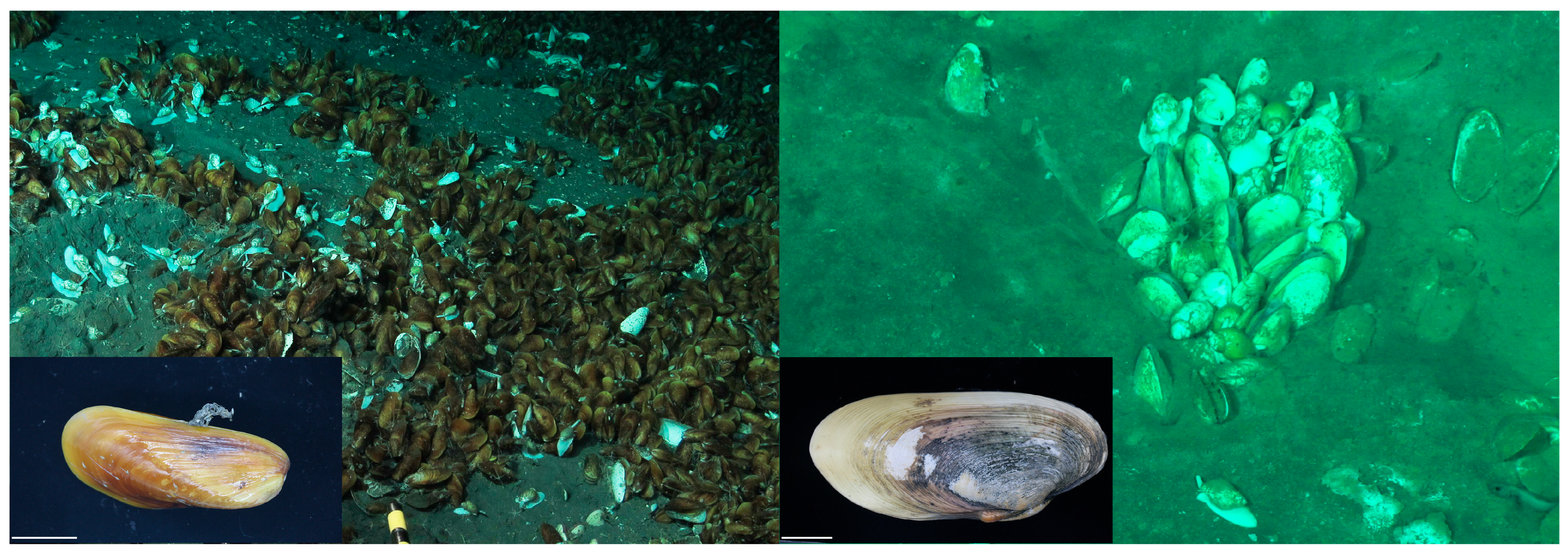
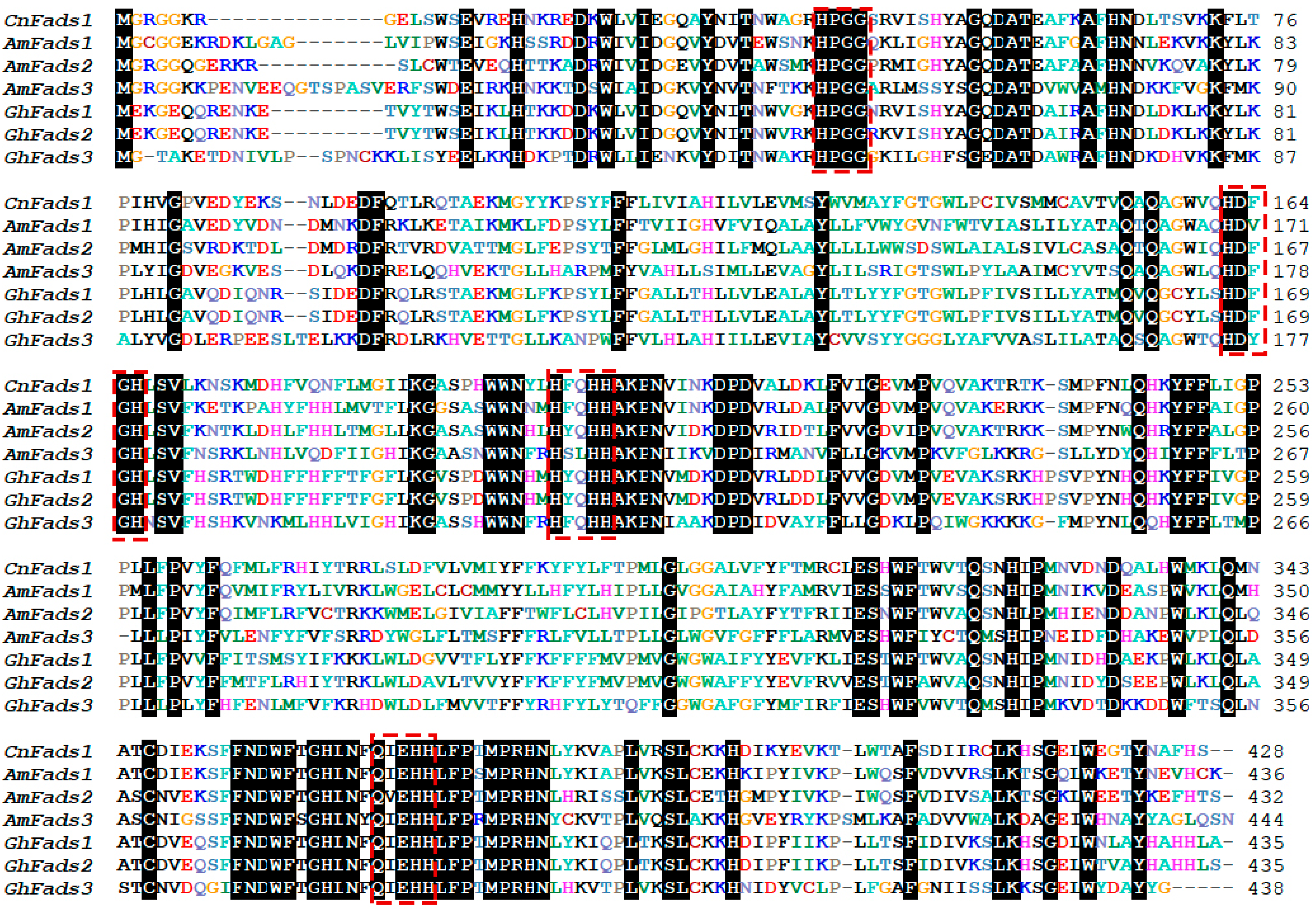
The sampling site was characterized by active gas seepage and a thriving macrofaunal community, dominated by dense but patchy beds of the bathymodiolin mussel G. haimaensis and the vesicomyid clam A. marissinica on a muddy substrate (Figure 1). Through homology-based searches against transcriptome and genome data, we identified multiple fad transcripts. Both G. haimaensis (here named GhFads1, GhFads2, and GhFads3) and A. marissinica (here named AmFads1, AmFads2, and AmFads3) possessed three full-length Fads each, with lengths ranging from 432 to 444 amino acids (Table 2). These identified full-length peptides contained both the characteristic cyt-b5 (PF00173) and FA_desaturase (PF00487) domains, displaying a 47.27–61.50% similarity to the functionally characterized C. nobilis Fads (AIC34709). No ω3 Fad was identified in both bivalve transcriptomes and genomes, suggesting their inability to de novo biosynthesize the PUFA. Multiple sequence alignment of the full-length Fad proteins revealed high conservation of critical functional motifs across these Fads (Figure 2). These included the heme-binding motif (HPGG) and the three histidine-rich boxes: HXXXH, HXXHH, and QXXHH. The first histidine box conformed to the consensus sequence HD(F/V/Y)GH, with a high variation at the third amino acid. The second box (HXXHH) was variant, with a consensus of H(Y/F/S)(Q/L)HH. The final QXXHH box was a highly conserved sequence Q(I/V)EHH, with only a conservative isoleucine-to-valine substitution observed in one A. marissinica Fads2.
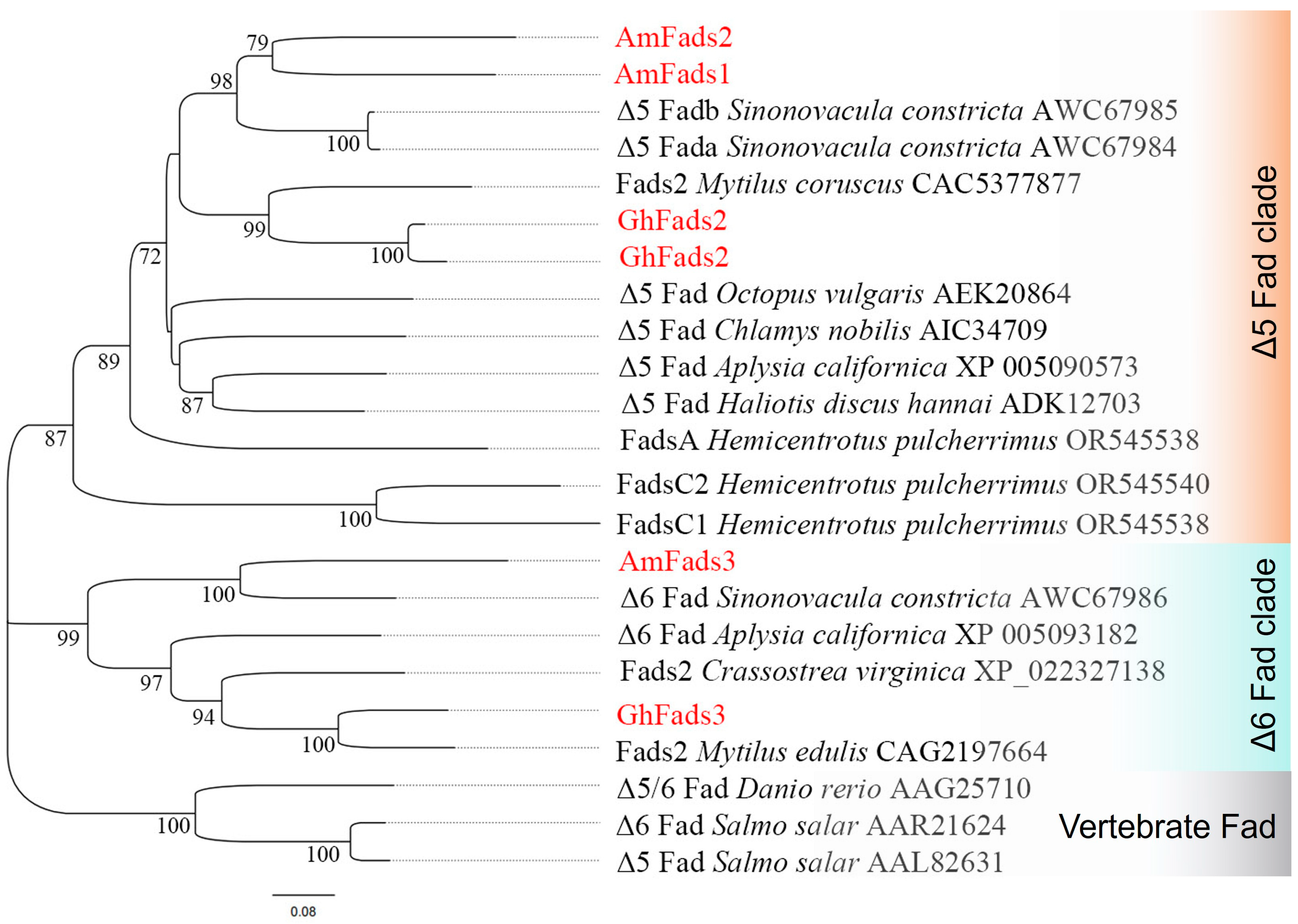
Fads usually form two clades according to their catalytic activity (Δ5 and Δ6/8 desaturation activity) in phylogenetic topology, which was reported both in vertebrates and invertebrates [14]. Phylogenetic analysis of the full-length ORF sequences for these cold seep Fad sequences also identified two well-supported clades (Δ5 Fad clade and Δ6/8 Fad clade) (Figure 3). Both G. haimaensis (GhFads1 and GhFads2) and A. marissinica (AmFads1 and AmFads2) had two Fads that formed distinct pairs that clustered within the Δ5 Fad clade and one Fad (GhFads3 and AmFads3) cluster within the Δ6 Fad clade, indicating a lineage-specific gene duplication event for these two species within the Δ5 Fad clade.

3.2. Functional Characterization of Fad Genes

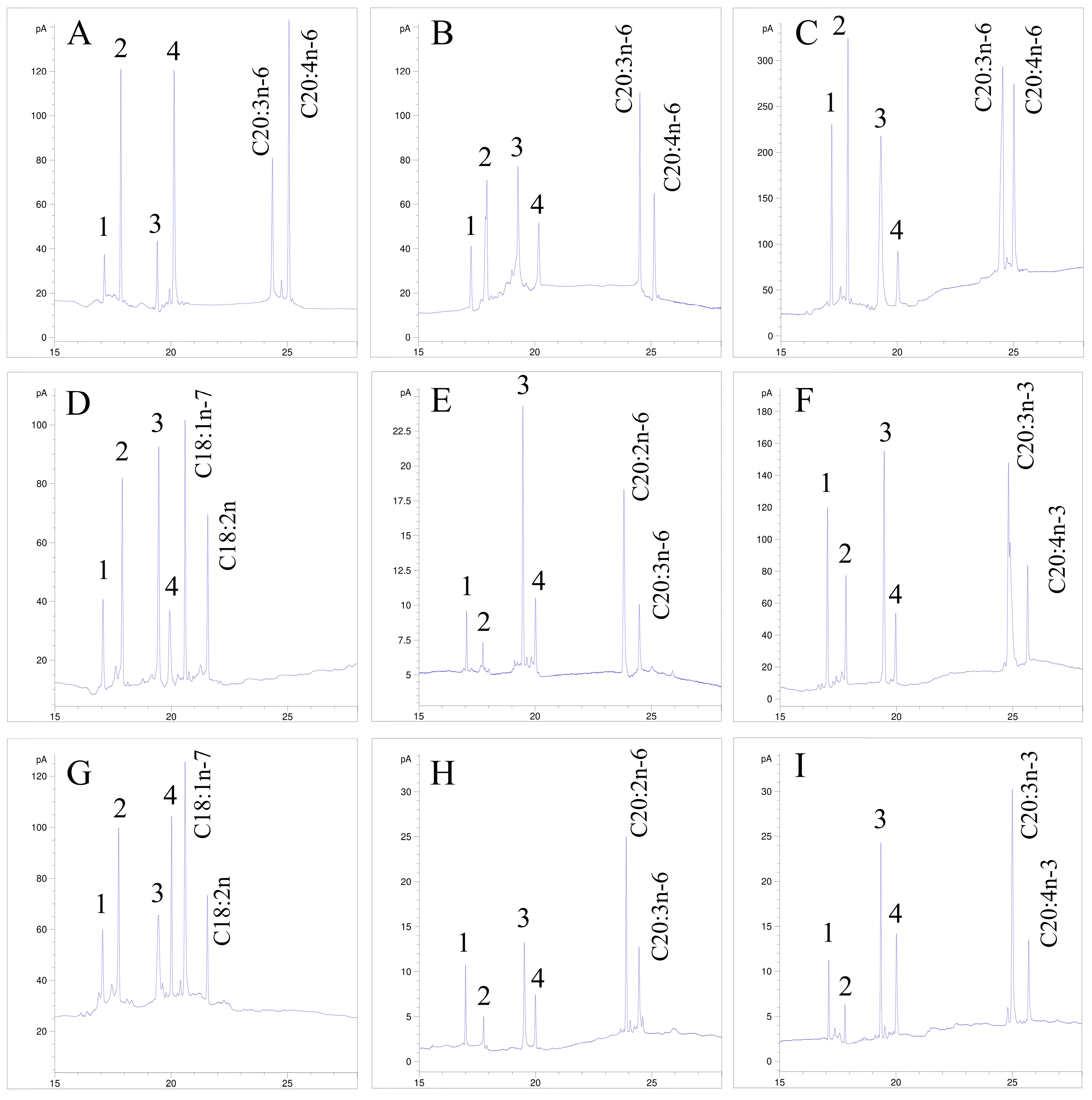
The putative Fad desaturases from these two seep bivalves were functionally characterized by heterologously expressing their cDNA open reading frames (ORFs) in yeast in the presence of Δ5 (C20:3n-6), Δ6 (C18:3n-3 and C18:2n-6), and Δ8 (C20:2n-6 and C20:3n-3) substrates, followed by analysis of the resulting fatty acid profiles. Yeast cells transformed with the empty pYES2 vector (control) exhibited a baseline fatty acid profile consisting primarily of C16:0, C16:1n-7, C18:0, and C18:1n-9 [13,14]. Yeast transformed with GhFads2 (Figure 4A), GhFads1 (Figure 4B), or AmFads1 (Figure 4C) displayed classical Δ5-desaturase activity, as evidenced by their ability to convert C20:3n-6 into C20:4n-6 (AA), with conversion rates of 31.37%, 76.55%, and 45.94%, respectively (Table 3). In contrast, AmFads2 showed no detectable Δ5-desaturase activity toward C20:3n-6. None of these genes exhibited Δ6- or Δ8-desaturase activity when tested with the corresponding substrates. Invertebrate Fads in the Δ5-clade have often been reported to act on MUFAs such as C18:1n-9 and C20:1n-9 to produce non-methylene-interrupted (NMI) fatty acids. Accordingly, we investigated whether AmFads1, AmFads2, GhFads1, and GhFads2 exhibit activity on MUFAs. Both GhFads1 and AmFads2 showed no activity on yeast endogenously produced C18:1n-9, as no C18:2 product was detected. Interestingly, in the presence of C18:1n-7, both GhFads1 and AmFads2 converted this MUFA substrate into a C18:2 fatty acid, as detected by GC-MS (Figure 4D). We do not have a standard for the presumed product, 5,11C18:2n-7. Since both enzymes are expected to possess Δ5 activity as they cluster into the Δ5 clade, we hypothesize that the new product is likely 5,11C18:2n-7, generated by introducing a double bond at the Δ5 position of C18:1n-7. Thus, GhFads1 exhibited broader substrate specificity than AmFads2, as it acted on both MUFA and PUFA substrates. In contrast, functional assays revealed no catalytic activity of GhFads2 or AmFads1 toward C18:1n-7.
When yeast transformed with AmFads3- or GhFads3-containing recombinant plasmids was grown in the presence of Δ5 (C20:3n-6), Δ6 (C18:3n-3 and C18:2n-6), or Δ8 (C20:2n-6 and C20:3n-3) substrates, both AmFads3 (Figure 4E,F) and GhFads3 (Figure 4H,I) converted the exogenously added C20:2n-6 and C20:3n-3 into C20:3n-6 and C20:4n-3, respectively, indicating that both enzymes possess Δ8-desaturation activity. For GhFads3, approximately 36.41% of C20:2n-6 and 35.95% of C20:3n-3 were desaturated to C20:3n-6 and C20:4n-3, respectively. For AmFads3, the conversion rates were 37.07% for C20:2n-6 and 28.19% for C20:3n-3 (Table 3). No additional desaturated products were detected when Δ6 (C18:3n-3 and C18:2n-6) or Δ5 (C20:3n-6) fatty acids were used as substrates, confirming that neither AmFads3 nor GhFads3 possesses Δ6- or Δ5-desaturation activity. Thus, both AmFads3 and GhFads3 display classical Δ8-desaturation activity.

3.3. Expression of Fad Genes

qPCR analysis revealed distinct tissue-specific expression patterns among the Fad genes. GhFads1, AmFads1, and AmFads2 were most highly expressed in the gill, followed by the digestive gland, with low expression levels detected in the adductor muscle, foot muscle, and mantle. In contrast, GhFads2, GhFads3, and AmFads3 exhibited the highest expression in the digestive gland and only low expression in the remaining tissues.

4. Discussion

Most deep-sea ecosystems are heterotrophic and rely on the downward flux of photosynthetic organic matter from surface waters. This chronic energy limitation is a fundamental force shaping deep-sea community structure and function [21]. A major exception to this paradigm occurs in chemosynthesis-based ecosystems, where chemical energy replaces solar energy to drive primary production [22,23]. The Haima cold seep is a classic example, sustaining exceptionally high biodiversity through dense beds of the chemosymbiotic bivalves G. haimaensis and A. marissinica. These two bivalves support higher trophic levels by hosting endosymbiotic bacteria that perform chemosynthesis. In contrast to surface habitats where organic matter is rich in essential PUFAs [14,24], bacterial biomass at cold seeps is characteristically PUFA-poor but enriched in bacterial-derived MUFAs such as C16:1n-7 and C18:1n-7 [25]. Consistent with this, both G. haimaensis and A. marissinica exhibit low levels of phototrophic PUFAs and high levels of bacterial MUFAs. Fads are key enzymes required for PUFA synthesis, yet little research has been conducted on seep bivalve Fads. Given the chronically low dietary PUFA supply at seeps, we asked whether these bivalves retain any capacity for LC-PUFA biosynthesis.
Through transcriptomic assembly, we identified three full-length Fad genes in each species, all possessing the typical features of Fad enzymes. These Fads clustered into the two major clades (Δ5 and Δ6/8) characteristic of invertebrates, as reported in other bivalves [14]. Gene duplication is a primary mechanism for generating genetic novelty and functional diversification [26,27]. We observed lineage-specific duplications within the Δ5-Fad clade of both G. haimaensis and A. marissinica. Comparable duplication events have been reported across mollusks (e.g., H. discus, Crassostrea gigas, Lottia gigantea) [10,12] and vertebrates (fish and mammals) [28], highlighting the widespread evolutionary role of Fad gene expansion. Functional characterization revealed that GhFads3 and AmFads3 (Δ6/8 clade) exhibit Δ8-desaturase activity on PUFA substrates, while GhFads2 and AmFads1 display classical Δ5-desaturase activity. These enzymes together enable LC-PUFA synthesis via the alternative “Δ8 pathway”. Thus, our result confirmed that these two seep bivalves retain the capability of LC-PUFA synthesis.
Functional characterization of invertebrate desaturases has established that NMI fatty acid biosynthesis is primarily catalyzed by Δ5-desaturases [15]. For example, the scallop Δ5 Fad converts C18:1n-9, C20:3n-3, and C20:2n-6 into Δ5,9C18:2, Δ5,11,14,17C20:4, and Δ5,11,14C20:3, respectively [13]. Similarly, sea urchin FadsA introduces a Δ5 double bond into the MUFA substrates 20:1n-9 and 20:1n-7, yielding Δ5,11C20:2 and Δ5,13C20:2 [15]. In our study, heterologous expression confirmed that GhFads1 and AmFads2 possess the desaturase activity specifically toward C18:1n-7. Notably, neither enzyme acted on the substrates preferred by the scallop Δ5 Fad (C18:1n-9, C20:3n-3 or C20:2n-6), demonstrating distinct regioselectivity and clear functional diversification among these two seep Δ5 Fad isoforms. Since cold-seep environments are naturally enriched in n-7 fatty acids and poor in PUFA sources, the Δ5 activity on bacterial-sourced fatty acids C18:1n-7 by both GhFads1 and AmFads2 may represent a precise nutritional and environmental adaptation. In littoral bivalves, Fad genes generally show high expression in the digestive gland and low expression in muscle tissue [13,16]. Consistent with this, qPCR analysis showed that GhFads2, GhFads3, and AmFads3 were most highly expressed in the digestive gland, with only low expression in other tissues. In contrast, GhFads1, AmFads1, and AmFads2 were most highly expressed in the gill, followed by the digestive gland, with low expression levels in the adductor muscle, foot muscle, and mantle. Since both G. haimaensis and A. marissinica host bacteria in their gills, where symbiont-derived nutrients can be directly transferred to the host, the high expression of Δ5 Fads in the gill may facilitate more efficient desaturation of bacterial fatty acids.

5. Conclusions

In conclusion, this study provides a comprehensive report of Fads in two Haima cold-seep bivalves that host chemosynthetic bacterial symbionts. Our results demonstrate that these bivalves retain a high capacity for LC-PUFA biosynthesis, despite inhabiting an environment persistently deficient in PUFAs. Notably, the identified Fads exhibited desaturase activity toward bacterial C18 MUFA substrates, which constitutes a precise nutritional and environmental adaptation in cold seep bivalves.

Author Contributions

R.L.: methodology, visualization, writing—original draft preparation, and formal analysis; M.C.: methodology, validation, writing—review and editing; D.J.: conceptualization, investigation, supervision, funding acquisition, data curation, writing—review and editing. H.L.: writing—review and editing, supervision, and funding acquisition. All authors have read and agreed to the published version of the manuscript.

Funding

This work was supported by Hainan Provincial Natural Science Foundation of China (823QN247) and National Key R & D Program of China (2022YFC2805505).

Institutional Review Board Statement

The animal study protocol was approved by the ethics committee of the Institute of Deep-sea Science and Engineering, Chinese Academy of Sciences (Approval Code: IDSSE-2026-001, 17 March 2026).

Informed Consent Statement

Not applicable.

Data Availability Statement

The original contributions presented in this study are included in the article. Further inquiries can be directed to the corresponding authors.

Acknowledgments

We acknowledge the crews of the research vessel TANSUO 2 and the pilots of the HOV SHENHAIYONGSHI under cruise of TS2-30 for their kind help with collecting specimens. During the preparation of this work, the authors only used ChatGPT(v5.2) for language editing and readability improvement. After using this tool, the authors reviewed and edited the output as needed and take full responsibility for the content of the published article.

Conflicts of Interest

The authors declare no conflicts of interest.

References

  1. Vrablik, T.L.; Watts, J.L. Polyunsaturated fatty acid derived signaling in reproduction and development: Insights from Caenorhabditis elegans and Drosophila melanogaster. Mol. Reprod. Dev. 2013, 80, 244–259. [Google Scholar] [CrossRef]
  2. Dong, Y.; Wei, Y.; Wang, L.; Song, K.; Zhang, C.; Lu, K.; Rahimnejad, S. Dietary n-3/n-6 polyunsaturated fatty acid ratio modulates growth performance in spotted seabass (Lateolabrax maculatus) through regulating lipid metabolism, hepatic antioxidant capacity and intestinal health. Anim. Nutr. 2023, 14, 20–31. [Google Scholar] [CrossRef] [PubMed]
  3. Tian, L.; Chi, G.; Lin, S.; Ling, X.; He, N. Marine microorganisms: Natural factories for polyunsaturated fatty acid production. Blue Biotechnol. 2024, 1, 15. [Google Scholar] [CrossRef]
  4. Parrish, C.C. Production, transport, fate and effects of lipids in the marine environment. Mar. Drugs 2025, 23, 52. [Google Scholar] [CrossRef]
  5. Fullarton, J.G.; Dando, P.R.; Sargent, J.R.; Southwards, A.J.; Southward, E.C. Fatty acids of hydrothermal vent Ridgeia piscesae and inshore bivalves containing symbiotic bacteria. J. Mar. Biol. Assoc. United Kingd. 1995, 75, 455–468. [Google Scholar] [CrossRef]
  6. Guan, H.; Feng, D.; Birgel, D.; Kiel, S.; Peckmann, J.; Li, S.; Tao, J. Lipid biomarker patterns reflect nutritional strategies of seep-dwelling bivalves from the South China Sea. Front. Mar. Sci. 2022, 9, 831286. [Google Scholar] [CrossRef]
  7. Liu, H.; Wang, H.; Cai, S.; Zhang, H. A novel ω3-desaturase in the deep sea giant tubeworm Riftia pachyptila. Mar. Biotechnol. 2017, 19, 345–350. [Google Scholar] [CrossRef]
  8. Kabeya, N.; Fonseca, M.M.; Ferrier, D.E.; Navarro, J.C.; Bay, L.K.; Francis, D.S.; Tocher, D.R.; Castro, L.F.C.; Monroig, Ó. Genes for de novo biosynthesis of omega-3 polyunsaturated fatty acids are widespread in animals. Sci. Adances 2018, 4, eaar6849. [Google Scholar] [CrossRef]
  9. Waldock, M.; Holland, D. Fatty acid metabolism in young oysters, Crassostrea gigas: Polyunsaturated fatty acids. Lipids 1984, 19, 332. [Google Scholar] [CrossRef]
  10. Surm, J.M.; Prentis, P.J.; Pavasovic, A. Comparative analysis and distribution of omega-3 lcPUFA biosynthesis genes in marine molluscs. PLoS ONE 2015, 10, e0136301. [Google Scholar] [CrossRef]
  11. Monroig, Ó.; Navarro, J.C.; Dick, J.R.; Alemany, F.; Tocher, D.R. Identification of a Δ5-like fatty acyl desaturase from the cephalopod Octopus vulgaris (Cuvier 1797) involved in the biosynthesis of essential fatty acids. Mar. Biotechnol. 2012, 14, 411–422. [Google Scholar] [CrossRef]
  12. Li, M.; Mai, K.; He, G.; Ai, Q.; Zhang, W.; Xu, W.; Wang, J.; Liufu, Z.; Zhang, Y.; Zhou, H. Characterization of two Δ5 fatty acyl desaturases in abalone (Haliotis discus hannai Ino). Aquaculture 2013, 416, 48–56. [Google Scholar] [CrossRef]
  13. Liu, H.; Guo, Z.; Zheng, H.; Wang, S.; Wang, Y.; Liu, W.; Zhang, G. Functional characterization of a Δ5-like fatty acyl desaturase and its expression during early embryogenesis in the noble scallop Chlamys nobilis Reeve. Mol. Biol. Rep. 2014, 41, 7437–7445. [Google Scholar] [CrossRef] [PubMed]
  14. Liu, H.; Zhang, H.; Zheng, H.; Wang, S.; Guo, Z.; Zhang, G. PUFA biosynthesis pathway in marine scallop Chlamys nobilis Reeve. J. Agric. Food Chem. 2014, 62, 12384–12391. [Google Scholar] [CrossRef] [PubMed]
  15. Ran, Z.; Xu, J.; Liao, K.; Li, S.; Chen, S.; Yan, X. Biosynthesis of polyunsaturated fatty acids in the razor clam Sinonovacula constricta: Characterization of Δ5 and Δ6 fatty acid desaturases. J. Agric. Food Chem. 2018, 66, 4592–4601. [Google Scholar] [CrossRef]
  16. Teng, T.; Zheng, Z.; Jiao, W.; Liu, N.; Wang, A.; Liu, M.; Xie, L.; Yang, Z.; Hu, J.; Bao, Z. Characterization and Functional Analysis of Fads Reveals Δ5 Desaturation Activity during Long-Chain Polyunsaturated Fatty Acid Biosynthesis in Dwarf Surf Clam Mulinia lateralis. Genes 2024, 15, 365. [Google Scholar] [CrossRef]
  17. Xu, T.; Feng, D.; Tao, J.; Qiu, J.-W. A new species of deep-sea mussel (Bivalvia: Mytilidae: Gigantidas) from the South China Sea: Morphology, phylogenetic position, and gill-associated microbes. Deep. Sea Res. Part I Oceanogr. Res. Pap. 2019, 146, 79–90. [Google Scholar] [CrossRef]
  18. Ke, Z.; Li, R.; Chen, Y.; Chen, D.; Chen, Z.; Lian, X.; Tan, Y. A preliminary study of macrofaunal communities and their carbon and nitrogen stable isotopes in the Haima cold seeps, South China Sea. Deep. Sea Res. Part I Oceanogr. Res. Pap. 2022, 184, 103774. [Google Scholar] [CrossRef]
  19. Tamura, K.; Stecher, G.; Kumar, S. MEGA11: Molecular evolutionary genetics analysis version 11. Mol. Biol. Evol. 2021, 38, 3022–3027. [Google Scholar] [CrossRef]
  20. Hastings, N.; Agaba, M.; Tocher, D.R.; Leaver, M.J.; Dick, J.R.; Sargent, J.R.; Teale, A.J. A vertebrate fatty acid desaturase with Δ5 and Δ6 activities. Proc. Natl. Acad. Sci. USA 2001, 98, 14304–14309. [Google Scholar] [CrossRef]
  21. Ramirez-Llodra, E.; Brandt, A.; Danovaro, R.; De Mol, B.; Escobar, E.; German, C.R.; Levin, L.A.; Martinez Arbizu, P.; Menot, L.; Buhl-Mortensen, P.; et al. Deep, diverse and definitely different: Unique attributes of the world’s largest ecosystem. Biogeosciences 2010, 7, 2851–2899. [Google Scholar] [CrossRef]
  22. Sun, Q.-L.; Xu, K.; Cao, L.; Du, Z.; Wang, M.; Sun, L. Nitrogen and sulfur cycling driven by Campylobacterota in the sediment–water interface of deep-sea cold seep: A case in the South China Sea. mBio 2023, 14, e00117-23. [Google Scholar] [CrossRef]
  23. Levin, L.A. Ecology of cold seep sediments: Interactions of fauna with flow, chemistry and microbes. Oceanogr. Mar. Biol. 2005, 43, 11–56. [Google Scholar]
  24. Svetashev, V.I.J.M.D. Investigation of deep-sea ecosystems using marker fatty acids: Sources of essential polyunsaturated fatty acids in abyssal megafauna. Mar. Drugs 2021, 20, 17. [Google Scholar] [CrossRef] [PubMed]
  25. Colaço, A.; Desbruyères, D.; Guezennec, J. Polar lipid fatty acids as indicators of trophic associations in a deep-sea vent system community. Mar. Ecol. 2007, 28, 15–24. [Google Scholar] [CrossRef]
  26. Ohta, T. Role of gene duplication in evolution. Genome 1989, 31, 304–310. [Google Scholar] [CrossRef]
  27. Long, M.; Thornton, K. Gene duplication and evolution. Science 2001, 293, 1551. [Google Scholar] [CrossRef]
  28. Monroig, Ó.; Zheng, X.; Morais, S.; Leaver, M.J.; Taggart, J.B.; Tocher, D.R. Multiple genes for functional∆ 6 fatty acyl desaturases (Fad) in Atlantic salmon (Salmo salar L.): Gene and cDNA characterization, functional expression, tissue distribution and nutritional regulation. Biochim. Biophys. Acta Mol. Cell Biol. Lipids 2010, 1801, 1072–1081. [Google Scholar] [CrossRef]
Figure 1. Color images of the macrofaunal ecosystem at the Haima cold seeps show beds of G. haimaensis and A. marissinica.
Genes 17 00662 g001
Figure 2. Alignment of Fad protein sequences showing conserved and variable regions. The haeme binding domain (HPGG) and the three histidine boxes (HXXXH, HXXHH, and QXXHH) are indicated with a red rectangular outline. CnFads1: Chlamys nobilis Fads1 (AIC34709.1). AmFads1, AmFads2, AmFads3: Archivesica_marissinica Fads. GhFads1, GhFads2, GhFads3: Gigantidas_haimaensis Fads.
Genes 17 00662 g002
Figure 3. Phylogenetic tree comparing the deduced aa sequences of Fad from cold seep with their orthologues from representative vertebrates and invertebrates. The tree was constructed using the NJ method by MEGA v.11. The horizontal branch length is proportional to the aa substitution rate per site. The numbers represent the frequencies (%) with which the tree topology presented was replicated after 1000 iterations.
Genes 17 00662 g003
Figure 4. Functional characterization of the putative Fads2 from chemosymbiotic bivalves G. haimaensis and A. marissinica in transgenic yeast (S. cerevisiae). (AC) FAMEs were extracted from yeast transformed with pYES2-GhFads2 (A), pYES2-GhFads1 (B), and pYES2-AmFads1 (C), and grown in the presence of FA substrates C20:3n-6. (D,G) FAMEs were extracted from yeast transformed with pYES2-GhFads1 (D) or pYES2-AmFads2 (G), and grown in the presence of FA substrates C18:1n-7. (E,F) FAMEs were extracted from yeast transformed with pYES2-GhFads3 in the presence of FA substrates C20:2n-6 (E) or C20:3n-3 (F). (H,I) FAMEs were extracted from yeast transformed with pYES2- AmFads3 in the presence of FA substrates C20:2n-6 (H) or C20:3n-3 (I). Peaks 1−4 correspond to the major endogenous yeast fatty acids 16:0, 16:1n-7, 18:0, and 18:1n-9, respectively. Only chromatograms showing new productions were displayed here. Horizontal axis: retention time. Vertical axis: FID response.
Genes 17 00662 g004
Table 1. Primer list.
Gene Sequence (5′ to 3′)Usage
Cox1LCO1490: GGTCAACAAATCATAAAGATATTGG
HCO2198: TAAACTTCAGGGTGACCAAAAAATCA
Cox1 fragment
GhFads1F: CGGGGTACCCTTCCGATAAGTAGGCCTATGCAAT (Kpn I)
R: TGCTCTAGAATTTAATGAATCTTGTCTGTCTTTA (Xba I)
Heterologous expression
GhFads2F: CGGGGTACCAATTTGAAACCTGGATTGAAATGGA (Kpn I)
R: TGCTCTAGATAAGTCTAATTAATAGACAAGTCAT (Xba I)
Heterologous expression
GhFads3F: CGGGGTACCAATTTGAAACCTGGATTGAAATGGA (Kpn I)
R: TGCTCTAGAACTAGTGTGTGGAGACCATGATATA (Xba I)
Heterologous expression
AmFads1F: CGGGGTACCAATCTGAGTACTGTCGTCTGATGGG (Kpn I)
R: TGCTCTAGAGATCGTCCGTGTGTAATGATGTAGG (Xba I)
Heterologous expression
AmFads2F: CGGGGTACCACATCCACCGAATACCACTGAACAA (Kpn I)
R: TGCTCTAGATGTGTTGATTCAATGTAGACTTTAT (Xba I)
Heterologous expression
AmFads3F: CGGGGTACCACATTAGATCGTGCACTTACAAATA (Kpn I)
R: TGCTCTAGAACATTACGATCACTCTCTGTCCCAC (Xba I)
Heterologous expression
GhFads1qPCR_F: AGTCACTGGTTTGTTTGGG
qPCR_R: CGTTGAAGATTCCTTGGTC
qPCR
GhFads2qPCR_F: AGCATCCTTCTGTCCCCTA
qPCR_R: GCATCCAGCCATAACTTTC
qPCR
GhFads3qPCR_F: AGAAAAAGTTATGGCTGGA
qPCR_R: AACCTCGTAGTAGAAGATGG
qPCR
AmFads1F: TTTGATGGTTACTTTTTTGAA
R: AATATTTGTGTTGTTGGTTGA
qPCR
AmFads2F: ATTCCCGTTCAGGTAGCCA
R: CAGTTCCATCCACTTTTTTC
qPCR
AmFads3qPCR_F: TTATAATTGGACACATAAAGGG
qPCR_R: TTGGTAATCATAGAGCAGGG
qPCR
Note: The underlined sequence indicates the restriction enzyme site.
Table 2. List of candidate genes that encode putative Fad proteins identified from transcriptome assemblies.
SpeciesContig NameFull LengthProtein LengthPfam Domain
Archivesica_marissinicaAmFads2Yes432cyt-b5, FA_desaturase
AmFads1Yes436cyt-b5, FA_desaturase
AmFads3Yes444cyt-b5, FA_desaturase
Gigantidas_haimaensisGhFads1Yes435cyt-b5, FA_desaturase
GhFads2Yes435cyt-b5, FA_desaturase
GhFads3Yes438cyt-b5, FA_desaturase
Table 3. Functional characterization of the putative desaturase cDNA from chemosymbiotic bivalves G. haimaensis and A. marissinica in the yeast S. cerevisiae cell.
Fad GeneSubstrateProductionConversion Ratio (%)Activity
GhFads1C20:3n-6C20:4n-631.37Δ5
C18:2n-6--Δ6
C20:2n-6--Δ8
C18:1n-7C18:2n43.81Δ5
GhFads2C20:3n-6C20:4n-676.55Δ5
C18:2n-6--Δ6
C20:2n-6--Δ8
C18:1n-7--Δ5
AmFads1C20:3n-6C20:4n-645.94Δ5
C18:2n-6--Δ6
C20:2n-6--Δ8
C18:1n-7--Δ5
AmFads2C20:3n-6--Δ5
C18:2n-6--Δ6
C20:2n-6--Δ8
C18:1n-7C18:2n27.94Δ5
GhFads3C20:2n-6C20:3n-636.41Δ8
C20:3n-3C20:4n-335.95Δ8
C18:2n-6---
C20:3n-6---
C18:1n-7---
AmFads3C20:2n-6C20:3n-637.07Δ8
C20:3n-3C20:4n-328.19Δ8
C18:2n-6--Δ6
C20:3n-6--Δ5
C18:1n-7--Δ6/8
Disclaimer/Publisher’s Note: The statements, opinions and data contained in all publications are solely those of the individual author(s) and contributor(s) and not of MDPI and/or the editor(s). MDPI and/or the editor(s) disclaim responsibility for any injury to people or property resulting from any ideas, methods, instructions or products referred to in the content.