Acute and Chronic High-Intensity Exercise Differentially Regulate the miRNA Biogenesis Pathway in Human Skeletal Muscle
 , ,
, ,
Abstract
1. Introduction
2. Materials and Methods
2.1. Study Design
2.2. Participants
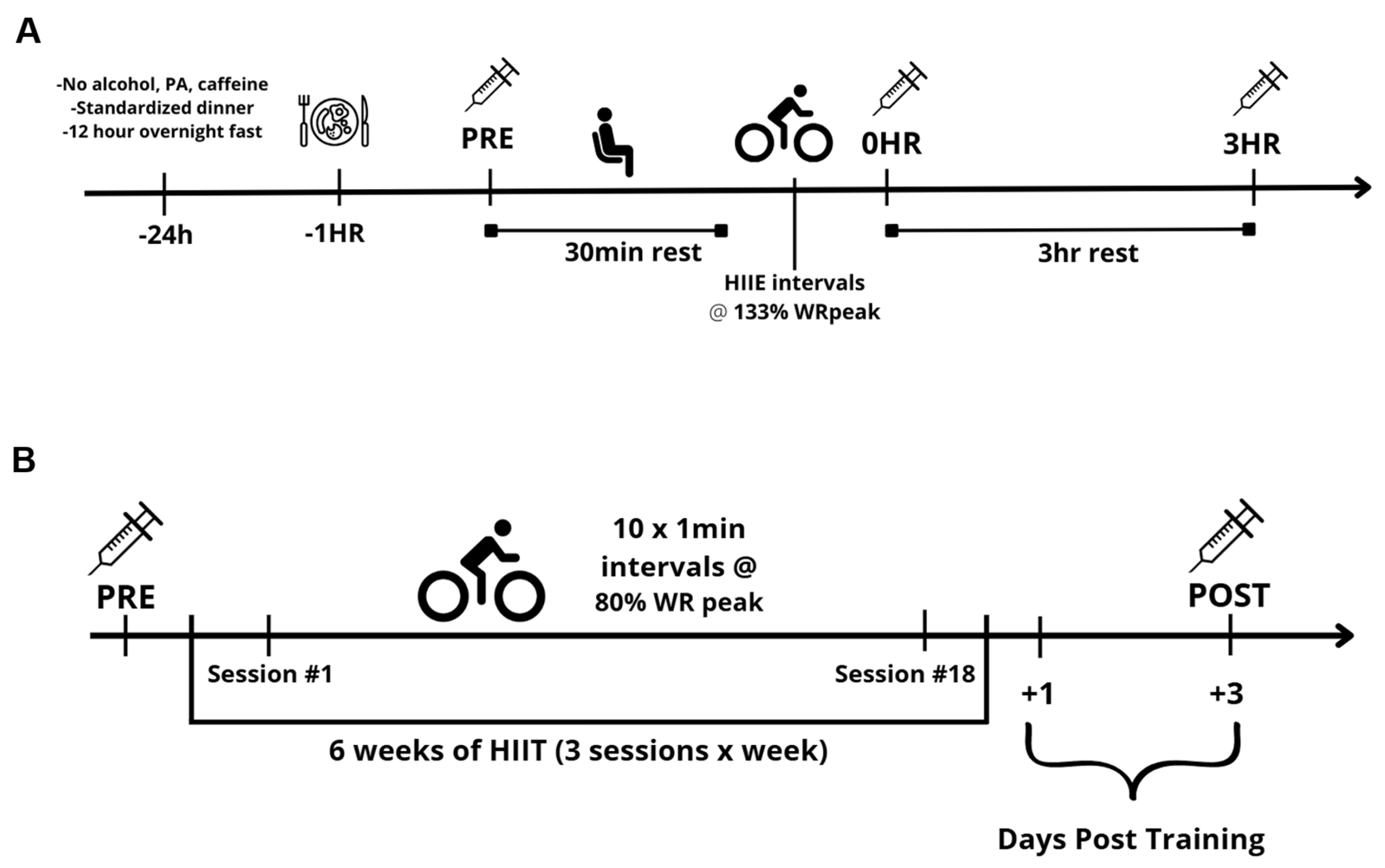
2.3. Experimental Design of HIIE and HIIT Study
2.4. Muscle Biopsies
2.5. Western Blot Analysis
2.6. RNA Extraction
2.7. RT-qPCR
2.8. miRNA RT-qPCR
2.9. Statistical Analysis
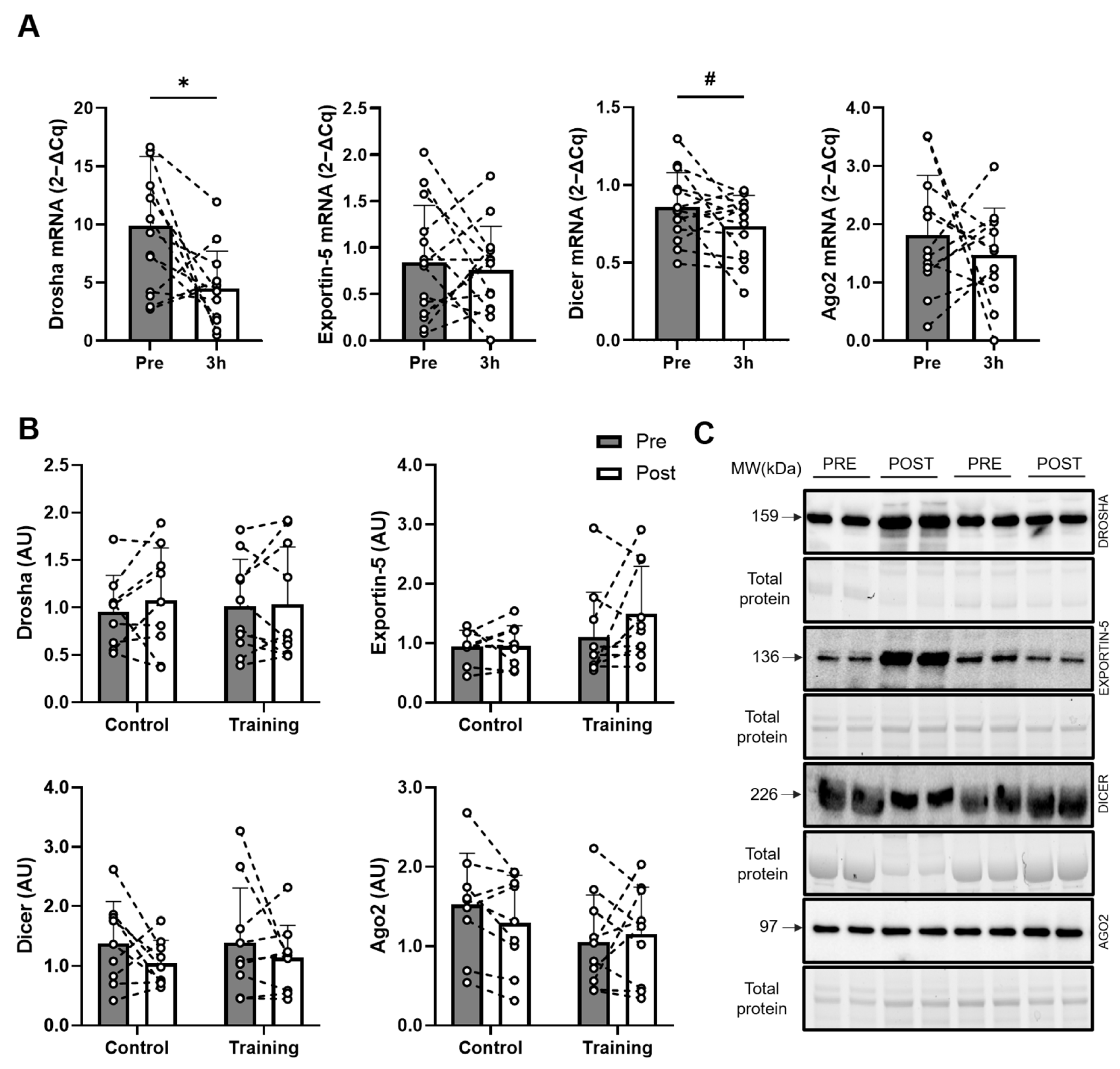
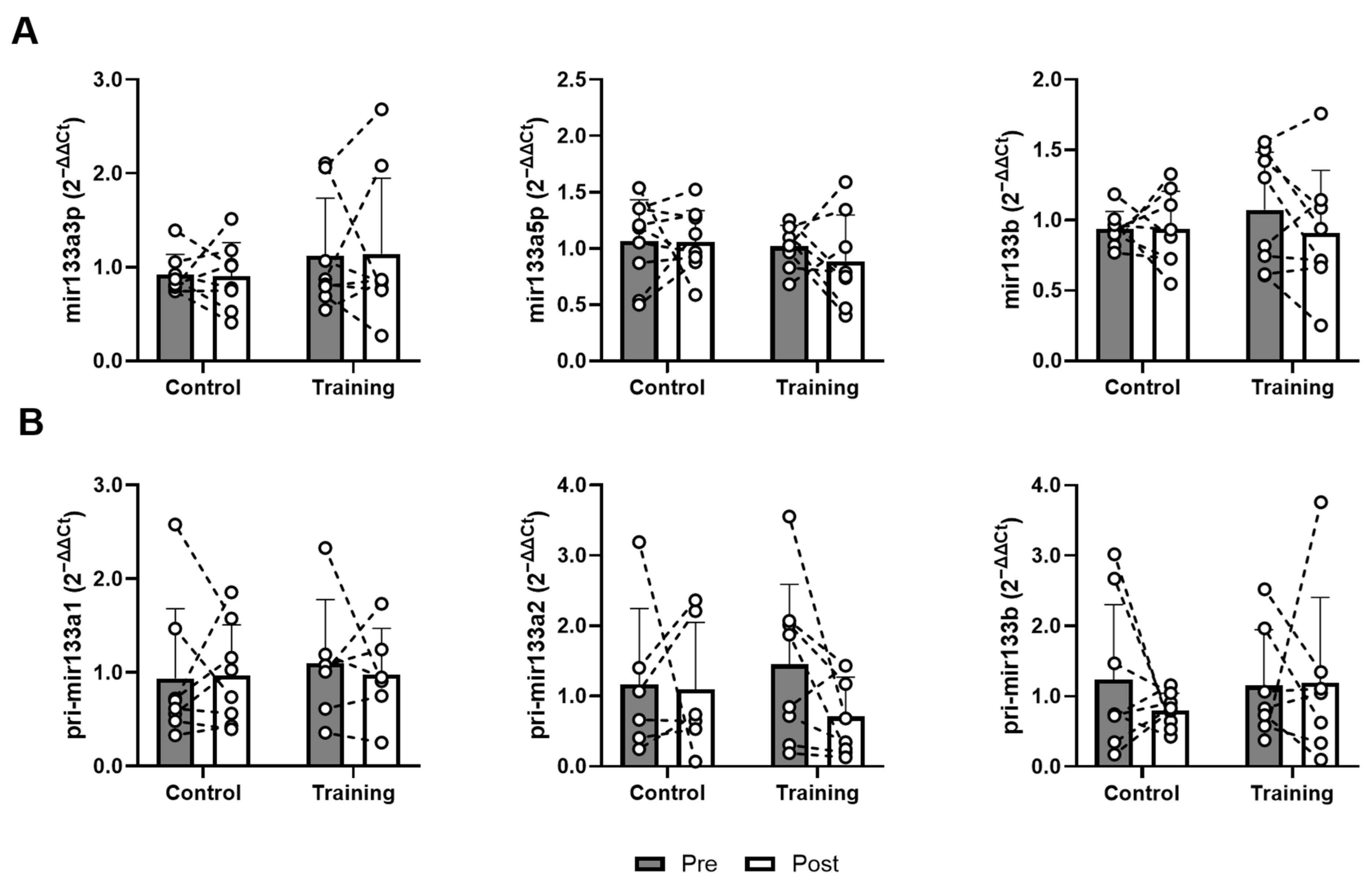
3. Results
4. Discussion
5. Limitations and Future Directions
6. Conclusions
Supplementary Materials
Author Contributions
Funding
Institutional Review Board Statement
Informed Consent Statement
Data Availability Statement
Conflicts of Interest
Abbreviations
| miRNA | MicroRNA |
| HIIE | High-Intensity Interval Exercise |
| HIIT | High-Intensity Interval Training |
| pri-miRNA | Primary MicroRNA |
| pre-miRNA | Precursor MicroRNA |
| PAR-Q | Physical Activity Readiness Questionnaire |
| VO2peak | Peak Oxygen Uptake |
| WRpeak | Peak Work Rate |
| RT-qPCR | Reverse Transcription Quantitative PCR |
| FOXO | Forkhead Box O |
| c-Myc | Cellular Myc Oncogene |
References
- Gurd, B.J.; Menezes, E.S.; Arhen, B.B.; Islam, H. Impacts of altered exercise volume, intensity, and duration on the activation of AMPK and CaMKII and increases in PGC-1α mRNA. Semin. Cell Dev. Biol. 2023, 143, 17–27. [Google Scholar] [CrossRef]
- Bishop, D.J.; Hawley, J.A. Reassessing the relationship between mRNA levels and protein abundance in exercised skeletal muscles. Nat. Rev. Mol. Cell Biol. 2022, 23, 773–774. [Google Scholar] [CrossRef] [PubMed]
- Csárdi, G.; Franks, A.; Choi, D.S.; Airoldi, E.M.; Drummond, D.A. Accounting for Experimental Noise Reveals That mRNA Levels, Amplified by Post-Transcriptional Processes, Largely Determine Steady-State Protein Levels in Yeast. PLoS Genet. 2015, 11, e1005206. [Google Scholar] [CrossRef] [PubMed]
- Schwanhäusser, B.; Busse, D.; Li, N.; Dittmar, G.; Schuchhardt, J.; Wolf, J.; Chen, W.; Selbach, M. Global quantification of mammalian gene expression control. Nature 2011, 473, 337–342. [Google Scholar] [CrossRef]
- Vogel, C.; Marcotte, E.M. Insights into the regulation of protein abundance from proteomic and transcriptomic analyses. Nat. Rev. Genet. 2012, 13, 227–232. [Google Scholar] [CrossRef]
- Kirby, T.J.; McCarthy, J.J. MicroRNAs in skeletal muscle biology and exercise adaptation. Free Radic. Biol. Med. 2013, 64, 95–105. [Google Scholar] [CrossRef] [PubMed]
- Koscianska, E.; Starega-Roslan, J.; Krzyzosiak, W.J. The Role of Dicer Protein Partners in the Processing of MicroRNA Precursors. PLoS ONE 2011, 6, e28548. [Google Scholar] [CrossRef]
- Bartel, D.P. MicroRNAs: Genomics, Biogenesis, Mechanism, and Function. Cell 2004, 116, 281–297. [Google Scholar] [CrossRef]
- Wienholds, E.; Plasterk, R.H.A. MicroRNA function in animal development. FEBS Lett. 2005, 579, 5911–5922. [Google Scholar] [CrossRef]
- D’Souza, R.F.; Figueiredo, V.C.; Markworth, J.F.; Zeng, N.; Hedges, C.P.; Roberts, L.A.; Raastad, T.; Coombes, J.S.; Peake, J.M.; Mitchell, C.J.; et al. Cold water immersion in recovery following a single bout resistance exercise suppresses mechanisms of miRNA nuclear export and maturation. Physiol. Rep. 2023, 11, e15784. [Google Scholar] [CrossRef]
- Drummond, M.J.; McCarthy, J.J.; Fry, C.S.; Esser, K.A.; Rasmussen, B.B. Aging differentially affects human skeletal muscle microRNA expression at rest and after an anabolic stimulus of resistance exercise and essential amino acids. Am. J. Physiol.-Endocrinol. Metab. 2008, 295, E1333–E1340. [Google Scholar] [CrossRef] [PubMed]
- Russell, A.P.; Lamon, S.; Boon, H.; Wada, S.; Güller, I.; Brown, E.L.; Chibalin, A.V.; Zierath, J.R.; Snow, R.J.; Stepto, N.; et al. Regulation of miRNAs in human skeletal muscle following acute endurance exercise and short-term endurance training. J. Physiol. 2013, 591, 4637–4653. [Google Scholar] [CrossRef] [PubMed]
- Broderick, J.A.; Salomon, W.E.; Ryder, S.P.; Aronin, N.; Zamore, P.D. Argonaute protein identity and pairing geometry determine cooperativity in mammalian RNA silencing. RNA 2011, 17, 1858–1869. [Google Scholar] [CrossRef]
- Pitchiaya, S.; Heinicke, L.A.; Park, J.I.; Cameron, E.L.; Walter, N.G. Resolving Subcellular miRNA Trafficking and Turnover at Single-Molecule Resolution. Cell Rep. 2017, 19, 630–642. [Google Scholar] [CrossRef] [PubMed]
- Davidsen, P.K.; Gallagher, I.J.; Hartman, J.W.; Tarnopolsky, M.A.; Dela, F.; Helge, J.W.; Timmons, J.A.; Phillips, S.M. High responders to resistance exercise training demonstrate differential regulation of skeletal muscle microRNA expression. J. Appl. Physiol. 2011, 110, 309–317. [Google Scholar] [CrossRef]
- Nielsen, S.; Scheele, C.; Yfanti, C.; Akerström, T.; Nielsen, A.R.; Pedersen, B.K.; Laye, M.J. Muscle specific microRNAs are regulated by endurance exercise in human skeletal muscle. J. Physiol. 2010, 588, 4029–4037. [Google Scholar] [CrossRef]
- Keller, P.; Vollaard, N.B.; Gustafsson, T.; Gallagher, I.J.; Sundberg, C.J.; Rankinen, T.; Britton, S.L.; Bouchard, C.; Koch, L.G.; Timmons, J.A. A transcriptional map of the impact of endurance exercise training on skeletal muscle phenotype. J. Appl. Physiol. (1985) 2011, 110, 46–59. [Google Scholar] [CrossRef]
- Gan, L.; Denecke, B. Profiling Pre-MicroRNA and Mature MicroRNA Expressions Using a Single Microarray and Avoiding Separate Sample Preparation. Microarrays 2013, 2, 24–33. [Google Scholar] [CrossRef]
- Moreau, P.R.; Tomas Bosch, V.; Bouvy-Liivrand, M.; Õunap, K.; Örd, T.; Pulkkinen, H.H.; Pölönen, P.; Heinäniemi, M.; Ylä-Herttuala, S.; Laakkonen, J.P.; et al. Profiling of Primary and Mature miRNA Expression in Atherosclerosis-Associated Cell Types. Arterioscler. Thromb. Vasc. Biol. 2021, 41, 2149–2167. [Google Scholar] [CrossRef]
- Baggish, A.L.; Hale, A.; Weiner, R.B.; Lewis, G.D.; Systrom, D.; Wang, F.; Wang, T.J.; Chan, S.Y. Dynamic regulation of circulating microRNA during acute exhaustive exercise and sustained aerobic exercise training. J. Physiol. 2011, 589, 3983–3994. [Google Scholar] [CrossRef]
- Chen, J.F.; Mandel, E.M.; Thomson, J.M.; Wu, Q.; Callis, T.E.; Hammond, S.M.; Conlon, F.L.; Wang, D.Z. The role of microRNA-1 and microRNA-133 in skeletal muscle proliferation and differentiation. Nat. Genet. 2006, 38, 228–233. [Google Scholar] [CrossRef]
- Koltai, E.; Bori, Z.; Chabert, C.; Dubouchaud, H.; Naito, H.; Machida, S.; Davies, K.J.; Murlasits, Z.; Fry, A.C.; Boldogh, I.; et al. SIRT1 may play a crucial role in overload-induced hypertrophy of skeletal muscle. J. Physiol. 2017, 595, 3361–3376. [Google Scholar] [CrossRef] [PubMed]
- Nie, Y.; Sato, Y.; Wang, C.; Yue, F.; Kuang, S.; Gavin, T.P. Impaired exercise tolerance, mitochondrial biogenesis, and muscle fiber maintenance in miR-133a-deficient mice. FASEB J. 2016, 30, 3745–3758. [Google Scholar] [CrossRef] [PubMed]
- Arhen, B.B.; Renwick, J.R.M.; Zedic, A.K.; Menezes, E.S.; Preobrazenski, N.; Simpson, C.A.; Stokes, T.; McGlory, C.; Gurd, B.J. AMPK and PGC-α following maximal and supramaximal exercise in men and women: A randomized cross-over study. Appl. Physiol. Nutr. Metab. 2024, 49, 526–538. [Google Scholar] [CrossRef]
- Menezes, E.S.; Islam, H.; Arhen, B.B.; Wu, Z.; Pacitti, L.J.; Silva, N.M.L.; Chiarot, A.; Ng, S.Y.; Wilkinson, J.A.; Nederveen, J.; et al. Regulation of PERM1 and select target genes in human skeletal muscle following fasting and exercise. Appl. Physiol. Nutr. Metab. 2026, 51, 1–15. [Google Scholar] [CrossRef] [PubMed]
- Granata, C.; Jamnick, N.A.; Bishop, D.J. Principles of exercise prescription, and how they influence exercise-induced changes of transcription factors and other regulators of mitochondrial biogenesis. Sports Med. 2018, 48, 1541–1559. [Google Scholar] [CrossRef]
- Martinez, N.J.; Gregory, R.I. Argonaute2 expression is post-transcriptionally coupled to microRNA abundance. RNA 2013, 19, 605–612. [Google Scholar] [CrossRef]
- Heisz, J.J.; Clark, I.B.; Bonin, K.; Paolucci, E.M.; Michalski, B.; Becker, S.; Fahnestock, M. The effects of physical exercise and cognitive training on memory and neurotrophic factors. J. Cogn. Neurosci. 2017, 29, 1895–1907. [Google Scholar] [CrossRef]
- Edgett, B.A.; Foster, W.S.; Hankinson, P.B.; Simpson, C.A.; Little, J.P.; Graham, R.B.; Gurd, B.J. Dissociation of increases in PGC-1α and its regulators from exercise intensity and muscle activation following acute exercise. PLoS ONE 2013, 8, e71623. [Google Scholar] [CrossRef]
- Preobrazenski, N.; Islam, H.; Drouin, P.J.; Bonafiglia, J.T.; Tschakovsky, M.E.; Gurd, B.J. A novel gravity-induced blood flow restriction model augments ACC phosphorylation and PGC-1α mRNA in human skeletal muscle following aerobic exercise: A randomized crossover study. Appl. Physiol. Nutr. Metab. 2020, 45, 641–649. [Google Scholar] [CrossRef]
- Bergstrom, J. Percutaneous needle biopsy of skeletal muscle in physiological and clinical research. Scand. J. Clin. Lab. Investig. 1975, 35, 609–616. [Google Scholar] [CrossRef]
- Islam, H.; Amato, A.; Bonafiglia, J.T.; Rahman, F.A.; Preobrazenski, N.; Ma, A.; Simpson, C.A.; Quadrilatero, J.; Gurd, B.J. Increasing whole-body energetic stress does not augment fasting-induced changes in human skeletal muscle. Pflügers Arch. Eur. J. Physiol. 2021, 473, 241–252. [Google Scholar] [CrossRef] [PubMed]
- Islam, H.; Edgett, B.A.; Bonafiglia, J.T.; Shulman, T.; Ma, A.; Quadrilatero, J.; Simpson, C.A.; Gurd, B.J. Repeatability of exercise-induced changes in mRNA expression and technical considerations for qPCR analysis in human skeletal muscle. Exp. Physiol. 2019, 104, 407–420. [Google Scholar] [CrossRef] [PubMed]
- Scribbans, T.D.; Edgett, B.A.; Bonafiglia, J.T.; Baechler, B.L.; Quadrilatero, J.; Gurd, B.J. A systematic upregulation of nuclear and mitochondrial genes is not present in the initial postexercise recovery period in human skeletal muscle. Appl. Physiol. Nutr. Metab. 2017, 42, 571–578. [Google Scholar] [CrossRef] [PubMed]
- Schmittgen, T.D.; Livak, K.J. Analyzing real-time PCR data by the comparative C(T) method. Nat. Protoc. 2008, 3, 1101–1108. [Google Scholar] [CrossRef]
- Hammouri, H.M.; Sabo, R.T.; Alsaadawi, R.; Kheirallah, K.A. Handling Skewed Data: A Comparison of Two Popular Methods. Appl. Sci. 2020, 10, 6247. [Google Scholar] [CrossRef]
- Cohen, J. Statistical Power Analysis for the Behavioral Sciences; Routledge: Oxfordshire, UK, 2013. [Google Scholar]
- Garner, R.T.; Solfest, J.S.; Nie, Y.; Kuang, S.; Stout, J.; Gavin, T.P. Multivesicular body and exosome pathway responses to acute exercise. Exp. Physiol. 2020, 105, 511–521. [Google Scholar] [CrossRef]
- Fiorenza, M.; Gunnarsson, T.P.; Hostrup, M.; Iaia, F.M.; Schena, F.; Pilegaard, H.; Bangsbo, J. Metabolic stress-dependent regulation of the mitochondrial biogenic molecular response to high-intensity exercise in human skeletal muscle. J. Physiol. 2018, 596, 2823–2840. [Google Scholar] [CrossRef]
- Egan, B.; Carson, B.P.; Garcia-Roves, P.M.; Chibalin, A.V.; Sarsfield, F.M.; Barron, N.; McCaffrey, N.; Moyna, N.M.; Zierath, J.R.; O’Gorman, D.J. Exercise intensity-dependent regulation of peroxisome proliferator-activated receptor coactivator-1 mRNA abundance is associated with differential activation of upstream signalling kinases in human skeletal muscle. J. Physiol. 2010, 588, 1779–1790. [Google Scholar] [CrossRef]
- Wang, X.; Zhao, X.; Gao, P.; Wu, M. c-Myc modulates microRNA processing via the transcriptional regulation of Drosha. Sci. Rep. 2013, 3, 1942. [Google Scholar] [CrossRef]
- Mori, T.; Ato, S.; Knudsen, J.R.; Henriquez-Olguin, C.; Li, Z.; Wakabayashi, K.; Suginohara, T.; Higashida, K.; Tamura, Y.; Nakazato, K.; et al. c-Myc overexpression increases ribosome biogenesis and protein synthesis independent of mTORC1 activation in mouse skeletal muscle. Am. J. Physiol. Endocrinol. Metab. 2021, 321, E551–E559. [Google Scholar] [CrossRef] [PubMed]
- Jones, R.G.I.; von Walden, F.; Murach, K.A. Exercise-Induced MYC as an Epigenetic Reprogramming Factor That Combats Skeletal Muscle Aging. Exerc. Sport Sci. Rev. 2024, 52, 63–67. [Google Scholar] [CrossRef]
- Sánchez, J.A.; Ingaramo, M.C.; Gervé, M.P.; Thomas, M.G.; Boccaccio, G.L.; Dekanty, A. FOXO-mediated repression of Dicer1 regulates metabolism, stress resistance, and longevity in Drosophila. Proc. Natl. Acad. Sci. USA 2023, 120, e2216539120. [Google Scholar] [CrossRef] [PubMed]
- Sanchez, A.M.J. FoxO transcription factors and endurance training: A role for FoxO1 and FoxO3 in exercise-induced angiogenesis. J. Physiol. 2015, 593, 363–364. [Google Scholar] [CrossRef] [PubMed]
- Davis, B.N.; Hata, A. Regulation of MicroRNA Biogenesis: A miRiad of mechanisms. Cell Commun. Signal 2009, 7, 18. [Google Scholar] [CrossRef]
- Humphreys, D.T.; Westman, B.J.; Martin, D.I.; Preiss, T. MicroRNAs control translation initiation by inhibiting eukaryotic initiation factor 4E/cap and poly(A) tail function. Proc. Natl. Acad. Sci. USA 2005, 102, 16961–16966. [Google Scholar] [CrossRef]
- Petersen, C.P.; Bordeleau, M.E.; Pelletier, J.; Sharp, P.A. Short RNAs repress translation after initiation in mammalian cells. Mol. Cell 2006, 21, 533–542. [Google Scholar] [CrossRef]
- Pillai, R.S.; Bhattacharyya, S.N.; Artus, C.G.; Zoller, T.; Cougot, N.; Basyuk, E.; Bertrand, E.; Filipowicz, W. Inhibition of translational initiation by Let-7 MicroRNA in human cells. Science 2005, 309, 1573–1576. [Google Scholar] [CrossRef]
- Winter, J.; Diederichs, S. Argonaute proteins regulate microRNA stability: Increased microRNA abundance by Argonaute proteins is due to microRNA stabilization. RNA Biol. 2011, 8, 1149–1157. [Google Scholar] [CrossRef]
- Diederichs, S.; Haber, D.A. Dual role for argonautes in microRNA processing and posttranscriptional regulation of microRNA expression. Cell 2007, 131, 1097–1108. [Google Scholar] [CrossRef]
- Zeng, Y.; Sankala, H.; Zhang, X.; Graves, P.R. Phosphorylation of Argonaute 2 at serine-387 facilitates its localization to processing bodies. Biochem. J. 2008, 413, 429–436. [Google Scholar] [CrossRef]
- Li, J.-N.; Sun, H.-L.; Wang, M.-Y.; Chen, P.-S. E-cadherin interacts with posttranslationally-modified AGO2 to enhance miRISC activity. Front. Cell Dev. Biol. 2021, 9, 671244. [Google Scholar] [CrossRef]
- Shen, J.; Xia, W.; Khotskaya, Y.B.; Huo, L.; Nakanishi, K.; Lim, S.-O.; Du, Y.; Wang, Y.; Chang, W.-C.; Chen, C.-H. EGFR modulates microRNA maturation in response to hypoxia through phosphorylation of AGO2. Nature 2013, 497, 383–387. [Google Scholar] [CrossRef]
- Camera, D.M.; Ong, J.N.; Coffey, V.G.; Hawley, J.A. Selective Modulation of MicroRNA Expression with Protein Ingestion Following Concurrent Resistance and Endurance Exercise in Human Skeletal Muscle. Front. Physiol. 2016, 7, 87. [Google Scholar] [CrossRef]



| Genes | Forward Sequence | Reverse Sequence |
|---|---|---|
| Drosha | ACAACGATCCAGGCCAGATGA | AGGACGACAGGGCTTGATGG |
| Exportin-5 | GCCCTTCCATGCAGCAAGAC | GGCTTTACAAAGACACGAAGCA |
| Dicer | ACACTGGCTCAGGGAAGACA | AGCAACCTGGTTTGCAGAGT |
| Ago2 | CAAGAACGAGCGGGTTGGGA | TTGTCGTCCCAGAGGACGTG |
| TBP | AGACGAGTTCCAGCGCAAGG | GCGTAAGGTGGCAGGCTGTT |
| Genes | ID Number |
|---|---|
| Pri-miR-133a-1 | Hs03303117_pri |
| Pri-miR-133a-2 | Hs03303121_pri |
| Pri-miR-133b | Hs03303651_pri |
| miR-133a-3p | 478511_mir |
| miR-133a-5p | 478706_mir |
| miR-133b | 480871_mir |
| miR-361-5p | 478056_mir |
| miR-191-5p | 477952_mir |
| miR-320-3p | 478594_mir |
| GAPDH | Hs99999905_m1 |
| Age (yr.) | Body Mass (kg) | Height (cm) | BMI (kg/m2) | VO2peak (mL/min/kg) | WRpeak (Watts) | |||||||
|---|---|---|---|---|---|---|---|---|---|---|---|---|
| HIIE Study | ||||||||||||
| Males (n = 9) | 22.4 | ± 4.6 | 84.0 | ± 9.8 * | 180.3 | ± 4.6 * | 26.1 | ± 3.0 * | 43.5 | ± 7.4 * | 251.9 | ± 25.5 * |
| Females (n = 8) | 21.6 | ± 2.3 | 61.2 | ± 11.2 | 167.2 | ± 8.1 | 21.9 | ± 3.3 | 36.3 | ± 6.4 | 182.0 | ± 44.2 |
| Total (n = 17) | 22.2 | ± 3.5 | 73.3 | ± 15.5 | 173.8 | ± 9.5 | 24.1 | ± 3.4 | 39.9 | ± 7.7 | 227.3 | ± 43.6 |
| HIIT Study | ||||||||||||
| Males (n = 11) | 23.9 | ± 6.2 | 76.2 | ± 6.8 * | 175.2 | ± 6.6 * | 24.8 | ± 2.2 | 250.8 | ± 31.3 * | ||
| Females (n = 8) | 23.1 | ± 6.2 | 61.4 | ± 9.2 | 167.0 | ± 3.8 | 22.1 | ± 3.7 | 176.7 | ± 25.0 | ||
| Total (n = 19) | 23.6 | ± 6.2 | 70.0 | ± 10.7 | 171.7 | ± 6.9 | 23.7 | ± 3.2 | 217.9 | ± 47.3 | ||
| Exercise Group (n = 10; 5M/5F) | Control Group (n = 9; 6M/3F) | |||
|---|---|---|---|---|
| Age (yr.) | 22.8 | ± 4.6 | 24.4 | ± 8.3 |
| Height (cm) | 171.1 | ± 6.8 | 172.4 | ± 7.8 |
| BMI (kg/m2) | 24.2 | ± 3.2 | 23.0 | ± 3.6 |
| WRmax (Watts) | ||||
| Pre | 211.8 | ± 58.7 | 228.3 | ± 33.3 |
| Post (24 h) | 223.9 | ± 63.1 | 221.3 | ± 47.7 |
| Post (72 h) | 227.0 | ± 64.7 | 231.5 | ± 44.9 |
Disclaimer/Publisher’s Note: The statements, opinions and data contained in all publications are solely those of the individual author(s) and contributor(s) and not of MDPI and/or the editor(s). MDPI and/or the editor(s) disclaim responsibility for any injury to people or property resulting from any ideas, methods, instructions or products referred to in the content. |
© 2026 by the authors. Licensee MDPI, Basel, Switzerland. This article is an open access article distributed under the terms and conditions of the Creative Commons Attribution (CC BY) license.
Share and Cite
Wu, Z.; Menezes, E.S.; Silva, N.d.M.L.e.; Arhen, B.B.; Beaupre, L.P.R.; Simpson, C.A.; McGlory, C.; De Felice, F.G.; Gurd, B.J. Acute and Chronic High-Intensity Exercise Differentially Regulate the miRNA Biogenesis Pathway in Human Skeletal Muscle. Genes 2026, 17, 626. https://doi.org/10.3390/genes17060626
Wu Z, Menezes ES, Silva NdMLe, Arhen BB, Beaupre LPR, Simpson CA, McGlory C, De Felice FG, Gurd BJ. Acute and Chronic High-Intensity Exercise Differentially Regulate the miRNA Biogenesis Pathway in Human Skeletal Muscle. Genes. 2026; 17(6):626. https://doi.org/10.3390/genes17060626
Chicago/Turabian StyleWu, Zeyu, Eveline S. Menezes, Natalia de M. Lyra e Silva, Benjamin B. Arhen, Lucas P. R. Beaupre, Craig A. Simpson, Chris McGlory, Fernanda G. De Felice, and Brendon J. Gurd. 2026. "Acute and Chronic High-Intensity Exercise Differentially Regulate the miRNA Biogenesis Pathway in Human Skeletal Muscle" Genes 17, no. 6: 626. https://doi.org/10.3390/genes17060626
APA StyleWu, Z., Menezes, E. S., Silva, N. d. M. L. e., Arhen, B. B., Beaupre, L. P. R., Simpson, C. A., McGlory, C., De Felice, F. G., & Gurd, B. J. (2026). Acute and Chronic High-Intensity Exercise Differentially Regulate the miRNA Biogenesis Pathway in Human Skeletal Muscle. Genes, 17(6), 626. https://doi.org/10.3390/genes17060626