Article

Humanization of the rpb9 Locus in Fission Yeast Reveals Conserved and Divergent Roles of rpb9 and Human POLR2I


1
Department of Biochemistry and Molecular Biology, Michigan State University, East Lansing, MI 48824, USA
2
Summer Research Opportunities Program (SROP), Michigan State University, East Lansing, MI 48824, USA
3
University School of Biotechnology, Guru Gobind Singh (G.G.S.) Indraprastha University, Sector 16C, Dwarka, New Delhi 110078, India
*
Author to whom correspondence should be addressed.
Genes 2026, 17(6), 606; https://doi.org/10.3390/genes17060606
Submission received: 2 April 2026 / Revised: 14 May 2026 / Accepted: 22 May 2026 / Published: 27 May 2026
(This article belongs to the Section Molecular Genetics and Genomics)

Abstract

Background/Objectives: RNA polymerase II is a multifunctional complex that is critical for gene regulation and environmental responses. Its POLR2I subunit in humans is associated with various pathologies, including cancer chemoresistance. However, much of our understanding of how POLR2I functions is inferred from studies of its homologs in yeasts called Rpb9. Here, we endogenously humanized the rpb9 gene of the fission yeast Schizosaccharomyces pombe to examine the functional capabilities of POLR2I. Methods: We edited the genomic rpb9 locus in S. pombe so that it encodes the human POLR2I protein, and investigated functional and structural conservation. Results: With our humanized yeast system, we find widespread functional complementation by human POLR2I of S. pombe rpb9 roles in yeast growth, chronological aging, and stress responses. We also find that POLR2I complements novel roles for yeast rpb9 in facultative heterochromatin assembly, resistance against the chemotherapy 5-fluorouracil, and resistance against the fungicide thiabendazole. In contrast, we find that POLR2I cannot complement the role of rpb9 in resistance against the transcription elongation inhibitor 6-azauracil (6-AU) in our system. Interestingly, POLR2I could complement 6-AU resistance if ectopically expressed. Lastly, we observe extensive structural homology between Rpb9 and POLR2I proteins. Conclusions: Our study establishes an endogenous cross-species gene complementation strategy that uncovers both conserved and rewired functions of fission yeast rpb9 and its human homolog, POLR2I. In addition to validating conserved roles, we also identified conservation of previously unrecognized roles of rpb9 in heterochromatin formation and chemoresistance.

1. Introduction

Gene regulation is a fundamental process that shapes cell fate and behaviors. In eukaryotes, gene expression is prominently regulated at the level of chromatin through transcriptional [1], co-transcriptional [2], and post-transcriptional mechanisms [3]. DNA-dependent RNA polymerase II (Pol II) plays a central role in these processes by functioning both as an enzyme and as a molecular recruitment platform [4]. As an enzyme, Pol II mediates transcription by synthesizing RNA [5,6,7,8]. As a platform, it can accommodate diverse post-translational modifications and interact with other biomolecules to coordinate transcription, chromatin modifications, chromatin remodeling, and RNA processing [9,10,11].
Pol II comprises 12 core protein subunits that collectively mediate its distinct functions [12,13,14,15]. While most Pol II subunits are essential for viability in yeast and metazoans, the Rpb9 subunit (also known as POLR2I in humans) is non-essential but is involved in environmental responses [16,17]. Most of our understanding of the molecular functions of Rpb9 comes from studies in the model budding yeast Saccharomyces cerevisiae, which indicate that Rpb9 plays important roles in transcription start site selection, transcription elongation, transcriptional fidelity, and transcription-coupled DNA repair [18,19,20,21]. Rpb9 performs these roles, in part, by modulating interactions of Pol II with transcription factors such as TFIIS [20] and TFIIF [22]. In contrast, there is a paucity of studies that have directly interrogated the molecular functions of human POLR2I [23]. This limits our ability to directly translate knowledge of yeast Rpb9 to its human homolog POLR2I. As recent studies showed that POLR2I amplification or upregulation is associated with colorectal cancer metastasis [24], chemoresistance of head and neck cancer [25], and hypertensive nephropathy [26], elucidating its molecular roles could advance our understanding of the etiology of these conditions.
Cross-species gene complementation is a powerful genetic approach for assessing the functional conservation of homologous coding genes [27,28,29,30]. For a given gene pair in which one gene encodes a protein with established function(s) and the other encodes a homolog with unclear function(s), the better-characterized gene is replaced with the less-characterized counterpart [31]. Functional assays are then used to determine which known activities can be complemented by the uncharacterized homolog. Successful complementation provides strong genetic evidence that the two genes (likely via their encoded proteins) share the function(s) in question. Gene complementation studies have been conducted to test whether human POLR2I can complement the roles of rpb9 in the model yeasts S. cerevisiae and S. pombe. However, the biological interpretation of some results has been challenging. For example, high-level expression of POLR2I suppressed the hypersensitivity of yeast lacking rpb9 (rpb9Δ) to elevated temperature, whereas lower expression levels produced no complementation [17,32]. This makes it unclear whether yeast rpb9 and human POLR2I genuinely share temperature-related roles or if the complementation is rather context-dependent. Such challenges stem from the design of previous gene complementation studies [31,33], which relied on ectopic expression of POLR2I from plasmids in rpb9Δ yeast cells, followed by phenotypic analysis [17,34]. Although this strategy has enabled powerful functional interrogation of human genes in genetically tractable yeast systems, it also introduces confounding variables, including disruption of native regulatory context, non-physiological expression levels (determined by plasmid copy number or artificial promoters), and dependence on selective pressures to maintain plasmids. Refining the design of gene complementation studies for rpb9POLR2I to minimize these extraneous variables would strengthen the biological interpretation of their functional relationships.
In this study, we developed a genomic gene complementation strategy to functionally re-examine human POLR2I in the fission yeast S. pombe. This approach overcomes limitations of traditional plasmid-based systems by directly replacing the endogenous rpb9 gene with POLR2I, at the native rpb9 locus, thereby preserving the native regulatory context of the rpb9 locus. Genomic integration also enables analysis of POLR2I function under standard non-selective rich media conditions. Consistent with previous plasmid-based complementation studies [17,34], we find that endogenously expressed POLR2I complements S. pombe rpb9 roles in cell growth in the presence of several stress conditions. In addition, we identify a previously unrecognized and conserved role for rpb9POLR2I in the formation of facultative heterochromatin in S. pombe. Notably, our system reveals a lack of complementation in response to 6-azauracil (6-AU), a transcription elongation inhibitor, suggesting partial functional divergence between fission yeast rpb9 and human POLR2I. Collectively, our study establishes a physiologically relevant gene complementation framework that both reproduces and extends the current understanding of POLR2I function.

2. Materials and Methods

2.1. Yeast Culturing and Manipulation

The S. pombe yeast strains used in this study are listed in Table S1. The rpb9Δ yeast strain was constructed by replacing the rpb9 open reading frame with the kanMX gene by using a PCR-based gene deletion procedure with transformation by the lithium acetate method, as previously described [35]. The kanMX gene was derived from a pFA6a-kanMX plasmid that was purchased from Addgene (Addgene 39296; Watertown, MA, USA). All yeast strains were cultured in media that were based on the yeast extract rich medium with glucose and adenine supplement (YEA; 30 g/L glucose, 5 g/L yeast extract, 75 mg/L adenine, pH 5.5) and incubated at 32 °C, unless noted otherwise. To make plates, YEA-based media was prepared with 2% agar. Liquid cultures were grown at 32 °C with 220 rpm shaking for aeration. For our experiments, we used YEA media with the following: 5-FOA (GoldBio, cat no. F-230, 850 mg/L, St. Louis, MO, USA), G418 sulfate (GoldBio, cat no. G-418, 50 mg/L), NaCl (Sigma, cat no. 746398; St. Louis, MO, USA), 5-fluorouracil (Sigma, cat no. F6627, 25 μM), thiabendazole (Fisher Scientific, cat no. AAJ6000909, 20 μg/mL; Waltham, MA, USA), lithium chloride (Sigma, cat no. L7026), and 6-azauracil (Fisher Scientific, cat no. A05585G). For experiments using cells that carried ectopic expression plasmids, cell manipulation and spotting assays were performed as previously described in [17].

2.2. Endogenous Humanization of rpb9 in S. pombe

To integrate either POLR2I or rpb9 into the endogenous rpb9 locus, we started with a wild-type yeast strain that has an intact rpb9+ locus and lacks the ura4 and kanMX genes. First, we constructed a pFA6a-ura4-kanMX plasmid by cloning the ura4 gene, along with 500 bp upstream and downstream regions, into the commercial pFA6a-kanMX plasmid (Addgene 39296). The upstream and downstream regions include the native ura4 promoter and termination sequences [36]. PCR amplification of the ura4 locus was performed to add AscI and BglII restriction enzyme sites onto the PCR amplicon ends. Subsequently, conventional restriction enzyme cloning was performed to integrate the ura4 amplicon into pFA6a-kanMX, placing it upstream of the kanMX promoter. The resultant pFA6a-ura4-kanMX plasmid was verified by Sanger sequencing.
Next, PCR-based homologous recombination [35] was used to replace the endogenous rpb9 open reading frame DNA sequence with ura4-kanMX. The ura4-kanMX cassette was PCR-amplified using Splicing by Overlapping Extension (SOE) PCR [37] to append ~300 bp of sequence homology to the genomic region that flanks the rpb9 open reading frame. Cells, where the swap was successful, grew on Pombe Minimum Glutamate (PMG) media lacking uracil and on YEA media with G418, but failed to grow on YEA media with 5-FOA.
Finally, PCR-based homologous recombination [35] was used to replace the ura4-kanMX cassette with the open reading frame DNA sequence of POLR2I or rpb9. The POLR2I DNA sequence was codon-optimized for S. pombe and synthesized as a double-stranded DNA product by the Integrated DNA Technologies (IDT) company. The rpb9 DNA sequence was PCR-amplified from the ancestral wild-type strain TVTV39. Cells that successfully lost the ura4-kanMX cassette grew on YEA media with 5-FOA, but failed to grow on PMG media lacking uracil and YEA media with G418. The genotypes of the resultant yeast strains were verified by PCR and Sanger sequencing analyses. The DNA sequence of the POLR2I open reading frame used in this study is provided in Table S2.

2.3. Yeast Spotting Assays

Yeast cells were pre-cultured at 32 °C for 220 rpm overnight until cells reached the log growth phase. Afterwards, cell optical densities (OD600) were measured using a Denovix DS-11+ apparatus (Denovix; Wilmington, DE, USA), and then cells were normalized to the equivalent OD600 of 0.2–0.5. Finally, cells were serially diluted 4-fold or 10-fold, and equal volumes of cells were spotted onto the indicated media plates. Spotted plates were incubated at 32 °C without shaking for 2–5 days. Images were collected using a Bio-Rad Chemidoc imager (Bio-Rad; Hercules, CA, USA) using the Colorimeteric setting. Any image correction was uniformly applied to the entirety of the shown images.

2.4. Western Blotting

Western blotting was essentially performed as previously described [38]. Specifically, approximately two OD600 units of yeast cells were harvested by centrifugation in 2 mL screw-cap tubes. The cell pellet was resuspended in 200 µL of cold 20% trichloroacetic acid (TCA). Approximately 400 µL of acid-washed glass beads were added, and the cells were lysed using mechanical disruption with a bead beater (20 s beating × 3 cycles with 45-s intervals on ice). Following lysis, each tube was punctured, placed in a 5 mL polystyrene collection tube, and the lysate was collected by centrifugation at 1000 rpm for 30 s. The remaining beads were washed with 400 µL of cold 5% TCA, spun again, and the wash was pooled with the initial lysate. The combined lysate (~600 µL total) was transferred to a 1.5 mL microcentrifuge tube and centrifuged at 13,000 rpm for 5 min at 4 °C to pellet the proteins. The supernatant was discarded, and the remaining protein pellet was centrifuged 2–3 times, followed by removal of any residual TCA. The resulting protein pellet was resuspended in 100 µL of SDS-PAGE 1× sample loading buffer (Fisher Scientific, cat no. NP0007-2988243). The samples were then boiled at 95 °C and loaded on SDS-PAGE 4–12% Bis-Tris gels (Fisher Scientific, cat no. 25010870). Electrophoresis was performed in an Invitrogen mini tank apparatus using NuPage 1× running buffer (Fisher Scientific, cat no. NP0001) at room temperature at 200 volts for 45 min. Proteins were transferred onto PVDF membranes (pre-activated with methanol) using wet transfer (Nupage 1× transfer buffer (NP0006-2988243) at room temperature.
Then, membranes were blocked for 1 h at room temperature in 1× TBST (Tris-buffered saline with 0.1% Tween-20) or 1× PBST (phosphate-buffered saline with 0.1% Tween-20) containing 5% non-fat dry milk. Membranes were then incubated for 1 h at 37 °C with 1:2000 mouse monoclonal anti-GFP (Sigma, cat no. 11814460001, clones 7.1 and 13.1) or 1:1000 mouse monoclonal anti-tubulin (Sigma, cat no. T5168) that was diluted in blocking buffer. After washing three times with 1× TBST or 1× PBST (10 min each), membranes were incubated with an HRP-conjugated secondary anti-mouse (Jackson laboratory, cat no. 115-035-146, at 1:5000 dilution) for 1 h at room temperature. Following three additional 1× TBST or 1× PBST washes, signal detection was performed using an enhanced chemiluminescence (Cytiva, cat no. RPN2232-18206643; Wilmington, DE, USA) substrate and visualized using the Bio-Rad Chemidoc imaging system (Bio-Rad).

2.5. Live-Cell Microscopy

To visualize Rpb9 or POLR2I localization in yeast cells, we used strains where the gfp gene was genomically integrated adjacent to the rpb9 or POLR2I open reading frames to encode for C-terminally tagged Rpb9-GFP or POLR2I-GFP fusion proteins. Yeast cells were grown in YEA media to the exponential growth phase, and then 1 OD600 of cells were washed with phosphate-buffered saline (PBS) by pelleting cells in a centrifuge at ≥13,000× g for 1 min, repeated three times. To visualize nuclear DNA, cells were stained with Hoescht 33342 by adding the dye to create a 1 μg/mL solution. Cells were then incubated in darkness for 15 min. Next, cells were added to a glass slide and visualized using the Brightfield, DAPI, or eGFP fluorescence settings of the ZEISS Axio Observer Z1 inverted fluorescence microscope using the 63x oil immersion objective. Images were processed using the ZEN Pro (ZEISS) software (version 2.0).

2.6. Chronological Aging Assay

Yeast cells were cultured in YEA liquid media at a constant 1:5 volume-to-flask maximum volume ratio, at 32 °C with 220 rpm shaking for aeration. To assess the chronological lifespan of the various yeast strains, cultures were left shaking continuously without changing the media. Day-0 is defined as the day when cultures were in an exponential growth phase. Day-1 is defined as the start of the stationary phase. Day-1+ is defined as the days after initially reaching the stationary phase. On various days, cells were normalized by OD600 across strains, then serially diluted 1:4, and finally spotted onto YEA media plates. Plates were incubated at 32 °C for 3 days to assess strain viability based on yeast growth patterns.

2.7. Chromatin Immunoprecipitation

Chromatin immunoprecipitation was mostly performed as previously described [38]. Specifically, S. pombe cells were inoculated in 50 mL of YEA medium at 32 °C with shaking at 220 rpm to an OD600 of 0.5–0.6. Cells were crosslinked with 1% formaldehyde for 20 min at room temperature, followed by quenching with 2.5 M glycine. Next, cells were washed twice with 20 mL of cold 1× PBS. The cell pellet was resuspended in 350 µL of ChIP lysis buffer (50 mM HEPES, pH 7.5, 140 mM NaCl, 1 mM EDTA, 1% Triton X-100, 0.1% sodium deoxycholate, EDTA-free 1X cOmplete) and disrupted with 1 mL of glass beads using bead-beating (1 min beating, 2 min on ice, repeated 3 times). Chromatin was sheared using a QSonica Q800R sonicator (20 sec ON/40 sec OFF cycles, 70% amplitude) for 10 min at 4 °C. Cell debris was removed by centrifugation at 4 °C, 1500× g, for 5 min. The supernatant was transferred to fresh 1.5 mL tubes and diluted with ChIP lysis buffer. Lysates were pre-cleared with 20 µL of protein A/G agarose beads (Santa Cruz, cat no. A3124; Dallas, TX, USA) and incubated at 4 °C for 1 h. An amount of 50 µL of pre-cleared lysate was reserved as the 5% input control. The remaining lysate was incubated with the H3K9me2 (Abcam, cat no. ab115159; Waltham, MA, USA) antibody and protein A/G agarose beads overnight at 4 °C. Beads were washed sequentially (twice each) with the following buffers: ChIP Buffer I (50 mM HEPES, pH 7.5, 140 mM NaCl, 1 mM EDTA, 1% Triton X-100, and 0.1% deoxycholate), ChIP Buffer II (same as Buffer I, but with 500 mM NaCl), ChIP Buffer III (10 mM Tris-HCl, pH 8.0, 250 mM LiCl, 0.5% NP-40, 0.5% deoxycholate, and 1 mM EDTA), and 1× Tris-EDTA buffer.
Immunoprecipitated chromatin was extracted by incubating the agarose beads with 100 µL of elution buffer (50 mM Tris-HCl, pH 8.0, and 10 mM EDTA) at 65 °C and agitating at 1000 rpm for 30 min. This step was repeated to obtain a total volume of 200 µL eluent. To each ChIP sample, 4 µL of 5N NaCl and 1 µL of RNase A (Fisher Scientific, 20 mg/mL) were added, and samples were incubated overnight at 65 °C in a water bath to reverse crosslinks. Input samples were adjusted to 200 µL with elution buffer, followed by the addition of 2.6 µL of 5N NaCl and 1 µL of RNase A, and incubated overnight at 65 °C in a water bath to reverse crosslinks. Afterwards, 1 µL of Proteinase K (Fisher Scientific, 20 mg/mL) was added to each tube and incubated at 50 °C for 1 h. Finally, DNA was purified by ethanol precipitation using 3 M sodium acetate and 1 µL glycoblue (Fisher Scientific, 15 mg/mL), and then resuspended in 50 µL of molecular-grade water. For quantitative PCR (qPCR), 1 µL of ChIP DNA was used per reaction with a Power SYBR Green PCR master mix (Life Technologies, cat no. 4367659; Waltham, MA, USA). Oligos used for PCRs are listed in Table S3.

2.8. RNA RT-qPCR

Total RNA was isolated from 10 mL of S. pombe cells that were grown in liquid YEA media at 32 °C to OD600 between 0.5 and 1. Cells were pelleted by centrifugation at 4000× g for 5 min at 4 °C, with the media discarded afterwards. AES buffer (50 mM sodium acetate, pH 5.3, 10 mM EDTA, and 1% SDS) was added to the cell pellet and mixed gently. In a fume hood, acidic phenol (pH 4.5) was added to the cell suspension and gently mixed by inverting the tube 10 times. Next, the sample was vortexed for 10 sec and incubated in the 65 °C water bath for 1 min. This vortex and incubation cycling was repeated five times without interruption. The resulting cell–AES–phenol mixture was centrifuged at 4000× g for 5 min at 6 °C. The aqueous phase was transferred to a new tube, then phenol–chloroform–isoamyl alcohol (25:24:1) (VWR) was added to the sample, and the tube was inverted gently 10 times to mix, followed by centrifugation at 4000× g for 5 min at 6 °C. The aqueous phase was transferred to a new tube, and then chloroform was added to each sample, gently mixed by inversion (10 times), and centrifuged again at 4000× g for 4 min at 6 °C. Carefully, the aqueous phase was transferred to a new tube. To this, 3M NaOAc and glycoblue (Fisher Scientific, 15 mg/mL) were added and mixed thoroughly by inverting the tube 10 times. An equal volume of 100% isopropanol was then added, and the tube was inverted 10 times to mix. The sample was centrifuged at maximum speed for 20 min at 6 °C. A moderate RNA pellet was observed, the supernatant was discarded, and the pellet was washed with 900 µL of 75% ethanol by inverting the tube 10 times, followed by centrifugation at maximum speed for 5 min at 6 °C. The supernatant was removed using a P1000 pipette, and any residual liquid was removed using a P200 or P20 pipette. The pellet was air-dried for 5 min before adding 100 µL of DEPC-treated water. The sample was incubated at room temperature for 1 min to dissolve the pellet and mixed gently by pipetting. The RNA concentration was measured using a DS-11+ spectrophotometer (Denovix). Then, 10 µg of isolated RNA was treated with Turbo DNase (Fisher Scientific, cat no. AM2238) in 50 uL of total volume to remove genomic DNA. Next, the volume was brought to 100 uL by adding DEPC-treated water. 100 µL of phenol–chloroform–isopropyl alcohol was added. The sample was gently inverted 10 times to mix and centrifuged at 20,000× g for 5 min at 6 °C. An amount of 70 µL of the top aqueous layer was carefully transferred to a new microcentrifuge tube. To this, 7 µL of 3M sodium acetate and 1 µL of glycogen were added and mixed by gentle tapping. Then, 235 µL of 200-proof ethanol was added and mixed by inverting the tube 40 times. The tubes were incubated overnight at −20 °C to precipitate the RNA. The sample was centrifuged at maximum speed (20,000× g) for 30 min at 6 °C to pellet the purified RNA. After centrifugation, the supernatant was carefully discarded using a P1000 pipette, leaving behind the RNA pellet. To wash the pellet, 900 µL of 75% ethanol was added, and the tube was inverted 10 times to mix. The sample was then centrifuged again at 20,000× g for 5 min at 6 °C. The supernatant was removed. The remaining RNA pellet was air-dried for 5 min to allow the remaining ethanol to evaporate. Finally, 20 µL of DEPC-treated water was added to dissolve the RNA. The tube was incubated at room temperature for 1 min, mixed gently by pipetting, and the RNA concentration was measured. From the DNase-treated total RNAs, cDNA was synthesized using a high-capacity cDNA reverse transcription kit (Applied Biosystems, cat no. 4368814; Waltham, MA, USA). Quantitative PCRs (qPCRs) were performed using a Power SYBR Green PCR master mix (Applied Biosystems, cat no. 4367659).

2.9. Sequence Alignment Analyses

Gene sequences for S. pombe rpb9 and human POLR2I were collected from Pombase and UCSC Genome Browser, respectively. Protein sequences for S. pombe Rpb9 were obtained from Pombase and human POLR2I was obtained from Uniprot. Visualization of gene sequence comparison and amino acid sequence comparison was generated using the Needleman–Wunsch algorithm from EMBOSS NEEDLE Pairwise Sequence Alignment (PSA). Values of sequence comparison for gene sequence and amino acid sequence were collected using the Clustal Omega tool from EMBL-EBI (version 1). For Figure S6, the protein sequences were aligned using ClustalW with the BLOSUM62 matrix.

2.10. Protein Structure Analyses

Empirical protein structures for S. pombe Rpb1, Rpb2, and Rpb9 were downloaded from the structures 3H0G-A, 3H0G-B, and 3H0G-I from the Protein Data Bank (PDB) database, respectively. The human POLR2I empirical structure was downloaded from 9EHZ-F from the PDB. AlphaFold-predicted structures of S. pombe Rpb9 and human POLR2I were downloaded from the AlphaFold database AF-O74635-F1 and AF-P36954-F1, respectively [39]. RMSD, TM-Score, and visualizations were determined by comparing structures using the Pairwise Structure Alignment tool from the PDB or PyMOL (version 3.1). To model the Rpb1-Rpb2-Rpb9 and Rpb1-Rpb2-POLR2I complexes, the AlphaFold server was used with the following sequences: S. pombe Rpb1 (UniProt P36594) truncated to reside at 1555, S. pombe Rpb2 (Q02061), and S. pombe Rpb9 (O74635) or human POLR2I (P36954). Three zinc ions were also included in the Rpb9 and POLR2I models.

3. Results

3.1. Swapping the Endogenous rpb9 Gene for PORL2I in the S. pombe Genome

To humanize rpb9 in S. pombe cells, we performed a two-step, scarless genome swapping procedure to replace the entire rpb9 open reading frame (ORF) with an ORF corresponding to human POLR2I (Figure 1A). First, PCR-based homologous recombination was used to swap out the rpb9 ORF for a ura4-kanMX DNA cassette. Then, another round of PCR-based homologous recombination was used to replace the ura4-kanMX cassette with the POLR2I ORF to generate the humanized yeast strain (rpb9Δ::POLR2I) (Table S2). The intermediatory ura4 and kanMX genes permitted selection and counter-selection of our yeast constructs (Table 1).
Throughout this procedure, PCR was used to confirm successful completion of the two steps (Figure S1). We also validated the integration of POLR2I by Sanger sequencing. The humanized rpb9Δ::POLR2I yeast strain preserves the endogenous promoter, 5′- and 3′- untranslated regions (UTRs) at the native rpb9 genomic locus. Effectively, we constructed a truly humanized S. pombe strain that carried a POLR2I ORF sequence in place of the rpb9 ORF sequence, within the yeast genome, and that could be cultured in standard non-selective media.
The design of our cross-species gene complementation approach required two synthetic modifications of the POLR2I ORF. First, the POLR2I ORF had to be codon-optimized to ensure proper POLR2I expression in S. pombe cells, since codon biases differ between S. pombe and humans [42,43]. This differs from previous rpb9POLR2I complementation approaches that used POLR2I derived from human complementary DNAs (cDNAs) [17,32,34], which would not have been codon-optimized for S. pombe expression. Second, the POLR2I sequence in the rpb9Δ::POLR2I strain lacked introns. While POLR2I has five introns in human cells [44] and the general mechanisms of RNA splicing are well-conserved between S. pombe and humans [45,46], there are also key differences in the typical structure of introns from S. pombe and humans [47] that could make the splicing of human introns in S. pombe cells not ideal. This second modification was also adopted by previous rpb9POLR2I complementation studies [17,32,34]. Since our primary goal was to endogenously express the POLR2I protein in S. pombe, we decided to commercially synthesize double-stranded DNA that corresponded to codon-optimized intronless POLR2I and integrate this version into S. pombe cells (Table S2). The predicted POLR2I amino acid sequence is the same between our humanized yeast and human cells.
To measure the expression and localization of POLR2I protein in our humanized S. pombe cells, we first tagged the C-terminus of POLR2I with green fluorescent protein (GFP) and then performed Western blotting and fluorescence microscopy. As a control, we also generated S. pombe cells with endogenously tagged Rpb9-GFP at the C-terminus, to allow comparison of POLR2I-GFP expression with physiological levels of Rpb9 protein expression. We find that POLR2I-GFP is expressed, although the protein level is reduced by approximately 59% compared to Rpb9-GFP (Figure 1B). Also, both Rpb9-GFP and POLR2I-GFP primarily localize to the S. pombe nucleus (Figure 1C), as expected for core subunits of Pol II [15], although there was also a substantial cytoplasmic GFP signal for POLR2I-GFP (Figure 1C). These results indicate that POLR2I, which is genomically integrated at the yeast rpb9 locus, is expressed in S. pombe cells to produce nuclear POLR2I protein that is markedly lower in level compared to Rpb9 in S. pombe.

3.2. Characterizing Effects of POLR2I on S. pombe Cell Growth in Non-Selective Media

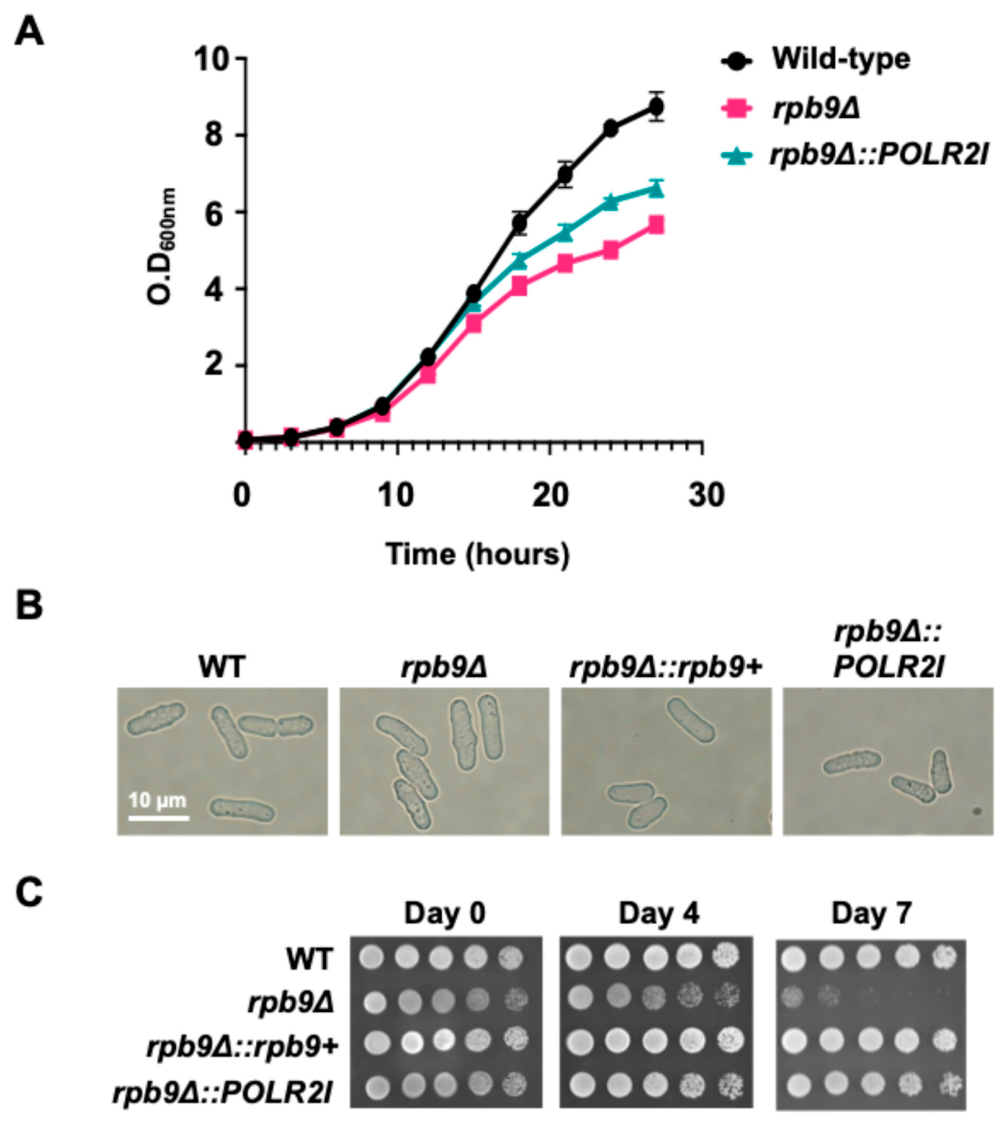
Hereafter, we performed our experiments using non-selective yeast extract with glucose and adenine supplement media (YEA), which is a standard rich media for S. pombe [48]. In this liquid media, we observed that rpb9Δ::POLR2I S. pombe cells grew substantially faster than rpb9Δ cells, but not fully as fast as wild-type (rpb9+) cells (Figure 2A). This growth pattern was also observed in the context of colony sizes where rpb9Δ cells often produced colonies that were smaller than wild-type ones, but rpb9Δ::POLR2I gave rise to colonies that were approximately as large as wild-type colonies (Figure S2). By light microscopy, we did not notice gross anomalies in the morphology of rpb9Δ or rpb9Δ::POLR2I cells (Figure 2B). These results suggest that endogenously expressed POLR2I in our humanization system can largely complement the general growth defects of S. pombe cells lacking rpb9.
We also examined whether POLR2I could complement the function of rpb9 in S. pombe aging because a recent study indicated that rpb9Δ reduces the chronological lifespan of S. pombe cells [34]. Chronological lifespan is defined as the duration during which yeast cells remain viable in the stationary phase in unchanged liquid media (e.g., YEA) [49]. We tested whether POLR2I expression can restore the aging phenotype in rpb9Δ cells. We found that the viability of rpb9Δ cells was drastically reduced after 7 days of continuous culturing in unreplenished YEA media (Figure 2C). In contrast, cells where rpb9+ or POLR2I was reintroduced into the native rpb9 locus continued to grow robustly at the 7-day time-point (Figure 2C). These results agree with a prior study that rpb9 loss reduces S. pombe chronological lifespan [34]. Furthermore, they indicate that human POLR2I complements the role of S. pombe rpb9 in the chronological aging process.

3.3. POLR2I Complements Defects in Stress Responses in rpb9Δ Cells

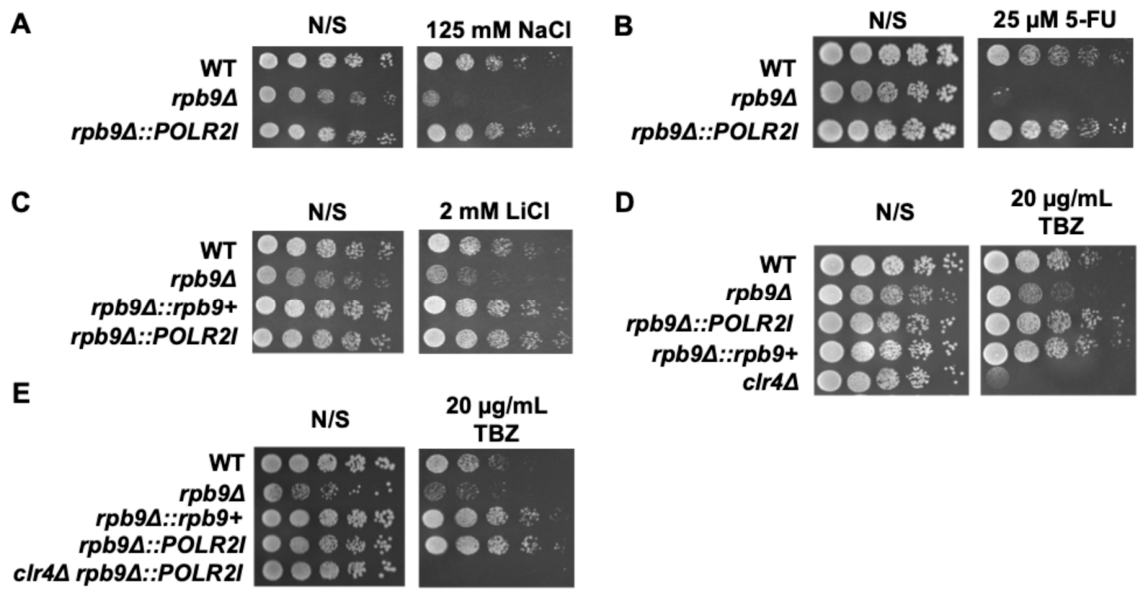
In S. cerevisiae and S. pombe, rpb9 was found to be important for yeast viability in response to various environmental stressors [16,17]. Additionally, ectopic high expression of POLR2I in rpb9Δ cells can complement environment-dependent growth defects [17,32]. We sought to test whether endogenously expressed POLR2I could complement similar stress-related growth defects. We found that, while 125 mM NaCl severely inhibits the growth of rpb9Δ cells on YEA media, growth was robustly restored for rpb9Δ::POLR2I cells (Figure 3A). We also tested whether rpb9POLR2I affects S. pombe response to the chemotherapy drug 5-fluorouracil (5-FU) because recent studies suggested that rpb9 promotes the growth of S. pombe cells in the presence of 5-FU [50] and that POLR2I gene amplification might promote 5-FU resistance in human head and neck cancers [25]. We observed that rpb9Δ::POLR2I cells could grow on YEA media in the presence of 25 μM 5-FU, unlike rpb9Δ cells (Figure 3B). Additionally, a recent high-throughput phenomics study indicated that rpb9Δ cells are sensitive to environmental lithium chloride [51]. We were able to replicate this finding (Figure 3C). Interestingly, POLR2I expression was sufficient to restore growth of rpb9Δ cells in the presence of lithium chloride (Figure 3C). Lastly, we found that endogenous POLR2I rescued cell growth in the presence of the antifungal drug, thiabendazole (TBZ) [52,53] (Figure 3D). These various growth defects were also rescued by applying our humanization procedure to re-integrate S. pombe rpb9 (rpb9Δ::rpb9+) (Figure 3C–E and Figure S3). Altogether, these results indicate that endogenous human POLR2I suppresses diverse environmental-related and rpb9-dependent yeast growth defects.
As rpb9Δ and clr4Δ cells are hypersensitive to YEA media containing the TBZ drug (Figure 3D) [54,55], we tested whether rpb9 might mediate the yeast growth response to TBZ in a Clr4-dependent manner. To do this, we deleted the clr4 gene in rpb9Δ::POLR2I cells and assayed their growth on YEA media with TBZ. Unlike rpb9Δ::POLR2I cells, we found that rpb9Δ::POLR2I clr4Δ cells failed to grow in the presence of TBZ (Figure 3E). This indicates that Rpb9 and POLR2I require Clr4 to promote yeast growth upon TBZ exposure.

3.4. Rpb9 and POLR2I Promote Facultative Heterochromatin Formation in S. pombe Cells

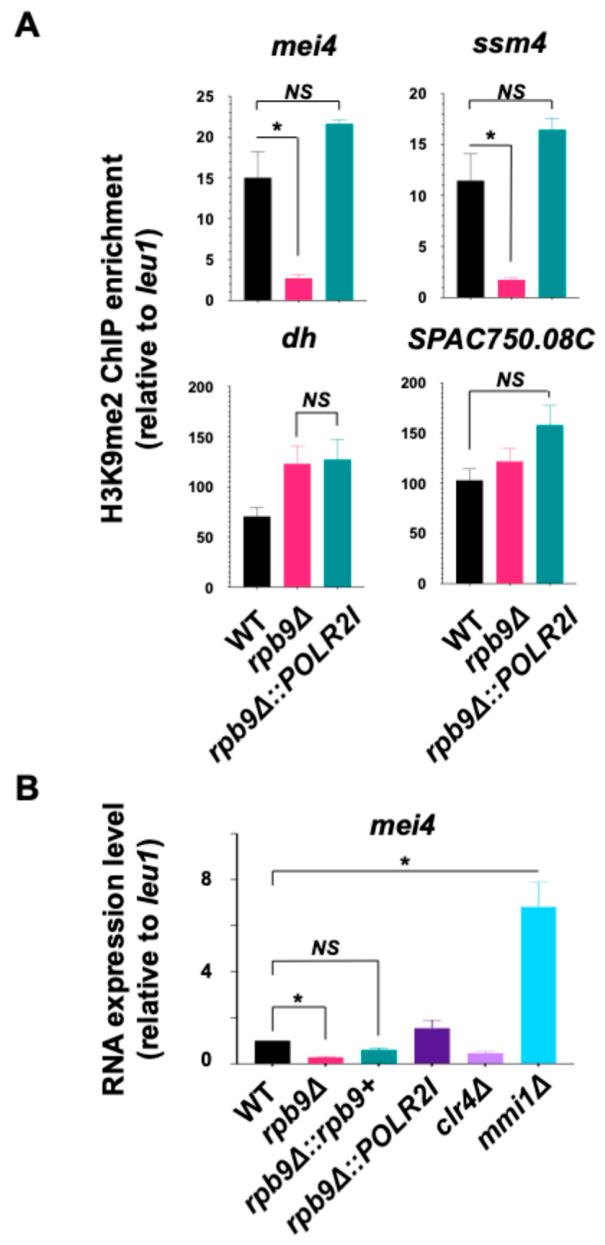
We explored whether yeast rpb9 has a novel role in the formation of facultative heterochromatin in S. pombe, which are repressed portions of the genome that are characterized, in part, by di-methylation of histone H3 at lysine-9 (H3K9me2) [56,57]. We previously found that S. pombe Rpb9 can directly interact with Mmi1 [58], which is required for H3K9me2 at some facultative heterochromatin regions [57]. Therefore, we tested whether rpb9 was required for Mmi1-dependent H3K9me2 and whether POLR2I can complement that putative role. Using chromatin immunoprecipitation (ChIP), we found that rpb9Δ abolished H3K9me2 at the mei4 and ssm4 loci (Figure 4A), which are two representative genomic regions where Mmi1 promotes H3K9 methylation [57,59,60]. Furthermore, H3K9me2 levels were restored in rpb9Δ::POLR2I cells (Figure 4A). This indicates that rpb9 and POLR2I may share a conserved mechanism that permits the formation of facultative heterochromatin in S. pombe cells.
The effects of rpb9 on H3K9me2 were specific to the mei4 and ssm4 loci because H3K9me2 enrichment levels were neither reduced at pericentromeric dh repeats nor at the subtelomeric gene SPAC750.08C (Figure 4A). In wild-type S. pombe cells, the pericentromeres and subtelomeres are normally enriched for H3K9me2-marked heterochromatin [61]. The non-reduction in pericentromeric H3K9me2 suggests that the TBZ sensitivity of rpb9Δ cells might not be due to loss of heterochromatin assembly and impaired cohesion loading at centromeres [62,63]. Although rpb9Δ led to H3K9me2 loss at the mei4 locus (Figure 4A), there was no accumulation of mei4 RNAs (Figure 4B). Furthermore, the mei4 RNA level did not increase in clr4Δ cells, where H3K9 cannot be methylated [64]. These rpb9Δ and clr4Δ results agree with conclusions from a previous study where clr4 loss, alone, was insufficient to increase RNA from another Mmi1-regulated locus [57]. Repression of these loci is possibly enforced by two parallel mechanisms of Clr4- and Rpb9-dependent H3K9 methylation, and via RNA degradation that is mediated by the polyA-binding protein Pab2 and the nuclear exosome [57,65,66,67]. Supporting this, we found that mei4 RNA is significantly increased upon the loss of Mmi1 (Figure 4B), which is required for both H3K9me2 and RNA degradation at the mei4 locus.

3.5. Endogenously Expressed POLR2I Does Not Complement Growth Defects of rpb9Δ Cells Under 37 °C Heat Stress or in the Presence of 6-Azauracil (6-AU)

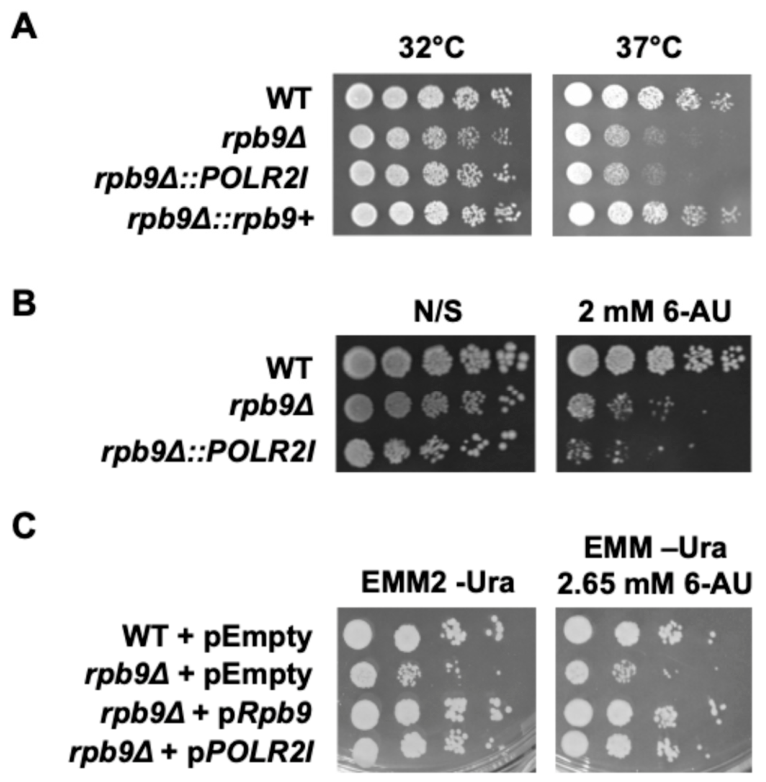
One of the earliest reported phenotypes of rpb9Δ in the budding yeast S. cerevisiae was hypersensitivity to 37 °C elevated heat stress. We confirmed that this was also the case for rpb9Δ in S. pombe cells (Figure 5A) [17]. Interestingly, POLR2I in our humanization system could not complement the growth defect at 37 °C.
Yeast Rpb9 promotes transcription elongation at transcription pause/arrest sites [19,20]. Therefore, we tested whether rpb9 and POLR2I are responsive to the transcription elongation inhibitor drug 6-azauracil (6-AU), which reduces transcription elongation by depleting intracellular levels of uracil triphosphates and guanine triphosphates [68]. After knocking out rpb9, we found that cell growth was strongly inhibited by 6-AU (Figure 5B). Our finding agrees with a previous study, which showed that rpb9 loss in the budding yeast S. cerevisiae reduced cell growth on media containing 6-AU [19]. Sensitivity to 6-AU was rpb9-dependent because reintroduction of S. pombe rpb9 (rpb9Δ::rpb9+) led to restored yeast growth on YEA media with 6-AU (Figure S4). In contrast, rpb9Δ::POLR2I cells grew poorly in the presence of 6-AU (Figure 5B). Therefore, endogenous POLR2I in our humanized system is unable to restore growth upon rpb9 loss and 6-AU exposure. Whether the lack of complementation by POLR2I is related to transcription elongation remains unknown.
Next, we examined whether ectopic POLR2I could restore the growth of 6-AU-exposed rpb9Δ cells. Using our previously described plasmid-based approach to express POLR2I, from a plasmid with the P81nmt1 promoter, in rpb9Δ cells [17,34], we found that ectopic POLR2I could complement 6-AU-associated growth defects (Figure 5C). In these cells, we previously showed that Rpb9 and POLR2I proteins are ectopically expressed at similar levels [17]. This suggests that the design of cross-species gene complementation assays can impact the levels of complementation.

3.6. Structural Similarities and Divergences of S. pombe Rbp9 and Human POLR2I

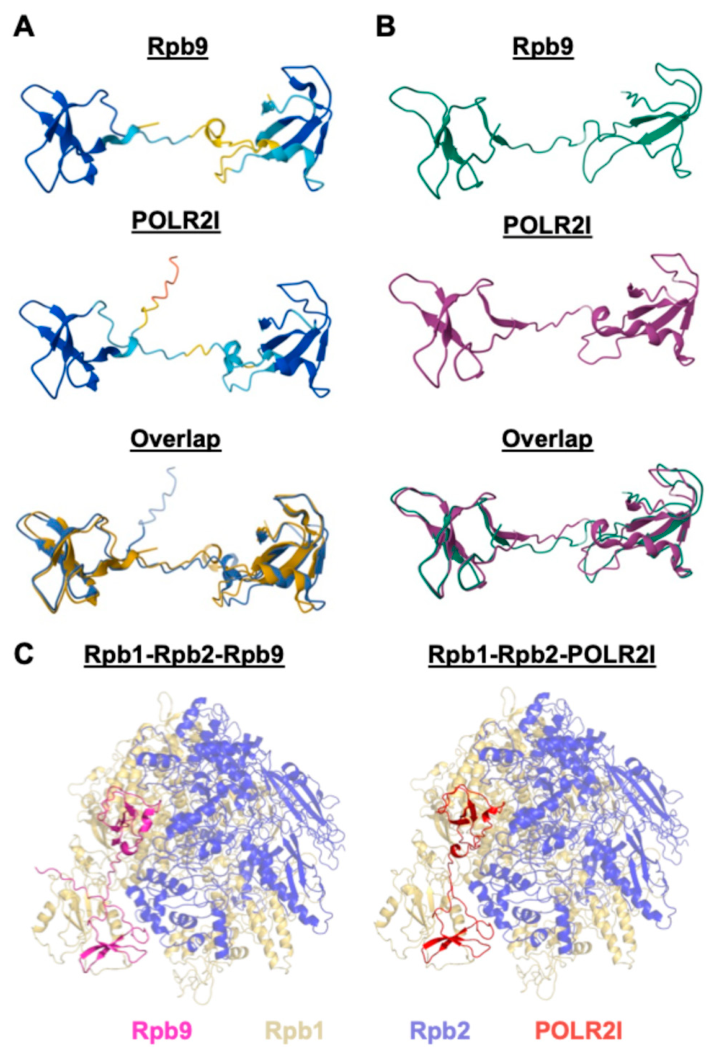
Protein sequence and structure are major determinants of protein functions [69]. Hence, the ability of endogenously expressed POLR2I to fully or partially complement many phenotypic roles of S. pombe rpb9 suggests a high degree of conservation at the sequence and/or structural levels [17,70]. Indeed, the two homologs show 48.54% identity at the DNA sequence level and 48.21% identity at the amino acid level, based on the native sequences of rpb9/Rpb2 and POLR2I (Figure S5A,B). We leveraged AlphaFold to predict structures of S. pombe Rpb9 and human POLR2I (Figure 5A). Structural comparisons of the predicted models revealed high overall similarity. Since experimentally resolved structures of Rpb9 and POLR2I already exist [12,71], we additionally compared those empirical structures (Rpb9, 3H0G-I; POLR2I, 9EHZ-F) and also found high overall resemblance (Figure 5B). The TM-score, a measure of protein structure similarity [72], of Rpb9 and POLR2I is 0.84 (for the AlphaFold models) and 0.79 (for the empirical models). These scores suggest high overall similarity of Rpb9 and POLR2I. Lastly, we used AlphaFold to predict how POLR2I could interact with the two largest subunits of Pol II, Rpb1 and Rpb2, because structural features or interactions within the larger complex may influence the functions of Rpb9 and POLR2I [58]. We focused on Rpb1 and Rpb2 because Rpb9 primarily makes direct contact with those Pol II subunits [12]. The AlphaFold-generated models revealed notable overlaps in the predicted interactions of Rpb9 (or POLR2I) with S. pombe Rpb1 and Rpb2 (Figure 5C and Figure S5C,D). The α-carbon root mean square deviation (Cα RMSD) between the models is 0.61 angstroms (Å), indicating very high similarity between the two models [73]. Upon closer inspection, two structural differences were apparent. The first was at the N-terminus of POLR2I, which has an extended tail that is absent from Rpb9 (Figure S5C). Second, there was a small insertion in the second zinc finger domain of POLR2I that maps to residues 104–105 of Rpb9 (Figure S5C). Additionally, inspection of Rpb9 from the empirically resolved structure of S. pombe Pol II (PDB: 3H0G) revealed several amino acid residues that are within 5 Å of Rpb1 (Rpb9-N5, N52, E74, and R91) or Rpb2 (Rpb9-K42, R45, E47, M96, and Q113) and might mediate Rpb9-Rpb1 or Rpb9-Rpb2 interactions, but are not conserved in POLR2I (Figure S6). Future work will be required to determine whether these residues or structural differences could contribute to functional complementation differences between S. pombe Rpb9 and human POLR2I. Overall, our cross-species structural analyses suggest that Rpb9 and POLR2I are highly conserved at the sequence, structure, and function levels, albeit with noticeable structural differences that could be phenotypically significant. Our conclusions based on empirical and predicted structures are overall consistent with those of prior studies that used experimentally resolved structures of Rpb9 and POLR2I [17,32,34].

4. Discussion

Here, we developed a novel approach to humanize S. pombe yeast cells to investigate the functional conservation of yeast rpb9 and its human homolog POLR2I. Our approach of gene swapping directly at the genomic rpb9 locus represents an orthogonal cross-species gene complementation strategy compared to the conventional plasmid-based approach [17,34]. We find that S. pombe rpb9 promotes general yeast growth, growth in the presence of various environmental stressors, and histone methylation at certain facultative heterochromatin loci. While our humanization system reveals that POLR2I can fully or partially complement most of the defects observed in rpb9Δ yeast cells, POLR2I was unable to restore cell growth in the presence of the 6-AU drug. However, this was context-dependent since plasmid-based POLR2I could rescue yeast sensitivity to 6-AU. Overall, our study corroborates prior conclusions from other studies that the functions of rpb9 and POLR2I are mostly conserved. Moreover, it reveals that the functional conservation of these two genes can vary depending on the phenotype or the assay design, suggesting context-dependency for at least some of their functions.
We observed endogenous nuclear POLR2I protein levels to be markedly reduced when compared to Rpb9 levels. This was unexpected since rpb9 and POLR2I were controlled by the same promoter, 5′- and 3′-UTRs, and presumably shared the same genomic context. Furthermore, the DNA sequence of the POLR2I ORF was codon-optimized for S. pombe expression. We propose that there are inherent differences in how Rpb9POLR2I proteins are synthesized or stabilized in S. pombe cells. One possibility is that POLR2I is differently regulated at the transcriptional, post-transcriptional, or translational level(s). Another possibility is that the POLR2I protein is less stable compared to Rpb9, perhaps due to the absence of a human-specific stabilizing factor. These options may relate to the POLR2I introns that we intentionally omitted in our study design. Introns can enhance gene expression by affecting transcription, RNA transport, and stability, or translation [74,75]. S. pombe rpb9 naturally has four introns [70], while POLR2I has five introns. Since rpb9 in our wild-type and rescue strains contains its introns, but POLR2I lacks them, those introns could be important for enhancing the expression of POLR2I. Our unexpected finding should spur future studies into the potential role of rpb9POLR2I introns, or other factors, in regulating POLR2I expression. Given that the POLR2I copy number or expression is associated with human diseases [25,26], insights into how it is regulated would be informative from a human biology standpoint.
We found that rpb9 and POLR2I share novel roles in H3K9 methylation at the facultative heterochromatin loci mei4 and ssm4. This suggests that both proteins may have additional roles in chromatin modifications, perhaps in addition to (or as a consequence of) transcription and transcription-coupled DNA repair [19,21]. Interestingly, H3K9me2 at these loci requires the S. pombe RNA-binding protein Mmi1 [57], which we previously found to directly interact with S. pombe Rpb9 [58]. Also, transcription of the ssm4 locus is required for H3K9me2 formation at that region [57]. It is possible that rpb9 and POLR2I promote Mmi1-dependent H3K9me2 indirectly through conserved transcription initiation and/or elongation functions [18,20]. Transcription would generate nascent RNAs that Mmi1 [76] could bind with to begin the H3K9 methylation process [57,59,60,77]. Alternatively, Rpb9POLR2I could directly recruit or stabilize Mmi1 at the mei4 and ssm4 loci to promote H3K9 methylation. As S. pombe Mmi1 and its mouse homolog YTHDC1 [78] repress genes, in part, through H3K9 methylation [57,79], future studies into how Rpb9POLR2I could be involved would improve our understanding of how RNA-binding proteins coordinate with Pol II and RNAs to regulate chromatin modifications.
Of all the phenotypes that we tested, endogenously expressed POLR2I failed to complement rpb9-dependent 37 °C and 6-AU hypersensitivity in our yeast system. However, reintroducing endogenous S. pombe rpb9+ or ectopically expressed POLR2I restored growth. One possible explanation for these non-complementations is that there is not enough expression of functional POLR2I in our endogenous system (Figure 1B,C). In support of this model, it was previously shown in S. cerevisiae that POLR2I expression from a high-copy plasmid could restore growth at 37 °C, but not if expressed from a low-copy plasmid [32]. Additionally, we observed complementation of S. pombe yeast growth in the presence of 6-AU when POLR2I was ectopically expressed (Figure 5C). It was previously shown that the POLR2I protein level, in this ectopic system, was similar to that of ectopically expressed Rpb9 in S. pombe cells [17]. It remains unknown whether the levels of POLR2I in the ectopic system match (or exceed) the level of Rpb9 protein in the endogenous system. Altering the ectopic system to permit POLR2I expression in non-selective YEA media will be required to experimentally compare protein levels between the two expression systems. A second possible explanation for the non-complementation cases is that rpb9 and POLR2I might have divergent roles in the complementable and non-complementable phenotypes. These roles may include yeast- and human-specific mechanisms that are affected by the sequence and/or structural differences between Rpb9 and POLR2I (Figure 6C, Figures S5C and S6). For example, the extra N-terminal tail of POLR2I, which is absent in Rpb9, might influence 6-AU responses differently. Our lack of complementation finding is important because it reveals a phenotype that is distinct from the others, which is genetic support for the notion that rpb9POLR2I may be multifunctional with distinct roles [20]. Whether the role of rpb9 in 6-AU response is generally related to transcription elongation or specifically to the 6-AU compound requires further investigation. Future studies could examine the interaction of rpb9POLR2I with genetic mutants that perturb transcription elongation.
The only other studies of functional complementation between S. pombe rpb9 and human POLR2I were performed by us [17,34]. Although both our previous and current work provide largely consistent evidence for functional conservation between these homologs, we observed a discrepancy in growth responses to 6-AU. These findings underscore the value of employing orthogonal experimental approaches to dissect distinct determinants of functional conservation. While successful complementation demonstrates that homologous proteins can fulfill similar molecular roles, divergent complementation outcomes across experimental designs (such as those observed for 6-AU sensitivity) suggest that cellular and regulatory context influences how these conserved functions are executed.

Supplementary Materials

The following supporting information can be downloaded at: https://www.mdpi.com/article/10.3390/genes17060606/s1, Table S1. Yeast strains used in this study. Table S2. DNA sequence of POLR2I used in this study. Table S3. Oligos used in this study. Table S4. OD600 measurements of yeast strains (N = 3) that were grown in YEA media over 27 h at 32 °C. Figure S1. PCR-based validation of yeast strain genotypes. Figure S2. Yeast colony sizes on non-selective YEA media. Figure S3. Reintroduction of rpb9 rescues rpb9Δ defects. Figure S4. Reintroduction of rpb9 rescues yeast growth on media with 6-AU. Figure S5. DNA and amino acid sequence alignments of S. pombe rpb9/Rpb9 and native consensus human POLR2I/POLR2I. Figure S6. Rpb9 residues that could interact with S. pombe Rpb1 or Rpb2, but are not conserved in POLR2I.

Author Contributions

Project conceptualization, T.V.V.; designed and/or performed experiments, J.M.F., M.G.W., M.B.N., E.D.H., C.T.L., S.P. and T.V.V.; protein structure modeling, J.M.F. and J.R.L.; supervision, J.R.L., N.S. and T.V.V.; wrote original draft, T.V.V.; writing and editing, J.M.F., J.R.L., C.T.L., E.D.H. and T.V.V.; preparation of data figures; J.M.F., M.B.N., S.P., J.R.L. and T.V.V.; funding acquisition, N.S. and T.V.V. All authors have read and agreed to the published version of the manuscript.

Funding

This research was funded by a grant from the National Science Foundation (grant number 2422223) to T.V.V.; a grant (EMR/2015/001443) from the Science and Engineering Research Board, Department of Science and Technology, Government of India, to N.S.; and start-up funds from Michigan State University to T.V.V.

Institutional Review Board Statement

Not applicable.

Informed Consent Statement

Not applicable.

Data Availability Statement

The yeast strains and plasmids that were used for this work are available from the corresponding author.

Acknowledgments

We would like to thank Matthew Faber for generating the rpbΔ::kanMX yeast strain, David Arnosti for scientific feedback on this project at group meetings, and Hyojin (Kelly) Kim for help teaching J.M.F. how to bioinformatically investigate protein structures.

Conflicts of Interest

The authors declare no conflicts of interest.

Abbreviations

The following abbreviations are used in this manuscript:
Pol IIRNA polymerase II
ORFOpen reading frame
UTRUntranslated region
cDNAComplementary DNA
YEAYeast extract with adenine and glucose
PMGPombe minimal glutamate
qPCRQuantitative polymerase chain reaction
ChIPChromatin immunoprecipitation
H3K9me2Di-methylation of histone H3 at lysine 9
5-FOA5-fluoroorotic acid
5-FU5-fluorouracil
6-AU6-azauracil
MPAMycophenolic acid
TBZThiabendazole
S. cerevisiaeSaccharomyces cerevisiae
S. pombeSchizosaccharomyces pombe
rpb9ΔEndogenous deletion of the rpb9 gene
rpb9Δ::rpb9+Endogenous rpb9 swapped for rpb9
rpb9Δ::POLR2IEndogenous rpb9 swapped for POLR2I

References

  1. Lee, T.I.; Young, R.A. Transcriptional regulation and its misregulation in disease. Cell 2013, 152, 1237–1251. [Google Scholar] [CrossRef]
  2. Shine, M.; Gordon, J.; Schärfen, L.; Zigackova, D.; Herzel, L.; Neugebauer, K.M. Co-transcriptional gene regulation in eukaryotes and prokaryotes. Nat. Rev. Mol. Cell Biol. 2024, 25, 534–554. [Google Scholar] [CrossRef] [PubMed]
  3. Corbett, A.H. Post-transcriptional regulation of gene expression and human disease. Curr. Opin. Cell Biol. 2018, 52, 96–104. [Google Scholar] [CrossRef] [PubMed]
  4. Hirose, Y.; Manley, J.L. RNA polymerase II and the integration of nuclear events. Genes Dev. 2000, 14, 1415–1429. [Google Scholar] [CrossRef] [PubMed]
  5. Cramer, P.; Bushnell, D.A.; Fu, J.; Gnatt, A.L.; Maier-Davis, B.; Thompson, N.E.; Burgess, R.R.; Edwards, A.M.; David, P.R.; Kornberg, R.D. Architecture of RNA polymerase II and implications for the transcription mechanism. Science 2000, 288, 640–649. [Google Scholar] [CrossRef]
  6. Cramer, P.; Bushnell, D.A.; Kornberg, R.D. Structural basis of transcription: RNA polymerase II at 2.8 Ångstrom resolution. Science 2001, 292, 1863–1876. [Google Scholar] [CrossRef]
  7. Gnatt, A.L.; Cramer, P.; Fu, J.; Bushnell, D.A.; Kornberg, R.D. Structural basis of transcription: An RNA polymerase II elongation complex at 3.3 Å resolution. Science 2001, 292, 1876–1882. [Google Scholar] [CrossRef]
  8. Murakami, K.; Tsai, K.-L.; Kalisman, N.; Bushnell, D.A.; Asturias, F.J.; Kornberg, R.D. Structure of an RNA polymerase II preinitiation complex. Proc. Natl. Acad. Sci. USA 2015, 112, 13543–13548. [Google Scholar] [CrossRef]
  9. Phatnani, H.P.; Greenleaf, A.L. Phosphorylation and functions of the RNA polymerase II CTD. Genes Dev. 2006, 20, 2922–2936. [Google Scholar] [CrossRef]
  10. Hsin, J.-P.; Manley, J.L. The RNA polymerase II CTD coordinates transcription and RNA processing. Genes Dev. 2012, 26, 2119–2137. [Google Scholar] [CrossRef]
  11. Buratowski, S. Progression through the RNA polymerase II CTD cycle. Mol. Cell 2009, 36, 541–546. [Google Scholar] [CrossRef]
  12. Spåhr, H.; Calero, G.; Bushnell, D.A.; Kornberg, R.D. Schizosacharomyces pombe RNA polymerase II at 3.6-Å resolution. Proc. Natl. Acad. Sci. USA 2009, 106, 9185–9190. [Google Scholar] [CrossRef]
  13. Sentenac, A. Eukaryotic RNA polymerase. Crit. Rev. Biochem. 1985, 18, 31–90. [Google Scholar] [CrossRef] [PubMed]
  14. Bernecky, C.; Herzog, F.; Baumeister, W.; Plitzko, J.M.; Cramer, P. Structure of transcribing mammalian RNA polymerase II. Nature 2016, 529, 551–554. [Google Scholar] [CrossRef]
  15. Myer, V.E.; Young, R.A. RNA polymerase II holoenzymes and subcomplexes. J. Biol. Chem. 1998, 273, 27757–27760. [Google Scholar] [CrossRef]
  16. Woychik, N.A.; Lane, W.S.; Young, R.A. Yeast RNA polymerase II subunit RPB9 is essential for growth at temperature extremes. J. Biol. Chem. 1991, 266, 19053–19055. [Google Scholar] [CrossRef]
  17. Bhardwaj, V.; Vishwakarma, P.; Lynn, A.; Sharma, N. Deletion of the non-essential Rpb9 subunit of RNA polymerase II results in pleiotropic phenotypes in Schizosaccharomyces pombe. Biochim. Biophys. Acta (BBA)—Proteins Proteom. 2021, 1869, 140654. [Google Scholar] [CrossRef]
  18. Hull, M.W.; McKune, K.; Woychik, N.A. RNA polymerase II subunit RPB9 is required for accurate start site selection. Genes Dev. 1995, 9, 481–490. [Google Scholar] [CrossRef] [PubMed]
  19. Hemming, S.A.; Jansma, D.B.; Macgregor, P.F.; Goryachev, A.; Friesen, J.D.; Edwards, A.M. RNA polymerase II subunit Rpb9 regulates transcription elongation in vivo. J. Biol. Chem. 2000, 275, 35506–35511. [Google Scholar] [CrossRef] [PubMed]
  20. Awrey, D.E.; Weilbaecher, R.G.; Hemming, S.A.; Orlicky, S.M.; Kane, C.M.; Edwards, A.M. Transcription elongation through DNA arrest sites: A multistep process involving both RNA polymerase II subunit RPB9 and TFIIS. J. Biol. Chem. 1997, 272, 14747–14754. [Google Scholar] [CrossRef]
  21. Li, S.; Smerdon, M.J. Rpb4 and Rpb9 mediate subpathways of transcription-coupled DNA repair in Saccharomyces cerevisiae. EMBO J. 2002, 21, 5921–5929. [Google Scholar] [CrossRef]
  22. Ziegler, L.M.; Khaperskyy, D.A.; Ammerman, M.L.; Ponticelli, A.S. Yeast RNA polymerase II lacking the Rpb9 subunit is impaired for interaction with transcription factor IIF. J. Biol. Chem. 2003, 278, 48950–48956. [Google Scholar] [CrossRef] [PubMed]
  23. Muste Sadurni, M.; Saponaro, M. Deregulations of RNA pol II subunits in cancer. Appl. Biosci. 2023, 2, 459–476. [Google Scholar] [CrossRef]
  24. Long, N.P.; Lee, W.J.; Huy, N.T.; Lee, S.J.; Park, J.H.; Kwon, S.W. Novel biomarker candidates for colorectal cancer metastasis: A meta-analysis of in vitro studies. Cancer Inform. 2016, 15, CIN-S40301. [Google Scholar] [CrossRef] [PubMed]
  25. Gaponova, A.V.; Deneka, A.Y.; Beck, T.N.; Liu, H.; Andrianov, G.; Nikonova, A.S.; Nicolas, E.; Einarson, M.B.; Golemis, E.A.; Serebriiskii, I.G. Identification of evolutionarily conserved DNA damage response genes that alter sensitivity to cisplatin. Oncotarget 2016, 8, 19156. [Google Scholar] [CrossRef]
  26. You, S.; Xu, J.; Wu, B.; Wu, S.; Zhang, Y.; Sun, Y.; Zhang, N. Comprehensive bioinformatics analysis identifies POLR2I as a key gene in the pathogenesis of hypertensive nephropathy. Front. Genet. 2021, 12, 698570. [Google Scholar] [CrossRef]
  27. Ehrenhofer-Murray, A.E.; Gossen, M.; Pak, D.T.; Botchan, M.R.; Rine, J. Separation of origin recognition complex functions by cross-species complementation. Science 1995, 270, 1671–1674. [Google Scholar] [CrossRef]
  28. Huang, H.; Gehan, M.A.; Huss, S.E.; Alvarez, S.; Lizarraga, C.; Gruebbling, E.L.; Gierer, J.; Naldrett, M.J.; Bindbeutel, R.K.; Evans, B.S. Cross-species complementation reveals conserved functions for EARLY FLOWERING 3 between monocots and dicots. Plant Direct 2017, 1, e00018. [Google Scholar] [CrossRef]
  29. Hamza, A.; Tammpere, E.; Kofoed, M.; Keong, C.; Chiang, J.; Giaever, G.; Nislow, C.; Hieter, P. Complementation of yeast genes with human genes as an experimental platform for functional testing of human genetic variants. Genetics 2015, 201, 1263–1274. [Google Scholar] [CrossRef]
  30. Lee, M.G.; Nurse, P. Complementation used to clone a human homologue of the fission yeast cell cycle control gene cdc2. Nature 1987, 327, 31–35. [Google Scholar] [CrossRef]
  31. Kachroo, A.H.; Vandeloo, M.; Greco, B.M.; Abdullah, M. Humanized yeast to model human biology, disease and evolution. Dis. Models Mech. 2022, 15, dmm049309. [Google Scholar] [CrossRef]
  32. McKune, K.; Moore, P.A.; Hull, M.W.; Woychik, N.A. Six human RNA polymerase subunits functionally substitute for their yeast counterparts. Mol. Cell. Biol. 1995, 15, 6895–6900. [Google Scholar] [CrossRef][Green Version]
  33. Ólafsson, G.; Haase, M.A.; Boeke, J.D. Humanization reveals pervasive incompatibility of yeast and human kinetochore components. G3 Genes Genomes Genet. 2024, 14, jkad260. [Google Scholar] [CrossRef] [PubMed]
  34. Bhardwaj, V.; Sharma, N. Absence of the Rpb9 subunit of RNA polymerase II reduces the chronological life span in fission yeast. J. Basic Microbiol. 2022, 62, 900–910. [Google Scholar] [CrossRef] [PubMed]
  35. Krawchuk, M.D.; Wahls, W.P. High-efficiency gene targeting in Schizosaccharomyces pombe using a modular, PCR-based approach with long tracts of flanking homology. Yeast 1999, 15, 1419–1427. [Google Scholar] [CrossRef]
  36. Grimm, C.; Kohli, J.; Murray, J.; Maundrell, K. Genetic engineering of Schizosaccharomyces pombe: A system for gene disruption and replacement using the ura4 gene as a selectable marker. Mol. Gen. Genet. MGG 1988, 215, 81–86. [Google Scholar] [CrossRef]
  37. Horton, R.M.; Cai, Z.; Ho, S.N.; Pease, L.R. Gene splicing by overlap extension: Tailor-made genes using the polymerase chain reaction. Biotechniques 2013, 54, 129–133. [Google Scholar] [CrossRef]
  38. Nirmal, M.B.; Pearce, M.E.; Liu, C.T.; Finkel, J.M.; Darrow, K.S.; Vo, T.V. Deletion of Elongator Protein 1 (Elp1) relieves heterochromatin defects in a Pol II mutant of Schizosaccharomyces pombe. Genetics 2025, 232, iyaf258. [Google Scholar] [CrossRef]
  39. Abramson, J.; Adler, J.; Dunger, J.; Evans, R.; Green, T.; Pritzel, A.; Ronneberger, O.; Willmore, L.; Ballard, A.J.; Bambrick, J. Accurate structure prediction of biomolecular interactions with AlphaFold 3. Nature 2024, 630, 493–500. [Google Scholar] [CrossRef]
  40. Bähler, J.; Wu, J.Q.; Longtine, M.S.; Shah, N.G.; Mckenzie, A., III; Steever, A.B.; Wach, A.; Philippsen, P.; Pringle, J.R. Heterologous modules for efficient and versatile PCR-based gene targeting in Schizosaccharomyces pombe. Yeast 1998, 14, 943–951. [Google Scholar] [CrossRef]
  41. Boeke, J.D.; La Croute, F.; Fink, G.R. A positive selection for mutants lacking orotidine-5′-phosphate decarboxylase activity in yeast: 5-fluoro-orotic acid resistance. Mol. Gen. Genet. MGG 1984, 197, 345–346. [Google Scholar] [CrossRef]
  42. Sharp, P.M.; Cowe, E.; Higgins, D.G.; Shields, D.C.; Wolfe, K.H.; Wright, F. Codon usage patterns in Escherichia coli, Bacillus subtilis, Saccharomyces cerevisiae, Schizosaccharomyces pombe, Drosophila melanogaster and Homo sapiens; a review of the considerable within-species diversity. Nucleic Acids Res. 1988, 16, 8207–8211. [Google Scholar] [CrossRef]
  43. Hiraoka, Y.; Kawamata, K.; Haraguchi, T.; Chikashige, Y. Codon usage bias is correlated with gene expression levels in the fission yeast Schizosaccharomyces pombe. Genes Cells 2009, 14, 499–509. [Google Scholar] [CrossRef]
  44. Dyer, S.C.; Austine-Orimoloye, O.; Azov, A.G.; Barba, M.; Barnes, I.; Barrera-Enriquez, V.P.; Becker, A.; Bennett, R.; Beracochea, M.; Berry, A.; et al. Ensembl 2025. Nucleic Acids Res. 2024, 53, D948–D957. [Google Scholar] [CrossRef]
  45. Awan, A.R.; Manfredo, A.; Pleiss, J.A. Lariat sequencing in a unicellular yeast identifies regulated alternative splicing of exons that are evolutionarily conserved with humans. Proc. Natl. Acad. Sci. USA 2013, 110, 12762–12767. [Google Scholar] [CrossRef]
  46. Montañés, J.C.; Huertas, M.; Moro, S.G.; Blevins, W.R.; Carmona, M.; Ayté, J.; Hidalgo, E.; Albà, M.M. Native RNA sequencing in fission yeast reveals frequent alternative splicing isoforms. Genome Res. 2022, 32, 1215–1227. [Google Scholar] [CrossRef] [PubMed]
  47. Kuhn, A.N.; Käufer, N.F. Pre-mRNA splicing in Schizosaccharomyces pombe: Regulatory role of a kinase conserved from fission yeast to mammals. Curr. Genet. 2003, 42, 241–251. [Google Scholar] [CrossRef]
  48. Gutz, H.; Heslot, H.; Leupold, U.; Loprieno, N. Schizosaccharomyces pombe. In Bacteria, Bacteriophages, and Fungi: Volume 1; Springer: Berlin/Heidelberg, Germany, 1974; pp. 395–446. [Google Scholar]
  49. Burtner, C.R.; Murakami, C.J.; Kennedy, B.K.; Kaeberlein, M. A molecular mechanism of chronological aging in yeast. Cell Cycle 2009, 8, 1256–1270. [Google Scholar] [CrossRef] [PubMed]
  50. Mojardín, L.; Botet, J.; Moreno, S.; Salas, M. Chromosome segregation and organization are targets of 5′-Fluorouracil in eukaryotic cells. Cell Cycle 2015, 14, 206–218. [Google Scholar] [CrossRef] [PubMed]
  51. Rodríguez-López, M.; Bordin, N.; Lees, J.; Scholes, H.; Hassan, S.; Saintain, Q.; Kamrad, S.; Orengo, C.; Bähler, J. Broad functional profiling of fission yeast proteins using phenomics and machine learning. eLife 2023, 12, RP88229. [Google Scholar] [CrossRef]
  52. Davidse, L.C.; Flach, W. Interaction of thiabendazole with fungal tubulin. Biochim. Biophys. Acta (BBA)—Gen. Subj. 1978, 543, 82–90. [Google Scholar] [CrossRef]
  53. Walker, G.M. Cell cycle specificity of certain antimicrotubular drugs in Schizosaccharomyces pombe. Microbiology 1982, 128, 61–71. [Google Scholar] [CrossRef]
  54. Farooq, Z.; Abdullah, E.; Banday, S.; Ganai, S.A.; Rashid, R.; Mushtaq, A.; Rashid, S.; Altaf, M. Vigilin protein Vgl1 is required for heterochromatin-mediated gene silencing in Schizosaccharomyces pombe. J. Biol. Chem. 2019, 294, 18029–18040. [Google Scholar] [CrossRef]
  55. Khanduja, J.S.; Joh, R.I.; Perez, M.M.; Paulo, J.A.; Palmieri, C.M.; Zhang, J.; Gulka, A.O.; Haas, W.; Gygi, S.P.; Motamedi, M. RNA quality control factors nucleate Clr4/SUV39H and trigger constitutive heterochromatin assembly. Cell 2024, 187, 3262–3283.e23. [Google Scholar] [CrossRef]
  56. Allshire, R.C.; Ekwall, K. Epigenetic regulation of chromatin states in Schizosaccharomyces pombe. Cold Spring Harb. Perspect. Biol. 2015, 7, a018770. [Google Scholar] [CrossRef]
  57. Zofall, M.; Yamanaka, S.; Reyes-Turcu, F.E.; Zhang, K.; Rubin, C.; Grewal, S.I. RNA elimination machinery targeting meiotic mRNAs promotes facultative heterochromatin formation. Science 2012, 335, 96–100. [Google Scholar] [CrossRef]
  58. Vo, T.V.; Das, J.; Meyer, M.J.; Cordero, N.A.; Akturk, N.; Wei, X.; Fair, B.J.; Degatano, A.G.; Fragoza, R.; Liu, L.G. A proteome-wide fission yeast interactome reveals network evolution principles from yeasts to human. Cell 2016, 164, 310–323. [Google Scholar] [CrossRef]
  59. Vo, T.V.; Dhakshnamoorthy, J.; Larkin, M.; Zofall, M.; Thillainadesan, G.; Balachandran, V.; Holla, S.; Wheeler, D.; Grewal, S.I. CPF recruitment to non-canonical transcription termination sites triggers heterochromatin assembly and gene silencing. Cell Rep. 2019, 28, 267–281.e5. [Google Scholar] [CrossRef]
  60. Xie, G.; Vo, T.V.; Thillainadesan, G.; Holla, S.; Zhang, B.; Jiang, Y.; Lv, M.; Xu, Z.; Wang, C.; Balachandran, V. A conserved dimer interface connects ERH and YTH family proteins to promote gene silencing. Nat. Commun. 2019, 10, 251. [Google Scholar] [CrossRef]
  61. Cam, H.P.; Sugiyama, T.; Chen, E.S.; Chen, X.; FitzGerald, P.C.; Grewal, S.I. Comprehensive analysis of heterochromatin-and RNAi-mediated epigenetic control of the fission yeast genome. Nat. Genet. 2005, 37, 809–819. [Google Scholar] [CrossRef]
  62. Tatebayashi, K.; Kato, J.; Ikeda, H. Isolation of a Schizosaccharomyces pombe rad21ts mutant that is aberrant in chromosome segregation, microtubule function, DNA repair and sensitive to hydroxyurea: Possible involvement of Rad21 in ubiquitin-mediated proteolysis. Genetics 1998, 148, 49–57. [Google Scholar] [CrossRef]
  63. Nonaka, N.; Kitajima, T.; Yokobayashi, S.; Xiao, G.; Yamamoto, M.; Grewal, S.I.; Watanabe, Y. Recruitment of cohesin to heterochromatic regions by Swi6/HP1 in fission yeast. Nat. Cell Biol. 2002, 4, 89–93. [Google Scholar] [CrossRef]
  64. Zhang, K.; Mosch, K.; Fischle, W.; Grewal, S.I. Roles of the Clr4 methyltransferase complex in nucleation, spreading and maintenance of heterochromatin. Nat. Struct. Mol. Biol. 2008, 15, 381–388. [Google Scholar] [CrossRef]
  65. Tashiro, S.; Asano, T.; Kanoh, J.; Ishikawa, F. Transcription-induced chromatin association of RNA surveillance factors mediates facultative heterochromatin formation in fission yeast. Genes Cells 2013, 18, 327–339. [Google Scholar] [CrossRef]
  66. Liu, Z.; Song, X.; Thillainadesan, G.; Sugiyama, T. The nuclear poly (A)-binding protein Pab2/PABPN1 promotes heterochromatin assembly through the formation of Pab2 nuclear condensates. PLoS Genet. 2025, 21, e1011647. [Google Scholar] [CrossRef]
  67. Grenier St-Sauveur, V.; Soucek, S.; Corbett, A.H.; Bachand, F. Poly (A) tail-mediated gene regulation by opposing roles of Nab2 and Pab2 nuclear poly (A)-binding proteins in pre-mRNA decay. Mol. Cell. Biol. 2013, 33, 4718–4731. [Google Scholar] [CrossRef]
  68. Zhou, H.; Liu, Q.; Shi, T.; Yu, Y.; Lu, H. Genome-wide screen of fission yeast mutants for sensitivity to 6-azauracil, an inhibitor of transcriptional elongation. Yeast 2015, 32, 643–655. [Google Scholar] [CrossRef]
  69. Lee, D.; Redfern, O.; Orengo, C. Predicting protein function from sequence and structure. Nat. Rev. Mol. Cell Biol. 2007, 8, 995–1005. [Google Scholar] [CrossRef]
  70. Sakurai, H.; Kimura, M.; Ishihama, A. Identification of the gene and the protein of RNA polymerase II subunit 9 (Rpb9) from the fission yeast Schizosaccharomyces pombe. Gene 1998, 221, 11–16. [Google Scholar] [CrossRef]
  71. Florez Ariza, A.J.; Lue, N.Z.; Grob, P.; Kaeser, B.; Fang, J.; Kassube, S.A.; Nogales, E. Structural insights into transcriptional regulation by the helicase RECQL5. Nat. Struct. Mol. Biol. 2025, 32, 1721–1730. [Google Scholar] [CrossRef]
  72. Zhang, Y.; Skolnick, J. Scoring function for automated assessment of protein structure template quality. Proteins Struct. Funct. Bioinform. 2004, 57, 702–710. [Google Scholar] [CrossRef] [PubMed]
  73. Carugo, O.; Pongor, S. A normalized root-mean-spuare distance for comparing protein three-dimensional structures. Protein Sci. 2001, 10, 1470–1473. [Google Scholar] [CrossRef]
  74. Nott, A.; Meislin, S.H.; Moore, M.J. A quantitative analysis of intron effects on mammalian gene expression. RNA 2003, 9, 607–617. [Google Scholar] [CrossRef]
  75. Shaul, O. How introns enhance gene expression. Int. J. Biochem. Cell Biol. 2017, 91, 145–155. [Google Scholar] [CrossRef] [PubMed]
  76. Harigaya, Y.; Tanaka, H.; Yamanaka, S.; Tanaka, K.; Watanabe, Y.; Tsutsumi, C.; Chikashige, Y.; Hiraoka, Y.; Yamashita, A.; Yamamoto, M. Selective elimination of messenger RNA prevents an incidence of untimely meiosis. Nature 2006, 442, 45–50. [Google Scholar] [CrossRef]
  77. Lee, N.N.; Chalamcharla, V.R.; Reyes-Turcu, F.; Mehta, S.; Zofall, M.; Balachandran, V.; Dhakshnamoorthy, J.; Taneja, N.; Yamanaka, S.; Zhou, M. Mtr4-like protein coordinates nuclear RNA processing for heterochromatin assembly and for telomere maintenance. Cell 2013, 155, 1061–1074. [Google Scholar] [CrossRef]
  78. Faber, M.W.; Vo, T.V. Long RNA-mediated chromatin regulation in fission yeast and mammals. Int. J. Mol. Sci. 2022, 23, 968. [Google Scholar] [CrossRef]
  79. Liu, J.; Gao, M.; He, J.; Wu, K.; Lin, S.; Jin, L.; Chen, Y.; Liu, H.; Shi, J.; Wang, X. The RNA m6A reader YTHDC1 silences retrotransposons and guards ES cell identity. Nature 2021, 591, 322–326. [Google Scholar] [CrossRef] [PubMed]
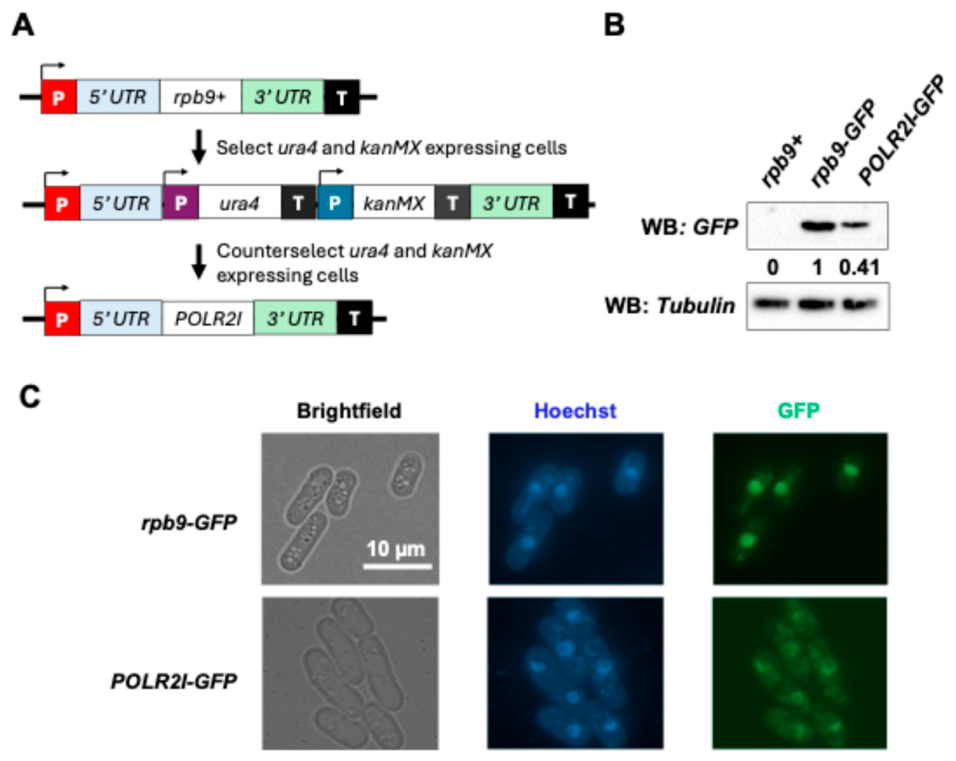
Figure 1. Genome-integrated POLR2I expresses nuclear-localized protein in S. pombe. (A) Illustration of our procedure to endogenously swap yeast rpb9 for human POLR2I. (B) Western blot analysis of GFP-tagged endogenous Rpb9 or POLR2I protein in S. pombe cells. Wild-type cells without a GFP tag were used as a negative control. Levels of α-tubulin served as internal loading controls. Numbers indicate intensities of the GFP bands as percentages relative to the band of rpb9-GFP, which was defined as 1. (C) Brightfield and fluorescence microscopy of S. pombe cells with GFP-tagged Rpb9 or POLR2I protein. Hoechst stains nuclear DNA.
Genes 17 00606 g001
Figure 2. Effects of rpb9 and POLR2I on yeast growth, physiology, and chronological aging. (A) Growth rate of yeast cultures as measured by optical density at 600 nm wavelength readings, N = 3 biological replicates. O.D600 data can be found in Table S4. (B) Brightfield microscopy images of cells belong to the indicated yeast strains. (C) Spotting assays showing the chronological aging phenotype of the indicated yeast strains, as a function of days after the yeast cultures had reached the stationary phase at 32 °C.
Genes 17 00606 g002
Figure 3. POLR2I complements certain rpb9 roles in environmental stresses and facultative heterochromatin formation. (A) Spotting assays with serial dilutions of cells on non-selective (N/S) YEA media or YEA media with 125 mM NaCl. (B) Spotting assays with YEA media −/+ 25 μM 5-FU. (C) Spotting assays with YEA media −/+ 2 mM lithium chloride. (D,E) Spotting assays with YEA media −/+ 20 μg/mL TBZ. For all spotting assays, the yeast strains are indicated to the left of each panel. All incubations were performed at 32 °C.
Genes 17 00606 g003
Figure 4. Rpb9 and POLR2I promote H3K9me2 at the Mmi1-dependent facultative heterochromatin islands mei4 and ssm4. (A) H3K9me2 ChIP enrichments at the mei4 and ssm4 loci, at the pericentromeric dh repeats, and at the subtelomeric SPAC750.08C gene. (B) Fold-changes in steady-state RNA levels as determined by reverse transcription with quantitative PCR (RT-qPCR). Fold-changes are relative to wild-type, which is defined to be one. For both panels A and B, error bars denote the standard deviation of a representative ChIP experiment, N = 3. Statistical significance was determined by Student’s t-test. NS denotes not statistically significant. Asterisk (*) denotes statistical significance with p-value < 0.05.
Genes 17 00606 g004
Figure 5. Endogenous POLR2I does not complement heat stress and 6-AU defects in our humanization system. (A) Spotting assays with serial dilutions of cells on non-selective (N/S) YEA media and grown at 32 °C or 37 °C. (B) Spotting assays at 32 °C with serial dilutions of cells on non-selective (N/S) YEA media or YEA media with 2 mM lithium chloride. For the assays shown in panels A and B, yeast strains with endogenous rpb9, POLR2I, or rpb9Δ were used. (C) Spotting assay at 32 °C using cells with empty (pEmpty) or expression plasmids (pRpb9, pPOLR2I). Media lacking uracil was used to maintain selection of the plasmids, therefore ensuring that the cells retain them.
Genes 17 00606 g005
Figure 6. Structural analyses of Rpb9 and POLR2I. (A) AlphaFold-predicted structures of S. pombe Rpb9 (top) and human POLR2I (middle). Both structures are color-coded based on pIDDT confidence scores with blue (>90): backbone and sidechain are accurate; teal (90 to 70): backbone good, side chain inaccurate; yellow (70 to 50): possible backbone inaccuracy; and orange (<50): flexible spot or intrinsically disordered. At the bottom, the structures are overlaid, with Rpb9 in dark yellow and POLR2I in blue. (B) Empirically resolved structures of S. pombe Rpb9 (top, PDB: 3H0G-I), human POLR2I (middle, PDB: 9EHZ-F), and overlaid (bottom). For the overlaid bottom structure, green is Rpb9 and magenta is POLR2I. (C) AlphaFold-predicted structure of S. pombe Rpb9 interacting with S. pombe Rpb1 and Rpb2 (left) and AlphaFold-predicted structure of human POLR2I interacting with S. pombe Rpb1 and Rpb2 (right).
Genes 17 00606 g006
Table 1. S. pombe growth phenotypes during our procedure to endogenously replace rpb9 for POLR2I.
GenotypeExpected Growth in the
Presence of G418 Drug 1
Expected Growth in the
Presence of 5-FOA Drug 2
rpb9+Not viableViable
rpb9Δ::ura4-kanMXViableNot viable
rpb9Δ::POLR2INot viableViable
1 S. pombe cells expressing the kanMX gene are resistant to the G418 antibiotic [40]. 2 Yeast cells expressing the ura4 gene are sensitive to compound 5-fluoroorotic acid (5-FOA) [38,41].
Disclaimer/Publisher’s Note: The statements, opinions and data contained in all publications are solely those of the individual author(s) and contributor(s) and not of MDPI and/or the editor(s). MDPI and/or the editor(s) disclaim responsibility for any injury to people or property resulting from any ideas, methods, instructions or products referred to in the content.