
Systematic Identification of Immune-Related SnoRNAs: Potential Dual Roles in Tumor Progression and Immunotherapy Response

Abstract
1. Introduction
2. Materials and Methods
2.1. Data Acquisition and Preprocessing
2.2. Estimation of Tumor Microenvironment Scores
2.3. Systematic Identification of Immune-Related snoRNAs
2.4. Permutation Test and Sensitivity Analyses for Partial Correlation
2.5. Analysis of snoRNA Expression Perturbation in Cancer
2.6. Inference of snoRNA Expression in Immune Cell Types
2.7. Association Analysis with Immune Cell Infiltration
2.8. Molecular Subtyping Based on Immune-Related snoRNAs
| Step | Criterion | Quantitative Threshold | Cancer Type |
| 1 | Expression filtering | Remove snoRNAs with zero expression in all samples | NSCLC, HNSC |
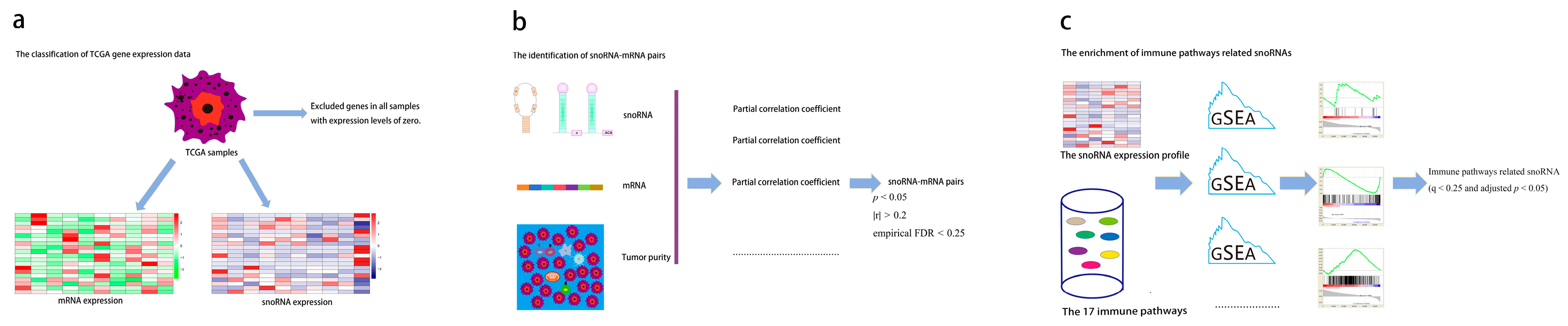
| 2 | Identification of immune-related snoRNAs (partial correlation) | |r| > 0.2, nominal p < 0.05, empirical FDR < 0.25 | NSCLC, HNSC |
| 3 | Identification of immune-related snoRNAs (GSEA) | q < 0.25, adjusted p < 0.05 | NSCLC, HNSC |
| 4 | Final immune-related snoRNA set | Intersection of step 2 and step 3 | NSCLC, HNSC |
| 5 | Correlation with immune infiltra-tion (TIMER) | |Spearman r| ≥ 0.3, p < 0.05 for any immune cell types | NSCLC, HNSC |
| 6 | Final subtyping snoRNA set | Intersection of step 4 and step 5 | NSCLC: 46 genes; HNSC: 39 genes |
2.9. Assessment of Immune Landscape and Therapeutic Potential
2.10. Experimental Validation of Immune-Related snoRNA Function
3. Results
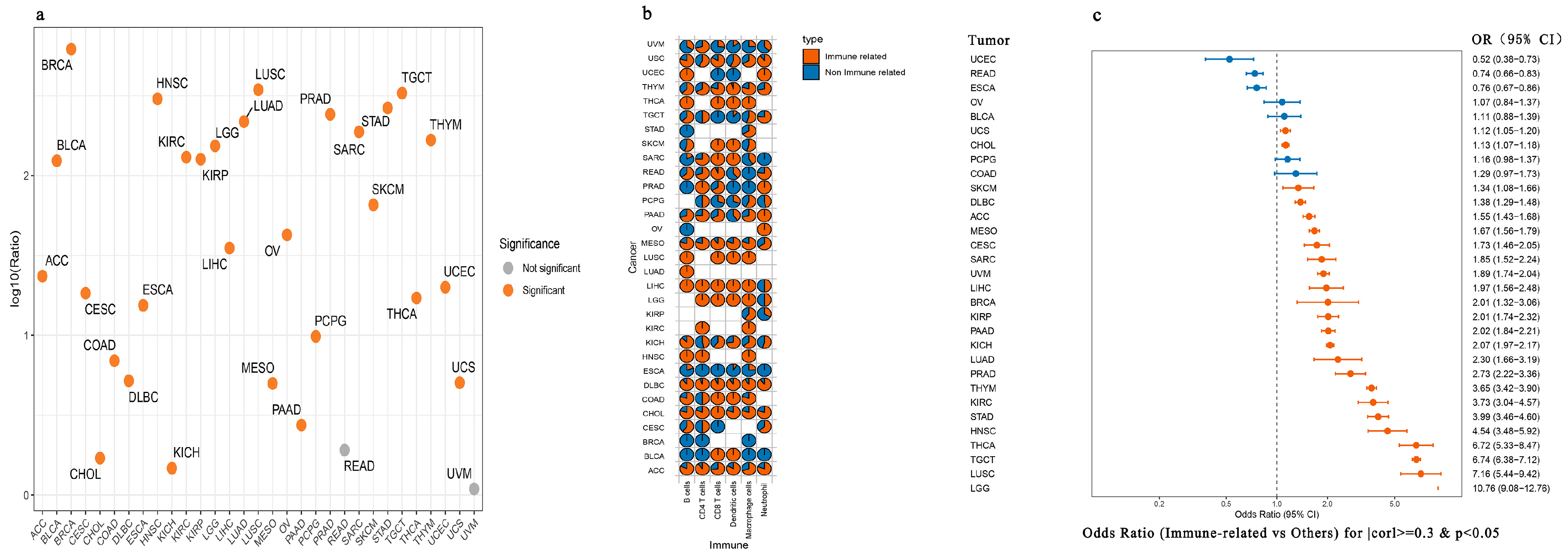
3.1. Immune-Related snoRNAs Are Prevalent and Linked to Core Immunological Pathways
3.2. Immune-Related snoRNAs Drive Oncogenesis and Modulate Cancer Stemness
3.3. Immune-Related snoRNAs Are Enriched in Immune Cells and Correlate with Immune Infiltration
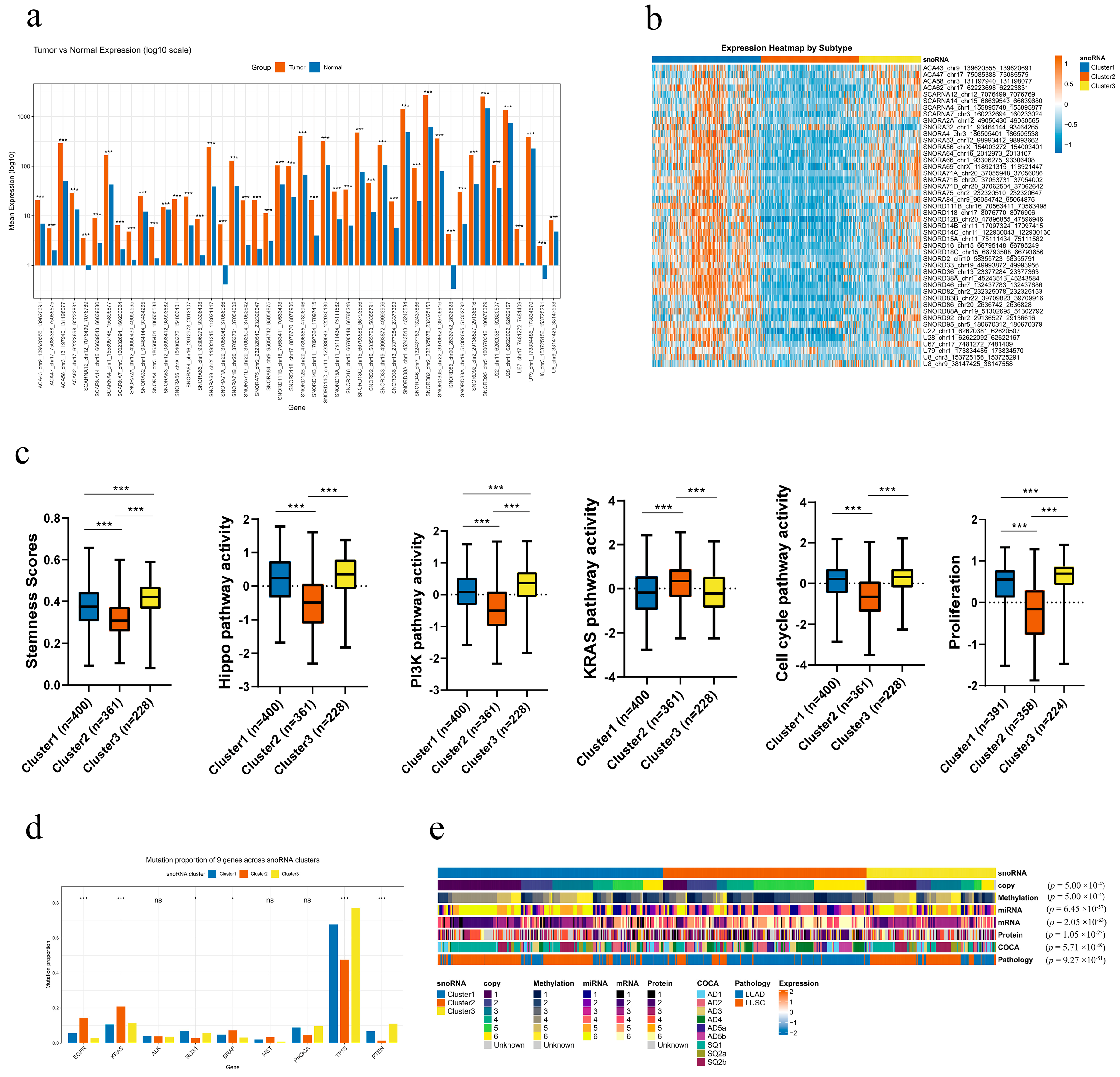
3.4. Molecular Subtyping of Nsclc Using Immune-Related snoRNAs
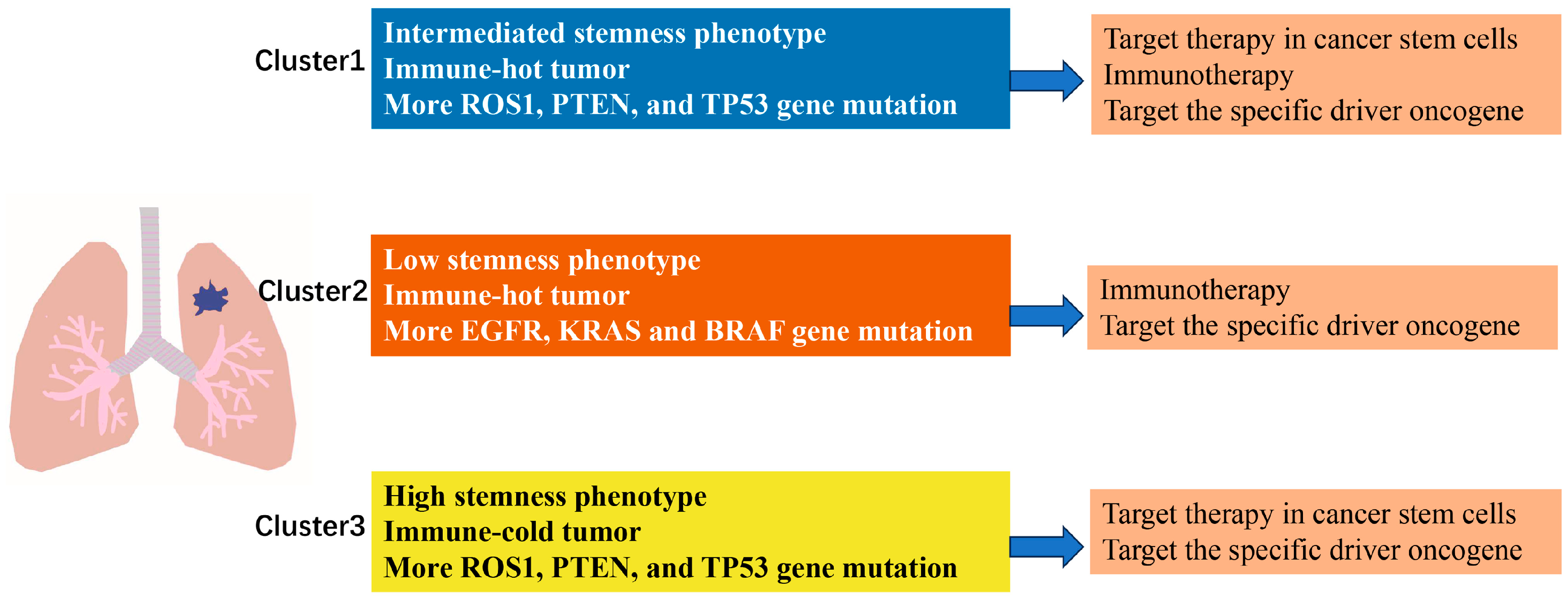
3.5. Distinct Molecular Phenotypes of the snoRNA-Based Subtypes in Nsclc
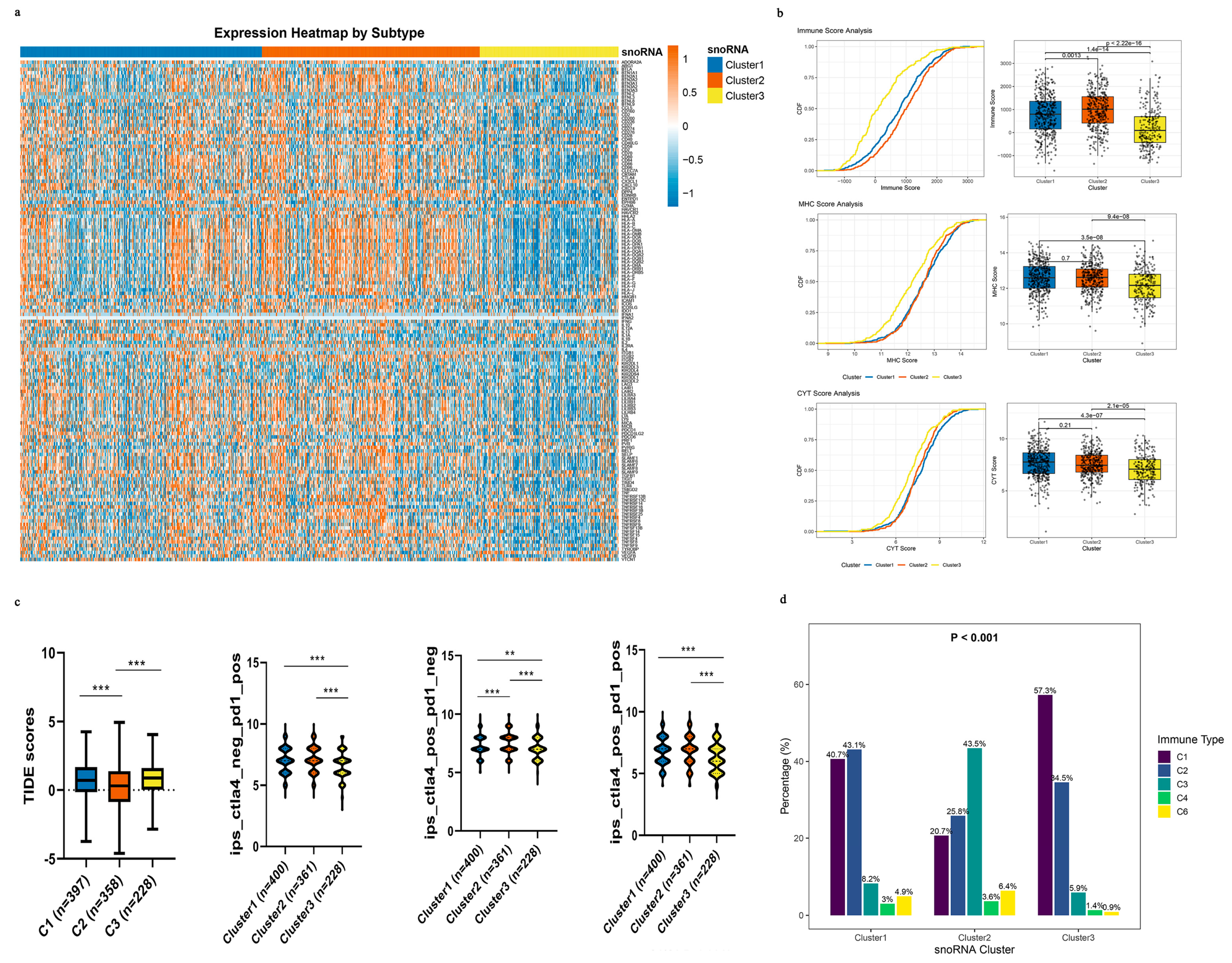
3.6. Immune-Related snoRNA-Based Subtyping Suggests Differential Immunotherapy Response Potential in Nsclc
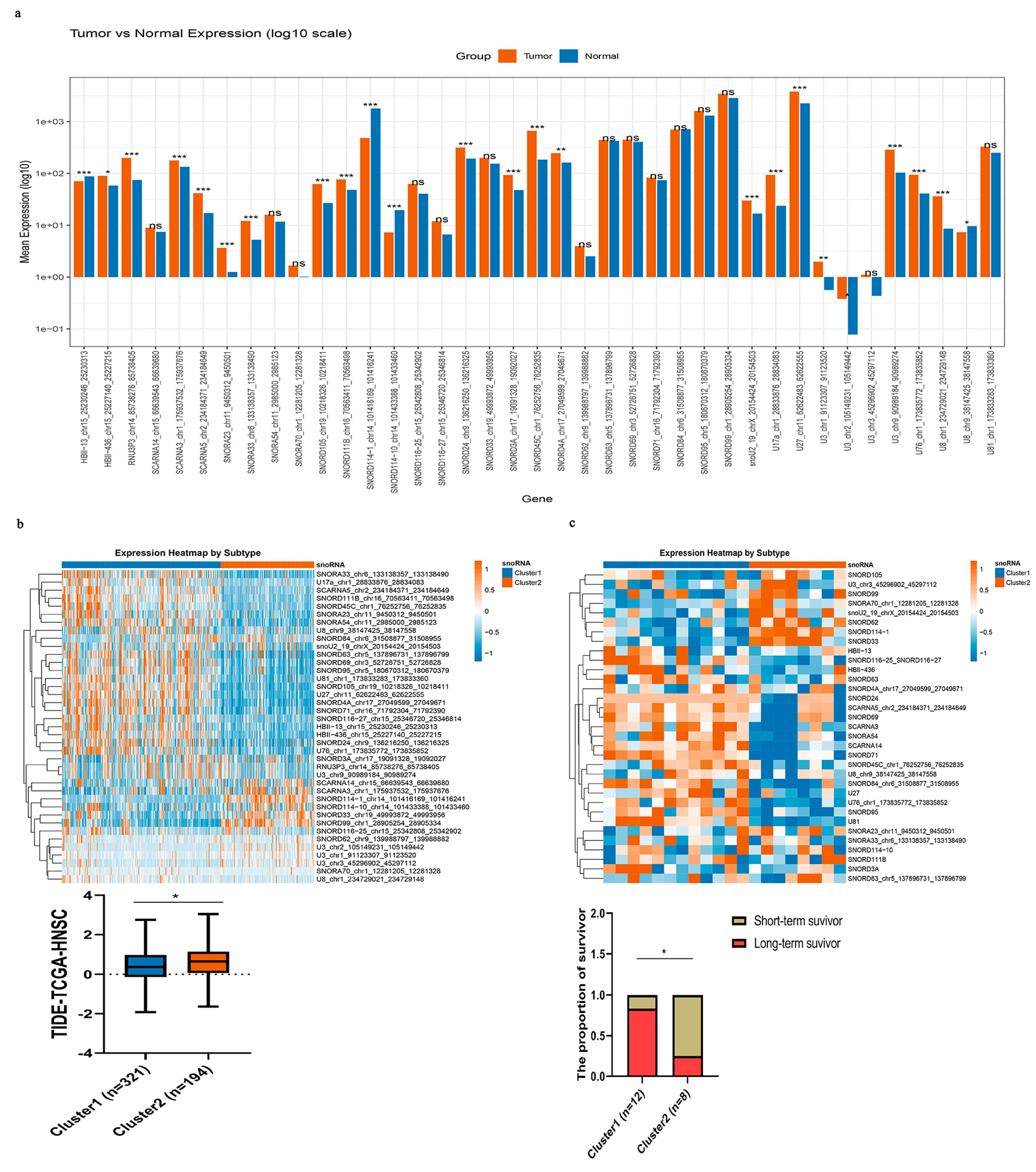
3.7. Generalization of the Immune-Related snoRNA-Based Framework to Head and Neck Squamous Cell Carcinoma (HNSC)
4. Discussion
5. Conclusions
Supplementary Materials
Author Contributions
Funding
Institutional Review Board Statement
Informed Consent Statement
Data Availability Statement
Acknowledgments
Conflicts of Interest
Abbreviations
References
- Nemeth, K.; Bayraktar, R.; Ferracin, M.; Calin, G.A. Non-coding RNAs in disease: From mechanisms to therapeutics. Nat. Rev. Genet. 2024, 25, 211–232. [Google Scholar] [CrossRef]
- Chen, L.L.; Kim, V.N. Small and long non-coding RNAs: Past, present, and future. Cell 2024, 187, 6451–6485. [Google Scholar] [CrossRef] [PubMed]
- Zhang, X.; Wang, C.; Xia, S.; Xiao, F.; Peng, J.; Gao, Y.; Yu, F.; Wang, C.; Chen, X. The emerging role of snoRNAs in human disease. Genes. Dis. 2023, 10, 2064–2081. [Google Scholar]
- Chabronova, A.; Holmes, T.L.; Hoang, D.M.; Denning, C.; James, V.; Smith, J.G.W.; Peffers, M.J. SnoRNAs in cardiovascular development, function, and disease. Trends Mol. Med. 2024, 30, 562–578. [Google Scholar] [CrossRef] [PubMed]
- Zhang, Z.; Zhang, J.; Diao, L.; Han, L. Small non-coding RNAs in human cancer: Function, clinical utility, and characterization. Oncogene 2021, 40, 1570–1577. [Google Scholar] [CrossRef] [PubMed]
- Xu, C.; Bian, Z.; Wang, X.; Niu, N.; Liu, L.; Xiao, Y.; Zhu, J.; Huang, N.; Zhang, Y.; Chen, Y.; et al. SNORA56-mediated pseudouridylation of 28 S rRNA inhibits ferroptosis and promotes colorectal cancer proliferation by enhancing GCLC translation. J. Exp. Clin. Cancer Res. 2023, 42, 331. [Google Scholar]
- Han, C.; Sun, L.Y.; Luo, X.Q.; Pan, Q.; Sun, Y.M.; Zeng, Z.C.; Chen, T.-Q.; Huang, W.; Fang, K.; Wang, W.-T.; et al. Chromatin-associated orphan snoRNA regulates DNA damage-mediated differentiation via a non-canonical complex. Cell Rep. 2022, 38, 110421. [Google Scholar] [CrossRef]
- Gu, Y.; Yi, Z.; Zhou, Z.; Wang, J.; Li, S.; Zhu, P.; Liu, N.; Xu, Y.; He, L.; Wang, Y.; et al. SNORD88B-mediated WRN nucleolar trafficking drives self-renewal in liver cancer initiating cells and hepatocarcinogenesis. Nat. Commun. 2024, 15, 6730. [Google Scholar] [CrossRef]
- Liu, X.; Zhang, H.; Fan, Y.; Cai, D.; Lei, R.; Wang, Q.; Li, Y.; Shen, L.; Gu, Y.; Zhang, Q.; et al. SNORA28 Promotes Proliferation and Radioresistance in Colorectal Cancer Cells through the STAT3 Pathway by Increasing H3K9 Acetylation in the LIFR Promoter. Adv. Sci. 2024, 11, e2405332. [Google Scholar] [CrossRef]
- Liang, J.; Li, G.; Liao, J.; Huang, Z.; Wen, J.; Wang, Y.; Chen, Z.; Cai, G.; Xu, W.; Ding, Z.; et al. Non-coding small nucleolar RNA SNORD17 promotes the progression of hepatocellular carcinoma through a positive feedback loop upon p53 inactivation. Cell Death Differ. 2022, 29, 988–1003. [Google Scholar] [CrossRef]
- Zhuo, Y.; Li, S.; Hu, W.; Zhang, Y.; Shi, Y.; Zhang, F.; Zhang, J.; Wang, J.; Liao, M.; Chen, J.; et al. Targeting SNORA38B attenuates tumorigenesis and sensitizes immune checkpoint blockade in non-small cell lung cancer by remodeling the tumor microenvironment via regulation of GAB2/AKT/mTOR signaling pathway. J. Immunother. Cancer 2022, 10, e004113. [Google Scholar] [CrossRef] [PubMed]
- Lemus-Diaz, N.; Ferreira, R.R.; Bohnsack, K.E.; Gruber, J.; Bohnsack, M.T. The human box C/D snoRNA U3 is a miRNA source and miR-U3 regulates expression of sortin nexin 27. Nucleic Acids Res. 2020, 48, 8074–8089. [Google Scholar] [CrossRef]
- Hu, X.; Cui, W.; Liu, M.; Zhang, F.; Zhao, Y.; Zhang, M.; Yin, Y.; Li, Y.; Che, Y.; Zhu, X.; et al. SnoRNAs: The promising targets for anti-tumor therapy. J. Pharm. Anal. 2024, 14, 101064. [Google Scholar] [CrossRef]
- Zhang, W.; Song, X.; Jin, Z.; Zhang, Y.; Li, S.; Jin, F.; Zheng, A. U2AF2-SNORA68 promotes triple-negative breast cancer stemness through the translocation of RPL23 from nucleoplasm to nucleolus and c-Myc expression. Breast Cancer Res. 2024, 26, 60. [Google Scholar] [CrossRef]
- van der Werf, J.; Chin, C.V.; Fleming, N.I. SnoRNA in Cancer Progression, Metastasis and Immunotherapy Response. Biology 2021, 10, 809. [Google Scholar] [CrossRef] [PubMed]
- Zhang, Y.; Zheng, A.; Shi, Y.; Lu, H. SNORA5A regulates tumor-associated macrophage M1/M2 phenotypes via TRAF3IP3 in breast cancer. Braz. J. Med. Biol. Res. 2024, 57, e13809. [Google Scholar] [PubMed]
- Xiao, H.; Feng, X.; Liu, M.; Gong, H.; Zhou, X. SnoRNA and lncSNHG: Advances of nucleolar small RNA host gene transcripts in anti-tumor immunity. Front. Immunol. 2023, 14, 1143980. [Google Scholar] [CrossRef]
- Nation, G.K.; Saffold, C.E.; Pua, H.H. Secret messengers: Extracellular RNA communication in the immune system. Immunol. Rev. 2021, 304, 62–76. [Google Scholar] [CrossRef]
- Tjahjono, E.; Revtovich, A.V.; Kirienko, N.V. Box C/D small nucleolar ribonucleoproteins regulate mitochondrial surveillance and innate immunity. PLoS Genet. 2022, 18, e1010103. [Google Scholar] [CrossRef]
- Bouchard-Bourelle, P.; Desjardins-Henri, C.; Mathurin-St-Pierre, D.; Deschamps-Francoeur, G.; Fafard-Couture, É.; Garant, J.M.; Elela, S.A.; Scott, M.S. snoDB: An interactive database of human snoRNA sequences, abundance and interactions. Nucleic Acids Res. 2020, 48, D220–D225. [Google Scholar]
- Cai, C.; Peng, Y.; Shen, E.; Wan, R.; Gao, L.; Gao, Y.; Zhou, Y.; Huang, Q.; Chen, Y.; Liu, P.; et al. Identification of tumour immune infiltration-associated snoRNAs (TIIsno) for predicting prognosis and immune landscape in patients with colon cancer via a TIIsno score model. eBioMedicine 2022, 76, 103866. [Google Scholar] [CrossRef]
- Wang, R.; Chen, C.; Liu, Y.; Luo, M.; Yang, J.; Chen, Y.; Ma, L.; Yang, L.; Lin, C.; Diao, L.; et al. The pharmacogenomic and immune landscape of snoRNAs in human cancers. Cancer Lett. 2024, 605, 217304. [Google Scholar] [CrossRef]
- Bhattacharya, S.; Andorf, S.; Gomes, L.; Dunn, P.; Schaefer, H.; Pontius, J.; Berger, P.; Desborough, V.; Smith, T.; Campbell, J.; et al. ImmPort: Disseminating data to the public for the future of immunology. Immunol. Res. 2014, 58, 234–239. [Google Scholar] [CrossRef] [PubMed]
- Li, Y.; Jiang, T.; Zhou, W.; Li, J.; Li, X.; Wang, Q.; Jin, X.; Yin, J.; Chen, L.; Zhang, Y.; et al. Pan-cancer characterization of immune-related lncRNAs identifies potential oncogenic biomarkers. Nat. Commun. 2020, 11, 1000. [Google Scholar] [CrossRef] [PubMed]
- Ng, J.C.F.; Quist, J.; Grigoriadis, A.; Malim, M.H.; Fraternali, F. Pan-cancer transcriptomic analysis dissects immune and proliferative functions of APOBEC3 cytidine deaminases. Nucleic Acids Res. 2019, 47, 1178–1194. [Google Scholar] [CrossRef]
- Li, B.; Severson, E.; Pignon, J.C.; Zhao, H.; Li, T.; Novak, J.; Jiang, P.; Shen, H.; Aster, J.C.; Rodig, S.; et al. Comprehensive analyses of tumor immunity: Implications for cancer immunotherapy. Genome Biol. 2016, 17, 174. [Google Scholar] [CrossRef]
- Newman, A.M.; Liu, C.L.; Green, M.R.; Gentles, A.J.; Feng, W.; Xu, Y.; Hoang, C.D.; Diehn, M.; Alizadeh, A.A. Robust enumeration of cell subsets from tissue expression profiles. Nat. Methods 2015, 12, 453–457. [Google Scholar] [CrossRef]
- Chen, F.; Zhang, Y.; Parra, E.; Rodriguez, J.; Behrens, C.; Akbani, R.; Lu, Y.; Kurie, J.M.; Gibbons, D.L.; Mills, G.B.; et al. Multiplatform-based molecular subtypes of non-small-cell lung cancer. Oncogene 2017, 36, 1384–1393. [Google Scholar] [CrossRef]
- Malta, T.M.; Sokolov, A.; Gentles, A.J.; Burzykowski, T.; Poisson, L.; Weinstein, J.N.; Kamińska, B.; Huelsken, J.; Omberg, L.; Gevaert, O.; et al. Machine Learning Identifies Stemness Features Associated with Oncogenic Dedifferentiation. Cell 2018, 173, 338–354.e315. [Google Scholar] [CrossRef]
- Jiang, P.; Gu, S.; Pan, D.; Fu, J.; Sahu, A.; Hu, X.; Li, Z.; Traugh, N.; Bu, X.; Li, B.; et al. Signatures of T cell dysfunction and exclusion predict cancer immunotherapy response. Nat. Med. 2018, 24, 1550–1558. [Google Scholar] [CrossRef] [PubMed]
- Serafini, M.S.; Cavalieri, S.; Licitra, L.; Pistore, F.; Lenoci, D.; Canevari, S.; Airoldi, M.; Rocca, M.C.; Strojan, P.; Kuhar, C.G.; et al. Association of a gene-expression subtype to outcome and treatment response in patients with recurrent/metastatic head and neck squamous cell carcinoma treated with nivolumab. J. Immunother. Cancer 2024, 12, e007823. [Google Scholar] [CrossRef] [PubMed]
- Thorsson, V.; Gibbs, D.L.; Brown, S.D.; Wolf, D.; Bortone, D.S.; Ou Yang, T.H.; Porta-Pardo, E.; Gao, G.F.; Plaisier, C.L.; Eddy, J.A.; et al. The Immune Landscape of Cancer. Immunity 2019, 51, 411–412. [Google Scholar] [CrossRef]
- Lauss, M.; Donia, M.; Harbst, K.; Andersen, R.; Mitra, S.; Rosengren, F.; Salim, M.; Vallon-Christersson, J.; Törngren, T.; Kvist, A.; et al. Mutational and putative neoantigen load predict clinical benefit of adoptive T cell therapy in melanoma. Nat. Commun. 2017, 8, 1738. [Google Scholar] [CrossRef] [PubMed]
- Rooney, M.S.; Shukla, S.A.; Wu, C.J.; Getz, G.; Hacohen, N. Molecular and genetic properties of tumors associated with local immune cytolytic activity. Cell 2015, 160, 48–61. [Google Scholar] [CrossRef]
- Charoentong, P.; Finotello, F.; Angelova, M.; Mayer, C.; Efremova, M.; Rieder, D.; Hackl, H.; Trajanoski, Z. Pan-cancer Immunogenomic Analyses Reveal Genotype-Immunophenotype Relationships and Predictors of Response to Checkpoint Blockade. Cell Rep. 2017, 18, 248–262. [Google Scholar] [CrossRef]
- Bhattacharya, S.; Dunn, P.; Thomas, C.G.; Smith, B.; Schaefer, H.; Chen, J.; Hu, Z.; Zalocusky, K.A.; Shankar, R.D.; Shen-Orr, S.S.; et al. ImmPort, toward repurposing of open access immunological assay data for translational and clinical research. Sci. Data 2018, 5, 180015. [Google Scholar] [CrossRef]
- Yang, K.; Halima, A.; Chan, T.A. Antigen presentation in cancer—Mechanisms and clinical implications for immunotherapy. Nat. Rev. Clin. Oncol. 2023, 20, 604–623. [Google Scholar] [CrossRef]
- Fu, Y.; Tang, R.; Zhao, X. Engineering cytokines for cancer immunotherapy: A systematic review. Front. Immunol. 2023, 14, 1218082. [Google Scholar] [CrossRef] [PubMed]
- Mollica Poeta, V.; Massara, M.; Capucetti, A.; Bonecchi, R. Chemokines and Chemokine Receptors: New Targets for Cancer Immunotherapy. Front. Immunol. 2019, 10, 379. [Google Scholar] [CrossRef]
- Chu, X.; Tian, W.; Ning, J.; Xiao, G.; Zhou, Y.; Wang, Z.; Zhai, Z.; Tanzhu, G.; Yang, J.; Zhou, R. Cancer stem cells: Advances in knowledge and implications for cancer therapy. Signal Transduct. Target. Ther. 2024, 9, 170. [Google Scholar] [CrossRef]
- Luo, M.; Bao, L.; Xue, Y.; Zhu, M.; Kumar, A.; Xing, C.; Wang, J.E.; Wang, Y.; Luo, W. ZMYND8 protects breast cancer stem cells against oxidative stress and ferroptosis through activation of NRF2. J. Clin. Investig. 2024, 134, e171166. [Google Scholar] [CrossRef] [PubMed]
- Battaglin, F.; Millstein, J.; Bartolini, M.; Ashouri, K.; Soni, S.; Algaze, S.; Mittal, P.; Torres-Gonzalez, L.; Jayachandran, P.; Shah, U.H.; et al. Small nucleolar RNAs (snoRNAs) expression and effects on patient (pt) outcomes in metastatic colorectal cancer (mCRC): Data from CALGB (Alliance)/SWOG 80405. J. Clin. Oncol. 2025, 43, 3145. [Google Scholar] [CrossRef]
- Záveský, L.; Jandáková, E.; Weinberger, V.; Minář, L.; Turyna, R.; Faridová, A.T.; Hanzíková, V.; Slanař, O. Evaluation of Expression and Clinicopathological Relevance of Small Nucleolar RNAs (snoRNAs) in Invasive Breast Cancer. NonCoding RNA 2025, 11, 76. [Google Scholar] [CrossRef]
- Huang, D.; Chen, X.; Zeng, X.; Lao, L.; Li, J.; Xing, Y.; Lu, Y.; Ouyang, Q.; Chen, J.; Yang, L.; et al. Targeting regulator of G protein signaling 1 in tumor-specific T cells enhances their trafficking to breast cancer. Nat. Immunol. 2021, 22, 865–879. [Google Scholar] [CrossRef] [PubMed]





| Cancers | B Cells | Macrophages | Dendritic Cells | Neutrophil | CD4+ T Cells | CD8+ T Cells |
|---|---|---|---|---|---|---|
| ACC | 0 | 9.64 × 10⁻⁷ | 0.000514855 | 4.89 × 10⁻³¹ | 0.8716862 | 1.05 × 10⁻² |
| BLCA | 0.001725197 | 1.86 × 10⁻²⁴ | 0.5434576 | 9.84 × 10⁻¹ | 6.25 × 10⁻²⁴ | 1.83 × 10⁻¹ |
| BRCA | 7.31 × 10⁻²³ | 9.52 × 10⁻¹⁶ | 5.32 × 10⁻² | 3.73 × 10⁻² | 4.38 × 10⁻¹⁶ | 1.83 × 10⁻¹² |
| CESC | 1.36 × 10⁻³ | 7.95 × 10⁻¹ | 8.20 × 10⁻⁴ | 6.09 × 10⁻¹ | 4.17 × 10⁻¹ | 1.70 × 10⁻⁴ |
| CHOL | 3.37 × 10−124 | 7.75 × 10⁻² | 0.2781415 | 0.8881242 | 2.71 × 10−123 | 0.5831955 |
| COAD | 0.000134637 | 1.11 × 10−37 | 1.58 × 10⁻⁸ | 7.67 × 10⁻⁸ | 3.37 × 10⁻²¹ | 8.04 × 10⁻⁷ |
| DLBC | 0.2859313 | 0.000146168 | 0.9968618 | 0.7929443 | 8.69 × 10⁻⁷ | 0.2936191 |
| ESCA | 3.73 × 10−56 | 2.91 × 10⁻¹² | 0.1115102 | 0.09755062 | 0.407884 | 5.57 × 10⁻⁶ |
| HNSC | 1.02 × 10−51 | 4.92 × 10⁻²⁸ | 0.4231745 | 0.8840514 | 9.70 × 10⁻²⁸ | 1.04 × 10−43 |
| KICH | 0.9964794 | 3.34 × 10⁻¹⁰ | 0.9900563 | 0.8145457 | 0.000144348 | 0.7792685 |
| KIRC | 1.08 × 10⁻⁹ | 5.12 × 10⁻⁹ | 0.000162787 | 0.03466863 | 0.07561106 | 2.38 × 10⁻¹² |
| KIRP | 1.80 × 10⁻¹⁵ | 1.72 × 10⁻⁵ | 0.1581215 | 6.13 × 10⁻⁶ | 9.93 × 10⁻¹² | 0.000141409 |
| LGG | 5.19 × 10⁻²⁷ | 5.47 × 10⁻¹⁸ | 0.4371587 | 0.1834694 | 5.85 × 10⁻¹⁶ | 0.0014817 |
| LIHC | 2.66 × 10⁻⁷ | 1.61 × 10⁻⁵ | 0.6020427 | 0.001582464 | 0.003700548 | 2.66 × 10⁻¹⁰ |
| LUAD | 4.87 × 10⁻³⁵ | 2.62 × 10⁻⁷ | 0.1978027 | 0.000417827 | 1.91 × 10⁻¹⁴ | 1.09 × 10⁻⁵ |
| LUSC | 5.52 × 10⁻¹⁷ | 2.06 × 10⁻¹¹ | 0.04039687 | 0.0128479 | 3.17 × 10−57 | 2.94 × 10⁻⁵ |
| MESO | 1.21 × 10−114 | 0.005740786 | 0.005558234 | 0.04509911 | 0.000180287 | 2.19 × 10⁻¹² |
| OV | 0.5829572 | 0.006828906 | 0.000938342 | 0.08519513 | 0.000634034 | 0.4575554 |
| PAAD | 1.72 × 10−79 | 2.91 × 10⁻¹⁵ | 0.5498204 | 0.9969005 | 2.56 × 10⁻²⁷ | 0.02671072 |
| PCPG | 0.5813277 | 0.006037756 | 0.7731533 | 0.6787109 | 0.05909795 | 9.33 × 10⁻¹⁰ |
| PRAD | 7.87 × 10⁻⁸ | 1.21 × 10−43 | 0.9397916 | 0.02500553 | 5.15 × 10⁻²⁹ | 1.51 × 10⁻³³ |
| READ | 0.05658329 | 7.54 × 10⁻³³ | 0.01158724 | 3.41 × 10⁻¹⁷ | 0.2979904 | 1.23 × 10⁻²⁵ |
| SARC | 0.01173038 | 0.09849348 | 2.49 × 10⁻⁵ | 0.000757975 | 3.84 × 10⁻⁵ | 5.80 × 10⁻⁹ |
| SKCM | 1.78 × 10⁻³³ | 6.17 × 10⁻⁷ | 0.03962026 | 0.8109472 | 5.21 × 10⁻¹² | 1.50 × 10⁻¹² |
| STAD | 2.27 × 10⁻¹⁰ | 1.57 × 10⁻¹⁴ | 0.1067971 | 0.000174964 | 1.69 × 10⁻³³ | 0.007622005 |
| TGCT | 7.01 × 10⁻¹⁵ | 0.000853644 | 0.05542729 | 0.5922325 | 4.51 × 10−69 | 3.38 × 10⁻³² |
| THCA | 5.90 × 10⁻¹⁵ | 0.000668974 | 1.23 × 10⁻²² | 0.000172601 | 1.41 × 10⁻²⁰ | 1.46 × 10⁻⁵ |
| THYM | 1.40 × 10⁻¹² | 6.65 × 10⁻¹² | 0.008992865 | 0.9999996 | 6.97 × 10⁻²⁰ | 0.3936162 |
| UCEC | 6.90 × 10⁻⁹ | 0.08134059 | 0.001168213 | 0.008084847 | 0.001920156 | 3.29 × 10⁻⁶ |
| UCS | 2.10 × 10⁻⁵ | 3.33 × 10⁻⁶ | 1.34 × 10⁻⁷ | 1.19 × 10⁻⁵ | 0.19475 | 0.6510826 |
| UVM | 0.08105518 | 0.8726819 | 0.01450239 | 0.7265488 | 0.4072468 | 3.47 × 10⁻⁶ |
Disclaimer/Publisher’s Note: The statements, opinions and data contained in all publications are solely those of the individual author(s) and contributor(s) and not of MDPI and/or the editor(s). MDPI and/or the editor(s) disclaim responsibility for any injury to people or property resulting from any ideas, methods, instructions or products referred to in the content. |
© 2026 by the authors. Licensee MDPI, Basel, Switzerland. This article is an open access article distributed under the terms and conditions of the Creative Commons Attribution (CC BY) license.
Share and Cite
Li, H.; Zhang, L.; Li, Z.; Lin, S. Systematic Identification of Immune-Related SnoRNAs: Potential Dual Roles in Tumor Progression and Immunotherapy Response. Genes 2026, 17, 581. https://doi.org/10.3390/genes17050581
Li H, Zhang L, Li Z, Lin S. Systematic Identification of Immune-Related SnoRNAs: Potential Dual Roles in Tumor Progression and Immunotherapy Response. Genes. 2026; 17(5):581. https://doi.org/10.3390/genes17050581
Chicago/Turabian StyleLi, Hongling, Lihua Zhang, Zhaobin Li, and Shuchen Lin. 2026. "Systematic Identification of Immune-Related SnoRNAs: Potential Dual Roles in Tumor Progression and Immunotherapy Response" Genes 17, no. 5: 581. https://doi.org/10.3390/genes17050581
APA StyleLi, H., Zhang, L., Li, Z., & Lin, S. (2026). Systematic Identification of Immune-Related SnoRNAs: Potential Dual Roles in Tumor Progression and Immunotherapy Response. Genes, 17(5), 581. https://doi.org/10.3390/genes17050581