Article

Association of VTN Genotype with Plasminogen Activator Inhibitor-1 Activity in Late-Onset Alzheimer’s Disease


1
Department of Medical Genetics, Cerrahpasa Faculty of Medicine, Istanbul University-Cerrahpasa, 34098 Istanbul, Turkey
2
Department of Cardiology, School of Medicine, Istanbul Medeniyet University, Uskudar, 34700 Istanbul, Turkey
3
Department of Neurology, Sancaktepe Şehit Prof. Dr. Ilhan Varank Training and Research Hospital, Sancaktepe, 34785 Istanbul, Turkey
4
Department of Neurology, Goztepe Training and Research Hospital, Istanbul Medeniyet University, Kadikoy, 34722 Istanbul, Turkey
5
Department of Molecular Biology and Genetics, Faculty of Engineering and Natural Sciences, Graduate School of Natural and Applied Sciences, Acibadem Mehmet Ali Aydinlar University, Atasehir, 34752 Istanbul, Turkey
*
Author to whom correspondence should be addressed.
Genes 2026, 17(5), 516; https://doi.org/10.3390/genes17050516
Submission received: 13 March 2026 / Revised: 22 April 2026 / Accepted: 23 April 2026 / Published: 27 April 2026
(This article belongs to the Section Human Genomics and Genetic Diseases)

Abstract

Background/Objectives: Late-onset Alzheimer’s disease (LOAD) is a multifactorial neurodegenerative disorder involving the interaction of genetic and environmental factors. Dysregulation of the fibrinolytic system, particularly an increase in plasminogen activator inhibitor-1 (PAI-1) levels, may contribute to Alzheimer’s pathology. Vitronectin (VTN) regulates fibrinolysis by stabilizing PAI-1. This study investigated the relationships between plasma PAI-1 activity and VTN, SERPINE1 (PAI-1), and APOE gene variants in nineteen LOAD patients (>65 years) and ten cognitively normal age-matched control groups. Methods: Targeted next-generation sequencing was used to analyze the VTN, APOE, and SERPINE1 genes in 19 LOAD patients and ten controls. Additionally, plasma PAI-1 activity was measured in both groups. Results: Plasma PAI-1 activity was statistically significantly higher in LOAD patients compared to controls (p = 0.04). Targeted next-generation sequencing results showed that VTN 5′-UTR variants (rs7212814, rs1555584131, rs71135830, and rs11437594) were found in all patients and observed in 20% of controls (p = 0.0001). The VTN rs704 variant was detected in 84% of patients and 29% of controls (p = 0.001). VTN 5′-UTR variants showed Spearman correlation with PAI-1 activity (r = 1.0; p < 0.0001). SERPINE1 3′-UTR variants (rs11178, rs41423845) were found to be associated with the disease (p = 0.027; p = 0.0001). The APOE ε3/ε4 genotype was present in 52.6% of patients and was not associated with PAI-1 activity. VTN variants showed an association with LOAD. Conclusions: These findings suggest that VTN variants may contribute to LOAD pathogenesis by affecting PAI-1 and leading to fibrinolytic system dysregulation.

1. Introduction

Alzheimer’s disease (AD) is a progressive neurodegenerative disorder characterized by multifactorial pathophysiology. Early-onset AD, which typically manifests before age 65, has a strong genetic basis and follows a Mendelian dominant inheritance pattern. Additional genetic variants may influence the age of onset and disease progression. The pathophysiology of late-onset AD (LOAD) includes age-related damage. The ideal age cut-off for defining LOAD depends on genetic variability [1]. The deposition of amyloid fibrils and neurofibrillary tangles has been implicated in the pathophysiology of AD [2]. The impaired fibrinolytic system fails to clear fibrin deposits, leading to the abnormal accumulation of fibrin(ogen) in the AD brain [3,4].
A key regulator of fibrinolysis is plasminogen activator inhibitor-1 (PAI-1). PAI-1 is a serine proteinase inhibitor (serpin family member) that inhibits tissue- and urokinase-type plasminogen activators (t-PA and u-PA) [5]. It is a marker and mediator in several biological processes, including thrombosis, angiogenesis, fibrosis, connective tissue diseases, malignancy, and metastasis [6]. It has three conformations, including free active PAI-1, inactive PAI-1 complexed with t-PA, and latent PAI-1 (an inactive PAI-1 conformation) [7,8]. The inhibitory activity and stability of PAI-1 are critically dependent on its conformational flexibility and its interaction with binding partners [9]. Notably, the extracellular matrix glycoprotein vitronectin (VTN) plays a significant role in the modulation of fibrinolytic system activity by increasing the stability of PAI-1 [10,11]. Active PAI-1 rapidly binds to t-PA, whereas the clearance of active t-PA and PAI-1 is faster than the PAI-1/t-PA complex [12]. The polymorphism rs704C>T in the VTN gene alters its protein expression and functionality and has been associated with age-related macular degeneration [13,14,15], highlighting the importance of VTN in age-related pathologies. Elevated PAI-1 activity reduces plasmin generation, and plasmin is known to degrade amyloid-β peptides, a key pathological hallmark of AD. Although VTN is known to bind to PAI-1 and affect its stability and activity, little is known about how VTN and PAI-1 interact in AD, the influence of genetic variants in the VTN and SERPINE1 genes on this interaction, or how this interaction contributes to AD pathology. Given that VTN stabilizes active PAI-1 and modulates fibrinolytic activity—a process implicated in neurodegeneration—we hypothesized that genetic variants in VTN may influence PAI-1 activity and contribute to LOAD risk. To test this hypothesis, we analyzed VTN and SERPINE1 variants and measured PAI-1 activity in a cohort of LOAD patients and cognitively healthy, age-matched controls. The APOE gene has been implicated in the pathophysiology of LOAD. APOE is polymorphic at two single nucleotides (rs429358 and rs7412), resulting in three different alleles (ε2, ε3, and ε4). While the ε4 allele of the APOE gene significantly increases LOAD risk, the ε2 allele is protective relative to the common ε3 allele [16]. This study also aims to elucidate a novel potential link between VTN and APOE genetics, PAI-1 biology, and the pathogenesis of LOAD.

2. Materials and Methods

2.1. Study Population

Peripheral blood samples were collected from 19 LOAD patients (>65 years) and 10 age-matched cognitively controls without any AD family history, recruited at the Department of Neurology, Medeniyet University Goztepe Training and Research Hospital, Istanbul, Turkey. Patients with acute illness and other forms of neurological diseases were excluded. The clinical diagnosis of LOAD was made according to the Neurological and Communicative Disorders and Stroke–Alzheimer’s Disease and Related Disorders Association (NINCDS-ADRDA) criteria and the criteria of the Diagnostic and Statistical Manual of Mental Disorders, 4th ed. (DSM-IV). Cognitively normal participants received the same assessment as the LOAD patients and were determined to be cognitively unimpaired. In addition to the clinical information, including age, gender, duration of disease, and age of onset, the cognitive status was assessed using the Mini-Mental State Examination (MMSE). Written informed consent was obtained from all subjects before their inclusion in the study. All procedures were performed in compliance with relevant laws and institutional guidelines. Acibadem University Institutional Review Board (ATADEK) approved the study protocol with decision number 2025-01/28.

2.2. PAI-1 Activity Measurement

Blood was collected in EDTA-coated tubes after overnight fasting. The plasma was separated by low-speed centrifugation at 4 °C right after venipuncture. The PAI-1 human chromogenic activity kit (ab108894) (Biotech, Life Sciences, Cambridge, UK) was employed to determine PAI-1 activity in plasma samples following the manufacturer’s instructions. In this assay, an excess amount of t-PA is added to undiluted plasma, allowing the formation of inactive PAI-1/t-PA complexes. Residual t-PA activity is then determined in a coupled reaction containing t-PA, plasminogen, and a plasmin-specific chromogenic substrate. The plasmin generated in this process cleaves a substrate to release para-nitroaniline (pNA), a yellow chromophore measured at 405 nm. The PAI-1 enzymatic activity presented was the average of three independent experiments.

2.3. Targeted Next-Generation Sequencing of VTN, APOE, and SERPINE1 Genes

Total DNA was isolated using a DNAeasy Blood & Tissue kit (Qiagen, Hilden, Germany) according to the manufacturer`s protocol. DNA quality and quantity were evaluated using Qubit dsDNA HS Assay Kit (Thermo Fisher Scientific, Waltham, MA, USA) according to the manufacturer’s protocol. Targeted next-generation sequencing (NGS) was performed using the Illumina platform in a commercial laboratory (Eurofins, Hamburg, Germany). FASTQ files were provided by Eurofins. Alignment of FASTQ reads to the GRCh37 (hg19) human reference genome and variant detection were performed using the Variant Caller plugin to generate VCF files. Comparative analyses of case and control datasets were conducted with CLC Genomics Workbench (v.9.0.1; Qiagen, Hilden, Germany). Statistically significant variants were determined based on Bonferroni-adjusted Fisher’s exact test p-values.

2.4. Statistical Analysis

Statistical analysis was performed using the GraphPad Prism 11 software. A two-tailed unpaired Student t-test was used to compare the PAI activity between samples and controls. The relationships among parameters were assessed using Pearson’s or Spearman’s correlation coefficient according to the normality of the data. Fisher’s exact test was performed to compare the allele frequencies between LOAD and controls. A p-value of <0.05 was considered statistically significant.

3. Results

3.1. Plasma PAI-1 Activity Levels Are Increased in LOAD Patients

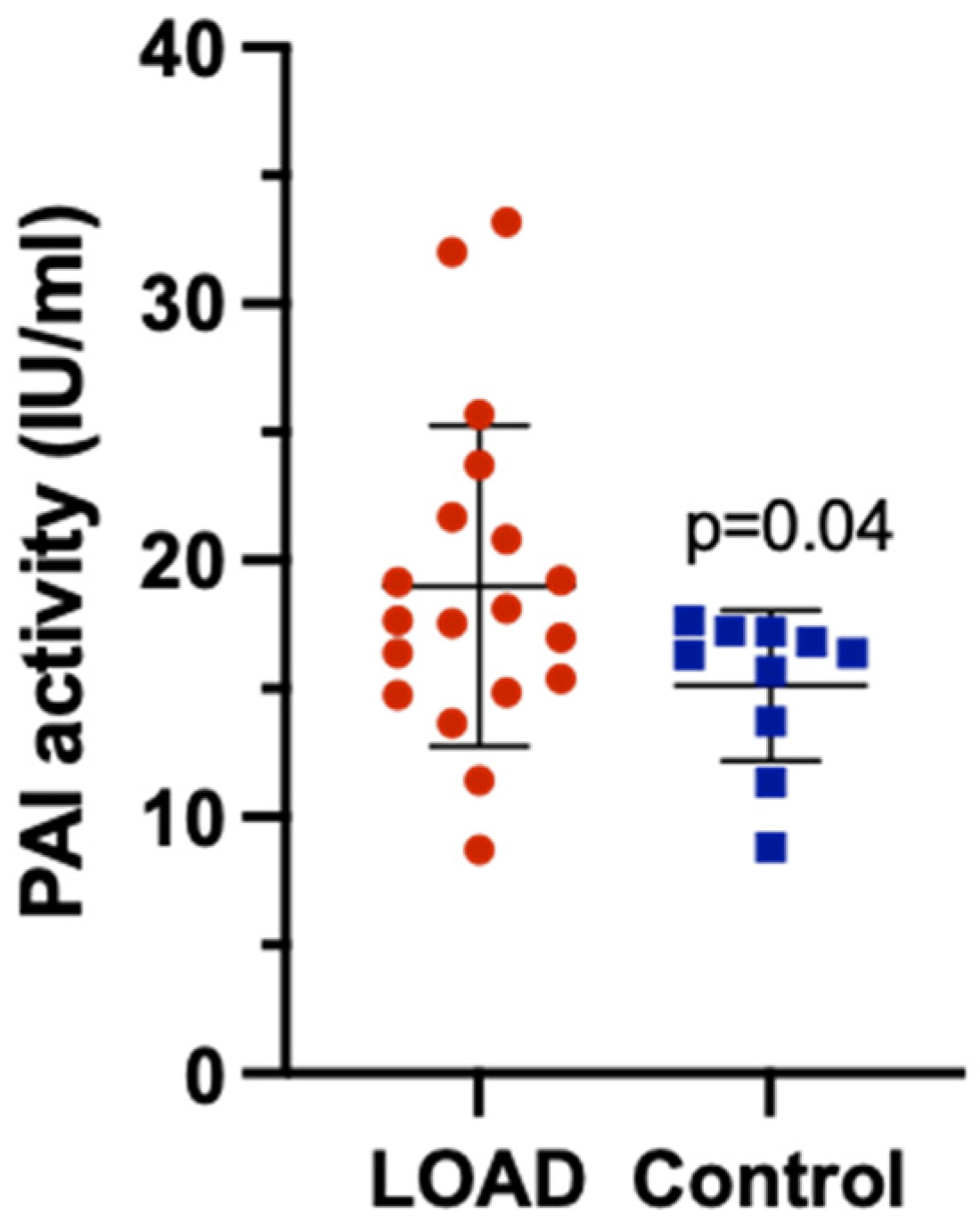
Since dysregulation of the fibrinolytic system, particularly elevated PAI-1, may contribute to Alzheimer’s pathology by reducing fibrin clearance, PAI-1 activity was measured in peripheral blood samples from 19 LOAD and 10 cognitively normal age-matched control subjects. The demographic and clinical characteristics of the participants are shown in Table 1. PAI-1 activity was statistically significantly increased in LOAD patients (18.89 ± 6.45 IU/mL) compared to the control group (15.12 ± 2.93 IU/mL) (p = 0.04) (Figure 1). No statistically significant correlation was found between PAI-1 activity and MMSI and CDR scores, or PAI-1 activity and age (p > 0.05). Although no statistically significant difference was observed across MMSE severity groups (p = 0.788), mean PAI-1 activity was numerically slightly lower in the severe group (17.5 ± 4.4 IU/mL, n = 4) compared to the mild (18.9 ± 8.7 IU/mL, n = 8) and moderate (20.1 ± 6.3 IU/mL, n = 7) groups. The standard deviations ranged from ±4.4 to ±8.7 IU/mL, indicating substantial inter-individual variability, which provided limited statistical power to detect small or moderate effect sizes.
We performed a sex-adjusted analysis using multiple linear regression with sex and group (patient/control) as independent variables and plasma PAI-1 activity as the dependent variable. After adjustment for sex, the difference between patients and controls was no longer statistically significant (β = 3.77, p = 0.09). Sex itself did not show a significant independent effect on PAI-1 activity (β = 0.20, p = 0.92). The overall model was not significant (R2 = 0.10, p > 0.05)

3.2. SERPINE1 (PAI-1), VTN, and APOE Gene Variants in LOAD Patients and Control Subjects

To investigate the genetic basis underlying not only the neuronal but also the vascular and coagulation components of LOAD, we performed targeted NGS for the VTN, SERPINE1 (PAI-1), and APOE genes in peripheral blood samples from 19 Alzheimer’s patients and 10 cognitively normal, age-matched control subjects (Table 2). Two variants were identified in the 3′-UTR region of the SERPINE1 gene, which encodes the PAI-1 protein: rs11178 (p = 0.027) and rs41423845 (p = 0.0001) (Table 2). Rs41423845 is a common (GnomAD = 0.87) synonymous polymorphism and is therefore not considered biologically statistically significant. The second SERPINE1 3′-UTR variant, rs11178 (p = 0.027), showed no statistically significant correlation with PAI-1 activity levels in variant carriers (p > 0.05). Two exonic variants in the SERPINE1 gene, rs6090 and rs6092, were identified in LOAD patients (Table 2). The SERPINE1 rs6092 variant was present in four of the 19 LOAD patients (21.05%). The mean PAI-1 activity was 23.18 ± 12.31 IU/mL in LOAD patients carrying this variant, compared to 16.70 ± 3.65 IU/mL in non-carriers.
Analysis of the VTN gene revealed numerous variants that showed statistically significant differences between LAOD patients and controls. Four variants in the 5′-UTR region of the VTN gene (rs7212814, rs1555584131, rs71135830, and rs11437594) were present in all 19 LOAD patients and in 2 out of 10 control subjects, while the remaining 7 controls carried none of these variants (Table 2; p = 0.0001). Additionally, an intron variant, rs2227725, was similarly detected in all patients (100%) and 20% of controls (p = 0.0001). Furthermore, the rs704 variant (p.Thr400Met) was observed in 16 out of 19 LOAD patients (84%) and in 2 out of 10 control subjects (29%) (Table 2; p = 0.001). The presence of VTN 5′-UTR variants showed a Spearman correlation with PAI-1 activity (Spearman’s r = 1.0, p < 0.0001), indicating an association between VTN genotype and PAI-1 levels. However, mean PAI-1 activity did not differ statistically significantly between variant carriers (n = 21; 18.00 ± 6.28 IU/mL) and non-carriers (n = 8; 15.77 ± 2.27 IU/mL) (p > 0.05), likely due to high interindividual variability within the carrier group. Nevertheless, the observed association suggests that this VTN variant cluster may influence fibrinolytic regulation, potentially contributing to LOAD pathogenesis through modulation of PAI-1 activity.
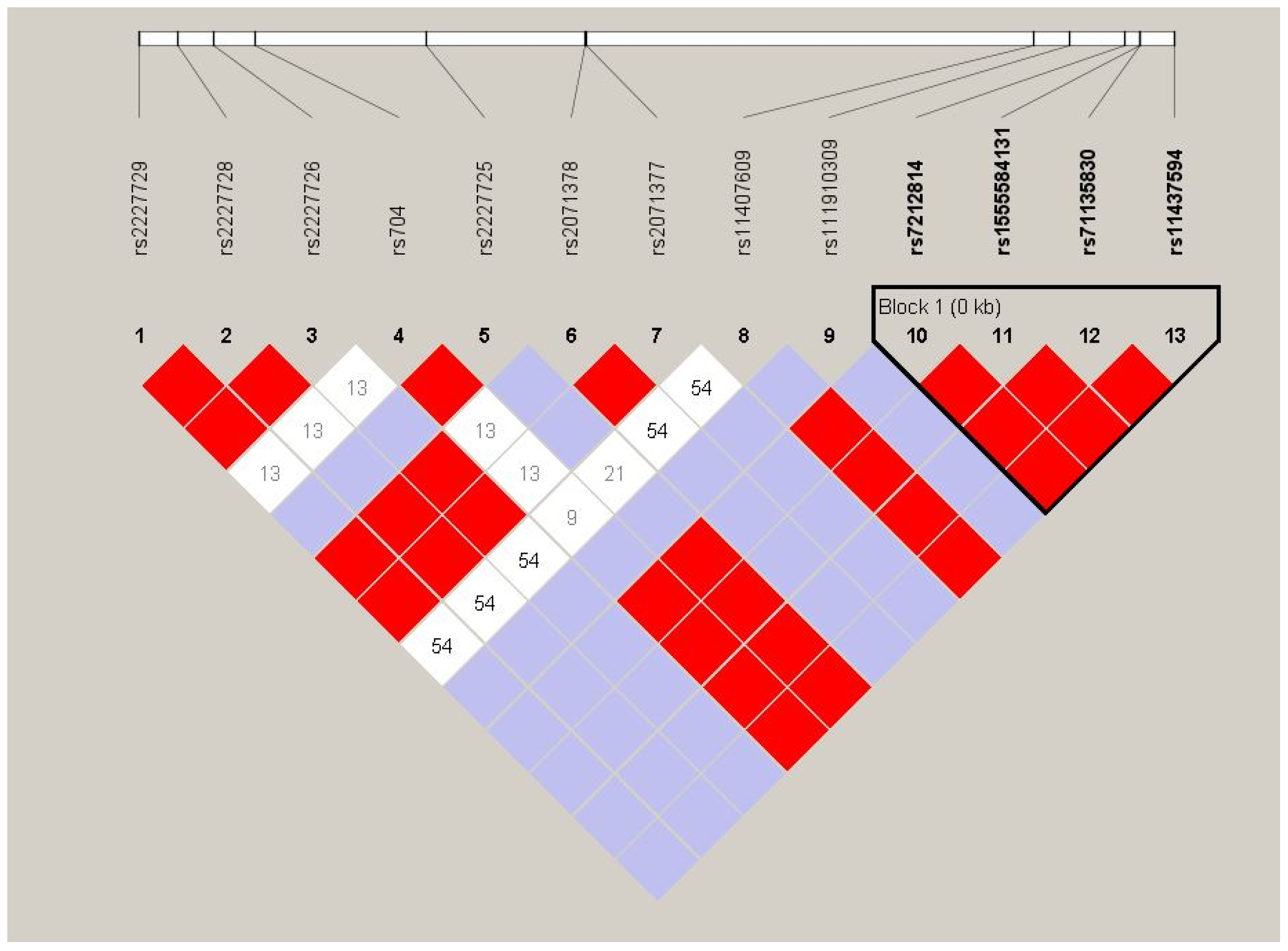
Linkage disequilibrium (LD) structure across the 13 genotyped SNPs was assessed using Haploview v4.2 in the combined cohort of 19 LOAD patients and 10 controls. Pairwise D′ values were computed under the confidence-interval algorithm of Gabriel et al. [17], and haplotype blocks were defined using the default criteria (with strong LD requiring an upper 95% confidence bound ≥ 0.98 and lower bound ≥ 0.70). The analysis identified a single haplotype block (Block 1) encompassing four SNPs at the 3′ end of the region (rs7212814, rs1555584131, rs71135830, and rs11437594), all of which were in complete pairwise LD (D′ = 1.0) (Figure 2). Notably, an excess co-occurrence of the minor alleles of rs704 and rs2227725 was observed, with the two variants displaying complete allelic association (D′ = 1.0); this non-random co-segregation suggests a shared ancestral haplotype background linking these two markers and may be of functional relevance given their location within the locus. Additional marker pairs—including rs2227729–rs2227728 and rs2071377–rs11407609—likewise showed high D′ values without reaching block-defining significance, likely reflecting the limited statistical power of the present sample. Intermediate D′ values (ranging from 0.09 to 0.54) were observed between the 5′ and central SNP clusters, indicating historical recombination events that partition the locus into distinct LD segments (Figure 2). These findings should be interpreted with caution, given the modest sample size (n = 29), which limits the precision of pairwise LD estimates and may underestimate block extent; replication in a larger independent cohort is warranted to confirm the observed haplotype architecture and to evaluate the potential biological significance of the rs704–rs2227725 association.
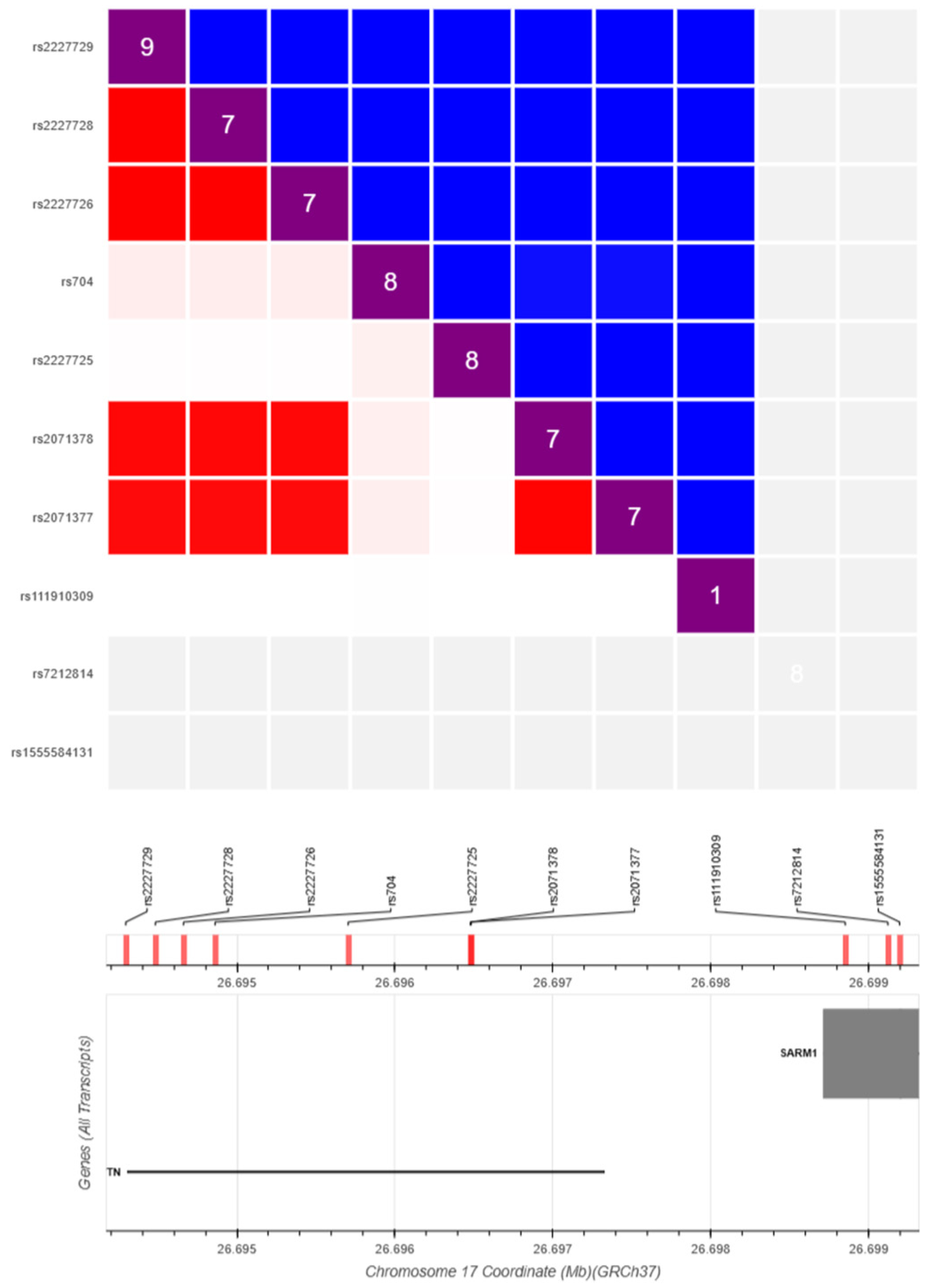
A striking divergence was observed when comparing the LD structure of our LOAD cohort with the 1000 Genomes European (EUR) reference panel. In the EUR population, rs704 (Thr400Met) and rs2227725 showed weak pairwise LD (D′ ≈ 0, light red/near-white in the LD matrix output), indicating that these two alleles are inherited largely independently in healthy European individuals (Figure 3). In sharp contrast, the two variants co-occurred in 16 of 19 AD patients (84.2%) in our cohort, while only 2 of 10 controls (20.0%) carried both alleles simultaneously (Fisher’s exact test, OR = 21.33, p = 0.001). This marked enrichment of the rs704–rs2227725 co-carrier state in LOAD cases—a combination that is not a recognized haplotype in the EUR reference—suggests a disease-associated allelic co-segregation pattern specific to this patient group. Although the small sample size warrants cautious interpretation, the magnitude of the effect and the absence of this co-occurrence signature in both population-level and local control datasets indicate that this variant pairing merits validation in larger, independently ascertained LOAD cohorts.
Targeted NGS results showed that 10 out of 19 patients (52.6%) carried the genetic risk factor for LOAD pathogenesis, APOE ε3/ε4 genotype. The remaining nine patients (47.4%) and ten cognitively normal age-matched control subjects carried the neutral APOE ε3/ε3 genotype. The PAI-1 activity of APOE ε3/ε3 carriers was 16.93 ± 4.05 IU/mL, and that of APOE ε3/ε4 carriers was 18.85 ± 8.16 IU/mL. The association between PAI-1 activity and APOE ε3/ε4 or APOE ε3/ε3 carriers was not statistically significant (p > 0.05). Thus, the increase in PAI-1 activity in LOAD patients is not related to APO ε4 status.

4. Discussion

In this study, a statistically significant increase in PAI-1 activity was observed in LOAD patients compared to the control group. We also identified an association between LOAD and both the T allele of the VTN rs704 (c.1199C>T) and VTN 5′-UTR variants. The APOE ε4 allele frequency was 52.6% in the LOAD patients, which is consistent with its established role as a major genetic risk factor for LOAD. However, the lack of a statistically significant difference in mean PAI-1 activity between variant carriers and non-carriers (p > 0.05) suggests that this relationship may be due to high individual variability (SD = 6.28) within the carrier group rather than a linear dose–response effect. These findings support the hypothesis that VTN variants may contribute to LOAD pathogenesis by modulating PAI-1 activity, but they highlight the effect’s inherent complexity. Biasella et al. (2022) demonstrated that the VTN rs704 variant enhances PAI-1 binding affinity rather than its catalytic activity [14], suggesting that VTN variants may influence PAI-1 localization, stability, or cellular distribution rather than its activity.
In the present study, no significant difference in PAI-1 activity was observed across MMSE-based disease severity groups (p = 0.788). Although this finding may suggest that PAI-1 activity does not directly reflect current clinical disease stage, several important limitations must be considered before drawing firm conclusions. The sample size was very small, particularly in the severe group (n = 4), which substantially limited statistical power. The relatively high inter-individual variability (standard deviations ranging from ±4.4 to ±8.7) suggests that plasma PAI-1 activity may be influenced by factors other than disease severity, such as systemic inflammation, endothelial dysfunction, or comorbid conditions. Therefore, larger longitudinal studies with adequate statistical power are needed to definitively evaluate plasma PAI-1’s potential role as a biomarker. Future studies with larger cohorts and more comprehensive clinical data, including vascular comorbidities, inflammatory markers, and medication use, will be important to better delineate the relationship between plasma PAI-1 and disease-specific mechanisms.
The increased PAI-1 activity observed in our LOAD patients is consistent with the model of suppressed fibrinolysis in neurodegeneration. Elevated PAI-1 levels and suppressed fibrinolysis have been proposed as mechanisms that can start neurodegeneration in the central nervous system [18]. The role of fibrinolytic system components, including PAI-1 activity, in the pathophysiology of chronic complex diseases such as neurodegenerative diseases has been the focus of intense research [19,20]. Neurodegenerative diseases have complex pathophysiology involving inflammation [11]. The effects of PAI-1 and t-PA on the vascular and nervous systems present paradoxical and pleiotropic effects, such as permeability of the blood–brain barrier [21]. Clinical studies generally report PAI-1 antigen levels as a risk factor in vascular diseases [22]. However, in addition to the antigen levels, the stability and activity of PAI-1 have long been proven important [10]. Inflammation increases the activity and stability of PAI-1 [10,23]. We previously demonstrated the increased (nearly 43-fold) functional stability of PAI-1 in patients with thrombotic skin disorders [24]. Similarly, Eren et al. (2002) displayed coronary arterial thrombosis and alopecia areata in a transgenic expression animal model of conformationally stabilized active human PAI-1 [22]. Several environmental factors affect the stability of PAI-1. The interaction between proteases and other inflammatory proteins in neurodegenerative disease can affect the stability of the PAI-1.
Plasma PAI-1 levels predominantly reflect systemic vascular and inflammatory processes rather than central nervous system (CNS)-specific fibrinolytic activity. Nevertheless, emerging evidence suggests that systemic modulation of PAI-1 activity may still influence CNS pathology. For example, oral administration of TM5275, a small-molecule PAI-1 inhibitor, has been shown to reduce PAI-1 activity, increase tPA, uPA, and plasmin activity, and consequently decrease amyloid-β deposition in the hippocampus and cortex, along with improvements in cognitive function in APP/PS1 mice [25]. These findings support the notion that systemic PAI-1 activity may have indirect effects on brain fibrinolytic balance and neurodegenerative processes. Therefore, while plasma PAI-1 cannot be considered a direct surrogate marker of CNS PAI-1 activity, it may still provide complementary information regarding systemic pathways that are potentially linked to CNS pathology.
The genetic association with the VTN rs704 T allele offers a plausible mechanism for increased PAI-1 stability in LOAD. VTN is an inflammatory protein involved in cell adhesion and cancer progression [26]. Although active PAI-1 has a short half-life, binding to VTN not only stabilizes active PAI-1 but also enables it to regulate adhesion, migration, and extracellular matrix homeostasis through interaction with integrin αvβ3 [27,28,29]. The tertiary structure of VTN regulates fibrinolysis by increasing PAI-1 activity and protecting its active site from inactivation [30,31]. Additionally, the PAI-1- VTN interaction promotes microglial migration while inhibiting phagocytosis [30]. Recent studies on age-related macular degeneration (AMD) have provided important insights into the VTN rs704 variant. Although this variant does not affect the stabilization of active PAI-1, it does influence the binding capacity of VTN to PAI-1 [14]. Specifically, the T allele causes a stronger interaction between the AMD risk and PAI-1. The T allele enhances endogenous VTN expression and is associated with a modestly increased binding affinity for PAI-1, leading to a stronger interaction between PAI-1 and AMD risk [13,14]. In the present study, the T allele frequency was higher in LOAD patients compared to controls, suggesting a strong association with disease susceptibility.
There are conflicting reports on PAI-1 levels in AD. PAI-1 is associated with Aβ accumulation, and knocking out the SERPINE1 gene or adding PAI-1 inhibitors reduces Aβ accumulation in the mouse model of AD [25,32]. Serum PAI-1 levels positively correlate with cognitive impairment in AD patients [33], and PAI-1 levels increase in AD patients while serum t-PA levels remain unchanged [34]. In contrast, other studies have demonstrated that PAI-1 levels decrease in both preclinical and clinical AD [35,36]. These conflicting results may be partly explained by the fact that, in addition to PAI-1 concentration, the stability of its active form is also functionally important. In complex diseases, there can be a mismatch between serpin concentration and activity. The present study indicates that PAI-1 activity is prolonged in LOAD patients. We propose that VTN and neuroinflammation may potentially increase PAI-1 activity in neurodegenerative diseases.
Age is a primary risk factor for neurodegenerative diseases, yet their pathophysiology remains incompletely understood. Several lines of evidence suggest a causal role for PAI-1 in aging as components of the fibrinolytic system, including PAI-1, which can modulate the aging process. Studies indicate that cellular senescence and premature aging are associated with increased PAI-1 expression [37]. In line with this, the present study demonstrates that PAI-1 activity—a potential mediator of central nervous system senescence and brain aging—is increased in LOAD. The significance of this finding is underscored by the well-established role of PAI-1 in cellular senescence and aging, the primary risk factor for LOAD [37,38]. Furthermore, carriers of the null SERPINE1 mutation exhibit significantly longer leukocyte telomere length, lower fasting insulin levels, lower prevalence of diabetes mellitus, and a longer lifespan [38].
The absence of a direct correlation between PAI-1 activity and specific VTN or APOE genotypes points to the multifaceted regulation of this pathway, likely involving additional genetic and environmental factors. Although we observed an association between specific VTN variants and altered PAI-1 activity, we cannot infer causation or a direct molecular mechanism. PAI-1 is likely at the crossroads of disturbed metabolism and neurodegeneration. At present, intravenous thrombolysis is the only way to activate fibrinolysis in humans, but oral PAI-1 inhibitors have been in phase 1-3 trials for other indications [39] and may represent a future therapeutic option for neurodegenerative diseases [40]. Future functional studies—including VTN protein expression and purification, PAI-1 activity assays in VTN-overexpressing or knockdown cellular models, and investigation of the VTN-PAI-1 interaction interface—are essential to establish whether VTN variants directly modulate PAI-1 regulation and thereby influence LOAD pathogenesis.

5. Conclusions

In conclusion, our data position PAI-1 activity, potentially modulated by VTN genetics, at the crossroads of fibrinolysis, neuroinflammation, and aging in LOAD. The development of oral PAI-1 inhibitors currently in clinical trials for other indications [41] opens a novel therapeutic avenue for neurodegenerative diseases. Future studies with larger cohorts are required to assess the putative epistasis between VTN, SERPINE1, and APOE genes as well as the additive effects of each risk allele on LOAD susceptibility and specific phenotypic subsets. Collectively, these findings highlight the need to consider PAI-1 activity not merely as a peripheral vascular marker but as a potential central mediator of LOAD pathogenesis.

Author Contributions

Conceptualization, D.A., M.A. and M.M.; methodology, D.A., M.A., M.E.C. and M.M.; validation, D.A., M.E.C., M.A. and M.M.; formal analysis, D.A., M.A. and M.M.; investigation, D.A., M.A. and M.M.; resources, M.E.C.; writing—original draft preparation, D.A., M.A. and M.M.; writing—review and editing, D.A., M.A. and M.M. All authors have read and agreed to the published version of the manuscript.

Funding

This research received no external funding.

Institutional Review Board Statement

The present study was approved by the Acibadem Mehmet Ali Aydinlar University (ACU) and Acibadem Healthcare Institutions Medical Research Ethics Committee (ATADEK) (approval no. 2025-01/28, approval date 9 January 2025) and was performed in accordance with the guidelines of human research.

Informed Consent Statement

All subjects involved in the study were informed about the study and provided their written informed consent according to the Declaration of Helsinki, as approved by the Ethics Committee of ACU and ATADEK. All personal data were anonymized, and the samples were coded.

Data Availability Statement

The original contributions presented in the study are included in the article, further inquiries can be directed to the corresponding author.

Acknowledgments

The authors wish to thank Alper Bülbül for performing the Haploview-based LD analysis and the confirmatory LD assessment using the 1000 Genomes reference panel.

Conflicts of Interest

The authors declare no conflicts of interest.

Abbreviations

The following abbreviations are used in this manuscript:
α-SYN Alpha-synuclein
AMDAge-related maculodegeneration
APOEApolipoprotein E
LOADLate-onset Alzheimer’s disease
DSM-IVDiagnostic and Statistical Manual of Mental Disorders-IV
EDTAEthylenediaminetetraacetic acid
IUInternational unit
IQRInterquartile range
MMSEMini Mental Status Exam
NGSNext generation sequencing
PAI-1Plasminogen activator inhibitor-1
pNAPara-nitroaniline
t-PATissue plasminogen activator
u-PAUrokinase-type plasminogen activator
VTNVitronectin

References

  1. De Luca, V.; Spalletta, G.; Souza, R.P.; Graff, A.; Bastos-Rodrigues, L.; Camargos Bicalho, M.A. Definition of Late Onset Alzheimer’s Disease and Anticipation Effect of Genome-Wide Significant Risk Variants: Pilot Study of the APOE e4 Allele. Neuropsychobiology 2019, 77, 8–12. [Google Scholar] [CrossRef] [PubMed]
  2. DeTure, M.A.; Dickson, D.W. The neuropathological diagnosis of Alzheimer’s disease. Mol. Neurodegener. 2019, 14, 32. [Google Scholar] [CrossRef] [PubMed]
  3. Badimon, A.; Torrente, D.; Norris, E.H. Vascular Dysfunction in Alzheimer’s Disease: Alterations in the Plasma Contact and Fibrinolytic Systems. Int. J. Mol. Sci. 2023, 24, 7046. [Google Scholar] [CrossRef]
  4. American Association of Neurological Surgeons (AANS); American Society of Neuroradiology (ASNR); Cardiovascular and Interventional Radiology Society of Europe (CIRSE); Canadian Interventional Radiology Association (CIRA); Congress of Neurological Surgeons (CNS); European Society of Minimally Invasive Neurological Therapy (ESMINT); European Society of Neuroradiology (ESNR); European Stroke Organization (ESO); Society for Cardiovascular Angiography and Interventions (SCAI); Society of Interventional Radiology (SIR); et al. Multisociety Consensus Quality Improvement Revised Consensus Statement for Endovascular Therapy of Acute Ischemic Stroke. Int. J. Stroke 2018, 13, 612–632. [Google Scholar] [CrossRef]
  5. Lawrence, D.; Strandberg, L.; Grundstrom, T.; Ny, T. Purification of active human plasminogen activator inhibitor 1 from Escherichia coli. Comparison with natural and recombinant forms purified from eucaryotic cells. Eur. J. Biochem. 1989, 186, 523–533. [Google Scholar] [CrossRef]
  6. Rein-Smith, C.M.; Church, F.C. Emerging pathophysiological roles for fibrinolysis. Curr. Opin. Hematol. 2014, 21, 438–444. [Google Scholar] [CrossRef] [PubMed]
  7. Gils, A.; Declerck, P.J. Structure-function relationships in serpins: Current concepts and controversies. Thromb. Haemost. 1998, 80, 531–541. [Google Scholar]
  8. Gils, A.; Declerck, P.J. The structural basis for the pathophysiological relevance of PAI-I in cardiovascular diseases and the development of potential PAI-I inhibitors. Thromb. Haemost. 2004, 91, 425–437. [Google Scholar] [CrossRef]
  9. Yasar Yildiz, S.; Kuru, P.; Toksoy Oner, E.; Agirbasli, M. Functional stability of plasminogen activator inhibitor-1. Sci. World J. 2014, 2014, 858293. [Google Scholar] [CrossRef]
  10. Cale, J.M.; Lawrence, D.A. Structure-function relationships of plasminogen activator inhibitor-1 and its potential as a therapeutic agent. Curr. Drug Targets 2007, 8, 971–981. [Google Scholar] [CrossRef]
  11. Wang, C.; Wang, J.; Zhu, Z.; Hu, J.; Lin, Y. Spotlight on pro-inflammatory chemokines: Regulators of cellular communication in cognitive impairment. Front. Immunol. 2024, 15, 1421076. [Google Scholar] [CrossRef]
  12. Chandler, W.L.; Alessi, M.C.; Aillaud, M.F.; Henderson, P.; Vague, P.; Juhan-Vague, I. Clearance of tissue plasminogen activator (TPA) and TPA/plasminogen activator inhibitor type 1 (PAI-1) complex: Relationship to elevated TPA antigen in patients with high PAI-1 activity levels. Circulation 1997, 96, 761–768. [Google Scholar] [CrossRef]
  13. Biasella, F.; Plossl, K.; Karl, C.; Weber, B.H.F.; Friedrich, U. Altered Protein Function Caused by AMD-associated Variant rs704 Links Vitronectin to Disease Pathology. Investig. Ophthalmol. Vis. Sci. 2020, 61, 2. [Google Scholar] [CrossRef]
  14. Biasella, F.; Strunz, T.; Kiel, C.; on behalf of the International AMD Genomics Consortium (IAMDGC); Weber, B.H.F.; Friedrich, U. Vitronectin and Its Interaction with PAI-1 Suggests a Functional Link to Vascular Changes in AMD Pathobiology. Cells 2022, 11, 1766. [Google Scholar] [CrossRef]
  15. Cerman, E.; Eraslan, M.; Cekic, O. Age-related macular degeneration and Alzheimer disease. Turk. J. Med. Sci. 2015, 45, 1004–1009. [Google Scholar] [CrossRef]
  16. Raulin, A.C.; Doss, S.V.; Trottier, Z.A.; Ikezu, T.C.; Bu, G.; Liu, C.C. ApoE in Alzheimer’s disease: Pathophysiology and therapeutic strategies. Mol. Neurodegener. 2022, 17, 72. [Google Scholar] [CrossRef]
  17. Gabriel, S.B.; Schaffner, S.F.; Nguyen, H.; Moore, J.M.; Roy, J.; Blumenstiel, B.; Higgins, J.; DeFelice, M.; Lochner, A.; Faggart, M.; et al. The structure of haplotype blocks in the human genome. Science 2002, 296, 2225–2229. [Google Scholar] [CrossRef]
  18. Erkal, B.; Kalayci Yigin, A.; Palanduz, S.; Dasdemir, S.; Seven, M. The Effect of PAI-1 Gene Variants and PAI-1 Plasma Levels on Development of Thrombophilia in Patients with Klinefelter Syndrome. Am. J. Men’s Health 2018, 12, 2152–2156. [Google Scholar] [CrossRef]
  19. Baart, V.M.; Houvast, R.D.; de Geus-Oei, L.F.; Quax, P.H.A.; Kuppen, P.J.K.; Vahrmeijer, A.L.; Sier, C.F.M. Molecular imaging of the urokinase plasminogen activator receptor: Opportunities beyond cancer. EJNMMI Res. 2020, 10, 87. [Google Scholar] [CrossRef]
  20. Yepes, M.; Woo, Y.; Martin-Jimenez, C. Plasminogen Activators in Neurovascular and Neurodegenerative Disorders. Int. J. Mol. Sci. 2021, 22, 4380. [Google Scholar] [CrossRef]
  21. Rebeck, G.W.; Harr, S.D.; Strickland, D.K.; Hyman, B.T. Multiple, diverse senile plaque-associated proteins are ligands of an apolipoprotein E receptor, the alpha 2-macroglobulin receptor/low-density-lipoprotein receptor-related protein. Ann. Neurol. 1995, 37, 211–217. [Google Scholar] [CrossRef]
  22. Eren, M.; Painter, C.A.; Atkinson, J.B.; Declerck, P.J.; Vaughan, D.E. Age-dependent spontaneous coronary arterial thrombosis in transgenic mice that express a stable form of human plasminogen activator inhibitor-1. Circulation 2002, 106, 491–496. [Google Scholar] [CrossRef]
  23. Sillen, M.; Declerck, P.J. A Narrative Review on Plasminogen Activator Inhibitor-1 and Its (Patho)Physiological Role: To Target or Not to Target? Int. J. Mol. Sci. 2021, 22, 2721. [Google Scholar] [CrossRef]
  24. Agirbasli, M.; Eren, M.; Eren, F.; Murphy, S.B.; Serdar, Z.A.; Seckin, D.; Zara, T.; Cem Mat, M.; Demirkesen, C.; Vaughan, D.E. Enhanced functional stability of plasminogen activator inhibitor-1 in patients with livedoid vasculopathy. J. Thromb. Thrombolysis 2011, 32, 59–63. [Google Scholar] [CrossRef]
  25. Akhter, H.; Huang, W.T.; van Groen, T.; Kuo, H.C.; Miyata, T.; Liu, R.M. A Small Molecule Inhibitor of Plasminogen Activator Inhibitor-1 Reduces Brain Amyloid-beta Load and Improves Memory in an Animal Model of Alzheimer’s Disease. J. Alzheimer’s Dis. 2018, 64, 447–457. [Google Scholar] [CrossRef]
  26. Preissner, K.T.; Reuning, U. Vitronectin in vascular context: Facets of a multitalented matricellular protein. Semin. Thromb. Hemost. 2011, 37, 408–424. [Google Scholar] [CrossRef]
  27. Lawrence, D.A.; Berkenpas, M.B.; Palaniappan, S.; Ginsburg, D. Localization of vitronectin binding domain in plasminogen activator inhibitor-1. J. Biol. Chem. 1994, 269, 15223–15228. [Google Scholar] [CrossRef]
  28. Podor, T.J.; Peterson, C.B.; Lawrence, D.A.; Stefansson, S.; Shaughnessy, S.G.; Foulon, D.M.; Butcher, M.; Weitz, J.I. Type 1 plasminogen activator inhibitor binds to fibrin via vitronectin. J. Biol. Chem. 2000, 275, 19788–19794. [Google Scholar] [CrossRef]
  29. Stefansson, S.; Lawrence, D.A. The serpin PAI-1 inhibits cell migration by blocking integrin alpha V beta 3 binding to vitronectin. Nature 1996, 383, 441–443. [Google Scholar] [CrossRef]
  30. Jeon, H.; Kim, J.H.; Kim, J.H.; Lee, W.H.; Lee, M.S.; Suk, K. Plasminogen activator inhibitor type 1 regulates microglial motility and phagocytic activity. J. Neuroinflamm. 2012, 9, 149. [Google Scholar] [CrossRef]
  31. Zhou, A.; Huntington, J.A.; Pannu, N.S.; Carrell, R.W.; Read, R.J. How vitronectin binds PAI-1 to modulate fibrinolysis and cell migration. Nat. Struct. Biol. 2003, 10, 541–544. [Google Scholar] [CrossRef]
  32. Liu, R.M.; van Groen, T.; Katre, A.; Cao, D.; Kadisha, I.; Ballinger, C.; Wang, L.; Carroll, S.L.; Li, L. Knockout of plasminogen activator inhibitor 1 gene reduces amyloid beta peptide burden in a mouse model of Alzheimer’s disease. Neurobiol. Aging 2011, 32, 1079–1089. [Google Scholar] [CrossRef]
  33. Oh, J.; Lee, H.J.; Song, J.H.; Park, S.I.; Kim, H. Plasminogen activator inhibitor-1 as an early potential diagnostic marker for Alzheimer’s disease. Exp. Gerontol. 2014, 60, 87–91. [Google Scholar] [CrossRef]
  34. Angelucci, F.; Veverova, K.; Katonova, A.; Piendel, L.; Vyhnalek, M.; Hort, J. Alzheimer’s Disease Severity Is Associated with an Imbalance in Serum Levels of Enzymes Regulating Plasmin Synthesis. Pharmaceuticals 2022, 15, 1074. [Google Scholar] [CrossRef]
  35. Eruysal, E.; Ravdin, L.; Zhang, C.; Kamel, H.; Iadecola, C.; Ishii, M. Sexually Dimorphic Association of Circulating Plasminogen Activator Inhibitor-1 Levels and Body Mass Index with Cerebrospinal Fluid Biomarkers of Alzheimer’s Pathology in Preclinical Alzheimer’s Disease. J. Alzheimer’s Dis. 2023, 91, 1073–1083. [Google Scholar] [CrossRef]
  36. Shi, L.; Winchester, L.M.; Westwood, S.; Baird, A.L.; Anand, S.N.; Buckley, N.J.; Hye, A.; Ashton, N.J.; Bos, I.; Vos, S.J.B.; et al. Replication study of plasma proteins relating to Alzheimer’s pathology. Alzheimer’s Dement. 2021, 17, 1452–1464. [Google Scholar] [CrossRef]
  37. Vaughan, D.E.; Rai, R.; Khan, S.S.; Eren, M.; Ghosh, A.K. Plasminogen Activator Inhibitor-1 Is a Marker and a Mediator of Senescence. Arter. Thromb. Vasc. Biol. 2017, 37, 1446–1452. [Google Scholar] [CrossRef]
  38. Khan, S.S.; Shah, S.J.; Klyachko, E.; Baldridge, A.S.; Eren, M.; Place, A.T.; Aviv, A.; Puterman, E.; Lloyd-Jones, D.M.; Heiman, M.; et al. A null mutation in SERPINE1 protects against biological aging in humans. Sci. Adv. 2017, 3, eaao1617. [Google Scholar] [CrossRef]
  39. Taner, T.; Ağırbaşlı, M. Current status and potential future of PAI-1 inhibitors. J. Curr. Hematol. Oncol. Res. 2024, 2, 73–76. [Google Scholar] [CrossRef]
  40. Hirai, T.; Asano, K.; Ito, I.; Miyazaki, Y.; Sugiura, H.; Agirbasli, M.; Kobayashi, S.; Kobayashi, M.; Shimada, D.; Natsume, I.; et al. A randomized double-blind placebo-controlled trial of an inhibitor of plasminogen activator inhibitor-1 (TM5614) in mild to moderate COVID-19. Sci. Rep. 2024, 14, 165. [Google Scholar] [CrossRef]
  41. Ma, G.; Pan, Z.; Kong, L.; Du, G. Neuroinflammation in hemorrhagic transformation after tissue plasminogen activator thrombolysis: Potential mechanisms, targets, therapeutic drugs and biomarkers. Int. Immunopharmacol. 2021, 90, 107216. [Google Scholar] [CrossRef] [PubMed]
Figure 1. PAI-1 activity. A two-tailed t-test was used to compare the PAI activity between the LOAD samples and the control.
Genes 17 00516 g001
Figure 2. Haploview pairwise LD plot of 13 VTN variants in the combined cohort (19 LOAD cases, 10 controls). Cell color reflects D′/LOD: bright red, D′ = 1.0 with LOD ≥ 2; light blue, D′ = 1.0 with LOD < 2; white, D′ < 1.0. Numbers within cells indicate D′ × 100 (empty cells denote D′ = 1.0).
Genes 17 00516 g002
Figure 3. Pairwise LD of VTN variants in the 1000 Genomes EUR population (LDlink LDmatrix; GRCh37). Lower triangle: D′ (red); upper triangle: r2 (blue); diagonal: MAF × 100. The middle and bottom tracks show variant positions on chromosome 17. rs704 and rs2227725 show near-zero D′, indicating independent inheritance in healthy Europeans. (https://ldlink.nci.nih.gov/).
Genes 17 00516 g003
Table 1. Characteristics of the study population. MMSE, mini-mental state examination; CDR, clinical dementia rating scale; SD, standard deviation.
CharacteristicsLOAD, n = 19Controls, n = 10
Age, mean ± SD77.84 ± 6.1377.60 ± 1.58
Female/male9/105/5
MMSE score
>20, mild (n)22.38 ± 1.51 (8)
10–19, moderate (n)14.43 ± 2.51 (7)Normal
<10, severe (n)6.00 ± 3.83 (4)
CDR scorenn
0, normal010
1, mild60
2, moderate60
3, severe70
Table 2. Frequencies of SERPINE1 and VTN gene variants in LOAD patients and age-matched cognitively normal control subjects.
SERPINE1 (PAI-1),
chr 7
Rs NumberRef/SNPLocationAmino Acid ChangeLOAD/ControlFisher’s p-ValueBonferroni Adjusted p-ValueGnomAD
100771717rs6092G/AExon 2p.Ala15Thr4/00.271.000000.09
100771723rs6090G/AExon 2p.Val17Ile1/011.000000.29
100776931rs2227684G/AIntron 10/20.131.000000.41
100777197rs139464072C/TIntron 1/011.000000.0026
100780903rs41334349C/T3′-UTR 1/011.000000.0066
100781084rs11178T/C3′-UTR 8/00.0270.594000.44
100781445rs7242T/G3′-UTR 1/111.000000.45
100781711^
100781712
rs41423845-/CGCGCCCCC3′-UTR 19/20.00010.002200.87
100781615rs1050813G/A3′-UTR 7/10.201.000000.14
VTN, chr17
26698673^ 26698674rs11407609-/C5′-UTR 7/10.201.00000.67
26698851rs111910309C/T5′-UTR 0/10.351.00000.0014
26699121rs7212814C/G5′-UTR 19/20.00010.00221
26699195^
26699196
rs1555584131-/C5′-UTR 19/20.00010.00221
26699199^
26699200
rs71135830-/C5′-UTR 19/20.00010.00220.99
26699367^
26699368
rs11437594-/C5′-UTR 19/20.00010.00221
26694296rs2227729A/G5′-UTR 3/00.531.00000.17
26694483rs2227728A/GExon 8p.Asn448=3/00.531.00000.11
26694661rs2227726G/A5′-UTR 3/00.531.00000.15
26694861rs704G/AExon 7p.Thr400Met16/20.0010.02200.51
26695704rs2227725A/Gintron 19/20.00010.00220.96
26696477rs2071378A/G5′-UTR 3/00.531.00000.23
26696482rs2071377C/T5′-UTR 3/00.531.00000.23
Disclaimer/Publisher’s Note: The statements, opinions and data contained in all publications are solely those of the individual author(s) and contributor(s) and not of MDPI and/or the editor(s). MDPI and/or the editor(s) disclaim responsibility for any injury to people or property resulting from any ideas, methods, instructions or products referred to in the content.