Review

Clinical Applications of Liquid Biopsy in Colorectal Cancer: A Focus on Registered Clinical Trials

Oncology Department, Health in Code Group, 46024 Valencia, Spain
*
Authors to whom correspondence should be addressed.
Genes 2026, 17(5), 500; https://doi.org/10.3390/genes17050500
Submission received: 27 February 2026 / Revised: 6 April 2026 / Accepted: 21 April 2026 / Published: 24 April 2026

Abstract

Background/Objectives: Early detection through minimally invasive approaches is critical for timely patient stratification and optimal therapeutic decision-making in colorectal cancer (CRC). Liquid biopsy, based on the analysis of tumor-derived components in blood and other body fluids, has emerged as a promising strategy to overcome current limitations in CRC diagnosis and follow-up. This review evaluates the current landscape of liquid biopsy clinical trials in CRC, focusing on predictive biomarker detection, prognostic assessment, and disease monitoring. Methods: ClinicalTrials.gov was searched using the terms “colorectal cancer” and “liquid biopsy” yielding 153 registered trials. After manual screening, 44 trials were excluded for not using liquid biopsy for CRC management, leaving 109 trials for analysis. Of these, 25 were completed, and 13 had publicly available results related to liquid biopsy. Results: The included trials were conducted across 27 countries on four continents. Overall, 119 biomolecules assessments and 167 different endpoints were reported across 109 clinical trials. Because individual trials could evaluate multiple biomolecules and endpoints, counts exceed the total number of trials. Cell-free DNA (cfDNA) was evaluated in 92/109 trials (84%) and accounting for 77% of all biomolecule assessments. Circulatingtumor cells (CTCs) were analyzed in 9/109 trials (8%, representing 8% of all the biomolecules analyzed), and microRNAs (miRNAs) in 8/109 (7%, representing 7% of all the biomolecules analyzed). Treatment sensitivity was the most common endpoint (57/109, 52% of the clinical trials; representing 34% of all the 167 different endpoints analyzed), followed by disease progression (28/109, 26%; representing 17% of all the different endpoints analyzed) and diagnostic applications (21/109, 19%; representing 12% of all the different endpoints analyzed). Among the 25 completed studies, 10/25 (40%) were interventional and 15/25 (60%) observational, spanning 14 countries. The majority of completed trials (21/25, 84%) used cfDNA. Interventional studies were predominantly phase II (5/10), with fewer phase III trials (2/10), primarily evaluating treatment response, particularly in relation to EGFR inhibitors and RAS/BRAF mutation status. Four observational studies (4/15) investigated emerging biomarkers, including long noncoding RNAs and miRNAs. Conclusions: Current clinical trials highlight cfDNA as the dominant and most clinically advanced liquid biopsy biomarker in CRC, primarily used for treatment guidance and disease monitoring. In contrast, CTCs and RNA-based biomarkers remain underrepresented. The limited number of randomized late-phase trials, heterogeneity in study design, and technical challenges associated with emerging biomarkers underscore the need for standardized methodologies and robust validation before routine clinical implementation.

1. Introduction

1.1. CRC Incidence, Genetics and Pathogenesis

Colorectal cancer (CRC) is the fourth leading cause of cancer-related deaths worldwide, responsible for approximately 900,000 deaths annually [1], with incidence varying by region [2,3,4]. The prevalence of CRC is expected to rise, with an estimated 2.5 million new cases projected globally by 2035 [3,4]. Early-onset CRC is also increasing in an expanding number of countries [5]. Although genetic, lifestyle, and environmental factors are well-recognized contributors, the factors driving this rising incidence remain incompletely understood [6].
CRC can be classified into three categories based on molecular genetic similarities: chromosomal instability (CIN), microsatellite instability (MSI), and CpG island methylator phenotype (CIMP) [7,8].
CIN tumors, the largest subgroup, are characterized by aneuploidy, loss-of-heterozygosity (notably in APC, DCC/MADH2/MADH4, TP53), and mutations in KRAS, BRAF, and SMAD4 [4,9].
MSI tumors, present in <10% of CRCs, result from defective DNA mismatch repair, and are often associated with Lynch syndrome [4,9].
CIMP tumors show promoter hypermethylation of multiple genes and may be microsatellite-stable or unstable, frequently harboring RAS or BRAF alterations that impact prognosis and therapy response [4,10,11].
Genome-wide studies have also found further markers in accordance with the mutation spectrum, such as the presence of POLE, DCC, MYC or MCC alterations [4,12,13,14].
Altogether, molecular characterization shows that CRC is a heterogeneous disorder. Although its genetics and key pathways are well studied, this knowledge has not yet led to effective methods for detection or non-invasive monitoring.

1.2. Management: Diagnosis and Treatment of CRC

CRC diagnosis relies on colonoscopy, imaging, and histopathological evaluation, including TNM staging and tumor subtyping [15]. In addition, tumor-based biomarkers are assessed, such as the BRAF V600E mutation, RAS mutations, HER2, NTRK gene fusions and the mismatch repair system (MMR) [16,17]. For instance, tumors with high microsatellite instability (MSI-H), deficient MMR (dMMR), or, in some cases, high tumor mutational burden (TMB) have important implications for clinical management, providing prognostic information and guiding treatment decisions, such as the use of immunotherapy in metastatic CRC, particularly in MSI-H/dMMR tumors [18,19,20,21,22].
Treatment options for colorectal cancer (CRC) typically include surgery, radiotherapy, chemotherapy, targeted therapies, and immunotherapy [23]. Management strategies differ depending on whether the tumor is resectable or metastatic, as surgical removal is not feasible in the majority of metastatic cases [17,18,24,25]. For resectable tumors, surgery may be combined with radiotherapy and/or chemotherapy in a (neo)adjuvant setting. In metastatic CRC, systemic treatments are preferred, including chemotherapy with agents such as fluoropyrimidines, oxaliplatin, and irinotecan, often combined with leucovorin. Targeted therapies are also part of the treatment for metastatic CRC. Bevacizumab, a humanized monoclonal antibody, inhibits angiogenesis by blocking vascular endothelial growth factor (VEGF) and is commonly combined with chemotherapy [17,21]. Cetuximab, an anti-EGFR monoclonal antibody, inhibits signaling pathways that regulate tumor-cell proliferation and survival. In BRAF V600E mutant CRC, combining cetuximab with a BRAF inhibitor such as encorafenib has shown significant clinical benefit [26]. Also, for those carrying the KRAS G12C variant, the combination of KRAS G12C inhibitors with EGFR monoclonal antibodies has shown to be useful [27]. For tumors with wild-type (wt) KRAS, panitumumab is preferred [28].
Additionally, approximately 5% of metastatic CRCs overexpress Human Epidermal Growth Factor Receptor 2 (HER2), and treatment with trastuzumab, combined with tucatinib, a selective HER2 inhibitor, has demonstrated encouraging efficacy [29].
Also, in <5% of metastatic CRCs, fusions in NTRK are found. However, testing is recommended when possible [17] to be eligible for treatment with TRK inhibitors (e.g., larotrectinib, entrectinib) [17,29].
As described previously, MSI-H/dMMR tumors, characterized by high mutational burden, are particularly responsive to immune checkpoint inhibitors (ICIs). Regarding this, examples of immunotherapies include pembrolizumab and nivolumab, which block PD-1, and ipilimumab, a CTLA-4 inhibitor [30].
Although these targeted therapies improved outcomes in specific molecular subgroups, treatment selection still largely depends on tissue sampling, which hampers dynamic evaluation of tumor evolution, such as, for instance, the emergence of resistance mutations (e.g., KRAS mutations acquired after an anti-EGFR therapy), since repeated biopsies are required to be properly identified [31].
Beyond these established systemic approaches, additional pharmacological strategies are being explored, including pharmacological agents targeting alternative tumor pathways or tumor microenvironment modulation, such as the use of sodium butyrate, which induces apoptosis in CRC cells [32] or nifedipine which showed effectiveness in inhibiting proliferation and metastasis in CRC by reactivating tumor immunity [33,34].
Taken together, this highlights the urgent clinical need for minimally invasive tools effective in evaluating tumor burden, predicting treatment response, and detecting recurrence, which could complement or eventually substitute conventional biopsy-based approaches.

1.3. Non-Invasive Detection of CRC

Early detection of CRC and its precursor lesions is essential for reducing disease-related mortality. Nevertheless, current screening strategies remain limited [35]. Stool-based tests such as fecal occult blood test (FOBT) and fecal immunochemical test (FIT) are used as first-line screening tools for CRC, with colonoscopy performed as follow-up after a positive result [36]. Serum tumor markers are not used for routine screening due to their very low sensitivity and specificity, particularly for early-stage or precancerous lesions, and are instead primarily used for monitoring treatment response, disease progression, and recurrence [25,35,36,37]. Liquid biopsy, detecting circulating tumor DNA, RNA, or other tumor-derived components in blood or other body fluids, emerges as a promising strategy to address these gaps [38,39,40]. Compared to tissue biopsy, liquid biopsy is faster, less invasive, and potentially allows for longitudinal monitoring of tumor dynamics and treatment response. However, standardization, clinical validation, and integration into existing workflows remain as the main challenges for its implementation [39].
The field of liquid biopsy is rapidly evolving as an efficient and non-invasive method for the detection, prognosis, treatment and recurrence of CRC, although still facing some challenges. Therefore, this review aims to analyze the current status as well as critically assess the landscape of liquid biopsy clinical trials in CRC, highlighting advances, limitations, and opportunities to implement this approach more effectively in clinical practice.

2. Current Status of Liquid Biopsy in CRC

2.1. Liquid Biopsy and Its Implications in Diagnosis and Treatment

Generally, non-invasive approaches such as imaging for breast cancer and screenings using stool or biofluids like blood and urine (e.g., in colorectal or prostate cancer) do not allow assessment of the genetic landscape of these malignancies. In this context, liquid biopsy has emerged as a minimally invasive strategy for molecular characterization, which can aid in accurate cancer diagnosis, patient stratification for targeted therapies, and monitoring of tumor evolution and treatment response over time. This approach provides a more comprehensive view of cancer heterogeneity and facilitates estimation of disease burden [38,41].
Over the past years, the field of liquid biopsy has evolved. Nowadays, it includes the detection of either circulating tumor cells (CTCs), circulating tumor DNA (ctDNA), extracellular vesicles (EVs), platelets modulated by cancer cells, proteins (such as carcinoembryonic antigen, CEA, in CRC), metabolites or cell-free RNAs, such as mRNA, long noncoding RNA (lnRNAs) and microRNA (miRNA), from different biofluids, with blood and stool being the most relevant in the context of CRC [38,42].

2.2. Circulating Tumor Cells (CTCs)

Recently, a large number of studies have concluded that the proportion of CTCs in the blood is associated with cancer development, especially during metastasis, confirming their implications as a relevant biomarker [43]. Thus, CTCs became an important tool for cancer diagnosis, especially shedding light on clinical decision-making [44,45,46]. Indeed, studies have demonstrated that higher levels of CTCs are linked with poor overall survival and progression-free survival [47,48]. However, due to their low concentration, sensitive tools are needed for their detection [49].
There are five different methods for CTCs characterization (reviewed in [43]), the main challenges to address are related with the sensitivity, specificity, time consumption and cost-effectivity [50,51,52,53]. The only method authorized by the FDA for the identification of the number of CTCs by the expression of specific markers in blood (by using antibodies combined with flow cytometry) is called CellSearch [15]. It is considered the gold-standard for CTC detection, and it is based on the epithelial cell adhesion molecule (EPCAM) expression [15,43].
Overall, for CRC, clinical data has already proved the prognostic involvement of CTCs at all stages of CRC [54], namely by using qPCR to detect mutated KRAS, CK19, CK20 and MUC2 [55]. On the other hand, the utility of CTCs in CRC screening or early detection is still limited [39].

2.3. Circulating Tumor DNA (ctDNA)

Blood samples may also contain cell-free DNA (cfDNA), fragments of DNA released into the bloodstream from normal and tumor cells. When the fraction of cfDNA derives specifically from tumor cells, it is known as circulating tumor DNA (ctDNA). This ctDNA provides a wider and comprehensive overview of tumor heterogeneity compared with a single biopsy of the tumor [56]. Currently, several methodological approaches are employed to identify actionable tumor biomarkers in plasma [57]. One strategy is a targeted approach that focuses on known genetic alterations in the primary tumor, typically within a limited panel of recurrent driver mutations with therapeutic relevance, such as KRAS or EGFR mutations [58]. The second strategy relies on an untargeted approach, conducted without prior knowledge of the specific genomic alterations present in the primary tumor. Genome-wide analysis of ctDNA enables the identification of tumor-specific alterations for disease monitoring, detection of resistance mechanisms, and the discovery of new therapeutic targets. A more cost-effective alternative to whole-genome sequencing is exome sequencing, which similarly does not require prior information about the tumor’s genetic landscape [56,57]. Technically, qPCR has been generally used to detect specific variants in ctDNA; however, due to the low concentration of it in early tumor stages, droplet digital PCR (ddPCR) has been preferably used to increase sensitivity and specificity [39]. Other approaches, including next-generation sequencing (NGS) and more sensitive PCR-based methods such as Beads-Emulsion-Amplification and Magnetics (BEAMing) or Amplification Refractory Mutation System (ARMS), are increasingly applied [59,60,61]. Supporting this, in a study in which a metastatic colorectal cancer cohort was used [62], cfDNA testing demonstrated distinct performance using different techniques: on the one hand, ddPCR achieved 47% sensitivity, 77% specificity, 70% positive predictive value (PPV), and 55% negative predictive value (NPV); on the other hand, BEAMing reached 93% sensitivity, 69% specificity, 78% PPV, and 90% NPV; while NGS showed 73% sensitivity, 77% specificity, 79% PPV, and 71% NPV, all relative to FFPE tumor tissue as reference. Regarding detection thresholds, ddPCR and NGS typically detect variants at 0.5–1% variant allele frequency (VAF) in cfDNA, while BEAMing can detect down to 0.03% VAF [62]. Overall, these results highlight the high sensitivity of BEAMing for low-frequency variants, whereas NGS provides a balanced performance across sensitivity and specificity relative to the other methods [62].
Also, epigenetic analysis is emerging as a novel approach to determine the methylation pattern in ctDNA due to its early detection capability and high specificity for different types of cancer [63].
The identification of genetic and epigenetic hallmarks in liquid biopsy has been applied to enable early detection of colorectal cancer (CRC), predict responses to specific therapies, and monitor disease recurrence in a minimally invasive manner (reviewed in [39]). SEPT9 gene methylation has been reported as a non-invasive biomarker for early CRC diagnosis and disease surveillance, and is assessed through the FDA-approved Epi proColon test [64]. Additional biomarkers, such as BCAT1 and IKZF1 methylation—which are also useful for recurrence detection, as well as methylation of APC, MGMT, RASSF2A, and WIF1 for early-stage CRC detection, have also been described [65,66]. Moreover, NPY methylation has been proposed as a potential biomarker for the early assessment of treatment response in metastatic CRC [67,68,69]. Additional blood-based methylation tests are already available to detect these signatures, namely the FDA-approved test called Shield, which attained an overall sensitivity over 80% for early detection of CRC [70]. Others, not yet approved by the FDA but still of relevance in the field of CRC, have been emerging such as COLVERA, which detects DNA methylation of BCAT1 and IKZF1 by real-time PCR, reaching an overall sensitivity of ≈60% for CRC recurrence [71], and the ColonAiQ assay, another multi-locus DNA-methylation assay for early detection of CRC at-risk individuals [72].
Prognostic biomarkers for early-stage colorectal cancer, including those associated with recurrence risk, include, for example, KRAS mutational status and CDKN2A hypermethylation [58]. Moreover, since the half-life of ctDNA is short (20–60 min), its levels decline rapidly following surgical removal of tumor tissue. Therefore, ctDNA can be used to monitor disease status, detect recurrence, and assess treatment response [39]. For instance, resistance to anti-EGFR or anti-HER2 therapies can be identified through the presence of KRAS, BRAF, and NRAS point mutations in ctDNA, as well as ERBB2 (HER2 protein), KRAS, and MET amplifications, although the detection of such amplifications remains challenging [39,73]. Furthermore, ctDNA profiling has also been associated with other potentially relevant biomarkers, including ROS1 fusions and alterations in KRAS, NTRK1–3, RET, FGFR2–3, and ALK [73].

2.4. Emerging Liquid Biopsy Analytes in Colorectal Cancer Management

In addition to circulating nucleic acids, other tumor-derived components obtained through liquid biopsy—such as extracellular vesicles (EVs)—have been evaluated as potential biomarkers. EVs released by tumor cells carry DNA, RNA (including microRNAs, miRNAs), and proteins [38]. Several EV-associated miRNAs have been reported to be enriched in the plasma of patients with colorectal cancer (CRC) compared with healthy controls, and their presence has been linked to early-stage disease, thereby enhancing the potential for early-stage CRC detection [74].

3. Registered Clinical Trials on Liquid Biopsy in Colorectal Cancer

3.1. Strategy to Search for Clinical Trials at ClinicalTrials.gov

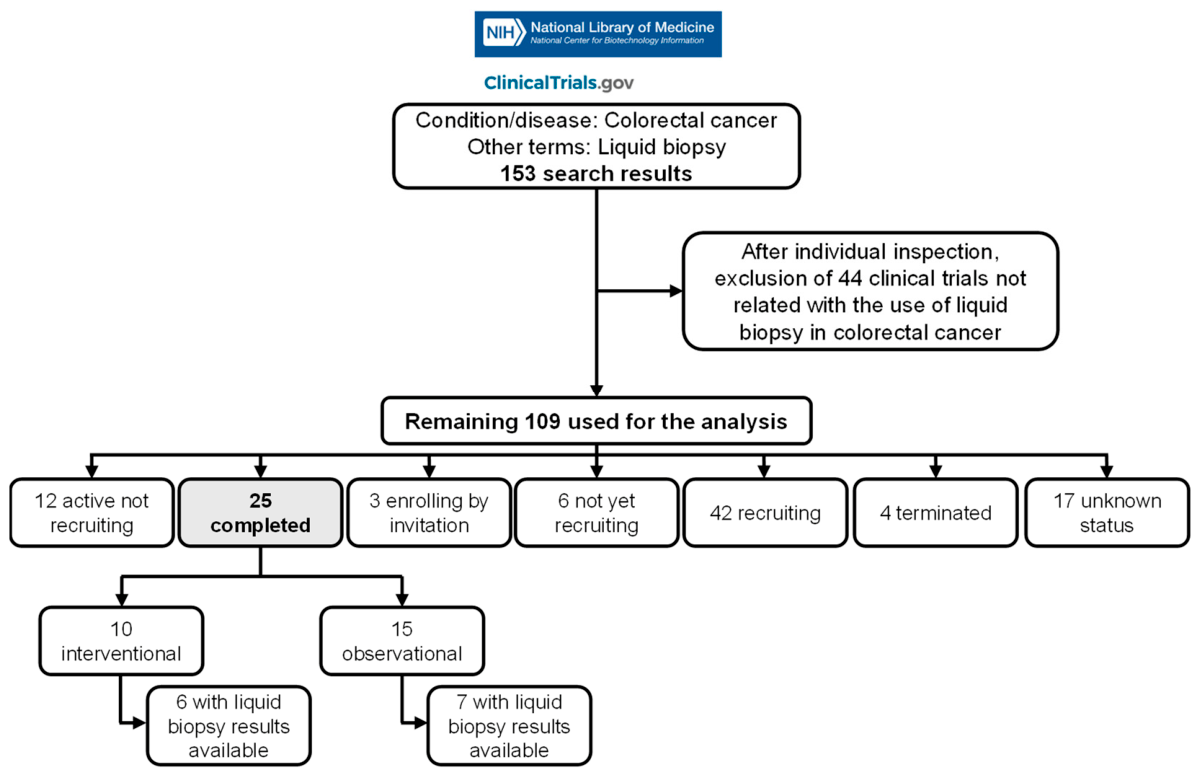
The overall strategy followed is described in Figure 1. On ClinicalTrials.gov, a query for condition/disease “colorectal cancer” and other terms “liquid biopsy”, was performed (accessed on 29 September 2025). No filters were applied, and clinical trials were not restricted by recruitment status. Duplicates were checked based on NCT identifier and trial title; no duplicate entries were identified. This strategy retrieved 153 different registered clinical trials. Those using specific circulating biomarkers (e.g., cfDNA, ctDNA, CTCs, or miRNAs) but not explicitly registered as liquid biopsy trials, were not captured by this query and therefore may be underrepresented.
Out of the 153 clinical trials identified, 44 were excluded after manual verification because they did not explicitly report the use of liquid biopsy for CRC management. The remaining 109 were used for analysis and are described in detail in Supplementary Table S1. Of these 109 trials, 25 are already completed and 13 have results related to liquid biopsy available, either published in the literature or documented on ClinicalTrials.gov.

3.2. General Overview of Available Clinical Trials Using Liquid Biopsy for Colorectal Cancer

A total of 109 clinical trials were analyzed in detail, as shown in Table S1. They are being carried out in 27 countries from four continents (Supplementary Figure S1). The top three more represented countries are: the USA (where 20/109 [18%] clinical trials are being carried out: 4 interventional; 16 observational), Italy (with 17/109 [16%] clinical trials: 12 interventional; 5 observational) followed by China (with 10/109 [9%] clinical trials: 4 interventional; 6 observational). Among those completed (n = 25), 10 were interventional and 15 observational, distributed across 14 countries (Supplementary Figure S1). In total, 119 biomolecules evaluations and 167 different endpoints were reported across 109 clinical trials.
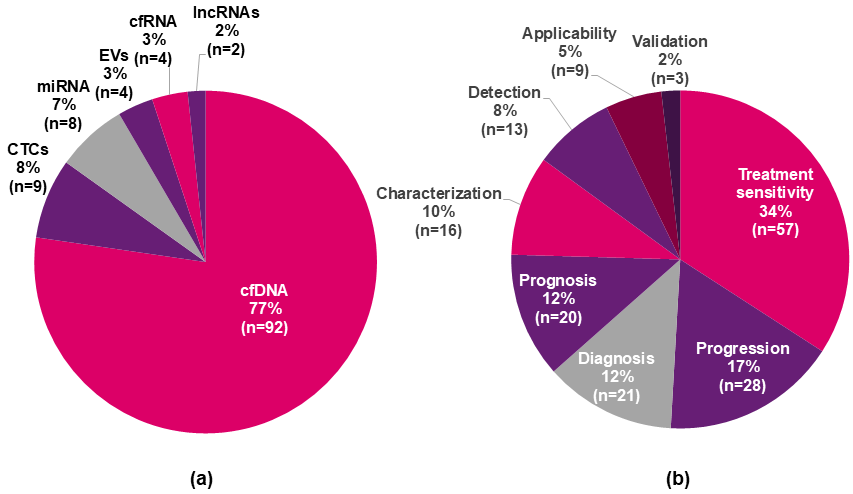
92/119 (77%) of the biomolecules used to perform clinical trials in CRC patients were ctDNA/cfDNA (analyzed jointly in the same category); followed by CTCs, in 9/119 (8%); miRNA, in 8/119 (7%) and EVs, in 4/119 (3%), amongst other biomolecules that were represented in approximately 5% of them (Figure 2a). Regarding the endpoint overview of all the clinical trials, >50% of the outcomes were related to treatment sensitivity and disease progression (57/167 [34%] and 28/167 [17%], respectively); followed by diagnosis, in 21/167; (12%) and prognosis in 20/167 (12%) and characterization of tumor features in 16/167 (10%). A total of 9/109 of the clinical trials had the purpose of analyzing the applicability of liquid biopsy in the clinical context, including considerations regarding cost-effectiveness (Figure 2b).

3.3. Insights from Completed Clinical Trials

Twenty-five completed clinical trials were selected for further analysis (Table 1). As anticipated, the vast majority (21/25) of the clinical trials already completed used cfDNA. As previously referred, 10 were interventional and 15 observational. Among those classified as interventional, 5/10 are currently in phase II and 2/10 are already in phase III.
The primary objective of all five completed phase II studies was the evaluation of treatment sensitivity (NCT03227926; NCT03142516; NCT04425239; NCT04554836; NCT03829410), generally in the context of assessing the efficacy of EGFR inhibitors according to RAS/BRAF mutational status (Table 1 and Table S1). In contrast, the phase III studies were also focused on treatment sensitivity, but additionally addressed prognostic assessment in CRC patients and molecular profiling-based characterization (NCT02484833; NCT02934529).
Among the observational clinical trials, 2 of the 15 studies focused on CTCs to characterize the genomic landscape of metastatic CRC. Additionally, a research group in Egypt completed two observational trials investigating circulating miRNAs and lncRNAs (NCT03563651; NCT02809716), although results remain unavailable (Table 1). Together, these four studies underscore the continued exploration of emerging circulating biomolecule classes in CRC, including CTCs, miRNAs, and lncRNAs (Table 1 and Table S1).

3.4. Available Results on Completed Clinical Trials

Thirteen completed clinical trials have reported results, either in the literature or on ClinicalTrials.gov. Main characteristics, findings and data available from each completed trial are detailed below and in Supplementary Table S1.
  • NCT03227926
CHRONOS is an open-label, single-arm phase II clinical trial evaluating the feasibility of using liquid biopsy for detection of RAS, BRAF, and EGFR mutations in ctDNA to guide a chemotherapy-free rechallenge with panitumumab in patients with RAS wt metastatic CRC previously treated with anti-EGFR therapy. A total of 52 patients with tissue-confirmed RAS wt tumors were screened; 16 patients (31%) showed at least one resistance mutation in ctDNA, indicating ongoing molecular resistance to anti-EGFR therapy, and were therefore excluded. The remaining 36 patients were eligible, and 27 were enrolled and treated with panitumumab, achieving a 30% objective response rate (8/27 partial responses) and 63% disease control (17/27 including two unconfirmed responses). The study met its primary endpoint, demonstrating that ctDNA-guided selection can effectively and safely optimize anti-EGFR retreatment. However, limitations highlighted are the necessity to implement a larger panel of resistant variants in ctDNA to increase the effectiveness of anti-EGFR monoclonal antibodies, the risk of stochastic events that may affect the sensitivity and the fact that randomized trials are still missing (although already ongoing [75]). Moreover, they underscore the necessity to reduce operational and technical challenges [76].
  • NCT06414304
BLOOMSI is a prospective observational trial evaluating the impact of MSI/dMMR testing methods and baseline tumor heterogeneity on immunotherapy outcomes in 30 MSI/dMMR CRC patients. PCR/IHC testing and NGS of both formalin-fixed tissue (FFPE) and liquid biopsy were performed to assess concordance and mutation clonality. The objective response rate (ORR) in the intent-to-treat population was 50%, with concordance of 81% between local and central MSI/dMMR testing and around 68% among IHC, PCR, and NGS methods; however, patients with discordant results showed 0% ORR. Quantitative MSI analysis identified MSI clonality in FFPE and liquid biopsy as independent predictors of progression, suggesting that MSI heterogeneity may underlie resistance to immunotherapy; larger studies are needed to validate these findings. Although these data are preliminary, they indicate trends that will be further evaluated in the ongoing clinical trial [77].
  • NCT04776837
In total, 203 patients with metastatic gastrointestinal cancer (including CRC) were analyzed in this prospective study. Quality of life parameters were associated with treatment response and survival outcomes. A total of 160/203 completed the 1-month follow-up assessment. Functional Assessment of Cancer Therapy–General (FACT-G) scores over the first month of treatment were significantly associated with higher likelihood of clinical benefit, longer progression-free survival (PFS), and improved overall survival (OS), also analyzed by ctDNAs. Hence, although with limited results yet available, they conclude that quality of life parameters may serve as a useful biomarker for treatment response and survival in metastatic gastrointestinal cancers [78].
  • NCT02792478
PERSEIDA is a prospective, observational, multicenter study including 119 treatment-naive metastatic CRC patients to evaluate the concordance between tissue and liquid biopsies for RAS mutation detection. The study highlights the utility of BEAMing analysis, which identified additional RAS mutations in ctDNA, mostly at low mutant allele fractions (≥0.02%) [79]. Altogether, these findings underline the potential of liquid biopsy to guide treatment decisions and monitor therapeutic response over time. However, it is important to highlight that it was challenging to find statistically significant differences for some of the clinical outcomes (namely response rates or progression-free survival). Moreover, technically, for the second cohort they used, it shows the limitation of a less sensitive method [80]. Nevertheless, focusing on a homogeneous group of RAS wt patients enabled a more robust evaluation of liquid biopsy performance and mutation dynamics [81,82].
  • NCT04425239
This randomized study analyzed 137 patients with unresectable metastatic CRC (RAS/BRAF wt) divided into two groups: one receiving intermittent treatment and another one receiving continuous treatment based on conventional chemotherapy combined with an anti-EGFR therapy to assess overall response rates. Relevant clinical mutation in KRAS, NRAS, BRAF, PI3K, EGFR, cKIT and PDGFR genes to define potential biomarkers associated with disease activity and the efficacy or safety of treatment were analyzed. The main limitations of this study include: (i) the use of progression-free survival on treatment as the primary endpoint, which has not yet been clinically validated, and therefore it did not allow the comparison directly between the two arms, and (ii) the fact that not all randomized patients ultimately received the assigned post-induction strategy. Despite these limitations, this trial demonstrates that an intermittent FOLFIRI plus panitumumab strategy is feasible and achieves reduced toxicity while increasing time off treatment. Overall, the results are particularly encouraging for left-sided mCRC and may be strengthened further by ongoing translational studies aimed at improving patient selection [83].
  • NCT05227261
This prospective multicenter study evaluated the clinical utility of a multimodal, non-invasive, multi-cancer early detection (MCED) test based on methylation patterns and fragment size of ctDNA (SPOT-MAS). The study involved 9024 asymptomatic adult participants. Overall, the results revealed a positive predictive value of 39.5%, with a tissue of origin (TOO) accuracy of 52.94%, a negative predictive value of 99.9%, a sensitivity of 70.8% and a specificity of 99.7% across various cancer types. Out of 17 cases with true positive ctDNA signals, three cases were true positive for CRC (cases: K7706 [stage IVC CRC]; K4040 [stage IVC CRC]; K2409 [stage IIB CRC]); the three of them had biopsy positive results in the colon. However, three false negatives for CRC, and four for other cancers are also reported. False negatives are those diagnosed with cancer within 12 months of follow-up. Overall, the findings support the potential of ctDNA-based MCED testing to enhance early cancer detection and screening strategies. However, based on the observations for CRC, its detection appears lower than the overall pooled sensitivity, particularly for early-stage lesions, highlighting that early-stage CRC detection remains limited. The study also suggests that in general, a cost-effective multimodal liquid biopsy can support scalable early cancer detection and interception of precancerous disease in resource-limited settings, but its clinical impact remains constrained by limited case numbers, uncertain survival benefit, suboptimal performance in breast cancer, algorithmic and population-specific biases and the absence of direct comparison with established screening standards [84].
  • NCT02484833
The Phase III ERMES trial compared two maintenance strategies after first-line FOLFIRI + cetuximab in patients with RAS and BRAF wt metastatic CRC: continuing full FOLFIRI + cetuximab vs. switching to cetuximab monotherapy after induction. Cetuximab monotherapy reduces toxicity but fails to maintain equivalent disease control. Real-time ctDNA analysis enables early detection of clonal evolution under cetuximab maintenance, supporting decisions to discontinue anti-EGFR if resistant clones appear and consider EGFR rechallenge after mutation clearance. One limitation of the study was a high dropout rate due to the more fragile conditions of the patients included. Although noninferiority was not achieved with monotherapy, lower toxicity was demonstrated, so larger cohorts could help confirm a benefit in de-escalation [85].
  • NCT02934529
The FIRE-4 study randomly assigned patients with first-line RAS wt metastatic CRC to FOLFIRI plus cetuximab until progression or intolerable toxicity was observed, or to FOLFIRI plus cetuximab followed by a switch maintenance treatment using Fluorouracilplus bevacizumab. The study evaluates baseline liquid biopsy for detecting RAS and BRAF mutations in 540 metastatic CRC patients initially classified as RAS wt by tissue testing. RAS mutations were detected in 13% of cases and the V600E BRAF mutation in 7% of cases, showing worse survival outcomes and reflecting their true molecular status [86]. As an open-label clinical trial, a certain bias in outcome reporting is expected. However, the fact that this is a phase III randomized study and the fact that it had clinically meaningful survival rates, make these promising results [87].
  • NCT04319354
Although registered as interventional in ClinicalTrials.gov, the study design is prospective observational, since no experimental intervention was administered and patients received standard care. Thus, in this prospective observational study, cfDNA is investigated as a biomarker of response to neoadjuvant chemoradiotherapy (nCRT) in patients with locally advanced rectal cancer undergoing surgical excision. Serial liquid biopsies are collected at predefined time points (pre-nCRT, post-nCRT, and postoperative week 1) to assess cfDNA concentration, % of mutation frequency and mutational profile via NGS of tumor biopsies. Patients are stratified according to pathological response after surgery into complete, partial, and non-responders. Patients with higher baseline cfDNA whose levels decline progressively during and after nCRT may be more likely to achieve pathological complete response (PCR) and improved survival outcomes. This study demonstrates the feasibility of cfDNA-based monitoring as a non-invasive biomarker of treatment response in rectal cancer management. One of the limitations of the trial is the low number of patients recruited, so future trials involving a larger number of patients would be necessary [88].
  • NCT04369053
The PREEMPT CRC study is a prospective observational multicenter study evaluating a multiomics blood test for the early detection of CRC in participants aged 45 to 85 who are eligible for CRC screening and scheduled for a standard-of-care screening colonoscopy. For this purpose, they use Freenome which employs machine learning to identify patterns of cell-free biomarkers in blood for early cancer detection. Blood samples are collected prior to routine colonoscopy, and test performance is assessed against colonoscopy findings, with participants stratified by cancer, advanced adenoma, and non-advanced neoplasia. The study aims to evaluate the feasibility and clinical utility of multiomics blood testing as a non-invasive tool to support CRC screening, potentially enhancing adherence and facilitating earlier detection. However, it should be noted that the sensitivity of the test increases with the size of the lesion and the stage of the neoplasm [89].
  • NCT03688906
This study developed a blood-based, multiomic test using tumor- and immune-derived biomarkers to detect early-stage CRC in a cohort composed of 591 individuals. These findings show that combining multiomic signals can significantly enhance early CRC detection accuracy. This trial validated a multiomic liquid biopsy platform that integrates cfDNA whole-genome sequencing (WGS), bisulfite sequencing for epigenetic markers, and protein quantification to detect CRC. In a prospective cohort of 591 participants (including 548 colonoscopy-confirmed controls), the multiomic integration significantly outperformed individual assays, which achieved only 50–66% sensitivity. While the test demonstrated a high sensitivity of 92% for early-stage adenocarcinomas at 90% specificity, its performance was highly dependent on histological subtype. Notably, while it detected squamous cell carcinoma, it failed to identify neuroendocrine tumors, reducing overall sensitivity across all pathological subtypes to 80% in early stages. These findings suggest that while multiomic signals enhance detection for the majority of CRCs, pathological heterogeneity and the detection of rare subtypes remain significant challenges for blood-based screening tools [90].
  • NCT04554836
This study investigated dynamic changes in RAS mutational status among patients with initially RAS-mutated metastatic CRC during first-line therapy using BEAMing and ddPCR-based liquid biopsy assays. In 91% of patients exhibiting partial response or stable disease, RAS mutations in circulating tumor DNA converted to wt early during treatment, irrespective of chemotherapy regimen. These findings indicate that RAS conversion may identify a subset of patients who could benefit from anti-EGFR therapy despite initial RAS-mutant status. This study utilized high-sensitivity liquid biopsy assays (BEAMing and ddPCR) to perform an in-depth longitudinal monitoring of RAS mutational status in patients with initially RAS-mutant metastatic CRC (mCRC) during first-line therapy. The study revealed a high rate of molecular conversion, where 91% of patients with a positive therapeutic response (partial response or stable disease) saw their RAS mutations in ctDNA convert to wt (neoRAS-wt). This phenomenon occurred rapidly, with a median of 3.3–5.1 cycles, regardless of the chemotherapy regimen or anti-VEGF administration. To confirm that the disappearance of RAS mutations was due to clonal selection rather than low ctDNA shedding, the researchers used WIF1-promoter methylation as a secondary tumor marker, which remained detectable in 60% of cases after RAS conversion. These findings provide a biological rationale for the intermittent use of anti-EGFR therapy in initially RAS-mutant patients. However, the study is limited by its small longitudinal cohort (n = 20), which restricts the generalizability of these conversion rates. Furthermore, the clinical utility of this molecular window remains to be validated, as the study did not confirm whether rechallenging neoRAS-wt patients with anti-EGFR therapy translates into improved progression-free or OS [91].
  • NCT03829410
This is a phase II study involving 53 patients. They used a multicenter, open-label, single-arm study analyzing, for the first time, the safety and efficacy of a PLK1 inhibitor with a combination of conventional chemotherapies for patients with metastatic and unresectable CRC and a KRAS mutation in exons 2, 3, or 4. The detection of KRAS-mutant ctDNA was used for real-time assessment of tumor dynamics and treatment response. Thus, they found associations between KRAS-mutant ctDNA measures and ORR and PFS as well as confirming it as a sensitive and non-invasive pharmacodynamic biomarker [92]. As a previously raised concern, the fact that this is a single-arm study, with a limited number of cases highlights the necessity to develop larger and randomized controlled trials to further validate these results.

4. Additional Ongoing Clinical Trials on Colorectal Cancer Using Cell-Free DNA/Circulating Tumor DNA (cfDNA/ctDNA)

Since clinical trials using cfDNA have emerged as the most promising approach in the context of CRC, an additional, more comprehensive search of the literature was conducted to identify the most updated list of clinical trials not captured by the initial query on ClinicalTrials.gov.
Two multicenter, randomized clinical trials with results available have been registered in the Australian New Zealand Clinical Trials Registry (ACTRN12615000381583; ACTRN12617001566325). These studies, the latter designed as a phase II/III trial, evaluated stage II and stage III CRC cohorts, respectively, to assess recurrence risk and optimize adjuvant treatment strategies based on ctDNA analysis. In ACTRN12615000381583, a ctDNA-guided approach reduced the use of adjuvant chemotherapy without compromising recurrence-free survival (RFS). In contrast, ACTRN12617001566325 explored both treatment de-escalation and escalation strategies guided by ctDNA, demonstrating its utility as a strong prognostic biomarker; however, chemotherapy intensification in ctDNA-positive patients did not improve RFS, highlighting the need for alternative therapeutic strategies in this high-risk group [93,94].
Promising recent ongoing clinical trials for CRC management, not retrieved by the ClinicalTrials.gov query, are also exploring ctDNA-guided rechallenge strategies as study endpoints. This is the case for the randomized phase II CITRIC study, which evaluated rechallenge cetuximab and irinotecan by analyzing RAS/BRAF/EGFR-Extracellular domain mutations [95], supporting CHRONOS results. Other phase II trial representative examples are consistent with these results (namely, CRICKET [single arm, NCT02296203], VELO, [randomized, NCT05468892], or CAVE [single arm, NCT04561336]), reinforcing the role of ctDNA in guiding retreatment decisions. An in-depth description of ongoing clinical trials addressing this topic has been reviewed elsewhere [96].

5. Conclusions

In this study, we report a substantial number of registered clinical trials investigating the application of liquid biopsy for early detection, therapeutic monitoring, and molecular characterization of CRC. These initiatives are critical for the identification of robust biomarkers, the development of personalized treatment strategies, including immunotherapies, and ultimately for improving patient management and clinical outcomes.
Most of the currently ongoing clinical trials focus on cfDNA to detect CRC biomarkers in blood. However, other biomolecules seem to be emerging in the field of liquid biopsy for CRC diagnosis, treatment guidance and follow-up, namely CTCs, lncRNAs and miRNAs. However, no available results on these clinical trials are available yet and proven efficacy is needed in order to implement these approaches in the clinical setting. In addition, studying the expression by using lncRNAs and miRNAs, is still technically challenging [97].
One of the concerns extracted from this study and that may arise as a potential confounder in variants identification is the awareness of clonal hematopoiesis. Clinical trials like PERSEIDA (NCT02792478) report the identification of RAS mutations in ctDNA at a low VAF. Clonal hematopoiesis is relevant in this context since misattributing clonal hematopoiesis mutations as tumor-derived could misguide treatment decisions (i.e., RAS-targeted therapy eligibility). This underscores the need for cautious interpretation of ultra-sensitive liquid biopsy results.
Currently, only 4/25 completed clinical trials with results available in our ClinicalTrials.gov query have been randomized and had multiple arms, and therefore there is an enrichment in single-arm and non-randomized clinical trials. Therefore, this limits the solid applicability of liquid biopsy for CRC management into the clinics. Overall, our study underscores the need to refine clinical trial design, including the incorporation of larger cohorts, to generate more robust and consistent results.
The majority of registered clinical trials in ClinicalTrials.gov included in this study, as well as those most recently completed with available results, underscore the utility of liquid biopsy in assessing treatment response, typically in the context of evaluating EGFR inhibitors according to RAS/BRAF mutation status and in guiding therapy rechallenge strategies in patients previously treated with anti-EGFR agents (namely, CHRONOS (NCT03227926), FIRE-4 (NCT02934529), CAPRI 2 GOIM (NCT05312398), CAVE 2 GOIM (NCT05291156), found in Table S1). These findings further support its promising application in the clinical setting. Indeed, current ESMO clinical guidelines for metastatic CRC recommend that cfDNA analysis from plasma be considered to determine RAS mutation status when adequate tissue is unavailable, thereby facilitating optimal treatment selection [17,98,99,100].
Cancer progression is the second most common endpoint among all the clinical trials analyzed on ClinicalTrials.gov. Regarding this, both the ESMO clinical guidelines for localized colon cancer [25] and the NCCN guidelines for colon cancer (version 5.2025) [101], highlight the utility of liquid biopsy to determine the risk of recurrence. Nonetheless, for both therapeutic purposes and to clarify relapse status, the ESMO guidelines underline that it must be awaited before these can be accepted in routine practice [19,25,102]. In fact, after briefly analyzing the main endpoints retrieved by a secondary query on ClinicalTrials.gov based solely on cfDNA in the context of CRC, we observed that the retrieved trials were predominantly focused on recurrence. This highlights a limitation of our primary search strategy on ClinicalTrials.gov: because terminology in trial registries is not standardized, some studies analyzing specific circulating biomarkers, such as cfDNA, ctDNA, CTCs and miRNAs, may not have been captured if the term “liquid biopsy” was not explicitly included in the trial registration. Nevertheless, restricting our search to trials that explicitly use the term “liquid biopsy” allowed us to evaluate how this concept is currently framed and implemented in clinical trial design and reporting. However, to overcome this limitation, a more comprehensive review of cfDNA clinical trials in the context of CRC is presented in Section 4. Nonetheless, future studies should complement our approach by systematically exploring biomarker-specific terminology to better characterize the clinical utility and evolution of individual biomolecules used in liquid biopsy.
To the best of our knowledge, only 5/109 clinical trials in our ClinicalTrials.gov query (NCT06989814; NCT06163365; NCT06708429; NCT06726642; NCT04261972) are devoted to the application of liquid biopsy in Lynch syndrome patients, which are at high risk of CRC development at an early age of onset [103,104]. Only one more (early-stage) clinical trial (NCT06218433) appears when we perform a query on ClinicalTrials.gov about this subject (condition/disease “Lynch Syndrome” and other terms “liquid biopsy”). Multicenter initiatives such as the European project “predi-Lynch” may shed light on this gap, since its aim is to develop and validate non-invasive, accurate, and cost-effective liquid biopsy tests to detect cancer at its earliest stages in those carrying germline variants in Lynch syndrome-associated genes [105]. This would be crucial to develop strategies to prevent CRC in young patients with other rare tumor-risk syndromes, such as the PTEN Hamartoma Tumor Syndrome (PHTS) [106,107], and improve their pathway of care, with economic and social impacts, as claimed, for instance, by the European project PREVENTABLE [108].
Altogether, this analysis allowed us to analyze how the trajectory of liquid biopsy development in CRC differs from that observed in other solid tumors, such as lung cancer, where early adoption was facilitated by highly actionable genomic alterations and rapid therapeutic targets [109,110]. Indeed, for other cancer types, such as breast, lung or gastrointestinal cancers, previous recent large cohorts studies have demonstrated a high specificity and positive predictive values when assessing ctDNA liquid biopsy in comparison with tissue-based PCR/NGS testing as well as a high accuracy for single nucleotide variants (SNVs), conferring reliable evidence with strong potential to be implemented in the clinical setting [109,110,111,112,113,114]. For instance, in breast cancer, it has been demonstrated that using liquid biopsy for a tumor’s genotyping provided more accuracy than standard serum markers [61]. In contrast, for CRC, the limited spectrum of immediately actionable mutations and the biological complexity of tumor heterogeneity may partly explain the slower transition toward routine clinical use.
One potential future direction in ctDNA use for CRC lies in the neoadjuvant setting: for example, immunotherapy trials such as NCT04165772 have shown promising results in dMMR CRC, highlighting the potential for integrating molecular biomarkers, including ctDNA, for treatment stratification [115]. Additionally, ongoing clinical trials (Table S1) such as SAGITARIUS (NCT06490536) and PEGASUS (NCT04259944) remark the use of ctDNA to guide adjuvant therapy strategies [116,117].
In conclusion, our work provides an overview of the current landscape of clinical trials in the field, summarizing their scope and relevance as well as unveiling potential gaps to be addressed in future studies. Altogether, the observations reported herein will help clarify the context for the effective clinical application of liquid biopsy in CRC.

Supplementary Materials

The following supporting information can be downloaded at: https://www.mdpi.com/article/10.3390/genes17050500/s1, Table S1: Detailed description of clinical trials using liquid biopsy for colorectal cancer; Supplementary Figure S1: Global distribution of 109 clinical trials applying liquid biopsy in colorectal cancer (CRC).

Author Contributions

Conceptualization, J.G.-P., Y.Y. and I.C.; methodology, J.G.-P. and Y.Y.; formal analysis, J.G.-P., Y.Y., M.A., M.L., M.M., M.O.-T., L.R. and I.C.; writing—original draft preparation, J.G.-P.; writing—review and editing, J.G.-P., Y.Y., M.A., M.L., M.M., M.O.-T., L.R. and I.C. All authors have read and agreed to the published version of the manuscript.

Funding

The APC was funded by Health in Code Group, Valencia, Spain.

Institutional Review Board Statement

Not applicable.

Informed Consent Statement

Not applicable.

Data Availability Statement

All data used to generate this manuscript are publicly available at ClinicalTrials.gov.

Acknowledgments

The team would like to thank María Cervera López (Health in Code Group, Valencia, Spain) for her valuable engagement in clinical trials’ discussions.

Conflicts of Interest

All authors are employees of Health in Code and declare no other conflicts of interest.

Abbreviations

The following abbreviations are used in this manuscript:
ARMSAmplification Refractory Mutations System
BEAMingBeads-Emulsion-Amplification and Magnetics
CEACarcinoembryonic antigen
cfDNACell-free DNA
CIMPCpG island methylator phenotype
CINChromosomal instability
CRCColorectal cancer
CTComputed tomography
CTCsCirculating tumor cells
ctDNACirculating tumor DNA
ddPCRDroplet digital PCR
dMMRDeficient mismatch repair
EGFREpidermal growth factor receptor
EVsExtracellular vesicles
FACT-GFunctional assessment of cancer therapy-general 
FFPEFormalin-fixed paraffin-embedded
GFPGreen fluorescent protein
HER2Human epidermal growth factor receptor 2
ICIsImmune checkpoint inhibitors
IHCImmunohistochemistry
lnRNALong noncoding RNA
MCEDMulti-cancer early detection
miRNAmicroRNA
MMRMismatch repair 
MRIMagnetic resonance imaging
MSI/MSI-HMicrosatellite instability
NGSNext generation sequencing
nCRTNeoadjuvant chemoradiotherapy
NPVNegative predictive value
ORRObjective response rate
OSOverall survival
PCRPolymerase chain reaction
pCRPathological complete response
PFSProgression-free survival
PHTSPTEN Hamartoma Tumor Syndrome
PPVPositive predictive value
RFSRecurrence-free survival
SNVsSingle nucleotide variants
PD-1Programmed death-1
TMBTumor mutation burden
TOOTissue of origin
VAFVariant allele frequency
VEGFEndothelial growth factor 
WTWild type

References

  1. Bray, F.; Laversanne, M.; Sung, H.; Ferlay, J.; Siegel, R.L.; Soerjomataram, I.; Jemal, A. Global Cancer Statistics 2022: GLOBOCAN Estimates of Incidence and Mortality Worldwide for 36 Cancers in 185 Countries. CA Cancer J. Clin. 2024, 74, 229–263. [Google Scholar] [CrossRef]
  2. Bray, F.; Ferlay, J.; Soerjomataram, I.; Siegel, R.L.; Torre, L.A.; Jemal, A. Global Cancer Statistics 2018: GLOBOCAN Estimates of Incidence and Mortality Worldwide for 36 Cancers in 185 Countries. CA Cancer J. Clin. 2018, 68, 394–424. [Google Scholar] [CrossRef]
  3. Sung, H.; Ferlay, J.; Siegel, R.L.; Laversanne, M.; Soerjomataram, I.; Jemal, A.; Bray, F. Global Cancer Statistics 2020: GLOBOCAN Estimates of Incidence and Mortality Worldwide for 36 Cancers in 185 Countries. CA Cancer J. Clin. 2021, 71, 209–249. [Google Scholar] [CrossRef]
  4. Dekker, E.; Tanis, P.J.; Vleugels, J.L.A.; Kasi, P.M.; Wallace, M.B. Colorectal Cancer. Lancet 2019, 394, 1467–1480. [Google Scholar] [CrossRef] [PubMed]
  5. Sung, H.; Siegel, R.L.; Laversanne, M.; Jiang, C.; Morgan, E.; Zahwe, M.; Cao, Y.; Bray, F.; Jemal, A. Colorectal Cancer Incidence Trends in Younger versus Older Adults: An Analysis of Population-Based Cancer Registry Data. Lancet Oncol. 2025, 26, 51–63. [Google Scholar] [CrossRef] [PubMed]
  6. Johnson, C.M.; Wei, C.; Ensor, J.E.; Smolenski, D.J.; Amos, C.I.; Levin, B.; Berry, D.A. Meta-Analyses of Colorectal Cancer Risk Factors. Cancer Causes Control 2013, 24, 1207–1222. [Google Scholar] [CrossRef] [PubMed]
  7. Jass, J.R. Classification of Colorectal Cancer Based on Correlation of Clinical, Morphological and Molecular Features. Histopathology 2007, 50, 113–130. [Google Scholar] [CrossRef]
  8. Kang, G.H. Four Molecular Subtypes of Colorectal Cancer and Their Precursor Lesions. Arch. Pathol. Lab. Med. 2011, 135, 698–703. [Google Scholar] [CrossRef]
  9. PDQ Cancer Genetics Editorial Board. Genetics of Colorectal Cancer (PDQ®); Health Professional Version; National Cancer Institute: Rockville, MD, USA, 2002.
  10. Schirripa, M.; Cohen, S.A.; Battaglin, F.; Lenz, H.-J. Biomarker-Driven and Molecular Targeted Therapies for Colorectal Cancers. Semin. Oncol. 2018, 45, 124–132. [Google Scholar] [CrossRef]
  11. Taieb, J.; Le Malicot, K.; Shi, Q.; Penault-Llorca, F.; Bouché, O.; Tabernero, J.; Mini, E.; Goldberg, R.M.; Folprecht, G.; Luc Van Laethem, J.; et al. Prognostic Value of BRAF and KRAS Mutations in MSI and MSS Stage III Colon Cancer. J. Natl. Cancer Inst. 2017, 109, djw272. [Google Scholar] [CrossRef]
  12. Cancer Genome Atlas Network. Comprehensive Molecular Characterization of Human Colon and Rectal Cancer. Nature 2012, 487, 330–337. [Google Scholar] [CrossRef]
  13. Simon, K. Colorectal Cancer Development and Advances in Screening. Clin. Interv. Aging 2016, 11, 967–976. [Google Scholar] [CrossRef]
  14. Al-Sohaily, S.; Biankin, A.; Leong, R.; Kohonen-Corish, M.; Warusavitarne, J. Molecular Pathways in Colorectal Cancer. J. Gastroenterol. Hepatol. 2012, 27, 1423–1431. [Google Scholar] [CrossRef] [PubMed]
  15. Petrik, J.; Verbanac, D.; Fabijanec, M.; Hulina-Tomašković, A.; Čeri, A.; Somborac-Bačura, A.; Petlevski, R.; Grdić Rajković, M.; Rumora, L.; Krušlin, B.; et al. Circulating Tumor Cells in Colorectal Cancer: Detection Systems and Clinical Utility. Int. J. Mol. Sci. 2022, 23, 13582. [Google Scholar] [CrossRef]
  16. Pentheroudakis, G.; Argilés, G.; Arnold, D.; Smyth, E.; Ducreux, M. ESMO Clinical Practice Guideline Express Update on the Adoption of Physical Exercise in Patients with Localised Colon Cancer. ESMO Open 2026, 11, 106019. [Google Scholar] [CrossRef] [PubMed]
  17. Cervantes, A.; Adam, R.; Roselló, S.; Arnold, D.; Normanno, N.; Taïeb, J.; Seligmann, J.; De Baere, T.; Osterlund, P.; Yoshino, T.; et al. Metastatic Colorectal Cancer: ESMO Clinical Practice Guideline for Diagnosis, Treatment and Follow-up. Ann. Oncol. 2023, 34, 10–32. [Google Scholar] [CrossRef]
  18. Benson, A.B.; Venook, A.P.; Adam, M.; Chang, G.; Chen, Y.-J.; Ciombor, K.K.; Cohen, S.A.; Cooper, H.S.; Deming, D.; Garrido-Laguna, I.; et al. Colon Cancer, Version 3.2024, NCCN Clinical Practice Guidelines in Oncology. J. Natl. Compr. Cancer Netw. 2024, 22, e240029. [Google Scholar] [CrossRef]
  19. Pagès, F.; Mlecnik, B.; Marliot, F.; Bindea, G.; Ou, F.-S.; Bifulco, C.; Lugli, A.; Zlobec, I.; Rau, T.T.; Berger, M.D.; et al. International Validation of the Consensus Immunoscore for the Classification of Colon Cancer: A Prognostic and Accuracy Study. Lancet 2018, 391, 2128–2139. [Google Scholar] [CrossRef] [PubMed]
  20. Le, D.T.; Durham, J.N.; Smith, K.N.; Wang, H.; Bartlett, B.R.; Aulakh, L.K.; Lu, S.; Kemberling, H.; Wilt, C.; Luber, B.S.; et al. Mismatch Repair Deficiency Predicts Response of Solid Tumors to PD-1 Blockade. Science 2017, 357, 409–413. [Google Scholar] [CrossRef]
  21. Romero-Zoghbi, S.E.; Krumina, E.; López-Campos, F.; Couñago, F. Current and Future Perspectives in the Management and Treatment of Colorectal Cancer. World J. Clin. Oncol. 2025, 16, 100807. [Google Scholar] [CrossRef]
  22. Li, Y.; Ma, Y.; Wu, Z.; Zeng, F.; Song, B.; Zhang, Y.; Li, J.; Lui, S.; Wu, M. Tumor Mutational Burden Predicting the Efficacy of Immune Checkpoint Inhibitors in Colorectal Cancer: A Systematic Review and Meta-Analysis. Front. Immunol. 2021, 12, 751407. [Google Scholar] [CrossRef] [PubMed]
  23. Fadlallah, H.; El Masri, J.; Fakhereddine, H.; Youssef, J.; Chemaly, C.; Doughan, S.; Abou-Kheir, W. Colorectal Cancer: Recent Advances in Management and Treatment. World J. Clin. Oncol. 2024, 15, 1136–1156. [Google Scholar] [CrossRef] [PubMed]
  24. Adam, M.; Chang, G.J.; Chen, Y.-J.; Ciombor, K.K.; Cohen, S.A.; Deming, D.; Garrido-Laguna, I.; Grem, J.L.; Harmath, C.; Randolph Hecht, J.; et al. NCCN Guidelines Version 4.2025 Colon Cancer Continue NCCN Guidelines Panel Disclosures; The National Comprehensive Cancer Network: Plymouth Meeting, PA, USA, 2025. [Google Scholar]
  25. Argilés, G.; Tabernero, J.; Labianca, R.; Hochhauser, D.; Salazar, R.; Iveson, T.; Laurent-Puig, P.; Quirke, P.; Yoshino, T.; Taieb, J.; et al. Localised Colon Cancer: ESMO Clinical Practice Guidelines for Diagnosis, Treatment and Follow-Up. Ann. Oncol. 2020, 31, 1291–1305. [Google Scholar] [CrossRef]
  26. Kopetz, S.; Grothey, A.; Yaeger, R.; Van Cutsem, E.; Desai, J.; Yoshino, T.; Wasan, H.; Ciardiello, F.; Loupakis, F.; Hong, Y.S.; et al. Encorafenib, Binimetinib, and Cetuximab in BRAF V600E-Mutated Colorectal Cancer. N. Engl. J. Med. 2019, 381, 1632–1643. [Google Scholar] [CrossRef]
  27. McFall, T.; Trogdon, M.; Guizar, A.C.; Langenheim, J.F.; Sisk-Hackworth, L.; Stites, E.C. Co-Targeting KRAS G12C and EGFR Reduces Both Mutant and Wild-Type RAS-GTP. NPJ Precis. Oncol. 2022, 6, 86. [Google Scholar] [CrossRef]
  28. Petrelli, F.; Ardito, R.; Ghidini, A.; Zaniboni, A.; Ghidini, M.; Barni, S.; Tomasello, G. Different Toxicity of Cetuximab and Panitumumab in Metastatic Colorectal Cancer Treatment: A Systematic Review and Meta-Analysis. Oncology 2018, 94, 191–199. [Google Scholar] [CrossRef]
  29. Marchiò, C.; Scaltriti, M.; Ladanyi, M.; Iafrate, A.J.; Bibeau, F.; Dietel, M.; Hechtman, J.F.; Troiani, T.; López-Rios, F.; Douillard, J.-Y.; et al. ESMO Recommendations on the Standard Methods to Detect NTRK Fusions in Daily Practice and Clinical Research. Ann. Oncol. 2019, 30, 1417–1427. [Google Scholar] [CrossRef]
  30. Kanani, A.; Veen, T.; Søreide, K. Neoadjuvant Immunotherapy in Primary and Metastatic Colorectal Cancer. Br. J. Surg. 2021, 108, 1417–1425. [Google Scholar] [CrossRef]
  31. Misale, S.; Yaeger, R.; Hobor, S.; Scala, E.; Janakiraman, M.; Liska, D.; Valtorta, E.; Schiavo, R.; Buscarino, M.; Siravegna, G.; et al. Emergence of KRAS Mutations and Acquired Resistance to Anti-EGFR Therapy in Colorectal Cancer. Nature 2012, 486, 532–536. [Google Scholar] [CrossRef]
  32. Qin, Y.; Liu, L.; Luo, S.; He, H.; Sun, X.; Zhang, Q.; Bian, Z.; Sun, S. Sodium Butyrate Induces Colorectal Cancer Cell Apoptosis via the MCU/Drp1 Pathway. Int. Immunopharmacol. 2025, 161, 115052. [Google Scholar] [CrossRef] [PubMed]
  33. Flegiel, E.; Piotrowska, M.; Ptasznik, M.; Baran, A.; Lenart, J.; Podrażka, M.; Mazurek, J.; Stachowicz, H.; Bartos, W.; Adamczyk, M. Review of the Effects of Sodium Butyrate on Obesity, Inflammatory Bowel Disease, Pregnancy and Colorectal Cancer. Prospect. Pharm. Sci. 2024, 22, 7–15. [Google Scholar] [CrossRef]
  34. Rahman, M.U.; Hussain, H.R.; Akram, H.; Gulzar, F.; Nouman, M.; Farooq, H.; Ashfaq, A.; Kalsoom, Z. Nifedipine’s Synergistic Therapeutic Potential: Overcoming Challenges and Embracing Novel Applications in Pharmacotherapy. Prospect. Pharm. Sci. 2025, 23, 101–115. [Google Scholar] [CrossRef]
  35. Thorsteinsson, M.; Jess, P. The Clinical Significance of Circulating Tumor Cells in Non-Metastatic Colorectal Cancer—A Review. Eur. J. Surg. Oncol. 2011, 37, 459–465. [Google Scholar] [CrossRef]
  36. Ness, R.M.; Llor, X.; Chair, V.; Baidoo, L.; Jude, S.; Bishu, S.; Cooper, G.; Early, D.S.; Friedman, M.; Fudman, D.; et al. NCCN Guidelines Version 2.2025 Colorectal Cancer Screening Continue NCCN Guidelines Panel Disclosures Independent Patient Advocate; The National Comprehensive Cancer Network: Plymouth Meeting, PA, USA, 2025. [Google Scholar]
  37. Ferrari, A.; Neefs, I.; Hoeck, S.; Peeters, M.; Van Hal, G. Towards Novel Non-Invasive Colorectal Cancer Screening Methods: A Comprehensive Review. Cancers 2021, 13, 1820. [Google Scholar] [CrossRef]
  38. Batool, S.M.; Yekula, A.; Khanna, P.; Hsia, T.; Gamblin, A.S.; Ekanayake, E.; Escobedo, A.K.; You, D.G.; Castro, C.M.; Im, H.; et al. The Liquid Biopsy Consortium: Challenges and Opportunities for Early Cancer Detection and Monitoring. Cell Rep. Med. 2023, 4, 101198. [Google Scholar] [CrossRef]
  39. Marcuello, M.; Vymetalkova, V.; Neves, R.P.L.; Duran-Sanchon, S.; Vedeld, H.M.; Tham, E.; van Dalum, G.; Flügen, G.; Garcia-Barberan, V.; Fijneman, R.J.; et al. Circulating Biomarkers for Early Detection and Clinical Management of Colorectal Cancer. Mol. Aspects Med. 2019, 69, 107–122. [Google Scholar] [CrossRef]
  40. Amin, M.B.; Greene, F.L.; Edge, S.B.; Compton, C.C.; Gershenwald, J.E.; Brookland, R.K.; Meyer, L.; Gress, D.M.; Byrd, D.R.; Winchester, D.P. The Eighth Edition AJCC Cancer Staging Manual: Continuing to Build a Bridge from a Population-Based to a More “Personalized” Approach to Cancer Staging. CA Cancer J. Clin. 2017, 67, 93–99. [Google Scholar] [CrossRef] [PubMed]
  41. Meng, W.; Petry, R.; Galicia, N.P.; van den Hout, A.; Yu, J.; Gong, S.; Shah, D.; Sun, D.; Guo, C.; Bailey, S.; et al. Analytical Validation and Sequencing Coverage Studies Suggest That Performance of a Liquid Biopsy Assay Is Tumor Agnostic (DNA-Is-DNA). PLoS ONE 2025, 20, e0329392. [Google Scholar] [CrossRef] [PubMed]
  42. Ziranu, P.; Pretta, A.; Saba, G.; Spanu, D.; Donisi, C.; Ferrari, P.A.; Cau, F.; D’Agata, A.P.; Piras, M.; Mariani, S.; et al. Navigating the Landscape of Liquid Biopsy in Colorectal Cancer: Current Insights and Future Directions. Int. J. Mol. Sci. 2025, 26, 7619. [Google Scholar] [CrossRef]
  43. Ma, L.; Guo, H.; Zhao, Y.; Liu, Z.; Wang, C.; Bu, J.; Sun, T.; Wei, J. Liquid Biopsy in Cancer Current: Status, Challenges and Future Prospects. Signal Transduct. Target. Ther. 2024, 9, 336. [Google Scholar] [CrossRef]
  44. Salu, P.; Reindl, K.M. Advancements in Circulating Tumor Cell Research: Bridging Biology and Clinical Applications. Cancers 2024, 16, 1213. [Google Scholar] [CrossRef]
  45. Jia, S.; Zhang, R.; Li, Z.; Li, J. Clinical and Biological Significance of Circulating Tumor Cells, Circulating Tumor DNA, and Exosomes as Biomarkers in Colorectal Cancer. Oncotarget 2017, 8, 55632–55645. [Google Scholar] [CrossRef]
  46. Tan, C.R.C.; Zhou, L.; El-Deiry, W.S. Circulating Tumor Cells Versus Circulating Tumor DNA in Colorectal Cancer: Pros and Cons. Curr. Colorectal Cancer Rep. 2016, 12, 151–161. [Google Scholar] [CrossRef]
  47. Cristofanilli, M.; Budd, G.T.; Ellis, M.J.; Stopeck, A.; Matera, J.; Miller, M.C.; Reuben, J.M.; Doyle, G.V.; Allard, W.J.; Terstappen, L.W.M.M.; et al. Circulating Tumor Cells, Disease Progression, and Survival in Metastatic Breast Cancer. N. Engl. J. Med. 2004, 351, 781–791. [Google Scholar] [CrossRef] [PubMed]
  48. Sefrioui, D.; Blanchard, F.; Toure, E.; Basile, P.; Beaussire, L.; Dolfus, C.; Perdrix, A.; Paresy, M.; Antonietti, M.; Iwanicki-Caron, I.; et al. Diagnostic Value of CA19.9, Circulating Tumour DNA and Circulating Tumour Cells in Patients with Solid Pancreatic Tumours. Br. J. Cancer 2017, 117, 1017–1025. [Google Scholar] [CrossRef] [PubMed]
  49. Vidlarova, M.; Rehulkova, A.; Stejskal, P.; Prokopova, A.; Slavik, H.; Hajduch, M.; Srovnal, J. Recent Advances in Methods for Circulating Tumor Cell Detection. Int. J. Mol. Sci. 2023, 24, 3902. [Google Scholar] [CrossRef] [PubMed]
  50. Kojima, T.; Hashimoto, Y.; Watanabe, Y.; Kagawa, S.; Uno, F.; Kuroda, S.; Tazawa, H.; Kyo, S.; Mizuguchi, H.; Urata, Y.; et al. A Simple Biological Imaging System for Detecting Viable Human Circulating Tumor Cells. J. Clin. Investig. 2009, 119, 3172–3181. [Google Scholar] [CrossRef]
  51. Gao, F.; Cui, Y.; Jiang, H.; Sui, D.; Wang, Y.; Jiang, Z.; Zhao, J.; Lin, S. Circulating Tumor Cell Is a Common Property of Brain Glioma and Promotes the Monitoring System. Oncotarget 2016, 7, 71330–71340. [Google Scholar] [CrossRef]
  52. Hu, B.; Gong, Y.; Wang, Y.; Xie, J.; Cheng, J.; Huang, Q. Comprehensive Atlas of Circulating Rare Cells Detected by SE-IFISH and Image Scanning Platform in Patients With Various Diseases. Front. Oncol. 2022, 12, 821454. [Google Scholar] [CrossRef]
  53. Rushton, A.J.; Nteliopoulos, G.; Shaw, J.A.; Coombes, R.C. A Review of Circulating Tumour Cell Enrichment Technologies. Cancers 2021, 13, 970. [Google Scholar] [CrossRef]
  54. Hardingham, J.E.; Kotasek, D.; Sage, R.E.; Eaton, M.C.; Pascoe, V.H.; Dobrovic, A. Detection of Circulating Tumor Cells in Colorectal Cancer by Immunobead-PCR Is a Sensitive Prognostic Marker for Relapse of Disease. Mol. Med. 1995, 1, 789–794. [Google Scholar] [CrossRef]
  55. Yang, C.; Zou, K.; Zheng, L.; Xiong, B. Prognostic and Clinicopathological Significance of Circulating Tumor Cells Detected by RT-PCR in Non-Metastatic Colorectal Cancer: A Meta-Analysis and Systematic Review. BMC Cancer 2017, 17, 725. [Google Scholar] [CrossRef] [PubMed]
  56. Heitzer, E.; Ulz, P.; Geigl, J.B. Circulating Tumor DNA as a Liquid Biopsy for Cancer. Clin. Chem. 2015, 61, 112–123. [Google Scholar] [CrossRef]
  57. Bettegowda, C.; Sausen, M.; Leary, R.J.; Kinde, I.; Wang, Y.; Agrawal, N.; Bartlett, B.R.; Wang, H.; Luber, B.; Alani, R.M.; et al. Detection of Circulating Tumor DNA in Early- and Late-Stage Human Malignancies. Sci. Transl. Med. 2014, 6, 224ra24. [Google Scholar] [CrossRef]
  58. Lecomte, T.; Berger, A.; Zinzindohoué, F.; Micard, S.; Landi, B.; Blons, H.; Beaune, P.; Cugnenc, P.-H.; Laurent-Puig, P. Detection of Free-Circulating Tumor-Associated DNA in Plasma of Colorectal Cancer Patients and Its Association with Prognosis. Int. J. Cancer 2002, 100, 542–548. [Google Scholar] [CrossRef]
  59. Diehl, F.; Li, M.; He, Y.; Kinzler, K.W.; Vogelstein, B.; Dressman, D. BEAMing: Single-Molecule PCR on Microparticles in Water-in-Oil Emulsions. Nat. Methods 2006, 3, 551–559. [Google Scholar] [CrossRef] [PubMed]
  60. Spindler, K.-L.G.; Pallisgaard, N.; Vogelius, I.; Jakobsen, A. Quantitative Cell-Free DNA, KRAS, and BRAF Mutations in Plasma from Patients with Metastatic Colorectal Cancer during Treatment with Cetuximab and Irinotecan. Clin. Cancer Res. 2012, 18, 1177–1185. [Google Scholar] [CrossRef]
  61. Dawson, S.-J.; Tsui, D.W.Y.; Murtaza, M.; Biggs, H.; Rueda, O.M.; Chin, S.-F.; Dunning, M.J.; Gale, D.; Forshew, T.; Mahler-Araujo, B.; et al. Analysis of Circulating Tumor DNA to Monitor Metastatic Breast Cancer. N. Engl. J. Med. 2013, 368, 1199–1209. [Google Scholar] [CrossRef] [PubMed]
  62. Garcia, J.; Forestier, J.; Dusserre, E.; Wozny, A.-S.; Geiguer, F.; Merle, P.; Tissot, C.; Ferraro-Peyret, C.; Jones, F.S.; Edelstein, D.L.; et al. Cross-Platform Comparison for the Detection of RAS Mutations in CfDNA (DdPCR Biorad Detection Assay, BEAMing Assay, and NGS Strategy). Oncotarget 2018, 9, 21122–21131. [Google Scholar] [CrossRef]
  63. Li, L.; Sun, Y. Circulating Tumor DNA Methylation Detection as Biomarker and Its Application in Tumor Liquid Biopsy: Advances and Challenges. MedComm 2024, 5, e766. [Google Scholar] [CrossRef] [PubMed]
  64. Payne, S.R. From Discovery to the Clinic: The Novel DNA Methylation Biomarker (m)SEPT9 for the Detection of Colorectal Cancer in Blood. Epigenomics 2010, 2, 575–585. [Google Scholar] [CrossRef]
  65. Lee, B.B.; Lee, E.J.; Jung, E.H.; Chun, H.-K.; Chang, D.K.; Song, S.Y.; Park, J.; Kim, D.-H. Aberrant Methylation of APC, MGMT, RASSF2A, and Wif-1 Genes in Plasma as a Biomarker for Early Detection of Colorectal Cancer. Clin. Cancer Res. 2009, 15, 6185–6191. [Google Scholar] [CrossRef]
  66. Symonds, E.L.; Pedersen, S.K.; Murray, D.H.; Jedi, M.; Byrne, S.E.; Rabbitt, P.; Baker, R.T.; Bastin, D.; Young, G.P. Circulating Tumour DNA for Monitoring Colorectal Cancer-a Prospective Cohort Study to Assess Relationship to Tissue Methylation, Cancer Characteristics and Surgical Resection. Clin. Epigenetics 2018, 10, 63. [Google Scholar] [CrossRef]
  67. Jensen, L.H.; Olesen, R.; Petersen, L.N.; Boysen, A.K.; Andersen, R.F.; Lindebjerg, J.; Nottelmann, L.; Thomsen, C.E.B.; Havelund, B.M.; Jakobsen, A.; et al. NPY Gene Methylation as a Universal, Longitudinal Plasma Marker for Evaluating the Clinical Benefit from Last-Line Treatment with Regorafenib in Metastatic Colorectal Cancer. Cancers 2019, 11, 1649. [Google Scholar] [CrossRef]
  68. Roperch, J.-P.; Incitti, R.; Forbin, S.; Bard, F.; Mansour, H.; Mesli, F.; Baumgaertner, I.; Brunetti, F.; Sobhani, I. Aberrant Methylation of NPY, PENK, and WIF1 as a Promising Marker for Blood-Based Diagnosis of Colorectal Cancer. BMC Cancer 2013, 13, 566. [Google Scholar] [CrossRef] [PubMed]
  69. Garlan, F.; Laurent-Puig, P.; Sefrioui, D.; Siauve, N.; Didelot, A.; Sarafan-Vasseur, N.; Michel, P.; Perkins, G.; Mulot, C.; Blons, H.; et al. Early Evaluation of Circulating Tumor DNA as Marker of Therapeutic Efficacy in Metastatic Colorectal Cancer Patients (PLACOL Study). Clin. Cancer Res. 2017, 23, 5416–5425. [Google Scholar] [CrossRef] [PubMed]
  70. He, Y.; Forouzmand, E.; Burke, J.; Gittelman, R.; Selewa, A.; Raymond, V.M.; Duenwald, S.; Eagle, C.; Talasaz, A.; Chudova, D. Evaluation of a Plasma Cell-Free DNA Methylation-Based Multi-Cancer Detection Test. J. Clin. Oncol. 2025, 43, 10550. [Google Scholar] [CrossRef]
  71. Musher, B.L.; Melson, J.E.; Amato, G.; Chan, D.; Hill, M.; Khan, I.; Kochuparambil, S.T.; Lyons, S.E.; Orsini, J.; Pedersen, S.K.; et al. Evaluation of Circulating Tumor DNA for Methylated BCAT1 and IKZF1 to Detect Recurrence of Stage II/Stage III Colorectal Cancer (CRC). Cancer Epidemiol. Biomarkers Prev. 2020, 29, 2702–2709. [Google Scholar] [CrossRef]
  72. Wang, B.; Zhang, Y.; Liu, J.; Deng, B.; Li, Q.; Liu, H.; Sui, Y.; Wang, N.; Xiao, Q.; Liu, W.; et al. Colorectal Cancer Screening Using a Multi-Locus Blood-Based Assay Targeting Circulating Tumor DNA Methylation: A Cross-Sectional Study in an Average-Risk Population. BMC Med. 2024, 22, 560. [Google Scholar] [CrossRef]
  73. Patelli, G.; Mauri, G.; Tosi, F.; Amatu, A.; Bencardino, K.; Bonazzina, E.; Pizzutilo, E.G.; Villa, F.; Calvanese, G.; Agostara, A.G.; et al. Circulating Tumor DNA to Drive Treatment in Metastatic Colorectal Cancer. Clin. Cancer Res. 2023, 29, 4530–4539. [Google Scholar] [CrossRef] [PubMed]
  74. Assunção, R.R.S.; Santos, N.L.; de Sousa Andrade, L.N. Extracellular Vesicles as Cancer Biomarkers and Drug Delivery Strategies in Clinical Settings: Advances, Perspectives, and Challenges. Clinics 2025, 80, 100635. [Google Scholar] [CrossRef]
  75. Moretto, R.; Rossini, D.; Capone, I.; Boccaccino, A.; Perrone, F.; Tamborini, E.; Masi, G.; Antoniotti, C.; Marmorino, F.; Conca, V.; et al. Rationale and Study Design of the PARERE Trial: Randomized Phase II Study of Panitumumab Re-Treatment Followed by Regorafenib Versus the Reverse Sequence in RAS and BRAF Wild-Type Chemo-Refractory Metastatic Colorectal Cancer Patients. Clin. Colorectal Cancer 2021, 20, 314–317. [Google Scholar] [CrossRef]
  76. Sartore-Bianchi, A.; Pietrantonio, F.; Lonardi, S.; Mussolin, B.; Rua, F.; Crisafulli, G.; Bartolini, A.; Fenocchio, E.; Amatu, A.; Manca, P.; et al. Circulating Tumor DNA to Guide Rechallenge with Panitumumab in Metastatic Colorectal Cancer: The Phase 2 CHRONOS Trial. Nat. Med. 2022, 28, 1612–1618. [Google Scholar] [CrossRef]
  77. Lebedeva, A.; Taraskina, A.; Grigoreva, T.; Belova, E.; Kuznetsova, O.; Ivanilova, D.; Sergeeva, A.; Kavun, A.; Veselovsky, E.; Nikulin, V.; et al. The Role of MSI Testing Methodology and Its Heterogeneity in Predicting Colorectal Cancer Immunotherapy Response. Int. J. Mol. Sci. 2025, 26, 3420. [Google Scholar] [CrossRef] [PubMed]
  78. Jarnagin, J.X.; Saraf, A.; Chi, G.; Baiev, I.; Mojtahed, A.; Allen, J.N.; Ryan, D.P.; Clark, J.W.; Blaszkowsky, L.S.; Giantonio, B.J.; et al. Changes in Functional Assessment of Cancer Therapy: General (FACT-G) to Predict Treatment Response and Survival Outcomes in Patients with Metastatic Gastrointestinal (GI) Cancer. J. Clin. Oncol. 2022, 40, 6570. [Google Scholar] [CrossRef]
  79. Valladares-Ayerbes, M.; Garcia Alfonso, P.; Muñoz Luengo, J.; Pimentel Cáceres, P.; Vieitez, J.M.; Cruz-Hernández, J.J.; Llanos, M.; García Girón, C.; Cirera, L.; Lloansí Vila, A. Concordance in RAS Mutation Status between Liquid and Solid Biopsies in Subjects with RAS Wild-Type (Wt) Metastatic Colorectal Cancer (MCRC) in First-Line Treatment in Spain: PERSEIDA Study (NCT02792478). J. Clin. Oncol. 2018, 36, e15602. [Google Scholar] [CrossRef]
  80. Vivancos, A.; Aranda, E.; Benavides, M.; Élez, E.; Gómez-España, M.A.; Toledano, M.; Alvarez, M.; Parrado, M.R.C.; García-Barberán, V.; Diaz-Rubio, E. Comparison of the Clinical Sensitivity of the Idylla Platform and the OncoBEAM RAS CRC Assay for KRAS Mutation Detection in Liquid Biopsy Samples. Sci. Rep. 2019, 9, 8976. [Google Scholar] [CrossRef]
  81. Valladares-Ayerbes, M.; Safont, M.J.; González Flores, E.; García-Alfonso, P.; Aranda, E.; Muñoz, A.-M.L.; Falcó Ferrer, E.; Cirera Nogueras, L.; Rodríguez-Salas, N.; Aparicio, J.; et al. Sequential RAS Mutations Evaluation in Cell-Free DNA of Patients with Tissue RAS Wild-Type Metastatic Colorectal Cancer: The PERSEIDA (Cohort 2) Study. Clin. Transl. Oncol. 2024, 26, 2640–2651. [Google Scholar] [CrossRef]
  82. Valladares-Ayerbes, M.; Garcia-Alfonso, P.; Muñoz Luengo, J.; Pimentel Caceres, P.P.; Castillo Trujillo, O.A.; Vidal-Tocino, R.; Llanos, M.; Llorente Ayala, B.; Limon Miron, M.L.; Salud, A.; et al. Evolution of RAS Mutations in Cell-Free DNA of Patients with Tissue RAS Wild-Type Metastatic Colorectal Cancer Receiving First-Line Treatment: The PERSEIDA Study. Cancers 2022, 14, 6075. [Google Scholar] [CrossRef] [PubMed]
  83. Avallone, A.; Giuliani, F.; De Stefano, A.; Santabarbara, G.; Nasti, G.; Montesarchio, V.; Rosati, G.; Cassata, A.; Leo, S.; Romano, C.; et al. Intermittent or Continuous Panitumumab Plus Fluorouracil, Leucovorin, and Irinotecan for First-Line Treatment of RAS and BRAF Wild-Type Metastatic Colorectal Cancer: The IMPROVE Trial. J. Clin. Oncol. 2025, 43, 829–839. [Google Scholar] [CrossRef] [PubMed]
  84. Nguyen, L.H.D.; Nguyen, T.H.H.; Le, V.H.; Bui, V.Q.; Nguyen, L.H.; Pham, N.H.; Phan, T.H.; Nguyen, H.T.; Tran, V.S.; Bui, C.V.; et al. Prospective Validation Study: A Non-Invasive Circulating Tumor DNA-Based Assay for Simultaneous Early Detection of Multiple Cancers in Asymptomatic Adults. BMC Med. 2025, 23, 90. [Google Scholar] [CrossRef]
  85. Pinto, C.; Orlandi, A.; Normanno, N.; Maiello, E.; Calegari, M.A.; Antonuzzo, L.; Bordonaro, R.; Zampino, M.G.; Pini, S.; Bergamo, F.; et al. Fluorouracil, Leucovorin, and Irinotecan Plus Cetuximab Versus Cetuximab as Maintenance Therapy in First-Line Therapy for RAS and BRAF Wild-Type Metastatic Colorectal Cancer: Phase III ERMES Study. J. Clin. Oncol. 2024, 42, 1278–1287. [Google Scholar] [CrossRef]
  86. Stintzing, S.; Klein-Scory, S.; von Weikersthal, L.F.; Fuchs, M.; Kaiser, F.; Heinrich, K.; Modest, D.P.; Hofheinz, R.-D.; Decker, T.; Gerger, A.; et al. Baseline Liquid Biopsy in Relation to Tissue-Based Parameters in Metastatic Colorectal Cancer: Results From the Randomized FIRE-4 (AIO-KRK-0114) Study. J. Clin. Oncol. 2025, 43, 1463–1473. [Google Scholar] [CrossRef]
  87. Weiss, L.; Heinemann, V.; von Weikersthal, L.F.; Kaiser, F.; Fuchs, M.; Prager, G.W.; Heinrich, K.; Dickhut, A.; Hofheinz, R.; Decker, T.; et al. FIRE-4 (AIO KRK-0114): Randomized Study Evaluating the Efficacy of Cetuximab Re-Challenge in Patients with Metastatic RAS Wild-Type Colorectal Cancer Responding to First-Line Treatment with FOLFIRI plus Cetuximab. J. Clin. Oncol. 2025, 43, 3513. [Google Scholar] [CrossRef]
  88. Morais, M.; Fonseca, T.; Melo-Pinto, D.; Prieto, I.; Vilares, A.T.; Duarte, A.L.; Leitão, P.; Cirnes, L.; Machado, J.C.; Carneiro, S. Evaluation of CtDNA in the Prediction of Response to Neoadjuvant Therapy and Prognosis in Locally Advanced Rectal Cancer Patients: A Prospective Study. Pharmaceuticals 2023, 16, 427. [Google Scholar] [CrossRef]
  89. Kortlever, T.L.; Ferlizza, E.; Lauriola, M.; Borrelli, F.; Porro, A.; Spaander, M.C.W.; Bossuyt, P.M.; Ricciardiello, L.; Dekker, E. Diagnostic Accuracy of an Add-On, Blood-Based Screening Test for Colorectal Cancer in Two Established Screening Programmes. Aliment. Pharmacol. Ther. 2025, 61, 1935–1943. [Google Scholar] [CrossRef]
  90. Putcha, G.; Liu, T.-Y.; Ariazi, E.; Bertin, M.; Drake, A.; Dzamba, M.; Hogan, G.; Kothen-Hill, S.; Liao, J.; Li, K.; et al. Blood-Based Detection of Early-Stage Colorectal Cancer Using Multiomics and Machine Learning. J. Clin. Oncol. 2020, 38, 66. [Google Scholar] [CrossRef]
  91. TheraOp. Modulation of the FOLFIRI-Based Standard First-Line Therapy with Cetuximab, Controlled by Monitoring the RAS (Rat Sarcoma) Mutation Load by Liquid Biopsy in RAS-Mutated MCRC: A Randomized Phase II Study with FOLFIRI-Based First-Line Therapy with or Without Intermittent Cetuximab (MoLiMoR) [Internet]. ClinicalTrials.Gov. Identifier NCT04554836. Available online: https://clinicaltrials.gov/study/NCT04554836 (accessed on 5 November 2025).
  92. Ahn, D.H.; Ridinger, M.; Cannon, T.L.; Mendelsohn, L.; Starr, J.S.; Hubbard, J.M.; Kasi, A.; Barzi, A.; Samuëlsz, E.; Karki, A.; et al. Onvansertib in Combination With Chemotherapy and Bevacizumab in Second-Line Treatment of KRAS-Mutant Metastatic Colorectal Cancer: A Single-Arm, Phase II Trial. J. Clin. Oncol. 2025, 43, 840–851. [Google Scholar] [CrossRef] [PubMed]
  93. Tie, J.; Wang, Y.; Loree, J.M.; Cohen, J.D.; Wong, R.; Price, T.; Tebbutt, N.C.; Gebski, V.; Espinoza, D.; Burge, M.; et al. Circulating Tumor DNA-Guided Adjuvant Therapy in Locally Advanced Colon Cancer: The Randomized Phase 2/3 DYNAMIC-III Trial. Nat. Med. 2025, 31, 4291–4300. [Google Scholar] [CrossRef] [PubMed]
  94. Tie, J.; Cohen, J.D.; Lahouel, K.; Lo, S.N.; Wang, Y.; Kosmider, S.; Wong, R.; Shapiro, J.; Lee, M.; Harris, S.; et al. Circulating Tumor DNA Analysis Guiding Adjuvant Therapy in Stage II Colon Cancer. N. Engl. J. Med. 2022, 386, 2261–2272. [Google Scholar] [CrossRef]
  95. Vivas, C.S.; Barrull, J.V.; Rodriguez, C.F.; Ballabrera, F.S.; Alonso-Orduna, V.; Garcia-Carbonero, R.; Losa, F.; Llavero, N.T.; Aguileria, M.J.S.; Herrero, F.R.; et al. 511MO Third Line Rechallenge with Cetuximab (Cet) and Irinotecan in Circulating Tumor DNA (CtDNA) Selected Metastatic Colorectal Cancer (MCRC) Patients: The Randomized Phase II CITRIC Trial. Ann. Oncol. 2024, 35, S433–S434. [Google Scholar] [CrossRef]
  96. Ciardiello, D.; Mauri, G.; Sartore-Bianchi, A.; Siena, S.; Zampino, M.G.; Fazio, N.; Cervantes, A. The Role of Anti-EGFR Rechallenge in Metastatic Colorectal Cancer, from Available Data to Future Developments: A Systematic Review. Cancer Treat. Rev. 2024, 124, 102683. [Google Scholar] [CrossRef]
  97. Ghani, M.U.; Du, L.; Moqbel, A.Q.; Zhao, E.; Cui, H.; Yang, L.; Ke, X. Exosomal NcRNAs in Liquid Biopsy: A New Paradigm for Early Cancer Diagnosis and Monitoring. Front. Oncol. 2025, 15, 1615433. [Google Scholar] [CrossRef]
  98. Maurel, J.; Alonso, V.; Escudero, P.; Fernández-Martos, C.; Salud, A.; Méndez, M.; Gallego, J.; Rodriguez, J.R.; Martín-Richard, M.; Fernández-Plana, J.; et al. Clinical Impact of Circulating Tumor RAS and BRAF Mutation Dynamics in Patients With Metastatic Colorectal Cancer Treated With First-Line Chemotherapy Plus Anti–Epidermal Growth Factor Receptor Therapy. JCO Precis. Oncol. 2019, 3, 1–16. [Google Scholar] [CrossRef]
  99. Normanno, N.; Morabito, A.; Rachiglio, A.M.; Sforza, V.; Landi, L.; Bria, E.; Delmonte, A.; Cappuzzo, F.; De Luca, A. Circulating Tumour DNA in Early Stage and Locally Advanced NSCLC: Ready for Clinical Implementation? Nat. Rev. Clin. Oncol. 2025, 22, 215–231. [Google Scholar] [CrossRef]
  100. Bachet, J.B.; Bouché, O.; Taieb, J.; Dubreuil, O.; Garcia, M.L.; Meurisse, A.; Normand, C.; Gornet, J.M.; Artru, P.; Louafi, S.; et al. RAS Mutation Analysis in Circulating Tumor DNA from Patients with Metastatic Colorectal Cancer: The AGEO RASANC Prospective Multicenter Study. Ann. Oncol. 2018, 29, 1211–1219. [Google Scholar] [CrossRef]
  101. Chang, G.J.; Chen, Y.-J.; Ciombor, K.K.; Cohen, S.A.; Deming, D.; Garrido-Laguna, I.; Grem, J.L.; Harmath, C.; Randolph Hecht, J.; Kevin Hicks, J.; et al. NCCN Guidelines Version 5.2025 Colon Cancer; The National Comprehensive Cancer Network: Plymouth Meeting, PA, USA, 2025. [Google Scholar]
  102. Tie, J.; Wang, Y.; Tomasetti, C.; Li, L.; Springer, S.; Kinde, I.; Silliman, N.; Tacey, M.; Wong, H.-L.; Christie, M.; et al. Circulating Tumor DNA Analysis Detects Minimal Residual Disease and Predicts Recurrence in Patients with Stage II Colon Cancer. Sci. Transl. Med. 2016, 8, 346ra92. [Google Scholar] [CrossRef]
  103. Valle, L. Lynch Syndrome: A Single Hereditary Cancer Syndrome or Multiple Syndromes Defined by Different Mismatch Repair Genes? Gastroenterology 2023, 165, 20–23. [Google Scholar] [CrossRef] [PubMed]
  104. Liu, Y.L.; Cadoo, K.A.; Maio, A.; Patel, Z.; Kemel, Y.; Salo-Mullen, E.; Catchings, A.; Ranganathan, M.; Kane, S.; Soslow, R.; et al. Early Age of Onset and Broad Cancer Spectrum Persist in MSH6- and PMS2-Associated Lynch Syndrome. Genet. Med. 2022, 24, 1187–1195. [Google Scholar] [CrossRef] [PubMed]
  105. PREDI-LYNCH: Advancing Early Detection and Personalized Prevention of Lynch Syndrome and Other Types of Cancer. Available online: https://predi-lynch.eu/ (accessed on 7 November 2025).
  106. Vos, J.R.; Giepmans, L.; Röhl, C.; Geverink, N.; Hoogerbrugge, N.; ERN GENTURIS. Boosting Care and Knowledge about Hereditary Cancer: European Reference Network on Genetic Tumour Risk Syndromes. Fam. Cancer 2019, 18, 281–284. [Google Scholar] [CrossRef]
  107. Bohaumilitzky, L.; Gebert, J.; von Knebel Doeberitz, M.; Kloor, M.; Ahadova, A. Liquid Biopsy-Based Early Tumor and Minimal Residual Disease Detection: New Perspectives for Cancer Predisposition Syndromes. Med. Genet. 2023, 35, 259–268. [Google Scholar] [CrossRef]
  108. PREVENTABLE Consortium PREVENTABLE—Sustainable Care for Rare Tumour Risk Syndromes (RTRS). Available online: https://preventable.eu/ (accessed on 7 November 2025).
  109. Leighl, N.B.; Page, R.D.; Raymond, V.M.; Daniel, D.B.; Divers, S.G.; Reckamp, K.L.; Villalona-Calero, M.A.; Dix, D.; Odegaard, J.I.; Lanman, R.B.; et al. Clinical Utility of Comprehensive Cell-Free DNA Analysis to Identify Genomic Biomarkers in Patients with Newly Diagnosed Metastatic Non-Small Cell Lung Cancer. Clin. Cancer Res. 2019, 25, 4691–4700. [Google Scholar] [CrossRef]
  110. Mack, P.C.; Banks, K.C.; Espenschied, C.R.; Burich, R.A.; Zill, O.A.; Lee, C.E.; Riess, J.W.; Mortimer, S.A.; Talasaz, A.; Lanman, R.B.; et al. Spectrum of Driver Mutations and Clinical Impact of Circulating Tumor DNA Analysis in Non-Small Cell Lung Cancer: Analysis of over 8000 Cases. Cancer 2020, 126, 3219–3228. [Google Scholar] [CrossRef]
  111. Aggarwal, C.; Thompson, J.C.; Black, T.A.; Katz, S.I.; Fan, R.; Yee, S.S.; Chien, A.L.; Evans, T.L.; Bauml, J.M.; Alley, E.W.; et al. Clinical Implications of Plasma-Based Genotyping With the Delivery of Personalized Therapy in Metastatic Non-Small Cell Lung Cancer. JAMA Oncol. 2019, 5, 173–180. [Google Scholar] [CrossRef] [PubMed]
  112. Kato, S.; Kim, K.H.; Lim, H.J.; Boichard, A.; Nikanjam, M.; Weihe, E.; Kuo, D.J.; Eskander, R.N.; Goodman, A.; Galanina, N.; et al. Real-World Data from a Molecular Tumor Board Demonstrates Improved Outcomes with a Precision N-of-One Strategy. Nat. Commun. 2020, 11, 4965. [Google Scholar] [CrossRef]
  113. Turner, N.C.; Kingston, B.; Kilburn, L.S.; Kernaghan, S.; Wardley, A.M.; Macpherson, I.R.; Baird, R.D.; Roylance, R.; Stephens, P.; Oikonomidou, O.; et al. Circulating Tumour DNA Analysis to Direct Therapy in Advanced Breast Cancer (PlasmaMATCH): A Multicentre, Multicohort, Phase 2a, Platform Trial. Lancet Oncol. 2020, 21, 1296–1308. [Google Scholar] [CrossRef]
  114. Nakamura, Y.; Taniguchi, H.; Ikeda, M.; Bando, H.; Kato, K.; Morizane, C.; Esaki, T.; Komatsu, Y.; Kawamoto, Y.; Takahashi, N.; et al. Clinical Utility of Circulating Tumor DNA Sequencing in Advanced Gastrointestinal Cancer: SCRUM-Japan GI-SCREEN and GOZILA Studies. Nat. Med. 2020, 26, 1859–1864. [Google Scholar] [CrossRef] [PubMed]
  115. Cercek, A.; Lumish, M.; Sinopoli, J.; Weiss, J.; Shia, J.; Lamendola-Essel, M.; El Dika, I.H.; Segal, N.; Shcherba, M.; Sugarman, R.; et al. PD-1 Blockade in Mismatch Repair-Deficient, Locally Advanced Rectal Cancer. N. Engl. J. Med. 2022, 386, 2363–2376. [Google Scholar] [CrossRef] [PubMed]
  116. Lonardi, S.; Montagut, C.; Pietrantonio, F.; Elez, E.; Sartore-Bianchi, A.; Tarazona, N.; Sciallero, S.; Zampino, M.G.; Mosconi, S.; Muñoz, S.; et al. The PEGASUS Trial: Post-Surgical Liquid Biopsy-Guided Treatment of Stage III and High-Risk Stage II Colon Cancer Patients. J. Clin. Oncol. 2020, 38, TPS4124. [Google Scholar] [CrossRef]
  117. Montagut, C.O.; Tamberi, S.; Leone, F.; Libertini, M.; Negri, F.; Pastorino, A.; Siena, S.; Fenocchio, E.; Gennari, A.; Mandala, M.; et al. A Precision Medicine Trial Leveraging Tissue and Blood-Based Tumor Genomics to Optimize Treatment in Resected Stage III and High-Risk Stage II Colon Cancer (CC) Patients (Pts): The SAGITTARIUS Trial. J. Clin. Oncol. 2025, 43, TPS3647. [Google Scholar] [CrossRef]
Figure 1. Flowchart describing the general strategy followed to search for clinical trials using liquid biopsy in CRC (source: https://clinicaltrials.gov/). In total, 109 clinical trials were used for analysis, of which 25 are already completed and 13 have available results related to liquid biopsy. Accessed on 29 September 2025.
Genes 17 00500 g001
Figure 2. Landscape of available clinical trials using liquid biopsy for CRC. (a) Biomolecules assessed across 109 clinical trials. (b) Standardized endpoint categories of these clinical trials. Because some trials assess multiple biomolecules and endpoints, a single trial can be counted more than once across categories. CTCs, circulating tumor cells; lncRNAs, long non-coding RNA; cfDNA, cell-free DNA; cfRNA, cell-free RNA; EVs, extracellular vesicles; miRNA, microRNA.
Genes 17 00500 g002
Table 1. List of 25 completed clinical trials with a brief description and availability of results.
NCT NumberSample SourceEndpoint CategoryLiquid Biopsy
Type
Results in ClinicalTrials.gov?PublicationStudy TypeCountry
NCT03563651Blood/urine/stoolDetection/
Characterization
CTCsNo results-ObservationalUSA
NCT06432413BloodPrognosislncRNAs/miRNAsNo results-ObservationalEgypt
NCT03227926BloodTreatment sensitivitycfDNANo resultsPMID: 35915157Interventional
(Phase II)
Italy
NCT04566614BloodTreatment sensitivity/PrognosiscfDNANo results-ObservationalUK
NCT06414304BloodTreatment sensitivitycfDNANo resultsPMID: 40244273ObservationalRussia
NCT05875584BloodDiagnosiscfDNANo results-ObservationalChina
NCT04104633BloodCharacterization/ApplicabilitycfDNANo results-InterventionalFrance
NCT04776837BloodProgressioncfDNANo resultsDOI: 10.1200/JCO.2022.40.16_suppl.6570ObservationalUSA
NCT02792478BloodDetection/Treatment sensitivitycfDNANo resultsPMID: 36551560; 38642257ObservationalSpain
NCT03142516BloodTreatment sensitivity/
Progression
cfDNANo results-Interventional
(Phase II)
Spain
NCT06427278BloodProgression/PrognosislncRNAs/miRNAsNo results-ObservationalEgypt
NCT04425239BloodApplicability/
Treatment sensitivity
cfDNANo resultsPMID:
39576946
Interventional
(Phase II)
Italy
NCT06531902BloodDiagnosis/PrognosiscfDNANo results-ObservationalEgypt
NCT05227261BloodDiagnosiscfDNANo resultsPMID:
39948555
ObservationalVietnam
NCT06738511Blood/stoolApplicability/CharacterizationcfDNANo results-InterventionalGermany/Poland
NCT02595645BloodDetectioncfDNANo resultsPMID: 29511559InterventionalGermany/Austria
NCT02809716BloodApplicability/CharacterizationCTCsNo results-ObservationalUSA
NCT02484833BloodTreatment sensitivity/CharacterizationcfDNANo resultsPMID: 38181312Interventional (Phase III)Italy
NCT02934529BloodTreatment sensitivity/PrognosiscfDNANo resultsPMID: 39903881Interventional (Phase III)Germany
NCT04319354NSTreatment sensitivitycfDNANo resultsPMID: 36986526ObservationalPortugal
NCT04369053BloodDiagnosiscfDNANo resultsPMID: 40207404ObservationalUSA
NCT03688906BloodDiagnosiscfDNANo resultsDOI:
10.1200/JCO.2020.38.4_suppl.66
ObservationalUSA/
Canada
NCT04554836BloodTreatment sensitivitycfDNAResults available-Interventional
(Phase II)
Germany
NCT05697198BloodCharacterization/Treatment sensitivitycfDNANo results-ObservationalUSA
NCT03829410BloodTreatment sensitivitycfDNAResults availablePMID: 39475591Interventional
(Phase I/II)
USA
NS, not specified; CTCs, circulating tumor cells; lncRNAs, long non-coding RNA; cfDNA, cell-free DNA; miRNA, microRNA; UK, United Kingdom; USA, United States of America.
Disclaimer/Publisher’s Note: The statements, opinions and data contained in all publications are solely those of the individual author(s) and contributor(s) and not of MDPI and/or the editor(s). MDPI and/or the editor(s) disclaim responsibility for any injury to people or property resulting from any ideas, methods, instructions or products referred to in the content.