Article

Genome-Wide Identification of the IDD Gene Family in Soybean (Glycine max) and Their Expression Profiles in Response to Drought, Salt Stress, and Different Photoperiod Conditions

1
College of Agriculture, Anhui Science and Technology University, Chuzhou 233100, China
2
College of Life and Health Sciences, Anhui Science and Technology University, Chuzhou 233100, China
3
Anhui Province Key Laboratory of Functional Agriculture and Functional Food, Anhui Science and Technology University, Chuzhou 233100, China
*
Authors to whom correspondence should be addressed.
These authors contributed equally to this work.
Genes 2026, 17(4), 489; https://doi.org/10.3390/genes17040489
Submission received: 17 March 2026 / Revised: 10 April 2026 / Accepted: 17 April 2026 / Published: 20 April 2026
(This article belongs to the Section Plant Genetics and Genomics)

Abstract

Background: INDETERMINATE DOMAIN proteins (IDDs) are a plant-specific transcription factor family, and members of this family play crucial roles in regulating growth and development as well as environmental adaptation. However, a comprehensive analysis of the IDD family in soybean [Glycine max (L.) Merrill] is limited. Methods and Results: A total of 27 GmIDD genes were identified in the soybean genome, unevenly distributed across 14 chromosomes, and their encoded proteins all harbor a conserved INDETERMINATE (ID) domain with two Cys2His2 (C2H2) and two Cys2HisCys (C2HC) zinc finger motifs. Phylogenetic analysis classified these GmIDD genes into three subgroups. Soybean GmIDD genes exhibit high homology with their Arabidopsis thaliana IDD counterparts. Cis-acting element analysis indicated that the promoters of GmIDD genes are enriched in light-responsive elements (such as Box4), hormone-responsive elements (such as ABRE and AuxRR-core), and abiotic stress-responsive elements (such as MBS and LTR). The qRT-PCR results showed that GmIDD3/5/14/22/26 were upregulated under salt stress, while GmIDD8/9/10/12/16/17/19/20/23/24/25/27 were obviously downregulated during treatment. Under drought stress, the expression levels of GmIDD4/6/7/10/14/16/19/22/24/25/26/27 were upregulated during the treatment. The expression levels of GmIDD1/2/3/4/12/14/15/16/17/18/22/23/25/26 were induced by short-day conditions, whereas GmIDD9/13/19/21 were induced by long-day conditions in soybean leaves. Conclusions: This study provides a theoretical basis for further understanding the functions of the soybean IDD gene family in abiotic stress tolerance and photoperiod adaptability.

1. Introduction

The precise regulation of plant growth, development, and stress responses relies on complex transcriptional regulatory networks. Among numerous transcription factor families (TFs), the INDETERMINATE DOMAIN (IDD) family has attracted widespread attention due to its pivotal roles in plant-specific biological processes. Members of this family belong to the subfamily of Cys2His2 (C2H2) zinc-finger structure transcription factors, with their most distinctive molecular feature being a highly conserved INDETERMINATE (ID) domain located at the N-terminus of the protein. This domain is typically composed of two C2H2 and two Cys2HisCys (C2HC) zinc-finger motifs [1,2,3]. A growing body of evidence demonstrates that IDD genes perform diverse functions in Arabidopsis, with key roles also being characterized in major crops such as Zea mays (maize) and Oryza sativa (rice) [4,5,6,7].
Recent years have witnessed breakthrough advances in the functional studies of IDD genes in model plants, gradually unveiling the complexity and multifunctionality of their regulatory networks. In the regulation of growth and development, members of the IDD family have been established as core regulatory factors governing pivotal transitions in the plant life cycle. As a pivotal phase connecting vegetative and reproductive development, flowering time has been clearly shown to be controlled by IDD genes in maize, rice and Arabidopsis. The first identified IDD family gene in maize, ZmID1, initiates the transition from vegetative to reproductive growth by indirectly regulating the expression of the mobile florigen signal ZEA CENTRORADIALIS 8 (ZCN8), and its mutant exhibits a delayed- or even non-flowering phenotype [3,8]. ZmID1 regulates ZCN8 not through direct promoter binding, but by activating other downstream transcription factors to mediate signal transduction [9]. In rice, the ZmID1 ortholog INDETERMINATE 1/OsID1 (EHD2/RID1) serves as the master switch for floral transition, directly binding to the TTTGTC motif in the promoters of florigen genes such as HEADING DATE 3A (Hd3A) and RICEFLOWERING LOCUS T1 (RFT1) to activate their expression and initiate flowering [1,10,11,12]. Moreover, OsIDD1, OsIDD4 and OsIDD6 exhibit functional redundancy with OsID1, as overexpression of any one of these genes can restore flowering in the non-flowering OsID1 mutant [12]. In Arabidopsis, NUTCRACKER/AtIDD8 (NUC) participates in the regulation of photoperiodic flowering by directly binding to the conserved CTTTTGTCC motif in the promoter of the SUS4 gene, thereby modulating sucrose metabolism [13]. Concurrently, its transcriptional activation activity can be inhibited through phosphorylation by the SUCROSE NONFERMENTING-1-RELATED PROTEIN KINASE 1 (SnRK1) kinase [14].
In terms of environmental stress responses, IDD genes have been confirmed as key regulators enabling plants to cope with various abiotic stresses. In response to temperature stress, the Arabidopsis AtIDD14 gene undergoes alternative splicing to produce two isoforms, α and β. Under low temperatures, AtIDD14β forms non-functional heterodimers with AtIDD14α, which inhibits the binding and regulation of downstream starch metabolism genes such as Qua-QuineStarch (QQS), thereby reducing starch degradation during cold stress [15]. The SHOOT GRAVITROPISM5/AtIDD15 (SGR5) gene generates two alternative splicing variants: the full-length SGR5α and a truncated SGR5β isoform lacking functional ZF motifs. Under high-temperature conditions, the production of the truncated SGR5β is specifically induced. This variant functions by suppressing the activity of the full-length SGR5α, ultimately leading to a reduction in the gravitropic response of inflorescence stems [16]. In rice, OsIDD3 (ROC1) activates the expression of the cold-responsive gene CBF1 and its downstream target CBF3 by directly binding to the CBF1 promoter region, and its mutant exhibits a cold-sensitive phenotype [17]. In response to drought stress, AtIDD14 directly interacts with the ABRE-binding factor 1-4 (ABF1-4) transcription factors within the ABA signaling pathway, enhancing their transcriptional activation activity to regulate stomatal closure and water loss rate [18]. Moreover, IDD genes are also involved in saline–alkaline stress responses. In rice, OsIDD10 interacts with the brassinazole-resistant 1 (BZR1) protein to activate the expression of AMT1;2, enhancing ammonium uptake in roots and consequently improving plant tolerance to saline–alkaline stress [19]. In gravitropic responses, AtIDD15 affects gravity perception and stem circumnutation by regulating the accumulation and sedimentation rate of starch granules in shoot tissues [20,21,22]. In rice, the LOOSE PLANT ARCHITECTURE 1/OsIDD14 (LPA1), a homologous gene of AtIDD15, modulates shoot gravitropism and plant architecture by influencing amyloplast sedimentation through regulating the adaxial growth of the tiller node and lamina joint [23].
Within hormone signaling transduction and photoperiod regulatory networks, IDD genes function as pivotal nodal proteins, enabling the crosstalk and integration of multiple signaling pathways. In the gibberellin (GA) signaling pathway, AtIDD3, AtIDD4, AtIDD5, AtIDD9 and AtIDD10 can interact with the DELLA protein REPRESSOR OF GA1-3 1 (RGA1) to cooperatively activate the transcription of SCARECROW-LIKE3 (SCL3), a positive regulator of GA signaling, thereby forming a feedback regulatory loop for GA signals [24]. Furthermore, GAI-ASSOCIATED FACTOR1/AtIDD2(GAF1) can bind to DELLA proteins to form a complex that regulates the expression of GA biosynthesis genes such as GA20ox2 [25,26,27,28]. In the auxin signaling pathway, AtIDD14, AtIDD15, and AtIDD16 promote auxin biosynthesis and polar transport by directly binding to the promoters of genes such as TRYPTOPHAN AMINOTRANSFERASE of ARABIDOPSIS1 (TAA1), PINFORMED1 (PIN1), and YUCCA5 (YUC5) [22]. OsIDD3 indirectly influences plant resistance to sheath blight by repressing the expression of the auxin transporter gene PIN-FORMED 1b (PIN1b) [29,30]. In the brassinosteroid (BR) signaling pathway, OsIDD3 negatively regulates plant resistance to sheath blight by activating the expression of genes such as D2, D11 and BRI1 [31].
Soybean is a globally crucial oilseed crop and protein source, and its developmental processes are highly susceptible to environmental factors. Both abiotic stresses and changes in photoperiod can significantly impact flowering time, plant architecture establishment, and yield formation in soybean [32]. Previous studies have shown that GmIDD, a member of the IDD gene family in soybean, is induced by short days in soybean leaves and regulated by the circadian clock. Under long-day conditions, GmIDD suppresses the expression of AGAMOUS-like 18 (AGL18) by binding to its promoter, thereby inducing the expression of FLOWERING LOCUS T (FT) and promoting flowering in Arabidopsis [33]. However, systematic genome-wide identification, evolutionary analysis, and expression profiling under different photoperiods and abiotic stresses are still lacking.
In this study, we performed genome-wide systematic identification and bioinformatic characterization of the IDD family genes in soybean. A comprehensive analysis was performed to determine its member size, phylogenetic relationships, gene structures, conserved motifs, and promoter cis-acting elements. Furthermore, the expression patterns of IDD genes in soybean under drought, salt stress, and different photoperiod conditions (long-day/short-day) were investigated. This research aims to elucidate the molecular characteristics and potential environmental adaptation functions of IDD genes in soybean, thereby providing new genetic resources and a theoretical foundation for breeding stress-tolerant soybean varieties with improved photoperiod adaptability.

2. Materials and Methods

2.1. Identification and Characteristics of IDD Members in Soybean

To achieve genome-wide identification of the IDD gene family, the complete genome sequences and corresponding annotation data for soybean (Version 6.1), rice and Arabidopsis were retrieved from the Phytozome v13 database (https://phytozome-next.jgi.doe.gov/ (accessed on 3 November 2024)). Members of the soybean IDD gene family were systematically identified using a combined approach based on the Hidden Markov Model (HMM) and local BLAST (Basic Local Alignment Search Tool, Version 2.11.0). The soybean proteome was searched using BLAST (E-value ≤ 1 × 10⁻⁵) with a query dataset of Arabidopsis (16 members) and rice (14 members) IDD protein sequences to identify potential homologs. The Zn-C2H2 domain file (PF00096) from the Pfam database (http://pfam-legacy.xfam.org/ (accessed on 3 November 2024)) was downloaded and uploaded to the HMMERv3.3.2 (https://www.ebi.ac.uk/Tools/hmmer/ (accessed on 3 November 2024)) to search for potential genes containing this conserved domain in the soybean genome, with an E-value < 1 × 10⁻⁵ [34]. The candidate sets from both approaches were merged and redundant entries were removed. For gene loci with multiple transcript isoforms, the longest coding sequence (CDS) and its corresponding protein sequence were selected for subsequent analyses to minimize potential interference from alternative splicing. Potential pseudogenes were excluded based on the presence of disrupted reading frames and lack of transcriptional support. All the remaining candidate genes were subjected to domain architecture analysis using NCBI Batch CD-Search (https://www.ncbi.nlm.nih.gov/Structure/cdd/wrpsb.cgi (accessed on 3 November 2024)). Only proteins harboring the full INDETERMINATE (ID) domain were retained as candidate IDD members. This domain is characterized by two Cys2His2 (C2H2) and two Cys2HisCys (C2HC) zinc finger motifs arranged in a conserved manner at the N-terminus. Thus, the 27 GmIDD genes identified represent the set of canonical, functional IDD family members in the soybean genome. Protein physicochemical properties, such as molecular weight (MW), isoelectric point (pI), and grand average of hydropathy (GRAVY), were analyzed using ExPASy (Version 3.0, https://www.expasy.org/ (accessed on 3 November 2024)). The subcellular localization of IDD family proteins was predicted using PSORT (Version II, https://www.genscript.com/psort.html (accessed on 3 November 2024)).

2.2. Chromosomal Location

The chromosomal position data of the IDD genes were obtained and visualized using TBtools-II v2.376 software. According to the order of gene location on the chromosome, they were named GmIDD1-GmIDD27, respectively. The corresponding relationship between each GmIDD gene and its official gene locus identifier, chromosome coordinates, and the closest Arabidopsis IDD homologous gene are listed in Supplementary Table S1.

2.3. Multiple Sequence Alignment and Phylogenetic Tree Analysis of IDD Proteins

The GmIDD sequences were aligned using Clustal X2.0 software with default parameters and the Multiple Alignment Mode. The alignment results were analyzed for conserved regions in GeneDoc Ver 2.7.000, with underlines for annotation. Multiple sequence alignment of a total of 79 IDD protein sequences from soybean (27 members), Arabidopsis (16 members), rice (15 members) and maize (22 members) was performed using Clustal X2.0. Based on the alignment results, a phylogenetic tree of the IDD protein family members was reconstructed using the MEGA11 and the maximum likelihood method, with the bootstrap value set to 1000 replicates. Online tool iTOL (Version 6, https://itol.embl.de/ (accessed on 10 January 2025)) was used to visualize the phylogenetic tree.

2.4. Gene Structure and Protein Motif Analysis

To analyze the gene structure, the intron–exon organization was determined using the “Visualize Gene Structure (Basic Version)” feature in TBtools-II v2.376 software. Conserved motifs of the full-length IDD protein sequences were predicted using MEME (Version 5.5.8, http://meme-suite.org/ (accessed on 15 January 2025)), with the number of motifs set to 10. The prediction results were subsequently visualized using TBtools-II v2.376. Batch CD-search (https://www.ncbi.nlm.nih.gov/Structure/bwrpsb/bwrpsb.cgi (accessed on 15 January 2025)) was used to analyze the conserved domain structure.

2.5. Analysis of Duplication and Collinearity

We employed the “One Step MCScanX”, “MCScanX File Merge,” and “Dual Synteny Plot” functions of TBtools-II v2.376 to calculate synteny among homologous IDD genes both within and between species. The results, including syntenic relationships across Arabidopsis, rice, maize and soybean, were subsequently visualized.

2.6. Cis-Acting Element Analysis of the GmIDD Genes

We extracted the 2000-bp promoter sequences upstream of the initiation codon (ATG) for all GmIDD genes using TBtools-II v2.376 and submitted them to the PlantCARE (http://bioinformatics.psb.ugent.be/webtools/plantcare/html/ (accessed on 15 January 2025)) for predicting cis-acting regulatory elements. The cis-acting elements in the promoter regions were visualized using TBtools-II v2.376 [35].

2.7. Plant Materials, Methods of Abiotic Stress and Different Photoperiod Treatments

Seeds of the “Williams 82” cultivar were provided by the Legume Crop Engineering Technology Research Center, Anhui Science and Technology University, Chuzhou, China. They were then surface-sterilized by soaking in 1% sodium hypochlorite (analytical grade, Sinopharm Chemical Reagent Co., Ltd., Shanghai, China) solution for 15 min, followed by three rinses with deionized water. The surface-sterilized seeds were evenly spread on moist filter paper and germinated at 25 °C in a growth chamber for 3 days. Subsequently, the germinated seeds were transferred to 1/2 Hoagland nutrient solution (Coolaber Science & Technology Co., Ltd., Beijing, China) for hydroponic cultivation. The plants were grown under controlled conditions: 25 °C, 250 µmol m−2 s−1 white light under long-day (16/8 h light/dark) conditions (LDs). NaCl and PEG-6000 (polyethylene glycol, MW 6000) were purchased from Shanghai Macklin Biochemical Co., Ltd. (Shanghai, China). When the first trifoliate leaves were expanded, stress treatments were initiated by supplementing the 1/2 Hoagland nutrient solution with either 150 mmol/L NaCl (salt) or 20% PEG-6000 (drought). The control group was maintained in normal 1/2 Hoagland nutrient solution throughout the experiment. Leaf samples from both the treated and control groups were collected at 0, 1, 3, 6 and 12 h after treatment initiation.
To analyze the expression patterns of all GmIDD genes under different photoperiods, seeds of “Williams 82” were planted in a greenhouse at 25 °C with 250 µmol m−2 s−1 white light under LDs. On day 15 after emergence, a subset of seedlings was transferred to short-day (8/16 h light/dark) conditions (SDs) for separate LD and SD treatments. Prior to transfer, all plants were grown under LDs for 15 days to ensure uniform growth and development. After 15 days of growth under the respective photoperiod conditions, leaf samples were collected at seven time points (ZT0, 4, 8, 12, 16, 20 and 24h), with lights-on defined as ZT0. This sampling design, with frequent time points across a full light–dark cycle, allowed the capture of both diurnal expression patterns and potential phase shifts in gene expression induced by the change in photoperiod. All samples were frozen in liquid nitrogen and stored at −80 °C.

2.8. Quantitative RT-PCR Analysis

RNA isolation has been described previously [36]. qRT-PCR amplifications were performed using the 2 × SYBR Green qPCR Mix (BOLAZ, Nanjing, China) according to the manufacturer’s instructions, on an ABIViiA7 real-time PCR instrument (Life Technologies, Carlsbad, CA, USA). The PCR cycling conditions were as follows: 95 °C for 15 min; 40 cycles of 95 °C for 10 s, 60 °C for 20 s, and 72 °C for 30 s. Gene-specific primers for GmIDD genes were designed using Primer3 (https://bioinfo.ut.ee/ (accessed 10 February 2025)). Primer specificity was checked with NCBI Primer-BLAST and further confirmed by a single peak in the melting curve analysis. GmActin4 (GenBank accession number AF049106) was used as a reference gene [37,38,39] (Table S2). The experiment was conducted with three biological replicates and three technical replicates. The relative expression level of each gene was calculated using the 2−∆∆Ct method, and the data are presented as the average values of three biological replicates ± standard deviation (SD). SPSS software (Version 20) was used for the statistical analysis. A two-tailed Student’s t-test was performed to compare each treatment time point (1, 3, 6, 12 h) independently against the 0 h control. Significance was determined at * p < 0.05, ** p < 0.01. This repeated pairwise testing without multiple correction is a simplified statistical approach.

3. Results

3.1. Identification of Members of the Soybean IDD Gene Family

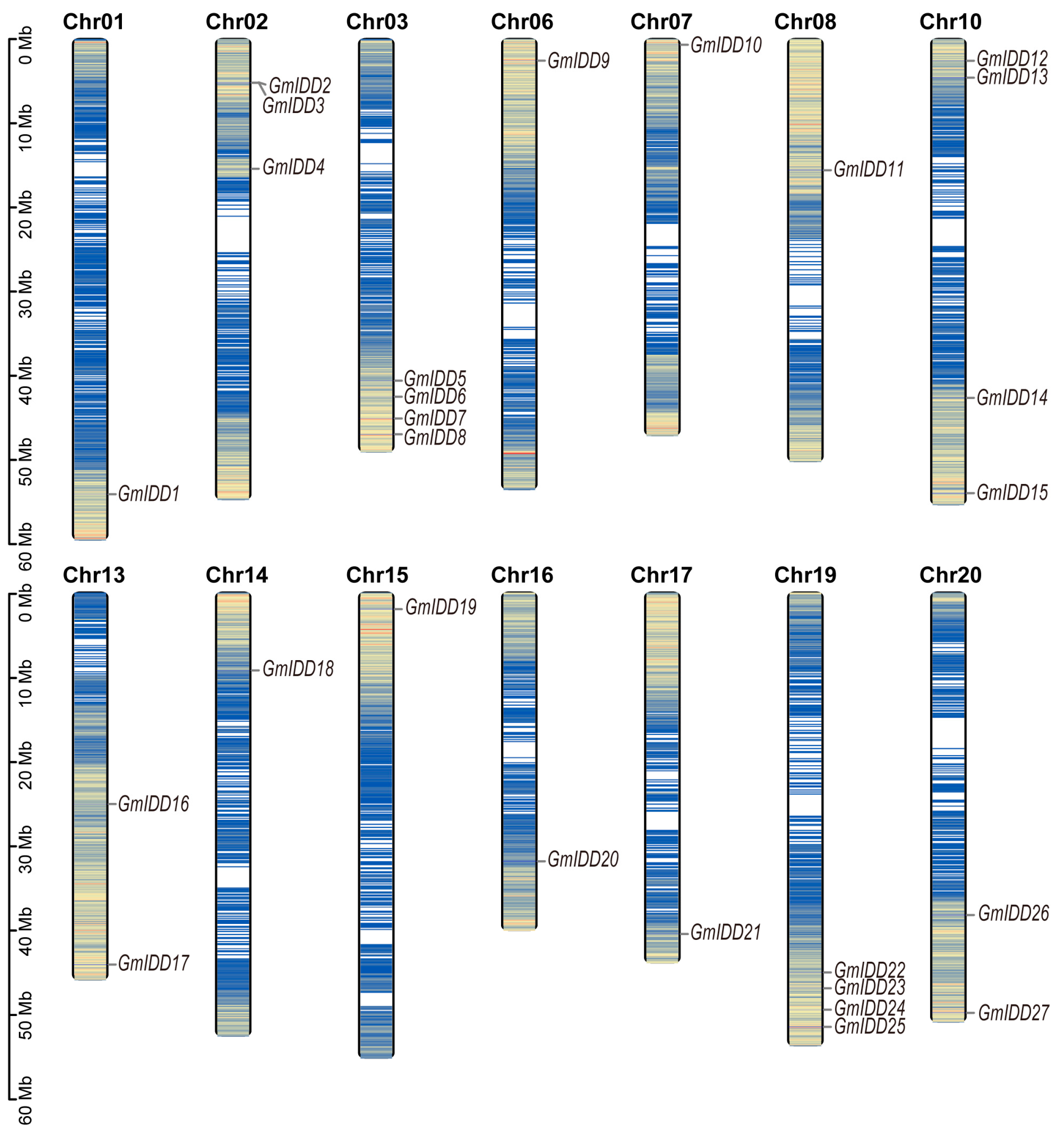
The Hidden Markov Model (HMM) and local BLAST (Basic Local Alignment Search Tool) were combined to systematically identify the members of the soybean IDD gene family. After merging candidates and removing duplicates, we selected the longest transcript for each gene locus. Pseudogenes were excluded. Domain analysis with NCBI Batch CD-Search kept only proteins containing the complete INDETERMINATE (ID) domain (two C2H2 and two C2HC motifs). A total of 27 IDD family genes were finally screened and identified in soybean. To understand the distribution characteristics of the GmIDD genes on the chromosomes, we analyzed the chromosomal location of the GmIDD genes using TBtools. The results showed that the 27 GmIDD genes were unevenly distributed on fourteen chromosomes (Figure 1). These IDD genes were named according to their position on the chromosome, in the order of GmIDD1 to GmIDD27. Chromosomes 03, 10 and 19 each harbored four gene members. Chromosome 02 carried three gene members, while chromosomes 13 and 20 each had two gene members. All remaining chromosomes contained only one gene member. Furthermore, GmIDD2 and GmIDD3 formed a tight gene cluster on chromosome 02 (Figure 1).
The amino acid sequence characteristics of the GmIDD family proteins indicated that the number of amino acids in GmIDD proteins ranged from 408 (GmIDD18) to 571 (GmIDD15), and their molecular weights were between 45.1 and 61.7 kDa. The theoretical isoelectric point (pI) ranged from 7.51 to 9.4. The instability index of GmIDD proteins ranged from 38.72 (GmIDD4) to 61.19 (GmIDD1), and the aliphatic index ranged from 48.78 (GmIDD26) to 71.21 (GmIDD18). The grand average of hydropathicity (GRAVY) values for all GmIDD proteins were negative (Table 1), indicating an overall hydrophilic tendency at the whole-protein level. However, as with many transcription factors, this does not preclude the existence of local hydrophobic regions, which may be essential for structural integrity or DNA binding. Subcellular localization predictions consistently targeted all GmIDD proteins to the nucleus (Table 1), consistent with their predicted function as transcription factors, although experimental validation is still needed to confirm these predictions.

3.2. Gene Structure and Protein Motifs of IDD Genes

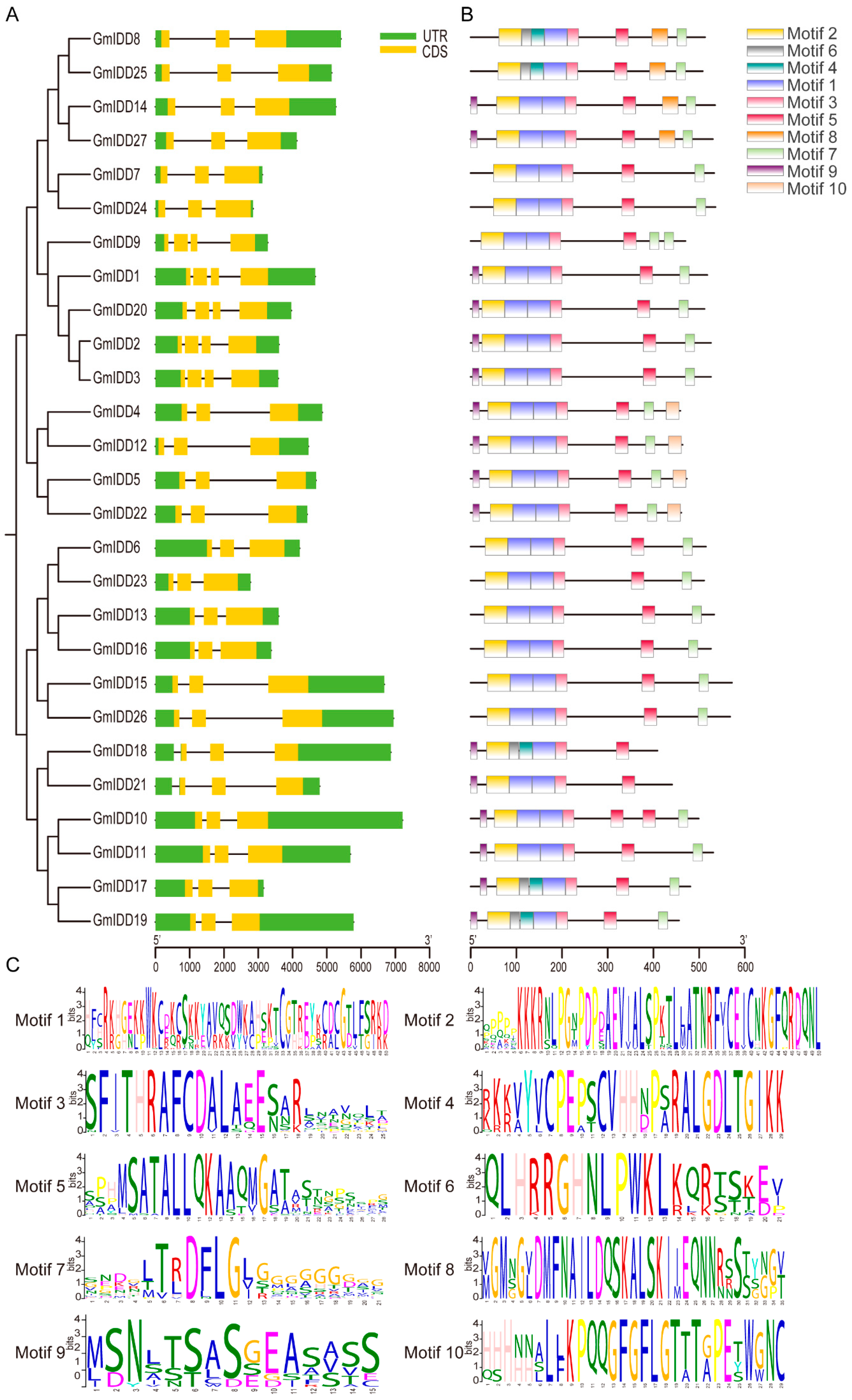
To comprehensively understand the genetic structure, we conducted a detailed analysis of the exon–intron structure of GmIDD genes (Figure 2A). The results showed that GmIDD genes contained 3 or 4 exons and 2 or 3 introns. Among them, GmIDD1/2/3/9/20 contained 4 exons and 3 introns. In addition to the aforementioned genes, the gene structures of all other genes consisted of 3 exons and 2 introns.
To further explore the motif regions of the IDD family proteins, we analyzed the distribution of motifs in the IDD proteins using the MEME website and predicted 10 conserved motifs (Figure 2B). The lengths of the 10 conserved motifs range from 15 to 50 amino acids (Figure 2C). All GmIDD proteins contained Motif 1, Motif 2, Motif 3 and Motif 5, indicating that these motifs were highly conserved within the IDD family. Except for GmIDD18 and GmIDD21, all other GmIDD proteins contained Motif7, and GmIDD9 had two more of them. Motif8 was present in the closely related GmIDD8/14/25/27. Similarly, GmIDD4/5/12/22 specifically contained Motif10 (Figure 2B).
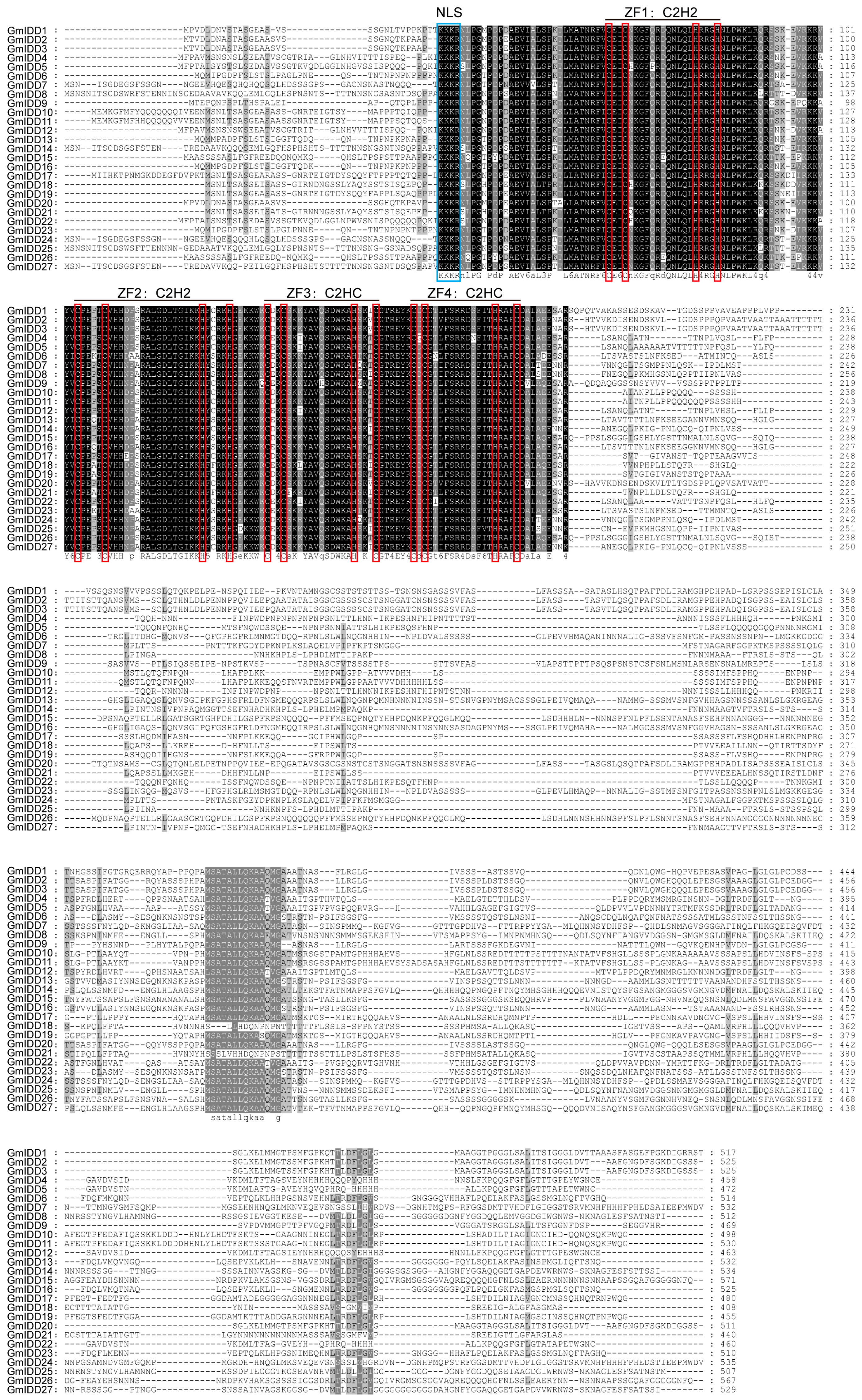
The protein sequences of GmIDD proteins were compared multiple times using Clustal X2.0 (Figure 3), and it was found that the N-terminus of all GmIDD proteins possessed one nuclear localization signal (NLS, KKKR sequence) and a highly conserved ID domain (2 C2H2 and 2 C2HC domains). Sequence alignment further confirmed that Motif 1, Motif 2 and Motif 3 were the major components constituting the conserved ID domain.

3.3. Phylogenetic Analysis of IDD Genes

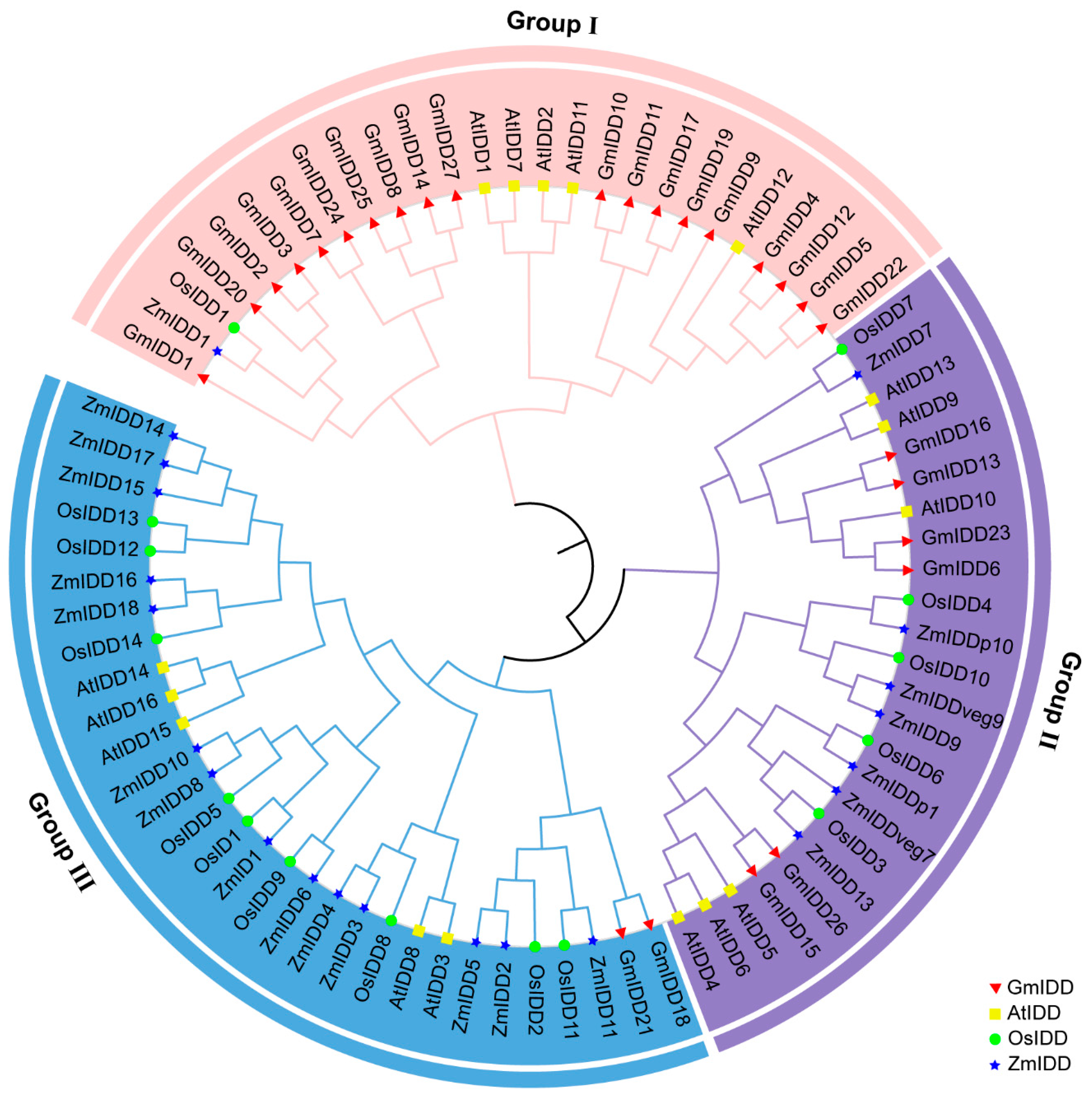
To investigate the phylogenetic relationship of GmIDD family genes, a phylogenetic tree of IDD genes was constructed using Clustal X2.0 sequence alignment and MEGA11 software (Maximum Likelihood method, ML), including four species: soybean (27 members), rice(15 members), Arabidopsis(16 members) and maize (22 members) (Table S3). Based on the results of the phylogenetic tree and referring to the IDD family classification standards of Arabidopsis and rice, the 27 GmIDD proteins were divided into three subgroups: I, II and III (Figure 4). In subgroups I, II and III, there were 2, 19 and 6 members of the GmIDD protein, respectively.
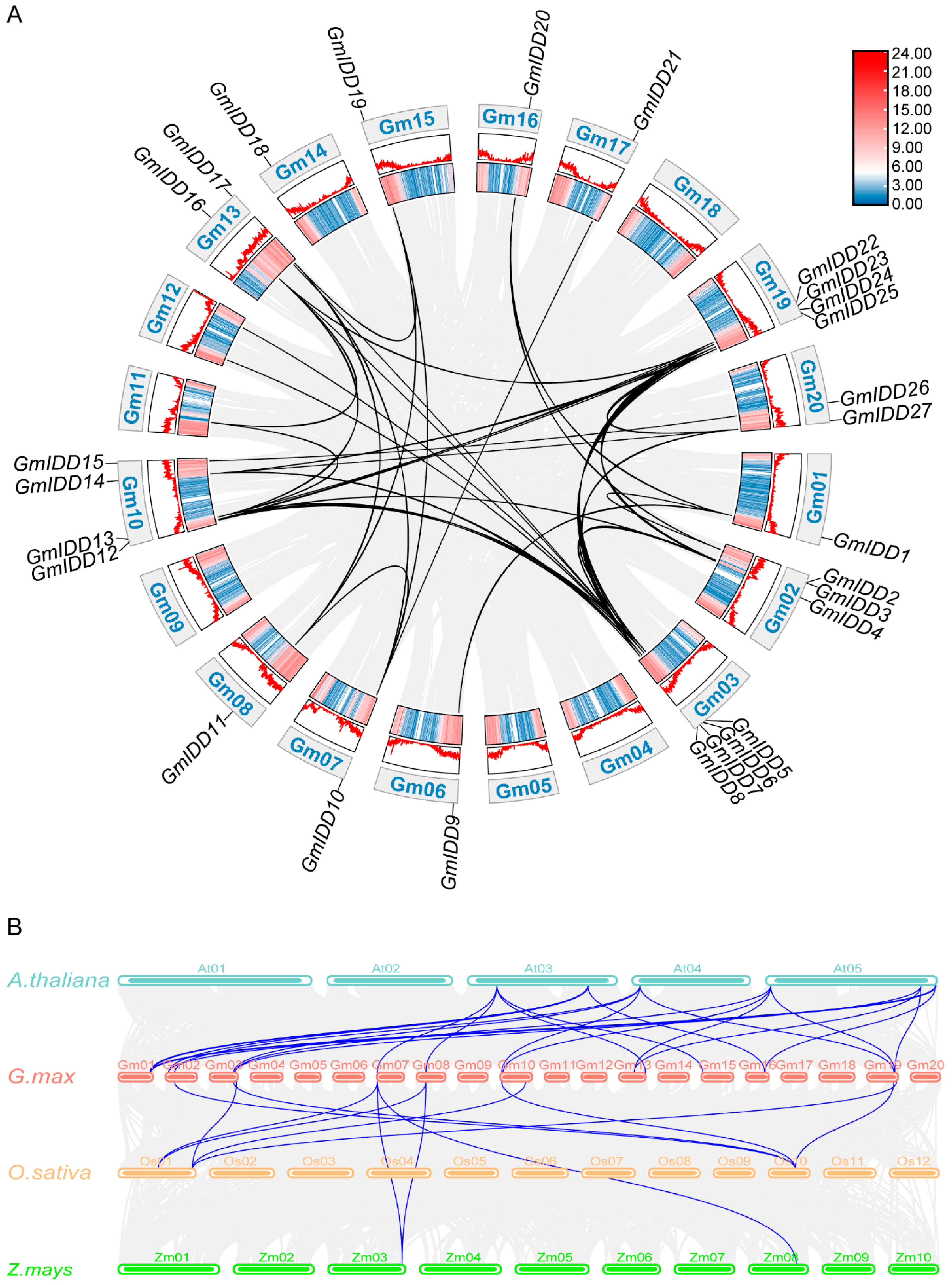
By using MCScanX and MicroSynteny to analyze the duplication relationships of the GmIDD genes, it was found that among the 27 GmIDD genes, there were 35 pairs of segmental duplication gene pairs (Figure 5A). Synteny analysis between soybean and the other three species was used to study the evolutionary relationship of IDD family genes (Figure 5B). The results showed that all the soybean IDD genes had a syntenic relationship with 21 IDD genes in Arabidopsis, 9 IDD genes in rice and 3 IDD genes in maize. This indicated that the IDD gene family in soybeans has a higher degree of homology with the IDD gene family in Arabidopsis, and this result was consistent with the results of the constructed evolutionary tree.

3.4. Distribution of Cis-Acting Elements on the Promoter of GmIDD Genes

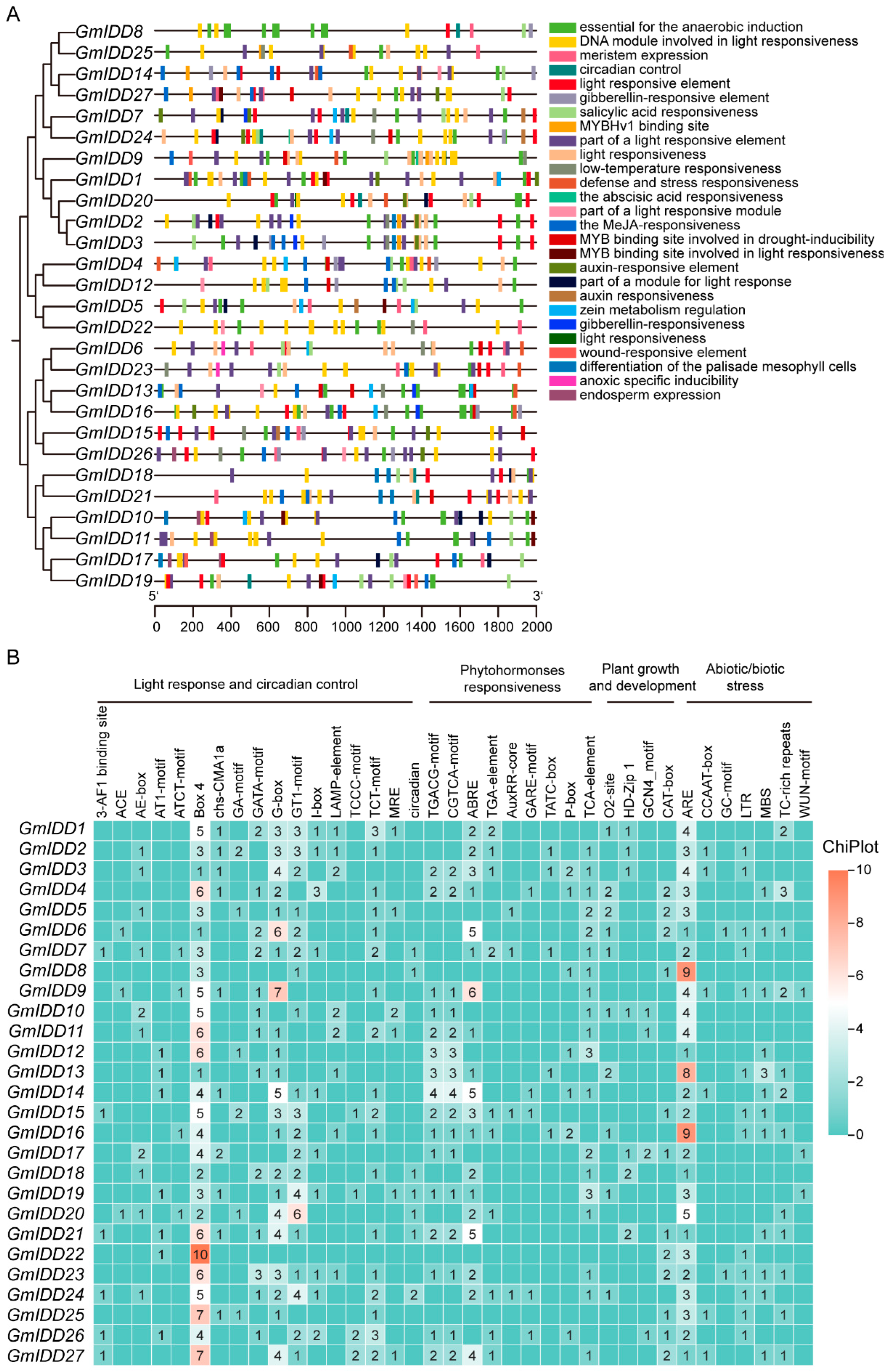
To investigate the cis-acting elements in the promoter of GmIDD genes, the sequence approximately 2000 bp upstream of the translation initiation site was analyzed. After excluding core promoter components such as CAAT-box and TATA-box, the remaining cis-acting elements were classified into four functional groups (Figure 6A,B). The first category was related to abiotic/biotic stress, including drought (MBS, CCAAT-box), low temperature (LTR), anaerobic induction (ARE), wound response (WUN-motif), hypoxia induction (GC-motif), and defense and stress response (TC-rich repeats). The second category was related to plant growth and development elements, including regulatory elements involved in zein metabolism regulation (O2-site), endosperm expression (GCN4-motif), differentiation of palisade mesophyll cells (HD-ZIP1) and meristem expression (CAT-box). The third category encompasses elements linked to phytohormones, such as gibberellins (GARE-motif, P-box, TATC-box), auxins (AuxRR-core, TGA-element), abolic acid (ABRE), salicylic acid (TCA-element) and methyl jasmonate (TGACG-motif, CGTCA-motif). The fourth functional cluster comprised light-responsive and circadian control elements. Among the various components, the number of light-response components ranked first. This suggested that these genes might respond to changes in light intensity or photoperiod, or be involved in photomorphogenesis. In particular, the promoter regions of all GmIDD genes contained 1 to 10 copies of Box4, GmIDD3 contained 1, and GmIDD22 contained 10.

3.5. Expression Pattern Analysis of GmIDDs Under Drought and Salt Stress Treatments

When the first trifoliate leaf of soybean seedlings was fully expanded, the seedlings were subjected to drought (20% PEG-6000) and salt (150 mmol/L NaCl) stress treatments. Leaf samples were collected at 0, 1, 3, 6 and 12 h after the initiation of treatment. Expression differences in GmIDDs under drought and salt treatments were analyzed by qRT-PCR. The results indicated that there were certain differences in the expression patterns of each gene under different treatments.
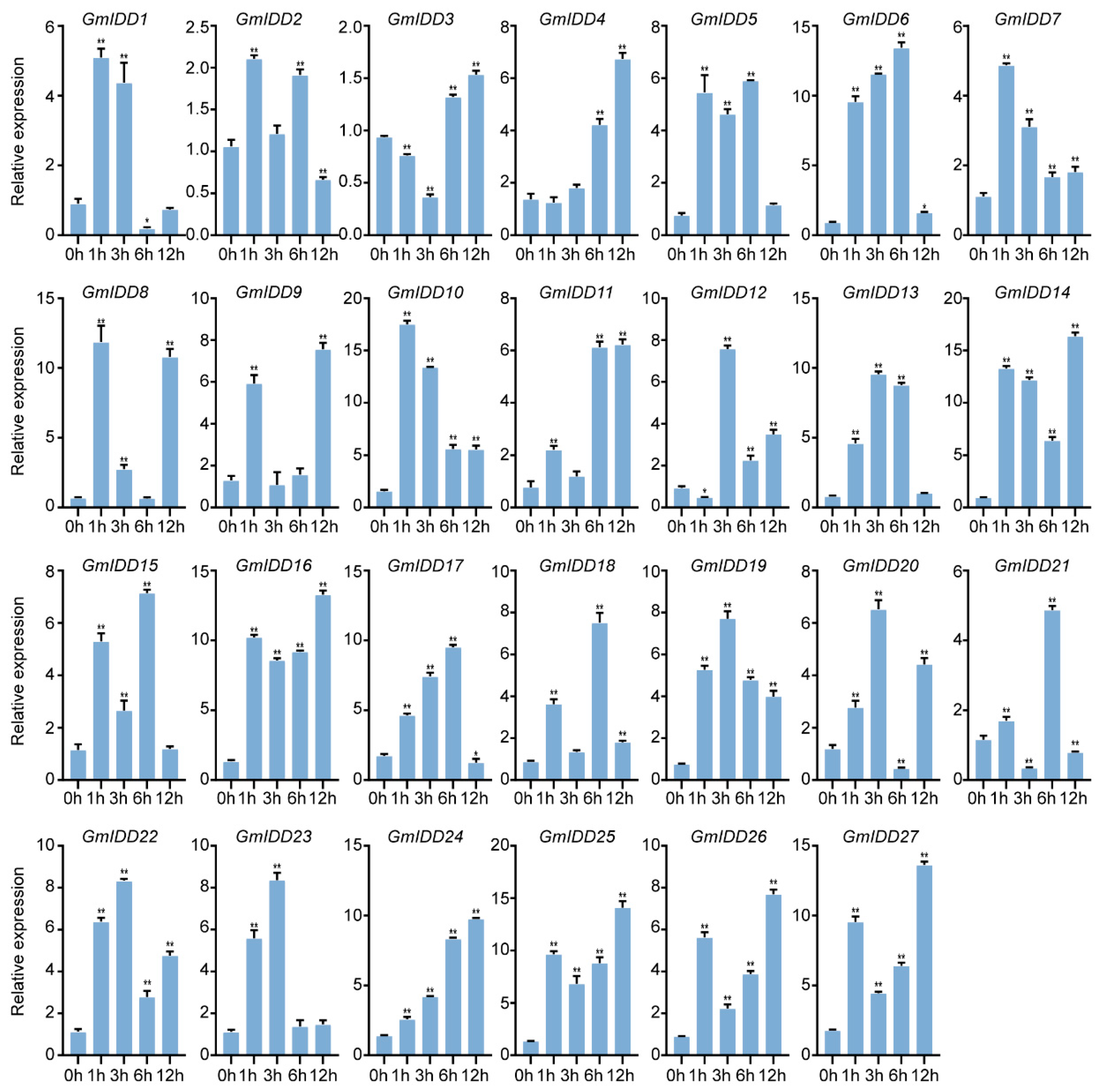
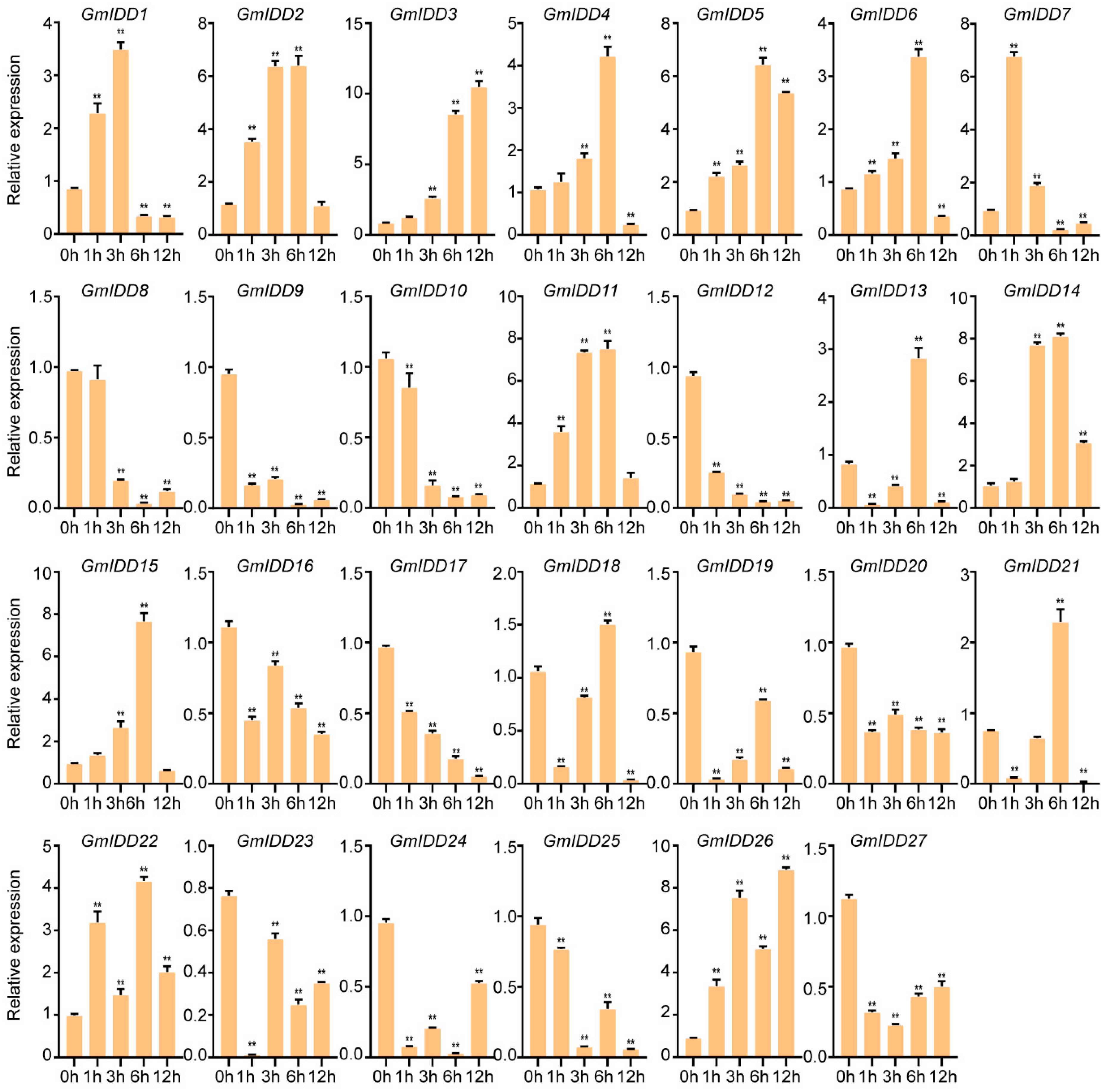
Under salt stress (150 mM NaCl), the expression levels of GmIDD3/5/14/22/26 were upregulated throughout the treatment period. GmIDD2 and GmIDD11 showed progressive upregulation from 1 to 6 h, and then dropped back to the original level at 12 h. In contrast, GmIDD8/9/10/12/16/17/19/20/23/24/25/27 were obviously downregulated during treatment. Several genes exhibited a biphasic expression pattern: GmIDD1 and GmIDD7 were downregulated early during treatment (1–3 h) and then significantly upregulated at 6–12 h. GmIDD4/6/15 reached their peak expression at 6 h after treatment, followed by a slight decline at 12 h. GmIDD13/18/21 showed a transient upregulation only at 6 h post-treatment, while their expression remained significantly downregulated at other time points (Figure 7).
Under drought stress, the expression levels of twelve GmIDD genes (GmIDD4/6/7/10/14/16/19/22/24/25/26/27) were upregulated throughout the treatment period. GmIDD5/13/15/17 exhibited an initial upregulation at 1 to 6 h followed by a decline at 12 h. GmIDD1 and GmIDD23 showed transient induction, reaching peak expression at 1 h or 3 h and then declining during 6 to 12 h. GmIDD3 and GmIDD12 showed a trend of first decreasing temporarily and then increasing. Five genes (GmIDD2/8/9/20/21) exhibited irregular fluctuations (Figure 8).

3.6. Expression Pattern Analysis of GmIDDs Under Different Photoperiod Conditions

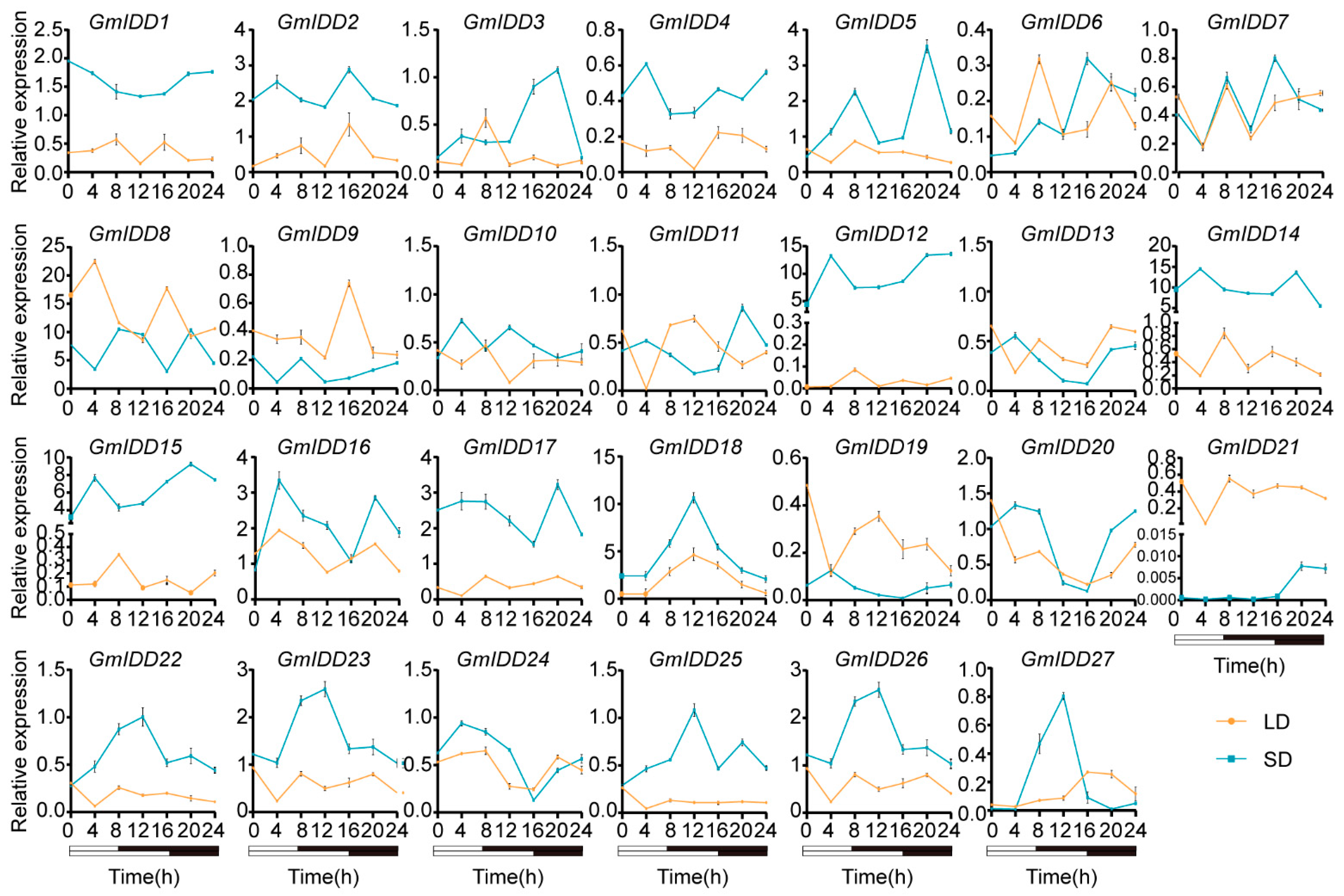
To investigate the photoperiodic responsiveness of the GmIDD gene family, we analyzed their expression patterns under long-day (16/8 h light/dark) conditions (LDs) and short-day (8/16 h light/dark) conditions (SDs) at seven time points (0, 4, 8, 12, 16, 20 and 24 h). The results showed that the expression levels of GmIDD1/2/4/12/14/15/17/18/22/23/25/26 were consistently higher under SDs than under LDs at all time points. In addition, GmIDD3 and GmIDD16 exhibited lower expression under SDs than under LDs at 8 h and 16 h, respectively, while their expression levels were higher under SDs than under LDs at the other time points. Therefore, the aforementioned 14 genes were induced by SDs in soybean leaves. Conversely, GmIDD9 and GmIDD21 displayed consistently higher expression under LDs than under SDs at all time points. GmIDD13 and GmIDD19 showed lower expression under LDs than under SDs at 4 h, but higher expression at all other time points, suggesting that GmIDD9/13/19/21 genes were induced by LDs (Figure 9).

4. Discussion

Soybean is one of the world’s most vital oil and protein crops, and its growth, development and environmental adaptability directly govern yield stability. The INDETERMINATE DOMAIN (IDD) gene family represents a class of plant-specific C2H2-type zinc finger transcription factors, and has been shown to participate in multiple critical biological processes including growth and development regulation, hormone signal transduction, and abiotic stress responses in species such as Arabidopsis, rice and maize. However, systematic characterization and functions of the IDD family in soybean are still absent. In this study, a total of 27 GmIDD members were identified at the genome-wide level in soybean, and comprehensive analyses were performed on their phylogenetic evolution, conserved motifs, and cis-acting elements within promoters, as well as expression patterns under diverse photoperiodic conditions and abiotic stresses. These findings lay a solid foundation for further elucidating the biological functions and molecular regulatory networks of GmIDD genes in soybean.
The members of the IDD gene family in soybean are unevenly distributed across chromosomes (Figure 1). Most of these members contain 3–4 exons, and the N-terminus of their encoded proteins all possess one nuclear localization signal (NLS, KKKR sequence) and a highly conserved ID domain (2 C2H2 and 2 C2HC domains) (Figure 2 and Figure 3). This structural feature is highly consistent with that of IDD proteins in species including Arabidopsis, rice and maize [2,40]. Phylogenetic analysis revealed that the 27 GmIDD proteins could be classified into three subgroups (I, II, III), with subgroup II harboring the largest number of members (19) (Figure 4). Synteny analysis of GmIDD genes against their orthologs in Arabidopsis, rice and maize demonstrated that soybean IDD genes shared a closer homologous relationship with those in Arabidopsis, suggesting a degree of evolutionary relatedness between the two lineages (Figure 5). This finding also reflects the evolutionary divergence in the IDD gene family between soybean, a representative leguminous species, and monocotyledonous Poaceae crops. Cis-acting element analysis revealed that the promoter regions of GmIDD genes are enriched with light-responsive elements (Box4), hormone-responsive elements (ABRE, AuxRR-core, GARE-motif), and abiotic stress-responsive elements (MBS, LTR) (Figure 6). Their cis-acting element distribution pattern is similar to that of AtIDD gene promoters in Arabidopsis [41], implying that soybean IDD may integrate light, hormone, and stress signals to participate in the regulation of complex physiological processes.
Abiotic stress represents a major environmental factor constraining soybean yield, and IDD proteins serve as key regulators in plant stress adaptation [17,18]. In this study, expression analysis under abiotic stress conditions further delineated the potential roles of GmIDD genes in plant stress adaptation. The expression levels of GmIDD3/5/14/22/26 were upregulated, whereas those of GmIDD8/9/10/12/16/17/19/20/23/24/25/27 were downregulated under salt treatment (150 mM NaCI) (Figure 7), suggesting that distinct GmIDD genes may be differentially involved in the salt stress response. Similar patterns of functional divergence have also been observed in the IDD gene families of both Arabidopsis and maize. In Arabidopsis, AtIDD4 is induced under salt stress and acts as a negative regulator to exacerbate the salt-sensitive phenotype, while AtIDD14 potentially mediates a positive regulatory role via the ABA signaling pathway [18,42]. In maize, ZmIDD8 is transcriptionally upregulated under salt stress to positively regulate salt tolerance, whereas ZmIDD5 is downregulated to negatively modulate the salt stress response, thus exhibiting a distinct pattern of functional divergence [7]. Under drought treatment, we used 20% PEG-6000 in hydroponic culture, which is an osmotic stress model widely used for the initial screening of stress-responsive genes. However, it does not fully represent field drought. Field drought involves gradual soil water depletion, root hydraulic changes, and integrated hormonal responses. The expression levels of twelve GmIDD genes (GmIDD4/6/7/10/14/16/19/22/24/25/26/27) were upregulated during the treatment (Figure 8). Cis-acting element analysis revealed that the numbers of both MBS (drought-responsive elements) and ABRE (ABA-responsive elements) were significantly enriched in the promoters of seven upregulated GmIDD genes (GmIDD4/6/13/14/15/16/24/27) (Figure 6). Previous studies have demonstrated that AtIDD14 regulates ABA-mediated drought tolerance by interacting with ABF1-4 in Arabidopsis [18]. Similarly, ZmIDD8 and ZmIDD21 integrate ABA signaling via ABA-responsive elements to modulate drought resistance in maize [7]. Based on the enrichment of ABRE elements in their promoters and their transcriptional responses to drought stress, it is plausible that these seven GmIDD genes may be involved in ABA-mediated drought response pathways. However, this speculation requires further experimental validation. Therefore, future research should conduct soil drought experiments to verify whether the candidate GmIDD genes have practical significance under agriculturally relevant conditions.
Photoperiod is a key environmental factor regulating flowering and yield formation in soybean, and IDD genes have been demonstrated to be involved in photoperiod-mediated flowering regulation in Arabidopsis and rice [11,13]. This study found that all GmIDD gene promoters contain multiple light-responsive elements (such as Box4 and G-box) (Figure 6), raising the possibility that genes of this family may be involved in the light signaling regulatory network. Furthermore, under different photoperiod conditions, the expression of some GmIDD genes showed photoperiod-dependent expression patterns. The expression levels of genes including GmIDD1/2/3/4/12/14/15/16/17/18/22/23/25/26 were significantly upregulated under short-day conditions (SDs), whereas GmIDD9/13/19/21 exhibited increased expression under long-day conditions (LDs) (Figure 9). In Arabidopsis, AtIDD8 binds to the promoter of SUS4 to regulate sucrose metabolism, thus modulating photoperiodic flowering [13]. In rice, OsID1 acts as a key regulator of flowering and directly activates florigen genes such as Hd3A and RFT1 [11]. The photoperiod-responsive GmIDD genes identified in this study provide candidate targets for further elucidating the photoperiod-regulated flowering pathway in soybean. Whether they function through sucrose metabolism or flower-inducing hormone regulatory pathways, as reported for their Arabidopsis and rice counterparts, remains to be determined experimentally.

Supplementary Materials

The following supporting information can be downloaded at: https://www.mdpi.com/article/10.3390/genes17040489/s1, Table S1: Correspondence of provisional GmIDD gene names with official locus identifiers, chromosomal coordinates, and their closest Arabidopsis thaliana IDD orthologs; Table S2: The specific sequences of the primers; Table S3: Summary of the IDD gene members in Arabidopsis thaliana, Oryza sativa and Zea mays.

Author Contributions

Conceptualization, X.Y. and Y.S.; Methodology, Z.D.; Software, R.L. and Z.N.; Validation, X.C. and Q.H.; Formal Analysis, R.L. and Z.D.; Investigation, X.Y. and Y.S.; Resources, Y.S.; Data Curation, R.L., Z.N., J.X. and Z.D.; Writing—Original Draft Preparation, R.L. and Z.N.; Writing—Review and Editing, X.Y. and Y.S.; Visualization, C.S. and S.C.; Supervision, X.Y. and Y.S.; Project Administration, X.Y. and Y.S. All authors have read and agreed to the published version of the manuscript.

Funding

This research was funded by the Key Project of Anhui Provincial Education Department (2023AH051879), the Major Project of Natural Science Research of Anhui Provincial Education Department (2023AH040279, 2022AH040239), the Talent Introduction Start up Fund Project of Anhui Science and Technology University (NXYJ202201), the Open Research Fund of Anhui Province Key Laboratory of Functional Agriculture and Functional Food (iFAST-2025-4), the Open Research Fund of Anhui Provincial Key Laboratory of Crop Quality Improvement (2024ZW01), the Program on Industrial Technology System of National Soybean (CARS-04), the Program on Industrial Technology System of Anhui Soybean (Anhui Agricultural Science Letter [2025] No. 468) and the National Innovation and Entrepreneurship Training Program for College Students (202410879063, 202510879033).

Institutional Review Board Statement

Not applicable.

Informed Consent Statement

Not applicable.

Data Availability Statement

All data analyzed during this study are included in the Supplementary Information Files.

Conflicts of Interest

The authors declare that they have no known competing financial interests or personal relationships that could have appeared to influence the work reported in this paper.

References

  1. Matsubara, K.; Yamanouchi, U.; Wang, Z.X.; Minobe, Y.; Izawa, T.; Yano, M. Ehd2, a rice ortholog of the maize INDETERMINATE1 gene, promotes flowering by up-regulating Ehd1. Plant Physiol. 2008, 148, 1425–1435. [Google Scholar] [CrossRef] [PubMed]
  2. Colasanti, J.; Tremblay, R.; Wong, A.Y.; Coneva, V.; Kozaki, A.; Mable, B.K. The maize INDETERMINATE1 flowering time regulator defines a highly conserved zinc finger protein family in higher plants. BMC Genom. 2006, 7, 158. [Google Scholar] [CrossRef]
  3. Colasanti, J.; Yuan, Z.; Sundaresan, V. The indeterminate gene encodes a zinc finger protein and regulates a leaf-generated signal required for the transition to flowering in maize. Cell 1998, 93, 593–603. [Google Scholar] [CrossRef]
  4. Kumar, M.; Le, D.T.; Hwang, S.; Seo, P.J.; Kim, H.U. Role of the INDETERMINATE DOMAIN genes in plants. Int. J. Mol. Sci. 2019, 20, 2286. [Google Scholar] [CrossRef]
  5. Coelho, C.P.; Huang, P.; Lee, D.Y.; Brutnell, T.P. Making roots, shoots, and seeds: IDD gene family diversification in plants. Trends Plant Sci. 2018, 23, 66–78. [Google Scholar] [CrossRef]
  6. Zhang, T.; Tan, M.; Geng, L.; Li, J.; Xiang, Y.; Zhang, B.; Zhao, Y. New insight into comprehensive analysis of INDETERMINATE DOMAIN (IDD) gene family in rice. Plant Physiol. Biochem. 2020, 154, 547–556. [Google Scholar] [CrossRef] [PubMed]
  7. Feng, X.; Yu, Q.; Zeng, J.; He, X.; Ma, W.; Ge, L.; Liu, W. Comprehensive Analysis of the INDETERMINATE DOMAIN (IDD) Gene Family and Their Response to Abiotic Stress in Zea mays. Int. J. Mol. Sci. 2023, 24, 6185. [Google Scholar] [CrossRef]
  8. Kozaki, A.; Hake, S.; Colasanti, J. The maize ID1 flowering time regulator is a zinc finger protein with novel DNA binding properties. Nucleic Acids Res. 2004, 32, 1710–1720. [Google Scholar] [CrossRef]
  9. Meng, X.; Muszynski, M.G.; Danilevskaya, O.N. The FT-like ZCN8 gene functions as afloral activator and is involved in photoperiod sensitivity in maize. Plant Cell 2011, 23, 942–960. [Google Scholar] [CrossRef]
  10. Park, S.J.; Kim, S.L.; Lee, S.; Je, B.I.; Piao, H.L.; Park, S.H.; Kim, C.M.; Ryu, C.H.; Park, S.H.; Xuan, Y.H.; et al. Rice Indeterminate 1 (OsId1) is necessary for the expression of Ehd1 (Early heading date 1) regardless of photoperiod. Plant J. 2008, 56, 1018–1029. [Google Scholar] [CrossRef] [PubMed]
  11. Wu, C.; You, C.; Li, C.; Long, T.; Chen, G.; Byrne, M.E.; Zhang, Q. RID1, encoding a Cys2/His2-type zinc finger transcription factor, acts as a master switch from vegetative to floral development in rice. Proc. Natl. Acad. Sci. USA 2008, 105, 12915–12920. [Google Scholar] [CrossRef] [PubMed]
  12. Deng, L.; Li, L.; Zhang, S.; Shen, J.; Li, S.; Hu, S.; Peng, Q.; Xiao, J.; Wu, C. Suppressor of rid1 (SID1) shares common targets with RID1 on florigen genes to initiate floral transition in rice. PLoS Genet. 2017, 13, e1006642. [Google Scholar] [CrossRef] [PubMed]
  13. Seo, P.J.; Ryu, J.; Kang, S.K.; Park, C.M. Modulation of sugar metabolism by an INDETERMINATE DOMAIN transcription factor contributes to photoperiodic flowering in Arabidopsis. Plant J. 2011, 65, 418–429. [Google Scholar] [CrossRef]
  14. Jeong, E.Y.; Seo, P.J.; Woo, J.C.; Park, C.M. AKIN10 delays flowering by inactivating IDD8 transcription factor through protein phosphorylation in Arabidopsis. BMC Plant Biol. 2015, 15, 110. [Google Scholar] [CrossRef]
  15. Seo, P.J.; Kim, M.J.; Ryu, J.Y.; Jeong, E.Y.; Park, C.M. Two splice variants of the IDD14 transcription factor competitively form nonfunctional heterodimers which may regulate starch metabolism. Nat. Commun. 2011, 2, 303. [Google Scholar] [CrossRef]
  16. Kim, J.Y.; Ryu, J.Y.; Baek, K.; Park, C.M. High temperature attenuates the gravitropism of inflorescence stems by inducing SHOOT GRAVITROPISM 5 alternative splicing in Arabidopsis. New Phytol. 2016, 209, 265–279. [Google Scholar] [CrossRef]
  17. Dou, M.; Cheng, S.; Zhao, B.; Xuan, Y.; Shao, M. The indeterminate domain protein ROC1 regulates chilling tolerance via activation of DREB1B/CBF1 in rice. Int. J. Mol. Sci. 2016, 17, 233. [Google Scholar] [CrossRef] [PubMed]
  18. Liu, J.; Shu, D.; Tan, Z.; Ma, M.; Guo, N.; Gao, S.; Duan, G.; Kuai, B.; Hu, Y.; Li, S.; et al. The Arabidopsis IDD14 transcription factor interacts with bZIP-type ABFs/AREBs and cooperatively regulates ABA-mediated drought tolerance. New Phytol. 2022, 236, 929–942. [Google Scholar] [CrossRef]
  19. Jung, J.H.; Li, Z.; Chen, H.; Yang, S.; Li, D.; Priatama, R.A.; Kumar, V.; Xuan, Y.H. Mutation of phytochrome B promotes resistance to sheath blight and saline–alkaline stress via increasing ammonium uptake in rice. Plant J. 2023, 113, 277–290. [Google Scholar] [CrossRef]
  20. Morita, M.T.; Sakaguchi, K.; Kiyose, S.; Taira, K.; Kato, T.; Nakamura, M.; Tasaka, M. A C2H2-type zinc finger protein, SGR5, is involved in early events of gravitropism in Arabidopsis inflorescence stems. Plant J. 2006, 47, 619–628. [Google Scholar] [CrossRef] [PubMed]
  21. Tanimoto, M.; Tremblay, R.; Colasanti, J. Altered gravitropic response, amyloplast sedimentation and circumnutation in the Arabidopsis shoot gravitropism 5 mutant are associated with reduced starch levels. Plant Mol. Biol. 2008, 67, 57–69. [Google Scholar] [CrossRef] [PubMed]
  22. Cui, D.; Zhao, J.; Jing, Y.; Fan, M.; Liu, J.; Wang, Z.; Xin, W.; Hu, Y. The Arabidopsis IDD14, IDD15, and IDD16 cooperatively regulate lateral organ morphogenesis and gravitropism by promoting auxin biosynthesis and transport. PLoS Genet. 2013, 9, e1003759. [Google Scholar] [CrossRef] [PubMed]
  23. Wu, X.; Tang, D.; Li, M.; Wang, K.; Cheng, Z. Loose plant Architecture1, an INDETERMINATE DOMAIN protein involved in shoot gravitropism, regulates plant architecture in rice. Plant Physiol. 2013, 161, 317–329. [Google Scholar] [CrossRef] [PubMed]
  24. Yoshida, H.; Hirano, K.; Sato, T.; Mitsuda, N.; Nomoto, M.; Maeo, K.; Koketsu, E.; Mitani, R.; Kawamura, M.; Ishiguro, S.; et al. DELLA protein functions as a transcriptional activator through the DNA binding of the indeterminate domain family proteins. Proc. Natl. Acad. Sci. USA 2014, 111, 7861–7866. [Google Scholar] [CrossRef]
  25. Fukazawa, J.; Teramura, H.; Murakoshi, S.; Nasuno, K.; Nishida, N.; Ito, T.; Yoshida, M.; Kamiya, Y.; Yamaguchi, S.; Takahashi, Y. DELLAs function as coactivators of GAI-ASSOCIATED FACTOR1 in regulation of gibberellin homeostasis and signaling in Arabidopsis. Plant Cell 2014, 26, 2920–2938. [Google Scholar] [CrossRef]
  26. Fukazawa, J.; Miyamoto, C.; Ando, H.; Mori, K.; Takahashi, Y. DELLA-GAF1 complex is involved in tissue-specific expression and gibberellin feedback regulation of GA20ox1 in Arabidopsis. Plant Mol. Biol. 2021, 107, 147–158. [Google Scholar] [CrossRef]
  27. Fukazawa, J.; Ito, T.; Kamiya, Y.; Yamaguchi, S.; Takahashi, Y. Binding of GID1 to DELLAs promotes dissociation of GAF1 from DELLA in GA dependent manner. Plant Signal. Behav. 2015, 10, e1052923. [Google Scholar] [CrossRef]
  28. Fukazawa, J.; Mori, M.; Watanabe, S.; Miyamoto, C.; Ito, T.; Takahashi, Y. DELLA-GAF1 complex is a main component in gibberellin feedback regulation of GA20 oxidase 2. Plant Physiol. 2017, 175, 1395–1406. [Google Scholar] [CrossRef]
  29. Sun, Q.; Li, D.D.; Chu, J.; Yuan, P.; Li, S.; Zhong, L.J.; Han, X.; Xuan, Y.H. Indeterminate domain proteins regulate rice defense to sheath blight disease. Rice 2020, 13, 15. [Google Scholar] [CrossRef]
  30. Wang, S.T.; Guo, X.F.; Yao, T.S.; Xuan, Y.H. Indeterminate domain 3 negatively regulates plant erectness and the resistance of rice to sheath blight by controlling PIN-FORMED gene expressions. Plant Signal. Behav. 2020, 15, 1809847. [Google Scholar] [CrossRef]
  31. Sun, Q.; Yang, S.; Guo, X.F.; Wang, S.T.; Jia, X.T. RAVL1 activates IDD3 to negatively regulate rice resistance to sheath blight disease. Rice Sci. 2021, 28, 146–155. [Google Scholar] [CrossRef]
  32. Fang, C.; Du, H.; Wang, L.; Liu, B.; Kong, F. Mechanisms underlying key agronomic traits and implications for molecular breeding in soybean. J. Genet. Genom. 2024, 51, 379–393. [Google Scholar] [CrossRef]
  33. Yang, X.; Zhang, Y.; Shan, J.; Sun, J.; Li, D.; Zhang, X.; Li, W.; Zhao, L. GmIDD Is Induced by Short Days in Soybean and May Accelerate Flowering When Overexpressed in Arabidopsis via Inhibiting AGAMOUS-LIKE 18. Front. Plant Sci. 2021, 12, 629069. [Google Scholar] [CrossRef] [PubMed]
  34. Potter, S.C.; Luciani, A.; Eddy, S.R.; Park, Y.; Lopez, R.; Finn, R.D. HMMER web server: 2018 update. Nucleic Acids Res. 2018, 46, W200–W204. [Google Scholar] [CrossRef] [PubMed]
  35. Chen, C.; Chen, H.; Zhang, Y.; Thomas, H.R.; Frank, M.H.; He, Y.; Xia, R. TBtools: An Integrative Toolkit Developed for Interactive Analyses of Big Biological Data. Mol. Plant 2020, 13, 1194–1202. [Google Scholar] [CrossRef]
  36. Zhao, L.; Wang, Z.; Lu, Q.; Wang, P.; Li, Y.; Lv, Q.; Song, X.; Li, D.; Gu, Y.; Liu, L.; et al. Overexpression of a GmGBP1 ortholog of soybean enhances the responses to flowering, stem elongation and heat tolerance in transgenic tobaccos. Plant Mol. Biol. 2013, 82, 279–299. [Google Scholar] [CrossRef]
  37. Fang, X.; Ma, J.; Guo, F.; Qi, D.; Zhao, M.; Zhang, C.; Wang, L.; Song, B.; Liu, S.; He, S.; et al. The AP2/ERF GmERF113 Positively Regulates the Drought Response by Activating GmPR10-1 in Soybean. Int. J. Mol. Sci. 2022, 23, 8159. [Google Scholar] [CrossRef]
  38. Zhao, X.; Wang, J.; Xia, N.; Qu, Y.; Zhan, Y.; Teng, W.; Li, H.; Li, W.; Li, Y.; Zhao, X.; et al. Genome-wide identification and analysis of glyceraldehyde-3-phosphate dehydrogenase family reveals the role of GmGAPDH14 to improve salt tolerance in soybean (Glycine max L.). Front. Plant Sci. 2023, 14, 1193044. [Google Scholar] [CrossRef]
  39. Sun, J.; Wang, M.; Zhao, C.; Liu, T.; Liu, Z.; Fan, Y.; Xue, Y.; Li, W.; Zhang, X.; Zhao, L. GmFULc Is Induced by Short Days in Soybean and May Accelerate Flowering in Transgenic Arabidopsis thaliana. Int. J. Mol. Sci. 2021, 22, 10333. [Google Scholar] [CrossRef] [PubMed]
  40. Guo, X.; Zhou, M.; Chen, J.; Shao, M.; Zou, L.; Ying, Y.; Liu, S. Genome-Wide Identification of the Highly Conserved INDETERMINATE DOMAIN (IDD) Zinc Finger Gene Family in Moso Bamboo (Phyllostachys edulis). Int. J. Mol. Sci. 2022, 23, 13952. [Google Scholar] [CrossRef]
  41. Qi, S.L.; Lin, Q.F.; Feng, X.J.; Han, H.L.; Liu, J.; Zhang, L. IDD16 negatively regulates stomatal initiation via trans-repression of SPCH in Arabidopsis. Plant Biotechnol. J. 2019, 17, 1446–1457. [Google Scholar] [CrossRef] [PubMed]
  42. Rawat, A.; Völz, R.; Sheikh, A.; Mariappan, K.G.; Kim, S.K.; Rayapuram, N.; Alwutayd, K.M.; Alidrissi, L.K.; Benhamed, M.; Blilou, I.; et al. Salinity stress-induced phosphorylation of INDETERMINATE-DOMAIN 4 (IDD4) by MPK6 regulates plant growth adaptation in Arabidopsis. Front. Plant Sci. 2023, 14, 1265687. [Google Scholar] [CrossRef] [PubMed]
Figure 1. Chromosomal distribution of IDD family genes in soybean. The scale bars on the left indicate the length (Mb) of the chromosomes. The blue lines refer to low gene density, and the red lines refer to high gene density. The yellow and orange lines represent intermediate gene density levels (yellow: medium-low; orange: medium-high), and the white background indicates regions with no gene density data or intergenic spaces.
Genes 17 00489 g001
Figure 2. Conserved motifs and gene structure of 27 IDD family members in soybean. (A) Exon/intron structures of GmIDD genes. UTR, untranslated region; CDS, coding sequence. (B) Conserved motifs of GmIDD proteins. (C) The sequence logo conserved motif of GmIDD proteins. The letters represent amino acid residues, and their heights indicate the relative conservation level at each position.
Genes 17 00489 g002
Figure 3. Alignment of INDETERMINATE (ID) domain conserved amino acid sequence in soybean. The blue boxes indicate nuclear localization signal region (NLS). The red boxes indicate zinc finger domains (C, H residues). Black, homology 100%; dark grey, homology ≥75%; light grey, homology ≥50%.
Genes 17 00489 g003
Figure 4. Phylogenetic tree of IDD family proteins from soybean (Gm), Arabidopsis (At), rice (Os) and maize (Zm).
Genes 17 00489 g004
Figure 5. Collinearity analysis within and between species of IDD family genes in soybean. (A) Collinearity analysis of IDD family genes in soybean. Gray lines indicate all synteny blocks in the soybean genome. The genes linked by black lines represent homologues. (B) Collinearity analysis between IDD genes in soybean (G. max), Arabidopsis (A. thaliana), rice (O. sativa) and maize (Z. mays). The gray line represented all genes with synteny between the two species, and the blue lines highlight syntenic IDD gene pairs.
Genes 17 00489 g005
Figure 6. Analysis of cis-acting elements of IDD family promoters in soybean. (A) Predicted cis-acting elements in GmIDD promoters. The bottom scale indicates the direction and length of the sequence. (B) The types and numbers of cis-acting elements in the promoter of the GmIDD genes.
Genes 17 00489 g006
Figure 7. Expression pattern analysis of the GmIDD genes under salt (150 mmol/L NaCl) stress. Values are presented as means ± SD (n = 3). The asterisks on the top of the columns indicate significant differences from the value at 0 h (** p < 0.01, Student’s t-test).
Genes 17 00489 g007
Figure 8. Expression pattern analysis of the GmIDD genes under drought (20% PEG-6000) stress. Values are presented as means ± SD (n = 3). The asterisks on the top of the columns indicate significant differences from the value at 0 h (* p < 0.05, ** p < 0.01, Student’s t-test).
Genes 17 00489 g008
Figure 9. Expression pattern analysis of the GmIDD genes under different photoperiod conditions. White and black bars at the bottom represent light and dark phases, respectively. LD and SD respectively represent long-day (16/8 h light/dark) and short-day (8/16 h light/dark) conditions. Values are presented as means ± SD (n = 3).
Genes 17 00489 g009
Table 1. The characteristics of IDD family proteins in soybean.
GeneGene IDAminoAcid Number/aaMolecular Weight/DaTheoretical pIInstability IndexAliphatic IndexGrand Average of HydropathicitySubcellular Localization
GmIDD1Glyma.01G17660051754,325.018.9361.1963.66−0.425Nucleus
GmIDD2Glyma.02G05840052554,441.888.0852.6366.46−0.313Nucleus
GmIDD3Glyma.02G05850052554,441.888.0852.6366.46−0.313Nucleus
GmIDD4Glyma.02G14440045850,942.179.0838.7263.30−0.711Nucleus
GmIDD5Glyma.03G15743247251,840.269.3444.3863.31−0.586Nucleus
GmIDD6Glyma.03G17970051455,818.289.2942.1758.50−0.640Nucleus
GmIDD7Glyma.03G21170053258,198.768.6653.8350.41−0.736Nucleus
GmIDD8Glyma.03G23660051255,375.918.6551.6462.71−0.611Nucleus
GmIDD9Glyma.06G03330046950,062.389.1757.9664.07−0.495Nucleus
GmIDD10Glyma.07G00910049854,519.238.9753.6761.02−0.628Nucleus
GmIDD11Glyma.08G19230053058,109.898.9654.1258.06−0.691Nucleus
GmIDD12Glyma.10G02970046351,750.229.3640.5967.02−0.718Nucleus
GmIDD13Glyma.10G05150053257,447.109.3743.3257.99−0.660Nucleus
GmIDD14Glyma.10G15320053457,532.898.9552.6853.41−0.691Nucleus
GmIDD15Glyma.10G28000057161,730.739.3051.6449.47−0.853Nucleus
GmIDD16Glyma.13G13900052556,452.029.4042.8856.91−0.663Nucleus
GmIDD17Glyma.13G34950048052,482.728.9548.8758.58−0.719Nucleus
GmIDD18Glyma.14G09590040845,129.009.2554.6171.27−0.498Nucleus
GmIDD19Glyma.15G02450045549,126.979.2248.5160.35−0.631Nucleus
GmIDD20Glyma.16G14110051152,998.287.5152.4166.52−0.326Nucleus
GmIDD21Glyma.17G22800044048,499.599.2850.1768.95−0.515Nucleus
GmIDD22Glyma.19G15960046050,512.819.2442.7666.63−0.566Nucleus
GmIDD23Glyma.19G18040051055,322.699.2141.9158.22−0.650Nucleus
GmIDD24Glyma.19G20890053558,395.897.6858.2949.96−0.731Nucleus
GmIDD25Glyma.19G23450050754,935.358.7153.0561.05−0.641Nucleus
GmIDD26Glyma.20G10940056761,169.059.2349.4748.78−0.827Nucleus
GmIDD27Glyma.20G23510052956,754.218.8756.1255.18−0.635Nucleus
Disclaimer/Publisher’s Note: The statements, opinions and data contained in all publications are solely those of the individual author(s) and contributor(s) and not of MDPI and/or the editor(s). MDPI and/or the editor(s) disclaim responsibility for any injury to people or property resulting from any ideas, methods, instructions or products referred to in the content.