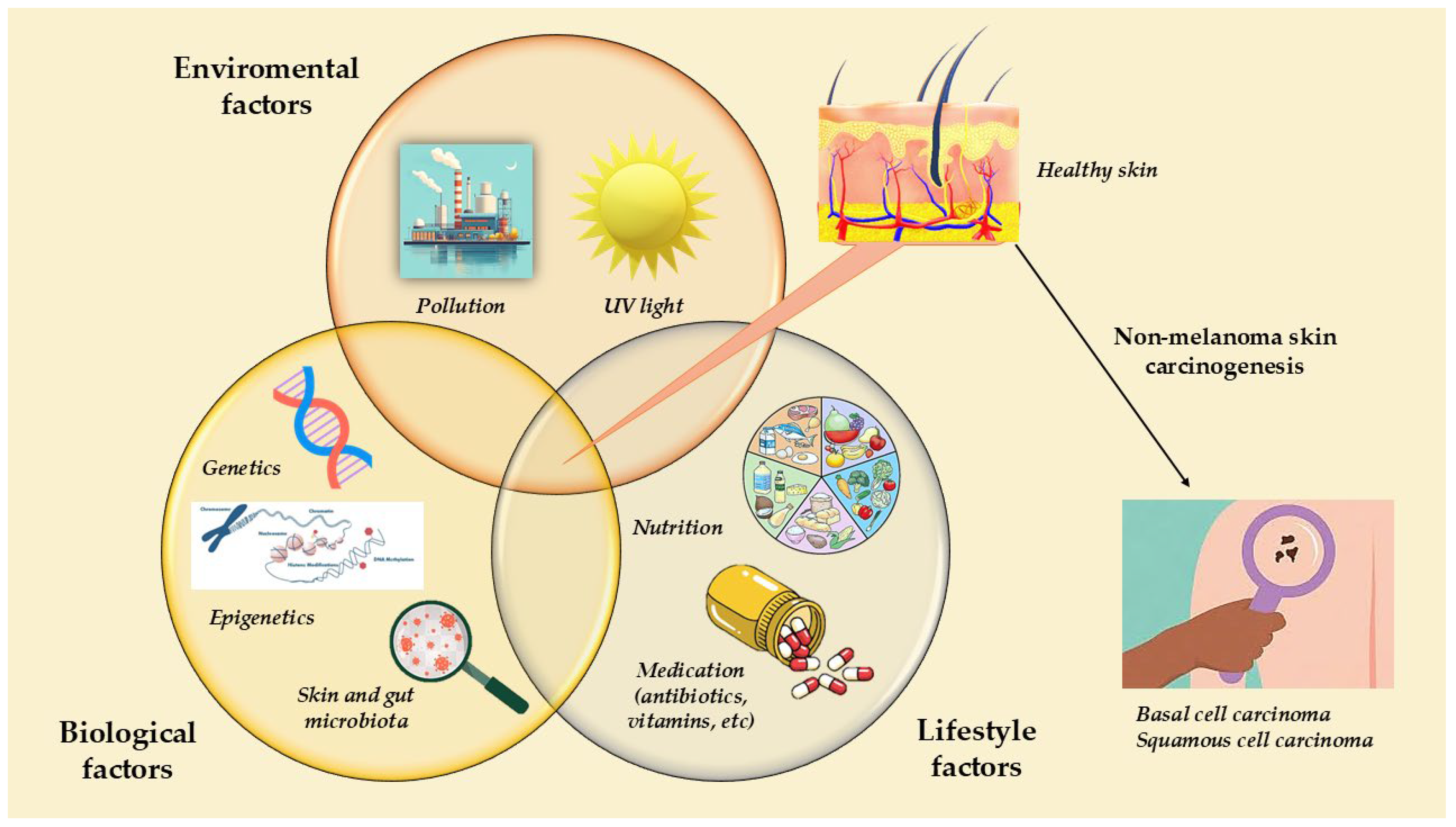

The Epigenetic Landscape and Exposome of Non-Melanoma Skin Cancer: Mechanisms, Biomarkers, and Therapeutic Perspectives

 , and
, and 
Abstract
1. Introduction
2. Genetic Factors Involved in NMSC Development
3. Epigenetic Factors Involved in NMSC Development
3.1. DNA Methylation in NMSC
3.2. Non-Coding RNAs in NMSC
3.2.1. MicroRNAs
3.2.2. Long Non-Coding RNAs in NMSC
4. HPV Role and Mechanism of Non-Melanoma Skin Cancer Oncogenesis
5. Exposome
5.1. Environmental Factors
5.2. Pollution
5.3. Microbiota, Skin Virome
5.4. Medication (Immunosuppression, Certain Medications)
5.5. Nutrition and Vitamins
6. Biomarkers—Predisposition, Diagnostic and Prognostic
7. Old, New and Future Therapies
8. Conclusions
Author Contributions
Funding
Institutional Review Board Statement
Informed Consent Statement
Data Availability Statement
Conflicts of Interest
References
- Nehal, K.S.; Bichakjian, C.K. Update on keratinocyte carcinomas. N. Engl. J. Med. 2018, 379, 363–374. [Google Scholar] [CrossRef] [PubMed]
- Ferlay, J.; Ervik, M.; Lam, F.; Laversanne, M.; Colombet, M.; Mery, L.; Piñeros, M.; Znaor, A.; Soerjomataram, I.; Bray, F. Global Cancer Observatory: Cancer Today; International Agency for Research on Cancer: Lyon, France, 2024; Available online: https://gco.iarc.who.int/today (accessed on 10 February 2026).
- Zink, A. Non-melanoma skin cancer: Pathogenesis, prevalence and prevention. Der Hautarzt 2017, 68, 919–928. [Google Scholar] [CrossRef] [PubMed]
- Boukamp, P. Non-melanoma skin cancer: What drives tumor development and progression? Carcinogenesis 2005, 26, 1657–1667. [Google Scholar] [CrossRef] [PubMed]
- Siegel, J.; Korgavkar, K.; Weinstock, M. Current perspective on actinic keratosis: A review. Br. J. Dermatol. 2017, 177, 350–358. [Google Scholar] [CrossRef]
- Neagu, M.; Constantin, C.; Caruntu, C.; Dumitru, C.; Surcel, M.; Zurac, S. Inflammation: A key process in skin tumorigenesis. Oncol. Lett. 2019, 17, 4068–4084. [Google Scholar] [CrossRef]
- Kwasniak, L.A.; Garcia-Zuazaga, J. Basal cell carcinoma: Evidence-based medicine and review of treatment modalities. Int. J. Dermatol. 2011, 50, 645–658. [Google Scholar] [CrossRef]
- Lucas, R.; McMichael, T.; Smith, W.; Armstrong, B. Solar ultraviolet radiation. In Global Burden of Disease from Solar Ultraviolet Radiation; Environmental Burden of Disease Series, No. 13; World Health Organization: Geneva, Switzerland, 2006. [Google Scholar]
- National Comprehensive Cancer Network, Inc. Available online: https://www.nccn.org/patients/guidelines/content/PDF/squamous_cell-patient.pdf (accessed on 10 February 2026).
- Huang, C.C.; Boyce, S.M. Surgical margins of excision for basal cell carcinoma and squamous cell carcinoma. Semin. Cutan. Med. Surg. 2004, 23, 167–173. [Google Scholar] [CrossRef]
- Rodriguez-Vigil, T.; Vázquez-López, F.; Perez-Oliva, N. Recurrence rates of primary basal cell carcinoma in facial risk areas treated with curettage and electrodesiccation. J. Am. Acad. Dermatol. 2007, 56, 91–95. [Google Scholar] [CrossRef]
- Yu, S.H.; Bordeaux, J.S.; Baron, E.D. The immune system and skin cancer. Adv. Exp. Med. Biol. 2014, 810, 182–191. [Google Scholar] [CrossRef]
- Berg, D.; Otley, C.C. Skin cancer in organ transplant recipients: Epidemiology, pathogenesis, and management. J. Am. Acad. Dermatol. 2002, 47, 1–20. [Google Scholar] [CrossRef]
- Samarasinghe, V.; Madan, V. Nonmelanoma skin cancer. J. Cutan. Aesthetic Surg. 2012, 5, 3–10. [Google Scholar] [CrossRef] [PubMed]
- Samarasinghe, V.; Madan, V.; Lear, J.T. Focus on Basal cell carcinoma. J. Ski. Cancer 2011, 2011, 328615. [Google Scholar] [CrossRef] [PubMed]
- Smeets, N.W.; Kuijpers, D.I.; Nelemans, P.; Ostertag, J.U.; Verhaegh, M.E.; Krekels, G.A.; Neumann, H.A. Mohs’ micrographic surgery for treatment of basal cell carcinoma of the face--results of a retrospective study and review of the literature. Br. J. Dermatol. 2004, 151, 141–147. [Google Scholar] [CrossRef] [PubMed]
- Zak-Prelich, M.; Narbutt, J.; Sysa-Jedrzejowska, A. Environmental risk factors predisposing to the development of basal cell carcinoma. Dermatol. Surg. 2004, 30, 248–252. [Google Scholar] [CrossRef]
- Narayanan, D.L.; Saladi, R.N.; Fox, J.L. Ultraviolet radiation and skin cancer. Int. J. Dermatol. 2010, 49, 978–986. [Google Scholar] [CrossRef]
- Grigore, O.; Mihailescu, A.I.; Solomon, I.; Boda, D.; Caruntu, C. Role of stress in modulation of skin neurogenic inflammation. Exp. Ther. Med. 2019, 17, 997–1003. [Google Scholar] [CrossRef]
- D’Orazio, J.; Jarrett, S.; Amaro-Ortiz, A.; Scott, T. UV radiation and the skin. Int. J. Mol. Sci. 2013, 14, 12222–12248. [Google Scholar] [CrossRef]
- Kathpalia, V.P.; Mussak, E.N.; Chow, S.S.; Lam, P.H.; Skelley, N.; Time, M.; Markelewicz, R.J.; Kanduc, D.; Lomas, L.; Xiang, Z.; et al. Genome-wide transcriptional profiling in human squamous cell carcinoma of the skin identifies unique tumor-associated signatures. J. Dermatol. 2006, 33, 309–318. [Google Scholar] [CrossRef]
- Naldi, L.; DiLandro, A.; D’Avanzo, B.; Parazzini, F. Host-related and environmental risk factors for cutaneous basal cell carcinoma: Evidence from an Italian case-control study. J. Am. Acad. Dermatol. 2000, 42, 446–452. [Google Scholar] [CrossRef]
- Fine, J.D.; Johnson, L.B.; Weiner, M.; Li, K.P.; Suchindran, C. Epidermolysis bullosa and the risk of life-threatening cancers: The National EB Registry experience, 1986–2006. J. Am. Acad. Dermatol. 2009, 60, 203–211. [Google Scholar] [CrossRef]
- Binstock, M.; Hafeez, F.; Metchnikoff, C.; Arron, S.T. Single-nucleotide polymorphisms in pigment genes and nonmelanoma skin cancer predisposition: A systematic review. Br. J. Dermatol. 2014, 171, 713–721. [Google Scholar] [CrossRef] [PubMed]
- Harwood, C.A.; Proby, C.M.; Inman, G.J.; Leigh, I.M. The Promise of Genomics and the Development of Targeted Therapies for Cutaneous Squamous Cell Carcinoma. Acta Derm. Venereol. 2016, 96, 3–16. [Google Scholar] [CrossRef] [PubMed]
- Ruczinski, I.; Jorgensen, T.J.; Shugart, Y.Y.; Schaad, Y.B.; Kessing, B.; Hoffman-Bolton, J.; Helzlsouer, K.J.; Kao, W.H.; Wheless, L.; Francis, L.; et al. A population-based study of DNA repair gene variants in relation to non-melanoma skin cancer as a marker of a cancer-prone phenotype. Carcinogenesis 2012, 33, 1692–1698. [Google Scholar] [CrossRef] [PubMed]
- Powers, J.M.; Murphy, G.; Ralph, N.; O’Gorman, S.M.; Murphy, J.E. Mitochondrial DNA deletion percentage in sun exposed and non sun exposed skin. J. Photochem. Photobiol. B 2016, 165, 277–282. [Google Scholar] [CrossRef]
- Parr, R.L.; Dakubo, G.D.; Thayer, R.E.; McKenney, K.; Birch-Machin, M.A. Mi-to-chondrial DNA as a po-ten-tial tool for early can-cer de-tec-tion. Hum. Genom. 2006, 2, 252–257. [Google Scholar] [CrossRef][Green Version]
- Hanahan, D. Hallmarks of Cancer: New Dimensions. Cancer Discov. 2022, 12, 31–46. [Google Scholar] [CrossRef]
- Botchkarev, V.A.; Gdula, M.R.; Mardaryev, A.N.; Sharov, A.A.; Fessing, M.Y. Epigenetic regulation of gene expression in keratinocytes. J. Investig. Dermatol. 2012, 132, 2505–2521. [Google Scholar] [CrossRef]
- Penta, D.; Somashekar, B.S.; Meeran, S.M. Epigenetics of skin cancer: Interventions by selected bioactive phytochemicals. Photodermatol. Photoimmunol. Photomed. 2018, 34, 42–49. [Google Scholar] [CrossRef]
- Kashyap, M.P.; Sinha, R.; Mukhtar, M.S.; Athar, M. Epigenetic regulation in the pathogenesis of non-melanoma skin cancer. Semin. Cancer Biol. 2022, 83, 36–56. [Google Scholar] [CrossRef]
- Rodríguez-Paredes, M.; Esteller, M. Cancer epigenetics reaches mainstream oncology. Nat. Med. 2011, 17, 330–339. [Google Scholar] [CrossRef]
- Pérez, R.F.; Tejedor, J.R.; Bayón, G.F.; Fernández, A.F.; Fraga, M.F. Distinct chromatin signatures of DNA hypomethylation in aging and cancer. Aging Cell 2018, 17, e12744. [Google Scholar] [CrossRef] [PubMed]
- Toyota, M.; Suzuki, H. Epigenetic drivers of genetic alterations. Adv. Genet. 2010, 70, 309–323. [Google Scholar] [CrossRef] [PubMed]
- Stamatelli, A.; Vlachou, C.; Aroni, K.; Papassideri, I.; Patsouris, E.; Saetta, A.A. Epigenetic alterations in sporadic basal cell carcinomas. Arch. Dermatol. Res. 2014, 306, 561–569. [Google Scholar] [CrossRef]
- Brinkhuizen, T.; van den Hurk, K.; Winnepenninckx, V.J.; de Hoon, J.P.; van Marion, A.M.; Veeck, J.; van Engeland, M.; van Steensel, M.A. Epigenetic changes in Basal Cell Carcinoma affect SHH and WNT signaling components. PLoS ONE 2012, 7, e51710. [Google Scholar] [CrossRef] [PubMed]
- Takeuchi, T.; Liang, S.B.; Ohtsuki, Y. Downregulation of expression of a novel cadherin molecule, T-cadherin, in basal cell carcinoma of the skin. Mol. Carcinog. 2002, 35, 173–179. [Google Scholar] [CrossRef]
- Goldberg, M.; Rummelt, C.; Laerm, A.; Helmbold, P.; Holbach, L.M.; Ballhausen, W.G. Epigenetic silencing contributes to frequent loss of the fragile histidine triad tumour suppressor in basal cell carcinomas. Br. J. Dermatol. 2006, 155, 1154–1158. [Google Scholar] [CrossRef] [PubMed]
- Lodygin, D.; Yazdi, A.S.; Sander, C.A.; Herzinger, T.; Hermeking, H. Analysis of 14-3-3sigma expression in hyperproliferative skin diseases reveals selective loss associated with CpG-methylation in basal cell carcinoma. Oncogene 2003, 22, 5519–5524. [Google Scholar] [CrossRef]
- Greenberg, E.S.; Chong, K.K.; Huynh, K.T.; Tanaka, R.; Hoon, D.S. Epigenetic biomarkers in skin cancer. Cancer Lett. 2014, 342, 170–177. [Google Scholar] [CrossRef]
- Brown, V.L.; Harwood, C.A.; Crook, T.; Cronin, J.G.; Kelsell, D.P.; Proby, C.M. p16INK4a and p14ARF tumor suppressor genes are commonly inactivated in cutaneous squamous cell carcinoma. J. Investig. Dermatol. 2004, 122, 1284–1292. [Google Scholar] [CrossRef]
- Murao, K.; Kubo, Y.; Ohtani, N.; Hara, E.; Arase, S. Epigenetic abnormalities in cutaneous squamous cell carcinomas: Frequent inactivation of the RB1/p16 and p53 pathways. Br. J. Dermatol. 2006, 155, 999–1005. [Google Scholar] [CrossRef]
- Toll, A.; Salgado, R.; Espinet, B.; Díaz-Lagares, A.; Hernández-Ruiz, E.; Andrades, E.; Sandoval, J.; Esteller, M.; Pujol, R.M.; Hernández-Muñoz, I. MiR-204 silencing in intraepithelial to invasive cutaneous squamous cell carcinoma progression. Mol. Cancer 2016, 15, 53. [Google Scholar] [CrossRef] [PubMed]
- O’Brien, J.; Hayder, H.; Zayed, Y.; Peng, C. Overview of MicroRNA Biogenesis, Mechanisms of Actions, and Circulation. Front. Endocrinol. 2018, 9, 402. [Google Scholar] [CrossRef] [PubMed]
- Tamas, T.; Baciut, M.; Nutu, A.; Bran, S.; Armencea, G.; Stoia, S.; Manea, A.; Crisan, L.; Opris, H.; Onisor, F.; et al. Is miRNA Regulation the Key to Controlling Non-Melanoma Skin Cancer Evolution? Genes 2021, 12, 1929. [Google Scholar] [CrossRef] [PubMed]
- Green, A.C.; Olsen, C.M. Cutaneous squamous cell carcinoma: An epidemiological review. Br. J. Dermatol. 2017, 177, 373–381. [Google Scholar] [CrossRef]
- Parekh, V.; Seykora, J.T. Cutaneous Squamous Cell Carcinoma. Clin. Lab. Med. 2017, 37, 503–525. [Google Scholar] [CrossRef]
- Heffelfinger, C.; Ouyang, Z.; Engberg, A.; Leffell, D.J.; Hanlon, A.M.; Gordon, P.B.; Zheng, W.; Zhao, H.; Snyder, M.P.; Bale, A.E. Correlation of Global MicroRNA Expression with Basal Cell Carcinoma Subtype. G3 Genes Genomes Genet. 2012, 2, 279–286. [Google Scholar] [CrossRef]
- Farzan, S.F.; Karagas, M.R.; Christensen, B.C.; Li, Z.; Kuriger, J.K.; Nelson, H.H. New Hampshire Skin Cancer Study. RNASEL and MIR146A SNP-SNP interaction as a susceptibility factor for non-melanoma skin cancer. PLoS ONE 2014, 9, e93602. [Google Scholar] [CrossRef]
- Chang, J.; Tran, D.C.; Zhu, G.A.; Li, R.; Whitson, R.; Kim, Y.H.; Gupta, A.; Afshari, A.; Antes, T.; Spitale, R.C.; et al. Initial in vitro functional characterization of serum exosomal microRNAs from patients with metastatic basal cell carcinoma. Br. J. Dermatol. 2017, 177, e187–e190. [Google Scholar] [CrossRef]
- Al-Eryani, L.; Jenkins, S.F.; States, V.A.; Pan, J.; Malone, J.C.; Rai, S.N.; Galandiuk, S.; Giri, A.K.; States, J.C. miRNA expression profiles of premalignant and malignant arsenic-induced skin lesions. PLoS ONE 2018, 13, e0202579. [Google Scholar] [CrossRef]
- Sand, M.; Skrygan, M.; Sand, D.; Georgas, D.; Hahn, S.A.; Gambichler, T.; Altmeyer, P.; Bechara, F.G. Expression of microRNAs in basal cell carcinoma. Br. J. Dermatol. 2012, 167, 847–855. [Google Scholar] [CrossRef]
- Sand, M.; Sand, D.; Altmeyer, P.; Bechara, F.G. MicroRNA in non-melanoma skin cancer. Cancer Biomark. 2012, 11, 253–257. [Google Scholar] [CrossRef] [PubMed]
- Dziunycz, P.; Iotzova-Weiss, G.; Eloranta, J.J.; Lauchli, S.; Hafner, J.; French, L.E.; Altmeyer, P.; Bechara, F.G. Squamous cell carcinoma of the skin shows a distinct microRNA profile modulated by UV radiation. J. Investig. Dermatol. 2010, 130, 2686–2689. [Google Scholar] [CrossRef] [PubMed]
- Gong, Z.H.; Zhou, F.; Shi, C.; Xiang, T.; Zhou, C.K.; Wang, Q.Q.; Jiang, Y.S.; Gao, S.F. miRNA-221 promotes cutaneous squamous cell carcinoma progression by targeting PTEN. Cell Mol. Biol. Lett. 2019, 24, 9. [Google Scholar] [CrossRef] [PubMed]
- Olasz, E.B.; Seline, L.N.; Schock, A.M.; Duncan, N.E.; Lopez, A.; Lazar, J.; Flister, M.J.; Lu, Y.; Liu, P.; Sokumbi, O.; et al. MicroRNA-135b Regulates Leucine Zipper Tumor Suppressor 1 in Cutaneous Squamous Cell Carcinoma. PLoS ONE 2015, 10, e0125412. [Google Scholar] [CrossRef]
- Zhou, M.; Liu, W.; Ma, S.; Cao, H.; Peng, X.; Guo, L.; Zhou, X.; Zheng, L.; Guo, L.; Wan, M.; et al. A novel onco-miR-365 induces cutaneous squamous cell carcinoma. Carcinogenesis 2013, 34, 1653–1659. [Google Scholar] [CrossRef]
- Sand, M.; Skrygan, M.; Georgas, D.; Sand, D.; Hahn, S.A.; Gambichler, T.; Altmeyer, P.; Bechara, F.G. Microarray analysis of microRNA expression in cutaneous squamous cell carcinoma. J. Dermatol. Sci. 2012, 68, 119–126. [Google Scholar] [CrossRef]
- Balci, S.; Ayaz, L.; Gorur, A.; Yildirim Yaroglu, H.; Akbayir, S.; Dogruer Unal, N.; Bulut, B.; Tursen, U.; Tamer, L. microRNA profiling for early detection of nonmelanoma skin cancer. Clin. Exp. Dermatol. 2016, 41, 346–351. [Google Scholar] [CrossRef]
- Sun, H.; Jiang, P. MicroRNA-451a acts as tumor suppressor in cutaneous basal cell carcinoma. Mol. Genet. Genom. Med. 2018, 6, 1001–1009. [Google Scholar] [CrossRef]
- Sonkoly, E.; Lov, J.; Xu, N.; Meisgen, F.; Wei, T.; Brodin, P.; Jacks, V.; Kasper, M.; Shimokawa, T.; Harada, M.; et al. MicroRNA-203 functions as a tumor suppressor in basal cell carcinoma. Oncogenesis 2012, 1, e3. [Google Scholar] [CrossRef]
- Wan, C.; Li, Y. Integrative analysis of mRNA-miRNA-TFs reveals the key regulatory connections involved in basal cell carcinoma. Arch. Dermatol. Res. 2020, 312, 133–143. [Google Scholar] [CrossRef]
- Xu, N.; Zhang, L.; Meisgen, F.; Harada, M.; Heilborn, J.; Homey, B.; Grandér, D.; Ståhle, M.; Sonkoly, E.; Pivarcsi, A. MicroRNA-125b down-regulates matrix metallopeptidase 13 and inhibits cutaneous squamous cell carcinoma cell proliferation, migration, and invasion. J. Biol. Chem. 2012, 287, 29899–29908. [Google Scholar] [CrossRef]
- Chen, B.; Pan, W.; Lin, X.; Hu, Z.; Jin, Y.; Chen, H.; Ma, G.; Qiu, Y.; Chang, L.; Hua, C.; et al. MicroRNA-346 functions as an oncogene in cutaneous squamous cell carcinoma. Tumor Biol. 2016, 37, 2765–2771. [Google Scholar] [CrossRef]
- Kanitz, A.; Imig, J.; Dziunycz, P.J.; Primorac, A.; Galgano, A.; Hofbauer, G.F.L.; Gerber, A.P.; Detmar, M. The expression levels of microRNA-361-5p and its target VEGFA are inversely correlated in human cutaneous squamous cell carcinoma. PLoS ONE 2012, 7, e49568. [Google Scholar] [CrossRef]
- Zhang, L.; Xiang, P.; Han, X.; Wu, L.; Li, X.; Xiong, Z. Decreased expression of microRNA-20a promotes tumor progression and predicts poor prognosis of cutaneous squamous cell carcinoma. Int. J. Clin. Exp. Pathol. 2015, 8, 11446–11451. [Google Scholar] [PubMed]
- Yamane, K.; Jinnin, M.; Etoh, T.; Kobayashi, Y.; Shimozono, N.; Fukushima, S.; Masuguchi, S.; Maruo, K.; Inoue, Y.; Ishihara, T.; et al. Down-regulation of miR-124/-214 in cutaneous squamous cell carcinoma mediates abnormal cell proliferation via the induction of ERK. J. Mol. Med. 2013, 91, 69–81. [Google Scholar] [CrossRef] [PubMed]
- Mattick, J.S.; Amaral, P.P.; Carninci, P.; Carpenter, S.; Chang, H.Y.; Chen, L.L.; Chen, R.; Dean, C.; Dinger, M.E.; Fitzgerald, K.A.; et al. Long non-coding RNAs: Definitions, functions, challenges and recommendations. Nat. Rev. Mol. Cell Biol. 2023, 24, 430–447. [Google Scholar] [CrossRef] [PubMed]
- Piipponen, M.; Heino, J.; Kähäri, V.M.; Nissinen, L. Long non-coding RNA PICSAR decreases adhesion and promotes migration of squamous carcinoma cells by downregulating α2β1 and α5β1 integrin expression. Biol. Open 2018, 7, bio037044. [Google Scholar] [CrossRef]
- Mei, X.L.; Zhong, S. Long noncoding RNA LINC00520 prevents the progression of cutaneous squamous cell carcinoma through the inactivation of the PI3K/Akt signaling pathway by downregulating EGFR. Chin. Med. J. 2019, 132, 454–465. [Google Scholar] [CrossRef]
- Mancini, M.; Cappello, A.; Pecorari, R.; Lena, A.M.; Montanaro, M.; Fania, L.; Ricci, F.; Di Lella, G.; Piro, M.C.; Abeni, D.; et al. Involvement of transcribed lncRNA uc.291 and SWI/SNF complex in cutaneous squamous cell carcinoma. Discov. Oncol. 2021, 12, 14. [Google Scholar] [CrossRef]
- Dehcheshmeh, I.S.; Karimi, M.M.; Jafarisani, M. Increased Expression of CCAT2 LncRNA in Non-Melanoma Skin Cancer. Shahroud J. Med. Sci. 2018, 4, 1–4. [Google Scholar] [CrossRef]
- El Derbaly, S.A.; Hamouda, M.A.F.; Abdallah Elnahas, M.; Mahfouz Hamed1, A.; Abd El Gayed, E.M. Unveiling the Role of lncRNA BBOX1-AS1, HOXB7, and IGF2BP1 in Non-Melanocytic Skin Tumors: Potential Biomarkers for Diagnosis. Egypt. J. Hosp. Med. 2025, 100, 3567–3576. [Google Scholar] [CrossRef]
- Ma, Y.; Madupu, R.; Karaoz, U.; Nossa, C.W.; Yang, L.; Yooseph, S.; Yachimski, P.S.; Brodie, E.L.; Nelson, K.E.; Pei, Z. Human papillomavirus community in healthy persons, defined by metagenomics analysis of human microbiome project shotgun sequencing data sets. J. Virol. 2014, 88, 4786–4797. [Google Scholar] [CrossRef]
- Bzhalava, D.; Mühr, L.S.; Lagheden, C.; Ekström, J.; Forslund, O.; Dillner, J.; Hultin, E. Deep sequencing extends the diversity of human papillomaviruses in human skin. Sci. Rep. 2014, 4, 5807. [Google Scholar] [CrossRef] [PubMed]
- Antonsson, A.; Karanfilovska, S.; Lindqvist, P.G.; Hansson, B.G. General acquisition of human papillomavirus infections of skin occurs in early infancy. J. Clin. Microbiol. 2003, 41, 2509–2514. [Google Scholar] [CrossRef] [PubMed]
- Bruggink, S.C.; de Koning, M.N.; Gussekloo, J.; Egberts, P.F.; Ter Schegget, J.; Feltkamp, M.C.; Bavinck, J.N.; Quint, W.G.; Assendelft, W.J.; Eekhof, J.A. Cutaneous wart-associated HPV types: Prevalence and relation with patient characteristics. J. Clin. Virol. Off. Publ. Pan Am. Soc. Clin. Virol. 2012, 55, 250–255. [Google Scholar] [CrossRef] [PubMed]
- Rahman, S.; Pierce Campbell, C.M.; Rollison, D.E.; Wang, W.; Waterboer, T.; Michel, A.; Pawlita, M.; Villa, L.L.; Lazcano Ponce, E.; Borenstein, A.R.; et al. Seroprevalence and Associated Factors of 9-Valent Human Papillomavirus (HPV) Types among Men in the Multinational HIM Study. PLoS ONE 2016, 11, e0167173. [Google Scholar] [CrossRef]
- Hampras, S.S.; Giuliano, A.R.; Lin, H.Y.; Fisher, K.J.; Abrahamsen, M.E.; Sirak, B.A.; Iannacone, M.R.; Gheit, T.; Tommasino, M.; Rollison, D.E. Natural history of cutaneous human papillomavirus (HPV) infection in men: The HIM study. PLoS ONE 2014, 9, e104843. [Google Scholar] [CrossRef]
- Hasche, D.; Vinzón, S.E.; Rösl, F. Cutaneous Papillomaviruses and Non-melanoma Skin Cancer: Causal Agents or Innocent Bystanders? Front. Microbiol. 2018, 9, 874. [Google Scholar] [CrossRef]
- Ally, M.S.; Tang, J.Y.; Arron, S.T. Cutaneous human papillomavirus infection and Basal cell carcinoma of the skin. J. Investig. Dermatol. 2013, 133, 1456–1458. [Google Scholar] [CrossRef]
- And Ersson, K.; Michael, K.M.; Luostarinen, T.; Waterboer, T.; Gislefoss, R.; Hakulinen, T.; Forslund, O.; Pawlita, M.; Dillner, J. Prospective study of human papillomavirus seropositivity and risk of nonmelanoma skin cancer. Am. J. Epidemiol. 2012, 175, 685–695. [Google Scholar] [CrossRef]
- And Ersson, K.; Waterboer, T.; Kirnbauer, R.; Slupetzky, K.; Iftner, T.; de Villiers, E.M.; Forslund, O.; Pawlita, M.; Dillner, J. Seroreactivity to cutaneous human papillomaviruses among patients with nonmelanoma skin cancer or benign skin lesions. Cancer Epidemiol. Biomark. Prev. 2008, 17, 189–195. [Google Scholar] [CrossRef] [PubMed]
- Sandoval-Clavijo, A.; Martí-Martí, I.; Ferrándiz-Pulido, C.; Verdaguer-Faja, J.; Jaka, A.; Toll, A. Human Papillomavirus-Related Cutaneous Squamous Cell Carcinoma. Cancers 2025, 17, 897. [Google Scholar] [CrossRef] [PubMed]
- Iannacone, M.R.; Gheit, T.; Waterboer, T.; Giuliano, A.R.; Messina, J.L.; Fenske, N.A.; Cherpelis, B.S.; Sondak, V.K.; Roetzheim, R.G.; Ferrer-Gil, S.; et al. Case–Control Study of Cutaneous Human Papillomavirus Infection in Basal Cell Carcinoma of the Skin. J. Investig. Dermatol. 2013, 133, 1512–1520. [Google Scholar] [CrossRef] [PubMed]
- Hasche, D.; Stephan, S.; Braspenning-Wesch, I.; Mikulec, J.; Niebler, M.; Gröne, H.; Flechtenmacher, C.; Akgül, B.; Rösl, F.; Vinzón, S.E. The interplay of UV and cutaneous papillomavirus infection in skin cancer development. PLoS Pathog. 2017, 13, e1006723. [Google Scholar] [CrossRef]
- IARC Working Group on the Evaluation of Carcinogenic Risks to Humans. Solar and Ultraviolet Radiation; IARC Monographs on the Evaluation of Carcinogenic Risks to Humans; International Agency for Research on Cancer: Lyon, France, 1992; Volume 55. [Google Scholar]
- Young, A.R. Chapter 1: Damage from acute vs chronic solar exposure. In Biophysical and Physiological Effects of Solar Radiation on Human Skin; Giacomoni, P.U., Jori, G., Hader, D.P., Eds.; RSC Publishing: Cambridge, UK, 2007. [Google Scholar]
- Hunter, N.; Haylock, R. The risk of basal and squamous cell carcinomas of the skin cancer incidence and external radiation in the updated National Registry for radiation workers cohort in the UK. Int. J. Cancer. 2026, 158, 574–586. [Google Scholar] [CrossRef]
- World Health Organization. The Effect of Occupational Exposure to Solar Ultraviolet Radiation on Malignant Skin Melanoma and Nonmelanoma Skin Cancer: A Systematic Review and Meta-Analysis from the WHO/ILO Joint Estimates of the Work-Related Burden of Disease and Injury; World Health Organization: Geneva, Switzerland, 2021. [Google Scholar]
- Saitoh, Y.; Miyanishi, A.; Mizuno, H.; Kato, S.; Aoshima, H.; Kokubo, K.; Miwa, N. Su-per-highly hydroxylated fullerene derivative protects human keratinocytes from UV-induced cell injuries together with the decreases in intracellular ROS generation and DNA damages. J. Photochem. Photobiol. 2011, 102, 69–76. [Google Scholar] [CrossRef]
- Kim, Y.; He, Y.Y. Ultraviolet radiation-induced non-melanoma skin cancer: Regulation of DNA damage repair and inflammation. Genes Dis. 2014, 1, 188–198. [Google Scholar] [CrossRef]
- Calzavara-Pinton, P.; Ortel, B.; Venturini, M. Non-melanoma skin cancer, sun exposure and sun protection. G. Ital. Dermatol. Venereol. 2015, 150, 369–378. [Google Scholar]
- López-Camarillo, C.; Ocampo, E.A.; Casamichana, M.L.; Pérez-Plasencia, C.; Alvarez-Sánchez, E.; Marchat, L.A. Protein kinases and transcription factors activation in response to UV-radiation of skin: Implications for carcinogenesis. Int. J. Mol. Sci. 2012, 13, 142–172. [Google Scholar] [CrossRef]
- Von Schuckmann, L.A.; Law, M.H.; Montgomery, G.W.; Green, A.C.; Van Der Pols, J.C. Vitamin D Pathway Gene Polymorphisms and Keratinocyte Cancers: A Nested Case-Control Study and Meta-Analysis. Anticancer Res. 2016, 36, 2145–2152. [Google Scholar]
- IARC Working Group on the Evaluation of Carcinogenic Risks to Humans. Occupational exposures in insecticide application, and some pesticides. In IARC Monographs on the Evaluation of Carcinogenic Risks to Humans; IARC Working Group on the Evaluation of Carcinogenic Risks to Humans: Lyon, France, 1991; Volume 53, pp. 585–586. [Google Scholar]
- International Agency for Research on Cancer (IARC). List of Classifications by Cancer Sites with Sufficient or Limited Evidence in Humans. In IARC Monographs; IARC: Lyon, France; Volume 1–135, Available online: https://monographs.iarc.who.int/wp-content/uploads/2019/07/Classifications_by_cancer_site.pdf (accessed on 10 February 2026).
- Parker, E.R. The influence of climate change on skin cancer incidence—A review of the evidence. Int. J. Womens Dermatol. 2020, 7, 17–27, Erratum in Int. J. Womens Dermatol. 2021, 7, 867. https://doi.org/10.1016/j.ijwd.2021.09.013. [Google Scholar] [CrossRef] [PubMed]
- de Martel, C.; Ferlay, J.; Franceschi, S.; Vignat, J.; Bray, F.; Forman, D.; Plummer, M. Global burden of cancers attributable to infections in 2008: A review and synthetic analysis. Lancet Oncol. 2012, 13, 607–615. [Google Scholar] [CrossRef] [PubMed]
- Rahman, M.M.; Islam, M.R.; Shohag, S.; Ahasan, M.T.; Sarkar, N.; Khan, H.; Hasan, A.M.; Cavalu, S.; Rauf, A. Microbiome in cancer: Role in carcinogenesis and impact in therapeutic strategies. Biomed. Pharmacother. 2022, 149, 112898. [Google Scholar] [CrossRef] [PubMed]
- Nakatsuji, T.; Chen, T.H.; Butcher, A.M.; Trzoss, L.L.; Nam, S.-J.; Shirakawa, K.T.; Zhou, W.; Oh, J.; Otto, M.; Fenical, W.; et al. A commensal strain of Staphylococcus epidermidis protects against skin neoplasia. Sci. Adv. 2018, 4, eaao4502. [Google Scholar] [CrossRef]
- Godar, D.E. UV and Reactive Oxygen Species Activate Human Papillomaviruses Causing Skin Cancers. Curr. Probl. Dermatol. 2021, 55, 339–353. [Google Scholar] [CrossRef]
- Egert, M.; Simmering, R.; Riedel, C.U. The Association of the Skin Microbiota with Health, Immunity, and Disease. Clin. Pharmacol. Ther. 2017, 102, 62–69. [Google Scholar] [CrossRef]
- Squarzanti, D.F.; Zavattaro, E.; Pizzimenti, S.; Amoruso, A.; Savoia, P.; Azzimonti, B. Non-Melanoma Skin Cancer: News from microbiota research. Crit. Rev. Microbiol. 2020, 46, 433–449. [Google Scholar] [CrossRef]
- Kullander, J.; Forslund, O.; Dillner, J. Staphylococcus aureus and squamous cell carcinoma of the skin. Cancer Epidemiol. Biomark. Prev. 2009, 18, 472–478. [Google Scholar] [CrossRef]
- Wood, D.L.A.; Lachner, N.; Tan, J.-M.; Tang, S.; Angel, N.; Laino, A.; Linedale, R.; Cao, K.-A.L.; Morrison, M.; Frazer, I.H.; et al. A natural history of actinic keratosis and cutaneous squamous cell carcinoma microbiomes. mBio 2018, 9, e1432-18. [Google Scholar] [CrossRef]
- Madhusudhan, N.; Pausan, M.R.; Halwachs, B.; Durdević, M.; Windisch, M.; Kehrmann, J.; Patra, V.; Wolf, P.; Boukamp, P.; Moissl-Eichinger, C.; et al. Molecular Profiling of Keratinocyte Skin Tumors Links Staphylococcus aureus Overabundance and Increased Human β-Defensin-2 Expression to Growth Promotion of Squamous Cell Carcinoma. Cancers 2020, 12, 541. [Google Scholar] [CrossRef]
- Voigt, A.Y.; Emiola, A.; Johnson, J.S.; Fleming, E.S.; Nguyen, H.; Zhou, W.; Tsai, K.Y.; Fink, C.; Oh, J. Skin Microbiome Variation with Cancer Progression in Human Cutaneous Squamous Cell Carcinoma. J. Investig. Dermatol. 2022, 142, 2773–2782.e16. [Google Scholar] [CrossRef] [PubMed]
- Byrd, A.; Belkaid, Y.; Segre, J. The human skin microbiome. Nat. Rev. Microbiol. 2018, 16, 143–155. [Google Scholar] [CrossRef] [PubMed]
- Tomás-Pejó, E.; González-Fernández, C.; Greses, S.; Kennes, C.; Otero-Logilde, N.; Veiga, M.C.; Bolzonella, D.; Müller, B.; Passoth, V. Production of Short-Chain Fatty Acids (SCFAs) as Chemicals or Substrates for Microbes to Obtain Biochemicals. Biotechnol. Biofuels Bioprod. 2023, 16, 96. [Google Scholar] [CrossRef] [PubMed]
- Thomas, S.P.; Denu, J.M. Short-Chain Fatty Acids Activate Acetyltransferase P300. eLife 2021, 10, e72171. [Google Scholar] [CrossRef]
- Szabó, K.; Bolla, B.S.; Erdei, L.; Balogh, F.; Kemény, L. Are the Cutaneous Microbiota a Guardian of the Skin’s Physical Barrier? The Intricate Relationship between Skin Microbes and Barrier Integrity. Int. J. Mol. Sci. 2023, 24, 15962. [Google Scholar] [CrossRef]
- Bolla, B.S.; Erdei, L.; Urbán, E.; Burián, K.; Kemény, L.; Szabó, K. Cutibacterium Acnes Reg-ulates the Epidermal Barrier Properties of HPV-KER Human Immortalized Keratinocyte Cultures. Sci. Rep. 2020, 10, 12815. [Google Scholar] [CrossRef]
- Zeng, R.; Xu, H.; Liu, Y.; Du, L.; Duan, Z.; Tong, J.; He, Y.; Chen, Q.; Chen, X.; Li, M. MiR-146a Inhibits Biofilm-Derived Cutibacterium Acnes–Induced Inflammatory Reactions in Human Keratinocytes. J. Investig. Dermatol. 2019, 139, 2488–2496.e4. [Google Scholar] [CrossRef]
- Kreher, M.A.; Noland, M.M.B.; Konda, S.; Longo, M.I.; Valdes-Rodriguez, R. Risk of melanoma and nonmelanoma skin cancer with immunosuppressants, part I: Calcineurin inhibitors, thiopurines, IMDH inhibitors, mTOR inhibitors, and corticosteroids. J. Am. Acad. Dermatol. 2023, 88, 521–530. [Google Scholar] [CrossRef]
- Nardone, B.; West, D.P. Non-melanoma skin cancer and other adverse events resulting from antihypertensive drug use: What do we know? Expert Opin. Drug Saf. 2025, 25, 203–206. [Google Scholar] [CrossRef]
- Yang, K.; Marley, A.; Tang, H.; Song, Y.; Tang, J.Y.; Han, J. Statin use and non-melanoma skin cancer risk: A meta-analysis of rand omized controlled trials and observational studies. Oncotarget 2017, 8, 75411–75417. [Google Scholar] [CrossRef] [PubMed]
- O’Neill, B.; Moe, S.; Korownyk, C. Hydrochlorothiazide and squamous cell carcinoma. Can. Fam. Physician 2020, 66, 116. [Google Scholar]
- Hohl, M.; Götzinger, F.; Jäger, S.; Wagmann, L.; Tokcan, M.; Tschernig, T.; Reichrath, J.; Federspiel, J.M.; Boor, P.; Meyer, M.R.; et al. Assessing phototoxic drug properties of hydrochlo-rothiazide using human skin biopsies. Commun. Biol. 2025, 8, 705. [Google Scholar] [CrossRef] [PubMed]
- Bivona, J.J., 3rd; Patel, S.; Vajdy, M. Induction of cellular and molecular Immunomodulatory pathways by vitamin E and vitamin C. Expert Opin. Biol. Ther. 2017, 17, 1539–1551. [Google Scholar] [CrossRef] [PubMed]
- Weinstock, M.A.; Bingham, S.F.; DiGiovanna, J.J.; Rizzo, A.E.; Marcolivio, K.; Hall, R.; Eilers, D.; Naylor, M.; Kirsner, R.; Kalivas, J.; et al. Tretinoin and the prevention of keratinocyte carcinoma (Basal and squamous cell carcinoma of the skin): A veterans affairs rand omized chemoprevention trial. J. Investig. Dermatol. 2012, 32, 1583–1590. [Google Scholar] [CrossRef]
- Fania, L.; Mazzanti, C.; Campione, E.; Candi, E.; Abeni, D.; Dellambra, E. Role of Nicotinamide in Genomic Stability and Skin Cancer Chemoprevention. Int. J. Mol. Sci. 2019, 20, 5946. [Google Scholar] [CrossRef]
- Nazarali, S.; Kuzel, P. Vitamin B Derivative (Nicotinamide)Appears to Reduce Skin Cancer Risk. Ski. Ther. Lett. 2017, 22, 1–4. [Google Scholar]
- Surjana, D.; Halliday, G.M.; Damian, D.L. Role of nicotinamide in DNA damage, mutagenesis, and DNA repair. J. Nucleic Acids 2010, 2010, 157591. [Google Scholar] [CrossRef]
- Chen, A.C.; Martin, A.J.; Choy, B.; Fernández-Peñas, P.; Dalziell, R.A.; McKenzie, C.A.; Scolyer, R.A.; Dhillon, H.M.; Vardy, J.L.; Kricker, A.; et al. A Phase 3 Rand omized Trial of Nicotinamide for Skin-Cancer Chemoprevention. N. Engl. J. Med. 2015, 373, 1618–1626. [Google Scholar] [CrossRef]
- Park, S.M.; Li, T.; Wu, S.; Li, W.Q.; Weinstock, M.; Qureshi, A.A.; Cho, E. Niacin intake and risk of skin cancer in US women and men. Int. J. Cancer 2017, 140, 2023–2031. [Google Scholar] [CrossRef]
- Singh, S.; Aggarwal, B.B. Activation of transcription factor NF-kappa B is suppressed by curcumin (diferuloylmethane) [corrected]. J. Biol. Chem. 1995, 270, 24995–25000, Erratum in J. Biol. Chem. 1995, 270, 30235. [Google Scholar] [CrossRef] [PubMed]
- Amiri, K.I.; Richmond, A. Role of nuclear factor-kappa B in melanoma. Cancer Metastasis Rev. 2005, 24, 301–313. [Google Scholar] [CrossRef] [PubMed]
- Kumar, A.; Dhawan, S.; Hardegen, N.J.; Aggarwal, B.B. Curcumin (Diferuloylmethane) inhibition of tumor necrosis factor (TNF)-mediated adhesion of monocytes to endothelial cells by suppression of cell surface expression of adhesion molecules and of nuclear factor-kappaB activation. Biochem. Pharmacol. 1998, 55, 775–783. [Google Scholar] [CrossRef] [PubMed]
- Kuttan, R.; Sudheeran, P.C.; Josph, C.D. Turmeric and curcumin as topical agents in cancer therapy. Tumori J. 1987, 73, 29–31. [Google Scholar] [CrossRef]
- Rhode, J.; Fogoros, S.; Zick, S.; Wahl, H.; Griffith, K.A.; Huang, J.; Liu, J.R. Ginger inhibits cell growth and modulates angiogenic factors in ovarian cancer cells. BMC Complement. Altern. Med. 2007, 7, 44. [Google Scholar] [CrossRef]
- Nigam, N.; Bhui, K.; Prasad, S.; George, J.; Shukla, Y. [6]-Gingerol induces reactive oxygen species regulated mitochondrial cell death pathway in human epidermoid carcinoma A431 cells. Chem. Biol. Interact. 2009, 181, 77–84. [Google Scholar] [CrossRef]
- Banerjee, S.; Panda, C.K.; Das, S. Clove (Syzygium aromaticum L.), a potential chemopreventive agent for lung cancer. Carcinogenesis 2006, 27, 1645–1654. [Google Scholar] [CrossRef]
- Murakami, Y.; Shoji, M.; Hanazawa, S.; Tanaka, S.; Fujisawa, S. Preventive effect of bis-eugenol, a eugenol ortho dimer, on lipopolysaccharide-stimulated nuclear factor kappa B activation and inflammatory cytokine expression in macrophages. Biochem. Pharmacol. 2003, 66, 1061–1066. [Google Scholar] [CrossRef]
- Nichols, J.A.; Katiyar, S.K. Skin photoprotection by natural polyphenols: Anti-inflammatory, antioxidant and DNA repair mechanisms. Arch. Dermatol. Res. 2010, 302, 71–83. [Google Scholar] [CrossRef]
- Katta, R.; Brown, D.N. Diet and Skin Cancer: The Potential Role of Dietary Antioxidants in Nonmelanoma Skin Cancer Prevention. J. Ski. Cancer 2015, 2015, 893149. [Google Scholar] [CrossRef]
- Sancheti, G.; Goyal, P.K. Effect of Rosmarinus officinalis in modulating 7,12-dimethylbenz(a)anthracene induced skin tumorigenesis in mice. Phytother. Res. 2006, 20, 981–986. [Google Scholar] [CrossRef]
- Das, I.; Chakrabarty, R.N.; Das, S. Saffron can prevent chemically induced skin carcinogenesis in Swiss albino mice. Asian Pac. J. Cancer Prev. 2004, 5, 70–76. [Google Scholar]
- Lee, G.R.; Jang, S.H.; Kim, C.J.; Kim, A.R.; Yoon, D.J.; Park, N.H.; Han, I.S. Capsaicin suppresses the migration of cholangiocarcinoma cells by down-regulating matrix metalloproteinase-9 expression via the AMPK-NF-κB signaling pathway. Clin. Exp. Metastasis 2014, 31, 897–907. [Google Scholar] [CrossRef] [PubMed]
- Sreedhar, A.; Li, J.; Zhao, Y. Next-Gen Therapeutics for Skin Cancer: Nutraceuticals. Nutr. Cancer 2018, 70, 697–709. [Google Scholar] [CrossRef] [PubMed]
- Zhou, X.; Münch, G.; Wohlmuth, H.; Afzal, S.; Kao, M.-H. Synergistic Inhibition of Pro-Inflammatory Pathways by Ginger and Turmeric Extracts in RAW 264.7 Cells. Front. Pharmacol. 2022, 13, 818166. [Google Scholar] [CrossRef] [PubMed]
- Ouyang, B.; Wu, Q.; Liang, J.; Cao, H.; Xiao, J. Polyphenols-mediated immune regulation: Metabolite-driven epigenetic regulatory mechanisms. Phytomedicine 2025, 149, 157535. [Google Scholar] [CrossRef]
- Chou, P.J.; Peter, R.M.; Shannar, A.; Pan, Y.; Dave, P.D.; Xu, J.; Sarwar, M.S.; Kong, A.N. Epigenetics of Dietary Phytochemicals in Cancer Prevention: Fact or Fiction. Cancer J. 2024, 30, 320–328. [Google Scholar] [CrossRef]
- Bacaloni, S.; Agrawal, D.K. Nutrition, Gut Microbiota, and Epigenetics in the Modulation of Immune Response and Metabolic Health. Cardiol. Cardiovasc. Med. 2025, 9, 111–124. [Google Scholar] [CrossRef]
- Castelo, J.; Araujo-Aris, S.; Barriales, D.; Tanner Pasco, S.; Seoane, I.; Peña-Cearra, A.; Palacios, A.; Simó, C.; Garcia-Cañas, V.; Khamwong, M.; et al. The microbiota metabolite, phloroglucinol, confers long-term protection against in-flammation. Gut Microbes 2024, 16, 2438829. [Google Scholar] [CrossRef]
- Guo, X.; Li, J.; Xu, J.; Zhang, L.; Huang, C.; Nie, Y.; Zhou, Y. Gut microbiota and epigenetic inher-itance: Implications for the development of IBD. Gut Microbes 2025, 17, 2490207. [Google Scholar] [CrossRef]
- Hunt, K.M.; Srivastava, R.K.; Elmets, C.A.; Athar, M. The mechanistic basis of arsenicosis: Pathogenesis of skin cancer. Cancer Lett. 2014, 354, 211–219. [Google Scholar] [CrossRef] [PubMed]
- Shen, J.; Abel, E.L.; Riggs, P.K.; Repass, J.; Hensley, S.C.; Schroeder, L.J.; Temple, A.; Chau, A.; McClellan, S.A.; Rho, O.; et al. Proteomic and pathway analyses reveal a network of inflammatory genes associated with differences in skin tumor promotion susceptibility in DBA/2 and C57BL/6 mice. Carcinogenesis 2012, 33, 2208–2219. [Google Scholar] [CrossRef] [PubMed]
- Dusingize, J.C.; Olsen, C.M.; Pandeya, N.P.; Subramaniam, P.; Thompson, B.S.; Neale, R.E.; Green, A.C.; Whiteman, D.C. Cigarette Smoking and the Risks of Basal Cell Carcinoma and Squamous Cell Carcinoma. J. Investig. Dermatol. 2017, 137, 1700–1708. [Google Scholar] [CrossRef] [PubMed]
- Nikolaou, V.; Stratigos, A.J.; Tsao, H. Hereditary nonmelanoma skin cancer. Semin. Cutan. Med. Surg. 2012, 31, 204–210. [Google Scholar] [CrossRef]
- Greinert, R. Skin cancer: New markers for better prevention. Pathobiology 2009, 76, 64–81. [Google Scholar] [CrossRef]
- Gandini, S.; Sera, F.; Cattaruzza, M.S.; Pasquini, P.; Abeni, D.; Boyle, P.; Melchi, C.F. Meta-analysis of risk factors for cutaneous melanoma: I. Common and atypical naevi. Eur. J. Cancer 2005, 41, 28–44. [Google Scholar] [CrossRef]
- Beer, T.W.; Shepherd, P.; Theaker, J.M. Ber EP4 and epithelial membrane antigen aid distinction of basal cell, squamous cell and basosquamous carcinomas of the skin. Histopathology 2000, 37, 218–223. [Google Scholar] [CrossRef]
- Omland, S.H.; Wettergren, E.E.; Mollerup, S.; Asplund, M.; Mourier, T.; Hansen, A.J.; Gniadecki, R. Cancer associated fibroblasts (CAFs) are activated in cutaneous basal cell carcinoma and in the peritumoural skin. BMC Cancer 2017, 17, 675, Erratum in BMC Cancer 2018, 18, 111. https://doi.org/10.1186/s12885-018-3987-4. [Google Scholar] [CrossRef]
- Bridge, J.A.; Lee, J.C.; Daud, A.; Wells, J.W.; Bluestone, J.A. Cytokines, Chemokines, and Other Biomarkers of Response for Checkpoint Inhibitor Therapy in Skin Cancer. Front. Med. 2018, 5, 351. [Google Scholar] [CrossRef]
- Nicholas, C.; Lesinski, G.B. Immunomodulatory cytokines as therapeutic agents for melanoma. Immunotherapy 2011, 3, 673–690. [Google Scholar] [CrossRef]
- Chow, M.T.; Luster, A.D. Chemokines in cancer. Cancer Immunol. Res. 2014, 2, 1125–1131. [Google Scholar] [CrossRef]
- Byrne, S.N.; Halliday, G.M. UV-Induced Chemokines as Emerging Targets for Skin Cancer Photochemoprevention. In Skin Stress Response Pathways: Environmental Factors and Molecular Opportunities; Wondrak, G.T., Ed.; Springer International Publishing: Cham, Switzerland, 2016; pp. 211–234. [Google Scholar]
- Pittayapruek, P.; Meephansan, J.; Prapapan, O.; Komine, M.; Ohtsuki, M. Role of Matrix Metalloproteinases in Photoaging and Photocarcinogenesis. Int. J. Mol. Sci. 2016, 17, 868. [Google Scholar] [CrossRef] [PubMed]
- Didona, D.; Paolino, G.; Bottoni, U.; Cantisani, C. Non Melanoma Skin Cancer Pathogenesis Overview. Biomedicines 2018, 6, 6. [Google Scholar] [CrossRef] [PubMed]
- Griffin, J.R.; Wriston, C.C.; Peters, M.S.; Lehman, J.S. Decreased expression of intercellular adhesion molecules in acantholytic squamous cell carcinoma compared with invasive well-differentiated squamous cell carcinoma of the skin. Am. J. Clin. Pathol. 2013, 139, 442–447. [Google Scholar] [CrossRef] [PubMed]
- Lan, Y.J.; Chen, H.; Chen, J.Q.; Lei, Q.H.; Zheng, M.; Shao, Z.R. Immunolocalization of vimentin, keratin 17, Ki-67, involucrin, β-catenin and E-cadherin in cutaneous squamous cell carcinoma. Pathol. Oncol. Res. 2014, 20, 263–266. [Google Scholar] [CrossRef]
- Yamashiro, Y.; Takei, K.; Umikawa, M.; Asato, T.; Oshiro, M.; Uechi, Y.; Ishikawa, T.; Taira, K.; Uezato, H.; Kariya, K. Ectopic coexpression of keratin 8 and 18 promotes invasion of transformed keratinocytes and is induced in patients with cutaneous squamous cell carcinoma. Biochem. Biophys. Res. Commun. 2010, 399, 365–372. [Google Scholar] [CrossRef]
- Voiculescu, V.; Calenic, B.; Ghita, M.; Lupu, M.; Caruntu, A.; Moraru, L.; Voiculescu, S.; Ion, A.; Greabu, M.; Ishkitiev, N.; et al. From Normal Skin to Squamous Cell Carcinoma: A Quest for Novel Biomarkers. Dis. Markers 2016, 2016, 4517492. [Google Scholar] [CrossRef]
- Riihilä, P.M.; Nissinen, L.M.; Ala-Aho, R.; Kallajoki, M.; Grénman, R.; Meri, S.; Peltonen, S.; Peltonen, J.; Kähäri, V.M. Complement factor H: A biomarker for progression of cutaneous squamous cell carcinoma. J. Investig. Dermatol. 2014, 134, 498–506. [Google Scholar] [CrossRef]
- Farshchian, M.; Kivisaari, A.; Ala-Aho, R.; Riihilä, P.; Kallajoki, M.; Grénman, R.; Peltonen, J.; Pihlajaniemi, T.; Heljasvaara, R.; Kähäri, V.M. Serpin peptidase inhibitor clade A member 1 (SerpinA1) is a novel biomarker for progression of cutaneous squamous cell carcinoma. Am. J. Pathol. 2011, 179, 1110–1119. [Google Scholar] [CrossRef]
- Giglia-Mari, G.; Sarasin, A. TP53 mutations in human skin cancers. Hum. Mutat. 2003, 21, 217–228. [Google Scholar] [CrossRef]
- Su, F.; Viros, A.; Milagre, C.; Trunzer, K.; Bollag, G.; Spleiss, O.; Reis-Filho, J.S.; Kong, X.; Koya, R.C.; Flaherty, K.T.; et al. RAS mutations in cutaneous squamous-cell carcinomas in patients treated with BRAF inhibitors. N. Engl. J. Med. 2012, 366, 207–215. [Google Scholar] [CrossRef]
- Karagas, M.R.; Waterboer, T.; Li, Z.; Nelson, H.H.; Michael, K.M.; Bavinck, J.N.B.; Perry, A.E.; Spencer, S.K.; Daling, J.; Green, A.C.; et al. Genus beta human papillomaviruses and incidence of basal cell and squamous cell carcinomas of skin: Population based case-control study. BMJ 2010, 341, c2986. [Google Scholar] [CrossRef] [PubMed]
- Oshimori, N.; Oristian, D.; Fuchs, E. TGF-β promotes heterogeneity and drug resistance in squamous cell carcinoma. Cell 2015, 160, 963–976. [Google Scholar] [CrossRef]
- South, A.P.; Purdie, K.J.; Watt, S.A.; Haldenby, S.; den Breems, N.; Dimon, M.; Arron, S.T.; Kluk, M.J.; Aster, J.C.; McHugh, A.; et al. NOTCH1 mutations occur early during cutaneous squamous cell carcinogenesis. J. Investig. Dermatol. 2014, 134, 2630–2638. [Google Scholar] [CrossRef] [PubMed]
- Wang, N.J.; Sanborn, Z.; Arnett, K.L.; Bayston, L.J.; Liao, W.; Proby, C.M.; Leigh, I.M.; Collisson, E.A.; Gordon, P.B.; Jakkula, L.; et al. Loss-of-function mutations in Notch receptors in cutaneous and lung squamous cell carcinoma. Proc. Natl. Acad. Sci. USA 2011, 108, 17761–17766. [Google Scholar] [CrossRef] [PubMed]
- Ming, M.; Feng, L.; Shea, C.R.; Soltani, K.; Zhao, B.; Han, W.; Smart, R.C.; Trempus, C.S.; He, Y.Y. PTEN positively regulates UVB-induced DNA damage repair. Cancer Res. 2011, 71, 5287–5295. [Google Scholar] [CrossRef]
- Honeycutt, K.A.; Waikel, R.L.; Koster, M.I.; Wang, X.J.; Roop, D.R. The effect of c-myc on stem cell fate influences skin tumor phenotype. Mol. Carcinog. 2010, 49, 315–319. [Google Scholar] [CrossRef]
- Teh, M.T.; Hutchison, I.L.; Costea, D.E.; Neppelberg, E.; Liavaag, P.G.; Purdie, K.; Harwood, C.; Wan, H.; Odell, E.W.; Hackshaw, A.; et al. Exploiting FOXM1-orchestrated molecular network for early squamous cell carcinoma diagnosis and prognosis. Int. J. Cancer 2013, 132, 2095–2106. [Google Scholar] [CrossRef]
- Qi, Z.; Li, T.; Kong, F.; Li, Y.; Wang, R.; Wang, J.; Xiao, Q.; Zhang, W.; Sun, S.; He, D.; et al. The Characteristics and Function of S100A7 Induction in Squamous Cell Carcinoma: Heterogeneity, Promotion of Cell Proliferation and Suppression of Differentiation. PLoS ONE 2015, 10, e0128887. [Google Scholar] [CrossRef]
- Fogarty, G.B.; Conus, N.M.; Chu, J.; McArthur, G. Characterization of the expression and activation of the epidermal growth factor receptor in squamous cell carcinoma of the skin. Br. J. Dermatol. 2007, 156, 92–98. [Google Scholar] [CrossRef]
- Varjosalo, M.; Taipale, J. Hedgehog: Functions and mechanisms. Genes Dev. 2008, 22, 2454–2472. [Google Scholar] [CrossRef]
- Pourreyron, C.; Chen, M.; McGrath, J.A.; Salas-Alanis, J.C.; South, A.P.; Leigh, I.M. High levels of type VII collagen expression in recessive dystrophic epidermolysis bullosa cutaneous squamous cell carcinoma keratinocytes increases PI3K and MAPK signalling, cell migration and invasion. Br. J. Dermatol. 2014, 170, 1256–1265. [Google Scholar] [CrossRef] [PubMed]
- Lambert, S.R.; Mladkova, N.; Gulati, A.; Hamoudi, R.; Purdie, K.; Cerio, R.; Leigh, I.; Proby, C.; Harwood, C.A. Key differences identified between actinic keratosis and cutaneous squamous cell carcinoma by transcriptome profiling. Br. J. Cancer 2014, 110, 520–529. [Google Scholar] [CrossRef] [PubMed]
- Malanchi, I.; Peinado, H.; Kassen, D.; Hussenet, T.; Metzger, D.; Chambon, P.; Huber, M.; Hohl, D.; Cano, A.; Birchmeier, W.; et al. Cutaneous cancer stem cell maintenance is dependent on beta-catenin signalling. Nature 2008, 452, 650–653. [Google Scholar] [CrossRef] [PubMed]
- Cantley, L.C. The phosphoinositide 3-kinase pathway. Science 2002, 296, 1655–1657. [Google Scholar] [CrossRef]
- Loo, K.; Tsai, K.K.; Mahuron, K.; Liu, J.; Pauli, M.L.; Sandoval, P.M.; Nosrati, A.; Lee, J.; Chen, L.; Hwang, J.; et al. Partially exhausted tumor-infiltrating lymphocytes predict response to combination immunotherapy. JCI Insight 2017, 2, e93433. [Google Scholar] [CrossRef]
- Janus, J.M.; O’Shaughnessy, R.F.L.; Harwood, C.A.; Maffucci, T. Phosphoinositide 3-Kinase-Dependent Signalling Pathways in Cutaneous Squamous Cell Carcinomas. Cancers 2017, 9, 86. [Google Scholar] [CrossRef]
- Salgo, R.; Gossmann, J.; Schöfer, H.; Kachel, H.G.; Kuck, J.; Geiger, H.; Kaufmann, R.; Scheuermann, E.H. Switch to a sirolimus-based immunosuppression in long-term renal transplant recipients: Reduced rate of (pre-)malignancies and nonmelanoma skin cancer in a prospective, rand omized, assessor-blinded, controlled clinical trial. Am. J. Transplant. 2010, 10, 1385–1393. [Google Scholar] [CrossRef]
- Ghafouri-Fard, S.; Ghafouri-Fard, S. Immunotherapy in nonmelanoma skin cancer. Immunotherapy 2012, 4, 499–510. [Google Scholar] [CrossRef]
- Sekulic, A.; Migden, M.R.; Oro, A.E.; Dirix, L.; Lewis, K.D.; Hainsworth, J.D.; Solomon, J.A.; Yoo, S.; Arron, S.T.; Friedlander, P.A.; et al. Efficacy and safety of vismodegib in advanced basal-cell carcinoma. N. Engl. J. Med. 2012, 366, 2171–2179. [Google Scholar] [CrossRef]
- Kish, T.; Corry, L. Sonidegib (Odomzo) for the Systemic Treatment of Adults with Recurrent, Locally Advanced Basal Cell Skin Cancer. Pharm. Ther. 2016, 41, 322–325. [Google Scholar]
- Abramson, A.K.; Krasny, M.J.; Goldman, G.D. Tangential shave removal of basal cell carcinoma. Dermatol. Surg. 2013, 39, 387–392. [Google Scholar] [CrossRef] [PubMed]
- Lv, R.; Sun, Q. A Network Meta-Analysis of Non-Melanoma Skin Cancer (NMSC) Treatments: Efficacy and Safety Assessment. J. Cell. Biochem. 2017, 118, 3686–3695. [Google Scholar] [CrossRef] [PubMed]
- Cheraghi, N.; Cognetta, A.; Goldberg, D. Radiation Therapy in Dermatology: Non-Melanoma Skin Cancer. J. Drugs Dermatol. 2017, 16, 464–469. [Google Scholar]
- Micali, G.; Lacarrubba, F.; Nasca, M.R.; Ferraro, S.; Schwartz, R.A. Topical pharmacotherapy for skin cancer: Part II. Clinical applications. J. Am. Acad. Dermatol. 2014, 70, 979.e1–979.e12. [Google Scholar] [CrossRef]
- Russo, I.; Sernicola, A.; Alaibac, M. Recent advances in localized immunotherapy of skin cancers. Immunotherapy 2019, 11, 443–456. [Google Scholar] [CrossRef]
- Raasch, B. Management of superficial basal cell carcinoma: Focus on imiquimod. Clin. Cosmet. Investig. Dermatol. 2009, 2, 65–75. [Google Scholar] [CrossRef]
- Huang, S.M.; Harari, P.M. Epidermal growth factor receptor inhibition in cancer therapy: Biology, rationale and preliminary clinical results. Investig. New Drugs 1999, 17, 259–269. [Google Scholar] [CrossRef]
- Maubec, E.; Petrow, P.; Scheer-Senyarich, I.; Duvillard, P.; Lacroix, L.; Gelly, J.; Certain, A.; Duval, X.; Crickx, B.; Buffard, V.; et al. Phase II study of cetuximab as first-line single-drug therapy in patients with unresectable squamous cell carcinoma of the skin. J. Clin. Oncol. 2011, 29, 3419–3426. [Google Scholar] [CrossRef]
- Saran, A. Basal cell carcinoma and the carcinogenic role of aberrant Hedgehog signaling. Future Oncol. 2010, 6, 1003–1014. [Google Scholar] [CrossRef]
- Katoh, Y.; Katoh, M. Hedgehog target genes: Mechanisms of carcinogenesis induced by aberrant hedgehog signaling activation. Curr. Mol. Med. 2009, 9, 873–886. [Google Scholar] [CrossRef]
- Schneider, S.; Thurnher, D.; Kloimstein, P.; Leitner, V.; Petzelbauer, P.; Pammer, J.; Brunner, M.; Erovic, B.M. Expression of the Sonic hedgehog pathway in squamous cell carcinoma of the skin and the mucosa of the head and neck. Head Neck 2011, 33, 244–250. [Google Scholar] [CrossRef] [PubMed]
- Geng, L.; Cuneo, K.C.; Cooper, M.K.; Wang, H.; Sekhar, K.; Fu, A.; Hallahan, D.E. Hedgehog signaling in the murine melanoma microenvironment. Angiogenesis 2007, 10, 259–267. [Google Scholar] [CrossRef] [PubMed]
- Marzuka, A.G.; Book, S.E. Basal cell carcinoma: Pathogenesis, epidemiology, clinical features, diagnosis, histopathology, and management. Yale J. Biol. Med. 2015, 88, 167–179. [Google Scholar] [PubMed]
- Otsuka, A.; Levesque, M.P.; Dummer, R.; Kabashima, K. Hedgehog signaling in basal cell carcinoma. J. Dermatol. Sci. 2015, 78, 95–100. [Google Scholar] [CrossRef]
- Gu, H.; Li, X.U.; Zhou, C.; Wen, Y.; Shen, Y.; Zhou, L.; Li, J. Effects and mechanisms of blocking the hedgehog signaling pathway in human gastric cancer cells. Oncol. Lett. 2015, 9, 1997–2002. [Google Scholar] [CrossRef]
- Robarge, K.D.; Brunton, S.A.; Castanedo, G.M.; Cui, Y.; Dina, M.S.; Goldsmith, R.; Gould, S.E.; Guichert, O.; Gunzner, J.L.; Halladay, J.; et al. GDC-0449-a potent inhibitor of the hedgehog pathway. Bioorg. Med. Chem. Lett. 2009, 19, 5576–5581, Erratum in Bioorg. Med. Chem. Lett. 2010, 20, 771. [Google Scholar] [CrossRef]
- FDA-ERIVEDGE® Prescribing Information. Available online: https://www.accessdata.fda.gov/drugsatfda_docs/label/2012/203388lbl.pdf (accessed on 10 February 2026).
- EMA—European Public Assessment Report (EPAR) for Erivedge®. May 2019. Available online: https://www.ema.europa.eu/en/documents/assessment-report/erivedge-epar-public-assessment-report_en.pdf (accessed on 10 February 2026).
- EMA—European Public Assessment Report (EPAR) for Odomzo®. May 2019. Available online: https://www.ema.europa.eu/en/documents/assessment-report/odomzo-epar-public-assessment-report_en.pdf (accessed on 10 February 2026).
- National Comprehensive Cancer Network. Available online: https://www.nccn.org/professionals/physician_gls/pdf/nmsc_blocks.pdf (accessed on 10 February 2026).
- Brinkhuizen, T.; Reinders, M.G.; van Geel, M.; Hendriksen, A.J.; Paulussen, A.D.; Winnepenninckx, V.J.; Keymeulen, K.B.; Soetekouw, P.M.; van Steensel, M.A.; Mosterd, K. Acquired resistance to the Hedgehog pathway inhibitor vismodegib due to smoothened mutations in treatment of locally advanced basal cell carcinoma. J. Am. Acad. Dermatol. 2014, 71, 1005–1008. [Google Scholar] [CrossRef]
- Danial, C.; Sarin, K.Y.; Oro, A.E.; Chang, A.L. An Investigator-Initiated Open-Label Trial of Sonidegib in Advanced Basal Cell Carcinoma Patients Resistant to Vismodegib. Clin. Cancer Res. 2016, 22, 1325–1329. [Google Scholar] [CrossRef]
- Ascierto, P.A.; Schadendorf, D. Immunotherapy in non-melanoma skin cancer: Updates and new perspectives. Drugs Context 2019, 8, 212583. [Google Scholar] [CrossRef]
- Berman, B.; Perez, O.A.; Zell, D. Immunological strategies to fight skin cancer. Ski. Ther. Lett. 2006, 11, 1–7. [Google Scholar]
- Tarhini, A.A.; Gogas, H.; Kirkwood, J.M. IFN-α in the treatment of melanoma. J. Immunol. 2012, 189, 3789–3793. [Google Scholar] [CrossRef] [PubMed]
- Kowalzick, L.; Rogozinski, T.; Wimheuer, R.; Pilz, J.; Manske, U.; Scholz, A.; Fierlbeck, G.; Mohr, P.; Ochsendorf, F.; Wagner, G.; et al. Intralesional recombinant interferon beta-1a in the treatment of basal cell carcinoma: Results of an open-label multicentre study. Eur. J. Dermatol. 2002, 12, 558–561. [Google Scholar] [PubMed]
- Turan, A.; Saricaoglu, H.; Baskan, E.B.; Toker, S.C.; Tunali, S. Treatment of infiltrating basal cell carcinoma with the combination of intralesional IFNalpha-2b and topical imiquimod 5% cream. Int. J. Dermatol. 2009, 48, 214–215. [Google Scholar] [CrossRef]
- Migden, M.R.; Rischin, D.; Schmults, C.D.; Guminski, A.; Hauschild, A.; Lewis, K.D.; Chung, C.H.; Hernandez-Aya, L.; Lim, A.M.; Chang, A.L.S.; et al. PD-1 Blockade with Cemiplimab in Advanced Cutaneous Squamous-Cell Carcinoma. N. Engl. J. Med. 2018, 379, 341–351. [Google Scholar] [CrossRef]
- Maubec, E.; Boubaya, M.; Petrow, P.; Beylot-Barry, M.; Basset-Seguin, N.; Deschamps, L.; Grob, J.-J.; Dréno, B.; Scheer-Senyarich, I.; Bloch-Queyrat, C.; et al. Phase II Study of Pembrolizumab as First-Line, Single-Drug Therapy for Patients With Unresectable Cutaneous Squamous Cell Carcinomas. J. Clin. Oncol. 2020, 38, 3051–3061. [Google Scholar] [CrossRef]
- Saha, K.; Hornyak, T.J.; Eckert, R.L. Epigenetic cancer prevention mechanisms in skin cancer. AAPS J. 2013, 15, 1064–1071. [Google Scholar] [CrossRef]
- Zhang, P.F.; Li, Y.S.; Wang, C.; Gao, Y.H.; Liu, J.Y.; Zhang, H.E.; Shi, L.; Sun, L.P. Recent advances and strategies in BET bro-modomain inhibition for drug discovery. Eur. J. Med. Chem. 2026, 301, 118230. [Google Scholar] [CrossRef]
- Tigu, A.B.; Ivancuta, A.; Uhl, A.; Sabo, A.C.; Nistor, M.; Mureșan, X.-M.; Cenariu, D.; Timis, T.; Diculescu, D.; Gulei, D. Epigenetic Therapies in Melanoma—Targeting DNA Methyla-tion and Histone Modification. Biomedicines 2025, 13, 1188. [Google Scholar] [CrossRef]
- Liguori, L.; Luciano, A.; Pagliara, V.; Polcaro, G.; De Feo, R.; Viggiano, A.; Salomone, F.; Avanzo, A.; Vitale, F.; D’ambrosio, S.; et al. Epigenetic modifiers to enhance the efficacy of immune checkpoint inhibitors for the treatment of melanoma. Transl. Oncol. 2025, 59, 102452. [Google Scholar] [CrossRef]
- Xiao, X.; Hu, X.; Yao, J.; Cao, W.; Zou, Z.; Wang, L.; Qin, H.; Zhong, D.; Li, Y.; Xue, P.; et al. The role of short-chain fatty acids in inflammatory skin diseases. Front. Microbiol. 2023, 13, 1083432. [Google Scholar] [CrossRef]
- Paciolla, C.; Manganelli, M.; Di Chiano, M.; Montenegro, F.; Gallone, A.; Sallustio, F.; Guida, G. Valeric Acid: A Gut-Derived Metabolite as a Potential Epigenetic Modulator of Neuroinflammation in the Gut–Brain Axis. Cells 2025, 14, 1823. [Google Scholar] [CrossRef]


| Gene/Proteins Biomarkers | Functions/Role | Ref. | ||
|---|---|---|---|---|
| Genetic changes, polymorphisms (SNPs) | SCC and BCC | MC1R (melanocortin 1 receptor) (Arg151Cys, Arg160Trp) | Control of melanogenesis | [25] |
| ERCC8, ERCC3 (ERCC excision repair) | Nucleotide excision repair | [25,26] | ||
| PALB2 (partner and localizer of BRCA2), DMC1 (DNA meiotic recombinase 1) | Homologous recombinational repair | [25,26] | ||
| MGMT (O-6-methylguanine-DNA methyltransferase) | Direct reversal repair | [25,26] | ||
| CHEK2 (checkpoint kinase 2) | DNA damage signal transduction | [25] | ||
| MSH6 (mutS homolog 6) | Mismatch repair | [25,26] | ||
| mtDNA4977 deletion | Mitochondrial oxidative energy metabolism | [27,28] | ||
| miRNA | Associated Functions | Ref. | |
|---|---|---|---|
| miRNAs with increased expression levels in BCC | miRNA-21 | Inhibits multiple tumor suppressors, including PTEN and PDCD4 | [49] |
| miRNA-146a | Regulates inflammatory immune responses by coordinating myeloid and lymphocyte activity, thereby influencing both innate and adaptive immunity | [50] | |
| miRNA197-5p | Possible involvement in the metastatic process | [51] | |
| miRNA-425-5p miRNA-433 | Progression of premalignant lesions to malignancy | [52] | |
| miRNA-17 | Regulated in vitro through MAPK/ERK-mediated phosphorylation of TRBP | [53,54] | |
| miRNA-18a miRNA-18b | Cell growth and the inhibition of programmed cell death | [53,54] | |
| miRNA-19b | Promotes increased cell proliferation and inhibits apoptosis | [53,54] | |
| miRNA-125a-5p | Apoptosis inducer | [53,54] | |
| miRNA-182 | Inhibits FOXO1 | [53,54] | |
| miRNA-148a miRNA-143 miRNA-378 | - | [49] | |
| miRNA-455-3p miRNA-455-5p miRNA-542-5p | - | [53,54] | |
| miRNAs with increased expression levels in SCC | miRNA-21 | Key to skin SCC growth and persistence | [55] |
| miRNA-221 | Significantly increases cell proliferation | [56] | |
| miRNA-135b | Enhances keratinocyte migration and tumor invasiveness in early SCC | [57] | |
| miRNA-365 | Through NFIB suppression, reduces CDK4/CDK6 levels. | [58] | |
| miRNA-31 | Downregulates the tumor suppressor RhoBTB1 in A-431 cSCC cells, promoting proliferation and invasion | [59] | |
| miRNA-18a | Associated with both Sonic Hedgehog signaling and cSCC development | [59] | |
| miRNA-424 | Modulates angiogenesis by regulating cell-autonomous angiogenic functions | [59] | |
| miRNA-130b | Inhibits TP53INP1, a critical p53-mediated anti-cancer protein | [59] | |
| miRNA-374a miRNA-196a miRNA-455-5p miRNA-766 miRNA-128 | - | [59] | |
| miRNAs with increased expression levels in NMSC | miR-186–5p | Targets 3′-UTR P2X7, a ligand-activated membrane channel, which controls cellular proliferation through apoptosis mediation | [60] |
| miR-30e-3p | Shares cancer-related targets; its reduced expression in elderly advanced OPSC patients correlates with poorer survival, suggesting its key oncogenic roles | [60] | |
| miR-875–5p | - | [60] | |
| miR-145–5p | - | [60] |
| miRNA | Associated Functions | Ref. | |
|---|---|---|---|
| miRNAs with decreased expression levels in BCC | miRNA-34a | Potential involvement in metastatic progression | [51] |
| miRNA-451a | Inhibits cell proliferation via cell cycle arrest | [61] | |
| miRNA-203 | Potential therapeutic target in BCC management | [62] | |
| miRNA-29c | Inhibits DNA methyltransferases DNMT3A and DNMT3B | [53,54] | |
| miRNA-145 | Targets EGFR | [53,54] | |
| miRNA-101 | Targets ING3 | [53,54] | |
| miRNA-7b, miRNA-141, miRNA-9, miRNA-200a, miRNA-203, miRNA-7c, miRNA-132, miRNA-203, miRNA-495, miRNA-385, miRNA-220a, miRNA-30e, miRNA-29b, miRNA-103, miRNA-130a, miRNA-144, miRNA-381, miRNA-452, miRNA487b, miRNA-494, miRNA-590-5p, miRNA-139-5p, miRNA-140-3p, miRNA-572, miRNA-638, miRNA-2861, miRNA-3196 | - | [63] | |
| miRNAs with decreased expression levels in SCC | miRNA-125b | Potential therapeutic biomarker: MMP13 was identified as its direct target. | [64] |
| miRNA-346 | Enhances cSCC proliferation and migration by directly targeting SRCIN1 | [65] | |
| miRNA-361-5p | Modulates VEGFA expression | [66] | |
| miRNA-20a | May drive CSCC tumorigenesis and progression, serving as a prognostic biomarker for aggressive disease | [67] | |
| miRNA-124 miRNA-214 | Drives ERK1/2 overexpression, with potential utility for early tumor detection and miRNA-based therapeutics | [68] | |
| miRNA-203 | Activates p63 expression, reducing cellular senescence and promoting SCC development | [55] | |
| miRNA-26a | Suppresses EZH2 expression, a key oncogenic driver | [59] | |
| miRNA-145 | Suppresses FSCN1 in esophageal squamous cell carcinoma | [59] | |
| miRNA-378 | Directly targets both IGF1R and caspase-3 | [59] | |
| miRNA-133b, miRNA-101, miRNA-4324, miRNA-136, miRNA-204, miRNA-497, miRNA-29c, miRNA-214 | - | [59] | |
| miRNAs with decreased expression levels in NMSC | miR-30a-5p | Molecular pathogenesis of cutaneous SCC; found with decreased expression in NMSC | [59] |
| miR-576–3p | [59] | ||
| miR-25–3p | [59] | ||
| miR-19a-3p | [59] |
| Predisposition Biomarkers | Gene/Proteins Biomarkers | Functions/Role | Ref. | |
|---|---|---|---|---|
| Heritable mutations and associated syndromes | Squamous cell carcinoma (SCC) | XP gene mutations (XPA-G; XPV) and Xeroderma pigmentosum syndrome | Nucleotide excision repair (NER). Replication of damaged DNA on the leading strand | [151] |
| BLM (Bloom syndrome, RecQ-like helicase) and Bloom syndrome | DNA-stimulated ATPase and ATP-dependent DNA helicase activities | [151] | ||
| TP53 (Tumor protein p53) and Li–Fraumeni syndrome | Tumor suppressor gene. Cell cycle arrest, apoptosis, senescence, DNA repair, or changes in metabolism | [25] | ||
| TGFBR1 (Transforming growth factor beta receptor1) and Ferguson–Smith syndrome | Growth factor signaling | [151] | ||
| COL7A1 (Collagen type VII alpha 1 chain) and recessive dystrophic epidermolysis bullosa (RDEB) syndrome | Anchors fibril between the external epithelia and the underlying stroma | [151] | ||
| FERMT1 (Fermitin family member 1) and Kindler syndrome | Integrin signaling and linkage of the actin cytoskeleton to the extracellular matrix | [25] | ||
| MLH1 (MutL homolog 1) and MSH2 (mutS homolog 2) and Muir–Torre syndrome | DNA repair | [25] | ||
| DKC1 (Dyskerin pseudouridine synthase 1), TERC (Telomerase RNA component), TINF2 (TERF1-interacting nuclear factor 2), NHP2/NOLA2 (NHP2 ribonucleoprotein/H/ACA RNP complex subunit 2), NOP10/NOLA3 (NOP10 ribonucleoprotein/H/ACA RNP complex subunit 3), TERT (telomerase reverse transcriptase), WRAP53 (WD repeat containing antisense to TP53) and dyskeratosis congenital syndrome | Telomere maintenance | [25,151] | ||
| TYR (tyrosinase), TYRP1 (tyrosinase-related protein 1), OCA2 (OCA2 melanosomal transmembrane protein), MATP/OCA4 (macrodomain Ter protein/OCA4 melanosomal transmembrane protein and oculocutaneous albinism syndrome | Melanin synthesis | [25,151] | ||
| FANCA, FANC, FANCC, FANCD1, FANCD2, FANCE, FAN, ANCG, FANCI, FANCJ, FANL, FANC, FANCN (Fanconi anemia group protein homolog) and Fanconi anemia syndrome | DNA repair | [151] | ||
| PTEN (phosphatase and tensin homolog) and Cowden syndrome | Tumor suppressor gene | [25] | ||
| RECQL4 (RecQ-like helicase 4) and Rothmund–Thomson syndrome | DNA helicase | [25] | ||
| WRN (WRN RecQ-like helicase) and Werner syndrome | DNA helicase | [25] | ||
| Basal cell carcinoma (BCC) | PTCH (patched 1) and Gorlin syndrome (basal cell nevus syndrome) | Hedgehog signaling pathway activation. Promotes cell growth and differentiation | [25] | |
| Skin type | Type1(melanocompromised) and type VI (black skin, melanoprotected) | [152,153] | ||
| Biomarkers | Gene/Proteins Biomarkers | Functions/Role | Ref. | |
|---|---|---|---|---|
| Diagnostic biomarkers | EPCAM (Ber-EP4) (epithelial cell adhesion molecule) | Used to distinguish basal cell carcinoma from squamous cell carcinoma | [154] | |
| Prognostic biomarkers | Tumor microenvironment (TME) | CAFs (cancer-associated fibroblasts) | Promotes tumor growth and metastasis | [155] |
| Immune and inflammatory cells: cytokines/growth factors/chemokines/receptors: IFN-γ, TNF-α, IL-10, IL-12, IL-16, IL-17, IL-21, IL-22, IL-2, TGF-β, VEGF-C, CXCR3, CXCL9, CXCL10, CXCL11 | Cell proliferation, tumorigenesis and metastasis | [156,157,158,159] | ||
| MMP-7, MMP-9 (matrix metallopeptidase) | Angiogenesis, tumor growth initiation and invasion | [160,161] | ||
| Inflammatory biomarkers | E-cadherin, vimentin, Ki-67 antigen, involucrin, Krt8,18 (keratin 8,18) | Promotes cell–cell adhesion, invasion and metastasis. | [162,163,164] | |
| CFH (complement factor H) | Proliferation and migration | [165,166] | ||
| FHL-1 (factor-H-like protein-1) | Proliferation and migration | [166] | ||
| Serpin A1 | Tumorigenesis | [167] | ||
| Gene alteration (mutations/expression profile/signaling pathways) | TP53 (tumor protein p53) mutation | Apoptosis, cell cycle arrest and senescence | [168] | |
| CDKN2A (cyclin dependent kinase inhibitor 2A) mutation | Cell cycle progression and senescence | [42] | ||
| RAS mutation | Tumorigenesis and metastasis | [169] | ||
| TGFBR1 (transforming growth factor beta receptor 1) mutation | Cell proliferation survival, invasion, tumor heterogeneity and drug resistance | [170,171] | ||
| NOTCH1/2 mutations | Cell differentiation and morphogenesis | [172,173] | ||
| Loss of heterozygosity (LOH) of adenomatous polyposis coli (APC) gene | Cell migration and adhesion, transcriptional activation (e.g., oncogene activation such as c-Myc and Cyclin D1) | [162] | ||
| PTEN (phosphatase and tensin homolog) expression | Tumor suppressor; negative regulation of AKT/PKB signaling pathway | [174] | ||
| c-myc expression | Cell proliferation and tumorigenesis | [175] | ||
| FOXM1 (forkhead box M1) expression | Tumor cell proliferation | [25,176] | ||
| S100A7 (S100 calcium binding protein A7) expression | Cell proliferation, differentiation, metastasis | [177] | ||
| EphB2 expression | Cell proliferation, tumoral migration and invasion | [168] | ||
| EGFR (epidermal growth factor receptor) expression | Metastasis | [178] | ||
| GLI-1 (glioma-associated oncogene transcription factors) expression | Cell differentiation, proliferation, survival | [179] | ||
| MAPK signaling pathway | Cell proliferation, migration, invasion. | [180,181] | ||
| Wnt/beta-catenin signaling pathway | Critical role in cancer stem cells maintenance in epidermal tumors | [182] | ||
| PI3/AKT-mTOR signaling pathway | Cell proliferation, tumor growth and migration. | [183] | ||
| Predictive biomarkers (targeted therapies) | PD-L1 (programmed death-ligand 1) | [157,184] | ||
| PI3K (phosphoinositide 3-kinase) | [185] | |||
| mTOR (mechanistic target of rapamycin kinase) | [186] | |||
| CTLA-4 (cytotoxic T-lymphocyte-associated protein 4) | [187] | |||
| PTCH-1/SMO (patched 1/smoothened, frizzled class receptor) | [188,189] | |||
Disclaimer/Publisher’s Note: The statements, opinions and data contained in all publications are solely those of the individual author(s) and contributor(s) and not of MDPI and/or the editor(s). MDPI and/or the editor(s) disclaim responsibility for any injury to people or property resulting from any ideas, methods, instructions or products referred to in the content. |
© 2026 by the authors. Licensee MDPI, Basel, Switzerland. This article is an open access article distributed under the terms and conditions of the Creative Commons Attribution (CC BY) license.
Share and Cite
Albulescu, A.; Fudulu, A.; Constantin, I.V.; Plesa, A.; Huica, I.; Botezatu, A. The Epigenetic Landscape and Exposome of Non-Melanoma Skin Cancer: Mechanisms, Biomarkers, and Therapeutic Perspectives. Genes 2026, 17, 477. https://doi.org/10.3390/genes17040477
Albulescu A, Fudulu A, Constantin IV, Plesa A, Huica I, Botezatu A. The Epigenetic Landscape and Exposome of Non-Melanoma Skin Cancer: Mechanisms, Biomarkers, and Therapeutic Perspectives. Genes. 2026; 17(4):477. https://doi.org/10.3390/genes17040477
Chicago/Turabian StyleAlbulescu, Adrian, Alina Fudulu, Iulia Virginia Constantin (Iancu), Adriana Plesa, Irina Huica, and Anca Botezatu. 2026. "The Epigenetic Landscape and Exposome of Non-Melanoma Skin Cancer: Mechanisms, Biomarkers, and Therapeutic Perspectives" Genes 17, no. 4: 477. https://doi.org/10.3390/genes17040477
APA StyleAlbulescu, A., Fudulu, A., Constantin, I. V., Plesa, A., Huica, I., & Botezatu, A. (2026). The Epigenetic Landscape and Exposome of Non-Melanoma Skin Cancer: Mechanisms, Biomarkers, and Therapeutic Perspectives. Genes, 17(4), 477. https://doi.org/10.3390/genes17040477