DNA Recovery Using Different Extraction Kits and Cotton Swabs in Forensic DNA Analysis


Abstract
1. Introduction
2. Materials and Methods
2.1. Extraction Kit Comparisons
2.1.1. DNA Samples
2.1.2. DNA Extraction
2.1.3. DNA Quantification
2.2. Swab Comparisons
2.2.1. DNA Samples
2.2.2. DNA Quantification
2.2.3. STR Analysis
3. Results
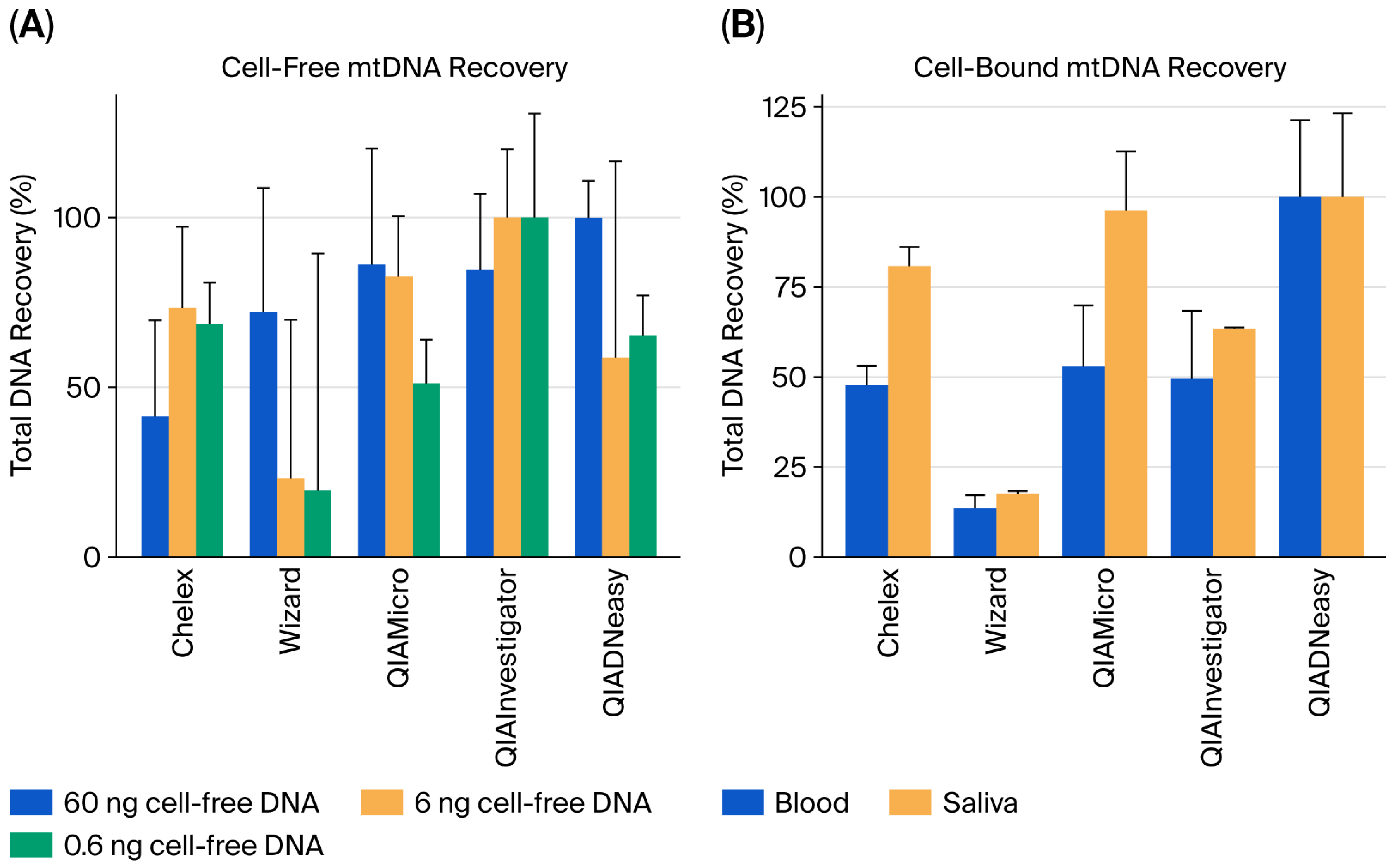
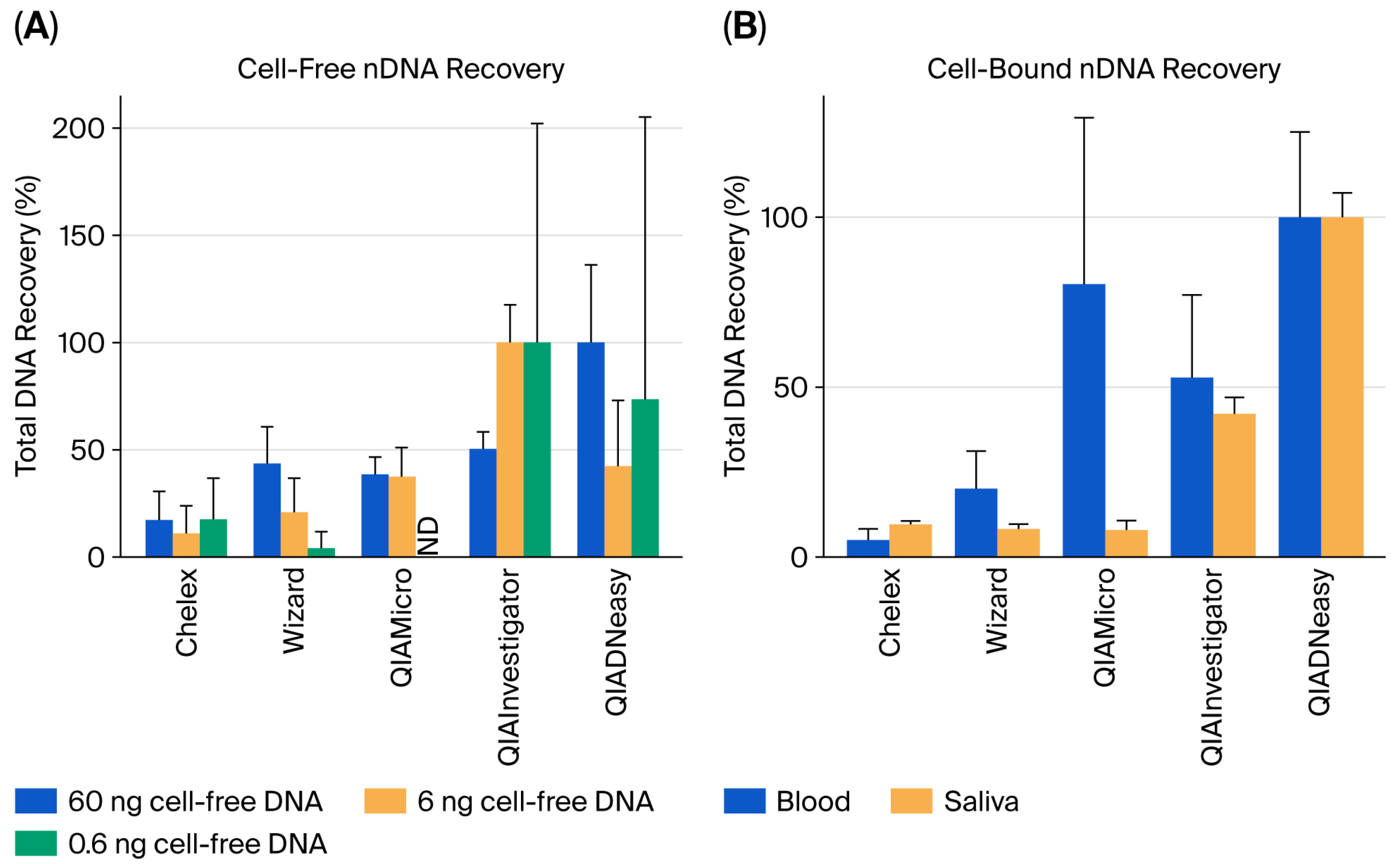
3.1. Extraction Kit Comparisons
3.2. DNA Loss
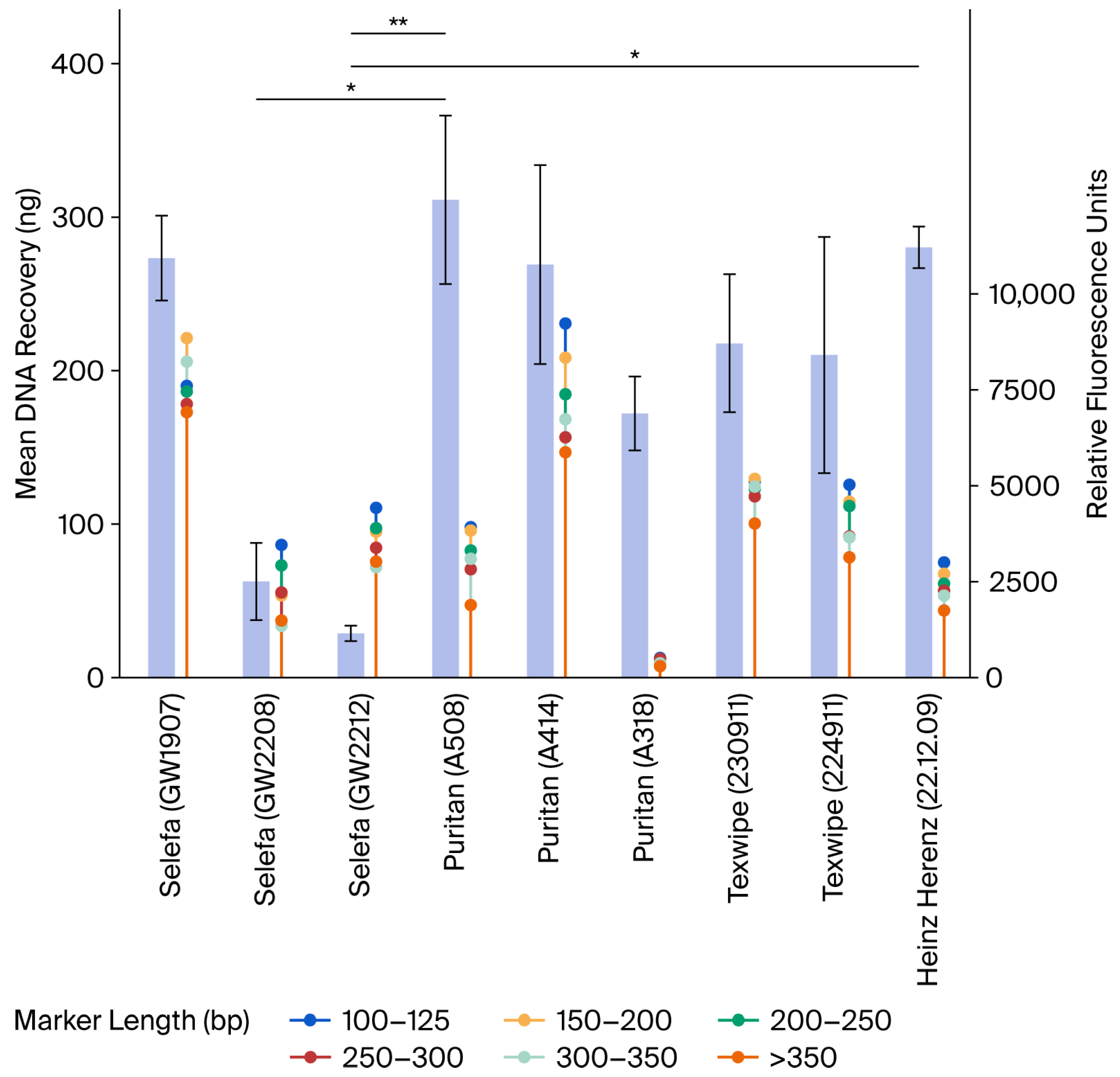
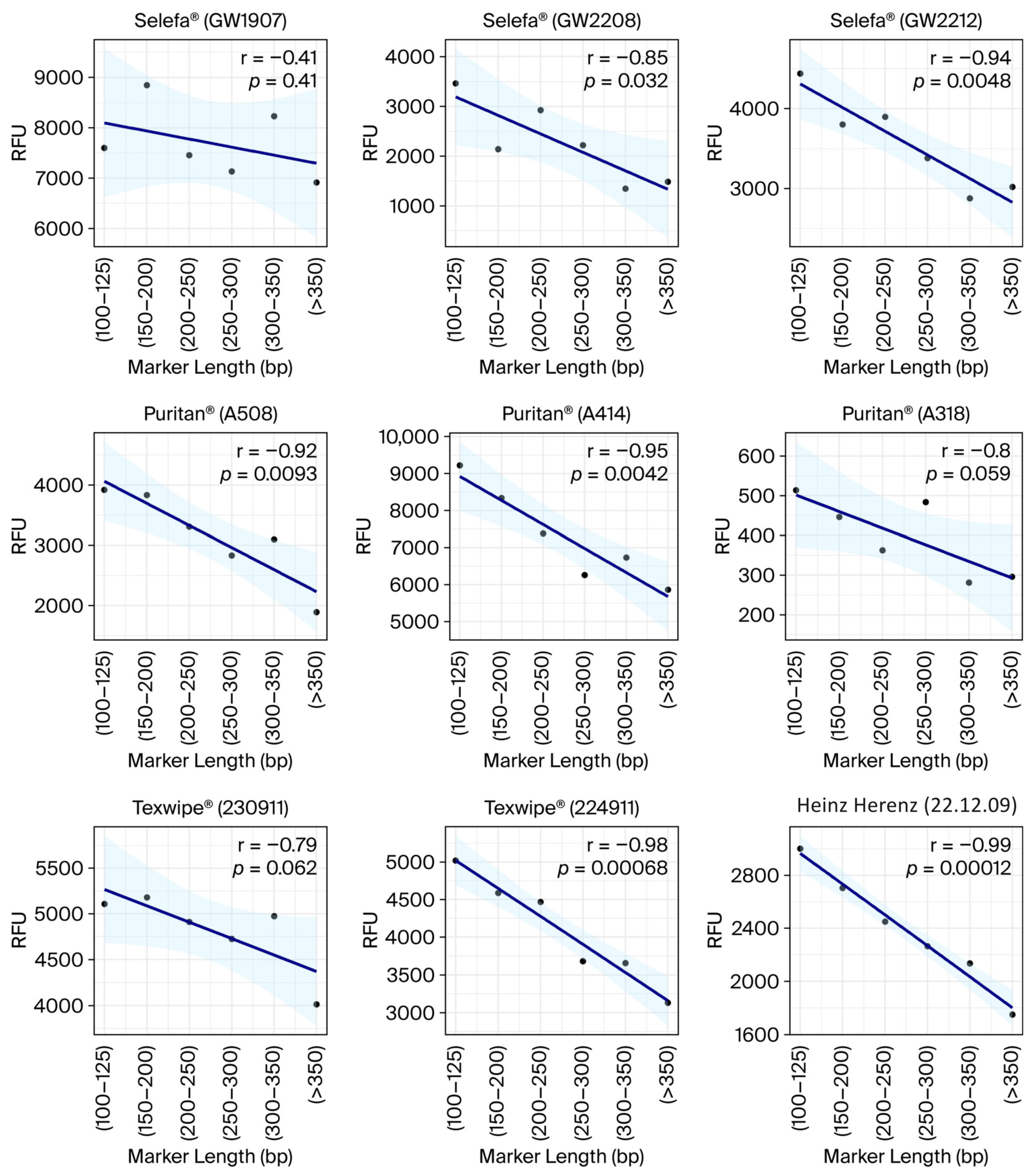
3.3. Swab Comparisons
4. Discussion
5. Conclusions
Supplementary Materials
Author Contributions
Funding
Institutional Review Board Statement
Informed Consent Statement
Data Availability Statement
Conflicts of Interest
References
- Martin, B.; Taylor, D.; Linacre, A. Comparison of six commercially available STR kits for their application to touch DNA using direct PCR. Forensic Sci. Int. Rep. 2021, 4, 100243. [Google Scholar] [CrossRef]
- Ludeman, M.J.; Zhong, C.; Mulero, J.J.; Lagacé, R.E.; Hennessy, L.K.; Short, M.L.; Wang, D.Y. Developmental validation of GlobalFilerTM PCR amplification kit: A 6-dye multiplex assay designed for amplification of casework samples. Int. J. Leg. Med. 2018, 132, 1555–1573. [Google Scholar] [CrossRef] [PubMed]
- Butler, J.M.; Coble, M.D.; Vallone, P.M. STRs vs. SNPs: Thoughts on the future of forensic DNA testing. Forensic Sci. Med. Pathol. 2007, 3, 200–205. [Google Scholar] [CrossRef] [PubMed]
- van Oorschot, R.A.H.; Ballantyne, K.N.; Mitchell, R.J. Forensic trace DNA: A review. Investig. Genet. 2010, 1, 14. [Google Scholar] [CrossRef]
- Senge, T.; Madea, B.; Junge, A.; Rothschild, M.A.; Schneider, P.M. STRs, mini STRs and SNPs—A comparative study for typing degraded DNA. Leg. Med. 2011, 13, 68–74. [Google Scholar] [CrossRef]
- Dixon, L.A.; Dobbins, A.E.; Pulker, H.K.; Butler, J.M.; Vallone, P.M.; Coble, M.D.; Parson, W.; Berger, B.; Grubwieser, P.; Mogensen, H.; et al. Analysis of artificially degraded DNA using STRs and SNPs-results of a collaborative European (EDNAP) exercise. Forensic Sci. Int. 2006, 164, 33–44. [Google Scholar] [CrossRef]
- Gill, P.; Whitaker, J.; Flaxman, C.; Brown, N.; Buckleton, J. An investigation of the rigor of interpretation rules for STRs derived from less than 100 pg of DNA. Forensic Sci. Int. 2000, 112, 17–40. [Google Scholar] [CrossRef]
- Coble, M.D.; Butler, J.M. Characterization of new miniSTR loci to aid analysis of degraded DNA. J. Forensic Sci. 2005, 50, 43–53. [Google Scholar] [CrossRef]
- Allen, M.; Engström, A.S.; Meyers, S.; Handt, O.; Saldeen, T.; von Haeseler, A.; Pääbo, S.; Gyllensten, U. Mitochondrial DNA sequencing of shed hairs and saliva on robbery caps: Sensitivity and matching probabilities. J. Forensic Sci. 1998, 43, 453–464. [Google Scholar] [CrossRef]
- Wickenheiser, R.A. Trace DNA: A review, discussion of theory, and application of the transfer of trace quantities of DNA through skin contact. J. Forensic Sci. 2002, 47, 442–450. [Google Scholar] [CrossRef]
- van Oorschot, R.A.H.; Jones, M.K. DNA fingerprints from fingerprints. Nature 1997, 387, 767. [Google Scholar] [CrossRef]
- Burrill, J.; Daniel, B.; Frascione, N. A review of trace “Touch DNA” deposits: Variability factors and an exploration of cellular composition. Forensic Sci. Int. Genet. 2019, 39, 8–18. [Google Scholar] [CrossRef] [PubMed]
- Tozzo, P.; Mazzobel, E.; Marcante, B.; Delicati, A.; Caenazzo, L. Touch DNA Sampling Methods: Efficacy Evaluation and Systematic Review. Int. J. Mol. Sci. 2022, 23, 15541. [Google Scholar] [CrossRef] [PubMed]
- Prasad, E.; Hitchcock, C.; Raymond, J.; Cole, A.; Barash, M.; McNevin, D.; van Oorschot, R.A. Touch DNA recovery from unfired and fired cartridges: Comparison of swabbing, tape lifting and soaking. Forensic Sci. Int. 2022, 330, 111101. [Google Scholar] [CrossRef] [PubMed]
- Balogh, M.K.; Burger, J.; Bender, K.; Schneider, P.M.; Alt, K.W. STR genotyping and mtDNA sequencing of latent fingerprint on paper. Forensic Sci. Int. 2003, 137, 188–195. [Google Scholar] [CrossRef]
- Quinones, I.; Daniel, B. Cell free DNA as a component of forensic evidence recovered from touched surfaces. Forensic Sci. Int. Genet. 2012, 6, 26–30. [Google Scholar] [CrossRef]
- Raymond, J.J.; van Oorschot, R.A.H.; Gunn, P.R.; Walsh, S.J.; Roux, C. Trace evidence characteristics of DNA: A preliminary investigation of the persistence of DNA at crime scenes. Forensic Sci. Int. Genet. 2009, 4, 26–33. [Google Scholar] [CrossRef]
- Goray, M.; Mitchell, R.J.; van Oorschot, R.A.H. Investigation of secondary DNA transfer of skin cells under controlled test conditions. Leg. Med. 2010, 12, 117–120. [Google Scholar] [CrossRef]
- Lowe, A.; Murray, C.; Whitaker, J.; Tully, G.; Gill, P. The propensity of individuals to deposit DNA and secondary transfer of low level DNA from individuals to inert surfaces. Forensic Sci. Int. 2002, 129, 25–34. [Google Scholar] [CrossRef]
- Währer, J.; Kehm, S.; Allen, M.; Brauer, L.; Eidam, O.; Seiberle, I.; Kron, S.; Scheurer, E.; Schulz, I. The DNA-Buster: The evaluation of an alternative DNA recovery approach. Forensic Sci. Int. Genet. 2023, 64, 102830. [Google Scholar] [CrossRef]
- Champion, J.; Kanokwongnuwut, P.; van Oorschot, R.A.H.; Taylor, D.; Linacre, A. Evaluation of a fluorescent dye to visualize touch DNA on various substrates. J. Forensic Sci. 2021, 66, 1435–1442. [Google Scholar] [CrossRef] [PubMed]
- Chong, K.W.Y.; Thong, Z.; Syn, C.K. Recent trends and developments in forensic DNA extraction. Wiley Interdiscip. Rev. Forensic Sci. 2021, 3, e1395. [Google Scholar] [CrossRef]
- van Oorschot, R.A.H.; Phelan, D.G.; Furlong, S.; Scarfo, G.M.; Holding, N.L.; Cummins, M.J. Are you collecting all the available DNA from touched objects? Int. Congr. Ser. 2003, 1239, 803–807. [Google Scholar] [CrossRef]
- Verdon, T.J.; Mitchell, R.J.; van Oorschot, R.A.H. Swabs as DNA collection devices for sampling different biological materials from different substrates. J. Forensic Sci. 2014, 59, 1080–1089. [Google Scholar] [CrossRef]
- Comment, D.; Gouy, A.; Zingg, C.; Zieger, M. A holistic approach for the selection of forensic DNA swabs. Forensic Sci. Int. 2023, 348, 111737. [Google Scholar] [CrossRef]
- Bruijns, B.B.; Tiggelaar, R.M.; Gardeniers, H. The Extraction and Recovery Efficiency of Pure DNA for Different Types of Swabs. J. Forensic Sci. 2018, 63, 1492–1499. [Google Scholar] [CrossRef]
- Bruijns, B. What Are the Limitations and Challenges of Swab-Based DNA Sampling? Forensic Sci. 2024, 4, 76–95. [Google Scholar] [CrossRef]
- Andréasson, H.; Gyllensten, U.; Allen, M. Real-Time DNA Quantification of Nuclear and Mitochondrial DNA in Forensic Analysis. Biotechniques 2002, 33, 402–411. [Google Scholar] [CrossRef]
- Parson, W.; Gusmão, L.; Hares, D.R.; Irwin, J.A.; Mayr, W.R.; Morling, N.; Pokorak, E.; Prinz, M.; Salas, A.; Schneider, P.; et al. DNA Commission of the International Society for Forensic Genetics: Revised and extended guidelines for mitochondrial DNA typing. Forensic Sci. Int. Genet. 2014, 13, 134–142. [Google Scholar] [CrossRef]
- Nilsson, M.; De Maeyer, H.; Allen, M. Evaluation of Different Cleaning Strategies for Removal of Contaminating DNA Molecules. Genes 2022, 13, 162. [Google Scholar] [CrossRef]
- Hedman, J.; Akel, Y.; Jansson, L.; Hedell, R.; Wallmark, N.; Forsberg, C.; Ansell, R. Enhanced forensic DNA recovery with appropriate swabs and optimized swabbing technique. Forensic Sci. Int. Genet. 2021, 53, 102491. [Google Scholar] [CrossRef] [PubMed]
- Adamowicz, M.S.; Stasulli, D.M.; Sobestanovich, E.M.; Bille, T.W. Evaluation of methods to improve the extraction and recovery of DNA from cotton swabs for forensic analysis. PLoS ONE 2014, 9, e116351. [Google Scholar] [CrossRef] [PubMed]
- Tang, J.; Ostrander, J.; Wickenheiser, R.; Hall, A. Touch DNA in forensic science: The use of laboratory-created eccrine fingerprints to quantify DNA loss. Forensic Sci. Int. 2020, 2, 1–16. [Google Scholar] [CrossRef] [PubMed]
- Ottens, R.; Templeton, J.; Paradiso, V.; Taylor, D.; Abarno, D.; Linacre, A. Application of direct PCR in forensic casework. Forensic Sci. Int. Genet. Suppl. Ser. 2013, 4, e47–e48. [Google Scholar] [CrossRef]
- Recipon, M.; Agniel, R.; Kunemann, P.; Ponche, A.; Carreiras, F.; Hermitte, F.; Leroy-Dudal, J.; Hubac, S.; Gallet, O.; Kellouche, S. Detection of invisible biological traces in relation to the physicochemical properties of substrates surfaces in forensic casework. Sci. Rep. 2024, 14, 13271. [Google Scholar] [CrossRef]
- Kaesler, T.; Kirkbride, K.P.; Linacre, A. Persistence of touch DNA on commonly encountered substrates in different storage conditions. Forensic Sci. Int. 2023, 348, 111728. [Google Scholar] [CrossRef]
- Kemp, B.M.; Winters, M.; Monroe, C.; Barta, J.L. How much DNA is lost? Measuring DNA loss of short-tandem-repeat length fragments targeted by the powerplex 16® system using the Qiagen Minelute purification kit. Hum. Biol. 2015, 86, 313–329. [Google Scholar] [CrossRef]
- Mulligan, C.M.; Kaufman, S.R.; Quarino, L. The utility of polyester and cotton as swabbing substrates for the removal of cellular material from surfaces. J. Forensic Sci. 2011, 56, 485–490. [Google Scholar] [CrossRef]
- Brownlow, R.J.; Dagnall, K.E.; Ames, C.E. A Comparison of DNA Collection and Retrieval from Two Swab Types (Cotton and Nylon Flocked Swab) when Processed Using Three QIAGEN Extraction Methods. J. Forensic Sci. 2012, 57, 713–717. [Google Scholar] [CrossRef]
- Funes-Huacca, M.E.; Opel, K.; Thompson, R.; Mccord, B.R. A comparison of the effects of PCR inhibition in quantitative PCR and forensic STR analysis. Electrophoresis 2011, 32, 1084–1089. [Google Scholar] [CrossRef]
- Opel, K.L.; Chung, D.; McCord, B.R. A study of PCR inhibition mechanisms using real time PCR. J. Forensic Sci. 2010, 55, 25–33. [Google Scholar] [CrossRef]



| Swab | Lot Number | Manufacturer Reference | Expiry Date | Manufacturer |
|---|---|---|---|---|
| Selefa® | GW1907 | 120788 | June 2022 | OneMed Group (Stockholm, Sweden) |
| Selefa® | GW2208 | 120788 | July 2025 | OneMed Group |
| Selefa® | GW2212 | 120788 | November 2025 | OneMed Group |
| Puritan® | A508 | 25-806 1WC FDNA | June 2028 | Puritan Medical Products (Guilford & Maine, MN, USA) |
| Puritan® | A414 | 25-806 2WC | April 2028 | Puritan Medical Products |
| Puritan® | A318 | 25-806 1WC FDNA | February 2028 | Puritan Medical Products |
| Texwipe® | 224911 | STX705W | December 2025 | Texwipe® An ITW Company (Kernersville, NC, USA) |
| Texwipe® | 230911 | STX705P | March 2026 | Texwipe® An ITW Company |
| Heinz Herenz | 22.12.09 | 1030419 | September 2027 | Heinz Herenz, Medizinalbedarf GmbH (Hamburg, Germany) |
Disclaimer/Publisher’s Note: The statements, opinions and data contained in all publications are solely those of the individual author(s) and contributor(s) and not of MDPI and/or the editor(s). MDPI and/or the editor(s) disclaim responsibility for any injury to people or property resulting from any ideas, methods, instructions or products referred to in the content. |
© 2026 by the authors. Licensee MDPI, Basel, Switzerland. This article is an open access article distributed under the terms and conditions of the Creative Commons Attribution (CC BY) license.
Share and Cite
Salih, G.A.; Nilsson, M.; Allen, M. DNA Recovery Using Different Extraction Kits and Cotton Swabs in Forensic DNA Analysis. Genes 2026, 17, 457. https://doi.org/10.3390/genes17040457
Salih GA, Nilsson M, Allen M. DNA Recovery Using Different Extraction Kits and Cotton Swabs in Forensic DNA Analysis. Genes. 2026; 17(4):457. https://doi.org/10.3390/genes17040457
Chicago/Turabian StyleSalih, Ghassan Ali, Martina Nilsson, and Marie Allen. 2026. "DNA Recovery Using Different Extraction Kits and Cotton Swabs in Forensic DNA Analysis" Genes 17, no. 4: 457. https://doi.org/10.3390/genes17040457
APA StyleSalih, G. A., Nilsson, M., & Allen, M. (2026). DNA Recovery Using Different Extraction Kits and Cotton Swabs in Forensic DNA Analysis. Genes, 17(4), 457. https://doi.org/10.3390/genes17040457