Article

Morphological and Cyto-Nuclear Conflicting Signals Across Non-Sister Lineages in Darkling Beetles (Tenebrionidae: Akis)

by
Pilar Jurado-Angulo
1,2,3,
Ernesto Recuero
1,4,
José L. Ruiz
5 and
Mario García-París
1,*
1
Department of Biodiversity and Evolutionary Biology, Museo Nacional de Ciencias Naturales (MNCN, CSIC), c/José Gutiérrez Abascal, 2, 28006 Madrid, Spain
2
CIBIO, Centro de Investigação em Biodiversidade e Recursos Genéticos, InBIO Laboratório Associado, BIOPOLIS Program in Genomics, Biodiversity and Land Planning, Campus de Vairão, Universidade do Porto, 4485-661 Vairão, Portugal
3
Departamento de Biologia, Faculdade de Ciências, Universidade do Porto, 4169-007 Porto, Portugal
4
Departamento de Biología, Universidad Rey Juan Carlos, c/Tulipán s/n, Móstoles, 28933 Madrid, Spain
5
Instituto de Estudios Ceutíes, Paseo del Revellín 30, 51001 Ceuta, Spain
*
Author to whom correspondence should be addressed.
Genes 2026, 17(4), 455; https://doi.org/10.3390/genes17040455
Submission received: 15 January 2026 / Revised: 17 March 2026 / Accepted: 23 March 2026 / Published: 14 April 2026
(This article belongs to the Section Animal Genetics and Genomics)

Abstract

Background/Objectives: Cyto-nuclear discordances, resulting from the independent evolutionary histories of cytoplasmic and nuclear genomes, often obscure phylogenetic inference and species delimitation, particularly at shallow taxonomic levels. In this study, we examine the extent and causes of cyto-nuclear discordances within the darkling beetle tribe Akidini (Coleoptera: Tenebrionidae), focusing on the genera Akis Herbst, 1799 and Morica Dejean, 1834. Methods: Using two molecular markers—nuclear histone 3 (H3) and mitochondrial cytochrome c oxidase subunit I (COI)—and a comprehensive sampling from western Europe and northern Africa, we assess reciprocal monophyly, internal relationships, and phylogenetic incongruence across datasets. Results: Discordances between morphological species assignment and mitochondrial topologies may result from retained ancient polymorphisms or historical introgression among closely related species (e.g., Akis genei vs. Akis lusitanica). However, these causes seem less plausible for explaining discordances between nuclear and mitochondrial markers involving non-closely related species (e.g., A. discoidea and A. granulifera). The geographic location of the problematic specimens, limited to a narrow marginal contact zone between the two non-sister species, suggests that local hybridisation may occur. Conclusions: Our results indicate that cyto-nuclear discordances between mitochondrial and nuclear markers, even across morphologically well-differentiated non-sister lineages, may be more frequent than previously assumed in darkling beetles, highlighting both their evolutionary relevance and the need for caution when relying solely on mitochondrial data for species identification.

1. Introduction

The phylogenetic conflict across molecular markers is generally the result of differences in the models of molecular evolution affecting different genes or DNA fragments [1,2,3] or even different sections of a single gene [4]. The problem becomes even more complex when genes from different evolutionary backgrounds, e.g., nuclear vs. cytoplasmic, are compared or analysed together [5,6,7,8]. Organelle (mitochondrion or chloroplast) and nuclear genes not only differ in their model of evolution but also in highly relevant traits such as ploidy, inheritance mode, recombination, and demography [8,9]. These differences often result in conflicting or potentially misleading phylogenetic signals, particularly at shallow evolutionary scales, when markers are compared or analysed together. Evolution of nuclear DNA is also heterogeneous, with substantial differences among markers subject to highly different evolutionary models (e.g., coding, ribosomal, spacers…) [2,10].
Phylogenetic conflict among markers is often assumed to be minimised by combining and analysing together large genome datasets [11,12,13,14], under the expectation that the statistically predominant signal reflects the true phylogenetic relationships of the studied organisms. However, such an approach may not always be reliable: phylogenetic hypotheses can differ according to the datasets included [8,15,16], or may fail to accurately reflect the underlying evolutionary history [17,18,19,20]. As suggested by coalescent theory [21,22,23,24], combining large genomic datasets is likely to provide reliable inferences for deep phylogenetic relationships when taxon sampling is thorough [25,26,27], but it is very unlikely that it works out equally well for more recent, e.g., shallow in time, phylogenetic hypotheses [28,29].
One further, less explored drawback of combining datasets for phylogenetic inference is the potential loss of relevant evolutionary information provided by each individual dataset. The hypothesis derived from loci sharing a common evolutionary mode depicts a “true” phylogeny, i.e., the evolutionary history of the marker analysed for the lineage studied [16,30]. However, such information can be masked or diluted when combined with another “also true” hypothesis, generated either using super-trees or by analysing concatenated datasets that include markers with different evolutionary modes of even different evolutionary or demographic histories [31,32,33]. This loss of information is particularly relevant when the phylogeny includes taxa or lineages that have only recently acquired reproductive incompatibility and may therefore still show evidence of recent past hybridisation or gene introgression [34,35,36], or even phylogenies that include older taxa but with very different demographic histories, resulting in substantially different amount of evolutionary change across them [37]. In these cases, combining datasets will render a single phylogenetic hypothesis that primarily reflects the evolutionary history of the dominant dataset (i.e., the one with the largest proportion of informative characters, irrespective of its informative content), thereby failing to capture the independent information provided by each dataset [32,38].
This problem is particularly relevant when combining mitochondrial and nuclear datasets for phylogenetic reconstruction of shallow-time phylogenies, such as those comprising species within a single tribe, genus, or species–group [7,39]. When combining cytoplasmic and nuclear data that independently produced different topologies, direct information on the processes generating each topology may be lost. This issue has long been discussed in studies on mtDNA evolution, which have shown that the spatial position of secondary contact zones can shift by tens to hundreds of kilometres when inferred from mtDNA compared with nuclear and morphological data [40,41]. Most of these studies have been conducted in well-studied taxa that already have substantial documentation regarding hybridisation or secondary contact zones. In most other groups, the extent and frequency of hybridisation or gene introgression across secondary contact zones is mostly unknown, making it difficult to determine the extent of information lost when combining datasets.
Beetles of the family Tenebrionidae (darkling beetles) are one of these less studied groups in which cyto-nuclear discordances have been already reported without further investigation [42]. Darkling beetles are a main component of the biodiversity of arid and semi-arid regions all over the world. Most species are relatively common and easy to identify at the genus level, but the internal taxonomic structuring within genera is often complex and problematic. In such cases, molecular data are extremely useful for defining evolutionary units and delimiting species hypotheses. However, there is very little information on the extent and frequency of cyto-nuclear discordances across the family, which renders the use of combined datasets not necessarily reliable for certain intra-genus phylogenetic approximations.
In this study, we address this issue by focusing on two of the most conspicuous genera of the Old World Tenebrionidae: Akis Herbst, 1799 and Morica Dejean, 1834 (tribe Akidini), with two main objectives. First, to assess the reciprocal monophyly and preliminary internal phylogenetic relationships of each genus by analysing two molecular markers, nuclear histone 3 (H3) and mitochondrial cytochrome c oxidase subunit I (COI), in a robust taxon sampling of Akidini from western Europe and Northern Africa. This sampling included 10 species of Akis (28% of the world diversity) and three of Morica (60% of the world diversity), with most species represented by multiple populations and individuals. Second, to identify discordances between molecular markers (nuclear vs. mitochondrial) and morphological data by contrasting the topologies obtained for each individual marker with the morphological traits of each specimen, and to explore the causes of discordances. We found that phylogenetic discordances in Akidini are likely a consequence of retained ancestral polymorphisms or historical past introgression among recently differentiated taxa or closely related species but may also result from recent processes of hybridisation across secondary contact zones between non-sister species of well-differentiated clades. With this information, we evaluate the utility of analysing independently molecular datasets of diverse nature, even if they are phylogenetically consistent.

2. Materials and Methods

2.1. Taxon Sampling and DNA Sequencing

Specimens of Akis and Morica were collected from the Iberian Peninsula, Balearic Islands, and North Africa. The sampling included 10 species of Akis (110 specimens) and three species of Morica (10 specimens), as well as four specimens of Leptoderis collaris (Linnaeus, 1767) (tribe Elenophorini) used as outgroup in the phylogenetic analyses (Table 1).
Specimens were captured by hand, injected with 96% ethanol and preserved in absolute ethanol at −20 °C at the Museo Nacional de Ciencias Naturales (MNCN-CSIC, Madrid). Tissues for DNA extraction were obtained from under the metacoxal plates of the ethanol-preserved individuals.
Subsequently, these tissues were digested and the DNA was purified using the Qiagen DNeasy Blood & Tissue (Qiagen, Hilden, Germany). Partial sequences of the mitochondrial cytochrome c oxidase subunit I (COI), mitochondrial molecular marker that is informative at both interspecific and intraspecific levels, and the gene histone 3 (H3), a nuclear marker with a slower mutation rate than the former, were amplified by polymerase chain reaction (PCR). The set of primers LCO1490 [43]/COI-H [44] and TY-J-1460 [45]/COI-H [44] for the COI, and HexAF/HexAR [46] for the H3 were used. PCR amplifications were performed in a final volume of 25 μl, including 1 μl of template DNA, 0.2 μl of DNA polymerase (Biotools, Madrid, Spain, 5 U/μl), 1 μl of each primer (10 μM), 1 μl of dNTP mix (10 μM), 0.25 μl of MgCl2 (50 mM), and 2.5 μl of reaction buffer (Tris–HCl, pH 8.3, Biotools). PCR for COI was run with the following conditions: initial denaturation at 94 °C for 5 min, followed by 35 cycles at 94 °C for 30 s, 42–44 °C for 45 s and 72 °C for 1 min, and a final extension step at 72 °C for 5 min. PCR cycling profile for H3 was: initial denaturation at 94 °C for 5 min, followed by 35 cycles at 94 °C for 40 s, 50 °C for 40 s and 72 °C for 40 s, and a final extension step at 72 °C for 5 min. PCR products were checked in a 1.5% agarose gel and the products of expected length were purified with ethanol–sodium acetate and sequenced in automatic Sanger sequencers by SECUGEN (Madrid, Spain).
Sequences were compiled and revised with the software Sequencer v.5.4.8 (Gene Codes Corporation, Ann Arbor, MI, USA), and aligned manually. Alignments were visually inspected and checked for potential presence of stop codons using Geneious Prime 21.1.1 software. H3 sequences were assembled as a single consensus sequence per individual from forward and reverse Sanger reads. Heterozygous sites were retained and coded using standard IUPAC ambiguity codes, and no allele phasing was performed.

2.2. Phylogenetic Analyses

Three different datasets were constructed for the phylogenetic analyses: one for each sequenced gene (Figure 1 and Figure 2) and a third comprising both genes concatenated (Figure 3). First, the best-fit substitution models for each gene were determined using JModelTest ver. 2.1.10 [47]. These models were subsequently applied in the Bayesian analyses, both for the individual gene assessments and the combined analysis. In the latter, two partitions were defined based on the genes, considering the different models applicable to each gene.
We assessed substitution saturation for COI using the entropy-based Xia test implemented in DAMBE (DAMBE7) [48], evaluating all sites and codon partitions (1st + 2nd vs. 3rd positions) using 60 replicates; Iss was compared to the critical Iss.c under both symmetrical and asymmetrical topologies.
The analyses were conducted in MrBayes ver. 3.2.6 [49] and comprised two simultaneous runs of 10 million generations, with trees sampled every 1000 generations. Convergence of the Monte Carlo Markov chains (MCMC) were verified using Tracer v.1.7 [50], by examining trace plots and Effective Sample Size (ESS). A 20% “burn-in” was applied to remove the initially topologies. The final results were summarised in a Maximum Clade Credibility (MCC) tree using TreeAnnotator v.1.8.4 [51], and posterior probability values (PP) were considered as an estimate of the stability.
We also analysed the three datasets using a maximum-likelihood phylogenetic approach in IQ-TREE v2.4 [52]. Node support was assessed with 1000 ultrafast bootstrap (UFBS) replicates, and the best-fitting substitution model was selected automatically for each locus using the “-m AUTO” option. Trees were rooted using the outgroup Leptoderis collaris.
To establish a temporal framework for the cladogenesis events observed in our analyses, we employed BEAST version 1.10.4 [53]. We analysed the COI database under a GTR+I+G nucleotide substitution model, and a Birth and Death tree prior. Because no reliable fossil calibrations exist for this lineage, we used a secondary, rate-based calibration derived from a well-characterised biogeographic calibration event and estimated over six different Tenebrionidae genera [54]. We used an uncorrelated lognormal relaxed clock, placing a normal prior on the parameter ucld.mean (mean = 0.0169 substitutions per lineage per Myr; SD = 0.0019), following the estimates reported for tenebrionid beetles [54]. This rate prior assumes that the mitochondrial COI rate is broadly transferable across Tenebrionidae, as commonly adopted in studies lacking fossil constraints. The analyses ran for 20 million generations, sampling trees and other parameters every 2000 generations. The stability and convergence of the results were verified using Tracer v.1.7 [50], with an optimal burn-in of 25%. We used TreeAnnotator v1.10.4 to generate a MCC tree, with posterior probabilities to assess node support.

2.3. Species Delimitation Analyses

We performed distance-based, single-locus species delimitation analyses separately for the genera Akis and Morica using ASAP (Assemble Species by Automatic Partitioning) [55]. ASAP analyses were run via the Spart Explorer platform (https://spartexplorer.mnhn.fr) [56] using our COI dataset, corresponding with the barcoding region typically used in Metazoa [57]. We used simple uncorrected p-distances and set the split-group probability threshold to 0.001. ASAP scores and panmixia probabilities (p-value) were used to select the best-supported species partitions.
Following the recommendations of the ASAP framework [55], we treated ASAP outputs as preliminary species hypotheses within an integrative taxonomy workflow. To reduce potential over-splitting inherent to single-locus, distance-based approaches, we cross-validated ASAP partitions against independent morphological and geographic evidence before drawing final taxonomic conclusions (Table S1).

2.4. Morphological Study

Morphological study was based on the original species descriptions and on the diagnostic characters proposed by zur Strassen [58] and Ferrer et al. [59]. The main diagnostic morphological characters of each species included in this study are summarised in Table S2. Specimens showing discordance between morphological identification and mtDNA were photographed in order to illustrate the observed morphological variability. Photographs were taken using a digital camera Nikon (Nikon Corporation, Tokyo, Japan) and a lens Nikon AF-S VR Micro-Nikkor 105 mm f/2.8 G IF-ED, using the software Helicon Remote ver. 3.9.11 and Helicon Focus ver. 7.6.4.

3. Results

3.1. Species Delimitation

Among species of the genus Akis, ASAP analysis resulted in two similarly supported partitions (ASAP score = 4, p-value = 2.355289 × 10⁻¹/6.467066 × 10−1 for 13/14 species partition, respectively), suggesting the existence of 13 to 14 species hypotheses. These values are slightly higher than our morphological hypotheses, by splitting, as potential different species, clades morphologically defined as A. genei, A. lusitanica (13 species partition) and also A. acuminata (14 species partition). Considering all available evidence (molecular, morphological, and geographic distribution), we consider that ASAP results are slightly overestimating species diversity in those three lineages, as frequently observed for single-locus species delimitation methods [55], and that an integrative taxonomy species delimitation includes 11 species of Akis within our sampling. For the genus Morica, we obtained a single, best supported partition (ASAP score = 1, p-value = 2.215569 × 10⁻¹) including three species, perfectly matching morphological and geographic evidence (Table S1).

3.2. Interspecific Relationships

Xia’s test showed no evidence of saturation when considering all sites (e.g., for the largest subset, NumOTU = 32: Iss = 0.153, Iss.cAsym = 0.393, t = 14.533, df = 662, p < 0.001). For 3rd codon positions, Iss slightly exceed the critical value (NumOTU = 32: Iss = 0.406, Iss.cAsym = 0.366), but the associated test was not statistically significant (t = 1.264, df = 220, p = 0.208). This result suggests faster synonymous evolution at third positions but does not provide significant statistical support for substitution saturation under Xia’s criterion. Results were consistent across alternative NumOTU subsets and under the symmetrical topology.
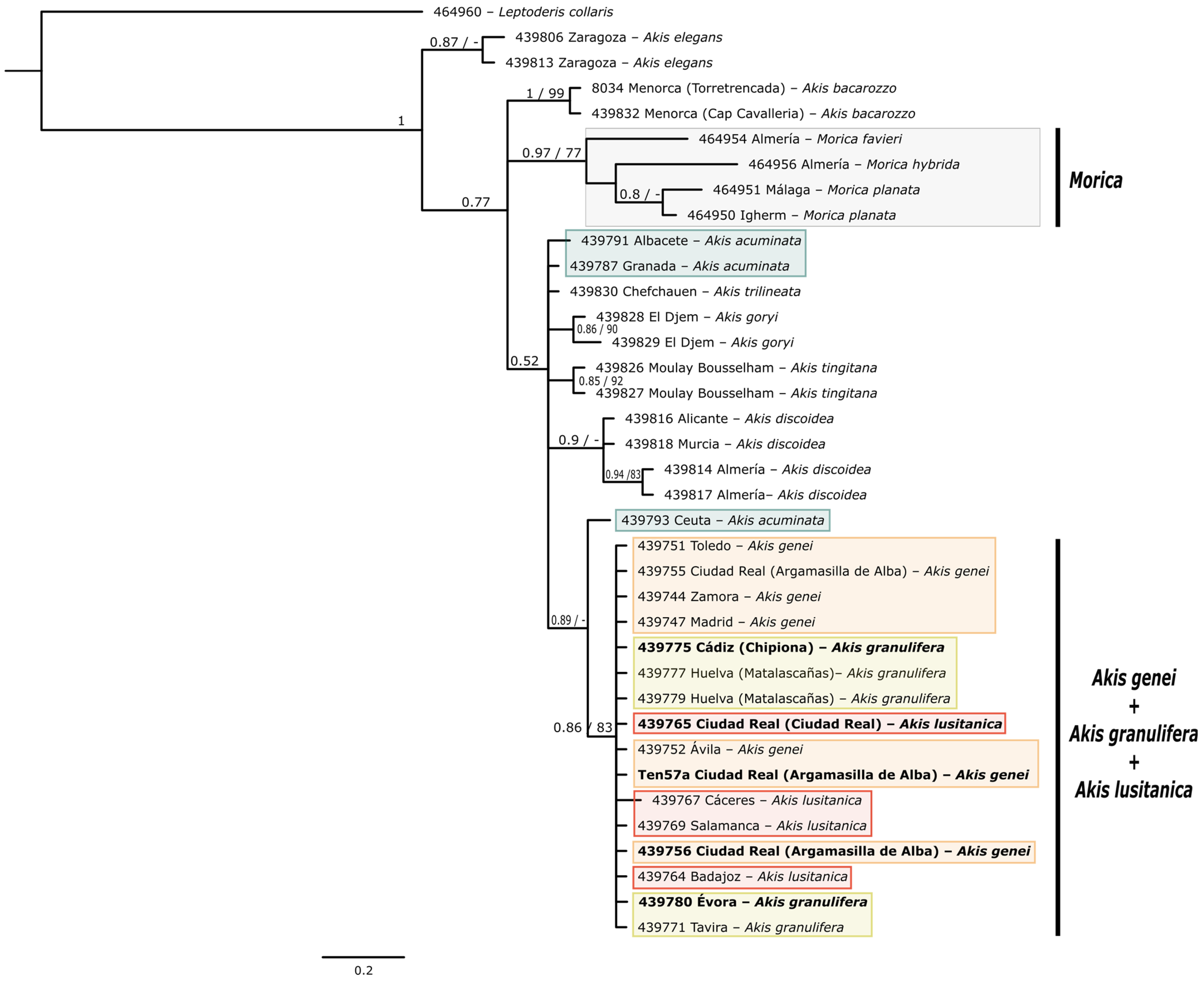
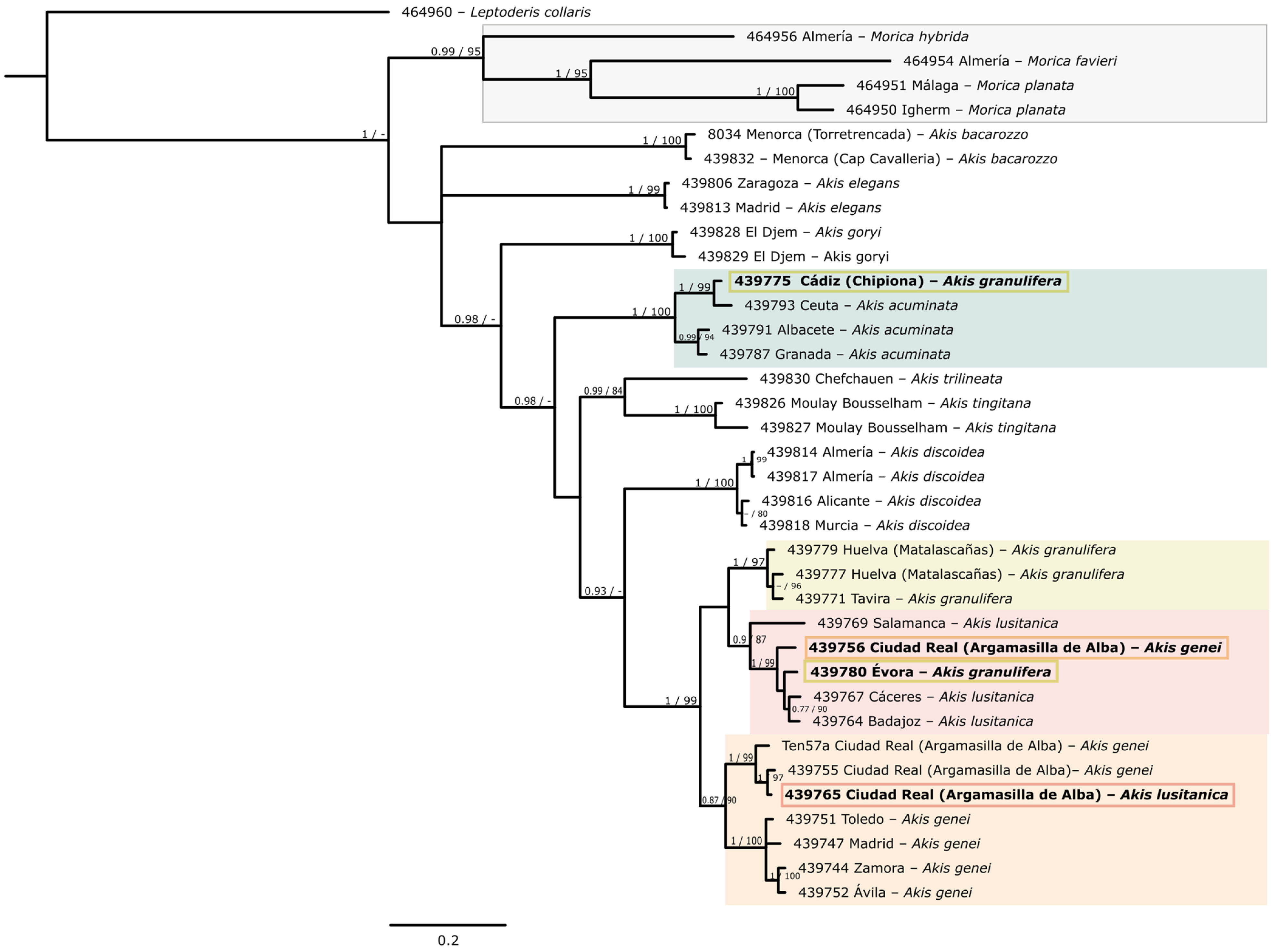
The Bayesian analysis of the partial sequences of COI mtDNA gene and the two combined genes (COI and nuclear H3) confirmed the monophyly of Akis and Morica, respectively (Figure 1 and Figure 3). The analysis of the H3 gene on its own (Figure 2), due to its limited variability, does not provide a statistically well-resolved phylogenetic reconstruction. While it does recover a monophyletic clade for the genus Morica (PP = 0.97; UFBS = 77), the relationships within the genus Akis are less clear, with the position of the lineages corresponding to A. elegans Charpentier, 1825 and A. bacarozzo Schrank von Paula, 1786 being particularly contentious. Within the genus Morica, our results suggest a basal position for the Iberian species M. hybrida Charpentier, 1825, while M. favieri Lucas, 1859 appears more closely related to Morica planata Fabricius, 1801 (Figure 1 and Figure 3).
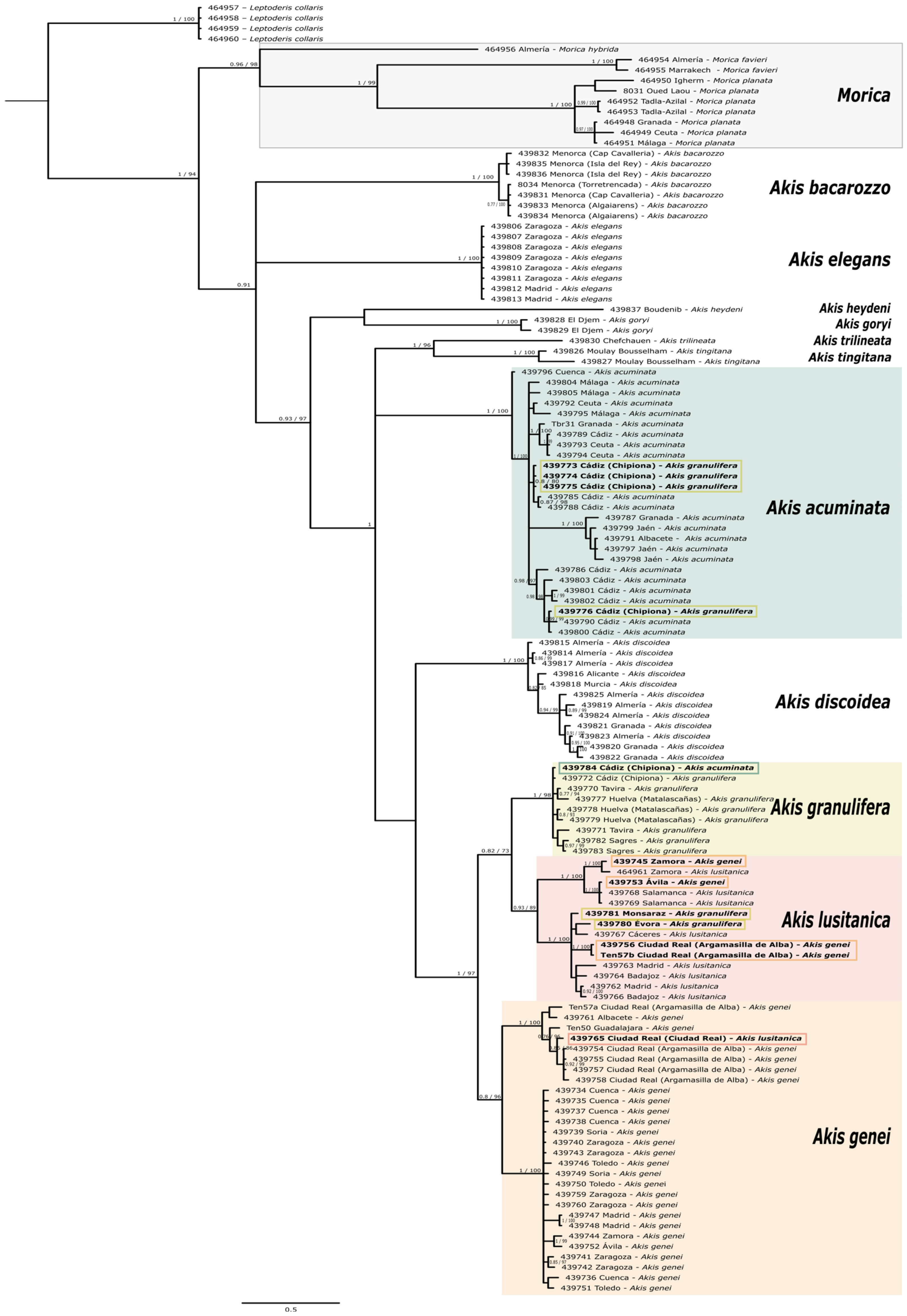
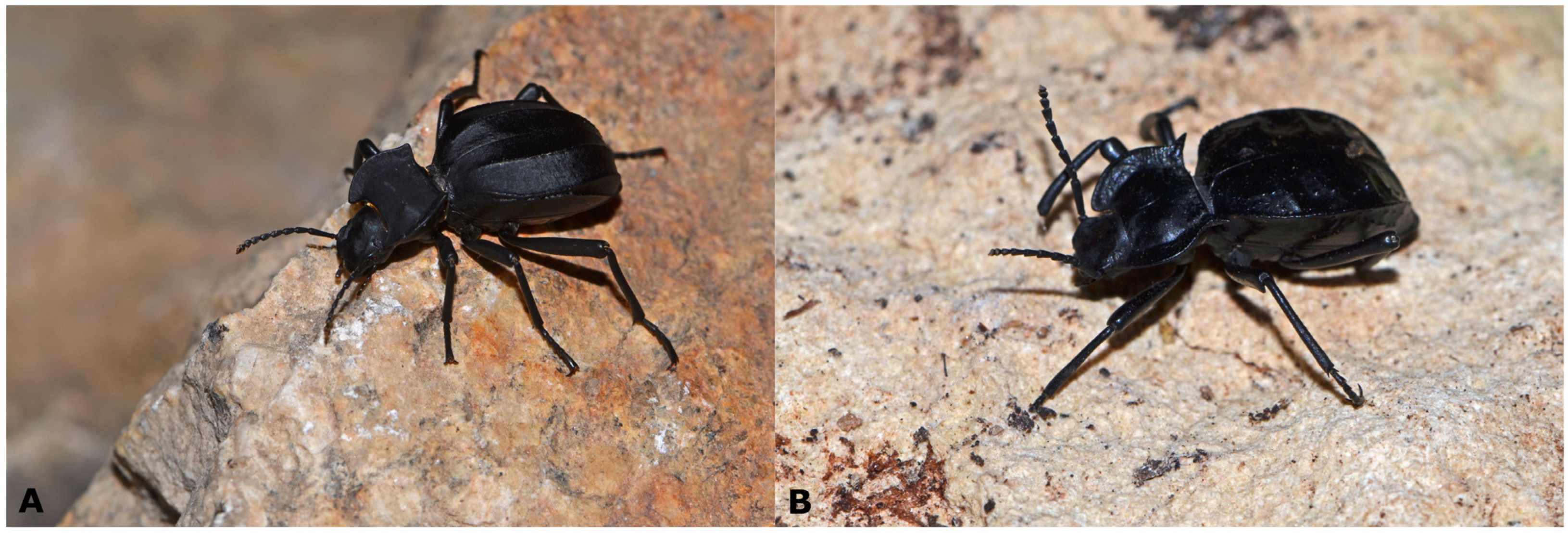
Some relationships within Akis are more difficult to resolve confidently due to the low phylogenetic resolution of both markers when analysed independently (Figure 1 and Figure 2). However, the existence of three main, distinct lineages seems evident: two of them each corresponding with the species A. elegans and A. bacarozzo (Figure 4), and a third one including the remaining species. Within the latter group, A. goryi Solier, 1836 and A. heydeni Haag-Rutenberg, 1876 emerge as sister species, while the position of A. acuminata Fabricius, 1787 remains ambiguous. In the concatenated analysis, A. acuminata appears as the basal lineage of the entire group (PP = 0.98, UFBS = 74; Figure 3), but in the analysis of COI, it forms a polytomy with the clade that groups A. tingitana Lucas, 1859 and A. trilineata Herbst, 1799, and the clade consisting of A. discoidea Quensel, 1806, the sister species to the A. granulifera Sahlberg, 1823 group (which includes A. granulifera, A. genei Solier, 1836, and A. lusitanica Solier, 1836) (Figure 1). Finally, the A. granulifera species group consistently forms a monophyletic clade. In both the COI and concatenated analyses (Figure 1 and Figure 3), A. lusitanica and A. granulifera are more closely related to each other than to A. genei. However, in the H3 analysis (Figure 2), it is not possible to establish relationships between these species, as all sequenced H3 alleles from these three species are almost identical and nested in a single clade with no structure.
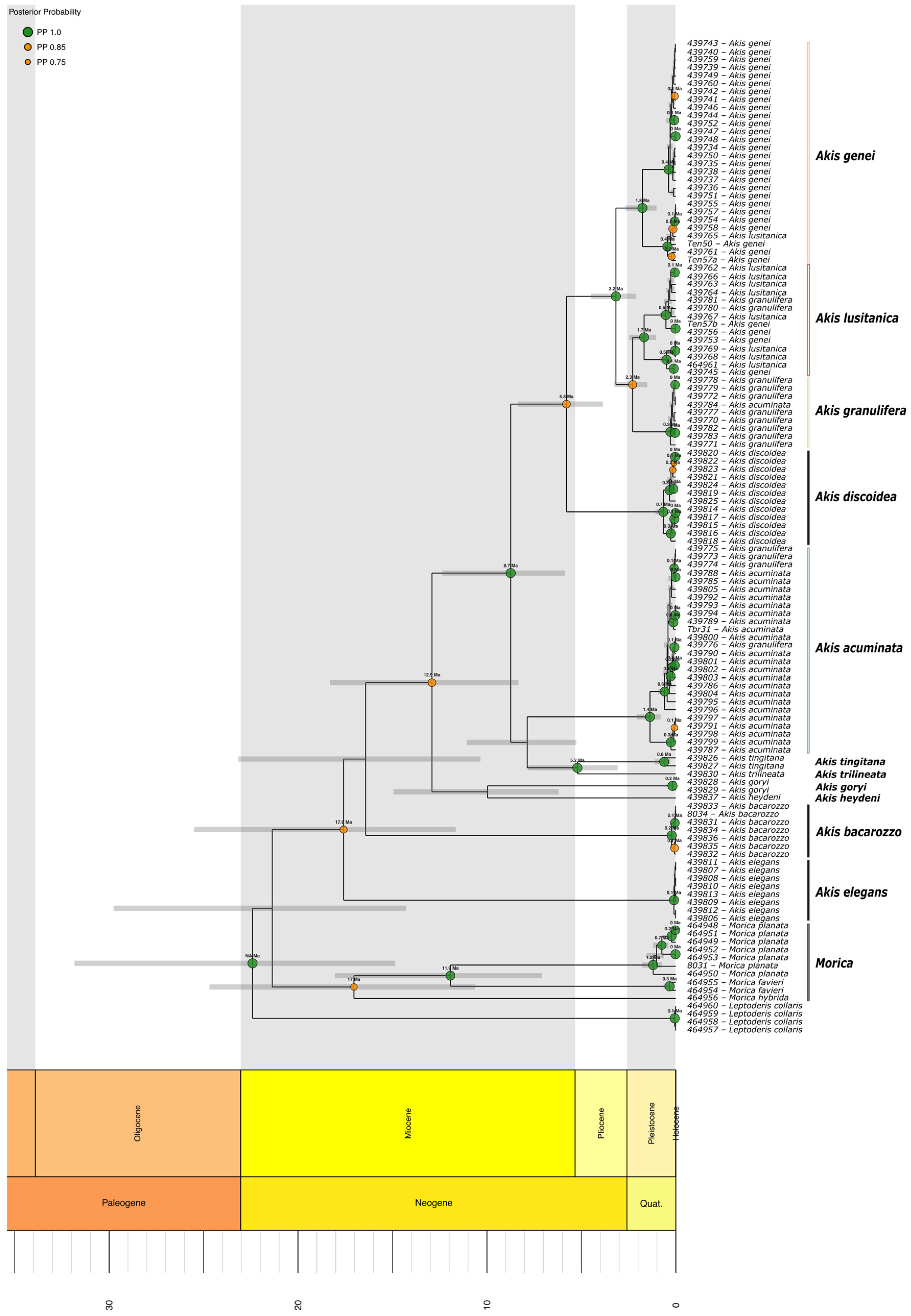
The phylogenetic analysis of the COI sequences using a relaxed molecular clock suggests relatively old divergence times (Figure 5). The Iberian group comprising the taxa Akis discoidea, A. granulifera, A. lusitanica, and A. genei shows an estimated age of their common ancestor between 3.9 and 8.4 million years ago (Ma), with a mean estimated value of 5.79 Ma, with an ancestor for the three latter species estimated in the late Pliocene, around 3.17 (2.1–4.5) Ma. The Iberian–African group, which includes the aforementioned species plus A. acuminata, A. tingitana, and A. trilineata, would have an estimated age between 5.9 and 12.4 Ma, with a mean estimated value of 8.74 Ma. The age of the clade including this group and the African species represented in our analysis by A. goryi and A. heydeni is estimated between 8.3 and 18.3 Ma, with a mean estimated value of 12.91 Ma. The common ancestor for all Akis species included in the analysis occurred around 17.6 (11.6–25.5) Ma. The estimated divergence times among species of Morica are even older than those among species of the genus Akis, although the base of the clade (the split of M. hybrida from the rest) has a similar age estimate of 17.04 (10.6–24.7) Ma. The time to the most recent common ancestor of M. planata and M. favieri was estimated at 11.93 (7.1–18) Ma. Several of the studied species show an intraspecific genetic diversity originating during the Pleistocene, over 1 Ma, including Akis acuminata (1.37, 0.8–2.1 Ma), A. genei (1.77, 1–2.7 Ma), A. lusitanica (1.68, 1–2.5 Ma), and Morica planata (1.2, 0.7–1.8 Ma).

3.3. Intraspecific Relationships

At the intraspecific level, Akis genei presents two divergent clades (Figure 1) with almost parapatric geographic distribution. The northern clade is broadly distributed north and south to the Iberian Central System, in the Spanish provinces of Soria, Zaragoza, Madrid, Toledo, and Cuenca. The southern group has a more restricted distribution, with populations located in the provinces of Ciudad Real, Albacete, and Guadalajara. Based on the distribution of these two groups, it is likely that a broad contact zone between the two lineages exists in La Mancha.
The lineage of A. lusitanica comprises two distinct subclades that are clearly separated by the Central System. A northern subclade is present in Salamanca, Ávila, and Zamora, while a southern subclade extends across Extremadura and central Portugal (Figure 1). Haplotypes assignable to A. lusitanica have even been found as far north as Valdefinjas (Zamora). A population of possibly introduced origin has been detected inside the city of Madrid.
Some specimens morphologically assignable to A. genei from Ávila and Zamora, present mitochondrial haplotypes corresponding to A. lusitanica (Figure 1). Although A. genei and A. lusitanica exhibit mostly separate geographic distributions, mitochondrial haplotypes of A. lusitanica appear in some specimens from populations morphologically assignable to A. genei (in Zamora and Ávila), while mitochondrial haplotypes clustering with A. genei are displayed in populations assignable to A. lusitanica (Ciudad Real).
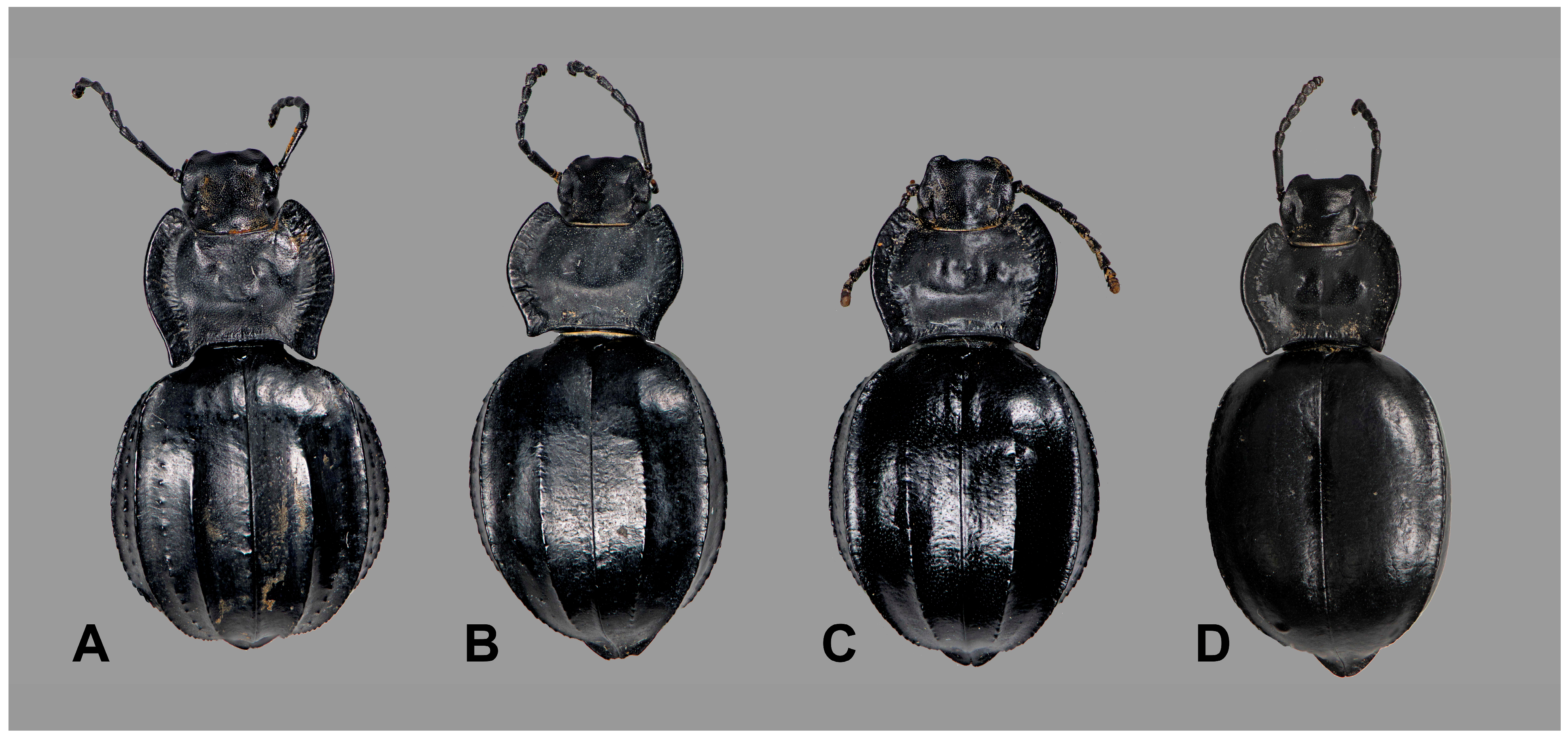
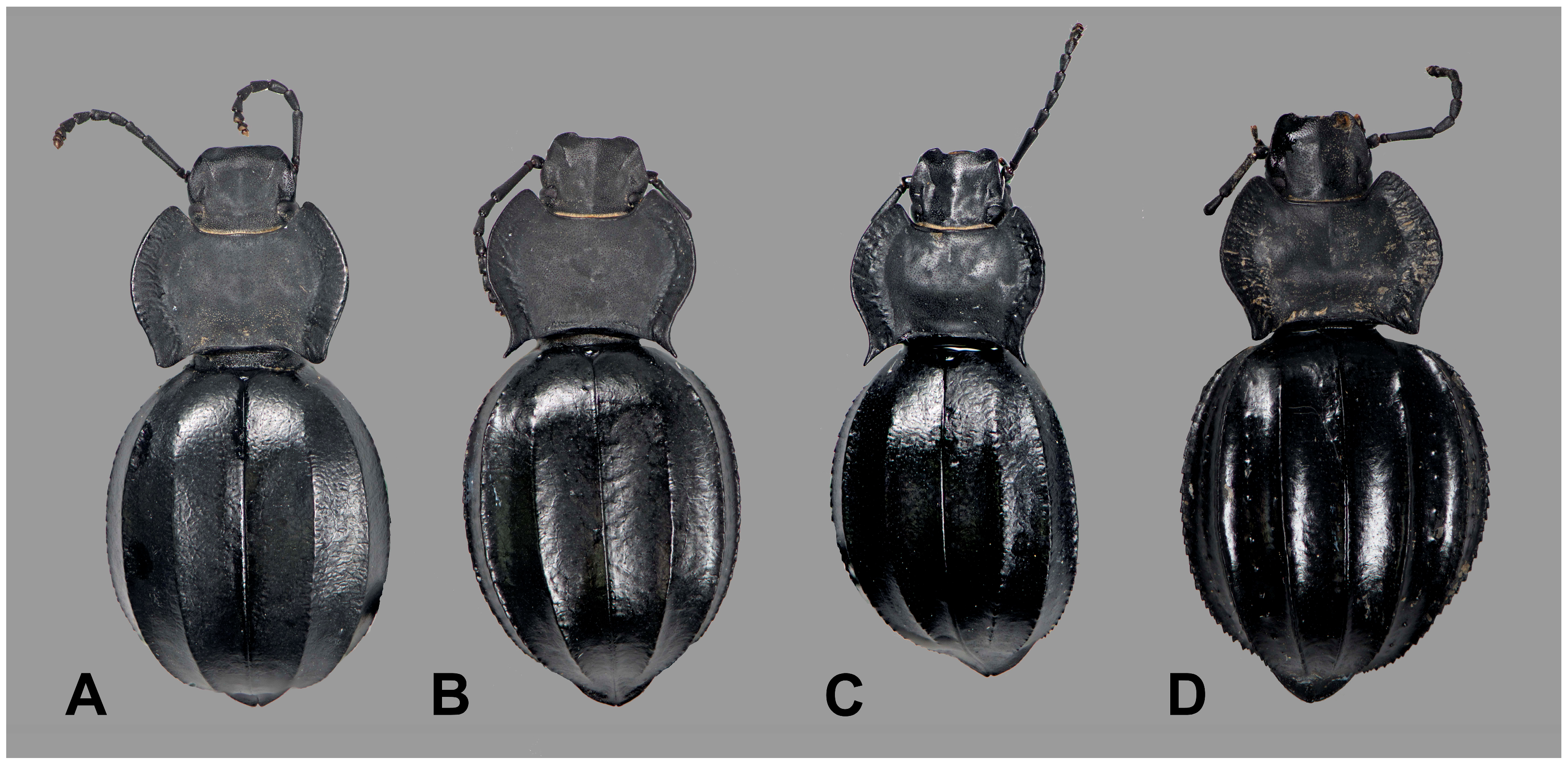
Mitochondrial haplotypes of specimens showing the typical morphology of A. granulifera (Figure 6), A. ilonka, and A. bayardi (Figure 7C,D) are grouped into a single clade, which is the sister group to A. lusitanica (Figure 1 and Figure 7A). This lineage includes typical A. granulifera specimens (from Faro district, Portugal) (Figure 6), individuals corresponding to the morphology of A. bayardi (from Tavira, Portugal) (Figure 7C), and those of A. ilonka (from Matalascañas, Spain) (Figure 7D). In the locality of Chipiona (Cádiz, Spain), we also found specimens exhibiting typical A. granulifera morphology but with A. acuminata mtDNA, and vice versa (Figure 8).
Within the A. acuminata clade, genetic differentiation is relatively low (Figure 1). The most distinct haplotypes, though lacking a clear geographical structure, correspond to specimens from the Iberian Peninsula’s interior: Tarancón (Cuenca), Villarrobledo (Albacete), Pegalajar (Jaén), and Darro (Granada). The specimens from Albacete and Cuenca notably extend the species’ known distribution inland. The absence of genetic differentiation between populations located on either side of the Strait of Gibraltar is particularly remarkable (Figure 1). Some haplotypes are shared between populations from Ceuta (North Africa) and Cádiz (Southern Europe), while others are very similar between Ceuta and Málaga (Fuengirola). The A. acuminata clade also includes two haplotypes found in four specimens that are morphologically assignable to A. granulifera from Chipiona (Cádiz) (Figure 1 and Figure 8). Therefore, in Chipiona, there are specimens with A. granulifera morphology and A. acuminata mtDNA haplotypes, and also specimens with A. acuminata morphology and A. granulifera mtDNA. At Chipiona, we also found some specimens with peculiar morphological traits, which could be considered intermediate characteristics between the two species (Figure 8B,C). Some of these individuals exhibited the general appearance of A. acuminata but had an additional elytral ridge, matching the morphology described for A. acuminata dorsigera [60,61].
The Akis specimens studied on the island of Menorca correspond to the morphology of A. bacarozzo and its synonym, A. tuberculata. For the genetic analyses, specimens with the morphology of A. bacarozzo (from Torretrencada Cap Cavalleria, and Algaiarens) (Figure 4B) and with the morphology of A. tuberculata (from Cap Cavalleria and Algaiarens) were examined. The results (Figure 1) indicate that, regardless of their morphology or origin, all the specimens cluster into a single clade comprising only two haplotypes that differ by a single base pair.
The A. discoidea clade shows relatively high variability compared to other species of the genus (Figure 1), with all studied specimens showing the typical morphology of A. discoidea, and no clear geographical structure.
For the A. elegans clade, a noteworthy finding is a poor mitochondrial diversity, with only a single haplotype detected across the five populations studied from Madrid and Zaragoza.
In Morica planata, we found five different COI haplotypes. The largest diversity is concentrated in Morocco, with four highly divergent haplotypes (Figure 1). In contrast, only one haplotype has been found in the Iberian Peninsula, which is more closely related to the one found in Ceuta than to the others in Morocco. The two M. favieri specimens studied, one from southeastern Iberia and another from near Marrakech, exhibit two COI haplotypes that are only slightly divergent (Figure 1).

4. Discussion

4.1. Phylogenetic Relationships and Morphological Diversity Within Akis and Morica

The concatenated analyses resulted in a phylogenetic hypothesis with a topology very similar to that obtained from the mtDNA dataset alone (Figure 1 and Figure 3), depicting Morica and Akis as reciprocally monophyletic and providing resolution within the Akis granulifera species group. Given the similarity between the combined and mtDNA trees, it is evident that nuclear information is largely overshadowed in the concatenated dataset, even though posterior probability values for some nodes increased upon concatenation. A plausible explanation for this is that the number of informative characters differs substantially between the mtDNA dataset (34.8%) and the nuclear dataset (8.5%), thereby obscuring the less informative dataset.
The combined and mtDNA dataset broadly supports the morphological species hypotheses traditionally used to define species within Akis, with all taxa recovered as monophyletic (except for a few terminal branches which are discussed below). Although the nuclear dataset is less informative overall and depicts clades with low support, it provides some relevant insights for species–group delimitation. For instance, all Iberian taxa related to A. granulifera (including A. lusitanica and A. genei) form a tight clade of poorly differentiated H3 sequences (PP = 0.86) (Figure 2). Estimates of the time to the most recent common ancestor, based on our COI sequences, indicate a Pliocene origin for this clade, with pre-Pleistocene speciation events (Figure 5). Considering these ages, the substitution rate of the studied H3 fragment appears too low to generate meaningful differentiation, at least within clades 2–3 million years old. As with any mtDNA-based dating that relies on a single substitution rate, some uncertainty is expected due to possible rate variation among lineages and divergence depths. Absolute ages should therefore be interpreted with caution, although the relative divergence patterns are robust. In fact, the topologies obtained from the different datasets are not in conflict but are rather unresolved. Thus, the main discrepancies observed are not in the main phylogenetic hypotheses but are related to individual assignments to different clades when using mtDNA or nDNA data.
Relationships within the genera Akis and Morica have been little discussed. Zur Strassen [58] and Español [60] considered A. granulifera, A. lusitanica and A. genei to be closely related, which is fully supported by our mtDNA and nuclear topologies (Figure 1 and Figure 2). They even proposed A. granulifera and A. lusitanica as subspecies of the same species. Indeed, we have identified populations in southern Portugal attributable to A. lusitanica but showing morphological traits reminiscent of A. granulifera (Figure 7), including the loss and fading of elytral tubercles and modifications in the shape of the elytral costae. This suggests the potential existence of a broad contact zone between A. lusitanica and A. granulifera, which warrants further in-depth study. Based on detectable levels of genetic exchange between A. granulifera and A. lusitanica in this region, the taxonomic status of these two species could be reconsidered, potentially supporting the taxonomic hypotheses proposed by zur Strassen [58] and Español [60]. However, both A. lusitanica and A. granulifera retain relatively stable morphological characteristics across their extensive geographical distributions. Furthermore, both groups exhibit a degree of differentiation comparable to that observed between A. genei and A. granulifera. Thus, in line with previous authors [59,62], we propose to treat A. lusitanica as an independent evolutionary unit and maintain its species-level taxonomic status while more detailed data become available.
The clade containing haplotypes from specimens with typical A. granulifera morphology (from Chipiona, Spain) also includes haplotypes from specimens exhibiting A. bayardi morphology (from Tavira, Portugal) (Figure 7C) [59], as well as haplotypes from all specimens with A. ilonka morphology (Matalascañas and Chipiona, Spain) (Figure 7D). The genetic differentiation observed among haplotypes within this clade is minimal, suggesting that the morphological variation should either be considered as individual variability or as reflecting the presence of local ecotypes. Specifically, the A. ilonka population does not differ genetically from other A. granulifera populations. Consequently, the hypotheses treating A. ilonka as a distinct species [59,63] are rejected. According to the principle of priority (Article 23 of the International Code of Zoological Nomenclature) [64], the name Akis granulifera Sahlberg, 1823, takes nomenclatural precedence over Akis bayardi Solier, 1836, and Akis ilonka zur Strassen, 1957, which should be treated as synonyms of A. granulifera.
Regarding the morphological differentiation observed within Akis discoidea, we lack adequate molecular data for the morphotypes named as A. hispanica Solier, 1836 and A. salzei Solier, 1836, as our analyses only included specimens with typical A. discoidea morphology. However, based on the morphological descriptions of A. hispanica and A. salzei, their traits appear to align with the levels of phenotypic plasticity observed in southeastern A. granulifera populations. Viñolas & Cartagena [62] and Español [60] previously considered A. salzei and A. hispanica as recurring individual variations in A. discoidea. Ferrer et al. [59], however, treated A. salzei and A. hispanica as separate species, whereas Iwan et al. [65] synonymised A. salzei with A. hispanica. Given that specimens of A. hispanica and A. salzei recorded to date are intermixed with typical A. discoidea specimens [59], we consider it plausible that both, A. hispanica and A. salzei, represent patterns of individual variability within A. discoidea. Nevertheless, testing this hypothesis would require the inclusion of these phenotypes in future molecular analyses.
Soldati [66] synonymised A. dorsigera Reitter, 1904, with A. acuminata (Fabricius, 1787), considering the previous elevation to species status by Ferrer et al. [59] to have been based on “irrelevant (and incorrectly illustrated) character states.” Our molecular analyses included a specimen exhibiting typical A. dorsigera morphology, characterised by the general appearance of A. acuminata but with an additional elytral ridge [60,61]. This specimen, collected in Chipiona (Cádiz), presented mtDNA assignable to A. granulifera. Therefore, we support Soldati’s [66] hypothesis. It would be worthwhile to investigate the genetic situation in other localities where this unusual morphology has been recorded (in Córdoba and Cádiz provinces and southern Portugal) [59,61] to identify the processes underlying this morphological pattern (Figure 8).
Ferrer et al. [59] elevated Akis tuberculata Kraatz, 1865 to species rank, which Leo & Fanchello [67] later synonymised with Akis bacarozzo Schrank von Paula, 1786. Specimens from Menorca morphologically assignable to A. tuberculata were genetically identical to those morphologically assignable to A. bacarozzo based on the molecular markers studied (Figure 1). Thus, we concur with the taxonomic proposals considering both morphological types to represent a single taxon, with A. bacarozzo taking nomenclatural priority [60,62,63,67].

4.2. Biogeography

Based on our results, several distinct groups within the Akidini tribe can be identified in the western Mediterranean, potentially shaped by the formation of the Betic Riffean Massif. Iberian populations of M. planata are recently separated from the Moroccan stock and therefore unrelated to the closure of the Strait of Gibraltar (5.3 million years ago) [68]. In contrast, the divergence of M. hybrida with respect to M. planata appears to be considerably older. Our estimates of the clade’s age (Figure 5) are inconsistent with the hypothesis that ancestral M. hybrida colonised the Iberian Peninsula during the Messinian Salinity Crisis and was later isolated following the reopening of the Strait of Gibraltar. This scenario would only be plausible if these organisms exhibited significantly higher mutation rates than those typically observed in other insects. An alternative explanation could be that M. hybrida became isolated in the Betic Riffean Massif, which formed during the Early to Middle Miocene [69].
For Akis, we identified a distinct Iberian–African group comprising four clades (Figure 1): two African species (A. tingitana and A. trilineata), one species found on both sides of the Strait of Gibraltar (A. acuminata), and a fourth clade comprising four Iberian endemics (A. discoidea, A. genei, A. lusitanica, and A. granulifera). Although we were unable to fully resolve the basal relationships among these clades, our dating places the origin of this Iberian–African group between the Middle and Late Miocene (Figure 5). This suggests that the formation of the various clades could be linked to isolation events following the reopening of the Betic Strait, which separated the Iberian Peninsula from the Betic-Rif Massif. This pattern is similar to the speciation scenarios proposed by Martínez-Solano et al. [70] for Alytes (Anura).
Our phylogeographic analyses further demonstrate that the movement of terrestrial species across the Strait of Gibraltar, traditionally considered a strong barrier, has occurred more frequently than previously thought [71,72,73,74,75]. In this group, dispersal has taken place both northward from Africa to Europe and southward from Europe to Africa (Figure 1). In the case of A. acuminata, our data clearly indicate that dispersal occurred from the Iberian Peninsula to North Africa, similar to the pattern observed in Pleurodeles waltl Michahelles, 1830 [76,77]. The entire intraspecific diversity of A. acuminata is concentrated in the Iberian Peninsula, and there is notable genetic similarity between populations from Ceuta in northern Africa and Cádiz in southern Spain (Figure 1). Since A. acuminata lacks the ability to cross large bodies of water like the Strait of Gibraltar on its own, its colonisation likely occurred passively, perhaps via the transport of adult beetles or larvae by rafts of vegetation. The species’ frequent presence in coastal habitats near the sea supports this possibility. However, given its pronounced anthropophilic tendencies, it is also plausible that human activity facilitated its dispersal, as previously suggested by Ruiz & Ávila [78]. This hypothesis is further supported not only by the genetic similarity with Iberian specimens but also by the species’ restricted distribution in North Africa, being limited to areas around Tangier [79] and Ceuta [78], where it is associated with suburban environments subject to significant human impact. The case of Morica planata follows a similar pattern to A. acuminata, although our data suggest that dispersal in this species occurred in the opposite direction, from south to north (Figure 1), as observed in Hyla meridionalis Boettger, 1874 [80] and in various species of darkling beetles of the genus Pimelia [42,75]. The analysed samples of M. planata show considerable differentiation among African populations, with four highly divergent haplotypes identified in Northern Africa (Figure 1). In contrast, only a single haplotype was found in the Iberian Peninsula, which is closely related to the haplotype found in Ceuta. Genetically, these results suggest that the Iberian populations originated relatively recently and have not yet had time to accumulate significant mutations in their DNA. Regarding the mechanisms of dispersal, the same hypotheses proposed for A. acuminata may be applicable, as the two species are frequently found in sympatry. Moreover, the low mitochondrial differentiation observed between the two M. favieri specimens studied (Figure 1), one from southeastern Iberia and another from the Marrakech area, also suggests recent colonisation events in southeastern Iberia. The movement of species of Akis across the Mediterranean is also evident in multiple directions, with A. acuminata and A. bacarozzo found in the Balearic Islands [60], and A. trilineata documented in Barcelona and Almería [62]. In all these cases of introduction, the role of maritime ports such as Ceuta and Tangier in Africa, or Málaga and Almería in Europe, stands out as potential facilitators of species transport. These colonisation events may go completely unnoticed when populations are widespread on both sides of the Strait, highlighting the importance of phylogeographic studies for their detection.

4.3. The Problems of Morphological Variability in Tenebrionid Taxonomy

A major challenge for species definition in Tenebrionidae is that the main morphological taxonomic characters useful for defining species within a clade are often inconsistent or even misleading when applied to closely related clades, making taxonomic decisions impossible or even serendipitous. In these cases, molecular data are extremely useful for defining evolutionary units.
The most commonly used characters for distinguishing species within the tribe Akidini are based on external morphology. Specifically, in the taxonomy of the tribe, the most significant characteristic is the arrangement and structure of the ridges, ribs, and rows of tubercles running longitudinally along the elytra [58,59,60,62,67,81]. These elytral traits are also the most contentious in the identification of Akis species, as many species exhibit substantial morphological variability, which has occasionally led to the description of varieties, subspecies, or species of questionable validity. Ferrer et al. [59] provide detailed illustrations of the arrangement and structure of the elytral ridges of all Iberian Akis taxa, making it unnecessary to present the data again. Morphologically, the characters outlined by Ferrer et al. [59] accurately distinguish all the examined specimens in this work. However, the core issue, as is common in typological taxonomy, lies in determining whether the observed morphological differences correspond to species-level differences, locally adapted population sets exhibiting differential expression of high phenotypic plasticity, or merely individual variations occasionally arising within a population.
In some cases, the presence of microgranulation on the elytral surface has proven useful and serves as an indisputable diagnostic character for identifying taxa such as A. genei and A. lusitanica, which frequently coexist and display highly similar external morphologies [59,60]. Akis lusitanica and A. genei are phylogenetically close species, but their divergence is ancient (Figure 5), and the level of mitochondrial DNA sequence divergence is substantial. Both species occur in sympatry across a broad region of the western plateau, with no evidence of ongoing hybridisation between them, although the observed discordances in geographically scattered specimens showing mtDNA haplotypes that do not match their morphological assignment (e.g., specimens with morphology of A. lusitanica presenting COI haplotypes assignable to A. genei, and vice versa) suggest the possible existence of either retention of ancestral polymorphisms or local gene introgression (Figure 1). Given the broad sympatric range and the low levels of introgression, it is indisputable that these two lineages represent independent species according to both evolutionary [82] and biological criteria [83]. Our results do not support previous doubts regarding the diagnostic value of microgranulation [81]. Male genitalia can define groups at generic and suprageneric levels [84], however genital morphology is not commonly used for species-level taxonomy of Pimeliinae, as the degree of differentiation between closely related taxa is minimal and intrapopulational variability is so high that potential differences between closely related species are obscured [59]. The female reproductive system seems to follow similar patterns, exhibiting marked differentiation at deep nodes but high intraspecific variability [85,86].

4.4. Cyto-Nuclear Discordances and Hybridization

There are some isolated cases of mismatch between the mtDNA phylogenetic hypothesis, the nuclear topology, and the morphological data (Figure 1, Figure 7 and Figure 8). The first case involves four specimens clearly identifiable morphologically as A. granulifera and assigned to the A. granuliferaA. lusitanicaA. genei nuclear H3 clade that fall within the mitochondrial clade of A. acuminata (Figure 1 and Figure 8). Conversely, one specimen morphologically assignable to A. acuminata and included as such in the nuclear H3 clade, presents mtDNA of A. granulifera.
The A. granulifera and A. acuminata clades are highly differentiated, not sister to each other, and have been separated since the Miocene (5.9–12.4 Ma) (Figure 5). Both species are well characterised morphologically and are unmistakably diagnosable (Figure 8). All the specimens involved in this situation came from the same area, a small stretch of back-dunes near the inner edge of the beach, flanked by avenues and streets within the village of Chipiona (Cádiz, Spain). Chipiona is almost located at the westernmost edge of the geographic range of A. acuminata, and also quite into the easternmost limit for A. granulifera [58,59,62,81,87], but the population is predominantly composed of A. granulifera, with A. acuminata being relatively scarce. It is thus quite possible that contact between these two species is relatively uncommon. Sympatry between these two species has only previously been reported in one locality: “El Conquero”, Huelva [87]. The observed pattern of mtDNA introgression is thus likely the result of occasional local hybridisation following recent secondary contact between these two otherwise unrelated species. It is very likely that the introgression in this case remained confined to the areas where the two species cohabit.
In the absence of rapidly evolving nuclear markers, testing this hypothesis could be achieved by identifying morphologically singular specimens that, although clearly assignable to one species, exhibit some characters typical of the other, indicating potential nuclear gene exchange. Among the seven specimens studied from Chipiona, five showed evidence of mtDNA introgression, but only one displayed divergent morphology. This specimen probably represents a F1 hybrid, and since no other morphological evidence has been observed, we infer that hybridisation is locally restricted and unlikely to be persistent over time.
The second set of mismatches between morphology and mtDNA occurs between the closely related, but non-sister, A. genei and A. lusitanica. In this case, some specimens morphologically assigned to A. genei present mtDNA corresponding to A. lusitanica (Zamora, Ávila, Ciudad Real), whereas some specimens morphologically assigned to A. lusitanica present mtDNA corresponding to A. genei (Ciudad Real). Despite exhibiting highly similar external morphology, both species can be clearly distinguished by their elytral tegument patterns. These mismatched specimens were collected in the southern and northwestern regions of the Sistema Central, respectively. These areas may provide extensive contact zones between A. genei and A. lusitanica. However, since the haplotypes found are not identical to those currently present in the corresponding species (Figure 1), it is also possible that these cases reflect the retention of ancestral polymorphisms, whereby certain populations have not lost ancient haplotypes inherited from their common ancestors, resulting in incomplete lineage sorting [88]. This process may have been facilitated if A. lusitanica exhibited particularly large effective population sizes in these regions [89]. Alternatively, these instances could represent mitochondrial introgression derived from past hybridisation events in past contact zones, allowing the persistence of A. lusitanica haplotypes within A. genei populations, or vice versa. In this context, ongoing hybridisation need not be persistent, which would account for the absence of specimens with intermediate morphological characteristics or even for the lack of current sympatry. Both phenomena might occur simultaneously, potentially suggesting that A. lusitanica is expanding into areas previously inhabited solely by A. genei, leading to local displacement. As A. genei shifts eastward, traces of introgression may remain. In this regard, it is noteworthy that we have found A. lusitanica in Madrid, an area where A. genei would traditionally be expected; however, this population may instead result from accidental introduction through soil transport for landscaping, as has already been documented in other cases [90]. Nevertheless, none of these hypotheses challenges the treatment of A. lusitanica and A. genei as independent taxonomic entities. Even if the observed patterns reflect hybridisation, the levels of introgression are so limited relative to the overall distribution range of both taxa that do not undermine the existence of reproductive isolation between them. Furthermore, the restricted geographical extent of the areas of cyto-nuclear discordances and the substantial divergence observed between A. lusitanica and A. genei provide additional support for this interpretation.
Our results suggest that cyto-nuclear discordances across morphologically differentiated non-sister clades may be more frequent in darkling beetles than generally assumed (see also Mas-Peinado et al. [42]). This situation provides an opportunity to study the origin and consequences of introgression in organisms that rely primarily on postzygotic mechanisms for reproductive isolation [91,92]. It also indicates that mitochondrial barcoding may not always constitute a reliable tool for species identification in certain groups of arthropods, as it has been observed in other organisms [93,94].

Supplementary Materials

The following supporting information can be downloaded at: https://www.mdpi.com/article/10.3390/genes17040455/s1, Table S1. Correspondence between ASAP partitions inferred from COI sequences and the final species hypotheses adopted in this study. Morphological identification and geographic area were used to evaluate and, when necessary, merge or retain ASAP units within an integrative taxonomic framework; Table S2. Main morphological diagnostic traits of the species of Morica and Akis. Sources: [58,59,60,62,81,95,96,97], and pers. obs. (authors).

Author Contributions

Conceptualization, M.G.-P. and E.R.; methodology, P.J.-A., E.R. and M.G.-P.; formal analysis, P.J.-A. and E.R.; investigation, P.J.-A., E.R., J.L.R. and M.G.-P.; data curation, P.J.-A. and E.R.; writing—original draft preparation, P.J.-A., E.R. and M.G.-P.; writing—review and editing, P.J.-A., E.R., J.L.R. and M.G.-P.; visualisation, P.J.-A., E.R. and M.G.-P.; supervision M.G.-P.; funding acquisition, E.R. and M.G.-P. All authors have read and agreed to the published version of the manuscript.

Funding

This study was funded by a research grant from Instituto de Estudios Ceutíes (Convocatoria Ayudas a la Investigación 2008) to E. Recuero and M. García-París, and grants PID2019-110243GB-100 (Ministerio de Ciencia, Innovación y Universidades, Spain) and MICIU/AEI/10.13039/501100011033/FEDER, UE (PID2024-159987NB-I00) to M. García-París.

Institutional Review Board Statement

Not applicable.

Informed Consent Statement

Not applicable.

Data Availability Statement

The genetic data supporting the findings of this study are freely available in GenBank (PZ044878-PZ045001, PZ049389-PZ049425). The sequence alignments are available in the Zenodo repository (DOI: 10.5281/zenodo.19040712).

Acknowledgments

We thank M. París, curator of Entomology of the Museo Nacional de Ciencias Naturales (Madrid). We also thank two anonymous reviewers for their constructive comments to the manuscript. P. Jurado-Angulo was supported by a FCT (Fundação para a Ciência e a Tecnologia, I.P.) PhD grant (2022.14742.BD; https://doi.org/10.54499/2022.14742.BD; financed by the European Social Fund and the national programme “Portugal 2030”). Sadly, during the development of this project, Marina Alcobendas, the true driving force and the heart and soul of the laboratory work carried out for this study, passed away. Our memories of her and our gratitude for her daily efforts will always remain with her.

Conflicts of Interest

The authors declare no conflicts of interest.

References

  1. Funk, D.J.; Omland, K.E. Species-level paraphyly and polyphyly: Frequency, causes, and consequences, with insights from animal mitochondrial DNA. Annu. Rev. Ecol. Evol. Syst. 2003, 34, 397–423. [Google Scholar] [CrossRef]
  2. Philippe, H.; Brinkmann, H.; Lavrov, D.V.; Littlewood, D.T.J.; Manuel, M.; Wörheide, G.; Baurain, D. Resolving difficult phylogenetic questions: Why more sequences are not enough. PLoS Biol. 2011, 9, e1000602. [Google Scholar] [CrossRef]
  3. Som, A. Causes, consequences and solutions of phylogenetic incongruence. Brief. Bioinform. 2015, 16, 536–548. [Google Scholar] [CrossRef] [PubMed]
  4. Sanz-laParra, A.M.; García-París, M.; López-Estrada, E.K. Different Perspectives on the Phylogeny of Mordellidae (Coleoptera) Provided by Two Regions of the mtDNA COI Gene. Ann. Zool. 2023, 73, 293–312. [Google Scholar] [CrossRef]
  5. Martin, W.; Herrmann, R.G. Gene transfer from organelles to the nucleus: How much, what happens, and why? Plant Physiol. 1998, 118, 9–17. [Google Scholar] [CrossRef] [PubMed]
  6. Renoult, J.P.; Kjellberg, F.; Grout, C.; Santoni, S.; Khadari, B. Cyto-nuclear discordance in the phylogeny of Ficus section Galoglychia and host shifts in plant-pollinator associations. BMC Evol. Biol. 2009, 9, 248. [Google Scholar] [CrossRef]
  7. Wahlberg, N.; Weingartner, E.; Warren, A.D.; Nylin, S. Timing major conflict between mitochondrial and nuclear genes in species relationships of Polygonia butterflies (Nymphalidae: Nymphalini). BMC Evol. Biol. 2009, 9, 92. [Google Scholar] [CrossRef]
  8. De Chiara, M.; Friedrich, A.; Barré, B.; Breitenbach, M.; Schacherer, J.; Liti, G. Discordant evolution of mitochondrial and nuclear yeast genomes at population level. BMC Biol. 2020, 18, 92. [Google Scholar] [CrossRef]
  9. Korpelainen, H. The evolutionary processes of mitochondrial and chloroplast genomes differ from those of nuclear genomes. Naturwissenschaften 2004, 91, 505–518. [Google Scholar] [CrossRef]
  10. Vaghefi, N.; Kusch, S.; Németh, M.Z.; Seress, D.; Braun, U.; Takamatsu, S.; Panstruga, R.; Kiss, L. Beyond nuclear ribosomal DNA sequences: Evolution, taxonomy, and closest known saprobic relatives of powdery mildew fungi (Erysiphaceae) inferred from their first comprehensive genome-scale phylogenetic analyses. Front. Microbiol. 2022, 13, 903024. [Google Scholar] [CrossRef]
  11. Fisher-Reid, M.C.; Wiens, J.J. What are the consequences of combining nuclear and mitochondrial data for phylogenetic analysis? Lessons from Plethodon salamanders and 13 other vertebrate clades. BMC Evol. Biol. 2011, 11, 300. [Google Scholar] [CrossRef]
  12. Salichos, L.; Rokas, A. Inferring ancient divergences requires genes with strong phylogenetic signals. Nature 2013, 497, 327–331. [Google Scholar] [CrossRef] [PubMed]
  13. Jarvis, E.D.; Mirarab, S.; Aberer, A.J.; Li, B.; Houde, P.; Li, C.; Ho, S.Y.; Faircloth, B.C.; Nabholz, B.; Howard, J.T.; et al. Whole-genome analyses resolve early branches in the tree of life of modern birds. Science 2014, 346, 1320–1331. [Google Scholar] [CrossRef] [PubMed]
  14. Wickett, N.J.; Mirarab, S.; Nguyen, N.; Warnow, T.; Carpenter, E.; Matasci, N.; Ayyampalayam, S.; Barker, M.S.; Burleigh, J.G.; Gitzendanner, M.A.; et al. Phylotranscriptomic analysis of the origin and early diversification of land plants. Proc. Natl. Acad. Sci. USA 2014, 111, E4859–E4868. [Google Scholar] [CrossRef] [PubMed]
  15. Lakshmi, S.; Mohideen, M.A. Issues in reliability and validity of research. Int. J. Manag. Res. Rev. 2013, 3, 2752. [Google Scholar]
  16. Smith, S.A.; Moore, M.J.; Brown, J.W.; Yang, Y. Analysis of phylogenomic datasets reveals conflict, concordance, and gene duplications with examples from animals and plants. BMC Evol. Biol. 2015, 15, 150. [Google Scholar] [CrossRef]
  17. Bergsten, J. A review of long-branch attraction. Cladistics 2005, 21, 163–193. [Google Scholar] [CrossRef]
  18. Delsuc, F.; Brinkmann, H.; Philippe, H. Phylogenomics and the reconstruction of the tree of life. Nat. Rev. Genet. 2005, 6, 361–375. [Google Scholar] [CrossRef]
  19. Roch, S.; Steel, M. Likelihood-based tree reconstruction on a concatenation of alignments can be statistically inconsistent. Theor. Popul. Biol. 2015, 100, 56–62. [Google Scholar] [CrossRef]
  20. Zhang, D.; Rheindt, F.E.; She, H.; Cheng, Y.; Song, G.; Jia, C.; Qu, Y.; Alström, P.; Lei, F. Most genomic loci misrepresent the phylogeny of an avian radiation because of ancient gene flow. Syst. Biol. 2021, 70, 961–975. [Google Scholar] [CrossRef]
  21. Kingman, J.F.C. The coalescent. Stoch. Process. Appl. 1982, 13, 235–248. [Google Scholar] [CrossRef]
  22. Hudson, R.R. Gene genealogies and the coalescent process. In Oxford Surveys in Evolutionary Biology; Futuyma, D.J., Antonovics, J.D., Eds.; Oxford University Press: New York, NY, USA, 1990; pp. 1–44. [Google Scholar]
  23. Hein, J.; Schieriup, M.H.; Wiuf, C. Gene Genealogies, Variation and Evolution: A Primer in Coalescent Theory; Oxford University Press: Oxford, UK, 2005; p. 290. [Google Scholar]
  24. Jiao, X.; Flouri, T.; Yang, Z. Multispecies coalescent and its applications to infer species phylogenies and cross-species gene flow. Natl. Sci. Rev. 2021, 8, nwab127. [Google Scholar] [CrossRef] [PubMed]
  25. Havird, J.C.; Miyamoto, M.M. The importance of taxon sampling in genomic studies: An example from the cyclooxygenases of teleost fishes. Mol. Phylogenetics Evol. 2010, 56, 451–455. [Google Scholar] [CrossRef] [PubMed]
  26. Koenen, E.J.; Ojeda, D.I.; Steeves, R.; Migliore, J.; Bakker, F.T.; Wieringa, J.J.; Kidner, C.; Hardy, O.J.; Pennington, T.; Bruneae, A.; et al. Large-scale genomic sequence data resolve the deepest divergences in the legume phylogeny and support a near-simultaneous evolutionary origin of all six subfamilies. New Phytol. 2020, 225, 1355–1369. [Google Scholar] [CrossRef] [PubMed]
  27. Li, X.; Hou, Z.; Xu, C.; Shi, X.; Yang, L.; Lewis, L.A.; Zhong, B. Large phylogenomic data sets reveal deep relationships and trait evolution in chlorophyte green algae. Genome Biol. Evol. 2021, 13, evab101. [Google Scholar] [CrossRef]
  28. Giarla, T.C.; Esselstyn, J.A. The challenges of resolving a rapid, recent radiation: Empirical and simulated phylogenomics of Philippine shrews. Syst. Biol. 2015, 64, 727–740. [Google Scholar] [CrossRef]
  29. Kandziora, M.; Sklenář, P.; Kolář, F.; Schmickl, R. How to tackle phylogenetic discordance in recent and rapidly radiating groups? Developing a workflow using Loricaria (Asteraceae) as an example. Front. Plant Sci. 2022, 12, 765719. [Google Scholar] [CrossRef]
  30. Springer, M.S.; Gatesy, J. The gene tree delusion. Mol. Phylogenetics Evol. 2016, 94, 1–33. [Google Scholar] [CrossRef]
  31. Chen, M.Y.; Liang, D.; Zhang, P. Selecting question-specific genes to reduce incongruence in phylogenomics: A case study of jawed vertebrate backbone phylogeny. Syst. Biol. 2015, 64, 1104–1120. [Google Scholar] [CrossRef]
  32. Shen, X.X.; Hittinger, C.T.; Rokas, A. Contentious relationships in phylogenomic studies can be driven by a handful of genes. Nat. Ecol. Evol. 2017, 1, 0126. [Google Scholar] [CrossRef]
  33. Smith, S.A.; Walker-Hale, N.; Walker, J.F.; Brown, J.W. Phylogenetic conflicts, combinability, and deep phylogenomics in plants. Syst. Biol. 2020, 69, 579–592. [Google Scholar] [CrossRef] [PubMed]
  34. Meleshko, O.; Martin, M.D.; Korneliussen, T.S.; Schröck, C.; Lamkowski, P.; Schmutz, J.; Healey, A.; Piatkowski, B.T.; Shaw, J.; Weston, D.J.; et al. Extensive genome-wide phylogenetic discordance is due to incomplete lineage sorting and not ongoing introgression in a rapidly radiated bryophyte genus. Mol. Biol. Evol. 2021, 38, 2750–2766. [Google Scholar] [CrossRef] [PubMed]
  35. Komarova, V.A.; Lavrenchenko, L.A. Approaches to the detection of hybridization events and genetic introgression upon phylogenetic incongruence. Biol. Bull. Rev. 2022, 12, 240–253. [Google Scholar] [CrossRef]
  36. Yang, L.H.; Shi, X.Z.; Wen, F.; Kang, M. Phylogenomics reveals widespread hybridization and polyploidization in Henckelia (Gesneriaceae). Ann. Bot. 2023, 131, 953–966. [Google Scholar] [CrossRef]
  37. Lescroart, J.; Bonilla-Sánchez, A.; Napolitano, C.; Buitrago-Torres, D.L.; Ramírez-Chaves, H.E.; Pulido-Santacruz, P.; Murphy, W.J.; Svardal, H.; Eizirik, E. Extensive phylogenomic discordance and the complex evolutionary history of the neotropical cat genus Leopardus. Mol. Biol. Evol. 2023, 40, msad255. [Google Scholar] [CrossRef]
  38. Lanfear, R.; Hahn, M.W. The meaning and measure of concordance factors in phylogenomics. Mol. Biol. Evol. 2024, 41, msae214. [Google Scholar] [CrossRef]
  39. Sequeira, F.; Sodré, D.; Ferrand, N.; Bernardi, J.A.; Sampaio, I.; Schneider, H.; Vallinoto, M. Hybridization and massive mtDNA unidirectional introgression between the closely related Neotropical toads Rhinella marina and R. schneideri inferred from mtDNA and nuclear markers. BMC Evol. Biol. 2011, 11, 264. [Google Scholar] [CrossRef]
  40. García-París, M.; Alcobendas, M.; Buckley, D.; Wake, D.B. Dispersal of viviparity across contact zones in Iberian populations of fire salamanders (Salamandra) inferred from discordance of genetic and morphological traits. Evolution 2003, 57, 129–143. [Google Scholar] [CrossRef]
  41. Toews, D.P.; Brelsford, A. The biogeography of mitochondrial and nuclear discordance in animals. Mol. Ecol. 2012, 21, 3907–3930. [Google Scholar] [CrossRef]
  42. Mas-Peinado, P.; Ruiz, J.L.; Merkl, O.; Buckley, D.; García-París, M. Taxonomy of the North Moroccan and Iberian species of the subgenus Amblypteraca (Coleoptera: Tenebrionidae: Pimeliinae: Pimelia). Zootaxa 2021, 4963, 457–482. [Google Scholar] [CrossRef]
  43. Folmer, O.; Black, M.; Hoeh, W.; Lutz, R.; Vrijenhoek, R. DNA primers for amplification of mitochondrial cytochrome c oxidase subunit I from diverse metazoan invertebrates. Mol. Mar. Biol. Biotechnol. 1994, 3, 294–299. [Google Scholar] [PubMed]
  44. Machordom, A.; Araujo, R.; Erpenbeck, D.; Ramos, M.A. Phylogeography and conservation genetics of endangered European Margaritiferidae (Bivalvia: Unionoidea). Biol. J. Linn. Soc. 2003, 78, 235–252. [Google Scholar] [CrossRef]
  45. Simon, C.; Frati, F.; Beckenbach, A.; Crespi, B.; Liu, H.; Flook, P. Evolution, weighting, and phylogenetic utility of mitochondrial gene sequences and a compilation of conserved polymerase chain reaction primers. Ann. Entomol. Soc. Am. 1994, 87, 651–701. [Google Scholar] [CrossRef]
  46. Ogden, T.H.; Whiting, M.F. The problem with the Paleoptera problem: Sense and sensitivity. Cladistics 2003, 19, 432–442. [Google Scholar] [CrossRef]
  47. Darriba, D.; Taboada, G.L.; Doallo, R.; Posada, D. jModelTest 2: More models, new heuristics and parallel computing. Nat. Methods 2012, 9, 772. [Google Scholar] [CrossRef]
  48. Xia, X.; Lemey, P. Assessing substitution saturation with DAMBE. In The Phylogenetic Handbook: A Practical Approach to DNA and Protein Phylogeny; Lemey, P., Salemi, M., Vandamme, A.M., Eds.; Cambridge University Press: Cambridge, UK, 2009; pp. 615–630. [Google Scholar]
  49. Ronquist, F.; Teslenko, M.; Van der Mark, P.; Ayres, D.L.; Darling, A.; Höhna, S.; Larget, B.; Liu, L.; Suchard, M.A.; Huelsenbeck, J.P. MrBayes 3.2: Efficient Bayesian phylogenetic inference and model choice across a large model space. Syst. Biol. 2012, 61, 539–542. [Google Scholar] [CrossRef]
  50. Rambaut, A.; Drummond, A.J.; Xie, D.; Baele, G.; Suchard, M.A. Posterior Summarization in Bayesian Phylogenetics Using Tracer 1.7. Syst. Biol. 2018, 67, 901–904. [Google Scholar] [CrossRef]
  51. Drummond, A.J.; Suchard, M.A.; Xie, D.; Rambaut, A. Bayesian phylogenetics with BEAUti and the BEAST 1.7. Mol. Biol. Evol. 2012, 29, 1969–1973. [Google Scholar] [CrossRef]
  52. Minh, B.Q.; Schmidt, H.A.; Chernomor, O.; Schrempf, D.; Woodhams, M.D.; Von Haeseler, A.; Lanfear, R. IQ-TREE 2: New models and efficient methods for phylogenetic inference in the genomic era. Mol. Biol. Evol. 2020, 37, 1530–1534. [Google Scholar] [CrossRef]
  53. Suchard, M.A.; Lemey, P.; Baele, G.; Ayres, D.L.; Drummond, A.J.; Rambaut, A. Bayesian phylogenetic and phylodynamic data integration using BEAST 1.10. Virus Evol. 2018, 4, vey016. [Google Scholar] [CrossRef]
  54. Papadopoulou, A.; Anastasiou, I.; Vogler, A.P. Revisiting the insect mitochondrial molecular clock: The mid-Aegean trench calibration. Mol. Biol. Evol. 2010, 27, 1659–1672. [Google Scholar] [CrossRef]
  55. Puillandre, N.; Brouillet, S.; Achaz, G. ASAP: Assemble species by automatic partitioning. Mol. Ecol. Resour. 2021, 21, 609–620. [Google Scholar] [CrossRef] [PubMed]
  56. Miralles, A.; Ducasse, J.; Brouillet, S.; Flouri, T.; Fujisawa, T.; Kapli, P.; Knowles, L.L.; Kumari, S.; Stamatakis, A.; Sukumaran, J.; et al. SPART: A versatile and standardized data exchange format for species partition information. Mol. Ecol. Resour. 2022, 22, 430–438. [Google Scholar] [CrossRef] [PubMed]
  57. Andújar, C.; Arribas, P.; Yu, D.W.; Vogler, A.P.; Emerson, B.C. Why the COI barcode should be the community DNA metabarcode for the metazoa. Mol. Ecol. 2018, 27, 3968–3975. [Google Scholar] [CrossRef] [PubMed]
  58. zur Strassen, R. Zur Kenntnis der Arten Gruppe Akis spinosa Linnaeus, genei Solier und granulifera Sahlberg. Senckenberg. Biol. 1957, 38, 41–59. [Google Scholar]
  59. Ferrer, J.; Martínez Fernández, J.C.; Castro Tovar, A. Aportación al conocimiento del género Akis Herbst, 1799 (Coleoptera, Tenebrionidae, Pimeliinae). Bol. Soc. Entomol. Aragon. 2008, 43, 153–172. [Google Scholar]
  60. Español, F. Los Akidini de la fauna española. EOS 1959, 35, 171–188. [Google Scholar]
  61. Reitter, E. Bestimmungs-Tabelle der Tenebrioniden-Unterfamilien: Lachnogyini, Akidini, Pedinini, Opatrini und Trachyscelini aus Europa und den angrenzenden Ländern. Verhandlungen Naturforschenden Ver. Brünn 1904, 42, 25–189. [Google Scholar]
  62. Viñolas, A.; Cartagena, M.C. Fauna de Tenebrionidae de la Península Ibérica y Baleares. Lagriinae, Pimelinae; Argania Editio: Barcelona, Spain, 2005; Volume 1, 428p. [Google Scholar]
  63. Löbl, I.; Merkl, O.; Ando, K.; Bouchard, P.; Lillig, M.; Masomuto, K.; Schawaller, W. Family Tenebrionidae Latreille, 1825. In Catalogue of Palaearctic Coleoptera. Volume 5: Tenebrionoidea; Löbl, I., Smetana, A., Eds.; Apollo Books: Stenstrup, Denmark, 2008; p. 670. [Google Scholar]
  64. ICZN—International Commission on Zoological Nomenclature. International Code of Zoological Nomenclature, 4th ed.; The International Trust for Zoological Nomenclature: London, UK, 1999; 306p. [Google Scholar]
  65. Iwan, D.; Löbl, I.; Bouchard, P.; Bousquet, Y.; Kaminski, M.; Merkl, O.; Ando, K.; Schawaller, W. Family Tenebrionidae. In Catalogue of Palaearctic Coleoptera. Vol. 5. Tenebrionoidea; Iwan, D., Löbl, I., Eds.; Revised and Updated Second Edition; Brill: Leiden, The Netherlands; Boston, MA, USA, 2020; p. 969. [Google Scholar]
  66. Soldati, L. New nomenclatural and taxonomic acts, and comments. Tenebrionidae: Akidini. In Catalogue of Palaearctic Coleoptera. Vol. 5. Tenebrionoidea; Iwan, D., Löbl, I., Eds.; Revised and Updated Second Edition; Brill: Leiden, The Netherlands; Boston, MA, USA, 2020; p. 969. [Google Scholar]
  67. Leo, P.; Fancello, L. Observaciones sobre Akis bacarozzo (Schrank, 1786) y Akis tuberculata Kraatz, 1865, y nota sinonímica (Coleoptera, Tenebrionidae). Rev. Gaditana Entomol. 2019, 10, 31–46. [Google Scholar]
  68. Krijgsman, W.; Hilgen, F.J.; Raffi, I.; Sierro, F.J.; Wilson, D.S. Chronology, causes and progression of the Messinian salinity crisis. Nature 1999, 400, 652–655. [Google Scholar] [CrossRef]
  69. Weijermars, R. Geology and tectonics of the Betic Zone, SE Spain. Earth-Sci. Rev. 1991, 31, 153–236. [Google Scholar] [CrossRef]
  70. Martínez-Solano, I.; Gonçalves, H.A.; Arntzen, J.W.; García-París, M. Phylogenetic relationships and biogeography of midwife toads (Discoglossidae: Alytes). J. Biogeogr. 2004, 31, 603–618. [Google Scholar] [CrossRef]
  71. Paulo, O.S.; Pinto, I.; Bruford, M.W.; Jordan, W.C.; Nichols, R.A. The double origin of Iberian peninsular chamaeleons. Biol. J. Linn. Soc. 2002, 75, 1–7. [Google Scholar] [CrossRef]
  72. Cosson, J.F.; Hutterer, R.; Libois, R.; Sara, M.; Taberlet, P.; Vogel, P. Phylogeographical footprints of the Strait of Gibraltar and Quaternary climatic fluctuations in the western Mediterranean: A case study with the greater whitetoothed shrew, Crocidura russula (Mammalia: Soricidae). Mol. Ecol. 2005, 14, 1151–1162. [Google Scholar] [CrossRef]
  73. Pinho, C.; Ferrand, N.; Harris, D.J. Reexamination of the Iberian and North African Podarcis (Squamata: Lacertidae) phylogeny based on increased mitochondrial DNA sequencing. Mol. Phylogenetics Evol. 2006, 38, 266–273. [Google Scholar] [CrossRef]
  74. Gutiérrez-Rodríguez, J.; Barbosa, A.M.; Martínez-Solano, Í. Integrative inference of population history in the Ibero-Maghrebian endemic Pleurodeles waltl (Salamandridae). Mol. Phylogenetics Evol. 2017, 112, 122–137. [Google Scholar] [CrossRef]
  75. Mas-Peinado, P.; García-París, M.; Ruiz, J.L.; Buckley, D. The Strait of Gibraltar is an ineffective palaeogeographic barrier for some flightless darkling beetles (Coleoptera: Tenebrionidae: Pimelia). Zool. J. Linn. Soc. 2022, 195, 1147–1180. [Google Scholar] [CrossRef]
  76. Carranza, S.; Arnold, E.N. History of West Mediterranean newts, Pleurodeles (Amphibia: Salamandridae), inferred from old and recent DNA sequences. Syst. Biodivers. 2003, 1, 327–337. [Google Scholar] [CrossRef]
  77. Veith, M.; Mayer, C.; Samraoui, B.; Donaire-Barroso, D.; Bogaerts, S. From Europe to Africa and vice versa: Evidence for multiple intercontinental dispersal in ribbed salamanders (Genus Pleurodeles). J. Biogeogr. 2004, 31, 159–171. [Google Scholar] [CrossRef]
  78. Ruiz, J.L.; Ávila, J.M. Sobre la presencia de Akis acuminata (Fabricius, 1787) en el norte de África (Coleoptera, Tenebrionidae). Zool. Baetica 1994, 5, 119–120. [Google Scholar]
  79. Español, F. Datos para el conocimiento de los tenebriónidos del Mediterráneo occidental (Coleoptera). EOS 1963, 39, 185–209. [Google Scholar]
  80. Recuero, E.; Iraola, A.; Rubio, X.; Machordom, A.; García-París, M. Mitochondrial differentiation and biogeography of Hyla meridionalis (Anura: Hylidae): An unusual phylogeographical pattern. J. Biogeogr. 2007, 34, 1207–1219. [Google Scholar] [CrossRef]
  81. Schawaller, W. Revision westpaläarktischer Tenebrionidae (Coleoptera). Teil 1. Die Arten der Gattung Akis Herbst. Stuttg. Beiträge Naturkunde Ser. A (Biol.) 1987, 403, 1–21. [Google Scholar]
  82. Wiley, E.O. The evolutionary species concept reconsidered. Syst. Zool. 1978, 27, 17–26. [Google Scholar] [CrossRef]
  83. Mayr, E. Animal Species and Evolution; Harvard University Press: Cambridge, MA, USA, 1963; 800p. [Google Scholar]
  84. Tschinkel, W.R.; Doyen, J.T. Comparative anatomy of the efensive glands, ovipositor and female genital tubes of tenebrionid beetles (Coleoptera). Int. J. Insect Morphol. Embryol. 1980, 9, 321–368. [Google Scholar] [CrossRef]
  85. Cartagena, M.C.; Viñolas, A. Anatomía genital en los Tenebrionidae (Coleoptera). Sess. Entomo. ICHN-SCL 2001, 11, 35–44. [Google Scholar]
  86. Panchez, B.C.; García-París, M.; Kamiński, M.J.; Gündemir, O.; Mas-Peinado, P. Morphological Diversity and Specialization of the Ovipositor in the Darkling Beetle Genus Pimelia (Coleoptera: Tenebrionidae). Ann. Zool. 2025, 75, 1163–1179. [Google Scholar] [CrossRef]
  87. López-Pérez, J.J. Corología del género Akis Herbst, 1799 (Col., Tenebrionidae, Akidini) en la provincia de Huelva (SO de Andalucía). Bol. Asoc. Esp. Entomol. 2011, 35, 273–280. [Google Scholar]
  88. Maddison, W.P.; Knowles, L.L. Inferring phylogeny despite incomplete lineage sorting. Syst. Biol. 2006, 55, 21–30. [Google Scholar] [CrossRef]
  89. Maddison, W.P. Gene trees in species trees. Syst. Biol. 1997, 46, 523–536. [Google Scholar] [CrossRef]
  90. García-París, M.; París, M. Distribución de los Carabinae (s. str.) (Coleoptera: Carabidae) de Madrid: Atlas provisional. Bol. Asoc. Esp. Entomol. 1993, 17, 27–36. [Google Scholar]
  91. Pryke, S.R.; Griffith, S.C. Postzygotic genetic incompatibility between sympatric color morphs. Evolution 2009, 63, 793–798. [Google Scholar] [CrossRef] [PubMed]
  92. Coughlan, J.M.; Matute, D.R. The importance of intrinsic postzygotic barriers throughout the speciation process. Philos. Trans. R. Soc. B 2020, 375, 20190533. [Google Scholar] [CrossRef] [PubMed]
  93. Dupont, L.; Porco, D.; Symondson, W.O.C.; Roy, V. Hybridization relics complicate barcode-based identification of species in earthworms. Mol. Ecol. Resour. 2016, 16, 883–894. [Google Scholar] [CrossRef] [PubMed]
  94. Kartavtsev, Y.P.; Redin, A.D. Estimates of genetic introgression, gene tree reticulation, taxon divergence, and sustainability of DNA barcoding based on genetic molecular markers. Biol. Bull. Rev. 2019, 9, 275–294. [Google Scholar] [CrossRef]
  95. Castro Tovar, A.; Ferrer, J. Morica favieri Lucas, 1859 nueva para Europa y comentarios sobre el concepto de introgresión y sus implicaciones para la taxonomía del género Morica Solier, 1836 (Coleoptera, Tenebrionidae, Pimeliinae). Bol. Soc. Entomol. Aragon. 2007, 40, 485–490. [Google Scholar]
  96. Martínez de la Escalera, M. Especies nuevas de Akis de Marruecos y del Sáhara occidental (Col. Ten.). Eos 1934, 9, 301–311. [Google Scholar]
  97. Antoine, M. Notes d’entomologie marocaine LXIV—Contribution à la connaissance des ténébrionides du Maroc. Bull. Soc. Sci. Nat. Phys. Maroc 1957, 37, 39–56. [Google Scholar]
Figure 1. Phylogenetic hypothesis of the analysed representatives of the tribe Akidini, based on mtDNA (COI) sequences. The same topology was recovered using Bayesian inference and maximum-likelihood approaches. Node support (PP/UFBS) is indicated when equal or higher than 0.75/75. Names shown on the right margin indicate the mitochondrial clades of the genus or species included in the analyses, while terminal branch labels indicate the code, locality, and morphological identification of each sample. Specimens whose morphology does not correspond to their mtDNA clade are highlighted with a box coloured according to the mitochondrial clade of the morphologically identified species (i.e., green for A. acuminata, yellow for A. granulifera, pink for A. lusitanica, and orange for A. genei).
Genes 17 00455 g001
Figure 2. Phylogenetic hypothesis of the analysed representatives of the tribe Akidini, based on nDNA (H3). Node support (PP/UFBS) is indicated when equal or higher than 0.75/75. Terminal branches indicate the code, locality, and morphological identification of each sample. Samples in bold indicate specimens showing discrepancies between mtDNA and morphology; coloured boxes group species following the colour code used in the other figures.
Genes 17 00455 g002
Figure 3. Phylogenetic hypothesis of the analysed representatives of the tribe Akidini, based on the combined dataset (COI and H3). Node support (PP/UFBS) is indicated when equal or higher than 0.75/75. Terminal branches indicate the code, locality, and morphological identification of each sample. Specimens whose morphology does not correspond to their mtDNA clade are highlighted with a box coloured according to the mitochondrial clade of the morphologically identified species (i.e., green for A. acuminata, yellow for A. granulifera, pink for A. lusitanica, and orange for A. genei).
Genes 17 00455 g003
Figure 4. Specimens of Akis elegans and Akis bacarozzo. (A) Female specimen of A. elegans from El Viso de San Juan (Toledo, Spain). (B) Male specimen of A. bacarozzo from Menorca (Spain).
Genes 17 00455 g004
Figure 5. Chronogram showing mean divergence ages of the analysed lineages of Akidini estimated in BEAST from the COI dataset. Posterior probability (PP) is shown when higher than 0.75. Grey horizontal bars at nodes indicate 95% highest posterior density (HPD) intervals. Coloured vertical bars on the right group mitochondrial clades and follow the species colour coding used in the other figures, regardless of instances of mito-nuclear discordance.
Genes 17 00455 g005
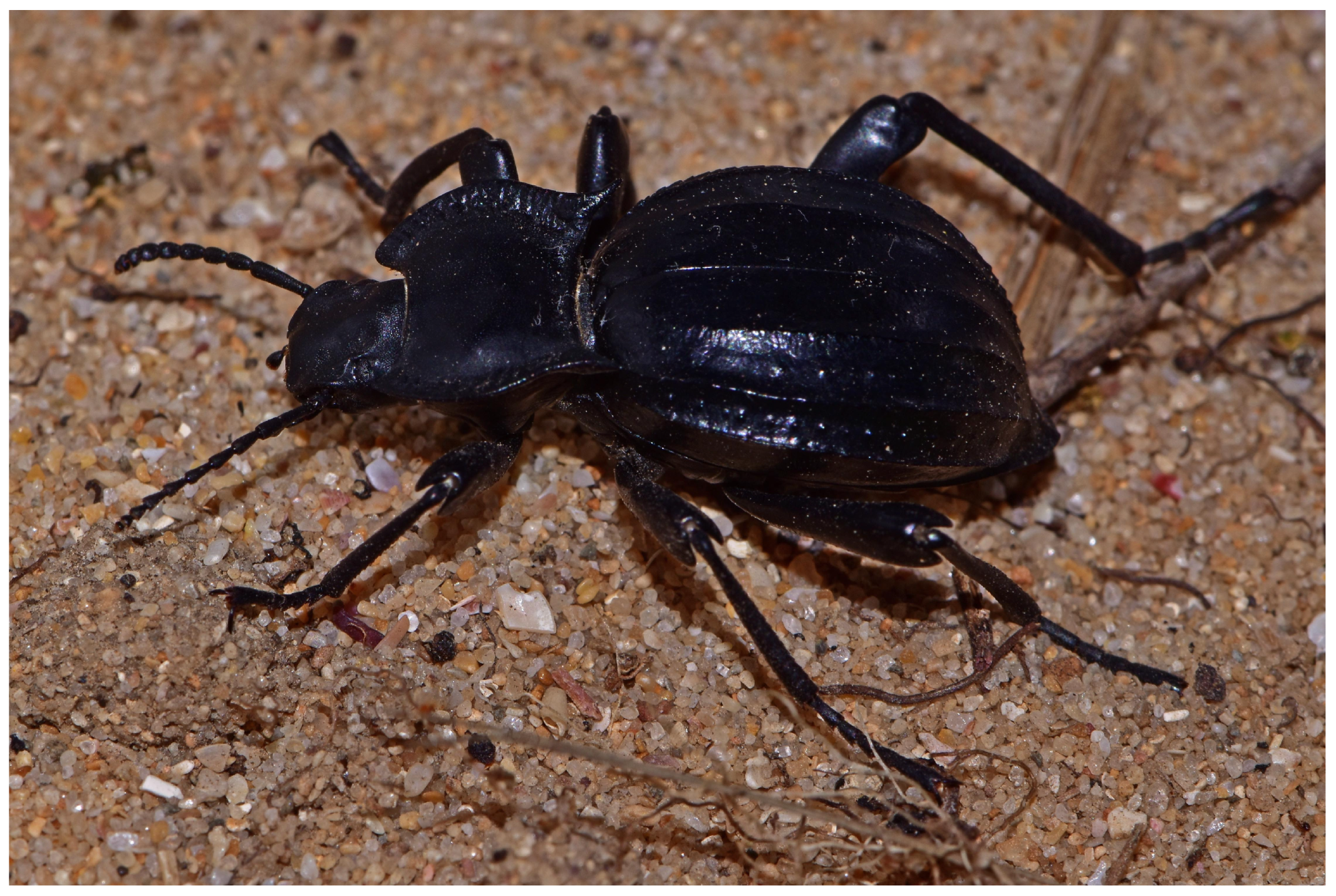
Figure 6. Male specimen with typical morphology of A. granulifera from Sagres (Faro, Portugal).
Genes 17 00455 g006
Figure 7. Dorsal view of specimens of the Akis granulifera and Akis lusitanica mtDNA clades. (A) Female specimen with typical morphology of A. lusitanica included in the mtDNA clade of A. lusitanica, from Calera de León (Badajoz, Spain) (MNCN_Ent 439764) with moderately shiny elytra, matte pronotum, well developed but not very sharp elytral costae, and only the external serrate; (B) Male specimen from Mitra (Évora, Portugal) (MNCN_Ent 439780) with morphology somewhat transitional between A. lusitanica and A. granulifera, including very shiny elytra, sharp costae serrated, included in the mtDNA clade of A. lusitanica; (C) Male specimen from Tavira (Faro, Portugal) with all morphological traits and geographic provenance, as considered by zur Strassen [58] and Ferrer et al. [59], of Akis bayardi, included in the mtDNA clade of A. granulifera (MNCN_Ent 439771); (D) Female specimen from Matalascañas (Huelva) corresponding morphologically and geographically to Akis ilonka, included in the mtDNA clade of A. granulifera (MNCN_Ent 439779). See also Figure 6 showing a typical specimen of Akis granulifera from Sagres (Faro, Portugal).
Genes 17 00455 g007
Figure 8. Specimens from the contact zone between A. acuminata and A. granulifera in Chipiona (Cádiz, Spain). (A) Specimen with typical morphology of A. granulifera (MNCN_Ent 439774) from the Cádiz area, but having mtDNA corresponding to A. acuminata; (B) Specimen with almost typical morphology of A. granulifera (MNCN_Ent 439773) with a mtDNA haplotype corresponding to A. acuminata; note that the internal costae are less prominent and intercostal tubercles reduced; (C) Another specimen with less typical morphology of A. granulifera (MNCN_Ent 439776) with mtDNA haplotype of A. acuminata; note that the intercostal tubercles are absent; (D) Typical Akis acuminata (MNCN_Ent 439786) from Puerto Real (Cádiz, Spain).
Genes 17 00455 g008
Table 1. Specimens used for DNA analyses, with their corresponding specimen codes, localities, and GenBank accession numbers.
Specimen CodeMorphology-Based SpeciesLocalityCOIH3
MNCN_Ent 439734Akis geneiSpain: Cuenca: SegóbrigaPZ044878
MNCN_Ent 439735Akis geneiSpain: Cuenca: SegóbrigaPZ044879
MNCN_Ent 439736Akis geneiSpain: Cuenca: SegóbrigaPZ044880
MNCN_Ent 439737Akis geneiSpain: Cuenca: SegóbrigaPZ044881
MNCN_Ent 439738Akis geneiSpain: Cuenca: SegóbrigaPZ044882
MNCN_Ent 439739Akis geneiSpain: Soria: Monteagudo de las VicaríasPZ044885
MNCN_Ent 439740Akis geneiSpain: Zaragoza: FarletePZ044889
MNCN_Ent 439741Akis geneiSpain: Zaragoza: FarletePZ044890
MNCN_Ent 439742Akis geneiSpain: Zaragoza: 3 km NW FarletePZ044891
MNCN_Ent 439743Akis geneiSpain: Zaragoza: 3 km NW FarletePZ044892
MNCN_Ent 439744Akis geneiSpain: Zamora: ValdefinjasPZ044896PZ049398
MNCN_Ent 439745Akis genei (mtDNA A. lusitanica)Spain: Zamora: ValdefinjasPZ044897
MNCN_Ent 439746Akis geneiSpain: Toledo: Toledo, Puente de San MartínPZ044900
MNCN_Ent 439747Akis geneiSpain: Madrid: ValdaracetePZ044901PZ049399
MNCN_Ent 439748Akis geneiSpain: Madrid: ValdaracetePZ044902
MNCN_Ent 439749Akis geneiSpain: Soria: MedinaceliPZ044923
MNCN_Ent 439750Akis geneiSpain: Toledo: ConsuegraPZ044924
MNCN_Ent 439751Akis geneiSpain: Toledo: Sierra del Romeral, VillacañasPZ044934PZ049395
MNCN_Ent 439752Akis geneiSpain: Ávila: Castro de las Cogotas PZ044943PZ049407
MNCN_Ent 439753Akis genei (mtDNA A. lusitanica)Spain: Ávila: ÁvilaPZ044945
MNCN_Ent 439754Akis geneiSpain: Ciudad Real: Argamasilla de AlbaPZ044949
MNCN_Ent 439755Akis geneiSpain: Ciudad Real: Argamasilla de AlbaPZ044950PZ049397
MNCN_Ent 439756Akis genei (mtDNA A. lusitanica)Spain: Ciudad Real: Argamasilla de AlbaPZ044951PZ049412
MNCN_Ent 439757Akis geneiSpain: Ciudad Real: Argamasilla de AlbaPZ044952
MNCN_Ent 439758Akis geneiSpain: Ciudad Real: Argamasilla de AlbaPZ044953
MNCN_Ent 439759Akis geneiSpain: Zaragoza: FuendetodosPZ044960
MNCN_Ent 439760Akis geneiSpain: Zaragoza: FuendetodosPZ044961
MNCN_Ent 439761Akis geneiSpain: Albacete: El BonilloPZ044983
Ten50Akis geneiSpain: Guadalajara: Illana-EstremeraPZ044964
Ten57aAkis geneiSpain: Ciudad Real: Argamasilla de AlbaPZ044965PZ049409
Ten57bAkis genei (mtDNA lusitanica)Spain: Ciudad Real: Argamasilla de AlbaPZ044966
MNCN_Ent 439762Akis lusitanicaSpain: Madrid: Madrid, Calle Catalina SuárezPZ044883
MNCN_Ent 439763Akis lusitanicaSpain: Madrid: Madrid, Calle Catalina SuárezPZ044884
MNCN_Ent 439764Akis lusitanicaSpain: Badajoz: Calera de LeónPZ044917PZ049413
MNCN_Ent 439765Akis lusitanica (mtDNA genei)Spain: Ciudad Real: 4 km N Ciudad RealPZ044922PZ049405
MNCN_Ent 439766Akis lusitanicaSpain: Badajoz: Ctra. EX325 Km 6–7 Valdebótoa, N from BadajozPZ044925
MNCN_Ent 439767Akis lusitanicaSpain: Cáceres: TrujilloPZ044946PZ049410
MNCN_Ent 439768Akis lusitanicaSpain: Salamanca: Puente del CongostoPZ044947
MNCN_Ent 439769Akis lusitanicaSpain: Salamanca: Puente del CongostoPZ044948PZ049411
MNCN_Ent 464961Akis lusitanicaSpain: Zamora: MalillosPZ044982
MNCN_Ent 439770Akis granuliferaPortugal: Algarve: Tavira, Forte do RatoPZ044898
MNCN_Ent 439771Akis granuliferaPortugal: Algarve: Tavira, Forte do RatoPZ044899PZ049424
MNCN_Ent 439772Akis granuliferaSpain: Cádiz: ChipionaPZ044905
MNCN_Ent 439773Akis granulifera (mtDNA A. acuminata)Spain: Cádiz: ChipionaPZ044906
MNCN_Ent 439774Akis granulifera (mtDNA A. acuminata)Spain: Cádiz: ChipionaPZ044907
MNCN_Ent 439775Akis granulifera (mtDNA A. acuminata)Spain: Cádiz: ChipionaPZ044908PZ049400
MNCN_Ent 439776Akis granulifera (mtDNA A. acuminata)Spain: Cádiz: ChipionaPZ044909
MNCN_Ent 439777Akis granuliferaSpain: Huelva: MatalascañasPZ044910PZ049401
MNCN_Ent 439778Akis granuliferaSpain: Huelva: MatalascañasPZ044911
MNCN_Ent 439779Akis granuliferaSpain: Huelva: MatalascañasPZ044912PZ049402
MNCN_Ent 439780Akis granulifera (mtDNA A. lusitanica)Portugal: Alto Alentejo: Mitra, ÉvoraPZ044926PZ049414
MNCN_Ent 439781Akis granulifera (mtDNA A. lusitanica)Portugal: Alto Alentejo: São Pedro de Corval, MonsarazPZ044927
MNCN_Ent 439782Akis granuliferaPortugal: Algarve: Fortaleza de SagresPZ044977
MNCN_Ent 439783Akis granuliferaPortugal: Algarve: Fortaleza de SagresPZ044978
MNCN_Ent 439784Akis acuminata (mtDNA A. granulifera)Spain: Cádiz: ChipionaPZ044903
MNCN_Ent 439785Akis acuminataSpain: Cádiz: ChipionaPZ044904
MNCN_Ent 439786Akis acuminataSpain: Cádiz: Puerto RealPZ044928
MNCN_Ent 439787Akis acuminataSpain: Granada: DarroPZ044930PZ049408
MNCN_Ent 439788Akis acuminataSpain: Cádiz: Estella del MarquésPZ044931
MNCN_Ent 439789Akis acuminataSpain: Cádiz: Estella del MarquésPZ044932
MNCN_Ent 439790Akis acuminataSpain: Cádiz: Estella del MarquésPZ044933
MNCN_Ent 439791Akis acuminataSpain: Albacete: VillarrobledoPZ044937PZ049406
MNCN_Ent 439792Akis acuminataSpain: Ceuta: Avenida MadridPZ044938
MNCN_Ent 439793Akis acuminataSpain: Ceuta: Avenida MadridPZ044939PZ049396
MNCN_Ent 439794Akis acuminataSpain: Ceuta: Avenida MadridPZ044940
MNCN_Ent 439795Akis acuminataSpain: Málaga: FuengirolaPZ044942
MNCN_Ent 439796Akis acuminataSpain: Cuenca: TarancónPZ044954
MNCN_Ent 439797Akis acuminataSpain: Jaén: Pegalajar VG4376PZ044979
MNCN_Ent 439798Akis acuminataSpain: Jaén: Pegalajar VG4376PZ044980
MNCN_Ent 439799Akis acuminataSpain: Jaén: Pegalajar VG4376PZ044981
MNCN_Ent 439800Akis acuminataSpain: Cádiz: Medina Sidonia TF3938PZ044992
MNCN_Ent 439801Akis acuminataSpain: Cádiz: Medina Sidonia TF3938PZ044993
MNCN_Ent 439802Akis acuminataSpain: Cádiz: Medina Sidonia TF3938PZ044994
MNCN_Ent 439803Akis acuminataSpain: Cádiz: Medina Sidonia TF3938PZ044995
MNCN_Ent 439804Akis acuminataSpain: Málaga: Fuente de PiedraPZ044996
MNCN_Ent 439805Akis acuminataSpain: Málaga: Fuente de PiedraPZ044997
Tbr31Akis acuminataSpain: Granada: El AlbaicínPZ044963
MNCN_Ent 439806Akis elegansSpain: Zaragoza: Pozuel de ArizaPZ044886PZ049393
MNCN_Ent 439807Akis elegansSpain: Zaragoza: MequinenzaPZ044887
MNCN_Ent 439808Akis elegansSpain: Zaragoza: 5 km al N de MaellaPZ044888
MNCN_Ent 439809Akis elegansSpain: Zaragoza: FarletePZ044893
MNCN_Ent 439810Akis elegansSpain: Zaragoza: FarletePZ044894
MNCN_Ent 439811Akis elegansSpain: Zaragoza: 3 km NW FarletePZ044895
MNCN_Ent 439812Akis elegansSpain: Madrid: Fuente El Saz de JaramaPZ044919
MNCN_Ent 439813Akis elegansSpain: Madrid: Fuente El Saz de JaramaPZ044920PZ049394
MNCN_Ent 439814Akis discoideaSpain: Almería: PulpíPZ044913PZ049403
MNCN_Ent 439815Akis discoideaSpain: Almería: PulpíPZ044914
MNCN_Ent 439816Akis discoideaSpain: Alicante: DeniaPZ044918PZ049404
MNCN_Ent 439817Akis discoideaSpain: Almería: San Juan de TerrerosPZ044921PZ049425
MNCN_Ent 439818Akis discoideaSpain: Murcia: JumillaPZ044929PZ049423
MNCN_Ent 439819Akis discoideaSpain: Almería: El Alquián (Cabo de Gata)PZ044944
MNCN_Ent 439820Akis discoideaSpain: Granada: 6.5 km S–SW CharchesPZ044985
MNCN_Ent 439821Akis discoideaSpain: Granada: 6.5 km S–SW CharchesPZ044984
MNCN_Ent 439822Akis discoideaSpain: Granada: 6.5 km S–SW CharchesPZ044986
MNCN_Ent 439823Akis discoideaSpain: Almería: Laujar de AndaraxPZ044987
MNCN_Ent 439824Akis discoideaSpain: Almería: Laujar de AndaraxPZ044988
MNCN_Ent 439825Akis discoideaSpain: Almería: Laujar de AndaraxPZ044989
MNCN_Ent 439826Akis tingitanaMorocco: Moulay BousselhamPZ044915PZ049418
MNCN_Ent 439827Akis tingitanaMorocco: Moulay BousselhamPZ044916PZ049419
MNCN_Ent 439828Akis goryiTunisia: El DjemPZ044935PZ049415
MNCN_Ent 439829Akis goryiTunisia: El DjemPZ044936PZ049416
MNCN_Ent 439830Akis trilineataMorocco: Garganta Oued Laou, N ChefchauenPZ044941PZ049417
AKI8034Akis bacarozzoSpain: Menorca: TorretrencadaPZ044955PZ049391
MNCN_Ent 439831Akis bacarozzoSpain: Menorca: Cala Torta, Cap CavalleriaPZ044956
MNCN_Ent 439832Akis bacarozzoSpain: Menorca: Cala Torta, Cap CavalleriaPZ044957PZ049392
MNCN_Ent 439833Akis bacarozzoSpain: Menorca: AlgaiarensPZ044958
MNCN_Ent 439834Akis bacarozzoSpain: Menorca: AlgaiarensPZ044959
MNCN_Ent 439835Akis bacarozzoSpain: Menorca: Isla del Rey, MahónPZ044990
MNCN_Ent 439836Akis bacarozzoSpain: Menorca: Isla del Rey, MahónPZ044991
MNCN_Ent 439837Akis heydeniMorocco: Boudenib: Kef AzizaPZ044962
MNCN_Ent 464948Morica planataSpain: Granada: Ventas de ZafarrayaPZ044967
MNCN_Ent 464949Morica planataSpain: Ceuta: Camino de La LastraPZ044968
MNCN_Ent 464950Morica planataMorocco: 20 km E IghermPZ044971PZ049422
MNCN_Ent 464951Morica planataSpain: Málaga: Villanueva del TrabucoPZ044972PZ049421
AKI8031Morica planataMorocco: Oued Laou, TalambotePZ044973
MNCN_Ent 464952Morica planataMorocco: Tadla-Azilal: Kasba TadlaPZ044974
MNCN_Ent 464953Morica planataMorocco: Tadla-Azilal: Kasba TadlaPZ044975
MNCN_Ent 464954Morica favieriSpain: Almería: 8 km E TabernasPZ044969PZ049420
MNCN_Ent 464955Morica favieriMorocco: MarrakechPZ044976
MNCN_Ent 464956Morica hybridaSpain: Almería: Los Atochares, NíjarPZ044970PZ049390
MNCN_Ent 464957Leptoderis collarisSpain: Madrid: 5 km NE Molino de AldehuelaPZ044998
MNCN_Ent 464958Leptoderis collarisSpain: Madrid: 5 km NE Molino de AldehuelaPZ044999
MNCN_Ent 464959Leptoderis collarisSpain: Zaragoza: FarletePZ045000
MNCN_Ent 464960Leptoderis collarisSpain: Zaragoza: MequinenzaPZ045001PZ049389
Disclaimer/Publisher’s Note: The statements, opinions and data contained in all publications are solely those of the individual author(s) and contributor(s) and not of MDPI and/or the editor(s). MDPI and/or the editor(s) disclaim responsibility for any injury to people or property resulting from any ideas, methods, instructions or products referred to in the content.