Genetic Associations of Parkinson’s Disease Clinical, Pathological, and Data-Driven Subtypes

 ,
,  , , , , and
Abstract
1. Introduction
2. Materials and Methods
2.1. Study Population
2.2. Genetic Testing
2.3. Subtype Classification
2.3.1. Clinical Motor Subtypes (TD/PIGD)
2.3.2. SAA Status (SAA+/SAA−)
2.3.3. Pathological Subtype (Brain-First/Body-First)
2.3.4. Data-Driven Subtype (DM/MMP/IM)
2.4. Statistical Analysis
3. Results
3.1. Study Cohort
3.2. Subtype Distributions
- Clinical (TD/PIGD): At the baseline visit, among 1220 patients with evaluable tremor/PIGD scores, 793 (65.0%) were classified as TD, 296 (24.3%) as PIGD, and 131 (10.7%) as indeterminate.
- SAA Status: Among 1268 patients with baseline SAA results, 1112 (87.7%) were SAA+ and 156 (12.3%) were SAA−.
- Pathological Subtype: Among 1560 patients with baseline RBDSQ data, 985 (63.1%) were classified as brain-first, 342 (21.9%) as body-first, and 233 (14.9%) as indeterminate.
- Data-Driven Subtype: Among 1272 patients with complete baseline data, 322 (25.3%) were classified as DM, 441 (34.7%) as MMP, and 509 (40.0%) as IM.
3.3. Genetic Correlates by Subtyping Framework
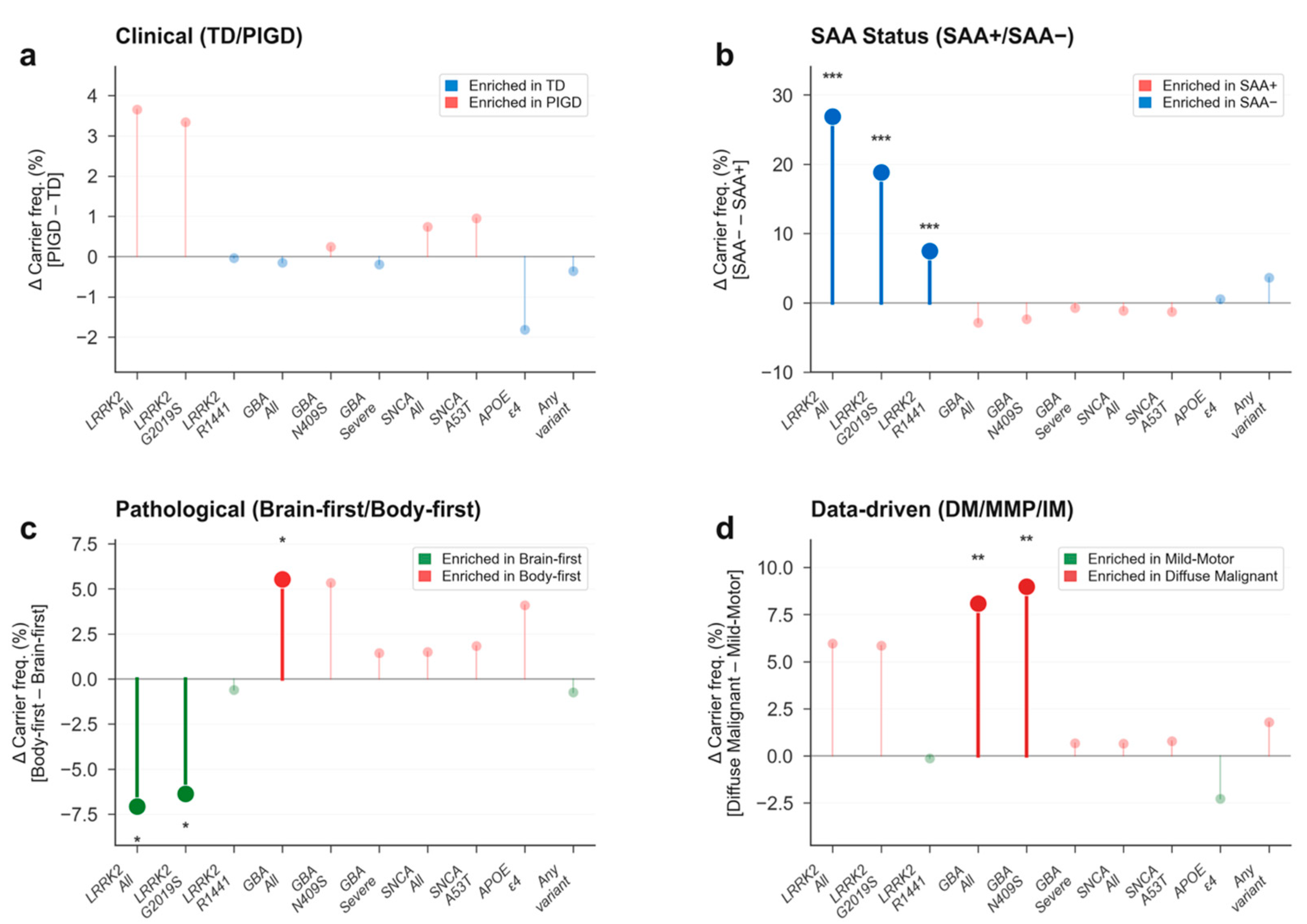
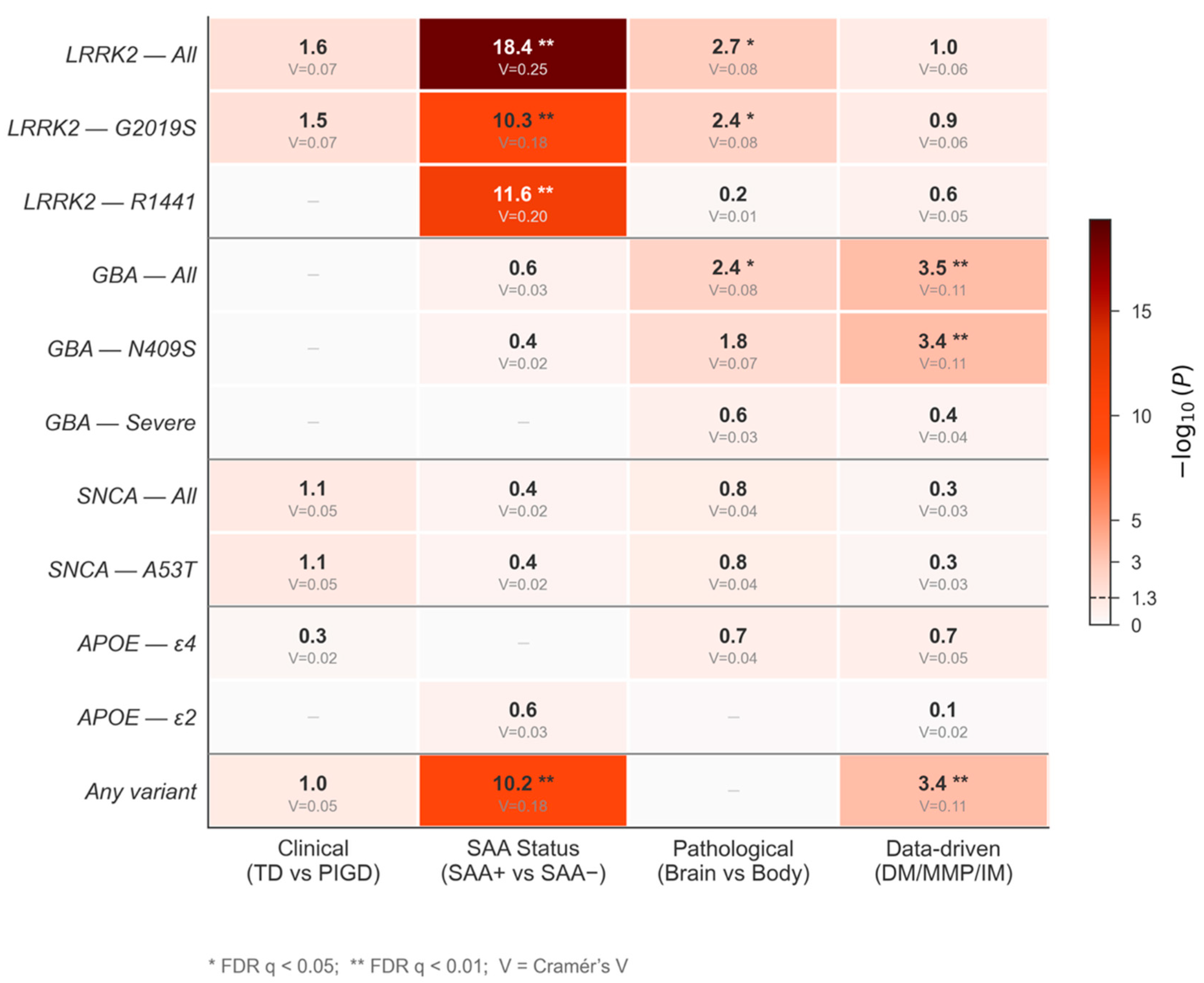
3.3.1. Clinical Motor Subtype (TD vs. PIGD)
3.3.2. SAA Status (SAA+ vs. SAA−)
3.3.3. Pathological Subtype (Brain-First vs. Body-First)
3.3.4. Data-Driven Subtype (DM vs. MMP vs. IM)
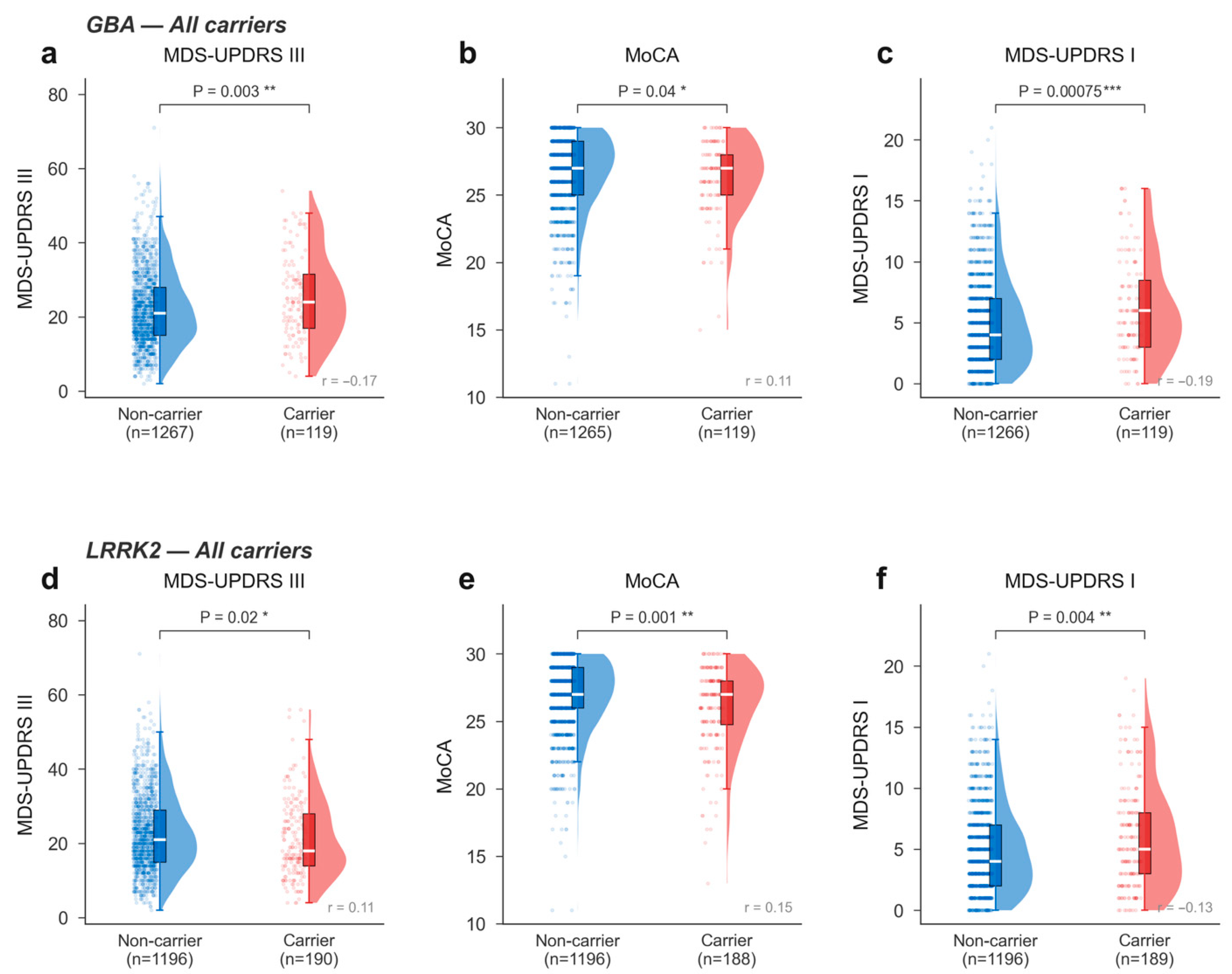
3.4. GBA1 and LRRK2 Carrier Subtype Profiles
3.5. APOE Analysis
4. Discussion
5. Conclusions
Supplementary Materials
Author Contributions
Funding
Institutional Review Board Statement
Informed Consent Statement
Data Availability Statement
Acknowledgments
Conflicts of Interest
Abbreviations
| PD | Parkinson’s disease |
| TD | Tremor-dominant |
| PIGD | Postural instability/gait difficulty |
| SAA | Seed amplification assay |
| DM | Diffuse malignant |
| MMP | Mild-motor predominant |
| IM | Intermediate |
| PPMI | Parkinson’s Progression Markers Initiative |
| LRRK2 | Leucine-rich repeat kinase 2 |
| GBA1 | Glucocerebrosidase |
| SNCA | Synuclein alpha |
| APOE | Apolipoprotein E |
| MDS-UPDRS | Movement Disorder Society–Unified Parkinson’s Disease Rating Scale |
| MoCA | Montreal Cognitive Assessment |
| RBD | Rapid eye movement sleep behavior disorder |
| RBDSQ | RBD Screening Questionnaire |
| CSF | Cerebrospinal fluid |
| CLIA | Clinical Laboratory Improvement Amendments |
| OR | Odds ratio |
| CI | Confidence interval |
| FDR | False discovery rate |
| AIC | Akaike information criterion |
| IQR | Interquartile range |
| SD | Standard deviation |
| SCOPA-AUT | Scales for Outcomes in Parkinson’s Disease–Autonomic |
References
- de Lau, L.M.L.; Breteler, M.M.B. Epidemiology of Parkinson’s disease. Lancet Neurol. 2006, 5, 525–535. [Google Scholar] [CrossRef]
- Grotewold, N.; Albin, R.L. Update: Descriptive epidemiology of Parkinson disease. Park. Relat. Disord. 2024, 120, 106000. [Google Scholar] [CrossRef]
- Negida, A.; Altamimi, F.Q.; Elsayed, M.; Ebuid, Y.R.I.; Nabil, Y.; Parker, M.O.; Barrett, M.J. Chapter 14—Epidemiology and risk factors of Parkinson’s disease. In Essential Guide to Neurodegenerative Disorders; Mohamed, W.M.Y., Ed.; Academic Press: Cambridge, MA, USA, 2025; pp. 225–234. [Google Scholar] [CrossRef]
- Albrecht, F.; Poulakis, K.; Freidle, M.; Johansson, H.; Ekman, U.; Volpe, G.; Westman, E.; Pereira, J.B.; Franzén, E. Unraveling Parkinson’s disease heterogeneity using subtypes based on multimodal data. Park. Relat. Disord. 2022, 102, 19–29. [Google Scholar] [CrossRef]
- Dulski, J.; Uitti, R.J.; Beasley, A.; Hernandez, D.; Ramanan, V.K.; Cahn, E.J.; Ren, Y.; Johnson, P.W.; Quicksall, Z.S.; Wszolek, Z.K.; et al. Genetics of Parkinson’s disease heterogeneity: A genome-wide association study of clinical subtypes. Park. Relat. Disord. 2024, 119, 105935. [Google Scholar] [CrossRef] [PubMed]
- Wüllner, U.; Borghammer, P.; Choe, C.; Csoti, I.; Falkenburger, B.; Gasser, T.; Lingor, P.; Riederer, P. The heterogeneity of Parkinson’s disease. J. Neural Transm. 2023, 130, 827–838. [Google Scholar] [CrossRef]
- von Coelln, R.; Shulman, L.M. Clinical subtypes and genetic heterogeneity: Of lumping and splitting in Parkinson disease. Curr. Opin. Neurol. 2016, 29, 727–734. [Google Scholar] [CrossRef]
- Mastenbroek, S.E.; Vogel, J.W.; Collij, L.E.; Serrano, G.E.; Tremblay, C.; Young, A.L.; Arce, R.A.; Shill, H.A.; Driver-Dunckley, E.D.; Mehta, S.H.; et al. Disease progression modelling reveals heterogeneity in trajectories of Lewy-type α-synuclein pathology. Nat. Commun. 2024, 15, 5133. [Google Scholar] [CrossRef]
- Adams, C.; Suescun, J.; Haque, A.; Block, K.; Chandra, S.; Ellmore, T.M.; Schiess, M.C. Updated Parkinson’s disease motor subtypes classification and correlation to cerebrospinal homovanillic acid and 5-hydroxyindoleacetic acid levels. Clin. Park. Relat. Disord. 2023, 8, 100187. [Google Scholar] [CrossRef] [PubMed]
- Jankovic, J.; McDermott, M.; Carter, J.; Gauthier, S.; Goetz, C.; Golbe, L.; Huber, S.; Koller, W.; Olanow, C.; Shoulson, I.; et al. Variable expression of Parkinson’s disease. Neurology 1990, 40, 1529. [Google Scholar] [CrossRef]
- Ren, J.; Pan, C.; Li, Y.; Li, L.; Hua, P.; Xu, L.; Zhang, L.; Zhang, W.; Xu, P.; Liu, W. Consistency and Stability of Motor Subtype Classifications in Patients With de novo Parkinson’s Disease. Front. Neurosci. 2021, 15, 637896. [Google Scholar] [CrossRef]
- Chen, Q.; Scherbaum, R.; Gold, R.; Pitarokoili, K.; Mosig, A.; Zella, S.; Tönges, L. Data-driven subtyping of Parkinson’s disease: Comparison of current methodologies and application to the Bochum PNS cohort. J. Neural Transm. 2023, 130, 763–776. [Google Scholar] [CrossRef] [PubMed]
- Deng, X.; Saffari, S.E.; Xiao, B.; Ng, S.Y.E.; Chia, N.; Choi, X.; Heng, D.L.; Ng, E.; Xu, Z.; Tay, K.-Y.; et al. Disease Progression of Data-Driven Subtypes of Parkinson’s Disease: 5-Year Longitudinal Study from the Early Parkinson’s Disease Longitudinal Singapore (PALS) Cohort. J. Park. Dis. 2024, 14, 1051–1059. [Google Scholar] [CrossRef]
- Negida, A.; Vohra, H.Z.; Lageman, S.K.; Mukhopadhyay, N.; Berman, B.D.; Weintraub, D.; Barrett, M.J. Parkinson’s Disease Mild Cognitive Impairment with MRI evidence of Cholinergic Nucleus 4 Degeneration: A New Subtype? Park. Relat. Disord. 2025, 141, 108072. [Google Scholar] [CrossRef]
- Fereshtehnejad, S.-M.; Zeighami, Y.; Dagher, A.; Postuma, R.B. Clinical criteria for subtyping Parkinson’s disease: Biomarkers and longitudinal progression. Brain 2017, 140, 1959–1976. [Google Scholar] [CrossRef]
- Fereshtehnejad, S.-M.; Romenets, S.R.; Anang, J.B.M.; Latreille, V.; Gagnon, J.-F.; Postuma, R.B. New Clinical Subtypes of Parkinson Disease and Their Longitudinal Progression: A Prospective Cohort Comparison with Other Phenotypes. JAMA Neurol. 2015, 72, 863–873. [Google Scholar] [CrossRef] [PubMed]
- Bohnen, N.I.; Postuma, R.B. Body-first versus brain-first biological subtyping of Parkinson’s disease. Brain 2020, 143, 2871–2873. [Google Scholar] [CrossRef]
- Borghammer, P.; Horsager, J.; Andersen, K.; Van Den Berge, N.; Raunio, A.; Murayama, S.; Parkkinen, L.; Myllykangas, L. Neuropathological evidence of body-first vs. brain-first Lewy body disease. Neurobiol. Dis. 2021, 161, 105557. [Google Scholar] [CrossRef]
- Borghammer, P.; Van Den Berge, N. Brain-First versus Gut-First Parkinson’s Disease: A Hypothesis. J. Park. Dis. 2019, 9, S281–S295. [Google Scholar] [CrossRef]
- Stebbins, G.T.; Goetz, C.G.; Burn, D.J.; Jankovic, J.; Khoo, T.K.; Tilley, B.C. How to identify tremor dominant and postural instability/gait difficulty groups with the movement disorder society unified Parkinson’s disease rating scale: Comparison with the unified Parkinson’s disease rating scale. Mov. Disord. 2013, 28, 668–670. [Google Scholar] [CrossRef]
- Brockmann, K.; Lerche, S.; Baiardi, S.; Rossi, M.; Wurster, I.; Quadalti, C.; Roeben, B.; Mammana, A.; Zimmermann, M.; Hauser, A.; et al. CSF α-synuclein seed amplification kinetic profiles are associated with cognitive decline in Parkinson’s disease. Npj Park. Dis. 2024, 10, 24. [Google Scholar] [CrossRef]
- Brooker, S.M.; Pasquini, J.; Choi, S.H.; Lafontant, D.-E.; Fereshtehnejad, S.-M.; Zeighami, Y.; Grillo, P.; Riboldi, G.M.; Azizi, H.; Moqadam, R.; et al. Clinical and Imaging Characteristics of Parkinson’s Disease with Negative Alpha-Synuclein Seed Amplification Assay. Mov. Disord. 2026. [Google Scholar] [CrossRef]
- Coughlin, D.G.; Shifflett, B.; Farris, C.M.; Ma, Y.; Galasko, D.; Edland, S.D.; Mollenhauer, B.; Brumm, M.C.; Poston, K.L.; Marek, K.; et al. α-Synuclein Seed Amplification Assay Amplification Parameters and the Risk of Progression in Prodromal Parkinson Disease. Neurology 2025, 104, e210279. [Google Scholar] [CrossRef] [PubMed]
- O’Hara, D.M.; Pawar, G.; Kalia, S.K.; Kalia, L.V. LRRK2 and α-Synuclein: Distinct or Synergistic Players in Parkinson’s Disease? Front. Neurosci. 2020, 14, 577. [Google Scholar] [CrossRef]
- Kalia, L.V.; Lang, A.E.; Hazrati, L.-N.; Fujioka, S.; Wszolek, Z.K.; Dickson, D.W.; Ross, O.A.; Van Deerlin, V.M.; Trojanowski, J.Q.; Hurtig, H.I.; et al. Clinical correlations with Lewy body pathology in LRRK2-related Parkinson disease. JAMA Neurol. 2015, 72, 100–105. [Google Scholar] [CrossRef]
- Sidransky, E.; Nalls, M.A.; Aasly, J.O.; Aharon-Peretz, J.; Annesi, G.; Barbosa, E.R.; Bar-Shira, A.; Berg, D.; Bras, J.; Brice, A.; et al. Multicenter analysis of glucocerebrosidase mutations in Parkinson’s disease. N. Engl. J. Med. 2009, 361, 1651–1661. [Google Scholar] [CrossRef]
- Huh, Y.E.; Usnich, T.; Scherzer, C.R.; Klein, C.; Chung, S.J. GBA1 Variants and Parkinson’s Disease: Paving the Way for Targeted Therapy. J. Mov. Disord. 2023, 16, 261–278. [Google Scholar] [CrossRef]
- Siderowf, A.; Concha-Marambio, L.; Lafontant, D.-E.; Farris, C.M.; Ma, Y.; Urenia, P.A.; Nguyen, H.; Alcalay, R.N.; Chahine, L.M.; Foroud, T.; et al. Assessment of heterogeneity among participants in the Parkinson’s Progression Markers Initiative cohort using α-synuclein seed amplification: A cross-sectional study. Lancet Neurol. 2023, 22, 407–417. [Google Scholar] [CrossRef] [PubMed]
- Chahine, L.M.; Lafontant, D.-E.; Choi, S.H.; Iwaki, H.; Blauwendraat, C.; Singleton, A.B.; Brumm, M.C.; Alcalay, R.N.; Merchant, K.; Nudelman, K.N.H.; et al. LRRK2-associated parkinsonism with and without in vivo evidence of alpha-synuclein aggregates: Longitudinal clinical and biomarker characterization. Brain Commun. 2025, 7, fcaf103. [Google Scholar] [CrossRef]
- Maple-Grødem, J.; Dalen, I.; Tysnes, O.-B.; Macleod, A.D.; Forsgren, L.; Counsell, C.E.; Alves, G. Association of GBA1 Genotype With Motor and Functional Decline in Patients With Newly Diagnosed Parkinson Disease. Neurology 2021, 96, e1036–e1044. [Google Scholar] [CrossRef]
- Menozzi, E.; Schapira, A.H.V. Exploring the Genotype–Phenotype Correlation in GBA1-Parkinson Disease: Clinical Aspects, Biomarkers, and Potential Modifiers. Front. Neurol. 2021, 12, 694764. [Google Scholar] [CrossRef]
- Aarsland, D.; Batzu, L.; Halliday, G.M.; Geurtsen, G.J.; Ballard, C.; Ray Chaudhuri, K.; Weintraub, D. Parkinson disease-associated cognitive impairment. Nat. Rev. Dis. Primers 2021, 7, 1–21. [Google Scholar] [CrossRef] [PubMed]
- Kim, I.; Shin, N.-Y.; Bak, Y.; Hyu Lee, P.; Lee, S.-K.; Mee Lim, S. Early-onset mild cognitive impairment in Parkinson’s disease: Altered corticopetal cholinergic network. Sci. Rep. 2017, 7, 2381. [Google Scholar] [CrossRef] [PubMed]
- Botta, R.; Locascio, J.J.; Ye, R.; Goodheart, A.E.; Gomperts, S.N. APOE, Aβ42, and tau differentially impact cognitive decline in Sporadic, GBA1 and LRRK2 Parkinson’s disease. Npj Park. Dis. 2026, 12, 79. [Google Scholar] [CrossRef]
- Xu, Z.; Hu, T.; Xu, C.; Liang, X.; Li, S.; Sun, Y.; Liu, F.; Wang, J.; Tang, Y. Disease progression in proposed brain-first and body-first Parkinson’s disease subtypes. Npj Park. Dis. 2024, 10, 111. [Google Scholar] [CrossRef]
- Benjamini, Y.; Hochberg, Y. Controlling the False Discovery Rate: A Practical and Powerful Approach to Multiple Testing. J. R. Stat. Soc. Ser. B 1995, 57, 289–300. [Google Scholar] [CrossRef]
- Feller, W. Review: Harald Cramer, Mathematical Methods of Statistics. Ann. Math. Stat. 1947, 18, 136–139. [Google Scholar] [CrossRef]
- Dadu, A.; Satone, V.; Kaur, R.; Hashemi, S.H.; Leonard, H.; Iwaki, H.; Makarious, M.B.; Billingsley, K.J.; Bandres-Ciga, S.; Sargent, L.J.; et al. Identification and prediction of Parkinson’s disease subtypes and progression using machine learning in two cohorts. Npj Park. Dis. 2022, 8, 172. [Google Scholar] [CrossRef]
- Lamonaca, G.; Volta, M. Alpha-Synuclein and LRRK2 in Synaptic Autophagy: Linking Early Dysfunction to Late-Stage Pathology in Parkinson’s Disease. Cells 2020, 9, 1115. [Google Scholar] [CrossRef]
- Vinagre-Aragón, A.; Campo-Caballero, D.; Mondragón-Rezola, E.; Pardina-Vilella, L.; Hernandez Eguiazu, H.; Gorostidi, A.; Croitoru, I.; Bergareche, A.; Ruiz-Martinez, J. A More Homogeneous Phenotype in Parkinson’s Disease Related to R1441G Mutation in the LRRK2 Gene. Front. Neurol. 2021, 12, 635396. [Google Scholar] [CrossRef]
- Höglinger, G.; Schulte, C.; Jost, W.H.; Storch, A.; Woitalla, D.; Krüger, R.; Falkenburger, B.; Brockmann, K. GBA1-associated PD: Chances and obstacles for targeted treatment strategies. J. Neural Transm. 2022, 129, 1219–1233. [Google Scholar] [CrossRef]
- Stoker, T.B.; Torsney, K.M.; Barker, R.A. Pathological Mechanisms and Clinical Aspects of GBA1 Mutation-Associated Parkinson’s Disease. In Parkinson’s Disease: Pathogenesis and Clinical Aspects; Stoker, T.B., Greenland, J.C., Eds.; Codon Publications: Brisbane, Australia, 2018. [Google Scholar]
- Granek, Z.; Barczuk, J.; Siwecka, N.; Rozpędek-Kamińska, W.; Kucharska, E.; Majsterek, I. GBA1 Gene Mutations in α-Synucleinopathies—Molecular Mechanisms Underlying Pathology and Their Clinical Significance. Int. J. Mol. Sci. 2023, 24, 2044. [Google Scholar] [CrossRef]
- Smith, L.; Schapira, A.H.V. GBA1 Variants and Parkinson Disease: Mechanisms and Treatments. Cells 2022, 11, 1261. [Google Scholar] [CrossRef]
- Zhang, X.; Wu, H.; Tang, B.; Guo, J. Clinical, mechanistic, biomarker, and therapeutic advances in GBA1-associated Parkinson’s disease. Transl. Neurodegener. 2024, 13, 48. [Google Scholar] [CrossRef] [PubMed]
- Pu, J.-L.; Jin, C.-Y.; Wang, Z.-X.; Fang, Y.; Li, Y.-L.; Xue, N.-J.; Zheng, R.; Lin, Z.; Yan, Y.; Si, X.; et al. Apolipoprotein E Genotype Contributes to Motor Progression in Parkinson’s Disease. Mov. Disord. 2022, 37, 196–200. [Google Scholar] [CrossRef] [PubMed]
- Conti, M.; Mascioli, D.; Simonetta, C.; Ferrari, V.; Bissacco, J.; Bagetta, S.; Carparelli, F.; Bernardini, S.; Di Giuliano, F.; Marchionni, E.; et al. Clinical, Biological, and Functional Connectivity Profile of Patients With De Novo Parkinson Disease Who Are APOE ε4 Carriers. Neurology 2026, 106, e214449. [Google Scholar] [CrossRef]
- Xu, X.; Zhang, S.; Xu, C.; Zhang, W.; Zhao, H.; Liu, Y.; Zhai, S.; Zu, J.; Li, Z.; Xiao, L. Identifying subtypes of longitudinal motor symptom severity trajectories in early Parkinson’s disease patients. Front. Neurol. 2025, 16, 1597132. [Google Scholar] [CrossRef]
- Soraya, G.V.; Fitrah, Y.A.; Bintang, A.K.; Akbar, M.; Jannah, A.R.; Ulhaq, Z.S.; Tammasse, J.; Kaelan, C.; Massi, M.N.; Obinata, A.; et al. Elucidating the role of APOE ε4 gene variants in the clinical manifestation of Parkinson’s disease. Front. Aging Neurosci. 2025, 17, 1632480. [Google Scholar] [CrossRef]
- Simuni, T.; Chahine, L.M.; Poston, K.; Brumm, M.; Buracchio, T.; Campbell, M.; Chowdhury, S.; Coffey, C.; Concha-Marambio, L.; Dam, T.; et al. A biological definition of neuronal α-synuclein disease: Towards an integrated staging system for research. Lancet Neurol. 2024, 23, 178–190. [Google Scholar] [CrossRef] [PubMed]



| Clinical Motor Subtypes | SAA Status | Pathological Subtypes | Data-Driven Subtypes | ||||||
|---|---|---|---|---|---|---|---|---|---|
| PIGD (n = 296) | TD (n = 793) | SAA+ (n = 1112) | SAA− (n = 156) | Body-First (n = 342) | Brain-First (n = 985) | DM (n = 322) | IM (n = 509) | MMP (n = 441) | |
| Age, years | 63.2 ± 9.5 | 63.5 ± 9.5 | 62.6 ± 9.6 | 66.1 ± 9.6 | 63.3 ± 9.5 | 62.6 ± 9.9 | 64.0 ± 10.3 | 62.7 ± 9.1 | 59.8 ± 10.1 |
| Male sex, n (%) | 117 (40%) | 317 (40%) | 377 (34%) | 49 (31.4%) | 148 (43%) | 338 (34%) | 133 (41%) | 208 (41%) | 160 (36%) |
| Education, years | 15.9 ± 3.4 | 16.2 ± 3.0 | 16.2 ± 3.2 | 15.1 ± 4.2 | 15.7 ± 3.4 | 16.1 ± 3.4 | 15.9 ± 3.6 | 16.1 ± 3.3 | 16.2 ± 3.2 |
| MDS-UPDRS III | 21.6 ± 9.9 | 22.6 ± 9.7 | 22.7 ± 9.9 | 20.6 ± 9.0 | 23.7 ± 11.4 | 21.8 ± 10.0 | 28.0 ± 12.1 | 21.3 ± 9.6 | 19.5 ± 8.3 |
| MoCA | 26.9 ± 2.4 | 26.9 ± 2.5 | 26.9 ± 2.5 | 26.0 ± 2.8 | 26.4 ± 2.9 | 26.8 ± 2.7 | 25.8 ± 2.9 | 26.3 ± 2.6 | 28.1 ± 1.3 |
| H&Y stage | 2 [1,2] | 2 [1,2] | 2 [1,2] | 2 [1,2] | 2 [1,2] | 2 [1,2] | 2 [2] | 2 [1,2] | 2 [1,2] |
| SAA positive, n (%) | 207 (83%) | 647 (91%) | 1112 (100%) | 0 (0%) | 240 (89%) | 704 (86%) | 218 (87%) | 370 (88%) | 351 (91%) |
| LRRK2 carrier, n (%) | 19 (7.0%) | 25 (3.4%) | 109 (10.2%) | 56 (37.1%) | 24 (7.9%) | 132 (15.0%) | 42 (15.1%) | 57 (12.8%) | 37 (9.1%) |
| GBA carrier, n (%) | 8 (3.0%) | 23 (3.1%) | 80 (7.5%) | 7 (4.6%) | 37 (12.3%) | 59 (6.7%) | 39 (14.0%) | 28 (6.3%) | 24 (5.9%) |
| SNCA carrier, n (%) | 2 (0.7%) | 0 (0.0%) | 12 (1.1%) | 0 (0.0%) | 9 (3.0%) | 13 (1.5%) | 8 (2.9%) | 7 (1.6%) | 9 (2.2%) |
| PRKN carrier, n (%) | 3 (1.1%) | 12 (1.6%) | 11 (1.0%) | 3 (2.0%) | 4 (1.3%) | 10 (1.1%) | 4 (1.4%) | 4 (0.9%) | 6 (1.5%) |
| PINK1 carrier, n (%) | 0 (0.0%) | 0 (0.0%) | 0 (0.0%) | 0 (0.0%) | 0 (0.0%) | 0 (0.0%) | 0 (0.0%) | 0 (0.0%) | 0 (0.0%) |
| PARK7 carrier, n (%) | 0 (0.0%) | 0 (0.0%) | 0 (0.0%) | 0 (0.0%) | 0 (0.0%) | 0 (0.0%) | 0 (0.0%) | 0 (0.0%) | 0 (0.0%) |
| VPS35 carrier, n (%) | 0 (0.0%) | 0 (0.0%) | 0 (0.0%) | 0 (0.0%) | 0 (0.0%) | 0 (0.0%) | 0 (0.0%) | 0 (0.0%) | 0 (0.0%) |
| LRRK2-G2019S, n (%) | 17 (6.3%) | 22 (3.0%) | 103 (9.6%) | 43 (28.5%) | 21 (7.0%) | 117 (13.3%) | 40 (14.4%) | 51 (11.4%) | 35 (8.6%) |
| LRRK2-R1441G/C/H, n (%) | 1 (0.4%) | 3 (0.4%) | 5 (0.5%) | 12 (7.9%) | 3 (1.0%) | 14 (1.6%) | 1 (0.4%) | 6 (1.3%) | 2 (0.5%) |
| GBA-N409S, n (%) | 6 (2.8%) | 16 (2.6%) | 66 (7.2%) | 6 (4.8%) | 30 (12.0%) | 49 (6.6%) | 32 (13.6%) | 23 (6.2%) | 16 (4.6%) |
| GBA severe, n (%) | 2 (0.9%) | 7 (1.1%) | 14 (1.5%) | 1 (0.8%) | 7 (2.8%) | 10 (1.3%) | 7 (3.0%) | 5 (1.3%) | 8 (2.3%) |
| SNCA-A53T, n (%) | 2 (0.9%) | 0 (0.0%) | 12 (1.3%) | 0 (0.0%) | 9 (3.6%) | 13 (1.8%) | 8 (3.4%) | 7 (1.9%) | 9 (2.6%) |
| APOE ε4 carrier, n (%) | 61 (22.7%) | 179 (24.5%) | 254 (24.0%) | 37 (24.5%) | 81 (26.9%) | 199 (22.8%) | 58 (20.8%) | 119 (26.9%) | 93 (23.1%) |
| APOE ε2 carrier, n (%) | 41 (15.2%) | 114 (15.6%) | 151 (14.3%) | 27 (17.9%) | 43 (14.3%) | 131 (15.0%) | 41 (14.7%) | 69 (15.6%) | 52 (12.9%) |
| Genetic Variant | PIGD (N = 270), n (%) | TD (N = 739), n (%) | Test | p-Value | q-Value | Cramér’s V |
|---|---|---|---|---|---|---|
| LRRK2—All | 19/270 (7.0) | 25/739 (3.4) | χ2 | 0.024 | 0.095 | 0.07 |
| GBA—All | 8/270 (3.0) | 23/739 (3.1) | χ2 | 1.0 | 1.0 | 0.00 |
| SNCA—All | 2/270 (0.7) | 0/739 (0.0) | Fisher | 0.074 | 0.236 | 0.05 |
| PRKN | 3/270 (1.1) | 12/739 (1.6) | Fisher | 0.771 | 0.949 | 0.01 |
| PINK1 | 0/270 (0.0) | 0/739 (0.0) | — | — | — | — |
| PARK7 | 0/270 (0.0) | 0/739 (0.0) | — | — | — | — |
| VPS35 | 0/270 (0.0) | 0/739 (0.0) | — | — | — | — |
| Any variant | 32/270 (11.9) | 59/739 (8.0) | χ2 | 0.096 | 0.288 | 0.05 |
| APOE—ε4 | 61/269 (22.7) | 179/731 (24.5) | χ2 | 0.539 | 0.762 | 0.02 |
| APOE—ε2 | 41/269 (15.2) | 114/731 (15.6) | χ2 | 0.902 | 1.0 | 0.00 |
| LRRK2—G2019S | 17/269 (6.3) | 22/739 (3.0) | χ2 | 0.031 | 0.113 | 0.07 |
| LRRK2—R1441 | 1/269 (0.4) | 3/739 (0.4) | Fisher | 1.0 | 1.0 | 0.00 |
| GBA—N409S | 6/211 (2.8) | 16/616 (2.6) | χ2 | 1.0 | 1.0 | 0.00 |
| GBA—Severe | 2/211 (0.9) | 7/616 (1.1) | Fisher | 1.0 | 1.0 | 0.00 |
| SNCA—A53T | 2/211 (0.9) | 0/616 (0.0) | Fisher | 0.074 | 0.236 | 0.05 |
| Genetic Variant | SAA+ (N = 1069), n (%) | SAA− (N = 151), n (%) | Test | p-Value | q-Value | Cramér’s V |
|---|---|---|---|---|---|---|
| LRRK2—All | 109/1069 (10.2) | 56/151 (37.1) | χ2 | 3.7 × 10⁻¹⁹ | < 0.001 | 0.25 |
| GBA—All | 80/1069 (7.5) | 7/151 (4.6) | χ2 | 0.279 | 0.514 | 0.03 |
| SNCA—All | 12/1069 (1.1) | 0/151 (0.0) | Fisher | 0.381 | 0.614 | 0.02 |
| PRKN | 11/1069 (1.0) | 3/151 (2.0) | Fisher | 0.400 | 0.620 | 0.02 |
| PINK1 | 0/1069 (0.0) | 0/151 (0.0) | — | — | — | — |
| PARK7 | 0/1069 (0.0) | 0/151 (0.0) | — | — | — | — |
| VPS35 | 0/1069 (0.0) | 0/151 (0.0) | — | — | — | — |
| Any variant | 205/1069 (19.2) | 65/151 (43.0) | χ2 | 6.4 × 10⁻¹¹ | < 0.001 | 0.18 |
| APOE—ε4 | 254/1059 (24.0) | 37/151 (24.5) | χ2 | 0.887 | 1.0 | 0.00 |
| APOE—ε2 | 151/1059 (14.3) | 27/151 (17.9) | χ2 | 0.257 | 0.494 | 0.03 |
| LRRK2—G2019S | 103/1069 (9.6) | 43/151 (28.5) | χ2 | 4.9 × 10⁻¹¹ | < 0.001 | 0.18 |
| LRRK2—R1441 | 5/1069 (0.5) | 12/151 (7.9) | χ2 | 2.7 × 10⁻¹² | < 0.001 | 0.20 |
| GBA—N409S | 66/916 (7.2) | 6/124 (4.8) | χ2 | 0.384 | 0.614 | 0.02 |
| GBA—Severe | 14/916 (1.5) | 1/124 (0.8) | Fisher | 1.0 | 1.0 | 0.01 |
| SNCA—A53T | 12/916 (1.3) | 0/124 (0.0) | Fisher | 0.381 | 0.614 | 0.02 |
| Genetic Variant | Body-First (N = 302), n (%) | Brain-First (N = 879), n (%) | Test | p-Value | q-Value | Cramér’s V |
|---|---|---|---|---|---|---|
| LRRK2—All | 24/302 (7.9) | 132/879 (15.0) | χ2 | 0.002 | 0.013 | 0.08 |
| GBA—All | 37/302 (12.3) | 59/879 (6.7) | χ2 | 0.004 | 0.021 | 0.08 |
| SNCA—All | 9/302 (3.0) | 13/879 (1.5) | χ2 | 0.164 | 0.394 | 0.04 |
| PRKN | 4/302 (1.3) | 10/879 (1.1) | Fisher | 0.764 | 0.949 | 0.00 |
| PINK1 | 0/302 (0.0) | 0/879 (0.0) | — | — | — | — |
| PARK7 | 0/302 (0.0) | 0/879 (0.0) | — | — | — | — |
| VPS35 | 0/302 (0.0) | 0/879 (0.0) | — | — | — | — |
| Any variant | 72/302 (23.8) | 210/879 (23.9) | χ2 | 0.978 | 1.0 | 0.00 |
| APOE—ε4 | 81/301 (26.9) | 199/872 (22.8) | χ2 | 0.200 | 0.436 | 0.04 |
| APOE—ε2 | 43/301 (14.3) | 131/872 (15.0) | χ2 | 0.803 | 0.963 | 0.01 |
| LRRK2—G2019S | 21/302 (7.0) | 117/878 (13.3) | χ2 | 0.004 | 0.020 | 0.08 |
| LRRK2—R1441 | 3/302 (1.0) | 14/878 (1.6) | Fisher | 0.583 | 0.799 | 0.01 |
| GBA—N409S | 30/251 (12.0) | 49/741 (6.6) | χ2 | 0.015 | 0.067 | 0.07 |
| GBA—Severe | 7/251 (2.8) | 10/741 (1.3) | χ2 | 0.237 | 0.494 | 0.03 |
| SNCA—A53T | 9/251 (3.6) | 13/741 (1.8) | χ2 | 0.164 | 0.394 | 0.04 |
| Genetic Variant | DM (N = 279), n (%) | IM (N = 447), n (%) | MMP (N = 407), n (%) | Test | p-value | q-value | Cramér’s V |
|---|---|---|---|---|---|---|---|
| LRRK2—All | 42/279 (15.1) | 57/447 (12.8) | 37/407 (9.1) | χ2 | 0.108 | 0.305 | 0.06 |
| GBA—All | 39/279 (14.0) | 28/447 (6.3) | 24/407 (5.9) | χ2 | 3.4 × 10⁻⁴ | 0.003 | 0.11 |
| SNCA—All | 8/279 (2.9) | 7/447 (1.6) | 9/407 (2.2) | χ2 | 0.497 | 0.723 | 0.03 |
| PRKN | 4/279 (1.4) | 4/447 (0.9) | 6/407 (1.5) | χ2 | 0.672 | 0.895 | 0.03 |
| PINK1 | 0/279 (0.0) | 0/447 (0.0) | 0/407 (0.0) | — | — | — | — |
| PARK7 | 0/279 (0.0) | 0/447 (0.0) | 0/407 (0.0) | — | — | — | — |
| VPS35 | 0/279 (0.0) | 0/447 (0.0) | 0/407 (0.0) | — | — | — | — |
| Any variant | 90/279 (32.3) | 95/447 (21.3) | 74/407 (18.2) | χ2 | 3.7 × 10⁻⁴ | 0.003 | 0.11 |
| APOE—ε4 | 58/279 (20.8) | 119/443 (26.9) | 93/403 (23.1) | χ2 | 0.182 | 0.417 | 0.05 |
| APOE—ε2 | 41/279 (14.7) | 69/443 (15.6) | 52/403 (12.9) | χ2 | 0.718 | 0.932 | 0.02 |
| LRRK2—G2019S | 40/277 (14.4) | 51/447 (11.4) | 35/407 (8.6) | χ2 | 0.122 | 0.325 | 0.06 |
| LRRK2—R1441 | 1/277 (0.4) | 6/447 (1.3) | 2/407 (0.5) | χ2 | 0.255 | 0.494 | 0.05 |
| GBA—N409S | 32/235 (13.6) | 23/371 (6.2) | 16/345 (4.6) | χ2 | 3.6 × 10⁻⁴ | 0.003 | 0.11 |
| GBA—Severe | 7/235 (3.0) | 5/371 (1.3) | 8/345 (2.3) | χ2 | 0.356 | 0.614 | 0.04 |
| SNCA—A53T | 8/236 (3.4) | 7/371 (1.9) | 9/345 (2.6) | χ2 | 0.497 | 0.723 | 0.03 |
Disclaimer/Publisher’s Note: The statements, opinions and data contained in all publications are solely those of the individual author(s) and contributor(s) and not of MDPI and/or the editor(s). MDPI and/or the editor(s) disclaim responsibility for any injury to people or property resulting from any ideas, methods, instructions or products referred to in the content. |
© 2026 by the authors. Licensee MDPI, Basel, Switzerland. This article is an open access article distributed under the terms and conditions of the Creative Commons Attribution (CC BY) license.
Share and Cite
Negida, A.; Abouelmagd, M.E.; Hamed, B.M.; Hawas, Y.; Dziri, A.; Negida, Y.; Berman, B.D.; Barrett, M.J. Genetic Associations of Parkinson’s Disease Clinical, Pathological, and Data-Driven Subtypes. Genes 2026, 17, 449. https://doi.org/10.3390/genes17040449
Negida A, Abouelmagd ME, Hamed BM, Hawas Y, Dziri A, Negida Y, Berman BD, Barrett MJ. Genetic Associations of Parkinson’s Disease Clinical, Pathological, and Data-Driven Subtypes. Genes. 2026; 17(4):449. https://doi.org/10.3390/genes17040449
Chicago/Turabian StyleNegida, Ahmed, Moaz Elsayed Abouelmagd, Belal Mohamed Hamed, Yousef Hawas, Aya Dziri, Yasmin Negida, Brian D. Berman, and Matthew J. Barrett. 2026. "Genetic Associations of Parkinson’s Disease Clinical, Pathological, and Data-Driven Subtypes" Genes 17, no. 4: 449. https://doi.org/10.3390/genes17040449
APA StyleNegida, A., Abouelmagd, M. E., Hamed, B. M., Hawas, Y., Dziri, A., Negida, Y., Berman, B. D., & Barrett, M. J. (2026). Genetic Associations of Parkinson’s Disease Clinical, Pathological, and Data-Driven Subtypes. Genes, 17(4), 449. https://doi.org/10.3390/genes17040449