Article

PaAIL1 Genes Modulate Floral Initiation, Floral Development, and Dormancy Regulation in Platanus acerifolia

1
Hangzhou Animation & Game College, Hangzhou Polytechnic University, Hangzhou 310018, China
2
National Key Laboratory for Germplasm Innovation & Utilization of Horticultural Crops, Huazhong Agricultural University, Wuhan 430070, China
3
Plant Genomics & Molecular Improvement of Colored Fiber Laboratory, College of Life Sciences and Medicine, Zhejiang Sci-Tech University, Hangzhou 310018, China
*
Authors to whom correspondence should be addressed.
Genes 2026, 17(4), 393; https://doi.org/10.3390/genes17040393
Submission received: 10 March 2026 / Revised: 24 March 2026 / Accepted: 26 March 2026 / Published: 30 March 2026
(This article belongs to the Section Plant Genetics and Genomics)

Abstract

Background/Objectives: The coordination of flowering and dormancy represents a fundamental adaptive strategy for perennial plant survival. Recent studies have demonstrated that AIL1 homologs act as integrators of short-day signals, playing pivotal roles in seasonal growth cessation and dormancy regulation in poplar. Despite these advances, whether AIL1-mediated regulatory mechanisms are conserved in Platanus acerifolia, a species with distinct phylogenetic and ecological characteristics, remains an open question. Methods: In this study, two AIL1 homologs, PaAIL1a and PaAIL1b, were isolated from P. acerifolia. Their biological functions were systematically investigated through sequence analysis, spatiotemporal expression profiling, environmental stress treatments, yeast one-hybrid assays, and luciferase (LUC) transient expression assays. Results: PaAIL1s (PaAIL1a and PaAIL1b) exhibited ubiquitous expression across diverse tissues and organs, functioning as mediators of photoperiod and temperature signaling to orchestrate bud dormancy regulation. Interaction and activation assays placed these factors downstream of PaFUL proteins. While displaying functional redundancy in dormancy induction and floral development, the paralogs underwent distinct subfunctionalization: PaAIL1a specifically regulated flowering initiation and dormancy release, whereas PaAIL1b acted predominantly during the ecodormancy phase. Conclusions: These results establish PaAIL1 genes as critical integrators of environmental signals and developmental programs, governing seasonal growth dynamics in this species.

1. Introduction

AINTEGUMENTA-LIKE (AIL) proteins are plant-specific transcription factors that belong to the APETALA2/ETHYLENE-RESPONSIVE FACTOR (AP2/ERF) superfamily; they are expressed in all plant meristems. Previous studies have demonstrated that AIL genes primarily regulate growth and floral-organ development, and that they are involved in the initiation of organ primordia, female gametophyte formation, organ growth, and polarity establishment, as well as in responses to abiotic stresses such as drought, freezing, and salinity [1,2].
Recent studies have revealed that AIL1 in poplar regulates cell division and proliferation, thereby promoting plant growth and development. Although SD (short-day) signals normally downregulate AIL1 expression, this downregulation is abolished when phyA and FT1 are overexpressed. In this regulatory hierarchy, AIL1 acts downstream of the FT-FDL1 module and is targeted by Like-AP1 (LAP1) [3,4]. Transgenic plants overexpressing or silencing AIL1 exhibited phenotypes similar to those with LAP1 overexpression or silencing, showing delayed or accelerated responses to short-day-induced growth cessation, respectively [5,6]. Additionally, in grape (Vitis vinifera), VvFT, VvAP1, and VvAIL2 showed higher expression levels in the shoot apical meristem than in lateral buds during the transition from ecodormancy to endodormancy [7]. Based on these advances in dormancy regulation research in poplar, a “short-day-induced growth cessation model” has been proposed [8,9,10]. Under long-day conditions, FT2 interacts with FDL1 to induce the expression of downstream genes AP1 and AIL1; consequently, AIL1 positively regulates cell proliferation genes, ultimately enhancing shoot apical meristem (SAM) activity to promote growth. Under short-day conditions, FT2 expression rapidly decreases, the entire pathway is suppressed, and growth cessation eventually occurs [4,11]. This photoperiodic regulatory mechanism provides a model for controlling seasonal growth in trees.
Given that AIL1 homologs in Populus primarily function as binary switches mediating SD-induced growth cessation, we hypothesized that AIL1 genes in P. acerifolia—a basal eudicot tree forming complex capitulum inflorescences—have undergone functional diversification to accommodate the antagonistic demands of prolonged floral development and seasonal dormancy. Specifically, we posit that gene duplication produced paralogs with distinct regulatory niches: one paralog (PaAIL1a) retained the ancestral role in growth cessation and dormancy release, while the other (PaAIL1b) neofunctionalized to regulate specific aspects of capitulum development and ecodormancy maintenance. This hypothesis predicts that (1) PaAIL1 paralogs will exhibit non-redundant expression patterns across the seasonal cycle, diverging from the uniform photoperiodic response of PtAIL1; (2) the paralogs will differentially integrate environmental signals, with PaAIL1a primarily responding to SD-induced dormancy cues and PaAIL1b to temperature-mediated ecodormancy regulation; and (3) PaAIL1 genes will occupy divergent positions within the floral regulatory network, potentially decoupling from the strict FT-FDL-AP1-AIL1 hierarchy characterized in Populus. Here, we test these predictions through comprehensive spatiotemporal expression analysis and functional characterization of PaAIL1 genes.
In this study, PaAIL1s (PaAIL1a/b) were identified in London plane tree (P. acerifolia). Spatiotemporal expression analyses indicated that PaAIL1s are likely involved in floral induction and dormancy regulation. Yeast one-hybrid and luciferase (LUC) transient expression assays demonstrated that PaAIL1s are directly or indirectly activated by PaFUL1/2/3. These results reveal that PaAIL1a/b regulate floral induction and dormancy release in London plane tree.

2. Materials and Methods

2.1. Plant Material

Plant materials (P. acerifolia) and growth conditions for year-round and spatial expression analyses were as described previously [12]. Tobacco (Nicotiana tabacum ‘Xanthi’) was used for genetic transformation, while Nicotiana benthamiana (N. benthamiana) seedlings (3–4 weeks old) were used for subcellular localization and dual-luciferase assays. All plants were maintained in growth chambers (14 h light/10 h dark photoperiod, 25 °C).

2.2. RNA Extraction and Quantification

Total RNA was extracted from P. acerifolia samples using a modified CTAB method and subsequently used for cDNA synthesis. RNA integrity was assessed by 1% agarose gel electrophoresis, and purity was determined using a NanoPhotometer® spectrophotometer (IMPLEN, Westlake Village, CA, USA). High-quality genomic DNA (gDNA) was isolated from young leaves using the standard CTAB protocol.

2.3. Gene Cloning and Sequence Analysis

Based on unpublished transcriptome data from P. acerifolia, two AIL1 genes were identified. Gene-specific primers were designed to amplify the full-length coding sequences (cDNAs) and genomic DNA (gDNA) of PaAIL1 (PaAIL1a/b).
Gene structure was analyzed using the Gene Structure Display Server (GSDS; http://gsds.cbi.pku.edu.cn/ (accessed on 25 March 2026)), conserved domains were identified using SMART (http://smart.embl-heidelberg.de/ (accessed on 25 March 2026)), multiple sequence alignment was performed using GeneDoc (http://nrbsc.org/gfx/genedoc/ (accessed on 25 March 2026)), and phylogenetic analysis was conducted using MEGA 11 with the Maximum Likelihood (ML) method (1000 bootstrap replicates). All primer sequences are listed in Supplementary Table S1.
Promoter regions of PaAIL1 (PaAIL1a/b) were cloned using fusion primer and nested integrated PCR (FPNI-PCR) [13]. Transcription start sites and putative cis-regulatory elements were predicted using PLACE) (https://www.dna.affrc.go.jp/PLACE/?action=newplace (accessed on 25 March 2026)) and PlantCARE (http://bioinformatics.psb.ugent.be/webtools/plantcare/html/ (accessed on 25 March 2026)).

2.4. Quantitative Real-Time PCR

For expression analysis, quantitative real-time PCR (qRT-PCR) was conducted using PaTPI (P. acerifolia triose phosphate isomerase) as the endogenous reference gene. The 2−ΔΔCT method was used to determine the relative expression levels of the genes. Data are presented as the mean values ± SD (standard deviation) of three replicates. The primers used in this work are listed in Table S1. All analyses included three biological replicates (Lines 1–3), with each sample run in triplicate (three technical replicates).
The total RNA extracted from P. acerifolia samples and Prime Script reverse transcriptase (RT) (Takara, Otsu, Japan) were used to synthesize the cDNAs that were used as templates for quantitative real-time PCR (qRT-PCR). SYBR Premix Ex Taq (Takara, Okinawa, Japan) and ABI 7500 Real-Time System (Applied Biosystems, Waltham, MA, USA) were used to perform qRT PCRs. qRT-PCR amplifications were performed in a 10 μL volume reaction, containing 1.0 μL template, 5.0 μL 2 × SYBR Green Master Mix, 0.2 μL forward and reverse primers (10 mL mol/mL), and 3.6 μL ddH2O.

2.5. Photoperiod/Temperature Treatments

Experimental treatments comprising low temperature (LT, 8 °C), a short photoperiod (SD, 8L:16D), and combined LT/SD were established according to [12]. Prior to treatment imposition, all specimens were acclimatized in a growth chamber under control conditions (25 °C, 14 h light/10 h dark).

2.6. Yeast One-Hybrid Assay and Dual-Luciferase Assay

The promoters of PaAIL1 genes were divided into four overlapping fragments (~500 bp each, overlapping adjacent fragments by ~50 bp). These fragments were individually cloned into pHIS2.1 (for yeast one-hybrid assays) and pBGWL7 (for dual-luciferase assays) to generate reporter constructs. Effector constructs were generated using PaFUL1 (KY432367), PaFUL2 (KY432368), and PaFUL3 (GU296505), which were cloned into pGADT7 and pCAMBIA2300s, respectively.
For yeast one-hybrid (Y1H) assays, reporter and effector vectors were co-transformed into yeast strain Y187. Transformants were selected on SD/-Leu/-Trp medium and subsequently assayed on SD/-Leu/-Trp/-His medium supplemented with an appropriate concentration of 3-amino-1,2,4-triazole (3-AT).
For dual-luciferase assays, reporter constructs (pBGWL7-promoter) were introduced into Agrobacterium tumefaciens GV3101 containing the helper plasmid pSoup. Effector constructs (pCAMBIA2300s-PaFUL) were separately transformed into GV3101. Agrobacterium cultures harboring reporter and effector constructs were co-infiltrated into the abaxial surface of N. benthamiana leaves. Luciferase activity was measured using the NightShade LB 985 In Vivo Plant Imaging System (Berthold, Bad Wildbad, Germany).

2.7. Statistical Treatment

Statistical significance was assessed by one-way analysis of variance (ANOVA) using SPSS software (IBM SPSS statistics 27), with p < 0.05 considered statistically significant. All data are presented as mean ± standard deviation (SD) from three independent biological replicates. Each experimental procedure was independently performed in triplicate.

3. Results

3.1. Molecular Cloning and Structural Characterization of AIL1 in P. acerifolia

Previous transcriptome analysis identified differentially expressed AIL genes during P. acerifolia dormancy transitions, suggesting roles in seasonal growth regulation. Here, we characterized two AIL1 homologs, PaAIL1a and PaAIL1b (GenBank: PX990732/PX990733), denoted collectively as PaAIL1a/b.
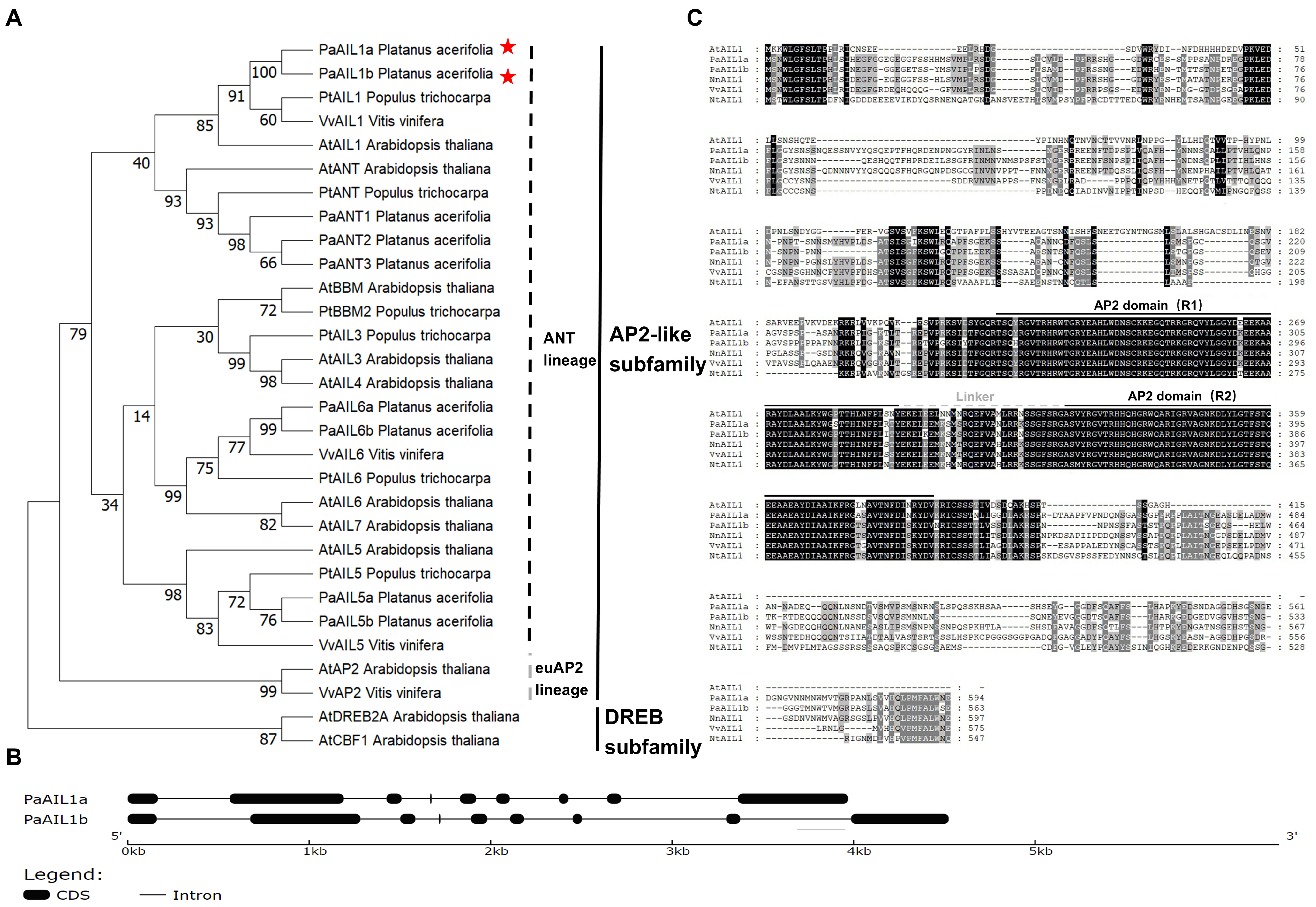
Phylogenetic reconstruction placed PaAIL1 proteins within the AINTEGUMENTA (ANT) clade, specifically clustering with Arabidopsis AIL1 in a distinct sub-clade comprising AIL1 and ANT proteins (Figure 1A).
Structural analysis revealed conserved gene architecture: both genes contain eight exons and seven introns (Figure 1B), with coding sequences of 1782 bp (PaAIL1a) and 1689 bp (PaAIL1b) encoding 594-aa and 563-aa proteins, respectively. Sequence alignment identified characteristic AP2 domains—R1 (73 aa, N-terminal) and R2 (65 aa, C-terminal)—connected by a linker region (Figure 1C), consistent with AIL protein topology. These features confirm PaAIL1a/b as ANT lineage transcription factors within the ERF/AP2 superfamily.

3.2. Subcellular Localization of PaAIL1a/b

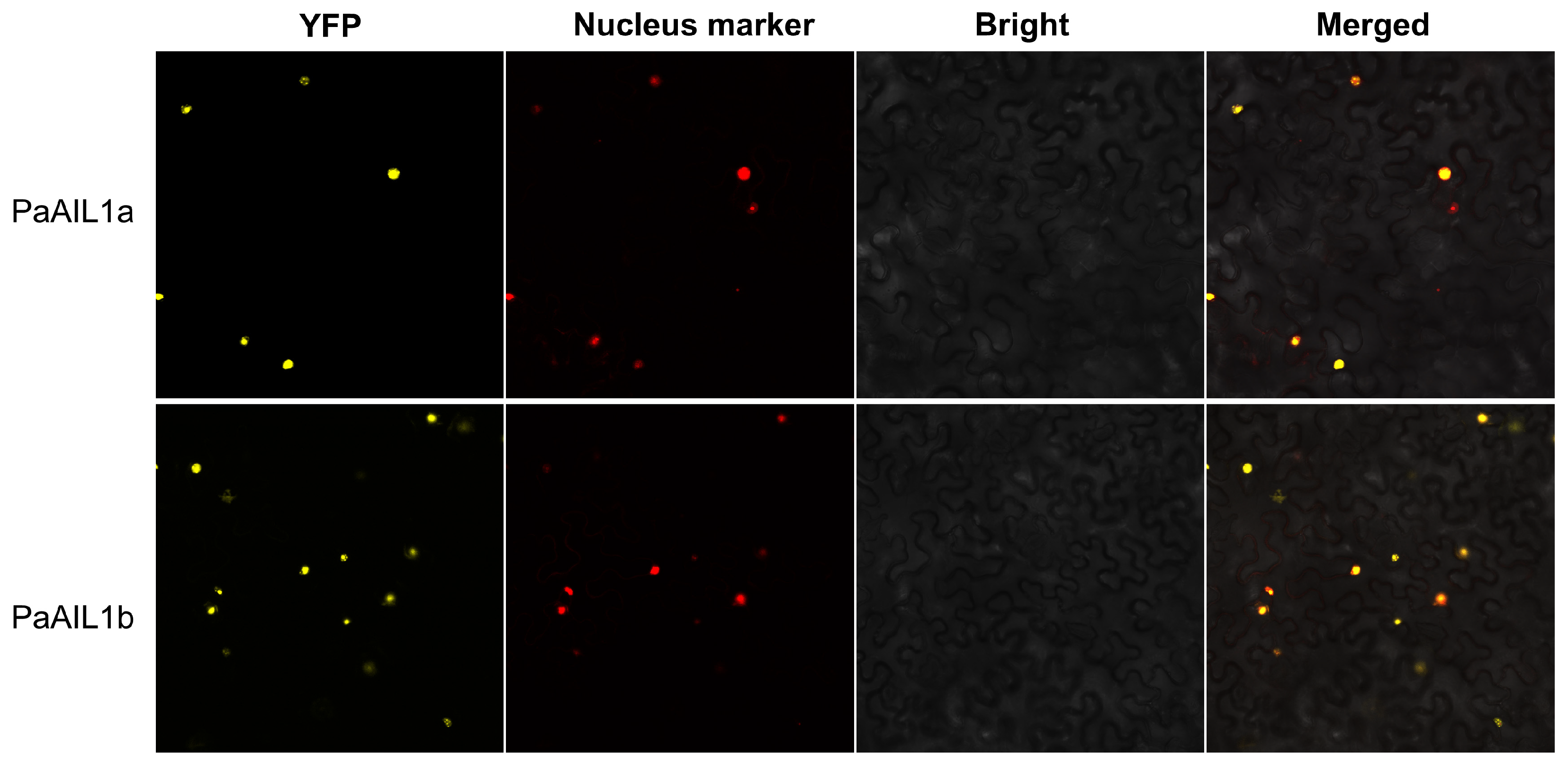
To further pinpoint the functional sites of PaAIL1a/b, we determined their subcellular localization. Both proteins were found exclusively in the nucleus (Figure 2), consistent with the expected behavior of transcription factors that operate within this compartment.

3.3. Spatiotemporal Expression Patterns of PaAIL1a/b in P. acerifolia

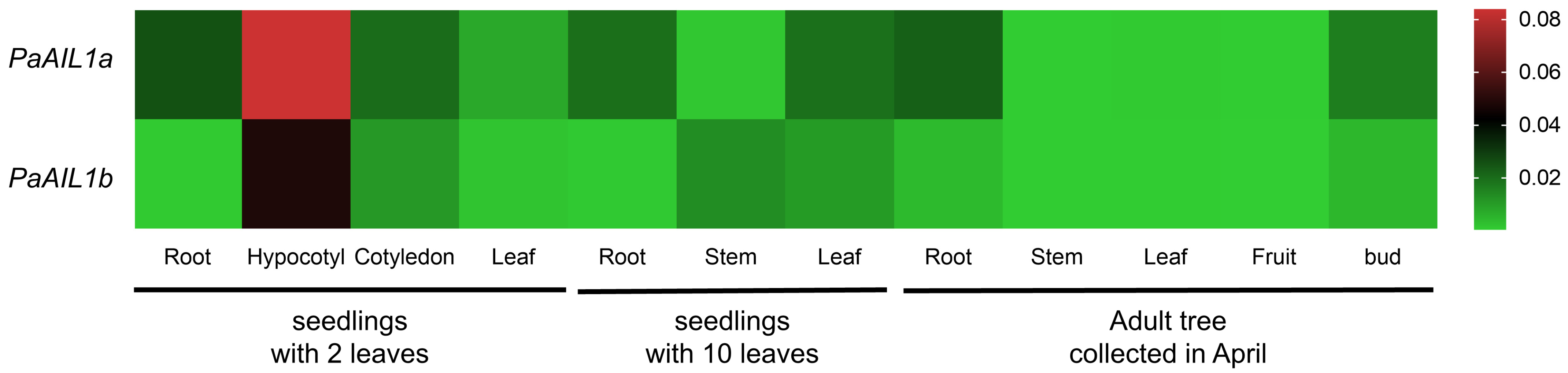
To characterize the spatiotemporal expression patterns of PaAIL1a/b, quantitative real-time PCR (qRT-PCR) was performed across various tissues and developmental stages of P. acerifolia. Transcripts of both genes were detected ubiquitously, though with distinct tissue-specific profiles (Figure 3). Both exhibited peak expression in the hypocotyls of two-leaf seedlings; however, PaAIL1a maintained substantial expression in roots across developmental stages, while PaAIL1b showed relatively weak expression in non-hypocotyl tissues. These results suggest partial functional redundancy accompanied by subfunctionalization between the paralogs.
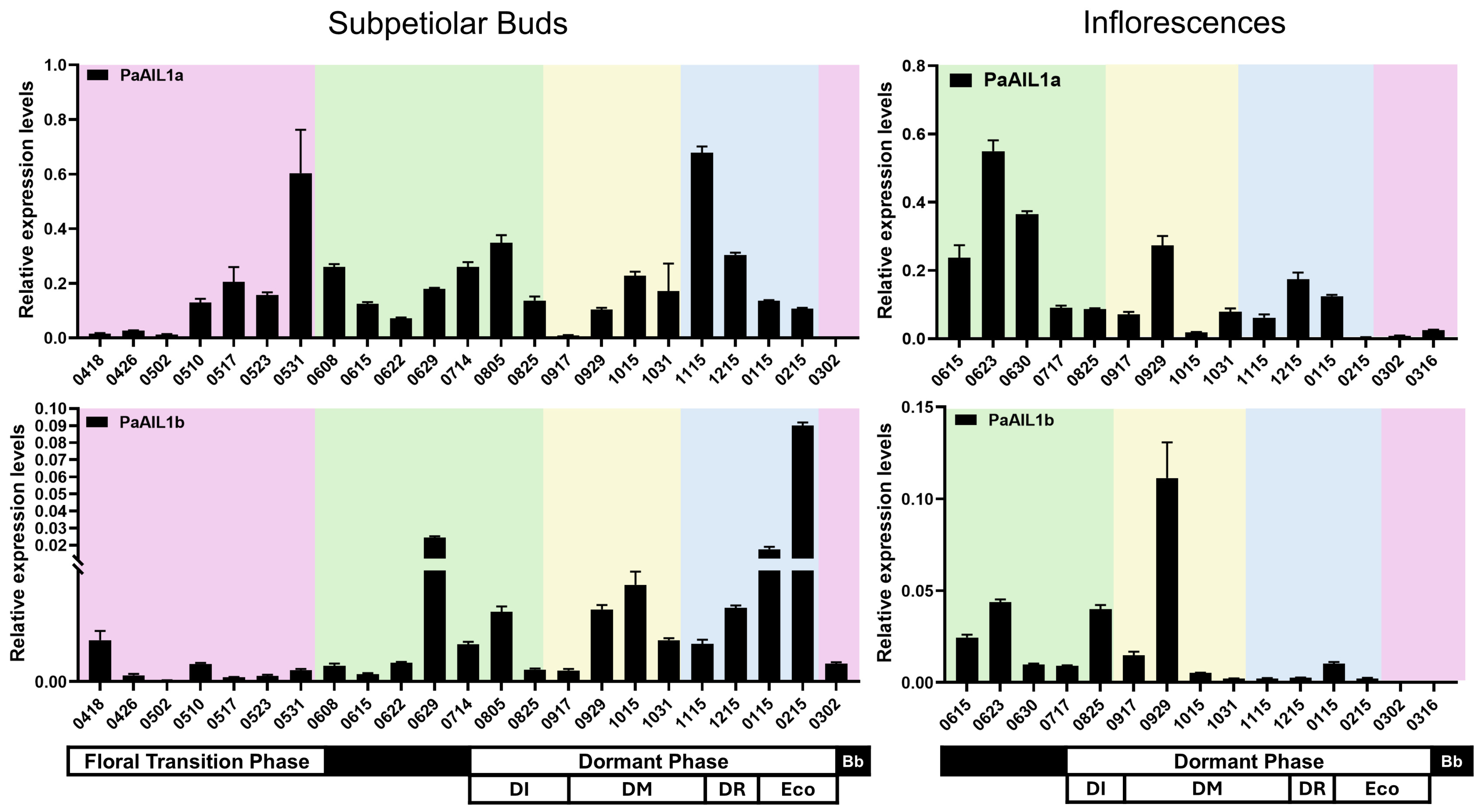
We further examined annual expression cycles of PaAIL1a/b in subpetiolar buds collected periodically from April through March. qRT-PCR revealed distinct seasonal expression patterns between the paralogs (Figure 4). PaAIL1a exhibited three major expression waves: (i) May to mid-June (floral induction and inflorescence differentiation), (ii) late June to late August (dormancy induction), and (iii) late September to mid-February (dormancy maintenance), with basal levels during intervening periods. By contrast, PaAIL1b displayed four distinct peaks: late June (inflorescence differentiation), mid-July to early September (dormancy induction), late September to mid-October (dormancy maintenance), and mid-January to mid-February (dormancy release and ecodormancy).
During floral induction, PaAIL1a expression increased in May, peaked at the end of May/early June, and remained elevated through subsequent stages. PaAIL1b, however, peaked in mid-May, declined, then resurged sharply during single-flower differentiation in late June (Figure 4). These divergent patterns suggest functional specialization: PaAIL1a appears to regulate both floral induction and subsequent growth maintenance, whereas PaAIL1b functions primarily during early induction and single-flower differentiation.
Throughout dormancy induction (July–November), PaAIL1a maintained high expression levels (peaking in early August), while PaAIL1b remained relatively low yet followed a similar expression trajectory (Figure 4). This indicates functional redundancy during dormancy establishment, with PaAIL1a acting throughout the entire induction period and PaAIL1b contributing primarily during early phases. During dormancy maintenance and release, expression patterns diverged markedly. PaAIL1a increased in late September (early maintenance), peaked in late November (early release), and remained elevated through February (release and ecodormancy). PaAIL1b, however, peaked in mid-October (maintenance), declined, then resurged in December, reaching maximum levels in mid-February (ecodormancy) before decreasing sharply (Figure 4). The elevated expression of both genes during dormancy release and ecodormancy suggests cooperative roles in dormancy termination.
Expression profiling throughout main inflorescence development revealed three distinct upregulation events for both genes: the first occurred from mid-June to late June (floral meristem differentiation), the second from mid-September to late September, and the third from mid-November to mid-January of the following year (inflorescence developmental arrest) (Figure 4) [12]. Notably, expression patterns in inflorescences closely paralleled those observed in axillary buds. Collectively, these findings demonstrate that PaAIL1a/b play multifaceted, partially redundant yet distinct roles in floral initiation, inflorescence development, and seasonal dormancy cycling.

3.4. PaAIL1a/b Expression Under LD, LT, and SD Treatments

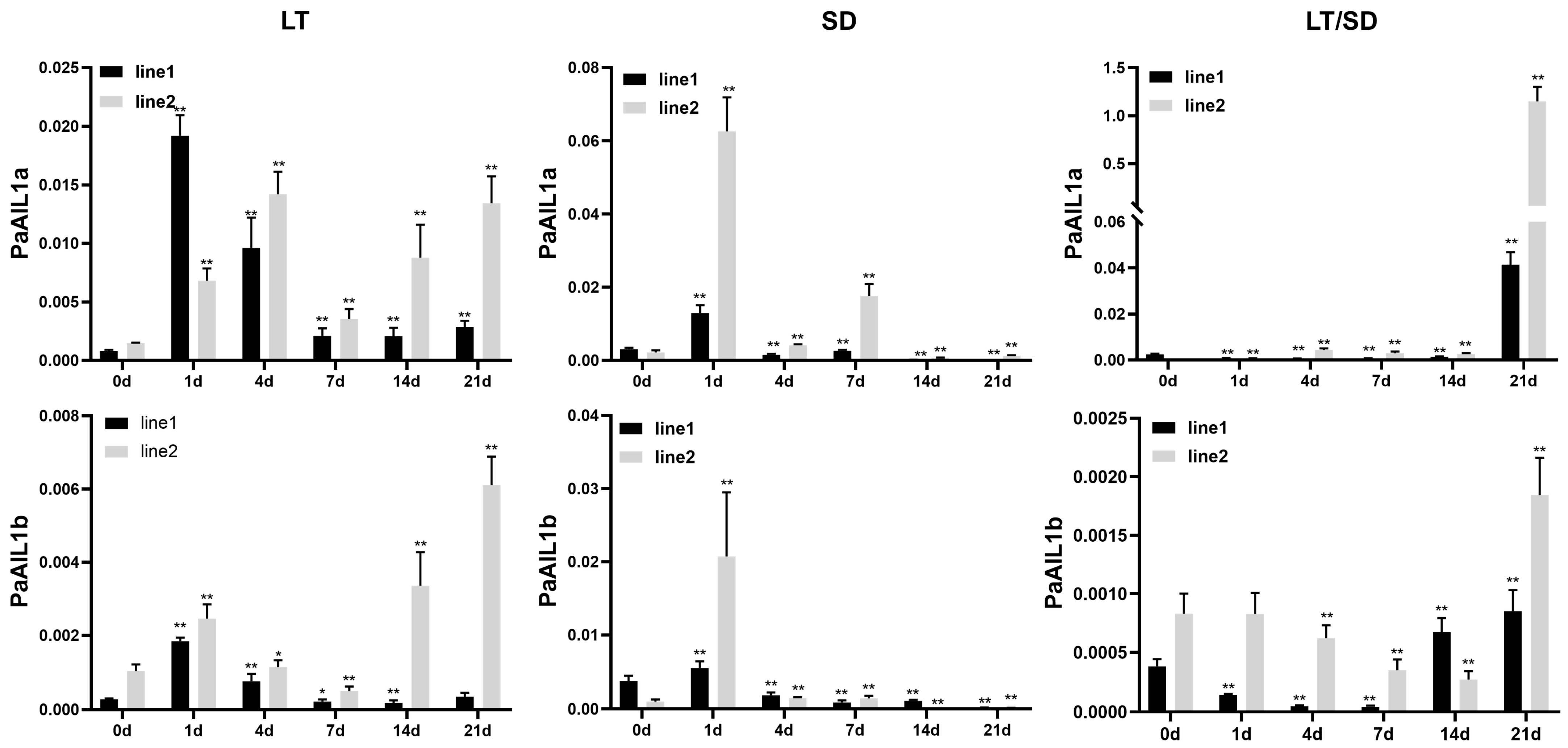
As noted above, PaAIL1a/b exhibited markedly elevated expression during dormancy release and ecodormancy—stages regulated by photoperiod and temperature cues. To dissect these environmental responses, we analyzed PaAIL1a/b expression under low-temperature (LT), short-day (SD), and combined LT/SD conditions (Figure 5). During the initial 0–7 day period, neither SD nor LT alone induced consistent expression patterns. However, by days 14 and 21, divergent responses emerged: PaAIL1a/b were significantly upregulated under LT but downregulated under SD conditions.
Under combined LT/SD conditions, PaAIL1a expression gradually increased during days 1–7, rose sharply at day 14, and reached peak levels hundreds-fold higher than the untreated controls (day 0) by day 21. In contrast, PaAIL1b showed no discernible pattern during days 1–7 but exhibited a sharp increase at day 21 (Figure 5). Notably, the response profiles of PaAIL1a/b to LT and LT/SD closely paralleled those of PaFT, a key dormancy regulator in P. acerifolia [14]. These results indicate that PaAIL1a/b are repressed by prolonged SD signals yet induced by sustained LT and combined LT/SD conditions, with PaAIL1a potentially playing a predominant role in this environmental sensing mechanism.

3.5. Interactions Between FUL Proteins and PaAIL1a/b Promoters

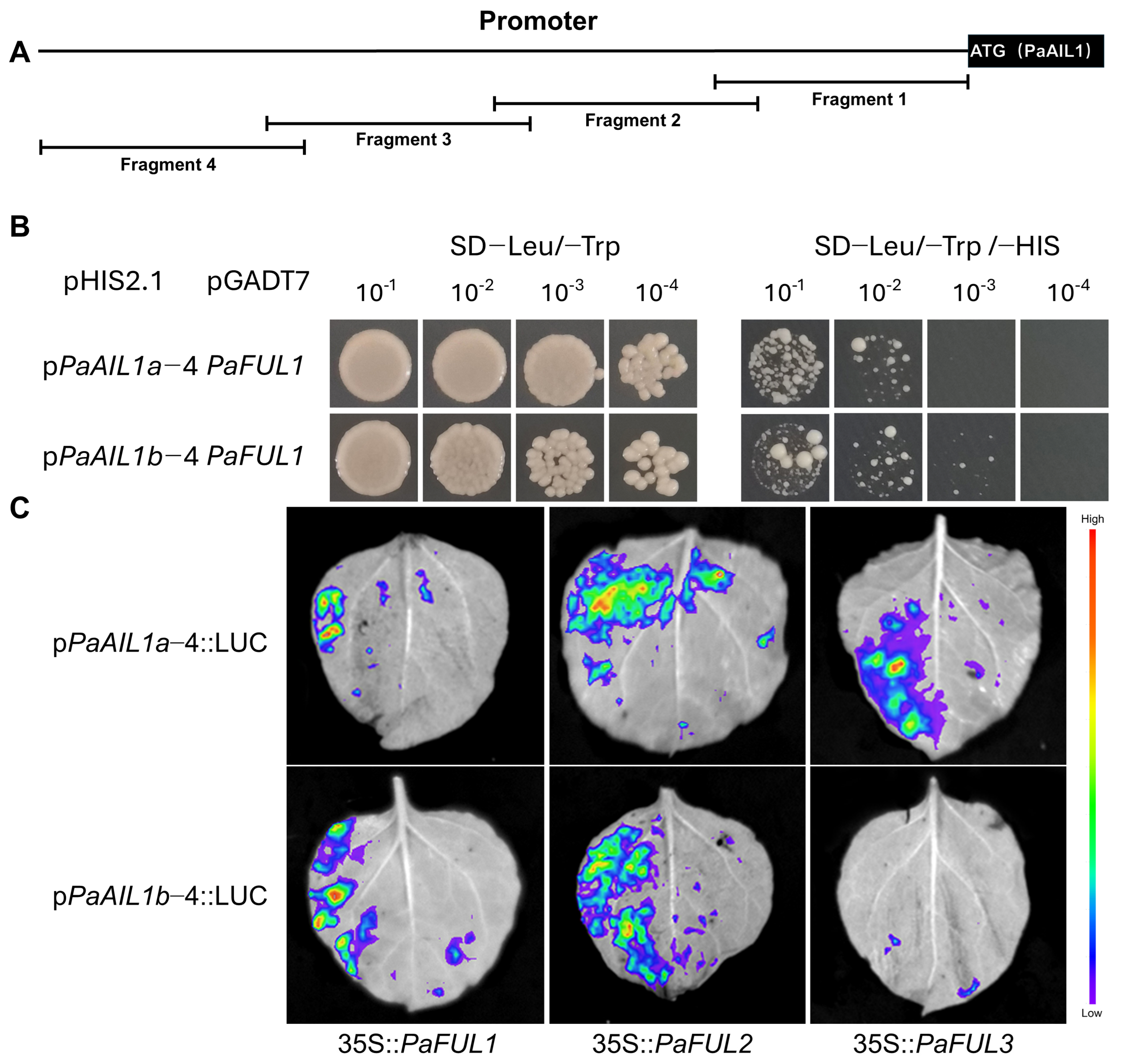
Given the positive correlation between PaFUL and PaAIL1a/b expression levels observed previously [15], we conducted yeast one-hybrid (Y1H) assays to determine whether PaFUL proteins directly interact with PaAIL1a/b promoters. Self-activation tests confirmed that PaAIL1a/b promoter fragments were effectively suppressed by supplementation with 3-amino-1,2,4-triazole (3-AT) (Figure 6A,B and Figure S1). Subsequent interaction assays revealed that PaFUL1 specifically bound to both PaAIL1a and PaAIL1b promoters in yeast, whereas PaFUL2 and PaFUL3 showed no detectable binding to either promoter (Figure 6B).
To further verify the interaction between FUL proteins and the PaAIL1a/b promoters, we performed a dual-luciferase assay in vivo. As shown in Figure 6C, unlike the yeast assay, PaFUL1/2/3 could trigger a fluorescent signal by interacting with the PaAIL1a promoter in vivo; when interacting with the PaAIL1b promoter in vivo, all PaFULs except PaFUL3 could trigger the fluorescent signal. These results demonstrate that PaFUL1 physically binds to both PaAIL1a and PaAIL1b promoters (Y1H) and activates their transcription. Notably, while PaFUL2 and PaFUL3 showed no detectable DNA binding in yeast, they were capable of activating PaAIL1a promoter-driven expression in planta. This discrepancy suggests that PaFUL2/3 may regulate PaAIL1 expression indirectly or require plant-specific co-factors/modifications absent in yeast cells. PaFUL3, however, failed to activate the PaAIL1b promoter in both assays, indicating paralog-specific target preferences.

4. Discussion

Spatiotemporal expression analysis revealed that PaAIL1a exhibited high expression in the roots of P. acerifolia at different developmental stages, while PaAIL1b transcripts were barely detectable (Figure 3). Previous studies have demonstrated that AINTEGUMENTA-LIKE1 (PtAIL1) controls adventitious root primordia formation in Populus [16], suggesting that the two AIL1 paralogs in P. acerifolia have undergone functional divergence, with PaAIL1a retaining the conserved function. Previous studies have also shown that hypocotyl elongation is strongly influenced by light and phytohormones [17]. The high expression of PaAIL1a/b in hypocotyls suggests that these genes may also be regulated by light or hormones.
Annual expression analysis showed that PaAIL1a was highly expressed in the subpetiolar buds during the floral induction (Figure 4), while PaAIL1b showed moderate expression in early floral induction and peaked again during single-flower differentiation (Figure 4). Yeast one-hybrid assays demonstrated that PaFUL1 directly binds to both PaAIL1a/b promoters, while dual-luciferase (LUC) reporter assays indicated that PaAIL1a can be activated by PaFUL1/2/3 in planta (Figure 6). Notably, given that PaFUL2/3 showed no binding in Y1H assays, their activation of PaAIL1a likely occurs through indirect mechanisms or requires additional plant-specific factors [15]. Collectively, these findings indicate that PaAIL1a and PaAIL1b contribute to floral induction regulation in P. acerifolia but have undergone significant functional divergence: PaAIL1a is primarily involved in the initial floral induction phase and maintains functional roles during single-flower differentiation, whereas PaAIL1b predominantly participates in single-flower differentiation within the capitulum while potentially contributing to early floral induction.
Decades of research have established a four-phase classification of bud dormancy in perennial plants: induction, endodormancy, release, and ecodormancy [11,18,19,20]. Consistent with this framework, P. acerifolia exhibits this four-phase dormancy pattern, with PaAIL1a/b showing phase-specific expression profiles (Figure 4). During dormancy induction, PaAIL1a/b expression initially increased then declined as day length shortened; during dormancy establishment and maintenance, PaAIL1a gradually increased while PaAIL1b remained low. Thereafter, the PaAIL1a gene was upregulated at the later stage of dormancy maintenance and peaked in the dormancy release phase, while PaAIL1b began to be upregulated at the late stage of dormancy release and peaked in the ecodormancy phase. PaAIL1a/b expression tracked with known dormancy regulators in a phase-dependent manner: both paralleled PaFTL and PaFUL1/2/3 during induction, but subsequently diverged—PaAIL1a aligned with PaFT/PaFUL2 during release, while PaAIL1b associated with PaFUL1/PaFTL during ecodormancy [14,15]. These temporal correlations, coupled with the critical roles of FT and AP1/FUL-like genes in dormancy [15,21,22,23], indicate that PaAIL1a/b likely modulate P. acerifolia dormancy, acting redundantly during induction but specializing in later phases.
Dormancy induction is primarily triggered by short-day (SD) photoperiodic signals, whereas chilling serves as the main cue for dormancy release in P. acerifolia [24,25]. Comparative analysis with poplar reveals that AIL1 functions as a critical molecular switch that connects photoperiodic signal perception with meristem activity maintenance. During the growing season, the FT2-LAP1-AIL1 pathway activates the cell cycle to sustain shoot apical meristem growth; however, under autumn SD conditions, AIL1 suppression leads to cell cycle arrest, thereby inducing dormancy [5,18]. Similarly, PaFTL expression is downregulated by prolonged SD signals and may participate in regulating SD-mediated dormancy induction in P. acerifolia [12]. Analogous to the expression pattern of LAP1 in poplar, PaFUL expression in P. acerifolia is also suppressed by extended SD conditions, with PaFUL2/3, especially PaFUL2, playing roles in dormancy regulation [15]. Our experimental results demonstrate that PaAIL1a/b genes exhibit expression trends consistent with PaFTL under SD conditions (Figure 5), and PaAIL1a/b expression can be activated by PaFUL2 (Figure 6). These findings suggest the existence of a dormancy induction pathway in P. acerifolia analogous to that in poplar, namely the PaFTL-PaFUL2-PaAIL1 axis.
Under LT and combined LT/SD treatments, PaAIL1a/b displayed response patterns congruent with those of PaFT and PaFUL2/3 (Figure 5). Notably, PaFT expression is upregulated under individual LT conditions and shows even stronger induction under combined LT/SD treatment, indicating that this gene specifically mediates LT-induced dormancy release [12]. Furthermore, under LT/SD treatment, PaFUL2/3 expression exhibited an upward trend consistent with PaFT [15]. Combined with yeast one-hybrid and LUC activation assays (Figure 6), these results suggest a putative regulatory axis involving PaFT-PaFUL2/3-PaAIL1. However, the absence of detectable binding between PaFUL2/3 and PaAIL1 promoters in Y1H assays indicates that this regulation may be indirect, or that PaFUL2/3 function as part of a protein complex rather than as direct DNA-binding regulators in this context. Additionally, annual expression profiling in subpetiolar buds revealed distinct temporal patterns: PaAIL1a exhibited higher expression levels during the dormancy release stage, whereas PaAIL1b expression increased during the ecodormancy stage (Figure 4). This differential expression suggests that PaAIL1a may play a more prominent role during dormancy release in P. acerifolia.
The coordinated regulation of flowering and dormancy by PaAIL1 genes reveals a sophisticated signal integration mechanism that converges photoperiodic and temperature cues. Our data support a model in which PaAIL1 genes function as molecular rheostats downstream of the PaFT-PaFUL signaling hierarchy, with PaFUL1 serving as a direct transcriptional activator of PaAIL1 promoters, whereas PaFUL2/3 likely regulate PaAIL1 expression indirectly or require plant-specific cofactors for effective DNA binding (Figure 6). Under short-day (SD) conditions, the downregulation of PaFT leads to reduced PaFUL2/3 expression, subsequently alleviating the activation of PaAIL1 genes, thereby simultaneously arresting floral meristem activity and inducing dormancy. Conversely, under low-temperature (LT) or combined LT/SD conditions, PaAIL1 expression is upregulated (Figure 4 and Figure 5), potentially through a chilling-mediated epigenetic mechanism or via alternative regulatory pathways that override SD repression. This dual responsiveness positions PaAIL1 as a critical decision-making node: high PaAIL1 activity promotes cell proliferation for both floral organogenesis and bud break, whereas reduced activity induces growth cessation. Notably, the distinct response kinetics of the two paralogs—PaAIL1a showed rapid induction under combined LT/SD stress, while PaAIL1b responded more slowly—suggest temporal partitioning of signal integration, allowing fine-tuned adaptation to gradual seasonal transitions.
Our findings challenge the traditional view that floral induction and dormancy establishment are discrete developmental stages. Instead, PaAIL1 expression patterns suggest that these processes represent a developmental continuum orchestrated by shared regulatory modules. During the floral induction phase (May–June), elevated PaAIL1a expression supports meristematic proliferation necessary for inflorescence differentiation, while later in the season (July–August), sustained PaAIL1 activity in subpetiolar buds prepares the meristem for dormancy entry by gradually downregulating cell cycle genes.
This ‘preparation-for-dormancy’ hypothesis implies that the same meristematic events required for floral organogenesis (cell division, differentiation) must be actively suppressed during dormancy onset. PaAIL1 genes appear to mediate this transition by shifting from promoting floral primordia growth to maintaining meristem potential during endodormancy. The functional bifurcation of the paralogs supports this model: PaAIL1a maintains basal activity throughout dormancy to preserve meristem identity, while PaAIL1b specifically activates during ecodormancy to prime floral development upon spring awakening. This regulatory architecture ensures that floral initiation and dormancy are antagonistic yet functionally linked processes.
Comparative analysis reveals both conserved regulatory architectures and species-specific innovations in AIL1-mediated seasonal growth regulation. In Populus, PtAIL1 functions as a binary switch responding primarily to photoperiod via the FT-LAP1-AIL1 cascade, with AIL1 directly controlling cell cycle exit during SD-induced growth cessation [4,5]. Similarly, in Platanus, we identified a PaFTL-PaFUL2-PaAIL1 axis that mediates SD-induced dormancy induction, suggesting deep conservation of this regulatory module across Salicaceae and Platanaceae.
However, significant divergences indicate adaptive evolution in response to distinct ecological niches. Unlike Populus, where a single AIL1 gene predominates, P. acerifolia has evolved functionally divergent paralogs with distinct temporal niches: PaAIL1a regulates both flowering initiation and dormancy release, while PaAIL1b specializes in single-flower differentiation and ecodormancy maintenance. This subfunctionalization may reflect the distinct reproductive strategy of Platanus, which forms complex capitulum inflorescences requiring prolonged meristematic activity compared to the catkins of Populus.
Furthermore, in grape (V. vinifera), VvAIL2 shows higher expression during ecodormancy-to-endodormancy transitions [7], resembling PaAIL1b expression patterns, suggesting that AIL gene family expansion and neofunctionalization may be a general evolutionary response to complex seasonal cycles in long-lived perennials. These comparative insights position PaAIL1 genes as evolutionary ‘tuning knobs’ that modulate the trade-off between reproductive investment and stress survival across diverse woody lineages.

5. Conclusions

In conclusion, PaAIL1a/b are direct downstream targets of PaFUL1, and may respond to PaFUL2/3-mediated signals, likely through indirect mechanisms, responding to short-day (SD) signals to regulate dormancy induction. Specifically, PaAIL1a may mediate dormancy release, whereas PaAIL1b may function during subsequent ecodormancy. These findings establish PaAIL1 genes as pivotal integrators coupling reproductive development with seasonal dormancy, providing a mechanistic basis for the long-observed but poorly understood coordination between flowering time and winter survival in temperate trees.

Supplementary Materials

The following supporting information can be downloaded at: https://www.mdpi.com/article/10.3390/genes17040393/s1, Figure S1: Self-activation tests of PaAIL1a/b promoter fragments; Table S1: Primers used in this study.

Author Contributions

F.C. and J.Z. designed the study. C.S. and H.C. performed the experiments. C.S. participated in data analysis and the discussion of the manuscript. F.C. and J.Z. reviewed and edited the manuscript. F.C. and C.S. provided the funding. All authors have read and agreed to the published version of the manuscript.

Funding

This work was supported by the Natural Science Foundation of Zhejiang Province (Grant No. LQ24C150004 and LQ22C150004), Research Startup Fund of Hangzhou Polytechnic University.

Institutional Review Board Statement

Not applicable.

Informed Consent Statement

Not applicable.

Data Availability Statement

The data supporting the results are available online in the paper and in the Supplementary Materials.

Conflicts of Interest

The authors declare no conflicts of interest.

Abbreviations

The following abbreviations are used in this manuscript:
LTLow temperature
SDShort day
3-AT3-amino1,2,4-triazole

References

  1. Kim, S.; Soltis, P.S.; Wall, K.; Soltis, D.E. Phylogeny and domain evolution in the APETALA2-like gene family. Mol. Biol. Evol. 2006, 23, 107–120. [Google Scholar] [CrossRef] [PubMed]
  2. Jofuku, K.D.; den Boer, B.G.; Van Montagu, M.; Okamuro, J.K. Control of Arabidopsis flower and seed development by the homeotic gene APETALA2. Plant Cell 1994, 6, 1211–1225. [Google Scholar] [CrossRef]
  3. Azeez, A.; Miskolczi, P.; Tylewicz, S.; Bhalerao, R.P. A Tree Ortholog of APETALA1 Mediates Photoperiodic Control of Seasonal Growth. Curr. Biol. 2014, 24, 717–724. [Google Scholar] [CrossRef] [PubMed]
  4. Singh, R.K.; Maurya, J.P.; Azeez, A.; Miskolczi, P.; Tylewicz, S.; Stojkovič, K.; Delhomme, N.; Busov, V.; Bhalerao, R.P. A genetic network mediating the control of bud break in hybrid aspen. Nat. Commun. 2018, 9, 4173. [Google Scholar] [CrossRef] [PubMed]
  5. Karlberg, A.; Bako, L.; Bhalerao, R.P. Short day-mediated cessation of growth requires the downregulation of AINTEGUMENTALIKE1 transcription factor in hybrid aspen. PLoS Genet. 2011, 7, e1002361. [Google Scholar] [CrossRef]
  6. Karlberg, A.; Englund, M.; Petterle, A.; Molnar, G.; Sjödin, A.; Bako, L.; Bhalerao, R.P. Analysis of global changes in gene expression during activity-dormancy cycle in hybrid aspen apex. Plant Biotechnol. 2010, 27, 1–16. [Google Scholar] [CrossRef]
  7. Vergara, R.; Noriega, X.; Parada, F.; Dantas, D.; Pérez, F.J. Relationship between endodormancy, FLOWERING LOCUS T and cell cycle genes in Vitis vinifera. Planta 2016, 243, 411–419. [Google Scholar] [CrossRef]
  8. Kusano, M.; Jonsson, P.; Fukushima, A.; Gullberg, J.; Sjöström, M.; Trygg, J.; Moritz, T. Metabolite Signature during Short-Day Induced Growth Cessation in Populus. Front. Plant Sci. 2011, 2, 29. [Google Scholar] [CrossRef]
  9. Singh, R.K.; Miskolczi, P.; Maurya, J.P.; Bhalerao, R.P. A Tree Ortholog of SHORT VEGETATIVE PHASE Floral Repressor Mediates Photoperiodic Control of Bud Dormancy. Curr. Biol. 2019, 29, 128–133.e2. [Google Scholar] [CrossRef]
  10. Zhou, C.; Liu, H.; Sang, Y.; Jiang, H.; Zhang, J.; Niu, S.; El-Kassaby, Y.A.; Li, W. Short-day-induced expression of PtTFL2 triggers growth-defense tradeoffs during Pinus tabuliformis dormancy. Plant Physiol. 2025, 198, kiaf362. [Google Scholar] [CrossRef]
  11. Maurya, J.P.; Bhalerao, R.P. Photoperiod- and temperature-mediated control of growth cessation and dormancy in trees: A molecular perspective. Ann. Bot. 2017, 120, 351–360. [Google Scholar] [CrossRef]
  12. Cai, F.; Shao, C.; Zhang, Y.; Bao, Z.; Li, Z.; Shi, G.; Bao, M.; Zhang, J. Identification and characterisation of a novel FT orthologous gene in London plane with a distinct expression response to environmental stimuli compared to PaFT. Plant Biol. 2019, 21, 1039–1051. [Google Scholar] [CrossRef] [PubMed]
  13. Wang, Z.; Ye, S.; Li, J.; Zheng, B.; Bao, M.; Ning, G. Fusion primer and nested integrated PCR (FPNI-PCR): A new high-efficiency strategy for rapid chromosome walking or flanking sequence cloning. BMC Biotechnol. 2011, 11, 109. [Google Scholar] [CrossRef]
  14. Cai, F.; Jin, X.; Han, L.; Chen, H.; Shao, C.; Shi, G.; Bao, M.; Sun, Y.; Zhang, J. AINTEGUMENTA-LIKE genes regulate reproductive growth and bud dormancy in Platanus acerifolia. Plant Cell Rep. 2024, 43, 261. [Google Scholar] [CrossRef]
  15. Zhang, S.; Lu, S.; Yi, S.; Han, H.; Zhou, Q.; Cai, F.; Bao, M.; Liu, G. Identification and characterization of FRUITFULL-like genes from Platanus acerifolia, a basal eudicot tree. Plant Sci. 2019, 280, 206–218. [Google Scholar] [CrossRef]
  16. Rigal, A.; Yordanov, Y.S.; Perrone, I.; Karlberg, A.; Tisserant, E.; Bellini, C.; Busov, V.B.; Martin, F.; Kohler, A.; Bhalerao, R.; et al. The AINTEGUMENTA LIKE1 homeotic transcription factor PtAIL1 controls the formation of adventitious root primordia in poplar. Plant Physiol. 2012, 160, 1996–2006. [Google Scholar] [CrossRef]
  17. Nakano, T. Hypocotyl Elongation: A Molecular Mechanism for the First Event in Plant Growth That Influences Its Physiology. Plant Cell Physiol. 2019, 60, 933–934. [Google Scholar] [CrossRef] [PubMed]
  18. Ding, J.; Wang, K.; Pandey, S.; Perales, M.; Allona, I.; Khan, M.R.I.; Busov, V.B.; Bhalerao, R.P. Molecular advances in bud dormancy in trees. J. Exp. Bot. 2024, 75, 6063–6075. [Google Scholar] [CrossRef] [PubMed]
  19. Yang, Q.; Gao, Y.; Wu, X.; Moriguchi, T.; Bai, S.; Teng, Y. Bud endodormancy in deciduous fruit trees: Advances and prospects. Hortic. Res. 2021, 8, 139. [Google Scholar] [CrossRef]
  20. Chen, Z.; Chen, Y.; Shi, L.; Wang, L.; Li, W. Interaction of Phytohormones and External Environmental Factors in the Regulation of the Bud Dormancy in Woody Plants. Int. J. Mol. Sci. 2023, 24, 17200. [Google Scholar] [CrossRef]
  21. Zhao, Y.; Ma, Y.; Qiu, H.; Zhou, L.; He, K.; Ye, Y. Wake up: The regulation of dormancy release and bud break in perennial plants. Front. Plant Sci. 2025, 16, 1553953. [Google Scholar] [CrossRef]
  22. Böhlenius, H.; Huang, T.; Charbonnel-Campaa, L.; Brunner, A.M.; Jansson, S.; Strauss, S.H.; Nilsson, O. CO/FT Regulatory Module Controls Timing of Flowering and Seasonal Growth Cessation in Trees. Science 2006, 312, 1040–1043. [Google Scholar] [CrossRef]
  23. André, D.; Marcon, A.; Lee, K.C.; Goretti, D.; Zhang, B.; Delhomme, N.; Schmid, M.; Nilsson, O. FLOWERING LOCUS T paralogs control the annual growth cycle in Populus trees. Curr. Biol. 2022, 32, 2988–2996.e4. [Google Scholar] [CrossRef] [PubMed]
  24. Gao, Y.; Chen, Z.; Feng, Q.; Long, T.; Ding, J.; Shu, P.; Deng, H.; Yu, P.; Tan, W.; Liu, S.; et al. ELONGATED HYPOCOTYL 5a modulates FLOWERING LOCUS T2 and gibberellin levels to control dormancy and bud break in poplar. Plant Cell 2024, 36, 1963–1984. [Google Scholar] [CrossRef] [PubMed]
  25. Liu, D.; Tang, D.; Xie, M.; Zhang, J.; Zhai, L.; Mao, J.; Luo, C.; Lipzen, A.; Zhang, Y.; Savage, E.; et al. Agave REVEILLE1 regulates the onset and release of seasonal dormancy in Populus. Plant Physiol. 2023, 191, 1492–1504. [Google Scholar] [CrossRef] [PubMed]
Figure 1. The sequence alignment and phylogenetic tree analysis of PaAIL1a/b. (A) The phylogenetic tree of PaAIL1a/b and AP2 family proteins from other species. The genes which are marked by a red pentacle are PaAIL1a/b. Numbers at nodes indicate bootstrap support values based on 1000 replicates. The evolutionary history was inferred using the Maximum Likelihood method and JTT matrix-based model. (B) The structure of PaAIL1a/b. Gene structures were analyzed and visualized using the Gene Structure Display Server (http://gsds.cbi.pku.edu.cn/ (accessed on 25 March 2026)); black boxes indicate exons, and horizontal lines indicate introns. (C) The conserved domains of PaAIL1a/b proteins. The multiple sequence alignment was performed and visualized using GeneDoc, and the conserved domains were analyzed using SMART (http://smart.embl-heidelberg.de/ (accessed on 25 March 2026)). The AP2 domains are indicated by black solid lines under sequences, the linker region is indicated by the gray dotted line.
Genes 17 00393 g001
Figure 2. Subcellular localization of PaAIL1a/b protein in tobacco leaves. 35S:YFP is an empty vector control. The red fluorescent part indicates the nucleus. Bright: bright field image; YFP: YFP fluorescence; Nucleus marker: histone H2B-RFP fluorescence; Merged: merged images of Bright, YFP and RFP fields. Scale bars 50 mm. RFP, red fluorescent protein.
Genes 17 00393 g002
Figure 3. Spatiotemporal expression profiling of PaAIL1a/b across developmental gradients. Tissue samples were harvested from three distinct ontogenetic stages: early seedlings (cotyledon stage, 2 true leaves), juvenile saplings (1-year-old, 10-leaf stage), and mature arboreal tissues (40-year-old specimens). Transcript abundance was quantified via quantitative real-time PCR, with PaTPI serving as the endogenous reference gene for normalization.
Genes 17 00393 g003
Figure 4. Seasonal transcript dynamics of PaAIL1a/b in subpetiolar buds and floral primordia of P. acerifolia. Samples were collected from mature field-grown specimens in Wuhan, Hubei Province, China (113°41′–115°05′ E, 29°58′–31°22′ N) across phenological cycles. The x-axis displays monthly sampling dates chromatically categorized by seasonal phases, with spring (red), summer (green), autumn (yellow), and winter (blue) denoted by distinct colors. Based on bud burst indices coupled with endogenous hormone profiles, the dormancy continuum was classified into paradormancy induction (DI), endodormancy maintenance (DM), dormancy release (DR), and ecodormancy (Eco) stages. Transcript abundance was quantified via qRT-PCR using TPI as the internal calibrator; data represent means ± standard deviation.
Genes 17 00393 g004
Figure 5. The expression of PaAIL1a/b genes in leaves under short-day and low-temperature conditions. Gene expression kinetics were monitored under three experimental conditions: low-temperature (LT, left panels), short-day (SD, middle panels), and combined SD + LT stress (right panels). Leaf tissues were excised from 1-year-old juvenile specimens at 4.5 h post-illumination. Statistical significance relative to control samples (0 d) was assessed by univariate analysis of variance, with * p < 0.05 and ** p < 0.01 denoting differential significance levels. The methodological specifics follow the protocols established in Figure 4.
Genes 17 00393 g005
Figure 6. The interactions between PaFUL proteins and PaAIL1a/b promoters. (A) Architectural organization of PaAIL1a/b proximal promoters, illustrating the segmental deletions used for interaction mapping. (B) Y1H (yeast one-hybrid) screening demonstrating direct binding of PaFUL1 to distinct promoter fragments. (C) Transient transactivation assays in planta via dual-luciferase re-porter systems; firefly luciferase activity driven by PaAIL1a/b promoters was normalized against Renilla luciferase, with empty pCAMBIA2300s vectors serving as negative controls.
Genes 17 00393 g006
Disclaimer/Publisher’s Note: The statements, opinions and data contained in all publications are solely those of the individual author(s) and contributor(s) and not of MDPI and/or the editor(s). MDPI and/or the editor(s) disclaim responsibility for any injury to people or property resulting from any ideas, methods, instructions or products referred to in the content.