Environmental Substances Associated with Neurodegeneration: An Overview of Parkinson’s Disease and Related Genotoxic Endpoints

 , , , ,
  and
and
Abstract
1. Introduction
2. Methods
- 1.
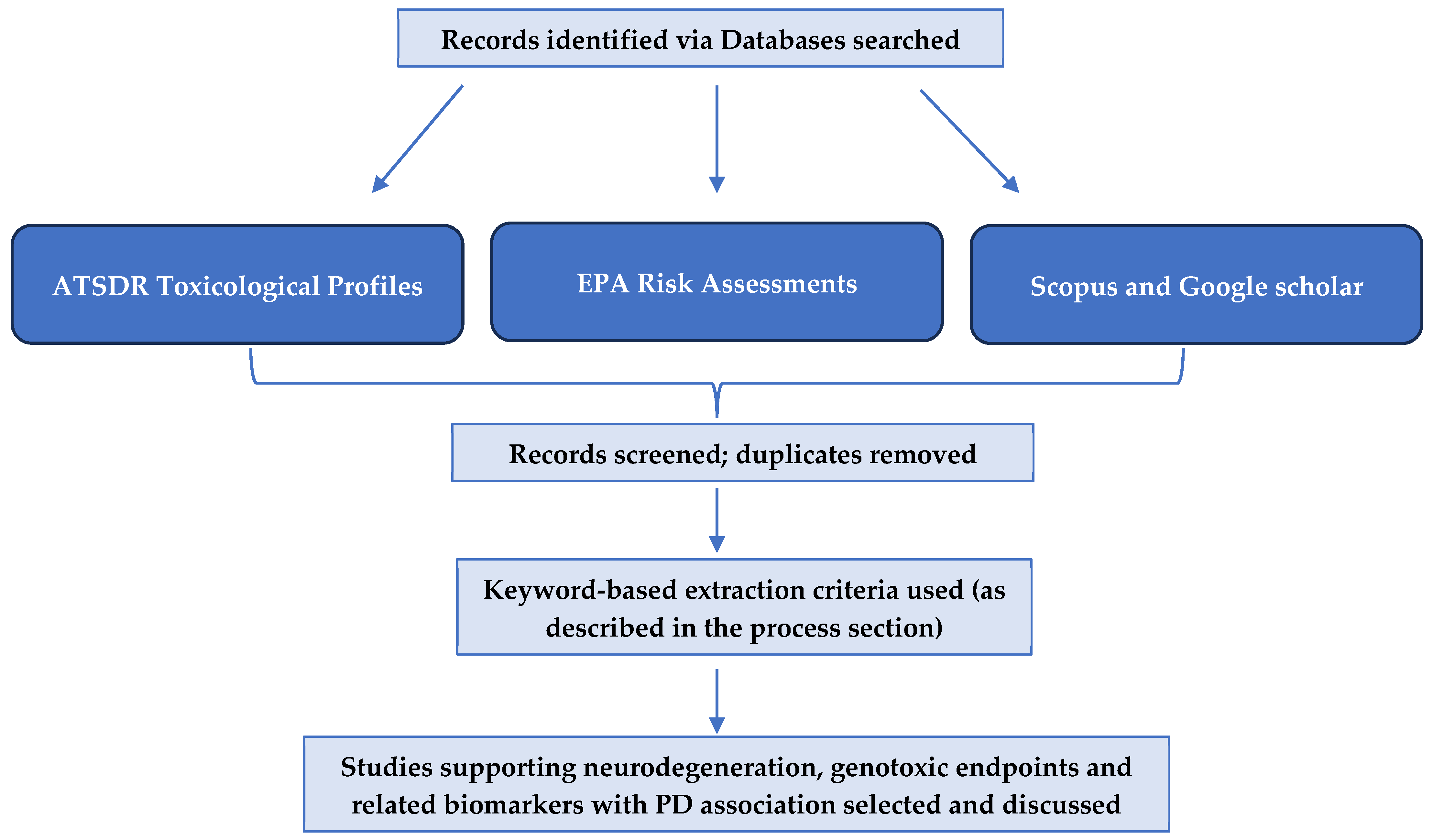
- A search was conducted across the 187 ATSDR Toxicological Profiles, all associated profile addendums, and Systematic Evidence Maps (SEMs) for the term “Parkinson’s.”
- 2.
- This was followed by a search of EPA Risk Assessment reports for each substance not addressed by a toxicological profile.
2.1. Rationale and Criteria for Substance Selection
2.2. Computational Analysis
3. Results
3.1. Substance-Specific Results
3.2. Heavy Metals
3.3. Pesticides
3.4. Chlorinated Organic Substances
3.5. Potential Genetic Mutations and Biomarkers
3.6. Genetics Mechanisms and PD
3.7. SNCA (Alpha-Synuclein)
- LRRK2 (Leucine-rich repeat kinase 2): Mutations in LRRK2 are the most common genetic cause of PD in late-onset cases. However, not all carriers develop the disease, indicating incomplete penetrance [160].
- PARK2 (Parkin): The PARK2 gene, essential for protein degradation and recycling, is commonly associated with early-onset PD when mutated [161].
- PINK1 (PTEN-induced kinase 1): PINK1 mutations impair mitochondrial function and are linked to early-onset PD [162].
- PARK7 (DJ-1): Mutations in PARK7 reduce protection against oxidative stress, contributing to early-onset PD [163].
- GBA (Glucocerebrosidase): Mutations in GBA reduce lysosomal enzyme activity, increasing the risk of PD [164].
- Three serum biomarkers of neural damage (neurofilament light chain, sphingosine-1-phosphate, and dopamine) associated with Ni were involved in the development of PD [66].
3.8. The Gene–Environment Interaction
- 1.
- Oxidative Stress
- 2.
- DNA Strand Breaks
- 3.
- Mitochondrial Dysfunction
- 4.
- Epigenetic Alterations
- Mechanism: Organochlorines and other environmental and occupational toxicants influence DNA methylation and histone modification patterns; post-translational histone modifications, chromatin remodeling, and RNA-based mechanisms [183,184,185,186]. Notably, DDT inhibits the plasma membrane dopamine transporter (DAT) and vesicular monoamine transporter (VMAT2), further implicating its role in dopaminergic dysfunction [88,89].
- PD Relevance: Epigenetic dysregulation affects neuronal function and survival, contributing to PD progression.
- 5.
- Chromosomal Abnormalities
- 6.
- Impaired DNA Repair Mechanisms
- PD Relevance: Studies show reduced DNA repair capacity in PD brains, exacerbating susceptibility to environmental insults [195].
- 7.
- Telomere Alteration
3.9. Genotoxicity and PD
3.10. Computational Toxicology Analysis
4. Conclusions
Author Contributions
Funding
Institutional Review Board Statement
Informed Consent Statement
Data Availability Statement
Conflicts of Interest
References
- Dorsey, E.R.; Sherer, T.; Okun, M.S.; Bloem, B.R. The Emerging Evidence of the Parkinson Pandemic. J. Park. Dis. 2018, 8, S3–S8. [Google Scholar] [CrossRef]
- Kang, S.H.; Moon, S.J.; Kang, M.; Chung, S.J.; Cho, G.J.; Koh, S.B. Incidence of Parkinson’s disease and modifiable risk factors in Korean population: A longitudinal follow-up study of a nationwide cohort. Front. Aging Neurosci. 2023, 15, 1094778. [Google Scholar] [CrossRef]
- Su, D.; Cui, Y.; He, C.; Yin, P.; Bai, R.; Zhu, J.; Lam, J.S.T.; Zhang, J.; Yan, R.; Zheng, X.; et al. Projections for prevalence of Parkinson’s disease and its driving factors in 195 countries and territories to 2050: Modelling study of Global Burden of Disease Study 2021. BMJ 2025, 388, e080952. [Google Scholar] [CrossRef] [PubMed]
- Willis, A.W.; Roberts, E.; Beck, J.C.; Fiske, B.; Ross, W.; Savica, R.; Van Den Eeden, S.K.; Tanner, C.M.; Marras, C. Incidence of Parkinson disease in North America. npj Park. Dis. 2022, 8, 170. [Google Scholar] [CrossRef] [PubMed]
- McDaniels, B.; Subramanian, I. Psychosocial Challenges Associated with Parkinson’s Disease. In Handbook of the Behavior and Psychology of Disease; Martin, C.R., Preedy, V.R., Patel, V.B., Rajendram, R., Eds.; Springer: Cham, Switzerland, 2024. [Google Scholar] [CrossRef]
- Burchill, E.; Watson, C.J.; Fanshawe, J.B.; Badenoch, J.B.; Rengasamy, E.; Ghanem, D.A.; Holle, C.; Conti, I.; Sadeq, M.A.; Saini, A.; et al. The impact of psychiatric comorbidity on Parkinson’s disease outcomes: A systematic review and meta-analysis. Lancet Reg. Health Eur. 2024, 39, 100870. [Google Scholar] [CrossRef] [PubMed]
- Pang, S.Y.Y.; Ho, P.W.L.; Liu, H.F.; Leung, C.T.; Li, L.; Chang, E.E.S.; Ramsden, D.B.; Ho, S.L. The interplay of aging, genetics and environmental factors in the pathogenesis of Parkinson’s disease. Transl. Neurodegener. 2019, 8, 23. [Google Scholar] [CrossRef]
- Shoeb, M.; Mustafa, G.M.; Kodali, V.K.; Smith, K.; Roach, K.A.; Boyce, G.; Meighan, T.; Roberts, J.R.; Erdely, A.; Antonini, J.M. A possible relationship between telomere length and markers of neurodegeneration in rat brain after welding fume inhalation exposure. Environ. Res. 2020, 180, 108900. [Google Scholar] [CrossRef]
- Kim, W.W.; Zarus, G.; Alman, B.; Ruiz, P.; Han, M.; Mehta, P.; Ji, C.; Qureshi, H.; Antonini, J.; Shoeb, M. Metal-Induced Genotoxic Events: Possible Distinction Between Sporadic and Familial ALS. Toxics 2025, 13, 493. [Google Scholar] [CrossRef]
- Napier, M.D.; Poole, C.; Satten, G.A.; Ashley-Koch, A.; Marrie, R.A.; Williamson, D.M. Heavy metals, organic solvents, and multiple sclerosis: An exploratory look at gene-environment interactions. Arch. Environ. Occup. Health 2016, 71, 26–34. [Google Scholar] [CrossRef]
- von Ehrenstein, O.S.; Ling, C.; Cui, X.; Cockburn, M.; Park, A.S.; Yu, F.; Wu, J.; Ritz, B. Prenatal and infant exposure to ambient pesticides and autism spectrum disorder in children: Population based case-control study. BMJ 2019, 364, l962. [Google Scholar] [CrossRef]
- Gu, Q.; Liu, J.; Zhang, X.; Huang, A.; Yu, X.; Wu, K.; Huang, Y. Association between heavy metals exposure and risk of attention deficit hyperactivity disorder (ADHD) in children: A systematic review and meta-analysis. Eur. Child Adolesc. Psychiatry 2025, 34, 921–941. [Google Scholar] [CrossRef] [PubMed]
- Nabi, M.; Tabassum, N. Role of environmental toxicants on neurodegenerative disorders. Front. Toxicol. 2022, 4, 837579. [Google Scholar] [CrossRef] [PubMed]
- Bakulski, K.M.; Seo, Y.A.; Hickman, R.C.; Brandt, D.; Vadari, H.S.; Hu, H.; Park, S.K. Heavy metals exposure and Alzheimer’s disease and related dementias. J. Alzheimer’s Dis. 2020, 76, 1215–1242. [Google Scholar] [CrossRef] [PubMed]
- Bast-Pettersen, R. The neuropsychological diagnosis of chronic solvent induced encephalopathy (CSE)—A reanalysis of neuropsychological test results in a group of CSE patients diagnosed 20 years ago, based on comparisons with matched controls. Neurotoxicology 2009, 30, 1195–1201. [Google Scholar] [CrossRef]
- Pamphlett, R.; Bishop, D.P. The toxic metal hypothesis for neurological disorders. Front. Neurol. 2023, 14, 1173779. [Google Scholar] [CrossRef]
- Pezzoli, G.; Cereda, E. Exposure to pesticides or solvents and risk of Parkinson disease. Neurology 2013, 80, 2035–2041. [Google Scholar] [CrossRef]
- Costello, S.; Cockburn, M.; Bronstein, J.; Zhang, X.; Ritz, B. Parkinson’s disease and residential exposure to maneb and paraquat from agricultural applications in the central valley of California. Am. J. Epidemiol. 2009, 169, 919–926. [Google Scholar] [CrossRef]
- Thiruchelvam, M.; Richfield, E.K.; Baggs, R.B.; Tank, A.W.; Cory-Slechta, D.A. The nigrostriatal dopaminergic system as a preferential target of repeated exposures to combined paraquat and maneb: Implications for Parkinson’s disease. J. Neurosci. 2000, 20, 9207–9214. [Google Scholar] [CrossRef]
- Guilarte, T.R. Manganese and Parkinson’s disease: A critical review and new findings. Environ. Health Perspect. 2010, 118, 1071–1080. [Google Scholar] [CrossRef]
- Czarnota, J.; Gennings, C.; Wheeler, D.C. Assessment of weighted quantile sum regression for modeling chemical mixtures and cancer risk. Cancer Inform. 2015, 14, 159–171. [Google Scholar] [CrossRef]
- Sudweeks, S.; Elgethun, K.; Abadin, H.; Zarus, G.; Irvin, E. Applied toxicology at the Agency for Toxic Substances and Disease Registry (ATSDR). In Encyclopedia of Toxicology, 4th ed.; Wexler, P., Ed.; Academic Press: Cambridge, MA, USA, 2024; pp. 761–767. [Google Scholar] [CrossRef]
- van der Mark, M.; Vermeulen, R.; Nijssen, P.C.; Mulleners, W.M.; Sas, A.M.; van Laar, T.; Huss, A.; Kromhout, H. Occupational exposure to solvents, metals and welding fumes and risk of Parkinson’s disease. Park. Relat. Disord. 2015, 21, 635–639. [Google Scholar] [CrossRef] [PubMed]
- Zarus, G.M.; Ruiz, P.; Benedict, R.; Brenner, S.; Carlson, K.; Jeong, L.; Morata, T.C. Which Environmental Pollutants Are Toxic to Our Ears? Evidence of the Ototoxicity of Common Substances. Toxics 2024, 12, 650. [Google Scholar] [CrossRef] [PubMed]
- Olanow, C.W. Manganese-induced parkinsonism and Parkinson’s disease. Ann. N. Y. Acad. Sci. 2004, 1012, 209–223. [Google Scholar] [CrossRef] [PubMed]
- Kwakye, G.F.; Paoliello, M.M.B.; Mukhopadhyay, S.; Bowman, A.B.; Aschner, M. Manganese-Induced Parkinsonism and Parkinson’s Disease: Shared and Distinguishable Features. Int. J. Environ. Res. Public Health 2015, 12, 7519–7540. [Google Scholar] [CrossRef]
- Powers, K.M.; Smith-Weller, T.; Franklin, G.M.; Longstreth, W.T.; Swanson, P.D., Jr.; Checkoway, H. Parkinson’s disease risks associated with dietary iron, manganese, and other nutrient intakes. Neurology 2003, 60, 1761–1766. [Google Scholar] [CrossRef]
- Aschner, M.; Erikson, K.M.; Herrero Hernández, E.; Tjalkens, R. Manganese and its role in Parkinson’s disease: From transport to neuropathology. Neuromol. Med. 2009, 11, 252–266. [Google Scholar] [CrossRef]
- Jankovic, J. Searching for a relationship between manganese and welding and Parkinson’s disease. Neurology 2005, 64, 2021–2028. [Google Scholar] [CrossRef]
- Martins, A.C.; Morcillo, P., Jr.; Ijomone, O.M.; Venkataramani, V.; Harrison, F.E.; Lee, E.; Bowman, A.B.; Aschner, M. New Insights on the Role of Manganese in Alzheimer’s Disease and Parkinson’s Disease. Int. J. Environ. Res. Public Health 2019, 16, 3546. [Google Scholar] [CrossRef]
- Lucchini, R.G.; Albini, E.; Benedetti, L.; Borghesi, S.; Coccaglio, R.; Malara, E.C.; Parrinello, G.; Garattini, S.; Resola, S.; Alessio, L. High prevalence of Parkinsonian disorders associated to manganese exposure in the vicinities of ferroalloy industries. Am. J. Ind. Med. 2007, 50, 788–800. [Google Scholar] [CrossRef]
- Gorell, J.M.; Johnson, C.C.; Rybicki, B.A.; Peterson, E.L.; Kortsha, G.X.; Brown, G.G.; Richardson, R.J. Occupational exposure to manganese, copper, lead, iron, mercury and zinc and the risk of Parkinson’s disease. Neurotoxicology 1999, 20, 239–247. [Google Scholar]
- Goldsmith, J.R.; Herishanu, Y.; Abarbanel, J.M.; Weinbaum, Z. Clustering of Parkinson’s disease points to environmental etiology. Arch. Environ. Health 1990, 45, 88–94. [Google Scholar] [CrossRef] [PubMed]
- Barbeau, A. Manganese and extrapyramidal disorders (a critical review and tribute to Dr. George C. Cotzias). Neurotoxicology 1984, 5, 13–35. [Google Scholar] [PubMed]
- Calne, D.B.; Chu, N.S.; Huang, C.C.; Lu, C.S.; Olanow, W. Manganism and idiopathic parkinsonism: Similarities and differences. Neurology 1994, 44, 1583–1586. [Google Scholar] [CrossRef] [PubMed]
- Chu, N.S.; Hochberg, F.H.; Calne, D.B.; Olanow, C.W. Neurotoxicity of manganese. In Handbook of Neurotoxicology; Chang, L., Dyyer, R., Eds.; Marcel Dekker, Inc.: New York, NY, USA, 1995; pp. 91–103. [Google Scholar]
- Perl, D.P.; Olanow, C.W. The neuropathology of manganese-induced Parkinsonism. J. Neuropathol. Exp. Neurol. 2007, 66, 675–682. [Google Scholar] [CrossRef]
- Racette, B.A.; Antenor, J.A.; McGee-Minnich, L.; Moerlein, S.M.; Videen, T.O.; Kotagal, V.; Perlmutter, J.S. [18F]FDOPA PET and clinical features in parkinsonism due to manganism. Mov. Disord. 2005, 20, 492–496. [Google Scholar] [CrossRef]
- Lucchini, R.; Apostoli, P.; Perrone, C.; Placidi, D.; Albini, E.; Migliorati, P.; Mergler, D.; Sassine, M.P.; Palmi, S.; Alessio, L. Long term exposure to “low levels” of manganese oxides and neurofunctional changes in ferroalloy workers. Neurotoxicology 1999, 20, 287–298. [Google Scholar]
- Kim, Y.; Bowler, R.M.; Abdelouahab, N.; Harris, M.; Gocheva, V.; Roels, H.A. Motor function in adults of an Ohio community with environmental manganese exposure. Neurotoxicology 2011, 32, 606–614. [Google Scholar] [CrossRef]
- Holzgraefe, M.; Poser, W.; Kijewski, H.; Bueche, W. Chronic enteral poisoning caused by potassium permanganate: A case report. J. Toxicol. Clin. Toxicol. 1986, 24, 235–244. [Google Scholar] [CrossRef]
- Bernheimer, H.; Birkmayer, W.; Hornykiewicz, O.; Jellinger, K.; Seitelberger, F. Brain dopamine and the syndromes of Parkinson and Huntington: Clinical, morphological and neurochemical correlations. J. Neurol. Sci. 1973, 20, 415–455. [Google Scholar] [CrossRef]
- Kim, Y.; Kim, J.W.; Ito, K.; Lim, H.S.; Cheong, H.K.; Kim, J.Y.; Shin, Y.C.; Kim, K.S.; Moon, Y. Idiopathic Parkinsonism with superimposed manganese exposure: Utility of positron emission tomography. Neurotoxicology 1999, 20, 249–252. [Google Scholar]
- Nagatomo, S.; Umehara, F.; Hanada, K.; Nobuhara, Y.; Takenaga, S.; Arimura, K.; Osame, M. Manganese intoxication during total parenteral nutrition: Report of two cases and review of the literature. J. Neurol. Sci. 1999, 162, 102–105. [Google Scholar] [CrossRef] [PubMed]
- Weisskopf, M.G.; Weuve, J.; Nie, H.; Saint-Hilaire, M.H.; Sudarsky, L.; Simon, D.K.; Hersh, B.; Schwartz, J.; Wright, R.O.; Hu, H. Association of cumulative lead exposure with Parkinson’s disease. Environ. Health Perspect. 2010, 118, 1609–1613. [Google Scholar] [CrossRef] [PubMed]
- Cecil, K.M.; Brubaker, C.J.; Adler, C.M.; Dietrich, K.N.; Altaye, M.; Egelhoff, J.C.; Wessel, S.; Elangovan, I.; Hornung, R.; Jarvis, K.; et al. Decreased brain volume in adults with childhood lead exposure. PLoS Med. 2008, 5, e112. [Google Scholar] [CrossRef] [PubMed]
- Coon, S.; Stark, A.; Peterson, E.; Gloi, A.; Kortsha, G.; Pounds, J.; Chettle, D.; Gorell, J. Whole-body lifetime occupational lead exposure and risk of Parkinson’s disease. Environ. Health Perspect. 2006, 114, 1872–1876. [Google Scholar] [CrossRef]
- Weuve, J.; Press, D.Z.; Grodstein, F.; Wright, R.O.; Hu, H.; Weisskopf, M.G. Cumulative exposure to lead and cognition in persons with Parkinson’s disease. Mov. Disord. 2013, 28, 176–182. [Google Scholar] [CrossRef]
- Eum, K.D.; Seals, R.M.; Taylor, K.M.; Grespin, M.; Umbach, D.M.; Hu, H.; Sandler, D.P.; Kamel, F.; Weisskopf, M.G. Modification of the association between lead exposure and amyotrophic lateral sclerosis by iron and oxidative stress related gene polymorphisms. Amyotroph. Lateral Scler. Front. Degener. 2015, 16, 72–79. [Google Scholar] [CrossRef]
- Mutter, J.; Naumann, J.; Schneider, R.; Walach, H.; Haley, B. Mercury and autism: Accelerating evidence? Neuro Endocrinol. Lett. 2005, 26, 439–446. [Google Scholar]
- Clarkson, T.W.; Magos, L. The toxicology of mercury and its chemical compounds. Crit. Rev. Toxicol. 2006, 36, 609–662. [Google Scholar] [CrossRef]
- Hsu, Y.C.; Chang, C.W.; Lee, H.L.; Chuang, C.C.; Chiu, H.C.; Li, W.Y.; Horng, J.T.; Fu, E. Association between history of dental amalgam fillings and risk of Parkinson’s disease: A population-based retrospective cohort study in Taiwan. PLoS ONE 2016, 11, e0166552. [Google Scholar] [CrossRef]
- Pamphlett, R.; Bishop, D.P. Mercury is present in neurons and oligodendrocytes in regions of the brain affected by Parkinson’s disease and co-localises with Lewy bodies. PLoS ONE 2022, 17, e0262464. [Google Scholar] [CrossRef]
- Gaetke, L.M.; Chow, C.K. Copper toxicity, oxidative stress, and antioxidant nutrients. Toxicology 2003, 189, 147–163. [Google Scholar] [CrossRef]
- Acevedo, K.; Masaldan, S.; Opazo, C.M.; Bush, A.I. Redox active metals in neurodegenerative diseases. J. Biol. Inorg. Chem. 2019, 24, 1141–1157. [Google Scholar] [CrossRef] [PubMed]
- Gaetke, L.M.; Chow-Johnson, H.S.; Chow, C.K. Copper: Toxicological relevance and mechanisms. Arch. Toxicol. 2014, 88, 1929–1938. [Google Scholar] [CrossRef] [PubMed]
- Mezzaroba, L.; Alfieri, D.F.; Colado Simão, A.N.; Vissoci Reiche, E.M. The role of zinc, copper, manganese and iron in neurodegenerative diseases. Neurotoxicology 2019, 74, 230–241. [Google Scholar] [CrossRef] [PubMed]
- Satarug, S.; Garrett, S.H.; Sens, M.A.; Sens, D.A. Cadmium, environmental exposure, and health outcomes. Environ. Health Perspect. 2010, 118, 182–190. [Google Scholar] [CrossRef]
- Waalkes, M.P. Cadmium carcinogenesis. Mutat. Res.—Fundam. Mol. Mech. Mutagen. 2003, 533, 107–120. [Google Scholar] [CrossRef]
- Exley, C.; House, E.; Polwart, A.; Esiri, M.M. Brain burdens of aluminum, iron, and copper and their relationships with amyloid-β pathology in 60 human brains. J. Alzheimer’s Dis. JAD 2012, 31, 725–730. [Google Scholar] [CrossRef]
- Walton, J.R. Brain lesions comprised of aluminum-rich cells that lack microtubules may be associated with the cognitive deficit of Alzheimer’s disease. Neurotoxicology 2009, 30, 1059–1069. [Google Scholar] [CrossRef]
- Flaten, T.P. Geographical associations between aluminum in drinking water and death rates with dementia (including Alzheimer’s disease), Parkinson’s disease and amyotrophic lateral sclerosis in Norway. Environ. Geochem. Health 1990, 12, 152–167. [Google Scholar] [CrossRef]
- Perl, D.P.; Gajdusek, D.C.; Garruto, R.M.; Yanagihara, R.T.; Gibbs, C.J. Intraneuronal aluminum accumulation in amytotrophic lateral sclerosis and Parkinsonism-dementia of Guam. Science 1982, 217, 1053–1055. [Google Scholar] [CrossRef]
- Sunderman, F.W., Jr. Mechanisms of nickel carcinogenesis. Scand. J. Work. Environ. Health 1989, 15, 1–12. [Google Scholar] [CrossRef] [PubMed]
- Das, K.K.; Reddy, R.C.; Bagoji, I.B.; Das, S.; Bagali, S.; Mullur, L.; Khodnapur, J.P.; Biradar, M.S. Primary concept of nickel toxicity–an overview. J. Basic Clin. Physiol. Pharmacol. 2019, 30, 141–152. [Google Scholar] [CrossRef] [PubMed]
- Wu, L.; Cui, F.; Zhang, S.; Ding, X.; Gao, W.; Chen, L.; Ma, J.; Niu, P. Associations between multiple heavy metals exposure and neural damage biomarkers in welders: A cross-sectional study. Sci. Total Environ. 2023, 869, 161812. [Google Scholar] [CrossRef] [PubMed]
- Singh, A.P.; Goel, R.K.; Kaur, T. Mechanisms pertaining to arsenic toxicity. Toxicol. Int. 2011, 18, 87–93. [Google Scholar] [CrossRef]
- Naujokas, M.F.; Anderson, B.; Ahsan, H.; Aposhian, H.V.; Graziano, J.H.; Thompson, C.; Suk, W.A. The broad scope of health effects from chronic arsenic exposure: Update on a worldwide public health problem. Environ. Health Perspect. 2013, 121, 295–302. [Google Scholar] [CrossRef]
- Prasad, A.S. Discovery of human zinc deficiency: Its impact on human health and disease. Adv. Nutr. 2013, 4, 176–190. [Google Scholar] [CrossRef]
- Frederickson, C.J.; Koh, J.Y.; Bush, A.I. The neurobiology of zinc in health and disease. Nat. Rev. Neurosci. 2005, 6, 449–462. [Google Scholar] [CrossRef]
- Costa, M.; Zhitkovich, A.; Harris, M.; Paustenbach, D.; Gargas, M. DNA-protein cross-links produced by various chemicals, in cultured human lymphoma cells. J. Toxicol. Environ. Health 1997, 50, 433–449. [Google Scholar] [CrossRef]
- Das, S.K.; Mukherjee, M.; Guha, A.K. Interaction of chromium with resistant strain Aspergillus versicolor: Investigation with atomic force microscopy and other physical studies. Langmuir 2008, 24, 8643–8650. [Google Scholar] [CrossRef]
- Barceloux, D.G. Cobalt. J. Toxicol. Clin. Toxicol. 1999, 37, 201–206. [Google Scholar] [CrossRef]
- Lison, D.; De Boeck, M.; Verougstraete, V.; Kirsch-Volders, M. Update on the genotoxicity and carcinogenicity of cobalt compounds. Occup. Environ. Med. 2001, 58, 619–625. [Google Scholar] [CrossRef] [PubMed]
- McCauley, P.T.; Douglas, B.H.; Laurie, R.D.; Bull, R.J. Investigations into the effect of drinking water barium on rats. In Inorganics in Drinking Water and Cardiovascular Disease; Princeton Scientific Publications: Princeton, NJ, USA, 1985; Volume 9, pp. 197–210. [Google Scholar]
- Zecca, L.; Youdim, M.B.; Riederer, P.; Connor, J.R.; Crichton, R.R. Iron, brain ageing and neurodegenerative disorders. Nat. Rev. Neurosci. 2004, 5, 863–873. [Google Scholar] [CrossRef] [PubMed]
- Double, K.L.; Gerlach, M.; Youdim, M.B.; Riederer, P. Impaired iron homeostasis in Parkinson’s disease. J. Neural Transm. Suppl. 2000, 60, 37–58. [Google Scholar] [CrossRef]
- Briner, W. The Toxicity of Depleted Uranium. Int. J. Environ. Res. Public Health 2010, 7, 303–313. [Google Scholar] [CrossRef]
- Craft, E.; Abu-Qare, A.; Flaherty, M.; Garofolo, M.; Rincavage, H.; Abou-Donia, M. Depleted and natural uranium: Chemistry and toxicological effects. J. Toxicol. Environ. Health Part B Crit. Rev. 2004, 7, 297–317. [Google Scholar] [CrossRef]
- Fleming, L.; Mann, J.B.; Bean, J.; Briggle, T.; Sanchez-Ramos, J.R. Parkinson’s disease and brain levels of organochlorine pesticides. Ann. Neurol. 1994, 36, 100–103. [Google Scholar] [CrossRef]
- Corrigan, F.M.; Wienburg, C.L.; Shore, R.F.; Daniel, S.E.; Mann, D. Organochlorine insecticides in substantia nigra in Parkinson’s disease. J. Toxicol. Environ. Health Part A 2000, 59, 229–234. [Google Scholar] [CrossRef]
- Richardson, J.R.; Fitsanakis, V.; Westerink, R.H.; Kanthasamy, A.G. Neurotoxicity of pesticides. Acta Neuropathol. 2019, 138, 343–362. [Google Scholar] [CrossRef]
- Weisskopf, M.G.; Knekt, P.; O’Reilly, E.J.; Lyytinen, J.; Reunanen, A.; Laden, F.; Altshul, L.; Ascherio, A. Persistent organochlorine pesticides in serum and risk of Parkinson disease. Neurology 2010, 74, 1055–1061. [Google Scholar] [CrossRef]
- Dutheil, F.; Beaune, P.; Tzourio, C.; Loriot, M.A.; Elbaz, A. Interaction between ABCB1 and professional exposure to organochlorine insecticides in Parkinson disease. Arch. Neurol. 2010, 67, 739–745. [Google Scholar] [CrossRef] [PubMed]
- Dardiotis, E.; Aloizou, A.M.; Sakalakis, E.; Siokas, V.; Koureas, M.; Xiromerisiou, G.; Petinaki, E.; Wilks, M.; Tsatsakis, A.; Hadjichristodoulou, C.; et al. Organochlorine pesticide levels in Greek patients with Parkinson’s disease. Toxicol. Rep. 2020, 7, 596–601. [Google Scholar] [CrossRef] [PubMed]
- Xu, S.; Yang, X.; Qian, Y.; Luo, Q.; Song, Y.; Xiao, Q. Analysis of serum levels of organochlorine pesticides and related factors in Parkinson’s disease. Neurotoxicology 2022, 88, 216–223. [Google Scholar] [CrossRef] [PubMed]
- Xu, Y.; Su, Y.; Cai, S.; Yao, Y.; Chen, X. Environmental and occupational exposure to organochlorine pesticides associated with Parkinson’s disease risk: A systematic review and meta-analysis based on epidemiological evidence. Public Health 2024, 237, 374–386. [Google Scholar] [CrossRef]
- Hatcher, J.M.; Delea, K.C.; Richardson, J.R.; Pennell, K.D.; Miller, G.W. Disruption of dopamine transport by DDT and its metabolites. Neurotoxicology 2008, 29, 682–690. [Google Scholar] [CrossRef]
- Rossi, M.; Scarselli, M.; Fasciani, I.; Maggio, R.; Giorgi, F. Dichlorodiphenyltrichloroethane (DDT) induced extracellular vesicle formation: A potential role in organochlorine increased risk of Parkinson’s disease. Acta Neurobiol. Exp. 2017, 77, 113–117. [Google Scholar] [CrossRef]
- Myers, J.P.; Antoniou, M.N.; Blumberg, B.; Carroll, L.; Colborn, T.; Everett, L.G.; Hansen, M.; Landrigan, P.J.; Lanphear, B.P.; Mesnage, R.; et al. Concerns over use of glyphosate-based herbicides and risks associated with exposures: A consensus statement. Environ. Health 2016, 15, 19. [Google Scholar] [CrossRef]
- Uversky, V.N.; Li, J.; Bower, K.; Fink, A.L. Synergistic effects of pesticides and metals on the fibrillation of α-synuclein: Implications for Parkinson’s disease. Neurotoxicology 2002, 23, 527–536. [Google Scholar] [CrossRef]
- Samsel, A.; Seneff, S. Glyphosate, pathways to modern diseases III: Manganese, neurological diseases, and associated pathologies. Surg. Neurol. Int. 2015, 6, 45. [Google Scholar] [CrossRef]
- Eriguchi, M.; Iida, K.; Ikeda, S.; Osoegawa, M.; Nishioka, K.; Hattori, N.; Nagayama, H.; Hara, H. Parkinsonism relating to intoxication with glyphosate. Intern. Med. 2019, 58, 1935–1938. [Google Scholar] [CrossRef]
- Hutchins, H.; Compton, D.M.; Dougherty, K. Glyphosate Exposure Associated with Human Neurodegenerative Disorders: A Scoping Review. J. Behav. Brain Sci. 2024, 14, 187–209. [Google Scholar] [CrossRef]
- Madani, N.A.; Carpenter, D.O. Effects of glyphosate and glyphosate-based herbicides like Roundup™ on the mammalian nervous system: A review. Environ. Res. 2022, 214, 113933. [Google Scholar] [CrossRef]
- Caballero, M.; Amiri, S.; Denney, J.T.; Monsivais, P.; Hystad, P.; Amram, O. Estimated residential exposure to agricultural chemicals and premature mortality by Parkinson’s disease in Washington State. Int. J. Environ. Res. Public Health 2018, 15, 2885. [Google Scholar] [CrossRef] [PubMed]
- Tanner, C.M.; Kamel, F.; Ross, G.W.; Hoppin, J.A.; Goldman, S.M.; Korell, M.; Marras, C.; Bhudhikanok, G.S.; Kasten, M.; Chade, A.R.; et al. Rotenone, paraquat, and Parkinson’s disease. Environ. Health Perspect. 2011, 119, 866–872. [Google Scholar] [CrossRef] [PubMed]
- Kanthasamy, A.; Jin, H.; Anantharam, V.; Sondarva, G.; Rangasamy, V.; Rana, A.; Kanthasamy, A. Emerging neurotoxic mechanisms in environmental factors-induced neurodegeneration. Neurotoxicology 2012, 33, 833–837. [Google Scholar] [CrossRef] [PubMed]
- Dhillon, A.S.; Tarbutton, G.L.; Levin, J.L.; Plotkin, G.M.; Lowry, L.K.; Nalbone, J.T.; Shepherd, S. Pesticide/environmental exposures and Parkinson’s disease in east Texas. J. Agromed. 2008, 13, 37–48. [Google Scholar] [CrossRef]
- Hancock, D.B.; Martin, E.R.; Mayhew, G.M.; Stajich, J.M.; Jewett, R.; Stacy, M.A.; Scott, B.L.; Vance, J.M.; Scott, W.K. Pesticide exposure and risk of Parkinson’s disease: A family-based case-control study. BMC Neurol. 2008, 8, 6. [Google Scholar] [CrossRef]
- Tanner, C.M.; Ross, G.W.; Jewell, S.A.; Hauser, R.A.; Jankovic, J.; Factor, S.A.; Bressman, S.; Deligtisch, A.; Marras, C.; Lyons, K.E.; et al. Occupation and risk of parkinsonism: A multicenter case-control study. Arch. Neurol. 2009, 66, 1106–1113. [Google Scholar] [CrossRef]
- Alvarado-Hernandez, D.L.; Montero-Montoya, R.; Serrano-García, L.; Arellano-Aguilar, O.; Jasso-Pineda, Y.; Yáñez-Estrada, L. Assessment of exposure to organochlorine pesticides and levels of DNA damage in mother–infant pairs of an agrarian community. Environ. Mol. Mutagen. 2013, 54, 99–111. [Google Scholar] [CrossRef]
- Baldi, I.; Lebailly, P.; Mohammed-Brahim, B.; Letenneur, L.; Dartigues, J.F.; Brochard, P. Neurodegenerative diseases and exposure to pesticides in the elderly. Am. J. Epidemiol. 2003, 157, 409–414. [Google Scholar] [CrossRef]
- Wang, A.; Cockburn, M.; Ly, T.T.; Bronstein, J.M.; Ritz, B. The association between ambient exposure to organophosphates and Parkinson’s disease risk. Occup. Environ. Med. 2014, 71, 275–281. [Google Scholar] [CrossRef] [PubMed]
- Manthripragada, A.D.; Costello, S.; Cockburn, M.G.; Bronstein, J.M.; Ritz, B. Paraoxonase 1, agricultural organophosphate exposure, and Parkinson disease. Epidemiology 2010, 21, 87–94. [Google Scholar] [CrossRef] [PubMed]
- Paul, K.C.; Sinsheimer, J.S.; Cockburn, M.; Bronstein, J.M.; Bordelon, Y.; Ritz, B. Organophosphate pesticides and PON1 L55M in Parkinson’s disease progression. Environ. Int. 2017, 107, 75–81. [Google Scholar] [CrossRef] [PubMed]
- Thiruchelvam, M.; Richfield, E.K.; Goodman, B.M.; Baggs, R.B.; Cory-Slechta, D.A. Developmental exposure to the pesticides paraquat and maneb and the Parkinson’s disease phenotype. Neurotoxicology 2002, 23, 621–633. [Google Scholar] [CrossRef]
- Baltazar, M.T.; Dinis-Oliveira, R.J.; de Lourdes Bastos, M.; Tsatsakis, A.M.; Duarte, J.A.; Carvalho, F. Pesticides exposure as etiological factors of Parkinson’s disease and other neurodegenerative diseases—A mechanistic approach. Toxicol. Lett. 2014, 230, 85–103. [Google Scholar] [CrossRef]
- Wang, C.; Zhang, Q.; Zhang, X.; Liu, J.; Liu, W. Understanding the endocrine disruption of chiral pesticides: The enantioselectivity in estrogenic activity of synthetic pyrethroids. Sci. China Chem. 2010, 53, 1003–1009. [Google Scholar] [CrossRef]
- Hayes, T.B.; Stuart, A.A.; Mendoza, M.; Collins, A.; Noriega, N.; Vonk, A.; Johnston, G.; Liu, R.; Kpodzo, D. Characterization of atrazine-induced gonadal malformations in African clawed frogs (Xenopus laevis) and comparisons with effects of an androgen antagonist (cyproterone acetate) and exogenous estrogen (17β-estradiol): Support for the demasculinization/feminization hypothesis. Environ. Health Perspect. 2006, 114, 134–141. [Google Scholar]
- Hatcher, J.M.; Pennell, K.D.; Miller, G.W. Parkinson’s disease and pesticides: A toxicological perspective. Trends Pharmacol. Sci. 2008, 29, 322–329. [Google Scholar] [CrossRef]
- Zhao, H.; Xie, J.; Wu, S.; Zhao, X.; Sánchez, O.F.; Min, S.; Rochet, J.C.; Freeman, J.L.; Yuan, C. Elevated parkinsonism pathological markers in dopaminergic neurons with developmental exposure to atrazine. Sci. Total Environ. 2024, 908, 168307. [Google Scholar] [CrossRef]
- Li, J.; Bi, H. Exploring the molecular mechanism of Parkinson’s disease triggered by combined atrazine and simazine exposure. Arab. J. Chem. 2024, 17, 105657. [Google Scholar] [CrossRef]
- Stradtman, S.C.; Freeman, J.L. Mechanisms of Neurotoxicity Associated with Exposure to the Herbicide Atrazine. Toxics 2021, 9, 207. [Google Scholar] [CrossRef] [PubMed]
- Zahid, M. Atrazine Levels in Rural Nebraska Counties and Parkinson’s Disease. Master’s Thesis, University of Nebraska Medical Center, Omaha, NE, USA, 2022. [Google Scholar]
- U.S. Environmental Protection Agency. (15 October 2019). Paraquat Dichloride: Draft Human Health Risk Assessment in Support of Registration Review (EPA-HQ-OPP-2011-0855). Office of Pesticide Programs, U.S. Environmental Protection Agency. Available online: https://www.regulations.gov/document/EPA-HQ-OPP-2011-0855-0121 (accessed on 9 February 2026).
- Yang, W.; Tiffany-Castiglioni, E. The bipyridyl herbicide paraquat induces proteasome dysfunction in human neuroblastoma SH-SY5Y cells. J. Toxicol. Environ. Health Part A 2007, 70, 1849–1857. [Google Scholar] [CrossRef] [PubMed]
- Berry, C.; La Vecchia, C.; Nicotera, P. Paraquat and Parkinson’s disease. Cell Death Differ. 2010, 17, 1115–1125. [Google Scholar] [CrossRef] [PubMed]
- Dinis-Oliveira, R.J.; Remiao, F.; Carmo, H.; Duarte, J.A.; Navarro, A.S.; Bastos, M.L.; Carvalho, F. Paraquat exposure as an etiological factor of Parkinson’s disease. Neurotoxicology 2006, 27, 1110–1122. [Google Scholar] [CrossRef]
- U.S. Environmental Protection Agency. (20 March 2020). Rotenone: Human Health Risk Assessment for Registration Review (DP Barcode D456553, PC Code 071003, Case No. 0255). Office of Chemical Safety and Pollution Prevention, Health Effects Division, U.S. Environmental Protection Agency. Available online: https://www.regulations.gov/document/EPA-HQ-OPP-2015-0572-0039 (accessed on 9 February 2026).
- Betarbet, R.; Sherer, T.B.; MacKenzie, G.; Garcia-Osuna, M.; Panov, A.V.; Greenamyre, J.T. Chronic systemic pesticide exposure reproduces features of Parkinson’s disease. Nat. Neurosci. 2000, 3, 1301–1306. [Google Scholar] [CrossRef]
- U.S. Environmental Protection Agency. (19 December 2001). The Determination of Whether Dithiocarbamate Pesticides Share a Common Mechanism of Toxicity (Position Document, Office of Pesticide Programs). U.S. Environmental Protection Agency. Available online: https://www.regulations.gov/document/EPA-HQ-OPP-2002-0055-0005 (accessed on 9 February 2026).
- Chuang, C.S.; Su, H.L.; Lin, C.L.; Kao, C.H. Risk of Parkinson disease after organophosphate or carbamate poisoning. Acta Neurol. Scand. 2017, 136, 129–137. [Google Scholar] [CrossRef]
- Gupta, R.C. Classification and uses of organophosphates and carbamates. In Toxicology of Organophosphate Carbamate Compounds; Academic Press: Cambridge, MA, USA, 2006; pp. 5–24. [Google Scholar]
- Le Couteur, D.G.; McLean, A.J.; Taylor, M.C.; Woodham, B.L.; Board, P.G. Pesticides and Parkinson’s disease. Biomed. Pharmacother. 1999, 53, 122–130. [Google Scholar] [CrossRef]
- Dick, F.D. Parkinson’s disease and pesticide exposures. Br. Med. Bull. 2006, 79, 219–231. [Google Scholar] [CrossRef]
- U.S. Environmental Protection Agency. (12 July 2004). Reregistration Eligibility Decision (RED) for Ziram (PC Code 034805; Case No. 2180). Office of Prevention, Pesticides, and Toxic Substances, U.S. Environmental Protection Agency. Available online: https://www3.epa.gov/pesticides/chem_search/reg_actions/reregistration/red_PC-034805_12-Jul-04.pdf (accessed on 9 February 2026).
- Wang, A.; Costello, S.; Cockburn, M.; Zhang, X.; Bronstein, J.; Ritz, B. Parkinson’s disease risk from ambient exposure to pesticides. Eur. J. Epidemiol. 2011, 26, 547–555. [Google Scholar] [CrossRef]
- Elbaz, A.; Clavel, J.; Rathouz, P.J.; Moisan, F.; Galanaud, J.P.; Delemotte, B.; Alpérovitch, A.; Tzourio, C. Professional exposure to pesticides and Parkinson disease. Ann. Neurol. 2009, 66, 494–504. [Google Scholar] [CrossRef]
- Islam, M.S.; Azim, F.; Saju, H.; Zargaran, A.; Shirzad, M.; Kamal, M.; Fatema, K.; Rehman, S.; Azad, M.A.M.; Ebrahimi-Barough, S. Pesticides and Parkinson’s disease: Current and future perspective. J. Chem. Neuroanat. 2021, 115, 101966. [Google Scholar] [CrossRef] [PubMed]
- Moisan, F.; Spinosi, J.; Delabre, L.; Gourlet, V.; Mazurie, J.L.; Bénatru, I.; Goldberg, M.; Weisskopf, M.G.; Imbernon, E.; Tzourio, C.; et al. Association of Parkinson’s Disease and Its Subtypes with Agricultural Pesticide Exposures in Men: A Case-Control Study in France. Environ. Health Perspect. 2015, 123, 1123–1129. [Google Scholar] [CrossRef] [PubMed]
- Lock, E.A.; Zhang, J.; Checkoway, H. Solvents and Parkinson disease: A systematic review of toxicological and epidemiological evidence. Toxicol. Appl. Pharmacol. 2013, 266, 345–355. [Google Scholar] [CrossRef] [PubMed] [PubMed Central]
- Agency for Toxic Substances and Disease Registry. Toxicological Profile for Chloroform (ATSDR Toxicological Profile). U.S. Department of Health and Human Services, Public Health Service. 2024. Available online: https://www.atsdr.cdc.gov/toxprofiles/tp6.pdf (accessed on 9 February 2026).
- NTP Chloroform (67-66-3). Chemical Effects in Biological Systems (CEBS). Research Triangle Park, NC (USA): National Toxicology Program (NTP). Available online: https://doi.org/10.22427/NTP-DATA-DTXSID1020306 (accessed on 23 December 2024).
- Gash, D.M.; Rutland, K.; Hudson, N.L.; Sullivan, P.G.; Bing, G.; Cass, W.A.; Pandya, J.D.; Liu, M.; Choi, D.Y.; Hunter, R.L.; et al. Trichloroethylene: Parkinsonism and complex 1 mitochondrial neurotoxicity. Ann. Neurol. 2008, 63, 184–192. [Google Scholar] [CrossRef]
- Dorsey, E.R.; Zafar, M.; Lettenberger, S.E.; Pawlik, M.E.; Kinel, D.; Frissen, M.; Schneider, R.B.; Kieburtz, K.; Tanner, C.M.; De Miranda, B.R.; et al. Trichloroethylene: An Invisible Cause of Parkinson’s Disease? J. Park. Dis. 2023, 13, 203–218. [Google Scholar] [CrossRef]
- Goldman, S.M. Trichloroethylene and Parkinson’s disease: Dissolving the puzzle. Expert Rev. Neurother. 2010, 10, 835–837. [Google Scholar] [CrossRef]
- De Miranda, B.R.; Greenamyre, J.T. Trichloroethylene, a ubiquitous environmental contaminant in the risk for Parkinson’s disease. Environ. Sci. Process. Impacts 2020, 22, 543–554. [Google Scholar] [CrossRef]
- Liu, M.; Shin, E.J.; Dang, D.K.; Jin, C.H.; Lee, P.H.; Jeong, J.H.; Park, S.J.; Kim, Y.S.; Xing, B.; Xin, T.; et al. Trichloroethylene and Parkinson’s Disease: Risk Assessment. Mol. Neurobiol. 2018, 55, 6201–6214. [Google Scholar] [CrossRef]
- Goldman, S.M.; Quinlan, M.P.H.; Ross, G.W.; Marras, C.; Meng, C.; Bhudhikanok, G.S.; Comyns, K.; Korell, M.; Chade, A.R.; Kasten, M.; et al. Solvent exposures and Parkinson disease risk in twins. Ann. Neurol. 2012, 71, 776–784. [Google Scholar] [CrossRef]
- Aschengrau, A.; Winter, M.R.; Vieira, V.M.; Gallagher, L.G.; Getz, K.D.; Webster, T.F.; Ozonoff, D.M. Long-term health effects of early life exposure to tetrachloroethylene (PCE)-contaminated drinking water: A retrospective cohort study. Environ. Health 2015, 14, 36. [Google Scholar] [CrossRef]
- Dorsey, E.R.; Kinel, D.; Pawlik, M.E.; Zafar, M.; Lettenberger, S.E.; Coffey, M.; Auinger, P.; Hylton, K.L.; Shaw, C.W.; Adams, J.L.; et al. Dry-Cleaning Chemicals and a Cluster of Parkinson’s Disease and Cancer: A Retrospective Investigation. Mov. Disord. 2024, 39, 606–613. [Google Scholar] [CrossRef] [PubMed]
- Bove, F.J.; Ruckart, P.Z.; Maslia, M.; Larson, T.C. Evaluation of mortality among marines and navy personnel exposed to contaminated drinking water at USMC Base Camp Lejeune: A retrospective cohort study. Environ. Health 2014, 13, 10. [Google Scholar] [CrossRef] [PubMed]
- Bove, F.J.; Ruckart, P.Z.; Maslia, M.; Larson, T.C. Mortality study of civilian employees exposed to contaminated drinking water at USMC Base Camp Lejeune: A retrospective cohort study. Environ. Health 2014, 13, 68. [Google Scholar] [CrossRef] [PubMed]
- Hatcher-Martin, J.M.; Gearing, M.; Steenland, K.; Levey, A.I.; Miller, G.W.; Pennell, K.D. Association between polychlorinated biphenyls and Parkinson’s disease neuropathology. Neurotoxicology 2012, 33, 1298–1304. [Google Scholar] [CrossRef]
- Corrigan, F.M.; Murray, L.; Wyatt, C.L.; Shore, R.F. Diorthosubstituted polychlorinated biphenyls in caudate nucleus in Parkinson’s disease. Exp. Neurol. 1998, 150, 339–342. [Google Scholar] [CrossRef]
- Hall, G.M.; Kirtland, S.J.; Baum, H. The inhibition of mitochondrial respiration by inhalational anaesthetic agents. Br. J. Anaesth. 1973, 45, 1005–1009. [Google Scholar] [CrossRef]
- Agency for Toxic Substances and Disease Registry. Toxicological Profile for Carbon Tetrachloride (ATSDR Toxicological Profile). U.S. Department of Health and Human Services, Public Health Service. 2005. Available online: https://www.atsdr.cdc.gov/ToxProfiles/tp30.pdf (accessed on 9 February 2026).
- Unsal, V.; Cicek, M.; Sabancilar, İ. Toxicity of carbon tetrachloride, free radicals and role of antioxidants. Rev. Environ. Health 2020, 36, 279–295. [Google Scholar] [CrossRef]
- Segal, N.L. Solvent exposure and Parkinson’s disease: Co-twin control study/Twin research reports/Human interest stories. Twin Res. Hum. Genet. 2012, 15, 468–471. [Google Scholar] [CrossRef]
- Shrestha, S.; Parks, C.G.; Umbach, D.M.; Richards-Barber, M.; Hofmann, J.N.; Chen, H.; Blair, A.; Beane Freeman, L.E.; Sandler, D.P. Pesticide use and incident Parkinson’s disease in a cohort of farmers and their spouses. Environ. Res. 2020, 191, 110186. [Google Scholar] [CrossRef]
- Zheng, J.; Pang, Y.; Zhang, Y.; Hu, W.; Yang, P.; Liu, Q.; Ning, J.; Du, Z.; Jin, T.; Tang, J.; et al. Indoor VOCs exposure induced Parkinson-like behaviors through autophagy dysfunction and NLRP3 inflammasome-mediated neuroinflammation. J. Hazard. Mater. 2022, 440, 129818. [Google Scholar] [CrossRef]
- Brenner, S. Solvents may act as estrogen blockers in development of Parkinson disease. Ann. Neurol. 2012, 72, 477. [Google Scholar] [CrossRef] [PubMed]
- Klein, C.; Westenberger, A. Genetics of Parkinson’s disease. Cold Spring Harb. Perspect. Med. 2012, 2, a008888. [Google Scholar] [CrossRef] [PubMed]
- Nuytemans, K.; Theuns, J.; Cruts, M.; Van Broeckhoven, C. Genetic etiology of Parkinson disease associated with mutations in the SNCA, PARK2, PINK1, PARK7, and LRRK2 genes: A mutation update. Hum. Mutat. 2010, 31, 763–780. [Google Scholar] [CrossRef] [PubMed]
- Kieburtz, K.; Wunderle, K.B. Parkinson’s disease: Evidence for environmental risk factors. Mov. Disord. 2013, 28, 8–13. [Google Scholar] [CrossRef]
- Mohamed, W. Exploring environmental factors contributing to Parkinson’s disease in AfrAbian populations. Acad. Biol. 2024, 2. [Google Scholar] [CrossRef]
- Polymeropoulos, M.H.; Lavedan, C.; Leroy, E.; Ide, S.E.; Dehejia, A.; Dutra, A.; Pike, B.; Root, H.; Rubenstein, J.; Boyer, R.; et al. Mutation in the alpha-synuclein gene identified in families with Parkinson’s disease. Science 1997, 276, 2045–2047. [Google Scholar] [CrossRef]
- Compta, Y.; Parkkinen, L.; Kempster, P.; Selikhova, M.; Lashley, T.; Holton, J.L.; Lees, A.J.; Revesz, T. The significance of α-synuclein, amyloid-β and tau pathologies in Parkinson’s disease progression and related dementia. Neurodegener. Dis. 2014, 13, 154–156. [Google Scholar] [CrossRef]
- Healy, D.G.; Falchi, M.; O’Sullivan, S.S.; Bonifati, V.; Durr, A.; Bressman, S.; Brice, A.; Aasly, J.; Zabetian, C.P.; Goldwurm, S.; et al. Phenotype, genotype, and worldwide genetic penetrance of LRRK2-associated Parkinson’s disease: A case-control study. Lancet Neurol. 2008, 7, 583–590. [Google Scholar] [CrossRef]
- Kitada, T.; Asakawa, S.; Hattori, N.; Matsumine, H.; Yamamura, Y.; Minoshima, S.; Yokochi, M.; Mizuno, Y.; Shimizu, N. Mutations in the parkin gene cause autosomal recessive juvenile parkinsonism. Nature 1998, 392, 605–608. [Google Scholar] [CrossRef]
- Valente, E.M.; Abou-Sleiman, P.M.; Caputo, V.; Muqit, M.M.; Harvey, K.; Gispert, S.; Ali, Z.; Del Turco, D.; Bentivoglio, A.R.; Healy, D.G.; et al. Hereditary early-onset Parkinson’s disease caused by mutations in PINK1. Science 2004, 304, 1158–1160. [Google Scholar] [CrossRef]
- Bonifati, V.; Rizzu, P.; van Baren, M.J.; Schaap, O.; Breedveld, G.J.; Krieger, E.; Dekker, M.C.; Squitieri, F.; Ibanez, P.; Joosse, M.; et al. Mutations in the DJ-1 gene associated with autosomal recessive early-onset parkinsonism. Science 2003, 299, 256–259. [Google Scholar] [CrossRef]
- Sidransky, E.; Nalls, M.A.; Aasly, J.O.; Aharon-Peretz, J.; Annesi, G.; Barbosa, E.R.; Bar-Shira, A.; Berg, D.; Bras, J.; Brice, A.; et al. Multicenter analysis of glucocerebrosidase mutations in Parkinson’s disease. N. Engl. J. Med. 2009, 361, 1651–1661. [Google Scholar] [CrossRef] [PubMed]
- Kuhn, H.G.; Dickinson-Anson, H.; Gage, F.H. Neurogenesis in the dentate gyrus of the adult rat: Age-related decrease of neuronal progenitor proliferation. J. Neurosci. 1996, 16, 2027–2033. [Google Scholar] [CrossRef] [PubMed]
- Eriksson, P.S.; Perfilieva, E.; Bjork-Eriksson, T.; Alborn, A.M.; Nordborg, C.; Peterson, D.A.; Gage, F.H. Neurogenesis in the adult human hippocampus. Nat. Med. 1998, 4, 1313–1317. [Google Scholar] [CrossRef] [PubMed]
- Thomas, P.; O’ Callaghan, N.J.; Fenech, M. Telomere length in white blood cells, buccal cells and brain tissue and its variation with ageing and Alzheimer’s disease. Mech. Ageing Dev. 2008, 129, 183–190. [Google Scholar] [CrossRef]
- Sriram, K.; Lin, G.X.; Jefferson, A.M.; Roberts, J.R.; Wirth, O.; Hayashi, Y.; Krajnak, K.M.; Soukup, J.M.; Ghio, A.J.; Reynolds, S.; et al. Mitochondrial dysfunction and loss of Parkinson’s disease-linked proteins contribute to neurotoxicity of manganese-containing welding fumes. FASEB J. 2010, 24, 4989–5002. [Google Scholar]
- Shoeb, M.; Zarus, G.M.; Abadin, H.E. Profiling Metal-Induced Genotoxic Endpoints. J. Environ. Health 2023, 86, 30–35. Available online: https://pubmed.ncbi.nlm.nih.gov/39239121/ (accessed on 9 February 2026).
- Arora, N.K.; Chauhan, R. Heavy metal toxicity and sustainable interventions for their decontamination. Environ. Sustain. 2021, 4, 1–3. [Google Scholar] [CrossRef]
- Agency for Toxic Substances and Disease Registry. Toxicological Profile for Nickel (Draft for Public Comment). U.S. Department of Health and Human Services, Public Health Service. 2023. Available online: https://www.ncbi.nlm.nih.gov/books/NBK610351/ (accessed on 9 February 2026).
- Cabin, D.E.; Shimazu, K.; Murphy, D.; Cole, N.B.; Gottschalk, W.; McIlwain, K.L.; Orrison, B.; Chen, A.; Ellis, C.E.; Paylor, R.; et al. Synaptic vesicle depletion correlates with attenuated synaptic responses to prolonged repetitive stimulation in mice lacking alpha-synuclein. J. Neurosci. 2002, 22, 8797–8807. [Google Scholar] [CrossRef]
- Blesa, J.; Trigo-Damas, I.; Quiroga-Varela, A.; Jackson-Lewis, V.R. Oxidative stress and Parkinson’s disease. Front. Neuroanat. 2015, 9, 91. [Google Scholar] [CrossRef]
- Brauer, M.; Freedman, G.; Frostad, J.; van Donkelaar, A.; Martin, R.V.; Dentener, F.; van Dingenen, R.; Estep, K.; Amini, H.; Apte, J.S.; et al. Ambient Air Pollution Exposure Estimation for the Global Burden of Disease 2013. Environ. Sci. Technol. 2016, 50, 79–88. [Google Scholar] [CrossRef] [PubMed]
- Halliwell, B.; Gutteridge, J.M.C. Free Radicals in Biology and Medicine, 5th ed.; Oxford University Press: New York, NY, USA, 2015; Available online: http://dx.doi.org/10.1093/acprof:oso/9780198717478.001.0001 (accessed on 9 February 2026).
- Jenner, P. Oxidative stress in Parkinson’s disease. Ann. Neurol. 2003, 53, S26–S38. [Google Scholar] [CrossRef] [PubMed]
- Höglinger, G.U.; Lannuzel, A.; Khondiker, M.E.; Michel, P.P.; Duyckaerts, C.; Féger, J.; Champy, P.; Prigent, A.; Medja, F.; Lombes, A.; et al. The mitochondrial complex I inhibitor rotenone triggers a cerebral tauopathy. J. Neurochem. 2005, 95, 930–939. [Google Scholar] [CrossRef] [PubMed]
- Tice, R.R.; Agurell, E.; Anderson, D.; Burlinson, B.; Hartmann, A.; Kobayashi, H.; Miyamae, Y.; Rojas, E.; Ryu, J.C.; Sasaki, Y.F. Single cell gel/comet assay: Guidelines for in vitro and in vivo genetic toxicology testing. Environ. Mol. Mutagen. 2000, 35, 206–221. [Google Scholar] [CrossRef]
- Garcia-Martinez, E.M.; Sanz-Blasco, S.; Karachitos, A.; Bandez, M.J.; Fernandez-Gomez, F.J.; Perez-Alvarez, S.; de Mera, R.M.; Jordan, M.J.; Aguirre, N.; Galindo, M.F.; et al. Mitochondria and calcium flux as targets of neuroprotection caused by minocycline in cerebellar granule cells. Biochem. Pharmacol. 2010, 79, 239–250. [Google Scholar] [CrossRef]
- Sherer, T.B.; Betarbet, R.; Testa, C.M.; Seo, B.B.; Richardson, J.R.; Kim, J.H.; Miller, G.W.; Yagi, T.; Matsuno-Yagi, A.; Greenamyre, J.T. Mechanism of toxicity in rotenone models of Parkinson’s disease. J. Neurosci. 2003, 23, 10756–10764. [Google Scholar] [CrossRef]
- Bender, A.; Krishnan, K.J.; Morris, C.M.; Taylor, G.A.; Reeve, A.K.; Perry, R.H.; Jaros, E.; Hersheson, J.S.; Betts, J.; Klopstock, T.; et al. High levels of mitochondrial DNA deletions in substantia nigra neurons in aging and Parkinson disease. Nat. Genet. 2006, 38, 515–517. [Google Scholar] [CrossRef]
- Exner, N.; Lutz, A.K.; Haass, C.; Winklhofer, K.F. Mitochondrial dysfunction in Parkinson’s disease: Molecular mechanisms and pathophysiological consequences. EMBO J. 2012, 31, 3038–3062. [Google Scholar] [CrossRef]
- Chiu, C.C.; Yeh, T.H.; Lu, C.S.; Huang, Y.C.; Cheng, Y.C.; Huang, Y.Z.; Weng, Y.H.; Liu, Y.C.; Lai, S.C.; Chen, Y.L.; et al. PARK14 PLA2G6 mutants are defective in preventing rotenone-induced mitochondrial dysfunction, ROS generation and activation of mitochondrial apoptotic pathway. Oncotarget 2017, 8, 79046. [Google Scholar] [CrossRef]
- Labbé, C.; Lorenzo-Betancor, O.; Ross, O.A. Epigenetic regulation in Parkinson’s disease. Acta Neuropathol. 2016, 132, 515–530. [Google Scholar] [CrossRef]
- Song, H.; Chen, J.; Huang, J.; Sun, P.; Liu, Y.; Xu, L.; Wei, C.; Mu, X.; Lu, X.; Wang, W.; et al. Epigenetic modification in Parkinson’s disease. Front. Cell Dev. Biol. 2023, 11, 1123621. [Google Scholar] [CrossRef] [PubMed]
- Sharma, R.; Bisht, P.; Kesharwani, A.; Murti, K.; Kumar, N. Epigenetic modifications in Parkinson’s disease: A critical review. Eur. J. Pharmacol. 2024, 975, 176641. [Google Scholar] [CrossRef] [PubMed]
- Masliah, E.; Dumaop, W.; Galasko, D.; Desplats, P. Distinctive patterns of DNA methylation associated with Parkinson disease: Identification of concordant epigenetic changes in brain and peripheral blood leukocytes. Epigenetics 2013, 8, 1030–1038. [Google Scholar] [CrossRef] [PubMed]
- Tucker, M.A.; Halpern, A.; Holly, E.A.; Hartge, P.; Elder, D.E.; Sagebiel, R.W.; Guerry, D., 4th; Clark, W.H. Clinically recognized dysplastic nevi: A central risk factor for cutaneous melanoma. JAMA 1997, 277, 1439–1444. [Google Scholar] [CrossRef]
- Seidler, A.; Hellenbrand, W.; Robra, B.P.; Vieregge, P.; Nischan, P.; Joerg, J.; Oertel, W.H.; Ulm, G.; Schneider, E. Possible environmental, occupational, and other etiologic factors for Parkinson’s disease: A case-control study in Germany. Neurology 1996, 46, 1275. [Google Scholar] [CrossRef]
- Schapira, A.H.; Patel, S. Targeting mitochondria for neuroprotection in Parkinson disease. JAMA Neurol. 2014, 71, 537–538. [Google Scholar] [CrossRef]
- Jinnah, H.A.; Sepkuty, J.P.; Ho, T.; Yitta, S.; Drew, T.; Rothstein, J.D.; Hess, E.J. Calcium channel agonists and dystonia in the mouse. Mov. Disord. Off. J. Mov. Disord. Soc. 2000, 15, 542–551. [Google Scholar] [CrossRef]
- Wang, Z.X.; Li, Y.L.; Pu, J.L.; Zhang, B.R. DNA Damage-Mediated Neurotoxicity in Parkinson’s Disease. Int. J. Mol. Sci. 2023, 24, 6313. [Google Scholar] [CrossRef]
- Qin, N.; Geng, A.; Xue, R. Activated or Impaired: An Overview of DNA Repair in Neurodegenerative Diseases. Aging Dis. 2022, 13, 987–1004. [Google Scholar] [CrossRef]
- Ropert, B.; Gallrein, C.; Schumacher, B. DNA repair deficiencies and neurodegeneration. DNA Repair 2024, 138, 103679. [Google Scholar] [CrossRef]
- Gispert, S.; Ricciardi, F.; Kurz, A.; Azizov, M.; Hoepken, H.H.; Becker, D.; Voos, W.; Leuner, K.; Müller, W.E.; Kudin, A.P.; et al. Parkinson phenotype in aged PINK1-deficient mice is accompanied by progressive mitochondrial dysfunction in absence of neurodegeneration. PLoS ONE 2009, 4, e5777. [Google Scholar] [CrossRef]
- Shoeb, M.; Meier, H.C.S.; Antonini, J.M. Telomeres in toxicology: Occupational health. Pharmacol. Ther. 2021, 220, 107742. [Google Scholar] [CrossRef] [PubMed]
- Zoufal, V.; Mairinger, S.; Brackhan, M.; Krohn, M.; Filip, T.; Sauberer, M.; Stanek, J.; Wanek, T.; Tournier, N.; Bauer, M.; et al. Imaging P-Glycoprotein Induction at the Blood-Brain Barrier of a β-Amyloidosis Mouse Model with 11C-Metoclopramide PET. J. Nucl. Med. 2020, 61, 1050–1057. [Google Scholar] [CrossRef] [PubMed]
- Bartels, A.L.; Willemsen, A.T.M.; Kortekaas, R.; De Jong, B.M.; De Vries, R.; De Klerk, O.; van Oostrom, J.C.; Portman, A.; Leenders, K.L. Decreased blood–brain barrier P-glycoprotein function in the progression of Parkinson’s disease, PSP and MSA. J. Neural Transm. 2008, 115, 1001–1009. [Google Scholar] [CrossRef] [PubMed]
- Chen, Z.; Zhang, H. A meta-analysis on the role of brain-derived neurotrophic factor in Parkinson’s disease patients. Adv. Clin. Exp. Med. 2023, 32, 285–295. [Google Scholar] [CrossRef]
- Jain, A. Endothelin-1: A potential pathological factor in Parkinson’s disease?—From endoplasmic reticulum stress to beyond. J. Neurol. Sci. 2014, 344, 236–237. [Google Scholar] [CrossRef]
- D’Orléans-Juste, P.; Ndunge, O.B.A.; Desbiens, L.; Tanowitz, H.B.; Desruisseaux, M.S. Endothelins in inflammatory neurological diseases. Pharmacol. Ther. 2019, 194, 145–160. [Google Scholar] [CrossRef]
- Jewett, M.; Jimenez-Ferrer, I.; Swanberg, M. Astrocytic Expression of GSTA4 Is Associated to Dopaminergic Neuroprotection in a Rat 6-OHDA Model of Parkinson’s Disease. Brain Sci. 2017, 7, 73. [Google Scholar] [CrossRef]
- Al Nimer, F.; Ström, M.; Lindblom, R.; Aeinehband, S.; Bellander, B.M.; Nyengaard, J.R.; Lidman, O.; Piehl, F. Naturally occurring variation in the Glutathione-S-Transferase 4 gene determines neurodegeneration after traumatic brain injury. Antioxid. Redox Signal. 2013, 18, 784–794. [Google Scholar] [CrossRef]
- Pinhel, M.A.; Sado, C.L.; Longo, G.D.S.; Gregório, M.L.; Amorim, G.S.; Florim, G.M.; Mazeti, C.M.; Martins, D.P.; de Nazaré Oliveira, F.; Nakazone, M.A.; et al. Nullity of GSTT1/GSTM1 related to pesticides is associated with Parkinson’s disease. Arq. Neuro-Psiquiatr. 2013, 71, 527–532. [Google Scholar] [CrossRef]
- Dai, D.; Wang, Y.; Wang, L.; Li, J.; Zhou, H.; Ma, Q.; Zhou, X.; Pan, J.; Pan, G.; Chen, C.; et al. Association of four GSTs gene polymorphisms with Parkinson disease: A meta-analysis. Adv. Biosci. Biotechnol. 2014, 5, 100–107. [Google Scholar]
- Vilar, R.; Coelho, H.; Rodrigues, E.; Gama, M.J.; Rivera, I.; Taioli, E.; Lechner, M.C. Association of A313 G polymorphism (GSTP1* B) in the glutathione-S-transferase P1 gene with sporadic Parkinson’s disease. Eur. J. Neurol. 2007, 14, 156–161. [Google Scholar] [PubMed]
- Sun, W.; Zheng, J.; Ma, J.; Wang, Z.; Shi, X.; Li, M.; Huang, S.; Hu, S.; Zhao, Z.; Li, D. Increased plasma heme oxygenase-1 levels in patients with early-stage Parkinson’s disease. Front. Aging Neurosci. 2021, 13, 621508. [Google Scholar] [CrossRef] [PubMed]
- Yu, X.; Song, N.; Guo, X.; Jiang, H.; Zhang, H.; Xie, J. Differences in vulnerability of neurons and astrocytes to heme oxygenase-1 modulation: Implications for mitochondrial ferritin. Sci. Rep. 2016, 6, 24200. [Google Scholar] [CrossRef]
- Schipper, H.M. Heme oxygenase-1: Transducer of pathological brain iron sequestration under oxidative stress. Ann. N. Y. Acad. Sci. 2004, 1012, 84–93. [Google Scholar]
- Asad Samani, L.; Ghaedi, K.; Majd, A.; Peymani, M.; Etemadifar, M. Coordinated modification in expression levels of HSPA1A/B, DGKH, and NOTCH2 in Parkinson’s patients’ blood and substantia nigra as a diagnostic sign: The transcriptomes’ relationship. Neurol. Sci. 2023, 44, 2753–2761. [Google Scholar] [CrossRef]
- Ekimova, I.V.; Plaksina, D.V.; Pastukhov, Y.F.; Lapshina, K.V.; Lazarev, V.F.; Mikhaylova, E.R.; Polonik, S.G.; Pani, B.; Margulis, B.A.; Guzhova, I.V.; et al. New HSF1 inducer as a therapeutic agent in a rodent model of Parkinson’s disease. Exp. Neurol. 2018, 306, 199–208. [Google Scholar] [CrossRef]
- Martín-Montañez, E.; Valverde, N.; Ladrón de Guevara-Miranda, D.; Lara, E.; Romero-Zerbo, Y.S.; Millon, C.; Boraldi, F.; Ávila-Gámiz, F.; Pérez-Cano, A.M.; Garrido-Gil, P.; et al. Insulin-like growth factor II prevents oxidative and neuronal damage in cellular and mice models of Parkinson’s disease. Redox Biol. 2021, 46, 102095. [Google Scholar] [CrossRef]
- Arcos, J.; Grunenwald, F.; Sepulveda, D.; Jerez, C.; Urbina, V.; Huerta, T.; Troncoso-Escudero, P.; Tirado, D.; Perez, A.; Diaz-Espinoza, R.; et al. IGF2 prevents dopaminergic neuronal loss and decreases intracellular alpha-synuclein accumulation in Parkinson’s disease models. Cell Death Discov. 2023, 9, 438. [Google Scholar]
- Blum-Degena, D.; Müller, T.; Kuhn, W.; Gerlach, M.; Przuntek, H.; Riederer, P. Interleukin-1β and interleukin-6 are elevated in the cerebrospinal fluid of Alzheimer’s and de novo Parkinson’s disease patients. Neurosci. Lett. 1995, 202, 17–20. [Google Scholar]
- Fu, J.; Chen, S.; Liu, J.; Yang, J.; Ou, R.; Zhang, L.; Chen, X.; Shang, H. Serum inflammatory cytokines levels and the correlation analyses in Parkinson’s disease. Front. Cell Dev. Biol. 2023, 11, 1104393. [Google Scholar] [CrossRef] [PubMed]
- Chen, X.; Feng, Y.; Quinn, R.J.; Pountney, D.L.; Richardson, D.R.; Mellick, G.D.; Ma, L. Potassium channels in Parkinson’s disease: Potential roles in its pathogenesis and innovative molecular targets for treatment. Pharmacol. Rev. 2023, 75, 758–788. [Google Scholar] [CrossRef] [PubMed]
- Hur, E.M.; Jang, E.H.; Jeong, G.R.; Lee, B.D. LRRK2 and membrane trafficking: Nexus of Parkinson’s disease. BMB Rep. 2019, 52, 533–539. [Google Scholar] [CrossRef] [PubMed]
- Leveille, E.; Ross, O.A.; Gan-Or, Z. Tau and MAPT genetics in tauopathies and synucleinopathies. Park. Relat. Disord. 2021, 90, 142–154. [Google Scholar] [CrossRef]
- Pascale, E.; Di Battista, M.E.; Rubino, A.; Purcaro, C.; Valente, M.; Fattapposta, F.; Ferraguti, G.; Meco, G. Genetic architecture of MAPT gene region in Parkinson disease subtypes. Front. Cell. Neurosci. 2016, 10, 96. [Google Scholar] [CrossRef]
- Fong, C.S.; Wu, R.M.; Shieh, J.C.; Chao, Y.T.; Fu, Y.P.; Kuao, C.L.; Cheng, C.W. Pesticide exposure on southwestern Taiwanese with MnSOD and NQO1 polymorphisms is associated with increased risk of Parkinson’s disease. Clin. Chim. Acta 2007, 378, 136–141. [Google Scholar] [CrossRef]
- Yin, E.P.; Dieriks, B.V. Rethinking ‘rare’ PINK1 Parkinson’s disease: A meta-analysis of geographical prevalence, phenotypic diversity, and α-synuclein pathology. J. Park. Dis. 2025, 15, 41–65. [Google Scholar] [CrossRef]
- Jahabardeen, A.; Nirenjen, S.; Narayanan, J.; Chitra, V. A Review on the Role of SNCA Gene in Neurodegenerative Diseases. Cureus 2024, 16, e69450. [Google Scholar] [CrossRef]
- Li, D.; Yau, W.Y.; Chen, S.; Wilton, S.; Mastaglia, F. A personalised and comprehensive approach is required to suppress or replenish SNCA for Parkinson’s disease. npj Park. Dis. 2025, 11, 42. [Google Scholar] [CrossRef]
- Calabresi, P.; Mechelli, A.; Natale, G.; Volpicelli-Daley, L.; Di Lazzaro, G.; Ghiglieri, V. Alpha-synuclein in Parkinson’s disease and other synucleinopathies: From overt neurodegeneration back to early synaptic dysfunction. Cell Death Dis. 2023, 14, 176. [Google Scholar] [CrossRef]
- Abdeen, A.H.; Trist, B.G.; Nikseresht, S.; Harwood, R.; Roudeau, S.; Rowlands, B.D.; Kreilaus, F.; Cottam, V.; Mor, D.; Richardson, M.; et al. Parkinson-like wild-type superoxide dismutase 1 pathology induces nigral dopamine neuron degeneration in a novel murine model. Acta Neuropathol. 2025, 149, 22. [Google Scholar] [CrossRef]
- Yang, W.; Chang, Z.; Que, R.; Weng, G.; Deng, B.; Wang, T.; Huang, Z.; Xie, F.; Wei, X.; Yang, Q.; et al. Contra-directional expression of plasma superoxide dismutase with lipoprotein cholesterol and high-sensitivity C-reactive protein as important markers of Parkinson’s disease severity. Front. Aging Neurosci. 2020, 12, 53. [Google Scholar] [CrossRef]
- Flynn, J.M.; Melov, S. SOD2 in mitochondrial dysfunction and neurodegeneration. Free. Radic. Biol. Med. 2013, 62, 4–12. [Google Scholar] [CrossRef]
- Wu, Y.R.; Chang, K.H.; Chao, C.Y.; Lin, C.H.; Chen, Y.C.; Liu, T.W.; Lee-Chen, G.J.; Chen, C.M. Association of SOD2 p. V16A polymorphism with Parkinson’s disease: A meta-analysis in Han Chinese. J. Formos. Med. Assoc. 2021, 120, 501–507. [Google Scholar] [CrossRef]
- Haavik, J.; Toska, K. Tyrosine hydroxylase and Parkinson’s disease. Mol. Neurobiol. 1998, 16, 285–309. [Google Scholar] [CrossRef]
- Tansey, M.G.; Wallings, R.L.; Houser, M.C.; Herrick, M.K.; Keating, C.E.; Joers, V. Inflammation and immune dysfunction in Parkinson disease. Nat. Rev. Immunol. 2022, 22, 657–673. [Google Scholar] [CrossRef]
- Mogi, M.; Togari, A.; Tanaka, K.; Ogawa, N.; Ichinose, H.; Nagatsu, T. Increase in level of tumor necrosis factor (TNF)-alpha in 6-hydroxydopamine-lesioned striatum in rats without influence of systemic L-DOPA on the TNF-alpha induction. Neurosci. Lett. 1999, 268, 101–104. [Google Scholar] [CrossRef] [PubMed]



| Metal | Exposure Sources | Targeted Summary of Findings | References | ATSDR Minimal Risk Level (MRL) |
|---|---|---|---|---|
| Manganese (Mn) | Welding, mining, contaminated water, pesticides | Decreased dopamine levels in the caudate nucleus and putamen were observed, characterized by selective loss of nigral neurons projecting to the basal ganglia. | [20,25,26,27,28,29,30,31,32,33,34,35,36,37,38,39,40,41,42,43,44] | Chronic inhalation: 0.0003 mg Mn/m3 (0.3 µg/m3) |
| Lead (Pb) | Lead-based paints, soil, leaded gasoline, plumbing materials | Increased oxidative stress and dopaminergic neuron damage. Decreased brain volume in children, Bone Pb associated with PD. | [45,46,47,48,49] | N/A |
| Mercury (Hg) | Fish, dental amalgams, industrial waste | Elevated hazard ratios for diagnosis at death of PD in adults who had Hg amalgam restorations. Autopsy studies of PD patients found Hg deposited in neurons of various brain regions. | [50,51,52,53] | Chronic inhalation: 0.3 µg Hg/m3 (3 × 10⁻⁴ mg Hg/m3) |
| Copper (Cu) | Plumbing, pesticides, industrial processes | Oxidative stress and alpha-synuclein aggregation. | [54,55,56,57] | Acute oral: 0.02 mg Cu/kg/day Intermediate oral: 0.02 mg Cu/kg/day |
| Cadmium (Cd) | Batteries, cigarette smoke, contaminated food, fertilizers | Mitochondrial dysfunction and oxidative stress. | [58,59] | Acute inhalation: 3 × 10⁻⁵ mg Cd/m3 (0.03 µg Cd/m3) Chronic inhalation: 0.01 µg Cd/m3 Intermediate oral: 0.5 µg Cd/kg/day Chronic oral: 0.1 µg Cd/kg/day |
| Aluminum (Al) | Cookware, additives, antiperspirants, vaccines | Exacerbates neuronal damage. | [60,61,62,63] | Intermediate oral: 1 mg Al/kg/day Chronic oral: 1 mg Al/kg/day |
| Nickel (Ni) | Stainless steel, batteries, jewelry, fossil fuel emissions | Serum biomarkers of neural damage associated with Ni-induced neural damage. | [64,65,66] | Intermediate inhalation: 3 × 10⁻⁵ mg Ni/m3 Chronic inhalation: 1 × 10⁻⁵ mg Ni/m3 |
| Arsenic (As) | Groundwater, pesticides, industrial emissions, contaminated food (e.g., rice, seafood) | Chronic exposure linked to neuronal damage and oxidative stress, with possible contributions to PD-like effects. | [67,68] | Acute oral: 0.005 mg As/kg/day Chronic oral: 0.0003 mg As/kg/day |
| Zinc (Zn) | Industrial activities, contaminated water, food | Dysregulated Zn homeostasis may affect alpha-synuclein aggregation and oxidative stress in PD. | [69,70] | Intermediate oral: 0.3 mg Zn/kg/day |
| Chromium (Cr) | Electroplating, leather tanning, contaminated water | Hexavalent chromium (Cr(VI)) exposure linked to oxidative stress and neurotoxicity, with potential relevance to PD. | [71,72] | Intermediate inhalation: 5 × 10⁻⁶ mg Cr(VI)/m3 Chronic inhalation: 5 × 10⁻⁶ mg Cr(VI)/m3 Intermediate oral: 0.005 mg Cr(VI)/kg/day Chronic oral: 0.0009 mg Cr(VI)/kg/day |
| Cobalt (Co) | Alloys, lithium-ion batteries, contaminated water/soil | May induce oxidative stress and neuronal damage, but evidence for direct PD link is limited. | [73,74] | Acute inhalation: 0.0003 mg Co/m3 Chronic inhalation: 0.0001 mg Co/m3 Acute oral: 0.03 mg Co/kg/day Intermediate oral: 0.02 mg Co/kg/day |
| Barium (Ba) | Oil/gas drilling muds, contaminated water, industrial waste | Limited evidence for direct PD risk; general neurotoxic effects could contribute to neurodegeneration. | [75] | Intermediate oral: 0.2 mg Ba/kg/day Chronic oral: 0.2 mg Ba/kg/day |
| Iron (Fe) | Natural in water/soil, supplements, industrial exposure | Brain Fe accumulation contributes to oxidative stress and dopaminergic cell death in PD. | [76,77] | N/A |
| Uranium (U) | Mining, nuclear energy, contaminated groundwater | Neurotoxicity observed, but specific links to PD are not well established. | [78,79] | Intermediate inhalation: 0.002 mg U/m3 Chronic inhalation: 0.0008 mg U/m3 Acute oral: 0.002 mg U/kg/day Intermediate oral: 0.0002 mg U/kg/day |
| Pesticide | Exposure Sources | Targeted Summary of Findings | References |
|---|---|---|---|
| Organochlorines: DDT, α-HCH, DDE, and dieldrin | Persistent pesticides like DDT, DDE, and dieldrin, used in agriculture | Accumulate in fatty tissues; disrupt dopamine metabolism and induce oxidative stress; linked to PD risk. While evidence remains inconsistent, studies suggest a potential increased risk in adults. Notably, DDT inhibits the plasma membrane dopamine transporter (DAT) and vesicular monoamine transporter (VMAT2), further implicating its role in dopaminergic dysfunction. | [80,81,82,83,84,85,86,87,88,89] |
| Glyphosate | Broad-spectrum herbicide, widely used in agriculture and gardening | Limited evidence for direct PD association; concerns about oxidative stress and mitochondrial effects. A case study linked glyphosate ingestion to Parkinson’s symptoms after four years; spatial analysis in Washington State associated glyphosate exposure with increased odds of PD-related mortality. | [90,91,92,93,94,95,96] |
| 2,4-Dichlorophenoxyacetic Acid (2,4-D) | Herbicide used in agriculture and lawns | Evidence for neurotoxic effects but limited direct link to PD; may enhance susceptibility to other toxins. Limited human data on neurological effects of 2,4-D; epidemiological studies show no clear causal link to Parkinson’s disease, though some case–control studies suggest a potential association. | [97,98,99,100,101] |
| Organophosphates: chlorpyrifos and diazinon | Widely used insecticides, e.g., chlorpyrifos and diazinon | Inhibit acetylcholinesterase and may affect dopamine systems indirectly; mixed evidence for PD association. | [102,103,104,105,106] |
| Pyrethrin & Pyrethroids Permethrin | Common insecticides like permethrin, used in agriculture and household pest control | Affect voltage-gated sodium channels; may contribute to neuroinflammation and oxidative stress. | [107,108,109] |
| Atrazine | Herbicide used for weed control in agriculture and lawns | Potential to disrupt dopamine systems; indirect effects through endocrine disruption and oxidative stress. | [110,111,112,113,114,115] |
| Paraquat | Herbicide commonly used in agriculture | Associated with PD risk; induces oxidative stress and dopaminergic neuron degeneration. | [97,116,117,118,119] |
| Rotenone | Natural pesticide derived from plants; used in farming and gardening | Direct inhibitor of mitochondrial complex I; replicates PD-like symptoms in animal models. | [97,120,121] |
| Carbamates: ethylene-bis-dithiocarbamate, carbaryl, and aldicarb | Insecticides used in agriculture and pest control | Less persistent but linked to mitochondrial dysfunction and neuroinflammation; possible role in PD. | [17,108,122,123,124,125,126] |
| Fungicides: Maneb, Ziram No tox profile available | Includes maneb and ziram, often used on crops; might be measured as manganese or zinc | Linked to mitochondrial dysfunction and alpha-synuclein aggregation; synergistic effects with paraquat. | [19,88,127,128,129,130,131] |
| Substance | Exposure Sources | Targeted Summary of Findings | References |
|---|---|---|---|
| Trichloroethylene (TCE) | Industrial solvents, contaminated groundwater | Strongly associated with increased PD risk; induces mitochondrial dysfunction, oxidative stress, and dopaminergic neuron degeneration. | [135,136,137,138,139,140] |
| Tetrachloroethylene (PERC) | Dry cleaning agents, contaminated drinking water | Linked to increased PD risk through oxidative stress and disruption of calcium homeostasis. Camp Lejeune studies reported a potential increased risk for Parkinson’s disease among civilian employees (SMR 2.19; 95% CI: 0.71–5.11), but the wide confidence interval indicates statistical uncertainty. | [47,141,142,143,144] |
| Polychlorinated biphenyls (PCBs) | Industrial coolants, contaminated fish and soil | Accumulate in fatty tissues; disrupt dopamine metabolism, induce oxidative stress, and increase neuroinflammation. Postmortem analysis of Parkinson’s disease brain tissue found significantly higher levels of PCB congener 153 and a trend toward increased total PCBs, suggesting a potential role of diorthosubstituted PCBs in PD pathogenesis. | [135,145,146] |
| Chloroform | Contaminated drinking water, industrial emissions | Potential contribution to oxidative damage and neurotoxicity; limited evidence for PD-specific association. No directly defined PD studies mentioned in toxicological profile. | [133,134,147] |
| Carbon tetrachloride (CCl4) | Industrial solvent, air and water contamination (before 2000 in the US) | Potential role in neurotoxicity, and PD remains under investigation. No directly defined PD studies mentioned in dated toxicological profile. | [140,148,149,150,151,152,153] |
| Gene | Description | References |
|---|---|---|
| SNCA (Alpha-synuclein) | Mutations in SNCA lead to abnormal accumulation of alpha-synuclein, forming Lewy bodies, a pathological hallmark of PD. These mutations are often associated with early-onset of the disease. | [55,56,57,158] |
| LRRK2 (Leucine-rich repeat kinase 2) | Mutations in LRRK2 are the most common genetic cause of PD in late-onset cases. However, not all carriers develop the disease, indicating incomplete penetrance. | [160] |
| PARK2 (Parkin) | The PARK2 gene, essential for protein degradation and recycling, is commonly associated with early-onset PD when mutated. | [161] |
| PINK1 (PTEN-induced kinase 1) | PINK1 mutations impair mitochondrial function and are linked to early-onset PD. | [162] |
| PARK7 (DJ-1) | Mutations in PARK7 reduce protection against oxidative stress, contributing to early-onset PD. | [163] |
| GBA (Glucocerebrosidase) | Mutations in GBA reduce lysosomal enzyme activity, increasing the risk of PD. | [164] |
| Serum Biomarkers | Three biomarkers of neural damage—neurofilament light chain, sphingosine-1-phosphate, and dopamine—associated with nickel (Ni) exposure were implicated in PD development. | [66] |
| Gene | Function/Relevance to PD | References |
|---|---|---|
| ABCB1 | Encodes P-glycoprotein involved in blood–brain barrier transport; altered expression may affect neurotoxicant clearance. | [197,198] |
| BDNF | Brain-derived neurotrophic factor; supports survival of dopaminergic neurons. Reduced levels are implicated in PD progression. | [199] |
| EDN1 | Encodes endothelin-1, a vasoconstrictor that may influence cerebral blood flow and neuroinflammation. | [200,201] |
| GSTA4 | Detoxification enzyme that protects against lipid peroxidation; relevant to oxidative stress seen in PD. | [202,203] |
| GSTM1 | Glutathione S-transferase; genetic polymorphisms linked to increased PD risk, especially with pesticide exposure. | [204,205] |
| GSTP1 | Antioxidant enzyme involved in detoxification; variants may influence susceptibility to environmental toxins. | [206] |
| HMOX1 | Heme oxygenase-1; stress-response gene linked to oxidative stress and neuronal injury in PD. | [207,208,209] |
| HSPA1A | Heat shock protein involved in protein folding and cellular protection under stress conditions. | [210,211] |
| IGF2 | Insulin-like growth factor; involved in neuroprotection and neuronal development. | [212] |
| IGF2R | Mediates IGF2 signaling; linked to neurotrophic and neurodegenerative pathways. | [213] |
| IL6 | Pro-inflammatory cytokine; elevated levels are observed in PD brains and CSF. | [214,215] |
| KCNJ4 | Potassium channel subunit; regulates neuronal excitability and may be involved in PD motor dysfunction. | [216] |
| LRRK2 | One of the most common genetic mutations linked to PD; involved in vesicle trafficking and mitochondrial function. | [217] |
| MAPT | Encodes tau protein; mutations or dysregulation linked to PD and other tauopathies. | [218,219] |
| NQO1 | Enzyme protecting against oxidative stress; polymorphisms may modify PD risk. | [220] |
| PINK1 | Regulates mitochondrial quality control; mutations cause autosomal recessive early-onset PD. | [221] |
| SNCA | Encodes alpha-synuclein; central to Lewy body formation and PD pathogenesis. | [222,223,224] |
| SOD1 | Antioxidant enzyme converting superoxide radicals; oxidative imbalance is a hallmark of PD. | [225,226] |
| SOD2 | Mitochondrial form of SOD; important in defense against mitochondrial oxidative stress. | [227,228] |
| TH | Tyrosine hydroxylase; rate-limiting enzyme in dopamine synthesis, critical in PD. | [229] |
| TNF | Tumor necrosis factor; major inflammatory cytokine elevated in PD patients. | [230,231] |
Disclaimer/Publisher’s Note: The statements, opinions and data contained in all publications are solely those of the individual author(s) and contributor(s) and not of MDPI and/or the editor(s). MDPI and/or the editor(s) disclaim responsibility for any injury to people or property resulting from any ideas, methods, instructions or products referred to in the content. |
© 2026 by the authors. Licensee MDPI, Basel, Switzerland. This article is an open access article distributed under the terms and conditions of the Creative Commons Attribution (CC BY) license.
Share and Cite
Shoeb, M.; Alman, B.; Kaur, H.; Han, M.; Atif, F.; Kim, W.W.; Desai, S.; Ruiz, P.; Zarus, G.M. Environmental Substances Associated with Neurodegeneration: An Overview of Parkinson’s Disease and Related Genotoxic Endpoints. Genes 2026, 17, 236. https://doi.org/10.3390/genes17020236
Shoeb M, Alman B, Kaur H, Han M, Atif F, Kim WW, Desai S, Ruiz P, Zarus GM. Environmental Substances Associated with Neurodegeneration: An Overview of Parkinson’s Disease and Related Genotoxic Endpoints. Genes. 2026; 17(2):236. https://doi.org/10.3390/genes17020236
Chicago/Turabian StyleShoeb, Mohammad, Breanna Alman, Harpriya Kaur, Moon Han, Fahim Atif, William Wu Kim, Siddhi Desai, Patricia Ruiz, and Gregory M. Zarus. 2026. "Environmental Substances Associated with Neurodegeneration: An Overview of Parkinson’s Disease and Related Genotoxic Endpoints" Genes 17, no. 2: 236. https://doi.org/10.3390/genes17020236
APA StyleShoeb, M., Alman, B., Kaur, H., Han, M., Atif, F., Kim, W. W., Desai, S., Ruiz, P., & Zarus, G. M. (2026). Environmental Substances Associated with Neurodegeneration: An Overview of Parkinson’s Disease and Related Genotoxic Endpoints. Genes, 17(2), 236. https://doi.org/10.3390/genes17020236