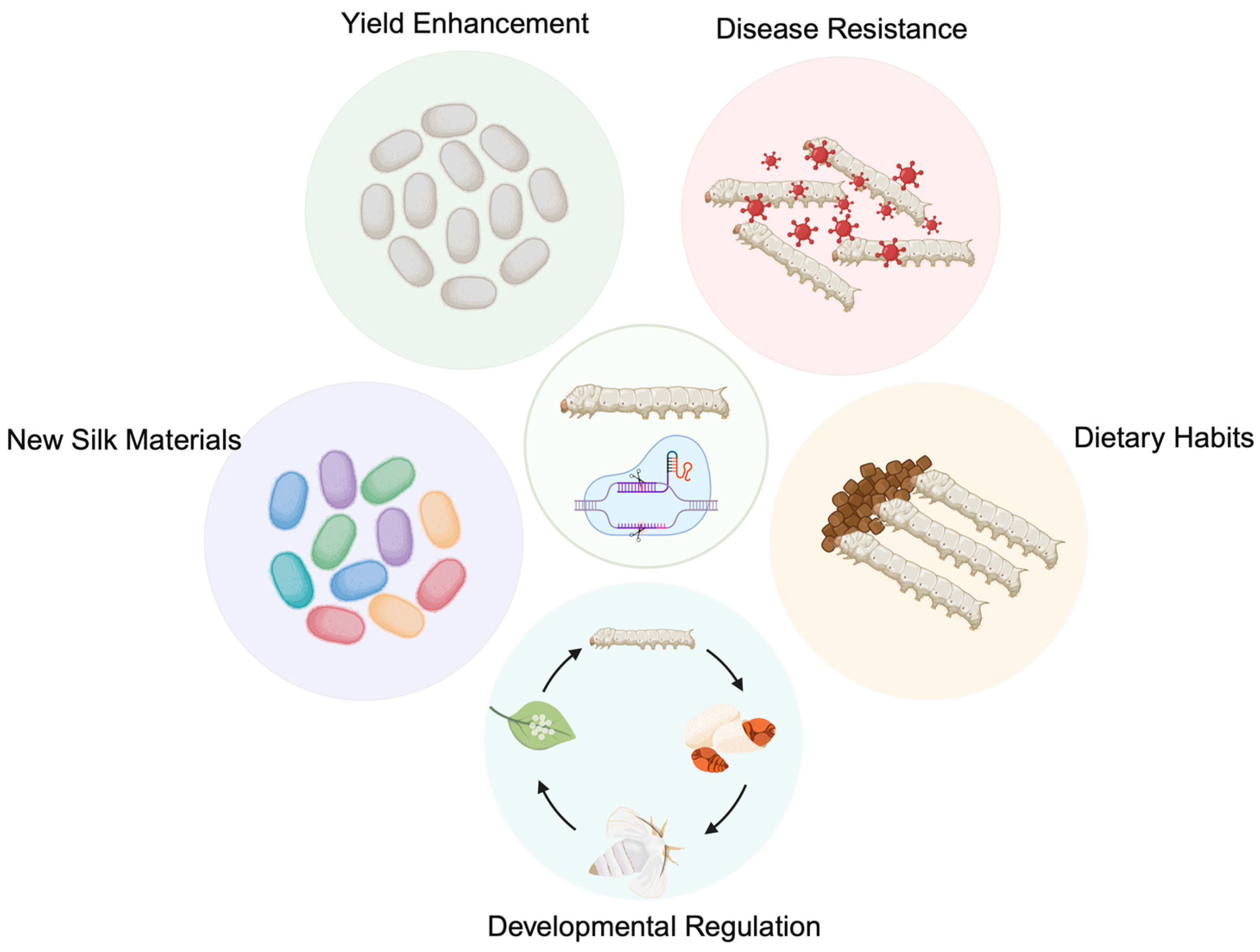
CRISPR-Mediated Silkworm: The Oncoming Agricultural Revolutions and a Rising Model Organism

Abstract
1. Introduction
2. Genome Editing Technologies in Silkworm
2.1. From Random Mutagenesis to Programmable Genome Reshaping
2.2. The Ever-Expanding CRISPR Toolbox: From Disruption to Precision Regulation
2.2.1. Canonical and Multiplex Editing
2.2.2. Conditional Editing: Tissue-Specific and Inducible Systems
2.2.3. Beyond the DSB: Base Editing, Regulation, and Precise Knock-In
2.2.4. Expanding the Scope: Variants and Toolkit Optimization

| Ref. | Study | CRISPR Tool/System | Target/Strategy | Performance in B. mori | Key Applications | Limitations |
|---|---|---|---|---|---|---|
| [21] | Wang et al., 2013 | Standard SpCas9 | Knockout (Indel) DSB-mediated NHEJ | High (94.0–95.6%) | Gene disruption; Large fragment deletion (~3.5 kb); Proof-of-concept (e.g., BmBLOS2). | Random Indels; Unpredictable outcomes; Frameshift mutations. |
| [36,38] | Ma et al., 2014; Wei et al., 2014 | Multiplex/Heritable Cas9 | Multiplex Editing; PiggyBac/ multi-gRNA | 16.7–35.0% (G0 stage); Heritable mutagenesis achieved | Heritable site-directed mutagenesis (e.g., BmKu70); Multiplex genome editing (up to 3 sites/gene). | Variable gRNA efficiency: Lower efficiency in embryos compared to cells. |
| [43,45,47] | Xu et al., 2019; Liu et al., 2017; Yu et al., 2023 | Tissue- Specific Cas9 | Conditional Editing Promoter-driven (Bmnos, BmFibH, CPG25) or Ligand fusion (BmOTP) | Restricted expression to target tissues (Germline, Silk gland, Epidermis) | Tissue-specific control; Sex-control systems (W-linked); Silk yield modification (BmLMN); Oocyte-targeted editing. | Promoter leakage; Limited availability of strictly tissue-specific promoters. |
| [40,49] | Dong et al., 2016; Fang et al., 2024 | Inducible Cas9 | Inducible Editing Pathogen-responsive complex | High antiviral activity; Triggered by infection | Smart defense systems; Inhibiting BmNPV replication (ie-1); Detecting infection of Nosema bombycis. | Response latency; Dependent on pathogen load for activation. |
| [50,51] | Li et al., 2018; Liu et al., 2020 | Base Editor (BE3) | Base Editing C-G to T-A conversion | 40–53.75% | Precise point mutation; Creating premature stop codons; Correcting SNPs without DSB. | Off-target effects (DNA/RNA); Restricted by PAM and editing window. |
| [58,59] | Nakade et al., 2014; Wan et al., 2024 | CRIS-PITCh/MMEJ | Knock-in MMEJ-mediated | Variable/High (Locus-dependent) | Targeted integration; Inserting fluorescent markers (e.g., 3xP3-DsRed2 into Fib-L). | Lower efficiency than NHEJ; Requires construction of microhomology vectors. |
| [52,54] | Wang et al., 2019; Hu et al., 2021 | CRISPRa | Activation Transcriptional regulation dCas9-VP64/VPR | Up to 8000-fold | Gain-of-function; Upregulating silk proteins (BmFib-H) in BmE. | Context-dependent; potential toxicity of VPR domain; Transient effect. |
| [53] | Wang et al., 2019 | CRISPRi | Repression dCas9-KRAB/SID/ SRDX | Significant repression | Gene silencing; Loss-of-function analysis without DNA damage; Alternative to RNAi. | Incomplete knockdown: Transient effect compared to stable KO. |
| [55] | Liu et al., 2019 | dCas9-TET1 | Epigenetic Editing Demethylation | 17.5–40.0% | Epigenetic regulation; Modifying DNA methylation status to study gene regulation. | Incomplete conversion: Effect may not be heritable or stable. |
| [56] | Chen et al., 2024 | dCas9-METTL4 | Epigenetic Editing 6mA Modification | Detected (Qualitative) | N6-methyladenine editing; Site-specific installation of 6mA (e.g., proteasome subunit). | Novel tool; Functional consequences of 6mA still under investigation. |
| [23,72] | Ma et al., 2024; Chang et al., 2020 | CRISPR Library | Screening Genome-wide KO | 1726 lines (High throughput) | Forward genetics; Identification of essential genes, toxin resistance, and visible phenotypes. | Labor intensive; Requires large-scale rearing and screening infrastructure. |
| [67] | Zou et al., 2025 | Cas12a (Cpf1) | Knockout T-rich PAM | Lower than Cas9 | AT-rich targets; Alternative to Cas9 for T-rich genomic regions; RNP delivery. | Lower efficiency compared to Cas9; Temperature sensitivity. |
| [57] | Xing et al., 2020 | CRISPR Imaging | Visualization dCas9-EGFP | Visualized | Live imaging; Tracking endogenous genomic loci dynamics in living cells. | Signal-to-noise ratio; non-editing application only. |
3. Agricultural Revolutions: Modernizing Sericulture
3.1. Addressing Long-Standing Challenges in Sericulture
3.1.1. Yield Enhancement and Developmental Regulation
3.1.2. Disease Resistance
3.2. Expanding the Frontiers of Sericulture: Novel Materials and Dietary Adaptation
3.2.1. New Silk Materials
3.2.2. Modification of Dietary Habits and Large-Scale Breeding
4. CRISPR-Driven Elevation of the Silkworm as a Model Organism
4.1. Comprehensive Genomics and Multi-Omics Resources
4.2. Unique Biological Characteristics and Mechanisms
4.2.1. Silk Biology
4.2.2. piRNA Biology
4.2.3. Hormone Signaling
4.3. Genome-Wide Screening and Libraries
4.3.1. Cell-Based High-Throughput Screening
4.3.2. Large-Scale Mutant Library Creation and In Vivo Screening
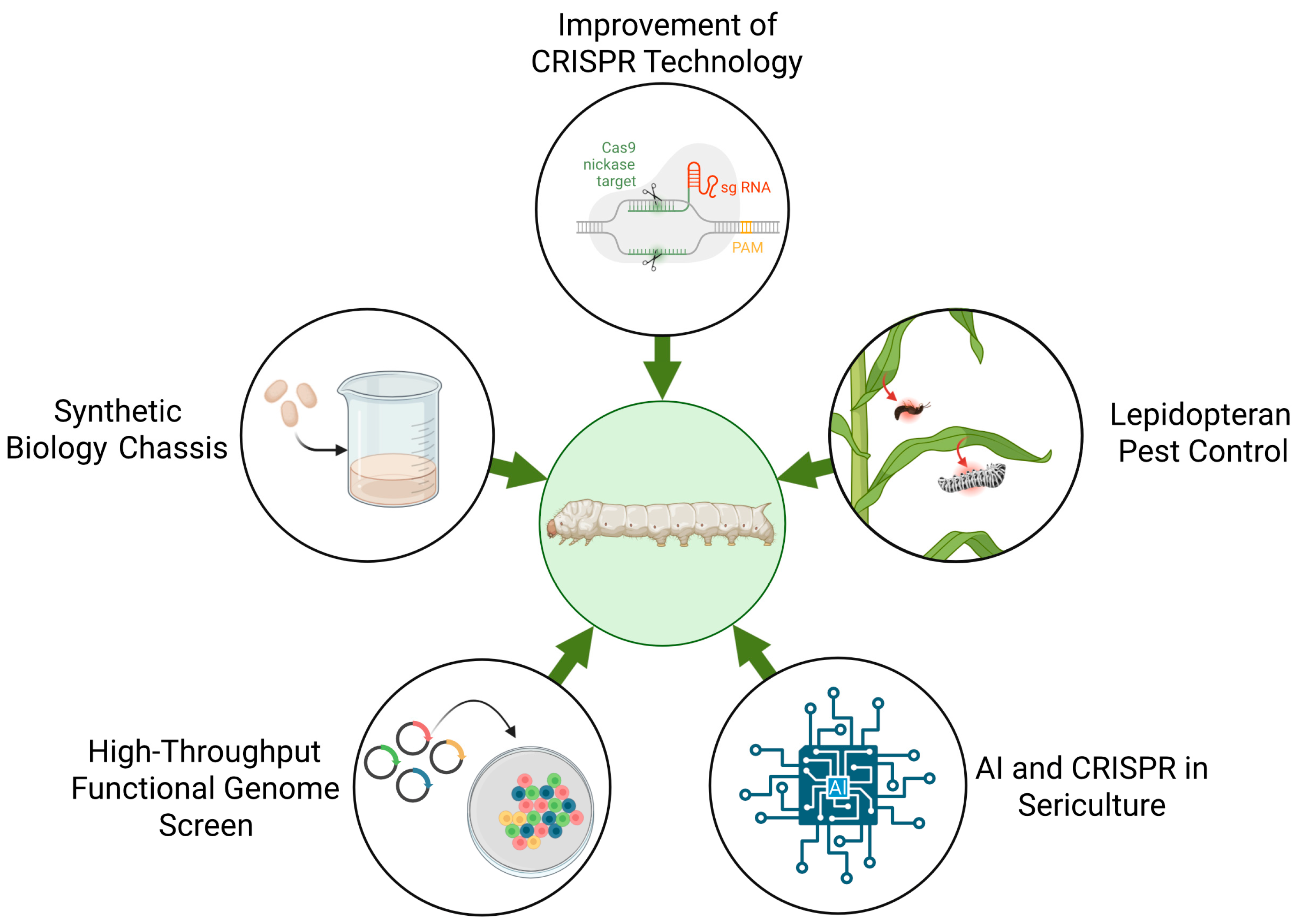
5. Future Directions and Perspectives
5.1. Development of CRISPR Future Technologies in Silkworm
5.2. CRISPR-Mediated Modification of Synthetic Biology Chassis
5.3. From Silkworm to Lepidopteran Pest Control
5.4. High-Throughput Functional Genomics and the Pangenome Era
5.5. The Convergence of AI and CRISPR in Sericulture
5.6. Ecological Safety, Ethics, and Regulatory Landscapes
Author Contributions
Funding
Institutional Review Board Statement
Informed Consent Statement
Data Availability Statement
Conflicts of Interest
Abbreviations
| ZFNs | Zinc Finger Nucleases |
| TALENs | Transcription Activator-Like Effector Nucleases |
| CRISPR | Clustered Regularly Interspaced Short Palindromic Repeats |
| NHEJ | Non-Homologous End Joining |
| RVD | Repeat-Variable Diresidue |
| DSBs | DNA Double-Strand Breaks |
| HDR | Homology-Directed Repair |
| PAM | Protospacer Adjacent Motif |
| BE3 | Base Editor 3 |
| MMEJ | Microhomology-Mediated End-Joining |
| ssODN | Single-Stranded Oligodeoxynucleotide |
| RNP | Ribonucleoprotein |
| CGA | Chlorogenic Acid |
| ISQ | Isoquercitrin |
| Orco | Odorant Receptor Co-Receptor |
| 20E | 20-hydroxyecdysone |
| JH | Juvenile Hormone |
| T2T | Telomere-to-Telomere |
| CNN | Convolutional Neural Network |
| AI | Artificial Intelligence |
References
- Tong, X.; Han, M.; Lu, K.; Tai, S.; Liang, S.; Liu, Y.; Hu, H.; Shen, J.; Long, A.; Zhan, C.; et al. High-Resolution Silkworm Pan-Genome Provides Genetic Insights into Artificial Selection and Ecological Adaptation. Nat. Commun. 2022, 13, 5619. [Google Scholar] [CrossRef]
- Xiang, H.; Liu, X.; Li, M.; Zhu, Y.; Wang, L.; Cui, Y.; Liu, L.; Fang, G.; Qian, H.; Xu, A.; et al. The Evolutionary Road from Wild Moth to Domestic Silkworm. Nat. Ecol. Evol. 2018, 2, 1268–1279. [Google Scholar] [CrossRef]
- Xia, Q.; Li, S.; Feng, Q. Advances in Silkworm Studies Accelerated by the Genome Sequencing of Bombyx mori. Annu. Rev. Entomol. 2014, 59, 513–536. [Google Scholar] [CrossRef]
- Xu, J.; Dong, Q.; Yu, Y.; Niu, B.; Ji, D.; Li, M.; Huang, Y.; Chen, X.; Tan, A. Mass Spider Silk Production through Targeted Gene Replacement in Bombyx mori. Proc. Natl. Acad. Sci. USA 2018, 115, 8757–8762. [Google Scholar] [CrossRef]
- Zou, S.; Luo, Y.; Jin, Y.; Jing, W.; Huang, Y.; Liang, Y.; Li, Y.; Hao, Z.; Xu, Y.; Wang, H. Draper-ATG3 Interaction Positively Regulates Autophagy to Mediate Silk Gland Degradation in Bombyx mori. Adv. Sci. 2025, 12, e04664. [Google Scholar] [CrossRef] [PubMed]
- Tomita, M.; Munetsuna, H.; Sato, T.; Adachi, T.; Hino, R.; Hayashi, M.; Shimizu, K.; Nakamura, N.; Tamura, T.; Yoshizato, K. Transgenic Silkworms Produce Recombinant Human Type III Procollagen in Cocoons. Nat. Biotechnol. 2003, 21, 52–56. [Google Scholar] [CrossRef] [PubMed]
- Teulé, F.; Miao, Y.; Sohn, B.; Kim, Y.; Hull, J.J.; Fraser, M.J., Jr.; Lewis, R.V.; Jarvis, D.L. Silkworms Transformed with Chimeric Silkworm/Spider Silk Genes Spin Composite Silk Fibers with Improved Mechanical Properties. Proc. Natl. Acad. Sci. USA 2012, 109, 923–928. [Google Scholar] [CrossRef]
- Holland, C.; Numata, K.; Rnjak-Kovacina, J.; Seib, F.P. The Biomedical Use of Silk: Past, Present, Future. Adv. Healthc. Mater. 2019, 8, e1800465. [Google Scholar] [CrossRef] [PubMed]
- Chouhan, D.; Mandal, B.B. Silk Biomaterials in Wound Healing and Skin Regeneration Therapeutics: From Bench to Bedside. Acta Biomater. 2020, 103, 24–51. [Google Scholar] [CrossRef]
- Reizabal, A.; Costa, C.M.; Pérez-Álvarez, L.; Vilas-Vilela, J.L.; Lanceros-Méndez, S. Silk Fibroin as Sustainable Advanced Material: Material Properties and Characteristics, Processing, and Applications. Adv. Funct. Mater. 2023, 33, 2210764. [Google Scholar] [CrossRef]
- Fire, A.; Xu, S.; Montgomery, M.K.; Kostas, S.A.; Driver, S.E.; Mello, C.C. Potent and Specific Genetic Interference by Double-Stranded RNA in Caenorhabditis elegans. Nature 1998, 391, 806–811. [Google Scholar] [CrossRef]
- Boutros, M.; Kiger, A.A.; Armknecht, S.; Kerr, K.; Hild, M.; Koch, B.; Haas, S.A.; Paro, R.; Perrimon, N. Heidelberg Fly Array Consortium Genome-Wide RNAi Analysis of Growth and Viability in Drosophila Cells. Science 2004, 303, 832–835. [Google Scholar] [CrossRef]
- Moffat, J.; Grueneberg, D.A.; Yang, X.; Kim, S.Y.; Kloepfer, A.M.; Hinkle, G.; Piqani, B.; Eisenhaure, T.M.; Luo, B.; Grenier, J.K.; et al. A Lentiviral RNAi Library for Human and Mouse Genes Applied to an Arrayed Viral High-Content Screen. Cell 2006, 124, 1283–1298. [Google Scholar] [CrossRef]
- Terenius, O.; Papanicolaou, A.; Garbutt, J.S.; Eleftherianos, I.; Huvenne, H.; Kanginakudru, S.; Albrechtsen, M.; An, C.; Aymeric, J.-L.; Barthel, A.; et al. RNA Interference in Lepidoptera: An Overview of Successful and Unsuccessful Studies and Implications for Experimental Design. J. Insect Physiol. 2011, 57, 231–245. [Google Scholar] [CrossRef]
- Kolliopoulou, A.; Swevers, L. Recent Progress in RNAi Research in Lepidoptera: Intracellular Machinery, Antiviral Immune Response and Prospects for Insect Pest Control. Curr. Opin. Insect Sci. 2014, 6, 28–34. [Google Scholar] [CrossRef]
- Gaj, T.; Gersbach, C.A.; Barbas, C.F., 3rd. ZFN, TALEN, and CRISPR/Cas-Based Methods for Genome Engineering. Trends Biotechnol. 2013, 31, 397–405. [Google Scholar] [CrossRef]
- Doudna, J.A.; Charpentier, E. The New Frontier of Genome Engineering with CRISPR-Cas9. Science 2014, 346, 1258096. [Google Scholar] [CrossRef] [PubMed]
- Ma, S.; Smagghe, G.; Xia, Q. Genome Editing in Bombyx mori: New Opportunities for Silkworm Functional Genomics and the Sericulture Industry. Insect Sci. 2019, 26, 964–972. [Google Scholar] [CrossRef] [PubMed]
- Mali, P.; Esvelt, K.M.; Church, G.M. Cas9 as a Versatile Tool for Engineering Biology. Nat. Methods 2013, 10, 957–963. [Google Scholar] [CrossRef] [PubMed]
- Chakrabarti, A.M.; Henser-Brownhill, T.; Monserrat, J.; Poetsch, A.R.; Luscombe, N.M.; Scaffidi, P. Target-Specific Precision of CRISPR-Mediated Genome Editing. Mol. Cell 2019, 73, 699–713.e6. [Google Scholar] [CrossRef]
- Wang, Y.; Li, Z.; Xu, J.; Zeng, B.; Ling, L.; You, L.; Chen, Y.; Huang, Y.; Tan, A. The CRISPR/Cas System Mediates Efficient Genome Engineering in Bombyx mori. Cell Res. 2013, 23, 1414–1416. [Google Scholar] [CrossRef] [PubMed]
- Chang, J.; Chen, X.; Zhang, T.; Wang, R.; Wang, A.; Lan, X.; Zhou, Y.; Ma, S.; Xia, Q. The Novel Insight into the Outcomes of CRISPR/Cas9 Editing Intra- and Inter-Species. Int. J. Biol. Macromol. 2020, 163, 711–717. [Google Scholar] [CrossRef]
- Ma, S.; Zhang, T.; Wang, R.; Wang, P.; Liu, Y.; Chang, J.; Wang, A.; Lan, X.; Sun, L.; Sun, H.; et al. High-Throughput and Genome-Scale Targeted Mutagenesis Using CRISPR in a Nonmodel Multicellular Organism, Bombyx mori. Genome Res. 2024, 34, 134–144. [Google Scholar] [CrossRef]
- Zhang, T.; Xing, W.; Wang, A.; Zhang, N.; Jia, L.; Ma, S.; Xia, Q. Comparison of Long-Read Methods for Sequencing and Assembly of Lepidopteran Pest Genomes. Int. J. Mol. Sci. 2022, 24, 649. [Google Scholar] [CrossRef]
- Li, W.-S.; Xiao, Y.-D.; Liu, J.-Q.; Li, S.-L.; Chen, Y.; Xu, Y.-J.; Yang, X.; Wang, Y.-J.; Li, Z.-Q.; Xia, Q.-Y.; et al. The T2T Genome of the Domesticated Silkworm Bombyx mori. Int. J. Mol. Sci. 2024, 25, 12341. [Google Scholar] [CrossRef]
- Takasu, Y.; Kobayashi, I.; Beumer, K.; Uchino, K.; Sezutsu, H.; Sajwan, S.; Carroll, D.; Tamura, T.; Zurovec, M. Targeted Mutagenesis in the Silkworm Bombyx mori Using Zinc Finger Nuclease MRNA Injection. Insect Biochem. Mol. Biol. 2010, 40, 759–765. [Google Scholar] [CrossRef]
- Ma, S.; Zhang, S.; Wang, F.; Liu, Y.; Liu, Y.; Xu, H.; Liu, C.; Lin, Y.; Zhao, P.; Xia, Q. Highly Efficient and Specific Genome Editing in Silkworm Using Custom TALENs. PLoS ONE 2012, 7, e45035. [Google Scholar] [CrossRef]
- Takasu, Y.; Sajwan, S.; Daimon, T.; Osanai-Futahashi, M.; Uchino, K.; Sezutsu, H.; Tamura, T.; Zurovec, M. Efficient TALEN Construction for Bombyx mori Gene Targeting. PLoS ONE 2013, 8, e73458. [Google Scholar] [CrossRef]
- Tamura, T.; Thibert, C.; Royer, C.; Kanda, T.; Abraham, E.; Kamba, M.; Komoto, N.; Thomas, J.L.; Mauchamp, B.; Chavancy, G.; et al. Germline Transformation of the Silkworm Bombyx mori L. Using a PiggyBac Transposon-Derived Vector. Nat. Biotechnol. 2000, 18, 81–84. [Google Scholar] [CrossRef] [PubMed]
- Kim, Y.G.; Cha, J.; Chandrasegaran, S. Hybrid Restriction Enzymes: Zinc Finger Fusions to Fok I Cleavage Domain. Proc. Natl. Acad. Sci. USA 1996, 93, 1156–1160. [Google Scholar] [CrossRef] [PubMed]
- Bibikova, M.; Beumer, K.; Trautman, J.K.; Carroll, D. Enhancing Gene Targeting with Designed Zinc Finger Nucleases. Science 2003, 300, 764. [Google Scholar] [CrossRef]
- Boch, J.; Scholze, H.; Schornack, S.; Landgraf, A.; Hahn, S.; Kay, S.; Lahaye, T.; Nickstadt, A.; Bonas, U. Breaking the Code of DNA Binding Specificity of TAL-Type III Effectors. Science 2009, 326, 1509–1512. [Google Scholar] [CrossRef] [PubMed]
- Moscou, M.J.; Bogdanove, A.J. A Simple Cipher Governs DNA Recognition by TAL Effectors. Science 2009, 326, 1501. [Google Scholar] [CrossRef]
- Barrangou, R.; Fremaux, C.; Deveau, H.; Richards, M.; Boyaval, P.; Moineau, S.; Romero, D.A.; Horvath, P. CRISPR Provides Acquired Resistance against Viruses in Prokaryotes. Science 2007, 315, 1709–1712. [Google Scholar] [CrossRef] [PubMed]
- Jinek, M.; Chylinski, K.; Fonfara, I.; Hauer, M.; Doudna, J.A.; Charpentier, E. A Programmable Dual-RNA-Guided DNA Endonuclease in Adaptive Bacterial Immunity. Science 2012, 337, 816–821. [Google Scholar] [CrossRef]
- Ma, S.; Chang, J.; Wang, X.; Liu, Y.; Zhang, J.; Lu, W.; Gao, J.; Shi, R.; Zhao, P.; Xia, Q. CRISPR/Cas9 Mediated Multiplex Genome Editing and Heritable Mutagenesis of BmKu70 in Bombyx mori. Sci. Rep. 2014, 4, 4489. [Google Scholar] [CrossRef] [PubMed]
- Liu, Y.; Ma, S.; Wang, X.; Chang, J.; Gao, J.; Shi, R.; Zhang, J.; Lu, W.; Liu, Y.; Zhao, P.; et al. Highly Efficient Multiplex Targeted Mutagenesis and Genomic Structure Variation in Bombyx mori Cells Using CRISPR/Cas9. Insect Biochem. Mol. Biol. 2014, 49, 35–42. [Google Scholar] [CrossRef]
- Wei, W.; Xin, H.; Roy, B.; Dai, J.; Miao, Y.; Gao, G. Heritable Genome Editing with CRISPR/Cas9 in the Silkworm, Bombyx mori. PLoS ONE 2014, 9, e101210. [Google Scholar] [CrossRef]
- Tang, Y.; Zhang, X.; Dai, Z.; Li, H.; Yang, Y.; Zhao, T.; Yuan, D.; Qian, W.; Cheng, D. CRISPR-Cas13-Mediated RNA Editing in the Silkworm Bombyx mori. Zool. Res. 2024, 45, 1249–1260. [Google Scholar]
- Dong, Z.; Chen, T.; Zhang, J.; Hu, N.; Cao, M.; Dong, F.; Jiang, Y.; Chen, P.; Lu, C.; Pan, M. Establishment of a Highly Efficient Virus-Inducible CRISPR/Cas9 System in Insect Cells. Antivir. Res. 2016, 130, 50–57. [Google Scholar] [CrossRef]
- Liu, Y.; Chen, D.; Zhang, X.; Chen, S.; Yang, D.; Tang, L.; Yang, X.; Wang, Y.; Luo, X.; Wang, M.; et al. Construction of Baculovirus-Inducible CRISPR/Cas9 Antiviral System Targeting BmNPV in Bombyx mori. Viruses 2021, 14, 59. [Google Scholar] [CrossRef]
- Liu, Y.; Yang, X.; Wu, P.; Guo, X.; Liu, Z.; Huang, Y.; Xu, X. Multi-Targets Cleavage of BmNPV Genome through Genome-Wide Repeat Sequence Using CRISPR/Cas9 Antiviral System. Insect Sci. 2025, 32, 1174–1184. [Google Scholar] [CrossRef]
- Xu, J.; Chen, R.; Chen, S.; Chen, K.; Tang, L.; Yang, D.; Yang, X.; Zhang, Y.; Song, H.; Huang, Y. Identification of a Germline-Expression Promoter for Genome Editing in Bombyx mori. Insect Sci. 2019, 26, 991–999. [Google Scholar] [CrossRef]
- Zhang, Z.; Niu, B.; Ji, D.; Li, M.; Li, K.; James, A.A.; Tan, A.; Huang, Y. Silkworm Genetic Sexing through W Chromosome-Linked, Targeted Gene Integration. Proc. Natl. Acad. Sci. USA 2018, 115, 8752–8756. [Google Scholar] [CrossRef]
- Liu, Y.; Ma, S.; Chang, J.; Zhang, T.; Wang, X.; Shi, R.; Zhang, J.; Lu, W.; Liu, Y.; Xia, Q. Tissue-Specific Genome Editing of LaminA/C in the Posterior Silk Glands of Bombyx mori. J. Genet. Genom. 2017, 44, 451–459. [Google Scholar] [CrossRef] [PubMed]
- Wang, Y.; Du, T.; Li, A.; Qiao, L.; Zhang, Z.; Sun, W. Establishment and Application of a Silkworm CRISPR/Cas9 Tool for Conditionally Manipulating Gene Disruption in the Epidermis. Insect Biochem. Mol. Biol. 2022, 151, 103861. [Google Scholar] [CrossRef]
- Yu, B.; Dong, S.; Jiang, X.; Qiao, L.; Chen, J.; Li, T.; Pan, G.; Zhou, Z.; Li, C. Cas9-Mediated Gene Editing Using Receptor-Mediated Ovary Transduction of Cargo (ReMOT) Control in Bombyx mori. Insects 2023, 14, 932. [Google Scholar] [CrossRef]
- Dong, Z.; Dong, F.; Yu, X.; Huang, L.; Jiang, Y.; Hu, Z.; Chen, P.; Lu, C.; Pan, M. Excision of Nucleopolyhedrovirus Form Transgenic Silkworm Using the CRISPR/Cas9 System. Front. Microbiol. 2018, 9, 209. [Google Scholar] [CrossRef] [PubMed]
- Fang, W.; Zhou, L.; Deng, B.; Guo, B.; Chen, X.; Chen, P.; Lu, C.; Dong, Z.; Pan, M. Establishment of a Secretory Protein-Inducible CRISPR/Cas9 System for Nosema Bombycis in Insect Cells. J. Agric. Food Chem. 2024, 72, 13175–13185. [Google Scholar] [CrossRef] [PubMed]
- Li, Y.; Ma, S.; Sun, L.; Zhang, T.; Chang, J.; Lu, W.; Chen, X.; Liu, Y.; Wang, X.; Shi, R.; et al. Programmable Single and Multiplex Base-Editing in Bombyx mori Using RNA-Guided Cytidine Deaminases. G3 Genes Genomes Genet. 2018, 8, 1701–1709. [Google Scholar] [CrossRef]
- Liu, Y.; Li, Y.; Liang, Y.; Wang, T.; Yang, C.; Ma, S.; Xia, Q. Comparative Analysis of Genome Editing Systems, Cas9 and BE3, in Silkworms. Int. J. Biol. Macromol. 2020, 158, 486–492. [Google Scholar] [CrossRef]
- Wang, X.; Ma, S.; Chang, J.; Shi, R.; Wang, R.; Zhao, P.; Xia, Q. Programmable Activation of Bombyx Gene Expression Using CRISPR/DCas9 Fusion System. Insect Sci. 2019, 26, 983–990. [Google Scholar] [CrossRef]
- Wang, X.; Ma, S.; Liu, Y.; Lu, W.; Sun, L.; Zhao, P.; Xia, Q. Transcriptional Repression of Endogenous Genes in BmE Cells Using CRISPRi System. Insect Biochem. Mol. Biol. 2019, 111, 103172. [Google Scholar] [CrossRef] [PubMed]
- Hu, W.; Wang, X.; Ma, S.; Peng, Z.; Cao, Y.; Xia, Q. CRISPR-Mediated Endogenous Activation of Fibroin Heavy Chain Gene Triggers Cellular Stress Responses in Bombyx mori Embryonic Cells. Insects 2021, 12, 552. [Google Scholar] [CrossRef] [PubMed]
- Liu, Y.; Ma, S.; Chang, J.; Zhang, T.; Chen, X.; Liang, Y.; Xia, Q. Programmable Targeted Epigenetic Editing Using CRISPR System in Bombyx mori. Insect Biochem. Mol. Biol. 2019, 110, 105–111. [Google Scholar] [CrossRef]
- Chen, F.; Guo, H.; Lan, W.; Zhou, M.; Geng, W.; Shen, G.; Lin, P.; Xia, Q.; Zhao, P.; Li, Z. Targeted DNA N6-Methyladenine Editing by DCas9 Fused to METTL4 in the Lepidopteran Model Insect Bombyx mori. Insect Sci. 2024, 31, 646–650. [Google Scholar] [CrossRef]
- Xing, W.; Ma, S.; Liu, Y.; Xia, Q. CRISPR/DCas9-Mediated Imaging of Endogenous Genomic Loci in Living Bombyx mori Cells. Insect Sci. 2020, 27, 1360–1364. [Google Scholar] [CrossRef] [PubMed]
- Nakade, S.; Tsubota, T.; Sakane, Y.; Kume, S.; Sakamoto, N.; Obara, M.; Daimon, T.; Sezutsu, H.; Yamamoto, T.; Sakuma, T.; et al. Microhomology-Mediated End-Joining-Dependent Integration of Donor DNA in Cells and Animals Using TALENs and CRISPR/Cas9. Nat. Commun. 2014, 5, 5560. [Google Scholar] [CrossRef]
- Wan, Z.; Tsubota, T.; Uchino, K.; Sezutsu, H.; Daimon, T. MMEJ-Mediated Precise Gene Knock-in into the Fibroin-L Locus of the Silkworm, Bombyx mori. J. Insect Biotechnol. Sericology 2024, 93, 2_013–2_021. [Google Scholar]
- Fujii, T.; Hino, M.; Fujimoto, T.; Kakino, K.; Kaneko, Y.; Abe, H.; Lee, J.M.; Kusakabe, T.; Shimada, T. Peroxiredoxin 6 Is Essential for the Posttranslational Activation of Xanthine Dehydrogenase in the Uric Acid Synthesis of Bombyx mori. Insect Biochem. Mol. Biol. 2025, 178, 104264. [Google Scholar] [CrossRef]
- Mi, J.; Zhou, Y.; Ma, S.; Zhou, X.; Xu, S.; Yang, Y.; Sun, Y.; Xia, Q.; Zhu, H.; Wang, S.; et al. High-Strength and Ultra-Tough Whole Spider Silk Fibers Spun from Transgenic Silkworms. Matter 2023, 6, 3661–3683. [Google Scholar] [CrossRef]
- Zhang, X.; Xia, L.; Day, B.A.; Harris, T.I.; Oliveira, P.; Knittel, C.; Licon, A.L.; Gong, C.; Dion, G.; Lewis, R.V.; et al. CRISPR/Cas9 Initiated Transgenic Silkworms as a Natural Spinner of Spider Silk. Biomacromolecules 2019, 20, 2252–2264. [Google Scholar] [CrossRef] [PubMed]
- Tsubota, T.; Takasu, Y.; Yonemura, N.; Sezutsu, H. Enhancements of the CRISPR-Cas System in the Silkworm Bombyx mori. CRISPR J. 2025, 8, 155–164. [Google Scholar] [CrossRef] [PubMed]
- Nakata, M.; Ueno, M.; Kikuchi, Y.; Iwami, M.; Takayanagi-Kiya, S.; Kiya, T. CRISPR/Cas9- and Single-Stranded ODN-Mediated Knock-In in Silkworm Bombyx mori. Zoolog. Sci. 2024, 41, 540–547. [Google Scholar] [CrossRef]
- Sun, L.; Zhang, T.; Lan, X.; Zhang, N.; Wang, R.; Ma, S.; Zhao, P.; Xia, Q. High-Throughput Screening of PAM-Flexible Cas9 Variants for Expanded Genome Editing in the Silkworm (Bombyx mori). Insects 2024, 15, 241. [Google Scholar] [CrossRef]
- Ma, S.; Liu, Y.; Liu, Y.; Chang, J.; Zhang, T.; Wang, X.; Shi, R.; Lu, W.; Xia, X.; Zhao, P.; et al. An Integrated CRISPR Bombyx mori Genome Editing System with Improved Efficiency and Expanded Target Sites. Insect Biochem. Mol. Biol. 2017, 83, 13–20. [Google Scholar] [CrossRef] [PubMed]
- Zou, Y.; Ye, A.; Dong, M.; Zhou, Y.; Wu, W.; Tang, Y.; Hu, H.; Dai, F.; Tong, X. Silkworm Mutagenesis Using a Ribonucleoprotein-Based CRISPR/Cas12a System. Insect Biochem. Mol. Biol. 2025, 182, 104329. [Google Scholar] [CrossRef]
- Zeng, B.; Zhan, S.; Wang, Y.; Huang, Y.; Xu, J.; Liu, Q.; Li, Z.; Huang, Y.; Tan, A. Expansion of CRISPR Targeting Sites in Bombyx mori. Insect Biochem. Mol. Biol. 2016, 72, 31–40. [Google Scholar] [CrossRef]
- Zou, Y.; Ye, A.; Liu, S.; Wu, W.; Xu, L.; Dai, F.; Tong, X. Expansion of Targetable Sites for the Ribonucleoprotein-Based CRISPR/Cas9 System in the Silkworm Bombyx mori. BMC Biotechnol. 2021, 21, 54. [Google Scholar] [CrossRef]
- Jia, L.; Ma, S.; Zhang, T.; Xing, W.; Liu, Y.; Li, Y.; Chen, X.; Xia, Q. Enhanced Bombyx Genome Editing via Cas9 Ribonucleoprotein Injection. Insect Sci. 2019, 26, 1059–1062. [Google Scholar] [CrossRef]
- Ma, S.; Wang, A.; Chen, X.; Zhang, T.; Xing, W.; Xia, Q. Deep Sequencing Reveals the Comprehensive CRISPR-Cas9 Editing Spectrum in Bombyx mori. CRISPR J. 2021, 4, 371–380. [Google Scholar] [CrossRef] [PubMed]
- Chang, J.; Wang, R.; Yu, K.; Zhang, T.; Chen, X.; Liu, Y.; Shi, R.; Wang, X.; Xia, Q.; Ma, S. Genome-Wide CRISPR Screening Reveals Genes Essential for Cell Viability and Resistance to Abiotic and Biotic Stresses in Bombyx mori. Genome Res. 2020, 30, 757–767. [Google Scholar] [CrossRef]
- Ma, S.; Xia, Q. Genetic Breeding of Silkworms: From Traditional Hybridization to Molecular Design. Yi Chuan 2017, 39, 1025–1032. [Google Scholar]
- Hu, Z.; Zhu, F.; Chen, K. The Mechanisms of Silkworm Resistance to the Baculovirus and Antiviral Breeding. Annu. Rev. Entomol. 2023, 68, 381–399. [Google Scholar] [CrossRef]
- Fan, X.; Wei, M.; Li, Y.; Xia, Q.; Wang, X. Genetic Engineering of Silkworm for Enhanced Silk Mechanical Properties: A Review. Mater. Des. 2025, 260, 115031. [Google Scholar] [CrossRef]
- Douglas, C.; Turner, J.M.A. Advances and Challenges in Genetic Technologies to Produce Single-Sex Litters. PLoS Genet. 2020, 16, e1008898. [Google Scholar] [CrossRef]
- Gai, T.; Tong, X.; Han, M.; Li, C.; Fang, C.; Zou, Y.; Hu, H.; Xiang, H.; Xiang, Z.; Lu, C.; et al. Cocoonase Is Indispensable for Lepidoptera Insects Breaking the Sealed Cocoon. PLoS Genet. 2020, 16, e1009004. [Google Scholar] [CrossRef] [PubMed]
- Wang, W.; Wang, X.; Luo, C.; Pu, Q.; Yin, Q.; Xu, L.; Peng, X.; Ma, S.; Xia, Q.; Liu, S. Let-7 MicroRNA Is a Critical Regulator in Controlling the Growth and Function of Silk Gland in the Silkworm. RNA Biol. 2020, 17, 703–717. [Google Scholar] [CrossRef]
- Wang, W.; Ji, L.; Jing, X.; Zhao, P.; Xia, Q. MicroRNA Let-7 Targets BmCDK1 to Regulate Cell Proliferation and Endomitosis of Silk Gland in the Silkworm, Bombyx mori. Insect Sci. 2024, 31, 1026–1040. [Google Scholar] [CrossRef]
- Wang, W.; Zhang, F.; Guo, K.; Xu, J.; Zhao, P.; Xia, Q. CRISPR/Cas9-Mediated Gene Editing of the Let-7 Seed Sequence Improves Silk Yield in the Silkworm, Bombyx mori. Int. J. Biol. Macromol. 2023, 243, 124793. [Google Scholar] [CrossRef] [PubMed]
- Li, S.; Lao, J.; Sun, Y.; Hua, X.; Lin, P.; Wang, F.; Shen, G.; Zhao, P.; Xia, Q. CRISPR/Cas9-Mediated Editing of BmEcKL1 Gene Sequence Affected Silk Gland Development of Silkworms (Bombyx mori). Int. J. Mol. Sci. 2024, 25, 1907. [Google Scholar] [CrossRef]
- Wu, L.; Zhao, L.; Feng, Y.; Wu, J.; Hua, X.; Wang, W.; Wang, Y.; Li, Z.; Xia, Q.; Lin, P.; et al. SGDAcn Is a Suppressor for Silk Gland Endoreplication and Development. Insect Sci. 2025. [Google Scholar] [CrossRef]
- Zabelina, V.; Takasu, Y.; Sehadova, H.; Yonemura, N.; Nakajima, K.; Sezutsu, H.; Sery, M.; Zurovec, M.; Sehnal, F.; Tamura, T. Mutation in Bombyx mori Fibrohexamerin (P25) Gene Causes Reorganization of Rough Endoplasmic Reticulum in Posterior Silk Gland Cells and Alters Morphology of Fibroin Secretory Globules in the Silk Gland Lumen. Insect Biochem. Mol. Biol. 2021, 135, 103607. [Google Scholar] [CrossRef]
- Qian, W.; Li, H.; Zhang, X.; Tang, Y.; Yuan, D.; Huang, Z.; Cheng, D. Fzr Regulates Silk Gland Growth by Promoting Endoreplication and Protein Synthesis in the Silkworm. PLoS Genet. 2023, 19, e1010602. [Google Scholar] [CrossRef] [PubMed]
- Chen, Y.; Li, J.; Niu, K.; Peng, Y.; Song, Q.; Feng, Q. G-Quadruplex Is Involved in the Regulation of BmSGF1 Expression in the Silkworm, Bombyx mori. Insect Sci. 2024, 31, 1440–1452. [Google Scholar] [CrossRef]
- Tao, C.; Wang, J.; Cong, J.; Yang, H.; Cao, J.; Liu, C.; Cheng, T. Broad Complex Negatively Regulates Fibrohexamerin/P25 by Binding to the Cis-Element BMFA in the Silkworm, Bombyx mori. Int. J. Biol. Macromol. 2025, 307, 142114. [Google Scholar] [CrossRef]
- Yi, M.; Yang, X.; Wang, M.; Chen, J.; Xiang, J.; Xiang, L.; Qian, L.; Chen, D.; Huang, Y.; Tong, X.; et al. Consistency, Distinction, and Potential Metabolic Crosstalk of Nitrogen Mobilization-Related Genes in Silk Production and Silk Gland Biology. Zool. Res. 2025, 46, 446–458. [Google Scholar] [CrossRef] [PubMed]
- Zhang, Z.; Liu, X.; Shiotsuki, T.; Wang, Z.; Xu, X.; Huang, Y.; Li, M.; Li, K.; Tan, A. Depletion of Juvenile Hormone Esterase Extends Larval Growth in Bombyx mori. Insect Biochem. Mol. Biol. 2017, 81, 72–79. [Google Scholar] [CrossRef] [PubMed]
- Brady, D.J.; Saviane, A.; Battistolli, M.; Varponi, I.; Barca, F.; Shiomi, K.; Cappellozza, S.; Sandrelli, F. Enhanced Silk Production and Pupal Weight in Bombyx mori through CRISPR/Cas9-Mediated Circadian Clock Gene Disruption. PLoS ONE 2025, 20, e0317572. [Google Scholar] [CrossRef]
- Cao, J.; Zheng, H.; Zhang, R.; Xu, Y.; Pan, H.; Li, S.; Liu, C.; Cheng, T. Dimmed Gene Knockout Shortens Larval Growth and Reduces Silk Yield in the Silkworm, Bombyx mori. Insect Mol. Biol. 2023, 32, 26–35. [Google Scholar] [CrossRef]
- Tan, A.; Fu, G.; Jin, L.; Guo, Q.; Li, Z.; Niu, B.; Meng, Z.; Morrison, N.I.; Alphey, L.; Huang, Y. Transgene-Based, Female-Specific Lethality System for Genetic Sexing of the Silkworm, Bombyx mori. Proc. Natl. Acad. Sci. USA 2013, 110, 6766–6770. [Google Scholar] [CrossRef]
- Fang, S.-M.; Zhou, Q.-Z.; Yu, Q.-Y.; Zhang, Z. Genetic and Genomic Analysis for Cocoon Yield Traits in Silkworm. Sci. Rep. 2020, 10, 5682. [Google Scholar] [CrossRef]
- Li, K.; Dong, Z.; Dong, F.; Hu, Z.; Huang, L.; Wang, J.; Chen, P.; Lu, C.; Pan, M. Transcriptome Analysis Reveals That Knocking out BmNPV Iap2 Induces Apoptosis by Inhibiting the Oxidative Phosphorylation Pathway. Int. J. Biol. Macromol. 2023, 233, 123482. [Google Scholar] [CrossRef]
- Chauhan, P.; Bashir, M.; Pandey, A.; Kaur, A. Silkworm Disease Management. In Sericulture; CRC Press: London, UK, 2025; pp. 128–148. ISBN 9781003717768. [Google Scholar]
- Ye, X.; Zhao, S.; Wu, M.; Ruan, J.; Tang, X.; Wang, X.; Zhong, B. Role of Sericin 1 in the Immune System of Silkworms Revealed by Transcriptomic and Proteomic Analyses after Gene Knockout. FEBS Open Bio 2021, 11, 2304–2318. [Google Scholar] [CrossRef] [PubMed]
- Heng, J.; Liu, H.; Xu, J.; Huang, X.; Sun, X.; Yang, R.; Xia, Q.; Zhao, P. KPI5 Is Involved in the Regulation of the Expression of Antibacterial Peptide Genes and Hemolymph Melanization in the Silkworm, Bombyx mori. Front. Immunol. 2022, 13, 907427. [Google Scholar] [CrossRef]
- Liu, H.; Xu, J.; Wang, L.; Guo, P.; Tang, Z.; Sun, X.; Tang, X.; Wang, W.; Wang, L.; Cao, Y.; et al. Serpin-1a and Serpin-6 Regulate the Toll Pathway Immune Homeostasis by Synergistically Inhibiting the Spätzle-Processing Enzyme CLIP2 in Silkworm, Bombyx mori. PLoS Pathog. 2023, 19, e1011740. [Google Scholar] [CrossRef]
- Xiong, J.; Hu, Z.; Wang, G.; Wang, C.; Chen, P. The Role of BmsPLA2-4 in Tissue Defense against Pathogens in Silkworm, Bombyx mori. Insect Sci. 2025. [Google Scholar] [CrossRef]
- He, L.; Liu, L.; Liu, H.; Tang, X.; Meng, Y.; Xie, H.; Zhu, L.; Xia, Q.; Zhao, P. Functional Analysis of BmHemolin in the Immune Defense of Silkworms. Insects 2025, 16, 778. [Google Scholar] [CrossRef] [PubMed]
- Dong, Z.; Huang, L.; Dong, F.; Hu, Z.; Qin, Q.; Long, J.; Cao, M.; Chen, P.; Lu, C.; Pan, M.-H. Establishment of a Baculovirus-Inducible CRISPR/Cas9 System for Antiviral Research in Transgenic Silkworms. Appl. Microbiol. Biotechnol. 2018, 102, 9255–9265. [Google Scholar] [CrossRef] [PubMed]
- Huang, L.; Dong, Z.; Dong, F.; Yu, X.; Hu, Z.; Liao, N.; Chen, P.; Lu, C.; Pan, M. Gene Editing the BmNPV Inhibitor of Apoptosis Protein 2 (Iap2) as an Antiviral Strategy in Transgenic Silkworm. Int. J. Biol. Macromol. 2021, 166, 529–537. [Google Scholar] [CrossRef]
- Zhu, Y.; Hu, Z.; Chen, P.; Xiao, Q.; Xiao, Y.; Jia, X.; Dong, Z.; Pan, M.; Lu, C. CRISPR/Cas9-Mediated Disruption of Orf76 as an Antiviral Therapy against BmNPV in the Transgenic Silkworm. Int. J. Biol. Macromol. 2024, 278, 134773. [Google Scholar] [CrossRef] [PubMed]
- Chen, S.; Hou, C.; Bi, H.; Wang, Y.; Xu, J.; Li, M.; James, A.A.; Huang, Y.; Tan, A. Transgenic Clustered Regularly Interspaced Short Palindromic Repeat/Cas9-Mediated Viral Gene Targeting for Antiviral Therapy of Bombyx mori Nucleopolyhedrovirus. J. Virol. 2017, 91, e02465-16. [Google Scholar] [CrossRef] [PubMed]
- Liao, N.; Dong, Z.; Zhang, X.; Qin, Q.; Luo, Y.; Huang, L.; Chen, P.; Lu, C.; Pan, M. Construction of a CRISPR/FnCas12a Multi-Sites Editing System for Inhibiting Proliferation of Bombyx mori Nuclearpolyhedrosisvirus. Int. J. Biol. Macromol. 2021, 193, 585–591. [Google Scholar] [CrossRef]
- Liang, Y.; Xu, W.; Zhou, Y.; Gao, Y.; Tian, H.; Wu, X.; Xu, Y.; Wang, H. Midgut Membrane Protein BmSUH Facilitates Bombyx mori Nucleopolyhedrovirus Oral Infection. PLoS Pathog. 2022, 18, e1010938. [Google Scholar] [CrossRef]
- Feng, Y.; Yang, C.; Wu, L.; Wang, Y.; Shen, G.; Lin, P. BmSPP Is a Virus Resistance Gene in Bombyx mori. Front. Immunol. 2024, 15, 1377270. [Google Scholar] [CrossRef]
- Chen, F.; Zhou, M.; Chen, W.; Geng, W.; Lu, L.; Shen, G.; Lin, P.; Xia, Q.; Zhao, P.; Li, Z. N6-Methyladenosine Modification of Host Hsc70 Attenuates Nucleopolyhedrovirus Infection in the Lepidopteran Model Insect Bombyx mori. Int. J. Biol. Macromol. 2025, 298, 139869. [Google Scholar] [CrossRef]
- Dong, Z.; Long, J.; Huang, L.; Hu, Z.; Chen, P.; Hu, N.; Zheng, N.; Huang, X.; Lu, C.; Pan, M. Construction and Application of an HSP70 Promoter-Inducible Genome Editing System in Transgenic Silkworm to Induce Resistance to Nosema bombycis. Appl. Microbiol. Biotechnol. 2019, 103, 9583–9592. [Google Scholar] [CrossRef] [PubMed]
- Hua, X.; Xu, W.; Ma, S.; Xia, Q. STING-Dependent Autophagy Suppresses Nosema Bombycis Infection in Silkworms, Bombyx mori. Dev. Comp. Immunol. 2021, 115, 103862. [Google Scholar] [CrossRef]
- Ran, M.; Bao, J.; Li, B.; Shi, Y.; Yang, W.; Meng, X.; Chen, J.; Wei, J.; Long, M.; Li, T.; et al. Microsporidian Nosema Bombycis Secretes Serine Protease Inhibitor to Suppress Host Cell Apoptosis via Caspase BmICE. PLoS Pathog. 2025, 21, e1012373. [Google Scholar] [CrossRef]
- Feng, Y.; Tan, Q.; Qin, X.; Xia, Q.; Lin, P.; Shen, G. Signal Peptide Peptidase Serves as a Target Gene to Improve the Biological Control Efficacy of Beauveria Bassiana against Lepidopteran Insect Bombyx mori. Pest Manag. Sci. 2025. [Google Scholar] [CrossRef]
- Ma, Y.; Zeng, W.; Ba, Y.; Luo, Q.; Ou, Y.; Liu, R.; Ma, J.; Tang, Y.; Hu, J.; Wang, H.; et al. A Single-Cell Transcriptomic Atlas Characterizes the Silk-Producing Organ in the Silkworm. Nat. Commun. 2022, 13, 3316. [Google Scholar] [CrossRef]
- Hino, R.; Tomita, M.; Yoshizato, K. The Generation of Germline Transgenic Silkworms for the Production of Biologically Active Recombinant Fusion Proteins of Fibroin and Human Basic Fibroblast Growth Factor. Biomaterials 2006, 27, 5715–5724. [Google Scholar] [CrossRef]
- Kurihara, H.; Sezutsu, H.; Tamura, T.; Yamada, K. Production of an Active Feline Interferon in the Cocoon of Transgenic Silkworms Using the Fibroin H-Chain Expression System. Biochem. Biophys. Res. Commun. 2007, 355, 976–980. [Google Scholar] [CrossRef] [PubMed]
- Adachi, T.; Wang, X.; Murata, T.; Obara, M.; Akutsu, H.; Machida, M.; Umezawa, A.; Tomita, M. Production of a Non-Triple Helical Collagen Alpha Chain in Transgenic Silkworms and Its Evaluation as a Gelatin Substitute for Cell Culture. Biotechnol. Bioeng. 2010, 106, 860–870. [Google Scholar] [CrossRef] [PubMed]
- Qi, Q.; Yao, L.; Liang, Z.; Yan, D.; Li, Z.; Huang, Y.; Sun, J. Production of Human Type II Collagen Using an Efficient Baculovirus-Silkworm Multigene Expression System. Mol. Genet. Genom. 2016, 291, 2189–2198. [Google Scholar] [CrossRef]
- Yu, S.; Zheng, H.; Ye, X.; Dai, X.; Wang, X.; Zhao, S.; Dai, X.; Zhong, B. TALEN-Mediated Homologous-Recombination-Based Fibroin Light Chain in-Fusion Expression System in Bombyx mori. Front. Bioeng. Biotechnol. 2024, 12, 1399629. [Google Scholar] [CrossRef]
- Yu, Y.; Chen, K.; Wang, J.; Zhang, Z.; Hu, B.; Liu, X.; Lin, Z.; Tan, A. Custom-Designed, Mass Silk Production in Genetically Engineered Silkworms. PNAS Nexus 2024, 3, pgae128. [Google Scholar] [CrossRef]
- Teramoto, H.; Kojima, K.; Iga, M.; Yoshioka, T. Unique Material Properties of Bombyx mori Silk Fiber Incorporated with 3-Azidotyrosine. Biomacromolecules 2023, 24, 4208–4217. [Google Scholar] [CrossRef] [PubMed]
- Zhao, S.; Ye, X.; Dai, X.; Wang, X.; Yu, S.; Zhong, B. Drosophila melanogaster Resilin Improves the Mechanical Properties of Transgenic Silk. PLoS ONE 2023, 18, e0282533. [Google Scholar] [CrossRef]
- Dai, X.; Ye, X.; Shi, L.; Yu, S.; Wang, X.; Zhong, B. High Mechanical Property Silk Produced by Transgenic Silkworms Expressing the Drosophila Dumpy. Front. Bioeng. Biotechnol. 2024, 12, 1359587. [Google Scholar] [CrossRef]
- Shimizu, K. Genetic Engineered Color Silk: Fabrication of a Photonics Material through a Bioassisted Technology. Bioinspir. Biomim. 2018, 13, 041003. [Google Scholar] [CrossRef]
- Whittall, D.R.; Baker, K.V.; Breitling, R.; Takano, E. Host Systems for the Production of Recombinant Spider Silk. Trends Biotechnol. 2021, 39, 560–573. [Google Scholar] [CrossRef]
- Ma, S.; Shi, R.; Wang, X.; Liu, Y.; Chang, J.; Gao, J.; Lu, W.; Zhang, J.; Zhao, P.; Xia, Q. Genome Editing of BmFib-H Gene Provides an Empty Bombyx mori Silk Gland for a Highly Efficient Bioreactor. Sci. Rep. 2014, 4, 6867. [Google Scholar] [CrossRef] [PubMed]
- You, Z.; Ye, X.; Ye, L.; Qian, Q.; Wu, M.; Song, J.; Che, J.; Zhong, B. Extraordinary Mechanical Properties of Composite Silk through Hereditable Transgenic Silkworm Expressing Recombinant Major Ampullate Spidroin. Sci. Rep. 2018, 8, 15956. [Google Scholar] [CrossRef]
- Dong, H.; Zhang, S.; Tao, H.; Chen, Z.; Li, X.; Qiu, J.; Cui, W.; Sima, Y.; Cui, W.; Xu, S. Metabolomics Differences between Silkworms (Bombyx mori) Reared on Fresh Mulberry (Morus) Leaves or Artificial Diets. Sci. Rep. 2017, 7, 10972. [Google Scholar] [CrossRef] [PubMed]
- Qin, D.; Wang, G.; Dong, Z.; Xia, Q.; Zhao, P. Comparative Fecal Metabolomes of Silkworms Being Fed Mulberry Leaf and Artificial Diet. Insects 2020, 11, 851. [Google Scholar] [CrossRef]
- Gs, A.; Mayavathi Nr, N.P.; N R, A.; B M, M.; Sherpa, D.C.; C, A.; Suresh, A.; Kammar, S.; M, S.; S, S.; et al. Diversity of Fungal Pathogens in Leaf Spot Disease of Indian Mulberry and Its Management. Heliyon 2023, 9, e21750. [Google Scholar] [CrossRef]
- Zhang, M.; Yuan, C.; Liu, Q.; Liu, H.; Qiu, X.; Zhao, M. Detection of Mulberry Leaf Diseases in Natural Environments Based on Improved YOLOv8. Forests 2024, 15, 1188. [Google Scholar] [CrossRef]
- Huang, X.; Yuan, T.; Huang, Y.; Qazi, I.H.; Liu, J. Analysis of Causal Pathogens of Mulberry Bacterial Blight in Samples Collected from Eight Provinces of China Using Culturomics and Metagenomic Sequencing Methods. Front. Plant Sci. 2025, 16, 1517050. [Google Scholar] [CrossRef]
- Liu, Q.; Liu, W.; Zeng, B.; Wang, G.; Hao, D.; Huang, Y. Deletion of the Bombyx mori Odorant Receptor Co-Receptor (BmOrco) Impairs Olfactory Sensitivity in Silkworms. Insect Biochem. Mol. Biol. 2017, 86, 58–67. [Google Scholar] [CrossRef]
- Jiang, L.; Wang, P.; Li, C.; Shen, D.; Chen, A.; Qian, H.; Zhao, Q. Compensatory Effects of Other Olfactory Genes after CRISPR/Cas9 Editing of BmOR56 in Silkworm, Bombyx mori. Comp. Biochem. Physiol. Part D Genom. Proteom. 2024, 52, 101275. [Google Scholar] [CrossRef]
- Zhang, Z.; Zhang, S.; Niu, B.; Ji, D.; Liu, X.; Li, M.; Bai, H.; Palli, S.R.; Wang, C.; Tan, A. A Determining Factor for Insect Feeding Preference in the Silkworm, Bombyx mori. PLoS Biol. 2019, 17, e3000162. [Google Scholar] [CrossRef]
- Endo, H.; Tsuneto, K.; Mang, D.; Zhang, W.; Yamagishi, T.; Ito, K.; Nagata, S.; Sato, R. Molecular Basis of Host Plant Recognition by Silkworm Larvae. J. Insect Physiol. 2024, 154, 104628. [Google Scholar] [CrossRef]
- Jiang, J.; Xiao, Q.; Gao, Z.; Gu, J.; Huang, L. Identification and Function Analysis of Two New Gustatory Receptors Related to Silkworm Monophagy. Insect Sci. 2025. [Google Scholar] [CrossRef]
- Zhang, S.; Gu, Q.; Li, Y.; Li, Y.; Li, M.; Li, D.; He, N. An Amino Acid-Tuned Gustatory Receptor Relatively Abundant in the Silkworm Gut Is Crucial for Growth and Development. Pest Manag. Sci. 2025, 81, 4220–4229. [Google Scholar] [CrossRef]
- Zou, Y.; Wu, W.; Luo, T.; Tang, Y.; Hu, H.; Ye, A.; Xu, L.; Dai, F.; Tong, X. Disruption of Zfh3 Abolishes Mulberry-Specific Monophagy in Silkworm Larvae. Insect Sci. 2024, 31, 1397–1411. [Google Scholar]
- Kawamoto, M.; Jouraku, A.; Toyoda, A.; Yokoi, K.; Minakuchi, Y.; Katsuma, S.; Fujiyama, A.; Kiuchi, T.; Yamamoto, K.; Shimada, T. High-Quality Genome Assembly of the Silkworm, Bombyx mori. Insect Biochem. Mol. Biol. 2019, 107, 53–62. [Google Scholar] [CrossRef]
- Lu, F.; Wei, Z.; Luo, Y.; Guo, H.; Zhang, G.; Xia, Q.; Wang, Y. SilkDB 3.0: Visualizing and Exploring Multiple Levels of Data for Silkworm. Nucleic Acids Res. 2020, 48, D749–D755. [Google Scholar] [CrossRef]
- Yang, C.-C.; Yokoi, K.; Yamamoto, K.; Jouraku, A. An Update of KAIKObase, the Silkworm Genome Database. Database 2021, 2021, baaa099. [Google Scholar] [CrossRef]
- Lee, J.; Fujimoto, T.; Sahara, K.; Toyoda, A.; Shimada, T. Comprehensive Genome Annotation of Bombyx mori P50ma Strain, a Newly Developed Standard Strain. Sci. Data 2025, 12, 359. [Google Scholar] [CrossRef]
- Zhu, Z.; Guan, Z.; Liu, G.; Wang, Y.; Zhang, Z. SGID: A Comprehensive and Interactive Database of the Silkworm. Database 2019, 2019, baz134. [Google Scholar] [CrossRef]
- Li, T.; Xu, C.; Xu, J.; Luo, J.; Yu, B.; Meng, X.; Li, C.; Pan, G.; Zhou, Z. Proteomic Identification of Bombyx mori Organelles Using the Engineered Ascorbate Peroxidase APEX and Development of Silkworm Organelle Proteome Database (SilkOrganPDB). Int. J. Mol. Sci. 2021, 22, 5051. [Google Scholar] [CrossRef]
- Li, C.; Tong, X.; Gao, R.; Jiang, J.; Hu, D.; Zhou, A.; Lu, K.; Han, M.; Zhou, L.; Dai, F. Silk_40K SNP Array Facilitates the Genomic Prediction of Complex Traits in Silkworm (Bombyx mori). J. Adv. Res. 2025, in press. [Google Scholar] [CrossRef] [PubMed]
- Cui, Y.; Zhu, Y.; Lin, Y.; Chen, L.; Feng, Q.; Wang, W.; Xiang, H. New Insight into the Mechanism Underlying the Silk Gland Biological Process by Knocking out Fibroin Heavy Chain in the Silkworm. BMC Genom. 2018, 19, 215. [Google Scholar] [CrossRef]
- Ye, X.; Tang, X.; Zhao, S.; Ruan, J.; Wu, M.; Wang, X.; Li, H.; Zhong, B. Mechanism of the Growth and Development of the Posterior Silk Gland and Silk Secretion Revealed by Mutation of the Fibroin Light Chain in Silkworm. Int. J. Biol. Macromol. 2021, 188, 375–384. [Google Scholar] [CrossRef]
- Wu, M.; Ruan, J.; Ye, X.; Zhao, S.; Tang, X.; Wang, X.; Li, H.; Zhong, B. P25 Gene Knockout Contributes to Human Epidermal Growth Factor Production in Transgenic Silkworms. Int. J. Mol. Sci. 2021, 22, 2709. [Google Scholar] [CrossRef]
- Zhang, X.; Dong, Z.; Guo, K.; Jiang, W.; Wu, X.; Duan, J.; Jing, X.; Xia, Q.; Zhao, P. Identification and Functional Study of Fhx-L1, a Major Silk Component in Bombyx mori. Int. J. Biol. Macromol. 2023, 232, 123371. [Google Scholar] [CrossRef] [PubMed]
- Yang, L.; Zhao, Y.; Gan, Q.; Liang, D.; Shu, R.; Jiang, S.; Xie, R.; Meng, Y. BmSuc1 Affects Silk Properties by Acting on Sericin1 in Bombyx mori. Int. J. Mol. Sci. 2022, 23, 9891. [Google Scholar] [CrossRef]
- Peng, Z.; Yang, X.; Liu, C.; Dong, Z.; Wang, F.; Wang, X.; Hu, W.; Zhang, X.; Zhao, P.; Xia, Q. Structural and Mechanical Properties of Silk from Different Instars of Bombyx mori. Biomacromolecules 2019, 20, 1203–1216. [Google Scholar] [CrossRef]
- Kiuchi, T.; Koga, H.; Kawamoto, M.; Shoji, K.; Sakai, H.; Arai, Y.; Ishihara, G.; Kawaoka, S.; Sugano, S.; Shimada, T.; et al. A Single Female-Specific PiRNA Is the Primary Determiner of Sex in the Silkworm. Nature 2014, 509, 633–636. [Google Scholar] [CrossRef]
- Sakakibara, K.; Siomi, M.C. The PIWI-Interacting RNA Molecular Pathway: Insights from Cultured Silkworm Germline Cells. Bioessays 2018, 40, 1700068. [Google Scholar] [CrossRef]
- Li, Z.; You, L.; Yan, D.; James, A.A.; Huang, Y.; Tan, A. Bombyx mori Histone Methyltransferase BmAsh2 Is Essential for Silkworm PiRNA-Mediated Sex Determination. PLoS Genet. 2018, 14, e1007245. [Google Scholar] [CrossRef]
- Chen, K.; Chen, S.; Xu, J.; Yu, Y.; Liu, Z.; Tan, A.; Huang, Y. Maelstrom Regulates Spermatogenesis of the Silkworm, Bombyx mori. Insect Biochem. Mol. Biol. 2019, 109, 43–51. [Google Scholar] [CrossRef] [PubMed]
- Chen, K.; Yu, Y.; Yang, D.; Yang, X.; Tang, L.; Liu, Y.; Luo, X.; Walters, J.R.; Liu, Z.; Xu, J.; et al. Gtsf1 Is Essential for Proper Female Sex Determination and Transposon Silencing in the Silkworm, Bombyx mori. PLoS Genet. 2020, 16, e1009194. [Google Scholar] [CrossRef] [PubMed]
- Izumi, N.; Shoji, K.; Suzuki, Y.; Katsuma, S.; Tomari, Y. Zucchini Consensus Motifs Determine the Mechanism of Pre-PiRNA Production. Nature 2020, 578, 311–316. [Google Scholar] [CrossRef]
- Shigematsu, M.; Kawamura, T.; Morichika, K.; Izumi, N.; Kiuchi, T.; Honda, S.; Pliatsika, V.; Matsubara, R.; Rigoutsos, I.; Katsuma, S.; et al. RNase κ Promotes Robust PiRNA Production by Generating 2′,3′-Cyclic Phosphate-Containing Precursors. Nat. Commun. 2021, 12, 4498. [Google Scholar] [CrossRef] [PubMed]
- Chen, K.; Ye, L.; Yu, Y.; Guo, P.; Tan, A. Sex-Biased Fertility Degeneration Induced by Depletion of an Auxiliary PiRNA-Pathway Factor Qin in Bombyx mori. Insect Biochem. Mol. Biol. 2025, 181, 104319. [Google Scholar] [CrossRef]
- Czech, B.; Munafò, M.; Ciabrelli, F.; Eastwood, E.L.; Fabry, M.H.; Kneuss, E.; Hannon, G.J. PiRNA-Guided Genome Defense: From Biogenesis to Silencing. Annu. Rev. Genet. 2018, 52, 131–157. [Google Scholar] [CrossRef]
- Feng, M.; Kolliopoulou, A.; Zhou, Y.-H.; Fei, S.-G.; Xia, J.-M.; Swevers, L.; Sun, J.-C. The PiRNA Response to BmNPV Infection in the Silkworm Fat Body and Midgut. Insect Sci. 2021, 28, 662–679. [Google Scholar] [CrossRef]
- Kiuchi, T.; Shoji, K.; Izumi, N.; Tomari, Y.; Katsuma, S. Non-Gonadal Somatic PiRNA Pathways Ensure Sexual Differentiation, Larval Growth, and Wing Development in Silkworms. PLoS Genet. 2023, 19, e1010912. [Google Scholar] [CrossRef]
- Nishida, K.M.; Sakakibara, K.; Iwasaki, Y.W.; Yamada, H.; Murakami, R.; Murota, Y.; Kawamura, T.; Kodama, T.; Siomi, H.; Siomi, M.C. Hierarchical Roles of Mitochondrial Papi and Zucchini in Bombyx Germline PiRNA Biogenesis. Nature 2018, 555, 260–264. [Google Scholar] [CrossRef]
- Wang, X.; Ramat, A.; Simonelig, M.; Liu, M. Emerging Roles and Functional Mechanisms of PIWI-Interacting RNAs. Nat. Rev. Mol. Cell Biol. 2023, 24, 123–141. [Google Scholar] [CrossRef]
- Zhao, X. G Protein-Coupled Receptors Function as Cell Membrane Receptors for the Steroid Hormone 20-Hydroxyecdysone. Cell Commun. Signal. 2020, 18, 146. [Google Scholar] [CrossRef] [PubMed]
- Li, Z.; You, L.; Zeng, B.; Ling, L.; Xu, J.; Chen, X.; Zhang, Z.; Palli, S.R.; Huang, Y.; Tan, A. Ectopic Expression of Ecdysone Oxidase Impairs Tissue Degeneration in Bombyx mori. Proc. Biol. Sci. 2015, 282, 20150513. [Google Scholar] [CrossRef]
- Xu, X.; Pu, S.; Jiang, M.; Hu, X.; Wang, Q.; Yu, J.; Chu, J.; Wei, G.; Wang, L. Knockout of Nuclear Receptor HR38 Gene Impairs Pupal-Adult Development in Silkworm Bombyx mori. Insect Mol. Biol. 2024, 33, 29–40. [Google Scholar] [CrossRef]
- Li, K.; Jia, Q.-Q.; Li, S. Juvenile Hormone Signaling—A Mini Review. Insect Sci. 2019, 26, 600–606. [Google Scholar] [CrossRef]
- Cui, Y.; Liu, Z.; Li, C.; Wei, X.; Lin, Y.; You, L.; Zhu, Z.; Deng, H.; Feng, Q.; Huang, Y.; et al. Role of Juvenile Hormone Receptor Methoprene-Tolerant 1 in Silkworm Larval Brain Development and Domestication. Zool. Res. 2021, 42, 637–649. [Google Scholar] [CrossRef] [PubMed]
- Zeng, B.; Huang, Y.; Xu, J.; Shiotsuki, T.; Bai, H.; Palli, S.R.; Huang, Y.; Tan, A. The FOXO Transcription Factor Controls Insect Growth and Development by Regulating Juvenile Hormone Degradation in the Silkworm, Bombyx mori. J. Biol. Chem. 2017, 292, 11659–11669. [Google Scholar] [CrossRef]
- Koyama, T.; Saeed, U.; Rewitz, K.; Halberg, K.V. The Integrative Physiology of Hormone Signaling: Insights from Insect Models. Physiology 2025, 40, 343–362. [Google Scholar] [CrossRef] [PubMed]
- Liu, Y.; Chang, J.; Yang, C.; Zhang, T.; Chen, X.; Shi, R.; Liang, Y.; Xia, Q.; Ma, S. Genome-Wide CRISPR-Cas9 Screening in Bombyx mori Reveals the Toxicological Mechanisms of Environmental Pollutants, Fluoride and Cadmium. J. Hazard. Mater. 2021, 410, 124666. [Google Scholar] [CrossRef]
- Sun, H.; Chen, J.; Wang, R.; Liu, D.; Zhang, N.; Zhang, T.; Jia, L.; Ma, S.; Xia, Q. Genome-Wide CRISPR Screening Reveals Key Genes and Pathways Associated with 20-Hydroxyecdysone Signal Transduction in the Silkworm (Bombyx mori). Insect Sci. 2024, 31, 47–58. [Google Scholar] [CrossRef]
- Chang, J.; Li, Q.; Zhang, T.; Sun, H.; Jia, Z.; Li, Y.; Zhang, S.; Sun, T.; Ma, S.; Cao, J. Genome-Wide CRISPR Screening of Genes and Pathways for Insect Cell Responding to Abnormal Environmental PH. Int. J. Biol. Macromol. 2025, 305, 141000. [Google Scholar] [CrossRef]
- Sun, H.; Chen, C.; Shi, Z.; Liu, Y.; Wang, R.; Liu, D.; Zhang, T.; Ma, S.; Jia, L. CRISPR Screening Unravels Genome-Wide Regulators of Juvenile Hormone Signaling in Bombyx mori. Insect Sci. 2025. [Google Scholar] [CrossRef]
- Cao, M.; Brennan, A.; Lee, C.M.; Park, S.-H.; Bao, G. Deep Learning Based Models for CRISPR/Cas off-Target Prediction. Small Methods 2025, 9, e2500122. [Google Scholar] [CrossRef]
- Strunnikov, V. Sex Control in Silkworms. Nature 1975, 255, 111–113. [Google Scholar] [CrossRef]
- Yuan, Y.; Zhou, T.; Yang, Z.; Zhang, Y.; Ye, Z.; Liu, L.; Zheng, L.; Yan, Z.; Hu, H.; Han, M.; et al. Doublesex Gene in Bombyx mori: CRISPR-Mediated Female-to-Male Sex Reversal through Exon Skipping. Pest Manag. Sci. 2025, 81, 5917–5927. [Google Scholar] [CrossRef] [PubMed]
- Kaneda, T.; Matsuda-Imai, N.; Kosako, H.; Shoji, K.; Suzuki, M.G.; Suzuki, Y.; Kiuchi, T.; Katsuma, S. The Masc-PSI Complex Directly Induces Male-Type Doublesex Splicing in Silkworms. Commun. Biol. 2025, 8, 927. [Google Scholar] [CrossRef] [PubMed]
- Kim, C.; Tagmount, A.; Zhu, Z.; Wilson, F.; Li, D.; Ostrov, D.A.; Brad Barbazuk, W.; Bacher, R.; Vulpe, C.D. Identification of Functional Genetic Components Modulating Toxicity Response to PFOS Using Genome-Wide CRISPR Screens in HepG2/C3A Cells. Arch. Toxicol. 2026. [Google Scholar] [CrossRef] [PubMed]
- Shibue, K.; Kahraman, S.; Castillo-Quan, J.I.; De Jesus, D.F.; Hu, J.; Morita, H.; Blackwell, T.K.; Yi, P.; Kulkarni, R.N. Genome-Wide CRISPR Screen Identifies Sec31A as a Key Regulator of Alpha Cell Survival. Nat. Commun. 2025, 16, 9159. [Google Scholar] [CrossRef]
- Liu, B.; Jing, Z.; Zhang, X.; Chen, Y.; Mao, S.; Kaundal, R.; Zou, Y.; Wei, G.; Zang, Y.; Wang, X.; et al. Large-Scale Multiplexed Mosaic CRISPR Perturbation in the Whole Organism. Cell 2022, 185, 3008–3024.e16. [Google Scholar] [CrossRef]
- Zhu, W.; Xie, H.; Chen, Y.; Zhang, G. CrnnCrispr: An Interpretable Deep Learning Method for CRISPR/Cas9 SgRNA on-Target Activity Prediction. Int. J. Mol. Sci. 2024, 25, 4429. [Google Scholar] [CrossRef]
- Dauparas, J.; Anishchenko, I.; Bennett, N.; Bai, H.; Ragotte, R.J.; Milles, L.F.; Wicky, B.I.M.; Courbet, A.; de Haas, R.J.; Bethel, N.; et al. Robust Deep Learning-Based Protein Sequence Design Using ProteinMPNN. Science 2022, 378, 49–56. [Google Scholar] [CrossRef]
- Watson, J.L.; Juergens, D.; Bennett, N.R.; Trippe, B.L.; Yim, J.; Eisenach, H.E.; Ahern, W.; Borst, A.J.; Ragotte, R.J.; Milles, L.F.; et al. De Novo Design of Protein Structure and Function with RFdiffusion. Nature 2023, 620, 1089–1100. [Google Scholar] [CrossRef]
- Kômoto, N.; Tomita, S. Risk Assessment of Transgenic Silkworms. In GMOs; Springer International Publishing: Cham, Switzerland, 2020; pp. 223–237. ISBN 9783030531829. [Google Scholar]
- Yan, Y.; Aumann, R.A.; Häcker, I.; Schetelig, M.F. CRISPR-Based Genetic Control Strategies for Insect Pests. J. Integr. Agric. 2023, 22, 651–668. [Google Scholar] [CrossRef]

Disclaimer/Publisher’s Note: The statements, opinions and data contained in all publications are solely those of the individual author(s) and contributor(s) and not of MDPI and/or the editor(s). MDPI and/or the editor(s) disclaim responsibility for any injury to people or property resulting from any ideas, methods, instructions or products referred to in the content. |
© 2026 by the authors. Licensee MDPI, Basel, Switzerland. This article is an open access article distributed under the terms and conditions of the Creative Commons Attribution (CC BY) license.
Share and Cite
Sun, Q.; Guo, Y.; Wang, L.; Jia, L.; Wei, P.; Ma, S. CRISPR-Mediated Silkworm: The Oncoming Agricultural Revolutions and a Rising Model Organism. Genes 2026, 17, 230. https://doi.org/10.3390/genes17020230
Sun Q, Guo Y, Wang L, Jia L, Wei P, Ma S. CRISPR-Mediated Silkworm: The Oncoming Agricultural Revolutions and a Rising Model Organism. Genes. 2026; 17(2):230. https://doi.org/10.3390/genes17020230
Chicago/Turabian StyleSun, Qiaoling, Yongkang Guo, Liting Wang, Ling Jia, Peng Wei, and Sanyuan Ma. 2026. "CRISPR-Mediated Silkworm: The Oncoming Agricultural Revolutions and a Rising Model Organism" Genes 17, no. 2: 230. https://doi.org/10.3390/genes17020230
APA StyleSun, Q., Guo, Y., Wang, L., Jia, L., Wei, P., & Ma, S. (2026). CRISPR-Mediated Silkworm: The Oncoming Agricultural Revolutions and a Rising Model Organism. Genes, 17(2), 230. https://doi.org/10.3390/genes17020230