Interdependent Regulation of Alternative Splicing by Serine/Arginine-Rich and Heterogeneous Nuclear Ribonucleoprotein Splicing Factors


Abstract
1. Introduction
2. Materials and Methods
2.1. Identification of Alternative Splicing Changes Using Publicly Available Datasets
2.2. Identifying RBP Pairs That Exhibit Statistically Significant Interdependent Regulation
- m: the number of exons present in both filtered differential splicing analysis files for a given pair.
- N: the total number of exons in the unfiltered differential splicing analysis files combined for the proteins of interest
- M: the total number of exons in the filtered differential splicing analysis file for the first RBP of interest
- n: the total number of exons in the filtered differential splicing analysis file for the second RBP of interest
2.3. Clustering of RBP Interdependence Activity
2.4. Identifying Evidence of Indirect Versus Direct Effects of Interdependence
2.5. Correlating Exon Features with Exons Affected by Varying Numbers of RBP Knockdowns
2.6. Analysis of Cell Type Specificity
2.7. Data Sources
3. Results
3.1. The Influence of Individual Splicing Regulators on Exon Inclusion
3.2. SR and hnRNP Splicing Factors Interdependently Regulate Exon Inclusion
3.3. Enhancing and Silencing Activity of SR and hnRNPs Varies Based on Interdependence
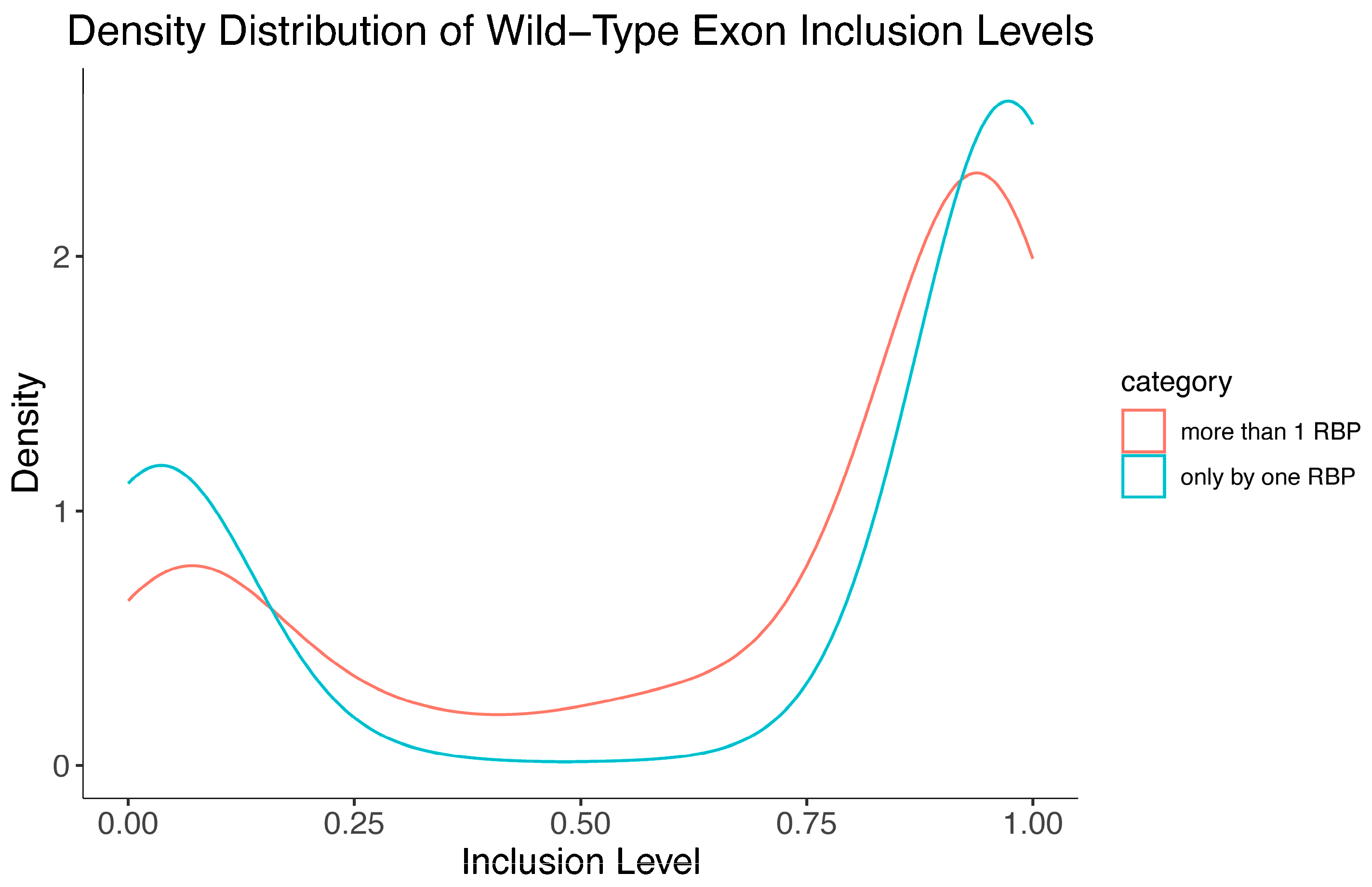
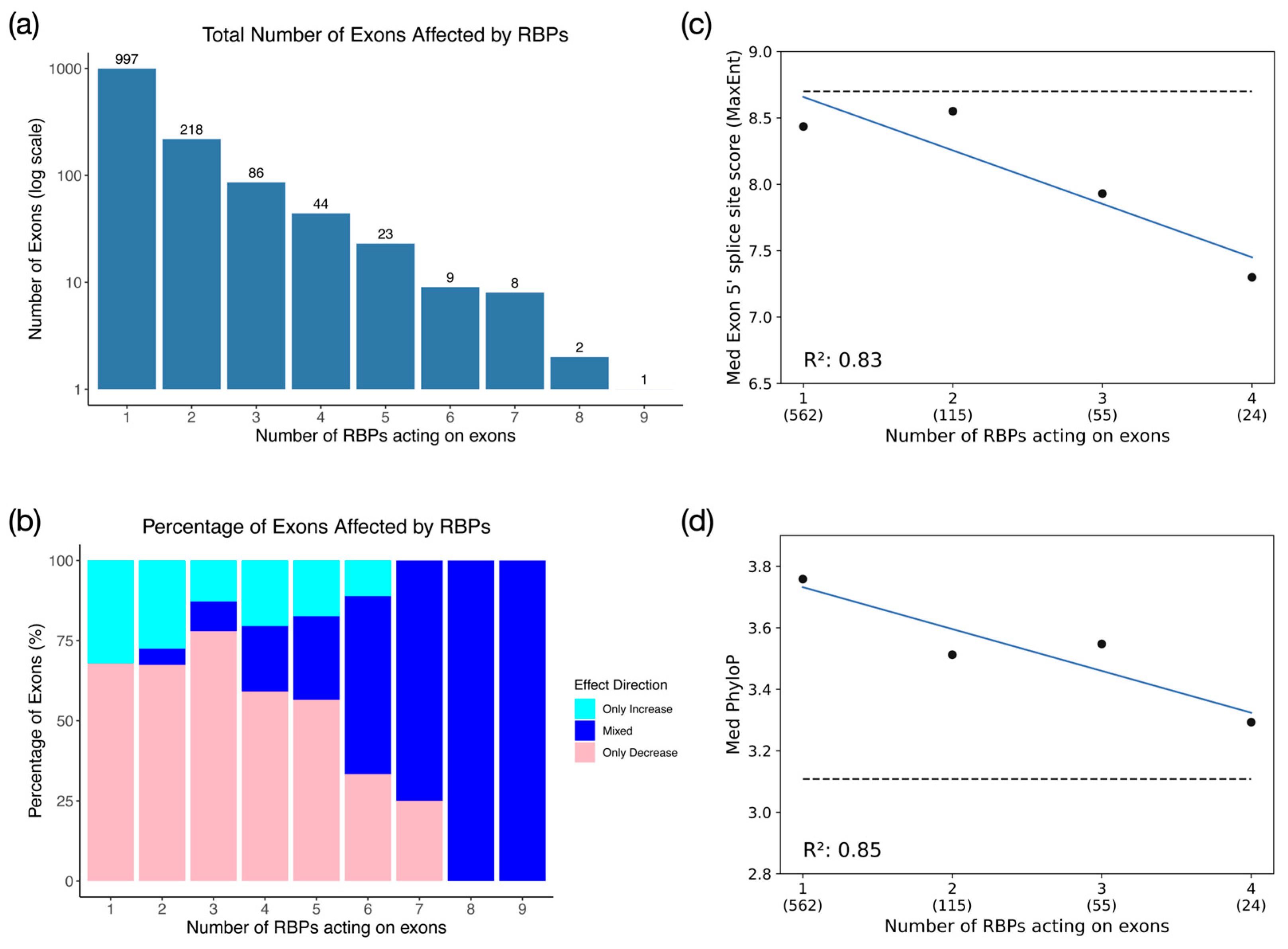
3.4. Independently and Interdependently Regulated Exon Populations Have Different Characteristics
4. Discussion
4.1. Pairs of RBPs, Family of RBPs, and Trends in Interdependent Regulation
4.2. Direct Versus Indirect Effects Mediating Interdependent Splicing Regulation
4.3. Features of Interdependently Regulated Exons
4.4. Cell Type Specificity
Supplementary Materials
Author Contributions
Funding
Institutional Review Board Statement
Informed Consent Statement
Data Availability Statement
Acknowledgments
Conflicts of Interest
Abbreviations
| RBP | RNA Binding Protein |
| AS | Alternative Splicing |
| ES | Exon Skipping |
| SR | serine/arginine-rich |
| hnRNP | heterogeneous nuclear ribonucleoprotein |
| HeLa Cells | Henrietta Lacks cell line |
| HepG2 Cells | Hepatocellular carcinoma cell line |
| K562 Cells | Erythroleukemia cell line |
| ENCODE | Encyclopedia of DNA Elements |
| qRT-PCR | Quantitative Reverse Transcription Polymerase Chain Reaction |
References
- House, A.E.; Lynch, K.W. Regulation of Alternative Splicing: More than Just the ABCs. J. Biol. Chem. 2008, 283, 1217–1221. [Google Scholar] [CrossRef] [Scilit] [PubMed]
- Maniatis, T.; Tasic, B. Alternative Pre-mRNA Splicing and Proteome Expansion in Metazoans. Nature 2002, 418, 236–243. [Google Scholar] [CrossRef] [Scilit]
- Woodley, L.; Valcárcel, J. Regulation of Alternative Pre-mRNA Splicing. Brief. Funct. Genom. 2002, 1, 266–277. [Google Scholar] [CrossRef] [Scilit]
- Wagner, S.D.; Berglund, J.A. Alternative Pre-mRNA Splicing; Methods in Molecular Biology; Springer: Berlin/Heidelberg, Germany, 2014; Volume 1126, pp. 45–54. [Google Scholar] [CrossRef] [Scilit]
- Kim, N.; Lee, C. Bioinformatics Detection of Alternative Splicing; Methods in Molecular Biology; Springer: Berlin/Heidelberg, Germany, 2008; Volume 452, pp. 179–197. [Google Scholar] [CrossRef] [Scilit]
- Nilsen, T.W.; Graveley, B.R. Expansion of the Eukaryotic Proteome by Alternative Splicing. Nature 2010, 463, 457–463. [Google Scholar] [CrossRef] [Scilit]
- Manuel, J.M.; Guilloy, N.; Khatir, I.; Roucou, X.; Laurent, B. Re-Evaluating the Impact of Alternative RNA Splicing on Proteomic Diversity. Front. Genet. 2023, 14, 1089053. [Google Scholar] [CrossRef] [Scilit]
- Pan, Q.; Shai, O.; Lee, L.J.; Frey, B.J.; Blencowe, B.J. Deep Surveying of Alternative Splicing Complexity in the Human Transcriptome by High-Throughput Sequencing. Nat. Genet. 2008, 40, 1413–1415. [Google Scholar] [CrossRef] [Scilit]
- Wang, Z.; Burge, C.B. Splicing Regulation: From a Parts List of Regulatory Elements to an Integrated Splicing Code. RNA 2008, 14, 802–813. [Google Scholar] [CrossRef] [Scilit]
- Johnson, J.M.; Castle, J.; Garrett-Engele, P.; Kan, Z.; Loerch, P.M.; Armour, C.D.; Santos, R.; Schadt, E.E.; Stoughton, R.; Shoemaker, D.D. Genome-Wide Survey of Human Alternative Pre-mRNA Splicing with Exon Junction Microarrays. Science 2003, 302, 2141–2144. [Google Scholar] [CrossRef] [Scilit]
- Shenasa, H.; Hertel, K.J. Combinatorial Regulation of Alternative Splicing. Biochim. Et Biophys. Acta-Gene Regul. Mech. 2019, 1862, 194392. [Google Scholar] [CrossRef] [Scilit] [PubMed]
- Douglas, A.G.L.; Wood, M.J.A. RNA Splicing: Disease and Therapy. Brief. Funct. Genom. 2011, 10, 151–164. [Google Scholar] [CrossRef] [Scilit] [PubMed]
- Tao, Y.; Zhang, Q.; Wang, H.; Yang, X.; Mu, H. Alternative Splicing and Related RNA Binding Proteins in Human Health and Disease. Signal Transduct. Target. Ther. 2024, 9, 26. [Google Scholar] [CrossRef] [Scilit]
- Rogalska, M.E.; Mancini, E.; Bonnal, S.; Gohr, A.; Dunyak, B.M.; Arecco, N.; Smith, P.G.; Vaillancourt, F.H.; Valcárcel, J. Transcriptome-Wide Splicing Network Reveals Specialized Regulatory Functions of the Core Spliceosome. Science 2024, 386, 551–560. [Google Scholar] [CrossRef] [Scilit]
- Van Nostrand, E.L.; Freese, P.; Pratt, G.A.; Wang, X.; Wei, X.; Xiao, R.; Blue, S.M.; Chen, J.Y.; Cody, N.A.L.; Dominguez, D.; et al. A Large-Scale Binding and Functional Map of Human RNA-Binding Proteins. Nature 2020, 583, 711–719. [Google Scholar] [CrossRef] [Scilit]
- Kolde, R. Pheatmap 1.0.13. GitHub. 2025. Available online: https://github.com/raivokolde/pheatmap (accessed on 10 July 2025).
- Eng, L.; Coutinho, G.; Nahas, S.; Yeo, G.; Tanouye, R.; Babaei, M.; Dörk, T.; Burge, C.; Gatti, R.A. Nonclassical Splicing Mutations in the Coding and Noncoding Regions of the ATM Gene: Maximum Entropy Estimates of Splice Junction Strengths. Hum. Mutat. 2004, 23, 67–76. [Google Scholar] [CrossRef] [Scilit]
- Yeo, G.; Burge, C.B. Maximum Entropy Modeling of Short Sequence Motifs with Applications to RNA Splicing Signals. In Proceedings of the Seventh Annual International Conference on Research in Computational Molecular Biology, Berlin, Germany, 10 April 2003; pp. 322–331. [Google Scholar]
- Zhou, Z.; Fu, X.D. Regulation of Splicing by SR Proteins and SR Protein-Specific Kinases. Chromosoma 2013, 122, 191–207. [Google Scholar] [CrossRef] [Scilit] [PubMed]
- Black, D.L. Mechanisms of Alternative Pre-Messenger RNA Splicing. Annu. Rev. Biochem. 2003, 72, 291–336. [Google Scholar] [CrossRef] [Scilit]
- Adams, M.D.; Rudner, D.Z.; Rio, D.C. Biochemistry and Regulation of Pre-mRNA Splicing. Curr. Opin. Cell Biol. 1996, 8, 331–339. [Google Scholar] [CrossRef] [Scilit] [PubMed]
- Graveley, B.R.; Maniatis, T. Arginine/Serine-Rich Domains of SR Proteins Can Function as Activators of Pre-mRNA Splicing. Mol. Cell 1998, 1, 765–771. [Google Scholar] [CrossRef] [Scilit]
- Graveley, B.R. Sorting out the Complexity of SR Protein Functions. RNA 2000, 6, 1197–1211. [Google Scholar] [CrossRef] [Scilit] [PubMed]
- Tange, T.; Damgaard, C.K.; Guth, S.; Valcárcel, J.; Kjems, J. The hnRNP A1 Protein Regulates HIV-1 Tat Splicing via a Novel Intron Silencer Element. EMBO J. 2001, 20, 5748–5758. [Google Scholar] [CrossRef] [Scilit]
- Zahler, A.M.; Damgaard, C.K.; Kjems, J.; Caputi, M. SC35 and Heterogeneous Nuclear Ribonucleoprotein A/B Proteins Bind to a Juxtaposed Exonic Splicing Enhancer/Exonic Splicing Silencer Element to Regulate HIV-1 Tat Exon 2 Splicing. J. Biol. Chem. 2004, 279, 10077–10084. [Google Scholar] [CrossRef] [Scilit]
- Graveley, B.R.; Hertel, K.J.; Maniatis, T. SR Proteins Are “locators” of the RNA Splicing Machinery. Curr. Biol. 1999, 9, R6-7. [Google Scholar] [CrossRef] [Scilit]
- Krecic, A.M.; Swanson, M.S. hnRNP Complexes: Composition, Structure, and Function. Curr. Opin. Cell Biol. 1999, 11, 363–371. [Google Scholar] [CrossRef] [Scilit]
- Ule, J.; Stefani, G.; Mele, A.; Ruggiu, M.; Wang, X.; Taneri, B.; Gaasterland, T.; Blencowe, B.J.; Darnell, R.B. An RNA Map Predicting Nova-Dependent Splicing Regulation. Nature 2006, 444, 580–586. [Google Scholar] [CrossRef] [Scilit] [PubMed]
- Carranza, F.; Shenasa, H.; Hertel, K.J. Splice Site Proximity Influences Alternative Exon Definition. RNA Biol. 2022, 19, 829–840. [Google Scholar] [CrossRef] [Scilit] [PubMed]
- Erkelenz, S.; Mueller, W.F.; Evans, M.S.; Busch, A.; Schöneweis, K.; Hertel, K.J.; Schaal, H. Position-Dependent Splicing Activation and Repression by SR and hnRNP Proteins Rely on Common Mechanisms. RNA 2013, 19, 96–102. [Google Scholar] [CrossRef] [Scilit]
- Shepard, P.J.; Choi, E.A.; Busch, A.; Hertel, K.J. Efficient internal exon recognition depends on near equal contributions from the 3′ and 5′ splice sites. Nucleic Acids Res. 2011, 39, 8928–8937. [Google Scholar] [CrossRef] [Scilit]
- Müller-McNicoll, M.; Rossbach, O.; Hui, J.; Medenbach, J. Auto-Regulatory Feedback by RNA-Binding Proteins. J. Mol. Cell Biol. 2019, 11, 930–939. [Google Scholar] [CrossRef] [Scilit] [PubMed]


Disclaimer/Publisher’s Note: The statements, opinions and data contained in all publications are solely those of the individual author(s) and contributor(s) and not of MDPI and/or the editor(s). MDPI and/or the editor(s) disclaim responsibility for any injury to people or property resulting from any ideas, methods, instructions or products referred to in the content. |
© 2026 by the authors. Licensee MDPI, Basel, Switzerland. This article is an open access article distributed under the terms and conditions of the Creative Commons Attribution (CC BY) license.
Share and Cite
Holmes, M.E.; Hertel, K.J. Interdependent Regulation of Alternative Splicing by Serine/Arginine-Rich and Heterogeneous Nuclear Ribonucleoprotein Splicing Factors. Genes 2026, 17, 78. https://doi.org/10.3390/genes17010078
Holmes ME, Hertel KJ. Interdependent Regulation of Alternative Splicing by Serine/Arginine-Rich and Heterogeneous Nuclear Ribonucleoprotein Splicing Factors. Genes. 2026; 17(1):78. https://doi.org/10.3390/genes17010078
Chicago/Turabian StyleHolmes, Megan E., and Klemens J. Hertel. 2026. "Interdependent Regulation of Alternative Splicing by Serine/Arginine-Rich and Heterogeneous Nuclear Ribonucleoprotein Splicing Factors" Genes 17, no. 1: 78. https://doi.org/10.3390/genes17010078
APA StyleHolmes, M. E., & Hertel, K. J. (2026). Interdependent Regulation of Alternative Splicing by Serine/Arginine-Rich and Heterogeneous Nuclear Ribonucleoprotein Splicing Factors. Genes, 17(1), 78. https://doi.org/10.3390/genes17010078