

Perspective

Genetically Transitional Disease and the Road to Personalized Medicine

by
Qingping Yao
1,*,
Peter D. Gorevic
1 and
Greg Gibson
2
1
Division of Rheumatology, Allergy, and Immunology, Stony Brook University Renaissance School of Medicine, Stony Brook, NY 11794, USA
2
Center for Integrative Genomics, School of Biology, Georgia Institute of Technology, Atlanta, GA 30332, USA
*
Author to whom correspondence should be addressed.
Genes 2025, 16(4), 401; https://doi.org/10.3390/genes16040401
Submission received: 1 March 2025 / Revised: 22 March 2025 / Accepted: 28 March 2025 / Published: 30 March 2025

Abstract

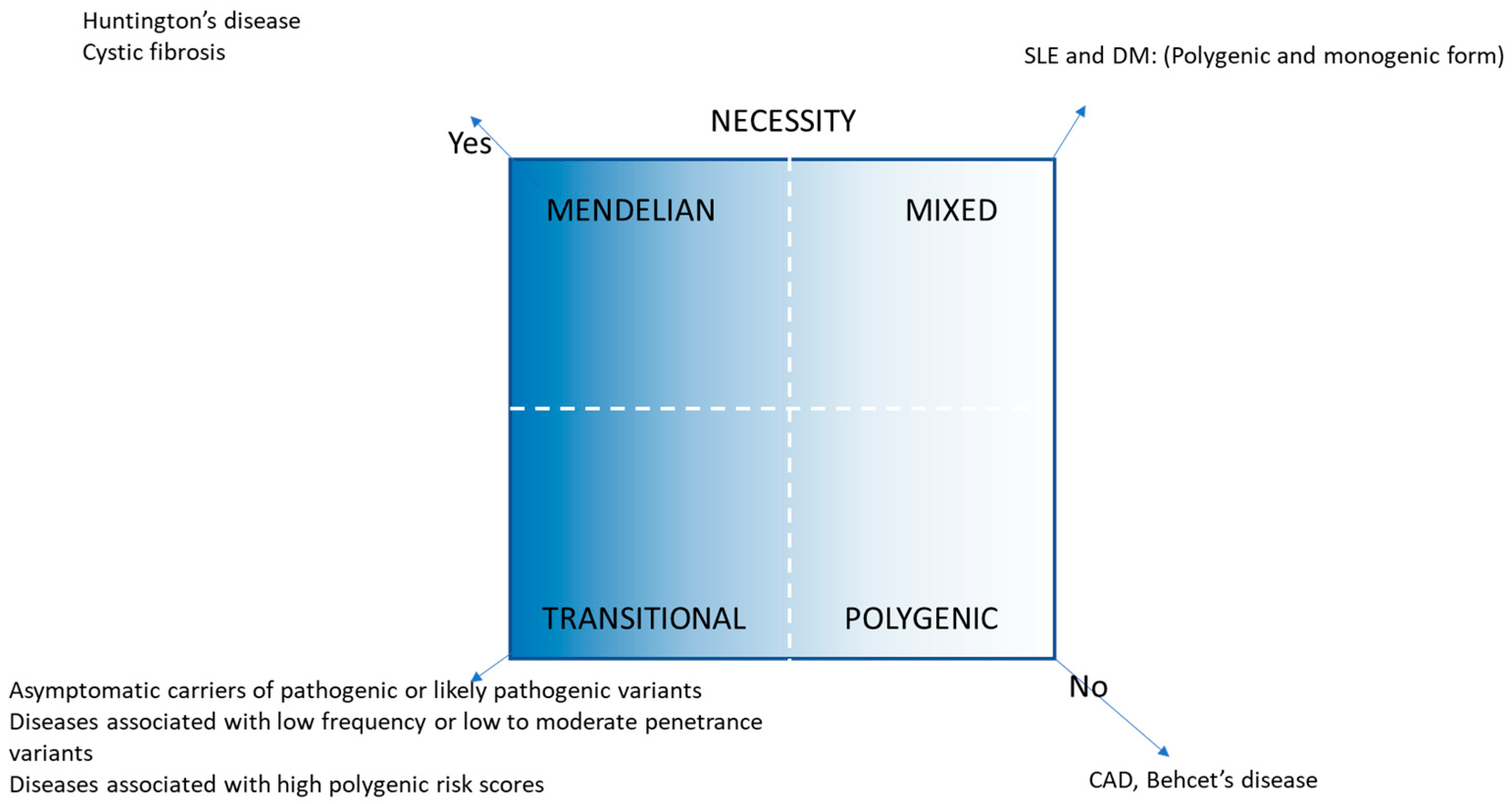
Genetically transitional disease (GTD) is emerging as a new concept in genomic medicine to straddle between the traditional binary classification of monogenic and polygenic disease. Genetic testing result reports in molecular laboratories have been predicated on the monogenic disease model, which focuses on pathogenic and likely pathogenic variants. While variants of uncertain significance (VUS) are reported by laboratories, there are challenges with regard to their clinical application so that these variants are often dismissed by ordering physicians. Unlike Mendelian disorders, where genetic variants are of high penetrance and highly probabilistic, the GTD concept is employed to highlight the impact of low-to-moderate effect gene variants whose influence on disease is modified by the genetic background. The GTD concept may explain health conditions associated with variants that are necessary but not sufficient for pathogenesis, lying in the mid gray zone between Mendelian and polygenic diseases. Although VUSs may not reach the level of pathogenicity based on American College of Medical Genetics and Genomics guidelines, they could be provisionally classified as GTD-associated variants to annotate and interpret the relationship between VUS and human genetic disease. The appropriate implementation of the GTD concept could impact patient care and research by focusing attention on the individual variability of responses in various diseases.
Keywords: autism; cardiomyopathy; autoimmune; genetics; monogenic; precision medicine; genetically transitional disease; variant; VUS autism; cardiomyopathy; autoimmune; genetics; monogenic; precision medicine; genetically transitional disease; variant; VUS


