Revealing Ancient Wheat Phylogenetic Diversity: Machine Learning and Logistic Regression Identify Triticum sphaerococcum in Bronze Age Iberia

 ,
,  , ,
, ,  ,
,  ,
,  ,
, 

Abstract
1. Introduction
1.1. Research Context and Significance
1.2. Archeological and Botanical Background
1.3. Challenges in Prehistoric Grain Identification
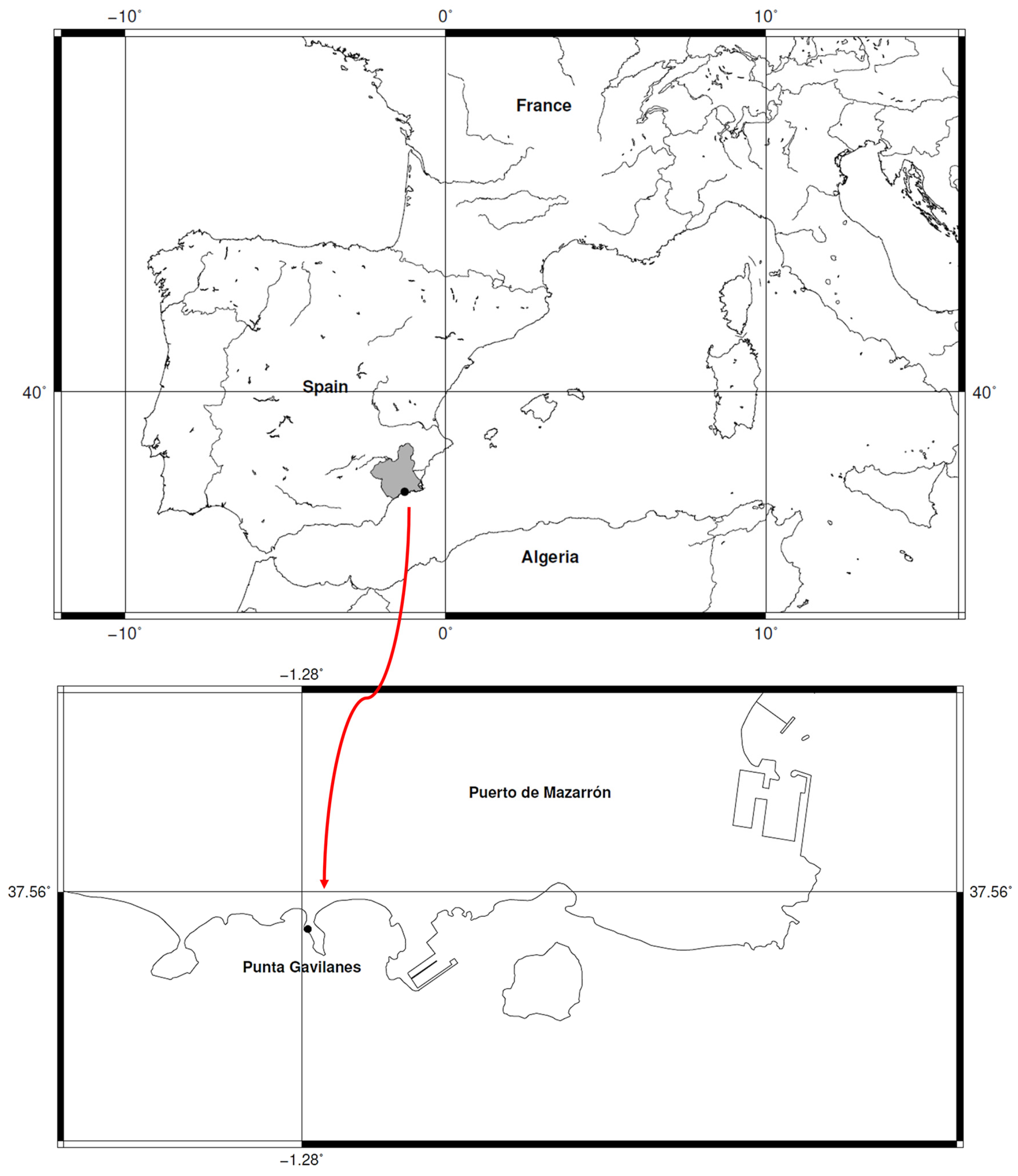
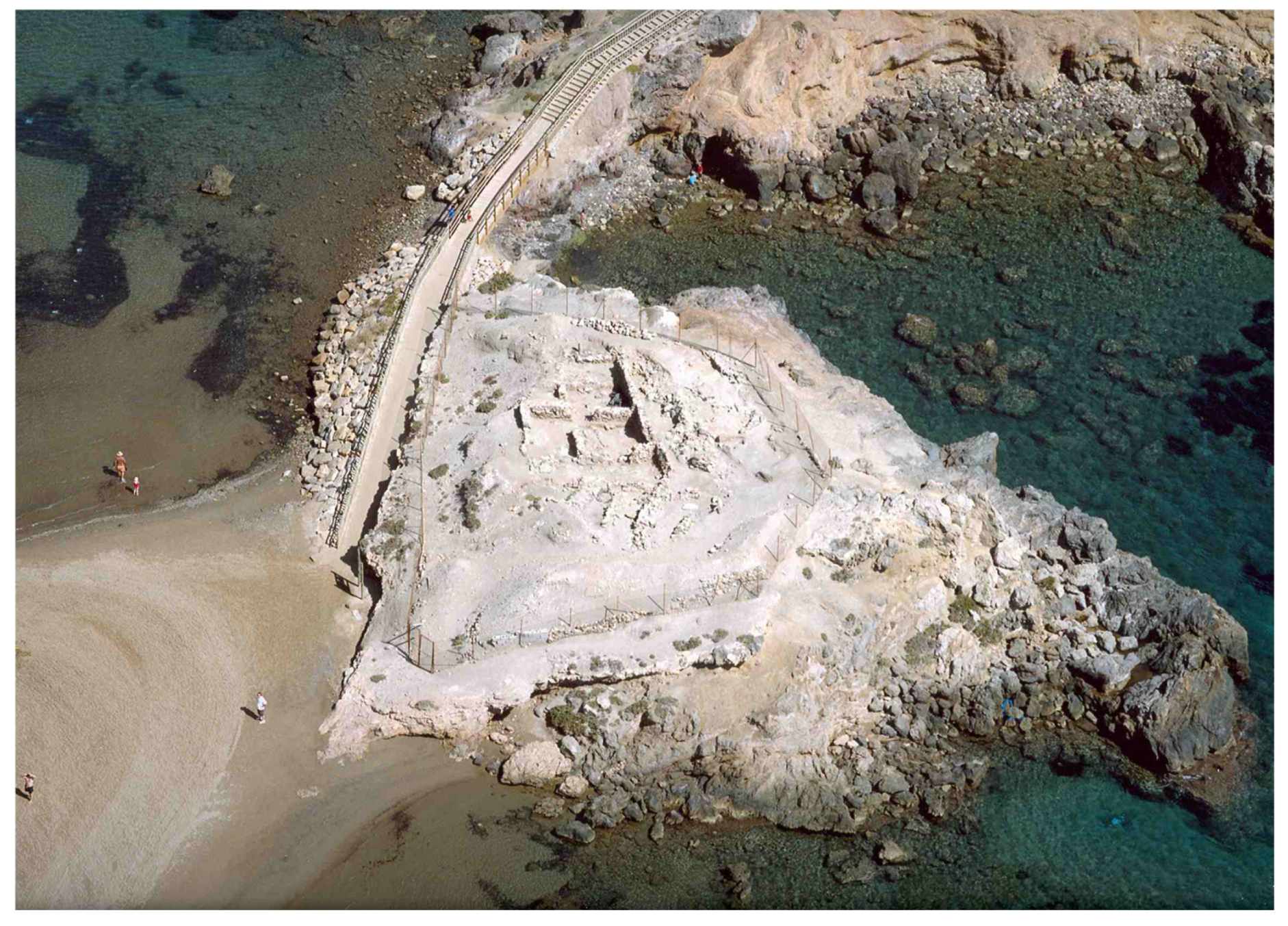
1.4. The Gavilanes Site
2. Materials and Methods
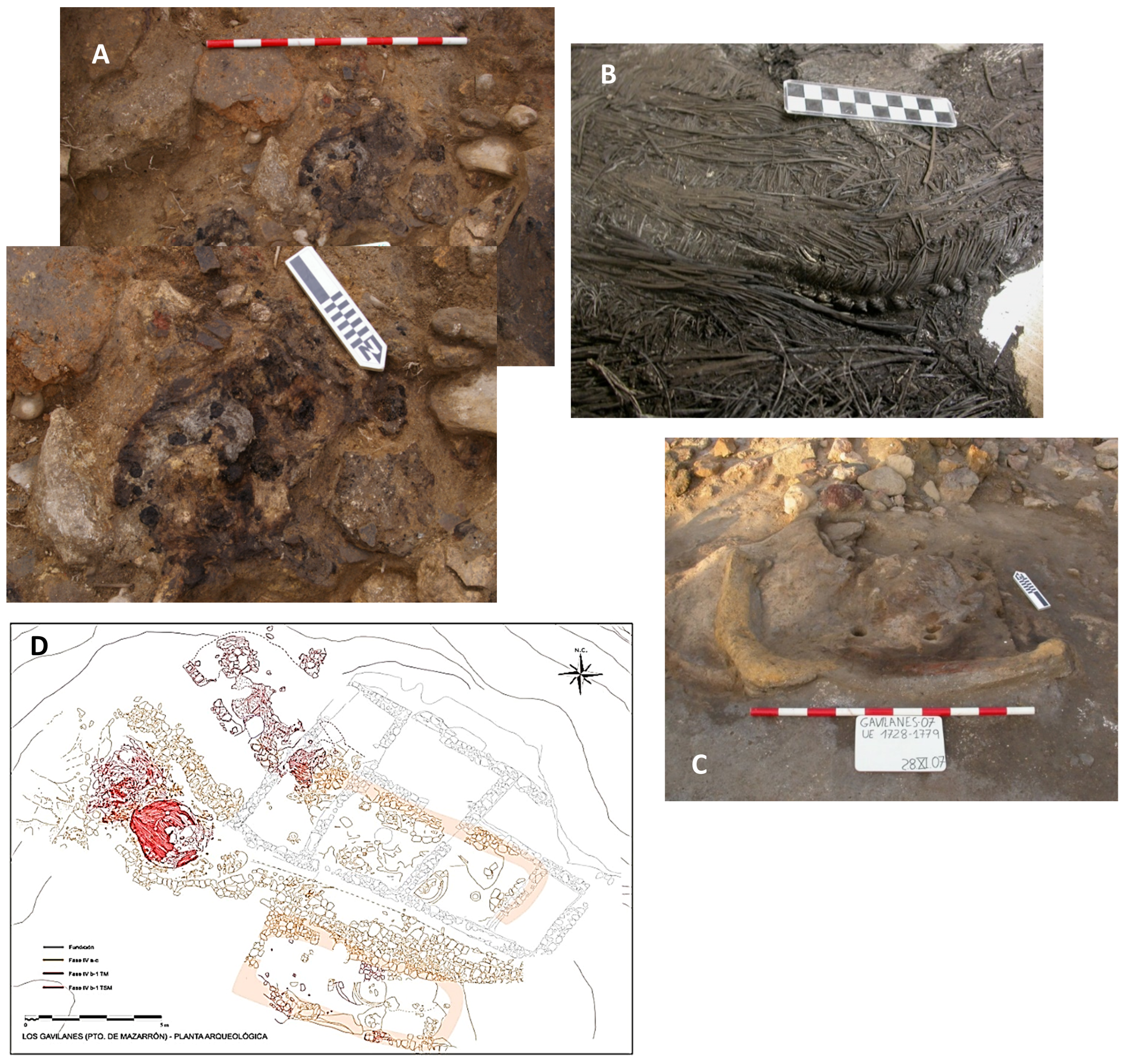
2.1. Sample Collection and Identification and Datation Techniques for Punta de los Gavilanes

| Taxa | NT | Type | Provenance | MV | RF | LO |
|---|---|---|---|---|---|---|
| Desiccated modern caryopses | ||||||
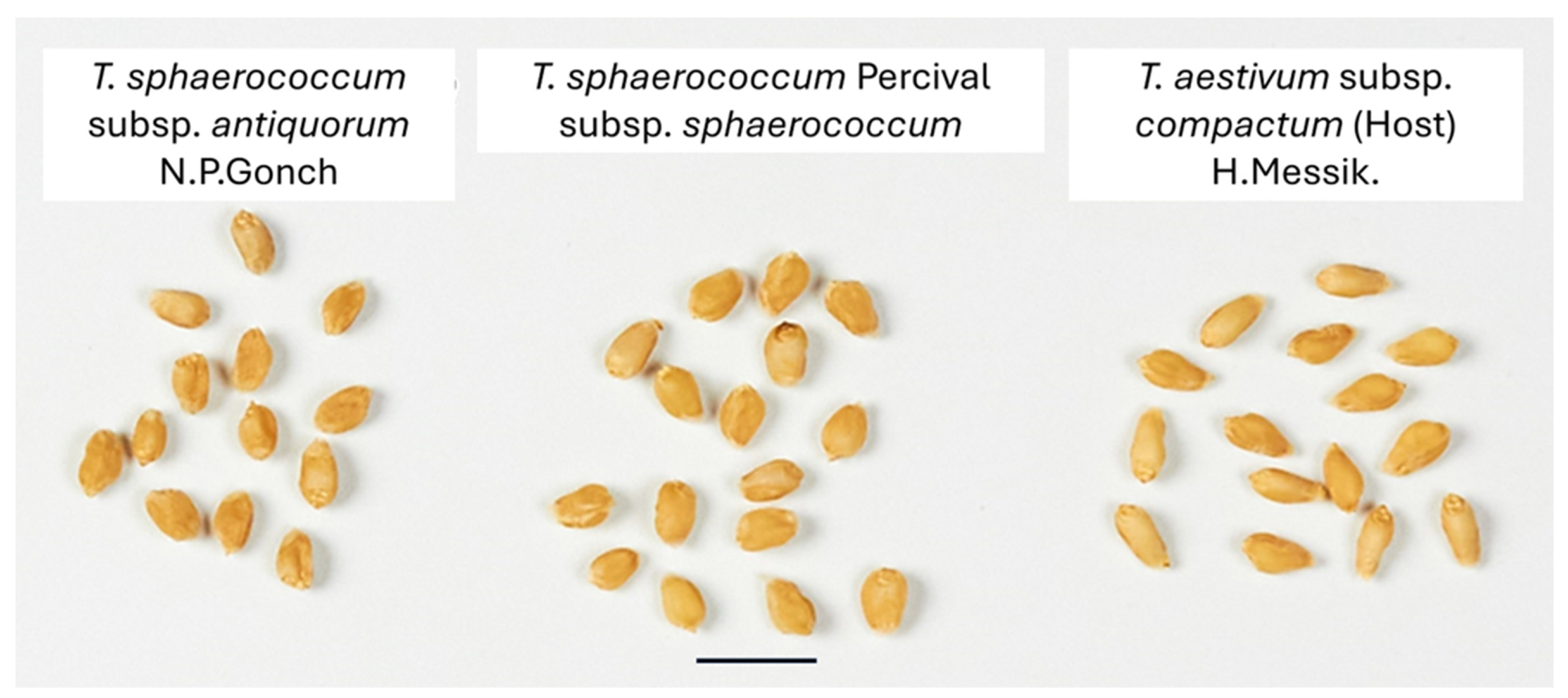
| Triticum aestivum L. subsp. aestivum, T. aestivum subsp. compactum (Host) H.Messik., T. aestivum subsp. macha (Dekapr. and Menabde) McKey, T. aestivum subsp. spelta (L.) Thell., T. monococcum L. subsp. monococcum, T. monococcum subsp. aegilopoides (Link) Thell., T. sphaerococcum Percival subsp. sphaerococcum (*), T. sphaerococcum subsp. antiquorum N.P.Gonch., T. turgidum L. subsp. turgidum, T. turgidum subsp. carthlicum (Nevski) Á.Löve and D.Löve, T. turgidum subsp. dicoccoides (Asch. and Graebn.) Thell., T. turgidum subsp. dicoccum (Schrank ex Schübl.) Thell., T. turgidum subsp. durum (Desf.) Husn., T. turgidum subsp. georgicum (Dekapr. & Menabde) Mac Key ex Hanelt, T. turgidum subsp. polonicum (L.) Thell., T. turgidum subsp. turanicum (Jakubz.) Á.Löve & D.Löve | 848 | TS | Tellez and Ciferri [68] and Institute of Cytology and Genetics, Siberian Branch of Russian Academy of Sciences, Novosibirsk | 0 | 848 | 848 |
| Carbonized modern caryopses | ||||||
| T. aestivum L. subsp. aestivum, T. aestivum subsp. compactum (Host) H.Messik., T. aestivum subsp. spelta (L.) Thell., T. monococcum L. subsp. monococcum, T. sphaerococcum Percival subsp. sphaerococcum, T. turgidum L. subsp. turgidum, T. turgidum subsp. dicoccum (Schrank ex Schübl.) Thell. | 340 | TS | Tellez and Ciferri [68] | 0 | 340 | 340 |
| Archaeobotanical types | ||||||
| T. aestivum var. antiquorum (Heer) H.Messik. | 38 | TS | Flaksberger [48] and Heer [25,26] | 3 | 38 | 38 |
| T. turgidum subsp. parvicoccum Kislev (Type) | 3 | TS | Tell Batash [41] | 3 | 3 | 3 |
| T. turgidum subsp. parvicoccum Kislev | 15 | TS | Deir Alla, Tell Keisan [21,37,59,63] | 2 | 15 | 15 |
| Archeological caryopses from Punta de Gavilanes | ||||||
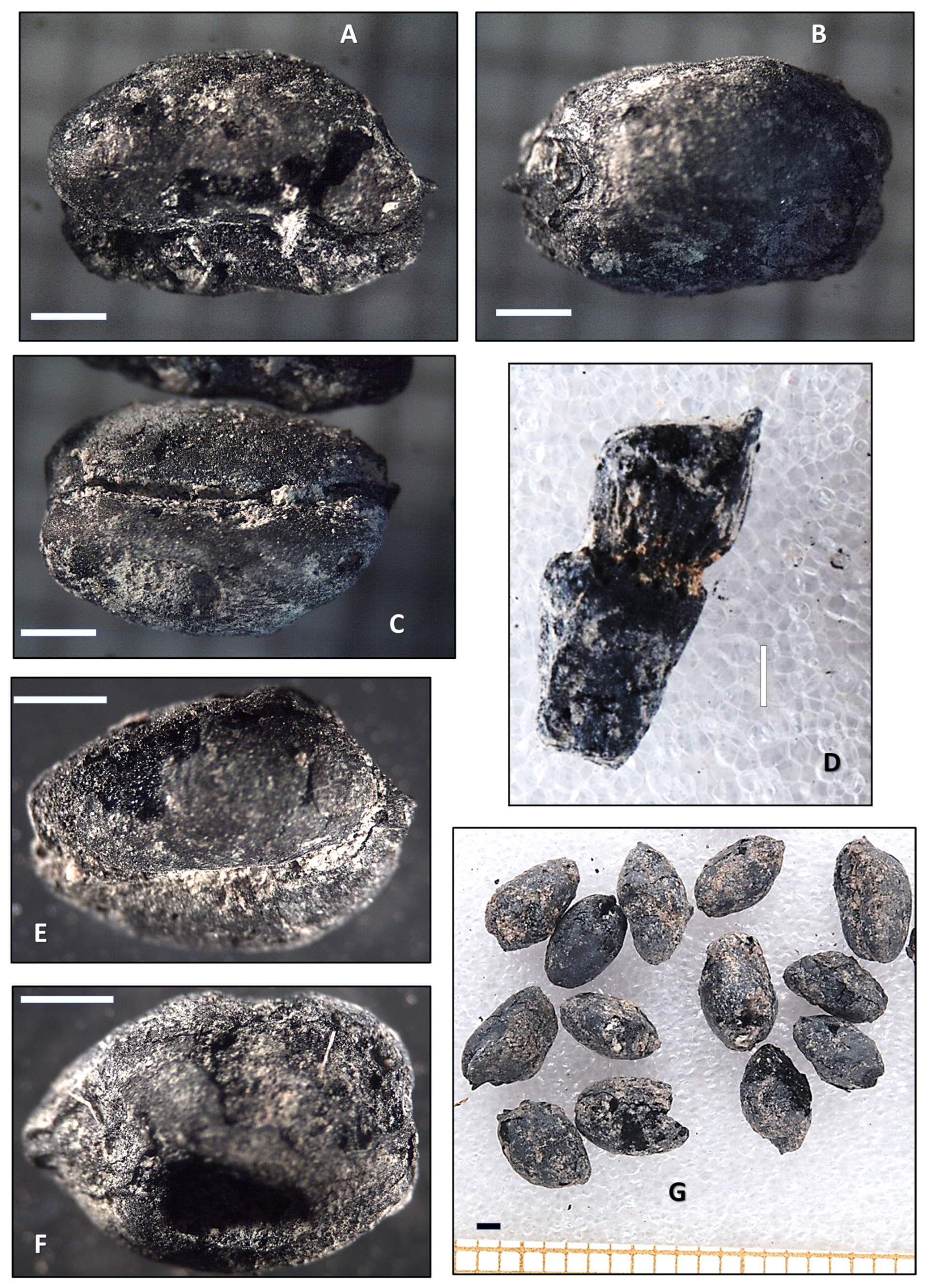
| 48 | OT | Punta de los Gavilanes | 48 | 48 | 48 | |
| Archeological caryopses from Almizaraque | ||||||
| 517 | OT | Tellez and Ciferri [68] | 0 | 517 | 517 | |
| Other archeological caryopses | ||||||
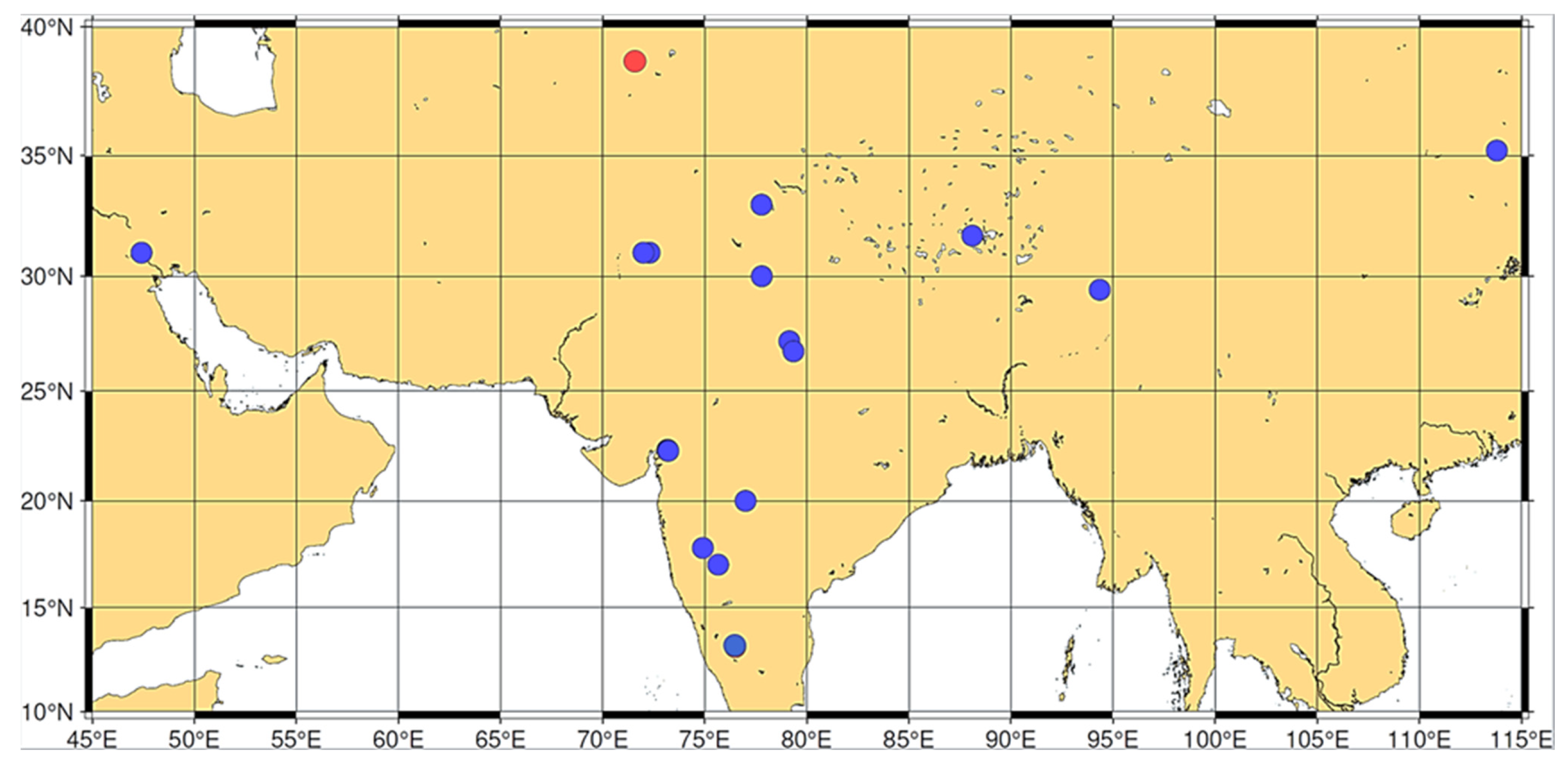
| 2463 | OT | [25,26,37,48,68,69,70,71,72,73,74,75,76,77,78,79,80,81] | 31 | 0 | 0 |
2.2. Weat Caryopses Used in the Analyses
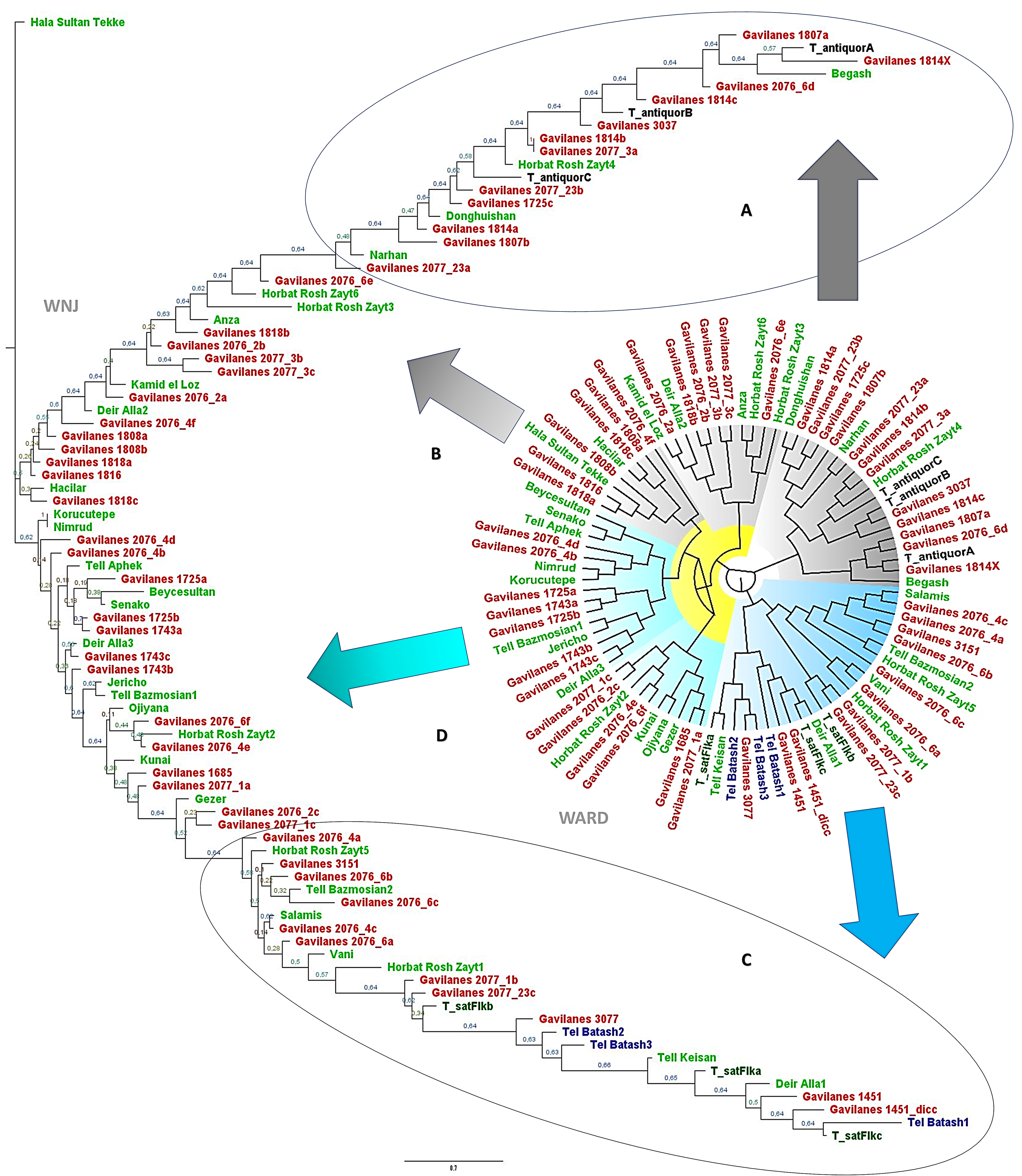
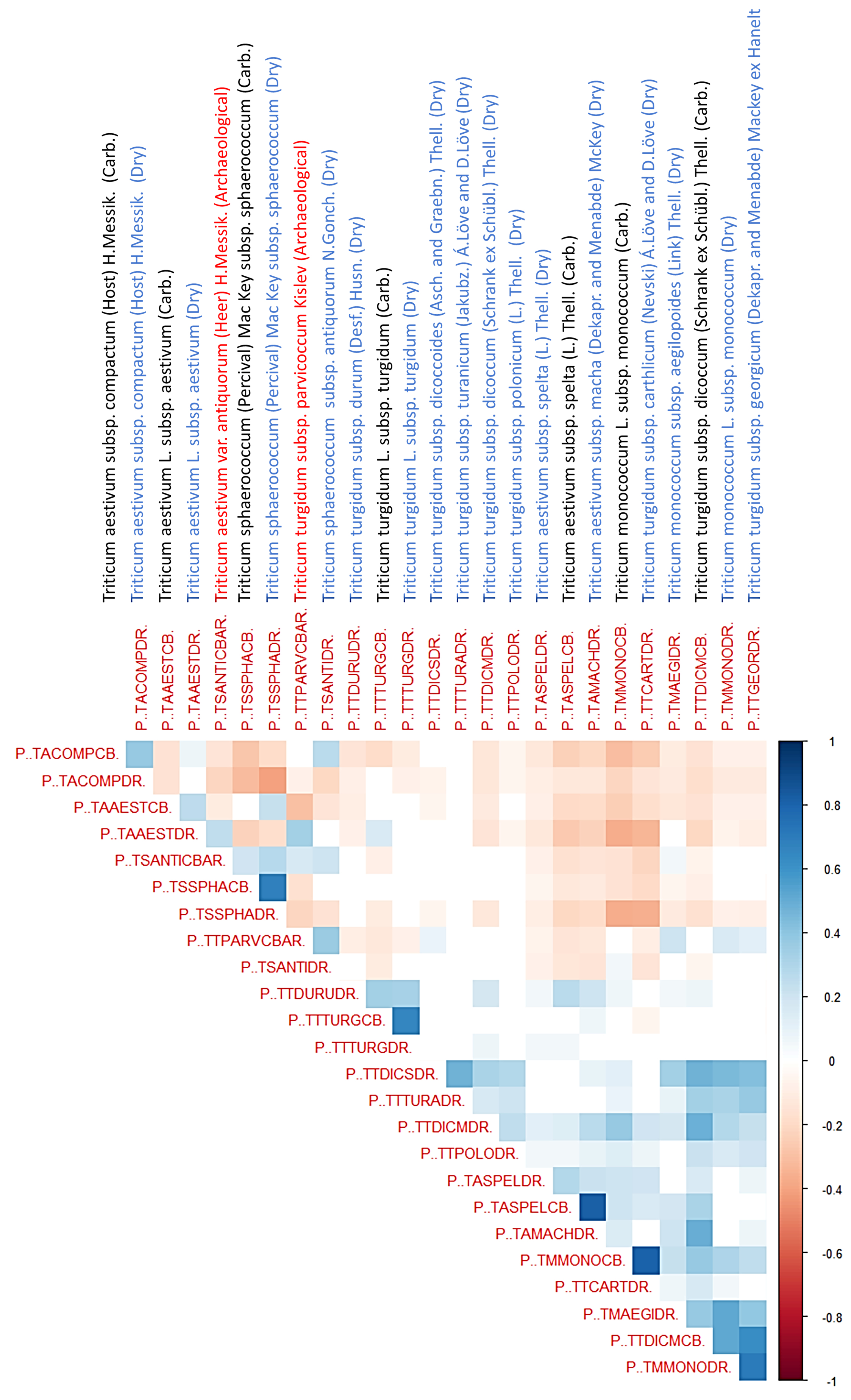
2.3. Multivariate Cluster Analysis
2.4. Machine Learning Methodology
- •
- Modern dry: Unaltered samples from the reference collection, attributed to different Triticum taxa.
- •
- Modern carbonized: Experimentally carbonized samples, initially dry, attributed to different Triticum taxa in the reference collection.
- •
- Archaeobotanical taxa: Includes T. turgidum subsp. parvicoccum and T. aestivum var. antiquorum.
3. Results
3.1. Taxonomic Classification Outcomes
3.2. Probabilistic Allocation Análisis
3.3. Comparative Assessment of Classification Techniques
4. Discussion
4.1. Interpretation of Taxonomic Results
4.1.1. What Represents the Presence of Sphaerococcum-Type Wheats in These Iberian Archeological Contexts?
4.1.2. What and Where Are T. parvicoccum and T. antiquorum?
4.1.3. The Significance of Small-Grained Free-Threshing Wheat at Punta de los Gavilanes
4.1.4. T. parvicoccum and T. antiquorum in the Iberian Peninsula
4.2. Implications for Current Wheat Conservation, Breeding Programs
4.3. Limitations
5. Conclusions
Supplementary Materials
Author Contributions
Funding
Institutional Review Board Statement
Informed Consent Statement
Data Availability Statement
Conflicts of Interest
Abbreviations
| B | Grain breadth |
| D | Grain depth |
| L | Grain length |
| LOG | Logit method for logistic regression |
| RF | Random Forest, a machine learning tool |
References
- Pearsall, D.M. Paleoethnobotany: A Handbook of Procedures, 3rd ed.; Routledge: New York, NY, USA, 2015. [Google Scholar]
- Fuller, D.Q.; Denham, T.; Arroyo-Kalin, M.; Lucas, L.; Stevens, C.J.; Qin, L.; Allaby, R.G.; Purugganan, M.D. Convergent evolution and parallelism in plant domestication revealed by an expanding archaeological record. Proc. Natl. Acad. Sci. USA 2014, 111, 6147–6152. [Google Scholar] [CrossRef] [PubMed]
- Zohary, D.; Hopf, M.; Weiss, E. Domestication of Plants in the Old World: The Origin and Spread of Domesticated Plants in Southwest Asia, Europe, and the Mediterranean Basin, 4th ed.; Oxford University Press: Oxford, UK, 2012. [Google Scholar]
- Purugganan, M.D.; Fuller, D.Q. The nature of selection during plant domestication. Nature 2009, 457, 843–848. [Google Scholar] [CrossRef] [PubMed]
- Boivin, N.; Crowther, A.; Prendergast, M.; Fuller, D.Q. Indian Ocean food globalization and Africa. Afr. Archaeol. Rev. 2014, 31, 547–581. [Google Scholar] [CrossRef]
- Mercuri, A.M.; Bandini Mazzanti, M.; Florenzano, A.; Montecchi, M.C.; Rattighieri, E. Plants and People in the African Past: Progress in African Archaeobotany; Springer: Cham, Switzerland, 2018. [Google Scholar]
- Van der Veen, M. Formation processes of desiccated and carbonized plant remains—The identification of routine practice. J. Archaeol. Sci. 2007, 34, 968–990. [Google Scholar] [CrossRef]
- Terral, J.-F.; Newton, C.; Ivorra, S.; Gros-Balthazard, M.; de Morais, C.T.; Picq, S.; Tengberg, M.; Pintaud, J.-C. Insights into the historical biogeography of the date palm (Phoenix dactylifera L.) using geometric morphometry of modern and ancient seeds. J. Biogeogr. 2012, 39, 929–941. [Google Scholar] [CrossRef]
- Cappers, R.T.J.; Bekker, R.M. A Manual for the Identification of Plant Seeds and Fruits; Barkhuis: Groningen, The Netherlands, 2013. [Google Scholar]
- Shillito, L.-M. Grains of truth or transparent blindfolds? A review of current debates in archaeological phytolith analysis. Veget. Hist. Archaeobot. 2013, 22, 71–82. [Google Scholar] [CrossRef]
- Rijksuniversiteit Groningen. Digital Seed Atlas of the Netherlands; Barkhuis: Groningen, The Netherlands, 2025. [Google Scholar]
- Rijksuniversiteit Groningen. The Digital Plant Atlas. Available online: https://www.plantatlas.eu/ (accessed on 25 September 2025).
- Rovira, N.; Chabal, L. The application of 3D geometric morphometrics and machine learning in seed shape analysis: A case study of Vitis vinifera L. Archaeol. Anthropol. Sci. 2023, 15, 12. [Google Scholar]
- Larson, G.; Piperno, D.R.; Allaby, R.G.; Purugganan, M.D.; Andersson, L.; Arroyo-Kalin, M.; Barton, L.; Climer Vigueira, C.; Denham, T.; Dobney, K.; et al. Current perspectives and the future of domestication studies. Proc. Natl. Acad. Sci. USA 2014, 111, 6139–6146. [Google Scholar] [CrossRef]
- Hastorf, C.A. The Social Archaeology of Food: Thinking about Eating from Prehistory to the Present; Cambridge University Press: Cambridge, UK, 2016. [Google Scholar]
- Kunth, C. Examen Botanique des Fruits et des Plantes de la collection égyptienne. In Catalogue Raisonné et Historique des Antiquités Découvertes en Égypte; Passalacqua, J., Ed.; La Galerie D’Antiquités Égyptiennes: Paris, France, 1826; pp. 227–229. [Google Scholar]
- Kunth, C. Examen Botanique des Fruits et des Plantes de la collection égyptienne. Ann. Sci. Nat. 1826, 8, 418–423. [Google Scholar]
- Renfrew, J. Palaeoethnobotany, The Prehistoric Food Plants of the Near East and Europe; Methuen & Co.: London, UK, 1973. [Google Scholar]
- Schultze-Motel, J.; Hammer, K. Literature on archaeological remains of cultivated plants (1826–1964). Genet. Resour. Crop Evol. 2021, 68, 101–104. [Google Scholar] [CrossRef]
- IFPNI-International-Editorial-Board. The International Fossil Plant Names Index, Triticum Parvicoccum. 2025. Available online: https://www.ifpni.org/species.htm?id=3FD01169-F7AA-641B-DF08-9285E1621611 (accessed on 15 January 2025).
- Schultze-Motel, J. Triticum parvicoccum Kislev in Transcaucasia. Genet. Resour. Crop Evol. 2019, 66, 1363–1366. [Google Scholar] [CrossRef]
- ArchbotLit. Literature Database ArchbotLit. The New Search Engine for Literature on Archaeological Remains of Cultivated Plants. 2025. Available online: https://www.wikis.uni-kiel.de/archbotlit/doku.php/taxalist?s[]=triticum&s[]=parvicoccum (accessed on 20 January 2025).
- Turland, N.J.; Wiersema, J.H.; Barrie, F.R.; Gandhi, K.N.; Gravendyck, J.; Greuter, W.; Hawksworth, D.L.; Herendeen, P.S.; Klopper, R.R.; Knapp, S.; et al. (Eds.) International Code of Nomenclature for Algae, Fungi, and Plants (Madrid Code); Regnum Vegetabile 162; University of Chicago Press: Chicago, IL, USA, 2025. [Google Scholar]
- Rivera, D.; Ferrer-Gallego, P.P.; Obón, C.; Alcaraz, F.; Valera, J.; Goncharov, N.P.; Laguna, E.; Kislev, M. Fossil or non-fossil? A best-practice guide for archaeobotanical taxa. Taxon 2024, 73, 425–435. [Google Scholar] [CrossRef]
- Heer, O. Die Pflanzen der Pfahlbauten; Druck von Zürcher und Furrer: Zürich, Switzerland, 1865. [Google Scholar]
- Heer, O. Die Pflanzen der Pfahlbauten. Neujbl. Naturf. Ges. Zürich 1866, 68, 1–54. Available online: https://ngzh.ch/wp-content/uploads/2024/09/Neujahrsblatt_NGZH_1866.pdf (accessed on 16 January 2025).
- Morrison, L.A. Triticum L. In Flora of North America, North of Mexico; Barkworth, M.E., Capels, K.M., Long, S., Anderton, L.K., Piep, M.B., Eds.; Oxford University Press: New York, NY, USA, 2007; Volume 24, pp. 268–277. [Google Scholar]
- Goncharov, N.P. Genus Triticum L. taxonomy: The present and the future. Plant Syst. Evol. 2011, 295, 1–11. [Google Scholar] [CrossRef]
- Nesbitt, M. When and where did domesticated cereals first occur in southwest Asia. In The Dawn of Farming in the Near East; Cappers, R.T.J., Bottema, S., Eds.; Ex Oriente: Berlin, Germany, 2002; pp. 113–132. [Google Scholar]
- Bowden, W.M. The taxonomy and nomenclature of the wheats, barleys and ryes and their wild relatives. Canad. J. Bot. 1959, 37, 657–684. [Google Scholar] [CrossRef]
- Mac Key, J. Species relationship in Triticum. Hereditas 1966, 2 (Suppl. S2), 237–276. [Google Scholar]
- Mac Key, J. Wheat: Its Concept, Evolution and Taxonomy. In Durum Wheat Breeding; Royo, C., Ed.; CRC Press: Boca Raton, FL, USA, 2005; Volume 1, pp. 3–61. [Google Scholar]
- Goncharov, N.P. Sravnitelnaya Genetika Pshenits i ikh Sorodichej (Comparative Genetics of Wheats and Their Related Species); Siberian University Press: Novosibirsk, Russia, 2002. (In Russian) [Google Scholar]
- Goncharov, N.P. Opredelitel’ Raznovidnostey Myagkoy i Tverdoy Pshenits; Publishing House of the Siberian Branch of the Russian Academy of Sciences: Novosibirsk, Russia, 2009. (In Russian) [Google Scholar]
- van Slageren, M.W. Wild Wheats: A Monograph of Aegilops L. and Amblyopyrum (Jaub. et Spach) Eig (Poaceae); Wageningen Agricultural University: Wageningen, The Netherlands, 1994. [Google Scholar]
- Morris, R.; Sears, E.R. The cytogenetics of wheat and its relatives. In Wheat and Wheat Improvement; Ouissenberry, K.S., Reitz, L.P., Eds.; American Society of Agronomy: Madison, WI, USA, 1967; pp. 19–87. [Google Scholar]
- Kislev, M.E. Triticum parvicoccum sp. nov., the oldest naked wheat. Isr. J. Bot. 1980, 28, 95–107. [Google Scholar]
- Zohary, D.; Hopf, M. Domestication of Plants in the Old World, 3rd ed.; Oxford University Press: Oxford, UK, 2000. [Google Scholar]
- Jacomet, S. Identification of Cereal Remains from Archaeological Sites, 2nd ed.; IPAS; Basel University: Basel, Switzerland, 2006. [Google Scholar]
- Kislev, M.E.; Melamed, Y.; Langsam, Y. Plant remains from Tel Batash. In Timnah (Tel Batash) III: The Finds from the Second Millennium BCE (Qedem 45); Panitz-Cohen, N., Mazar, A., Eds.; The Hebrew University: Jerusalem, Israel, 2006; pp. 295–311. [Google Scholar]
- Feldman, M.; Kislev, M.E. Domestication of emmer wheat and evolution of free-threshing tetraploid wheat. Isr. J. Plant Sci. 2007, 55, 207–221. [Google Scholar] [CrossRef]
- Sharma, J.; Running, K.; Xu, S.; Zhang, Q.; Haugrud, A.; Sharma, S.; McClean, P.; Faris, J.D. Genetic analysis of threshability and other spike traits in the evolution of cultivated emmer to fully domesticated durum wheat. Mol. Genet. Genom. 2019, 294, 757–771. [Google Scholar] [CrossRef]
- Kislev, M. Reconstructing the ear morphology of ancient small-grain wheat (Triticum turgidum ssp. parvicoccum). In From Foragers to Farmers; Fairbairn, A., Weiss, E., Eds.; Oxbow Books: Oxford, UK, 2009; pp. 235–238. [Google Scholar]
- Rivera, D.; Ferrer-Gallego, P.P.; Obón, C.; Alcaraz, F.; Laguna, E.; Goncharov, N.P.; Kislev, M. Fossil or non-fossil: A case study in the archaeological wheat Triticum parvicoccum (Poaceae: Triticeae). Genes 2025, 16, 274. [Google Scholar] [CrossRef]
- Hopf, M.; Schubart, H. Getreidefunde aus der Coveta de l’Or (prov. Alicante). Madr. Mitteilungen. 1965, 6, 20–38. [Google Scholar] [CrossRef]
- Udachin, R.A. On the possible current existence of Triticum antiquorum Heer. Nauch. Tekhn. Byul. VNII Rastenievod 1982, 119, 72–73. [Google Scholar]
- Udachin, R.A. N.I. Vavilov and studies of wheats from Central Asia. Tr. Prikl. Bot. Genet. Sel. 1991, 140, 47–57, (In Russian with English summary). [Google Scholar]
- Flaksberger, K.A. Triticum compactum antiquorum (Heer). Izv. Gl. Bot. Sada. SSSR 1930, 29, 72–88, (In Russian with German summary). [Google Scholar]
- Rivera, D.; Ferrer-Gallego, P.P.; Obón, C.; Alcaraz, F.; Laguna, E.; Goncharov, N.P. Exploring the Origins of Hexaploid Wheats: Typification of Archaeological Triticum vulgare var. antiquorum and Description of Modern Triticum sphaerococcum subsp. antiquorum (Poaceae: Triticeae). Taxonomy 2024, 4, 780–794. [Google Scholar] [CrossRef]
- Ros-Sala, M. Nuevos datos en torno a la presencia fenicia en la bahía de Mazarrón (Sureste Ibérico). In El Oriente de Occidente: Fenicios y Púnicos en el Área Ibérica; Sala, F., Prados, F., Eds.; Universidad de Alicante, Servicio de Publicaciones: Alicante, Spain, 2017; pp. 79–104. [Google Scholar]
- García-Martínez, M.; Ros-Sala, M. Fuel management and environmental impact of protohistoric metallurgy at Punta de los Gavilanes (Mazarrón, Murcia). Trab. Prehist. 2010, 67, 545–559. [Google Scholar] [CrossRef]
- García-Martínez, M.; Grau, E.; Ros-Sala, M. Woody plants in Bronze Age southeastern Iberia: Charcoal analysis from Punta de los Gavilanes. In Proceedings of the 4th International Anthracology Meeting, Brussels, Belgium, 8–13 September 2008; Archaeopress: Oxford, UK, 2013; pp. 103–112. [Google Scholar]
- Carrión, J.; Fierro, E.; Ros-Sala, M.; Munuera, M.; Fernández, S.; Ochando, J.; Amorós, G.; Navarro, F.; Rodríguez-Estrella, T.; Manzano, S.; et al. Ancient forests in European drylands: Holocene palaeoecology of Mazarrón, Spain. Proc. Geol. Assoc. 2018, 129, 1–15. [Google Scholar] [CrossRef]
- Rivera, D.; Ros-Sala, M.; Obón, C.; Sánchez-Gómez, P.; Alcaraz, F.; Ferrer, P.; Laguna, E.; Lahora, A.; Valera, J.; Coronado-Parra, M.-T.; et al. Seeds of Coronilla talaverae (Fabaceae), an Endemic Endangered Species, in Argaric Early Bronze Age Levels of Punta de los Gavilanes (Mazarrón, Spain). PalZ 2023, 97, 1–17. [Google Scholar] [CrossRef]
- Alcaraz, F.; Llimona, X. Flora Cormofítica de la Sierra de la Pila (Murcia, SE. de España) I. An. Univ. Murcia 1983, 34, 109–153. [Google Scholar]
- Anthos. Sistema de Información Sobre las Plantas de España. 2025. Available online: http://www.anthos.es (accessed on 1 April 2025).
- Charco, J.; Alcaraz, F.; Carrillo, F.; Rivera, D. Árboles y Arbustos Autóctonos de la Región de Murcia; CIAMED: Murcia, Spain, 2015. [Google Scholar]
- Esteve, F. Vegetación y Flora de las Regiones Central y Meridional de la Provincia de Murcia; CEBAS-CSIC: Murcia, Spain, 1973. [Google Scholar]
- Feldman, M.; Levy, A.A. Triticum L. In Wheat Evolution and Domestication; Feldman, M., Levy, A.A., Eds.; Springer International Publishing: Cham, Switzerland, 2023; pp. 365–526. Available online: https://link.springer.com/content/pdf/10.1007/978-3-031-30175-9_10.pdf (accessed on 15 January 2025).
- POWO. Plants of the World Online. 2025. Available online: https://powo.science.kew.org/ (accessed on 15 January 2025).
- IPNI. Triticum. Available online: https://www.ipni.org/?page=17&q=Triticum (accessed on 15 January 2025).
- GBIF Occurrence Download. Available online: https://doi.org/10.15468/dl.smu5d3 (accessed on 21 July 2023).
- Kislev, M. Emergence of wheat agriculture. Paléorient 1984, 10, 61–70. [Google Scholar] [CrossRef]
- Goncharov, N.; Gaidalenok, R. Localization of Genes Controlling Spherical Grain and Compact Ear in Triticum antiquorum Heer ex Udacz. Russ. J. Genet. 2005, 41, 1262–1267. [Google Scholar] [CrossRef]
- Hillman, G.; Mason, S.; de Moulins, D.; Nesbitt, M. Identification of archaeological remains of wheat: The 1992 London workshop. Circaea 1996, 12, 195–209. [Google Scholar]
- Hillman, G. Archaeology, Percival, and the problems of identifying wheat remains. Linn. Soc. Lond. Spec. Issue 2001, 3, 27–36. [Google Scholar]
- Stuiver, M.; Reimer, P.; Reimer, R. CALIB 7.1 [WWW Program]. 2025. Available online: http://calib.org (accessed on 1 April 2025).
- Tellez, R.; Ciferri, F. Trigos Arqueológicos de España; Ministerio de Agricultura, Instituto Nacional de Investigaciones Agronómicas: Madrid, Spain, 1954.
- Frachetti, M.D.; Spengler, R.N.; Fritz, G.J.; Mar’yashev, A.N. Earliest direct evidence for broomcorn millet and wheat in the central Eurasian steppe region. Antiquity 2010, 84, 993–1010. [Google Scholar] [CrossRef]
- Jessen, K.; Helbæk, H. Cereals in Great Britain and Ireland in prehistoric and early historic times. Biol. Skr. Det K. Dan. Vidensk. Selsk. 1944, 3, 1–68. [Google Scholar]
- Van Zeist, W.; Heeres, J.A. Paleobotanical studies of Deir‛ Alla‚ Jordan. Paléorient 1973, 1, 21–37. [Google Scholar] [CrossRef]
- Wei, Y.; Guo, B.; Ren, M. Properties of carbonized wheat kernels from the late Neolithic site of Donghuishan, Gansu Province, China. Cereal Chem. 2019, 96, 775–783. [Google Scholar] [CrossRef]
- Pokharia, A.K.; Pal, J.N.; Srivastava, A. Plant macro-remains from Neolithic Jhusi in Ganga Plain: Evidence for grain-based agriculture. Curr. Sci. 2009, 97, 564–572. Available online: https://www.jstor.org/stable/24111887 (accessed on 28 September 2025).
- Neuweiler, E. Nachträge urgeschichtlicher Pflanzen. Vierteljahrsschr. Naturforschenden Ges. Zürich 1935, 80, 98–122. [Google Scholar]
- Pokharia, A.K. Record of macrobotanical remains from the Aravalli Hill, Ojiyana, Rajasthan: Evidence for agriculture-based subsistence economy. Curr. Sci. 2008, 94, 612–622. Available online: https://www.jstor.org/stable/24100301 (accessed on 28 September 2025).
- Hopf, M. Botanik und Vorgeschichte. Jahrb. Römisch-Ger. Zentralmuseums Mainz. 1957, 4, 1–22. [Google Scholar]
- Valera, J.; Matilla-Seiquer, G.; Obón, C.; Rivera, D. Archaeobotanical Study of Tell Khamîs (Syria). Heritage 2022, 5, 1687–1718. [Google Scholar] [CrossRef]
- Rivera, D.; Matilla, G.; Obón, C.; Alcaraz, F. Plants and Humans in The Near East and The Caucasus Volume 2. The Plants: Angiosperms, Ancient and Traditional Uses of Plants as Food and Medicine, a Diachronic Ethnobotanical Review (Armenia, Azerbaijan, Georgia, Iran, Iraq, Lebanon, Syria, and Turkey); Plants & Humans—Editum Universidad de Murcia: Murcia, Spain, 2012. [Google Scholar]
- Tan, K. Triticum. In Flora of Turkey; Davis, P.H., Ed.; Edinburgh University Press: Edinburgh, UK, 1985; Volume 9, pp. 245–255. [Google Scholar]
- Kislev, M.; Melamed, Y. Ancient Infested Wheat and Horsebean from Horbat Rosh Zayit. In Horbat Rosh Zayit an Iron Age Storage Fort and Village; Gal, Z., Alexandre, Y., Eds.; Israel Antiquities Authority: Jerusalem, Israel, 2000; pp. 206–220. [Google Scholar]
- Liu, X.; Lister, D.; Zhao, Z.; Staff, R.; Jones, P.; Zhou, L.; Pokharia, A.; Petrie, C.; Pathak, A.; Lu, H.; et al. The virtues of small grain size: Potential pathways to a distinguishing feature of Asian wheats. Quat. Int. 2016, 426, 107–119. [Google Scholar] [CrossRef]
- Perrier, X.; Flori, A.; Bonnot, F. Data analysis methods. In Genetic Diversity of Cultivated Tropical Plants; Hamon, P., Seguin, M., Perrier, X., Glaszmann, J.C., Eds.; Science Publishers: Enfield, NH, USA, 2003; pp. 43–76. [Google Scholar]
- Perrier, X.; Jacquemoud-Collet, J.P. DARwin Software; CIRAD: Montpellier, France, 2006; Available online: http://darwin.cirad.fr/ (accessed on 23 January 2025).
- Kovach, W. MVSP—A MultiVariate Statistical Package for Windows; Version 3.1; Kovach Computing Services: Pentraeth, UK, 2007. [Google Scholar]
- Pagnoux, C.; Bouby, L.; Ivorra, S.; Petit, C.; Valamoti, S.M.; Pastor, T.; Picq, S.; Terral, J.F. Inferring the agrobiodiversity of Vitis vinifera L. (grapevine) in ancient Greece by comparative shape analysis of archaeological and modern seeds. Veg. Hist. Archaeobot. 2015, 24, 1–10. [Google Scholar] [CrossRef]
- Rivera, D.; Obón, C.; García-Arteaga, J.; Egea, T.; Alcaraz, F.; Laguna, E.; Carreño, E.; Johnson, D.; Krueger, R.; Delgadillo, J.; et al. Carpological analysis of Phoenix (Arecaceae): Contributions to the taxonomy and evolutionary history of the genus. Bot. J. Linn. Soc. 2014, 175, 74–122. [Google Scholar] [CrossRef]
- Rambaut, A. Tree Figure Drawing Tool; Version 1.4.4; University of Edinburgh: Edinburgh, UK, 2018; Available online: http://tree.bio.ed.ac.uk/software/figtree/ (accessed on 20 November 2024).
- Hosmer, D.W., Jr.; Lemeshow, S.; Sturdivant, R.X. Applied Logistic Regression, 3rd ed.; John Wiley & Sons: Hoboken, NJ, USA, 2013. [Google Scholar]
- Breiman, L. Random Forests. Mach. Learn. 2001, 45, 5–32. [Google Scholar] [CrossRef]
- Liaw, A.; Wiener, M. R Package, Version 4.7-1.1; randomForest: Breiman and Cutler’s Random Forests for Classification and Regression. 2023. Available online: https://CRAN.R-project.org/doc/Rnews/ (accessed on 18 December 2023).
- Breiman, L.; Cutler, A.; Liaw, A.; Wiener, M. Package ‘randomForest’. 2023. Available online: https://andyliaw-mrk.r-universe.dev/randomForest (accessed on 18 December 2023).
- Rossiter, D.G. Random Forests Two Ways; Cornell University: Ithaca, NY, USA, 2023; Available online: https://www.css.cornell.edu/faculty/dgr2/_static/files/R_html/CompareRandomForestPackages.html (accessed on 18 December 2023).
- R Core Team. R: A Language and Environment for Statistical Computing; R Foundation for Statistical Computing: Vienna, Austria, 2023; Available online: https://www.R-project.org/ (accessed on 18 December 2023).
- RStudio Team. RStudio: Integrated Development Environment for R; RStudio, PBC: Boston, MA, USA, 2023. [Google Scholar]
- R Core Team. R: A Language and Environment for Statistical Computing, CRAN; R Foundation for Statistical Computing: Vienna, Austria, 2025; Available online: https://cran.r-project.org/ (accessed on 1 April 2025).
- Couronné, R.; Probst, P.; Boulesteix, A.-L. Random forest versus logistic regression: A large-scale benchmark experiment. BMC Bioinform. 2018, 19, 270. [Google Scholar] [CrossRef]
- Novoselskaya-Dragovich, A.Y.; Fisenko, A.V.; Konovalov, F.A.; Lyapunova, O.A.; Kudryavtsev, A.M.; Badaeva, E.D.; Goncharov, N.P. Assessment of genetic diversity of tetraploid wheat Triticum dicoccum Schrank ex Schübl. based on long repeat [LTR] retrotransposon integration sites and C-banding analysis. Genet. Resour. Crop Evol. 2025, 72, 8819–8839. [Google Scholar] [CrossRef]
- Dorofeev, V.F.; Filatenko, A.A.; Migushova, E.F.; Udachin, R.A.; Jakubtsiner, M.M. Pshenitsa. (Wheat). In Cultivated Flora of the USSR; Dorofeev, V.F., Korovina, O.N., Eds.; Kolos Publishing: Saint Petersburg/Leningrad, Russia, 1979; Volume 1. (In Russian) [Google Scholar]
- Mori, N.; Ohta, S.; Chiba, H.; Takagi, T.; Niimi, Y.; Shinde, V.; Kajale, M.D.; Osada, T. Rediscovery of Indian dwarf wheat (Triticum aestivum L. ssp. sphaerococcum (Perc.) MK.) an ancient crop of the Indian subcontinent. Genet. Resour. Crop Evol. 2013, 60, 1771–1775. [Google Scholar] [CrossRef]
- Zohary, D.; Hopf, M. Domestication of Plants in the Old World, 2nd ed.; Clarendon Press: Oxford, UK, 1993. [Google Scholar]
- Nesbitt, M. Wheat evolution: Integrating archaeological and biological evidence. Linn. Soc. Lond. Spec. Issue 2001, 3, 37–59. [Google Scholar]
- Martínez-Moreno, F.; Solís, I.; Noguero, D.; Blanco, A.; Özberk, İ.; Nsarellah, N.; Elias, E.; Mylonas, I.; Soriano, J. Durum wheat in the Mediterranean Rim: Historical evolution and genetic resources. Genet. Resour. Crop Evol. 2020, 67, 1415–1436. [Google Scholar] [CrossRef]
- Wheat-BP. Evolution of Wheat. Available online: www.cerealsdb.uk.net/cerealgenomics/WheatBP/Documents/DOC_Evolution.php (accessed on 1 April 2025).
- Hopf, M.; Catalán, P. Neolithische Getreidefunde in der Höhle von Nerja (Prov. Málaga). Madr. Mitteilungen 2021, 11, 18–34. [Google Scholar] [CrossRef]
- Rivera, D.; Obón, C.; Asencio, A. Arqueobotánica y Paleoetnobotánica en el Sureste de España, datos preliminares. Trab. Prehist. 1988, 45, 317–334. [Google Scholar] [CrossRef]
- Rovira, N. Agricultura y Gestión de los Recursos Vegetales en el SE de la PENÍNSULA Ibérica Durante la Prehistoria Reciente. Ph.D. Thesis, Universitat Pompeu Fabra, Barcelona, Spain, 2007. Available online: https://www.tdx.cat/handle/10803/7468 (accessed on 1 April 2025).
- Stika, H.; Heiss, A. Plant cultivation in the Bronze Age. In The Oxford Handbook of the European Bronze Age; Harding, A., Fokkens, H., Eds.; Oxford University Press: Oxford, UK, 2013; pp. 348–369. [Google Scholar]
- Rovira, N. Semillas y frutos arqueológicos del yacimiento calcolítico de Las Pilas (Mojácar, Almería). Complutum 2000, 11, 191–208. [Google Scholar]


| Taxon | IP | NS Gavilanes RF | NS Gavilanes LO | NS Almizaraque RF | NS Almizaraque LO | ||||
|---|---|---|---|---|---|---|---|---|---|
| (p > 0.7) | (p ≤ 0.7) | (p > 0.7) | (p ≤ 0.7) | (p > 0.7) | (p ≤ 0.7) | (p > 0.7) | (p ≤ 0.7) | ||
| Desiccated identified with higher probability | |||||||||
| T. aestivum L. subsp. aestivum | 6x | 0 | 1 | 0 | 4 | 16 | 28 | 0 | 113 |
| T. aestivum subsp. compactum (Host) H.Messik. | 6x | 1 | 1 | 0 | 1 | 15 | 14 | 0 | 12 |
| T. aestivum subsp. macha (Dekapr. and Menabde) McKey | 6x | 1 | 0 | 0 | 0 | 0 | 0 | 0 | 0 |
| T. sphaerococcum Percival subsp. sphaerococcum (=T. aestivum subsp. sphaerococcum (Percival) Mac Key) | 6x | 18 | 5 | 22 | 3 | 151 | 13 | 130 | 23 |
| T. sphaerococcum subsp. antiquorum N.P.Gonch., | 6x | 8 | 1 | 1 | 2 | 39 | 17 | 14 | 15 |
| T. turgidum subsp. dicoccoides (Asch. and Graebn.) Thell. | 4x | 0 | 0 | 1 | 0 | 0 | 0 | 6 | 0 |
| T. turgidum subsp. carthlicum (Nevski) Á.Löve and D.Löve | 4x | 0 | 0 | 0 | 0 | 7 | 21 | 0 | 1 |
| T. turgidum subsp. turanicum (Jakubz.) Á.Löve and D.Löve | 4x | 0 | 0 | 1 | 0 | 0 | 0 | 0 | 0 |
| Carbonized identified with higher probability | |||||||||
| T. aestivum L. subsp. aestivum | 6x | 0 | 1 | 0 | 2 | 13 | 46 | 1 | 14 |
| T. aestivum subsp. compactum (Host) H.Messik. | 6x | 0 | 0 | 3 | 2 | 24 | 57 | 14 | 20 |
| T. sphaerococcum Percival subsp. sphaerococcum (=T. aestivum subsp. sphaerococcum (Percival) Mac Key) | 6x | 1 | 0 | 0 | 0 | 3 | 3 | 9 | 1 |
| T. turgidum L. subsp. turgidum | 4x | 0 | 1 | 0 | 0 | 0 | 0 | 0 | 0 |
| T. monococcum L. subsp. monococcum | 2x | 0 | 0 | 0 | 0 | 0 | 2 | 10 | 0 |
| Archaeobotanical identified with higher probability | |||||||||
| T. turgidum subsp. parvicoccum Kislev | 4x | 1 | 3 | 6 | 0 | 5 | 35 | 70 | 57 |
| T. aestivum var. antiquorum (Heer) H.Messik., | 6x | 1 | 2 | 0 | 0 | 0 | 8 | 0 | 0 |
| Sample | Date Calibrated Year | Taxa and Status of the Reference | RF | Taxa and Status of the Reference | LO |
|---|---|---|---|---|---|
| Gavilanes 1451 | 1890 BC (93.8%) | T. aestivumsubsp. compactum (Host) H.Messik. (Dry) | 0.56 | T. aestivumsubsp. compactum (Host) H.Messik. (Dry) | 0.32 |
| Gavilanes 1451_dicc | T. aestivum subsp. macha (Dekapr. and Menabde) McKey (Dry) | 0.75 | T. turgidum subsp. turanicum (Jakubz.) Á.Löve and D.Löve | 1.00 | |
| Gavilanes 1685 | T. sphaerococcumsubsp. antiquorum N.P.Gonch. (Dry) | 0.64 | T. turgidum subsp. parvicoccum Kislev (Archaeo) | 0.96 | |
| Gavilanes 1725a | T. sphaerococcum subsp. antiquorum N.P.Gonch. (Dry) | 0.91 | T. turgidum subsp. parvicoccum Kislev (Archaeo) | 1.00 | |
| Gavilanes 1725b | T. sphaerococcum subsp. antiquorum N.P.Gonch. (Dry) | 0.88 | T. turgidum subsp. parvicoccum Kislev (Archaeo) | 0.96 | |
| Gavilanes 1725c | T. sphaerococcum Percival subsp. sphaerococcum (Dry) | 0.70 | T. sphaerococcum Percival subsp. sphaerococcum (Dry) | 0.98 | |
| Gavilanes 1743a | T. sphaerococcum subsp. antiquorum N.P.Gonch. (Dry) | 0.97 | T. turgidum subsp. parvicoccum Kislev (Archaeo) | 0.96 | |
| Gavilanes 1743b | T. sphaerococcum subsp. antiquorum N.P.Gonch. (Dry) | 0.80 | T. turgidum subsp. parvicoccum Kislev (Archaeo) | 0.73 | |
| Gavilanes 1743c | T. sphaerococcum subsp. antiquorum N.P.Gonch. (Dry) | 0.90 | T. sphaerococcumPercival subsp. sphaerococcum (Dry) | 0.57 | |
| Gavilanes 1807a | T. sphaerococcum Percival subsp. sphaerococcum (Dry) | 1.00 | T. sphaerococcum Percival subsp. sphaerococcum (Dry) | 0.99 | |
| Gavilanes 1807b | T. sphaerococcum Percival subsp. sphaerococcum (Dry) | 1.00 | T. sphaerococcum Percival subsp. sphaerococcum (Dry) | 0.99 | |
| Gavilanes 1808a | 2035 BC (68.2%) | T. sphaerococcumPercival subsp. sphaerococcum (Dry) | 0.54 | T. sphaerococcum Percival subsp. sphaerococcum (Dry) | 0.81 |
| Gavilanes 1808b | 2035 BC (68.2%) | T. sphaerococcum Percival subsp. sphaerococcum (Dry) | 0.97 | T. sphaerococcum Percival subsp. sphaerococcum (Dry) | 0.87 |
| Gavilanes 1814a | T. aestivum var. antiquorum (Heer) H.Messik. (Archaeo) | 0.74 | T. sphaerococcum Percival subsp. sphaerococcum (Dry) | 0.92 | |
| Gavilanes 1814b | T. sphaerococcum Percival subsp. sphaerococcum (Dry) | 1.00 | T. sphaerococcum Percival subsp. sphaerococcum (Dry) | 0.99 | |
| Gavilanes 1814c | T. sphaerococcum Percival subsp. sphaerococcum (Dry) | 0.98 | T. sphaerococcum Percival subsp. sphaerococcum (Dry) | 0.99 | |
| Gavilanes 1814X | T. sphaerococcum Percival subsp. sphaerococcum (Carbonized) | 0.91 | T. turgidum subsp. dicoccoides (Asch. and Graebn.) Thell. (Dry) | 1.00 | |
| Gavilanes 1816 | T. sphaerococcumPercival subsp. sphaerococcum (Dry) | 0.63 | T. sphaerococcum Percival subsp. sphaerococcum (Dry) | 0.75 | |
| Gavilanes 1818a | 2140 BC (95.4%) | T. sphaerococcum Percival subsp. sphaerococcum (Dry) | 0.91 | T. sphaerococcum Percival subsp. sphaerococcum (Dry) | 0.87 |
| Gavilanes 1818b | 2140 BC (95.4%) | T. sphaerococcum Percival subsp. sphaerococcum (Dry) | 0.94 | T. sphaerococcum Percival subsp. sphaerococcum (Dry) | 0.95 |
| Gavilanes 1818c | 2140 BC (95.4%) | T. turgidumsubsp. parvicoccum Kislev (Archaeo) | 0.68 | T. aestivumsubsp. compactum (Host) H.Messik. (Carbonized) | 0.66 |
| Gavilanes 2076_2a | 2290 BC (82.8%) | T. sphaerococcumPercival subsp. sphaerococcum (Dry) | 0.65 | T. sphaerococcum Percival subsp. sphaerococcum (Dry) | 0.88 |
| Gavilanes 2076_2b | 2290 BC (82.8%) | T. sphaerococcum Percival subsp. sphaerococcum (Dry) | 0.96 | T. sphaerococcum Percival subsp. sphaerococcum (Dry) | 0.89 |
| Gavilanes 2076_2c | 2290 BC (82.8%) | T. aestivum L. subsp. aestivum (Carbonized) | 0.71 | T. aestivumL. subsp. aestivum (Dry) | 0.35 |
| Gavilanes 2076_4a | T. turgidumsubsp. parvicoccum Kislev (Archaeo) | 0.60 | T. aestivum subsp. compactum (Host) H.Messik. (Carbonized) | 0.85 | |
| Gavilanes 2076_4b | T. turgidumsubsp. parvicoccum Kislev (Archaeo) | 0.59 | T. aestivumsubsp. compactum (Host) H.Messik. (Carbonized) | 0.49 | |
| Gavilanes 2076_4c | T. aestivumL. subsp. aestivum (Dry) | 0.48 | T. aestivum subsp. compactum (Host) H.Messik. (Carbonized) | 0.73 | |
| Gavilanes 2076_4d | T. sphaerococcum Percival subsp. sphaerococcum (Dry) | 0.79 | T. aestivumL. subsp. aestivum (Carbonized) | 0.45 | |
| Gavilanes 2076_4e | T. aestivum L. subsp. aestivum (Carbonized) | 0.77 | T. aestivumL. subsp. aestivum (Carbonized) | 0.40 | |
| Gavilanes 2076_4f | T. sphaerococcum Percival subsp. sphaerococcum (Dry) | 0.82 | T. sphaerococcum Percival subsp. sphaerococcum (Dry) | 0.90 | |
| Gavilanes 2076_6a | T. turgidum subsp. parvicoccum Kislev (Archaeo) | 0.76 | T. aestivum subsp. compactum (Host) H.Messik. (Carbonized) | 0.91 | |
| Gavilanes 2076_6b | T. sphaerococcum subsp. antiquorum N.P.Gonch. (Dry) | 0.93 | T. sphaerococcumsubsp. antiquorum N.P.Gonch. (Dry) | 0.59 | |
| Gavilanes 2076_6c | T. turgidumL. subsp. turgidum (Carbonized) | 0.39 | T. aestivumL. subsp. aestivum (Dry) | 0.27 | |
| Gavilanes 2076_6d | T. sphaerococcum Percival subsp. sphaerococcum (Dry) | 0.91 | T. sphaerococcum Percival subsp. sphaerococcum (Dry) | 1.00 | |
| Gavilanes 2076_6e | T. sphaerococcum Percival subsp. sphaerococcum (Dry) | 1.00 | T. sphaerococcum Percival subsp. sphaerococcum (Dry) | 0.99 | |
| Gavilanes 2076_6f | T. sphaerococcum Percival subsp. sphaerococcum (Dry) | 0.86 | T. sphaerococcumPercival subsp. sphaerococcum (Dry) | 0.34 | |
| Gavilanes 2077_1a | T. sphaerococcum subsp. antiquorum N.P.Gonch. (Dry) | 0.80 | T. turgidum subsp. parvicoccum Kislev (Archaeo) | 0.75 | |
| Gavilanes 2077_1b | T. aestivumvar. antiquorum (Heer) H.Messik. (Archaeo) | 0.36 | T. aestivumL. subsp. aestivum (Dry) | 0.30 | |
| Gavilanes 2077_1c | T. sphaerococcumPercival subsp. sphaerococcum (Dry) | 0.43 | T. sphaerococcumPercival subsp. sphaerococcum (Dry) | 0.25 | |
| Gavilanes 2077_23a | 2140 BC (68.2%) | T. aestivumvar. antiquorum (Heer) H.Messik. (Archaeo) | 0.69 | T. sphaerococcum Percival subsp. sphaerococcum (Dry) | 0.98 |
| Gavilanes 2077_23b | 2140 BC (68.2%) | T. sphaerococcum Percival subsp. sphaerococcum (Dry) | 0.96 | T. sphaerococcum Percival subsp. sphaerococcum (Dry) | 1.00 |
| Gavilanes 2077_23c | 2140 BC (68.2%) | T. aestivumL. subsp. aestivum (Carbonized) | 0.50 | T. sphaerococcumsubsp. antiquorum N.P.Gonch. (Dry) | 0.30 |
| Gavilanes 2077_3a | T. sphaerococcum Percival subsp. sphaerococcum (Dry) | 1.00 | T. sphaerococcum Percival subsp. sphaerococcum (Dry) | 0.99 | |
| Gavilanes 2077_3b | T. sphaerococcum Percival subsp. sphaerococcum (Dry) | 1.00 | T. sphaerococcum Percival subsp. sphaerococcum (Dry) | 0.95 | |
| Gavilanes 2077_3c | T. sphaerococcum Percival subsp. sphaerococcum (Dry) | 0.74 | T. sphaerococcum Percival subsp. sphaerococcum (Dry) | 0.99 | |
| Gavilanes 3037 | T. sphaerococcum Percival subsp. sphaerococcum (Dry) | 0.91 | T. sphaerococcum Percival subsp. sphaerococcum (Dry) | 1.00 | |
| Gavilanes 3077 | T. aestivum subsp. compactum (Host) H.Messik. (Dry) | 0.75 | T. aestivumL. subsp. aestivum (Dry) | 0.23 | |
| Gavilanes 3151 | T. sphaerococcum subsp. antiquorum N.P.Gonch. (Dry) | 1.00 | T. sphaerococcum subsp. antiquorum N.P.Gonch. (Dry) | 0.85 |
| Samples | Prior Identification by Tellez and Ciferri | According to Random Forest | According to Logistic Regression |
|---|---|---|---|
| Caja 1859. Muestra 10. | T. aestivum subsp. compactum (Host) H.Messik | T. sphaerococcum Percival subsp. sphaerococcum (Dry, mean 0.84, sd 0.26) | T. sphaerococcum Percival subsp. sphaerococcum (Dry, mean 0.8, sd 0.28) |
| Caja 1859. Muestra 11. | T. aestivum L. subsp. aestivum | T. turgidum subsp. parvicoccum Kislev (Archaeo, mean 0.45, sd 0.12) | T. turgidum subsp. parvicoccum Kislev (Archaeo, mean 0.82, sd 0.27) |
| Caja 1859. Muestra 9. | T. aestivum L. subsp. aestivum | T. aestivum L. subsp. aestivum (Carbonized, mean 0.39, sd 0.12) | T. aestivum L. subsp. aestivum (Dry, mean 0.36, sd 0.09) |
| Casa 32 Caja 1857. Muestra 4. | T. aestivum subsp. compactum (Host) H.Messik | T. sphaerococcum Percival subsp. sphaerococcum (Dry, mean 0.88, sd 0.22) | T. sphaerococcum Percival subsp. sphaerococcum (Dry, mean 0.82, sd 0.30) |
| Casa 32 Caja 1857. Muestra 5. | T. aestivum subsp. compactum (Host) H.Messik | T. aestivum L. subsp. aestivum (Carbonized, mean 0.33, sd 0.2) | T. aestivum L. subsp. aestivum (Dry, mean 0.38, sd 0.08) |
| Casa 32 Caja 1857. Muestra 6. | T. aestivum L. subsp. aestivum | T. turgidum subsp. parvicoccum Kislev (Archaeo, mean 0.52, sd 0.13) | T. turgidum subsp. parvicoccum Kislev (Archaeo, mean 0.86, sd 0.21) |
| Casa 40 Caja 1854. Muestra 1. | T. aestivum L. subsp. aestivum | T. aestivum subsp. compactum (Host) H.Messik. (Carbonized, mean 0.42, sd 0.26) | T. aestivum L. subsp. aestivum (Dry, mean 0.36, sd 0.09) |
| Casa 40 Caja 1854. Muestra 2. | T. aestivum subsp. compactum (Host) H.Messik | T. sphaerococcum Percival subsp. sphaerococcum (Dry, mean 0.89, sd 0.25) | T. sphaerococcum Percival subsp. sphaerococcum (Dry, mean 0.92, sd 0.22) |
| Casa 41 Caja 1854. Vasija 8 Muestra 3. | T. aestivum subsp. compactum (Host) H.Messik | T. sphaerococcum subsp. antiquorum N.P.Gonch. (Dry, mean 0.47, sd 0.31) | T. turgidum subsp. parvicoccum Kislev (Archaeo, mean 0.54, sd 0.2) |
| Casa 41 Caja 1857. Muestra 7. | T. aestivum L. subsp. aestivum | T. aestivum subsp. compactum (Host) H.Messik. (Carbonized, mean 0.33, sd 0.23) | T. aestivum L. subsp. aestivum (Dry, mean 0.36, sd 0.1) |
| Casa 41 Caja 1857. Muestra 8. | T. aestivum subsp. compactum (Host) H.Messik | T. sphaerococcum Percival subsp. sphaerococcum (Dry, mean 0.92, sd 0.16) | T. sphaerococcum Percival subsp. sphaerococcum (Dry, mean 0.89, sd 0.19) |
Disclaimer/Publisher’s Note: The statements, opinions and data contained in all publications are solely those of the individual author(s) and contributor(s) and not of MDPI and/or the editor(s). MDPI and/or the editor(s) disclaim responsibility for any injury to people or property resulting from any ideas, methods, instructions or products referred to in the content. |
© 2025 by the authors. Licensee MDPI, Basel, Switzerland. This article is an open access article distributed under the terms and conditions of the Creative Commons Attribution (CC BY) license (https://creativecommons.org/licenses/by/4.0/).
Share and Cite
Rivera, D.; Ros-Sala, M.; Rivera-Obón, D.-J.; Alcaraz, F.; Ferrer-Gallego, P.P.; Laguna, E.; Goncharov, N.P.; Kruchinina, Y.V.; Obón, C. Revealing Ancient Wheat Phylogenetic Diversity: Machine Learning and Logistic Regression Identify Triticum sphaerococcum in Bronze Age Iberia. Genes 2025, 16, 1477. https://doi.org/10.3390/genes16121477
Rivera D, Ros-Sala M, Rivera-Obón D-J, Alcaraz F, Ferrer-Gallego PP, Laguna E, Goncharov NP, Kruchinina YV, Obón C. Revealing Ancient Wheat Phylogenetic Diversity: Machine Learning and Logistic Regression Identify Triticum sphaerococcum in Bronze Age Iberia. Genes. 2025; 16(12):1477. https://doi.org/10.3390/genes16121477
Chicago/Turabian StyleRivera, Diego, Milagros Ros-Sala, Diego-José Rivera-Obón, Francisco Alcaraz, P. Pablo Ferrer-Gallego, Emilio Laguna, Nikolay P. Goncharov, Yulia V. Kruchinina, and Concepción Obón. 2025. "Revealing Ancient Wheat Phylogenetic Diversity: Machine Learning and Logistic Regression Identify Triticum sphaerococcum in Bronze Age Iberia" Genes 16, no. 12: 1477. https://doi.org/10.3390/genes16121477
APA StyleRivera, D., Ros-Sala, M., Rivera-Obón, D.-J., Alcaraz, F., Ferrer-Gallego, P. P., Laguna, E., Goncharov, N. P., Kruchinina, Y. V., & Obón, C. (2025). Revealing Ancient Wheat Phylogenetic Diversity: Machine Learning and Logistic Regression Identify Triticum sphaerococcum in Bronze Age Iberia. Genes, 16(12), 1477. https://doi.org/10.3390/genes16121477