The Diagnostic Reliability of BIN1 and TOMM40 Genotyping in Assessing Dementia Risk


 ,
,
Abstract
1. Introduction
2. Materials and Methods
2.1. Study Population
2.2. Genotyping
2.3. Statistical Analyses
3. Results
4. Discussion
Limitations
5. Conclusions
Author Contributions
Funding
Institutional Review Board Statement
Informed Consent Statement
Data Availability Statement
Conflicts of Interest
Abbreviations
| BIN1 | Bridging integrator 1 |
| TOMM40 | Translocase of outer mitochondrial membrane 40 |
| MCI | Mild cognitive impairment |
| AD | Alzheimer disease |
| CSF | Cerebrospinal fluid |
| APOE | Apolipoprotein E |
| CD33 | Cluster of Differentiation 33 |
| BACE | Beta-site amyloid precursor protein cleaving enzyme |
| APP | Amyloid precursor protein |
| Aβ | Amyloid beta |
| LOAD | Late-onset Alzheimer’s disease |
| LXR | Liver X receptor |
| MMSE | Mini-Mental State Examination |
| MoCA | Montreal Cognitive Assessment |
| EDTA | Ethylenediaminetetraacetic acid |
| qPCR | Quantitative polymerase chain reaction |
| PSEN | Presenilin |
| EOAD | Early-onset Alzheimer’s disease |
| TREM | Triggering receptor expressed on myeloid cells |
| ABCA | ATP-binding cassette sub-family A |
| SNP | Single-nucleotide polymorphism |
| PET | Positron emission tomography |
References
- 2024 Alzheimer’s disease facts and figures. Alzheimers Dement. 2024, 20, 3708–3821. [CrossRef] [Scilit] [PubMed]
- He, Q.; Wang, W.; Xiong, Y.; Tao, C.; Ma, L.; You, C. Potential Biomarkers in Cerebrospinal Fluid and Plasma for Dementia. J. Alzheimer’s Dis. 2024, 100, 603–611. [Google Scholar] [CrossRef] [Scilit] [PubMed]
- Beyer, K. The First Genetic Biomarker for Dementia with Lewy Bodies. Biomark. Med. 2013, 7, 909–911. [Google Scholar] [CrossRef] [Scilit] [PubMed]
- Miyagawa, T.; Ebinuma, I.; Morohashi, Y.; Hori, Y.; Chang, M.Y.; Hattori, H.; Maehara, T.; Yokoshima, S.; Fukuyama, T.; Tsuji, S.; et al. BIN1 Regulates BACE1 Intracellular Trafficking and Amyloid-β Production. Hum. Mol. Genet. 2016, 25, 2948–2958. [Google Scholar] [CrossRef] [Scilit]
- Sudwarts, A.; Ramesha, S.; Gao, T.; Ponnusamy, M.; Wang, S.; Hansen, M.; Kozlova, A.; Bitarafan, S.; Kumar, P.; Beaulieu-Abdelahad, D.; et al. BIN1 Is a Key Regulator of Proinflammatory and Neurodegeneration-Related Activation in Microglia. Mol. Neurodegener. 2022, 17, 33. [Google Scholar] [CrossRef] [Scilit]
- Malvaso, A.; Gatti, A.; Negro, G.; Calatozzolo, C.; Medici, V.; Poloni, T.E. Microglial Senescence and Activation in Healthy Aging and Alzheimer’s Disease: Systematic Review and Neuropathological Scoring. Cells 2023, 12, 2824. [Google Scholar] [CrossRef] [Scilit]
- Holler, C.J.; Davis, P.R.; Beckett, T.L.; Platt, T.L.; Webb, R.L.; Head, E.; Murphy, M.P. Bridging Integrator 1 (BIN1) Protein Expression Increases in the Alzheimer’s Disease Brain and Correlates with Neurofibrillary Tangle Pathology. J. Alzheimers Dis. 2014, 42, 1221–1227. [Google Scholar] [CrossRef] [Scilit]
- De Rossi, P.; Andrew, R.J.; Musial, T.F.; Buggia-Prevot, V.; Xu, G.; Ponnusamy, M.; Ly, H.; Krause, S.V.; Rice, R.C.; de l’Estoile, V.; et al. Aberrant Accrual of BIN1 near Alzheimer’s Disease Amyloid Deposits in Transgenic Models. Brain Pathol. 2019, 29, 485–501. [Google Scholar] [CrossRef] [Scilit]
- Franzmeier, N.; Ossenkoppele, R.; Brendel, M.; Rubinski, A.; Smith, R.; Kumar, A.; Mattsson-Carlgren, N.; Strandberg, O.; Duering, M.; Buerger, K.; et al. The BIN1 rs744373 Alzheimer’s Disease Risk SNP Is Associated with Faster Aβ-Associated Tau Accumulation and Cognitive Decline. Alzheimers Dement. 2022, 18, 103–115. [Google Scholar] [CrossRef] [Scilit]
- Zhang, X.; Yu, J.T.; Li, J.; Wang, C.; Tan, L.; Liu, B.; Jiang, T. Bridging Integrator 1 (BIN1) Genotype Effects on Working Memory, Hippocampal Volume, and Functional Connectivity in Young Healthy Individuals. Neuropsychopharmacology 2015, 40, 1794–1803. [Google Scholar] [CrossRef] [Scilit]
- Franzmeier, N.; Rubinski, A.; Neitzel, J.; Ewers, M.; Alzheimer’s Disease Neuroimaging Initiative (ADNI). The BIN1 rs744373 SNP Is Associated with Increased Tau-PET Levels and Impaired Memory. Nat. Commun. 2019, 10, 1766. [Google Scholar] [CrossRef] [Scilit] [PubMed]
- Gabriel, K.; Egan, B.; Lithgow, T. Tom40, the Import Channel of the Mitochondrial Outer Membrane, Plays an Active Role in Sorting Imported Proteins. EMBO J. 2003, 22, 2380–2386. [Google Scholar] [CrossRef] [Scilit] [PubMed]
- Yang, N.V.; Chao, J.Y.; Garton, K.A.; Tran, T.; King, S.M.; Orr, J.; Oei, J.H.; Crawford, A.; Kang, M.; Zalpuri, R.; et al. TOMM40 Regulates Hepatocellular and Plasma Lipid Metabolism via an LXR-Dependent Pathway. Mol. Metab. 2024, 90, 102056. [Google Scholar] [CrossRef] [Scilit] [PubMed]
- Gottschalk, W.K.; Lutz, M.W.; He, Y.T.; Saunders, A.M.; Burns, D.K.; Roses, A.D.; Chiba-Falek, O. The Broad Impact of TOM40 on Neurodegenerative Diseases in Aging. J. Parkinsons Dis. Alzheimers Dis. 2014, 1, 12. [Google Scholar]
- Huang, H.; Zhao, J.; Xu, B.; Ma, X.; Dai, Q.; Li, T.; Xue, F.; Chen, B. The TOMM40 Gene rs2075650 Polymorphism Contributes to Alzheimer’s Disease in Caucasian and Asian Populations. Neurosci. Lett. 2016, 628, 142–146. [Google Scholar] [CrossRef] [Scilit]
- Landhuis, E.; Fagan, T. Trial News: Woes, New Approaches. J. Alzheimers Dis. 2010, 22, 1033–1037. [Google Scholar] [CrossRef] [Scilit]
- Urbina, L. Global Dementia Strategy: Current Stage and Challenges. Int. Psychogeriatr. 2024, 36 (Suppl. S1), 2. [Google Scholar] [CrossRef] [Scilit]
- Firdaus, Z.; Li, X. Unraveling the Genetic Landscape of Neurological Disorders: Insights into Pathogenesis, Techniques for Variant Identification, and Therapeutic Approaches. Int. J. Mol. Sci. 2024, 25, 2320. [Google Scholar] [CrossRef] [Scilit]
- Terracciano, A.; Luchetti, M.; Karakose, S.; Miller, A.A.; Stephan, Y.; Sutin, A.R. Meta-analyses of personality change from the preclinical to the clinical stages of dementia. Ageing Res. Rev. 2025, 112, 102852. [Google Scholar] [CrossRef] [Scilit]
- Dai, M.H.; Zheng, H.; Zeng, L.D.; Zhang, Y. The Genes Associated with Early-Onset Alzheimer’s Disease. Oncotarget 2017, 9, 15132–15143. [Google Scholar] [CrossRef] [Scilit]
- Lacour, M.; Quenez, O.; Rovelet-Lecrux, A.; Salomon, B.; Rousseau, S.; Richard, A.-C.; Quillard-Muraine, M.; Pasquier, F.; Rollin-Sillaire, A.; Martinaud, O.; et al. Causative Mutations and Genetic Risk Factors in Sporadic Early Onset Alzheimer’s Disease Before 51 Years. J. Alzheimers Dis. 2019, 71, 227–243. [Google Scholar] [CrossRef] [Scilit] [PubMed]
- Bruno, F.; Aceto, M.A.; Paparazzo, E.; Arcuri, D.; Vozzo, F.; Mirante, S.; Greco, B.M.; Serra Cassano, T.; Abondio, P.; Canterini, S.; et al. Genetic variability in ADAM17/TACE is associated with sporadic Alzheimer’s disease risk, neuropsychiatric symptoms and cognitive performance on the Rey Auditory Verbal Learning and Clock Drawing Tests. PLoS ONE 2025, 20, e0309631. [Google Scholar] [CrossRef] [Scilit] [PubMed]
- Saberi, A.; Niroomand, Z.; Ghayeghran, A.; Ajamian, F.; Karimi, A.; Shirkouhi, S.G.; Mirzanejad, L.; Gooraji, S.A.; Andalib, S. The Relationship Between Bridging Integrator 1 Gene Polymorphism and Susceptibility to Alzheimer’s Disease. Casp. J. Neurol. Sci. 2023, 9, 71–77. [Google Scholar] [CrossRef] [Scilit]
- Liu, G.; Zhang, S.; Cai, Z.; Li, Y.; Cui, L.; Ma, G.; Jiang, Y.; Zhang, L.; Feng, R.; Liao, M.; et al. BIN1 Gene rs744373 Polymorphism Contributes to Alzheimer’s Disease in East Asian Population. Neurosci. Lett. 2013, 544, 47–51. [Google Scholar] [CrossRef] [Scilit]
- El-Husseini, A.; Mostafa, A.; Zaki, M.; Elshazly, R.; Abdelkhalek, M.; Hassan, M. A comprehensive review on novel opportunities for Alzheimer therapy by targeting BIN1. Egypt J. Med. Hum. Genet. 2025, 26, 7. [Google Scholar]
- Li, H.L.; Yang, P.; Liu, Z.J.; Sun, Y.M.; Lu, S.J.; Tao, Q.Q.; Guo, Q.H.; Wu, Z.Y. Common Variants at BIN1 Are Associated with Sporadic Alzheimer’s Disease in the Han Chinese Population. Psychiatr. Genet. 2015, 25, 21–25. [Google Scholar] [CrossRef] [Scilit]
- Schaeverbeke, J.; Luckett, E.S.; Gabel, S.; Reinartz, M.; De Meyer, S.; Cleynen, I.; Sleegers, K.; Van Broeckhoven, C.; Bormans, G.; Serdons, K.; et al. Lack of Association Between Bridging Integrator 1 (BIN1) rs744373 Polymorphism and Tau-PET Load in Cognitively Intact Older Adults. Alzheimers Dement. 2022, 8, e12227. [Google Scholar] [CrossRef] [Scilit]
- Cruz-Sanabria, F.; Bonilla-Vargas, K.; Estrada, K.; Mancera, O.; Vega, E.; Guerrero, E.; Ortega-Rojas, J.; María, F.M.; Romero, A. Montañés; et al. Analysis of Cognitive Performance and Polymorphisms of SORL1, PVRL2, CR1, TOMM40, APOE, PICALM, GWAS_14q, CLU, and BIN1 in Patients with Mild Cognitive Impairment and Cognitively Healthy Controls. Neurologia (Engl. Ed.) 2021, 36, 681–691. [Google Scholar]
- Cachide, M.; Carvalho, L.; Rosa, I.M.; Wiltfang, J.; Henriques, A.G.; da Cruz e Silva, O.A.B. BIN1 rs744373 SNP and APOE Alleles Specifically Associate to Common Diseases. Front. Dement. 2022, 1, 1001113. [Google Scholar] [CrossRef] [Scilit]
- Bao, J.; Wang, X.J.; Mao, Z.F. Associations Between Genetic Variants in 19p13 and 19q13 Regions and Susceptibility to Alzheimer Disease: A Meta-Analysis. Med. Sci. Monit. 2016, 22, 234–243. [Google Scholar] [CrossRef] [Scilit]
- Liang, X.; Liu, C.; Liu, K.; Cong, L.; Wang, Y.; Liu, R.; Wenxin, F.; Tian, N.; Cheng, Y.; Wang, N.; et al. Association and Interaction of TOMM40 and PVRL2 with Plasma Amyloid-β and Alzheimer’s Disease Among Chinese Older Adults: A Population-Based Study. Neurobiol. Aging 2022, 113, 143–151. [Google Scholar] [CrossRef] [Scilit] [PubMed]
- Chen, Y.-C.; Chang, S.-C.; Lee, Y.-S.; Ho, W.-M.; Huang, Y.-H.; Wu, Y.-Y.; Chu, Y.-C.; Wu, K.-H.; Wei, L.-S.; Wang, H.-L.; et al. TOMM40 Genetic Variants Cause Neuroinflammation in Alzheimer’s Disease. Int. J. Mol. Sci. 2023, 24, 4085. [Google Scholar] [CrossRef] [Scilit] [PubMed]
- Ortega-Rojas, J.; Morales, L.; Guerrero, E.; Arboleda-Bustos, C.E.; Mejia, A.; Forero, D.; Lopez, L.; Pardo, R.; Arboleda, G.; Yunis, J.; et al. Association Analysis of Polymorphisms in TOMM40, CR1, PVRL2, SORL1, PICALM, and 14q32.13 Regions in Colombian Alzheimer Disease Patients. Alzheimer Dis. Assoc. Disord. 2016, 30, 305–309. [Google Scholar] [CrossRef] [Scilit] [PubMed]
- Gui, W.; Qiu, C.; Shao, Q.; Li, J. Associations of Vascular Risk Factors, APOE and TOMM40 Polymorphisms with Cognitive Function in Dementia-Free Chinese Older Adults: A Community-Based Study. Front. Psychiatry 2021, 12, 617773. [Google Scholar] [CrossRef] [Scilit]
- Zhao, Q. The TOMM40 Gene rs2075650 Polymorphism Predicts the 2-Year Outcome of Amnestic Mild Cognitive Impairment in Chinese Han Population. Alzheimers Dement. 2018, 14, 382. [Google Scholar] [CrossRef] [Scilit]
- Lutz, M.W.; Soldan, A.; Selnes, O.A.; Roses, A.D.; Saunders, A.M.; Burns, D.K.; Albert, M.S. TOMM40/APOE Variation and Age of Onset of Mild Cognitive Impairment and Dementia in a Prospective, Longitudinal Study. Alzheimers Dement. 2015, 11, 626–627. [Google Scholar] [CrossRef] [Scilit]
- Cervantes, S.; Samaranch, L.; Vidal-Taboada, J.M.; Lamet, I.; Bullido, M.J.; Frank-García, A.; Coria, F.; Lleó, A.; Clarimón, J.; Lorenzo, E.; et al. Genetic Variation in APOE Cluster Region and Alzheimer’s Disease Risk. Neurobiol. Aging 2011, 32, 2107.e7–2107.e17. [Google Scholar] [CrossRef] [Scilit]
- Davies, G.; Harris, S.E.; Reynolds, C.A.; Payton, A.; Knight, H.M.; Liewald, D.C.; Lopez, L.M.; Luciano, M.; Gow, A.J.; Corley, J.; et al. A Genome-Wide Association Study Implicates the APOE Locus in Nonpathological Cognitive Ageing. Mol. Psychiatry 2014, 19, 76–87. [Google Scholar] [CrossRef] [Scilit]
- Prendecki, M.; Florczak-Wyspiańska, J.; Kowalska, M.; Ilkowski, J.; Grzelak, T.; Bialas, K.; Wiszniewska, M.; Kozubski, W.; Dorszewska, J. Biothiols and Oxidative Stress Markers and Polymorphisms of TOMM40 and APOC1 Genes in Alzheimer’s Disease Patients. Oncotarget 2018, 9, 35207–35225. [Google Scholar] [CrossRef] [Scilit]
- Watts, A.; Haneline, S.; Welsh-Bohmer, K.A.; Wu, J.; Alexander, R.; Swerdlow, R.H.; Burns, D.K.; Saunders, A.M. TOMM40 ’523 genotype distinguishes patterns of cognitive improvement for executive function in APOE ɛ3 homozygotes. J. Alzheimers Dis. 2023, 95, 1697–1707. [Google Scholar] [CrossRef] [Scilit]


| Control Group | Study Groups | ||||||
|---|---|---|---|---|---|---|---|
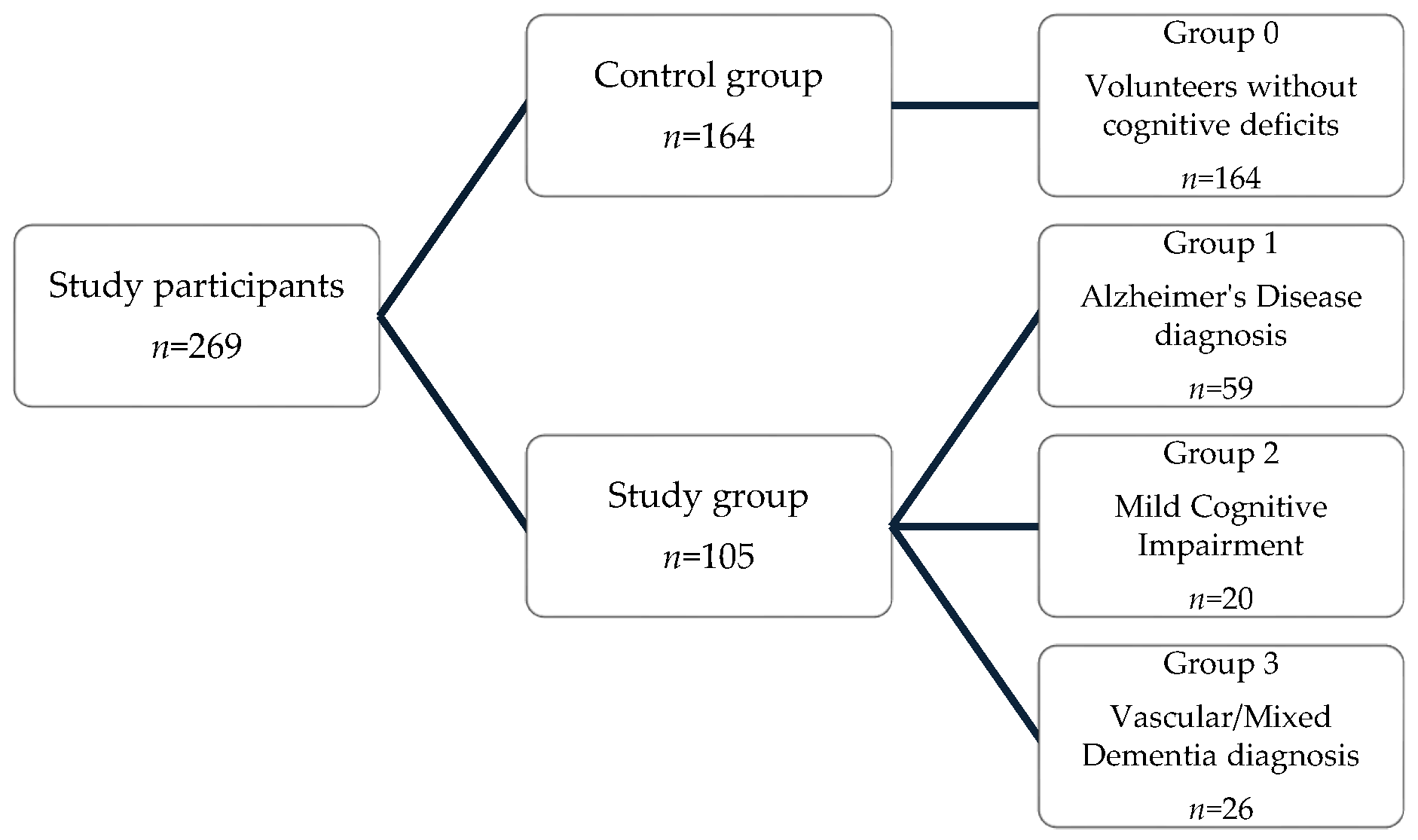
| Group 0 n = 164 | Group 1 n = 59 | Group 2 n = 20 | Group 1 n = 59 | Group 3 n = 26 | Group 2 n = 20 | Group 3 n = 26 | |
| Age, y | 68.1 (±12.9) | 74.5 (±9.6) | 56.5 (±15) | 74.5 (±9.6) | 74.7 (±19) | 56.5 (±15) | 74.7 (±19) |
| p-Value | p = 0.405 | p < 0.001 | p > 0.999 | p < 0.001 | |||
| Weight, kg | 78.0 (70.0 ÷ 86.5) | 74.5 (65 ÷ 83) | 77.7 (70 ÷ 82) | 74.5 (65 ÷ 83) | 80.6 (77 ÷ 87) | 77.7 (70 ÷ 82) | 80.6 (77 ÷ 87) |
| p-Value | p > 0.999 | p > 0.999 | p = 0.103 | p > 0.999 | |||
| Age of diagnosis, y | - | 67.9 (±9.7) | 50.3 (±10) | 67.9 (±9.7) | 66.3 (±7.1) | 50.3 (±10) | 66.3 (±7.1) |
| p-Value | - | p < 0.001 | p > 0.999 | p < 0.001 | |||
| Disease duration, y | - | 6.60 (±2.26) | 6.13 (2.83) | 6.60 (±2.26) | 8.83 (±1.15) | 6.13 (2.83) | 8.83 (±1.15) |
| p-Value | - | p > 0.999 | p < 0.001 | p = 0.003 | |||
| MMSE score | 28.4 (±1.0) | 18.1 (±3.6) | 21.6 (±4.9) | 18.1 (±3.6) | 17.5 (±5.0) | 21.6 (±4.9) | 17.5 (±5.0) |
| p-Value | p < 0.001 | p = 0.004 | p > 0.999 | p = 0.025 | |||
| MoCA score | 27.9 (±1.3) | 19.1 (±3.2) | 20.6 (±4.2) | 19.1 (±3.2) | 21.9 (±2.4) | 20.6 (±4.2) | 21.9 (±2.4) |
| p-Value | p < 0.001 | p = 0.073 | p = 0.003 | p > 0.999 | |||
| Gene | rs Code | Participants | Genotype Frequency | χ2 | p-Value | ||
|---|---|---|---|---|---|---|---|
| CT | CC | TT | |||||
| BIN1 | rs744373 | Group 0 | 61 (37.2%) | 17 (10.4%) | 86 (52.4%) | 0.142 | p = 0.913 |
| Group 1 | 23 (39%) | 5 (8.5%) | 31 (52.5%) | ||||
| Group 0 | 61 (37.2%) | 17 (10.4%) | 86 (52.4%) | 1.29 | p = 0.526 | ||
| Group 2 | 6 (30%) | 4 (20%) | 10 (50%) | ||||
| Group 0 | 61 (37.2%) | 17 (10.4%) | 86 (52.4%) | 2.43 | p = 0.297 | ||
| Group 3 | 12 (46.2% | 1 (3.8%) | 13 (50%) | ||||
| GG | AG | AA | |||||
| TOMM40 | rs2075650 | Group 0 | 8 (4.9%) | 53 (32.3%) | 103 (62.8%) | 5.59 | p = 0.045 |
| Group 1 | 7 (11.8%) | 28 (47.5%) | 24 (40.7%) | ||||
| Group 0 | 8 (4.9%) | 53 (32.3%) | 103 (62.8%) | 2.93 | p = 0.213 | ||
| Group 2 | 0 (0%) | 9 (45%) | 11 (55%) | ||||
| Group 0 | 8 (4.9%) | 53 (32.3%) | 103 (62.8%) | 2.15 | p = 0.342 | ||
| Group 3 | 2 (7.7%) | 10 (38.5%) | 14 (53.8%) | ||||
Disclaimer/Publisher’s Note: The statements, opinions and data contained in all publications are solely those of the individual author(s) and contributor(s) and not of MDPI and/or the editor(s). MDPI and/or the editor(s) disclaim responsibility for any injury to people or property resulting from any ideas, methods, instructions or products referred to in the content. |
© 2025 by the authors. Licensee MDPI, Basel, Switzerland. This article is an open access article distributed under the terms and conditions of the Creative Commons Attribution (CC BY) license (https://creativecommons.org/licenses/by/4.0/).
Share and Cite
Machowska, M.; Leszek, J.; Mikołajczyk-Tarnawa, A.; Głowacka, K.; Trypka, E.; Rąpała, M.; Piechota, J.; Wiela-Hojeńska, A. The Diagnostic Reliability of BIN1 and TOMM40 Genotyping in Assessing Dementia Risk. Genes 2025, 16, 1469. https://doi.org/10.3390/genes16121469
Machowska M, Leszek J, Mikołajczyk-Tarnawa A, Głowacka K, Trypka E, Rąpała M, Piechota J, Wiela-Hojeńska A. The Diagnostic Reliability of BIN1 and TOMM40 Genotyping in Assessing Dementia Risk. Genes. 2025; 16(12):1469. https://doi.org/10.3390/genes16121469
Chicago/Turabian StyleMachowska, Marta, Jerzy Leszek, Aleksandra Mikołajczyk-Tarnawa, Krystyna Głowacka, Elżbieta Trypka, Małgorzata Rąpała, Janusz Piechota, and Anna Wiela-Hojeńska. 2025. "The Diagnostic Reliability of BIN1 and TOMM40 Genotyping in Assessing Dementia Risk" Genes 16, no. 12: 1469. https://doi.org/10.3390/genes16121469
APA StyleMachowska, M., Leszek, J., Mikołajczyk-Tarnawa, A., Głowacka, K., Trypka, E., Rąpała, M., Piechota, J., & Wiela-Hojeńska, A. (2025). The Diagnostic Reliability of BIN1 and TOMM40 Genotyping in Assessing Dementia Risk. Genes, 16(12), 1469. https://doi.org/10.3390/genes16121469