Artificial Intelligence-Driven Design of Antisense Oligonucleotides for Precision Medicine in Neuromuscular Disorders


Abstract
1. Introduction
2. Overview of Antisense Oligonucleotide Mechanisms and Design
2.1. RNase H-Dependent ASO Mechanisms
2.2. RNase H-Independent ASO Mechanisms
2.3. Chemical Modifications
3. Antisense Oligonucleotides for Rare Neuromuscular Disorders
3.1. FDA-Approved ASOs for Rare Neuromuscular Disorders
3.2. Current Challenges Associated with Antisense Oligonucleotide Therapy for Rare Neuromuscular Diseases and Potential Solutions
3.2.1. Delivery and Uptake
3.2.2. Toxicity and Off-Target Effects
3.2.3. Limitations in Traditional Design Protocols
3.2.4. Potential Solutions to Improving ASO Efficacy for Rare Neuromuscular Disorders
4. Platforms Utilizing AI to Optimize ASO Design
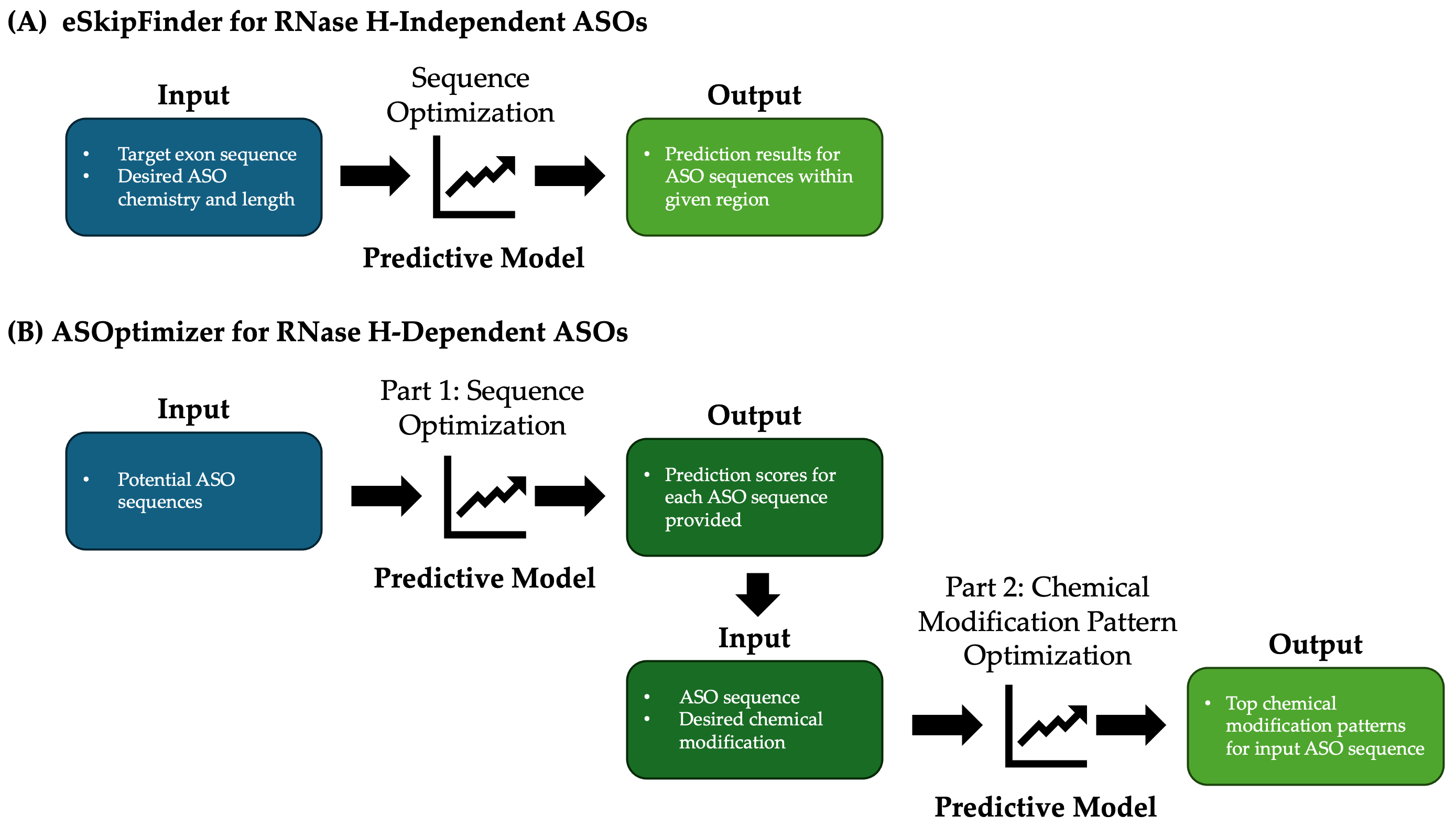
4.1. eSkipFinder: Optimizing Exon-Skipping ASOs
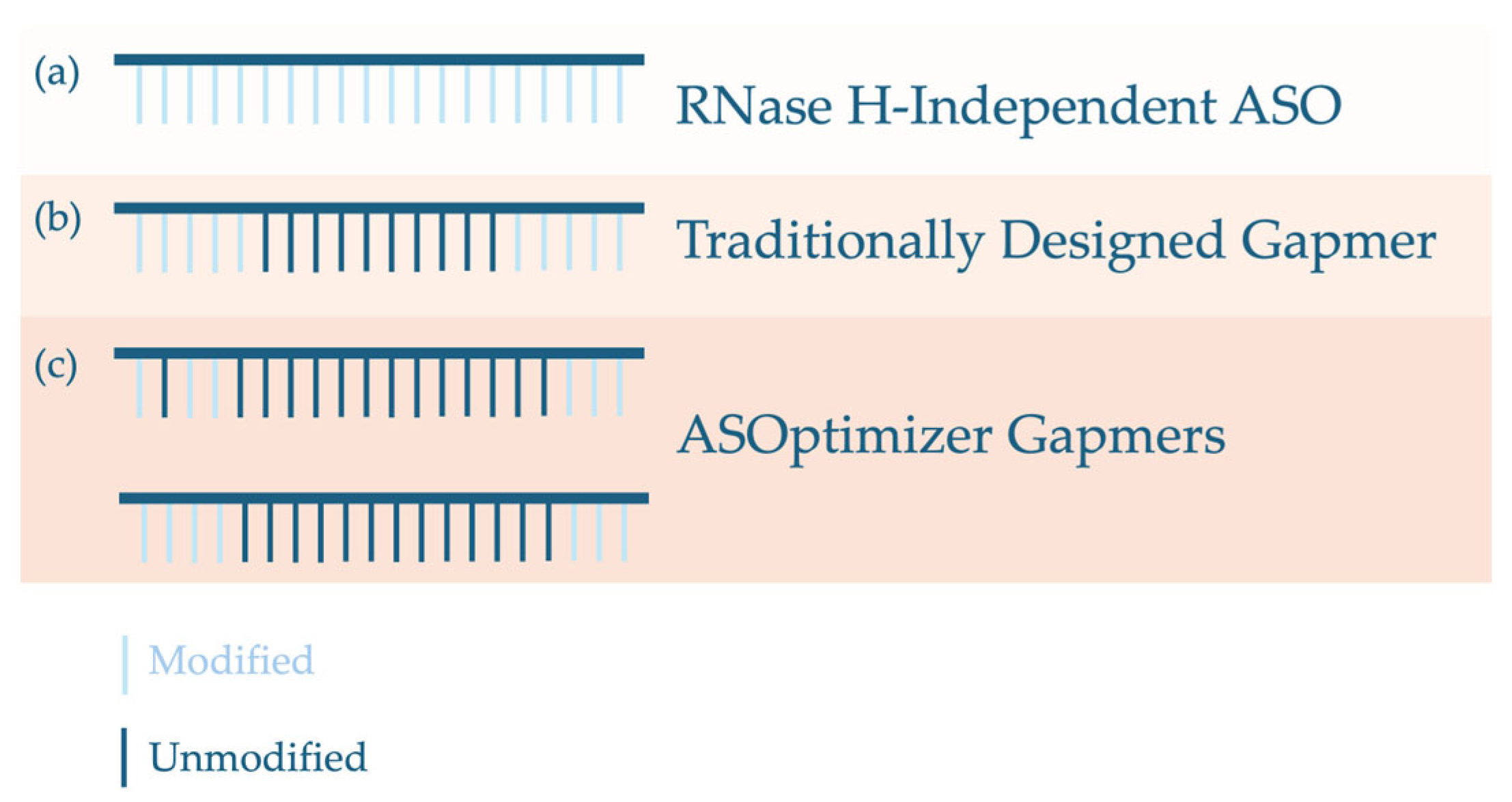
4.2. ASOptimizer: Optimizing RNase H-Dependent ASOs
4.3. Application of ASOptimizer and eSkipFinder for the Design of ASOs
4.4. Future Directions for Machine-Learning Platforms Optimizing ASO Design
5. Conclusions
Author Contributions
Funding
Institutional Review Board Statement
Informed Consent Statement
Data Availability Statement
Acknowledgments
Conflicts of Interest
Abbreviations
| ASO | Antisense oligonucleotides |
| AI | Artificial intelligence |
| ALS | Amyotrophic lateral sclerosis |
| DMD | Duchenne muscular dystrophy |
| SMA | Spinal muscular atrophy |
| PS | Phosphorothioate |
| 2′MOE | 2′-O-methoxyethyl |
| LNA | Locked nucleic acid |
| PMO | Phosphorodiamidate morpholine oligonucleotides |
| CPP | Cell-penetrating peptide |
| LNP | Lipid nanoparticle |
References
- Thayer, S.; Bell, C.; McDonald, C.M. The Direct Cost of Managing a Rare Disease: Assessing Medical and Pharmacy Costs Associated with Duchenne Muscular Dystrophy in the United States. J. Manag. Care Spec. Pharm. 2017, 23, 633–641. [Google Scholar] [CrossRef]
- Ryder, S.; Leadley, R.M.; Armstrong, N.; Westwood, M.; de Kock, S.; Butt, T.; Jain, M.; Kleijnen, J. The Burden, Epidemiology, Costs and Treatment for Duchenne Muscular Dystrophy: An Evidence Review. Orphanet J. Rare Dis. 2017, 12, 79. [Google Scholar] [CrossRef]
- Ortega, J.; Vázquez, N.; Amayra Caro, I.; Muntadas, J.; Squitín Tasende, M.; Rodriguez Bermejo, A. Health-Related Quality of Life in 153 Children with Neuromuscular Disorders in Latin America: Is It Age, Functional Dependence or Diagnosis? Eur. J. Paediatr. Neurol. 2024, 52, 95–102. [Google Scholar] [CrossRef] [PubMed]
- Martínez, O.; Amayra, I.; López-Paz, J.F.; Lázaro, E.; Caballero, P.; García, I.; Rodríguez, A.A.; García, M.; Luna, P.M.; Pérez-Núñez, P.; et al. Effects of Teleassistance on the Quality of Life of People With Rare Neuromuscular Diseases According to Their Degree of Disability. Front. Psychol. 2021, 12, 637413. [Google Scholar] [CrossRef]
- Deenen, J.C.W.; Horlings, C.G.C.; Verschuuren, J.J.G.M.; Verbeek, A.L.M.; van Engelen, B.G.M. The Epidemiology of Neuromuscular Disorders: A Comprehensive Overview of the Literature. J. Neuromuscul. Dis. 2015, 2, 73–85. [Google Scholar] [CrossRef]
- Wilson, L.A.; Macken, W.L.; Perry, L.D.; Record, C.J.; Schon, K.R.; Frezatti, R.S.S.; Raga, S.; Naidu, K.; Köken, Ö.Y.; Polat, I.; et al. Neuromuscular Disease Genetics in Under-Represented Populations: Increasing Data Diversity. Brain J. Neurol. 2023, 146, 5098–5109. [Google Scholar] [CrossRef]
- Mancuso, M.; Colitta, A.; Lavorato, M.; Van den Bergh, P.; Kirschner, J.; Kornblum, C.; Maggi, L.; Lamy, F.; Lochmüller, H.; Nordstrøm, M.; et al. The Most Bothersome Symptoms in Neuromuscular Diseases: The ERN EURO NMD Survey. Orphanet J. Rare Dis. 2025, 20, 221. [Google Scholar] [CrossRef]
- Hsu, D.T. Cardiac Manifestations of Neuromuscular Disorders in Children. Paediatr. Respir. Rev. 2010, 11, 35–38. [Google Scholar] [CrossRef]
- Voulgaris, A.; Antoniadou, M.; Agrafiotis, M.; Steiropoulos, P. Respiratory Involvement in Patients with Neuromuscular Diseases: A Narrative Review. Pulm. Med. 2019, 2019, 2734054. [Google Scholar] [CrossRef] [PubMed]
- Somanadhan, S.; O’Donnell, R.; Bracken, S.; McNulty, S.; Sweeney, A.; O’Toole, D.; Rogers, Y.; Flynn, C.; Awan, A.; Baker, M.; et al. Children and Young People’s Experiences of Living with Rare Diseases: An Integrative Review. J. Pediatr. Nurs. 2023, 68, e16–e26. [Google Scholar] [CrossRef] [PubMed]
- Chen, J.; Nie, L.; Lee, S.; Chu, H.; Tian, H.; Wang, Y.; He, W.; Jemielita, T.; Gruber, S.; Song, Y.; et al. Challenges and Possible Strategies to Address Them in Rare Disease Drug Development: A Statistical Perspective. Clin. Pharmacol. Ther. 2025, 118, 62–73. [Google Scholar] [CrossRef]
- Dhuri, K.; Bechtold, C.; Quijano, E.; Pham, H.; Gupta, A.; Vikram, A.; Bahal, R. Antisense Oligonucleotides: An Emerging Area in Drug Discovery and Development. J. Clin. Med. 2020, 9, 2004. [Google Scholar] [CrossRef]
- Lauffer, M.C.; van Roon-Mom, W.; Aartsma-Rus, A. Possibilities and Limitations of Antisense Oligonucleotide Therapies for the Treatment of Monogenic Disorders. Commun. Med. 2024, 4, 6. [Google Scholar] [CrossRef]
- Haque, U.S.; Yokota, T. Enhancing Antisense Oligonucleotide-Based Therapeutic Delivery with DG9, a Versatile Cell-Penetrating Peptide. Cells 2023, 12, 2395. [Google Scholar] [CrossRef]
- Roberts, T.C.; Langer, R.; Wood, M.J.A. Advances in Oligonucleotide Drug Delivery. Nat. Rev. Drug Discov. 2020, 19, 673–694. [Google Scholar] [CrossRef]
- Collotta, D.; Bertocchi, I.; Chiapello, E.; Collino, M. Antisense Oligonucleotides: A Novel Frontier in Pharmacological Strategy. Front. Pharmacol. 2023, 14, 1304342. [Google Scholar] [CrossRef]
- Echigoya, Y.; Lim, K.R.Q.; Trieu, N.; Bao, B.; Miskew Nichols, B.; Vila, M.C.; Novak, J.S.; Hara, Y.; Lee, J.; Touznik, A.; et al. Quantitative Antisense Screening and Optimization for Exon 51 Skipping in Duchenne Muscular Dystrophy. Mol. Ther. J. Am. Soc. Gene Ther. 2017, 25, 2561–2572. [Google Scholar] [CrossRef]
- Chiba, S.; Lim, K.R.Q.; Sheri, N.; Anwar, S.; Erkut, E.; Shah, M.N.A.; Aslesh, T.; Woo, S.; Sheikh, O.; Maruyama, R.; et al. eSkip-Finder: A Machine Learning-Based Web Application and Database to Identify the Optimal Sequences of Antisense Oligonucleotides for Exon Skipping. Nucleic Acids Res. 2021, 49, W193–W198. [Google Scholar] [CrossRef]
- Ding, Y.; Chan, C.Y.; Lawrence, C.E. Sfold Web Server for Statistical Folding and Rational Design of Nucleic Acids. Nucleic Acids Res. 2004, 32, W135–W141. [Google Scholar] [CrossRef]
- Hwang, G.; Kwon, M.; Seo, D.; Kim, D.H.; Lee, D.; Lee, K.; Kim, E.; Kang, M.; Ryu, J.-H. ASOptimizer: Optimizing Antisense Oligonucleotides through Deep Learning for IDO1 Gene Regulation. Mol. Ther. Nucleic Acids 2024, 35, 102186. [Google Scholar] [CrossRef]
- Quemener, A.M.; Bachelot, L.; Forestier, A.; Donnou-Fournet, E.; Gilot, D.; Galibert, M.-D. The Powerful World of Antisense Oligonucleotides: From Bench to Bedside. Wiley Interdiscip. Rev. RNA 2020, 11, e1594. [Google Scholar] [CrossRef]
- De Vivo, D.C.; Bertini, E.; Swoboda, K.J.; Hwu, W.-L.; Crawford, T.O.; Finkel, R.S.; Kirschner, J.; Kuntz, N.L.; Parsons, J.A.; Ryan, M.M.; et al. Nusinersen Initiated in Infants during the Presymptomatic Stage of Spinal Muscular Atrophy: Interim Efficacy and Safety Results from the Phase 2 NURTURE Study. Neuromuscul. Disord. 2019, 29, 842–856. [Google Scholar] [CrossRef]
- Hammond, S.M.; Aartsma-Rus, A.; Alves, S.; Borgos, S.E.; Buijsen, R.A.M.; Collin, R.W.J.; Covello, G.; Denti, M.A.; Desviat, L.R.; Echevarría, L.; et al. Delivery of Oligonucleotide-based Therapeutics: Challenges and Opportunities. EMBO Mol. Med. 2021, 13, e13243. [Google Scholar] [CrossRef]
- Sang, A.; Zhuo, S.; Bochanis, A.; Manautou, J.E.; Bahal, R.; Zhong, X.-B.; Rasmussen, T.P. Mechanisms of Action of the US Food and Drug Administration-Approved Antisense Oligonucleotide Drugs. BioDrugs Clin. Immunother. Biopharm. Gene Ther. 2024, 38, 511–526. [Google Scholar] [CrossRef] [PubMed]
- Ma, S.; Howden, S.A.; Keane, S.C. Use of Steric Blocking Antisense Oligonucleotides for the Targeted Inhibition of Junction Containing Precursor microRNAs. bioRxiv 2024. 2024.04.08.588531. [Google Scholar] [CrossRef]
- Wu, H.; Lima, W.F.; Zhang, H.; Fan, A.; Sun, H.; Crooke, S.T. Determination of the Role of the Human RNase H1 in the Pharmacology of DNA-like Antisense Drugs. J. Biol. Chem. 2004, 279, 17181–17189. [Google Scholar] [CrossRef]
- Chen, S.; Heendeniya, S.N.; Le, B.T.; Rahimizadeh, K.; Rabiee, N.; ul ain Zahra, Q.; Veedu, R.N. Splice-Modulating Antisense Oligonucleotides as Therapeutics for Inherited Metabolic Diseases. Biodrugs 2024, 38, 177–203. [Google Scholar] [CrossRef]
- Vickers, T.A.; Crooke, S.T. Antisense Oligonucleotides Capable of Promoting Specific Target mRNA Reduction via Competing RNase H1-Dependent and Independent Mechanisms. PLoS ONE 2014, 9, e108625. [Google Scholar] [CrossRef]
- Allison, D.F.; Wang, G.G. R-Loops: Formation, Function, and Relevance to Cell Stress. Cell Stress 2025, 3, 38–46. [Google Scholar] [CrossRef]
- Crossley, M.P.; Bocek, M.; Cimprich, K.A. R-Loops as Cellular Regulators and Genomic Threats. Mol. Cell 2019, 73, 398–411. [Google Scholar] [CrossRef]
- Crossley, M.P.; Song, C.; Bocek, M.J.; Choi, J.-H.; Kousorous, J.; Sathirachinda, A.; Lin, C.; Brickner, J.R.; Bai, G.; Lans, H.; et al. R-Loop-Derived Cytoplasmic RNA-DNA Hybrids Activate an Immune Response. Nature 2023, 613, 187–194. [Google Scholar] [CrossRef]
- Bennett, C.F.; Swayze, E.E. RNA Targeting Therapeutics: Molecular Mechanisms of Antisense Oligonucleotides as a Therapeutic Platform. Annu. Rev. Pharmacol. Toxicol. 2010, 50, 259–293. [Google Scholar] [CrossRef]
- Dowdy, S.F. Overcoming Cellular Barriers for RNA Therapeutics. Nat. Biotechnol. 2017, 35, 222–229. [Google Scholar] [CrossRef]
- Juliano, R.L.; Ming, X.; Carver, K.; Laing, B. Cellular Uptake and Intracellular Trafficking of Oligonucleotides: Implications for Oligonucleotide Pharmacology. Nucleic Acid Ther. 2014, 24, 101–113. [Google Scholar] [CrossRef] [PubMed]
- Liang, X.-H.; Sun, H.; Nichols, J.G.; Crooke, S.T. RNase H1-Dependent Antisense Oligonucleotides Are Robustly Active in Directing RNA Cleavage in Both the Cytoplasm and the Nucleus. Mol. Ther. 2017, 25, 2075–2092. [Google Scholar] [CrossRef] [PubMed]
- Lima, W.F.; De Hoyos, C.L.; Liang, X.; Crooke, S.T. RNA Cleavage Products Generated by Antisense Oligonucleotides and siRNAs Are Processed by the RNA Surveillance Machinery. Nucleic Acids Res. 2016, 44, 3351–3363. [Google Scholar] [CrossRef]
- Scherman, D. RNA Antisense and Silencing Strategies Using Synthetic Drugs for Rare Muscular and Neuromuscular Diseases. Rare Dis. Orphan Drugs J. 2023, 2, 12. [Google Scholar] [CrossRef]
- Sumner, C.J.; Miller, T.M. The Expanding Application of Antisense Oligonucleotides to Neurodegenerative Diseases. J. Clin. Investig. 2024, 134, e186116. [Google Scholar] [CrossRef]
- Boros, B.D.; Schoch, K.M.; Kreple, C.J.; Miller, T.M. Antisense Oligonucleotides for the Study and Treatment of ALS. Neurotherapeutics 2022, 19, 1145–1158. [Google Scholar] [CrossRef] [PubMed]
- Moriyama, H.; Yokota, T. Recent Progress of Antisense Oligonucleotide Therapy for Superoxide-Dismutase-1-Mutated Amyotrophic Lateral Sclerosis: Focus on Tofersen. Genes 2024, 15, 1342. [Google Scholar] [CrossRef] [PubMed]
- Miller, T.M.; Cudkowicz, M.E.; Genge, A.; Shaw, P.J.; Sobue, G.; Bucelli, R.C.; Chiò, A.; Damme, P.V.; Ludolph, A.C.; Glass, J.D.; et al. Trial of Antisense Oligonucleotide Tofersen for SOD1 ALS. N. Engl. J. Med. 2022, 387, 1099–1110. [Google Scholar] [CrossRef] [PubMed]
- Bauman, J.; Jearawiriyapaisarn, N.; Kole, R. Therapeutic Potential of Splice-Switching Oligonucleotides. Oligonucleotides 2009, 19, 1–13. [Google Scholar] [CrossRef]
- Torres-Masjoan, L.; Aguti, S.; Zhou, H.; Muntoni, F. Clinical Applications of Exon-Skipping Antisense Oligonucleotides in Neuromuscular Diseases. Mol. Ther. 2025, 33, 2689–2704. [Google Scholar] [CrossRef]
- Sardone, V.; Zhou, H.; Muntoni, F.; Ferlini, A.; Falzarano, M.S. Antisense Oligonucleotide-Based Therapy for Neuromuscular Disease. Mol. J. Synth. Chem. Nat. Prod. Chem. 2017, 22, 563. [Google Scholar] [CrossRef]
- Ohno, K.; Milone, M.; Shen, X.-M.; Engel, A.G. A Frameshifting Mutation in CHRNE Unmasks Skipping of the Preceding Exon. Hum. Mol. Genet. 2003, 12, 3055–3066. [Google Scholar] [CrossRef][Green Version]
- Meregalli, M.; Maciotta, S.; Angeloni, V.; Torrente, Y. Duchenne Muscular Dystrophy Caused by a Frame-Shift Mutation in the Acceptor Splice Site of Intron 26. BMC Med. Genet. 2016, 17, 55. [Google Scholar] [CrossRef][Green Version]
- Kashima, T.; Manley, J.L. A Negative Element in SMN2 Exon 7 Inhibits Splicing in Spinal Muscular Atrophy. Nat. Genet. 2003, 34, 460–463. [Google Scholar] [CrossRef]
- Hermitte, C.; de Calbiac, H.; Moulay, G.; Mérien, A.; Lainé, J.; Polvèche, H.; Cailleret, M.; Vassilopoulos, S.; Kabashi, E.; Furling, D.; et al. Alternative Splicing of SORBS1 Affects Neuromuscular Junction Formation and Stability in Myotonic Dystrophy Type 1. bioRxiv 2024. 2024.12.23.630072. [Google Scholar] [CrossRef]
- Toh, Z.Y.C.; Thandar Aung-Htut, M.; Pinniger, G.; Adams, A.M.; Krishnaswarmy, S.; Wong, B.L.; Fletcher, S.; Wilton, S.D. Deletion of Dystrophin In-Frame Exon 5 Leads to a Severe Phenotype: Guidance for Exon Skipping Strategies. PLoS ONE 2016, 11, e0145620. [Google Scholar] [CrossRef]
- Takeshima, Y.; Yagi, M.; Okizuka, Y.; Awano, H.; Zhang, Z.; Yamauchi, Y.; Nishio, H.; Matsuo, M. Mutation Spectrum of the Dystrophin Gene in 442 Duchenne/Becker Muscular Dystrophy Cases from One Japanese Referral Center. J. Hum. Genet. 2010, 55, 379–388. [Google Scholar] [CrossRef]
- Keinath, M.C.; Prior, D.E.; Prior, T.W. Spinal Muscular Atrophy: Mutations, Testing, and Clinical Relevance. Appl. Clin. Genet. 2021, 14, 11–25. [Google Scholar] [CrossRef]
- Maitra, S.; Oh, S.; Choe, Y.-J.; Kim, J.; Kim, N.C. The 21-Base Pair Deletion Mutant Calpain3 Does Not Inhibit Wild-Type Calpain3 Activity. Genes Dis. 2024, 12, 101301. [Google Scholar] [CrossRef]
- Havens, M.A.; Hastings, M.L. Splice-Switching Antisense Oligonucleotides as Therapeutic Drugs. Nucleic Acids Res. 2016, 44, 6549–6563. [Google Scholar] [CrossRef]
- Lim, K.R.Q.; Maruyama, R.; Yokota, T. Eteplirsen in the Treatment of Duchenne Muscular Dystrophy. Drug Des. Dev. Ther. 2017, 11, 533–545. [Google Scholar] [CrossRef]
- Vaillend, C.; Aoki, Y.; Mercuri, E.; Hendriksen, J.; Tetorou, K.; Goyenvalle, A.; Muntoni, F. Duchenne Muscular Dystrophy: Recent Insights in Brain Related Comorbidities. Nat. Commun. 2025, 16, 1298. [Google Scholar] [CrossRef]
- Takeda, S.; Clemens, P.R.; Hoffman, E.P. Exon-Skipping in Duchenne Muscular Dystrophy. J. Neuromuscul. Dis. 2025, 8, S343–S358. [Google Scholar] [CrossRef] [PubMed]
- Tang, S.; Stamberger, H.; Calhoun, J.D.; Weckhuysen, S.; Carvill, G.L. Antisense Oligonucleotides Modulate Aberrant Inclusion of Poison Exons in SCN1A-Related Dravet Syndrome. JCI Insight 2025, 10, e188014. [Google Scholar] [CrossRef] [PubMed]
- Evers, M.M.; Tran, H.-D.; Zalachoras, I.; Pepers, B.A.; Meijer, O.C.; den Dunnen, J.T.; van Ommen, G.-J.B.; Aartsma-Rus, A.; van Roon-Mom, W.M.C. Ataxin-3 Protein Modification as a Treatment Strategy for Spinocerebellar Ataxia Type 3: Removal of the CAG Containing Exon. Neurobiol. Dis. 2013, 58, 49–56. [Google Scholar] [CrossRef] [PubMed][Green Version]
- Toonen, L.J.A.; Schmidt, I.; Luijsterburg, M.S.; van Attikum, H.; van Roon-Mom, W.M.C. Antisense Oligonucleotide-Mediated Exon Skipping as a Strategy to Reduce Proteolytic Cleavage of Ataxin-3. Sci. Rep. 2016, 6, 35200. [Google Scholar] [CrossRef]
- Tomkiewicz, T.Z.; Suárez-Herrera, N.; Cremers, F.P.M.; Collin, R.W.J.; Garanto, A. Antisense Oligonucleotide-Based Rescue of Aberrant Splicing Defects Caused by 15 Pathogenic Variants in ABCA4. Int. J. Mol. Sci. 2021, 22, 4621. [Google Scholar] [CrossRef] [PubMed]
- Ward, A.J.; Norrbom, M.; Chun, S.; Bennett, C.F.; Rigo, F. Nonsense-Mediated Decay as a Terminating Mechanism for Antisense Oligonucleotides. Nucleic Acids Res. 2014, 42, 5871–5879. [Google Scholar] [CrossRef] [PubMed]
- Iwata-Endo, K.; Sahashi, K.; Kawai, K.; Fujioka, Y.; Okada, Y.; Watanabe, E.; Iwade, N.; Ishibashi, M.; Mohammad, M.; Aldoghachi, A.F.; et al. Correcting Tau Isoform Ratios with a Long-Acting Antisense Oligonucleotide Alleviates 4R-Tauopathy Phenotypes. Mol. Ther. Nucleic Acids 2025, 36, 102503. [Google Scholar] [CrossRef]
- Tei, S.; Ishii, H.T.; Mitsuhashi, H.; Ishiura, S. Antisense Oligonucleotide-Mediated Exon Skipping of CHRNA1 Pre-mRNA as Potential Therapy for Congenital Myasthenic Syndromes. Biochem. Biophys. Res. Commun. 2015, 461, 481–486. [Google Scholar] [CrossRef]
- Hua, Y.; Krainer, A.R. Antisense-Mediated Exon Inclusion. In Exon Skipping; Methods in Molecular Biology Book Series; Humana Press: Clifton, NJ, USA, 2012; Volume 867, pp. 307–323. [Google Scholar] [CrossRef]
- Chiriboga, C.A.; Swoboda, K.J.; Darras, B.T.; Iannaccone, S.T.; Montes, J.; De Vivo, D.C.; Norris, D.A.; Bennett, C.F.; Bishop, K.M. Results from a Phase 1 Study of Nusinersen (ISIS-SMN(Rx)) in Children with Spinal Muscular Atrophy. Neurology 2016, 86, 890–897. [Google Scholar] [CrossRef]
- Wurster, C.D.; Ludolph, A.C. Nusinersen for Spinal Muscular Atrophy. Ther. Adv. Neurol. Disord. 2018, 11, 1756285618754459. [Google Scholar] [CrossRef]
- Leclair, N.K.; Brugiolo, M.; Park, S.; Devoucoux, M.; Urbanski, L.; Angarola, B.L.; Yurieva, M.; Anczuków, O. Antisense Oligonucleotide-Mediated TRA2β Poison Exon Inclusion Induces the Expression of a lncRNA with Anti-Tumor Effects. Nat. Commun. 2025, 16, 1670. [Google Scholar] [CrossRef]
- Singh, N.N.; Howell, M.D.; Androphy, E.J.; Singh, R.N. How the Discovery of ISS-N1 Led to the First Medical Therapy for Spinal Muscular Atrophy. Gene Ther. 2017, 24, 520–526. [Google Scholar] [CrossRef]
- Baker, B.F.; Miraglia, L.; Hagedorn, C.H. Modulation of Eucaryotic Initiation Factor-4E Binding to 5′-Capped Oligoribonucleotides by Modified Anti-Sense Oligonucleotides. J. Biol. Chem. 1992, 267, 11495–11499. [Google Scholar] [CrossRef]
- Baker, B.F.; Lot, S.S.; Condon, T.P.; Cheng-Flournoy, S.; Lesnik, E.A.; Sasmor, H.M.; Bennett, C.F. 2′-O-(2-Methoxy)Ethyl-Modified Anti-Intercellular Adhesion Molecule 1 (ICAM-1) Oligonucleotides Selectively Increase the ICAM-1 mRNA Level and Inhibit Formation of the ICAM-1 Translation Initiation Complex in Human Umbilical Vein Endothelial Cells. J. Biol. Chem. 1997, 272, 11994–12000. [Google Scholar] [CrossRef]
- El Boujnouni, N.; van der Bent, M.L.; Willemse, M.; ’t Hoen, P.A.C.; Brock, R.; Wansink, D.G. Block or Degrade? Balancing on- and off-Target Effects of Antisense Strategies against Transcripts with Expanded Triplet Repeats in DM1. Mol. Ther. Nucleic Acids 2023, 32, 622–636. [Google Scholar] [CrossRef] [PubMed]
- Liang, X.; Nichols, J.G.; Hsu, C.-W.; Vickers, T.A.; Crooke, S.T. mRNA Levels Can Be Reduced by Antisense Oligonucleotides via No-Go Decay Pathway. Nucleic Acids Res. 2019, 47, 6900–6916. [Google Scholar] [CrossRef] [PubMed]
- Liang, X.-H.; Sun, H.; Shen, W.; Wang, S.; Yao, J.; Migawa, M.T.; Bui, H.-H.; Damle, S.S.; Riney, S.; Graham, M.J.; et al. Antisense Oligonucleotides Targeting Translation Inhibitory Elements in 5′ UTRs Can Selectively Increase Protein Levels. Nucleic Acids Res. 2017, 45, 9528–9546. [Google Scholar] [CrossRef]
- Liang, X.; Shen, W.; Sun, H.; Migawa, M.T.; Vickers, T.A.; Crooke, S.T. Translation Efficiency of mRNAs Is Increased by Antisense Oligonucleotides Targeting Upstream Open Reading Frames. Nat. Biotechnol. 2016, 34, 875–880. [Google Scholar] [CrossRef] [PubMed]
- Nomakuchi, T.T.; Rigo, F.; Aznarez, I.; Krainer, A.R. Antisense-Oligonucleotide-Directed Inhibition of Nonsense-Mediated mRNA Decay. Nat. Biotechnol. 2016, 34, 164–166. [Google Scholar] [CrossRef]
- Vickers, T.A.; Wyatt, J.R.; Burckin, T.; Bennett, C.F.; Freier, S.M. Fully Modified 2′ MOE Oligonucleotides Redirect Polyadenylation. Nucleic Acids Res. 2001, 29, 1293–1299. [Google Scholar] [CrossRef]
- Bennett, C.F.; Baker, B.F.; Pham, N.; Swayze, E.; Geary, R.S. Pharmacology of Antisense Drugs. Annu. Rev. Pharmacol. Toxicol. 2017, 57, 81–105. [Google Scholar] [CrossRef]
- Shadid, M.; Badawi, M.; Abulrob, A. Antisense Oligonucleotides: Absorption, Distribution, Metabolism, and Excretion. Expert Opin. Drug Metab. Toxicol. 2021, 17, 1281–1292. [Google Scholar] [CrossRef]
- Chen, X.; Dudgeon, N.; Shen, L.; Wang, J.H. Chemical Modification of Gene Silencing Oligonucleotides for Drug Discovery and Development. Drug Discov. Today 2005, 10, 587–593. [Google Scholar] [CrossRef]
- Eckstein, F. Phosphorothioates, Essential Components of Therapeutic Oligonucleotides. Nucleic Acid Ther. 2014, 24, 374–387. [Google Scholar] [CrossRef]
- Carlesso, A.; Hörberg, J.; Deganutti, G.; Reymer, A.; Matsson, P. Structural Dynamics of Therapeutic Nucleic Acids with Phosphorothioate Backbone Modifications. NAR Genom. Bioinform. 2024, 6, lqae058. [Google Scholar] [CrossRef]
- Koziolkiewicz, M.; Gendaszewska, E.; Maszewska, M.; Stein, C.A.; Stec, W.J. The Mononucleotide-Dependent, Nonantisense Mechanism of Action of Phosphodiester and Phosphorothioate Oligonucleotides Depends upon the Activity of an Ecto-5′-Nucleotidase. Blood 2001, 98, 995–1002. [Google Scholar] [CrossRef]
- Iwamoto, N.; Butler, D.C.D.; Svrzikapa, N.; Mohapatra, S.; Zlatev, I.; Sah, D.W.Y.; Meena; Standley, S.M.; Lu, G.; Apponi, L.H.; et al. Control of Phosphorothioate Stereochemistry Substantially Increases the Efficacy of Antisense Oligonucleotides. Nat. Biotechnol. 2017, 35, 845–851. [Google Scholar] [CrossRef] [PubMed]
- Monia, B.P.; Lesnik, E.A.; Gonzalez, C.; Lima, W.F.; McGee, D.; Guinosso, C.J.; Kawasaki, A.M.; Cook, P.D.; Freier, S.M. Evaluation of 2′-Modified Oligonucleotides Containing 2′-Deoxy Gaps as Antisense Inhibitors of Gene Expression. J. Biol. Chem. 1993, 268, 14514–14522. [Google Scholar] [CrossRef]
- Nicolussi, A.; D’Inzeo, S.; Capalbo, C.; Giannini, G.; Coppa, A. The Role of Peroxiredoxins in Cancer. Mol. Clin. Oncol. 2017, 6, 139–153. [Google Scholar] [CrossRef]
- Gryaznov, S.M.; Lloyd, D.H.; Chen, J.K.; Schultz, R.G.; DeDionisio, L.A.; Ratmeyer, L.; Wilson, W.D. Oligonucleotide N3′-->P5′ Phosphoramidates. Proc. Natl. Acad. Sci. USA 1995, 92, 5798–5802. [Google Scholar] [CrossRef]
- Yoshida, T.; Hagihara, T.; Uchida, Y.; Horiuchi, Y.; Sasaki, K.; Yamamoto, T.; Yamashita, T.; Goda, Y.; Saito, Y.; Yamaguchi, T.; et al. Introduction of Sugar-Modified Nucleotides into CpG-Containing Antisense Oligonucleotides Inhibits TLR9 Activation. Sci. Rep. 2024, 14, 11540. [Google Scholar] [CrossRef]
- Henry, S.; Stecker, K.; Brooks, D.; Monteith, D.; Conklin, B.; Bennett, C.F. Chemically Modified Oligonucleotides Exhibit Decreased Immune Stimulation in Mice. J. Pharmacol. Exp. Ther. 2000, 292, 468–479. [Google Scholar] [CrossRef]
- Guo, F.; Li, Q.; Zhou, C. Synthesis and Biological Applications of Fluoro-Modified Nucleic Acids. Org. Biomol. Chem. 2017, 15, 9552–9565. [Google Scholar] [CrossRef] [PubMed]
- Khvorova, A.; Watts, J.K. The Chemical Evolution of Oligonucleotide Therapies of Clinical Utility. Nat. Biotechnol. 2017, 35, 238–248. [Google Scholar] [CrossRef] [PubMed]
- Rahman, S.M.A.; Seki, S.; Utsuki, K.; Obika, S.; Miyashita, K.; Imanishi, T. 2′,4′-BNA(NC): A Novel Bridged Nucleic Acid Analogue with Excellent Hybridizing and Nuclease Resistance Profiles. Nucleosides Nucleotides Nucleic Acids 2007, 26, 1625–1628. [Google Scholar] [CrossRef]
- Koshkin, A.A.; Nielsen, P.; Meldgaard, M.; Rajwanshi, V.K.; Singh, S.K.; Wengel, J. LNA (Locked Nucleic Acid): An RNA Mimic Forming Exceedingly Stable LNA:LNA Duplexes. J. Am. Chem. Soc. 1998, 120, 13252–13253. [Google Scholar] [CrossRef]
- Soler-Bistué, A.; Zorreguieta, A.; Tolmasky, M.E. Bridged Nucleic Acids Reloaded. Molecules 2019, 24, 2297. [Google Scholar] [CrossRef]
- Hagedorn, P.H.; Persson, R.; Funder, E.D.; Albæk, N.; Diemer, S.L.; Hansen, D.J.; Møller, M.R.; Papargyri, N.; Christiansen, H.; Hansen, B.R.; et al. Locked Nucleic Acid: Modality, Diversity, and Drug Discovery. Drug Discov. Today 2018, 23, 101–114. [Google Scholar] [CrossRef]
- Sunchu, P.; Gaurrand, S.; Lambert, É.; Guillemont, J.; Beigelman, L.; Brioche, J.; Piettre, S.R. Synthesis of 7′-Substituted 2′-O-4′-C-Ethylene Bridged Nucleic Acid (ENA)-Thymidine Monomers. Eur. J. Org. Chem. 2024, 27, e202300946. [Google Scholar] [CrossRef]
- Seth, P.P.; Siwkowski, A.; Allerson, C.R.; Vasquez, G.; Lee, S.; Prakash, T.P.; Wancewicz, E.V.; Witchell, D.; Swayze, E.E. Short Antisense Oligonucleotides with Novel 2′−4′ Conformationaly Restricted Nucleoside Analogues Show Improved Potency without Increased Toxicity in Animals. J. Med. Chem. 2009, 52, 10–13. [Google Scholar] [CrossRef]
- Seth, P.P.; Siwkowski, A.; Allerson, C.R.; Vasquez, G.; Lee, S.; Prakash, T.P.; Kinberger, G.; Migawa, M.T.; Gaus, H.; Bhat, B.; et al. Design, Synthesis And Evaluation Of Constrained Methoxyethyl (cMOE) and Constrained Ethyl (cEt) Nucleoside Analogs. Nucleic Acids Symp. Ser. 2008, 52, 553–554. [Google Scholar] [CrossRef]
- Bege, M.; Borbás, A. The Medicinal Chemistry of Artificial Nucleic Acids and Therapeutic Oligonucleotides. Pharmaceuticals 2022, 15, 909. [Google Scholar] [CrossRef] [PubMed]
- Nielsen, P.E.; Egholm, M.; Berg, R.H.; Buchardt, O. Sequence-Selective Recognition of DNA by Strand Displacement with a Thymine-Substituted Polyamide. Science 1991, 254, 1497–1500. [Google Scholar] [CrossRef] [PubMed]
- Uhlmann, E. Peptide Nucleic Acids (PNA) and PNA-DNA Chimeras: From High Binding Affinity towards Biological Function. Biol. Chem. 1998, 379, 1045–1052. [Google Scholar]
- Nan, Y.; Zhang, Y.-J. Antisense Phosphorodiamidate Morpholino Oligomers as Novel Antiviral Compounds. Front. Microbiol. 2018, 9, 750. [Google Scholar] [CrossRef]
- Maksudov, F.; Kliuchnikov, E.; Pierson, D.; Ujwal, M.L.; Marx, K.A.; Chanda, A.; Barsegov, V. Therapeutic Phosphorodiamidate Morpholino Oligonucleotides: Physical Properties, Solution Structures, and Folding Thermodynamics. Mol. Ther.-Nucleic Acids 2023, 31, 631–647. [Google Scholar] [CrossRef]
- Upadhyay, A.; Ponzio, N.M.; Pandey, V.N. Immunological Response to Peptide Nucleic Acid and Its Peptide Conjugate Targeted to Transactivation Response (TAR) Region of HIV-1 RNA Genome. Oligonucleotides 2008, 18, 329–335. [Google Scholar] [CrossRef] [PubMed]
- Gupta, A.; Mishra, A.; Puri, N. Peptide Nucleic Acids: Advanced Tools for Biomedical Applications. J. Biotechnol. 2017, 259, 148–159. [Google Scholar] [CrossRef]
- Shen, W.; De Hoyos, C.L.; Migawa, M.T.; Vickers, T.A.; Sun, H.; Low, A.; Bell, T.A.; Rahdar, M.; Mukhopadhyay, S.; Hart, C.E.; et al. Chemical Modification of PS-ASO Therapeutics Reduces Cellular Protein-Binding and Improves the Therapeutic Index. Nat. Biotechnol. 2019, 37, 640–650. [Google Scholar] [CrossRef]
- McClorey, G.; Banerjee, S. Cell-Penetrating Peptides to Enhance Delivery of Oligonucleotide-Based Therapeutics. Biomedicines 2018, 6, 51. [Google Scholar] [CrossRef]
- Moulton, H.M.; Nelson, M.H.; Hatlevig, S.A.; Reddy, M.T.; Iversen, P.L. Cellular Uptake of Antisense Morpholino Oligomers Conjugated to Arginine-Rich Peptides. Bioconjug. Chem. 2004, 15, 290–299. [Google Scholar] [CrossRef]
- Aoki, Y.; Nagata, T.; Yokota, T.; Nakamura, A.; Wood, M.J.A.; Partridge, T.; Takeda, S. Highly Efficient in Vivo Delivery of PMO into Regenerating Myotubes and Rescue in Laminin-A2 Chain-Null Congenital Muscular Dystrophy Mice. Hum. Mol. Genet. 2013, 22, 4914–4928. [Google Scholar] [CrossRef] [PubMed]
- McArdle, A.; Edwards, R.H.; Jackson, M.J. Time Course of Changes in Plasma Membrane Permeability in the Dystrophin-Deficient Mdx Mouse. Muscle Nerve 1994, 17, 1378–1384. [Google Scholar] [CrossRef] [PubMed]
- Petrof, B.J.; Shrager, J.B.; Stedman, H.H.; Kelly, A.M.; Sweeney, H.L. Dystrophin Protects the Sarcolemma from Stresses Developed during Muscle Contraction. Proc. Natl. Acad. Sci. USA 1993, 90, 3710–3714. [Google Scholar] [CrossRef]
- Deleavey, G.F.; Damha, M.J. Designing Chemically Modified Oligonucleotides for Targeted Gene Silencing. Chem. Biol. 2012, 19, 937–954. [Google Scholar] [CrossRef]
- Flanagan, W.M.; Wolf, J.J.; Olson, P.; Grant, D.; Lin, K.-Y.; Wagner, R.W.; Matteucci, M.D. A Cytosine Analog That Confers Enhanced Potency to Antisense Oligonucleotides. Proc. Natl. Acad. Sci. USA 1999, 96, 3513–3518. [Google Scholar] [CrossRef]
- Rajeev, K.G.; Maier, M.A.; Lesnik, E.A.; Manoharan, M. High-Affinity Peptide Nucleic Acid Oligomers Containing Tricyclic Cytosine Analogues. Org. Lett. 2002, 4, 4395–4398. [Google Scholar] [CrossRef]
- Hagedorn, P.H.; Yakimov, V.; Ottosen, S.; Kammler, S.; Nielsen, N.F.; Høg, A.M.; Hedtjärn, M.; Meldgaard, M.; Møller, M.R.; Orum, H.; et al. Hepatotoxic Potential of Therapeutic Oligonucleotides Can Be Predicted from Their Sequence and Modification Pattern. Nucleic Acid Ther. 2013, 23, 302–310. [Google Scholar] [CrossRef] [PubMed]
- Yoshida, T.; Morihiro, K.; Naito, Y.; Mikami, A.; Kasahara, Y.; Inoue, T.; Obika, S. Identification of Nucleobase Chemical Modifications That Reduce the Hepatotoxicity of Gapmer Antisense Oligonucleotides. Nucleic Acids Res. 2022, 50, 7224–7234. [Google Scholar] [CrossRef] [PubMed]
- Shen, X.; Corey, D.R. Chemistry, Mechanism and Clinical Status of Antisense Oligonucleotides and Duplex RNAs. Nucleic Acids Res. 2018, 46, 1584–1600. [Google Scholar] [CrossRef]
- Doxtader Lacy, K.A.; Liang, X.; Zhang, L.; Crooke, S.T. RNA Modifications Can Affect RNase H1-Mediated PS-ASO Activity. Mol. Ther.-Nucleic Acids 2022, 28, 814–828. [Google Scholar] [CrossRef]
- Kiełpiński, Ł.J.; Hagedorn, P.H.; Lindow, M.; Vinther, J. RNase H Sequence Preferences Influence Antisense Oligonucleotide Efficiency. Nucleic Acids Res. 2017, 45, 12932–12944. [Google Scholar] [CrossRef]
- Furdon, P.J.; Dominski, Z.; Kole, R. RNase H Cleavage of RNA Hybridized to Oligonucleotides Containing Methylphosphonate, Phosphorothioate and Phosphodiester Bonds. Nucleic Acids Res. 1989, 17, 9193–9204. [Google Scholar] [CrossRef] [PubMed]
- Rigo, F.; Seth, P.P.; Bennett, C.F. Antisense Oligonucleotide-Based Therapies for Diseases Caused by Pre-mRNA Processing Defects. Adv. Exp. Med. Biol. 2014, 825, 303–352. [Google Scholar] [CrossRef]
- Dias, N.; Dheur, S.; Nielsen, P.E.; Gryaznov, S.; Van Aerschot, A.; Herdewijn, P.; Hélène, C.; Saison-Behmoaras, T.E. Antisense PNA Tridecamers Targeted to the Coding Region of Ha-Ras mRNA Arrest Polypeptide Chain Elongation. J. Mol. Biol. 1999, 294, 403–416. [Google Scholar] [CrossRef]
- Dresser, L.; Wlodarski, R.; Rezania, K.; Soliven, B. Myasthenia Gravis: Epidemiology, Pathophysiology and Clinical Manifestations. J. Clin. Med. 2021, 10, 2235. [Google Scholar] [CrossRef]
- Soreq, H.; Seidman, S. Acetylcholinesterase--New Roles for an Old Actor. Nat. Rev. Neurosci. 2001, 2, 294–302. [Google Scholar] [CrossRef]
- Gilboa-Geffen, A.; Lacoste, P.P.; Soreq, L.; Cizeron-Clairac, G.; Le Panse, R.; Truffault, F.; Shaked, I.; Soreq, H.; Berrih-Aknin, S. The Thymic Theme of Acetylcholinesterase Splice Variants in Myasthenia Gravis. Blood 2007, 109, 4383–4391. [Google Scholar] [CrossRef]
- Sussman, J.D.; Argov, Z.; McKee, D.; Hazum, E.; Brawer, S.; Soreq, H. Antisense Treatment for Myasthenia Gravis: Experience with Monarsen. Ann. N. Y. Acad. Sci. 2008, 1132, 283–290. [Google Scholar] [CrossRef] [PubMed]
- Angelini, C.; Martignago, S.; Bisciglia, M. New Treatments for Myasthenia: A Focus on Antisense Oligonucleotides. Drug Des. Dev. Ther. 2013, 7, 13–17. [Google Scholar] [CrossRef]
- Piper, H.; Ciulla, T.A.; Danis, R.P.; Pratt, L.M. Changing Therapeutic Paradigms in CMV Retinitis in AIDS. Expert Opin. Pharmacother. 2000, 1, 1343–1352. [Google Scholar] [CrossRef]
- Geary, R.S.; Henry, S.P.; Grillone, L.R. Fomivirsen: Clinical Pharmacology and Potential Drug Interactions. Clin. Pharmacokinet. 2002, 41, 255–260. [Google Scholar] [CrossRef]
- Bege, M.; Borbás, A. Rise and Fall of Fomivirsen, the First Approved Gene Silencing Medicine: A Historical Review. Acta Pharm. Hung. 2022, 92, 38–44. [Google Scholar] [CrossRef]
- Syed, Y.Y. Eteplirsen: First Global Approval. Drugs 2016, 76, 1699–1704. [Google Scholar] [CrossRef] [PubMed]
- Aartsma-Rus, A.; Fokkema, I.; Verschuuren, J.; Ginjaar, I.; van Deutekom, J.; van Ommen, G.-J.; den Dunnen, J.T. Theoretic Applicability of Antisense-Mediated Exon Skipping for Duchenne Muscular Dystrophy Mutations. Hum. Mutat. 2009, 30, 293–299. [Google Scholar] [CrossRef]
- Mendell, J.R.; Rodino-Klapac, L.R.; Sahenk, Z.; Roush, K.; Bird, L.; Lowes, L.P.; Alfano, L.; Gomez, A.M.; Lewis, S.; Kota, J.; et al. Eteplirsen for the Treatment of Duchenne Muscular Dystrophy. Ann. Neurol. 2013, 74, 637–647. [Google Scholar] [CrossRef] [PubMed]
- Anwar, S.; He, M.; Lim, K.R.Q.; Maruyama, R.; Yokota, T. A Genotype-Phenotype Correlation Study of Exon Skip-Equivalent In-Frame Deletions and Exon Skip-Amenable Out-of-Frame Deletions across the DMD Gene to Simulate the Effects of Exon-Skipping Therapies: A Meta-Analysis. J. Pers. Med. 2021, 11, 46. [Google Scholar] [CrossRef]
- Leckie, J.; Zia, A.; Yokota, T. An Updated Analysis of Exon-Skipping Applicability for Duchenne Muscular Dystrophy Using the UMD-DMD Database. Genes 2024, 15, 1489. [Google Scholar] [CrossRef]
- Heo, Y.-A. Golodirsen: First Approval. Drugs 2020, 80, 329–333. [Google Scholar] [CrossRef]
- Roshmi, R.R.; Yokota, T. Viltolarsen: From Preclinical Studies to FDA Approval. In Muscular Dystrophy Therapeutics: Methods and Protocols; Maruyama, R., Yokota, T., Eds.; Springer US: New York, NY, USA, 2023; pp. 31–41. ISBN 978-1-0716-2772-3. [Google Scholar]
- Shirley, M. Casimersen: First Approval. Drugs 2021, 81, 875–879. [Google Scholar] [CrossRef] [PubMed]
- Frank, D.E.; Schnell, F.J.; Akana, C.; El-Husayni, S.H.; Desjardins, C.A.; Morgan, J.; Charleston, J.S.; Sardone, V.; Domingos, J.; Dickson, G.; et al. Increased Dystrophin Production with Golodirsen in Patients with Duchenne Muscular Dystrophy. Neurology 2020, 94, e2270–e2282. [Google Scholar] [CrossRef]
- Wagner, K.R.; Kuntz, N.L.; Koenig, E.; East, L.; Upadhyay, S.; Han, B.; Shieh, P.B. Safety, Tolerability, and Pharmacokinetics of Casimersen in Patients with Duchenne Muscular Dystrophy Amenable to Exon 45 Skipping: A Randomized, Double-Blind, Placebo-Controlled, Dose-Titration Trial. Muscle Nerve 2021, 64, 285–292. [Google Scholar] [CrossRef] [PubMed]
- Hoy, S.M. Nusinersen: First Global Approval. Drugs 2017, 77, 473–479. [Google Scholar] [CrossRef]
- Castro, D.; Iannaccone, S.T. Spinal Muscular Atrophy: Therapeutic Strategies. Curr. Treat. Options Neurol. 2014, 16, 316. [Google Scholar] [CrossRef]
- Hill, S.F.; Meisler, M.H. Antisense Oligonucleotide Therapy for Neurodevelopmental Disorders. Dev. Neurosci. 2021, 43, 247–252. [Google Scholar] [CrossRef]
- Rigo, F.; Chun, S.J.; Norris, D.A.; Hung, G.; Lee, S.; Matson, J.; Fey, R.A.; Gaus, H.; Hua, Y.; Grundy, J.S.; et al. Pharmacology of a Central Nervous System Delivered 2′-O-Methoxyethyl–Modified Survival of Motor Neuron Splicing Oligonucleotide in Mice and Nonhuman Primates. J. Pharmacol. Exp. Ther. 2014, 350, 46–55. [Google Scholar] [CrossRef]
- Keam, S.J. Inotersen: First Global Approval. Drugs 2018, 78, 1371–1376. [Google Scholar] [CrossRef]
- Rüger, J.; Ioannou, S.; Castanotto, D.; Stein, C.A. Oligonucleotides to the (Gene) Rescue: FDA Approvals 2017–2019. Trends Pharmacol. Sci. 2020, 41, 27–41. [Google Scholar] [CrossRef] [PubMed]
- Sekijima, Y. Transthyretin (ATTR) Amyloidosis: Clinical Spectrum, Molecular Pathogenesis and Disease-Modifying Treatments. J. Neurol. Neurosurg. Psychiatry 2015, 86, 1036–1043. [Google Scholar] [CrossRef] [PubMed]
- Benson, M.D.; Waddington-Cruz, M.; Berk, J.L.; Polydefkis, M.; Dyck, P.J.; Wang, A.K.; Planté-Bordeneuve, V.; Barroso, F.A.; Merlini, G.; Obici, L.; et al. Inotersen Treatment for Patients with Hereditary Transthyretin Amyloidosis. N. Engl. J. Med. 2018, 379, 22–31. [Google Scholar] [CrossRef]
- Nie, T. Eplontersen: First Approval. Drugs 2024, 84, 473–478. [Google Scholar] [CrossRef]
- Coelho, T.; Marques, W., Jr.; Dasgupta, N.R.; Chao, C.-C.; Parman, Y.; França, M.C., Jr.; Guo, Y.-C.; Wixner, J.; Ro, L.-S.; Calandra, C.R.; et al. Eplontersen for Hereditary Transthyretin Amyloidosis With Polyneuropathy. JAMA 2023, 330, 1448–1458. [Google Scholar] [CrossRef]
- Wang, Y.; Yu, R.Z.; Henry, S.; Geary, R.S. Pharmacokinetics and Clinical Pharmacology Considerations of GalNAc3-Conjugated Antisense Oligonucleotides. Expert Opin. Drug Metab. Toxicol. 2019, 15, 475–485. [Google Scholar] [CrossRef] [PubMed]
- Blair, H.A. Tofersen: First Approval. Drugs 2023, 83, 1039–1043. [Google Scholar] [CrossRef]
- Bunton-Stasyshyn, R.K.A.; Saccon, R.A.; Fratta, P.; Fisher, E.M.C. SOD1 Function and Its Implications for Amyotrophic Lateral Sclerosis Pathology: New and Renascent Themes. Neuroscientist 2015, 21, 519–529. [Google Scholar] [CrossRef]
- Kim, J.; Hu, C.; Achkar, C.M.E.; Black, L.E.; Douville, J.; Larson, A.; Pendergast, M.K.; Goldkind, S.F.; Lee, E.A.; Kuniholm, A.; et al. Patient-Customized Oligonucleotide Therapy for a Rare Genetic Disease. N. Engl. J. Med. 2019, 381, 1644–1652. [Google Scholar] [CrossRef]
- Kim, J.; Woo, S.; de Gusmao, C.M.; Zhao, B.; Chin, D.H.; DiDonato, R.L.; Nguyen, M.A.; Nakayama, T.; Hu, C.A.; Soucy, A.; et al. A Framework for Individualized Splice-Switching Oligonucleotide Therapy. Nature 2023, 619, 828–836. [Google Scholar] [CrossRef]
- Gagliardi, M.; Ashizawa, A.T. The Challenges and Strategies of Antisense Oligonucleotide Drug Delivery. Biomedicines 2021, 9, 433. [Google Scholar] [CrossRef]
- Liang, X.; Sun, H.; Shen, W.; Crooke, S.T. Identification and Characterization of Intracellular Proteins That Bind Oligonucleotides with Phosphorothioate Linkages. Nucleic Acids Res. 2015, 43, 2927–2945. [Google Scholar] [CrossRef]
- Miller, C.M.; Wan, W.B.; Seth, P.P.; Harris, E.N. Endosomal Escape of Antisense Oligonucleotides Internalized by Stabilin Receptors Is Regulated by Rab5C and EEA1 During Endosomal Maturation. Nucleic Acid Ther. 2018, 28, 86–96. [Google Scholar] [CrossRef]
- Seth, P.P.; Tanowitz, M.; Bennett, C.F. Selective Tissue Targeting of Synthetic Nucleic Acid Drugs. J. Clin. Investig. 2019, 129, 915–925. [Google Scholar] [CrossRef] [PubMed]
- Gökirmak, T.; Nikan, M.; Wiechmann, S.; Prakash, T.P.; Tanowitz, M.; Seth, P.P. Overcoming the Challenges of Tissue Delivery for Oligonucleotide Therapeutics. Trends Pharmacol. Sci. 2021, 42, 588–604. [Google Scholar] [CrossRef] [PubMed]
- Goyenvalle, A.; Davies, K.E. Challenges to Oligonucleotides-Based Therapeutics for Duchenne Muscular Dystrophy. Skelet. Muscle 2011, 1, 8. [Google Scholar] [CrossRef] [PubMed]
- Kim, K.T. Lumbar Puncture: Considerations, Procedure, and Complications. Encephalitis 2022, 2, 93–97. [Google Scholar] [CrossRef]
- Bowens, C.; Dobie, K.H.; Devin, C.J.; Corey, J.M. An Approach to Neuraxial Anaesthesia for the Severely Scoliotic Spine. BJA Br. J. Anaesth. 2013, 111, 807–811. [Google Scholar] [CrossRef][Green Version]
- Sabrina Haque, U.; Kohut, M.; Yokota, T. Comprehensive Review of Adverse Reactions and Toxicology in ASO-Based Therapies for Duchenne Muscular Dystrophy: From FDA-Approved Drugs to Peptide-Conjugated ASO. Curr. Res. Toxicol. 2024, 7, 100182. [Google Scholar] [CrossRef]
- Yokota, T.; Lu, Q.; Partridge, T.; Kobayashi, M.; Nakamura, A.; Takeda, S.; Hoffman, E. Efficacy of Systemic Morpholino Exon-Skipping in Duchenne Dystrophy Dogs. Ann. Neurol. 2009, 65, 667–676. [Google Scholar] [CrossRef]
- Kuijper, E.C.; Bergsma, A.J.; Pijnappel, W.W.M.P.; Aartsma-Rus, A. Opportunities and Challenges for Antisense Oligonucleotide Therapies. J. Inherit. Metab. Dis. 2021, 44, 72–87. [Google Scholar] [CrossRef] [PubMed]
- Henry, S.P.; Giclas, P.C.; Leeds, J.; Pangburn, M.; Auletta, C.; Levin, A.A.; Kornbrust, D.J. Activation of the Alternative Pathway of Complement by a Phosphorothioate Oligonucleotide: Potential Mechanism of Action. J. Pharmacol. Exp. Ther. 1997, 281, 810–816. [Google Scholar] [CrossRef] [PubMed]
- Levin, A.A. A Review of the Issues in the Pharmacokinetics and Toxicology of Phosphorothioate Antisense Oligonucleotides. Biochim. Biophys. Acta 1999, 1489, 69–84. [Google Scholar] [CrossRef]
- Sheehan, J.P.; Phan, T.M. Phosphorothioate Oligonucleotides Inhibit the Intrinsic Tenase Complex by an Allosteric Mechanism. Biochemistry 2001, 40, 4980–4989. [Google Scholar] [CrossRef] [PubMed]
- Frazier, K.S. Antisense Oligonucleotide Therapies: The Promise and the Challenges from a Toxicologic Pathologist’s Perspective. Toxicol. Pathol. 2015, 43, 78–89. [Google Scholar] [CrossRef]
- Crooke, S.T.; Baker, B.F.; Witztum, J.L.; Kwoh, T.J.; Pham, N.C.; Salgado, N.; McEvoy, B.W.; Cheng, W.; Hughes, S.G.; Bhanot, S.; et al. The Effects of 2′-O-Methoxyethyl Containing Antisense Oligonucleotides on Platelets in Human Clinical Trials. Nucleic Acid Ther. 2017, 27, 121–129. [Google Scholar] [CrossRef]
- Aartsma-Rus, A.; Krieg, A.M. FDA Approves Eteplirsen for Duchenne Muscular Dystrophy: The Next Chapter in the Eteplirsen Saga. Nucleic Acid Ther. 2017, 27, 1–3. [Google Scholar] [CrossRef]
- Hartmann, G.; Krieg, A.M. CpG DNA and LPS Induce Distinct Patterns of Activation in Human Monocytes. Gene Ther. 1999, 6, 893–903. [Google Scholar] [CrossRef] [PubMed]
- Krieg, A.M. Lymphocyte Activation by CpG Dinucleotide Motifs in Prokaryotic DNA. Trends Microbiol. 1996, 4, 73–76. [Google Scholar] [CrossRef]
- Krieg, A.M.; Matson, S.; Fisher, E. Oligodeoxynucleotide Modifications Determine the Magnitude of B Cell Stimulation by CpG Motifs. Antisense Nucleic Acid Drug Dev. 1996, 6, 133–139. [Google Scholar] [CrossRef]
- Yoshida, T.; Naito, Y.; Yasuhara, H.; Sasaki, K.; Kawaji, H.; Kawai, J.; Naito, M.; Okuda, H.; Obika, S.; Inoue, T. Evaluation of Off-Target Effects of Gapmer Antisense Oligonucleotides Using Human Cells. Genes Cells Devoted Mol. Cell. Mech. 2019, 24, 827–835. [Google Scholar] [CrossRef] [PubMed]
- Belgrad, J.; McConnell, E.; Leonard, S.; Nolen, N.; Lauffer, M.C.; Watts, J.K.; Yu, T.; Yan, W.X.; Aartsma-Rus, A. The N=1 Collaborative: Advancing Customized Nucleic Acid Therapies through Collaboration and Data Sharing. Nucleic Acids Res. 2025, 53, gkaf346. [Google Scholar] [CrossRef]
- Chan, J.H.P.; Lim, S.; Wong, W.S.F. Antisense Oligonucleotides: From Design to Therapeutic Application. Clin. Exp. Pharmacol. Physiol. 2006, 33, 533–540. [Google Scholar] [CrossRef]
- Vázquez-Domínguez, I.; Anido, A.A.; Duijkers, L.; Hoppenbrouwers, T.; Hoogendoorn, A.D.M.; Koster, C.; Collin, R.W.J.; Garanto, A. Efficacy, Biodistribution and Safety Comparison of Chemically Modified Antisense Oligonucleotides in the Retina. Nucleic Acids Res. 2024, 52, 10447–10463. [Google Scholar] [CrossRef]
- Shabalina, S.A.; Spiridonov, A.N.; Ogurtsov, A.Y. Computational Models with Thermodynamic and Composition Features Improve siRNA Design. BMC Bioinform. 2006, 7, 65. [Google Scholar] [CrossRef]
- Copolovici, D.M.; Langel, K.; Eriste, E.; Langel, Ü. Cell-Penetrating Peptides: Design, Synthesis, and Applications. ACS Nano 2014, 8, 1972–1994. [Google Scholar] [CrossRef] [PubMed]
- Klein, A.F.; Varela, M.A.; Arandel, L.; Holland, A.; Naouar, N.; Arzumanov, A.; Seoane, D.; Revillod, L.; Bassez, G.; Ferry, A.; et al. Peptide-Conjugated Oligonucleotides Evoke Long-Lasting Myotonic Dystrophy Correction in Patient-Derived Cells and Mice. J. Clin. Investig. 2025, 129, 4739–4744. [Google Scholar] [CrossRef]
- Betts, C.; Saleh, A.F.; Arzumanov, A.A.; Hammond, S.M.; Godfrey, C.; Coursindel, T.; Gait, M.J.; Wood, M.J. Pip6-PMO, A New Generation of Peptide-Oligonucleotide Conjugates With Improved Cardiac Exon Skipping Activity for DMD Treatment. Mol. Ther. Nucleic Acids 2012, 1, e38. [Google Scholar] [CrossRef] [PubMed]
- Nelson, M.H.; Stein, D.A.; Kroeker, A.D.; Hatlevig, S.A.; Iversen, P.L.; Moulton, H.M. Arginine-Rich Peptide Conjugation to Morpholino Oligomers: Effects on Antisense Activity and Specificity. Bioconjug. Chem. 2005, 16, 959–966. [Google Scholar] [CrossRef] [PubMed]
- Lim, K.R.Q.; Woo, S.; Melo, D.; Huang, Y.; Dzierlega, K.; Shah, M.N.A.; Aslesh, T.; Roshmi, R.R.; Echigoya, Y.; Maruyama, R.; et al. Development of DG9 Peptide-Conjugated Single- and Multi-Exon Skipping Therapies for the Treatment of Duchenne Muscular Dystrophy. Proc. Natl. Acad. Sci. USA 2022, 119, e2112546119. [Google Scholar] [CrossRef]
- Nikan, M.; Tanowitz, M.; Dwyer, C.A.; Jackson, M.; Gaus, H.J.; Swayze, E.E.; Rigo, F.; Seth, P.P.; Prakash, T.P. Targeted Delivery of Antisense Oligonucleotides Using Neurotensin Peptides. J. Med. Chem. 2020, 63, 8471–8484. [Google Scholar] [CrossRef]
- Dugal-Tessier, J.; Thirumalairajan, S.; Jain, N. Antibody-Oligonucleotide Conjugates: A Twist to Antibody-Drug Conjugates. J. Clin. Med. 2021, 10, 838. [Google Scholar] [CrossRef]
- Tanaka, K.; Okuda, T.; Kasahara, Y.; Obika, S. Base-Modified Aptamers Obtained by Cell-Internalization SELEX Facilitate Cellular Uptake of an Antisense Oligonucleotide. Mol. Ther.-Nucleic Acids 2021, 23, 440–449. [Google Scholar] [CrossRef]
- Scott, L.J. Givosiran: First Approval. Drugs 2020, 80, 335–339. [Google Scholar] [CrossRef] [PubMed]
- Baenziger, J.U.; Fiete, D. Galactose and N-Acetylgalactosamine-Specific Endocytosis of Glycopeptides by Isolated Rat Hepatocytes. Cell 1980, 22, 611–620. [Google Scholar] [CrossRef]
- Steirer, L.M.; Park, E.I.; Townsend, R.R.; Baenziger, J.U. The Asialoglycoprotein Receptor Regulates Levels of Plasma Glycoproteins Terminating with Sialic Acid A2,6-Galactose. J. Biol. Chem. 2009, 284, 3777–3783. [Google Scholar] [CrossRef]
- Prakash, T.P.; Graham, M.J.; Yu, J.; Carty, R.; Low, A.; Chappell, A.; Schmidt, K.; Zhao, C.; Aghajan, M.; Murray, H.F.; et al. Targeted Delivery of Antisense Oligonucleotides to Hepatocytes Using Triantennary N-Acetyl Galactosamine Improves Potency 10-Fold in Mice. Nucleic Acids Res. 2014, 42, 8796–8807. [Google Scholar] [CrossRef]
- Morales, J.C. Synthesis of Carbohydrate–Oligonucleotide Conjugates and Their Applications. In Enzymatic and Chemical Synthesis of Nucleic Acid Derivatives; John Wiley & Sons, Ltd.: Hoboken, NJ, USA, 2019; pp. 259–289. ISBN 978-3-527-81210-3. [Google Scholar]
- Dam, T.K.; Brewer, C.F. Lectins as Pattern Recognition Molecules: The Effects of Epitope Density in Innate Immunity. Glycobiology 2010, 20, 270–279. [Google Scholar] [CrossRef] [PubMed]
- Thi, T.T.H.; Suys, E.J.A.; Lee, J.S.; Nguyen, D.H.; Park, K.D.; Truong, N.P. Lipid-Based Nanoparticles in the Clinic and Clinical Trials: From Cancer Nanomedicine to COVID-19 Vaccines. Vaccines 2021, 9, 359. [Google Scholar] [CrossRef]
- Yang, L.; Ma, F.; Liu, F.; Chen, J.; Zhao, X.; Xu, Q. Efficient Delivery of Antisense Oligonucleotides Using Bioreducible Lipid Nanoparticles In Vitro and In Vivo. Mol. Ther. Nucleic Acids 2020, 19, 1357–1367. [Google Scholar] [CrossRef]
- Cheng, C.J.; Saltzman, W.M. Polymer Nanoparticle-Mediated Delivery of microRNA Inhibition and Alternative Splicing. Mol. Pharm. 2012, 9, 1481–1488. [Google Scholar] [CrossRef]
- Alvarez, A.C.; Maguire, D.; Brannigan, R.P. Synthetic-Polymer-Assisted Antisense Oligonucleotide Delivery: Targeted Approaches for Precision Disease Treatment. Beilstein J. Nanotechnol. 2025, 16, 435–463. [Google Scholar] [CrossRef] [PubMed]
- Yang, J.; Luo, S.; Zhang, J.; Yu, T.; Fu, Z.; Zheng, Y.; Xu, X.; Liu, C.; Fan, M.; Zhang, Z. Exosome-Mediated Delivery of Antisense Oligonucleotides Targeting α-Synuclein Ameliorates the Pathology in a Mouse Model of Parkinson’s Disease. Neurobiol. Dis. 2021, 148, 105218. [Google Scholar] [CrossRef] [PubMed]
- Stadler, M.B.; Shomron, N.; Yeo, G.W.; Schneider, A.; Xiao, X.; Burge, C.B. Inference of Splicing Regulatory Activities by Sequence Neighborhood Analysis. PLoS Genet. 2006, 2, e191. [Google Scholar] [CrossRef]
- Zhu, A.; Chiba, S.; Shimizu, Y.; Kunitake, K.; Okuno, Y.; Aoki, Y.; Yokota, T. Ensemble-Learning and Feature Selection Techniques for Enhanced Antisense Oligonucleotide Efficacy Prediction in Exon Skipping. Pharmaceutics 2023, 15, 1808. [Google Scholar] [CrossRef]
- Anwar, S.; Roshmi, R.R.; Woo, S.; Haque, U.S.; Arthur Lee, J.J.; Duddy, W.J.; Bigot, A.; Maruyama, R.; Yokota, T. Antisense Oligonucleotide-Mediated Exon 27 Skipping Restores Dysferlin Function in Dysferlinopathy Patient-Derived Muscle Cells. Mol. Ther. Nucleic Acids 2025, 36, 102443. [Google Scholar] [CrossRef]
- Walter, D.M.; Cho, K.; Sivakumar, S.; Lee, I.T.-H.; Dohlman, A.B.; Shurberg, E.; Jiang, K.X.; Gupta, A.A.; Frampton, G.M.; Meyerson, M. U2AF1 Mutations Rescue Deleterious Exon Skipping Induced by KRAS Mutations. BioRxiv 2025. 2025.03.21.644128. [Google Scholar] [CrossRef]
- Lin, S.; Hong, L.; Wei, D.-Q.; Xiong, Y. Deep Learning Facilitates Efficient Optimization of Antisense Oligonucleotide Drugs. Mol. Ther. Nucleic Acids 2024, 35, 102208. [Google Scholar] [CrossRef] [PubMed]
- Geary, R.S.; Norris, D.; Yu, R.; Bennett, C.F. Pharmacokinetics, Biodistribution and Cell Uptake of Antisense Oligonucleotides. Adv. Drug Deliv. Rev. 2015, 87, 46–51. [Google Scholar] [CrossRef]
- Xu, Y.; Liu, X.; Cao, X.; Huang, C.; Liu, E.; Qian, S.; Liu, X.; Wu, Y.; Dong, F.; Qiu, C.-W.; et al. Artificial Intelligence: A Powerful Paradigm for Scientific Research. Innovation 2021, 2, 100179. [Google Scholar] [CrossRef] [PubMed]
- Burel, S.A.; Hart, C.E.; Cauntay, P.; Hsiao, J.; Machemer, T.; Katz, M.; Watt, A.; Bui, H.-H.; Younis, H.; Sabripour, M.; et al. Hepatotoxicity of High Affinity Gapmer Antisense Oligonucleotides Is Mediated by RNase H1 Dependent Promiscuous Reduction of Very Long Pre-mRNA Transcripts. Nucleic Acids Res. 2016, 44, 2093–2109. [Google Scholar] [CrossRef] [PubMed]



| Drug Name | Year Approved | Disease | Mechanism | Target Gene/Exon | Modifications | Conjugations | Delivery Method |
|---|---|---|---|---|---|---|---|
| Eteplirsen | 2016 | DMD | Exon skipping | DMD (51) | PMO | - | Intravenous |
| Nusinersen | 2016 | SMA | Exon inclusion | SMN2 (7) | PS; 2′-MOE | - | Intrathecal |
| Inotersen | 2018 | hATTR | RNA degradation | TTR | PS; 2′-MOE | - | Subcutaneous |
| Golodirsen | 2019 | DMD | Exon skipping | DMD (53) | PMO | - | Intravenous |
| Viltolarsen | 2020 | DMD | Exon skipping | DMD (53) | PMO | - | Intravenous |
| Casimersen | 2021 | DMD | Exon skipping | DMD (45) | PMO | - | Intravenous |
| Eplontersen | 2023 | hATTR | RNA degradation | TTR | PS; 2′-MOE | GalNAc | Subcutaneous |
| Tofersen | 2023 | ALS | RNA degradation | SOD1 | 2′-MOE | - | Intrathecal |
Disclaimer/Publisher’s Note: The statements, opinions and data contained in all publications are solely those of the individual author(s) and contributor(s) and not of MDPI and/or the editor(s). MDPI and/or the editor(s) disclaim responsibility for any injury to people or property resulting from any ideas, methods, instructions or products referred to in the content. |
© 2025 by the authors. Licensee MDPI, Basel, Switzerland. This article is an open access article distributed under the terms and conditions of the Creative Commons Attribution (CC BY) license (https://creativecommons.org/licenses/by/4.0/).
Share and Cite
Leckie, J.; Wu, S.; Standell, T.; Yokota, T. Artificial Intelligence-Driven Design of Antisense Oligonucleotides for Precision Medicine in Neuromuscular Disorders. Genes 2025, 16, 1468. https://doi.org/10.3390/genes16121468
Leckie J, Wu S, Standell T, Yokota T. Artificial Intelligence-Driven Design of Antisense Oligonucleotides for Precision Medicine in Neuromuscular Disorders. Genes. 2025; 16(12):1468. https://doi.org/10.3390/genes16121468
Chicago/Turabian StyleLeckie, Jamie, Sunny Wu, Terryanne Standell, and Toshifumi Yokota. 2025. "Artificial Intelligence-Driven Design of Antisense Oligonucleotides for Precision Medicine in Neuromuscular Disorders" Genes 16, no. 12: 1468. https://doi.org/10.3390/genes16121468
APA StyleLeckie, J., Wu, S., Standell, T., & Yokota, T. (2025). Artificial Intelligence-Driven Design of Antisense Oligonucleotides for Precision Medicine in Neuromuscular Disorders. Genes, 16(12), 1468. https://doi.org/10.3390/genes16121468