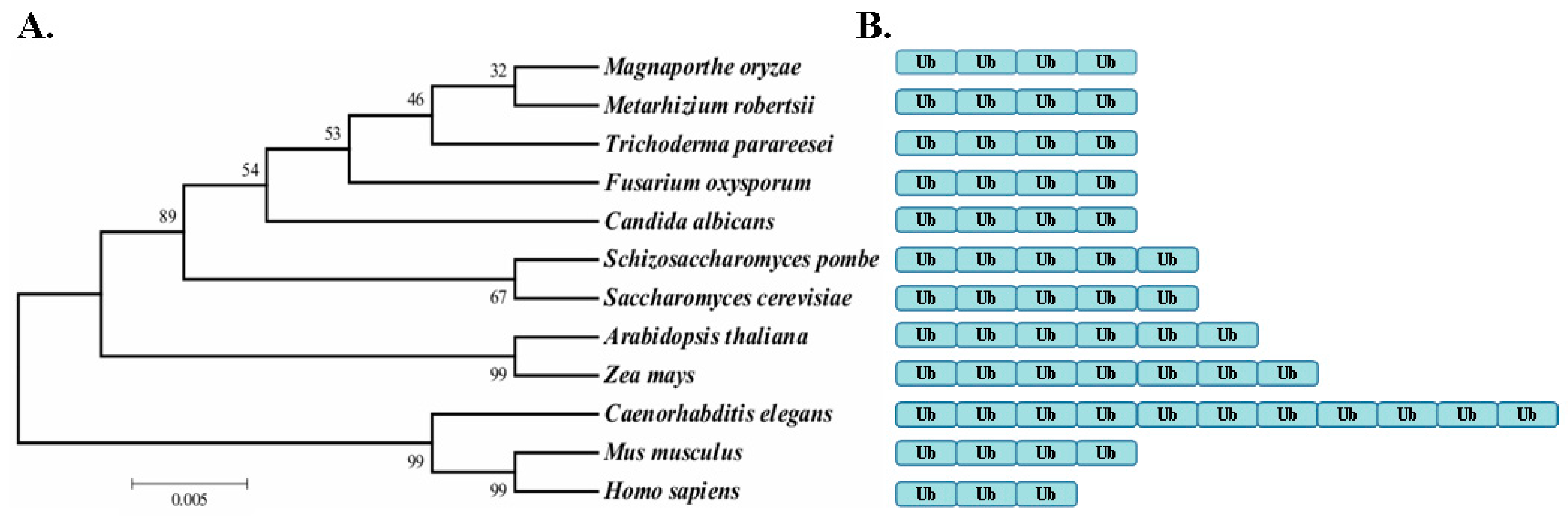
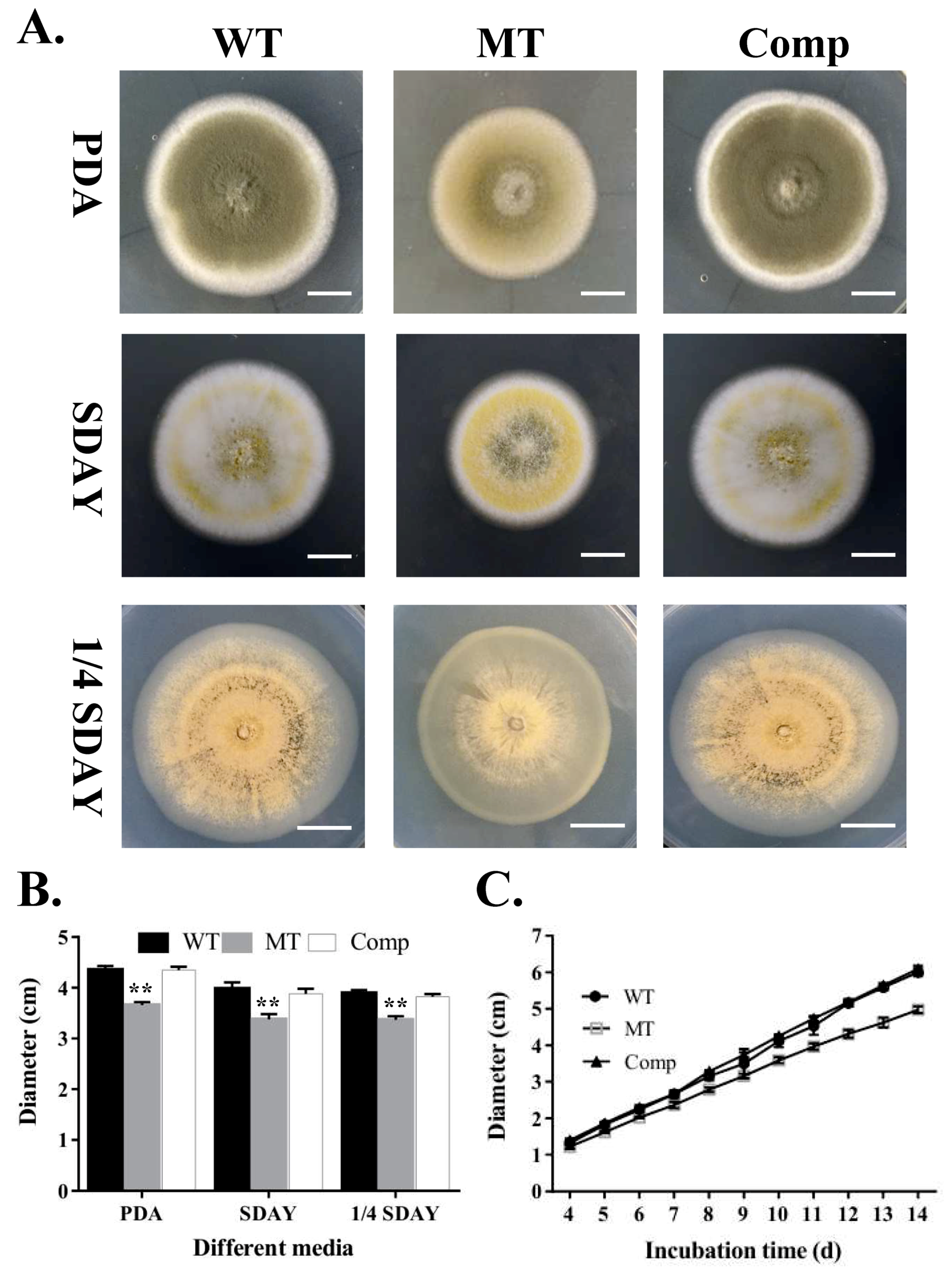
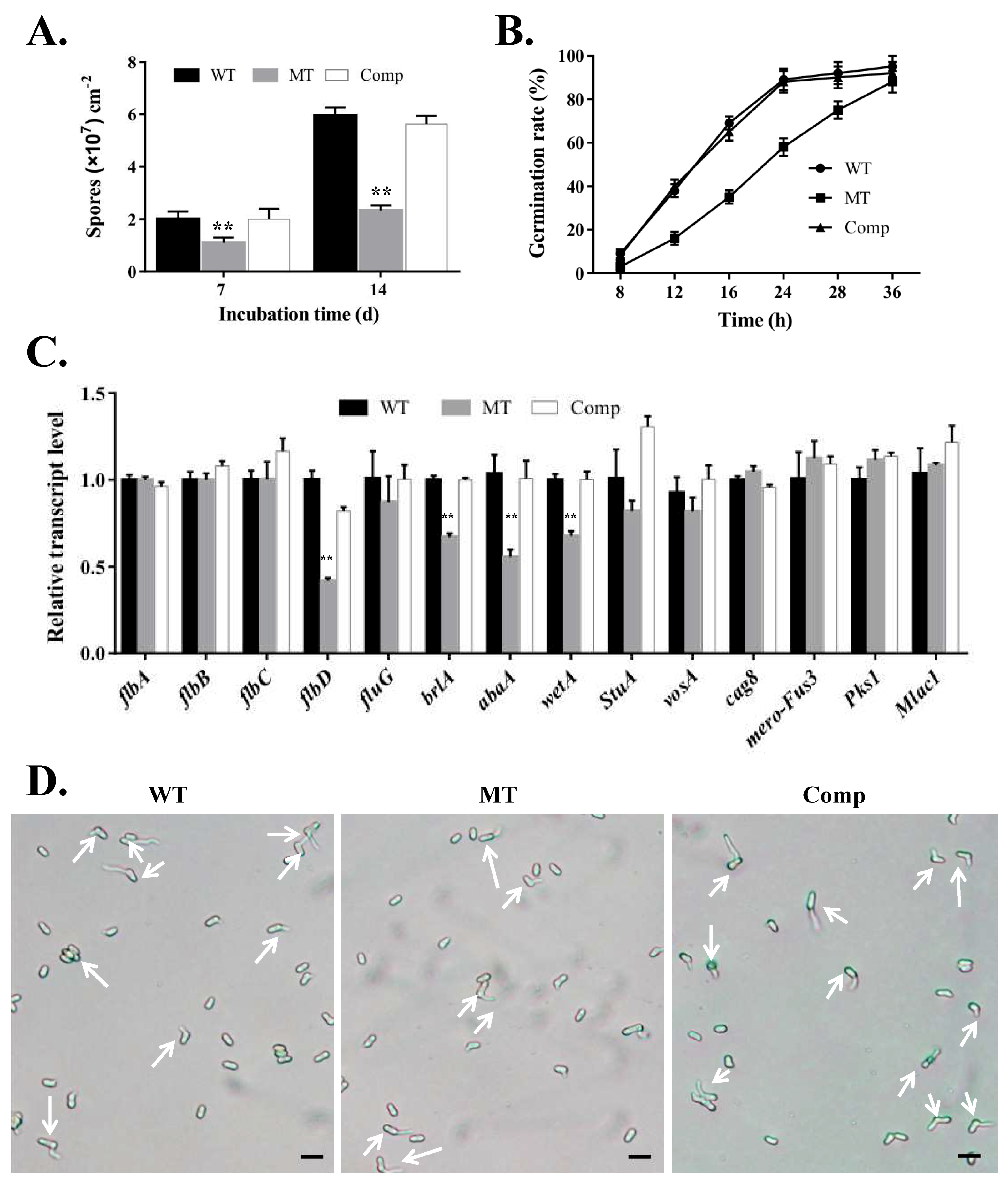
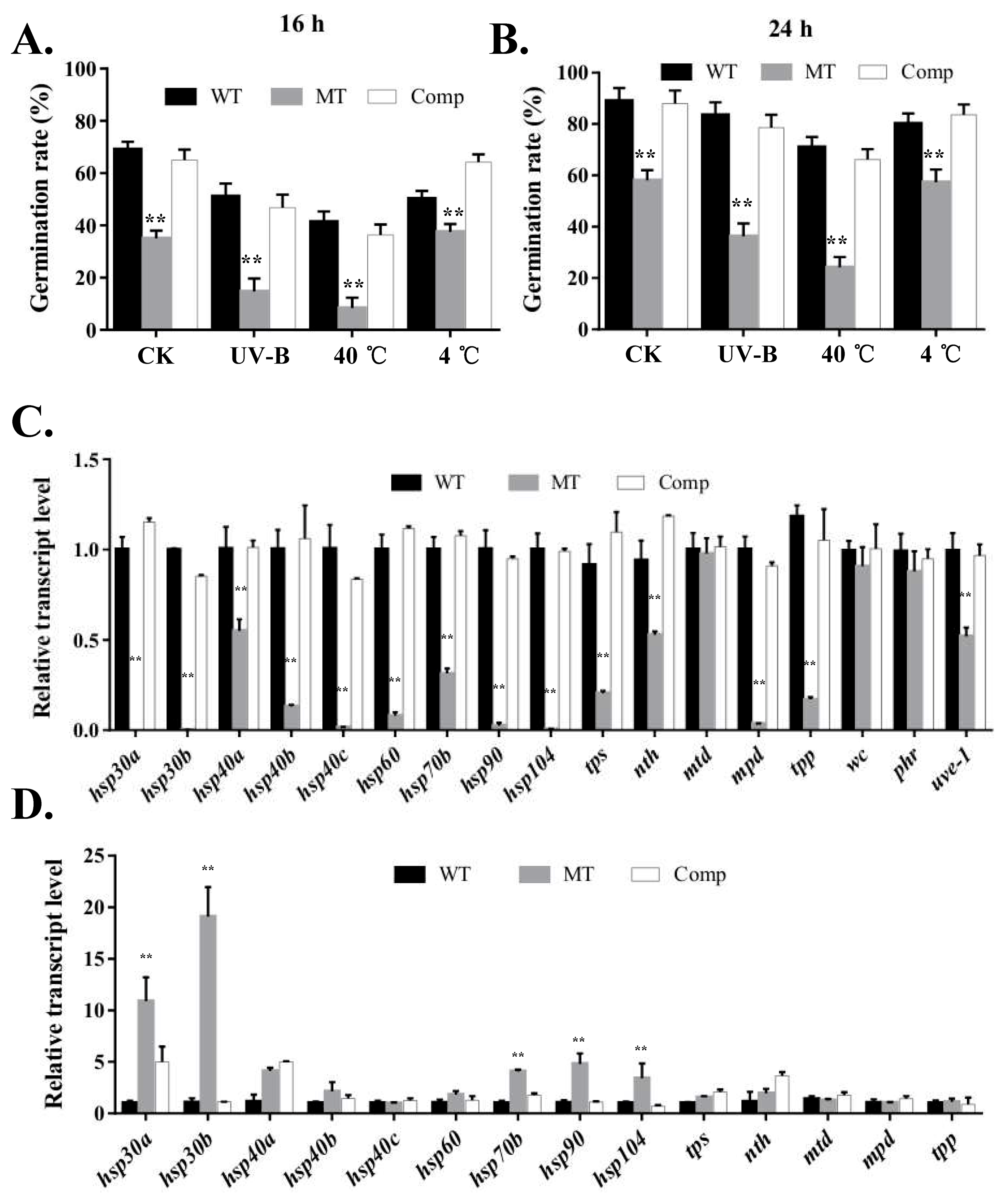
The Polyubiquitin Gene MrUBI4 Is Required for Conidiation, Conidial Germination, and Stress Tolerance in the Filamentous Fungus Metarhizium robertsii

Abstract
Share and Cite
Wang, Z.; Zhu, H.; Cheng, Y.; Jiang, Y.; Li, Y.; Huang, B. The Polyubiquitin Gene MrUBI4 Is Required for Conidiation, Conidial Germination, and Stress Tolerance in the Filamentous Fungus Metarhizium robertsii. Genes 2019, 10, 412. https://doi.org/10.3390/genes10060412
Wang Z, Zhu H, Cheng Y, Jiang Y, Li Y, Huang B. The Polyubiquitin Gene MrUBI4 Is Required for Conidiation, Conidial Germination, and Stress Tolerance in the Filamentous Fungus Metarhizium robertsii. Genes. 2019; 10(6):412. https://doi.org/10.3390/genes10060412
Chicago/Turabian StyleWang, Zhangxun, Hong Zhu, Yuran Cheng, Yuanyuan Jiang, Yuandong Li, and Bo Huang. 2019. "The Polyubiquitin Gene MrUBI4 Is Required for Conidiation, Conidial Germination, and Stress Tolerance in the Filamentous Fungus Metarhizium robertsii" Genes 10, no. 6: 412. https://doi.org/10.3390/genes10060412
APA StyleWang, Z., Zhu, H., Cheng, Y., Jiang, Y., Li, Y., & Huang, B. (2019). The Polyubiquitin Gene MrUBI4 Is Required for Conidiation, Conidial Germination, and Stress Tolerance in the Filamentous Fungus Metarhizium robertsii. Genes, 10(6), 412. https://doi.org/10.3390/genes10060412