Genetic Deficiency of the Macrophage Csf2ra Receptor Modulates Inflammatory Responses Following Cardiac Ischaemic Injury in Mice
 , , , , and
Abstract
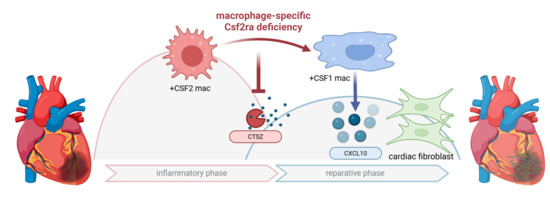
1. Introduction
2. Materials and Methods
2.1. Generation of Mice with Inducible Monocyte/Macrophage Cell–Specific Loss of Csf2ra
2.2. Cardiac Dysfunction and Fibrosis Model in Mice
2.3. Histochemistry
3. Results
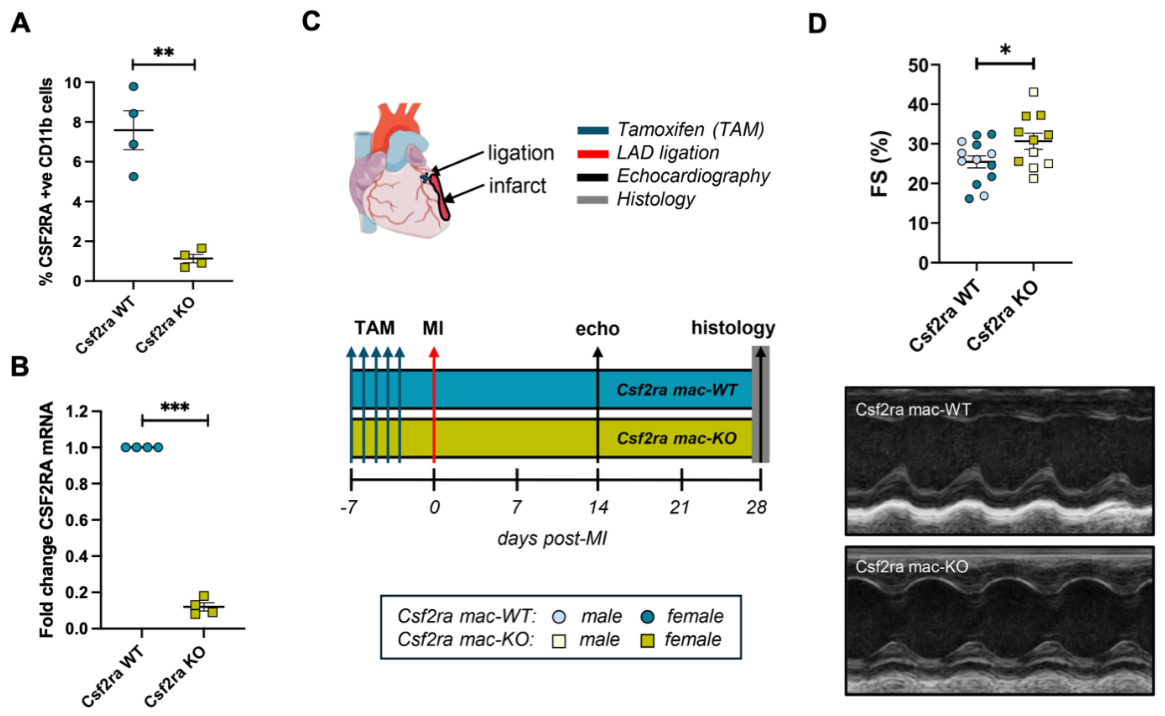
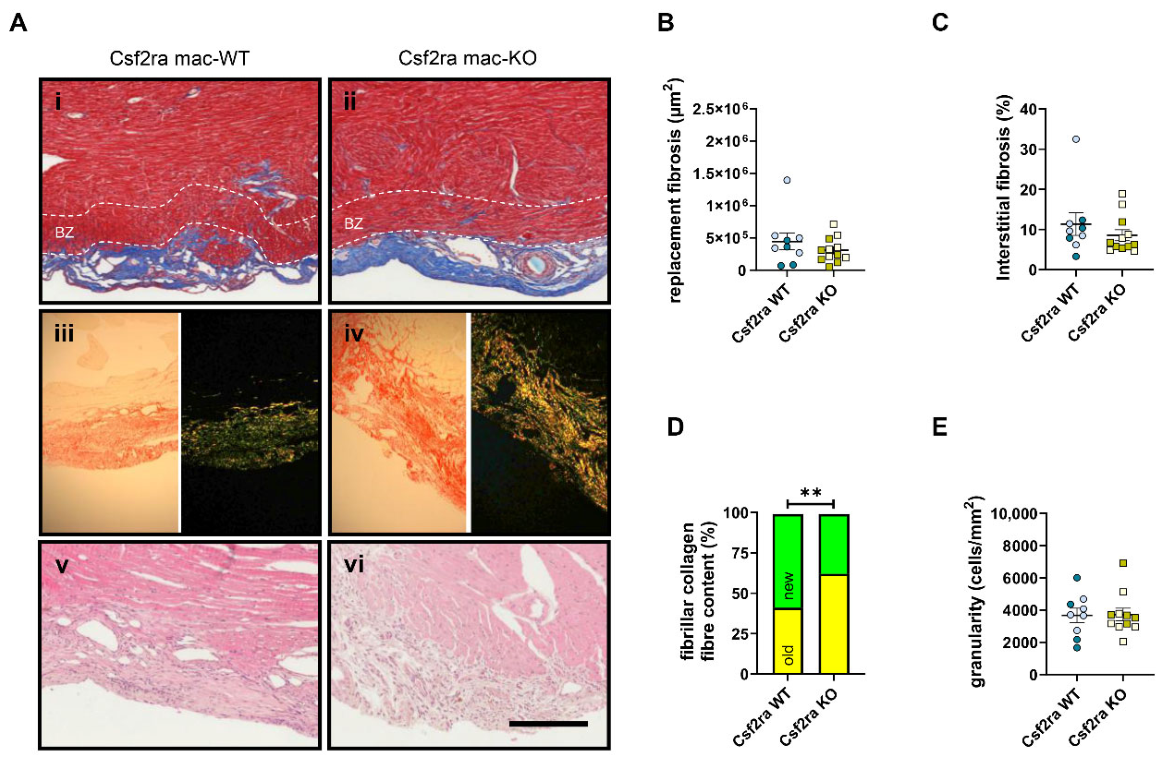
3.1. Macrophage-Specific Csf2ra Deficiency Improves Cardiac Function and Alters Scar Collagen Content Post-Myocardial Infarction
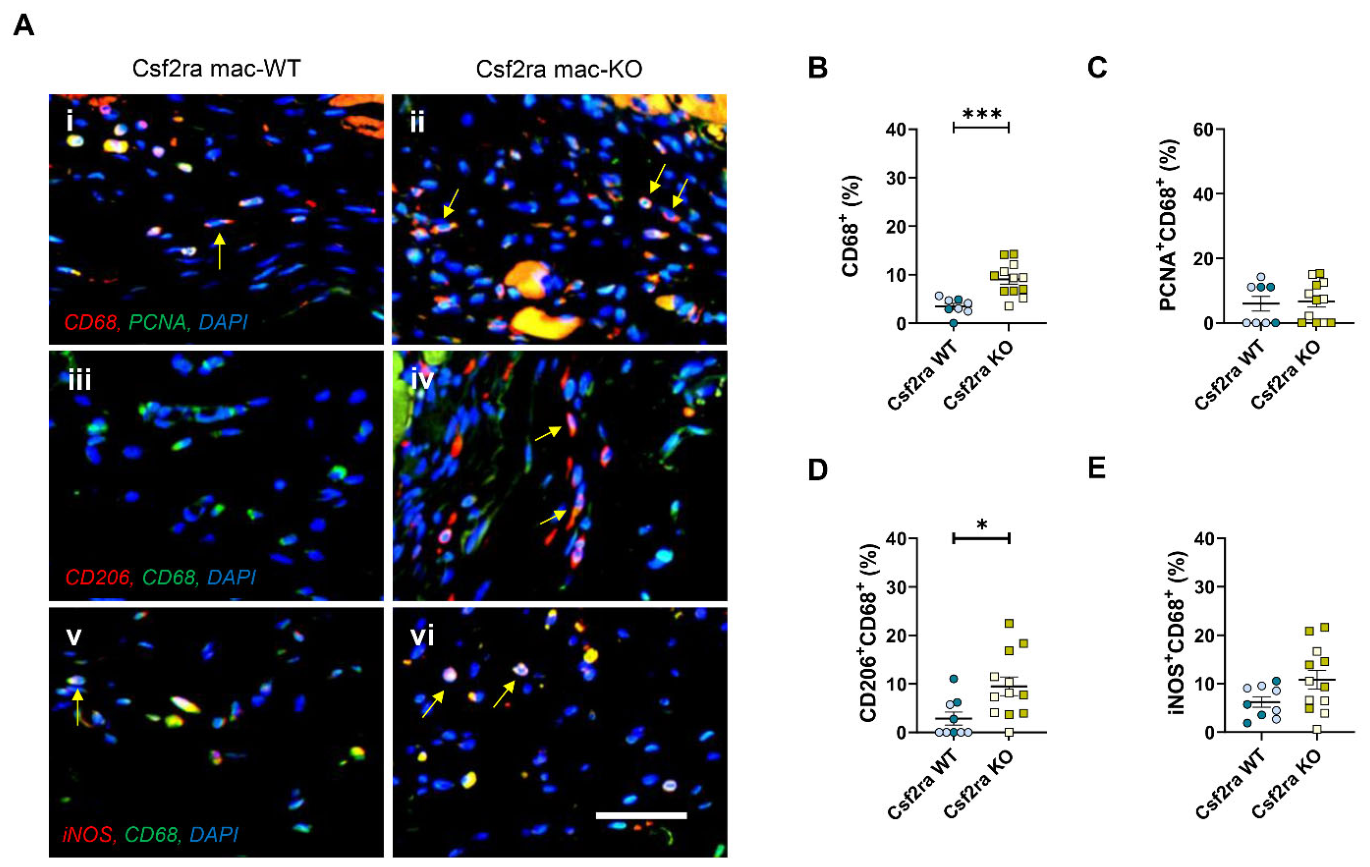
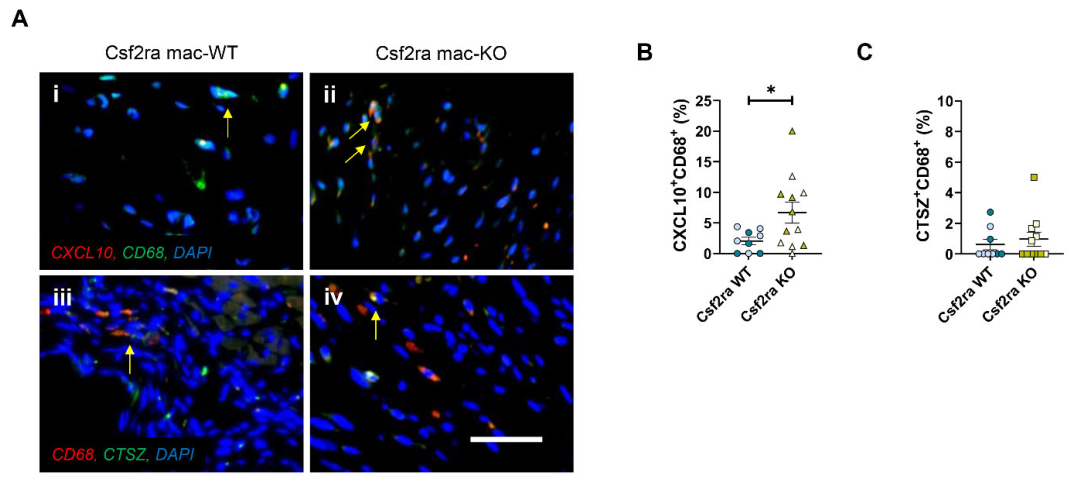
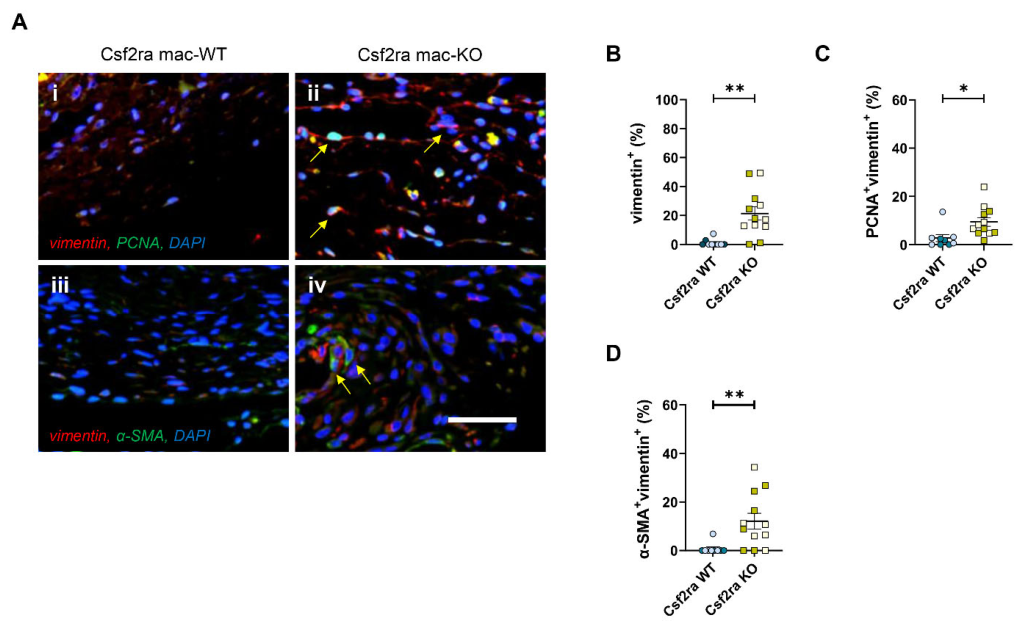
3.2. Macrophage-Specific Csf2ra Deficiency Alters Infarct Cellular Composition, Increasing Pro-Reparative Macrophage Accrual
4. Discussion
5. Conclusions
Author Contributions
Funding
Institutional Review Board Statement
Informed Consent Statement
Data Availability Statement
Conflicts of Interest
Abbreviations
| α-SMA | Alpha-smooth muscle actin |
| CSF | Colony-stimulating factor |
| Csf2ra mac-KO | Csf2ra macrophage-specific deficiency |
| Csf2ra mac-WT | Csf2ra macrophage wild type |
| CSF2RA/B | CSF2 receptor subunit alpha/beta |
| CTSZ | Cathepsin Z |
| CXCL10 | CXC Motif Chemokine Ligand 10 |
| ECM | Extracellular matrix |
| EF | Ejection fraction |
| FS | Fractional shortening |
| GM-CSF | Granulocyte macrophage colony-stimulating factor |
| LAD | Left anterior descending |
| LVPW | Left ventricular posterior wall |
| MI | Myocardial infarction |
References
- Martin, S.S.; Aday, A.W.; Allen, N.B.; Almarzooq, Z.I.; Anderson, C.A.M.; Arora, P.; Avery, C.L.; Baker-Smith, C.M.; Bansal, N.; Beaton, A.Z.; et al. 2025 Heart Disease and Stroke Statistics: A Report of US and Global Data from the American Heart Association. Circulation 2025, 151, e41–e660. [Google Scholar] [CrossRef] [PubMed]
- Velagaleti, R.S.; Pencina, M.J.; Murabito, J.M.; Wang, T.J.; Parikh, N.I.; D’Agostino, R.B.; Levy, D.; Kannel, W.B.; Vasan, R.S. Long-term trends in the incidence of heart failure after myocardial infarction. Circulation 2008, 118, 2057–2062. [Google Scholar] [CrossRef] [PubMed]
- Sulo, G.; Igland, J.; Vollset, S.E.; Nygård, O.; Ebbing, M.; Sulo, E.; Egeland, G.M.; Tell, G.S. Heart Failure Complicating Acute Myocardial Infarction; Burden and Timing of Occurrence: A Nation-wide Analysis Including 86 771 Patients from the Cardiovascular Disease in Norway (CVDNOR) Project. J. Am. Heart Assoc. 2016, 5, e002667. [Google Scholar] [CrossRef]
- Jenča, D.; Melenovský, V.; Stehlik, J.; Staněk, V.; Kettner, J.; Kautzner, J.; Adámková, V.; Wohlfahrt, P. Heart failure after myocardial infarction: Incidence and predictors. ESC Heart Fail. 2021, 8, 222–237. [Google Scholar] [CrossRef]
- Schmidt, A.; Azevedo, C.F.; Cheng, A.; Gupta, S.N.; Bluemke, D.A.; Foo, T.K.; Gerstenblith, G.; Weiss, R.G.; Marbán, E.; Tomaselli, G.F.; et al. Infarct tissue heterogeneity by magnetic resonance imaging identifies enhanced cardiac arrhythmia susceptibility in patients with left ventricular dysfunction. Circulation 2007, 115, 2006–2014. [Google Scholar] [CrossRef]
- Roes, S.D.; Borleffs, C.J.; van der Geest, R.J.; Westenberg, J.J.; Marsan, N.A.; Kaandorp, T.A.; Reiber, J.H.; Zeppenfeld, K.; Lamb, H.J.; de Roos, A.; et al. Infarct tissue heterogeneity assessed with contrast-enhanced MRI predicts spontaneous ventricular arrhythmia in patients with ischemic cardiomyopathy and implantable cardioverter-defibrillator. Circ. Cardiovasc. Imaging 2009, 2, 183–190. [Google Scholar] [CrossRef]
- Schuleri, K.H.; Centola, M.; Evers, K.S.; Zviman, A.; Evers, R.; Lima, J.A.; Lardo, A.C. Cardiovascular magnetic resonance characterization of peri-infarct zone remodeling following myocardial infarction. J. Cardiovasc. Magn. Reson. 2012, 14, 24. [Google Scholar] [CrossRef]
- Sinn, M.R.; Lund, G.K.; Muellerleile, K.; Freiwald, E.; Saeed, M.; Avanesov, M.; Lenz, A.; Starekova, J.; von Kodolitsch, Y.; Blankenberg, S.; et al. Prognosis of early pre-discharge and late left ventricular dilatation by cardiac magnetic resonance imaging after acute myocardial infarction. Int. J. Cardiovasc. Imaging 2021, 37, 1711–1720. [Google Scholar] [CrossRef]
- Van der Bijl, P.; Abou, R.; Goedemans, L.; Gersh, B.J.; Holmes, D.R.; Ajmone Marsan, N.; Delgado, V.; Bax, J.J. Left Ventricular Post-Infarct Remodeling: Implications for Systolic Function Improvement and Outcomes in the Modern Era. JACC Heart Fail. 2020, 8, 131–140. [Google Scholar] [CrossRef]
- Mouton, A.J.; DeLeon-Pennell, K.Y.; Rivera Gonzalez, O.J.; Flynn, E.R.; Freeman, T.C.; Saucerman, J.J.; Garrett, M.R.; Ma, Y.; Harmancey, R.; Lindsey, M.L. Mapping macrophage polarization over the myocardial infarction time continuum. Basic. Res. Cardiol. 2018, 113, 26. [Google Scholar] [CrossRef] [PubMed]
- Nahrendorf, M.; Pittet, M.J.; Swirski, F.K. Monocytes: Protagonists of infarct inflammation and repair after myocardial infarction. Circulation 2010, 121, 2437–2445. [Google Scholar] [CrossRef] [PubMed]
- Swirski, F.K.; Nahrendorf, M.; Etzrodt, M.; Wildgruber, M.; Cortez-Retamozo, V.; Panizzi, P.; Figueiredo, J.L.; Kohler, R.H.; Chudnovskiy, A.; Waterman, P.; et al. Identification of splenic reservoir monocytes and their deployment to inflammatory sites. Science 2009, 325, 612–616. [Google Scholar] [CrossRef]
- Nahrendorf, M.; Swirski, F.K.; Aikawa, E.; Stangenberg, L.; Wurdinger, T.; Figueiredo, J.L.; Libby, P.; Weissleder, R.; Pittet, M.J. The healing myocardium sequentially mobilizes two monocyte subsets with divergent and complementary functions. J. Exp. Med. 2007, 204, 3037–3047. [Google Scholar] [CrossRef]
- Mouton, A.J.; Ma, Y.; Rivera Gonzalez, O.J.; Daseke, M.J.; Flynn, E.R.; Freeman, T.C.; Garrett, M.R.; DeLeon-Pennell, K.Y.; Lindsey, M.L. Fibroblast polarization over the myocardial infarction time continuum shifts roles from inflammation to angiogenesis. Basic. Res. Cardiol. 2019, 114, 6. [Google Scholar] [CrossRef]
- Li, R.; Hanna, A.; Huang, S.; Hernandez, S.C.; Tuleta, I.; Kubota, A.; Humeres, C.; Chen, B.; Liu, Y.; Zheng, D.; et al. Macrophages in the infarcted heart acquire a fibrogenic phenotype, expressing matricellular proteins, but do not undergo fibroblast conversion. J. Mol. Cell Cardiol. 2024, 196, 152–167. [Google Scholar] [CrossRef]
- Mouton, A.J.; Rivera, O.J.; Lindsey, M.L. Myocardial infarction remodeling that progresses to heart failure: A signaling misunderstanding. Am. J. Physiol. Heart Circ. Physiol. 2018, 315, H71–H79. [Google Scholar] [CrossRef]
- Hamilton, J.A. Colony-stimulating factors in inflammation and autoimmunity. Nat. Rev. Immunol. 2008, 8, 533–544. [Google Scholar] [CrossRef] [PubMed]
- Anzai, A.; Choi, J.L.; He, S.; Fenn, A.M.; Nairz, M.; Rattik, S.; McAlpine, C.S.; Mindur, J.E.; Chan, C.T.; Iwamoto, Y.; et al. The infarcted myocardium solicits GM-CSF for the detrimental oversupply of inflammatory leukocytes. J. Exp. Med. 2017, 214, 3293–3310. [Google Scholar] [CrossRef] [PubMed]
- Parissis, J.T.; Adamopoulos, S.; Venetsanou, K.; Kostakis, G.; Rigas, A.; Karas, S.M.; Kremastinos, D. Plasma profiles of circulating granulocyte-macrophage colony-stimulating factor and soluble cellular adhesion molecules in acute myocardial infarction. Contribution to post-infarction left ventricular dysfunction. Eur. Cytokine Netw. 2004, 15, 139–144. [Google Scholar]
- Di Gregoli, K.; Johnson, J.L. Role of colony-stimulating factors in atherosclerosis. Curr. Opin. Lipidol. 2012, 23, 412–421. [Google Scholar] [CrossRef]
- Hercus, T.R.; Thomas, D.; Guthridge, M.A.; Ekert, P.G.; King-Scott, J.; Parker, M.W.; Lopez, A.F. The granulocyte-macrophage colony-stimulating factor receptor: Linking its structure to cell signaling and its role in disease. Blood 2009, 114, 1289–1298. [Google Scholar] [CrossRef]
- Kremastiotis, G.; Li, Y.; Bond, A.; Shanahan, D.; Di Gregoli, K.; Poole, A.W.; George, S.J.; Johnson, J.L. Suppression of CSF2RA macrophage polarisation impacts pathological cardiac remodelling in mice. Sci. Rep. 2026, 16, 3870. [Google Scholar] [CrossRef] [PubMed]
- Quillard, T.; Tesmenitsky, Y.; Croce, K.; Travers, R.; Shvartz, E.; Koskinas, K.C.; Sukhova, G.K.; Aikawa, E.; Aikawa, M.; Libby, P. Selective Inhibition of Matrix Met alloproteinase-13 Increases Collagen Content of Established Mouse Atherosclerosis. Arter. Thromb. Vasc. Biol. 2011, 31, 2464–2472. [Google Scholar] [CrossRef]
- Hulsmans, M.; Sam, F.; Nahrendorf, M. Monocyte and macrophage contributions to cardiac remodeling. J. Mol. Cell Cardiol. 2016, 93, 149–155. [Google Scholar] [CrossRef] [PubMed]
- Gao, X.M.; Ming, Z.; Su, Y.; Fang, L.; Kiriazis, H.; Xu, Q.; Dart, A.M.; Du, X.J. Infarct size and post-infarct inflammation determine the risk of cardiac rupture in mice. Int. J. Cardiol. 2010, 143, 20–28. [Google Scholar] [CrossRef]
- Gao, X.M.; Xu, Q.; Kiriazis, H.; Dart, A.M.; Du, X.J. Mouse model of post-infarct ventricular rupture: Time course, strain- and gender-dependency, tensile strength, and histopathology. Cardiovasc. Res. 2005, 65, 469–477. [Google Scholar] [CrossRef] [PubMed]
- Bujak, M.; Dobaczewski, M.; Gonzalez-Quesada, C.; Xia, Y.; Leucker, T.; Zymek, P.; Veeranna, V.; Tager, A.M.; Luster, A.D.; Frangogiannis, N.G. Induction of the CXC chemokine interferon-gamma-inducible protein 10 regulates the reparative response following myocardial infarction. Circ. Res. 2009, 105, 973–983. [Google Scholar] [CrossRef]




| Antibody | Working Conc. | Cat. No.; Supplier |
|---|---|---|
| anti-α-SMA | 2.66 μg/mL | A2547; Sigma-Aldrich |
| anti-CD68 | 0.33 μg/mL | 97778; CST |
| anti-CD68 | 1.56 μg/mL | M0814; Dako |
| anti-CD206 | 0.31 μg/mL | 24595; CST |
| anti-CTSZ | 2.0 μg/mL | AF1033; R&D Systems |
| anti-CXCL10 | 6.67 μg/mL | Ab9807; Abcam |
| anti-iNOS | 0.9 μg/mL | 68186; CST |
| anti-PCNA | 3.27 μg/mL | M0879; Dako |
| anti-vimentin | 2.5 μg/mL | Ab92547; Abcam |
| Day 14 Post-MI | WT | KO | p-Value |
|---|---|---|---|
| IVS; d (mm) | 0.93 ± 0.05 | 0.95 ± 0.06 | 0.8278 |
| IVS; s (mm) | 1.24 ± 0.04 | 1.26 ± 0.08 | 0.7777 |
| LVID; d (mm) | 3.84 ± 0.08 | 3.77 ± 0.08 | 0.5663 |
| LVID; s (mm) | 2.87 ± 0.10 | 2.63 ± 0.12 | 0.1341 |
| LVPW; d (mm) | 0.83 ± 0.04 | 1.20 ± 0.09 | 0.0009 *** |
| LVPW; s (mm) | 1.17 ± 0.05 | 1.53 ± 0.08 | 0.0011 ** |
| EF (%) | 50.45 ± 2.44 | 58.42 ± 2.77 | 0.0497 * |
| FS (%) | 25.43 ± 1.45 | 30.63 ± 1.92 | 0.0470 * |
| LV Vol; d (μL) | 63.92 ± 2.97 | 61.25 ± 3.18 | 0.5632 |
| LV Vol; s (μL) | 32.13 ± 2.51 | 26.17 ± 2.95 | 0.1518 |
| Day 28 Post-MI | WT | KO | p-Value |
|---|---|---|---|
| IVS; d (mm) | 0.98 ± 0.05 | 1.05 ± 0.09 | 0.5661 |
| IVS; s (mm) | 1.24 ± 0.07 | 1.32 ± 0.10 | 0.4775 |
| LVID; d (mm) | 4.22 ± 0.35 | 4.05 ± 1.25 | 0.3678 |
| LVID; s (mm) | 3.20 ± 0.31 | 2.96 ± 0.16 | 0.3182 |
| LVPW; d (mm) | 1.02 ± 0.13 | 1.03 ± 0.09 | 0.9094 |
| LVPW; s (mm) | 1.24 ± 0.16 | 1.38 ± 0.07 | 0.3200 |
| EF (%) | 48.15 ± 5.38 | 53.08 ± 3.19 | 0.3197 |
| FS (%) | 24.29 ± 2.86 | 27.32 ± 1.98 | 0.3103 |
| LV Vol; d (μL) | 80.38 ± 8.95 | 73.11 ± 5.27 | 0.3752 |
| LV Vol; s (μL) | 42.50 ± 6.21 | 35.80 ± 4.79 | 0.3740 |
| Male | Female | |
|---|---|---|
| FS (%) (day 14) | 0.5515 | 0.0346 * |
| Replacement fibrosis (μm2) | 0.3163 | 0.8956 |
| Interstitial fibrosis (%) | 0.5181 | 0.4667 |
| Fibrillar collagen fibre content (%) | 0.2168 | 0.0130 * |
| Granularity (cell/mm2) | 0.4474 | 0.6016 |
| CD68+ (%) | 0.0218 * | 0.0195 * |
| PCNA+CD68+ (%) | 0.5170 | 0.7308 |
| CD206+CD68+ (%) | 0.0267 * | 0.1520 |
| iNOS+CD68+ (%) | 0.6116 | 0.0415 * |
| CXCL10+CD68+ (%) | 0.3893 | 0.0669 |
| CTSZ+CD68+ (%) | 0.1588 | 0.9400 |
| Vimentin+ (%) | 0.0129 * | 0.0705 |
| PCNA+vimentin+ (%) | 0.0937 | 0.0327 * |
| α-SMA+vimentin+ (%) | 0.1005 | 0.0662 |
Disclaimer/Publisher’s Note: The statements, opinions and data contained in all publications are solely those of the individual author(s) and contributor(s) and not of MDPI and/or the editor(s). MDPI and/or the editor(s) disclaim responsibility for any injury to people or property resulting from any ideas, methods, instructions or products referred to in the content. |
© 2026 by the authors. Licensee MDPI, Basel, Switzerland. This article is an open access article distributed under the terms and conditions of the Creative Commons Attribution (CC BY) license.
Share and Cite
Kremastiotis, G.; Li, Y.; Bond, A.; Shanahan, D.; Di Gregoli, K.; Poole, A.W.; George, S.J.; Johnson, J.L. Genetic Deficiency of the Macrophage Csf2ra Receptor Modulates Inflammatory Responses Following Cardiac Ischaemic Injury in Mice. Cells 2026, 15, 764. https://doi.org/10.3390/cells15090764
Kremastiotis G, Li Y, Bond A, Shanahan D, Di Gregoli K, Poole AW, George SJ, Johnson JL. Genetic Deficiency of the Macrophage Csf2ra Receptor Modulates Inflammatory Responses Following Cardiac Ischaemic Injury in Mice. Cells. 2026; 15(9):764. https://doi.org/10.3390/cells15090764
Chicago/Turabian StyleKremastiotis, Georgios, Yong Li, Andrew Bond, Daire Shanahan, Karina Di Gregoli, Alastair W. Poole, Sarah J. George, and Jason L. Johnson. 2026. "Genetic Deficiency of the Macrophage Csf2ra Receptor Modulates Inflammatory Responses Following Cardiac Ischaemic Injury in Mice" Cells 15, no. 9: 764. https://doi.org/10.3390/cells15090764
APA StyleKremastiotis, G., Li, Y., Bond, A., Shanahan, D., Di Gregoli, K., Poole, A. W., George, S. J., & Johnson, J. L. (2026). Genetic Deficiency of the Macrophage Csf2ra Receptor Modulates Inflammatory Responses Following Cardiac Ischaemic Injury in Mice. Cells, 15(9), 764. https://doi.org/10.3390/cells15090764